Universal Design for Learning
UDL
What is The Center for Applied
Special Technology (CAST)?
• The Center for Applied Special Technology is
an organization that strives to develop ways
to access educational curriculum and learning.
• The Center for Applied Special Technology has
researched, developed and articulated the
principles , practices and guidelines for the
Universal Design for Learning (UDL).
What is Universal Design for
Learning (UDL)?
• UDL is an approach to learning that
recognizes the barriers to learning and the
diverse needs of learners.
• UDL helps meet the needs of diverse learners
by recommending use of flexible techniques,
instructional materials, and strategies.
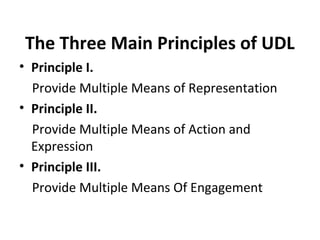
The Three Main Principles of UDL
• Principle I.
Provide Multiple Means of Representation
• Principle II.
Provide Multiple Means of Action and
Expression
• Principle III.
Provide Multiple Means Of Engagement
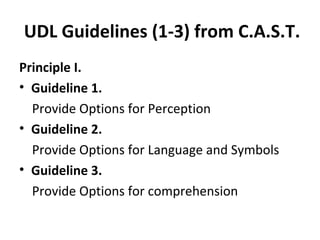
UDL Guidelines (1-3) from C.A.S.T.
Principle I.
• Guideline 1.
Provide Options for Perception
• Guideline 2.
Provide Options for Language and Symbols
• Guideline 3.
Provide Options for comprehension
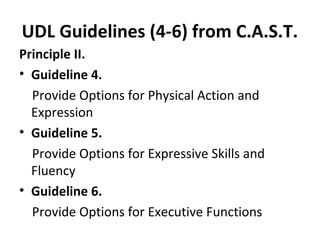
UDL Guidelines (4-6) from C.A.S.T.
Principle II.
• Guideline 4.
Provide Options for Physical Action and
Expression
• Guideline 5.
Provide Options for Expressive Skills and
Fluency
• Guideline 6.
Provide Options for Executive Functions
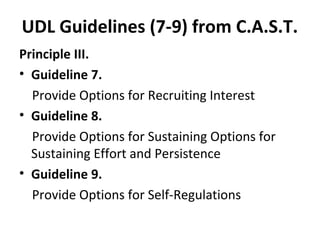
UDL Guidelines (7-9) from C.A.S.T.
Principle III.
• Guideline 7.
Provide Options for Recruiting Interest
• Guideline 8.
Provide Options for Sustaining Options for
Sustaining Effort and Persistence
• Guideline 9.
Provide Options for Self-Regulations
The Relationship Between UDL
and Differentiated Instruction
• Universal Design for Learning is based upon
individualizing learning for diverse learners.
• Universal Design for Learning uses digital
technologies to customize learning for diverse
learners.
• Universal Design for Learning addresses the
different ways students learn in our media
dominate culture of today.
Who are Diverse Learners ?
Diverse learners according to C.A.S.T. are:
• Distinctly “not average”
• Students with disabilities
• English language learners
• Gifted and Talented
• Students who have not received optimal
instruction in the past
• Students who are otherwise “in the margins”
Gifted Learners and the Use of
Differentiated Instruction
• Resource limitations for gifted learners limit
academic progress.
• Gifted learners are mainstreamed into regular
classroom settings without appropriate higher
level instruction for their abilities.
• Gifted learners benefit greatly from
differentiated instruction facilitated by
technology within the multi-ability classroom.
An Example of Differentiated
Instruction for Gifted Learners
Kid’sVid is a video software program that:
• differentiates instruction for gifted learners.
• teaches students how to produce videos.
• assists teachers in how to guide students
through the learning process of producing
videos.
• assists teachers with evaluating students
progress by using a rubric.
Kid’sVid, a Training Video by
kidsvid.altec.org/
Universal Design for Learning
Promotes Academic Progress for
Diverse Learners
by the Use of Differentiated
Instruction
Facilitated by the Use of
Technology
Credits
• CAST,
www.cast.org/publications/UDLguidelines/
versionI.html
• Teaching Every Student in the Digital Age, by
Rose & Meyer (ASCD, 2002)
• Kid’sVid, www.Kidsvid.altec.org/

735 Powerpointzamzarppt

  • 1.
  • 2.
    What is TheCenter for Applied Special Technology (CAST)? • The Center for Applied Special Technology is an organization that strives to develop ways to access educational curriculum and learning. • The Center for Applied Special Technology has researched, developed and articulated the principles , practices and guidelines for the Universal Design for Learning (UDL).
  • 3.
    What is UniversalDesign for Learning (UDL)? • UDL is an approach to learning that recognizes the barriers to learning and the diverse needs of learners. • UDL helps meet the needs of diverse learners by recommending use of flexible techniques, instructional materials, and strategies.
  • 4.
    The Three MainPrinciples of UDL • Principle I. Provide Multiple Means of Representation • Principle II. Provide Multiple Means of Action and Expression • Principle III. Provide Multiple Means Of Engagement
  • 5.
    UDL Guidelines (1-3)from C.A.S.T. Principle I. • Guideline 1. Provide Options for Perception • Guideline 2. Provide Options for Language and Symbols • Guideline 3. Provide Options for comprehension
  • 6.
    UDL Guidelines (4-6)from C.A.S.T. Principle II. • Guideline 4. Provide Options for Physical Action and Expression • Guideline 5. Provide Options for Expressive Skills and Fluency • Guideline 6. Provide Options for Executive Functions
  • 7.
    UDL Guidelines (7-9)from C.A.S.T. Principle III. • Guideline 7. Provide Options for Recruiting Interest • Guideline 8. Provide Options for Sustaining Options for Sustaining Effort and Persistence • Guideline 9. Provide Options for Self-Regulations
  • 8.
    The Relationship BetweenUDL and Differentiated Instruction • Universal Design for Learning is based upon individualizing learning for diverse learners. • Universal Design for Learning uses digital technologies to customize learning for diverse learners. • Universal Design for Learning addresses the different ways students learn in our media dominate culture of today.
  • 9.
    Who are DiverseLearners ? Diverse learners according to C.A.S.T. are: • Distinctly “not average” • Students with disabilities • English language learners • Gifted and Talented • Students who have not received optimal instruction in the past • Students who are otherwise “in the margins”
  • 10.
    Gifted Learners andthe Use of Differentiated Instruction • Resource limitations for gifted learners limit academic progress. • Gifted learners are mainstreamed into regular classroom settings without appropriate higher level instruction for their abilities. • Gifted learners benefit greatly from differentiated instruction facilitated by technology within the multi-ability classroom.
  • 11.
    An Example ofDifferentiated Instruction for Gifted Learners Kid’sVid is a video software program that: • differentiates instruction for gifted learners. • teaches students how to produce videos. • assists teachers in how to guide students through the learning process of producing videos. • assists teachers with evaluating students progress by using a rubric.
  • 12.
    Kid’sVid, a TrainingVideo by kidsvid.altec.org/
  • 13.
    Universal Design forLearning Promotes Academic Progress for Diverse Learners by the Use of Differentiated Instruction Facilitated by the Use of Technology
  • 14.
    Credits • CAST, www.cast.org/publications/UDLguidelines/ versionI.html • TeachingEvery Student in the Digital Age, by Rose & Meyer (ASCD, 2002) • Kid’sVid, www.Kidsvid.altec.org/