UDL Presentation: Sharing Ideas and Building Resources


Ashley Odom
Student ID: A00257081
EDUC 7109-1
Diverse Learners and Technology
 Aspires to give equal opportunities for all
  individuals to learn

 Creates instructional goals, methods,
  materials and assessments that can be
  adjusted to meet the individual needs of
  learners

 UDL at Cast:
   http://youtu.be/bDvKnY0g6e4
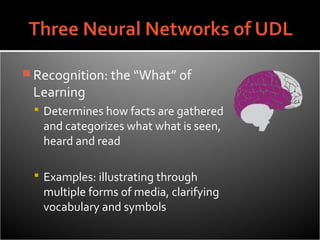
 Recognition: the “What” of
 Learning
  Determines how facts are gathered
   and categorizes what what is seen,
   heard and read

  Examples: illustrating through
   multiple forms of media, clarifying
   vocabulary and symbols
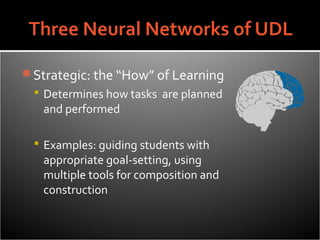
 Strategic: the “How” of Learning
  Determines how tasks are planned
   and performed

  Examples: guiding students with
   appropriate goal-setting, using
   multiple tools for composition and
   construction
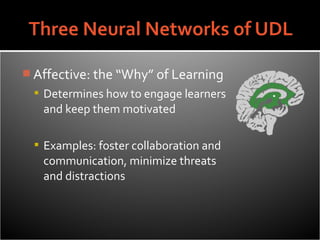
 Affective: the “Why” of Learning
  Determines how to engage learners
   and keep them motivated

  Examples: foster collaboration and
   communication, minimize threats
   and distractions
 Benefits the learner by
 creating easier and more
 effective customization of
 the curriculum

 Examples
   CAST UDL Book Builder
   CAST Strategy Tutor
   use of personal assistive technologies
 More successful differentiated learning
 throughout the campus

 Better meeting of accommodations and
 modifications for special education students

 More “expert learners” which would create
 higher expectations that are reachable for
 each students
 Learners should not be
 categorized in groups such as
 “disabled” or “bright”

 There are no “regular” students


 Learners differ across and within the three
 neural networks
 Learners learn differently on an individual
 basis

 Strengths and weaknesses make each learner
 unique

 UDL Guideline 2 focuses on providing options
 for language (linguistic)
 Curriculum Self-Check
   Helps educators create options within their curriculum
    and build flexibility to reach students and keep them
    engaged
 Lesson Builder
   Shows educators how to customize standards-based
    curriculum so they can meet individual learning needs
 Strategy Tutor
   Supports teachers and students doing reading and
    Internet research
ASCD. (2013). What Brain Research Tells Us About Learner
  Differences. Retrieved on January 12, 2013 from
  http://www.ascd.org/publications/books/101042/chapters/
  What-Brain-Research-Tells-Us-About-Learner-
  Differences.aspx
CAST, Inc. (2012). CAST: Center for Applied Special
  Technology. Retrieved on January 11, 2013 from
  http://cast.org/index.html
CAST, Inc. (2012). Home-National Center on Universal Design
  for Learning. Retrieved on January 11, 2013 from
  http://www.udlcenter.org
Janowski, Karen. (2013). Free Technology Toolkit for UDL in
  All Classrooms. Retrieved on January 10, 2013 from
  http://udltechtoolkit.wikispaces.com

Major Assessment 4: Assessment of Technology Proficiencies

  • 1.
    UDL Presentation: SharingIdeas and Building Resources Ashley Odom Student ID: A00257081 EDUC 7109-1 Diverse Learners and Technology
  • 2.
     Aspires togive equal opportunities for all individuals to learn  Creates instructional goals, methods, materials and assessments that can be adjusted to meet the individual needs of learners  UDL at Cast:  http://youtu.be/bDvKnY0g6e4
  • 3.
     Recognition: the“What” of Learning  Determines how facts are gathered and categorizes what what is seen, heard and read  Examples: illustrating through multiple forms of media, clarifying vocabulary and symbols
  • 4.
     Strategic: the“How” of Learning  Determines how tasks are planned and performed  Examples: guiding students with appropriate goal-setting, using multiple tools for composition and construction
  • 5.
     Affective: the“Why” of Learning  Determines how to engage learners and keep them motivated  Examples: foster collaboration and communication, minimize threats and distractions
  • 6.
     Benefits thelearner by creating easier and more effective customization of the curriculum  Examples  CAST UDL Book Builder  CAST Strategy Tutor  use of personal assistive technologies
  • 7.
     More successfuldifferentiated learning throughout the campus  Better meeting of accommodations and modifications for special education students  More “expert learners” which would create higher expectations that are reachable for each students
  • 8.
     Learners shouldnot be categorized in groups such as “disabled” or “bright”  There are no “regular” students  Learners differ across and within the three neural networks
  • 9.
     Learners learndifferently on an individual basis  Strengths and weaknesses make each learner unique  UDL Guideline 2 focuses on providing options for language (linguistic)
  • 10.
     Curriculum Self-Check  Helps educators create options within their curriculum and build flexibility to reach students and keep them engaged  Lesson Builder  Shows educators how to customize standards-based curriculum so they can meet individual learning needs  Strategy Tutor  Supports teachers and students doing reading and Internet research
  • 11.
    ASCD. (2013). WhatBrain Research Tells Us About Learner Differences. Retrieved on January 12, 2013 from http://www.ascd.org/publications/books/101042/chapters/ What-Brain-Research-Tells-Us-About-Learner- Differences.aspx CAST, Inc. (2012). CAST: Center for Applied Special Technology. Retrieved on January 11, 2013 from http://cast.org/index.html CAST, Inc. (2012). Home-National Center on Universal Design for Learning. Retrieved on January 11, 2013 from http://www.udlcenter.org Janowski, Karen. (2013). Free Technology Toolkit for UDL in All Classrooms. Retrieved on January 10, 2013 from http://udltechtoolkit.wikispaces.com