Muslim Scholars Chapter 10, section 3 Trace the origins and expansion of the Islamic World between 600 CE and 1300 CE.   d. Identify the contributions of Islamic scholars in medicine (Ibn Sina) and geography (Ibn Battuta).
Scholars Extend Knowledge Muslim rulers wanted good doctors People depended on math and astronomy to calculate when to pray People needed to know where Mecca was in relation to where they were People wanted to know the truth about the world Muhammad believed strongly in learning
Places to Learn Fall of Rome = limited learning in Europe (the Dark Ages) Muslim leaders and scholars saved a lot of the learning from Greece, Rome, Persia, and India House of Wisdom  – combination library, academy and translation center in Baghdad for learning
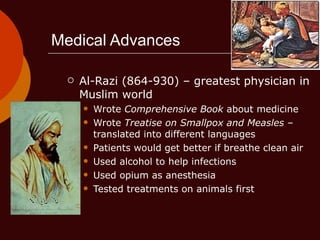
Medical Advances Al-Razi (864-930) – greatest physician in Muslim world Wrote  Comprehensive Book  about medicine Wrote  Treatise on Smallpox and Measles  – translated into different languages Patients would get better if breathe clean air Used alcohol to help infections Used opium as anesthesia Tested treatments on animals first
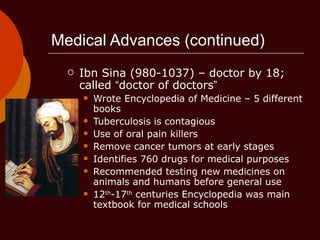
Medical Advances (continued) Ibn Sina (980-1037) – doctor by 18; called  “ doctor of doctors ” Wrote Encyclopedia of Medicine – 5 different books Tuberculosis is contagious Use of oral pain killers Remove cancer tumors at early stages Identifies 760 drugs for medical purposes Recommended testing new medicines on animals and humans before general use 12 th -17 th  centuries Encyclopedia was main textbook for medical schools
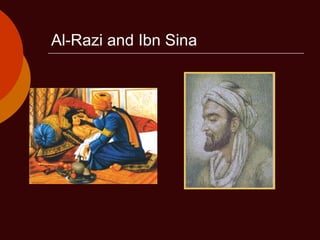
Al-Razi and Ibn Sina
Math and Science Science Relied on scientific observation Not logic only like the Greeks Conducted experiments in lab settings Math is basis of all knowledge Al-Khwarizmi, mathematician, developed  algebra  -  “ The art of bringing together unknowns to match a known quantity ” Astronomy – math advances because of this science Charted stars, comets, and planets Ibn al-Haytham book called  Optics  – basis for developing lenses for telescopes and microscopes
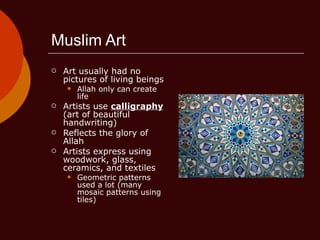
Muslim Art Art usually had no pictures of living beings Allah only can create life Artists use  calligraphy  (art of beautiful handwriting) Reflects the glory of Allah Artists express using woodwork, glass, ceramics, and textiles Geometric patterns used a lot (many mosaic patterns using tiles)
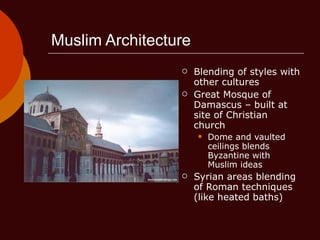
Muslim Architecture Blending of styles with other cultures Great Mosque of Damascus – built at site of Christian church Dome and vaulted ceilings blends Byzantine with Muslim ideas Syrian areas blending of Roman techniques (like heated baths)
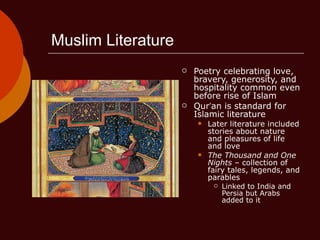
Muslim Literature Poetry celebrating love, bravery, generosity, and hospitality common even before rise of Islam Qur ’ an is standard for Islamic literature Later literature included stories about nature and pleasures of life and love The Thousand and One Nights  – collection of fairy tales, legends, and parables Linked to India and Persia but Arabs added to it

10.3 muslim culture

  • 1.
    Muslim Scholars Chapter10, section 3 Trace the origins and expansion of the Islamic World between 600 CE and 1300 CE. d. Identify the contributions of Islamic scholars in medicine (Ibn Sina) and geography (Ibn Battuta).
  • 2.
    Scholars Extend KnowledgeMuslim rulers wanted good doctors People depended on math and astronomy to calculate when to pray People needed to know where Mecca was in relation to where they were People wanted to know the truth about the world Muhammad believed strongly in learning
  • 3.
    Places to LearnFall of Rome = limited learning in Europe (the Dark Ages) Muslim leaders and scholars saved a lot of the learning from Greece, Rome, Persia, and India House of Wisdom – combination library, academy and translation center in Baghdad for learning
  • 4.
    Medical Advances Al-Razi(864-930) – greatest physician in Muslim world Wrote Comprehensive Book about medicine Wrote Treatise on Smallpox and Measles – translated into different languages Patients would get better if breathe clean air Used alcohol to help infections Used opium as anesthesia Tested treatments on animals first
  • 5.
    Medical Advances (continued)Ibn Sina (980-1037) – doctor by 18; called “ doctor of doctors ” Wrote Encyclopedia of Medicine – 5 different books Tuberculosis is contagious Use of oral pain killers Remove cancer tumors at early stages Identifies 760 drugs for medical purposes Recommended testing new medicines on animals and humans before general use 12 th -17 th centuries Encyclopedia was main textbook for medical schools
  • 6.
  • 7.
    Math and ScienceScience Relied on scientific observation Not logic only like the Greeks Conducted experiments in lab settings Math is basis of all knowledge Al-Khwarizmi, mathematician, developed algebra - “ The art of bringing together unknowns to match a known quantity ” Astronomy – math advances because of this science Charted stars, comets, and planets Ibn al-Haytham book called Optics – basis for developing lenses for telescopes and microscopes
  • 8.
    Muslim Art Artusually had no pictures of living beings Allah only can create life Artists use calligraphy (art of beautiful handwriting) Reflects the glory of Allah Artists express using woodwork, glass, ceramics, and textiles Geometric patterns used a lot (many mosaic patterns using tiles)
  • 9.
    Muslim Architecture Blendingof styles with other cultures Great Mosque of Damascus – built at site of Christian church Dome and vaulted ceilings blends Byzantine with Muslim ideas Syrian areas blending of Roman techniques (like heated baths)
  • 10.
    Muslim Literature Poetrycelebrating love, bravery, generosity, and hospitality common even before rise of Islam Qur ’ an is standard for Islamic literature Later literature included stories about nature and pleasures of life and love The Thousand and One Nights – collection of fairy tales, legends, and parables Linked to India and Persia but Arabs added to it