
Chapter 1Chapter 1
Number systemNumber system
Associated With Irrational
Numbers
 In earlier days, people used to exchange
their things for other things. The
requirement for numbers primarily
originated from the need to count. They
used the numbers 1,2,3,.that served the
people for many years because all they
needed to count was their crops, and
animals. Later on numbers such as zero,
integers, rational numbers, irrational
numbers were introduced.
Conversion of Fractions into Corresponding Decimal
Equivalents
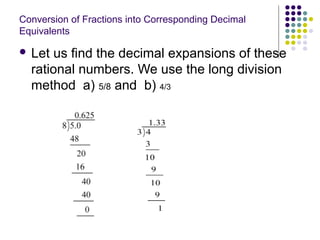
 Let us find the decimal expansions of these
rational numbers. We use the long division
method a) 5/8 and b) 4/3
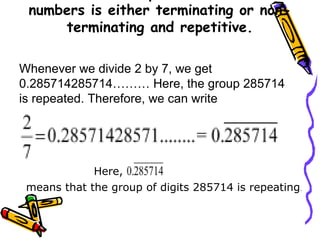
numbers is either terminating or non-
terminating and repetitive.
Whenever we divide 2 by 7, we get
0.285714285714……… Here, the group 285714
is repeated. Therefore, we can write
Here,
means that the group of digits 285714 is repeating.
•For irrational
numbers, the decimal
expansion is non-
terminating non-
repetitive.
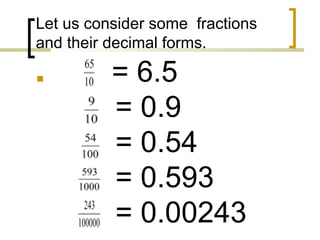
Let us consider some fractions
and their decimal forms.
 = 6.5
= 0.9
= 0.54
= 0.593
= 0.00243
Representation Of
Rational Numbers On
A Number Line Using
Successive
Magnification
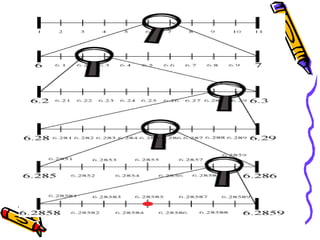
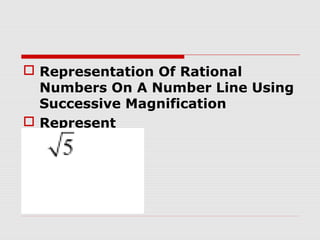
 Representation Of Rational
Numbers On A Number Line Using
Successive Magnification
 Represent
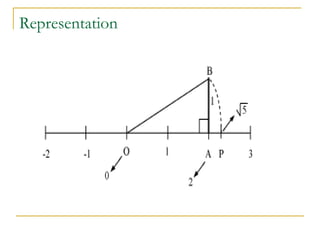
 On this number line, we mark O
and A at the points 0 and 2
respectively. At A, we draw AB
of unit length which is
perpendicular to OA. Now, we
join OB. Taking O as the centre
and OB as the radius, we will
draw an arc which cuts the
number line at P.
Representation
»End

number system

  • 1.
    Chapter 1Chapter 1 NumbersystemNumber system
  • 2.
    Associated With Irrational Numbers In earlier days, people used to exchange their things for other things. The requirement for numbers primarily originated from the need to count. They used the numbers 1,2,3,.that served the people for many years because all they needed to count was their crops, and animals. Later on numbers such as zero, integers, rational numbers, irrational numbers were introduced.
  • 3.
    Conversion of Fractionsinto Corresponding Decimal Equivalents  Let us find the decimal expansions of these rational numbers. We use the long division method a) 5/8 and b) 4/3
  • 4.
    numbers is eitherterminating or non- terminating and repetitive. Whenever we divide 2 by 7, we get 0.285714285714……… Here, the group 285714 is repeated. Therefore, we can write Here, means that the group of digits 285714 is repeating.
  • 5.
    •For irrational numbers, thedecimal expansion is non- terminating non- repetitive.
  • 6.
    Let us considersome fractions and their decimal forms.  = 6.5 = 0.9 = 0.54 = 0.593 = 0.00243
  • 7.
    Representation Of Rational NumbersOn A Number Line Using Successive Magnification
  • 9.
     Representation OfRational Numbers On A Number Line Using Successive Magnification  Represent
  • 10.
     On thisnumber line, we mark O and A at the points 0 and 2 respectively. At A, we draw AB of unit length which is perpendicular to OA. Now, we join OB. Taking O as the centre and OB as the radius, we will draw an arc which cuts the number line at P.
  • 11.
  • 12.