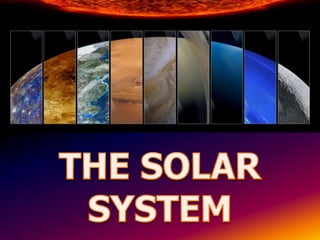
THE SOLAR SYSTEM
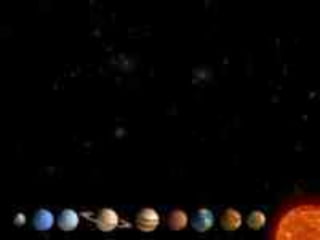
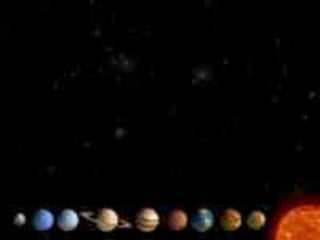
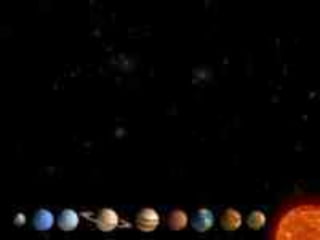
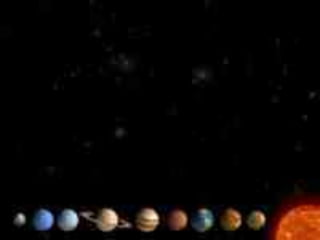
• The Solar System is a
collective name for the Sun
together with the groups of
celestial (heavenly) bodies
that are held in it’s gravity
and revolve around the Sun.
Members of the Solar System
• 1. The Sun- is a star, a huge
ball of hot gases with a
temperature of around
15,000,000 degrees Celsius at
the center and 5,000 degrees
Celsius at the surface.
Members of the Solar System
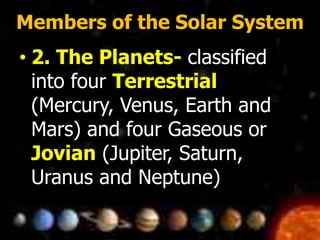
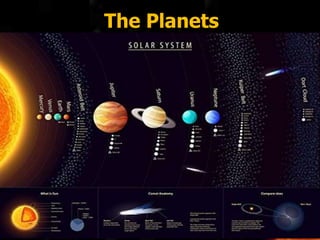
• 2. The Planets- classified
into four Terrestrial
(Mercury, Venus, Earth and
Mars) and four Gaseous or
Jovian (Jupiter, Saturn,
Uranus and Neptune)
The Planets
Compositions of Planet
Gases, hydrogen an helium, are those
with melting points near absolute zero (0
Kelvin). These are the most abundant
constituents of the solar nebula.
Rocks, principally silicate minerals and
metallic iron which have melting points
that exceed 700ºC.
Ices, include ammonia, methane, carbon
dioxide and water. They have immediate
melting points.
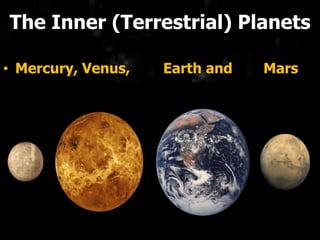
The Inner (Terrestrial) Planets
• Mercury, Venus, Earth and Mars
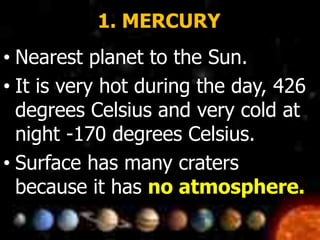
1. MERCURY
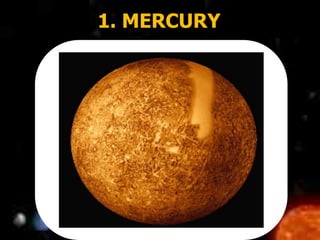
• Nearest planet to the Sun.
• It is very hot during the day, 426
degrees Celsius and very cold at
night -170 degrees Celsius.
• Surface has many craters
because it has no atmosphere.
1. MERCURY
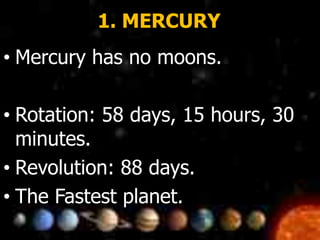
• Mercury has no moons.
• Rotation: 58 days, 15 hours, 30
minutes.
• Revolution: 88 days.
• The Fastest planet.
1. MERCURY
2. VENUS
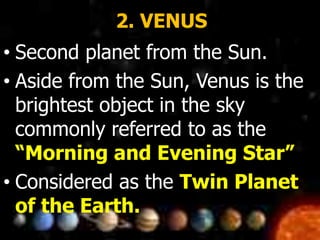
• Second planet from the Sun.
• Aside from the Sun, Venus is the
brightest object in the sky
commonly referred to as the
“Morning and Evening Star”
• Considered as the Twin Planet
of the Earth.
2. VENUS “The Veiled Planet”
2. VENUS
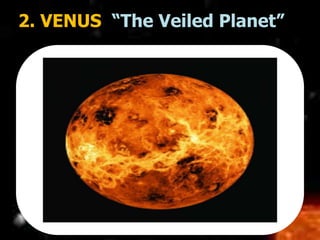
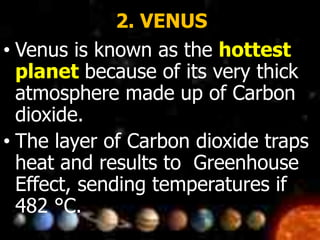
• Venus is known as the hottest
planet because of its very thick
atmosphere made up of Carbon
dioxide.
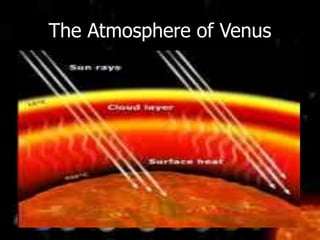
• The layer of Carbon dioxide traps
heat and results to Greenhouse
Effect, sending temperatures if
482 °C.
The Atmosphere of Venus
2. VENUS
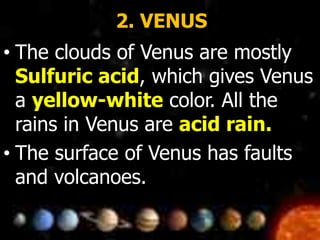
• The clouds of Venus are mostly
Sulfuric acid, which gives Venus
a yellow-white color. All the
rains in Venus are acid rain.
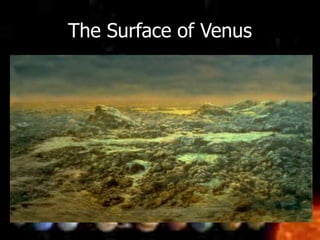
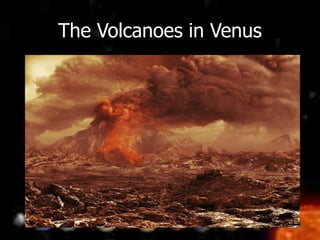
• The surface of Venus has faults
and volcanoes.
The Surface of Venus
2. VENUS
• Venus is the Earth’s closest
neighbor.
• It was the first planet to be
studied with space in 1962.
• Venus has no moons and the
gravity is as strong as the Earth.
The Volcanoes in Venus
2. VENUS
• Rotation: 116 days, 18 hours.
• Revolution: 225 days
• Venus’ rotation is very slow that it
only rotates nearly two times in
one year.
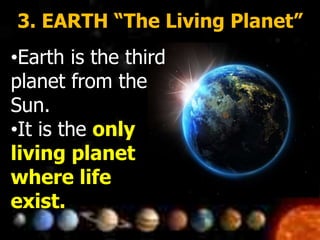
3. EARTH “The Living Planet”
•Earth is the third
planet from the
Sun.
•It is the only
living planet
where life
exist.
3. EARTH
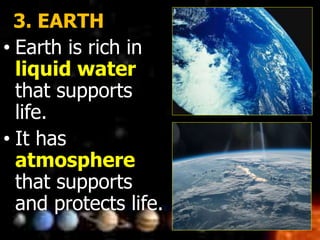
• Earth is rich in
liquid water
that supports
life.
• It has
atmosphere
that supports
and protects life.
3. EARTH
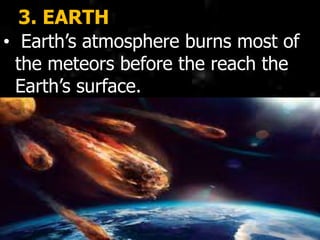
• Earth’s atmosphere burns most of
the meteors before the reach the
Earth’s surface.
3. The Earth’s Moon
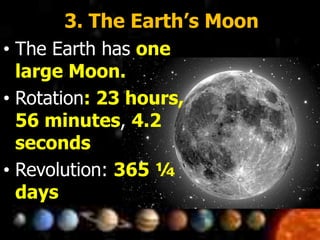
• The Earth has one
large Moon.
• Rotation: 23 hours,
56 minutes, 4.2
seconds
• Revolution: 365 ¼
days
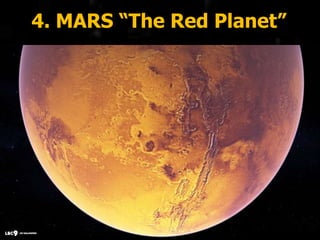
4. MARS “The Red Planet”
4. MARS
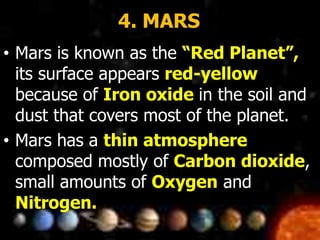
• Mars is known as the “Red Planet”,
its surface appears red-yellow
because of Iron oxide in the soil and
dust that covers most of the planet.
• Mars has a thin atmosphere
composed mostly of Carbon dioxide,
small amounts of Oxygen and
Nitrogen.
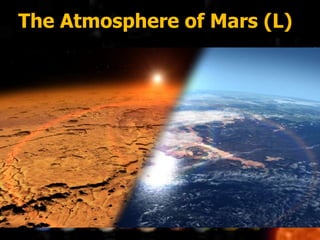
The Atmosphere of Mars (L)
4. MARS
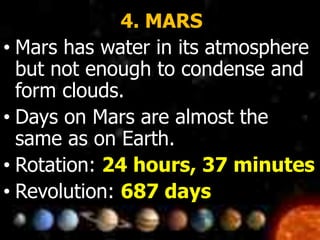
• Mars has water in its atmosphere
but not enough to condense and
form clouds.
• Days on Mars are almost the
same as on Earth.
• Rotation: 24 hours, 37 minutes
• Revolution: 687 days
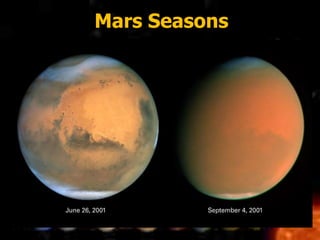
Mars Seasons
4. MARS
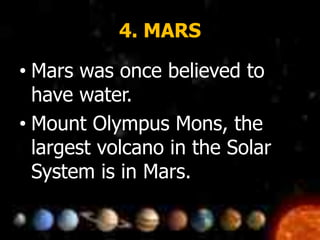
• Mars was once believed to
have water.
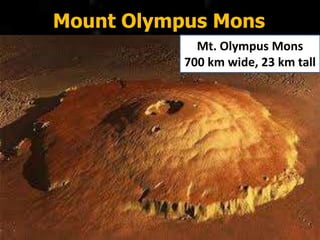
• Mount Olympus Mons, the
largest volcano in the Solar
System is in Mars.
Mount Olympus Mons
Mt. Olympus Mons
700 km wide, 23 km tall
4. MARS
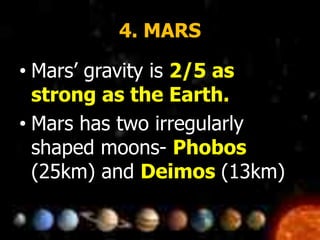
• Mars’ gravity is 2/5 as
strong as the Earth.
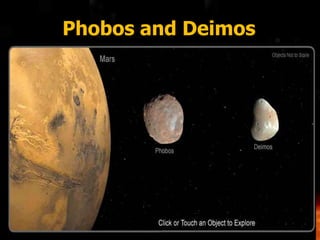
• Mars has two irregularly
shaped moons- Phobos
(25km) and Deimos (13km)
Phobos and Deimos
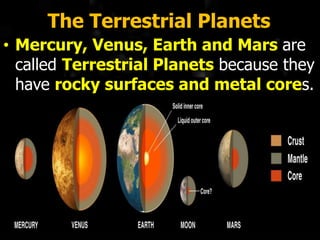
The Terrestrial Planets
• Mercury, Venus, Earth and Mars are
called Terrestrial Planets because they
have rocky surfaces and metal cores.
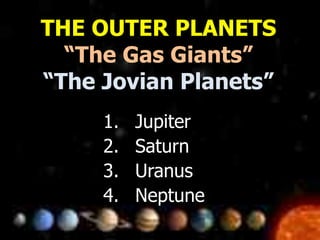
THE OUTER PLANETS
“The Gas Giants”
“The Jovian Planets”
1. Jupiter
2. Saturn
3. Uranus
4. Neptune
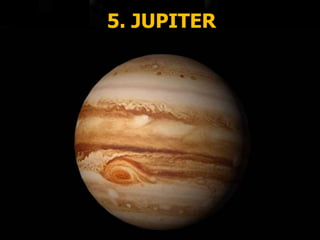
5. JUPITER
5. JUPITER
• Jupiter is the largest gaseous
planet in our Solar System.
• It is more than 11 times the size
of Earth.
• The great mass of Jupiter enables
it to generate very strong
gravitational force.
5. JUPITER
5. JUPITER
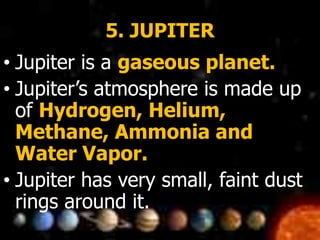
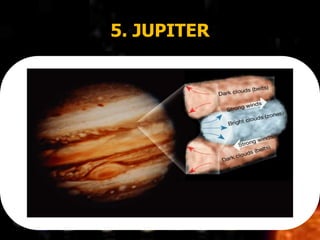
• Jupiter is a gaseous planet.
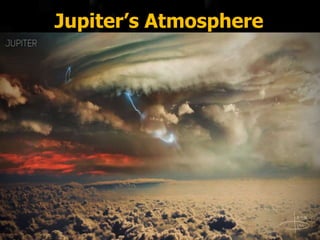
• Jupiter’s atmosphere is made up
of Hydrogen, Helium,
Methane, Ammonia and
Water Vapor.
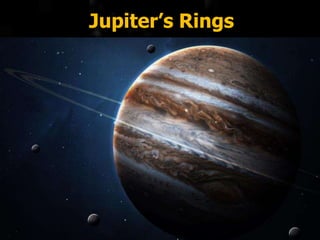
• Jupiter has very small, faint dust
rings around it.
Jupiter’s Rings
Jupiter’s Atmosphere
Jupiter’s Moons
• Jupiter has at least 63 moons.
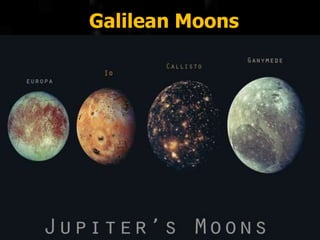
• Four moons were first observed
by Galileo Galilei and was
named Galilean Moons-
Ganymede, Io, Europa and
Callisto.
Galilean Moons
Jupiter’s Moons
• Ganymede- largest moon in the
Solar System, bigger than Mercury.
• Io- has an active volcano
• Callisto- has water, made mostly of
rocks and ice.
• Europa- rock, thick smooth crust of
ice.
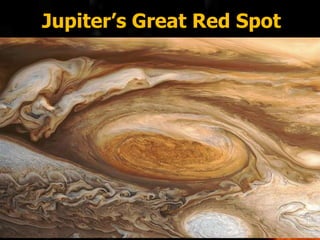
Jupiter’s Great Red Spot
• Most striking feature is the Great
Red Spot in the southern
hemisphere which is a
counterclockwise rotating storm.
• Rotation: 9 hours, 56 minutes
• Revolution: 12 years
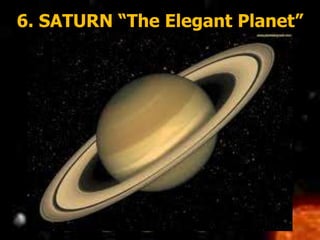
6. SATURN “The Elegant Planet”
6. SATURN
• Saturn is the second largest
planet but has the lowest
density.
• 9.5 times larger than Earth.
• Radiates more energy into space.
• Rotation: 10 hours, 39 minutes
• Revolution: 29 years
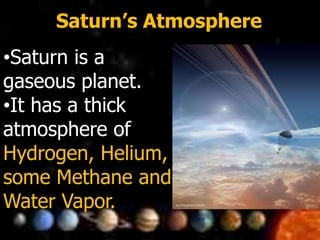
Saturn’s Atmosphere
•Saturn is a
gaseous planet.
•It has a thick
atmosphere of
Hydrogen, Helium,
some Methane and
Water Vapor.
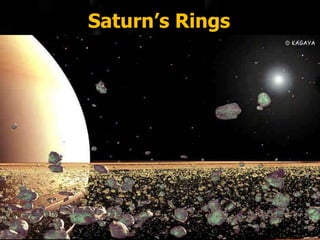
Saturn’s Rings
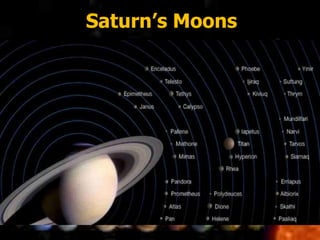
Saturn’s Moons
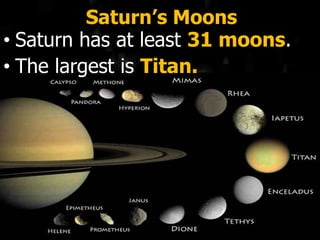
• Saturn has at least 31 moons.
• The largest is Titan.
Saturn’s Moons
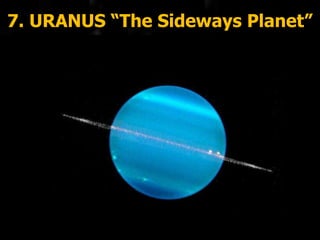
7. URANUS “The Sideways Planet”
7. URANUS
• Uranus is the third largest planet
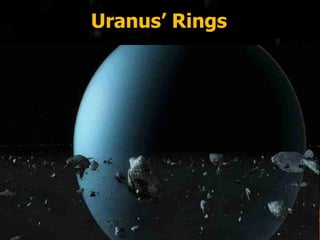
with a system of 11 thin, dark rings.
• Discovered by William Herschel
on March 13, 1781.
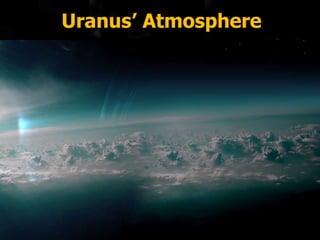
• Atmosphere is made up of
Hydrogen, Helium and some
Methane which gives the planet’s
bluish- green color.
Uranus’ Atmosphere
URANUS
• Uranus radiates the same amount
of solar energy it receives.
• Uranus’ axis of rotation is tilted at
84 degrees on its side.
• The result is its North Pole faces
the Sun for ½ of 84 years
revolution.
Uranus’ Rings
7. Uranus
• Rotation: 17 hours, 14 minutes
• Revolution: 84 years
• Uranus’ gravity is a little stronger
than of the Earth.
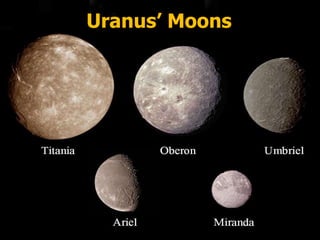
• Has at least 21 moons, largest is
Titania.
Uranus’ Moons
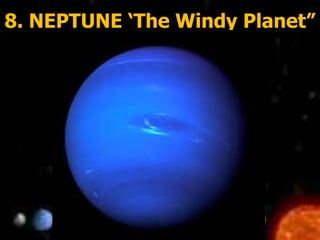
8. NEPTUNE ‘The Windy Planet”
8. NEPTUNE
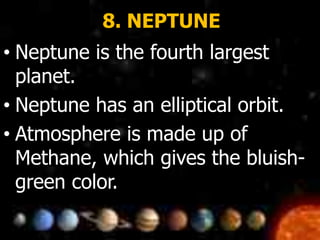
• Neptune is the fourth largest
planet.
• Neptune has an elliptical orbit.
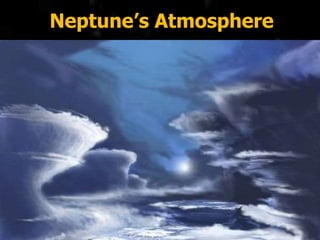
• Atmosphere is made up of
Methane, which gives the bluish-
green color.
Neptune’s Atmosphere
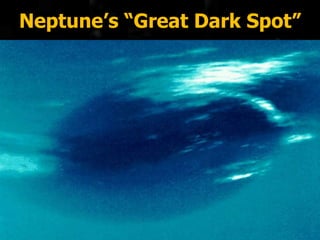
Neptune’s “Great Dark Spot”
8. NEPTUNE
• Neptune has a dark colored storm
called Great Dark Spot.
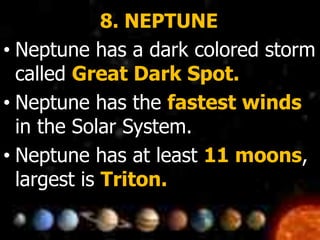
• Neptune has the fastest winds
in the Solar System.
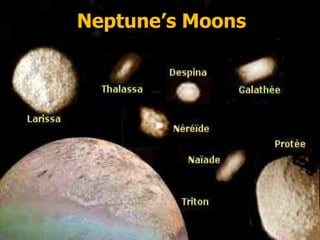
• Neptune has at least 11 moons,
largest is Triton.
Neptune’s Moons
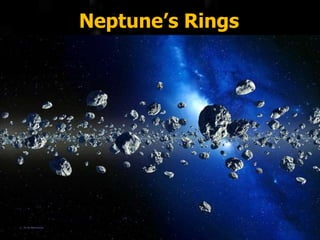
Neptune’s Rings
8. NEPTUNE
• Neptune was discovered in Berlin
Observatory, Germany by Johann
Gottfried Galle on September 23-24,
1846.
• Rotation: 16 hours, 6 minutes
• Revolution: 165 years
THE SOLAR SYSTEM.pptx

THE SOLAR SYSTEM.pptx

  • 2.
    THE SOLAR SYSTEM •The Solar System is a collective name for the Sun together with the groups of celestial (heavenly) bodies that are held in it’s gravity and revolve around the Sun.
  • 3.
    Members of theSolar System • 1. The Sun- is a star, a huge ball of hot gases with a temperature of around 15,000,000 degrees Celsius at the center and 5,000 degrees Celsius at the surface.
  • 4.
    Members of theSolar System • 2. The Planets- classified into four Terrestrial (Mercury, Venus, Earth and Mars) and four Gaseous or Jovian (Jupiter, Saturn, Uranus and Neptune)
  • 5.
  • 6.
    Compositions of Planet Gases,hydrogen an helium, are those with melting points near absolute zero (0 Kelvin). These are the most abundant constituents of the solar nebula. Rocks, principally silicate minerals and metallic iron which have melting points that exceed 700ºC. Ices, include ammonia, methane, carbon dioxide and water. They have immediate melting points.
  • 7.
    The Inner (Terrestrial)Planets • Mercury, Venus, Earth and Mars
  • 8.
    1. MERCURY • Nearestplanet to the Sun. • It is very hot during the day, 426 degrees Celsius and very cold at night -170 degrees Celsius. • Surface has many craters because it has no atmosphere.
  • 9.
    1. MERCURY • Mercuryhas no moons. • Rotation: 58 days, 15 hours, 30 minutes. • Revolution: 88 days. • The Fastest planet.
  • 10.
  • 11.
    2. VENUS • Secondplanet from the Sun. • Aside from the Sun, Venus is the brightest object in the sky commonly referred to as the “Morning and Evening Star” • Considered as the Twin Planet of the Earth.
  • 12.
    2. VENUS “TheVeiled Planet”
  • 13.
    2. VENUS • Venusis known as the hottest planet because of its very thick atmosphere made up of Carbon dioxide. • The layer of Carbon dioxide traps heat and results to Greenhouse Effect, sending temperatures if 482 °C.
  • 14.
  • 15.
    2. VENUS • Theclouds of Venus are mostly Sulfuric acid, which gives Venus a yellow-white color. All the rains in Venus are acid rain. • The surface of Venus has faults and volcanoes.
  • 16.
  • 17.
    2. VENUS • Venusis the Earth’s closest neighbor. • It was the first planet to be studied with space in 1962. • Venus has no moons and the gravity is as strong as the Earth.
  • 18.
  • 19.
    2. VENUS • Rotation:116 days, 18 hours. • Revolution: 225 days • Venus’ rotation is very slow that it only rotates nearly two times in one year.
  • 20.
    3. EARTH “TheLiving Planet” •Earth is the third planet from the Sun. •It is the only living planet where life exist.
  • 21.
    3. EARTH • Earthis rich in liquid water that supports life. • It has atmosphere that supports and protects life.
  • 22.
    3. EARTH • Earth’satmosphere burns most of the meteors before the reach the Earth’s surface.
  • 23.
    3. The Earth’sMoon • The Earth has one large Moon. • Rotation: 23 hours, 56 minutes, 4.2 seconds • Revolution: 365 ¼ days
  • 24.
    4. MARS “TheRed Planet”
  • 25.
    4. MARS • Marsis known as the “Red Planet”, its surface appears red-yellow because of Iron oxide in the soil and dust that covers most of the planet. • Mars has a thin atmosphere composed mostly of Carbon dioxide, small amounts of Oxygen and Nitrogen.
  • 26.
  • 27.
    4. MARS • Marshas water in its atmosphere but not enough to condense and form clouds. • Days on Mars are almost the same as on Earth. • Rotation: 24 hours, 37 minutes • Revolution: 687 days
  • 28.
  • 29.
    4. MARS • Marswas once believed to have water. • Mount Olympus Mons, the largest volcano in the Solar System is in Mars.
  • 30.
    Mount Olympus Mons Mt.Olympus Mons 700 km wide, 23 km tall
  • 31.
    4. MARS • Mars’gravity is 2/5 as strong as the Earth. • Mars has two irregularly shaped moons- Phobos (25km) and Deimos (13km)
  • 32.
  • 33.
    The Terrestrial Planets •Mercury, Venus, Earth and Mars are called Terrestrial Planets because they have rocky surfaces and metal cores.
  • 34.
    THE OUTER PLANETS “TheGas Giants” “The Jovian Planets” 1. Jupiter 2. Saturn 3. Uranus 4. Neptune
  • 35.
  • 36.
    5. JUPITER • Jupiteris the largest gaseous planet in our Solar System. • It is more than 11 times the size of Earth. • The great mass of Jupiter enables it to generate very strong gravitational force.
  • 37.
  • 38.
    5. JUPITER • Jupiteris a gaseous planet. • Jupiter’s atmosphere is made up of Hydrogen, Helium, Methane, Ammonia and Water Vapor. • Jupiter has very small, faint dust rings around it.
  • 39.
  • 40.
  • 41.
    Jupiter’s Moons • Jupiterhas at least 63 moons. • Four moons were first observed by Galileo Galilei and was named Galilean Moons- Ganymede, Io, Europa and Callisto.
  • 42.
  • 43.
    Jupiter’s Moons • Ganymede-largest moon in the Solar System, bigger than Mercury. • Io- has an active volcano • Callisto- has water, made mostly of rocks and ice. • Europa- rock, thick smooth crust of ice.
  • 44.
  • 45.
    Jupiter’s Great RedSpot • Most striking feature is the Great Red Spot in the southern hemisphere which is a counterclockwise rotating storm. • Rotation: 9 hours, 56 minutes • Revolution: 12 years
  • 46.
    6. SATURN “TheElegant Planet”
  • 47.
    6. SATURN • Saturnis the second largest planet but has the lowest density. • 9.5 times larger than Earth. • Radiates more energy into space. • Rotation: 10 hours, 39 minutes • Revolution: 29 years
  • 48.
    Saturn’s Atmosphere •Saturn isa gaseous planet. •It has a thick atmosphere of Hydrogen, Helium, some Methane and Water Vapor.
  • 49.
  • 50.
    Saturn’s Moons • Saturnhas at least 31 moons. • The largest is Titan.
  • 51.
  • 52.
    7. URANUS “TheSideways Planet”
  • 53.
    7. URANUS • Uranusis the third largest planet with a system of 11 thin, dark rings. • Discovered by William Herschel on March 13, 1781. • Atmosphere is made up of Hydrogen, Helium and some Methane which gives the planet’s bluish- green color.
  • 54.
  • 55.
    URANUS • Uranus radiatesthe same amount of solar energy it receives. • Uranus’ axis of rotation is tilted at 84 degrees on its side. • The result is its North Pole faces the Sun for ½ of 84 years revolution.
  • 56.
  • 57.
    7. Uranus • Rotation:17 hours, 14 minutes • Revolution: 84 years • Uranus’ gravity is a little stronger than of the Earth. • Has at least 21 moons, largest is Titania.
  • 58.
  • 59.
    8. NEPTUNE ‘TheWindy Planet”
  • 60.
    8. NEPTUNE • Neptuneis the fourth largest planet. • Neptune has an elliptical orbit. • Atmosphere is made up of Methane, which gives the bluish- green color.
  • 61.
  • 62.
  • 63.
    8. NEPTUNE • Neptunehas a dark colored storm called Great Dark Spot. • Neptune has the fastest winds in the Solar System. • Neptune has at least 11 moons, largest is Triton.
  • 64.
  • 65.
  • 66.
    8. NEPTUNE • Neptunewas discovered in Berlin Observatory, Germany by Johann Gottfried Galle on September 23-24, 1846. • Rotation: 16 hours, 6 minutes • Revolution: 165 years