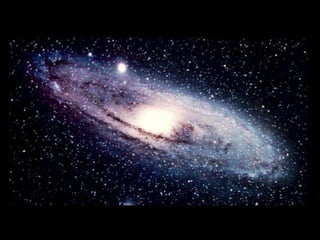
The Solar System!
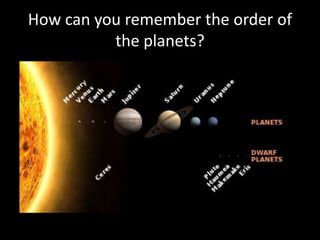
How can you remember the order of
the planets?
•
•
•
•
•
•
•
•
•

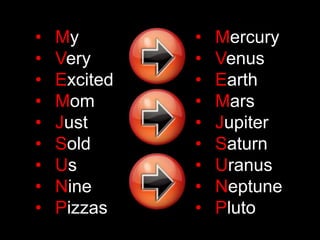
My
Very
Excited
Mom
Just
Sold
Us
Nine
Pizzas

•
•
•
•
•
•
•
•
•

Mercury
Venus
Earth
Mars
Jupiter
Saturn
Uranus
Neptune
Pluto
Some fast facts
about the
planets…
•

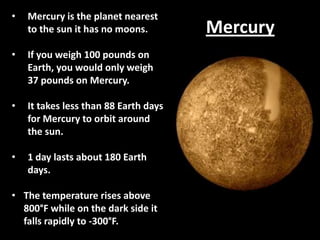
Mercury is the planet nearest
to the sun it has no moons.

•

If you weigh 100 pounds on
Earth, you would only weigh
37 pounds on Mercury.

•

It takes less than 88 Earth days
for Mercury to orbit around
the sun.

•

1 day lasts about 180 Earth
days.

• The temperature rises above
800°F while on the dark side it
falls rapidly to -300°F.

Mercury
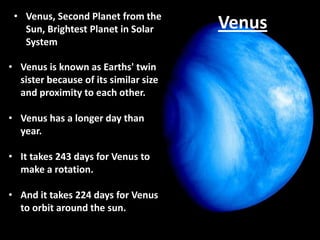
• Venus, Second Planet from the
Sun, Brightest Planet in Solar
System
• Venus is known as Earths' twin
sister because of its similar size
and proximity to each other.
• Venus has a longer day than
year.
• It takes 243 days for Venus to
make a rotation.

• And it takes 224 days for Venus
to orbit around the sun.

Venus
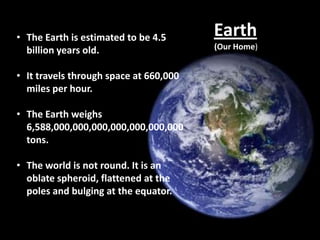
• The Earth is estimated to be 4.5
billion years old.
• It travels through space at 660,000
miles per hour.
• The Earth weighs
6,588,000,000,000,000,000,000,000
tons.
• The world is not round. It is an
oblate spheroid, flattened at the
poles and bulging at the equator.

Earth
(Our Home)
• Mars is the fourth closest
planet to the sun. It can easily
be seen from Earth

Mars

• Mars is red because it is rusty.
There is a lot of iron in the soil,
and the air on Mars has made it
turn red.
• Mars orbits the sun every 687
Earth days.
• The Martian “day” is about half
a hour longer than Earth.
• In winter, nighttime temps can • A hundred pound man would
drop as low as -191°F
weight 38 pounds on Mars.
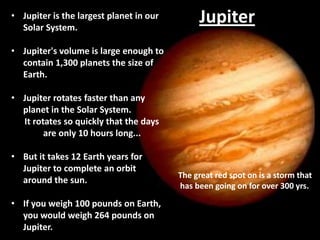
• Jupiter is the largest planet in our
Solar System.

Jupiter

• Jupiter's volume is large enough to
contain 1,300 planets the size of
Earth.
• Jupiter rotates faster than any
planet in the Solar System.
It rotates so quickly that the days
are only 10 hours long...
• But it takes 12 Earth years for
Jupiter to complete an orbit
around the sun.
• If you weigh 100 pounds on Earth,
you would weigh 264 pounds on
Jupiter.

The great red spot on is a storm that
has been going on for over 300 yrs.
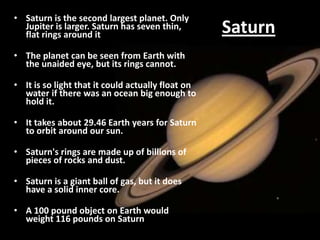
• Saturn is the second largest planet. Only
Jupiter is larger. Saturn has seven thin,
flat rings around it
• The planet can be seen from Earth with
the unaided eye, but its rings cannot.

• It is so light that it could actually float on
water if there was an ocean big enough to
hold it.
• It takes about 29.46 Earth years for Saturn
to orbit around our sun.
• Saturn's rings are made up of billions of
pieces of rocks and dust.
• Saturn is a giant ball of gas, but it does
have a solid inner core.
• A 100 pound object on Earth would
weight 116 pounds on Saturn

Saturn
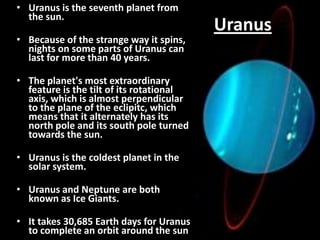
• Uranus is the seventh planet from
the sun.
• Because of the strange way it spins,
nights on some parts of Uranus can
last for more than 40 years.

• The planet's most extraordinary
feature is the tilt of its rotational
axis, which is almost perpendicular
to the plane of the eclipitc, which
means that it alternately has its
north pole and its south pole turned
towards the sun.
• Uranus is the coldest planet in the
solar system.

• Uranus and Neptune are both
known as Ice Giants.
• It takes 30,685 Earth days for Uranus
to complete an orbit around the sun

Uranus
• Neptune is so far away that it took
the space probe Voyager 2, 12
years to reach it.
• Neptune is the stormiest planet.
The winds there can blow up to
1,240 miles per hour, that is three
times as fast as Earth's
Hurricanes.
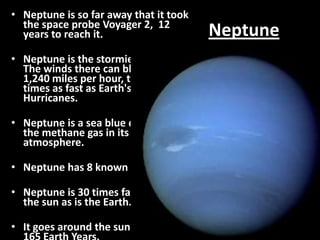
• Neptune is a sea blue color due to
the methane gas in its
atmosphere.
• Neptune has 8 known moons.

• Neptune is 30 times farther from
the sun as is the Earth.
• It goes around the sun once every

Neptune
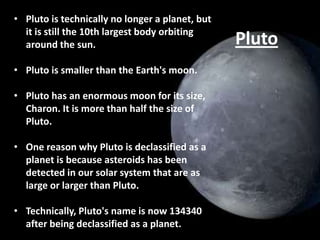
• Pluto is technically no longer a planet, but
it is still the 10th largest body orbiting
around the sun.
• Pluto is smaller than the Earth's moon.
• Pluto has an enormous moon for its size,
Charon. It is more than half the size of
Pluto.
• One reason why Pluto is declassified as a
planet is because asteroids has been
detected in our solar system that are as
large or larger than Pluto.
• Technically, Pluto's name is now 134340
after being declassified as a planet.

Pluto
The Solar System for Grades 3-8

The Solar System for Grades 3-8

  • 1.
  • 2.
    How can youremember the order of the planets?
  • 3.
  • 5.
    Some fast facts aboutthe planets…
  • 6.
    • Mercury is theplanet nearest to the sun it has no moons. • If you weigh 100 pounds on Earth, you would only weigh 37 pounds on Mercury. • It takes less than 88 Earth days for Mercury to orbit around the sun. • 1 day lasts about 180 Earth days. • The temperature rises above 800°F while on the dark side it falls rapidly to -300°F. Mercury
  • 7.
    • Venus, SecondPlanet from the Sun, Brightest Planet in Solar System • Venus is known as Earths' twin sister because of its similar size and proximity to each other. • Venus has a longer day than year. • It takes 243 days for Venus to make a rotation. • And it takes 224 days for Venus to orbit around the sun. Venus
  • 8.
    • The Earthis estimated to be 4.5 billion years old. • It travels through space at 660,000 miles per hour. • The Earth weighs 6,588,000,000,000,000,000,000,000 tons. • The world is not round. It is an oblate spheroid, flattened at the poles and bulging at the equator. Earth (Our Home)
  • 9.
    • Mars isthe fourth closest planet to the sun. It can easily be seen from Earth Mars • Mars is red because it is rusty. There is a lot of iron in the soil, and the air on Mars has made it turn red. • Mars orbits the sun every 687 Earth days. • The Martian “day” is about half a hour longer than Earth. • In winter, nighttime temps can • A hundred pound man would drop as low as -191°F weight 38 pounds on Mars.
  • 10.
    • Jupiter isthe largest planet in our Solar System. Jupiter • Jupiter's volume is large enough to contain 1,300 planets the size of Earth. • Jupiter rotates faster than any planet in the Solar System. It rotates so quickly that the days are only 10 hours long... • But it takes 12 Earth years for Jupiter to complete an orbit around the sun. • If you weigh 100 pounds on Earth, you would weigh 264 pounds on Jupiter. The great red spot on is a storm that has been going on for over 300 yrs.
  • 11.
    • Saturn isthe second largest planet. Only Jupiter is larger. Saturn has seven thin, flat rings around it • The planet can be seen from Earth with the unaided eye, but its rings cannot. • It is so light that it could actually float on water if there was an ocean big enough to hold it. • It takes about 29.46 Earth years for Saturn to orbit around our sun. • Saturn's rings are made up of billions of pieces of rocks and dust. • Saturn is a giant ball of gas, but it does have a solid inner core. • A 100 pound object on Earth would weight 116 pounds on Saturn Saturn
  • 12.
    • Uranus isthe seventh planet from the sun. • Because of the strange way it spins, nights on some parts of Uranus can last for more than 40 years. • The planet's most extraordinary feature is the tilt of its rotational axis, which is almost perpendicular to the plane of the eclipitc, which means that it alternately has its north pole and its south pole turned towards the sun. • Uranus is the coldest planet in the solar system. • Uranus and Neptune are both known as Ice Giants. • It takes 30,685 Earth days for Uranus to complete an orbit around the sun Uranus
  • 13.
    • Neptune isso far away that it took the space probe Voyager 2, 12 years to reach it. • Neptune is the stormiest planet. The winds there can blow up to 1,240 miles per hour, that is three times as fast as Earth's Hurricanes. • Neptune is a sea blue color due to the methane gas in its atmosphere. • Neptune has 8 known moons. • Neptune is 30 times farther from the sun as is the Earth. • It goes around the sun once every Neptune
  • 14.
    • Pluto istechnically no longer a planet, but it is still the 10th largest body orbiting around the sun. • Pluto is smaller than the Earth's moon. • Pluto has an enormous moon for its size, Charon. It is more than half the size of Pluto. • One reason why Pluto is declassified as a planet is because asteroids has been detected in our solar system that are as large or larger than Pluto. • Technically, Pluto's name is now 134340 after being declassified as a planet. Pluto