FLAMES
1. Related Definitions
2. Flames.
3. Laminar Premixed Flame.
4. Laminar Diffusion Flame.
Presentation Outline
1. Related Definitions
 Combustible mixture :( flammable mixture) is one which is
capable of propagation a flame indefinitely away from an
ignition source.
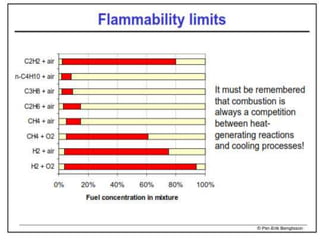
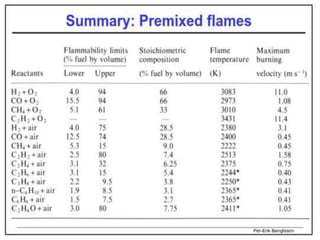
 Flammability limit: it is the composition of the fuel-oxidant
mixtures that will sustain a stable flame.
 There are two types of limits associated with the propagation
of a laminar flame.
– The first is associated with the chemical reactive capability
of the mixture to support a flame, and the second is
associated with gas flow influences.
 Mixtures will not burn when composition is lower than the
lower flammable limit (LFL), or above the upper flammable
limit (UFL).
2.Flames
 It is a thermal wave in which rapid exothermic chemical
reaction occurs and travels with subsonic velocities
(deflagration wave.)
Most flames result from highly exothermic reactions
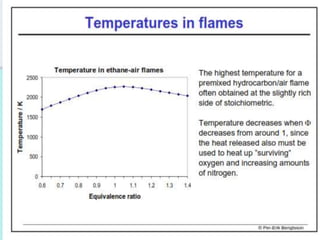
giving flame temperatures about 2200 K although flames may be
capable of burning down to about 1300 K, depending on the
fuel-air ratio.
Certain flames can be sustained below this temperature and
are termed "cool" flames, only partial combustion occurs.
Flame consists mainly of two zones: preheat zone : where little
heat is released, reaction zone : where bulk of chemical energy
is released.
Flames (cont.)
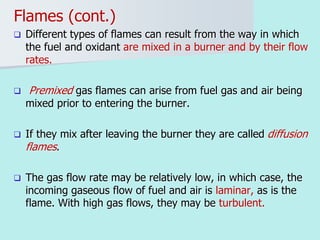
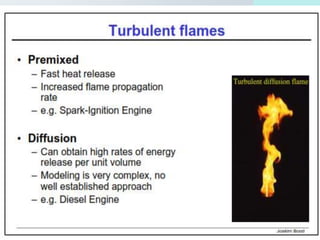
 Different types of flames can result from the way in which
the fuel and oxidant are mixed in a burner and by their flow
rates.
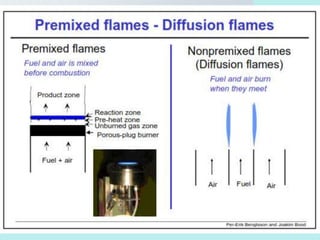
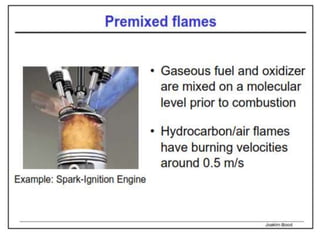
 Premixed gas flames can arise from fuel gas and air being
mixed prior to entering the burner.
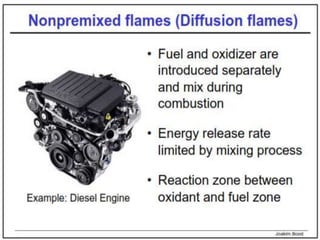
 If they mix after leaving the burner they are called diffusion
flames.
 The gas flow rate may be relatively low, in which case, the
incoming gaseous flow of fuel and air is laminar, as is the
flame. With high gas flows, they may be turbulent.
Flames (cont.)
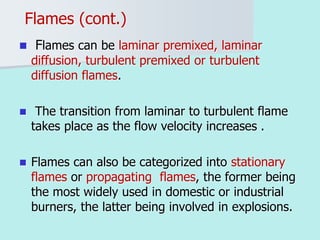
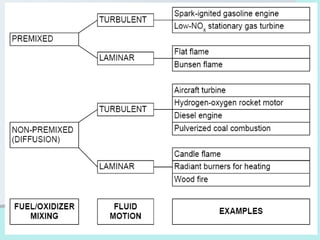
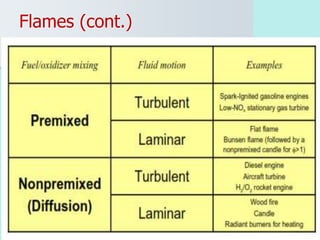
 Flames can be laminar premixed, laminar
diffusion, turbulent premixed or turbulent
diffusion flames.
 The transition from laminar to turbulent flame
takes place as the flow velocity increases .
 Flames can also be categorized into stationary
flames or propagating flames, the former being
the most widely used in domestic or industrial
burners, the latter being involved in explosions.
Flames (cont.)
Flames (cont.)
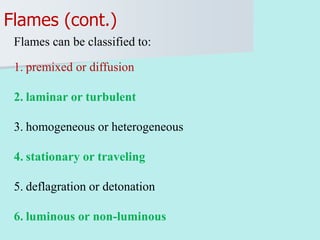
Flames can be classified to:
1. premixed or diffusion
2. laminar or turbulent
3. homogeneous or heterogeneous
4. stationary or traveling
5. deflagration or detonation
6. luminous or non-luminous
Flames (cont.)
The flame velocity su is the velocity at which the
unburned gases move through the combustion
wave in a direction normal to the wave surface.
The flame velocity depends on:
1. Initial temperature.
2. Pressure.
3. Composition of the gases, ”combustible mixture”.
3. Laminar Premixed Flames
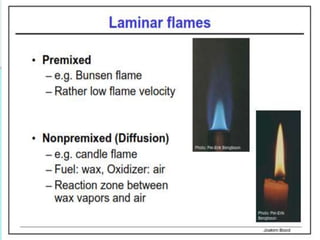
 Bunsen burner is a good example of laminar pre-
mixed flames, a type of flame widely used in gas
cookers and central heating units.
 The type of flame that has been most studied is
the laminar premixed flame of a gaseous fuel and
air, because it is the simplest flame and exhibits
characteristics common to many other systems.
3. Laminar Premixed Flames(cont.)
 The Bunsen burner, however, illustrates both the
premixed flame and the principle of the diffusion
flame.
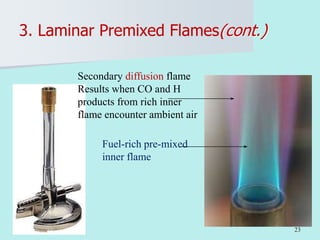
 The inner core is the reaction zone of a premixed
flame, but the flame is fuel-rich, so the products
of incomplete combustion burn in the outer core
as a diffusion flame with the surrounding air.
 The exact nature of the flame is determined by
the fuel to air ratio.
3. Laminar Premixed Flames(cont.)
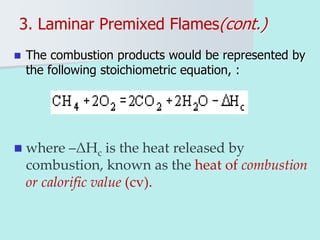
 The combustion products would be represented by
the following stoichiometric equation, :
 where –ΔHc is the heat released by
combustion, known as the heat of combustion
or calorific value (cv).
3. Laminar Premixed Flames(cont.)
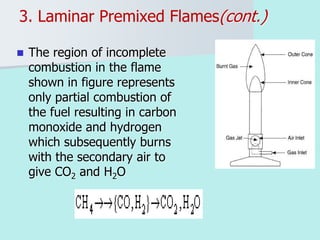
 The region of incomplete
combustion in the flame
shown in figure represents
only partial combustion of
the fuel resulting in carbon
monoxide and hydrogen
which subsequently burns
with the secondary air to
give CO2 and H2O
21
3. Laminar Premixed Flames(cont.)
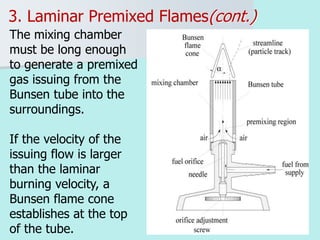
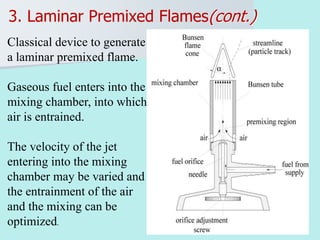
The mixing chamber
must be long enough
to generate a premixed
gas issuing from the
Bunsen tube into the
surroundings.
If the velocity of the
issuing flow is larger
than the laminar
burning velocity, a
Bunsen flame cone
establishes at the top
of the tube.
22
3. Laminar Premixed Flames(cont.)
Classical device to generate
a laminar premixed flame.
Gaseous fuel enters into the
mixing chamber, into which
air is entrained.
The velocity of the jet
entering into the mixing
chamber may be varied and
the entrainment of the air
and the mixing can be
optimized.
23
3. Laminar Premixed Flames(cont.)
Fuel-rich pre-mixed
inner flame
Secondary diffusion flame
Results when CO and H
products from rich inner
flame encounter ambient air
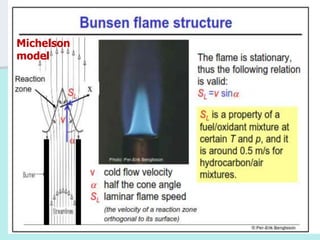
Michelson
model
3. Laminar Pre-mixed Flames(cont.)
The actual visible flame differs from Michelson model in
the following respects:
The tip of an actual Bunsen burner is rounded instead of
pointed one as given theoretically, and the base of
theoretical flame is equal to the inner diameter of the
tube while the actual flame overlaps the burner.
 The shape of the flame is determined by velocity profile,
flame speed, heat loss to tube wall
 The flame remains stationary if : flame speed is equal to the
speed of normal component of unburned gas at each
location.
3. Laminar Premixed Flames(cont.)
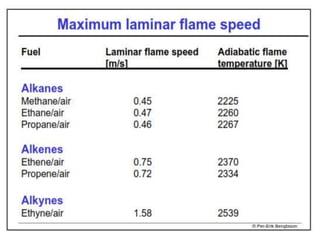
Flame velocity of laminar premixed flames depends
on:
1. fuel type
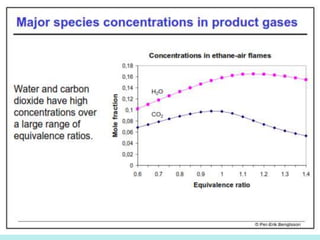
2. fuel-oxidant mass ratio (equivalence ratio)
3. initial temperature of combustible mixture
4. pressure
5. flow pattern. 6. geometry of system
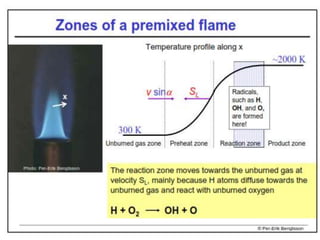
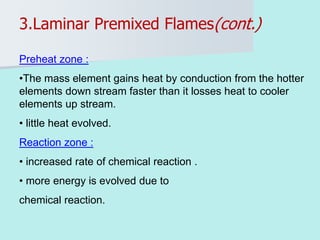
Preheat zone :
•The mass element gains heat by conduction from the hotter
elements down stream faster than it losses heat to cooler
elements up stream.
• little heat evolved.
Reaction zone :
• increased rate of chemical reaction .
• more energy is evolved due to
chemical reaction.
3.Laminar Premixed Flames(cont.)
3. Laminar Premixed Flames (cont.)
 Flame propagation refers to the propagation of the
reaction zone or “combustion wave” through a
combustible mixture.
 When the transport of heat and active species (free
radicals) have initiated chemical reaction in the
adjacent layer of the combustible mixture, the layer
itself becomes the source of heat and radicals and is
then capable of initiating reaction in the next layer.
3. Laminar Premixed Flames (cont.)
 A quantitative theory of flame propagation must be
based on the transfer of heat and mass from the
reaction zone to the unburned mixture.
 The enthalpy rise across the flame due to combustion
is balanced by conduction from the reaction zone.
Laminar Premixed Flames (cont.)

 It is possible therefore to stabilize a flame (obtain
a stationary flame) at gas flow rates higher than
the rate of flame propagation.
 This is the reason why Bunsen burners can
maintain flames over a range of flow rates and
fuel oxidant mixture ratios .
 A flat flame burner is stable only for the flow rate
of the gas that exactly matches the flame velocity.

The Structure Of A Laminar Premixed
Flame
1. Microscopic structure (Temperature and
concentration gradients across the combustion
wave.)
2. Macroscopic structure (flame shape.)
Factors Affecting The Flame Shape
The shape of a flame is mainly governed
by two factors :
 The flow pattern of the mixture or
products.
 The quenching effect of the solid surface.
Factors Controlling the Rate of Flame
Propagation
Rate of heat transfer . (from reaction zone to the
adjacent heating zone) .
Diffusion of radicals or chain carriers (from the
reaction zone to unburnt gases).
Chemical kinetics.(of individual reactions in the
mechanism).
Difference Between Diffusion Flames
and Premixed Flames
For Diffusion Flame:
1- Combustion occurs at the interface between the
fuel gas and oxidant gas .
2- The burning process depends more upon
the rate of mixing than on the rate of chemical
reactions involved .
4. Laminar Diffusion
Flame
4. Laminar Diffusion Flame
 In the case of laminar diffusion flames the fuel and the
oxidant only meet at the burner mouth and mix by diffusion
processes .
 Axisymmetric diffusion flames can be obtained by the use of
concentric tubes with the fuel usually entering via the inner
tube.
 Diffusion applies strictly to molecular diffusion of chemical
species
 In turbulent diffusion flames, turbulent convection mixes fuel
and air macroscopically, then molecular mixing completes
the process so that chemical reactions can take place
4. Laminar Diffusion Flame (cont.)
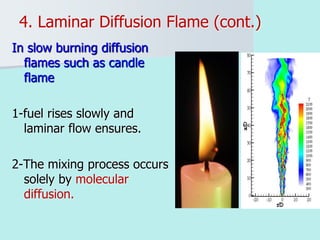
In slow burning diffusion
flames such as candle
flame
1-fuel rises slowly and
laminar flow ensures.
2-The mixing process occurs
solely by molecular
diffusion.
4. Laminar Diffusion Flame (cont.)
 In diffusion flames the reaction occurs mainly in the
maximum temperature region of the flame , but in
the premixed flame the reaction occurs before the
maximum temperature is reached.
 Diffusion flames are used more frequently in
industry.
 Burning rate : is determined by the rate at
which the fuel and oxidizer are brought together in
proper proportion for the reaction.
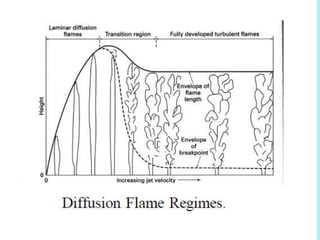
Effect Of Gas Flow On Diffusion Flame
Shape
The laminar characteristic of the diffusion
flame changes with increasing the gas flow.
Break point : is defined as the point where
the laminar stream changes to turbulent .
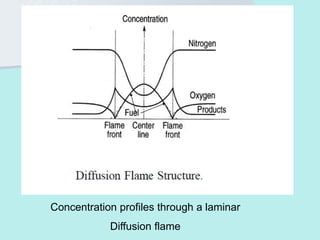
Concentration profiles through a laminar
Diffusion flame
Any Questions

Flames with prof Dr elkady mechanical engineering.pptx

  • 1.
  • 2.
    1. Related Definitions 2.Flames. 3. Laminar Premixed Flame. 4. Laminar Diffusion Flame. Presentation Outline
  • 3.
    1. Related Definitions Combustible mixture :( flammable mixture) is one which is capable of propagation a flame indefinitely away from an ignition source.  Flammability limit: it is the composition of the fuel-oxidant mixtures that will sustain a stable flame.  There are two types of limits associated with the propagation of a laminar flame. – The first is associated with the chemical reactive capability of the mixture to support a flame, and the second is associated with gas flow influences.  Mixtures will not burn when composition is lower than the lower flammable limit (LFL), or above the upper flammable limit (UFL).
  • 5.
    2.Flames  It isa thermal wave in which rapid exothermic chemical reaction occurs and travels with subsonic velocities (deflagration wave.) Most flames result from highly exothermic reactions giving flame temperatures about 2200 K although flames may be capable of burning down to about 1300 K, depending on the fuel-air ratio. Certain flames can be sustained below this temperature and are termed "cool" flames, only partial combustion occurs. Flame consists mainly of two zones: preheat zone : where little heat is released, reaction zone : where bulk of chemical energy is released.
  • 6.
    Flames (cont.)  Differenttypes of flames can result from the way in which the fuel and oxidant are mixed in a burner and by their flow rates.  Premixed gas flames can arise from fuel gas and air being mixed prior to entering the burner.  If they mix after leaving the burner they are called diffusion flames.  The gas flow rate may be relatively low, in which case, the incoming gaseous flow of fuel and air is laminar, as is the flame. With high gas flows, they may be turbulent.
  • 7.
    Flames (cont.)  Flamescan be laminar premixed, laminar diffusion, turbulent premixed or turbulent diffusion flames.  The transition from laminar to turbulent flame takes place as the flow velocity increases .  Flames can also be categorized into stationary flames or propagating flames, the former being the most widely used in domestic or industrial burners, the latter being involved in explosions.
  • 12.
  • 15.
    Flames (cont.) Flames canbe classified to: 1. premixed or diffusion 2. laminar or turbulent 3. homogeneous or heterogeneous 4. stationary or traveling 5. deflagration or detonation 6. luminous or non-luminous
  • 16.
    Flames (cont.) The flamevelocity su is the velocity at which the unburned gases move through the combustion wave in a direction normal to the wave surface. The flame velocity depends on: 1. Initial temperature. 2. Pressure. 3. Composition of the gases, ”combustible mixture”.
  • 17.
    3. Laminar PremixedFlames  Bunsen burner is a good example of laminar pre- mixed flames, a type of flame widely used in gas cookers and central heating units.  The type of flame that has been most studied is the laminar premixed flame of a gaseous fuel and air, because it is the simplest flame and exhibits characteristics common to many other systems.
  • 18.
    3. Laminar PremixedFlames(cont.)  The Bunsen burner, however, illustrates both the premixed flame and the principle of the diffusion flame.  The inner core is the reaction zone of a premixed flame, but the flame is fuel-rich, so the products of incomplete combustion burn in the outer core as a diffusion flame with the surrounding air.  The exact nature of the flame is determined by the fuel to air ratio.
  • 19.
    3. Laminar PremixedFlames(cont.)  The combustion products would be represented by the following stoichiometric equation, :  where –ΔHc is the heat released by combustion, known as the heat of combustion or calorific value (cv).
  • 20.
    3. Laminar PremixedFlames(cont.)  The region of incomplete combustion in the flame shown in figure represents only partial combustion of the fuel resulting in carbon monoxide and hydrogen which subsequently burns with the secondary air to give CO2 and H2O
  • 21.
    21 3. Laminar PremixedFlames(cont.) The mixing chamber must be long enough to generate a premixed gas issuing from the Bunsen tube into the surroundings. If the velocity of the issuing flow is larger than the laminar burning velocity, a Bunsen flame cone establishes at the top of the tube.
  • 22.
    22 3. Laminar PremixedFlames(cont.) Classical device to generate a laminar premixed flame. Gaseous fuel enters into the mixing chamber, into which air is entrained. The velocity of the jet entering into the mixing chamber may be varied and the entrainment of the air and the mixing can be optimized.
  • 23.
    23 3. Laminar PremixedFlames(cont.) Fuel-rich pre-mixed inner flame Secondary diffusion flame Results when CO and H products from rich inner flame encounter ambient air
  • 24.
  • 25.
    3. Laminar Pre-mixedFlames(cont.) The actual visible flame differs from Michelson model in the following respects: The tip of an actual Bunsen burner is rounded instead of pointed one as given theoretically, and the base of theoretical flame is equal to the inner diameter of the tube while the actual flame overlaps the burner.  The shape of the flame is determined by velocity profile, flame speed, heat loss to tube wall  The flame remains stationary if : flame speed is equal to the speed of normal component of unburned gas at each location.
  • 26.
    3. Laminar PremixedFlames(cont.) Flame velocity of laminar premixed flames depends on: 1. fuel type 2. fuel-oxidant mass ratio (equivalence ratio) 3. initial temperature of combustible mixture 4. pressure 5. flow pattern. 6. geometry of system
  • 28.
    Preheat zone : •Themass element gains heat by conduction from the hotter elements down stream faster than it losses heat to cooler elements up stream. • little heat evolved. Reaction zone : • increased rate of chemical reaction . • more energy is evolved due to chemical reaction. 3.Laminar Premixed Flames(cont.)
  • 29.
    3. Laminar PremixedFlames (cont.)  Flame propagation refers to the propagation of the reaction zone or “combustion wave” through a combustible mixture.  When the transport of heat and active species (free radicals) have initiated chemical reaction in the adjacent layer of the combustible mixture, the layer itself becomes the source of heat and radicals and is then capable of initiating reaction in the next layer.
  • 30.
    3. Laminar PremixedFlames (cont.)  A quantitative theory of flame propagation must be based on the transfer of heat and mass from the reaction zone to the unburned mixture.  The enthalpy rise across the flame due to combustion is balanced by conduction from the reaction zone.
  • 31.
    Laminar Premixed Flames(cont.)   It is possible therefore to stabilize a flame (obtain a stationary flame) at gas flow rates higher than the rate of flame propagation.  This is the reason why Bunsen burners can maintain flames over a range of flow rates and fuel oxidant mixture ratios .  A flat flame burner is stable only for the flow rate of the gas that exactly matches the flame velocity. 
  • 32.
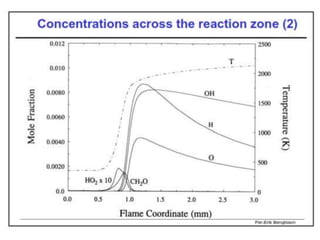
    The Structure OfA Laminar Premixed Flame 1. Microscopic structure (Temperature and concentration gradients across the combustion wave.) 2. Macroscopic structure (flame shape.)
  • 40.
    Factors Affecting TheFlame Shape The shape of a flame is mainly governed by two factors :  The flow pattern of the mixture or products.  The quenching effect of the solid surface.
  • 41.
    Factors Controlling theRate of Flame Propagation Rate of heat transfer . (from reaction zone to the adjacent heating zone) . Diffusion of radicals or chain carriers (from the reaction zone to unburnt gases). Chemical kinetics.(of individual reactions in the mechanism).
  • 42.
    Difference Between DiffusionFlames and Premixed Flames For Diffusion Flame: 1- Combustion occurs at the interface between the fuel gas and oxidant gas . 2- The burning process depends more upon the rate of mixing than on the rate of chemical reactions involved .
  • 43.
  • 44.
    4. Laminar DiffusionFlame  In the case of laminar diffusion flames the fuel and the oxidant only meet at the burner mouth and mix by diffusion processes .  Axisymmetric diffusion flames can be obtained by the use of concentric tubes with the fuel usually entering via the inner tube.  Diffusion applies strictly to molecular diffusion of chemical species  In turbulent diffusion flames, turbulent convection mixes fuel and air macroscopically, then molecular mixing completes the process so that chemical reactions can take place
  • 45.
    4. Laminar DiffusionFlame (cont.) In slow burning diffusion flames such as candle flame 1-fuel rises slowly and laminar flow ensures. 2-The mixing process occurs solely by molecular diffusion.
  • 46.
    4. Laminar DiffusionFlame (cont.)  In diffusion flames the reaction occurs mainly in the maximum temperature region of the flame , but in the premixed flame the reaction occurs before the maximum temperature is reached.  Diffusion flames are used more frequently in industry.  Burning rate : is determined by the rate at which the fuel and oxidizer are brought together in proper proportion for the reaction.
  • 47.
    Effect Of GasFlow On Diffusion Flame Shape The laminar characteristic of the diffusion flame changes with increasing the gas flow. Break point : is defined as the point where the laminar stream changes to turbulent .
  • 49.
    Concentration profiles througha laminar Diffusion flame
  • 51.