z
Heating Values and
Combustion Efficiency
Murtaza Shah 16CH48
z
Heating Values and Combustion
Efficiency
 Heating Value or Calorific value and Combustion Efficiency are
related with Combustion so for understanding phenomenon of
heating values and Combustion efficiency we must know what is
Combustion
z
Combustion
 Rapid chemical combination of a substance with oxygen,
involving the production of heat and light is called Combustion.
z
zz
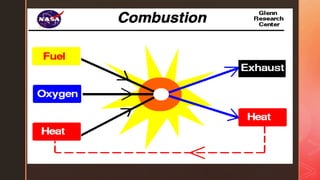
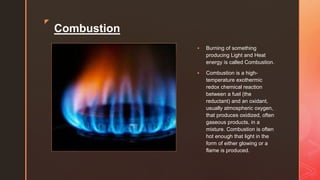
Combustion
 Burning of something
producing Light and Heat
energy is called Combustion.
 Combustion is a high-
temperature exothermic
redox chemical reaction
between a fuel (the
reductant) and an oxidant,
usually atmospheric oxygen,
that produces oxidized, often
gaseous products, in a
mixture. Combustion is often
hot enough that light in the
form of either glowing or a
flame is produced.
z
Reactions involved in Combustion
 Combustion reactions always involve molecular oxygen O2.
Anytime anything burns (in the usual sense), it is a combustion
reaction. Combustion reactions are almost always exothermic
(i.e., they give off heat). For example when wood burns, it must
do so in the presence of O2 and a lot of heat is produced
z
z
 Wood as well as many common items that combust are organic
(i.e., they are made up of carbon, hydrogen and oxygen). When
organic molecules combust the reaction, products are carbon
dioxide and water (as well as heat).
 Simply all Organic material consisting Carbon Hydrogen and
Oxygen are combustible
 Organic Material + O2  CO2 +
H2O + Heat
 (consisting Carbon Oxygen Hydrogen)
z
z
When ever a Volatile HydroCarbons are
ignited they catch Fire.This is also
Combustion
z

z
Smoldering
 This type of combustion, though characterized by the presence
of incandescence and smoke, produces no flame. A relatively
slow process, smoldering occurs between the oxygen in air and
the surfaces of solid fuels such as coal, peat, wood, tobacco,
and synthetic foams. These solid fuels glow when smoldering,
indicating temperatures in excess of one thousand degrees
Celsius. It may proceed even under oxygen-deficient conditions,
provided the environment is hot enough. Smoldering, an
incomplete combustion reaction, produces high levels of carbon
monoxide.
z
Examples of Smouldering
z Diffusion Combustion
 Diffusion combustion results from the transfer of fuel vapors and
oxygen across a concentration gradient into a reaction zone
characterized by high temperatures and the correct proportion of
reactants. Vapors may come initially from a solid fuel such as
candle wax, a liquid fuel like alcohol, or a gaseous fuel like
methane used in a typical Bunsen burner.
z
Examples of Diffusion Combustion
z
Rapid Combustion
 Rapid combustion releases massive amounts of energy in the
form of heat and light, as is the case with fire. In some cases,
combustion occurs so fast that large amounts of gas are
released along with heat and light, causing a significant pressure
shift in the surrounding atmosphere. This pressure shift, often
accompanied by a very loud noise, is called an explosion.
Internal combustion engines convert the energy produced by
rapid combustion into usable kinetic energy.
z
z
Spontaneous Heating and Combustion
 Spontaneous heating and combustion differs from most other types
of combustion in that no external ignition source is required for it to
proceed. An extremely slow process, spontaneous combustion can
take up to several weeks. It consists of the gradual oxidation of
certain materials when exposed to air, and is greatly dependent on
the fuel’s heat-retaining capacity. As heat builds up, the rate of
reaction increases, eventually causing smoldering or flaming
combustion when the temperature rises above the fuel’s ignition
point. Spontaneous combustion occurs in a variety of organic and
inorganic materials, such as hay, coal, linseed oil, manure and
cotton.
z
Spontaneous Combustion Example
z

z
(Heating Values)
 The heating value (or energy value or calorific value) of a
substance,{usually a fuel or food} is the amount of heat released
during the combustion of a specified amount of it.
z
Units of Heating Value
The amount of heat can be measured by following units :
 Calorie
 Kilocalorie
 British Thermal Unit ( BTU)
 Centigrade Heat Unit ( CHU)
z
 The calorific value is the total energy released as heat when a substance undergoes
complete combustion with oxygen under standard conditions. The chemical reaction
is typically a hydrocarbon or other organic molecule reacting with oxygen to form
carbon dioxide and water and release heat.
Heating value is used identified the efficiency of a fuel
It may be expressed with the quantities:
 energy/mole of fuel
 energy/mass of fuel
 energy/volume of the fuel
z
Heatng value is commonly determined by bomb calorimeter.
Bomb calorimeter is a type of constant volume calorimeter used in
measuring the heat of combustion
z
z
Types of Heating Values
 With Fuels containing Hydrogen Heating Value(calorific Value)
can be catergorized as two
 types :

 Higher or Gross Calorific Value (GCV)
 Lower or Net Calorifc Value (NCV)
z
1.Gross Calorific Value: -
 It is defined as “ Total amount of heat liberated when a unit mass
of fuel is burnt completely”
 OR
 “The product of combustion are cooled to room temperature”.
 When a fuel is burnt the hydrogen is converted into Steam, If the
product is cooled down the steam is condensed into water
thereby increasing Latent Heat Value. This latent heat of
condensation of steam is included in GCV. A good fuel
possess GCV.
z
2.Net Calorific Value: -
 It is defined as “ The net heat produced when unit mass is
completely burnt and the products of combustion are allowed to
escape”.
 The quantity known as lower heating value is determined by
subtracting the heat of vaporization of the water from the higher
heating value. Under normal working conditions water vapours
produced during combustion are not condensed and escape
along with hot gases. Hence lesser amount of heat is
available which is called Lower or Net Calorific Value.

z
z
z
Relation of Heating Values with Moisture
z

z
Efficiency: -
 Efficiency is the measure of "usefulness" of an operation,
process or machine - and can be expressed on the generic form.
 μ = Wo / Wi
 where
 μ = efficiency
 Wo = output from the operation - can be work, power, produced
products .
 Wi = input to the operation - can work, power, input products .
z
Combustion Efficiency: -
 Actual heat produced by combustion, divided by total heat potential of the
fuel consumed.
 OR
 Combustion efficiency is a measurement of how glowing the fuel being
burned is being utilized in the combustion process.
 OR
 The relative amount of time a fire burns in the flaming phase of combustion,
as compared to smoldering combustion. A ratio of the amount of fuel that is
consumed in flaming combustion compared to the amount of fuel
consumed during the smoldering phase, in which more of the fuel material
is emitted as smoke particles because it is not turned into carbon dioxide
and water.
z
 Combustion efficiency is a measurement of how well the fuel being burned is being
utilized in the combustion process.
 Combustion efficiency is total amount of heat available from the fuel minus the losses
from the gasses going up the stack. Stack loss is a measure of the heat carried away
by dry flue gases and the moisture loss. It is a good indicator of appliance efficiency.
The stack temperature is the temperature of the combustion gases (dry and water
vapor) leaving the appliance, and reflects the energy that did not transfer from the fuel
to the heat exchanger. The lower the stack temperature, the more effective the heat
exchanger design or heat transfer and the higher the fuel-to-air/water/steam efficiency
is. The combustion efficiency calculation considers both the stack temperature and the
net heat and moisture losses. This would include losses from dry gas plus losses from
the moisture and losses from the production of CO.
z
Graphical Representation of
Combustion Efficiency
z
Factors affecting the Combustion
Efficiency:
 These are the some factors, which affects on the efficiency of
combustion of any fuel in industry.
 Excess Air
 Flue gas temperature
 Convection & Radiation losses
 Fuel specification
 Ambient temperature
z
Excess Air:
 Excess air is the amount of air in a combustion process greater than the
amount theoretically required for complete oxidation. To ensure complete
combustion of the fuel used, combustion chambers are supplied with
excess air. Excess air increase the amount of oxygen to the combustion.
When fuel and oxygen from the air are in perfect balance - the combustion
is said to be stoichiometric. The combustion efficiency increases with
increased excess air until the heat loss in the excess air is larger than the
heat provided by more efficient combustion. Excess air is used to minimize
the production of NOx and carbon monoxide by managing the flame
temperature.
 The excess air ultimately absorbs a portion of the heat from
combustion. As a result, it reduces the efficiency of the transference of heat
to the system.
z
Flue Gas Temperature:
 "Stack temperature" or flue gas temperature measures the
temperature of the combustion gases when they leave the
system(boiler). If the flue gas temperature is high, it suggests
the heat created by the system isn't being effectively used to
generate steam. In other words, a high flue gas temperature
suggests heat is being lost.
z
Convection & Radiation losses:
 Convection and radiation losses are the losses of heat
emanating from the boiler during standard operation. Simply put,
we can't do anything about convection and radiation losses
because they're inevitable. Even though they're inevitable.
z
Fuel specification:
 Fuel specification can have a dramatic effect on combustion
efficiency. Addressing this issue is as simple as establishing the
proper specifications for fuel and making sure the actual fuel
meets the documentation criteria.
 Due to the high content of hydrogen for industrial boilers relying
on natural gas, fuel specification should be of the utmost
importance. It's important to understand that a significant portion
of the hydrogen is transformed into water during combustion. It
could be more aptly used in the process of combustion.
z
Ambient temperature:
 The temperature of the combustion air entering the boiler is called ambient
temperature. Another definition for ambient temperature is the temperature
of the air impelled by the forced draft fan. Ambient temperature can have a
relatively noticeable effect on combustion efficiency.
 It can also have an impact on combustion efficiency calculations due to it
affecting the net stack temperature. Net stack temperature is the difference
between the flue gas temp and the ambient temperature.
 Although it's tempting to minimize ambient temperature with hopes
of lowering flue gas temp, a 40 degree alteration in ambient temperature
can affect combustion efficiency by one percent or more.
z
How is Combustion Efficiency
calculated?
 The objective of a boiler is to burn the hydrogen contained in the
fuel with oxygen from the atmosphere to produce heat.
Combustion efficiency analysers exploit the fact that by knowing
the fuel (and its chemical composition) and measuring the flue
gas temperature and either the oxygen or carbon dioxide level
the combustion efficiency of the boiler can be calculated. On
some boilers the settings can then be adjusted to maximize the
combustion efficiency.
z In a perfect world the maximum efficiency would be achieved with 0% oxygen in the flue
and the lowest flue gas temperature. The settings on a boiler must allow for differences
in fuel composition, atmospheric pressure, wind direction, boiler demands etc.

 If the oxygen level is set too low and something changes the combustion process can
become 'fuel rich' as there is insufficient oxygen for all the fuel to burn. This can cause
high levels of CO to be generated and in the extreme enough fuel to enter boilers flue
and ignite (explode) outside the combustion chamber.

 The combustion efficiency of modern condensing gas boiler can theoretically be over
100% as heat is extracted from the incoming air. A traditional brick built coal fired boiler
may only be 50% efficient.
z
z
z
Combustion Efficiency for Natural Gas
z

Heating values and combustion efficiency

  • 1.
    z Heating Values and CombustionEfficiency Murtaza Shah 16CH48
  • 2.
    z Heating Values andCombustion Efficiency  Heating Value or Calorific value and Combustion Efficiency are related with Combustion so for understanding phenomenon of heating values and Combustion efficiency we must know what is Combustion
  • 3.
    z Combustion  Rapid chemicalcombination of a substance with oxygen, involving the production of heat and light is called Combustion.
  • 4.
  • 5.
    zz Combustion  Burning ofsomething producing Light and Heat energy is called Combustion.  Combustion is a high- temperature exothermic redox chemical reaction between a fuel (the reductant) and an oxidant, usually atmospheric oxygen, that produces oxidized, often gaseous products, in a mixture. Combustion is often hot enough that light in the form of either glowing or a flame is produced.
  • 6.
    z Reactions involved inCombustion  Combustion reactions always involve molecular oxygen O2. Anytime anything burns (in the usual sense), it is a combustion reaction. Combustion reactions are almost always exothermic (i.e., they give off heat). For example when wood burns, it must do so in the presence of O2 and a lot of heat is produced
  • 7.
  • 8.
    z  Wood aswell as many common items that combust are organic (i.e., they are made up of carbon, hydrogen and oxygen). When organic molecules combust the reaction, products are carbon dioxide and water (as well as heat).  Simply all Organic material consisting Carbon Hydrogen and Oxygen are combustible  Organic Material + O2  CO2 + H2O + Heat  (consisting Carbon Oxygen Hydrogen)
  • 9.
  • 10.
    z When ever aVolatile HydroCarbons are ignited they catch Fire.This is also Combustion
  • 11.
  • 12.
    z Smoldering  This typeof combustion, though characterized by the presence of incandescence and smoke, produces no flame. A relatively slow process, smoldering occurs between the oxygen in air and the surfaces of solid fuels such as coal, peat, wood, tobacco, and synthetic foams. These solid fuels glow when smoldering, indicating temperatures in excess of one thousand degrees Celsius. It may proceed even under oxygen-deficient conditions, provided the environment is hot enough. Smoldering, an incomplete combustion reaction, produces high levels of carbon monoxide.
  • 13.
  • 14.
    z Diffusion Combustion Diffusion combustion results from the transfer of fuel vapors and oxygen across a concentration gradient into a reaction zone characterized by high temperatures and the correct proportion of reactants. Vapors may come initially from a solid fuel such as candle wax, a liquid fuel like alcohol, or a gaseous fuel like methane used in a typical Bunsen burner.
  • 15.
  • 16.
    z Rapid Combustion  Rapidcombustion releases massive amounts of energy in the form of heat and light, as is the case with fire. In some cases, combustion occurs so fast that large amounts of gas are released along with heat and light, causing a significant pressure shift in the surrounding atmosphere. This pressure shift, often accompanied by a very loud noise, is called an explosion. Internal combustion engines convert the energy produced by rapid combustion into usable kinetic energy.
  • 17.
  • 18.
    z Spontaneous Heating andCombustion  Spontaneous heating and combustion differs from most other types of combustion in that no external ignition source is required for it to proceed. An extremely slow process, spontaneous combustion can take up to several weeks. It consists of the gradual oxidation of certain materials when exposed to air, and is greatly dependent on the fuel’s heat-retaining capacity. As heat builds up, the rate of reaction increases, eventually causing smoldering or flaming combustion when the temperature rises above the fuel’s ignition point. Spontaneous combustion occurs in a variety of organic and inorganic materials, such as hay, coal, linseed oil, manure and cotton.
  • 19.
  • 20.
  • 21.
    z (Heating Values)  Theheating value (or energy value or calorific value) of a substance,{usually a fuel or food} is the amount of heat released during the combustion of a specified amount of it.
  • 22.
    z Units of HeatingValue The amount of heat can be measured by following units :  Calorie  Kilocalorie  British Thermal Unit ( BTU)  Centigrade Heat Unit ( CHU)
  • 23.
    z  The calorificvalue is the total energy released as heat when a substance undergoes complete combustion with oxygen under standard conditions. The chemical reaction is typically a hydrocarbon or other organic molecule reacting with oxygen to form carbon dioxide and water and release heat. Heating value is used identified the efficiency of a fuel It may be expressed with the quantities:  energy/mole of fuel  energy/mass of fuel  energy/volume of the fuel
  • 24.
    z Heatng value iscommonly determined by bomb calorimeter. Bomb calorimeter is a type of constant volume calorimeter used in measuring the heat of combustion
  • 25.
  • 26.
    z Types of HeatingValues  With Fuels containing Hydrogen Heating Value(calorific Value) can be catergorized as two  types :   Higher or Gross Calorific Value (GCV)  Lower or Net Calorifc Value (NCV)
  • 27.
    z 1.Gross Calorific Value:-  It is defined as “ Total amount of heat liberated when a unit mass of fuel is burnt completely”  OR  “The product of combustion are cooled to room temperature”.  When a fuel is burnt the hydrogen is converted into Steam, If the product is cooled down the steam is condensed into water thereby increasing Latent Heat Value. This latent heat of condensation of steam is included in GCV. A good fuel possess GCV.
  • 28.
    z 2.Net Calorific Value:-  It is defined as “ The net heat produced when unit mass is completely burnt and the products of combustion are allowed to escape”.  The quantity known as lower heating value is determined by subtracting the heat of vaporization of the water from the higher heating value. Under normal working conditions water vapours produced during combustion are not condensed and escape along with hot gases. Hence lesser amount of heat is available which is called Lower or Net Calorific Value. 
  • 29.
  • 30.
  • 31.
    z Relation of HeatingValues with Moisture
  • 32.
  • 33.
    z Efficiency: -  Efficiencyis the measure of "usefulness" of an operation, process or machine - and can be expressed on the generic form.  μ = Wo / Wi  where  μ = efficiency  Wo = output from the operation - can be work, power, produced products .  Wi = input to the operation - can work, power, input products .
  • 34.
    z Combustion Efficiency: - Actual heat produced by combustion, divided by total heat potential of the fuel consumed.  OR  Combustion efficiency is a measurement of how glowing the fuel being burned is being utilized in the combustion process.  OR  The relative amount of time a fire burns in the flaming phase of combustion, as compared to smoldering combustion. A ratio of the amount of fuel that is consumed in flaming combustion compared to the amount of fuel consumed during the smoldering phase, in which more of the fuel material is emitted as smoke particles because it is not turned into carbon dioxide and water.
  • 35.
    z  Combustion efficiencyis a measurement of how well the fuel being burned is being utilized in the combustion process.  Combustion efficiency is total amount of heat available from the fuel minus the losses from the gasses going up the stack. Stack loss is a measure of the heat carried away by dry flue gases and the moisture loss. It is a good indicator of appliance efficiency. The stack temperature is the temperature of the combustion gases (dry and water vapor) leaving the appliance, and reflects the energy that did not transfer from the fuel to the heat exchanger. The lower the stack temperature, the more effective the heat exchanger design or heat transfer and the higher the fuel-to-air/water/steam efficiency is. The combustion efficiency calculation considers both the stack temperature and the net heat and moisture losses. This would include losses from dry gas plus losses from the moisture and losses from the production of CO.
  • 36.
  • 37.
    z Factors affecting theCombustion Efficiency:  These are the some factors, which affects on the efficiency of combustion of any fuel in industry.  Excess Air  Flue gas temperature  Convection & Radiation losses  Fuel specification  Ambient temperature
  • 38.
    z Excess Air:  Excessair is the amount of air in a combustion process greater than the amount theoretically required for complete oxidation. To ensure complete combustion of the fuel used, combustion chambers are supplied with excess air. Excess air increase the amount of oxygen to the combustion. When fuel and oxygen from the air are in perfect balance - the combustion is said to be stoichiometric. The combustion efficiency increases with increased excess air until the heat loss in the excess air is larger than the heat provided by more efficient combustion. Excess air is used to minimize the production of NOx and carbon monoxide by managing the flame temperature.  The excess air ultimately absorbs a portion of the heat from combustion. As a result, it reduces the efficiency of the transference of heat to the system.
  • 39.
    z Flue Gas Temperature: "Stack temperature" or flue gas temperature measures the temperature of the combustion gases when they leave the system(boiler). If the flue gas temperature is high, it suggests the heat created by the system isn't being effectively used to generate steam. In other words, a high flue gas temperature suggests heat is being lost.
  • 40.
    z Convection & Radiationlosses:  Convection and radiation losses are the losses of heat emanating from the boiler during standard operation. Simply put, we can't do anything about convection and radiation losses because they're inevitable. Even though they're inevitable.
  • 41.
    z Fuel specification:  Fuelspecification can have a dramatic effect on combustion efficiency. Addressing this issue is as simple as establishing the proper specifications for fuel and making sure the actual fuel meets the documentation criteria.  Due to the high content of hydrogen for industrial boilers relying on natural gas, fuel specification should be of the utmost importance. It's important to understand that a significant portion of the hydrogen is transformed into water during combustion. It could be more aptly used in the process of combustion.
  • 42.
    z Ambient temperature:  Thetemperature of the combustion air entering the boiler is called ambient temperature. Another definition for ambient temperature is the temperature of the air impelled by the forced draft fan. Ambient temperature can have a relatively noticeable effect on combustion efficiency.  It can also have an impact on combustion efficiency calculations due to it affecting the net stack temperature. Net stack temperature is the difference between the flue gas temp and the ambient temperature.  Although it's tempting to minimize ambient temperature with hopes of lowering flue gas temp, a 40 degree alteration in ambient temperature can affect combustion efficiency by one percent or more.
  • 43.
    z How is CombustionEfficiency calculated?  The objective of a boiler is to burn the hydrogen contained in the fuel with oxygen from the atmosphere to produce heat. Combustion efficiency analysers exploit the fact that by knowing the fuel (and its chemical composition) and measuring the flue gas temperature and either the oxygen or carbon dioxide level the combustion efficiency of the boiler can be calculated. On some boilers the settings can then be adjusted to maximize the combustion efficiency.
  • 44.
    z In aperfect world the maximum efficiency would be achieved with 0% oxygen in the flue and the lowest flue gas temperature. The settings on a boiler must allow for differences in fuel composition, atmospheric pressure, wind direction, boiler demands etc.   If the oxygen level is set too low and something changes the combustion process can become 'fuel rich' as there is insufficient oxygen for all the fuel to burn. This can cause high levels of CO to be generated and in the extreme enough fuel to enter boilers flue and ignite (explode) outside the combustion chamber.   The combustion efficiency of modern condensing gas boiler can theoretically be over 100% as heat is extracted from the incoming air. A traditional brick built coal fired boiler may only be 50% efficient.
  • 45.
  • 46.