Dead-Time Compensation 
(纯滞后补偿) 
Lei Xie 
Institute of Industrial Control, 
Zhejiang University, Hangzhou, P. R. 
China
Contents 
 Introduction 
 Smith Predictor for Dead-Time 
Compensation 
 Improved Smith Predictor 
 Simulation Examples 
 Summary
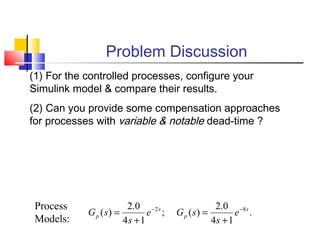
Problem Discussion 
(1) For the controlled processes, configure your 
Simulink model & compare their results. 
(2) Can you provide some compensation approaches 
for processes with variable & notable dead-time ? 
Process 
G ( s ) 2.0 e 
- 
2s 
Models: ; 
p ( ) 2.0 8s 
p e 
G s - 
= . 
s 
+ 
4 1 
s 
+ 
4 1 
=
Conventional PID Control Systems 
Process 
G ( s ) 2.0 e 
- 
2s 
Models: ; 
p ( ) 2.0 8s 
p e 
G s - 
= . 
s 
+ 
4 1 
s 
+ 
4 1 
= 
Question:Use Ziegler-Nichols or Lambda tuning method to obtain 
PID parameters and compare their values. 
Please see the SimuLink model …SISODelayPlant / PIDLoop.mdl
Simulation Example #1 
0 20 40 60 80 100 120 140 160 180 200 
78 
76 
74 
72 
70 
68 
66 
64 
62 
60 
58 
Output of Transmitter 
Time, min 
% 
setpoint 
Ziegler-Nichols Tuning 
Lambda Tuning 
; 
( ) 2.0 2s 
p e 
G s - 
s 
+ 
4 1 
= 
For PID Controller, 
Z-N tuning: Kc = 1.2, 
Ti = 4 min, Td = 1 min 
Lambda tuning: 
Kc = 0.83, Ti = 4 min , 
Td = 1 min
Simulation Example #2 
0 20 40 60 80 100 120 140 160 180 200 
80 
78 
76 
74 
72 
70 
68 
66 
64 
62 
60 
58 
Time, min 
% 
Output of Transmitter 
set point 
Z-N tuning 
Lambda tuning, Td = 1 min 
Lambda tuning, Td = 4 min 
( ) = 2.0 - 
8 ; 
p G s e 
s 
+ 
4 1 
s 
For PID Controller, 
Z-N tuning: Kc = 0.3, 
Ti = 16 min, Td = 4 min 
Lambda tuning: 
Kc = 0.2, Ti = 4 min , 
Td = 1 min
Smith’s Idea (1957) 
D (s) 
+ 
Process 
R (s) Y (s) 
Gc(s) + 
Kpgp (s) + _ 
e-t s 
D (s) 
+ 
Process 
R (s) Y (s) 
Gc(s) + 
Kpgp (s) + _ 
e-t s
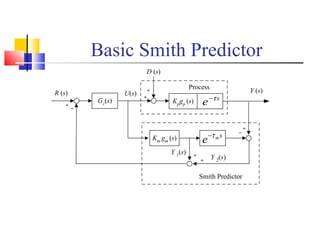
Basic Smith Predictor 
D (s) 
Process 
R (s) + 
Y (s) 
Gc(s) + 
Kpgp (s) + _ 
e-t s 
U(s) 
Km gm (s) s e-t m 
+ _ 
Y 2(s) 
Smith Predictor 
Y 1(s) + 
+
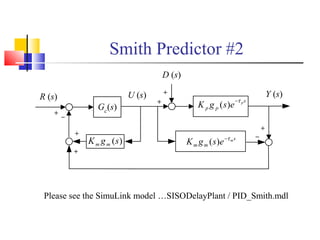
Smith Predictor #2 
+ _ 
+ 
Gc(s) + 
D (s) 
R (s) Y (s) 
+ 
_ 
U (s) s 
K g s e p -t ( ) 
p p 
K g (s) m m 
+ 
+ 
s 
K g (s)e-t m 
m m 
Please see the SimuLink model …SISODelayPlant / PID_Smith.mdl
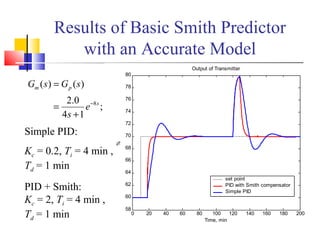
Results of Basic Smith Predictor 
with an Accurate Model 
0 20 40 60 80 100 120 140 160 180 200 
80 
78 
76 
74 
72 
70 
68 
66 
64 
62 
60 
58 
Time, min 
% 
Output of Transmitter 
set point 
PID with Smith compensator 
Simple PID 
G s G s 
= 
= 
m p 
2.0 - 
8 
; 
4 1 
( ) ( ) 
s 
e 
s 
+ 
Simple PID: 
Kc = 0.2, Ti = 4 min , 
Td = 1 min 
PID + Smith: 
Kc = 2, Ti = 4 min , 
Td = 1 min
Results of Basic Smith Predictor 
with an Inaccurate Model 
0 20 40 60 80 100 120 140 160 180 200 
85 
80 
75 
70 
65 
60 
55 
Time, min 
% 
Output of Transmitter 
set point 
PID + Smith 
Simple PID 
( ) 2.0 - 
8 
; 
- 
6 
G s e 
s 
+ 
4 1 
= 
( ) 2.0 
G s e 
s 
+ 
4 1 
s 
m 
s 
p 
= 
Simple PID: 
Kc = 0.2, Ti = 4 min , 
Td = 1 min 
PID + Smith: 
Kc = 2, Ti = 4 min , 
Td = 1 min
Improved Smith Predictor 
+ _ 
+ 
Gc(s) + 
D (s) 
R (s) Y (s) 
+ 
_ 
U (s) s 
K g s e p -t ( ) 
p p 
K g (s) m m 
+ 
+ 
s 
K g (s)e-t m 
m m 
Gf(s) 
1 
( ) 1 
+ 
= 
T s 
G s 
f 
Prediction Error Filter : f
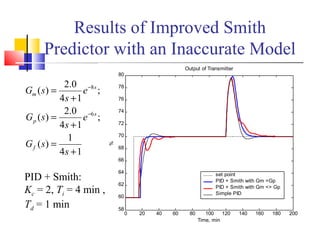
Results of Improved Smith 
Predictor with an Inaccurate Model 
0 20 40 60 80 100 120 140 160 180 200 
80 
78 
76 
74 
72 
70 
68 
66 
64 
62 
60 
58 
Time, min 
% 
Output of Transmitter 
set point 
PID + Smith with Gm =Gp 
PID + Smith with Gm <> Gp 
Simple PID 
( ) 2.0 - 
8 
s 
; 
G s e 
s 
= 
+ 
( ) 2.0 - 
6 
; 
4 1 
G s e 
s 
+ 
4 1 
= 
( ) 1 
s 
+ 
4 1 
m 
s 
p 
G s 
f 
= 
PID + Smith: 
Kc = 2, Ti = 4 min , 
Td = 1 min
Summary 
 The principle of Smith predictor for dead-time 
compensation 
 Improved Smith predictor for a controlled 
process with an inaccurate model 
 Comparison of the Simple PID and the PID 
with a Smith predictor
Next Topic: Coupling of Multivariable 
Systems and Decoupling 
 Concept of Relative Gains 
 Calculation of Relative Gain Matrix 
 Rule of CVs and MVs Pairing 
 Linear Decoupler from Block Diagrams 
 Nonlinear Decoupler from Basic Principles 
 Application Examples
Problem Discussion 
for Next Topic 
For the two-input-two-input 
controlled system, design 
your control schemes. 
Suppose that 
F = F + F C = C F + 
C F 
, 1 1 2 2 
; 
1 2 F + 
F 
1 2 
; 
F 0.5 5 
s 
m m 
2 1 
, 
C 
, 1 
1 
4 1 
+ 
= 
+ 
= 
+ 
= 
- 
s 
e 
A 
C 
C s 
F s 
Initial states: 
F 0 
= F 0 
= C = C = 
1 2 
75, 25, 60%, 40%. 1 2

7 2 dead time compensation

  • 1.
    Dead-Time Compensation (纯滞后补偿) Lei Xie Institute of Industrial Control, Zhejiang University, Hangzhou, P. R. China
  • 2.
    Contents  Introduction  Smith Predictor for Dead-Time Compensation  Improved Smith Predictor  Simulation Examples  Summary
  • 3.
    Problem Discussion (1)For the controlled processes, configure your Simulink model & compare their results. (2) Can you provide some compensation approaches for processes with variable & notable dead-time ? Process G ( s ) 2.0 e - 2s Models: ; p ( ) 2.0 8s p e G s - = . s + 4 1 s + 4 1 =
  • 4.
    Conventional PID ControlSystems Process G ( s ) 2.0 e - 2s Models: ; p ( ) 2.0 8s p e G s - = . s + 4 1 s + 4 1 = Question:Use Ziegler-Nichols or Lambda tuning method to obtain PID parameters and compare their values. Please see the SimuLink model …SISODelayPlant / PIDLoop.mdl
  • 5.
    Simulation Example #1 0 20 40 60 80 100 120 140 160 180 200 78 76 74 72 70 68 66 64 62 60 58 Output of Transmitter Time, min % setpoint Ziegler-Nichols Tuning Lambda Tuning ; ( ) 2.0 2s p e G s - s + 4 1 = For PID Controller, Z-N tuning: Kc = 1.2, Ti = 4 min, Td = 1 min Lambda tuning: Kc = 0.83, Ti = 4 min , Td = 1 min
  • 6.
    Simulation Example #2 0 20 40 60 80 100 120 140 160 180 200 80 78 76 74 72 70 68 66 64 62 60 58 Time, min % Output of Transmitter set point Z-N tuning Lambda tuning, Td = 1 min Lambda tuning, Td = 4 min ( ) = 2.0 - 8 ; p G s e s + 4 1 s For PID Controller, Z-N tuning: Kc = 0.3, Ti = 16 min, Td = 4 min Lambda tuning: Kc = 0.2, Ti = 4 min , Td = 1 min
  • 7.
    Smith’s Idea (1957) D (s) + Process R (s) Y (s) Gc(s) + Kpgp (s) + _ e-t s D (s) + Process R (s) Y (s) Gc(s) + Kpgp (s) + _ e-t s
  • 8.
    Basic Smith Predictor D (s) Process R (s) + Y (s) Gc(s) + Kpgp (s) + _ e-t s U(s) Km gm (s) s e-t m + _ Y 2(s) Smith Predictor Y 1(s) + +
  • 9.
    Smith Predictor #2 + _ + Gc(s) + D (s) R (s) Y (s) + _ U (s) s K g s e p -t ( ) p p K g (s) m m + + s K g (s)e-t m m m Please see the SimuLink model …SISODelayPlant / PID_Smith.mdl
  • 10.
    Results of BasicSmith Predictor with an Accurate Model 0 20 40 60 80 100 120 140 160 180 200 80 78 76 74 72 70 68 66 64 62 60 58 Time, min % Output of Transmitter set point PID with Smith compensator Simple PID G s G s = = m p 2.0 - 8 ; 4 1 ( ) ( ) s e s + Simple PID: Kc = 0.2, Ti = 4 min , Td = 1 min PID + Smith: Kc = 2, Ti = 4 min , Td = 1 min
  • 11.
    Results of BasicSmith Predictor with an Inaccurate Model 0 20 40 60 80 100 120 140 160 180 200 85 80 75 70 65 60 55 Time, min % Output of Transmitter set point PID + Smith Simple PID ( ) 2.0 - 8 ; - 6 G s e s + 4 1 = ( ) 2.0 G s e s + 4 1 s m s p = Simple PID: Kc = 0.2, Ti = 4 min , Td = 1 min PID + Smith: Kc = 2, Ti = 4 min , Td = 1 min
  • 12.
    Improved Smith Predictor + _ + Gc(s) + D (s) R (s) Y (s) + _ U (s) s K g s e p -t ( ) p p K g (s) m m + + s K g (s)e-t m m m Gf(s) 1 ( ) 1 + = T s G s f Prediction Error Filter : f
  • 13.
    Results of ImprovedSmith Predictor with an Inaccurate Model 0 20 40 60 80 100 120 140 160 180 200 80 78 76 74 72 70 68 66 64 62 60 58 Time, min % Output of Transmitter set point PID + Smith with Gm =Gp PID + Smith with Gm <> Gp Simple PID ( ) 2.0 - 8 s ; G s e s = + ( ) 2.0 - 6 ; 4 1 G s e s + 4 1 = ( ) 1 s + 4 1 m s p G s f = PID + Smith: Kc = 2, Ti = 4 min , Td = 1 min
  • 14.
    Summary  Theprinciple of Smith predictor for dead-time compensation  Improved Smith predictor for a controlled process with an inaccurate model  Comparison of the Simple PID and the PID with a Smith predictor
  • 15.
    Next Topic: Couplingof Multivariable Systems and Decoupling  Concept of Relative Gains  Calculation of Relative Gain Matrix  Rule of CVs and MVs Pairing  Linear Decoupler from Block Diagrams  Nonlinear Decoupler from Basic Principles  Application Examples
  • 16.
    Problem Discussion forNext Topic For the two-input-two-input controlled system, design your control schemes. Suppose that F = F + F C = C F + C F , 1 1 2 2 ; 1 2 F + F 1 2 ; F 0.5 5 s m m 2 1 , C , 1 1 4 1 + = + = + = - s e A C C s F s Initial states: F 0 = F 0 = C = C = 1 2 75, 25, 60%, 40%. 1 2