Hypovolemic Shock Due to Bleeding

           Mr. NAZIM JAT
                FRCS
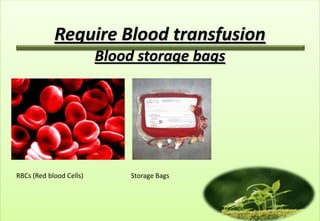
Require Blood transfusion
                         Blood storage bags


RBCs (Red blood Cells)        Storage Bags
CPDA BLOOD BAG
•   SPECIFICATIONS
•   Primary Bag capacity available in 150ml to 500ml
•   Donor needle gauge size: 16G to 17G
•   Package: Each set packed in one compounded
    vacuum pouch
CPDA BLOOD BAG
OPTIONAL FEATURES
• Attached Blood Sampling Bag
• Needle Protector
• Tube Holder
• "Y" injection port
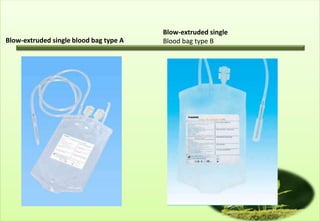
Blow-extruded single
Blow-extruded single blood bag type A   Blood bag type B
TRANSFER BAG
1. Bag capacity available in 150ml to 1000ml
2. Package: Each set packed in one PE compounded
   vacuum pouch, and then 100 to 150 sets packed
   in one carton
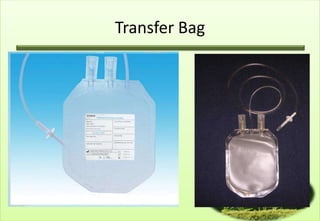
3. Standard Set: Two entry ports and one tube with
   a transfer spike.
4. Optional features: Two entry ports or one entry
   port, With or without transfer spike, Rolled Bag
   or Blow-extruded Bag
Transfer Bag
Transfusion
• Blood Transfusion become availabe in 1829
• Now a days no severe reactions to transfusion
  seen.
• Immunosuppresion to host occurs.
Blood & Blood Products
• Donated Blood are leucodepleted as a precaution
  against creutzfeldt-Jakob Diseases (transmissible
  spongiform encephalopathies )
Types of Blood Available
1.   Whole Blood
2.   Packed Red Cells
3.   Fresh Frozen Plasma
4.   Cryoprecipitate
5.   Platelets
6.   Prothrombin Complex Concentrates
7.   Autologous blood
Packed red cells
• Packed red blood cells are cells that are spun
  down and concentrated. Each unit is
  approximately 330ml and has a haematocrit of 50-
  70%. Packed cells are stored in a SAG-M solution
  (Saline-adenine-glucose-mannitol)to increase their
  shelf-life to 5 weeks at 2-60C. (Older storage
  regimens included storage in CPD – citrate-
  Phosphate-dextrose solutions –giving cells a shelf-
  life of 2-3 weeks).
Fresh Frozen Plasma
FFP is rich in coagulation factors
• It is removed from fresh blood and stored at -40
   to 50 0C with a 2 year shelf life.
• It is the first line therapy in the treatment of
   coagulopathic haemorrhage.
• Rhesus D positive FFP may be given to a Rhesus D
   negative woman
Cryoprecipitate
• Cryoprecipitate is a supernatant precipitate of FFp
  and is rich In factor VIII and fibrinogen.
• It is stored at -30oC with a 2 year shelf life.
• It is given in low fibrinogen states or in cases of
  factor VIII deficiency.
Platelets
• Platelets are supplied as a pooled platelet
  concentrate containing about 250×109 cells per
  litre.
• Platelets are stored on a special agitator at 20-240
  C and have a shelf life of only 5 days
• Platelets Transfusions are given to patients with
  thrombocycopenia.
Prothrombin Complex Concentrates
• Prothrombin complex concentrates (PCCs) are
  highly purified concentrates prepared frompooled
  plasma.
• They contain factors II,IX and X; factor VII may be
  included or produced seperately.
• PCCs are indicated for the emergency reversal of
  anti- coagulant (warfarin) therapy in uncontrolled
  haemorrhage.
Autologous blood
• Pre donation of their own blood patients
  undergoing elective surgery up to 3 weeks surgery
  of retransfusion.
• Collected in a cell saver, ( which washes and
  collects red blood cells) which can then be
  returned to the patient.
Indication of blood Transfusion
• Acute blood loss, to replace circulating volume
  and maintain oxygen delivery
• Perioperative anaemia, to ensure adequate
  oxygen delivery during to perioperative phase
• Symptomatic      chronic      anaemia     without
  hemorrhage or impending surgery.
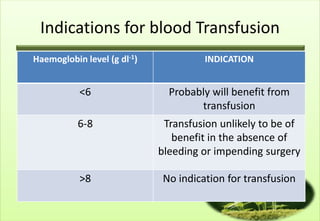
Indications for blood Transfusion
Haemoglobin level (g dl-1)            INDICATION


           <6                  Probably will benefit from
                                     transfusion
           6-8                Transfusion unlikely to be of
                                benefit in the absence of
                             bleeding or impending surgery

           >8                No indication for transfusion
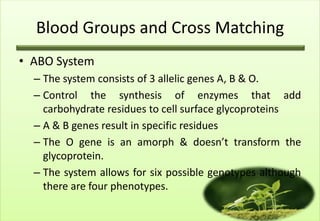
Blood Groups and Cross Matching
• ABO System
  – The system consists of 3 allelic genes A, B & O.
  – Control the synthesis of enzymes that add
    carbohydrate residues to cell surface glycoproteins
  – A & B genes result in specific residues
  – The O gene is an amorph & doesn’t transform the
    glycoprotein.
  – The system allows for six possible genotypes although
    there are four phenotypes.
ABO blood group System
Phenotype        Genotype         Antigen           Antibodies       Frequency (%)
O                OO               O                 Anti-A, Anti-B   46
A                AA or AO         A                 Anti-B           42
B                BB or BO         B                 Anti-A           9
AB               AB               AB                None             3

                        Rhesus System
The Rhesus D [Rh(D)] antigen is strongly antigenic.
Antibodies to the D antigen are not naturally present in the serum of the
remaining 15% of individuals but their formation may be stimulated by the
transfusion of Rh-positive red cells or they may be acquired during delivery of
a Rh(D) positive baby.
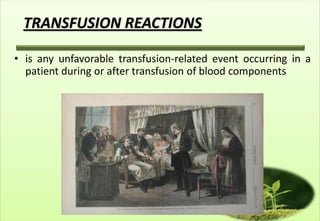
TRANSFUSION REACTIONS

• is any unfavorable transfusion-related event occurring in a
  patient during or after transfusion of blood components
TRANSFUSION REACTIONS

@RBC’s !
• Nonhemolytic 1-5 % transfusions
  Causes -Physical or chemical destruction of
            blood: freezing, heating, hemolytic drug
           -solution added to blood
             -Bacterial contamination
   : fever, chills, urticaria
    – Slow transfusion, diphenhydramine , antipyretic for fever
• Hemolytic
   – Immediate: ABO incompatibility (1/ 12-33,000) with fatality (1/ 500-800,000)
     Majority are group O patients receiving
   type A, B or AB blood Complement activation,
    RBC lysis, free Hb (+ direct Coombs Ab test)
Cross Matching
• Full cross matching of blood takes 45 min in most
  laboratories.
• In more urgent situations, “type-specific” blood is
  provided can be issued within 10-15 min.
• When blood must be given in an emergency,
  group O (Universal donor) blood is given (O- to
  female patients, O+ to male patients)
Complications of blood Transfusion
• From a Single Transfusion
   –   Incompatibility haemolytic transfusion reaction
   –   Febrile transfusion reaction
   –   Allergic reaction
   –   Infection
        •   Bacterial infection (usually as a result of faculty storage)
        •   Hepatitis
        •   HIV
        •   Malaria
   – Air embolism
   – Thrombophylebitis
   – Transfusion related acute lung injury (usually from FFP)
Complications of blood Transfusion
• From Massive Transfusion
  – Coagulopathy
  – Hypocalcaemia
  – Hyperkalaemia
  – Hypokalaemia
  – Hypothermia
 Patient who receive repeated transfusions e.g
 Patient with thalessaemia may develop iron
 overload
Management of Coagulopathy
• Standard Guidelines
  – FFP if prothrombin time (PT) or partial Thromboplastin
    time (PTT) > 1.5 × normal
  – Cryoprecipitate if fibrinogen < 0.8 gl-1
  – Platelets if platelet count < 50 × 109 ml-1
Blood Substitutes
• Blood substitutes are either biomimetic or abiotic
  – Biomimetic substitutes mimic the standard oxygen-
    carrying capacity of the blood and are haemoglobin
    based
  – Abiotic substutes are synthetic oxygen carriers and are
    currently primarily per fluorocarbon based.
Plasma Expanders
• Dextran            is        a           complex,
  branched glucan (polysaccharide made of
  many glucose molecules) composed of chains of
  varying lengths (from 3 to 2000 kilodaltons). It is
  used medicinally as an antithrombotic (anti-
  platelet), to reduce blood viscosity, and as a
  volume expander in anemia.
“Blood is still the best possible thing to have in our
                         veins” - Woody Allen


               Blood transfusion is a lot like marriage.
It should not be entered upon lightly, unadvisedly or wantonly,
         or more often than is absolutely necessary” - Beal
Questions & Comments
1.   CPDA bags
a.   Blood storage bags.
b.   Urine storage bags.
c.   Its saline storage bags
d.   Its coffee storage bags
e.   Not always sterile
Questions & Comments
2. Following are the true statements about types of
  blood available for transfusion
a. Whole blood
b. Packed red cells
c. Fresh frozen plasma (FFP)
d. Autologous blood
e. Blood stored more than 6 months
Questions & Comments
3. Following are true about FFP
a. Rich in coagulation factor
b. Remove from fresh blood
c. Stored at -40 to 500 C
d. It is first line treatment of coagulapathic
    haemorrhage
e. It can be used even after 4 years
Questions & Comments
4. Autologous blood is
a. Blood from other individual
b. Blood from same individual taken from 1 vein &
   given through the other vein.
c. Its blood taken 3 weeks before surgery from the
   same patient for the re transfusion
d. Its blood collected from animal.
e. It is blood mix with saline.
5. Transfusion Reaction are
a. Always haemolytic
b. Never haemolytic
c. Can be haemolytic
d. Never febrile
e. Never associated with vomiting.
6.shockblood transfusion)

6.shockblood transfusion)

  • 3.
    Hypovolemic Shock Dueto Bleeding Mr. NAZIM JAT FRCS
  • 4.
    Require Blood transfusion Blood storage bags RBCs (Red blood Cells) Storage Bags
  • 5.
    CPDA BLOOD BAG • SPECIFICATIONS • Primary Bag capacity available in 150ml to 500ml • Donor needle gauge size: 16G to 17G • Package: Each set packed in one compounded vacuum pouch
  • 6.
    CPDA BLOOD BAG OPTIONALFEATURES • Attached Blood Sampling Bag • Needle Protector • Tube Holder • "Y" injection port
  • 7.
    Blow-extruded single Blow-extruded singleblood bag type A Blood bag type B
  • 8.
    TRANSFER BAG 1. Bagcapacity available in 150ml to 1000ml 2. Package: Each set packed in one PE compounded vacuum pouch, and then 100 to 150 sets packed in one carton 3. Standard Set: Two entry ports and one tube with a transfer spike. 4. Optional features: Two entry ports or one entry port, With or without transfer spike, Rolled Bag or Blow-extruded Bag
  • 9.
  • 10.
    Transfusion • Blood Transfusionbecome availabe in 1829 • Now a days no severe reactions to transfusion seen. • Immunosuppresion to host occurs.
  • 11.
    Blood & BloodProducts • Donated Blood are leucodepleted as a precaution against creutzfeldt-Jakob Diseases (transmissible spongiform encephalopathies )
  • 12.
    Types of BloodAvailable 1. Whole Blood 2. Packed Red Cells 3. Fresh Frozen Plasma 4. Cryoprecipitate 5. Platelets 6. Prothrombin Complex Concentrates 7. Autologous blood
  • 13.
    Packed red cells •Packed red blood cells are cells that are spun down and concentrated. Each unit is approximately 330ml and has a haematocrit of 50- 70%. Packed cells are stored in a SAG-M solution (Saline-adenine-glucose-mannitol)to increase their shelf-life to 5 weeks at 2-60C. (Older storage regimens included storage in CPD – citrate- Phosphate-dextrose solutions –giving cells a shelf- life of 2-3 weeks).
  • 14.
    Fresh Frozen Plasma FFPis rich in coagulation factors • It is removed from fresh blood and stored at -40 to 50 0C with a 2 year shelf life. • It is the first line therapy in the treatment of coagulopathic haemorrhage. • Rhesus D positive FFP may be given to a Rhesus D negative woman
  • 15.
    Cryoprecipitate • Cryoprecipitate isa supernatant precipitate of FFp and is rich In factor VIII and fibrinogen. • It is stored at -30oC with a 2 year shelf life. • It is given in low fibrinogen states or in cases of factor VIII deficiency.
  • 16.
    Platelets • Platelets aresupplied as a pooled platelet concentrate containing about 250×109 cells per litre. • Platelets are stored on a special agitator at 20-240 C and have a shelf life of only 5 days • Platelets Transfusions are given to patients with thrombocycopenia.
  • 17.
    Prothrombin Complex Concentrates •Prothrombin complex concentrates (PCCs) are highly purified concentrates prepared frompooled plasma. • They contain factors II,IX and X; factor VII may be included or produced seperately. • PCCs are indicated for the emergency reversal of anti- coagulant (warfarin) therapy in uncontrolled haemorrhage.
  • 18.
    Autologous blood • Predonation of their own blood patients undergoing elective surgery up to 3 weeks surgery of retransfusion. • Collected in a cell saver, ( which washes and collects red blood cells) which can then be returned to the patient.
  • 19.
    Indication of bloodTransfusion • Acute blood loss, to replace circulating volume and maintain oxygen delivery • Perioperative anaemia, to ensure adequate oxygen delivery during to perioperative phase • Symptomatic chronic anaemia without hemorrhage or impending surgery.
  • 20.
    Indications for bloodTransfusion Haemoglobin level (g dl-1) INDICATION <6 Probably will benefit from transfusion 6-8 Transfusion unlikely to be of benefit in the absence of bleeding or impending surgery >8 No indication for transfusion
  • 21.
    Blood Groups andCross Matching • ABO System – The system consists of 3 allelic genes A, B & O. – Control the synthesis of enzymes that add carbohydrate residues to cell surface glycoproteins – A & B genes result in specific residues – The O gene is an amorph & doesn’t transform the glycoprotein. – The system allows for six possible genotypes although there are four phenotypes.
  • 22.
    ABO blood groupSystem Phenotype Genotype Antigen Antibodies Frequency (%) O OO O Anti-A, Anti-B 46 A AA or AO A Anti-B 42 B BB or BO B Anti-A 9 AB AB AB None 3 Rhesus System The Rhesus D [Rh(D)] antigen is strongly antigenic. Antibodies to the D antigen are not naturally present in the serum of the remaining 15% of individuals but their formation may be stimulated by the transfusion of Rh-positive red cells or they may be acquired during delivery of a Rh(D) positive baby.
  • 23.
    TRANSFUSION REACTIONS • isany unfavorable transfusion-related event occurring in a patient during or after transfusion of blood components
  • 24.
    TRANSFUSION REACTIONS @RBC’s ! •Nonhemolytic 1-5 % transfusions Causes -Physical or chemical destruction of blood: freezing, heating, hemolytic drug -solution added to blood -Bacterial contamination : fever, chills, urticaria – Slow transfusion, diphenhydramine , antipyretic for fever • Hemolytic – Immediate: ABO incompatibility (1/ 12-33,000) with fatality (1/ 500-800,000) Majority are group O patients receiving type A, B or AB blood Complement activation, RBC lysis, free Hb (+ direct Coombs Ab test)
  • 25.
    Cross Matching • Fullcross matching of blood takes 45 min in most laboratories. • In more urgent situations, “type-specific” blood is provided can be issued within 10-15 min. • When blood must be given in an emergency, group O (Universal donor) blood is given (O- to female patients, O+ to male patients)
  • 26.
    Complications of bloodTransfusion • From a Single Transfusion – Incompatibility haemolytic transfusion reaction – Febrile transfusion reaction – Allergic reaction – Infection • Bacterial infection (usually as a result of faculty storage) • Hepatitis • HIV • Malaria – Air embolism – Thrombophylebitis – Transfusion related acute lung injury (usually from FFP)
  • 27.
    Complications of bloodTransfusion • From Massive Transfusion – Coagulopathy – Hypocalcaemia – Hyperkalaemia – Hypokalaemia – Hypothermia Patient who receive repeated transfusions e.g Patient with thalessaemia may develop iron overload
  • 28.
    Management of Coagulopathy •Standard Guidelines – FFP if prothrombin time (PT) or partial Thromboplastin time (PTT) > 1.5 × normal – Cryoprecipitate if fibrinogen < 0.8 gl-1 – Platelets if platelet count < 50 × 109 ml-1
  • 29.
    Blood Substitutes • Bloodsubstitutes are either biomimetic or abiotic – Biomimetic substitutes mimic the standard oxygen- carrying capacity of the blood and are haemoglobin based – Abiotic substutes are synthetic oxygen carriers and are currently primarily per fluorocarbon based.
  • 30.
    Plasma Expanders • Dextran is a complex, branched glucan (polysaccharide made of many glucose molecules) composed of chains of varying lengths (from 3 to 2000 kilodaltons). It is used medicinally as an antithrombotic (anti- platelet), to reduce blood viscosity, and as a volume expander in anemia.
  • 31.
    “Blood is stillthe best possible thing to have in our veins” - Woody Allen Blood transfusion is a lot like marriage. It should not be entered upon lightly, unadvisedly or wantonly, or more often than is absolutely necessary” - Beal
  • 32.
  • 33.
    Questions & Comments 1. CPDA bags a. Blood storage bags. b. Urine storage bags. c. Its saline storage bags d. Its coffee storage bags e. Not always sterile
  • 34.
    Questions & Comments 2.Following are the true statements about types of blood available for transfusion a. Whole blood b. Packed red cells c. Fresh frozen plasma (FFP) d. Autologous blood e. Blood stored more than 6 months
  • 35.
    Questions & Comments 3.Following are true about FFP a. Rich in coagulation factor b. Remove from fresh blood c. Stored at -40 to 500 C d. It is first line treatment of coagulapathic haemorrhage e. It can be used even after 4 years
  • 36.
    Questions & Comments 4.Autologous blood is a. Blood from other individual b. Blood from same individual taken from 1 vein & given through the other vein. c. Its blood taken 3 weeks before surgery from the same patient for the re transfusion d. Its blood collected from animal. e. It is blood mix with saline.
  • 37.
    5. Transfusion Reactionare a. Always haemolytic b. Never haemolytic c. Can be haemolytic d. Never febrile e. Never associated with vomiting.