Introduction

 Blood transfusion can be life-saving & many
  areas of surgery could not be undertaken
  without reliable transfusion support.

 Tansfusion of blood & its components carries
  potential risks, which must be outweighed by
  the patient’s need.
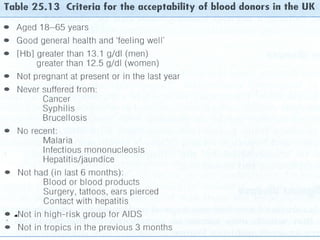
Criteria for Acceptability of
Blood Donors
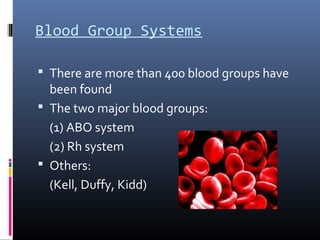
Blood Group Systems

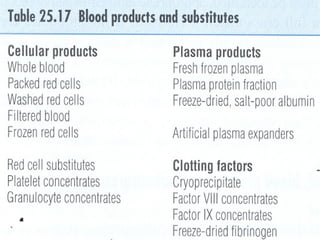
 There are more than 400 blood groups have
  been found
 The two major blood groups:
  (1) ABO system
  (2) Rh system
 Others:
  (Kell, Duffy, Kidd)
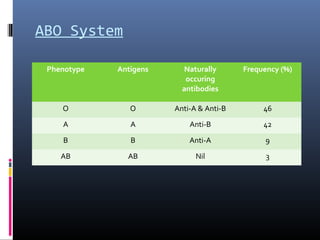
ABO System

 Phenotype   Antigens     Naturally       Frequency (%)
                           occuring
                          antibodies

    O           O       Anti-A & Anti-B        46
    A           A           Anti-B             42
    B           B           Anti-A             9
    AB         AB             Nil               3
Principles of Cross-match

 Blood is selected on the basis of ABO & Rh D
  group.
 Check compatibility between potential donor
  red cells & recipient serum.
 Takes about 40 minutes.
 O –ve group can be used in extreme
  emergency situations.
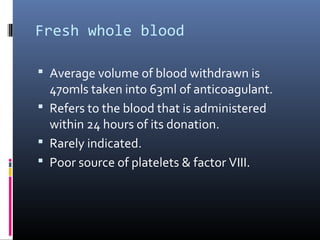
Fresh whole blood

 Average volume of blood withdrawn is
  470mls taken into 63ml of anticoagulant.
 Refers to the blood that is administered
  within 24 hours of its donation.
 Rarely indicated.
 Poor source of platelets & factor VIII.
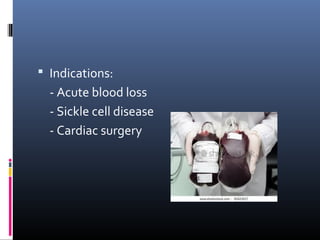
 Indications:
  - Acute blood loss
  - Sickle cell disease
  - Cardiac surgery
Red cell concentrates

 Product of choice for most clinical situations.
 Concentrated suspension of RBCs can be
  prepared by removing most of the
  supernatant plasma after centrifugation.
 The preparation reduces but does not
  eliminate reaction caused by plasma
  components.
 Reduces Na+, K+, lactic acid & citrate
  administered.
 Provides oxygen-carrying capacity.
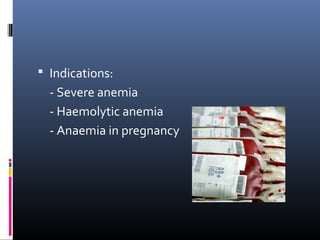
 Indications:
  - Severe anemia
  - Haemolytic anemia
  - Anaemia in pregnancy
Platelet concentrates

 Made either from centrifugation of whole
  blood or from an individual donor using
  apheresis.
 An adult dose is manufactured from 4
  separate donations pooled together or 1
  apheresis collection.
 Carry a greater risk of bacterial
  contamination as they cannot be
  refrigerated.
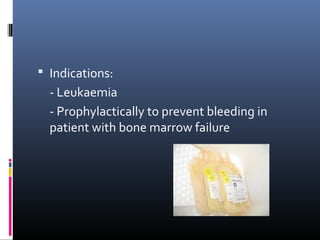
 Indications:
  - Leukaemia
  - Prophylactically to prevent bleeding in
  patient with bone marrow failure
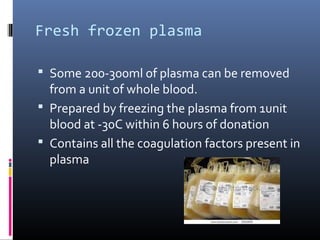
Fresh frozen plasma

 Some 200-300ml of plasma can be removed
  from a unit of whole blood.
 Prepared by freezing the plasma from 1unit
  blood at -30C within 6 hours of donation
 Contains all the coagulation factors present in
  plasma
 Indications:
  - Burns
  - Liver disease
  - Congenital coagulation disorders
  - DIC
Cryoprecipitate

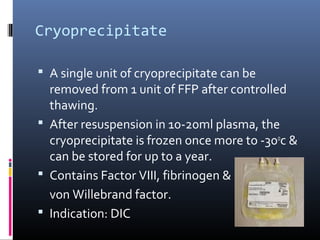
 A single unit of cryoprecipitate can be
  removed from 1 unit of FFP after controlled
  thawing.
 After resuspension in 10-20ml plasma, the
  cryoprecipitate is frozen once more to -30oc &
  can be stored for up to a year.
 Contains Factor VIII, fibrinogen &
  von Willebrand factor.
 Indication: DIC
Factor VIII and IX
concentrates
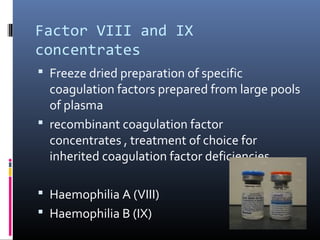
 Freeze dried preparation of specific
  coagulation factors prepared from large pools
  of plasma
 recombinant coagulation factor
  concentrates , treatment of choice for
  inherited coagulation factor deficiencies.

 Haemophilia A (VIII)
 Haemophilia B (IX)
Human albumin

 Human albumin solution 20%
 200 g/L albumin and 130 mmol/L sodium
 Indicated for treatment of acute severe
  hypoalbuminemia
Granulocyte concentrate

 Prepared from single donor using cell
  separatos and are used for pt with severe
  neutropenia with evidence of bacterial
  infection.
 Numbers of granulocytes increase by treating
  donors with G-CSF and steroids
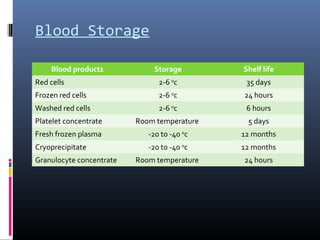
Blood Storage

    Blood products            Storage        Shelf life
Red cells                       2-6 oc        35 days
Frozen red cells                2-6 oc       24 hours
Washed red cells                2-6 oc        6 hours
Platelet concentrate      Room temperature    5 days
Fresh frozen plasma          -20 to -40 oc   12 months
Cryoprecipitate              -20 to -40 oc   12 months
Granulocyte concentrate   Room temperature   24 hours
Types of Blood Transfusion

 Homologous
 – from a volunteer donor ; interval between 2
 donations of at least 2 months

 Autologous
 – pre-operative collection & re-infusion on
 requirement.
 - possible if Hb > 11g%; No infection; Fit for
 anesthesia.
Autologous transfusion

1. Pre-operative donation
2. Isovolemic haemodilution
3. Cell salvage

Pre-operative donation
  - blood withdrawn pre-operatively & stored
  for up to 35-42 days.
  - up to 5 units of patient’s own blood made
  available, with the last unit being collected
  48-72 hours before surgery.
Isovolemic haemodilution
  - restricted to patients anticipated with
  significant blood loss (>1000ml).
  - up to 1.5L of blood withdrawn + standard
  anticoagulant  replaced by saline to
  maintain blood volume.
  - fall in Hct reduces the loss of RBCs
  - withdrawn blood re-infused either during or
  after surgery.
Cell salvage
  - blood collected from the operation site
  either directly during surgery or by the use of
  collection devices attached to surgical drains.
  - during surgery, blood collected by suction
   processed by a cell salvage machine
  (anticoagulated + washed to remove clots &
  debris)  returned to patient
  - post-operative drainage returned to patient,
  most commonly not washed.
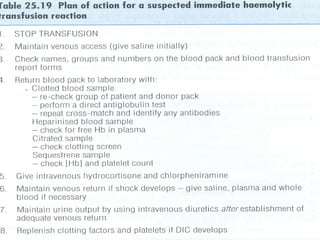
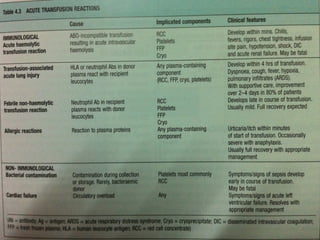
Acute Blood Transfusion
Reactions
 Immunological:
  - acute haemolytic transfusion reaction
  - transfusion related acute lung injury
  - febrile non-haemolytic transfusion reaction
  - allergic reactions

 Non-immunological:
  - bacterial contamination
  - cardiac failure
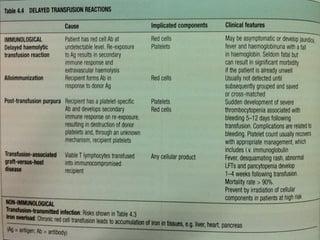
Chronic Blood Transfusion
Reactions
 Immunological:
  - delayed haemolytic transfusion reaction
  - alloimmunization
  - post-transfusion purpura
  - transfusion associated graft-versus-host
  disease

 Non-immunological:
  - transfusion-transmitted infections (HIV, hepatitis, CMV,
  Syphilis, Malaria)

  - iron overload
Blood transfusion
Blood transfusion
Blood transfusion
Blood transfusion

Blood transfusion

  • 2.
    Introduction  Blood transfusioncan be life-saving & many areas of surgery could not be undertaken without reliable transfusion support.  Tansfusion of blood & its components carries potential risks, which must be outweighed by the patient’s need.
  • 3.
  • 6.
    Blood Group Systems There are more than 400 blood groups have been found  The two major blood groups: (1) ABO system (2) Rh system  Others: (Kell, Duffy, Kidd)
  • 7.
    ABO System Phenotype Antigens Naturally Frequency (%) occuring antibodies O O Anti-A & Anti-B 46 A A Anti-B 42 B B Anti-A 9 AB AB Nil 3
  • 8.
    Principles of Cross-match Blood is selected on the basis of ABO & Rh D group.  Check compatibility between potential donor red cells & recipient serum.  Takes about 40 minutes.  O –ve group can be used in extreme emergency situations.
  • 10.
    Fresh whole blood Average volume of blood withdrawn is 470mls taken into 63ml of anticoagulant.  Refers to the blood that is administered within 24 hours of its donation.  Rarely indicated.  Poor source of platelets & factor VIII.
  • 11.
     Indications: - Acute blood loss - Sickle cell disease - Cardiac surgery
  • 12.
    Red cell concentrates Product of choice for most clinical situations.  Concentrated suspension of RBCs can be prepared by removing most of the supernatant plasma after centrifugation.  The preparation reduces but does not eliminate reaction caused by plasma components.  Reduces Na+, K+, lactic acid & citrate administered.  Provides oxygen-carrying capacity.
  • 13.
     Indications: - Severe anemia - Haemolytic anemia - Anaemia in pregnancy
  • 14.
    Platelet concentrates  Madeeither from centrifugation of whole blood or from an individual donor using apheresis.  An adult dose is manufactured from 4 separate donations pooled together or 1 apheresis collection.  Carry a greater risk of bacterial contamination as they cannot be refrigerated.
  • 15.
     Indications: - Leukaemia - Prophylactically to prevent bleeding in patient with bone marrow failure
  • 16.
    Fresh frozen plasma Some 200-300ml of plasma can be removed from a unit of whole blood.  Prepared by freezing the plasma from 1unit blood at -30C within 6 hours of donation  Contains all the coagulation factors present in plasma
  • 17.
     Indications: - Burns - Liver disease - Congenital coagulation disorders - DIC
  • 18.
    Cryoprecipitate  A singleunit of cryoprecipitate can be removed from 1 unit of FFP after controlled thawing.  After resuspension in 10-20ml plasma, the cryoprecipitate is frozen once more to -30oc & can be stored for up to a year.  Contains Factor VIII, fibrinogen & von Willebrand factor.  Indication: DIC
  • 19.
    Factor VIII andIX concentrates  Freeze dried preparation of specific coagulation factors prepared from large pools of plasma  recombinant coagulation factor concentrates , treatment of choice for inherited coagulation factor deficiencies.  Haemophilia A (VIII)  Haemophilia B (IX)
  • 20.
    Human albumin  Humanalbumin solution 20%  200 g/L albumin and 130 mmol/L sodium  Indicated for treatment of acute severe hypoalbuminemia
  • 21.
    Granulocyte concentrate  Preparedfrom single donor using cell separatos and are used for pt with severe neutropenia with evidence of bacterial infection.  Numbers of granulocytes increase by treating donors with G-CSF and steroids
  • 22.
    Blood Storage Blood products Storage Shelf life Red cells 2-6 oc 35 days Frozen red cells 2-6 oc 24 hours Washed red cells 2-6 oc 6 hours Platelet concentrate Room temperature 5 days Fresh frozen plasma -20 to -40 oc 12 months Cryoprecipitate -20 to -40 oc 12 months Granulocyte concentrate Room temperature 24 hours
  • 23.
    Types of BloodTransfusion  Homologous – from a volunteer donor ; interval between 2 donations of at least 2 months  Autologous – pre-operative collection & re-infusion on requirement. - possible if Hb > 11g%; No infection; Fit for anesthesia.
  • 24.
    Autologous transfusion 1. Pre-operativedonation 2. Isovolemic haemodilution 3. Cell salvage Pre-operative donation - blood withdrawn pre-operatively & stored for up to 35-42 days. - up to 5 units of patient’s own blood made available, with the last unit being collected 48-72 hours before surgery.
  • 25.
    Isovolemic haemodilution - restricted to patients anticipated with significant blood loss (>1000ml). - up to 1.5L of blood withdrawn + standard anticoagulant  replaced by saline to maintain blood volume. - fall in Hct reduces the loss of RBCs - withdrawn blood re-infused either during or after surgery.
  • 26.
    Cell salvage - blood collected from the operation site either directly during surgery or by the use of collection devices attached to surgical drains. - during surgery, blood collected by suction  processed by a cell salvage machine (anticoagulated + washed to remove clots & debris)  returned to patient - post-operative drainage returned to patient, most commonly not washed.
  • 27.
    Acute Blood Transfusion Reactions Immunological: - acute haemolytic transfusion reaction - transfusion related acute lung injury - febrile non-haemolytic transfusion reaction - allergic reactions  Non-immunological: - bacterial contamination - cardiac failure
  • 28.
    Chronic Blood Transfusion Reactions Immunological: - delayed haemolytic transfusion reaction - alloimmunization - post-transfusion purpura - transfusion associated graft-versus-host disease  Non-immunological: - transfusion-transmitted infections (HIV, hepatitis, CMV, Syphilis, Malaria) - iron overload