COMPLICATION
INVOLVED WITH
ORTHOGNATHIC
SURGERY
Common
complication
Post
operative
nausea
and
vomiting Infection
Excessive
bleeding
Soft tissue
damage
Localized
skin burn
Loss of
pulpal
activity
Periodonta
l disease
Gingival
recession
Nerve
exposure
Temporary
taste
disrupt
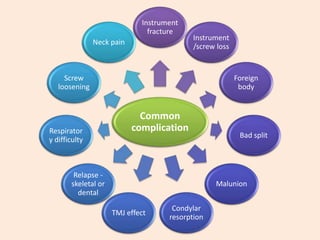
Common
complication
Instrument
fracture
Instrument
/screw loss
Foreign
body
Bad split
Malunion
Condylar
resorption
TMJ effect
Relapse -
skeletal or
dental
Respirator
y difficulty
Screw
loosening
Neck pain
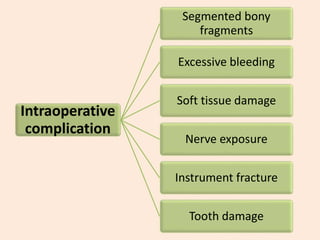
Intraoperative
complication
Segmented bony
fragments
Excessive bleeding
Soft tissue damage
Nerve exposure
Instrument fracture
Tooth damage
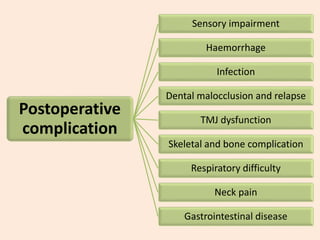
Postoperative
complication
Sensory impairment
Haemorrhage
Infection
Dental malocclusion and relapse
TMJ dysfunction
Skeletal and bone complication
Respiratory difficulty
Neck pain
Gastrointestinal disease
SOFT TISSUE DAMAGE
• Prolonged traction on lips and mucosa to
secure the operative field and facilitate access
• Instrument scraping the soft tissue
• Jaw osteotomies are carried out through
incisions in the mouth
• Incisions are made in the mucosal lining
usually at the junction of cheek and lip with
the upper or lower jaw
• For lower jaw surgery, there will be a 3mm
“stab” incision at the angle of the jaw
• Generally heal to virtually invisible scars
within 1-2 months after the operation,
although rarely there may be a small
depression or tiny scar remaining
• If a bone graft has been used from the hip, the
scar will remain a little conspicuous for 6 to 8
months and it will never disappear entirely.
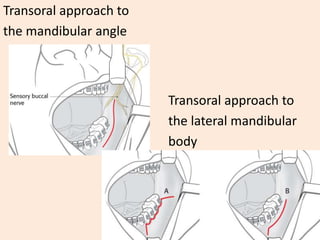
Transoral approach to
the mandibular angle
Transoral approach to
the lateral mandibular
body
Intraoral approach to the symphysis and body
Intraoral approach to
the condylar process
and ramus
HAEMORRHAGE
• During or after the operation
• Reactionary haemorrhage - first 24 hours
• Secondary haemorrhage occurs 5 to 7 days
usually the result of infection
• If bleeding is excessive during an operation, a
transfusion may be required
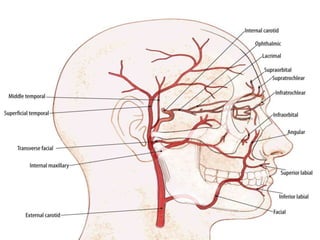
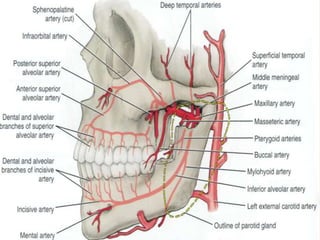
Facial artery
• Dissection
• Osteotomy of the mandibular margin
Inferior alveolar artery
• Sharp instruments severed it
• Distal bone fragment tears the artery
WOUND INFECTION
• Uncommon in upper or lower jaw osteotomies
• Minor, small abscess or redness of the skin
• Serious or life-threatening.
NERVE INJURIES
• Trigeminal nerve
–The nerve is dissected out over a distance of
approximately 4cm
–Sensory neuropathy
–Lower jaw osteotomies - numbness in the lower
lip and chin - immediate postoperative period
–Temporary and usually wears off over a period
of several weeks to several months sometimes
up to 12 months
–Occasionally permanent
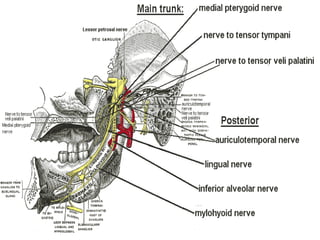
• Inferior alveolar
– Cut during the bone dissection
– Thorn during the separation and movement of the
distal segment
– Unfavourable fracture
– Large mandibular advancement
• The lingual nerve
– Small risk during the operation of lower jaw
osteotomy
– Lingual sensory neuropathy is not common in
mandibular osteotomy
– Nerve stretching
– Bruising of the nerve by retraction or screw
positioning.
SKELETAL AND BONE COMPLICATION
• Condylar resorption
– Pre-existing TMJ derangement
– High mandibular plane angle
– Posteriorly inclined condylar neck
– Large advancement
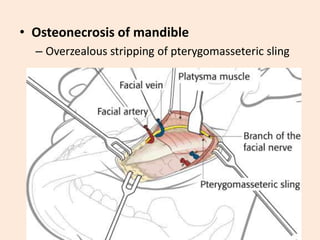
• Osteonecrosis of mandible
– Overzealous stripping of pterygomasseteric sling
Dental malocclusion and relapse
• Anterior open bite
– higher occurrence in high angle patients when
mandible is advanced
• Relapse
– With rigid fixation, this is no longer a problem
– the larger the jaw movement, the greater is the
chance and degree of relapse
– Relapse may also occur after removal of the
orthodontic bands and braces
Reference
• Saluja, S. (2014, Feb 25). Complication of Orthognathic
surgery. Retrieved from
http://www.slideshare.net/shivanisaluja11/complicatio
ns-orthognathic-surgery
• Maxillofacial & Orthodontics Unit (2013, March) A
guide for patients considering orthognathic jaw
surgery. Retrieved from
http://www.qvh.nhs.uk/assets/patient_information/A
%20guide%20for%20pts%20considering%20orthognat
hic%20surgery%20-Rvw%20March%202013.pdf

6.complication involved with orthognathic surgery ppt

  • 1.
  • 2.
    Common complication Post operative nausea and vomiting Infection Excessive bleeding Soft tissue damage Localized skinburn Loss of pulpal activity Periodonta l disease Gingival recession Nerve exposure Temporary taste disrupt
  • 3.
    Common complication Instrument fracture Instrument /screw loss Foreign body Bad split Malunion Condylar resorption TMJeffect Relapse - skeletal or dental Respirator y difficulty Screw loosening Neck pain
  • 4.
    Intraoperative complication Segmented bony fragments Excessive bleeding Softtissue damage Nerve exposure Instrument fracture Tooth damage
  • 5.
    Postoperative complication Sensory impairment Haemorrhage Infection Dental malocclusionand relapse TMJ dysfunction Skeletal and bone complication Respiratory difficulty Neck pain Gastrointestinal disease
  • 6.
    SOFT TISSUE DAMAGE •Prolonged traction on lips and mucosa to secure the operative field and facilitate access • Instrument scraping the soft tissue • Jaw osteotomies are carried out through incisions in the mouth • Incisions are made in the mucosal lining usually at the junction of cheek and lip with the upper or lower jaw
  • 7.
    • For lowerjaw surgery, there will be a 3mm “stab” incision at the angle of the jaw • Generally heal to virtually invisible scars within 1-2 months after the operation, although rarely there may be a small depression or tiny scar remaining • If a bone graft has been used from the hip, the scar will remain a little conspicuous for 6 to 8 months and it will never disappear entirely.
  • 8.
    Transoral approach to themandibular angle Transoral approach to the lateral mandibular body
  • 9.
    Intraoral approach tothe symphysis and body Intraoral approach to the condylar process and ramus
  • 10.
    HAEMORRHAGE • During orafter the operation • Reactionary haemorrhage - first 24 hours • Secondary haemorrhage occurs 5 to 7 days usually the result of infection • If bleeding is excessive during an operation, a transfusion may be required
  • 11.
    Facial artery • Dissection •Osteotomy of the mandibular margin Inferior alveolar artery • Sharp instruments severed it • Distal bone fragment tears the artery
  • 14.
    WOUND INFECTION • Uncommonin upper or lower jaw osteotomies • Minor, small abscess or redness of the skin • Serious or life-threatening.
  • 15.
    NERVE INJURIES • Trigeminalnerve –The nerve is dissected out over a distance of approximately 4cm –Sensory neuropathy –Lower jaw osteotomies - numbness in the lower lip and chin - immediate postoperative period –Temporary and usually wears off over a period of several weeks to several months sometimes up to 12 months –Occasionally permanent
  • 16.
    • Inferior alveolar –Cut during the bone dissection – Thorn during the separation and movement of the distal segment – Unfavourable fracture – Large mandibular advancement • The lingual nerve – Small risk during the operation of lower jaw osteotomy – Lingual sensory neuropathy is not common in mandibular osteotomy – Nerve stretching – Bruising of the nerve by retraction or screw positioning.
  • 18.
    SKELETAL AND BONECOMPLICATION • Condylar resorption – Pre-existing TMJ derangement – High mandibular plane angle – Posteriorly inclined condylar neck – Large advancement
  • 19.
    • Osteonecrosis ofmandible – Overzealous stripping of pterygomasseteric sling
  • 20.
    Dental malocclusion andrelapse • Anterior open bite – higher occurrence in high angle patients when mandible is advanced • Relapse – With rigid fixation, this is no longer a problem – the larger the jaw movement, the greater is the chance and degree of relapse – Relapse may also occur after removal of the orthodontic bands and braces
  • 21.
    Reference • Saluja, S.(2014, Feb 25). Complication of Orthognathic surgery. Retrieved from http://www.slideshare.net/shivanisaluja11/complicatio ns-orthognathic-surgery • Maxillofacial & Orthodontics Unit (2013, March) A guide for patients considering orthognathic jaw surgery. Retrieved from http://www.qvh.nhs.uk/assets/patient_information/A %20guide%20for%20pts%20considering%20orthognat hic%20surgery%20-Rvw%20March%202013.pdf

Editor's Notes

  • #15 Essential to maintain scrupulous oral hygiene both before and after the operation. A prophylactic is recommended before operation
  • #16 sensory neuropathy - numbness, pins and needles, burning, or itching or the sensation of ants crawling across the skin