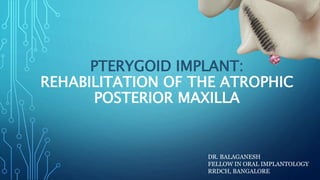
PTERYGOID IMPLANT:
REHABILITATION OF THE ATROPHIC
POSTERIOR MAXILLA
DR. BALAGANESH
FELLOW IN ORAL IMPLANTOLOGY
RRDCH, BANGALORE
INTRODUCTION
 Rehabilitation of the maxillary anterior region has been far
easier than the maxillary posterior region due to various
factors.
 The posterior maxillary region is characterized by ,
(1) Inadequate residual bone height due to maxillary sinus
expansion . and/or alveolar bone resorption.
(2) Poor bone density (Type III or IV) according to Lekholm
& Zarb . classification system.
 Sinus lift procedures
 Guided bone regeneration with
autogenous and allogenous bone
grafts
 Tilted implants (All-on-4)
 Zygomatic implants
 Sinus membrane perforation
 Rejection of graft
 Graft displacement into sinus cavities
 Screw loosening of tilted implants.
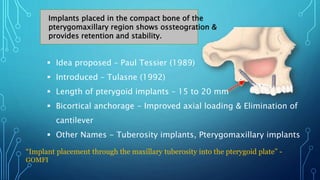
Implants placed in the compact bone of the
pterygomaxillary region shows ossteogration &
provides retention and stability.
 Idea proposed – Paul Tessier (1989)
 Introduced – Tulasne (1992)
 Length of pterygoid implants – 15 to 20 mm
 Bicortical anchorage - Improved axial loading & Elimination of
cantilever
 Other Names - Tuberosity implants, Pterygomaxillary implants
“Implant placement through the maxillary tuberosity into the pterygoid plate” -
GOMFI
ANATOMY OF PTERYGOID REGION
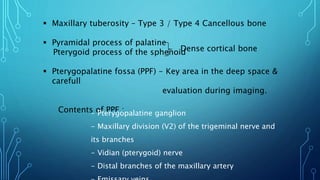
 Maxillary tuberosity – Type 3 / Type 4 Cancellous bone
 Pyramidal process of palatine
Pterygoid process of the sphenoid
 Pterygopalatine fossa (PPF) - Key area in the deep space &
carefull
evaluation during imaging.
Contents of PPF :
Dense cortical bone
- Pterygopalatine ganglion
- Maxillary division (V2) of the trigeminal nerve and
its branches
- Vidian (pterygoid) nerve
- Distal branches of the maxillary artery
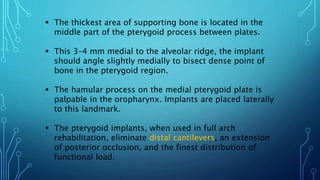
 The thickest area of supporting bone is located in the
middle part of the pterygoid process between plates.
 This 3–4 mm medial to the alveolar ridge, the implant
should angle slightly medially to bisect dense point of
bone in the pterygoid region.
 The hamular process on the medial pterygoid plate is
palpable in the oropharynx. Implants are placed laterally
to this landmark.
 The pterygoid implants, when used in full arch
rehabilitation, eliminate distal cantilevers, an extension
of posterior occlusion, and the finest distribution of
functional load.
REISER’S CLASSIFICATION OF PTERYGOID IMPLANTS
(Based on Anatomical location)
 Tuberosity – pyramidal process
 Tuberosity – pterygoid process
 Tuberosity – pyramidal process – pterygoid
process
 Pyramidal process – pterygoid process
 Maxillary tuberosity
PARP
Luis et al. - classification of diagnostic prediction in the
pterygomaxillary region
From the degree of sinus invasion obtained after a 3D computerized
tomography (CT), the PARP establishes the prediction of the difficulty
implied by implantology in this anatomical region, as well as the
appropriate choice of the type of implant and length with which to
approach it.
(Pterygoid Anatomic Radiographic Prediction)
Other treatment options for posterior maxillary rehabilitation,
1. Maxillary sinus floor elevation.
2. Zygomatic implants.
3. Short implants.
4. Tilted implants.
Misch Posterior Maxilla Classification
MAXILLARY SINUS FLOOR ELEVATION
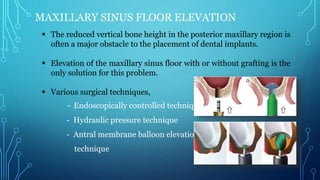
 The reduced vertical bone height in the posterior maxillary region is
often a major obstacle to the placement of dental implants.
 Elevation of the maxillary sinus floor with or without grafting is the
only solution for this problem.
 Various surgical techniques,
- Endoscopically controlled technique
- Hydraulic pressure technique
- Antral membrane balloon elevation
technique
ZYGOMATIC IMPLANTS
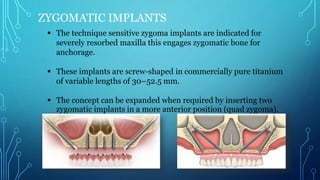
 The technique sensitive zygoma implants are indicated for
severely resorbed maxilla this engages zygomatic bone for
anchorage.
 These implants are screw-shaped in commercially pure titanium
of variable lengths of 30–52.5 mm.
 The concept can be expanded when required by inserting two
zygomatic implants in a more anterior position (quad zygoma).
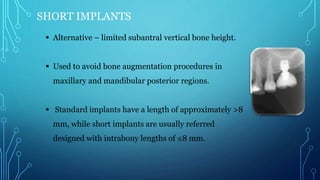
SHORT IMPLANTS
 Alternative – limited subantral vertical bone height.
 Used to avoid bone augmentation procedures in
maxillary and mandibular posterior regions.
 Standard implants have a length of approximately >8
mm, while short implants are usually referred
designed with intrabony lengths of ≤8 mm.
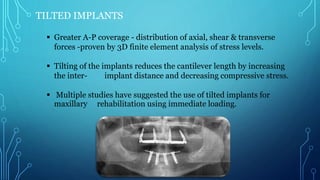
TILTED IMPLANTS
 Greater A-P coverage - distribution of axial, shear & transverse
forces -proven by 3D finite element analysis of stress levels.
 Tilting of the implants reduces the cantilever length by increasing
the inter- implant distance and decreasing compressive stress.
 Multiple studies have suggested the use of tilted implants for
maxillary rehabilitation using immediate loading.
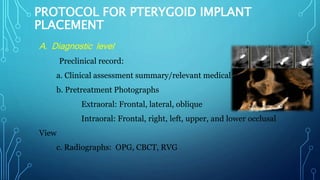
PROTOCOL FOR PTERYGOID IMPLANT
PLACEMENT
A. Diagnostic level
Preclinical record:
a. Clinical assessment summary/relevant medical history
b. Pretreatment Photographs
Extraoral: Frontal, lateral, oblique
Intraoral: Frontal, right, left, upper, and lower occlusal
View
c. Radiographs: OPG, CBCT, RVG
B. Surgical level
Presurgical stereolithography model
 Fabrication - conversion of patients CT scan images (Dicom) to STL
format.
 Virtual planning of implant placement and clinical angle measurement
should be done.
- Avoids perforations into adjacent anatomical si
- Help to identify the patient-specific anatomy
- Point of entries & exit
- Mesiodistal & Buccopalatal angulation
STL Model
Surgical phase
Surgical guide fabricated using the stereolith model.
The pterygoid implant is placed using a tilted concept, i.e., TTPHIL
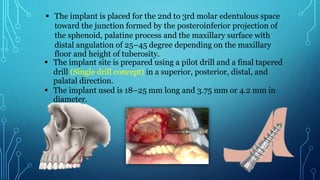
 The implant is placed for the 2nd to 3rd molar edentulous space
toward the junction formed by the posteroinferior projection of
the sphenoid, palatine process and the maxillary surface with
distal angulation of 25–45 degree depending on the maxillary
floor and height of tuberosity.
 The implant site is prepared using a pilot drill and a final tapered
drill (Single drill concept) in a superior, posterior, distal, and
palatal direction.
 The implant used is 18–25 mm long and 3.75 mm or 4.2 mm in
diameter.
 To check for the stability of the implant torque value of >40N cm
are to be obtained if immediate loading is desired.
 Multiunit abutments with varying lengths (3–5 mm) and
angulations (30°, 40° & 50°) are placed.
 Tulasne proposed the pterygoid implant technique using a 22 mm
long implant, which was anchorage to the pterygoid plate through
maxilla and palate with distal angulation between 35° and 55°.
 The osteotome technique minimizes surgical risk, preserves bone,
with better tactile control, whereas the drills facilitate the formation
of the implant bed, especially in the dense cortical bone area.
 A two-step open tray direct impression technique is used with
putty and light body material after splinting of multiunit
impression copings.
 Multiunit implant analogs are attached to the impression copings;
gingival mask is poured around implant analog and die stone is
poured to form the final cast.
 Jig trail, Jaw relation, and bite registration are recorded and sent to
the lab for CAD CAM designing screw-retained fixed prosthesis.
C. Prosthetic Level
CONCLUSION
 Extremely atrophic maxillae are the most challenging task for
restorative dentists. Pterygoid implant provides a reasonable
alternative to 3D maxillary reconstruction, sinus lifts and bone
augmentation technique.
 Many authors have reported success rates of pterygoid implants
ranging from 90% to 100% after follow-up period ranging from 1 to
12 years with minimal complications.
 Avoidance of a prosthetic distal cantilever with good stability fit
for immediate loading is possible with pterygoid implants.
References :
1. Albrektsson T, Zarb G, Worthington P, Eriksson AR. The long-term efficacy
of currently used dental implants: A review and proposed criteria of success. Int
J Oral Maxillofac Implants 1986;1:11-25.
2. Cucchi A, Vignudelli E, Franco S, Corinaldesi G. Minimally invasive approach
based on pterygoid and short implants for rehabilitation of an extremely atrophic
maxilla: Case report. Implant Dent 2017;26:639-44.
3. Procacci P, Lora V, Rossetto A, Gelpi F, Marconcini S, Armani L, et al.
Success of bone grafts in strophic posterior edentulous mandible: A Literature
review. Minerva Stomatol 2014;62:59-62.
4. De Santis D, Trevisiol L, D’Agostino A, Cucchi A, De Gemmis A, Nocini PF,
et al. Guided bone regeneration with autogenous block grafts applied to le fort I
osteotomy for treatment of severely resorbed maxillae: A 4 to 6-year prospective
study. Clin Oral Implants Res 2012;23:60-9.
5. Balaji VR, Lambodharan R, Manikandan D, Deenadayalan S. Pterygoid
implant for atrophic posterior maxilla. J Pharm Bioallied Sci 2017;9:S261-S263.
6. Reiser GM. Implant use in the tuberosity, pterygoid, and palatine region: Anatomic
and surgical considerations. In: Nevins M, Mellonig JT, editors. Implant Therapy
Clinical Approaches and Evidence of Success. Vol. 2. Chicago: Quintessence; 1998. p.
197.
7. Singh AV, Singh S. Tilted implant concept for full mouth immediate loading
restoration. Int J Oral Implantol Clin Res 2014;5:12-23.
8. Nag V, Sarika P, Addanki P, Bhagwatkar T. Bite reconstruction in aesthetic zone
using TTPHIL technique. Natl J Integr Res Med 2018;9:51-2.
9. Nag PV, Sarika P, Khan R, Bhagwatkar T. Tall and tilted pin hole immediately
loaded implants (TTPHIL) technique for maxillary arch rehabilitation. Int J Res Rev
2018;5:104-10.
10. Nag PV, Sarika P, Pavankumar A. TTPHIL-ALL TILTTM concept an innovative
technique in immediate functional loading implant placement in maxilla. Sch J Dent
Sci 2017;4:397-9.
Pterygoid Implants

Pterygoid Implants

  • 1.
    PTERYGOID IMPLANT: REHABILITATION OFTHE ATROPHIC POSTERIOR MAXILLA DR. BALAGANESH FELLOW IN ORAL IMPLANTOLOGY RRDCH, BANGALORE
  • 2.
    INTRODUCTION  Rehabilitation ofthe maxillary anterior region has been far easier than the maxillary posterior region due to various factors.  The posterior maxillary region is characterized by , (1) Inadequate residual bone height due to maxillary sinus expansion . and/or alveolar bone resorption. (2) Poor bone density (Type III or IV) according to Lekholm & Zarb . classification system.
  • 3.
     Sinus liftprocedures  Guided bone regeneration with autogenous and allogenous bone grafts  Tilted implants (All-on-4)  Zygomatic implants  Sinus membrane perforation  Rejection of graft  Graft displacement into sinus cavities  Screw loosening of tilted implants.
  • 4.
    Implants placed inthe compact bone of the pterygomaxillary region shows ossteogration & provides retention and stability.  Idea proposed – Paul Tessier (1989)  Introduced – Tulasne (1992)  Length of pterygoid implants – 15 to 20 mm  Bicortical anchorage - Improved axial loading & Elimination of cantilever  Other Names - Tuberosity implants, Pterygomaxillary implants “Implant placement through the maxillary tuberosity into the pterygoid plate” - GOMFI
  • 5.
  • 6.
     Maxillary tuberosity– Type 3 / Type 4 Cancellous bone  Pyramidal process of palatine Pterygoid process of the sphenoid  Pterygopalatine fossa (PPF) - Key area in the deep space & carefull evaluation during imaging. Contents of PPF : Dense cortical bone - Pterygopalatine ganglion - Maxillary division (V2) of the trigeminal nerve and its branches - Vidian (pterygoid) nerve - Distal branches of the maxillary artery
  • 7.
     The thickestarea of supporting bone is located in the middle part of the pterygoid process between plates.  This 3–4 mm medial to the alveolar ridge, the implant should angle slightly medially to bisect dense point of bone in the pterygoid region.  The hamular process on the medial pterygoid plate is palpable in the oropharynx. Implants are placed laterally to this landmark.  The pterygoid implants, when used in full arch rehabilitation, eliminate distal cantilevers, an extension of posterior occlusion, and the finest distribution of functional load.
  • 8.
    REISER’S CLASSIFICATION OFPTERYGOID IMPLANTS (Based on Anatomical location)  Tuberosity – pyramidal process  Tuberosity – pterygoid process  Tuberosity – pyramidal process – pterygoid process  Pyramidal process – pterygoid process  Maxillary tuberosity
  • 9.
    PARP Luis et al.- classification of diagnostic prediction in the pterygomaxillary region From the degree of sinus invasion obtained after a 3D computerized tomography (CT), the PARP establishes the prediction of the difficulty implied by implantology in this anatomical region, as well as the appropriate choice of the type of implant and length with which to approach it. (Pterygoid Anatomic Radiographic Prediction)
  • 10.
    Other treatment optionsfor posterior maxillary rehabilitation, 1. Maxillary sinus floor elevation. 2. Zygomatic implants. 3. Short implants. 4. Tilted implants. Misch Posterior Maxilla Classification
  • 11.
    MAXILLARY SINUS FLOORELEVATION  The reduced vertical bone height in the posterior maxillary region is often a major obstacle to the placement of dental implants.  Elevation of the maxillary sinus floor with or without grafting is the only solution for this problem.  Various surgical techniques, - Endoscopically controlled technique - Hydraulic pressure technique - Antral membrane balloon elevation technique
  • 12.
    ZYGOMATIC IMPLANTS  Thetechnique sensitive zygoma implants are indicated for severely resorbed maxilla this engages zygomatic bone for anchorage.  These implants are screw-shaped in commercially pure titanium of variable lengths of 30–52.5 mm.  The concept can be expanded when required by inserting two zygomatic implants in a more anterior position (quad zygoma).
  • 13.
    SHORT IMPLANTS  Alternative– limited subantral vertical bone height.  Used to avoid bone augmentation procedures in maxillary and mandibular posterior regions.  Standard implants have a length of approximately >8 mm, while short implants are usually referred designed with intrabony lengths of ≤8 mm.
  • 14.
    TILTED IMPLANTS  GreaterA-P coverage - distribution of axial, shear & transverse forces -proven by 3D finite element analysis of stress levels.  Tilting of the implants reduces the cantilever length by increasing the inter- implant distance and decreasing compressive stress.  Multiple studies have suggested the use of tilted implants for maxillary rehabilitation using immediate loading.
  • 15.
    PROTOCOL FOR PTERYGOIDIMPLANT PLACEMENT A. Diagnostic level Preclinical record: a. Clinical assessment summary/relevant medical history b. Pretreatment Photographs Extraoral: Frontal, lateral, oblique Intraoral: Frontal, right, left, upper, and lower occlusal View c. Radiographs: OPG, CBCT, RVG
  • 16.
    B. Surgical level Presurgicalstereolithography model  Fabrication - conversion of patients CT scan images (Dicom) to STL format.  Virtual planning of implant placement and clinical angle measurement should be done. - Avoids perforations into adjacent anatomical si - Help to identify the patient-specific anatomy - Point of entries & exit - Mesiodistal & Buccopalatal angulation STL Model
  • 17.
    Surgical phase Surgical guidefabricated using the stereolith model. The pterygoid implant is placed using a tilted concept, i.e., TTPHIL
  • 18.
     The implantis placed for the 2nd to 3rd molar edentulous space toward the junction formed by the posteroinferior projection of the sphenoid, palatine process and the maxillary surface with distal angulation of 25–45 degree depending on the maxillary floor and height of tuberosity.  The implant site is prepared using a pilot drill and a final tapered drill (Single drill concept) in a superior, posterior, distal, and palatal direction.  The implant used is 18–25 mm long and 3.75 mm or 4.2 mm in diameter.
  • 19.
     To checkfor the stability of the implant torque value of >40N cm are to be obtained if immediate loading is desired.  Multiunit abutments with varying lengths (3–5 mm) and angulations (30°, 40° & 50°) are placed.  Tulasne proposed the pterygoid implant technique using a 22 mm long implant, which was anchorage to the pterygoid plate through maxilla and palate with distal angulation between 35° and 55°.  The osteotome technique minimizes surgical risk, preserves bone, with better tactile control, whereas the drills facilitate the formation of the implant bed, especially in the dense cortical bone area.
  • 20.
     A two-stepopen tray direct impression technique is used with putty and light body material after splinting of multiunit impression copings.  Multiunit implant analogs are attached to the impression copings; gingival mask is poured around implant analog and die stone is poured to form the final cast.  Jig trail, Jaw relation, and bite registration are recorded and sent to the lab for CAD CAM designing screw-retained fixed prosthesis. C. Prosthetic Level
  • 21.
    CONCLUSION  Extremely atrophicmaxillae are the most challenging task for restorative dentists. Pterygoid implant provides a reasonable alternative to 3D maxillary reconstruction, sinus lifts and bone augmentation technique.  Many authors have reported success rates of pterygoid implants ranging from 90% to 100% after follow-up period ranging from 1 to 12 years with minimal complications.  Avoidance of a prosthetic distal cantilever with good stability fit for immediate loading is possible with pterygoid implants.
  • 22.
    References : 1. AlbrektssonT, Zarb G, Worthington P, Eriksson AR. The long-term efficacy of currently used dental implants: A review and proposed criteria of success. Int J Oral Maxillofac Implants 1986;1:11-25. 2. Cucchi A, Vignudelli E, Franco S, Corinaldesi G. Minimally invasive approach based on pterygoid and short implants for rehabilitation of an extremely atrophic maxilla: Case report. Implant Dent 2017;26:639-44. 3. Procacci P, Lora V, Rossetto A, Gelpi F, Marconcini S, Armani L, et al. Success of bone grafts in strophic posterior edentulous mandible: A Literature review. Minerva Stomatol 2014;62:59-62. 4. De Santis D, Trevisiol L, D’Agostino A, Cucchi A, De Gemmis A, Nocini PF, et al. Guided bone regeneration with autogenous block grafts applied to le fort I osteotomy for treatment of severely resorbed maxillae: A 4 to 6-year prospective study. Clin Oral Implants Res 2012;23:60-9. 5. Balaji VR, Lambodharan R, Manikandan D, Deenadayalan S. Pterygoid implant for atrophic posterior maxilla. J Pharm Bioallied Sci 2017;9:S261-S263.
  • 23.
    6. Reiser GM.Implant use in the tuberosity, pterygoid, and palatine region: Anatomic and surgical considerations. In: Nevins M, Mellonig JT, editors. Implant Therapy Clinical Approaches and Evidence of Success. Vol. 2. Chicago: Quintessence; 1998. p. 197. 7. Singh AV, Singh S. Tilted implant concept for full mouth immediate loading restoration. Int J Oral Implantol Clin Res 2014;5:12-23. 8. Nag V, Sarika P, Addanki P, Bhagwatkar T. Bite reconstruction in aesthetic zone using TTPHIL technique. Natl J Integr Res Med 2018;9:51-2. 9. Nag PV, Sarika P, Khan R, Bhagwatkar T. Tall and tilted pin hole immediately loaded implants (TTPHIL) technique for maxillary arch rehabilitation. Int J Res Rev 2018;5:104-10. 10. Nag PV, Sarika P, Pavankumar A. TTPHIL-ALL TILTTM concept an innovative technique in immediate functional loading implant placement in maxilla. Sch J Dent Sci 2017;4:397-9.