MANDIBULAR OSTEOTOMIES
• PRESENTED BY DR. SHOVITA
• 2ND
YEAR PGT
• DPT OF ORAL AND MAXILLOFACIAL SURGERY
• AWADH DENTAL COLLEGE AND HOSPITAL
CONTENTS
Introduction
Definition
Historical developments
Etiopathogenesis
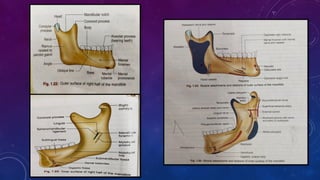
Surgical anatomy of mandible
Timing of osteotomies
Role of pre surgical orthodontics
Classification
Soft tissue changes
Complications
Conclusion
References
INTRODUCTION
• Face forms the identity of an individual .Facial deformities invariably make an individual highly self
conscious of this abnormal features . The appearance sometimes has a psychological impact on the
individual.
DEFINITION
• The word orthognathic comes from the Greek word “ORTHOS’’ meaning to straighten and ‘’ GNATHOS’’
meaning jaw.
• It involves ‘surgical manipulation of the elements of the facial skeleton to restore the proper
anatomic and functional relationship in patients with dentofacial and skeletal deformities.’
HISTORICAL DEVELOPMENTS
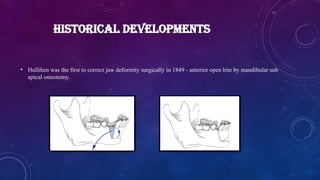
• Hullihen was the first to correct jaw deformity surgically in 1849 - anterior open bite by mandibular sub
apical osteotomy.
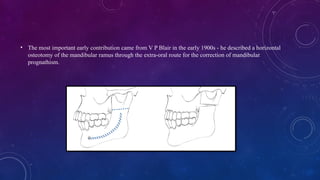
• The most important early contribution came from V P Blair in the early 1900s - he described a horizontal
osteotomy of the mandibular ramus through the extra-oral route for the correction of mandibular
prognathism.
• Trauner 1955 described the inverted ‘L’ osteotomy of the ramus for the correction of mandibular
prognathism.
• Caldwell and colleagues modification of L osteotomy to C - osteotomy
• Hugo Obwegesser (1955) described the technique of intraoral sagittal split osteotomy for the
correction of mandibular problems.
• Heinz Köle described the procedure of genioplasty 1968 and a technique to correct open bite.
• Burstone et al (1978 & 1980) gave an analysis for the assessment of dentofacial deformity
using cephalometric radiographs " The cephalometric analysis for orthognathic surgery"
(COGS).
• The latest developments in orthognathic surgery is the use of adjunct plastic surgical
procedures like liposuction, lip correction.
ETIOPATHOGENESIS
The etiology of the dentofacial deformities can be divided into CONGENITAL & ACQUIRED.
CONGENITAL
• Genetic – Underlying genetic predisposition
• Syndromes –Apert’s and Crouzon’s syndrome
ACQUIRED
• Traumatic
• Others – neoplastic growth in the jaws, surgical
resections etc.
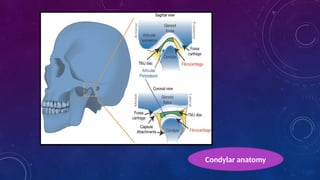
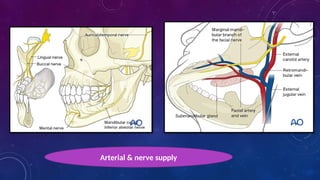
SURGICAL ANATOMY OF MANDIBLE
Condylar anatomy
Arterial & nerve supply
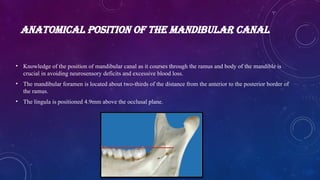
ANATOMICAL POSITION OF THE MANDIBULAR CANAL
• Knowledge of the position of mandibular canal as it courses through the ramus and body of the mandible is
crucial in avoiding neurosensory deficits and excessive blood loss.
• The mandibular foramen is located about two-thirds of the distance from the anterior to the posterior border of
the ramus.
• The lingula is positioned 4.9mm above the occlusal plane.
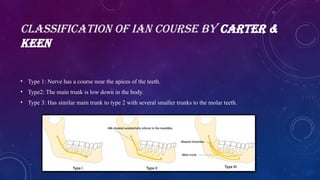
CLASSIFICATION OF IAN COURSE BY CARTER &
KEEN
• Type 1: Nerve has a course near the apices of the teeth.
• Type2: The main trunk is low down in the body.
• Type 3: Has similar main trunk to type 2 with several smaller trunks to the molar teeth.
TIMING OF OSTEOTOMIES
• The treatment of dentofacial deformities is based on a careful co-ordination of orthodontics and surgeon.
• Early treatment using functional appliances and by orthodontic teeth movements may prevent functional
and psychological problems, limit the deformity, shorten treatment time, improve results and obtain
stability.
• As a rule it is better to wait till the skeletal growth is completed before doing orthognathic surgery.
ROLE OF PRE-SURGICAL ORTHODONTICS
• Many patients undergoing orthognathic surgery require a period of pre-surgical
orthodontics. The goals of pre-surgical orthodontics are -
1. To eliminate dental mal-relationships which prevent surgical repositioning of fragments.
2. To achieve decompensation by undoing the natural compensating tooth alignments.
This usually worsens the occlusal relationship but it can be corrected by surgery.
3. To create interdental spacing to facilitate segmental osteotomy.
4. To perform those tooth movements which, will spoil the result of the surgery.
CLINICAL FEATURES OF MANDIBULAR PROGNATHISM
• Concave face profile.
• Prominent lower jaw and increased lower 1/3rd
of the face.
• Lip incompetence
• Reduced labio-mental fold
• Class 3 molar relation
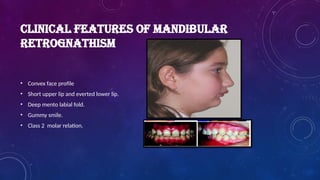
CLINICAL FEATURES OF MANDIBULAR
RETROGNATHISM
• Convex face profile
• Short upper lip and everted lower lip.
• Deep mento labial fold.
• Gummy smile.
• Class 2 molar relation.
CLASSIFICATION
• Ramus osteotomies
• vertical subsigmoid osteotomy
• Inverted L osteotomy
• C osteotomy
• Intraoral sagittal split osteotomy
• Body osteotomy
• Anterior sub apical osteotomy
• Total sub apical osteotomy
• Genioplasty
RAMUS OSTEOTOMY
HISTORY
• Movement of the mandible in the anteroposterior direction is usually achieved by ramus osteotomy.
• Limberg reported subcondylar oblique osteotomy in 1925.
• Thomas, Robinson, Shira and others described buccal osteotomy which involved the ramus.
• Later, Caldwell and Letterman (1954) described vertical subcondylar osteotomy by extra-oral approach,
which became very popular.
This technique minimized trauma of the inferior alveolar neurovascular bundle, though
the primary indication was mandibular prognathism
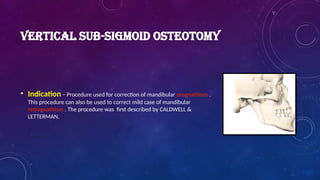
VERTICAL SUB-SIGMOID OSTEOTOMY
• Indication – Procedure used for correction of mandibular prognathism .
This procedure can also be used to correct mild case of mandibular
retrognathism . The procedure was first described by CALDWELL &
LETTERMAN.
INCISION
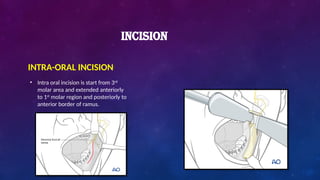
INTRA-ORAL INCISION
• Intra oral incision is start from 3rd
molar area and extended anteriorly
to 1st
molar region and posteriorly to
anterior border of ramus.
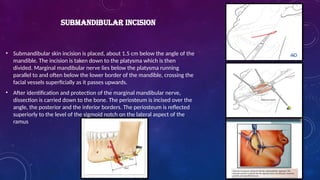
• Submandibular skin incision is placed, about 1.5 cm below the angle of the
mandible. The incision is taken down to the platysma which is then
divided. Marginal mandibular nerve lies below the platysma running
parallel to and often below the lower border of the mandible, crossing the
facial vessels superficially as it passes upwards.
• After identification and protection of the marginal mandibular nerve,
dissection is carried down to the bone. The periosteum is incised over the
angle, the posterior and the inferior borders. The periosteum is reflected
superiorly to the level of the sigmoid notch on the lateral aspect of the
ramus
SUBMANDIBULAR INCISION
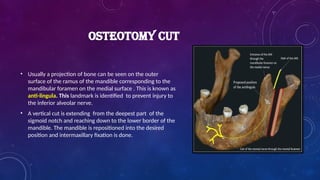
OSTEOTOMY CUT
• Usually a projection of bone can be seen on the outer
surface of the ramus of the mandible corresponding to the
mandibular foramen on the medial surface . This is known as
anti-lingula. This landmark is identified to prevent injury to
the inferior alveolar nerve.
• A vertical cut is extending from the deepest part of the
sigmoid notch and reaching down to the lower border of the
mandible. The mandible is repositioned into the desired
position and intermaxillary fixation is done.
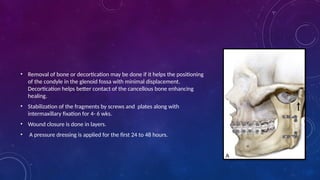
• Removal of bone or decortication may be done if it helps the positioning
of the condyle in the glenoid fossa with minimal displacement.
Decortication helps better contact of the cancellous bone enhancing
healing.
• Stabilization of the fragments by screws and plates along with
intermaxillary fixation for 4- 6 wks.
• Wound closure is done in layers.
• A pressure dressing is applied for the first 24 to 48 hours.
INVERTED-L OSTEOTOMY
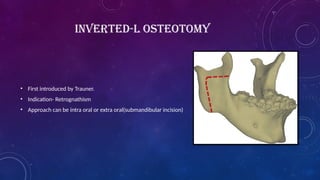
• First introduced by Trauner.
• Indication- Retrognathism
• Approach can be intra oral or extra oral(submandibular incision)
PROCEDURE
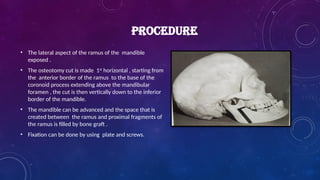
• The lateral aspect of the ramus of the mandible
exposed .
• The osteotomy cut is made 1st
horizontal , starting from
the anterior border of the ramus to the base of the
coronoid process extending above the mandibular
foramen , the cut is then vertically down to the inferior
border of the mandible.
• The mandible can be advanced and the space that is
created between the ramus and proximal fragments of
the ramus is filled by bone graft .
• Fixation can be done by using plate and screws.
CONTRAINDICATIONS –
Abnormal posterior location of the mandibular foramen
Advantages:
 Large mandibular setback
 Less risk of condylar sag
 Rigid skeletal fixation
Disadvantages:
 Bone or synthetic bone grafting - significant
ramus lengthening / mandibular advancement
 Healing time - increased compared to other
technique because of poor approximation of the
segments when grafts are not used
C OSTEOTOMY
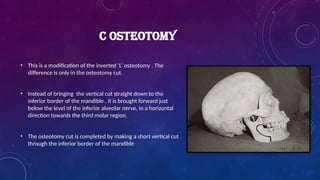
• This is a modification of the inverted ‘L’ osteotomy . The
difference is only in the osteotomy cut.
• Instead of bringing the vertical cut straight down to the
inferior border of the mandible , it is brought forward just
below the level of the inferior alveolar nerve, in a horizontal
direction towards the third molar region.
• The osteotomy cut is completed by making a short vertical cut
through the inferior border of the mandible
BILATERAL SAGITTAL SPLIT OSTEOTOMY
• Obwegesser & Trauner (1955) - Intraoral sagittal split osteotomy for the correction of mandibular
problems – through the ramus of the mandible
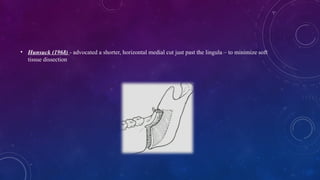
• Hunsuck (1968) - advocated a shorter, horizontal medial cut just past the lingula – to minimize soft
tissue dissection
• Rajchel article on the location of the mandibular canal and its relationship to the sagittal ramus
osteotomy was the first to report specifically on the mediolateral position of the mandibular
nerve
• His research suggested the extension of the sagittal osteotomy cut into the area of the first molar
for the following reasons:
 Buccal cortical plate is thicker
 Total mandibular body width is thicker
 The distance between the inner aspect of the buccal cortical plate & the mandibular canal is consistently
greater.
 The area just distal to the third molar is the area where the neurovascular bundle most often is
in direct contact with the buccal cortical plate and that occasionally the neurovascular bundle
and canal appears to be within the buccal cortical plate, so that area would be the least favorable
for cuts to be made.
SPIESSL (1974 – 1976)
 Lateral oblique ridge was removed to facilitate the use of smaller than traditional chisels to
make the split closely follow the buccal cortical wall.
 Following the cortical plate in that manner decreased injuries to the mandibular nerve.
 Rigid internal fixation – promote healing, restore early function & attenuate relapse
Indications
• Horizontal mandibular excess, deficiency &
asymmetry
Contraindications:
 Severe decreased posterior mandibular body
height
 Extremely thin medial-lateral width of ramus
 Severe ramus hypoplasia
 Severe mandibular asymmetries
Advantages
• Intra oral procedure
• Advance or setback the mandible
• Correct minor asymmetries
• Healing is quick – good bony interface
• Rigid fixation – used
• Muscles of mastication remain in original spatial
position-prevents relapse
Disadvantages
• Lingual cortical plate fracture
Increased incidence of nerve damage
• ult to correct significant asymmetries
• Unfavorable splits
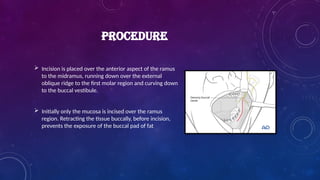
 Incision is placed over the anterior aspect of the ramus
to the midramus, running down over the external
oblique ridge to the first molar region and curving down
to the buccal vestibule.
 Initially only the mucosa is incised over the ramus
region. Retracting the tissue buccally, before incision,
prevents the exposure of the buccal pad of fat
PROCEDURE
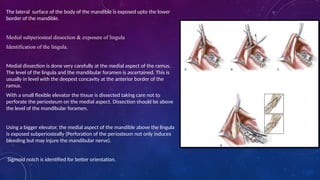
The lateral surface of the body of the mandible is exposed upto the lower
border of the mandible.
Medial subperiosteal dissection & exposure of lingula
Identification of the lingula.
Medial dissection is done very carefully at the medial aspect of the ramus.
The level of the lingula and the mandibular foramen is ascertained. This is
usually in level with the deepest concavity at the anterior border of the
ramus.
With a small flexible elevator the tissue is dissected taking care not to
perforate the periosteum on the medial aspect. Dissection should be above
the level of the mandibular foramen.
Using a bigger elevator, the medial aspect of the mandible above the lingula
is exposed subperiosteally (Perforation of the periosteum not only induces
bleeding but may injure the mandibular nerve).
Sigmoid notch is identified for better orientation.
OSTEOTOMY CUTS
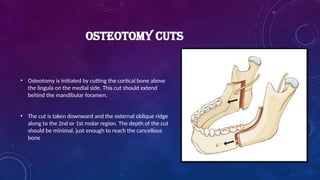
• Osteotomy is initiated by cutting the cortical bone above
the lingula on the medial side. This cut should extend
behind the mandibular foramen.
• The cut is taken downward and the external oblique ridge
along to the 2nd or 1st molar region. The depth of the cut
should be minimal, just enough to reach the cancellous
bone
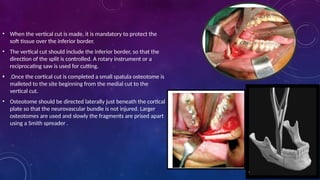
• When the vertical cut is made, it is mandatory to protect the
soft tissue over the inferior border.
• The vertical cut should include the inferior border, so that the
direction of the split is controlled. A rotary instrument or a
reciprocating saw is used for cutting.
• Once the cortical cut is completed a small spatula osteotome is
malleted to the site beginning from the medial cut to the
vertical cut.
• Osteotome should be directed laterally just beneath the cortical
plate so that the neurovascular bundle is not injured. Larger
osteotomes are used and slowly the fragments are prised apart
using a Smith spreader .
• .
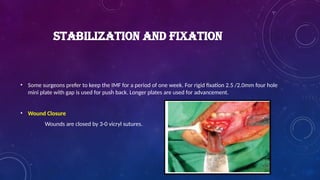
STABILIZATION AND FIXATION
• Some surgeons prefer to keep the IMF for a period of one week. For rigid fixation 2.5 /2.0mm four hole
mini plate with gap is used for push back. Longer plates are used for advancement.
• Wound Closure
Wounds are closed by 3-0 vicryl sutures.
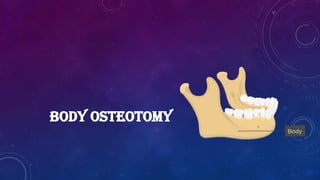
BODY OSTEOTOMY
INDICATION
 Mandibular setback (combination with ramus procedure / body is long in relation to the ramus)
 Anterior open bite closure & curve of Spee reduction
 Progenia correction
PROCEDURE
• Osteotomy done anterior to the mental foramen
• Osteotomy done posterior to the mental foramen
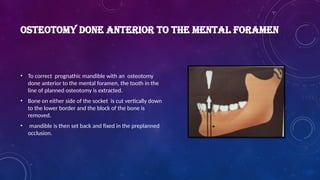
OSTEOTOMY DONE ANTERIOR TO THE MENTAL FORAMEN
• To correct prognathic mandible with an osteotomy
done anterior to the mental foramen, the tooth in the
line of planned osteotomy is extracted.
• Bone on either side of the socket is cut vertically down
to the lower border and the block of the bone is
removed.
• mandible is then set back and fixed in the preplanned
occlusion.
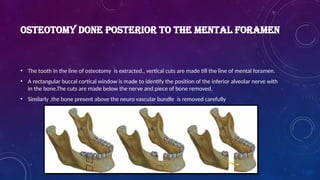
OSTEOTOMY DONE POSTERIOR TO THE MENTAL FORAMEN
• The tooth in the line of osteotomy is extracted., vertical cuts are made till the line of mental foramen.
• A rectangular buccal cortical window is made to identify the position of the inferior alveolar nerve with
in the bone.The cuts are made below the nerve and piece of bone removed.
• Similarly ,the bone present above the neuro vascular bundle is removed carefully
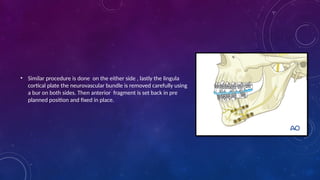
• Similar procedure is done on the either side , lastly the lingula
cortical plate the neurovascular bundle is removed carefully using
a bur on both sides. Then anterior fragment is set back in pre
planned position and fixed in place.
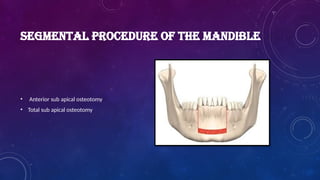
SEGMENTAL PROCEDURE OF THE MANDIBLE
• Anterior sub apical osteotomy
• Total sub apical osteotomy
ANTERIOR SUB APICAL OSTEOTOMY
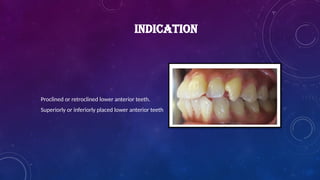
INDICATION
Proclined or retroclined lower anterior teeth.
Superiorly or inferiorly placed lower anterior teeth
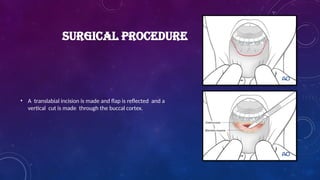
SURGICAL PROCEDURE
• A translabial incision is made and flap is reflected and a
vertical cut is made through the buccal cortex.
• The lingual cortex is visualized, lingual soft tissue around
the socket is retracted and a vertical cut is made
through the lingual cortex. This is done bilaterally. This
two vertical cut are the connected by horizontal cut just
just below the tooth apices.
• The horizontal cut is made through buccal cortex till the
lingual cortical bone.
• The fragment is mobilized and desired occlusion is
achieved and fixed in position.
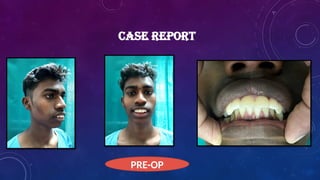
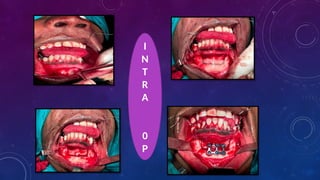
CASE REPORT
PRE-OP
I
N
T
R
A
0
P
1 month post op
TOTAL SUB APICAL OSTEOTOMY
INDICATION
• Changing the position of the entire dento alveolar segment
• Can be used to increase the lower 1/3rd
of the face by reposioning the dentoalveolar segment
superiorly.
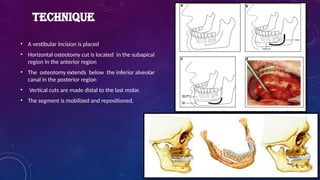
TECHNIQUE
• A vestibular incision is placed
• Horizontal osteotomy cut is located in the subapical
region in the anterior region
• The osteotomy extends below the inferior alveolar
canal in the posterior region
• Vertical cuts are made distal to the last molar.
• The segment is mobilized and repositioned.
GENIOPLASTY
INTRODUCTION
• Genioplasty is used for the correction of deformities of the anterior part of the
mandible, the chin. It is possible to reposition the chin in all the three
dimensions of space, moving it in anteroposterior, vertical and/or horizontal
directions.-
HISTORY
• Hofer in 1942 introduced horizontal osteotomy of the symphysis.
• Trauner & Obwegeser – 1957 – horizontal osteotomy through an intraoral approach
• Hinds & Kent – 1969 – discussed the importance of maintaining the soft tissue attachment along the
inferior segment & the role of these attachments in achieving maximal soft tissue change.
PREOPERATIVE EVALUATION
 Chin deformities can manifest in three dimensions, majority are in the horizontal plane
 When evaluating the chin, one must consider all structures that may be impacted by the planned surgical
procedure
 LIP POSITION, SHAPE & DEPTH OF THE LABIOMENTAL FOLD & SOFT TISSUE ENVELOPE
COVERING THE SYMPHYSIS
 Lower lip position
- Maxillary position & teeth
- Position of the lower incisors in the sagittal plane
 Mentalis muscle activity
 Chin contour is influenced by soft tissue thickness, as well as by the underlying bony contour.
INDICATIONS:
 Any skeletal deformity of the chin
 Primarily for esthetic reasons
 In combination with other facial osteotomies in a comprehensive treatment plan
 Adjunctive procedure to Orthognathic surgery, Rhinoplasty.
 Macro/microgenia
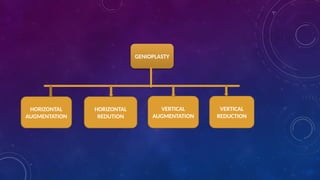
GENIOPLASTY
HORIZONTAL
AUGMENTATION
HORIZONTAL
REDUTION
VERTICAL
AUGMENTATION
VERTICAL
REDUCTION
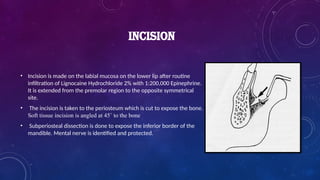
• Incision is made on the labial mucosa on the lower lip after routine
infiltration of Lignocaine Hydrochloride 2% with 1:200,000 Epinephrine.
It is extended from the premolar region to the opposite symmetrical
site.
• The incision is taken to the periosteum which is cut to expose the bone.
Soft tissue incision is angled at 45˚ to the bone
• Subperiosteal dissection is done to expose the inferior border of the
mandible. Mental nerve is identified and protected.
INCISION
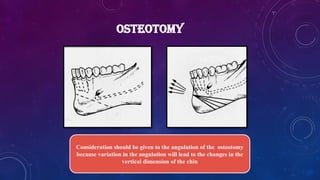
OSTEOTOMY
Consideration should be given to the angulation of the osteotomy
because variation in the angulation will lead to the changes in the
vertical dimension of the chin
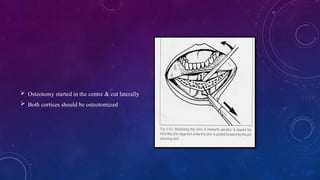
 Osteotomy started in the centre & cut laterally
 Both cortices should be osteotomized
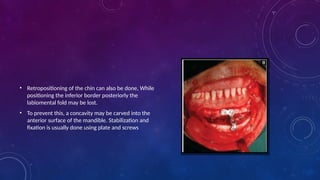
• Retropositioning of the chin can also be done, While
positioning the inferior border posteriorly the
labiomental fold may be lost.
• To prevent this, a concavity may be carved into the
anterior surface of the mandible. Stabilization and
fixation is usually done using plate and screws
NEWER TECHNIQUE
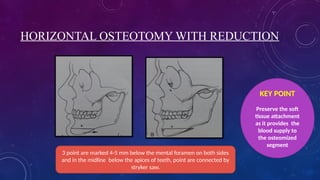
HORIZONTAL OSTEOTOMY WITH REDUCTION
3 point are marked 4-5 mm below the mental foramen on both sides
and in the midline below the apices of teeth, point are connected by
stryker saw.
KEY POINT
Preserve the soft
tissue attachment
as it provides the
blood supply to
the osteomized
segment
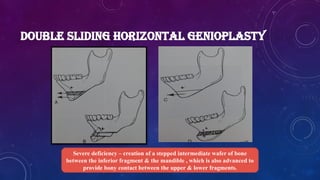
DOUBLE SLIDING HORIZONTAL GENIOPLASTY
Severe deficiency – creation of a stepped intermediate wafer of bone
between the inferior fragment & the mandible , which is also advanced to
provide bony contact between the upper & lower fragments.
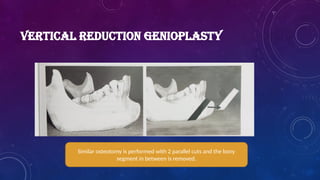
VERTICAL REDUCTION GENIOPLASTY
Similar osteotomy is performed with 2 parallel cuts and the bony
segment in between is removed.
VERTICAL AUGMENTATION
• Bone grafts may be placed between the two bony fragment
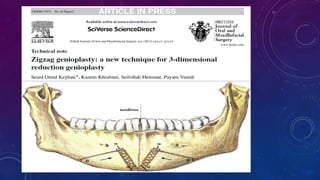
ADVANTAGES OF THE ZIGZAG TECHNIQUE
• There is a minimal change in the position of the
mentolabial fold
• There is the possibility of a combined reduction
of the height of the mandibular body
• It is possible to correct an asymmetrical chin
• There is minimal neurovascular disturbance
Intra op
Post op OPG
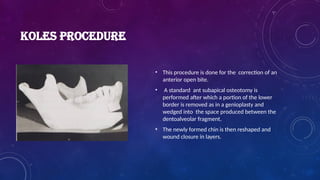
KOLES PROCEDURE
• This procedure is done for the correction of an
anterior open bite.
• A standard ant subapical osteotomy is
performed after which a portion of the lower
border is removed as in a genioplasty and
wedged into the space produced between the
dentoalveolar fragment.
• The newly formed chin is then reshaped and
wound closure in layers.
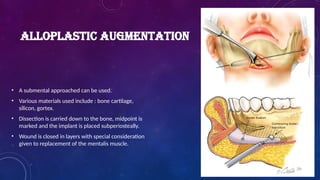
ALLOPLASTIC AUGMENTATION
• A submental approached can be used.
• Various materials used include : bone cartilage,
silicon, gortex.
• Dissection is carried down to the bone, midpoint is
marked and the implant is placed subperiosteally.
• Wound is closed in layers with special consideration
given to replacement of the mentalis muscle.
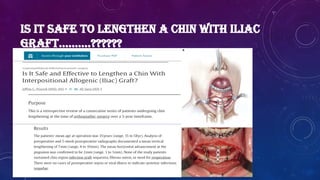
IS IT SAFE TO LENGTHEN A CHIN WITH ILIAC
GRAFT……….??????
SOFT TISSUE CLOSURE
 Atleast 2 layer closure – to prevent chin ptosis
 Mentalis muscle reapproximated
 Pressure dressing – minimize hematoma formation & facilitate soft tissue reattachment
COMPLICATIONS
NERVE INJURIES
• Inferior alveolar nerve
• Facial nerve
• Lingual nerve
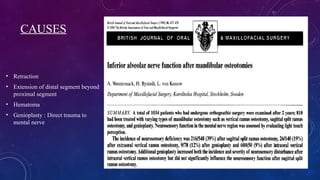
CAUSES
• Retraction
• Extension of distal segment beyond
proximal segment
• Hematoma
• Genioplasty : Direct trauma to
mental nerve
OTHERS
Malocclusion
Hemorrhage
Nonunion/delayed union
Condylar sag
TO CONCLUDE…
• Pre operative planning is very important, with all work up to be done in a very accurate and precise
manner
• Surgical anatomy of the mandible and the surrounding structures is very important for avoiding the
complications
• Position of the condyle needs to be take care of with intra op clinical judgment
• Rigid fixation plays a vital role in the stability and relapse
• Esthetics expectation of the patients needs to be fulfilled – Surgeon & orthodontist
REFERENCE
• 1. Aida T, Yoshioka I, Tominaga K, Fukuda J. Effects of latency period in a rabbit mandibular distraction osteogenesis.
Int J Oral Maxillofac Surg 2003; 32:54-62.
• 2. Aken HV, Fitch W, Graham DI, et al. Cardiovascular and cerebrovascular effects of isoflurane induced hypotension
in the baboon. Anesth Analg 1986; 65: 565-74.
• 3. Al Bishri A, Z Barghash, J Rosenquist, B Sunzel. Neurosensory disturbance after sagittal split and intra oral vertical
ramus osteotomy: as reported in questionnaires and patients records. Int J Oral Maxillofac Surg 2005; 34: 247-51.
• . Al Ruhaimi KA. Comparison of different distraction rates in the mandible: An experimental investigation. Int J Oral
Maxillofac Surg 2001; 30: 220-7. 5.
• Alder ME, Deahl ST, Matteson SR, Van Sickel JE, Tiner BD, Rugh JD. Short term change of condylar position after
sagittal split osteotomy for mandibular advancement. Oral Surg, Oral Med, Oral Pathol Oral Radiol Endod 1999;
87:159-65.
• 6. Aragon SB, VanSickels JE. Mandibular range of motion with rigid/ no rigid fixation. Oral Surg 1987; 63: 408-11
Surgical procedures for Mandibular Osteotomy

Surgical procedures for Mandibular Osteotomy

  • 2.
    MANDIBULAR OSTEOTOMIES • PRESENTEDBY DR. SHOVITA • 2ND YEAR PGT • DPT OF ORAL AND MAXILLOFACIAL SURGERY • AWADH DENTAL COLLEGE AND HOSPITAL
  • 3.
    CONTENTS Introduction Definition Historical developments Etiopathogenesis Surgical anatomyof mandible Timing of osteotomies Role of pre surgical orthodontics Classification Soft tissue changes Complications Conclusion References
  • 4.
    INTRODUCTION • Face formsthe identity of an individual .Facial deformities invariably make an individual highly self conscious of this abnormal features . The appearance sometimes has a psychological impact on the individual.
  • 5.
    DEFINITION • The wordorthognathic comes from the Greek word “ORTHOS’’ meaning to straighten and ‘’ GNATHOS’’ meaning jaw. • It involves ‘surgical manipulation of the elements of the facial skeleton to restore the proper anatomic and functional relationship in patients with dentofacial and skeletal deformities.’
  • 6.
    HISTORICAL DEVELOPMENTS • Hullihenwas the first to correct jaw deformity surgically in 1849 - anterior open bite by mandibular sub apical osteotomy.
  • 7.
    • The mostimportant early contribution came from V P Blair in the early 1900s - he described a horizontal osteotomy of the mandibular ramus through the extra-oral route for the correction of mandibular prognathism.
  • 8.
    • Trauner 1955described the inverted ‘L’ osteotomy of the ramus for the correction of mandibular prognathism. • Caldwell and colleagues modification of L osteotomy to C - osteotomy
  • 9.
    • Hugo Obwegesser(1955) described the technique of intraoral sagittal split osteotomy for the correction of mandibular problems. • Heinz Köle described the procedure of genioplasty 1968 and a technique to correct open bite. • Burstone et al (1978 & 1980) gave an analysis for the assessment of dentofacial deformity using cephalometric radiographs " The cephalometric analysis for orthognathic surgery" (COGS). • The latest developments in orthognathic surgery is the use of adjunct plastic surgical procedures like liposuction, lip correction.
  • 10.
    ETIOPATHOGENESIS The etiology ofthe dentofacial deformities can be divided into CONGENITAL & ACQUIRED. CONGENITAL • Genetic – Underlying genetic predisposition • Syndromes –Apert’s and Crouzon’s syndrome ACQUIRED • Traumatic • Others – neoplastic growth in the jaws, surgical resections etc.
  • 11.
  • 13.
  • 14.
  • 15.
    ANATOMICAL POSITION OFTHE MANDIBULAR CANAL • Knowledge of the position of mandibular canal as it courses through the ramus and body of the mandible is crucial in avoiding neurosensory deficits and excessive blood loss. • The mandibular foramen is located about two-thirds of the distance from the anterior to the posterior border of the ramus. • The lingula is positioned 4.9mm above the occlusal plane.
  • 16.
    CLASSIFICATION OF IANCOURSE BY CARTER & KEEN • Type 1: Nerve has a course near the apices of the teeth. • Type2: The main trunk is low down in the body. • Type 3: Has similar main trunk to type 2 with several smaller trunks to the molar teeth.
  • 17.
    TIMING OF OSTEOTOMIES •The treatment of dentofacial deformities is based on a careful co-ordination of orthodontics and surgeon. • Early treatment using functional appliances and by orthodontic teeth movements may prevent functional and psychological problems, limit the deformity, shorten treatment time, improve results and obtain stability. • As a rule it is better to wait till the skeletal growth is completed before doing orthognathic surgery.
  • 18.
    ROLE OF PRE-SURGICALORTHODONTICS • Many patients undergoing orthognathic surgery require a period of pre-surgical orthodontics. The goals of pre-surgical orthodontics are - 1. To eliminate dental mal-relationships which prevent surgical repositioning of fragments. 2. To achieve decompensation by undoing the natural compensating tooth alignments. This usually worsens the occlusal relationship but it can be corrected by surgery. 3. To create interdental spacing to facilitate segmental osteotomy. 4. To perform those tooth movements which, will spoil the result of the surgery.
  • 19.
    CLINICAL FEATURES OFMANDIBULAR PROGNATHISM • Concave face profile. • Prominent lower jaw and increased lower 1/3rd of the face. • Lip incompetence • Reduced labio-mental fold • Class 3 molar relation
  • 20.
    CLINICAL FEATURES OFMANDIBULAR RETROGNATHISM • Convex face profile • Short upper lip and everted lower lip. • Deep mento labial fold. • Gummy smile. • Class 2 molar relation.
  • 21.
    CLASSIFICATION • Ramus osteotomies •vertical subsigmoid osteotomy • Inverted L osteotomy • C osteotomy • Intraoral sagittal split osteotomy • Body osteotomy • Anterior sub apical osteotomy • Total sub apical osteotomy • Genioplasty
  • 22.
  • 23.
    HISTORY • Movement ofthe mandible in the anteroposterior direction is usually achieved by ramus osteotomy. • Limberg reported subcondylar oblique osteotomy in 1925. • Thomas, Robinson, Shira and others described buccal osteotomy which involved the ramus. • Later, Caldwell and Letterman (1954) described vertical subcondylar osteotomy by extra-oral approach, which became very popular. This technique minimized trauma of the inferior alveolar neurovascular bundle, though the primary indication was mandibular prognathism
  • 24.
    VERTICAL SUB-SIGMOID OSTEOTOMY •Indication – Procedure used for correction of mandibular prognathism . This procedure can also be used to correct mild case of mandibular retrognathism . The procedure was first described by CALDWELL & LETTERMAN.
  • 25.
    INCISION INTRA-ORAL INCISION • Intraoral incision is start from 3rd molar area and extended anteriorly to 1st molar region and posteriorly to anterior border of ramus.
  • 26.
    • Submandibular skinincision is placed, about 1.5 cm below the angle of the mandible. The incision is taken down to the platysma which is then divided. Marginal mandibular nerve lies below the platysma running parallel to and often below the lower border of the mandible, crossing the facial vessels superficially as it passes upwards. • After identification and protection of the marginal mandibular nerve, dissection is carried down to the bone. The periosteum is incised over the angle, the posterior and the inferior borders. The periosteum is reflected superiorly to the level of the sigmoid notch on the lateral aspect of the ramus SUBMANDIBULAR INCISION
  • 27.
    OSTEOTOMY CUT • Usuallya projection of bone can be seen on the outer surface of the ramus of the mandible corresponding to the mandibular foramen on the medial surface . This is known as anti-lingula. This landmark is identified to prevent injury to the inferior alveolar nerve. • A vertical cut is extending from the deepest part of the sigmoid notch and reaching down to the lower border of the mandible. The mandible is repositioned into the desired position and intermaxillary fixation is done.
  • 28.
    • Removal ofbone or decortication may be done if it helps the positioning of the condyle in the glenoid fossa with minimal displacement. Decortication helps better contact of the cancellous bone enhancing healing. • Stabilization of the fragments by screws and plates along with intermaxillary fixation for 4- 6 wks. • Wound closure is done in layers. • A pressure dressing is applied for the first 24 to 48 hours.
  • 29.
    INVERTED-L OSTEOTOMY • Firstintroduced by Trauner. • Indication- Retrognathism • Approach can be intra oral or extra oral(submandibular incision)
  • 30.
    PROCEDURE • The lateralaspect of the ramus of the mandible exposed . • The osteotomy cut is made 1st horizontal , starting from the anterior border of the ramus to the base of the coronoid process extending above the mandibular foramen , the cut is then vertically down to the inferior border of the mandible. • The mandible can be advanced and the space that is created between the ramus and proximal fragments of the ramus is filled by bone graft . • Fixation can be done by using plate and screws.
  • 31.
    CONTRAINDICATIONS – Abnormal posteriorlocation of the mandibular foramen Advantages:  Large mandibular setback  Less risk of condylar sag  Rigid skeletal fixation Disadvantages:  Bone or synthetic bone grafting - significant ramus lengthening / mandibular advancement  Healing time - increased compared to other technique because of poor approximation of the segments when grafts are not used
  • 32.
    C OSTEOTOMY • Thisis a modification of the inverted ‘L’ osteotomy . The difference is only in the osteotomy cut. • Instead of bringing the vertical cut straight down to the inferior border of the mandible , it is brought forward just below the level of the inferior alveolar nerve, in a horizontal direction towards the third molar region. • The osteotomy cut is completed by making a short vertical cut through the inferior border of the mandible
  • 33.
    BILATERAL SAGITTAL SPLITOSTEOTOMY • Obwegesser & Trauner (1955) - Intraoral sagittal split osteotomy for the correction of mandibular problems – through the ramus of the mandible
  • 34.
    • Hunsuck (1968)- advocated a shorter, horizontal medial cut just past the lingula – to minimize soft tissue dissection
  • 35.
    • Rajchel articleon the location of the mandibular canal and its relationship to the sagittal ramus osteotomy was the first to report specifically on the mediolateral position of the mandibular nerve • His research suggested the extension of the sagittal osteotomy cut into the area of the first molar for the following reasons:  Buccal cortical plate is thicker  Total mandibular body width is thicker  The distance between the inner aspect of the buccal cortical plate & the mandibular canal is consistently greater.  The area just distal to the third molar is the area where the neurovascular bundle most often is in direct contact with the buccal cortical plate and that occasionally the neurovascular bundle and canal appears to be within the buccal cortical plate, so that area would be the least favorable for cuts to be made.
  • 36.
    SPIESSL (1974 –1976)  Lateral oblique ridge was removed to facilitate the use of smaller than traditional chisels to make the split closely follow the buccal cortical wall.  Following the cortical plate in that manner decreased injuries to the mandibular nerve.  Rigid internal fixation – promote healing, restore early function & attenuate relapse
  • 37.
    Indications • Horizontal mandibularexcess, deficiency & asymmetry Contraindications:  Severe decreased posterior mandibular body height  Extremely thin medial-lateral width of ramus  Severe ramus hypoplasia  Severe mandibular asymmetries
  • 38.
    Advantages • Intra oralprocedure • Advance or setback the mandible • Correct minor asymmetries • Healing is quick – good bony interface • Rigid fixation – used • Muscles of mastication remain in original spatial position-prevents relapse Disadvantages • Lingual cortical plate fracture Increased incidence of nerve damage • ult to correct significant asymmetries • Unfavorable splits
  • 39.
     Incision isplaced over the anterior aspect of the ramus to the midramus, running down over the external oblique ridge to the first molar region and curving down to the buccal vestibule.  Initially only the mucosa is incised over the ramus region. Retracting the tissue buccally, before incision, prevents the exposure of the buccal pad of fat PROCEDURE
  • 40.
    The lateral surfaceof the body of the mandible is exposed upto the lower border of the mandible. Medial subperiosteal dissection & exposure of lingula Identification of the lingula. Medial dissection is done very carefully at the medial aspect of the ramus. The level of the lingula and the mandibular foramen is ascertained. This is usually in level with the deepest concavity at the anterior border of the ramus. With a small flexible elevator the tissue is dissected taking care not to perforate the periosteum on the medial aspect. Dissection should be above the level of the mandibular foramen. Using a bigger elevator, the medial aspect of the mandible above the lingula is exposed subperiosteally (Perforation of the periosteum not only induces bleeding but may injure the mandibular nerve). Sigmoid notch is identified for better orientation.
  • 41.
    OSTEOTOMY CUTS • Osteotomyis initiated by cutting the cortical bone above the lingula on the medial side. This cut should extend behind the mandibular foramen. • The cut is taken downward and the external oblique ridge along to the 2nd or 1st molar region. The depth of the cut should be minimal, just enough to reach the cancellous bone
  • 42.
    • When thevertical cut is made, it is mandatory to protect the soft tissue over the inferior border. • The vertical cut should include the inferior border, so that the direction of the split is controlled. A rotary instrument or a reciprocating saw is used for cutting. • Once the cortical cut is completed a small spatula osteotome is malleted to the site beginning from the medial cut to the vertical cut. • Osteotome should be directed laterally just beneath the cortical plate so that the neurovascular bundle is not injured. Larger osteotomes are used and slowly the fragments are prised apart using a Smith spreader . • .
  • 43.
    STABILIZATION AND FIXATION •Some surgeons prefer to keep the IMF for a period of one week. For rigid fixation 2.5 /2.0mm four hole mini plate with gap is used for push back. Longer plates are used for advancement. • Wound Closure Wounds are closed by 3-0 vicryl sutures.
  • 44.
  • 45.
    INDICATION  Mandibular setback(combination with ramus procedure / body is long in relation to the ramus)  Anterior open bite closure & curve of Spee reduction  Progenia correction
  • 46.
    PROCEDURE • Osteotomy doneanterior to the mental foramen • Osteotomy done posterior to the mental foramen
  • 47.
    OSTEOTOMY DONE ANTERIORTO THE MENTAL FORAMEN • To correct prognathic mandible with an osteotomy done anterior to the mental foramen, the tooth in the line of planned osteotomy is extracted. • Bone on either side of the socket is cut vertically down to the lower border and the block of the bone is removed. • mandible is then set back and fixed in the preplanned occlusion.
  • 48.
    OSTEOTOMY DONE POSTERIORTO THE MENTAL FORAMEN • The tooth in the line of osteotomy is extracted., vertical cuts are made till the line of mental foramen. • A rectangular buccal cortical window is made to identify the position of the inferior alveolar nerve with in the bone.The cuts are made below the nerve and piece of bone removed. • Similarly ,the bone present above the neuro vascular bundle is removed carefully
  • 49.
    • Similar procedureis done on the either side , lastly the lingula cortical plate the neurovascular bundle is removed carefully using a bur on both sides. Then anterior fragment is set back in pre planned position and fixed in place.
  • 50.
    SEGMENTAL PROCEDURE OFTHE MANDIBLE • Anterior sub apical osteotomy • Total sub apical osteotomy
  • 51.
  • 52.
    INDICATION Proclined or retroclinedlower anterior teeth. Superiorly or inferiorly placed lower anterior teeth
  • 53.
    SURGICAL PROCEDURE • Atranslabial incision is made and flap is reflected and a vertical cut is made through the buccal cortex.
  • 54.
    • The lingualcortex is visualized, lingual soft tissue around the socket is retracted and a vertical cut is made through the lingual cortex. This is done bilaterally. This two vertical cut are the connected by horizontal cut just just below the tooth apices. • The horizontal cut is made through buccal cortex till the lingual cortical bone. • The fragment is mobilized and desired occlusion is achieved and fixed in position.
  • 55.
  • 56.
  • 57.
  • 58.
  • 59.
    INDICATION • Changing theposition of the entire dento alveolar segment • Can be used to increase the lower 1/3rd of the face by reposioning the dentoalveolar segment superiorly.
  • 60.
    TECHNIQUE • A vestibularincision is placed • Horizontal osteotomy cut is located in the subapical region in the anterior region • The osteotomy extends below the inferior alveolar canal in the posterior region • Vertical cuts are made distal to the last molar. • The segment is mobilized and repositioned.
  • 61.
  • 62.
    INTRODUCTION • Genioplasty isused for the correction of deformities of the anterior part of the mandible, the chin. It is possible to reposition the chin in all the three dimensions of space, moving it in anteroposterior, vertical and/or horizontal directions.-
  • 63.
    HISTORY • Hofer in1942 introduced horizontal osteotomy of the symphysis. • Trauner & Obwegeser – 1957 – horizontal osteotomy through an intraoral approach • Hinds & Kent – 1969 – discussed the importance of maintaining the soft tissue attachment along the inferior segment & the role of these attachments in achieving maximal soft tissue change.
  • 64.
    PREOPERATIVE EVALUATION  Chindeformities can manifest in three dimensions, majority are in the horizontal plane  When evaluating the chin, one must consider all structures that may be impacted by the planned surgical procedure  LIP POSITION, SHAPE & DEPTH OF THE LABIOMENTAL FOLD & SOFT TISSUE ENVELOPE COVERING THE SYMPHYSIS
  • 65.
     Lower lipposition - Maxillary position & teeth - Position of the lower incisors in the sagittal plane  Mentalis muscle activity  Chin contour is influenced by soft tissue thickness, as well as by the underlying bony contour.
  • 66.
    INDICATIONS:  Any skeletaldeformity of the chin  Primarily for esthetic reasons  In combination with other facial osteotomies in a comprehensive treatment plan  Adjunctive procedure to Orthognathic surgery, Rhinoplasty.  Macro/microgenia
  • 67.
  • 68.
    • Incision ismade on the labial mucosa on the lower lip after routine infiltration of Lignocaine Hydrochloride 2% with 1:200,000 Epinephrine. It is extended from the premolar region to the opposite symmetrical site. • The incision is taken to the periosteum which is cut to expose the bone. Soft tissue incision is angled at 45˚ to the bone • Subperiosteal dissection is done to expose the inferior border of the mandible. Mental nerve is identified and protected. INCISION
  • 69.
    OSTEOTOMY Consideration should begiven to the angulation of the osteotomy because variation in the angulation will lead to the changes in the vertical dimension of the chin
  • 70.
     Osteotomy startedin the centre & cut laterally  Both cortices should be osteotomized
  • 71.
    • Retropositioning ofthe chin can also be done, While positioning the inferior border posteriorly the labiomental fold may be lost. • To prevent this, a concavity may be carved into the anterior surface of the mandible. Stabilization and fixation is usually done using plate and screws
  • 72.
  • 73.
    HORIZONTAL OSTEOTOMY WITHREDUCTION 3 point are marked 4-5 mm below the mental foramen on both sides and in the midline below the apices of teeth, point are connected by stryker saw. KEY POINT Preserve the soft tissue attachment as it provides the blood supply to the osteomized segment
  • 74.
    DOUBLE SLIDING HORIZONTALGENIOPLASTY Severe deficiency – creation of a stepped intermediate wafer of bone between the inferior fragment & the mandible , which is also advanced to provide bony contact between the upper & lower fragments.
  • 75.
    VERTICAL REDUCTION GENIOPLASTY Similarosteotomy is performed with 2 parallel cuts and the bony segment in between is removed.
  • 76.
    VERTICAL AUGMENTATION • Bonegrafts may be placed between the two bony fragment
  • 79.
    ADVANTAGES OF THEZIGZAG TECHNIQUE • There is a minimal change in the position of the mentolabial fold • There is the possibility of a combined reduction of the height of the mandibular body • It is possible to correct an asymmetrical chin • There is minimal neurovascular disturbance Intra op Post op OPG
  • 80.
    KOLES PROCEDURE • Thisprocedure is done for the correction of an anterior open bite. • A standard ant subapical osteotomy is performed after which a portion of the lower border is removed as in a genioplasty and wedged into the space produced between the dentoalveolar fragment. • The newly formed chin is then reshaped and wound closure in layers.
  • 81.
    ALLOPLASTIC AUGMENTATION • Asubmental approached can be used. • Various materials used include : bone cartilage, silicon, gortex. • Dissection is carried down to the bone, midpoint is marked and the implant is placed subperiosteally. • Wound is closed in layers with special consideration given to replacement of the mentalis muscle.
  • 82.
    IS IT SAFETO LENGTHEN A CHIN WITH ILIAC GRAFT……….??????
  • 83.
    SOFT TISSUE CLOSURE Atleast 2 layer closure – to prevent chin ptosis  Mentalis muscle reapproximated  Pressure dressing – minimize hematoma formation & facilitate soft tissue reattachment
  • 84.
  • 85.
    NERVE INJURIES • Inferioralveolar nerve • Facial nerve • Lingual nerve
  • 86.
    CAUSES • Retraction • Extensionof distal segment beyond proximal segment • Hematoma • Genioplasty : Direct trauma to mental nerve
  • 87.
  • 88.
    TO CONCLUDE… • Preoperative planning is very important, with all work up to be done in a very accurate and precise manner • Surgical anatomy of the mandible and the surrounding structures is very important for avoiding the complications • Position of the condyle needs to be take care of with intra op clinical judgment • Rigid fixation plays a vital role in the stability and relapse • Esthetics expectation of the patients needs to be fulfilled – Surgeon & orthodontist
  • 89.
    REFERENCE • 1. AidaT, Yoshioka I, Tominaga K, Fukuda J. Effects of latency period in a rabbit mandibular distraction osteogenesis. Int J Oral Maxillofac Surg 2003; 32:54-62. • 2. Aken HV, Fitch W, Graham DI, et al. Cardiovascular and cerebrovascular effects of isoflurane induced hypotension in the baboon. Anesth Analg 1986; 65: 565-74. • 3. Al Bishri A, Z Barghash, J Rosenquist, B Sunzel. Neurosensory disturbance after sagittal split and intra oral vertical ramus osteotomy: as reported in questionnaires and patients records. Int J Oral Maxillofac Surg 2005; 34: 247-51. • . Al Ruhaimi KA. Comparison of different distraction rates in the mandible: An experimental investigation. Int J Oral Maxillofac Surg 2001; 30: 220-7. 5. • Alder ME, Deahl ST, Matteson SR, Van Sickel JE, Tiner BD, Rugh JD. Short term change of condylar position after sagittal split osteotomy for mandibular advancement. Oral Surg, Oral Med, Oral Pathol Oral Radiol Endod 1999; 87:159-65. • 6. Aragon SB, VanSickels JE. Mandibular range of motion with rigid/ no rigid fixation. Oral Surg 1987; 63: 408-11