CEPHALOMETRIC
ANALYSIS FOR
ORTHOGNATHIC
SURGERY

DR ARIF ISMAIL
DEPARTMENT OF
CONTENTS :
• INTRODUCTION

• CEPHALOMETRIC LANDMARKS USED FOR THE
ANALYSIS
• HORIZONTAL ANALYSIS FOR THE SOFT TISSUE
PROFILE
• VERTICAL ANALYSIS FOR THE SOFT TISSUE
PROFILE

• CONCLUSION
INTRODUCTION :
Treatment planning for patients who require
orthognathic surgery should include both a hard
tissue and soft tissue cephalometric analysis.
A good facial profile reflects harmony between
many facial areas that are dependent on tooth
position, bone position and soft tissue mass. Thus
soft tissue areas such as the neck, nose and lilps
must be considered in determining whether
prognathism or retrognathism of the jaw exists.
The mean standard deviations for the
measurements used in this soft tissue analysis
were derived from a population of 40 white adults
(20 men and 20 women) – between the ages of 20
and 30. All patients in the sample were
orthodontically untreated with class I occlusions
and had vertical facial proportions that were
determined to be within normal limits (N.
ANS/ANS. Me was between 0.75 and 0.85)
SOFT TISSUE LANDMARKS USED
FOR THE ANALYSIS
•

•

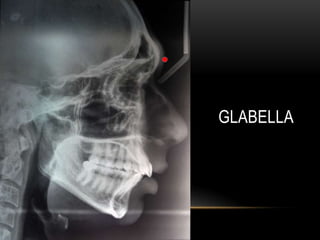
GLABELLA
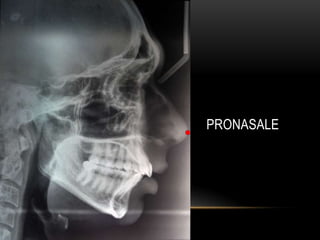
PRONASALE
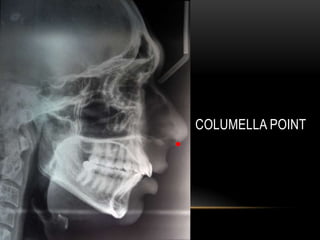
COLUMELLA POINT
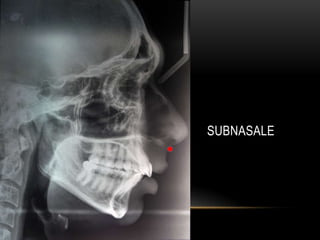
SUBNASALE
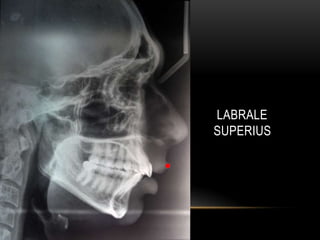
LABRALE
SUPERIUS
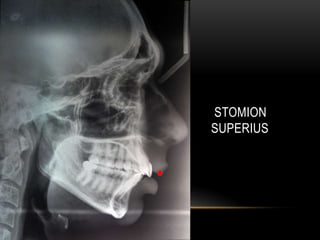
STOMION
SUPERIUS
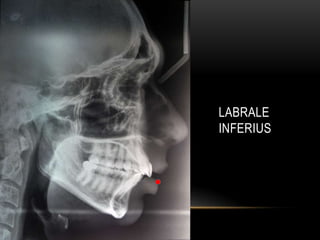
LABRALE
INFERIUS
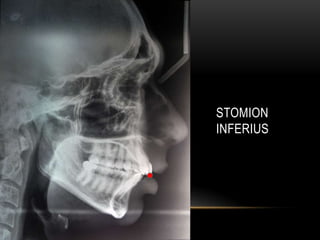
STOMION
INFERIUS
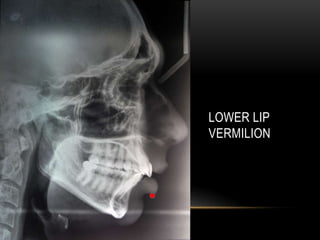
LOWER LIP
VERMILION
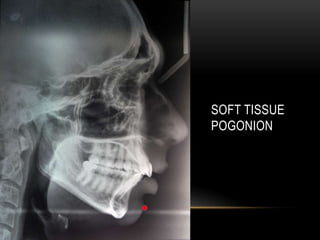
SOFT TISSUE
POGONION
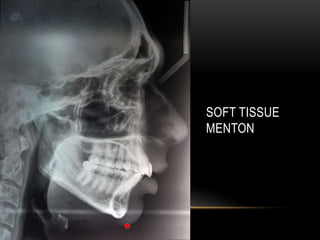
SOFT TISSUE
MENTON
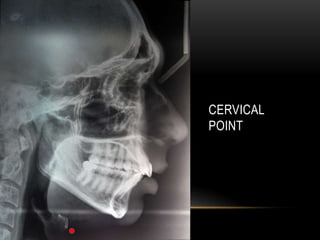
CERVICAL
POINT
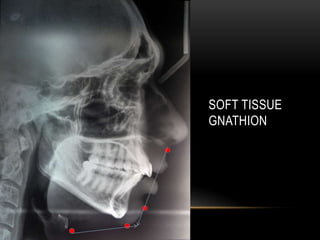
SOFT TISSUE
GNATHION
HORIZONTAL ANALYSIS OF THE SOFT TISSUE
PROFILE
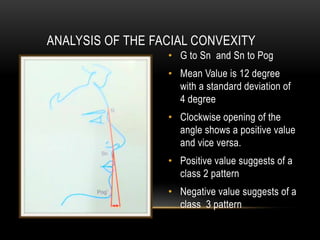
ANALYSIS OF THE FACIAL CONVEXITY
• G to Sn and Sn to Pog
• Mean Value is 12 degree
with a standard deviation of
4 degree
• Clockwise opening of the
angle shows a positive value
and vice versa.
• Positive value suggests of a
class 2 pattern
• Negative value suggests of a
class 3 pattern
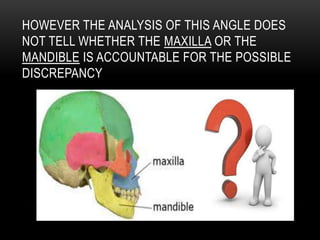
HOWEVER THE ANALYSIS OF THIS ANGLE DOES
NOT TELL WHETHER THE MAXILLA OR THE
MANDIBLE IS ACCOUNTABLE FOR THE POSSIBLE
DISCREPANCY
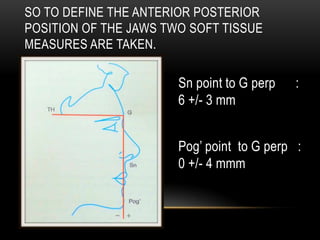
SO TO DEFINE THE ANTERIOR POSTERIOR
POSITION OF THE JAWS TWO SOFT TISSUE
MEASURES ARE TAKEN.

Sn point to G perp
6 +/- 3 mm

:

Pog’ point to G perp :
0 +/- 4 mmm
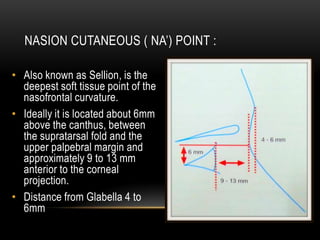
NASION CUTANEOUS ( NA’) POINT :
• Also known as Sellion, is the
deepest soft tissue point of the
nasofrontal curvature.
• Ideally it is located about 6mm
above the canthus, between
the supratarsal fold and the
upper palpebral margin and
approximately 9 to 13 mm
anterior to the corneal
projection.
• Distance from Glabella 4 to
6mm
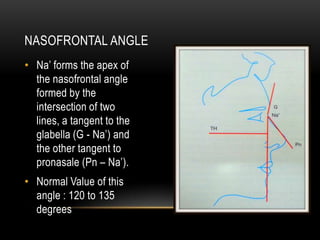
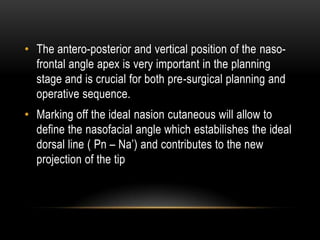
NASOFRONTAL ANGLE
• Na’ forms the apex of
the nasofrontal angle
formed by the
intersection of two
lines, a tangent to the
glabella (G - Na’) and
the other tangent to
pronasale (Pn – Na’).
• Normal Value of this
angle : 120 to 135
degrees
• The antero-posterior and vertical position of the nasofrontal angle apex is very important in the planning
stage and is crucial for both pre-surgical planning and
operative sequence.
• Marking off the ideal nasion cutaneous will allow to
define the nasofacial angle which estabilishes the ideal
dorsal line ( Pn – Na’) and contributes to the new
projection of the tip
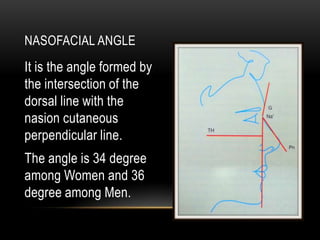
NASOFACIAL ANGLE

It is the angle formed by
the intersection of the
dorsal line with the
nasion cutaneous
perpendicular line.
The angle is 34 degree
among Women and 36
degree among Men.
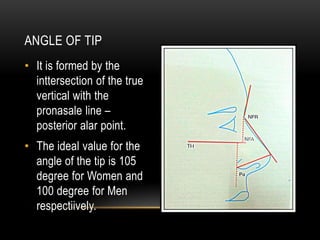
ANGLE OF TIP
• It is formed by the
inttersection of the true
vertical with the
pronasale line –
posterior alar point.
• The ideal value for the
angle of the tip is 105
degree for Women and
100 degree for Men
respectiively.
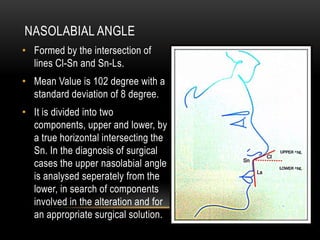
NASOLABIAL ANGLE
• Formed by the intersection of
lines Cl-Sn and Sn-Ls.
• Mean Value is 102 degree with a
standard deviation of 8 degree.
• It is divided into two
components, upper and lower, by
a true horizontal intersecting the
Sn. In the diagnosis of surgical
cases the upper nasolabial angle
is analysed seperately from the
lower, in search of components
involved in the alteration and for
an appropriate surgical solution.
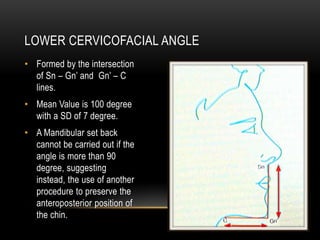
LOWER CERVICOFACIAL ANGLE
• Formed by the intersection
of Sn – Gn’ and Gn’ – C
lines.
• Mean Value is 100 degree
with a SD of 7 degree.
• A Mandibular set back
cannot be carried out if the
angle is more than 90
degree, suggesting
instead, the use of another
procedure to preserve the
anteroposterior position of
the chin.
VERTICAL ANALYSIS OF THE SOFT TISSUE
PROFILE
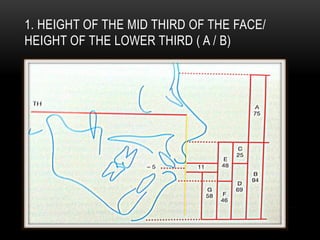
1. HEIGHT OF THE MID THIRD OF THE FACE/
HEIGHT OF THE LOWER THIRD ( A / B)
• The mean value of the ratio is 1:1 , deviations of about 5% are
accepted.
• Height of the lower third of the face increases in :
a) Maxillary vertical over growth
b) Class 3 patients with vertical height increase
c) Skeletal open bites
Height of the lower third of the face decreases in :
a) Maxillary Vertical undergrowth
b) Mandibular retrusion with deep bite
c) Vertical undergrowth of the chin
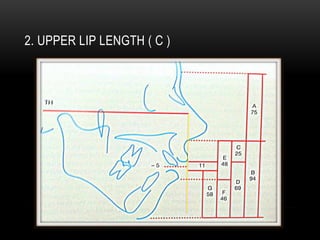
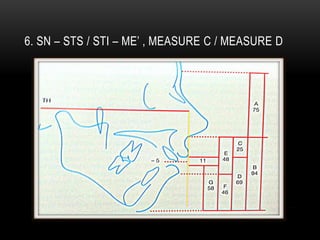
2. UPPER LIP LENGTH ( C )
• The length of the lip should be approximately 1/3 of the
height of the mid third of the face.
• When the upper lip is less is anatomically short ( less
than 18mm ) it is associated with an increase in the
inter labial distance and an excessice exposure of the
upper incisor even though the lower third has a normal
height.
• Norm : Male
Female

-

22 +/- 2mm

-

20 +/- 2mm
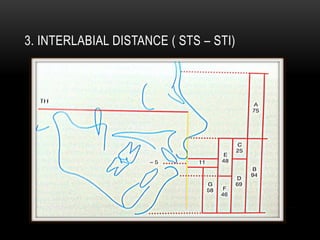
3. INTERLABIAL DISTANCE ( STS – STI)
• It is the distance between the upper lip stomion and the
lower lip stomion.
• Normal value is 0 to 3 mm

• High values indicate that there is labial incompetence.
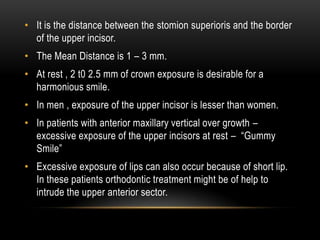
4. EXPOSURE OF THE UPPER INCISOR (STS-UI B)
• It is the distance between the stomion superioris and the border
of the upper incisor.
• The Mean Distance is 1 – 3 mm.
• At rest , 2 t0 2.5 mm of crown exposure is desirable for a
harmonious smile.
• In men , exposure of the upper incisor is lesser than women.
• In patients with anterior maxillary vertical over growth –
excessive exposure of the upper incisors at rest – “Gummy
Smile”
• Excessive exposure of lips can also occur because of short lip.
In these patients orthodontic treatment might be of help to
intrude the upper anterior sector.
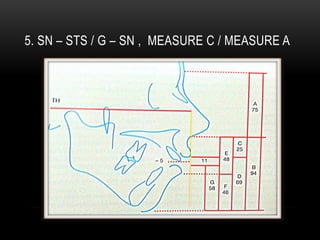
5. SN – STS / G – SN , MEASURE C / MEASURE A
• It is the relationship of the length of the upper lip to the
mid third of the face.
• In a harmonius face , the normal ratio is approximately
1:3.
• It allows to check whether the upper lip length is in tune
with the face under study.
6. SN – STS / STI – ME’ , MEASURE C / MEASURE D
• The length of the upper lip equals half the length of the
lower lip.( Ideal Ratio – 1 : 2 )
• The average length of the lower lip ranges from 38 to
44 cm.
• Anatomically short lower lip is related to Class II , and
conversely , anatomically long lower lip is related to
Class III.
• Anatomically Short lower lip is corrected by
advancement genioplasties.
CONCLUSION :

• Treatment using hard tissue cephalometric
standards may not lead to the desired
improvement in facial form.
• The soft tissue analysis evaluates both vertical
and horizontal aspects of the face, including lip
length and posture.
• The prime objective of orthognathic surgery is
facial improvement, therefore soft tissue
analysis becomes paramount in treatment
planning.
REFERENCE :
• ORTHODONTICS AND ORTHODONTIC SURGERY –
DIAGNOSIS AND PLANNING , JORGE GREGORET

Soft tissue cephalometric analysis for orthognathic surgery

  • 1.
  • 2.
    CONTENTS : • INTRODUCTION •CEPHALOMETRIC LANDMARKS USED FOR THE ANALYSIS • HORIZONTAL ANALYSIS FOR THE SOFT TISSUE PROFILE • VERTICAL ANALYSIS FOR THE SOFT TISSUE PROFILE • CONCLUSION
  • 3.
    INTRODUCTION : Treatment planningfor patients who require orthognathic surgery should include both a hard tissue and soft tissue cephalometric analysis. A good facial profile reflects harmony between many facial areas that are dependent on tooth position, bone position and soft tissue mass. Thus soft tissue areas such as the neck, nose and lilps must be considered in determining whether prognathism or retrognathism of the jaw exists.
  • 4.
    The mean standarddeviations for the measurements used in this soft tissue analysis were derived from a population of 40 white adults (20 men and 20 women) – between the ages of 20 and 30. All patients in the sample were orthodontically untreated with class I occlusions and had vertical facial proportions that were determined to be within normal limits (N. ANS/ANS. Me was between 0.75 and 0.85)
  • 5.
    SOFT TISSUE LANDMARKSUSED FOR THE ANALYSIS
  • 6.
  • 7.
  • 8.
  • 9.
  • 10.
  • 11.
  • 12.
  • 13.
  • 14.
  • 15.
  • 16.
  • 17.
  • 18.
  • 19.
    HORIZONTAL ANALYSIS OFTHE SOFT TISSUE PROFILE
  • 20.
    ANALYSIS OF THEFACIAL CONVEXITY • G to Sn and Sn to Pog • Mean Value is 12 degree with a standard deviation of 4 degree • Clockwise opening of the angle shows a positive value and vice versa. • Positive value suggests of a class 2 pattern • Negative value suggests of a class 3 pattern
  • 21.
    HOWEVER THE ANALYSISOF THIS ANGLE DOES NOT TELL WHETHER THE MAXILLA OR THE MANDIBLE IS ACCOUNTABLE FOR THE POSSIBLE DISCREPANCY
  • 22.
    SO TO DEFINETHE ANTERIOR POSTERIOR POSITION OF THE JAWS TWO SOFT TISSUE MEASURES ARE TAKEN. Sn point to G perp 6 +/- 3 mm : Pog’ point to G perp : 0 +/- 4 mmm
  • 23.
    NASION CUTANEOUS (NA’) POINT : • Also known as Sellion, is the deepest soft tissue point of the nasofrontal curvature. • Ideally it is located about 6mm above the canthus, between the supratarsal fold and the upper palpebral margin and approximately 9 to 13 mm anterior to the corneal projection. • Distance from Glabella 4 to 6mm
  • 24.
    NASOFRONTAL ANGLE • Na’forms the apex of the nasofrontal angle formed by the intersection of two lines, a tangent to the glabella (G - Na’) and the other tangent to pronasale (Pn – Na’). • Normal Value of this angle : 120 to 135 degrees
  • 25.
    • The antero-posteriorand vertical position of the nasofrontal angle apex is very important in the planning stage and is crucial for both pre-surgical planning and operative sequence. • Marking off the ideal nasion cutaneous will allow to define the nasofacial angle which estabilishes the ideal dorsal line ( Pn – Na’) and contributes to the new projection of the tip
  • 26.
    NASOFACIAL ANGLE It isthe angle formed by the intersection of the dorsal line with the nasion cutaneous perpendicular line. The angle is 34 degree among Women and 36 degree among Men.
  • 27.
    ANGLE OF TIP •It is formed by the inttersection of the true vertical with the pronasale line – posterior alar point. • The ideal value for the angle of the tip is 105 degree for Women and 100 degree for Men respectiively.
  • 28.
    NASOLABIAL ANGLE • Formedby the intersection of lines Cl-Sn and Sn-Ls. • Mean Value is 102 degree with a standard deviation of 8 degree. • It is divided into two components, upper and lower, by a true horizontal intersecting the Sn. In the diagnosis of surgical cases the upper nasolabial angle is analysed seperately from the lower, in search of components involved in the alteration and for an appropriate surgical solution.
  • 29.
    LOWER CERVICOFACIAL ANGLE •Formed by the intersection of Sn – Gn’ and Gn’ – C lines. • Mean Value is 100 degree with a SD of 7 degree. • A Mandibular set back cannot be carried out if the angle is more than 90 degree, suggesting instead, the use of another procedure to preserve the anteroposterior position of the chin.
  • 30.
    VERTICAL ANALYSIS OFTHE SOFT TISSUE PROFILE
  • 31.
    1. HEIGHT OFTHE MID THIRD OF THE FACE/ HEIGHT OF THE LOWER THIRD ( A / B)
  • 32.
    • The meanvalue of the ratio is 1:1 , deviations of about 5% are accepted. • Height of the lower third of the face increases in : a) Maxillary vertical over growth b) Class 3 patients with vertical height increase c) Skeletal open bites Height of the lower third of the face decreases in : a) Maxillary Vertical undergrowth b) Mandibular retrusion with deep bite c) Vertical undergrowth of the chin
  • 33.
    2. UPPER LIPLENGTH ( C )
  • 34.
    • The lengthof the lip should be approximately 1/3 of the height of the mid third of the face. • When the upper lip is less is anatomically short ( less than 18mm ) it is associated with an increase in the inter labial distance and an excessice exposure of the upper incisor even though the lower third has a normal height. • Norm : Male Female - 22 +/- 2mm - 20 +/- 2mm
  • 35.
  • 36.
    • It isthe distance between the upper lip stomion and the lower lip stomion. • Normal value is 0 to 3 mm • High values indicate that there is labial incompetence.
  • 37.
    4. EXPOSURE OFTHE UPPER INCISOR (STS-UI B)
  • 38.
    • It isthe distance between the stomion superioris and the border of the upper incisor. • The Mean Distance is 1 – 3 mm. • At rest , 2 t0 2.5 mm of crown exposure is desirable for a harmonious smile. • In men , exposure of the upper incisor is lesser than women. • In patients with anterior maxillary vertical over growth – excessive exposure of the upper incisors at rest – “Gummy Smile” • Excessive exposure of lips can also occur because of short lip. In these patients orthodontic treatment might be of help to intrude the upper anterior sector.
  • 39.
    5. SN –STS / G – SN , MEASURE C / MEASURE A
  • 40.
    • It isthe relationship of the length of the upper lip to the mid third of the face. • In a harmonius face , the normal ratio is approximately 1:3. • It allows to check whether the upper lip length is in tune with the face under study.
  • 41.
    6. SN –STS / STI – ME’ , MEASURE C / MEASURE D
  • 42.
    • The lengthof the upper lip equals half the length of the lower lip.( Ideal Ratio – 1 : 2 ) • The average length of the lower lip ranges from 38 to 44 cm. • Anatomically short lower lip is related to Class II , and conversely , anatomically long lower lip is related to Class III. • Anatomically Short lower lip is corrected by advancement genioplasties.
  • 43.
    CONCLUSION : • Treatmentusing hard tissue cephalometric standards may not lead to the desired improvement in facial form. • The soft tissue analysis evaluates both vertical and horizontal aspects of the face, including lip length and posture. • The prime objective of orthognathic surgery is facial improvement, therefore soft tissue analysis becomes paramount in treatment planning.
  • 44.
    REFERENCE : • ORTHODONTICSAND ORTHODONTIC SURGERY – DIAGNOSIS AND PLANNING , JORGE GREGORET

Editor's Notes