Level 1 Diploma in Plastering
© 2013 City and Guilds of London Institute. All rights reserved. 1 of 21
PowerPointpresentation
Material recognition
Unit 123: Fixing sheet materials
Level 1 Diploma in Plastering
© 2013 City and Guilds of London Institute. All rights reserved. 2 of 21
Assessment criteria
1.5 identify different types of materials used for jointing
plasterboards
2.6 follow current environmental and current health and
safety regulations
3.1 describe different types of pre-formed beads and
expanded metal lath (EML)
Level 1 Diploma in Plastering
© 2013 City and Guilds of London Institute. All rights reserved. 3 of 21
Plasterboards
• Plasterboard is gypsum
that is sandwiched
between two sheets of
paper.
• It has a number of
properties and can be
made in a variety of
sizes.
www.youtube.com/watch?v=tmbk8Pfau0I&feature=youtu.be
Level 1 Diploma in Plastering
© 2013 City and Guilds of London Institute. All rights reserved. 4 of 21
Task:
How many different thicknesses and sizes of plasterboard
can you name?
Plasterboards
Level 1 Diploma in Plastering
© 2013 City and Guilds of London Institute. All rights reserved. 5 of 21
Plasterboard sizes
Plasterboard sheets are commonly 9.5mm and 12.5mm
thick.
They come in a variety of sizes:
• 1,200mm x 900mm
• 1,800 x 900mm
• 2,400mm x 1,200mm.
Level 1 Diploma in Plastering
© 2013 City and Guilds of London Institute. All rights reserved. 6 of 21
Types of plasterboard
There are different types of plasterboard that can be used
for various purposes and also to meet specific building
regulations.
Can you think of any reasons why plasterboards may be
made differently?
www.british-gypsum.com/products/plasterboard___accessories/10_things_you_should_know.aspx
Level 1 Diploma in Plastering
© 2013 City and Guilds of London Institute. All rights reserved. 7 of 21
Types of plasterboard
include:
• soundproofing
• fire resistance
• moisture resistance
• thermal insulation
• impact protection.
Level 1 Diploma in Plastering
© 2013 City and Guilds of London Institute. All rights reserved. 8 of 21
Sound bloc
• For use where improved sound
performance is required.
• They have a higher density core
and are blue in colour.
www.british-gypsum.com/~/media/Files/British-Gypsum/Data-Sheets/DS-Gyproc-HandiBoard.pdf
Level 1 Diploma in Plastering
© 2013 City and Guilds of London Institute. All rights reserved. 9 of 21
Did you know?
Part E of the building
regulations stipulates minimum
noise levels for residential
buildings and different types of
acoustic plasterboard are
available to meet these
stipulations.
www.planningportal.gov.uk/uploads/br/BR_PDF_ADE_2003.pdf
Level 1 Diploma in Plastering
© 2013 City and Guilds of London Institute. All rights reserved. 10 of 21
Fire resistance
• Used in partition, wall lining and ceiling
systems to give increased fire protection.
• Pink plasterboard with glass fibre and
other additives in the core.
www.british-gypsum.com/~/media/Files/British-Gypsum/Data-
Sheets/PDS-Gyproc-FireLine.pdf
Part B of the building regulations
relates to fire safety and various
types of plasterboard have been
made to meet the requirements.
www.planningportal.gov.uk/uploads/br/BR_App_Doc_B_v2.pdf
Level 1 Diploma in Plastering
© 2013 City and Guilds of London Institute. All rights reserved. 11 of 21
Moisture resistant (MR)
• Plasterboard with water-repellent additives in the core
and paper liners.
• For use in wet areas.
• They are green in colour.
www.british-gypsum.com/~/media/Files/British-Gypsum/Data-Sheets/DS-Gyproc-
Moisture-Resistant.pdf
Level 1 Diploma in Plastering
© 2013 City and Guilds of London Institute. All rights reserved. 12 of 21
Thermal insulation
Layers of polystyrene or foam
can be added to plasterboard in
order to improve its thermal
properties.
www.british-gypsum.com/~/media/Files/British-Gypsum/Data-Sheets/PDS-Gyproc-
ThermaLine-BASIC.pdf
Level 1 Diploma in Plastering
© 2013 City and Guilds of London Institute. All rights reserved. 13 of 21
Impact protection
• Plasterboards with a higher
density core with glass fibre
and other additives.
• Designed to give greater
impact resistance in heavy use
areas.
www.british-gypsum.com/~/media/Files/British-Gypsum/Data-Sheets/PDS-Gyproc-
DuraLine.pdf
Level 1 Diploma in Plastering
© 2013 City and Guilds of London Institute. All rights reserved. 14 of 21
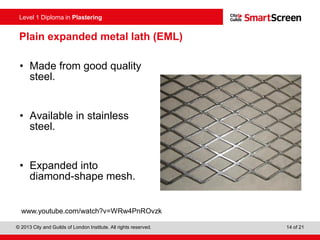
Plain expanded metal lath (EML)
• Made from good quality
steel.
• Available in stainless
steel.
• Expanded into
diamond-shape mesh.
www.youtube.com/watch?v=WRw4PnROvzk
Level 1 Diploma in Plastering
© 2013 City and Guilds of London Institute. All rights reserved. 15 of 21
Rib Lath
• Stiffened by steel ribs
10mm deep.
• Formed from the same
piece of metal.
Level 1 Diploma in Plastering
© 2013 City and Guilds of London Institute. All rights reserved. 16 of 21
Hi-rib Lath
• Has strengthening
pressed into it during
manufacture.
• Stronger than Rib Lath.
Level 1 Diploma in Plastering
© 2013 City and Guilds of London Institute. All rights reserved. 17 of 21
Pre-formed beading
Beads can be used for one- and two-coat work and
come in a range of thickness.
They can be referred to as thick and thin coat beads or
floating and skim beads.
Level 1 Diploma in Plastering
© 2013 City and Guilds of London Institute. All rights reserved. 18 of 21
Preformed beading – thick beads
• Floating/thick beads are
usually mesh with either a
nosing or a stopped
return.
• Range from 10mm to
19mm.
• Used for two-coat work
(float and skim).
Level 1 Diploma in Plastering
© 2013 City and Guilds of London Institute. All rights reserved. 19 of 21
Preformed beading – thin beads
• Thin or skim beads are usually
perforated along the length.
• Range from 3mm to 6mm.
• Used for one-coat work
(skimming).
Level 1 Diploma in Plastering
© 2013 City and Guilds of London Institute. All rights reserved. 20 of 21
Jointing tapes
Jointing tapes are designed to cover the gaps left between
plasterboards, giving strength and aiding in preventing cracking.
Some tapes need to be adhered using plaster mixes, whereas modern
day tapes are pre-glued.
Reinforcing materials include:
• self-adhesive scrim tape (fibreglass)
• non-adhesive scrims:
• hessian/jute scrim
• cotton/bandage scrim
• paper tape.
Level 1 Diploma in Plastering
© 2013 City and Guilds of London Institute. All rights reserved. 21 of 21
Any questions?

6708 13 l1_123_presentation_1

  • 1.
    Level 1 Diplomain Plastering © 2013 City and Guilds of London Institute. All rights reserved. 1 of 21 PowerPointpresentation Material recognition Unit 123: Fixing sheet materials
  • 2.
    Level 1 Diplomain Plastering © 2013 City and Guilds of London Institute. All rights reserved. 2 of 21 Assessment criteria 1.5 identify different types of materials used for jointing plasterboards 2.6 follow current environmental and current health and safety regulations 3.1 describe different types of pre-formed beads and expanded metal lath (EML)
  • 3.
    Level 1 Diplomain Plastering © 2013 City and Guilds of London Institute. All rights reserved. 3 of 21 Plasterboards • Plasterboard is gypsum that is sandwiched between two sheets of paper. • It has a number of properties and can be made in a variety of sizes. www.youtube.com/watch?v=tmbk8Pfau0I&feature=youtu.be
  • 4.
    Level 1 Diplomain Plastering © 2013 City and Guilds of London Institute. All rights reserved. 4 of 21 Task: How many different thicknesses and sizes of plasterboard can you name? Plasterboards
  • 5.
    Level 1 Diplomain Plastering © 2013 City and Guilds of London Institute. All rights reserved. 5 of 21 Plasterboard sizes Plasterboard sheets are commonly 9.5mm and 12.5mm thick. They come in a variety of sizes: • 1,200mm x 900mm • 1,800 x 900mm • 2,400mm x 1,200mm.
  • 6.
    Level 1 Diplomain Plastering © 2013 City and Guilds of London Institute. All rights reserved. 6 of 21 Types of plasterboard There are different types of plasterboard that can be used for various purposes and also to meet specific building regulations. Can you think of any reasons why plasterboards may be made differently? www.british-gypsum.com/products/plasterboard___accessories/10_things_you_should_know.aspx
  • 7.
    Level 1 Diplomain Plastering © 2013 City and Guilds of London Institute. All rights reserved. 7 of 21 Types of plasterboard Types of plasterboard include: • soundproofing • fire resistance • moisture resistance • thermal insulation • impact protection.
  • 8.
    Level 1 Diplomain Plastering © 2013 City and Guilds of London Institute. All rights reserved. 8 of 21 Sound bloc • For use where improved sound performance is required. • They have a higher density core and are blue in colour. www.british-gypsum.com/~/media/Files/British-Gypsum/Data-Sheets/DS-Gyproc-HandiBoard.pdf
  • 9.
    Level 1 Diplomain Plastering © 2013 City and Guilds of London Institute. All rights reserved. 9 of 21 Did you know? Part E of the building regulations stipulates minimum noise levels for residential buildings and different types of acoustic plasterboard are available to meet these stipulations. www.planningportal.gov.uk/uploads/br/BR_PDF_ADE_2003.pdf
  • 10.
    Level 1 Diplomain Plastering © 2013 City and Guilds of London Institute. All rights reserved. 10 of 21 Fire resistance • Used in partition, wall lining and ceiling systems to give increased fire protection. • Pink plasterboard with glass fibre and other additives in the core. www.british-gypsum.com/~/media/Files/British-Gypsum/Data- Sheets/PDS-Gyproc-FireLine.pdf Part B of the building regulations relates to fire safety and various types of plasterboard have been made to meet the requirements. www.planningportal.gov.uk/uploads/br/BR_App_Doc_B_v2.pdf
  • 11.
    Level 1 Diplomain Plastering © 2013 City and Guilds of London Institute. All rights reserved. 11 of 21 Moisture resistant (MR) • Plasterboard with water-repellent additives in the core and paper liners. • For use in wet areas. • They are green in colour. www.british-gypsum.com/~/media/Files/British-Gypsum/Data-Sheets/DS-Gyproc- Moisture-Resistant.pdf
  • 12.
    Level 1 Diplomain Plastering © 2013 City and Guilds of London Institute. All rights reserved. 12 of 21 Thermal insulation Layers of polystyrene or foam can be added to plasterboard in order to improve its thermal properties. www.british-gypsum.com/~/media/Files/British-Gypsum/Data-Sheets/PDS-Gyproc- ThermaLine-BASIC.pdf
  • 13.
    Level 1 Diplomain Plastering © 2013 City and Guilds of London Institute. All rights reserved. 13 of 21 Impact protection • Plasterboards with a higher density core with glass fibre and other additives. • Designed to give greater impact resistance in heavy use areas. www.british-gypsum.com/~/media/Files/British-Gypsum/Data-Sheets/PDS-Gyproc- DuraLine.pdf
  • 14.
    Level 1 Diplomain Plastering © 2013 City and Guilds of London Institute. All rights reserved. 14 of 21 Plain expanded metal lath (EML) • Made from good quality steel. • Available in stainless steel. • Expanded into diamond-shape mesh. www.youtube.com/watch?v=WRw4PnROvzk
  • 15.
    Level 1 Diplomain Plastering © 2013 City and Guilds of London Institute. All rights reserved. 15 of 21 Rib Lath • Stiffened by steel ribs 10mm deep. • Formed from the same piece of metal.
  • 16.
    Level 1 Diplomain Plastering © 2013 City and Guilds of London Institute. All rights reserved. 16 of 21 Hi-rib Lath • Has strengthening pressed into it during manufacture. • Stronger than Rib Lath.
  • 17.
    Level 1 Diplomain Plastering © 2013 City and Guilds of London Institute. All rights reserved. 17 of 21 Pre-formed beading Beads can be used for one- and two-coat work and come in a range of thickness. They can be referred to as thick and thin coat beads or floating and skim beads.
  • 18.
    Level 1 Diplomain Plastering © 2013 City and Guilds of London Institute. All rights reserved. 18 of 21 Preformed beading – thick beads • Floating/thick beads are usually mesh with either a nosing or a stopped return. • Range from 10mm to 19mm. • Used for two-coat work (float and skim).
  • 19.
    Level 1 Diplomain Plastering © 2013 City and Guilds of London Institute. All rights reserved. 19 of 21 Preformed beading – thin beads • Thin or skim beads are usually perforated along the length. • Range from 3mm to 6mm. • Used for one-coat work (skimming).
  • 20.
    Level 1 Diplomain Plastering © 2013 City and Guilds of London Institute. All rights reserved. 20 of 21 Jointing tapes Jointing tapes are designed to cover the gaps left between plasterboards, giving strength and aiding in preventing cracking. Some tapes need to be adhered using plaster mixes, whereas modern day tapes are pre-glued. Reinforcing materials include: • self-adhesive scrim tape (fibreglass) • non-adhesive scrims: • hessian/jute scrim • cotton/bandage scrim • paper tape.
  • 21.
    Level 1 Diplomain Plastering © 2013 City and Guilds of London Institute. All rights reserved. 21 of 21 Any questions?