Section D: High Risk Activities
Manual Handling
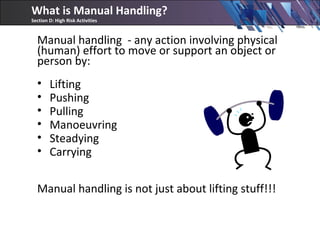
Manual handling - any action involving physical
(human) effort to move or support an object or
person by:
• Lifting
• Pushing
• Pulling
• Manoeuvring
• Steadying
• Carrying
Manual handling is not just about lifting stuff!!!
What is Manual Handling?
Section D: High Risk Activities
Manual Handling Involves…
Picking up… and putting back down!
and pulling!
Carrying… or stretching!
Pushing…
Manual Handling
Section D: High Risk Activities
Injuries due to manual handling typically include….
• Back injuries are the most common (mostly
muscles and ligaments)
• Injuries to fingers, thumbs and arms are the next
most common
• Others include hand and lower limb injuries
Injuries Due to Manual Handling
Section D: High Risk Activities
• Stress is greatest in the cervical (neck) and lumbar
(lower back) areas.
• These two regions are responsible for most of the
movement in the back, allowing you to bend and
twist.
• The lumbar curve of the lower spine supports the
greatest body weight and is the most vulnerable
to injury and pain.
Components of the Back
Section D: High Risk Activities
Vertebrae:
7 - Seven in the
neck (cervical
spine)
12- Twelve in the
mid-back
(thoracic spine)
5 - Five in the
lower back
(lumbar spine)
Components of the Back
Section D: High Risk Activities
Four main causes of back pain:
1. Cumulative – occurs gradually and associated with
poor posture
2. Psychological – pain but with no physical
symptoms, caused through stress or depression
3. Traumatic – caused by sudden and violent stress
to the spine
4. Degenerative – normal aging process which
produces ‘wear and tear’
Causes of Back Pain
Section D: High Risk Activities
What your employer should do for you…
• Eliminate manual handling where practicable
• Carry out suitable and sufficient risk assessment
• Provide information and instruction
(tell you about weight / centre of gravity of the load)
• Provide methods of work / equipment to minimise the
risk
• Plan delivery / offloading and distribution of materials
to avoid unnecessary carrying
Manual Handling
Section D: High Risk Activities
What you should do for your employer…
• Take care of your own safety and others affected by
your activity
• Co-operate with your employer on safety matters
• Make full and proper use of any systems of work
• Make proper use of equipment provided for your
safety
• Inform your employer if you identify hazardous
handling activities
Manual Handling
Section D: High Risk Activities
Lifting and Carrying
Section D: High Risk Activities
“Weigh up” your safety by considering:
T identifies the Task
I identifies the Individual
L identifies the Load
E identifies the Environment
Lifting and Carrying
Section D: High Risk Activities
Task:
Is it…
Necessary?
Possible?
Reasonable?
Practical?
Lifting and Carrying
Section D: High Risk Activities
Individual:
• The safe limit you feel you can lift?
• Working alone or team work?
• Any lifting aids?
Lifting and Carrying
Section D: High Risk Activities
Load:
• Physical size?
• How is the weight spread out (wide / long)?
• Eccentric load - centre of gravity?
• Are lifting handles available?
• Source and destination of the load?
Lifting and Carrying
Section D: High Risk Activities
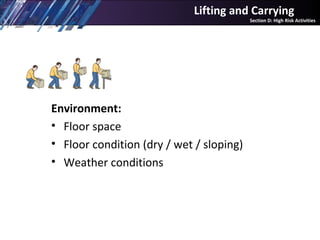
Environment:
• Floor space
• Floor condition (dry / wet / sloping)
• Weather conditions
Lifting and Carrying
Section D: High Risk Activities
Controlling Risks
Section D: High Risk Activities
The chart is a ‘filter mechanism’
Consider:
• Repetition
• Stooping or bending
• Pushing or pulling
• Twisting during lifting
• Balance
• Seated or standing
Controlling Risks – Training
Section D: High Risk Activities
How many of you lift things like this?
If so, you are putting your back at risk!
Controlling Risks
Section D: High Risk Activities
• Risk assess the task
• Keep the back straight
• Use the leg muscles / knees bent
• Keep load close to the body
• Elbows close to your side
• Use the palm grip
• Position the feet
Safe Lifting Summary
Section D: High Risk Activities
Working at Height
• Falls from height continue to be the
biggest industrial killer
• All work at height is covered (regardless
of the distance above ground)
• Precautions needed where there is a risk
of personal injury
• Employers use risk assessments to decide
on the necessary precautions
Working at Height
Section D: High Risk Activities
• Around 50% of industrial fatalities are caused by
falling from height
• 60% of work at height injuries are from falls
below head height
• Most fall from height accidents are caused by not
using the correct equipment for the job i.e.
incorrect use of ladders / stepladders or
improvised platforms
Working at Height - Facts
Section D: High Risk Activities
What your employer should do…
(Legal hierarchy of control)
1. Avoid working at height
2. Ensure all work at height is planned with proper
precautions in place
3. Provide work equipment to prevent falls
4. Mitigate the consequences of a fall
5. Provide instruction and training
Working at Height
Section D: High Risk Activities
A safe system of work would include:
1. Safe access
2. Method of protection
– Edge protection / guard rails
– Barriers back from the edge
– Safety harness or nets should only be used as a
last resort
3. You should not work in any environment if you do
not have a means of protection against falls
Work at Height Regulations
Section D: High Risk Activities
The best prevention from falls is to use guard rails, toe
boards, barriers and similar means of protection
• The minimum height of a top guard rail must be at
least 950 millimetres above the edge from which a
person could fall
• Intermediate gaps must be reduced to no more
than 470 millimetres
• Plastic barriers, netting or rope are not suitable as
edge protection to stop anyone from falling
Preventing Falls
Section D: High Risk Activities
If falls cannot be prevented by the use of guard rails then
the risk of injury must be minimised by:
• Collective fall arrest / mitigation by the
provision of air / bean bags, safety netting and ‘crash’
decks
• Personal fall arrest by the use of safety
harnesses
– The selection of the type of harness is vital
– You must receive additional training before using
a harness and lanyard
Arresting Falls
Section D: High Risk Activities
Protection measures;
• Collective fall prevention – guard rails / barriers
• Collective fall arrest / mitigation – nets / bags
• Personal fall arrest – harnesses
Work at Height Regulations
Section D: High Risk Activities
Common types Mobile Elevated Work Platforms
(MEWP’s) include scissor lifts and cherry pickers
• You must only use access equipment if you have
been fully trained
• If you are a passenger in a cherry picker you must
wear a safety harness and lanyard clipped to the
attachment point
• Never clip on to an adjacent structure
Access Equipment
Section D: High Risk Activities
Mobile towers are safe and versatile access equipment
• You must hold a PASMA or equivalent qualification to
erect, alter or dismantle a mobile tower
• If you are to work on such equipment you should
receive a toolbox talk
• Always ensure wheels are locked
• Only use the integrated ladder access
• Ensure guard rails are fitted
Mobile Towers
Section D: High Risk Activities
Ladders are a very common piece of access equipment
– most frequently misused when utilised as a working
platform
Ladders -
• Should only used for light work
• Always check they are in good condition – report
any defect to your supervisor
• Only use on firm, level ground
• Set at correct angle
• Extend 1 metre (5 rungs) above platform
• Beware of overhead cables
Ladders
Section D: High Risk Activities
Using a Ladder
Section D: High Risk Activities
• When using a ladder always keep the ladder at
an angle of 75 degrees
• Any angle greater than 75 degrees and the
ladder may be too steep to climb and become
unstable
• Any angle less than 75 degrees and the ladder
may be under too much stress and may snap
85
o 75
o
45
o
How Not to Use a Ladder!
Section D: High Risk Activities
A wide variety of stepladders are available…
• Stepladders should only be used for light work
• Always check they are in good condition
• Only use on firm, level ground
• Never over reach
• Don’t stand on the top four treads unless it is
designed to be used that way
Step Ladders
Section D: High Risk Activities
Podium steps are a safe and versatile
alternative – if used correctly
Podium Steps
Section D: High Risk Activities
Many fatalities occur from falling through fragile roofs
• Asbestos cement roofs
• Roof lights
• Other materials where the surface is dirty or
obscured with moss etc.
Never attempt to work on or cross a fragile roof
without a safe access system
Fragile Roofs
Section D: High Risk Activities
How Not to Use Edge Protection
Section D: High Risk Activities
Worst Practice…
Section D: High Risk Activities
Excavations and Confined Spaces
What your site and employer must do:
• Make sure you do not enter an excavation that has
not been adequately supported or designed to
prevent collapse
• Prevent persons or vehicles from falling into an
excavation
• Assess the risk
• Only allow entry to a confined space if it is necessary
and each person is adequately trained
Excavations / Confined Spaces
Section D: High Risk Activities
What you must do for your employer:
• Do not enter an excavation that has not been
adequately supported
• Follow the agreed safe system of work
• Do not remove any guards or leave the excavation
unprotected
• Do not enter confined spaces unless trained to do so
Excavations / Confined Spaces
Section D: High Risk Activities
Collapses can occur when:
• The sides are not (or inadequately) supported
• Vehicles operate too close to the edge of
excavations
• Materials are stored too close to the edge
• Heavy rain weakens the sides
• The ground dries out, shrinks and collapses
• Excavation undermines adjacent walls or structures
Excavations - Collapses
Section D: High Risk Activities
• A cubic metre of soil can weigh over two tonnes
• A shallow excavation can collapse onto you if your
bending over
• Collapsed soils can easily crush or break legs
• Collapse is often silent and occurs without warning
Excavations – The Problems
Section D: High Risk Activities
Every buried service is a danger to the unwary. The
services most likely to be found and their colour
codings are:
• Electricity Black or red
• Water Blue, black or grey
• Gas Yellow
• Communications Grey, yellow, purple or black
(non-exhaustive list)
Excavations – Buried Services
Section D: High Risk Activities
• Avoid the need to enter the excavation
• Install supports before anyone enters
• Only work within the protected area
• Provide a safe way to enter the excavation
• Provide fall protection around the edge
• Prevent vehicles from coming too close
• Inspect the excavation at the start of every shift
Excavations - The Solutions
Section D: High Risk Activities
Questions
Section D: High Risk Activities

D high risk activities (1)

  • 1.
    Section D: HighRisk Activities
  • 2.
  • 3.
    Manual handling -any action involving physical (human) effort to move or support an object or person by: • Lifting • Pushing • Pulling • Manoeuvring • Steadying • Carrying Manual handling is not just about lifting stuff!!! What is Manual Handling? Section D: High Risk Activities
  • 4.
    Manual Handling Involves… Pickingup… and putting back down! and pulling! Carrying… or stretching! Pushing… Manual Handling Section D: High Risk Activities
  • 5.
    Injuries due tomanual handling typically include…. • Back injuries are the most common (mostly muscles and ligaments) • Injuries to fingers, thumbs and arms are the next most common • Others include hand and lower limb injuries Injuries Due to Manual Handling Section D: High Risk Activities
  • 6.
    • Stress isgreatest in the cervical (neck) and lumbar (lower back) areas. • These two regions are responsible for most of the movement in the back, allowing you to bend and twist. • The lumbar curve of the lower spine supports the greatest body weight and is the most vulnerable to injury and pain. Components of the Back Section D: High Risk Activities
  • 7.
    Vertebrae: 7 - Sevenin the neck (cervical spine) 12- Twelve in the mid-back (thoracic spine) 5 - Five in the lower back (lumbar spine) Components of the Back Section D: High Risk Activities
  • 8.
    Four main causesof back pain: 1. Cumulative – occurs gradually and associated with poor posture 2. Psychological – pain but with no physical symptoms, caused through stress or depression 3. Traumatic – caused by sudden and violent stress to the spine 4. Degenerative – normal aging process which produces ‘wear and tear’ Causes of Back Pain Section D: High Risk Activities
  • 9.
    What your employershould do for you… • Eliminate manual handling where practicable • Carry out suitable and sufficient risk assessment • Provide information and instruction (tell you about weight / centre of gravity of the load) • Provide methods of work / equipment to minimise the risk • Plan delivery / offloading and distribution of materials to avoid unnecessary carrying Manual Handling Section D: High Risk Activities
  • 10.
    What you shoulddo for your employer… • Take care of your own safety and others affected by your activity • Co-operate with your employer on safety matters • Make full and proper use of any systems of work • Make proper use of equipment provided for your safety • Inform your employer if you identify hazardous handling activities Manual Handling Section D: High Risk Activities
  • 11.
    Lifting and Carrying SectionD: High Risk Activities
  • 12.
    “Weigh up” yoursafety by considering: T identifies the Task I identifies the Individual L identifies the Load E identifies the Environment Lifting and Carrying Section D: High Risk Activities
  • 13.
  • 14.
    Individual: • The safelimit you feel you can lift? • Working alone or team work? • Any lifting aids? Lifting and Carrying Section D: High Risk Activities
  • 15.
    Load: • Physical size? •How is the weight spread out (wide / long)? • Eccentric load - centre of gravity? • Are lifting handles available? • Source and destination of the load? Lifting and Carrying Section D: High Risk Activities
  • 16.
    Environment: • Floor space •Floor condition (dry / wet / sloping) • Weather conditions Lifting and Carrying Section D: High Risk Activities
  • 17.
    Controlling Risks Section D:High Risk Activities
  • 18.
    The chart isa ‘filter mechanism’ Consider: • Repetition • Stooping or bending • Pushing or pulling • Twisting during lifting • Balance • Seated or standing Controlling Risks – Training Section D: High Risk Activities
  • 19.
    How many ofyou lift things like this? If so, you are putting your back at risk! Controlling Risks Section D: High Risk Activities
  • 20.
    • Risk assessthe task • Keep the back straight • Use the leg muscles / knees bent • Keep load close to the body • Elbows close to your side • Use the palm grip • Position the feet Safe Lifting Summary Section D: High Risk Activities
  • 21.
  • 22.
    • Falls fromheight continue to be the biggest industrial killer • All work at height is covered (regardless of the distance above ground) • Precautions needed where there is a risk of personal injury • Employers use risk assessments to decide on the necessary precautions Working at Height Section D: High Risk Activities
  • 23.
    • Around 50%of industrial fatalities are caused by falling from height • 60% of work at height injuries are from falls below head height • Most fall from height accidents are caused by not using the correct equipment for the job i.e. incorrect use of ladders / stepladders or improvised platforms Working at Height - Facts Section D: High Risk Activities
  • 24.
    What your employershould do… (Legal hierarchy of control) 1. Avoid working at height 2. Ensure all work at height is planned with proper precautions in place 3. Provide work equipment to prevent falls 4. Mitigate the consequences of a fall 5. Provide instruction and training Working at Height Section D: High Risk Activities
  • 25.
    A safe systemof work would include: 1. Safe access 2. Method of protection – Edge protection / guard rails – Barriers back from the edge – Safety harness or nets should only be used as a last resort 3. You should not work in any environment if you do not have a means of protection against falls Work at Height Regulations Section D: High Risk Activities
  • 26.
    The best preventionfrom falls is to use guard rails, toe boards, barriers and similar means of protection • The minimum height of a top guard rail must be at least 950 millimetres above the edge from which a person could fall • Intermediate gaps must be reduced to no more than 470 millimetres • Plastic barriers, netting or rope are not suitable as edge protection to stop anyone from falling Preventing Falls Section D: High Risk Activities
  • 27.
    If falls cannotbe prevented by the use of guard rails then the risk of injury must be minimised by: • Collective fall arrest / mitigation by the provision of air / bean bags, safety netting and ‘crash’ decks • Personal fall arrest by the use of safety harnesses – The selection of the type of harness is vital – You must receive additional training before using a harness and lanyard Arresting Falls Section D: High Risk Activities
  • 28.
    Protection measures; • Collectivefall prevention – guard rails / barriers • Collective fall arrest / mitigation – nets / bags • Personal fall arrest – harnesses Work at Height Regulations Section D: High Risk Activities
  • 29.
    Common types MobileElevated Work Platforms (MEWP’s) include scissor lifts and cherry pickers • You must only use access equipment if you have been fully trained • If you are a passenger in a cherry picker you must wear a safety harness and lanyard clipped to the attachment point • Never clip on to an adjacent structure Access Equipment Section D: High Risk Activities
  • 30.
    Mobile towers aresafe and versatile access equipment • You must hold a PASMA or equivalent qualification to erect, alter or dismantle a mobile tower • If you are to work on such equipment you should receive a toolbox talk • Always ensure wheels are locked • Only use the integrated ladder access • Ensure guard rails are fitted Mobile Towers Section D: High Risk Activities
  • 31.
    Ladders are avery common piece of access equipment – most frequently misused when utilised as a working platform Ladders - • Should only used for light work • Always check they are in good condition – report any defect to your supervisor • Only use on firm, level ground • Set at correct angle • Extend 1 metre (5 rungs) above platform • Beware of overhead cables Ladders Section D: High Risk Activities
  • 32.
    Using a Ladder SectionD: High Risk Activities • When using a ladder always keep the ladder at an angle of 75 degrees • Any angle greater than 75 degrees and the ladder may be too steep to climb and become unstable • Any angle less than 75 degrees and the ladder may be under too much stress and may snap 85 o 75 o 45 o
  • 33.
    How Not toUse a Ladder! Section D: High Risk Activities
  • 34.
    A wide varietyof stepladders are available… • Stepladders should only be used for light work • Always check they are in good condition • Only use on firm, level ground • Never over reach • Don’t stand on the top four treads unless it is designed to be used that way Step Ladders Section D: High Risk Activities
  • 35.
    Podium steps area safe and versatile alternative – if used correctly Podium Steps Section D: High Risk Activities
  • 36.
    Many fatalities occurfrom falling through fragile roofs • Asbestos cement roofs • Roof lights • Other materials where the surface is dirty or obscured with moss etc. Never attempt to work on or cross a fragile roof without a safe access system Fragile Roofs Section D: High Risk Activities
  • 37.
    How Not toUse Edge Protection Section D: High Risk Activities
  • 38.
    Worst Practice… Section D:High Risk Activities
  • 39.
  • 40.
    What your siteand employer must do: • Make sure you do not enter an excavation that has not been adequately supported or designed to prevent collapse • Prevent persons or vehicles from falling into an excavation • Assess the risk • Only allow entry to a confined space if it is necessary and each person is adequately trained Excavations / Confined Spaces Section D: High Risk Activities
  • 41.
    What you mustdo for your employer: • Do not enter an excavation that has not been adequately supported • Follow the agreed safe system of work • Do not remove any guards or leave the excavation unprotected • Do not enter confined spaces unless trained to do so Excavations / Confined Spaces Section D: High Risk Activities
  • 42.
    Collapses can occurwhen: • The sides are not (or inadequately) supported • Vehicles operate too close to the edge of excavations • Materials are stored too close to the edge • Heavy rain weakens the sides • The ground dries out, shrinks and collapses • Excavation undermines adjacent walls or structures Excavations - Collapses Section D: High Risk Activities
  • 43.
    • A cubicmetre of soil can weigh over two tonnes • A shallow excavation can collapse onto you if your bending over • Collapsed soils can easily crush or break legs • Collapse is often silent and occurs without warning Excavations – The Problems Section D: High Risk Activities
  • 44.
    Every buried serviceis a danger to the unwary. The services most likely to be found and their colour codings are: • Electricity Black or red • Water Blue, black or grey • Gas Yellow • Communications Grey, yellow, purple or black (non-exhaustive list) Excavations – Buried Services Section D: High Risk Activities
  • 45.
    • Avoid theneed to enter the excavation • Install supports before anyone enters • Only work within the protected area • Provide a safe way to enter the excavation • Provide fall protection around the edge • Prevent vehicles from coming too close • Inspect the excavation at the start of every shift Excavations - The Solutions Section D: High Risk Activities
  • 46.

Editor's Notes

  • #20 Legs straight, trunk forward, muscles stiff, Pressure on toes, Distortion of discs due to compression of discs Stiffening and poor posture