Building Construction V
Topic 2. Cladding for external & internal
finishes
1. Classification
2.Various technical details
2.3.Various surface finishes
INTRODUCTION
• Definition:
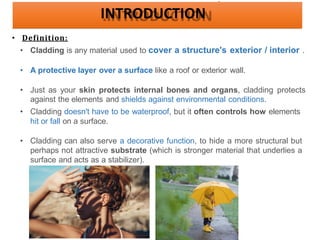
• Cladding is any material used to cover a structure's exterior / interior .
• A protective layer over a surface like a roof or exterior wall.
• Just as your skin protects internal bones and organs, cladding protects
against the elements and shields against environmental conditions.
• Cladding doesn't have to be waterproof, but it often controls how elements
hit or fall on a surface.
• Cladding can also serve a decorative function, to hide a more structural but
perhaps not attractive substrate (which is stronger material that underlies a
surface and acts as a stabilizer).
• FUNCTIONAL REQUIREMENTS
The functional requirements of roofs and walls comprise:
 Strength and stability
 Resistance to weather
 Durability and freedom from maintenance
 Fire safety
 Resistance to the passage of heat
 Resistance to the passage of sound
 Security.
INTRODUCTION
• Objective of cladding :
• Resistance to Sun
• Resistance to Wind
• Resistance to Corrosion
• Resistance to rain
• Appearance / aesthetics
• Resistance to external damage
• Prevent infiltration
• Resistance to Noise
INTRODUCTION
• History of cladding :
Explain in Presentation
just know your self!
INTRODUCTION
C lassification of cladding :
2.1.CLASSIFICATION
Interior cladding
• Plastering
• Paints
• Dry lining
• Tiles
Exterior cladding
• Cladding fixed to structural
backing
• Cladding fixed to framed
structure
2.1.CLASSIFICATION
Interior cladding
Interior cladding done when main or partition walls are built of less
aesthetic material such as blocks
Depends on :
1. Types of base or backing
2. Room usage
3. Degree of comfortrequired
4. Maintenance problems
5. Cost
6. Aesthetics and appearance
7. Safety
8. Individual choice
2.1.CLASSI2F.I1C.ACTLAIOSNSIF>I>CIAnTteIOriNorcladding
Interior cladding
1. Plastering
2.1.CLASSIFICATION >>Interior cladding
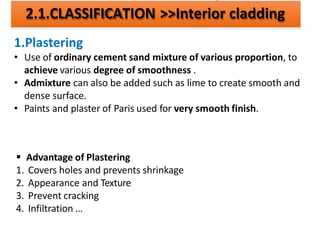
1.Plastering
• Use of ordinary cement sand mixture of various proportion, to
achieve various degree of smoothness .
• Admixture can also be added such as lime to create smooth and
dense surface.
• Paints and plaster of Paris used for very smooth finish.
 Advantage of Plastering
1. Covers holes and prevents shrinkage
2. Appearance and Texture
3. Prevent cracking
4. Infiltration …
2.1.CLASSIFICATION >>Interior cladding
Presentation by group A – ( Refer. book)
1. Plastering ( short definition )
2. Types of mortar used in plastering ( with table ) :
• Lime mortar
• Cement mortar
• Lime cement mortar
3. Number of coats of plaster ( with table )
4. Methods of plastering
• Methods of plastering in lime plaster
• Method of plastering in cement plaster and cement-
lime plaster(with diagram )
5. Defects in Plastering
2.1.CLASSIFICATION >>Interior cladding
Smooth Cast Plaster Finish
• mortar used should be in the
ratio 1: 3 [cement: sand]
• Fine Sand should be taken
• For spreading the mortar,
skimming float or wood float is
best suitable tool
https://theconstructor.org/building/types-plaster-finishes-external-
rendering-buildings/14532/
2.1.CLASSIFICATION >>Interior cladding
Interior cladding
1. Plastering
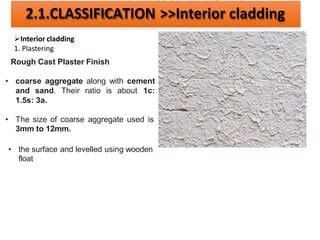
Rough Cast Plaster Finish
• coarse aggregate along with cement
and sand. Their ratio is about 1c:
1.5s: 3a.
• The size of coarse aggregate used is
3mm to 12mm.
• the surface and levelled using wooden
float
2.1.CLASSIFICATION >>Interior cladding
Interior cladding
1. Plastering
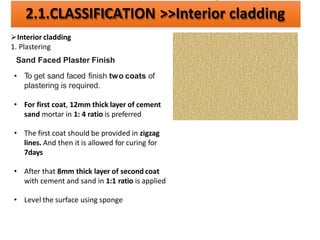
Sand Faced Plaster Finish
• To get sand faced finish two coats of
plastering is required.
• For first coat, 12mm thick layer of cement
sand mortar in 1: 4 ratio is preferred
• The first coat should be provided in zigzag
lines. And then it is allowed for curing for
7days
• After that 8mm thick layer of second coat
with cement and sand in 1:1 ratio is applied
• Level the surface using sponge
2.1.CLASSIFICATION
Interior cladding
1. Plastering
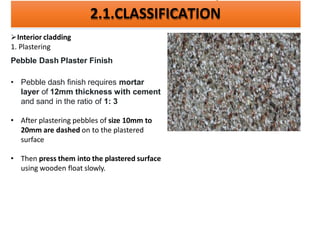
Pebble Dash Plaster Finish
• Pebble dash finish requires mortar
layer of 12mm thickness with cement
and sand in the ratio of 1: 3
• After plastering pebbles of size 10mm to
20mm are dashed on to the plastered
surface
• Then press them into the plastered surface
using wooden float slowly.
2.1.CLASSIFICATION >>Interior cladding
Interior cladding
1. Plastering
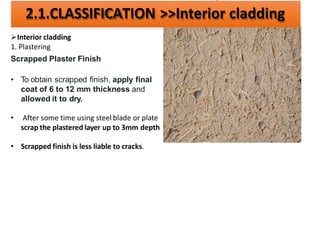
Scrapped Plaster Finish
• To obtain scrapped finish, apply final
coat of 6 to 12 mm thickness and
allowed it to dry.
• After some time using steel blade or plate
scrap the plastered layer up to 3mm depth
• Scrapped finish is less liable to cracks.
2.1.CLASSIFICATION >>Interior cladding
Interior cladding
1. Plastering
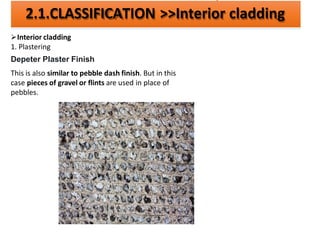
Depeter Plaster Finish
This is also similar to pebble dash finish. But in this
case pieces of gravel or flints are used in place of
pebbles.
2.1.CLASSIFICATION >>Interior cladding
Interior cladding
1. Plastering
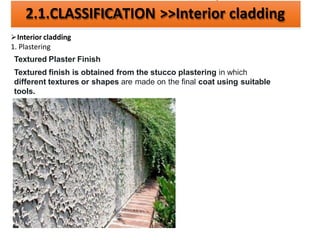
Textured Plaster Finish
Textured finish is obtained from the stucco plastering in which
different textures or shapes are made on the final coat using suitable
tools.
2.1.CLASSI2F.I1C.ACTLAIOSNSIF>I>CIAnTteIOriNorcladding
Interior cladding
2. Paints
Presentation by group B – ( Refer. Book )
1. Painting ( brief intro )
2. Constituents of a paint :
• A base
• A driver
• A solvents or thinner
• A Vehicle or carrier
• A coloring pigments
3. Classificationand type of paints
• Classification based on binders
• Classification based on ultimate use
• Classification mixed type.( types of paint )
Presentation by group C – ( Refer. Book )
4. Painting on surfaces
a. Painting on New wood work
b. Painting on New iron and steel work
c. Repainting old work ( iron/ steel )
5. Painting in plastered surface :
6. Defects in painting :
2.1.CLASSI2F.I1C.ACTLAIOSNSIF>I>CIAnTteIOriNorcladding
Some paint company
Pashupati Paints Pvt. Ltd
Yeti Paints Nepal Pvt. Ltd
Asian Paints Nepal Pvt. Ltd
Berger Johnson & Nicholson Nepal
Reliance Paints Pvt. Ltd
Apollo Paints Pvt. Ltd
Kansai Nerolac Paints Limited,
Choose any one paint in list by each group .
Got to nearest paint market or related paint
company and
Find out :
1. Types of color they are providing
2. Market price of color
3. How much (liter) color is sufficient for
one unit area (1 meter square) ?
4. lead and other chemical content.?
2.1.CLASSI2F.I1C.ACTLAIOSNSIF>I>CIAnTteIOriNorcladding
Interior cladding
3. Dry lining
2.1.CLASSI2F.I1C.ACTLAIOSNSIF>I>CIAnTteIOriNorcladding
Interior cladding
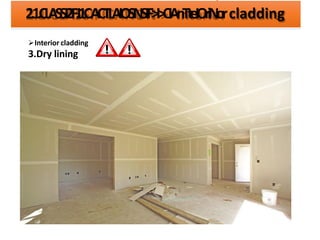
3.Dry lining
• Walls can be lined up with variety of materials which can be self finished
and ready for direct decoration or paint.
• Speed of construction
• The reduction in construction water uses
• Some case ( increase in insulation )
2.1.CLASSI2F.I1C.ACTLAIOSNSIF>I>CIAnTteIOriNorcladding
Interior cladding
3.Dry lining
Interior cladding
3.Dry lining
Suitable material for Dry lining
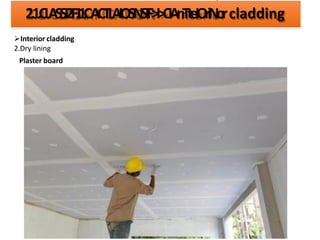
1. Plaster board : gypsum based and can have polished aluminum foil on one
side to act as a reflective insulator or when board is fixed to cavity
Types
a. Gypsum wall board : decorative , 9.5 – 12 .7 mm thick
width – 600,900,1200mm
Lengths – 1800 – 3000 mm
b. Gypsum laths : Narrow width ( cheaper )
9.5-12.7 mm thick
size : 406 x 1200/1219/1372 mm
c. Gypsum board : Sheet ( 9.5mm thick )
d. Gypsum base board or gypsum plank : 9.5mm thick and lengths 1200mm
2.1.CLASSI2F.I1C.ACTLAIOSNSIF>I>CIAnTteIOriNorcladding
Interior cladding
2.Dry lining
Plaster board
2.1.CLASSI2F.I1C.ACTLAIOSNSIF>I>CIAnTteIOriNorcladding
Interior cladding
Dry lining
 Suitable material for Dry lining
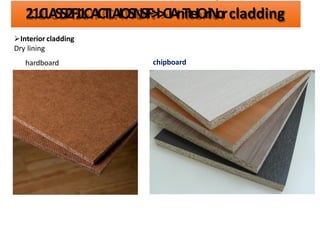
2.Hardboard , plywood and chipboard : Fixed on treated
timber battens attached to wall at suitable centers to suit the
spanning properties and module size of board.
Joints may be masked or emphasized as a design features
Paint, wall papers or varnishing can be applied to complete
the lining
2.1.CLASSI2F.I1C.ACTLAIOSNSIF>I>CIAnTteIOriNorcladding
Interior cladding
Dry lining
hardboard chipboard
2.1.CLASSI2F.I1C.ACTLAIOSNSIF>I>CIAnTteIOriNorcladding
Interior cladding
Dry lining
Fixingof dry lining is done by screw or nail on timber battens , suitable
spaced
Treatment of fixing battens essential to protect from damp and insect attack
Video
Interior cladding
4. Tiles
2.1.CLASSI2F.I1C.ACTLAIOSNSIF>I>CIAnTteIOriNorcladding
Interior cladding
3. Tiles
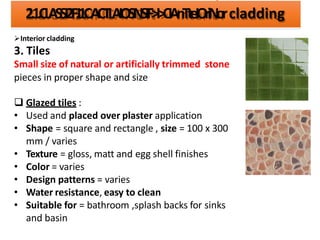
Small size of natural or artificially trimmed stone
pieces in proper shape and size
 Glazed tiles :
• Used and placed over plaster application
• Shape = square and rectangle , size = 100 x 300
mm / varies
• Texture = gloss, matt and egg shell finishes
• Color = varies
• Design patterns = varies
• Water resistance, easy to clean
• Suitable for = bathroom ,splash backs for sinks
and basin
2.1.cladding
Interior cladding
3. Tiles
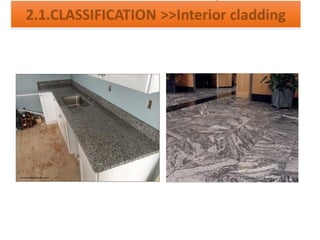
 Quarry tiles ( slate, marble, granite ) :
• Natural look , aesthetic value,
• Slate used for tiling is carefully selected and fixed on treated
timber battens by nailing and fixed to wall
• Marble and granite are heavy so are in small pieces , mostly
used in decorative purpose.
• Marble and granite fixed by mortar or by fixing into metal
clamps.
• Texture = varies
• Color = varies
• Design patterns = varies
• Water resistance, weathering resistance
• Suitable for = kitchen , basin , flooring , hospital walls
External cladding
2..1.CLASSIFICATION >> External cladding
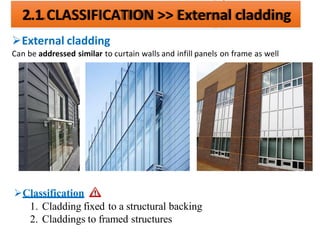
External cladding
Can be addressed similar to curtain walls and infill panels on frame as well
Classification
1. Cladding fixed to a structural backing
2. Claddings to framed structures
2.1.CLASSI2
F.I1
C.A
CT
LI
A
O
SN
SIF
>I>
C
E
A
x
T
tI
e
O
riN
or cladding
Exterior cladding
1. Cladding fixed to a structural backing
2.1.CLASSIF2I.C1A.CTLIAOSNSI>F>ICEAxTtIeOrnNalcladding
1. Cladding fixed to a structural backing
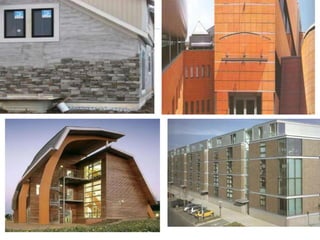
Material used are generally small units
Reasons : ( same as general reasons)
1.if the structural wall cannot act as an adequate protective barrier to
internal elements .
2. Used to improve resistance qualities of wall to acceptable levels.
3.Can be used as decorative features to break up the monotony of large
composed single material elevation.
 Material used :
Tiles , slates, shingles , ( timber pieces 8mm thick ) , timber boarding , plastics
boards , stones facings.
Shingle Cladding can be manufactured using many sheet metal finishes
2.1.CLASSIF2I.C1A.CTLIAOSNSI>F>ICEAxTtIeOrnNalcladding
1. Cladding fixed to a structural backing
 General method of fixing:
1.Secure cladding units to timber battens fixed to
structural backing.
2.stone and similar material are secure by special
mechanical fixings as described in cladding to
framed structure.
2.1.CLASSIF2I.C1A.CTLIAOSNSI>F>ICEAxTtIeOrnNalcladding
1. Cladding fixed to a structural backing
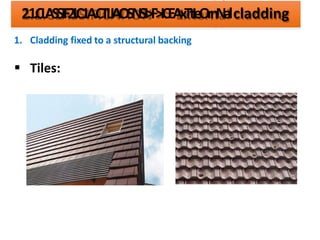
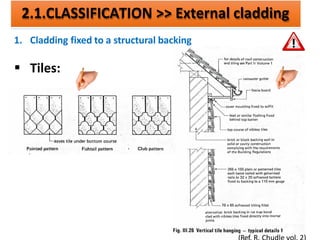
 Tiles:
2.1.CLASSIF2I.C1A.CTLIAOSNSI>F>ICEAxTtIeOrnNalcladding
1. Cladding fixed to a structural backing
 Tiles:
 Ordinary roof tiles/ tiles of decorative patterns
are fixed to lining battens.
 Tiles are nailed at two points with anticorrosive
nails overlapped is 40 mm
 Slates are applied similarly
2.1.CLASSIFICATION >> External cladding
1. Cladding fixed to a structural backing
 Tiles:
2.1.CLASSIFICATION >> External cladding
1. Cladding fixed to a structural backing
 Tiles:
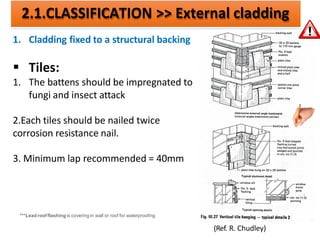
1. The battens should be impregnated to
fungi and insect attack
2.Each tiles should be nailed twice
corrosion resistance nail.
3. Minimum lap recommended = 40mm
(Ref. R. Chudley)
***Lead roof flashing is covering in wall or roof for waterproofing
2.1.CLASSIF2I.C1A.CTLIAOSNSI>F>ICEAxTtIeOrnNalcladding
1. Cladding fixed to a structural backing
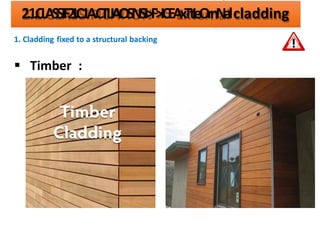
 Timber :
2.1.CLASSIF2I.C1A.CTLIAOSNSI>F>ICEAxTtIeOrnNalcladding
1. Cladding fixed to a structural backing
 Timber :
 Usually in the from of a mouled /shaped board .
 Fixed to battens or either a horizontal / vertical cladding
 Requires regular maintenance
 soft woods are painted regularly need repainting in 3-5 years
time
 Hard woods are given preservatives, preservatives treatment
needed in 2-5 year interval
2.1.CLASSIF2I.C1A.CTLIAOSNSI>F>ICEAxTtIeOrnNalcladding
1. Cladding fixed to a structural backing
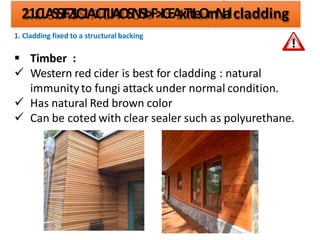
 Timber :
 Western red cider is best for cladding : natural
immunity to fungi attack under normal condition.
 Has natural Red brown color
 Can be coted with clear sealer such as polyurethane.
2.1.CLASSIF2I.C1A.CTLIAOSNSI>F>ICEAxTtIeOrnNalcladding
1. Cladding fixed to a structural backing
 Timber :
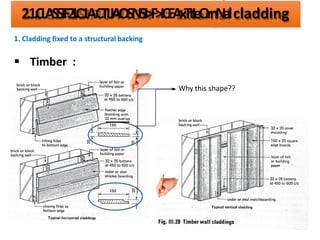
Why this shape??
2.1.CLASSI2
F.I1
C.A
CT
LI
A
O
SN
SIF
>I>
C
E
A
x
T
tI
e
O
riN
or cladding
Exterior cladding
2. Cladding fixed to framed structure
 The method required to clad a frame structure are extensive.
 It Includes :
 Brick panels constructed between columns & beams
 light infill panels of metal and timber
 precast concrete panels
 curtain walls
Exterior cladding
2. Cladding fixed to framed structure
Brick panel wall
2.1.CLASSIF2I.C1A.CTLIAOSNSI>F>ICEAxTtIeOrnNalcladding
2. Cladding fixed to a framed structure
 Brick panel wall
 Are non loadbearing wall
 Should fulfill : sufficient strength, bear positive and negative
wind pressure , required sound and thermal insulation, fire
resistance , durable
 Construction method : same as any ordinary wall or cavity wall
 Panels must be supported at each structural floor level and
tied to the structure at vertical edge.
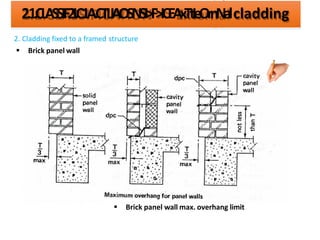
 Projection of panel in front of the structural member as shown
in figure ( maximum over hang ). : T/3
 Top edge should not be rigidly fixed ( panel may expand and
create cracks: compression joints are formed ne between top
edge of panel and under side of framing member
2.1.CLASSIF2I.C1A.CTLIAOSNSI>F>ICEAxTtIeOrnNalcladding
2. Cladding fixed to a framed structure
 Brick panel wall
 Brick panel wall max. overhang limit
2.1.CLASSIF2I.C1A.CTLIAOSNSI>F>ICEAxTtIeOrnNalcladding
2. Cladding fixed to a framed structure
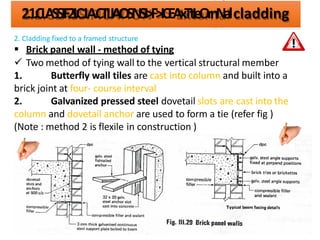
 Brick panel wall - method of tying
 Two method of tying wall to the vertical structural member
1. Butterfly wall tiles are cast into column and built into a
brick joint at four- course interval
2. Galvanized pressed steel dovetail slots are cast into the
column and dovetail anchor are used to form a tie (refer fig )
(Note : method 2 is flexile in construction )
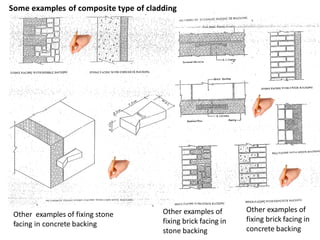
Other examples of fixing stone
facing in concrete backing
Other examples of
fixing brick facing in
concrete backing
Other examples of
fixing brick facing in
stone backing
Some examples of composite type of cladding
Exterior cladding
2. Cladding fixed to framed structure
Cladding fixed to a framed structure
2.1.CLASSIF2I.C1A.CTLIAOSNSI>F>ICEAxTtIeOrnNalcladding
2. Cladding fixed to a framed structure
 Facing to brick panels
 Any wall must have an acceptable and durable finish
 This can be achieved by using facing brick with a neat pointed
joints by attaching to the face of the panel a stone / similar
cladding.
 Suitable material are : natural stone, Artificial stone, reconstructed
stone, pre-cast concrete panel of small units (1 sq.m) and with a
thickens related to the density of the material .
 Dense material such as slate / marble needed only be 40mm thick
, where as softer stone such as sandstone / limestone should be as
least panel 75mm thick
2.1.CLASSIF2I.C1A.CTLIAOSNSI>F>ICEAxTtIeOrnNalcladding
2.Cladding fixed to a framed structures
 Facing to brick panels
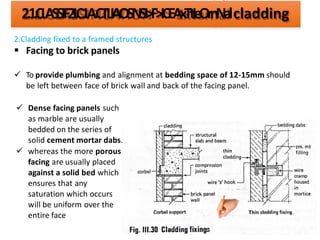
 To provide plumbing and alignment at bedding space of 12-15mm should
be left between face of brick wall and back of the facing panel.
 Dense facing panels such
as marble are usually
bedded on the series of
solid cement mortar dabs.
 whereas the more porous
facing are usually placed
against a solid bed which
ensures that any
saturation which occurs
will be uniform over the
entire face
2.1.CLASSIF2I.C1A.CTLIAOSNSI>F>ICEAxTtIeOrnNalcladding
2.Cladding fixed to a framed structures
 Facing to brick panels
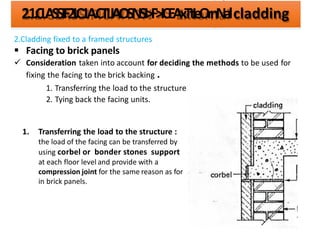
 Consideration taken into account for deciding the methods to be used for
fixing the facing to the brick backing .
1. Transferring the load to the structure
2. Tying back the facing units.
1. Transferring the load to the structure :
the load of the facing can be transferred by
using corbel or bonder stones support
at each floor level and provide with a
compression joint for the same reason as for
in brick panels.
2.1.CLASSIF2I.C1A.CTLIAOSNSI>F>ICEAxTtIeOrnNalcladding
2.Cladding fixed to a framed structures
 Facing to brick panels
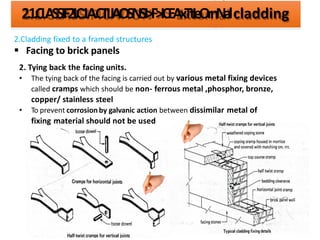
2. Tying back the facing units.
• The tying back of the facing is carried out by various metal fixing devices
called cramps which should be non- ferrous metal ,phosphor, bronze,
copper/ stainless steel
• To prevent corrosionby galvanic action between dissimilar metal of
fixing material should not be used
Exterior cladding
2. Cladding fixed to framed structure
Concrete cladding panels
2.1.CLASSIF2I.C1A.CTLIAOSNSI>F>ICEAxTtIeOrnNalcladding
2.Cladding fixed to a framed structures
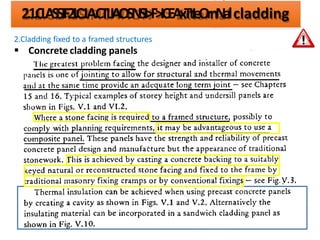
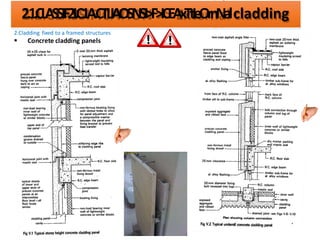
 Concrete cladding panels
 Concrete panels are constructed of dense concrete mix with
suitable steel Bar reinforcements.
 The reinforcements provided the necessary tensile resistance
to the stress developed in final position and for the stresses
set up during transportation, positioning and lifting
 Lifting lugs, Position ,holes must be incorporated in design to
see that they are hoisted correctly and the unwanted stress
are not developed
 The cover of the concrete over the reinforcement while
constructing panel should be 25mm minimum
 If the panels are used it is better to galvanize or use stainless
steel reinforcements ( to reduce corrosion)
2.1.CLASSIF2I.C1A.CTLIAOSNSI>F>ICEAxTtIeOrnNalcladding
2.Cladding fixed to a framed structures
 Concrete cladding panels
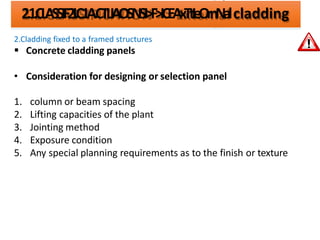
• Consideration for designing or selection panel
1. column or beam spacing
2. Lifting capacities of the plant
3. Jointing method
4. Exposure condition
5. Any special planning requirements as to the finish or texture
2.1.CLASSIF2I.C1A.CTLIAOSNSI>F>ICEAxTtIeOrnNalcladding
2.Cladding fixed to a framed structures
 Concrete cladding panels
2.1.CLASSIF2I.C1A.CTLIAOSNSI>F>ICEAxTtIeOrnNalcladding
2.Cladding fixed to a framed structures
 Concrete cladding panels
2.1.CLASSIF2I.C1A.CTLIAOSNSI>F>ICEAxTtIeOrnNalcladding
2.Cladding fixed to a framed structures
 Concrete cladding panels
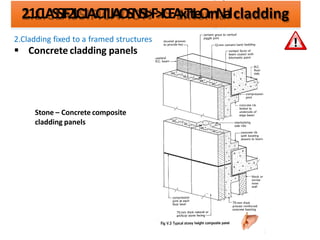
Stone – Concrete composite
cladding panels
Exterior cladding
2. Cladding fixed to framed structure
Infill panel
2.1.CLASSIF2I.C1A.CTLIAOSNSI>F>ICEAxTtIeOrnNalcladding
2.Cladding fixed to a framed structures
 Infill panel :
 Infill panel are usually light weight and usually glazed to give
good internal natural light
 Panels are arranged in various ways to create various optical
impression.
 Verity of material used : Timber, Steel, Aluminum and Plastic .
 Most of panels are either composite or sandwich panels.
 More Maintenance problem encountered in comparison to
concrete panel.
 Difficulty in cleaning facade
 Collects dirt easily
 Permanent panels , usually in large buildings should have
provision of mobile trolley and cradle should be supported.
2.1.CLASSIF2I.C1A.CTLIAOSNSI>F>ICEAxTtIeOrnNalcladding
2.Cladding fixed to a framed structures
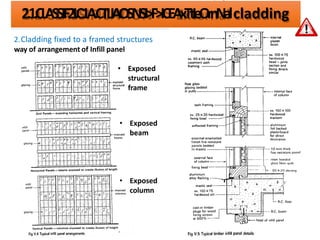
way of arrangement of Infill panel
• Exposed
structural
frame
• Exposed
column
• Exposed
beam
2.1.CLASSIF2I.C1A.CTLIAOSNSI>F>ICEAxTtIeOrnNalcladding
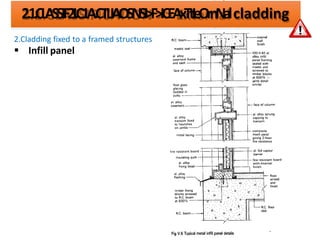
2.Cladding fixed to a framed structures
 Infill panel
Exterior cladding
2. Cladding fixed to framed structure
Light weight wall cladding
2.1.CLASSIF2I.C1A.CTLIAOSNSI>F>ICEAxTtIeOrnNalcladding
2.Cladding fixed to a framed structures
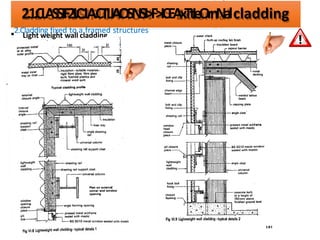
 Light weight wall cladding
 Generally do not require high compressive strength
 They only have to support their own dead load and imposing
wind load.
 Generally manufactured from impervious material ..
Therefore run off of rain water is high ( up to 2 lit/m.sq/mim)
of wall area.
 Sheeting rails fixed by cleats to the vertical structural frame
2.1.CLASSIF2I.C1A.CTLIAOSNSI>F>ICEAxTtIeOrnNalcladding
2.Cladding fixed to a framed structures
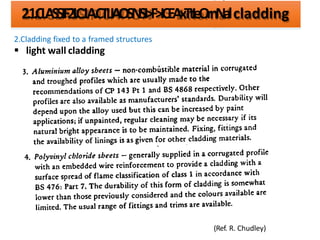
 common material used for light wall cladding are
 Fiber cement
 Coated steel sheets
 Aluminum alloy sheets
 Polyvinyl chloride sheets
2.1.CLASSIF2I.C1A.CTLIAOSNSI>F>ICEAxTtIeOrnNalcladding
2.Cladding fixed to a framed structures
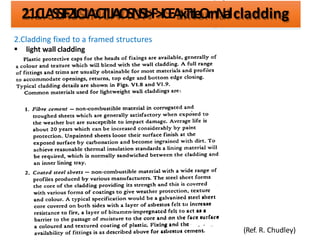
 light wall cladding
(Ref. R. Chudley)
2.1.CLASSIF2I.C1A.CTLIAOSNSI>F>ICEAxTtIeOrnNalcladding
2.Cladding fixed to a framed structures
 light wall cladding
(Ref. R. Chudley)
2.1.CLASSIF2I.C1A.CTLIAOSNSI>F>ICEAxTtIeOrnNalcladding

2.Cladding fixed to a framed structures
Light weight wall cladding
Exterior cladding
2. Cladding fixed to framed structure
Curtain wall
2.1.CLASSIF2I.C1A.CTLIAOSNSI>F>ICEAxTtIeOrnNalcladding
2.Cladding fixed to a framed structures
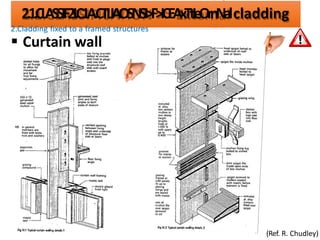
 Curtain wall
(Ref. R. Chudley)
2.3. various types of surface finishes
2.3. vario
2u
.1
s.C
ty
Lp
Ae
Ss
SIo
Ff
IC
sA
uT
rf
Ia
O
cN
e finishes
Ref https://www.constructiontuts.com/types-of-finishes-building-construction/
Apart from protecting various building units from the weathering action of the
atmosphere, the main objective of surface finishing materials is to provide a
decorative finish to obtain a clean, colourful and pleasing surface.
Surface finishing materials are paints, varnishes, distempers and
white/colour washing. The surfaces may be plastered wall surfaces,
ceilings, wooden surfaces, metallic surfaces, etc. These surface finishing
materials have to provide a hygienic surface and present a healthy
surrounding to live in.
2.3. vario
2u
.1
s.C
ty
Lp
Ae
Ss
SIo
Ff
IC
sA
uT
rf
Ia
O
cN
e finishes
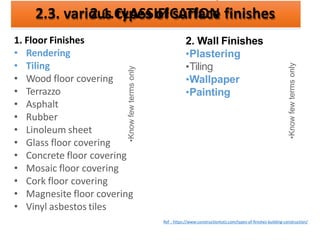
1. Floor Finishes
• Rendering
• Tiling
• Wood floor covering
• Terrazzo
• Asphalt
• Rubber
• Linoleum sheet
• Glass floor covering
• Concrete floor covering
• Mosaic floor covering
• Cork floor covering
• Magnesite floor covering
• Vinyl asbestos tiles
2. Wall Finishes
•Plastering
•Tiling
•Wallpaper
•Painting
Ref : https://www.constructiontuts.com/types-of-finishes-building-construction/
•
Know
few
terms
only
•
Know
few
terms
only
2.3. vario
2u
.1
s.C
ty
Lp
Ae
Ss
SIo
Ff
IC
sA
uT
rf
Ia
O
cN
e finishes
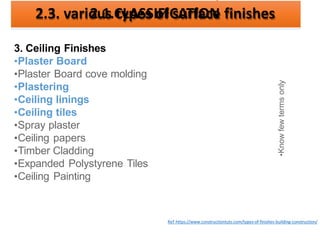
3. Ceiling Finishes
•Plaster Board
•Plaster Board cove molding
•Plastering
•Ceiling linings
•Ceiling tiles
•Spray plaster
•Ceiling papers
•Timber Cladding
•Expanded Polystyrene Tiles
•Ceiling Painting
Ref https://www.constructiontuts.com/types-of-finishes-building-construction/
•
Know
few
terms
only
Few Terminology to understand
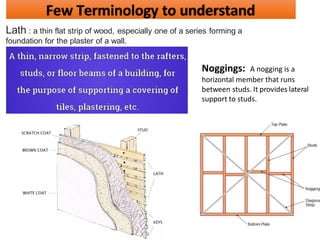
Lath : a thin flat strip of wood, especially one of a series forming a
foundation for the plaster of a wall.
Noggings: A nogging is a
horizontal member that runs
between studs. It provides lateral
support to studs.
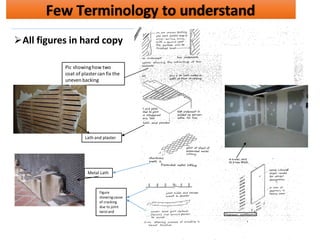
All figures in hard copy
Pic showinghow two
coat of plastercan fix the
uneven backing
Lath and plaster
Metal Lath
Figure
showingcause
of cracking
due to joint
twistand
Few Terminology to understand
Or
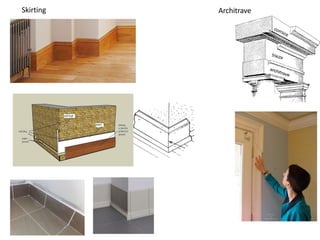
Skirting Architrave
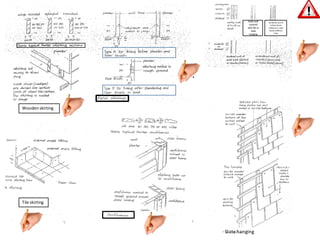
Wooden skirting
Tile skirting
Solid wall
covered
with tile or
slate
hanging
Solid wall
covered
with tile or
slate
hanging
Rendered wall of
hollow blocks
(200mm) or solid
blocks (250mm)
thick
Slatehanging
lecture 2 Cladding for external & internal.pdf

lecture 2 Cladding for external & internal.pdf