Level 1 Diploma in Plastering
© 2013 City and Guilds of London Institute. All rights reserved.
PowerPoint
presentationPreparation of backgrounds
Unit 121: Prepare background surfaces and mix
plastering materials
Level 1 Diploma in Plastering
© 2013 City and Guilds of London Institute. All rights reserved.
Assessment criteria
1.2 state the methods for removing existing plaster by hand and machine
1.3 state the methods for cleaning down background surfaces
1.7 describe the importance of cleaning and waste disposal
2.1 use instructions for preparation of background surfaces
2.3 select hand and power tools to prepare background surfaces
2.6 clean work area and dispose of waste
2.7 use correct access equipment
2.8 follow current environmental and current health and safety regulations
Level 1 Diploma in Plastering
© 2013 City and Guilds of London Institute. All rights reserved.
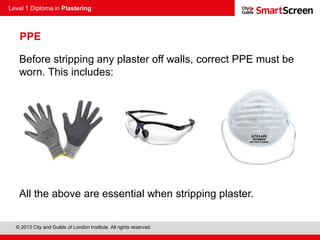
Before stripping any plaster off walls, correct PPE must be
worn. This includes:
All the above are essential when stripping plaster.
PPE
Level 1 Diploma in Plastering
© 2013 City and Guilds of London Institute. All rights reserved.
Stripping of plaster materials – commonly
known as hacking off on old walls – can
either be an easy or hard task, depending
on factors such as age, whether the
building has been left for a long time
without being watertight, etc.
Stripping plaster
Level 1 Diploma in Plastering
© 2013 City and Guilds of London Institute. All rights reserved.
Lump hammer
Big heavy hand-held hammer;
can be used to hit the wall
plaster to loosen it or in
conjunction with the tool below.
Bolster chisel
Hit by lump hammer to strip
plaster; also used by bricklayers
to cut brick blocks.
Tools and equipment
Level 1 Diploma in Plastering
© 2013 City and Guilds of London Institute. All rights reserved.
Claw hammer
The claw is used to extract
bent nails or old nails on pre-
used timber.
Pick hammer
This hammer is a good tool
for getting in between thin,
tight surfaces, like brick and
stone, to rake out the joints.
Tools and equipment
Level 1 Diploma in Plastering
© 2013 City and Guilds of London Institute. All rights reserved.
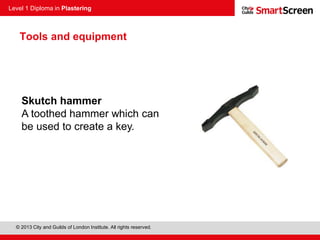
Skutch hammer
A toothed hammer which can
be used to create a key.
Tools and equipment
Level 1 Diploma in Plastering
© 2013 City and Guilds of London Institute. All rights reserved.
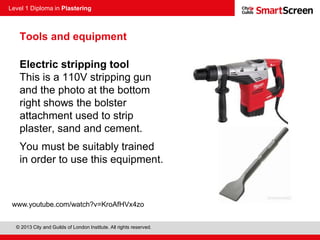
Electric stripping tool
This is a 110V stripping gun
and the photo at the bottom
right shows the bolster
attachment used to strip
plaster, sand and cement.
You must be suitably trained
in order to use this equipment.
Tools and equipment
www.youtube.com/watch?v=KroAfHVx4zo
Level 1 Diploma in Plastering
© 2013 City and Guilds of London Institute. All rights reserved.
Lath hammer
Old traditional tool used
by plasterers, before
plasterboard was widely
used, to cut odd wooden
laths when lathing.
Excellent for hacking off
old sand lime plaster from
walls.
Tools and equipment
Level 1 Diploma in Plastering
© 2013 City and Guilds of London Institute. All rights reserved.
Wire brush
Once you have stripped off the
old plaster on solid walls, all the
loose particles need removing.
You do this by using a wire
brush; this can be speeded up
by using a wire brush
attachment on a 110V drill.
Tools and equipment
Level 1 Diploma in Plastering
© 2013 City and Guilds of London Institute. All rights reserved.
Industrial vacuum
Especially made to vacuum up dust on a building
site, these are made in 110V for safety.
Mechanical extraction systems
Used to extract dust particles out of the air.
Tools and equipment
Level 1 Diploma in Plastering
© 2013 City and Guilds of London Institute. All rights reserved.
If the walls hacked off have had a damp
course treatment, they will still require a salt
neutraliser treatment on the brickwork prior to
plastering.
This stops any salts called efflorescence
working their way to the face of the newly
plastered wall.
Treating damp walls
www.dampshield.com.au/plastering.html
Level 1 Diploma in Plastering
© 2013 City and Guilds of London Institute. All rights reserved.
When working in occupied houses or
properties, always remember to protect any
carpets and furniture by using dust sheets
– not only in the room where you are
working but also in any stairs, hallways, etc
you may be walking through.
Protecting the area
Level 1 Diploma in Plastering
© 2013 City and Guilds of London Institute. All rights reserved.
Disposal of waste
After hacking off any gypsum waste, you
must disposed of it responsibly.
It is now an offence to dispose of gypsum
waste in a landfill site.
www.environment-
agency.gov.uk/static/documents/Business/PS_007_Landfilling_gypsum_rev_Jan_2011.pdf
Level 1 Diploma in Plastering
© 2013 City and Guilds of London Institute. All rights reserved.
Any questions?

6708 13 l1_121_presentation_2

  • 1.
    Level 1 Diplomain Plastering © 2013 City and Guilds of London Institute. All rights reserved. PowerPoint presentationPreparation of backgrounds Unit 121: Prepare background surfaces and mix plastering materials
  • 2.
    Level 1 Diplomain Plastering © 2013 City and Guilds of London Institute. All rights reserved. Assessment criteria 1.2 state the methods for removing existing plaster by hand and machine 1.3 state the methods for cleaning down background surfaces 1.7 describe the importance of cleaning and waste disposal 2.1 use instructions for preparation of background surfaces 2.3 select hand and power tools to prepare background surfaces 2.6 clean work area and dispose of waste 2.7 use correct access equipment 2.8 follow current environmental and current health and safety regulations
  • 3.
    Level 1 Diplomain Plastering © 2013 City and Guilds of London Institute. All rights reserved. Before stripping any plaster off walls, correct PPE must be worn. This includes: All the above are essential when stripping plaster. PPE
  • 4.
    Level 1 Diplomain Plastering © 2013 City and Guilds of London Institute. All rights reserved. Stripping of plaster materials – commonly known as hacking off on old walls – can either be an easy or hard task, depending on factors such as age, whether the building has been left for a long time without being watertight, etc. Stripping plaster
  • 5.
    Level 1 Diplomain Plastering © 2013 City and Guilds of London Institute. All rights reserved. Lump hammer Big heavy hand-held hammer; can be used to hit the wall plaster to loosen it or in conjunction with the tool below. Bolster chisel Hit by lump hammer to strip plaster; also used by bricklayers to cut brick blocks. Tools and equipment
  • 6.
    Level 1 Diplomain Plastering © 2013 City and Guilds of London Institute. All rights reserved. Claw hammer The claw is used to extract bent nails or old nails on pre- used timber. Pick hammer This hammer is a good tool for getting in between thin, tight surfaces, like brick and stone, to rake out the joints. Tools and equipment
  • 7.
    Level 1 Diplomain Plastering © 2013 City and Guilds of London Institute. All rights reserved. Skutch hammer A toothed hammer which can be used to create a key. Tools and equipment
  • 8.
    Level 1 Diplomain Plastering © 2013 City and Guilds of London Institute. All rights reserved. Electric stripping tool This is a 110V stripping gun and the photo at the bottom right shows the bolster attachment used to strip plaster, sand and cement. You must be suitably trained in order to use this equipment. Tools and equipment www.youtube.com/watch?v=KroAfHVx4zo
  • 9.
    Level 1 Diplomain Plastering © 2013 City and Guilds of London Institute. All rights reserved. Lath hammer Old traditional tool used by plasterers, before plasterboard was widely used, to cut odd wooden laths when lathing. Excellent for hacking off old sand lime plaster from walls. Tools and equipment
  • 10.
    Level 1 Diplomain Plastering © 2013 City and Guilds of London Institute. All rights reserved. Wire brush Once you have stripped off the old plaster on solid walls, all the loose particles need removing. You do this by using a wire brush; this can be speeded up by using a wire brush attachment on a 110V drill. Tools and equipment
  • 11.
    Level 1 Diplomain Plastering © 2013 City and Guilds of London Institute. All rights reserved. Industrial vacuum Especially made to vacuum up dust on a building site, these are made in 110V for safety. Mechanical extraction systems Used to extract dust particles out of the air. Tools and equipment
  • 12.
    Level 1 Diplomain Plastering © 2013 City and Guilds of London Institute. All rights reserved. If the walls hacked off have had a damp course treatment, they will still require a salt neutraliser treatment on the brickwork prior to plastering. This stops any salts called efflorescence working their way to the face of the newly plastered wall. Treating damp walls www.dampshield.com.au/plastering.html
  • 13.
    Level 1 Diplomain Plastering © 2013 City and Guilds of London Institute. All rights reserved. When working in occupied houses or properties, always remember to protect any carpets and furniture by using dust sheets – not only in the room where you are working but also in any stairs, hallways, etc you may be walking through. Protecting the area
  • 14.
    Level 1 Diplomain Plastering © 2013 City and Guilds of London Institute. All rights reserved. Disposal of waste After hacking off any gypsum waste, you must disposed of it responsibly. It is now an offence to dispose of gypsum waste in a landfill site. www.environment- agency.gov.uk/static/documents/Business/PS_007_Landfilling_gypsum_rev_Jan_2011.pdf
  • 15.
    Level 1 Diplomain Plastering © 2013 City and Guilds of London Institute. All rights reserved. Any questions?