Level 1 Diploma in Plastering
© 2013 City and Guilds of London Institute. All rights reserved.
PowerPoint
presentationTypes of backgrounds
Unit 121: Prepare background surfaces and mix
plastering materials
Level 1 Diploma in Plastering
© 2013 City and Guilds of London Institute. All rights reserved.
Assessment criteria
1.1 identify different types of background surfaces
1.4 describe the importance and control of suction
2.2 identify different suction backgrounds
Level 1 Diploma in Plastering
© 2013 City and Guilds of London Institute. All rights reserved.
Suction
Suction is a term that describes how the backgrounds
react with the plaster when applied.
• For example, Thermalite blocks are high suction. This
means that if untreated they will suck the water out of
the plaster, thus making it difficult to apply.
• Smooth concrete is low suction. This means that it will
not suck the water out of plaster that is applied.
It is important to control suction – or use an appropriate
plaster in order to combat the suction – otherwise your
plasterwork may fail.
Level 1 Diploma in Plastering
© 2013 City and Guilds of London Institute. All rights reserved.
Common breeze block
This is the most commonly
plastered block surface in
newbuild properties.
Medium /high suction
Thermalite block
Frequently used block; distinctive
wavy lines on face; very light and
can be cut by a saw.
High suction
Background surfaces
Level 1 Diploma in Plastering
© 2013 City and Guilds of London Institute. All rights reserved.
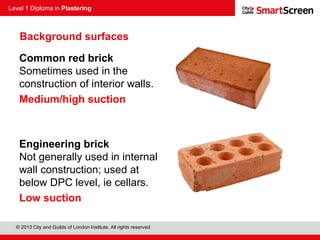
Common red brick
Sometimes used in the
construction of interior walls.
Medium/high suction
Engineering brick
Not generally used in internal
wall construction; used at
below DPC level, ie cellars.
Low suction
Background surfaces
Level 1 Diploma in Plastering
© 2013 City and Guilds of London Institute. All rights reserved.
Dense breeze block
Very heavy breeze block.
Low suction
No-fines block
A very heavy block that has no
fines added to the mix (sand) but
just large aggregate and cement.
Low suction
Background surfaces
Level 1 Diploma in Plastering
© 2013 City and Guilds of London Institute. All rights reserved.
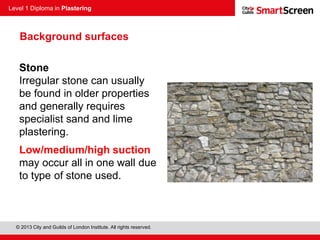
Stone
Irregular stone can usually
be found in older properties
and generally requires
specialist sand and lime
plastering.
Low/medium/high suction
may occur all in one wall due
to type of stone used.
Background surfaces
Level 1 Diploma in Plastering
© 2013 City and Guilds of London Institute. All rights reserved.
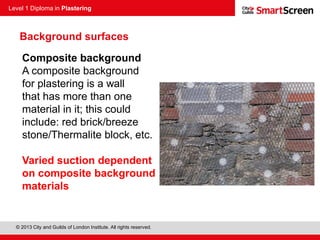
Composite background
A composite background
for plastering is a wall
that has more than one
material in it; this could
include: red brick/breeze
stone/Thermalite block, etc.
Varied suction dependent
on composite background
materials
Background surfaces
Level 1 Diploma in Plastering
© 2013 City and Guilds of London Institute. All rights reserved.
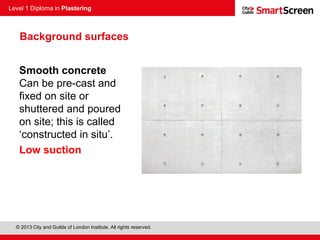
Smooth concrete
Can be pre-cast and
fixed on site or
shuttered and poured
on site; this is called
‘constructed in situ’.
Low suction
Background surfaces
Level 1 Diploma in Plastering
© 2013 City and Guilds of London Institute. All rights reserved.
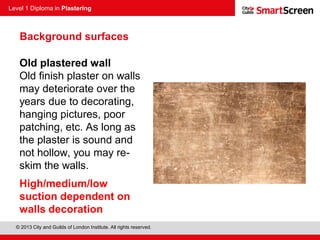
Old plastered wall
Old finish plaster on walls
may deteriorate over the
years due to decorating,
hanging pictures, poor
patching, etc. As long as
the plaster is sound and
not hollow, you may re-
skim the walls.
High/medium/low
suction dependent on
walls decoration
Background surfaces
Level 1 Diploma in Plastering
© 2013 City and Guilds of London Institute. All rights reserved.
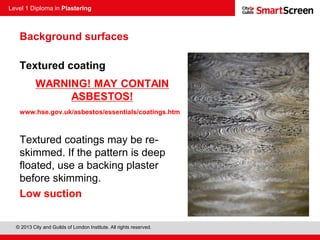
Textured coating
WARNING! MAY CONTAIN
ASBESTOS!
www.hse.gov.uk/asbestos/essentials/coatings.htm
Textured coatings may be re-
skimmed. If the pattern is deep
floated, use a backing plaster
before skimming.
Low suction
Background surfaces
Level 1 Diploma in Plastering
© 2013 City and Guilds of London Institute. All rights reserved.
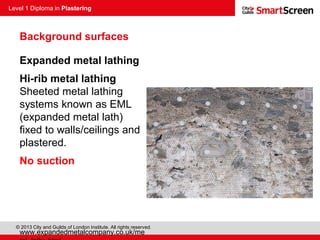
Expanded metal lathing
Hi-rib metal lathing
Sheeted metal lathing
systems known as EML
(expanded metal lath)
fixed to walls/ceilings and
plastered.
No suction
www.expandedmetalcompany.co.uk/me
Background surfaces
Level 1 Diploma in Plastering
© 2013 City and Guilds of London Institute. All rights reserved.
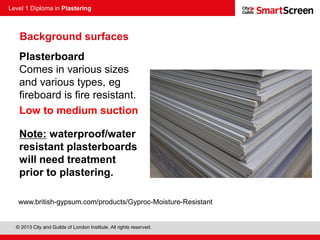
Plasterboard
Comes in various sizes
and various types, eg
fireboard is fire resistant.
Low to medium suction
Note: waterproof/water
resistant plasterboards
will need treatment
prior to plastering.
Background surfaces
www.british-gypsum.com/products/Gyproc-Moisture-Resistant
Level 1 Diploma in Plastering
© 2013 City and Guilds of London Institute. All rights reserved.
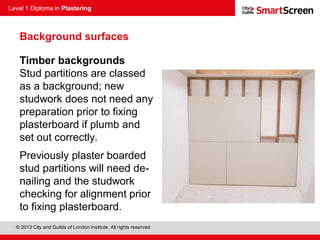
Timber backgrounds
Stud partitions are classed
as a background; new
studwork does not need any
preparation prior to fixing
plasterboard if plumb and
set out correctly.
Previously plaster boarded
stud partitions will need de-
nailing and the studwork
checking for alignment prior
to fixing plasterboard.
Background surfaces
Level 1 Diploma in Plastering
© 2013 City and Guilds of London Institute. All rights reserved.
Any questions?

6708 13 l1_121_presentation_1

  • 1.
    Level 1 Diplomain Plastering © 2013 City and Guilds of London Institute. All rights reserved. PowerPoint presentationTypes of backgrounds Unit 121: Prepare background surfaces and mix plastering materials
  • 2.
    Level 1 Diplomain Plastering © 2013 City and Guilds of London Institute. All rights reserved. Assessment criteria 1.1 identify different types of background surfaces 1.4 describe the importance and control of suction 2.2 identify different suction backgrounds
  • 3.
    Level 1 Diplomain Plastering © 2013 City and Guilds of London Institute. All rights reserved. Suction Suction is a term that describes how the backgrounds react with the plaster when applied. • For example, Thermalite blocks are high suction. This means that if untreated they will suck the water out of the plaster, thus making it difficult to apply. • Smooth concrete is low suction. This means that it will not suck the water out of plaster that is applied. It is important to control suction – or use an appropriate plaster in order to combat the suction – otherwise your plasterwork may fail.
  • 4.
    Level 1 Diplomain Plastering © 2013 City and Guilds of London Institute. All rights reserved. Common breeze block This is the most commonly plastered block surface in newbuild properties. Medium /high suction Thermalite block Frequently used block; distinctive wavy lines on face; very light and can be cut by a saw. High suction Background surfaces
  • 5.
    Level 1 Diplomain Plastering © 2013 City and Guilds of London Institute. All rights reserved. Common red brick Sometimes used in the construction of interior walls. Medium/high suction Engineering brick Not generally used in internal wall construction; used at below DPC level, ie cellars. Low suction Background surfaces
  • 6.
    Level 1 Diplomain Plastering © 2013 City and Guilds of London Institute. All rights reserved. Dense breeze block Very heavy breeze block. Low suction No-fines block A very heavy block that has no fines added to the mix (sand) but just large aggregate and cement. Low suction Background surfaces
  • 7.
    Level 1 Diplomain Plastering © 2013 City and Guilds of London Institute. All rights reserved. Stone Irregular stone can usually be found in older properties and generally requires specialist sand and lime plastering. Low/medium/high suction may occur all in one wall due to type of stone used. Background surfaces
  • 8.
    Level 1 Diplomain Plastering © 2013 City and Guilds of London Institute. All rights reserved. Composite background A composite background for plastering is a wall that has more than one material in it; this could include: red brick/breeze stone/Thermalite block, etc. Varied suction dependent on composite background materials Background surfaces
  • 9.
    Level 1 Diplomain Plastering © 2013 City and Guilds of London Institute. All rights reserved. Smooth concrete Can be pre-cast and fixed on site or shuttered and poured on site; this is called ‘constructed in situ’. Low suction Background surfaces
  • 10.
    Level 1 Diplomain Plastering © 2013 City and Guilds of London Institute. All rights reserved. Old plastered wall Old finish plaster on walls may deteriorate over the years due to decorating, hanging pictures, poor patching, etc. As long as the plaster is sound and not hollow, you may re- skim the walls. High/medium/low suction dependent on walls decoration Background surfaces
  • 11.
    Level 1 Diplomain Plastering © 2013 City and Guilds of London Institute. All rights reserved. Textured coating WARNING! MAY CONTAIN ASBESTOS! www.hse.gov.uk/asbestos/essentials/coatings.htm Textured coatings may be re- skimmed. If the pattern is deep floated, use a backing plaster before skimming. Low suction Background surfaces
  • 12.
    Level 1 Diplomain Plastering © 2013 City and Guilds of London Institute. All rights reserved. Expanded metal lathing Hi-rib metal lathing Sheeted metal lathing systems known as EML (expanded metal lath) fixed to walls/ceilings and plastered. No suction www.expandedmetalcompany.co.uk/me Background surfaces
  • 13.
    Level 1 Diplomain Plastering © 2013 City and Guilds of London Institute. All rights reserved. Plasterboard Comes in various sizes and various types, eg fireboard is fire resistant. Low to medium suction Note: waterproof/water resistant plasterboards will need treatment prior to plastering. Background surfaces www.british-gypsum.com/products/Gyproc-Moisture-Resistant
  • 14.
    Level 1 Diplomain Plastering © 2013 City and Guilds of London Institute. All rights reserved. Timber backgrounds Stud partitions are classed as a background; new studwork does not need any preparation prior to fixing plasterboard if plumb and set out correctly. Previously plaster boarded stud partitions will need de- nailing and the studwork checking for alignment prior to fixing plasterboard. Background surfaces
  • 15.
    Level 1 Diplomain Plastering © 2013 City and Guilds of London Institute. All rights reserved. Any questions?