6.5 Solving Square Root and
  Other Radical Equations
Radical equations
• A radical equation is an equation that
  has a variable in a radicand or a variable
  with a rational exponent.
  – If the radical has index 2, then the equation is
    a square root equation.
Solving Radical Equations
1. Isolate the radical
2. Raise each side to the power suggested
   by the index
3. Simplify
4. Check
Example: Solve
3 + 2x − 3 = 8
Example: Solve
4x + 1 − 5 = 0
Solving Equations with Rational
            Exponents
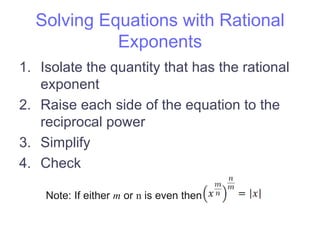
1. Isolate the quantity that has the rational
   exponent
2. Raise each side of the equation to the
   reciprocal power
3. Simplify
4. Check

    Note: If either m or n is even then
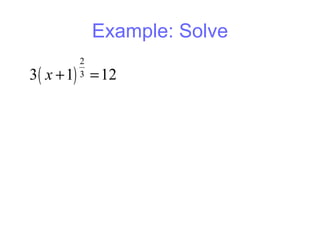
Example: Solve
        2
3 ( x + 1) = 12
        3
Example: Solve
        2
2 ( x + 3) = 8
        3
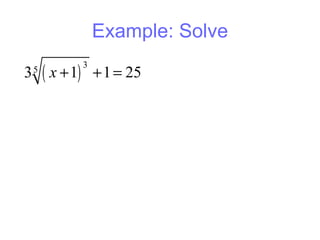
Example: Solve

        ( x + 1)
                   3
3   5
                       + 1 = 25
Extraneous Solutions
• When we are solving radical equations, it
  is possible to derive extraneous solutions,
  therefore we must ALWAYS check our
  solutions.
  – Remember: an extraneous solution gives a
    false statement when checked
Example: Solve. Check for
   extraneous solutions

x+7 −5= x
Example: Solve. Check for
     extraneous solutions

5x − 1 + 3 = x
Solving an equation with two radical
    expressions (or two terms with rational
                 exponents)
•    Isolate one of the radical (or one of the terms
     with a rational exponent) (Hint: Choose the
     more complicated one first)
•    Eliminate the radical (or the rational exponent)
•    Simplify
•    Isolate the other radical (or term with the
     rational exponent)
•    Eliminate the radical (or the rational exponent)
•    Simplify
•    Check for extraneous solutions
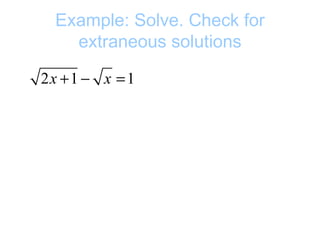
Example: Solve. Check for
    extraneous solutions

2x + 1 − x = 1
Example: Solve. Check for
   extraneous solutions

5x + 4 − x = 4
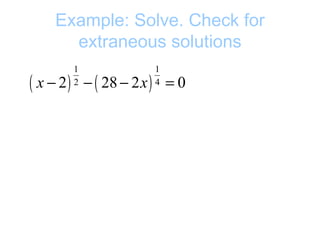
Example: Solve. Check for
       extraneous solutions
           1               1
( x − 2)   2   − ( 28 − 2 x ) = 0
                           4
Homework
• P395 #9, 13, 17, 19, 21, 23, 25 – 44 every
  other odd, 49, 53, 55, 56

6.5

  • 1.
    6.5 Solving SquareRoot and Other Radical Equations
  • 2.
    Radical equations • Aradical equation is an equation that has a variable in a radicand or a variable with a rational exponent. – If the radical has index 2, then the equation is a square root equation.
  • 3.
    Solving Radical Equations 1.Isolate the radical 2. Raise each side to the power suggested by the index 3. Simplify 4. Check
  • 4.
    Example: Solve 3 +2x − 3 = 8
  • 5.
  • 6.
    Solving Equations withRational Exponents 1. Isolate the quantity that has the rational exponent 2. Raise each side of the equation to the reciprocal power 3. Simplify 4. Check Note: If either m or n is even then
  • 7.
    Example: Solve 2 3 ( x + 1) = 12 3
  • 8.
    Example: Solve 2 2 ( x + 3) = 8 3
  • 9.
    Example: Solve ( x + 1) 3 3 5 + 1 = 25
  • 10.
    Extraneous Solutions • Whenwe are solving radical equations, it is possible to derive extraneous solutions, therefore we must ALWAYS check our solutions. – Remember: an extraneous solution gives a false statement when checked
  • 11.
    Example: Solve. Checkfor extraneous solutions x+7 −5= x
  • 12.
    Example: Solve. Checkfor extraneous solutions 5x − 1 + 3 = x
  • 13.
    Solving an equationwith two radical expressions (or two terms with rational exponents) • Isolate one of the radical (or one of the terms with a rational exponent) (Hint: Choose the more complicated one first) • Eliminate the radical (or the rational exponent) • Simplify • Isolate the other radical (or term with the rational exponent) • Eliminate the radical (or the rational exponent) • Simplify • Check for extraneous solutions
  • 14.
    Example: Solve. Checkfor extraneous solutions 2x + 1 − x = 1
  • 15.
    Example: Solve. Checkfor extraneous solutions 5x + 4 − x = 4
  • 16.
    Example: Solve. Checkfor extraneous solutions 1 1 ( x − 2) 2 − ( 28 − 2 x ) = 0 4
  • 17.
    Homework • P395 #9,13, 17, 19, 21, 23, 25 – 44 every other odd, 49, 53, 55, 56