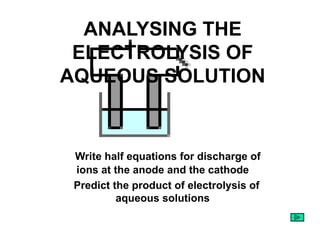
ANALYSING THE ELECTROLYSIS OF AQUEOUS SOLUTION Write half equations for discharge of ions at the anode and the cathode Predict the product of electrolysis of aqueous solutions
- + + -  -  -  -  + + + Anions Cations   electrolyte   Anode ELECTROLYTIC CELL cathode
Electrochemical Series Cu + H + Pb + Sn + Na + K + Ca + Mg + Al + Zn + Fe + Cl - Ag + NO 3 - SO 4 2- F - Br  - OH - I - CATIONS ANIONS MORE EASY TO DISCHARGE
OH - Cl- Carbon H + H + OH - Hydrochloric acid Solution Cl - 1 Electrolysis of HCl aqueous Cl -
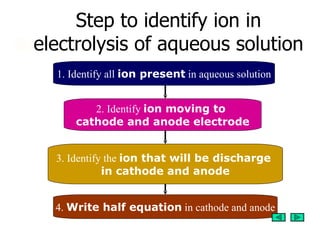
Step to identify ion in electrolysis of aqueous solution 1. Identify all  ion present   in aqueous solution 2. Identify  ion moving to  cathode and anode electrode 3. Identify the  ion that will be discharge  in cathode and anode 4.  Write half equation   in cathode and anode
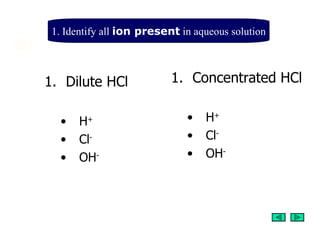
Dilute HCl H + Cl - OH - Concentrated HCl H + Cl - OH - 1. Identify all  ion present   in aqueous solution
Diluted HCl H + Cl - OH - Concentrated HCl H + Cl - OH - cathode cathode anode anode 2. Identify  ion moving to  cathode and anode electrode
Diluted HCl H + Cl - OH - Concentrated HCl H + Cl - OH - Choose ion that are lower In the electrochemical series for  Diluted HCl and choose ion that are higher In the electrochemical series  3. Identify the  ion that will be discharge  in cathode and anode cathode anode cathode anode
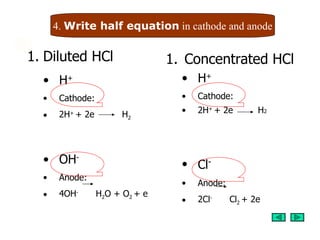
Diluted HCl H + Cathode: 2H +  + 2e  H 2 OH - Anode: 4OH -  H 2 O + O 2  + e Concentrated HCl H + Cathode: 2H +  + 2e  H 2 Cl -  Anode: 2Cl -  Cl 2  + 2e 4.  Write half equation   in cathode and anode
STEP TO WRITE HALF EQUATION OF DISCHARGE ION 1. Write  reactant and product  of reaction 2. Balance  the number of atom  in both equations 3. Balance  the charge of both equation  by adding of  electron
OBSERVATION EXPERIMENT 6.2 Gas bubles are released. A colourless gas which burns with a pop sound is produced. A greenish-yellow gas with a pungent and choking smell is realesed. The gas turns the blue litmus paper red and then white. Concentrated HCl Gas bubbles are released. A colourless gas which burns with a pop sound is produced Gas bubble are released. A colourless gas which relights a glowing splinter is produced   DILUTED HCl Cathode  Anode  SOLUTION
The end…………………
OBSERVATION EXPERIMENT 6.3 COPPER  CARBON ELECTRODE The cathode becomes thicker. Copper electrode dissoves into the solution. The anode become thinner. THE INTENSITY OF THE BLUE COLOUR OF THE ELECTROLYTE  REMAINS UNCHANGED   A reddish-brown solid is deposited on the cathode. Gas bubble are released. A colourless gas which relights a glowing splinter is produced   THE INTENSITY OF THE BLUE COLOUR OF THE ELECTROLYTE  DECREASE Cathode  Anode  ELECTROLYTE

6.3 (b) half equations

  • 1.
    ANALYSING THE ELECTROLYSISOF AQUEOUS SOLUTION Write half equations for discharge of ions at the anode and the cathode Predict the product of electrolysis of aqueous solutions
  • 2.
    - + +- - - - + + + Anions Cations electrolyte Anode ELECTROLYTIC CELL cathode
  • 3.
    Electrochemical Series Cu+ H + Pb + Sn + Na + K + Ca + Mg + Al + Zn + Fe + Cl - Ag + NO 3 - SO 4 2- F - Br - OH - I - CATIONS ANIONS MORE EASY TO DISCHARGE
  • 4.
    OH - Cl-Carbon H + H + OH - Hydrochloric acid Solution Cl - 1 Electrolysis of HCl aqueous Cl -
  • 5.
    Step to identifyion in electrolysis of aqueous solution 1. Identify all ion present in aqueous solution 2. Identify ion moving to cathode and anode electrode 3. Identify the ion that will be discharge in cathode and anode 4. Write half equation in cathode and anode
  • 6.
    Dilute HCl H+ Cl - OH - Concentrated HCl H + Cl - OH - 1. Identify all ion present in aqueous solution
  • 7.
    Diluted HCl H+ Cl - OH - Concentrated HCl H + Cl - OH - cathode cathode anode anode 2. Identify ion moving to cathode and anode electrode
  • 8.
    Diluted HCl H+ Cl - OH - Concentrated HCl H + Cl - OH - Choose ion that are lower In the electrochemical series for Diluted HCl and choose ion that are higher In the electrochemical series 3. Identify the ion that will be discharge in cathode and anode cathode anode cathode anode
  • 9.
    Diluted HCl H+ Cathode: 2H + + 2e H 2 OH - Anode: 4OH - H 2 O + O 2 + e Concentrated HCl H + Cathode: 2H + + 2e H 2 Cl - Anode: 2Cl - Cl 2 + 2e 4. Write half equation in cathode and anode
  • 10.
    STEP TO WRITEHALF EQUATION OF DISCHARGE ION 1. Write reactant and product of reaction 2. Balance the number of atom in both equations 3. Balance the charge of both equation by adding of electron
  • 11.
    OBSERVATION EXPERIMENT 6.2Gas bubles are released. A colourless gas which burns with a pop sound is produced. A greenish-yellow gas with a pungent and choking smell is realesed. The gas turns the blue litmus paper red and then white. Concentrated HCl Gas bubbles are released. A colourless gas which burns with a pop sound is produced Gas bubble are released. A colourless gas which relights a glowing splinter is produced DILUTED HCl Cathode Anode SOLUTION
  • 12.
  • 13.
    OBSERVATION EXPERIMENT 6.3COPPER CARBON ELECTRODE The cathode becomes thicker. Copper electrode dissoves into the solution. The anode become thinner. THE INTENSITY OF THE BLUE COLOUR OF THE ELECTROLYTE REMAINS UNCHANGED A reddish-brown solid is deposited on the cathode. Gas bubble are released. A colourless gas which relights a glowing splinter is produced THE INTENSITY OF THE BLUE COLOUR OF THE ELECTROLYTE DECREASE Cathode Anode ELECTROLYTE