6.2 Chemical Reactions
Chemical Reaction;
• Process by which atoms or groups of
atoms in substances are reorganized
into different substances
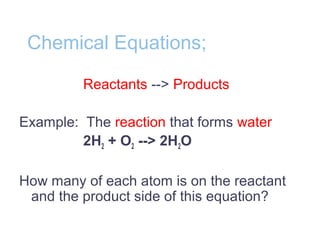
Chemical Equations;
Reactants --> Products
Example: The reaction that forms water
2H2 + O2 --> 2H2O
How many of each atom is on the reactant
and the product side of this equation?
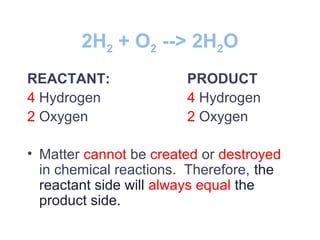
2H2 + O2 --> 2H2O
REACTANT: PRODUCT
4 Hydrogen 4 Hydrogen
2 Oxygen 2 Oxygen
• Matter cannot be created or destroyed
in chemical reactions. Therefore, the
reactant side will always equal the
product side.
Energy of Reactions
• The minimum amount of energy needed for
reactants to form products in a chemical
reaction is called the activation energy.
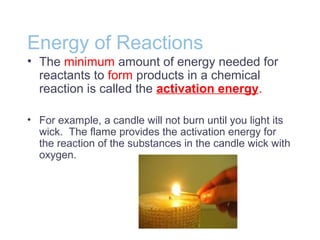
• For example, a candle will not burn until you light its
wick. The flame provides the activation energy for
the reaction of the substances in the candle wick with
oxygen.
Energy in Reactions
• Chemical reactions can be;
Exothermic; releasing energy
Endothermic; absorbing energy
Enzymes
• To speed up a chemical reaction,
scientists use catalysts
• A catalyst lowers the amount of energy
needed to start a chemical reaction.
• In living things, these catalysts are
called ENZYMES.
How Enzymes Work
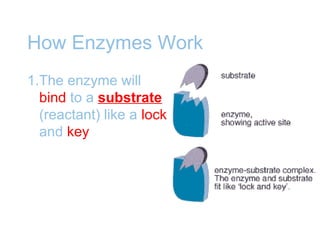
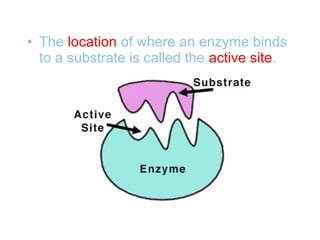
1.The enzyme will
bind to a substrate
(reactant) like a lock
and key
• The location of where an enzyme binds
to a substrate is called the active site.
How Enzymes Work
2. Once the enzyme and substrate
combine, the enzyme-substrate
complex is created.
3. This complex helps to break bonds in
the reactants and form new bonds,
changing the substrates into products
4. The enzyme then releases the product
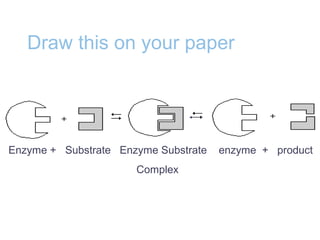
Draw this on your paper
Enzyme + Substrate Enzyme Substrate enzyme + product
Complex

6.2 Chemical Reactions

  • 1.
  • 2.
    Chemical Reaction; • Processby which atoms or groups of atoms in substances are reorganized into different substances
  • 3.
    Chemical Equations; Reactants -->Products Example: The reaction that forms water 2H2 + O2 --> 2H2O How many of each atom is on the reactant and the product side of this equation?
  • 4.
    2H2 + O2--> 2H2O REACTANT: PRODUCT 4 Hydrogen 4 Hydrogen 2 Oxygen 2 Oxygen • Matter cannot be created or destroyed in chemical reactions. Therefore, the reactant side will always equal the product side.
  • 5.
    Energy of Reactions •The minimum amount of energy needed for reactants to form products in a chemical reaction is called the activation energy. • For example, a candle will not burn until you light its wick. The flame provides the activation energy for the reaction of the substances in the candle wick with oxygen.
  • 6.
    Energy in Reactions •Chemical reactions can be; Exothermic; releasing energy Endothermic; absorbing energy
  • 7.
    Enzymes • To speedup a chemical reaction, scientists use catalysts • A catalyst lowers the amount of energy needed to start a chemical reaction. • In living things, these catalysts are called ENZYMES.
  • 8.
    How Enzymes Work 1.Theenzyme will bind to a substrate (reactant) like a lock and key
  • 9.
    • The locationof where an enzyme binds to a substrate is called the active site.
  • 10.
    How Enzymes Work 2.Once the enzyme and substrate combine, the enzyme-substrate complex is created. 3. This complex helps to break bonds in the reactants and form new bonds, changing the substrates into products 4. The enzyme then releases the product
  • 11.
    Draw this onyour paper Enzyme + Substrate Enzyme Substrate enzyme + product Complex