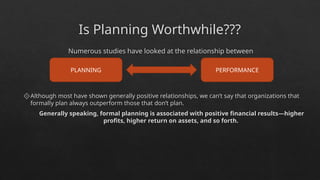
Is Planning Worthwhile???
Numerousstudies have looked at the relationship between
🞚Although most have shown generally positive relationships, we can’t say that organizations that
formally plan always outperform those that don’t plan.
Generally speaking, formal planning is associated with positive financial results—higher
profits, higher return on assets, and so forth.
PLANNING PERFORMANCE
3.
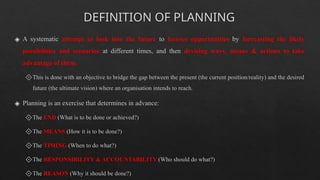
DEFINITION OF PLANNING
◈A systematic attempt to look into the future to foresee opportunities by forecasting the likely
possibilities and scenarios at different times, and then devising ways, means & actions to take
advantage of them.
🞚This is done with an objective to bridge the gap between the present (the current position/reality) and the desired
future (the ultimate vision) where an organisation intends to reach.
◈ Planning is an exercise that determines in advance:
🞚The END (What is to be done or achieved?)
🞚The MEANS (How it is to be done?)
🞚The TIMING (When to do what?)
🞚The RESPONSIBILITY & ACCOUNTABILITY (Who should do what?)
🞚The REASON (Why it should be done?)
4.
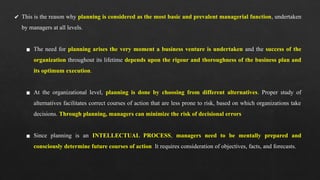
✔ This isthe reason why planning is considered as the most basic and prevalent managerial function, undertaken
by managers at all levels.
▪ The need for planning arises the very moment a business venture is undertaken and the success of the
organization throughout its lifetime depends upon the rigour and thoroughness of the business plan and
its optimum execution.
▪ At the organizational level, planning is done by choosing from different alternatives. Proper study of
alternatives facilitates correct courses of action that are less prone to risk, based on which organizations take
decisions. Through planning, managers can minimize the risk of decisional errors
▪ Since planning is an INTELLECTUAL PROCESS, managers need to be mentally prepared and
consciously determine future courses of action. It requires consideration of objectives, facts, and forecasts.
5.
NATURE & CHARACTERISTICSOF
PLANNING
❖ Planning clarifies the objectives of the organization:
Planning is the deliberate statement of organizational and departmental objectives. The objectives help employees to visualize the
organization in its entirety and see how their actions contribute to its ultimate goals.
❖ Pervasiveness of Planning
Planning is a pervasive activity. Managers at all levels of organization perform the planning function. However, the nature and scope
of planning may differ at various levels of management Top management looks after strategic planning. The middle and lower
management is concerned with administrative planning and operational planning respectively.
❖ Future-Oriented
Planning is always future-oriented because it is done for the future. It decides in the present what is to be done in the future. It is
based on forecasting and a plan is a synthesis of forecasts. Thus, planning is based on farsightedness, which is forward looking in
nature.
❖ Continuous Process
Planning is a continuous and never ending process of a manager in an organization. The manager plans on the basis of some
assumptions, which may not come true in the future. Therefore, he has to go on modifying, revising and adjusting plans in the light of
changing environment. A manager cannot plan once for all.
6.
❖ Planning isan intellectual process:
It involves creative thinking, imagination, foresight, evaluation & sound judgment about different activities that required to be
performed to create a desired future.
✔ It involves translating knowledge and information into a roadmap for a future course of action - Planning through goal
setting is particularly important when an organization is undergoing a major transition.
✔ It involves coordination of different activities to achieve the common objective – thereby, Planning reduces uncertainty.
✔ It needs to be dynamic and flexible in nature, to foresee and react upon events likely to happen in the environment and
thereby formulating contingency plans along with the main plan – Planning facilitates effective Decision making.
7.
IMPORTANCE & LIMITATIONS
IMPORTANCE:
❖Provides holistic picture of consequences – Assessment in advance the impact of plan on the organisation and the people within it and
even on the stakeholders outside the organisation. It also evaluates whether the effort, cost and implications of the implementing the
plan are beneficial to the organisation.
❖ Minimises risks & uncertainties by comprehending different future scenarios and helps in formulating different courses of action to
face the uncertainties.
❖ Judicious & Economical use of resources through their efficient utilisation. Planning Reduces Overlapping and Wasteful Activities.
❖ Promotes COORDINATION by assigning different tasks and responsibilities to different individuals.
❖ Planning helps in developing appropriate control mechanisms with respect to standards, acceptable quality levels, timelines, cost
control etc.
❖ Planning Promotes Innovative Ideas, selecting the best alternative out of the many available. All these alternatives do not come to the
manager on their own, but they have to be discovered. While making such an effort of discovery, many new ideas emerge and they are
studied intensively in order to determine the best out of them.
❖ Planning improves competitive strength, as effective planning gives a competitive edge to the enterprise over other enterprises that do
not have planning or have ineffective planning.
8.
LIMITATION:
❖ Planning premisesmay be wrong: The premises of planning are the basis and framework for any decision. Understanding the
planning premises with absolute accuracy is not possible. There always exists some margin of error that may vitiate the plans.
❖ Time and cost constraints: Every organization has to plan within given time and cost constraints. Such constraints stand against
the efficiency of planning. In a situation of crisis, organizations may even have to take decisions on war footing, in which case
planning itself becomes redundant. Non-availability of time and resources may compel the organization to settle for the most
convenient business plan.
❖ False Sense of Security: A manager may believe that once a plan has been prepared, its implementation will go smoothly, however,
it may not necessarily be the case. If the plan is not reviewed and analyzed periodically it may hinder or delay the implementation
of the same.
❖ Lack of control over external factors: Some external factors may seriously impede the process of planning, for example, a sudden
change in government policies, union pressure for a wage hike, war, and international policies
9.
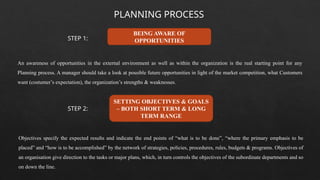
PLANNING PROCESS
BEING AWAREOF
OPPORTUNITIES
SETTING OBJECTIVES & GOALS
– BOTH SHORT TERM & LONG
TERM RANGE
An awareness of opportunities in the external environment as well as within the organization is the real starting point for any
Planning process. A manager should take a look at possible future opportunities in light of the market competition, what Customers
want (costumer’s expectation), the organization’s strengths & weaknesses.
Objectives specify the expected results and indicate the end points of “what is to be done”, “where the primary emphasis to be
placed” and “how is to be accomplished” by the network of strategies, policies, procedures, rules, budgets & programs. Objectives of
an organisation give direction to the tasks or major plans, which, in turn controls the objectives of the subordinate departments and so
on down the line.
STEP 1:
STEP 2:
10.
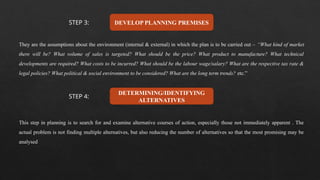
DEVELOP PLANNING PREMISES
Theyare the assumptions about the environment (internal & external) in which the plan is to be carried out – “What kind of market
there will be? What volume of sales is targeted? What should be the price? What product to manufacture? What technical
developments are required? What costs to be incurred? What should be the labour wage/salary? What are the respective tax rate &
legal policies? What political & social environment to be considered? What are the long term trends? etc.”
DETERMINING/IDENTIFYING
ALTERNATIVES
This step in planning is to search for and examine alternative courses of action, especially those not immediately apparent . The
actual problem is not finding multiple alternatives, but also reducing the number of alternatives so that the most promising may be
analysed
STEP 3:
STEP 4:
11.
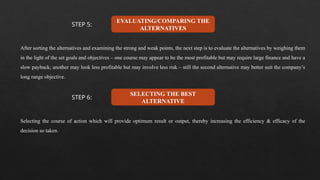
EVALUATING/COMPARING THE
ALTERNATIVES
After sortingthe alternatives and examining the strong and weak points, the next step is to evaluate the alternatives by weighing them
in the light of the set goals and objectives – one course may appear to be the most profitable but may require large finance and have a
slow payback; another may look less profitable but may involve less risk – still the second alternative may better suit the company’s
long range objective.
SELECTING THE BEST
ALTERNATIVE
Selecting the course of action which will provide optimum result or output, thereby increasing the efficiency & efficacy of the
decision so taken.
STEP 6:
STEP 5:
12.
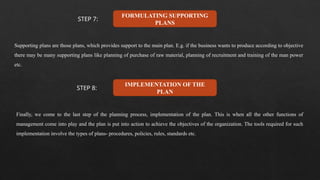
FORMULATING SUPPORTING
PLANS
Supporting plansare those plans, which provides support to the main plan. E.g. if the business wants to produce according to objective
there may be many supporting plans like planning of purchase of raw material, planning of recruitment and training of the man power
etc.
IMPLEMENTATION OF THE
PLAN
Finally, we come to the last step of the planning process, implementation of the plan. This is when all the other functions of
management come into play and the plan is put into action to achieve the objectives of the organization. The tools required for such
implementation involve the types of plans- procedures, policies, rules, standards etc.
STEP 8:
STEP 7:
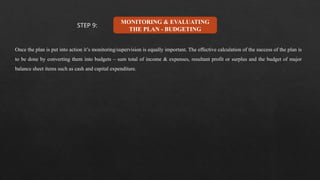
13.
MONITORING & EVALUATING
THEPLAN - BUDGETING
Once the plan is put into action it’s monitoring/supervision is equally important. The effective calculation of the success of the plan is
to be done by converting them into budgets – sum total of income & expenses, resultant profit or surplus and the budget of major
balance sheet items such as cash and capital expenditure.
STEP 9:
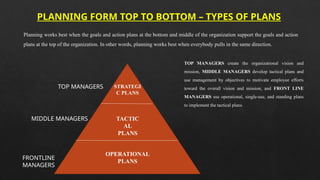
14.
Planning works bestwhen the goals and action plans at the bottom and middle of the organization support the goals and action
plans at the top of the organization. In other words, planning works best when everybody pulls in the same direction.
TOP MANAGERS
MIDDLE MANAGERS
FRONTLINE
MANAGERS
STRATEGI
C PLANS
TACTIC
AL
PLANS
OPERATIONAL
PLANS
PLANNING FORM TOP TO BOTTOM – TYPES OF PLANS
TOP MANAGERS create the organizational vision and
mission, MIDDLE MANAGERS develop tactical plans and
use management by objectives to motivate employee efforts
toward the overall vision and mission, and FRONT LINE
MANAGERS use operational, single-use, and standing plans
to implement the tactical plans.
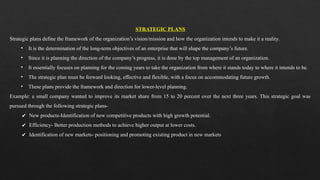
15.
STRATEGIC PLANS
Strategic plansdefine the framework of the organization’s vision/mission and how the organization intends to make it a reality.
• It is the determination of the long-term objectives of an enterprise that will shape the company’s future.
• Since it is planning the direction of the company’s progress, it is done by the top management of an organization.
• It essentially focuses on planning for the coming years to take the organization from where it stands today to where it intends to be.
• The strategic plan must be forward looking, effective and flexible, with a focus on accommodating future growth.
• These plans provide the framework and direction for lower-level planning.
Example: a small company wanted to improve its market share from 15 to 20 percent over the next three years. This strategic goal was
pursued through the following strategic plans-
✔ New products-Identification of new competitive products with high growth potential.
✔ Efficiency- Better production methods to achieve higher output at lower costs.
✔ Identification of new markets- positioning and promoting existing product in new markets
16.
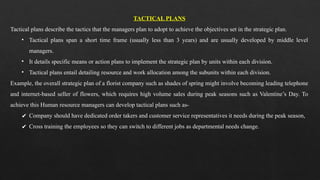
TACTICAL PLANS
Tactical plansdescribe the tactics that the managers plan to adopt to achieve the objectives set in the strategic plan.
• Tactical plans span a short time frame (usually less than 3 years) and are usually developed by middle level
managers.
• It details specific means or action plans to implement the strategic plan by units within each division.
• Tactical plans entail detailing resource and work allocation among the subunits within each division.
Example, the overall strategic plan of a florist company such as shades of spring might involve becoming leading telephone
and internet-based seller of flowers, which requires high volume sales during peak seasons such as Valentine’s Day. To
achieve this Human resource managers can develop tactical plans such as-
✔ Company should have dedicated order takers and customer service representatives it needs during the peak season,
✔ Cross training the employees so they can switch to different jobs as departmental needs change.
17.
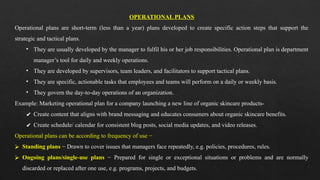
OPERATIONAL PLANS
Operational plansare short-term (less than a year) plans developed to create specific action steps that support the
strategic and tactical plans.
• They are usually developed by the manager to fulfil his or her job responsibilities. Operational plan is department
manager’s tool for daily and weekly operations.
• They are developed by supervisors, team leaders, and facilitators to support tactical plans.
• They are specific, actionable tasks that employees and teams will perform on a daily or weekly basis.
• They govern the day-to-day operations of an organization.
Example: Marketing operational plan for a company launching a new line of organic skincare products-
✔ Create content that aligns with brand messaging and educates consumers about organic skincare benefits.
✔ Create schedule/ calendar for consistent blog posts, social media updates, and video releases.
Operational plans can be according to frequency of use −
⮚ Standing plans − Drawn to cover issues that managers face repeatedly, e.g. policies, procedures, rules.
⮚ Ongoing plans/single-use plans − Prepared for single or exceptional situations or problems and are normally
discarded or replaced after one use, e.g. programs, projects, and budgets.
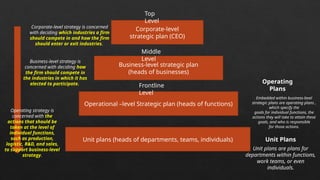
18.
Corporate-level
strategic plan (CEO)
Business-levelstrategic plan
(heads of businesses)
Operational –level Strategic plan (heads of functions)
Unit plans (heads of departments, teams, individuals)
Operating
Plans
Unit Plans
Unit plans are plans for
departments within functions,
work teams, or even
individuals.
Embedded within business-level
strategic plans are operating plans ,
which specify the
goals for individual functions, the
actions they will take to attain these
goals, and who is responsible
for those actions.
Top
Level
Middle
Level
Frontline
Level
Corporate-level strategy is concerned
with deciding which industries a firm
should compete in and how the firm
should enter or exit industries.
Business-level strategy is
concerned with deciding how
the firm should compete in
the industries in which it has
elected to participate.
Operating strategy is
concerned with the
actions that should be
taken at the level of
individual functions,
such as production,
logistic, R&D, and sales,
to support business-level
strategy.
19.
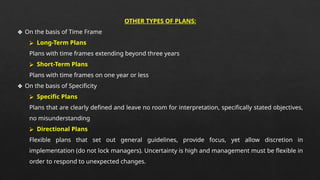
OTHER TYPES OFPLANS:
❖ On the basis of Time Frame
⮚ Long-Term Plans
Plans with time frames extending beyond three years
⮚ Short-Term Plans
Plans with time frames on one year or less
❖ On the basis of Specificity
⮚ Specific Plans
Plans that are clearly defined and leave no room for interpretation, specifically stated objectives,
no misunderstanding
⮚ Directional Plans
Flexible plans that set out general guidelines, provide focus, yet allow discretion in
implementation (do not lock managers). Uncertainty is high and management must be flexible in
order to respond to unexpected changes.
❖ A policyis a predetermined and established guideline aimed towards the attainment of accepted goals and objectives. Through policy statements, one
basically provides guidelines for decision making.
❖ Policies promote consistency and fairness of action under conditions that are similar in character and eliminate any bias in employee-related
decisions and help to avoid confusion and misunderstandings. For example, a disciplinary policy spells out minor and major violation of disciplinary
norms and, accordingly, lists the disciplinary actions.
❑ Policies cover a wide variety of subjects. A comprehensive coverage of policies may include any action or decision taken –
✔ by either employees or management in relation to the working environment,
✔ the rights and responsibilities of employees and management, or any such actions for both parties.
Thus, one policy, e.g., may be a statement of standards for employee attendance and another may be a statement of management obligations in
grievance administration. One policy may explain conditions under which loans will be granted, whereas another may indicate conditions under
which an employee is subjected to discharge.
❖ Inputs for policies may be from both internal and external sources. Internally, policies are developed based on employees’ suggestions or
complaints, collective bargaining, quality management teams, value engineering teams, self-managed teams, etc. External sources could be compliance
with legislative norms, norms of the society and community, national and global economic changes, political changes, etc.
❖ Once the organization finalizes the policy documents, subsequent changes, if any, can only be carried out from the top management. Each
documented policy needs to be communicated to everyone, especially when such policies concern them either directly or indirectly. Communication of
policies can be made in the form of standing orders, house journals, circulars, or documented policy manuals.
POLICY
22.
❖ A visionstatement is a statement of a company’s purpose and the destination it hopes to reach. It serves as a guide to
individuals in an organization. A vision statement should be brief—no more than two sentences—and should also be enduring,
inspirational, clear, and consistent with widely shared company beliefs and values.
❖ A vision consists of the organization’s intentions that are all-inclusive and forward-thinking. It is the driving force of the
organization. A vision has certain characteristics, such as:
⮚ It describes aspirations for the future.
⮚ It does not specify the means that are used to achieve the desired ends.
⮚ It must be inspirational.
⮚ It is often unwritten.
⮚ It must be communicated.
❖ Communication of a vision can be done in two ways:
⮚ in the form of a mission statement and
⮚ through personal interactions with customers to build relationships and communicate one’s vision.
VISION
23.
❖ A visionin tangible form is a mission statement. Therefore, a mission statement verbalizes the vision.
A mission statement attempts to answer the following issues:
⮚ Basic purpose of an organization
⮚ Uniqueness or distinctiveness of the organization
⮚ Likely difference in business three to five years in the future
⮚ Principal customers, clients, or key market segments
⮚ Principal goods and services in the present and the future
⮚ Principal economic concerns
⮚ Basic beliefs, values, aspirations, and philosophical priorities of the firm
Some of the key elements of a mission statement are:
✔ View of the future: The anticipated regulatory, competitive, and economic environment
✔ Competitive arenas: The business and geographic business arenas where the company will compete
✔ Sources of competitive advantage: The skills that the company will develop and a description of how the company intends to succeed
Some of the benefits of a mission statement are:
✔ It establishes boundaries to guide strategy formulation.
✔ It acknowledges responsibilities to various stakeholders and establishes standards of organizational performance.
✔ It suggests standards of individual behaviour.
MISSIO
N
24.
Strategy is thelong-term direction and scope of an organization, matching its resources to its changing environment and in particular its markets,
customers, or clients, to meet stakeholders’ expectations. To achieve results and excellence in business performance, most organizations around the world
take the initiative to align their strategies with their business goals and objectives. A well-developed strategy map for any organization gives a sense of
direction to all cross-sections of organizational members.
There are three levels of strategies:
1. Corporate-level strategy: Corporate-level strategies are influenced by the mission of the organization. They address the following issues:
⮚ Overall scope of an organization
⮚ How an organization is managed in structural and financial terms
⮚ How resources are allocated to different operations
2. Competitive or business strategy: These strategies are adopted in order to strengthen the position of the organization in the market. They explain:
⮚ How to compete in a market
⮚ Which products or services should be developed and offered to which markets
⮚ The extent to which customers’ needs are met
⮚ If it is possible to achieve the objectives of the organization, viz. long-term profitability, market growth, and efficiency
3. Operational strategies: These are adopted at the functional level and the success at the functional or operational level ultimately enables an organization
to achieve corporate-level and competitive strategies.
STRATEGY
25.
Goals are theends towards which the entire effort of the organization is concentrated or aimed. They not only represent the end point of planning
but also the collaborative end of the effective efforts of rest of the managerial functions.
⮚ Goals help define a company's purpose, assist its business growth and achieve its financial objectives.
⮚ Setting specific organizational goals can also help a company measure their organization's progress and determine the tasks that must
be improved to meet those business goals.
⮚ Goals need to be specific, measurable, achievable and timely. By setting clear, realistic goals, organizations have a clearer path to
achieve success and realize its vision. Goal setting, and attaining them, can also help an organization achieve increased efficiency,
productivity and profitability.
GOALS
Objectives are the operational definitions of goals. They describe what organizations hope to accomplish in specific measurable terms within a given
time frame.
⮚ The top management of an organization decides the overall objectives, which then cascades to divisional, departmental, and individual
employee-level objectives.
⮚ Individual employee-level objectives are variously known as key result areas (KRAs), key performance areas (KPAs), key performance
indicators (KPIs), or key sales objectives (KSOs). Such individual-level objectives then become the basis for performance evaluation.
⮚ Thus, characteristically, objectives can be measured; they have a time dimension; and they reduce conflicts (misunderstandings) by setting a
common direction for all those who work for the organization.
OBJECTIVES