KERALA UNIVERSITY COLLEGE OF TEACHER 
EDUCATION KUMARAPURAM 
B.Ed. Course 2013-14 
Semester II 
Optional : Natural Science 
Online Assignment 
Topic: Club Activities 
0 
Name : Shruthi.S 
Reg.No : 13971029 
[Typ 
e a 
quot 
e 
from
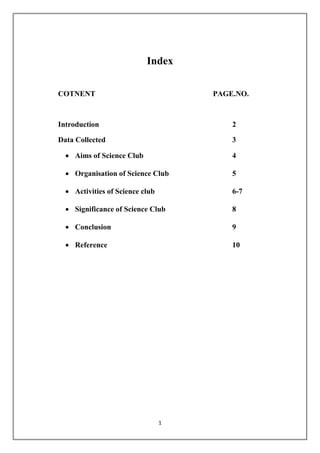
Index 
COTNENT PAGE.NO. 
Introduction 2 
Data Collected 3 
 Aims of Science Club 4 
 Organisation of Science Club 5 
 Activities of Science club 6-7 
 Significance of Science Club 8 
 Conclusion 9 
 Reference 10 
1
Introduction 
The Scientific and technological advancement of today is 
a long forward journey from Stone Age. As we live in an age 
of science, it is essential that the students have a deep insight 
to the background of science. Each individual has his own 
interest and abilities. Science educators, now a days are found 
to exhibit growing interest and means of stimulating group 
participation and mobilizing interest in Teaching Science. 
Organising Club is one among such activities. 
A Science club provides opportunities to students to 
express their creative abilities in the field of science. The 
routine science programme may not cater to the individual 
needs and interest. Science club activities improve students’ 
comprehension and help to develop scientific hobbies. 
Participation in science club should never be imposed on the 
students. It should emerge as a need of the students. 
Otherwise, the basic purpose of the science club will be 
defeated. 
2
Through activities of Science Club learning of Science 
becomes joyful. While activity participating in a science club 
students organize thought and translate these into action and 
there by develop a zealous enthusiasm to strike for the cause 
of scientific enterprise. 
3
Science Club 
“Learning by doing and learning by living” are two 
important factors of learning. Science club is the place where 
all the co-curricular activities are organized. Through the 
science club, students get an opportunity to extra learning in 
addition to their course content. 
According to ‘Davis’ said that the future of India belongs 
to youth and science there should be vast place for Science 
club in School curriculum. 
4 
Clubs are of two types 
1. Specialized club 
2. General Club 
Specialized club includes 
 Radio club 
 Aviation club 
 Astronomical club 
 Photographic club
The General type clubs are 
5 
 Science Club 
 Chemical Society 
 Biology club 
 Physics club
6 
Aims of Science Club 
 To broaden the scientific outlook of the students 
 To develop creativity and encourage the habit of 
exploration. 
 To develop interest in science hobbies 
 To increase the outlook of students so that they apply 
scientific knowledge in daily life activities. 
 To develop teaching in scientific method among 
students. 
 To keep the students in touch with the latest progress of 
science. 
 To develop a habit of co-operative working among 
students. 
 To provide profitable use of leisure time. 
 To develop the observation power. 
 To encourage the students for participation. 
 To provide for bringing forth student’s hidden talents. 
 To inculcate scientific attitude in pupils 
 To popularize science among the ordinary people.
Organisation of Science Club 
 A properly organized science club will be a valuable aid 
to teaching science and also a means of motivating the 
children for learning science. 
 The successful working of club depends on the persons 
who organize it and also on the interest and enthusiasm 
of students. 
 Though science club is run by the students for the 
students, the science teacher is the pivot of all activities. 
 To begin with, the science teacher can explain the 
importance and benefits of organizing science club and 
can arouse enthusiasm among students. This discussion 
may be followed by a business meeting in which office 
bearers are chosen. 
 Every Science club should have its own constitution. 
There should be a General body and an execute body. 
 The principal or Headmaster should be the sponsors. 
Executive members such as president, Vice president, 
Secretary, Treasurer, Librarian, publicity officers 
etc…are chosen from among the student members. 
7
 The executive committee has to chalk out programmes. 
The activities of the club should be taken up by the 
students themselves. There should be regular meetings 
discussion, planning, feedback etc. 
8 
Steps 
1. Prepare the action plan for carrying out activities of the 
club. 
2. Meet as and when required to decide the programme of 
activities 
3. Evaluate all the activities of the club 
4. Prepare budgets, maintain accounts, etc. 
5. Take decisions regarding membership. 
6. Supervise activities of all committees formed.
9 
Activities of Science club 
1. Organising lectures, debates, seminars, symposia 
2. Holding Science exhibition and fairs. 
3. Celebrating birthdays of eminent scientists. 
4. Participating in science fairs 
5. Conducting visual programmes of scientific interest. 
6. Arranging visits to places of scientific interests. 
7. Preparing of charts, postures, models etc. 
8. Developing school gardens 
9. Displaying science news. 
10. Planting and growing trees and plants. 
11. Improvising and preparing hand-made apparatus. 
12. Collecting specimens and arranging them in the museum. 
13. Managing a first acid squad. 
14. General reading of scientific literature. 
15. Rendering schools services in health and sanitation. 
16. Visiting other science clubs
17. Conducting essay competition on scientific problems. 
18. Maintaining an Aquarium. 
19. Participating in scientific hobbies-preparation of soaps, 
ink, candle, matches, toys, bleaching powder, nail polish, 
10 
chalk etc. 
20. Helping the community by way of demonstration on 
health and hygiene, improvement of agriculture, 
eradication of superstitious beliefs etc. 
21. Celebrating science days. 
22. Organising programmes like nature walk and nature 
games, Eco-clubs etc. 
23. Maintaining a Bulletin Board. 
24. Publishing school science magazine. 
25. Preparing albums and conducting projects.
Significance of Science club 
 It provides direct/ firsthand experience to students. 
 It supplements classroom learning. 
 It helps to relate classroom learning with things outside. 
 It provides reality to classroom learning. 
 It creates interest in learning subject. 
 It develops curiosity to known more and more about 
science and science related aspects. 
 It helps to develop scientific thinking, reasoning attitude 
11 
etc. in students. 
 It helps to develop observation and various other skills to 
students. 
 It helps to develop creativity among students. 
 To keep the students in touch with recent advances in 
science. 
 To make the students and public science minded. 
 To provide challenging opportunities to the gifted 
students. 
 It helps to inculcate scientific attitude and provide 
opportunities for training in scientific method.
 It helps to explore local resources and to learn and 
12 
maintain environment. 
 To inculcate scientific attitude in pupils. 
 To provide opportunities for the development of 
scientific skills. 
 To provide opportunities for training in scientific 
methods.
CONCLUSION 
A science club provides opportunities to students to 
express their creative abilities in the field of science. The 
routine science programme may not cater to the individual 
needs and interest. Science club activities improve student’s 
comprehension and help to develop scientific hobbies. Hence 
the children are interested in making things, breaking things 
and handling things. But in the classroom everything is done 
in formal, artificial and controlled atmosphere. 
By the arrival of club activities the students got an 
opportunity for his free lights in the world of science. So we 
can concluded that science club activities are essential for 
13 
learning biological science.
REFERENCE 
 Dr. Sivarajan.K. (2003)-Science Education methodology 
of teaching and pedagogic analysis and Central co-operative 
14 
stone. 
 Jessy Mathew (2008)- Teaching of National Science 
Academic Publication, St. Mary’s Training College, 
Kottayam. 
 Anju soni (2004)- Teaching of National Science. 
Tandom Publication, Ludiana. 
 Dr. K. Sivarajan, rends and Development in Modern 
Education Practice, Central Co-operative Stone, New 
Delhi. 
 www.google.com

ONLINE ASSIGNMENT -CLUB ACTIVITIES SHRUTHI.S

  • 1.
    KERALA UNIVERSITY COLLEGEOF TEACHER EDUCATION KUMARAPURAM B.Ed. Course 2013-14 Semester II Optional : Natural Science Online Assignment Topic: Club Activities 0 Name : Shruthi.S Reg.No : 13971029 [Typ e a quot e from
  • 2.
    Index COTNENT PAGE.NO. Introduction 2 Data Collected 3  Aims of Science Club 4  Organisation of Science Club 5  Activities of Science club 6-7  Significance of Science Club 8  Conclusion 9  Reference 10 1
  • 3.
    Introduction The Scientificand technological advancement of today is a long forward journey from Stone Age. As we live in an age of science, it is essential that the students have a deep insight to the background of science. Each individual has his own interest and abilities. Science educators, now a days are found to exhibit growing interest and means of stimulating group participation and mobilizing interest in Teaching Science. Organising Club is one among such activities. A Science club provides opportunities to students to express their creative abilities in the field of science. The routine science programme may not cater to the individual needs and interest. Science club activities improve students’ comprehension and help to develop scientific hobbies. Participation in science club should never be imposed on the students. It should emerge as a need of the students. Otherwise, the basic purpose of the science club will be defeated. 2
  • 4.
    Through activities ofScience Club learning of Science becomes joyful. While activity participating in a science club students organize thought and translate these into action and there by develop a zealous enthusiasm to strike for the cause of scientific enterprise. 3
  • 5.
    Science Club “Learningby doing and learning by living” are two important factors of learning. Science club is the place where all the co-curricular activities are organized. Through the science club, students get an opportunity to extra learning in addition to their course content. According to ‘Davis’ said that the future of India belongs to youth and science there should be vast place for Science club in School curriculum. 4 Clubs are of two types 1. Specialized club 2. General Club Specialized club includes  Radio club  Aviation club  Astronomical club  Photographic club
  • 6.
    The General typeclubs are 5  Science Club  Chemical Society  Biology club  Physics club
  • 7.
    6 Aims ofScience Club  To broaden the scientific outlook of the students  To develop creativity and encourage the habit of exploration.  To develop interest in science hobbies  To increase the outlook of students so that they apply scientific knowledge in daily life activities.  To develop teaching in scientific method among students.  To keep the students in touch with the latest progress of science.  To develop a habit of co-operative working among students.  To provide profitable use of leisure time.  To develop the observation power.  To encourage the students for participation.  To provide for bringing forth student’s hidden talents.  To inculcate scientific attitude in pupils  To popularize science among the ordinary people.
  • 8.
    Organisation of ScienceClub  A properly organized science club will be a valuable aid to teaching science and also a means of motivating the children for learning science.  The successful working of club depends on the persons who organize it and also on the interest and enthusiasm of students.  Though science club is run by the students for the students, the science teacher is the pivot of all activities.  To begin with, the science teacher can explain the importance and benefits of organizing science club and can arouse enthusiasm among students. This discussion may be followed by a business meeting in which office bearers are chosen.  Every Science club should have its own constitution. There should be a General body and an execute body.  The principal or Headmaster should be the sponsors. Executive members such as president, Vice president, Secretary, Treasurer, Librarian, publicity officers etc…are chosen from among the student members. 7
  • 9.
     The executivecommittee has to chalk out programmes. The activities of the club should be taken up by the students themselves. There should be regular meetings discussion, planning, feedback etc. 8 Steps 1. Prepare the action plan for carrying out activities of the club. 2. Meet as and when required to decide the programme of activities 3. Evaluate all the activities of the club 4. Prepare budgets, maintain accounts, etc. 5. Take decisions regarding membership. 6. Supervise activities of all committees formed.
  • 10.
    9 Activities ofScience club 1. Organising lectures, debates, seminars, symposia 2. Holding Science exhibition and fairs. 3. Celebrating birthdays of eminent scientists. 4. Participating in science fairs 5. Conducting visual programmes of scientific interest. 6. Arranging visits to places of scientific interests. 7. Preparing of charts, postures, models etc. 8. Developing school gardens 9. Displaying science news. 10. Planting and growing trees and plants. 11. Improvising and preparing hand-made apparatus. 12. Collecting specimens and arranging them in the museum. 13. Managing a first acid squad. 14. General reading of scientific literature. 15. Rendering schools services in health and sanitation. 16. Visiting other science clubs
  • 11.
    17. Conducting essaycompetition on scientific problems. 18. Maintaining an Aquarium. 19. Participating in scientific hobbies-preparation of soaps, ink, candle, matches, toys, bleaching powder, nail polish, 10 chalk etc. 20. Helping the community by way of demonstration on health and hygiene, improvement of agriculture, eradication of superstitious beliefs etc. 21. Celebrating science days. 22. Organising programmes like nature walk and nature games, Eco-clubs etc. 23. Maintaining a Bulletin Board. 24. Publishing school science magazine. 25. Preparing albums and conducting projects.
  • 12.
    Significance of Scienceclub  It provides direct/ firsthand experience to students.  It supplements classroom learning.  It helps to relate classroom learning with things outside.  It provides reality to classroom learning.  It creates interest in learning subject.  It develops curiosity to known more and more about science and science related aspects.  It helps to develop scientific thinking, reasoning attitude 11 etc. in students.  It helps to develop observation and various other skills to students.  It helps to develop creativity among students.  To keep the students in touch with recent advances in science.  To make the students and public science minded.  To provide challenging opportunities to the gifted students.  It helps to inculcate scientific attitude and provide opportunities for training in scientific method.
  • 13.
     It helpsto explore local resources and to learn and 12 maintain environment.  To inculcate scientific attitude in pupils.  To provide opportunities for the development of scientific skills.  To provide opportunities for training in scientific methods.
  • 14.
    CONCLUSION A scienceclub provides opportunities to students to express their creative abilities in the field of science. The routine science programme may not cater to the individual needs and interest. Science club activities improve student’s comprehension and help to develop scientific hobbies. Hence the children are interested in making things, breaking things and handling things. But in the classroom everything is done in formal, artificial and controlled atmosphere. By the arrival of club activities the students got an opportunity for his free lights in the world of science. So we can concluded that science club activities are essential for 13 learning biological science.
  • 15.
    REFERENCE  Dr.Sivarajan.K. (2003)-Science Education methodology of teaching and pedagogic analysis and Central co-operative 14 stone.  Jessy Mathew (2008)- Teaching of National Science Academic Publication, St. Mary’s Training College, Kottayam.  Anju soni (2004)- Teaching of National Science. Tandom Publication, Ludiana.  Dr. K. Sivarajan, rends and Development in Modern Education Practice, Central Co-operative Stone, New Delhi.  www.google.com