Aditya Bansal
IT-7th Sem
What is a Display?
A display output surface and projecting
mechanism that shows text and often graphic
images to the user, using a cathode ray tube ,
liquid crystal display ,light-emitting diode, or
other image projection technology. The
display is usually considered to include
the screen or projection surface and the
device that produces the information on the
screen.
History
One of the earliest electronic displays is the cathode ray tube (CRT), which
was made commercial in 1922. The CRT consists of an electron gun that forms
images by firing electrons onto a phosphor-coated screen. The earliest CRTs
were monochrome and were used primarily in oscilloscopes and black and
white televisions. The first commercial color CRT was produced in
1954.[1] CRTs were the single most popular display technology used
in television sets and computer monitors for over half a century; it was not
until the 2000s that LCDs began to gradually replace them.
Screenless Display
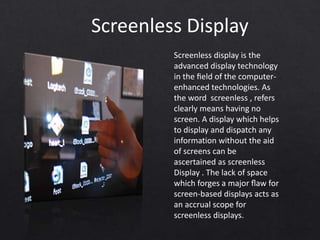
Screenless display is the
advanced display technology
in the field of the computer-
enhanced technologies. As
the word screenless , refers
clearly means having no
screen. A display which helps
to display and dispatch any
information without the aid
of screens can be
ascertained as screenless
Display . The lack of space
which forges a major flaw for
screen-based displays acts as
an accrual scope for
screenless displays.
Benefits
• Higher Resolution images
• Greater Portability
• Ability to present far-point images
• Wider Angle of View
Types of Screenless Display
• Visual Image
• Retinal Direct Display
• Synaptic Interface
Visual Image
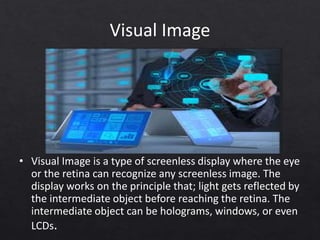
• Visual Image is a type of screenless display where the eye
or the retina can recognize any screenless image. The
display works on the principle that; light gets reflected by
the intermediate object before reaching the retina. The
intermediate object can be holograms, windows, or even
LCDs.
I am not real
I’m Projected holographic image
Hologram
Holograms were used
mostly in
telecommunications as an
alternative to screens.
Holograms could be
transmitted directly, or
they could be stored in
various storage
devices(such as holodiscs)
the storage device can be
hooked up with a holo
projector in order for the
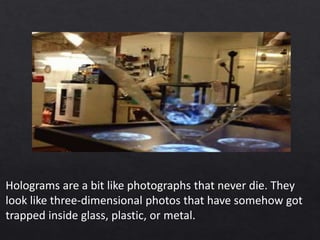
Holograms are a bit like photographs that never die. They
look like three-dimensional photos that have somehow got
trapped inside glass, plastic, or metal.
Displair
Displair is a 3D interactive display technology developed by a Russian
company of the same name. The Displair projects images onto sheets of
water droplets suspended in air, giving the illusion of a hologram
Google Glass
Google Glass is a type of wearable technology with an optical head-mounted display
(OHMD). Google Glass displays information in a smartphone-like hands-free format.
Wearers communicate with the Internet via natural language voice commands.
Features
• Record videos, take pictures
• Show messages
• Find information
• Show maps
• Live video sharing
• Integrates Google Now
• Translate
Heads Up Display
Heads Up Display (HUD) are transparent displays. They can be useful for
aeroplanes, automobiles, computer games etc. The device will project
information on a windshield such that the users do not need to look away
from their field of view. An ordinary HUD contains a projector unit,
combiner and a computer as its components. Projector Unit will project
the image and the combiner will redirect the projected image such that
we can see the field of view and the projected image at the same time.
Computer is an interface between projector unit and data to be displayed. Recent
‘Portable Garmin’s HUD’ for automobiles projects navigation information onto the
windshield. The device is placed on the dashboard of the car which works wirelessly
with a Bluetooth enabled smartphone. Estimated arrival time, lane assist, speed, traffic
and safety camera alerts are the informations displayed. ‘Russian Hudway App’ utilizes
just a smartphone (no projector) to act as HUD. It keeps track of speed, location,
coming curves and hills in road, and distance by using the device accelerometer and
GPS. Many aircrafts (e.g.: Embraer 190, PZL TS-11 Iskra), air buses, cars (e.g.: BMW E60,
2013 Toyota Prius) are using this device.
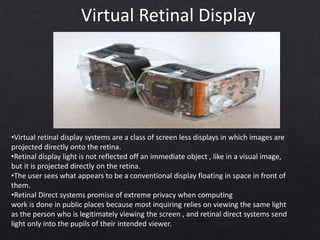
Virtual Retinal Display
•Virtual retinal display systems are a class of screen less displays in which images are
projected directly onto the retina.
•Retinal display light is not reflected off an immediate object , like in a visual image,
but it is projected directly on the retina.
•The user sees what appears to be a conventional display floating in space in front of
them.
•Retinal Direct systems promise of extreme privacy when computing
work is done in public places because most inquiring relies on viewing the same light
as the person who is legitimately viewing the screen , and retinal direct systems send
light only into the pupils of their intended viewer.
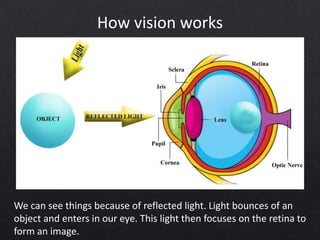
How vision works
We can see things because of reflected light. Light bounces of an
object and enters in our eye. This light then focuses on the retina to
form an image.
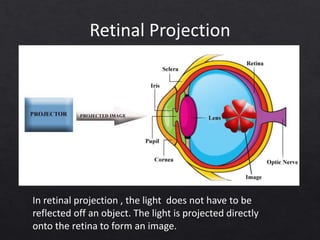
Retinal Projection
In retinal projection , the light does not have to be
reflected off an object. The light is projected directly
onto the retina to form an image.
Oculus rift
• The Oculus Rift is a virtual reality head-mounted display developed by Oculus VR,
the Rift uses an OLED panel for each eye, each having a resolution of 1080x1200.
• Low persistence makes the scene appear visually stable , increasing the potential
for our presence.
•We can play games in 360 degree head tracking.
•Oculus Rift provides an approximately 110 degree field of view.
• Oculus is including Oculus Cinema as a free application , which will allow the
Rift to be used to view conventional movies and videos from inside a virtual
cinema environment, giving the user the perception of viewing the content
on a cinema sized screen.
• In order to work, the Rift must be connected by a cable to a PC running
Microsoft Windows that will run the software (it is not a standalone device).
• This computer should be equipped with a powerful GPU at least equivalent
to a NVIDIA GTX 970 or AMD 290, and a CPU at least equivalent to Intel i5-
4590.
Synaptic Interface
• Synaptic Interface is type of Screenless display does not use
light at all.
• Visual Image and information completely bypasses the eye
and is Transmitted directly to the brain.
• Success has been achieved in sampling video signals from the
biological eyes of a living horse shoe crab through their optic
nerves and sending video signals from device to creatures
brain.
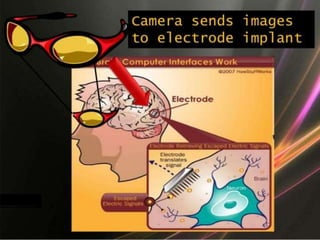
Brain-Computer Interface (BCI)
A Brain-Computer Interface (BCI) is a technology which allows a human
to control a computer, peripheral, or other electronic device with
thought.
It does so by using electrodes to detect electric signals in the brain
which are sent to a computer.
The computer then translates these electric signals into data which is
used to control a computer or a device linked to a computer.
Uses
• Transmit visual images to the mind of a blind
person, allowing them to see.
• Transmit auditory data to the mind of a deaf
person, allowing them to hear.
• Allow gamers to control video games with
their minds.
Future Scope
• Screenless Displays is on the way of progress.
Technological experts are taking great efforts in
researching the topic day by day, so we all can expect
a great revolution in the field of displays
• Companies are working out to bring more screenless
mobiles, TV’s, cameras and laptops for the coming
generation.
• Intelligent Glasses that can translate foreign text
while reading is a current innovative product brought
out by Japan.
• Google is developing a compact video camera which
uses this new advancing technology.
Research Papers
• http://www.ijera.com/papers/vol%201%20iss
ue%203/XC013942947.pdf#page=1&zoom=au
to,-103,842
• http://ijrest.net/downloads/volume-2/special-
issue-1/pid-m15ug603.pdf
References
https://www.mepits.com
http://www.techspurs.com/
http://www.academia.edu/
https://en.wikipedia.org/wiki/
https://www.google.com

Screenless display

  • 1.
  • 2.
    What is aDisplay? A display output surface and projecting mechanism that shows text and often graphic images to the user, using a cathode ray tube , liquid crystal display ,light-emitting diode, or other image projection technology. The display is usually considered to include the screen or projection surface and the device that produces the information on the screen.
  • 3.
    History One of theearliest electronic displays is the cathode ray tube (CRT), which was made commercial in 1922. The CRT consists of an electron gun that forms images by firing electrons onto a phosphor-coated screen. The earliest CRTs were monochrome and were used primarily in oscilloscopes and black and white televisions. The first commercial color CRT was produced in 1954.[1] CRTs were the single most popular display technology used in television sets and computer monitors for over half a century; it was not until the 2000s that LCDs began to gradually replace them.
  • 5.
    Screenless Display Screenless displayis the advanced display technology in the field of the computer- enhanced technologies. As the word screenless , refers clearly means having no screen. A display which helps to display and dispatch any information without the aid of screens can be ascertained as screenless Display . The lack of space which forges a major flaw for screen-based displays acts as an accrual scope for screenless displays.
  • 6.
    Benefits • Higher Resolutionimages • Greater Portability • Ability to present far-point images • Wider Angle of View
  • 7.
    Types of ScreenlessDisplay • Visual Image • Retinal Direct Display • Synaptic Interface
  • 8.
    Visual Image • VisualImage is a type of screenless display where the eye or the retina can recognize any screenless image. The display works on the principle that; light gets reflected by the intermediate object before reaching the retina. The intermediate object can be holograms, windows, or even LCDs.
  • 9.
    I am notreal I’m Projected holographic image Hologram Holograms were used mostly in telecommunications as an alternative to screens. Holograms could be transmitted directly, or they could be stored in various storage devices(such as holodiscs) the storage device can be hooked up with a holo projector in order for the
  • 10.
    Holograms are abit like photographs that never die. They look like three-dimensional photos that have somehow got trapped inside glass, plastic, or metal.
  • 13.
    Displair Displair is a3D interactive display technology developed by a Russian company of the same name. The Displair projects images onto sheets of water droplets suspended in air, giving the illusion of a hologram
  • 14.
    Google Glass Google Glassis a type of wearable technology with an optical head-mounted display (OHMD). Google Glass displays information in a smartphone-like hands-free format. Wearers communicate with the Internet via natural language voice commands.
  • 17.
    Features • Record videos,take pictures • Show messages • Find information • Show maps • Live video sharing • Integrates Google Now • Translate
  • 18.
    Heads Up Display HeadsUp Display (HUD) are transparent displays. They can be useful for aeroplanes, automobiles, computer games etc. The device will project information on a windshield such that the users do not need to look away from their field of view. An ordinary HUD contains a projector unit, combiner and a computer as its components. Projector Unit will project the image and the combiner will redirect the projected image such that we can see the field of view and the projected image at the same time.
  • 19.
    Computer is aninterface between projector unit and data to be displayed. Recent ‘Portable Garmin’s HUD’ for automobiles projects navigation information onto the windshield. The device is placed on the dashboard of the car which works wirelessly with a Bluetooth enabled smartphone. Estimated arrival time, lane assist, speed, traffic and safety camera alerts are the informations displayed. ‘Russian Hudway App’ utilizes just a smartphone (no projector) to act as HUD. It keeps track of speed, location, coming curves and hills in road, and distance by using the device accelerometer and GPS. Many aircrafts (e.g.: Embraer 190, PZL TS-11 Iskra), air buses, cars (e.g.: BMW E60, 2013 Toyota Prius) are using this device.
  • 20.
    Virtual Retinal Display •Virtualretinal display systems are a class of screen less displays in which images are projected directly onto the retina. •Retinal display light is not reflected off an immediate object , like in a visual image, but it is projected directly on the retina. •The user sees what appears to be a conventional display floating in space in front of them. •Retinal Direct systems promise of extreme privacy when computing work is done in public places because most inquiring relies on viewing the same light as the person who is legitimately viewing the screen , and retinal direct systems send light only into the pupils of their intended viewer.
  • 21.
    How vision works Wecan see things because of reflected light. Light bounces of an object and enters in our eye. This light then focuses on the retina to form an image.
  • 22.
    Retinal Projection In retinalprojection , the light does not have to be reflected off an object. The light is projected directly onto the retina to form an image.
  • 23.
  • 24.
    • The OculusRift is a virtual reality head-mounted display developed by Oculus VR, the Rift uses an OLED panel for each eye, each having a resolution of 1080x1200. • Low persistence makes the scene appear visually stable , increasing the potential for our presence. •We can play games in 360 degree head tracking. •Oculus Rift provides an approximately 110 degree field of view.
  • 25.
    • Oculus isincluding Oculus Cinema as a free application , which will allow the Rift to be used to view conventional movies and videos from inside a virtual cinema environment, giving the user the perception of viewing the content on a cinema sized screen. • In order to work, the Rift must be connected by a cable to a PC running Microsoft Windows that will run the software (it is not a standalone device). • This computer should be equipped with a powerful GPU at least equivalent to a NVIDIA GTX 970 or AMD 290, and a CPU at least equivalent to Intel i5- 4590.
  • 26.
  • 27.
    • Synaptic Interfaceis type of Screenless display does not use light at all. • Visual Image and information completely bypasses the eye and is Transmitted directly to the brain. • Success has been achieved in sampling video signals from the biological eyes of a living horse shoe crab through their optic nerves and sending video signals from device to creatures brain.
  • 28.
    Brain-Computer Interface (BCI) ABrain-Computer Interface (BCI) is a technology which allows a human to control a computer, peripheral, or other electronic device with thought. It does so by using electrodes to detect electric signals in the brain which are sent to a computer. The computer then translates these electric signals into data which is used to control a computer or a device linked to a computer.
  • 30.
    Uses • Transmit visualimages to the mind of a blind person, allowing them to see. • Transmit auditory data to the mind of a deaf person, allowing them to hear. • Allow gamers to control video games with their minds.
  • 31.
    Future Scope • ScreenlessDisplays is on the way of progress. Technological experts are taking great efforts in researching the topic day by day, so we all can expect a great revolution in the field of displays • Companies are working out to bring more screenless mobiles, TV’s, cameras and laptops for the coming generation. • Intelligent Glasses that can translate foreign text while reading is a current innovative product brought out by Japan. • Google is developing a compact video camera which uses this new advancing technology.
  • 32.
  • 33.