1
KEY TO THE PROGRAMMABLE WORLD
PRESENTED BY,
NISHANTH CHANDRAN
ROLL NO. 17
S7 CSE
ISSAT
GUIDED BY,
Ms. NEENU SHEREEF
Contents
1. Introduction
2. Existing Wireless Technologies
3. Evolution of Wireless Technologies
4. 5G – Architecture
5. Working Of 5G Networks
6. Features of 5G
7. Advantages of 5G Technology
8. Disadvantages of 5G Technology
9. Common Challenges
10. Applications of 5G
11. Conclusion
12. References
2
1. Introduction
 Radio technologies have evidenced a rapid and
multidirectional evolution with the launch of the analogue
cellular systems in 1980s.
 Thereafter, digital wireless communication systems are
consistently on a mission to fulfil the growing need of
human beings (1G, …4G, or now 5G).
 The word wireless in dictionary is defined “having no
wires” in networking terminology.
3
Cont..
 The 5G technologies include all type of complex features which
makes 5G mobile technology most powerful and in huge require
in near future.
 5G technology as well as camera, MP3 video recording, video
player, large mobile phone memory, dialing speed, audio actor
and much more you never visualize
 Here we describes the 5G technology emphasizing on its salient
features, technological design (architecture), advantages,
shortcomings, challenges, and future scope.
4
2. Existing Wireless Technologies
 3GPP(3rd Generation Partnership Project )
The 3rd Generation Partnership Project (3GPP) is a collaboration
between groups of telecommunications associations, known as the
Organizational Partners. The initial scope of 3GPP was to make a
globally applicable third-generation (3G) mobile phone system
specification based on evolved Global System for Mobile
Communications (GSM)
 HSPA(High Speed Packet Acess)
High Speed Packet Access (HSPA) is an amalgamation of
two mobile telephony protocols, High Speed Downlink Packet Access
(HSDPA) and High Speed Uplink Packet Access (HSUPA), that
extends and improves the performance of existing 3G mobile
telecommunication networks utilizing the WCDMA protocols.
5
Cont..
 LTE(Long Term Evolution)
Long-Term Evolution (LTE) is a standard for high-
speed wireless communication for mobile phones and data terminals. It
is based on the GSM/EDGE and UMTS/HSPA network technologies
 Wi-Fi(Wireless Fidelity)
Wi-Fi (Wireless Fidelity) is a generic term that refers to IEEE 802.11
standard for Wireless Local Area Networks (WLANs).
 Li-Fi(Light Fidelity)
Li-Fi(Light Fidelity) basically the sending of the digital signals via
light. if Li-Fi technology can be put into practical use, every bulb can
be used as an alternative to Wi-Fi hotspots
6
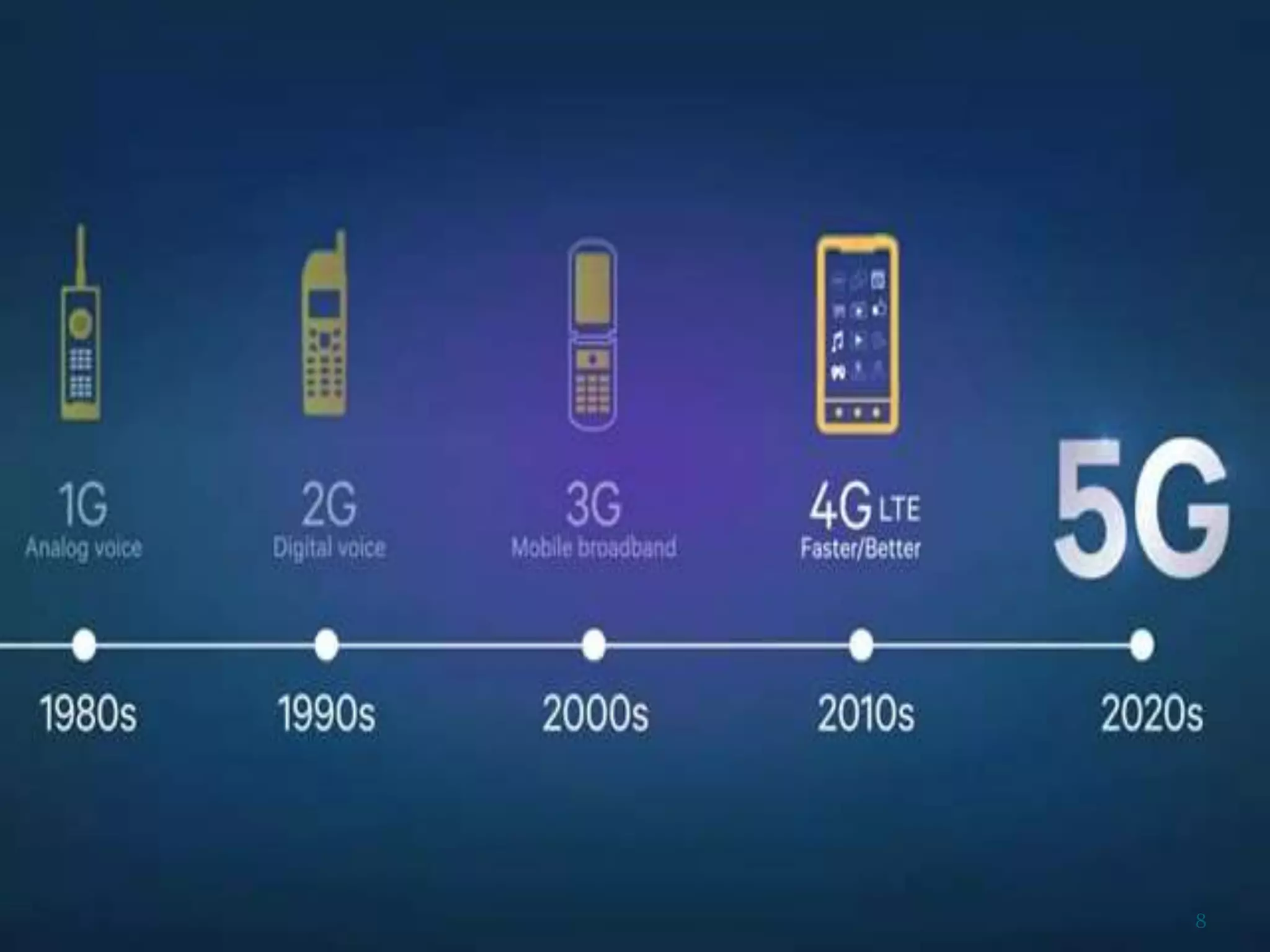
3. Evolution of Wireless Technologies
 G. Marconi, an Italian inventor, unlocks the path of recent day
wireless communications.
 Wireless communications have become an important part of
present day society. The satellite communication, television
and radio transmission ,mobile communications are the
example.
 It also shows that the 1G and 2G technologies use circuit
switching while 2.5G and 3G uses both circuit and packet
switching and the next generations from 3.5G to now i.e. 5G
are using packet switching
7
8
A. First-Generation Systems (1G)
 Developed in 1980s & completed in
early 1990s
 Based on analog system
 Speed up to 2.4 kbps
 AMPS (Advance Mobile Phone System) was launched by the US
& it was the 1G mobile system
 Allows user to make voice calls in 1 country
 1 G wireless networks used analog radio signals.
9
B. Second Generation Systems
(2G)
 Developed in late 1980s & completed in
late 1990s
 Speed up to 64 kbps
 Services such are digital
voice & SMS with more clarity
 2G are the handsets we are using today, with 2.5G
having more capabilities
 The main 2.5G technologies were GPRS, Enhanced Data Rate for GSM
Evolution (EDGE), and Code Division Multiple Access (CDMA).
10
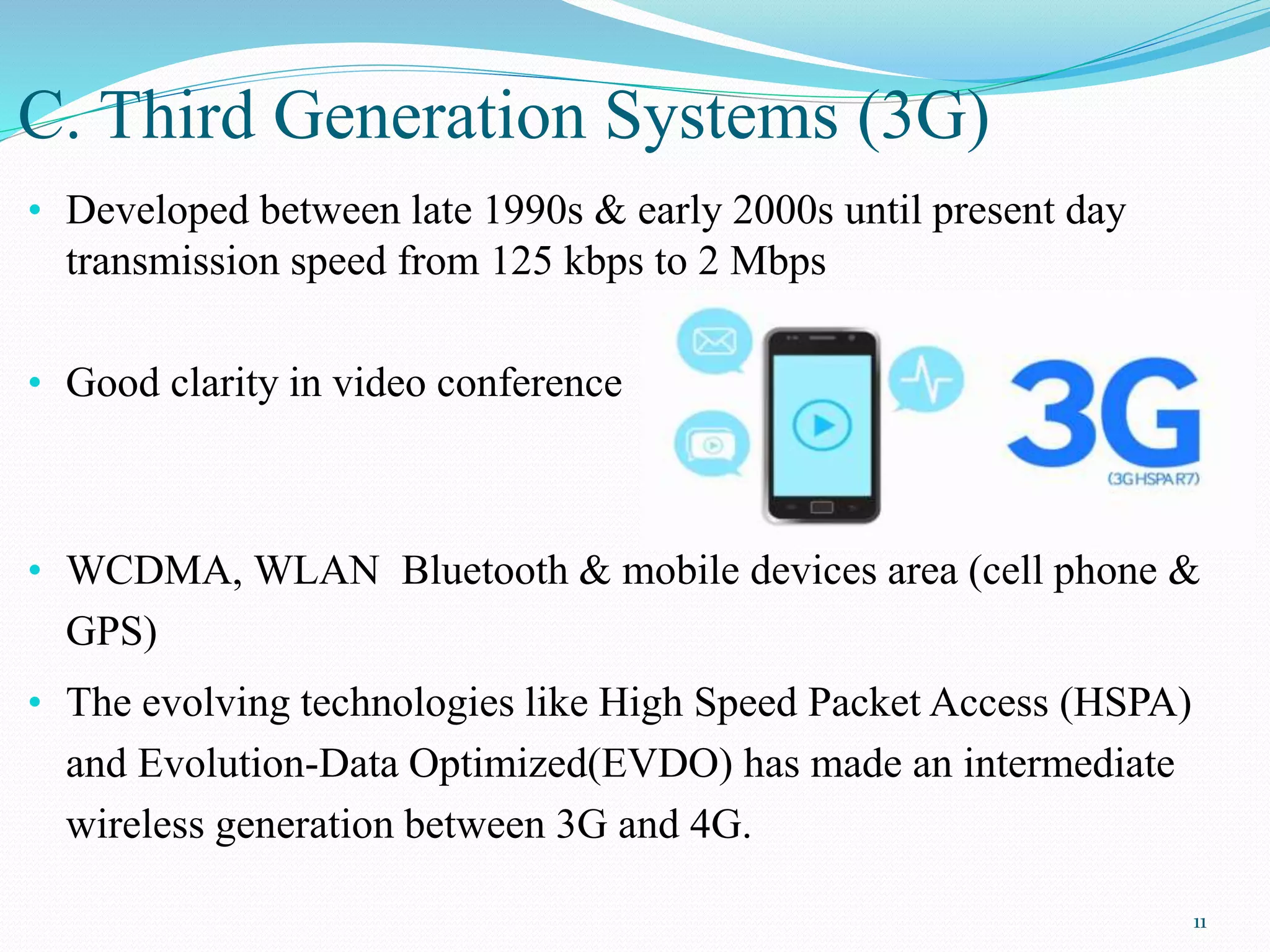
C. Third Generation Systems (3G)
• Developed between late 1990s & early 2000s until present day
transmission speed from 125 kbps to 2 Mbps
• Good clarity in video conference
• WCDMA, WLAN Bluetooth & mobile devices area (cell phone &
GPS)
• The evolving technologies like High Speed Packet Access (HSPA)
and Evolution-Data Optimized(EVDO) has made an intermediate
wireless generation between 3G and 4G.
11
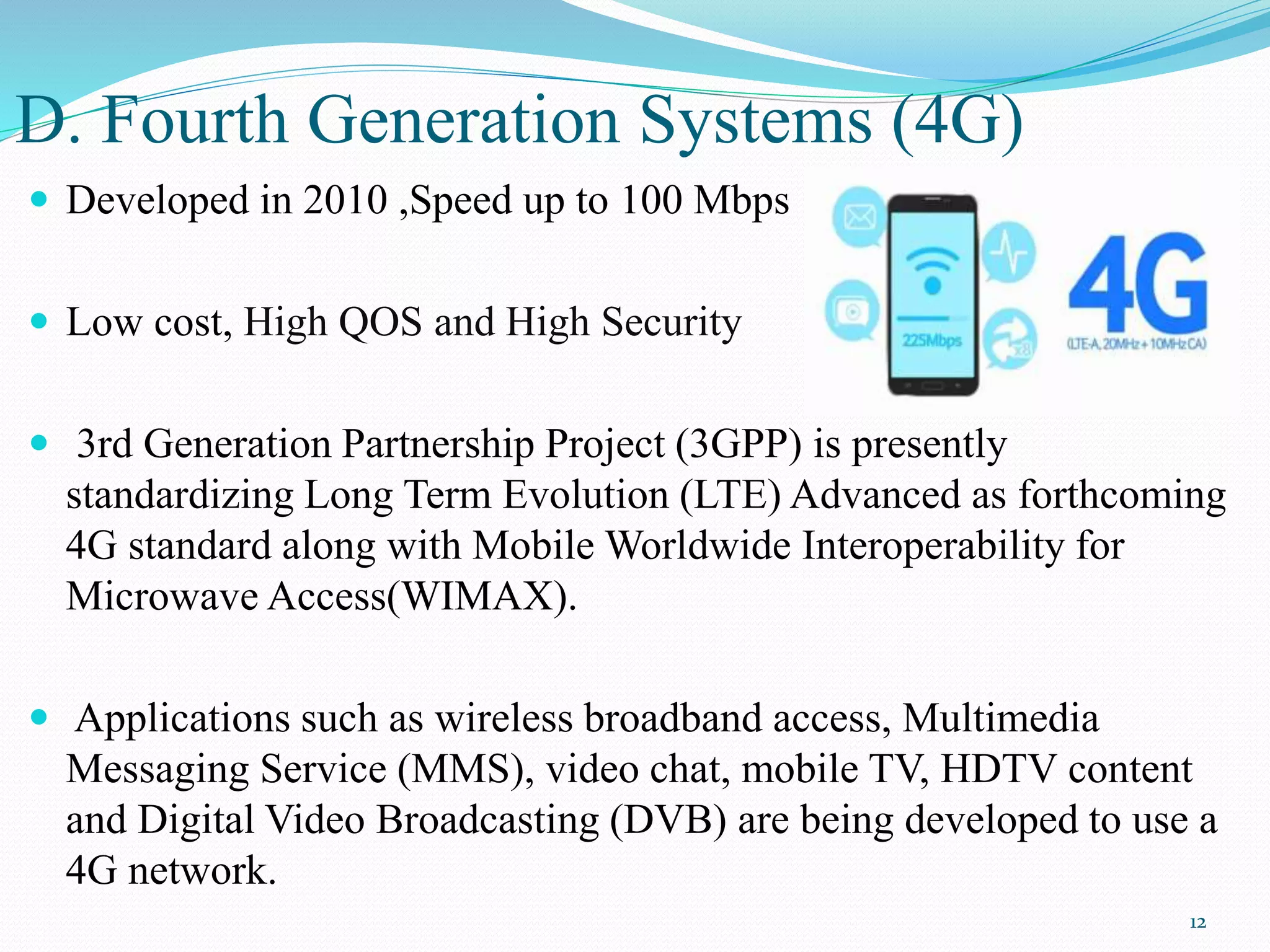
D. Fourth Generation Systems (4G)
 Developed in 2010 ,Speed up to 100 Mbps
 Low cost, High QOS and High Security
 3rd Generation Partnership Project (3GPP) is presently
standardizing Long Term Evolution (LTE) Advanced as forthcoming
4G standard along with Mobile Worldwide Interoperability for
Microwave Access(WIMAX).
 Applications such as wireless broadband access, Multimedia
Messaging Service (MMS), video chat, mobile TV, HDTV content
and Digital Video Broadcasting (DVB) are being developed to use a
4G network.
12
E. FIFTH GENERATION SYSTEMS (5G)
 5G Wireless Communication System is not deployed yet.
 Complete wireless communication with almost no limitation.
 Multi-Media Newspapers, watch T.V programs with the clarity as
to that of an HD T.V.
 Faster data transmission that of the previous generations.
 Real world wireless or called “WWWW: World Wide Wireless
Web, combined IP & seamless mixture of broadband.
13
Cont..
 IPv6, where a visiting care of mobile IP address is assigned according to
location & connected network.
 One unified global standard.
 The user can simultaneously be connected with several wireless access
technology.
 Multiple concurrent data transfer path.
 Recently introduced IEEE 802.11ac, 802.11ad and 802.11af standards are
very helpful and act as a building blocks in the road towards5G.
14
What is 5G Technology?
 For the consumer it will mean ultra high data speeds (upwards of
20GBPs), ultra low latency, and new devices and form factors.
 The 5G technology is expected to provide a new (much wider than
the previous one) frequency bands along with the wider spectral
bandwidth per frequency channel. As of now, the predecessors
(generations) mobile technologies have evidenced substantial
increase in peak bitrate.
 it is able to support the speed up to 10 Gbps.
15
4. 5G - Architecture
 Architecture of 5G is highly advanced, its network elements and
various terminals are characteristically upgraded to afford a new
situation. Likewise, service providers can implement the advance
technology to adopt the value-added services easily.
 However, upgradeability is based upon cognitive radio technology
that includes various significant features such as ability of devices
to identify their geographical location as well as weather,
temperature, etc.
16
Cont..
 Cognitive radio technology acts as a transceiver (beam) that
perceptively can catch and respond radio signals in its operating
environment. Further, it promptly distinguishes the changes in its
environment and hence respond accordingly to provide
uninterrupted quality service.
17
Cont..
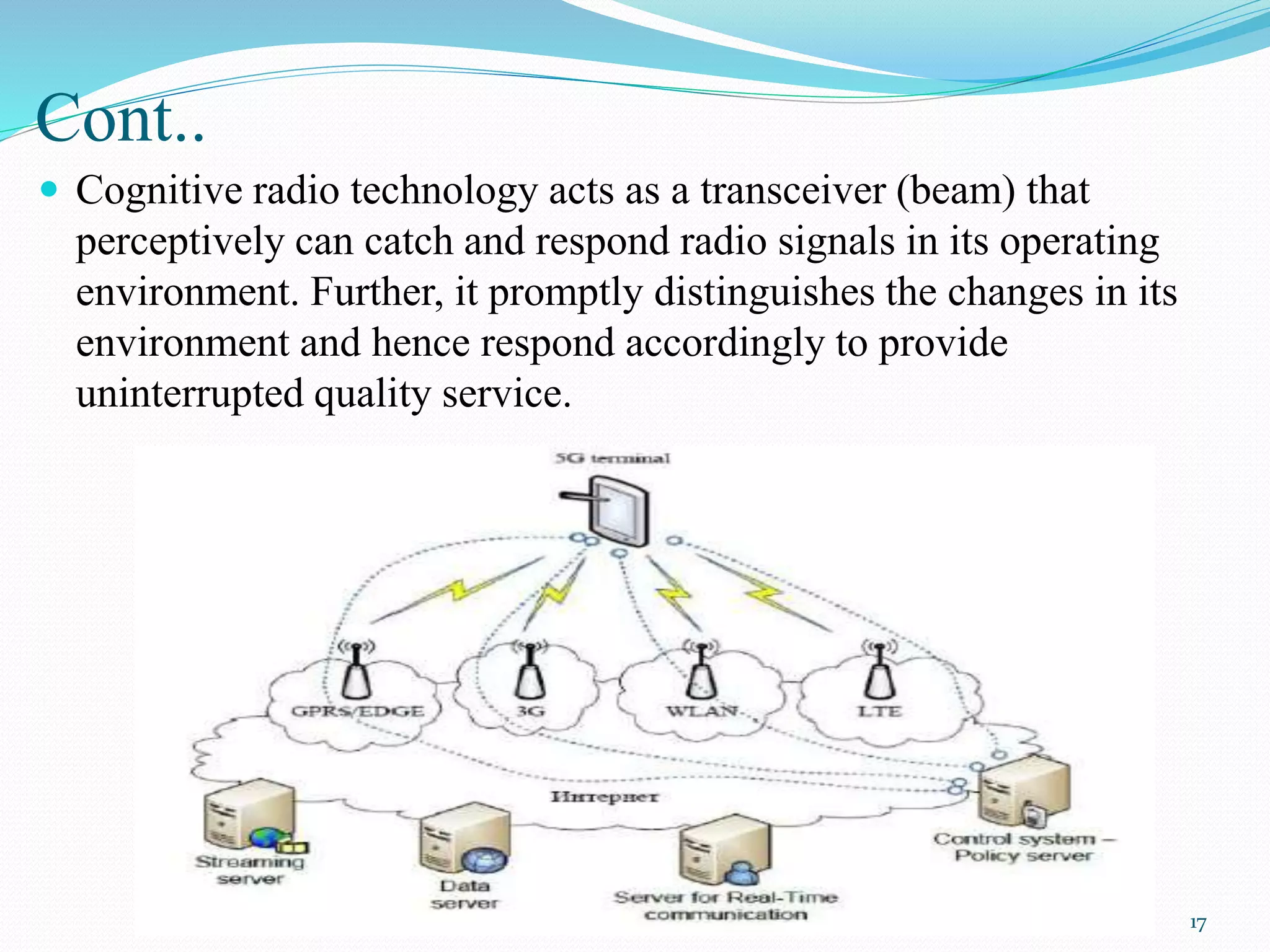
 As shown in the following image, the system model of 5G is
entirely IP based model designed for the wireless and mobile
networks.
 The system comprising of a main user terminal and then a
number of independent and autonomous radio access
technologies. Each of the radio technologies is considered as
the IP link for the outside internet world.
 The IP technology is designed exclusively to ensure sufficient
control data for appropriate routing of IP packets related to a
certain application connections.
18
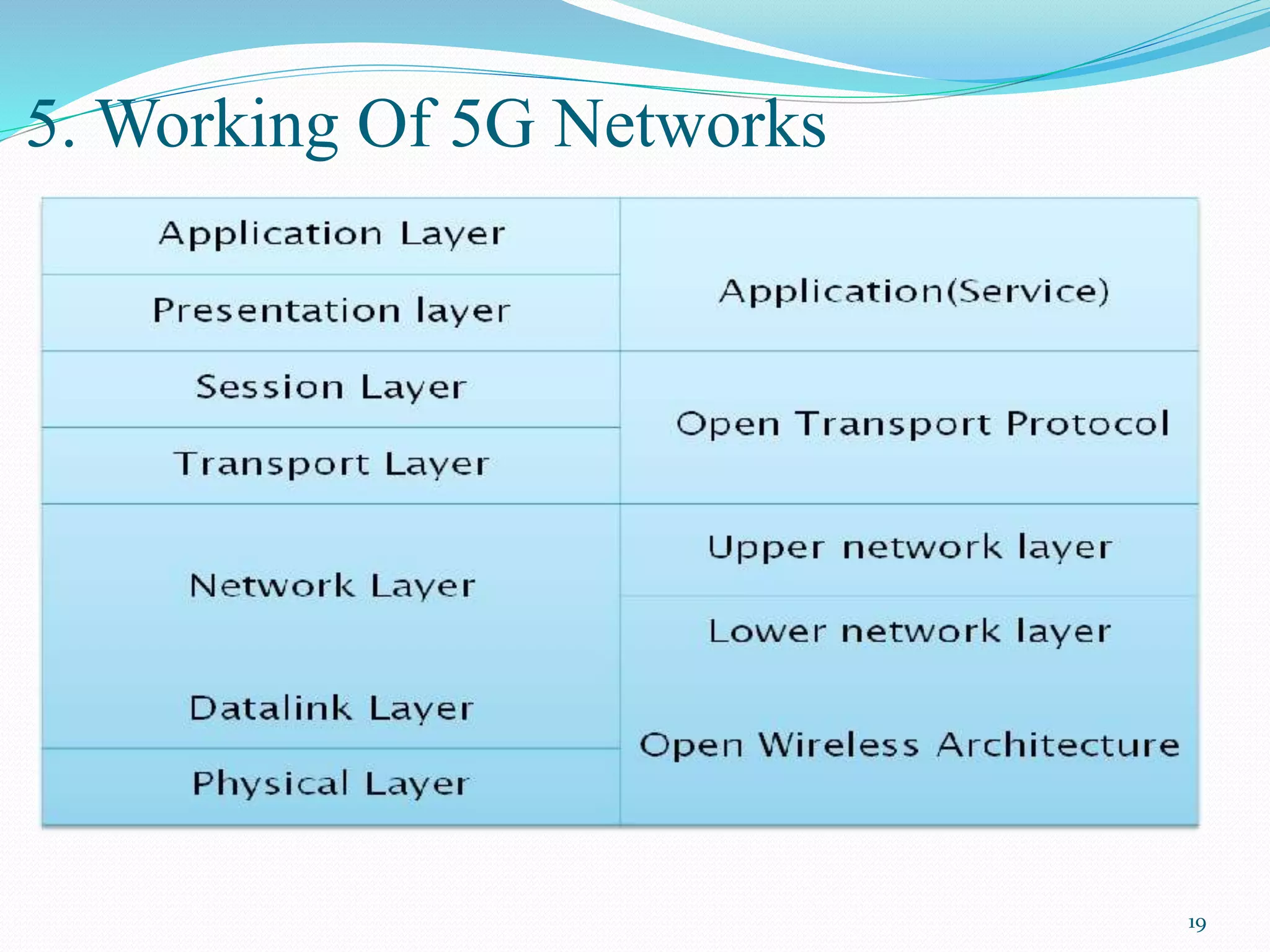
5. Working Of 5G Networks
19
Open Wireless Architecture
(OWA)
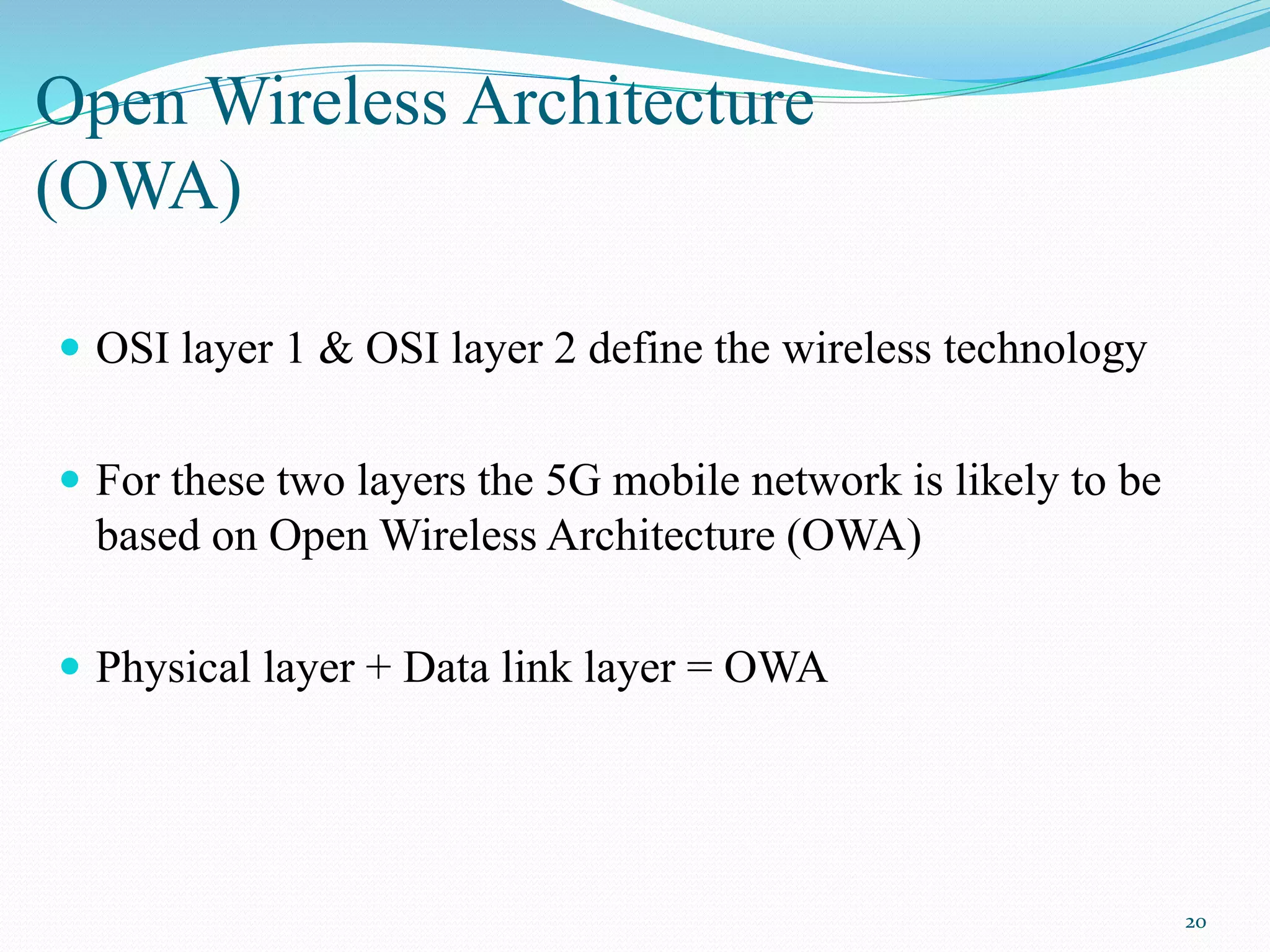
 OSI layer 1 & OSI layer 2 define the wireless technology
 For these two layers the 5G mobile network is likely to be
based on Open Wireless Architecture (OWA)
 Physical layer + Data link layer = OWA
20
Network Layer
 All mobile networks will use mobile IP
 Each mobile terminal will be FA (Foreign Agent)
 A mobile can be attached to several mobiles or wireless
networks at the same time
 The fixed IPv6 will be implemented in the mobile phones
 Separation of network layer into two sub-layers:
(i) Lower network layer (for each interface)
(ii) Upper network layer (for the mobile terminal)
21
Open Transport Protocol (OTP)
 Wireless network differs from wired network regarding the
transport layer
 In all TCP versions the assumption is that lost segments are due to
network congestion
 In wireless, the loss is due to higher bit error ratio in the radio
interface
 5G mobile terminals have transport layer that is possible to be
downloaded & installed – Open Transport Protocol (OTP)
 Transport layer + Session layer = OTP
22
Application (service) Layer
 Provides intelligent QoS (Quality of Service) management over
variety of networks
 Provides possibility for service quality testing & storage of
measurement information in information database in the mobile
terminal
 Select the best wireless connection for given services
 QoS parameters, such as, delay, losses, BW, reliability, will be
stored in DB of 5G mobile
 Presentation layer + Application layer = Application
23
Hardware of 5G
• Uses UWB (Ultra Wide Band) networks with higher BW at
low energy levels
• BW is of 4000 Mbps, which is 400 times faster than today’s
wireless networks
• Uses smart antenna
• Uses CDMA (Code Division Multiple Access)
24
Software of 5G
• 5G will be single unified standard of different wireless
networks, including LAN technologies, LAN/WAN,
WWWW- World Wide Wireless Web, unified IP & seamless
combination of broadband
• Software defined radio, encryption, flexibility, Anti-Virus
25
6. Features of 5G
 Practically possible to avail the super speed i.e. 1 to 10 Gbps.
 Latency will be 1 millisecond (end-to-end round trip).
 1,000x bandwidth per unit area.
 Feasibility to connect 10 to 100 number of devices.
 Worldwide coverage.
 About 90% reduction in network energy usage.
 Battery life will be much longer.
 Whole world will be in wi fi zone.
26
7. Advantages of 5G Technology
 High resolution and bi-directional large bandwidth shaping.
 Technology to gather all networks on one platform.
 Easily manageable with the previous generations.
 Possible to provide uniform, uninterrupted, and consistent
connectivity across the world
 Data BW of 1 Gbps or higher
 Available at low cost
27
8. Disadvantages of 5G Technology
 Technology is still under process and research on its viability is
going on.
 The speed, this technology is claiming seems difficult to achieve
(in future, it might be) because of the incompetent technological
support in most parts of the world.
 Many of the old devices would not be competent to 5G, hence, all
of them need to be replaced with new one expensive deal.
 Developing infrastructure needs high cost.
 Security and privacy issue yet to be solved.
28
9. Common Challenges
 Multiple Services
 Infrastructure
 Communication, Navigation, & Sensing
 Security and Privacy
 Legislation of Cyberlaw
29
10. Applications of 5G
30
• Wearable devices with AI (Artificial
Intelligence) capabilities
• Pervasive (Global) networks
• Media independent handover
• Radio resource management
• VoIP (Voice over IP) enabled devices
• With 6th sense technology
11. CONCLUSION
 5G wireless cellular communication systems that have been
defined in terms of capacity, data rate, spectral efficiency,
latency, energy efficiency, and Quality of service.
 The new coming 5G technology will be available in the
market at affordable rates, high peak future & much
reliability than preceding technologies
 Fifth generation should make an important difference and add
more services and reimbursement to the world over 4G.
31
12. References
 Nascimento, Andrea, et al. "A characterization of
mobility management in user-centric networks", Smart
Spaces and Next Generation Wired/Wireless
Networking. Springer Berlin Heidelberg, pg.314-325,
2013.
 PankajSharm "Evolution of Mobile Wireless
Communication NetworksI G to 5G as well as Future
Prospective ofNext Generation Communication
Network", International Journal of Computer Science
and Mobile Computing, Vol.2, Issue. , pg.47 - 53,20 I 3. [
32
33
THANK YOU
34
Any Questions?

5G complete presentation 2016 upload

  • 1.
    1 KEY TO THEPROGRAMMABLE WORLD PRESENTED BY, NISHANTH CHANDRAN ROLL NO. 17 S7 CSE ISSAT GUIDED BY, Ms. NEENU SHEREEF
  • 2.
    Contents 1. Introduction 2. ExistingWireless Technologies 3. Evolution of Wireless Technologies 4. 5G – Architecture 5. Working Of 5G Networks 6. Features of 5G 7. Advantages of 5G Technology 8. Disadvantages of 5G Technology 9. Common Challenges 10. Applications of 5G 11. Conclusion 12. References 2
  • 3.
    1. Introduction  Radiotechnologies have evidenced a rapid and multidirectional evolution with the launch of the analogue cellular systems in 1980s.  Thereafter, digital wireless communication systems are consistently on a mission to fulfil the growing need of human beings (1G, …4G, or now 5G).  The word wireless in dictionary is defined “having no wires” in networking terminology. 3
  • 4.
    Cont..  The 5Gtechnologies include all type of complex features which makes 5G mobile technology most powerful and in huge require in near future.  5G technology as well as camera, MP3 video recording, video player, large mobile phone memory, dialing speed, audio actor and much more you never visualize  Here we describes the 5G technology emphasizing on its salient features, technological design (architecture), advantages, shortcomings, challenges, and future scope. 4
  • 5.
    2. Existing WirelessTechnologies  3GPP(3rd Generation Partnership Project ) The 3rd Generation Partnership Project (3GPP) is a collaboration between groups of telecommunications associations, known as the Organizational Partners. The initial scope of 3GPP was to make a globally applicable third-generation (3G) mobile phone system specification based on evolved Global System for Mobile Communications (GSM)  HSPA(High Speed Packet Acess) High Speed Packet Access (HSPA) is an amalgamation of two mobile telephony protocols, High Speed Downlink Packet Access (HSDPA) and High Speed Uplink Packet Access (HSUPA), that extends and improves the performance of existing 3G mobile telecommunication networks utilizing the WCDMA protocols. 5
  • 6.
    Cont..  LTE(Long TermEvolution) Long-Term Evolution (LTE) is a standard for high- speed wireless communication for mobile phones and data terminals. It is based on the GSM/EDGE and UMTS/HSPA network technologies  Wi-Fi(Wireless Fidelity) Wi-Fi (Wireless Fidelity) is a generic term that refers to IEEE 802.11 standard for Wireless Local Area Networks (WLANs).  Li-Fi(Light Fidelity) Li-Fi(Light Fidelity) basically the sending of the digital signals via light. if Li-Fi technology can be put into practical use, every bulb can be used as an alternative to Wi-Fi hotspots 6
  • 7.
    3. Evolution ofWireless Technologies  G. Marconi, an Italian inventor, unlocks the path of recent day wireless communications.  Wireless communications have become an important part of present day society. The satellite communication, television and radio transmission ,mobile communications are the example.  It also shows that the 1G and 2G technologies use circuit switching while 2.5G and 3G uses both circuit and packet switching and the next generations from 3.5G to now i.e. 5G are using packet switching 7
  • 8.
  • 9.
    A. First-Generation Systems(1G)  Developed in 1980s & completed in early 1990s  Based on analog system  Speed up to 2.4 kbps  AMPS (Advance Mobile Phone System) was launched by the US & it was the 1G mobile system  Allows user to make voice calls in 1 country  1 G wireless networks used analog radio signals. 9
  • 10.
    B. Second GenerationSystems (2G)  Developed in late 1980s & completed in late 1990s  Speed up to 64 kbps  Services such are digital voice & SMS with more clarity  2G are the handsets we are using today, with 2.5G having more capabilities  The main 2.5G technologies were GPRS, Enhanced Data Rate for GSM Evolution (EDGE), and Code Division Multiple Access (CDMA). 10
  • 11.
    C. Third GenerationSystems (3G) • Developed between late 1990s & early 2000s until present day transmission speed from 125 kbps to 2 Mbps • Good clarity in video conference • WCDMA, WLAN Bluetooth & mobile devices area (cell phone & GPS) • The evolving technologies like High Speed Packet Access (HSPA) and Evolution-Data Optimized(EVDO) has made an intermediate wireless generation between 3G and 4G. 11
  • 12.
    D. Fourth GenerationSystems (4G)  Developed in 2010 ,Speed up to 100 Mbps  Low cost, High QOS and High Security  3rd Generation Partnership Project (3GPP) is presently standardizing Long Term Evolution (LTE) Advanced as forthcoming 4G standard along with Mobile Worldwide Interoperability for Microwave Access(WIMAX).  Applications such as wireless broadband access, Multimedia Messaging Service (MMS), video chat, mobile TV, HDTV content and Digital Video Broadcasting (DVB) are being developed to use a 4G network. 12
  • 13.
    E. FIFTH GENERATIONSYSTEMS (5G)  5G Wireless Communication System is not deployed yet.  Complete wireless communication with almost no limitation.  Multi-Media Newspapers, watch T.V programs with the clarity as to that of an HD T.V.  Faster data transmission that of the previous generations.  Real world wireless or called “WWWW: World Wide Wireless Web, combined IP & seamless mixture of broadband. 13
  • 14.
    Cont..  IPv6, wherea visiting care of mobile IP address is assigned according to location & connected network.  One unified global standard.  The user can simultaneously be connected with several wireless access technology.  Multiple concurrent data transfer path.  Recently introduced IEEE 802.11ac, 802.11ad and 802.11af standards are very helpful and act as a building blocks in the road towards5G. 14
  • 15.
    What is 5GTechnology?  For the consumer it will mean ultra high data speeds (upwards of 20GBPs), ultra low latency, and new devices and form factors.  The 5G technology is expected to provide a new (much wider than the previous one) frequency bands along with the wider spectral bandwidth per frequency channel. As of now, the predecessors (generations) mobile technologies have evidenced substantial increase in peak bitrate.  it is able to support the speed up to 10 Gbps. 15
  • 16.
    4. 5G -Architecture  Architecture of 5G is highly advanced, its network elements and various terminals are characteristically upgraded to afford a new situation. Likewise, service providers can implement the advance technology to adopt the value-added services easily.  However, upgradeability is based upon cognitive radio technology that includes various significant features such as ability of devices to identify their geographical location as well as weather, temperature, etc. 16
  • 17.
    Cont..  Cognitive radiotechnology acts as a transceiver (beam) that perceptively can catch and respond radio signals in its operating environment. Further, it promptly distinguishes the changes in its environment and hence respond accordingly to provide uninterrupted quality service. 17
  • 18.
    Cont..  As shownin the following image, the system model of 5G is entirely IP based model designed for the wireless and mobile networks.  The system comprising of a main user terminal and then a number of independent and autonomous radio access technologies. Each of the radio technologies is considered as the IP link for the outside internet world.  The IP technology is designed exclusively to ensure sufficient control data for appropriate routing of IP packets related to a certain application connections. 18
  • 19.
    5. Working Of5G Networks 19
  • 20.
    Open Wireless Architecture (OWA) OSI layer 1 & OSI layer 2 define the wireless technology  For these two layers the 5G mobile network is likely to be based on Open Wireless Architecture (OWA)  Physical layer + Data link layer = OWA 20
  • 21.
    Network Layer  Allmobile networks will use mobile IP  Each mobile terminal will be FA (Foreign Agent)  A mobile can be attached to several mobiles or wireless networks at the same time  The fixed IPv6 will be implemented in the mobile phones  Separation of network layer into two sub-layers: (i) Lower network layer (for each interface) (ii) Upper network layer (for the mobile terminal) 21
  • 22.
    Open Transport Protocol(OTP)  Wireless network differs from wired network regarding the transport layer  In all TCP versions the assumption is that lost segments are due to network congestion  In wireless, the loss is due to higher bit error ratio in the radio interface  5G mobile terminals have transport layer that is possible to be downloaded & installed – Open Transport Protocol (OTP)  Transport layer + Session layer = OTP 22
  • 23.
    Application (service) Layer Provides intelligent QoS (Quality of Service) management over variety of networks  Provides possibility for service quality testing & storage of measurement information in information database in the mobile terminal  Select the best wireless connection for given services  QoS parameters, such as, delay, losses, BW, reliability, will be stored in DB of 5G mobile  Presentation layer + Application layer = Application 23
  • 24.
    Hardware of 5G •Uses UWB (Ultra Wide Band) networks with higher BW at low energy levels • BW is of 4000 Mbps, which is 400 times faster than today’s wireless networks • Uses smart antenna • Uses CDMA (Code Division Multiple Access) 24
  • 25.
    Software of 5G •5G will be single unified standard of different wireless networks, including LAN technologies, LAN/WAN, WWWW- World Wide Wireless Web, unified IP & seamless combination of broadband • Software defined radio, encryption, flexibility, Anti-Virus 25
  • 26.
    6. Features of5G  Practically possible to avail the super speed i.e. 1 to 10 Gbps.  Latency will be 1 millisecond (end-to-end round trip).  1,000x bandwidth per unit area.  Feasibility to connect 10 to 100 number of devices.  Worldwide coverage.  About 90% reduction in network energy usage.  Battery life will be much longer.  Whole world will be in wi fi zone. 26
  • 27.
    7. Advantages of5G Technology  High resolution and bi-directional large bandwidth shaping.  Technology to gather all networks on one platform.  Easily manageable with the previous generations.  Possible to provide uniform, uninterrupted, and consistent connectivity across the world  Data BW of 1 Gbps or higher  Available at low cost 27
  • 28.
    8. Disadvantages of5G Technology  Technology is still under process and research on its viability is going on.  The speed, this technology is claiming seems difficult to achieve (in future, it might be) because of the incompetent technological support in most parts of the world.  Many of the old devices would not be competent to 5G, hence, all of them need to be replaced with new one expensive deal.  Developing infrastructure needs high cost.  Security and privacy issue yet to be solved. 28
  • 29.
    9. Common Challenges Multiple Services  Infrastructure  Communication, Navigation, & Sensing  Security and Privacy  Legislation of Cyberlaw 29
  • 30.
    10. Applications of5G 30 • Wearable devices with AI (Artificial Intelligence) capabilities • Pervasive (Global) networks • Media independent handover • Radio resource management • VoIP (Voice over IP) enabled devices • With 6th sense technology
  • 31.
    11. CONCLUSION  5Gwireless cellular communication systems that have been defined in terms of capacity, data rate, spectral efficiency, latency, energy efficiency, and Quality of service.  The new coming 5G technology will be available in the market at affordable rates, high peak future & much reliability than preceding technologies  Fifth generation should make an important difference and add more services and reimbursement to the world over 4G. 31
  • 32.
    12. References  Nascimento,Andrea, et al. "A characterization of mobility management in user-centric networks", Smart Spaces and Next Generation Wired/Wireless Networking. Springer Berlin Heidelberg, pg.314-325, 2013.  PankajSharm "Evolution of Mobile Wireless Communication NetworksI G to 5G as well as Future Prospective ofNext Generation Communication Network", International Journal of Computer Science and Mobile Computing, Vol.2, Issue. , pg.47 - 53,20 I 3. [ 32
  • 33.
  • 34.