SEMINAR ON
PRESENTED BY:-
VED PRAKASH
STUDENT OF BTECH CSE 3RD YEAR
ROLL NO:- 1515310081
SESSION :-2017-18
CONTENTS
 INTRODUCTION TO 5G
 EVOLUTION FROM 1G TO 5G
 KEY CONCEPTS ARCHITECTURE
 FEATURES
 HOW 5G TECHNOLOY WORKS
 ADVANTAGES
 APPLICATION
 CONCLUSION
 REFERENCES
INTRODUCTION
 5G Wireless: 5th generation wireless
technology.
 Complete wireless communication with
almost no limitations.
 Can be called REAL wireless world has
incredible transmission speed.
 Concept is only theory not real.
1G
2G
3G
4G
5G
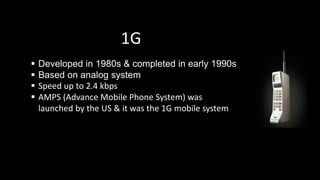
1G
 Developed in 1980s & completed in early 1990s
 Based on analog system
 Speed up to 2.4 kbps
 AMPS (Advance Mobile Phone System) was
launched by the US & it was the 1G mobile system
2G
 Allows user to make voice calls in 1 country
 Developed in late 1980s & completed in late
1990s
 Based on digital system
 Speed up to 64 kbps
 Services such are digital voice & SMS with
more clarity
 Semi global facility
3G
 Developed between late 1990s & early
2000s until present day
 Transmission speed from 125 kbps to
2 Mbps
 Superior voice quality
 Good clarity in video conference
 E-mail, PDA, information surfing, on-line
shopping/ banking, games, etc.
 Global roaming
4G
 Faster & more reliable
 Speed up to 100 Mbps
 High performance
 Easy roaming
 Low cost
5G
 Next major phase of mobile
telecommunication & wireless system.
 10 times more capacity than others
 Expected speed up to 1 Gbps
 More faster & reliable than 4G
 Lower cost than previous generations
 5-G wireless technology is fulfill for “4A
PARADIGM”
 4A paradigm:- “ Any rate, Anytime, Anywhere,
Affordable ”.
KEY CONCEPTS ARCHITECTURE
 Real wireless world with no more limitations with access &
zone issues
 Wearable devices
 IPv6, where a visiting care of mobile IP address is assigned
according to location & connected network
 One unified global standard
 Smart radio
 The user can simultaneously be connected with several
wireless access technology
 Multiple concurrent data transfer path
 25 Mbps connectivity speed
 Enhanced & available connectivity just
about the world
 Uploading & Downloading speed of 5G
touching the peak (up to 1 Gbps)
 Better & fast solution
 High quality service based on policy to
avoid error
 Support virtual private networks
5G Technologies – How does it work?
5G technology will achieve its expected high efficiency using most modern
modulation techniques and network terminologies like:
1.Carrier Aggregation
Carrier aggregation is a technique used in LTE advanced to improve the
system efficiency. In carrier aggregation, two or more carrier signals are
aggregated to support wider bandwidth which allows even up to 100
MHz.
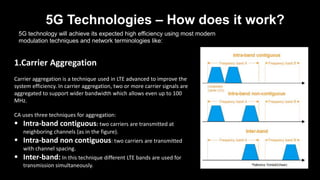
CA uses three techniques for aggregation:
 Intra-band contiguous: two carriers are transmitted at
neighboring channels (as in the figure).
 Intra-band non contiguous: two carriers are transmitted
with channel spacing.
 Inter-band: In this technique different LTE bands are used for
transmission simultaneously.
2. Small Cell Concept
In order to increase network efficiency, the cell is sub divided into micro and Pico cells.
Spectrum reusability allows to adding more users in a small geographical area and
handle network more efficiently.
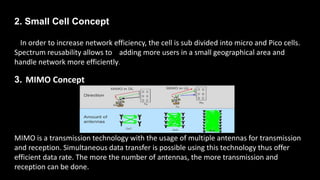
3. MIMO Concept
MIMO is a transmission technology with the usage of multiple antennas for transmission
and reception. Simultaneous data transfer is possible using this technology thus offer
efficient data rate. The more the number of antennas, the more transmission and
reception can be done.
4.Wi-Fi off loading
Wi-fi offloading is one the main feature of the future networks. It allows the user to connect
using wi-fi network and the cellular network can be allocated to other users. It would be
suitable for some places where cellular network quality is poor and user still have the option to
connect to the network without cellular reception.
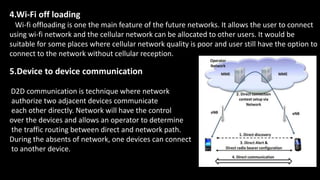
5.Device to device communication
D2D communication is technique where network
authorize two adjacent devices communicate
each other directly. Network will have the control
over the devices and allows an operator to determine
the traffic routing between direct and network path.
During the absents of network, one devices can connect
to another device.
Advantages
 More attractive & effective
 Provides subscriber supervision tools for fast
action
 Data BW of 1 Gbps or higher
 Globally accessible
 Dynamic information access
 Available at low cost
 Wearable devices with AI (Artificial Intelligence)
capabilities
 Pervasive (Global) networks
 Media independent handover
 Radio resource management
 VoIP (Voice over IP) enabled devices
 With 6th sense technology
 3G- Operator Centric,
 4G- Service Centric whereas
 5G- User Centric
 We have proposed 5G wireless concept designed as an
open platform on different layers
 The new coming 5G technology will be available in the
market at affordable rates, high peak future & much
reliability than preceding technologies
 http://www.slideshare.com
 http://www.tutorialspoint.com
 http://www.ericsson.com
References
5G WIRELESS TECHNOLOGY

5G WIRELESS TECHNOLOGY

  • 1.
    SEMINAR ON PRESENTED BY:- VEDPRAKASH STUDENT OF BTECH CSE 3RD YEAR ROLL NO:- 1515310081 SESSION :-2017-18
  • 2.
    CONTENTS  INTRODUCTION TO5G  EVOLUTION FROM 1G TO 5G  KEY CONCEPTS ARCHITECTURE  FEATURES  HOW 5G TECHNOLOY WORKS  ADVANTAGES  APPLICATION  CONCLUSION  REFERENCES
  • 3.
    INTRODUCTION  5G Wireless:5th generation wireless technology.  Complete wireless communication with almost no limitations.  Can be called REAL wireless world has incredible transmission speed.  Concept is only theory not real.
  • 4.
  • 5.
    1G  Developed in1980s & completed in early 1990s  Based on analog system  Speed up to 2.4 kbps  AMPS (Advance Mobile Phone System) was launched by the US & it was the 1G mobile system
  • 6.
    2G  Allows userto make voice calls in 1 country  Developed in late 1980s & completed in late 1990s  Based on digital system  Speed up to 64 kbps  Services such are digital voice & SMS with more clarity  Semi global facility
  • 7.
    3G  Developed betweenlate 1990s & early 2000s until present day  Transmission speed from 125 kbps to 2 Mbps  Superior voice quality  Good clarity in video conference  E-mail, PDA, information surfing, on-line shopping/ banking, games, etc.  Global roaming
  • 8.
    4G  Faster &more reliable  Speed up to 100 Mbps  High performance  Easy roaming  Low cost
  • 9.
    5G  Next majorphase of mobile telecommunication & wireless system.  10 times more capacity than others  Expected speed up to 1 Gbps  More faster & reliable than 4G  Lower cost than previous generations  5-G wireless technology is fulfill for “4A PARADIGM”  4A paradigm:- “ Any rate, Anytime, Anywhere, Affordable ”.
  • 10.
    KEY CONCEPTS ARCHITECTURE Real wireless world with no more limitations with access & zone issues  Wearable devices  IPv6, where a visiting care of mobile IP address is assigned according to location & connected network  One unified global standard  Smart radio  The user can simultaneously be connected with several wireless access technology  Multiple concurrent data transfer path
  • 11.
     25 Mbpsconnectivity speed  Enhanced & available connectivity just about the world  Uploading & Downloading speed of 5G touching the peak (up to 1 Gbps)  Better & fast solution  High quality service based on policy to avoid error  Support virtual private networks
  • 12.
    5G Technologies –How does it work? 5G technology will achieve its expected high efficiency using most modern modulation techniques and network terminologies like: 1.Carrier Aggregation Carrier aggregation is a technique used in LTE advanced to improve the system efficiency. In carrier aggregation, two or more carrier signals are aggregated to support wider bandwidth which allows even up to 100 MHz. CA uses three techniques for aggregation:  Intra-band contiguous: two carriers are transmitted at neighboring channels (as in the figure).  Intra-band non contiguous: two carriers are transmitted with channel spacing.  Inter-band: In this technique different LTE bands are used for transmission simultaneously.
  • 13.
    2. Small CellConcept In order to increase network efficiency, the cell is sub divided into micro and Pico cells. Spectrum reusability allows to adding more users in a small geographical area and handle network more efficiently. 3. MIMO Concept MIMO is a transmission technology with the usage of multiple antennas for transmission and reception. Simultaneous data transfer is possible using this technology thus offer efficient data rate. The more the number of antennas, the more transmission and reception can be done.
  • 14.
    4.Wi-Fi off loading Wi-fioffloading is one the main feature of the future networks. It allows the user to connect using wi-fi network and the cellular network can be allocated to other users. It would be suitable for some places where cellular network quality is poor and user still have the option to connect to the network without cellular reception. 5.Device to device communication D2D communication is technique where network authorize two adjacent devices communicate each other directly. Network will have the control over the devices and allows an operator to determine the traffic routing between direct and network path. During the absents of network, one devices can connect to another device.
  • 15.
    Advantages  More attractive& effective  Provides subscriber supervision tools for fast action  Data BW of 1 Gbps or higher  Globally accessible  Dynamic information access  Available at low cost
  • 16.
     Wearable deviceswith AI (Artificial Intelligence) capabilities  Pervasive (Global) networks  Media independent handover  Radio resource management  VoIP (Voice over IP) enabled devices  With 6th sense technology  3G- Operator Centric,
  • 17.
     4G- ServiceCentric whereas  5G- User Centric  We have proposed 5G wireless concept designed as an open platform on different layers  The new coming 5G technology will be available in the market at affordable rates, high peak future & much reliability than preceding technologies
  • 18.