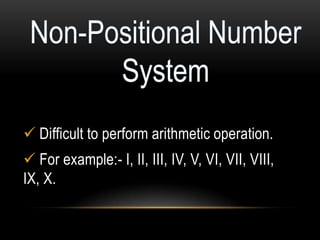

 Non-Positional Number System
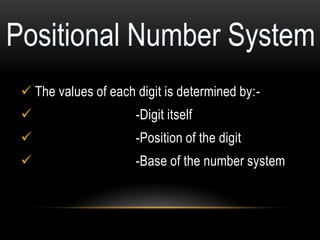
 Positional Number System
 Difficult to perform arithmetic operation.
 For example:- I, II, III, IV, V, VI, VII, VIII,
IX, X.
 The values of each digit is determined by:-
 -Digit itself
 -Position of the digit
 -Base of the number system
 The base is equal to 10.
 Uses 10 different symbols.
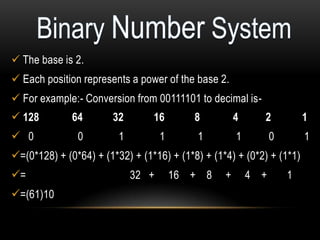
 The base is 2.
 Each position represents a power of the base 2.
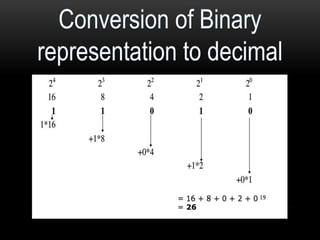
 For example:- Conversion from 00111101 to decimal is-
 128 64 32 16 8 4 2 1
 0 0 1 1 1 1 0 1
=(0*128) + (0*64) + (1*32) + (1*16) + (1*8) + (1*4) + (0*2) + (1*1)
= 32 + 16 + 8 + 4 + 1
=(61)10
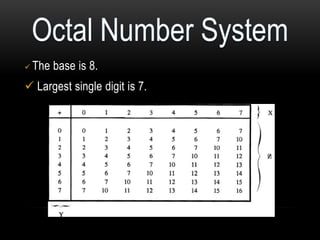
 The base is 8.
 Largest single digit is 7.
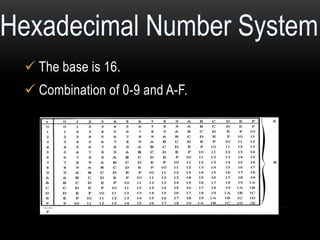
 The base is 16.
 Combination of 0-9 and A-F.
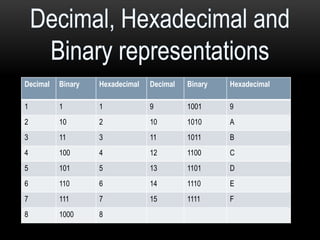
Decimal Binary Hexadecimal Decimal Binary Hexadecimal
1 1 1 9 1001 9
2 10 2 10 1010 A
3 11 3 11 1011 B
4 100 4 12 1100 C
5 101 5 13 1101 D
6 110 6 14 1110 E
7 111 7 15 1111 F
8 1000 8
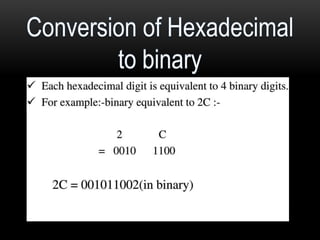
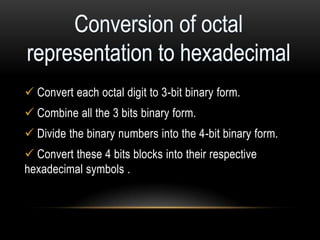
 Convert each octal digit to 3-bit binary form.
 Combine all the 3 bits binary form.
 Divide the binary numbers into the 4-bit binary form.
 Convert these 4 bits blocks into their respective
hexadecimal symbols .
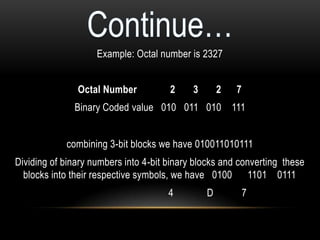
Example: Octal number is 2327
Octal Number 2 3 2 7
Binary Coded value 010 011 010 111
combining 3-bit blocks we have 010011010111
Dividing of binary numbers into 4-bit binary blocks and converting these
blocks into their respective symbols, we have 0100 1101 0111
4 D 7
Same procedure to convert
decimal number to binary, octal &
hexadecimal.
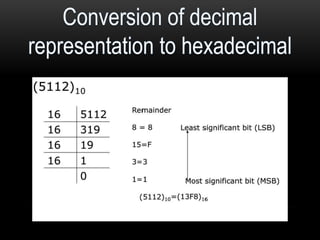
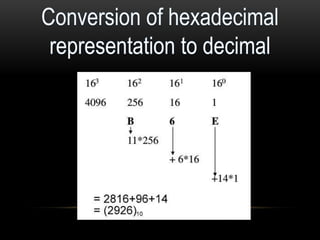
Same procedure to convert from
binary, octal & hexadecimal to
decimal numbers .
Number system

Number system

  • 2.
     Non-Positional NumberSystem  Positional Number System
  • 3.
     Difficult toperform arithmetic operation.  For example:- I, II, III, IV, V, VI, VII, VIII, IX, X.
  • 4.
     The valuesof each digit is determined by:-  -Digit itself  -Position of the digit  -Base of the number system
  • 5.
     The baseis equal to 10.  Uses 10 different symbols.
  • 6.
     The baseis 2.  Each position represents a power of the base 2.  For example:- Conversion from 00111101 to decimal is-  128 64 32 16 8 4 2 1  0 0 1 1 1 1 0 1 =(0*128) + (0*64) + (1*32) + (1*16) + (1*8) + (1*4) + (0*2) + (1*1) = 32 + 16 + 8 + 4 + 1 =(61)10
  • 7.
     The baseis 8.  Largest single digit is 7.
  • 8.
     The baseis 16.  Combination of 0-9 and A-F.
  • 9.
    Decimal Binary HexadecimalDecimal Binary Hexadecimal 1 1 1 9 1001 9 2 10 2 10 1010 A 3 11 3 11 1011 B 4 100 4 12 1100 C 5 101 5 13 1101 D 6 110 6 14 1110 E 7 111 7 15 1111 F 8 1000 8
  • 16.
     Convert eachoctal digit to 3-bit binary form.  Combine all the 3 bits binary form.  Divide the binary numbers into the 4-bit binary form.  Convert these 4 bits blocks into their respective hexadecimal symbols .
  • 17.
    Example: Octal numberis 2327 Octal Number 2 3 2 7 Binary Coded value 010 011 010 111 combining 3-bit blocks we have 010011010111 Dividing of binary numbers into 4-bit binary blocks and converting these blocks into their respective symbols, we have 0100 1101 0111 4 D 7
  • 18.
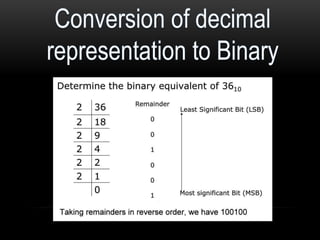
    Same procedure toconvert decimal number to binary, octal & hexadecimal. Same procedure to convert from binary, octal & hexadecimal to decimal numbers .