

NNUUMMBBEERR 
SSYYSSTTEEMM 
22 
The mysterious world of numbers…
Acknowledgement 
We would like to thank AKP sir for giving us an 
opportunity to express ourselves on this enthusiastic 
project. Any accomplishment requires the effort of 
many people and this work is no different. Every group 
member has been an important part of this project. We 
also thank our friends for their ideas and co-operation 
they provided to us. We are grateful to all of them. 
Thank you..
 A number is a mathematical object used in 
counting and measuring. Numerals are often used for 
labels, for ordering serial numbers, and for codes like 
ISBNs. 
 In mathematics, the definition of number has been 
extended over the years to include such numbers as zero, 
negative numbers, rational numbers, irrational numbers, 
and complex numbers.
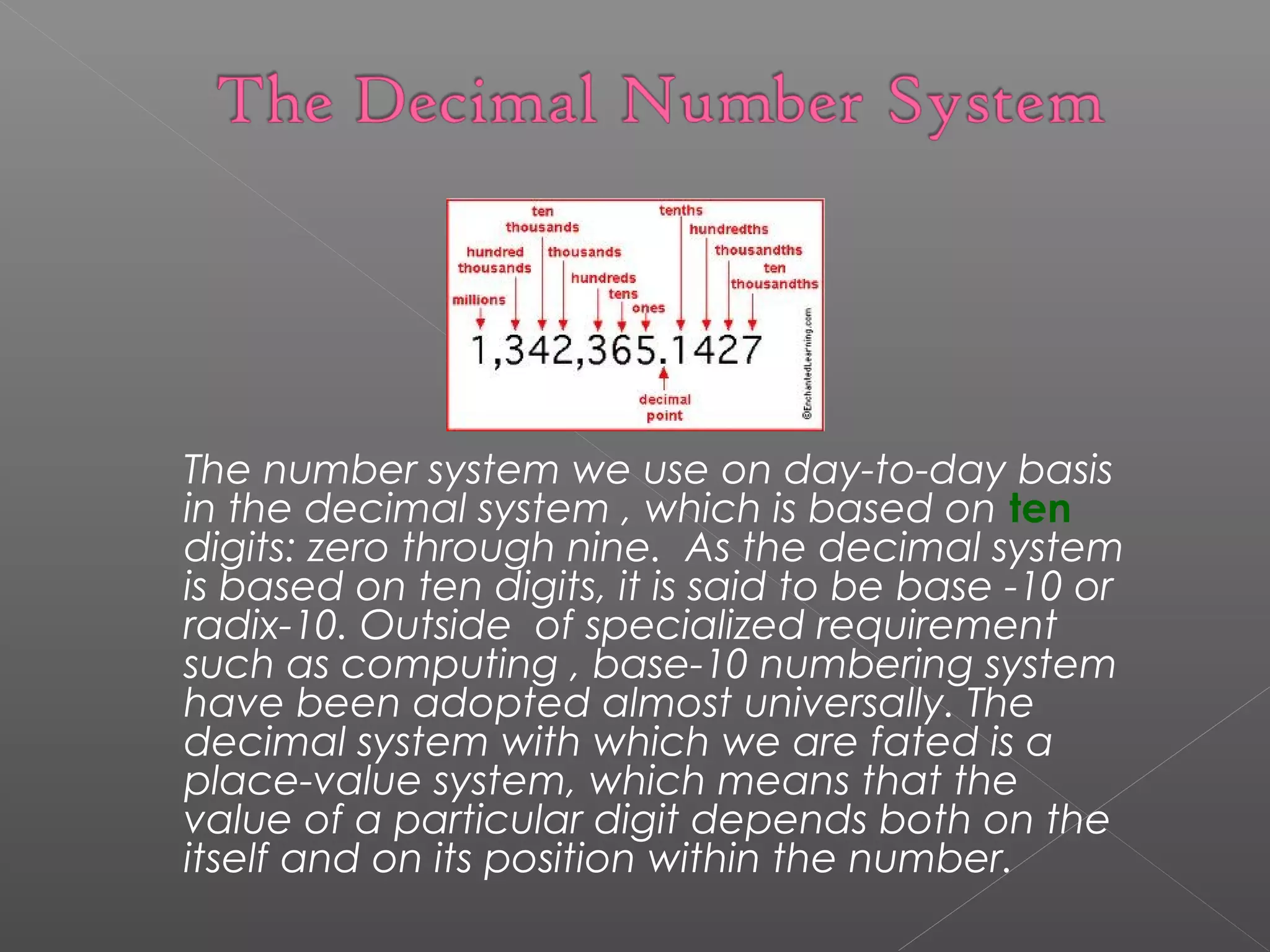
The number system we use on day-to-day basis 
in the decimal system , which is based on ten 
digits: zero through nine. As the decimal system 
is based on ten digits, it is said to be base -10 or 
radix-10. Outside of specialized requirement 
such as computing , base-10 numbering system 
have been adopted almost universally. The 
decimal system with which we are fated is a 
place-value system, which means that the 
value of a particular digit depends both on the 
itself and on its position within the number.
 The binar y numeral system, or base-2 number 
system, represents numeric values using two symbols, 0 and 
1. More specifically, the usual base-2 system is a positional 
notation with a radix of 2. Owing to its straight forward 
implementation in digital electronic circuitry using logic 
gates, the binary system is used internally by all modern 
computers. 
 Counting in binary is similar to counting in any other 
number system. Beginning with a single digit, counting 
proceeds through each symbol, in increasing order. Decimal 
counting uses the symbols 0 through 9, while binary only 
uses the symbols 0 and 1.
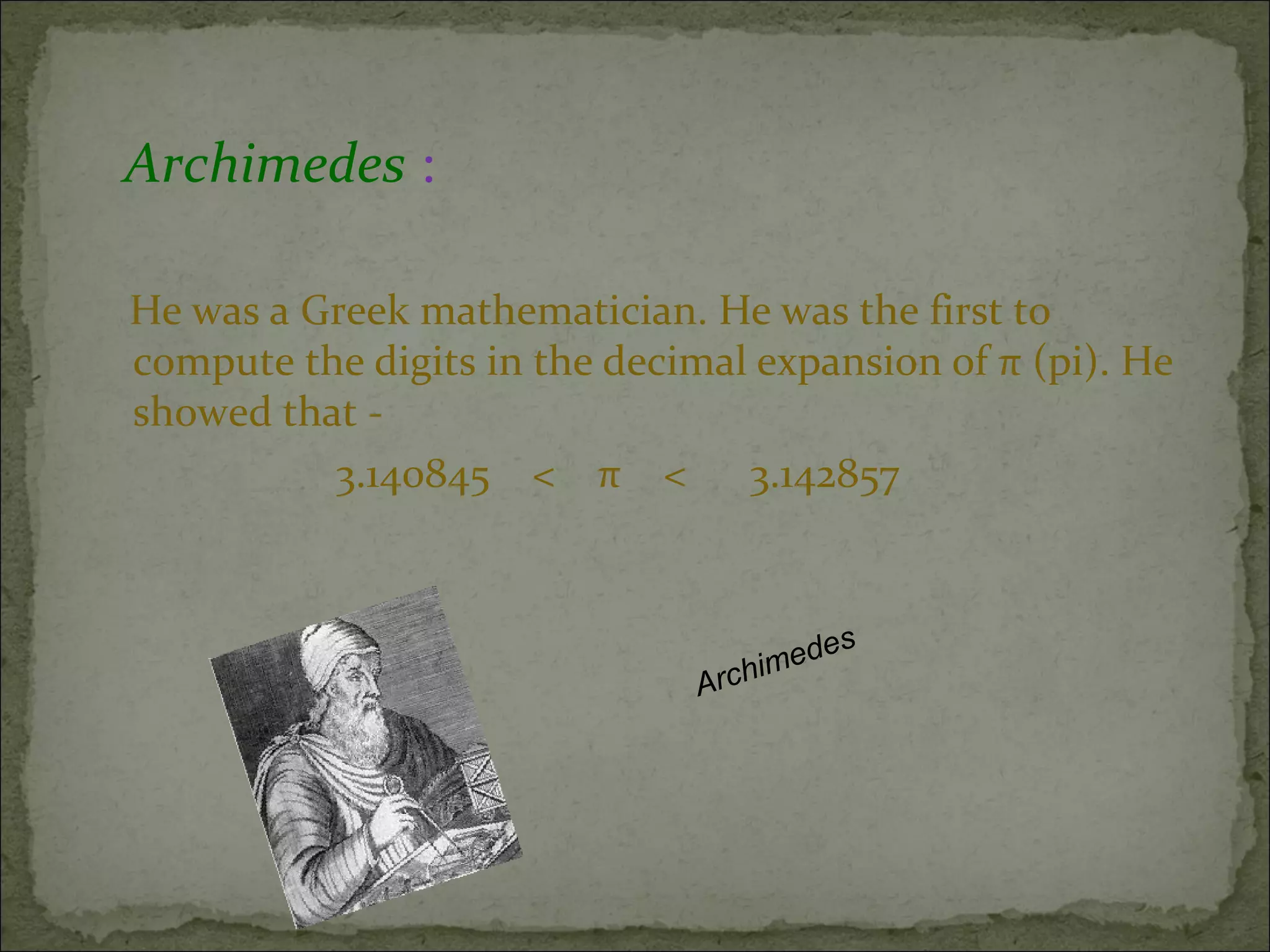
Archimedes : 
He was a Greek mathematician. He was the first to 
compute the digits in the decimal expansion of π (pi). He 
showed that - 
3.140845 < π < 3.142857 
Archimedes
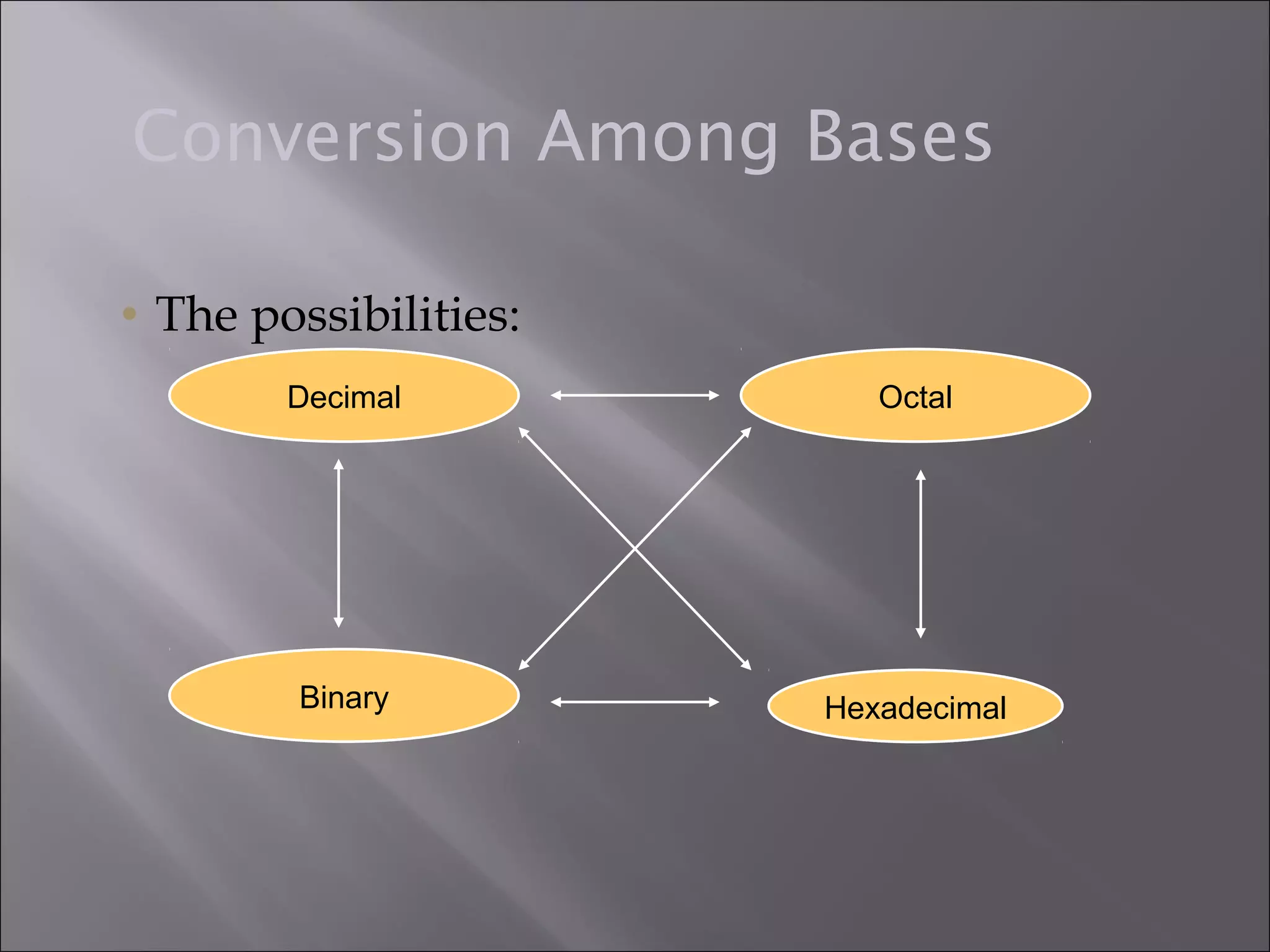
Conversion Among Bases 
• The possibilities: 
Decimal Octal 
Hexadecimal 
Binary
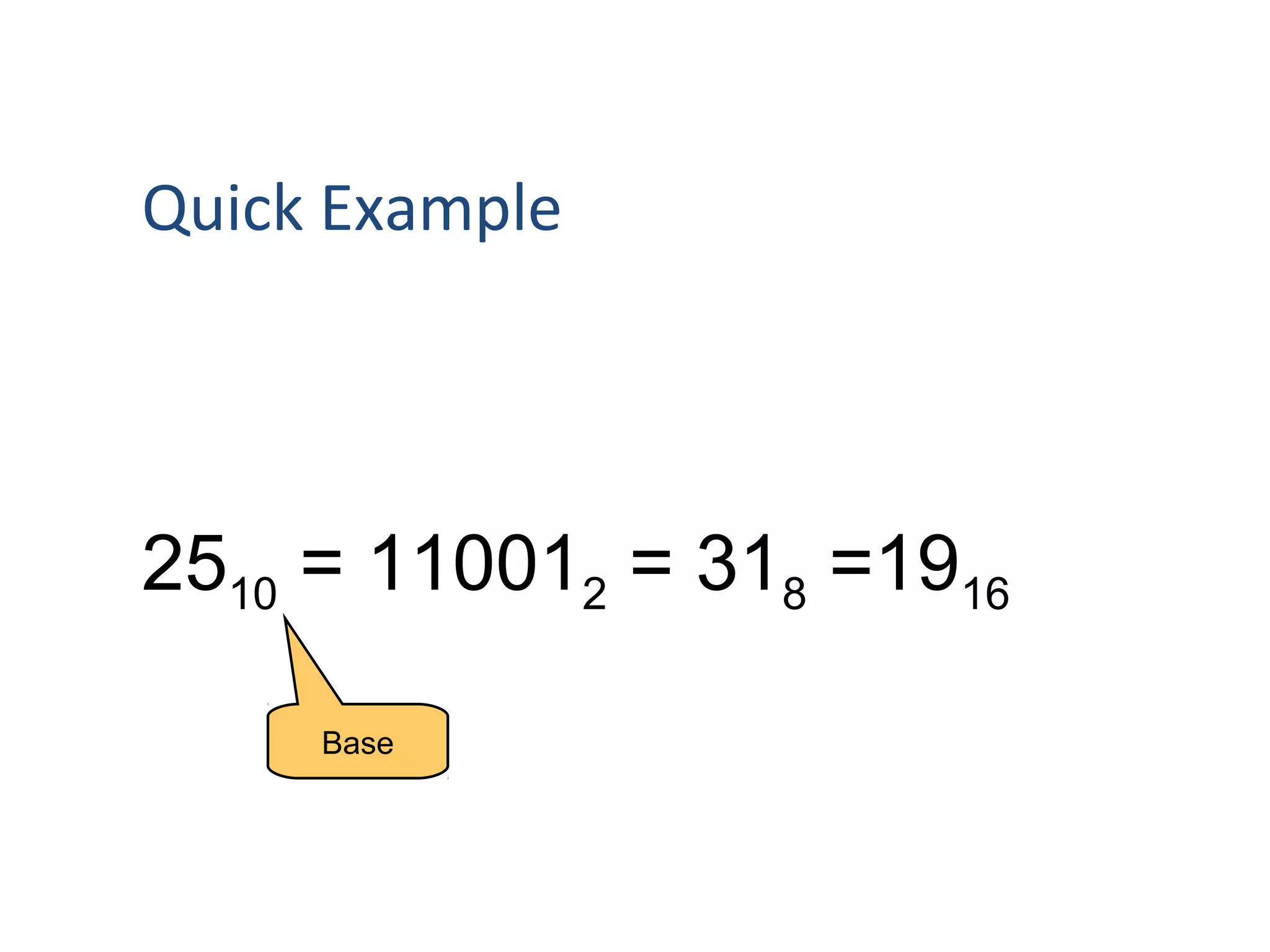
Quick Example 
2510 = 110012 = 318 =1916 
Base
> Binary to decimal 
> Octal to decimal 
> Hexadecimal to decimal 
> Decimal to binary 
> Octal to binary 
> Hexadecimal to binary 
> Decimal to octal, etc.. 
DDiiffffeerreenntt ccoonnvveerrssiioonnss ppoossssiibbllee::
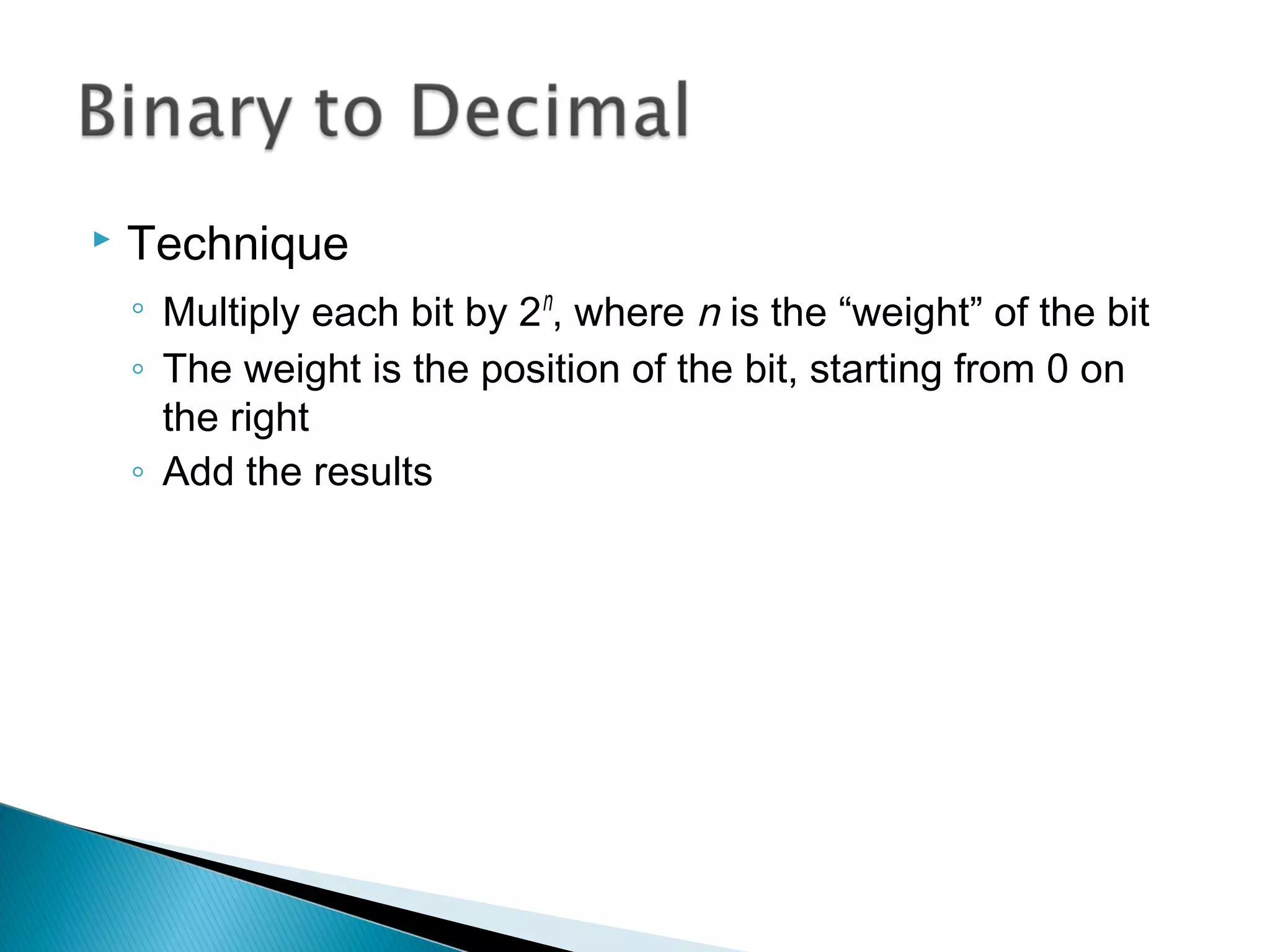
 Technique 
◦ Multiply each bit by 2n, where n is the “weight” of the bit 
◦ The weight is the position of the bit, starting from 0 on 
the right 
◦ Add the results
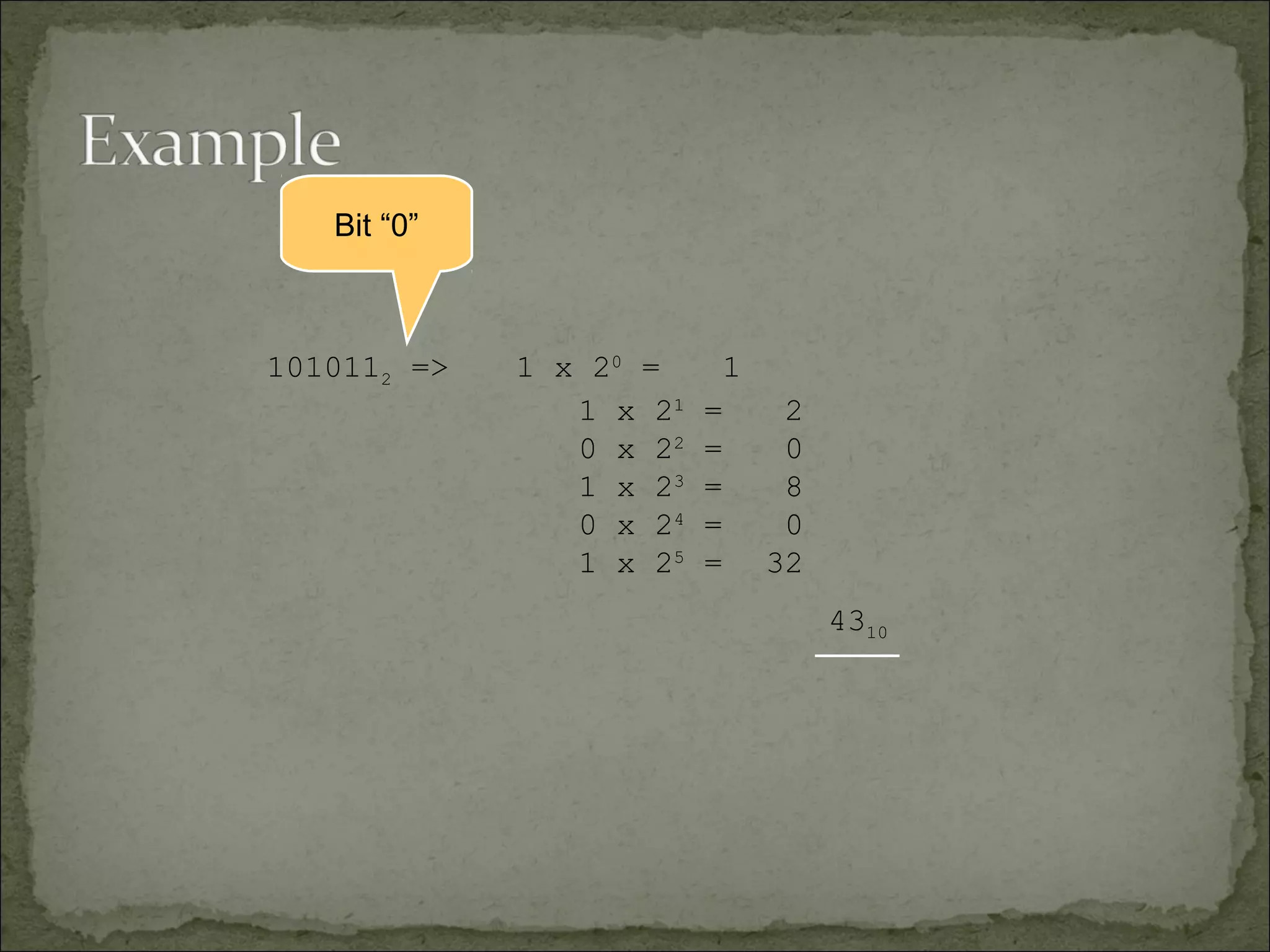
1010112 => 1 x 20 = 1 
1 x 21 = 2 
0 x 22 = 0 
1 x 23 = 8 
0 x 24 = 0 
1 x 25 = 32 
4310 
Bit “0”
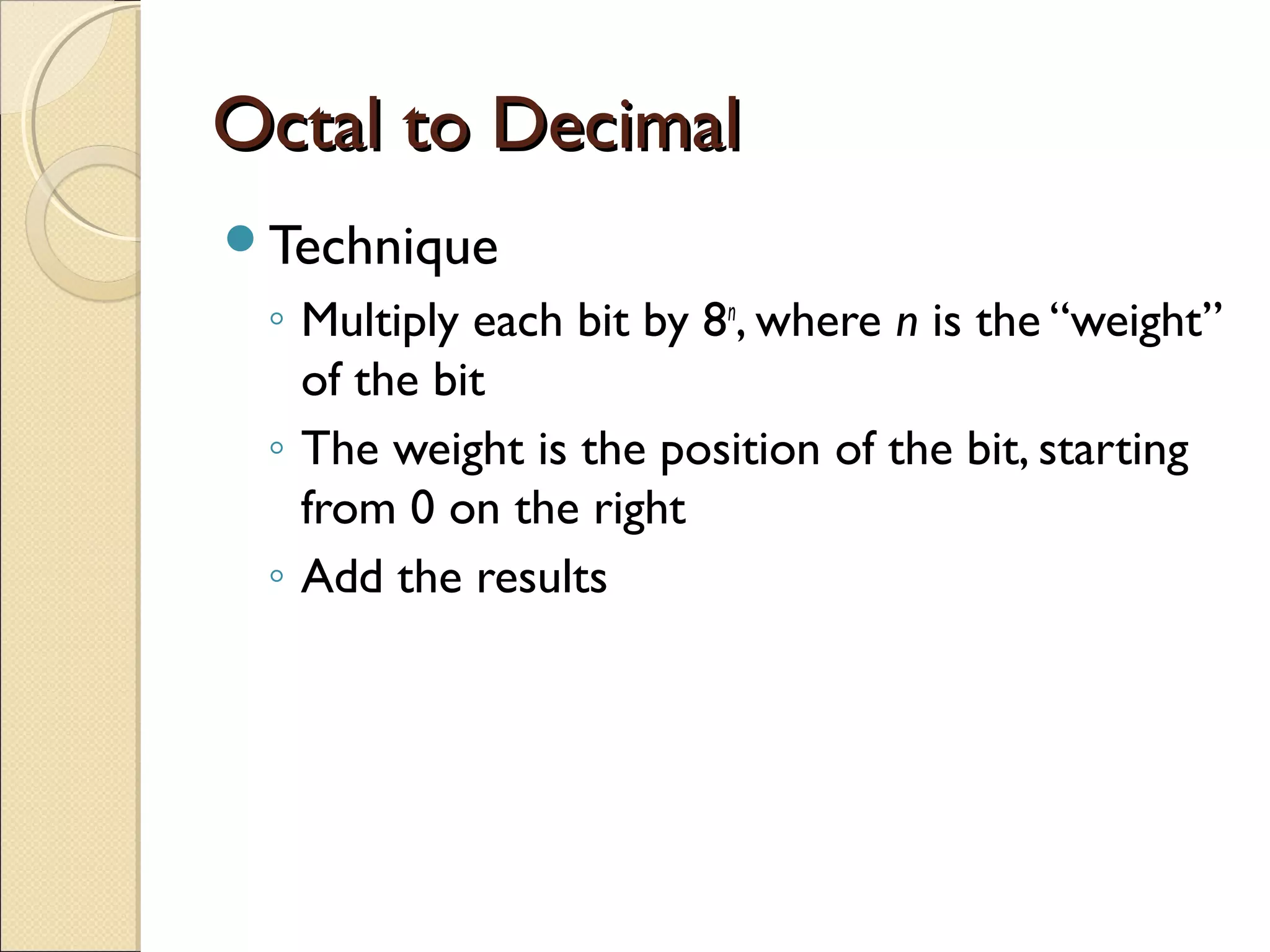
OOccttaall ttoo DDeecciimmaall 
Technique 
◦ Multiply each bit by 8n, where n is the “weight” 
of the bit 
◦ The weight is the position of the bit, starting 
from 0 on the right 
◦ Add the results
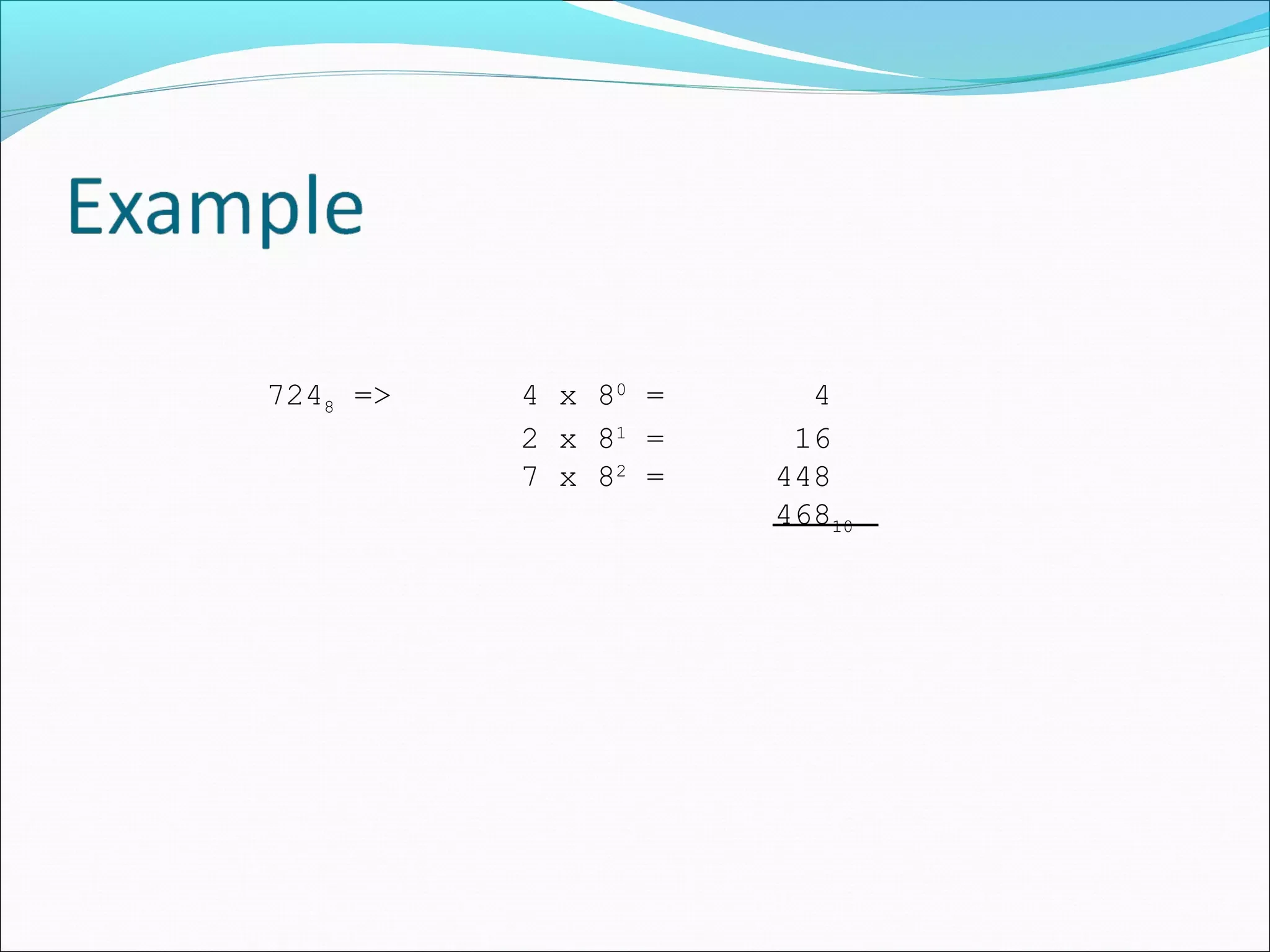
7248 => 4 x 80 = 4 
2 x 81 = 16 
7 x 82 = 448 
46810
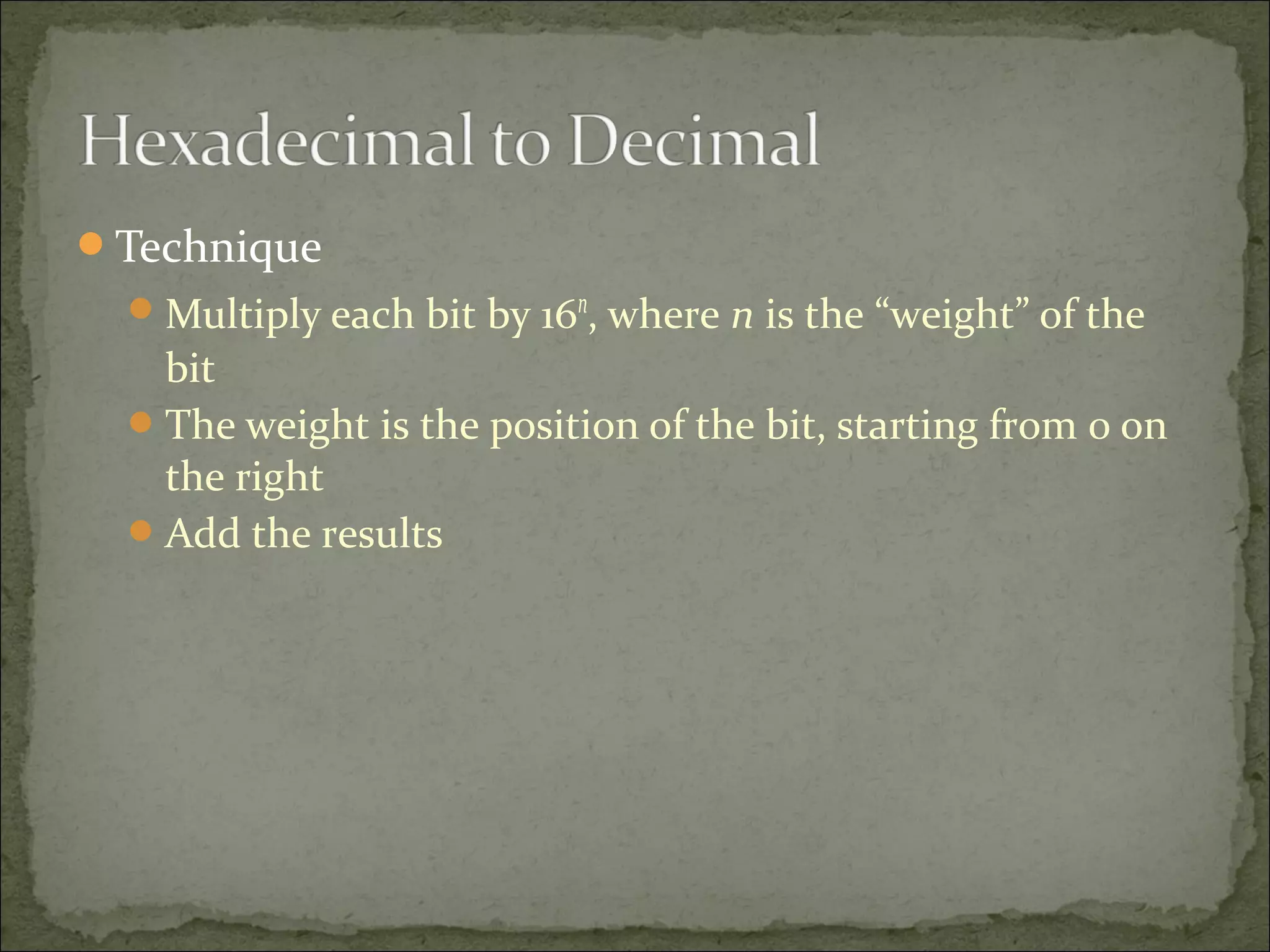
Technique 
Multiply each bit by 16n, where n is the “weight” of the 
bit 
The weight is the position of the bit, starting from 0 on 
the right 
Add the results
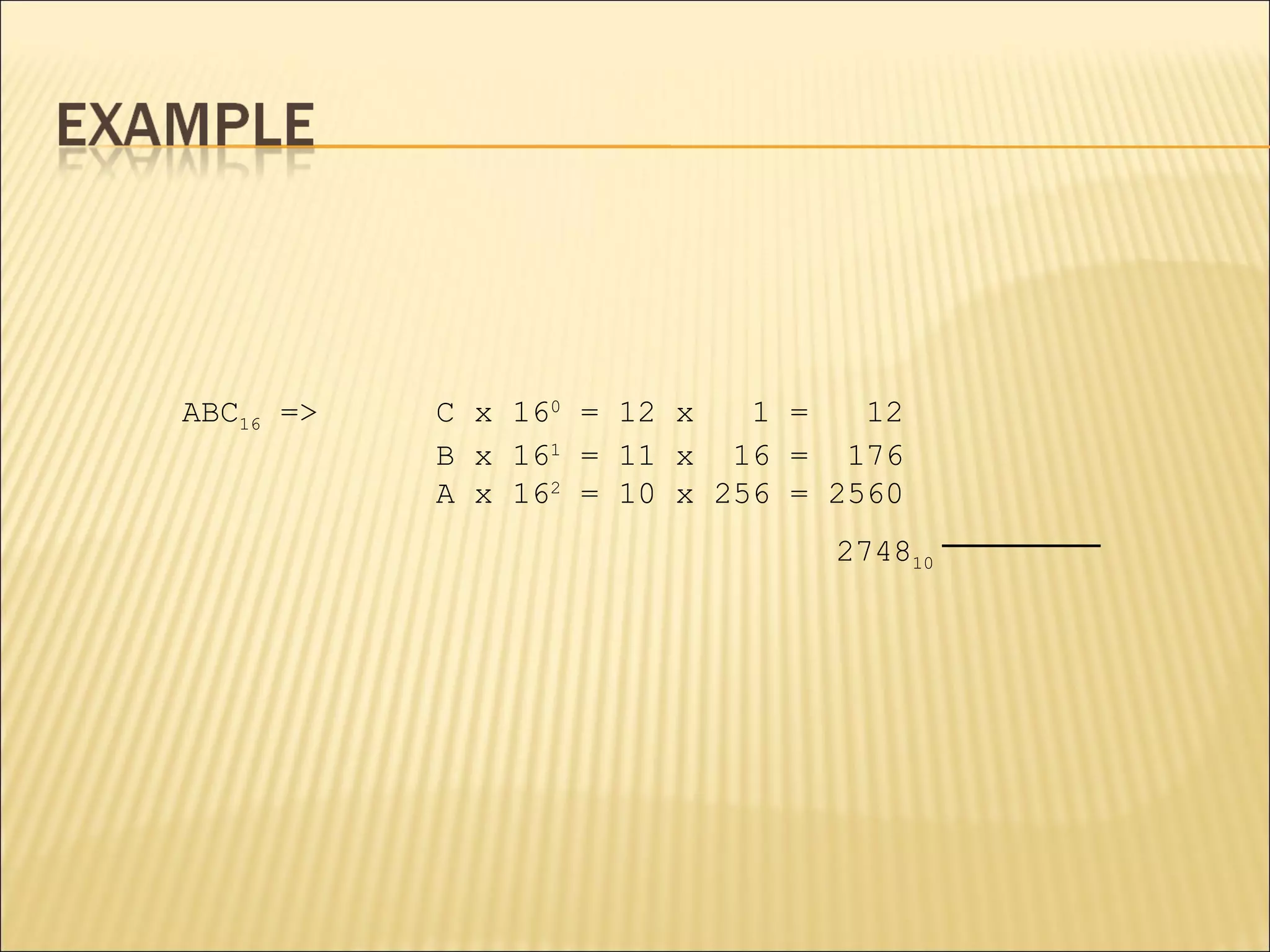
ABC16 => C x 160 = 12 x 1 = 12 
B x 161 = 11 x 16 = 176 
A x 162 = 10 x 256 = 2560 
274810
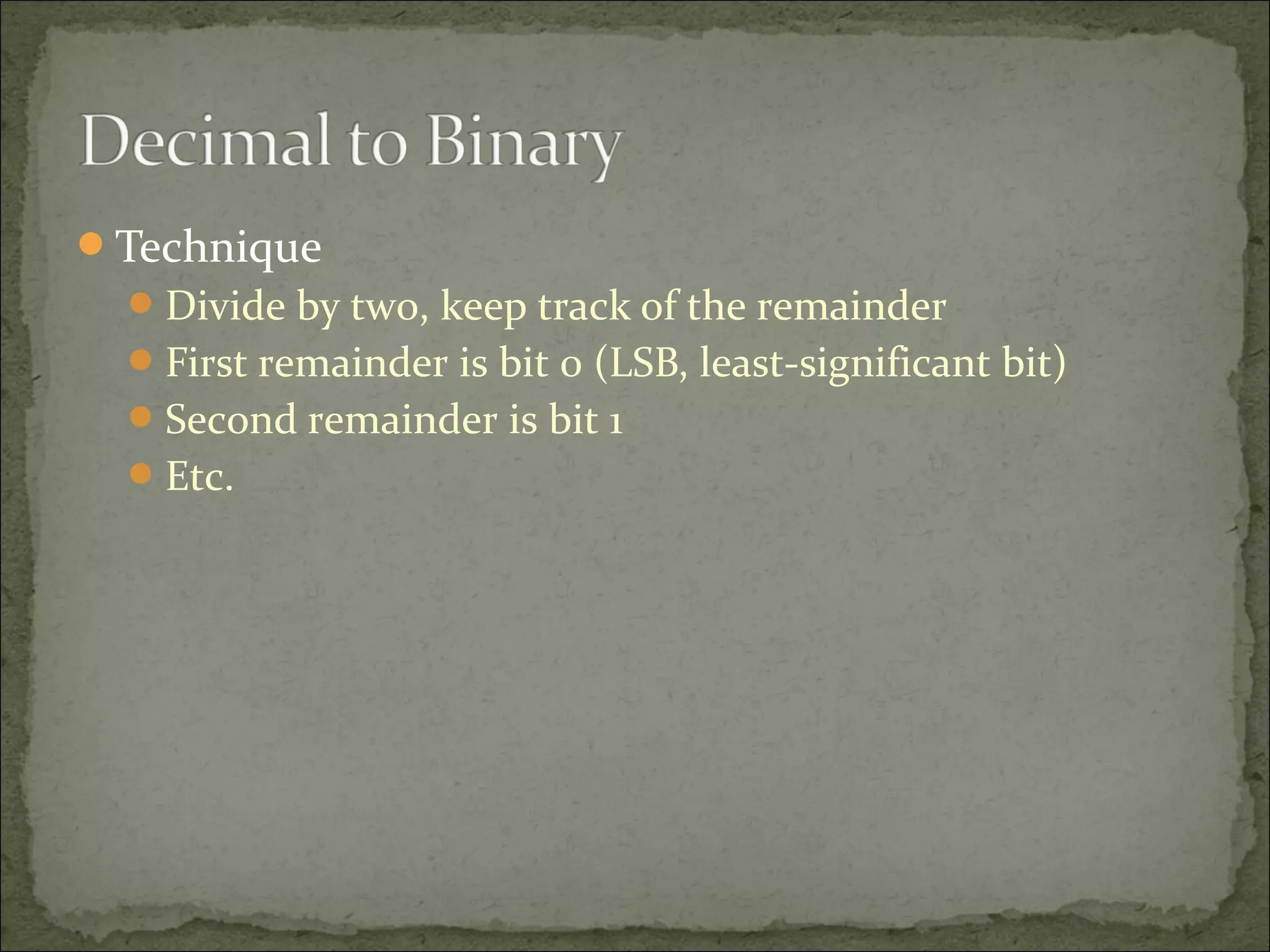
Technique 
Divide by two, keep track of the remainder 
First remainder is bit 0 (LSB, least-significant bit) 
Second remainder is bit 1 
Etc.
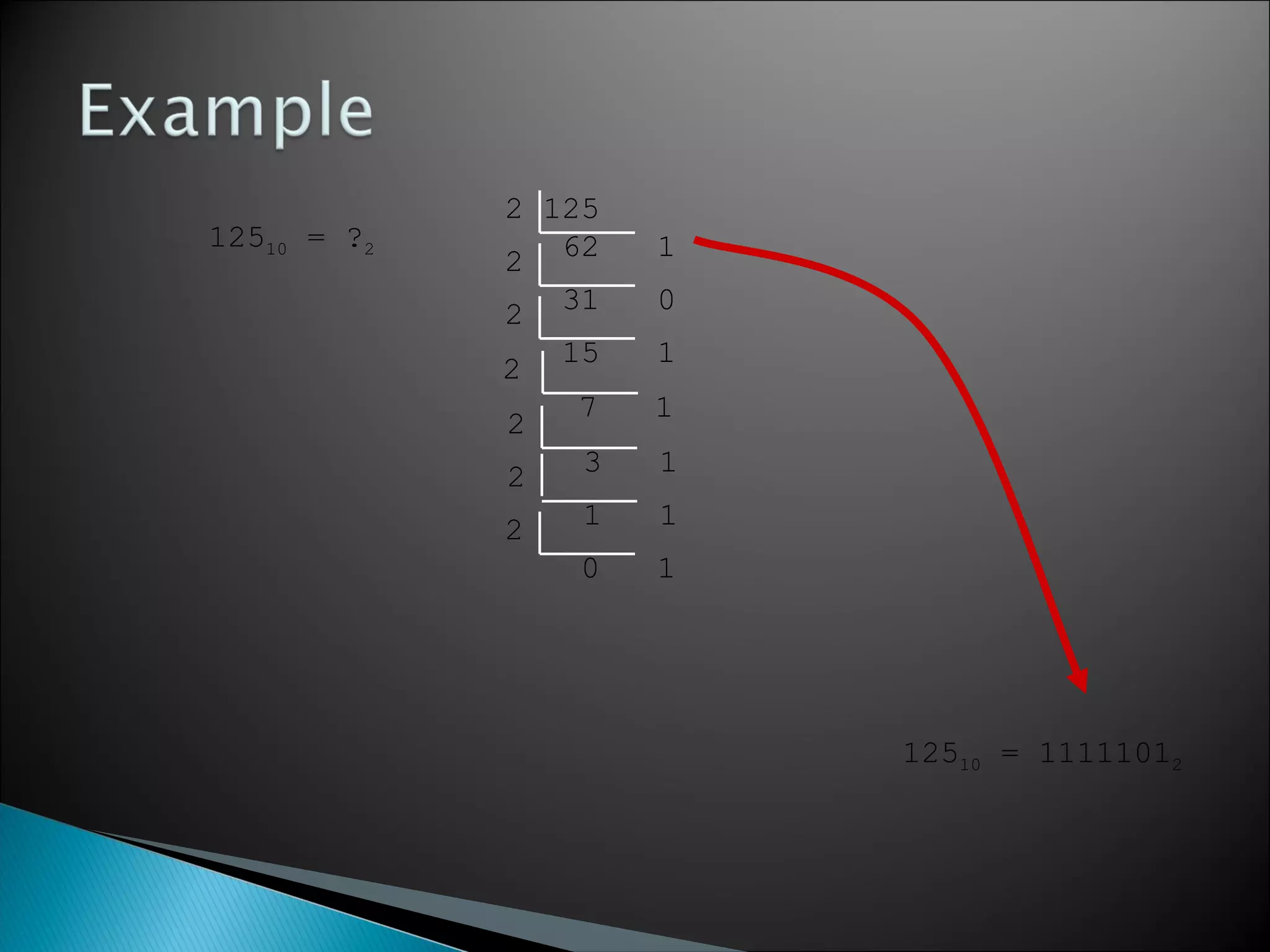
12510 = ?2 
2 125 
2 6 2 1 
2 3 1 0 
2 1 5 1 
2 7 1 
2 3 1 
2 1 1 
0 1 
12510 = 11111012
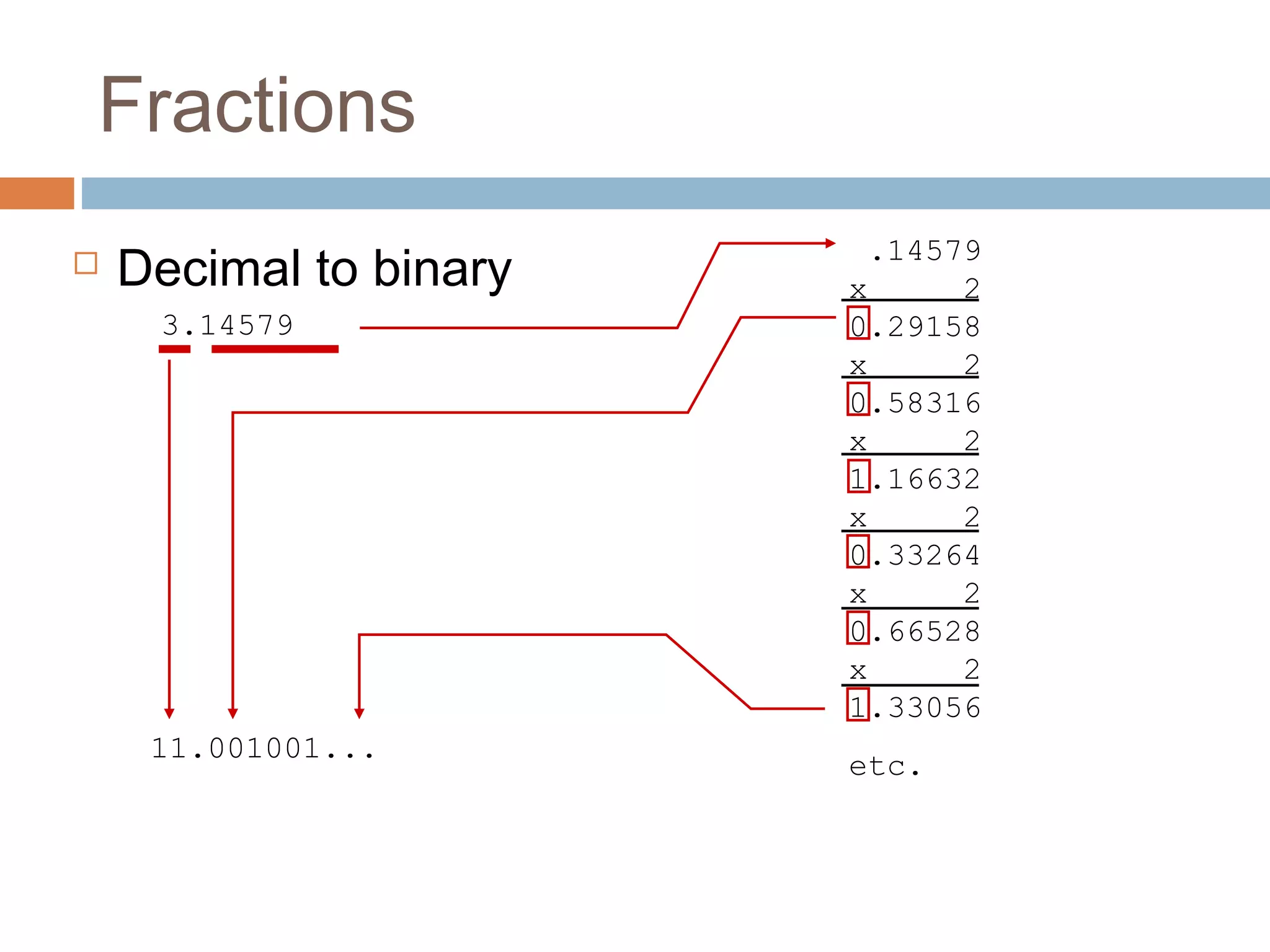
Fractions 
 Decimal to binary 
3.14579 
.14579 
x 2 
0.29158 
x 2 
0.58316 
x 2 
1.16632 
x 2 
0.33264 
x 2 
0.66528 
x 2 
1.33056 
11.001001... etc.
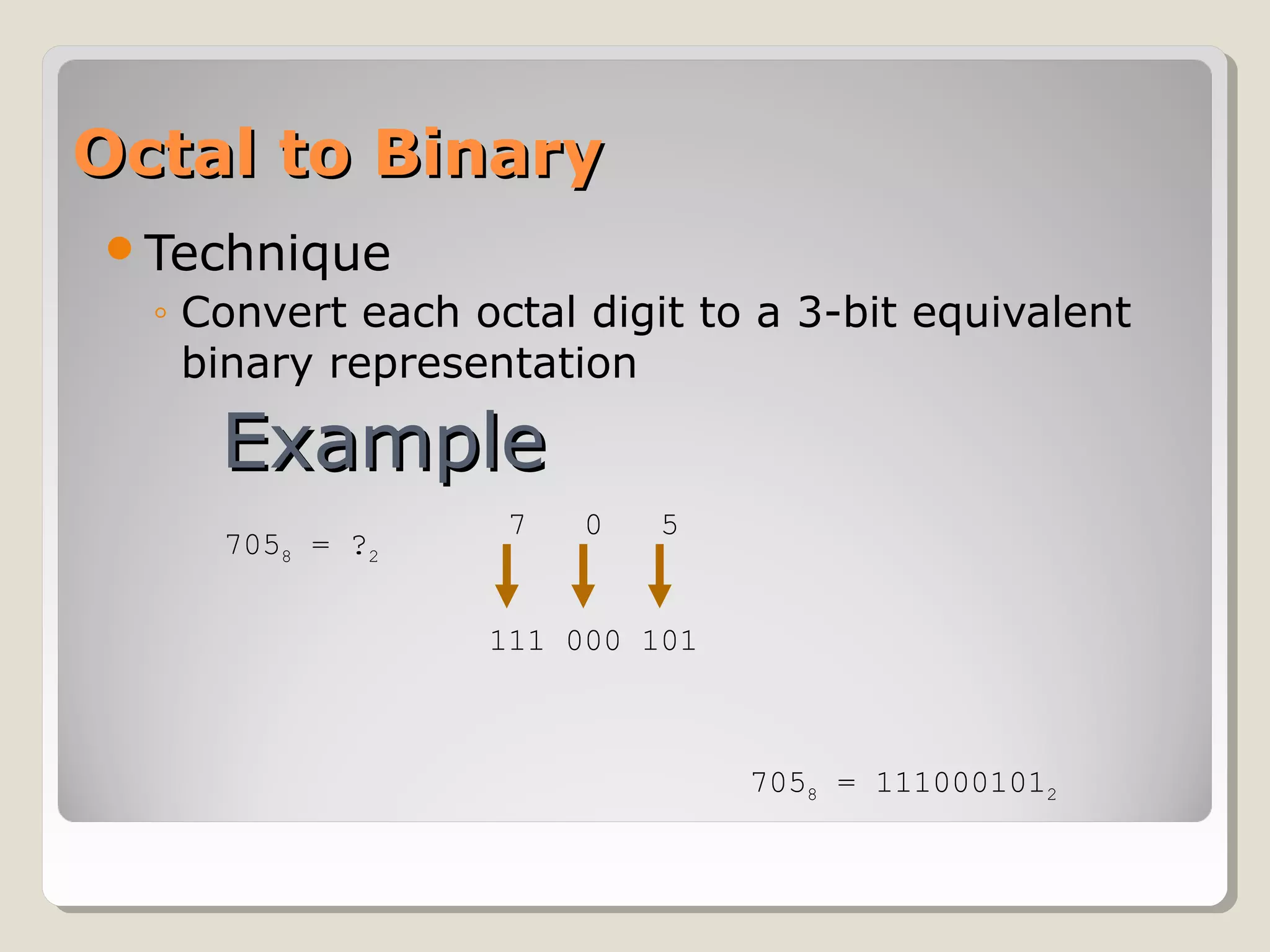
OOccttaall ttoo BBiinnaarryy 
Technique 
◦ Convert each octal digit to a 3-bit equivalent 
binary representation 
EExxaammppllee 
7058 = ?2 
7 0 5 
111 000 101 
7058 = 1110001012
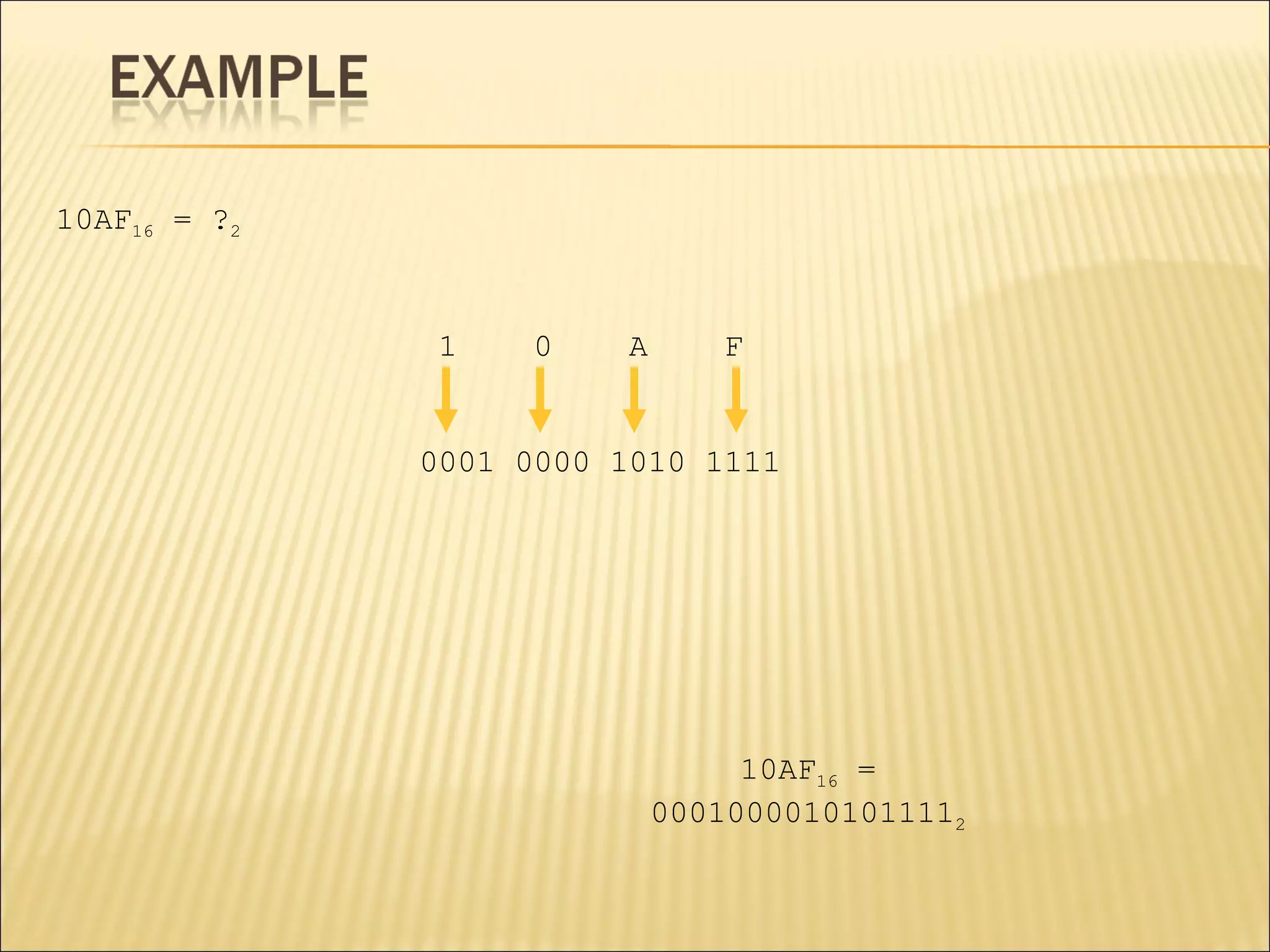
Technique 
Convert each hexadecimal digit to a 4-bit equivalent 
binary representation
10AF16 = ?2 
1 0 A F 
0001 0000 1010 1111 
10AF16 = 
00010000101011112
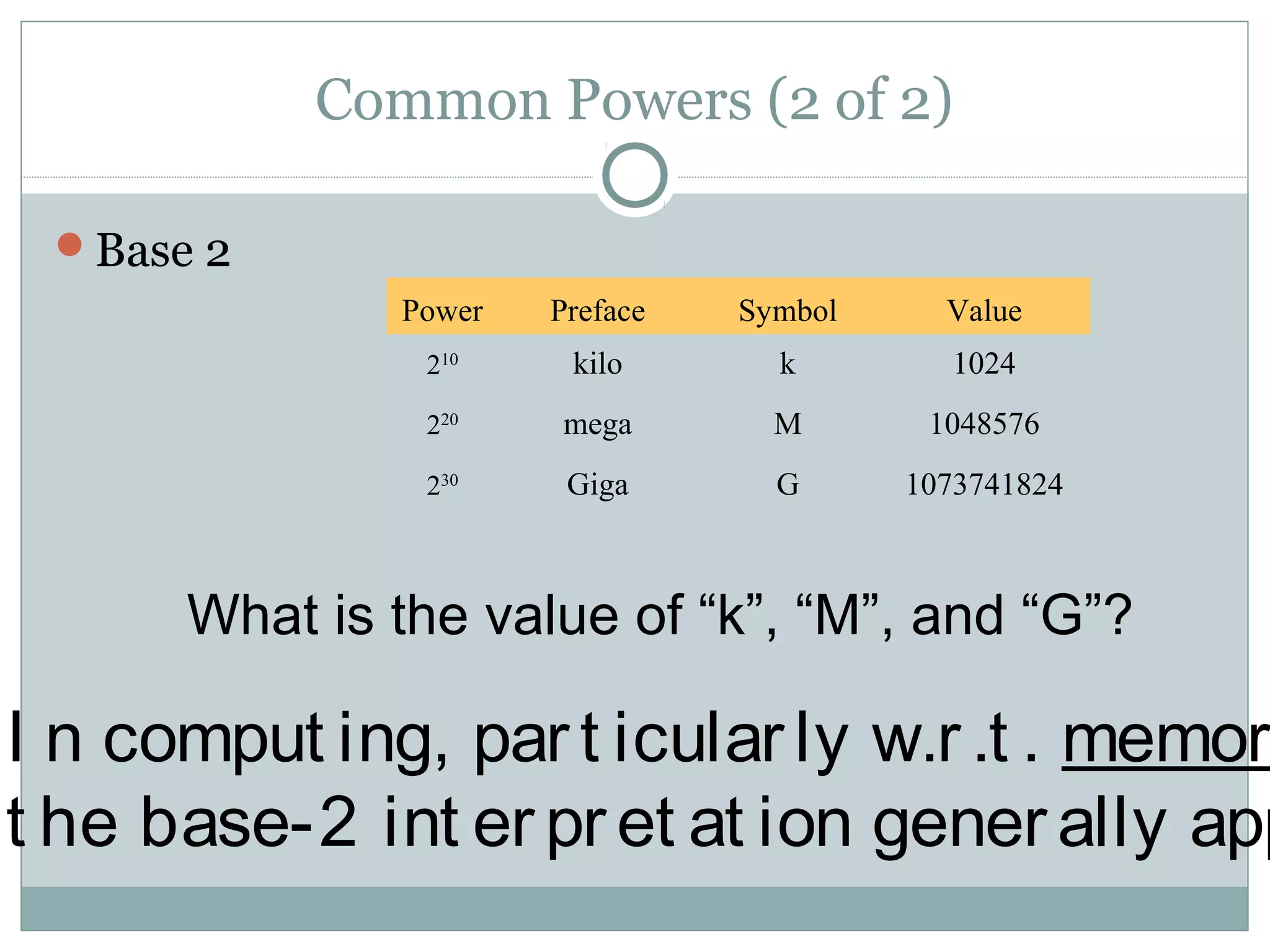
Common Powers (2 of 2) 
Base 2 
Power Preface Symbol 
210 kilo k 
220 mega M 
230 Giga G 
Value 
1024 
1048576 
1073741824 
What is the value of “k”, “M”, and “G”? 
I n comput ing, par t icular ly w.r .t . memor t he base-2 int er pr et at ion gener ally applies
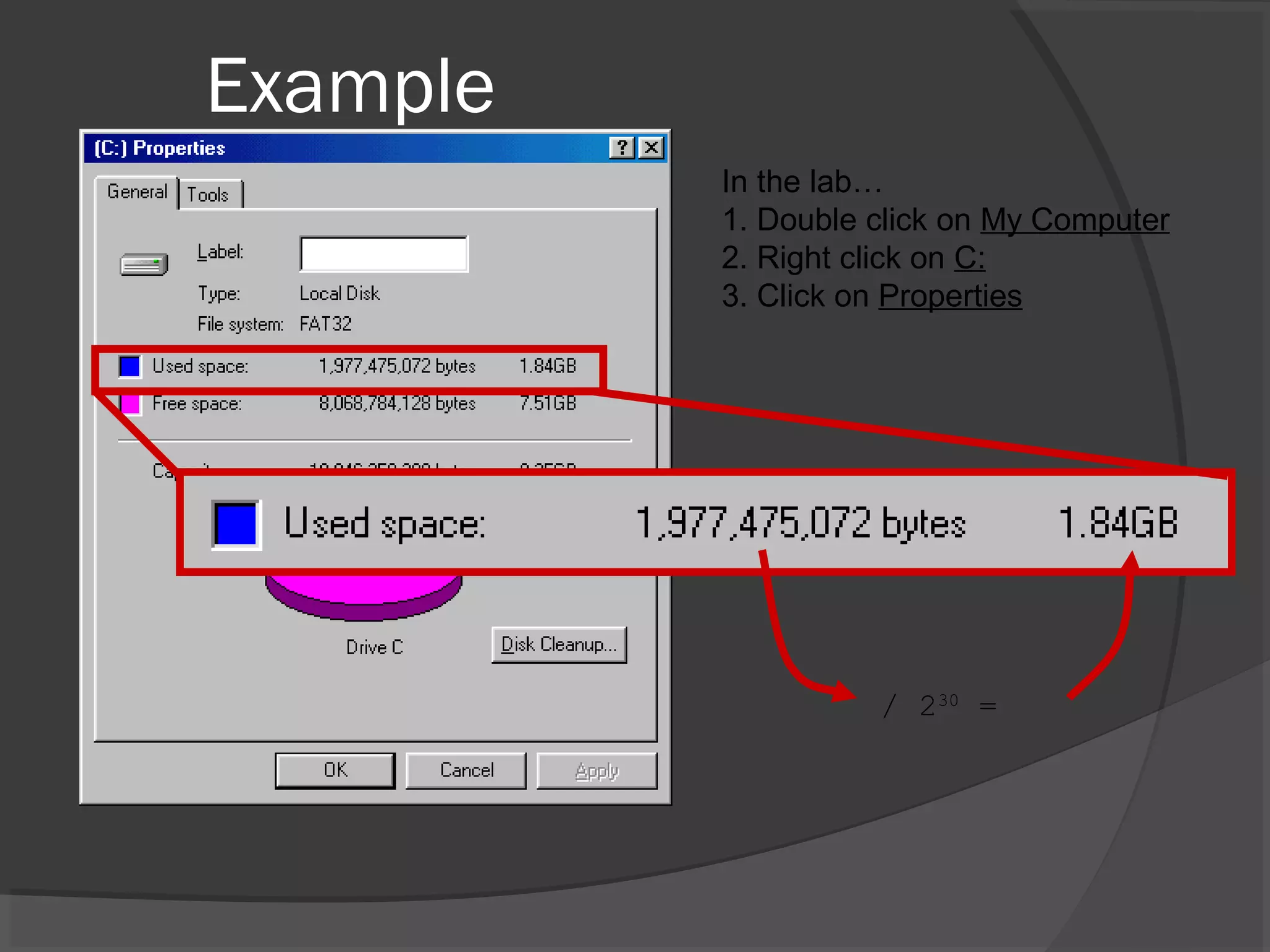
Example 
In the lab… 
1. Double click on My Computer 
2. Right click on C: 
3. Click on Properties 
/ 230 =
Numbers are never ending. You look into it, you find a 
world of quantities, helping you in your daily chores. 
It’s a simple yet hard to understand, you work on it, 
you are going to love it more and more. 
Exploring it is the best option, so just enjoy it.
Project made and Compiled by 
~ 
Sanjana Poddar 
Sana Jahan 
Ronodeep Mazumdar 
Riya Debnath

Number system

  • 1.
    NNUUMMBBEERR SSYYSSTTEEMM 22 The mysterious world of numbers…
  • 2.
    Acknowledgement We wouldlike to thank AKP sir for giving us an opportunity to express ourselves on this enthusiastic project. Any accomplishment requires the effort of many people and this work is no different. Every group member has been an important part of this project. We also thank our friends for their ideas and co-operation they provided to us. We are grateful to all of them. Thank you..
  • 3.
     A numberis a mathematical object used in counting and measuring. Numerals are often used for labels, for ordering serial numbers, and for codes like ISBNs.  In mathematics, the definition of number has been extended over the years to include such numbers as zero, negative numbers, rational numbers, irrational numbers, and complex numbers.
  • 4.
    The number systemwe use on day-to-day basis in the decimal system , which is based on ten digits: zero through nine. As the decimal system is based on ten digits, it is said to be base -10 or radix-10. Outside of specialized requirement such as computing , base-10 numbering system have been adopted almost universally. The decimal system with which we are fated is a place-value system, which means that the value of a particular digit depends both on the itself and on its position within the number.
  • 5.
     The binary numeral system, or base-2 number system, represents numeric values using two symbols, 0 and 1. More specifically, the usual base-2 system is a positional notation with a radix of 2. Owing to its straight forward implementation in digital electronic circuitry using logic gates, the binary system is used internally by all modern computers.  Counting in binary is similar to counting in any other number system. Beginning with a single digit, counting proceeds through each symbol, in increasing order. Decimal counting uses the symbols 0 through 9, while binary only uses the symbols 0 and 1.
  • 6.
    Archimedes : Hewas a Greek mathematician. He was the first to compute the digits in the decimal expansion of π (pi). He showed that - 3.140845 < π < 3.142857 Archimedes
  • 7.
    Conversion Among Bases • The possibilities: Decimal Octal Hexadecimal Binary
  • 8.
    Quick Example 2510= 110012 = 318 =1916 Base
  • 9.
    > Binary todecimal > Octal to decimal > Hexadecimal to decimal > Decimal to binary > Octal to binary > Hexadecimal to binary > Decimal to octal, etc.. DDiiffffeerreenntt ccoonnvveerrssiioonnss ppoossssiibbllee::
  • 10.
     Technique ◦Multiply each bit by 2n, where n is the “weight” of the bit ◦ The weight is the position of the bit, starting from 0 on the right ◦ Add the results
  • 11.
    1010112 => 1x 20 = 1 1 x 21 = 2 0 x 22 = 0 1 x 23 = 8 0 x 24 = 0 1 x 25 = 32 4310 Bit “0”
  • 12.
    OOccttaall ttoo DDeecciimmaall Technique ◦ Multiply each bit by 8n, where n is the “weight” of the bit ◦ The weight is the position of the bit, starting from 0 on the right ◦ Add the results
  • 13.
    7248 => 4x 80 = 4 2 x 81 = 16 7 x 82 = 448 46810
  • 14.
    Technique Multiply eachbit by 16n, where n is the “weight” of the bit The weight is the position of the bit, starting from 0 on the right Add the results
  • 15.
    ABC16 => Cx 160 = 12 x 1 = 12 B x 161 = 11 x 16 = 176 A x 162 = 10 x 256 = 2560 274810
  • 16.
    Technique Divide bytwo, keep track of the remainder First remainder is bit 0 (LSB, least-significant bit) Second remainder is bit 1 Etc.
  • 17.
    12510 = ?2 2 125 2 6 2 1 2 3 1 0 2 1 5 1 2 7 1 2 3 1 2 1 1 0 1 12510 = 11111012
  • 18.
    Fractions  Decimalto binary 3.14579 .14579 x 2 0.29158 x 2 0.58316 x 2 1.16632 x 2 0.33264 x 2 0.66528 x 2 1.33056 11.001001... etc.
  • 19.
    OOccttaall ttoo BBiinnaarryy Technique ◦ Convert each octal digit to a 3-bit equivalent binary representation EExxaammppllee 7058 = ?2 7 0 5 111 000 101 7058 = 1110001012
  • 20.
    Technique Convert eachhexadecimal digit to a 4-bit equivalent binary representation
  • 21.
    10AF16 = ?2 1 0 A F 0001 0000 1010 1111 10AF16 = 00010000101011112
  • 22.
    Common Powers (2of 2) Base 2 Power Preface Symbol 210 kilo k 220 mega M 230 Giga G Value 1024 1048576 1073741824 What is the value of “k”, “M”, and “G”? I n comput ing, par t icular ly w.r .t . memor t he base-2 int er pr et at ion gener ally applies
  • 23.
    Example In thelab… 1. Double click on My Computer 2. Right click on C: 3. Click on Properties / 230 =
  • 24.
    Numbers are neverending. You look into it, you find a world of quantities, helping you in your daily chores. It’s a simple yet hard to understand, you work on it, you are going to love it more and more. Exploring it is the best option, so just enjoy it.
  • 26.
    Project made andCompiled by ~ Sanjana Poddar Sana Jahan Ronodeep Mazumdar Riya Debnath