CELL DIVISION IN THE FORM OF
MEIOSIS BY TINYIKO DLAMINI

MEIOSIS
Lesson Overview

Meiosis

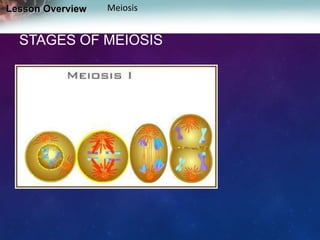
STAGES OF MEIOSIS
Lesson Overview

Meiosis

BACKGROUND

As geneticists in the early 1900s applied
Mendel’s laws, they wondered where genes
might be located.
They expected genes to be carried on
structures inside the cell, but which
structures?

What cellular processes could account for
segregation and independent
assortment, as Mendel had described?
CONTENT OF MEIOSIS

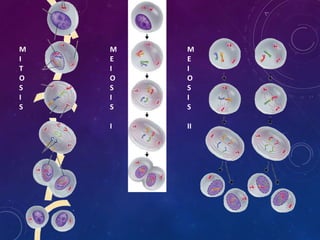
 Meiosis- a form of nuclear division in which the chromosome number is
halved from the diploid number (2n) to the haploid number (n).
 involves interphase
 followed by two cycle of cell division, known as meiosis I and meiosis II
(first & second meiotic division).
 gives rise to four haploid cells.
Importance term s in meiosis:
a)

Chromatid
- prior to meiosis 1,DNA replication occurs and each chromosomes has two sister
chromatids.
- After crossing over occurs,sister chromatid of a chromosome are not longer
identical
- the chromosomes in the four daughter cells of meiosis are actually chromatids
from the original parent cell.

b) Synapsis
- during meiosis 1,homologous chromosomes pair,come together and line up in
synapsis
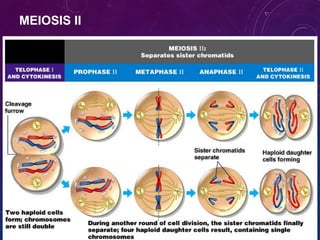
MEIOSIS II
Lesson Overview

Meiosis

PHASES OF MEIOSIS
What events occur during each phase of meiosis?
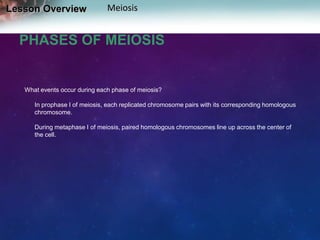
In prophase I of meiosis, each replicated chromosome pairs with its corresponding homologous chromosome.
During metaphase I of meiosis, paired homologous chromosomes line up across the center of the cell.
M
I
T
O
S
I
S

M
E
I
O
S
I
S

M
E
I
O
S
I
S

I

II
Lesson Overview

Meiosis

PHASES OF MEIOSIS

What events occur during each phase of meiosis?
In prophase I of meiosis, each replicated chromosome pairs with its corresponding homologous
chromosome.
During metaphase I of meiosis, paired homologous chromosomes line up across the center of
the cell.
Lesson Overview

Meiosis

PHASES OF MEIOSIS
What events occur during each phase of meiosis?
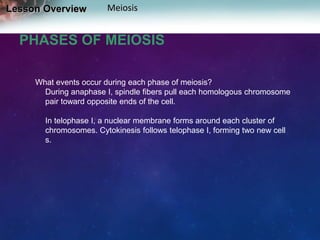
During anaphase I, spindle fibers pull each homologous chromosome
pair toward opposite ends of the cell.
In telophase I, a nuclear membrane forms around each cluster of
chromosomes. Cytokinesis follows telophase I, forming two new cell
s.
Lesson Overview

Meiosis

DIPLOID CELLS

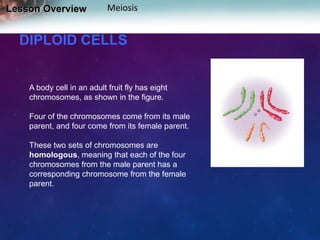
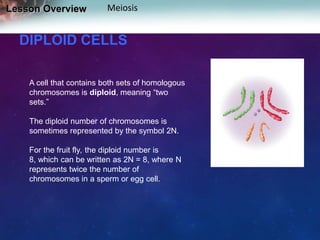
A body cell in an adult fruit fly has eight
chromosomes, as shown in the figure.
Four of the chromosomes come from its male
parent, and four come from its female parent.
These two sets of chromosomes are
homologous, meaning that each of the four
chromosomes from the male parent has a
corresponding chromosome from the female
parent.
Lesson Overview

Meiosis

DIPLOID CELLS
A cell that contains both sets of homologous
chromosomes is diploid, meaning “two
sets.”
The diploid number of chromosomes is
sometimes represented by the symbol 2N.
For the fruit fly, the diploid number is
8, which can be written as 2N = 8, where N
represents twice the number of
chromosomes in a sperm or egg cell.
Lesson Overview

Meiosis

HAPLOID CELLS
Some cells contain only a single set of chromosomes, and therefore a
single set of genes.
Such cells are haploid, meaning “one set.”
The gametes of sexually reproducing organisms are haploid.
For fruit fly gametes, the haploid number is 4, which can be written as
N = 4.
Lesson Overview

Meiosis

CHROMOSOME NUMBER

Chromosomes—those strands of DNA and protein inside
nucleus—are the carriers of genes.

the cell

The genes are located in specific positions on chromosomes.
Lesson Overview

Meiosis

CHROMOSOME NUMBER

How many sets of genes do multicellular organisms inherit?
The diploid cells of most adult organisms contain two complete sets of
inherited chromosomes and two complete sets of genes.
Lesson Overview

Meiosis

PHASES OF MEIOSIS

What events occur during each phase of meiosis?

As the cells enter prophase II, their chromosomes—each consisting
of two chromatids—become visible.
The final four phases of meiosis II are similar to those in meiosis I.
However, the result is four haploid daughter cells.
Lesson Overview

Meiosis

PHASES OF MEIOSIS

Meiosis is a process in which the number of chromosomes per cell is cut
in half through the separation of homologous chromosomes in a diploid
cell.
Meiosis usually involves two distinct divisions, called meiosis I and
meiosis II.
By the end of meiosis II, the diploid cell becomes four haploid cells.
Lesson Overview

Meiosis

MEIOSIS I

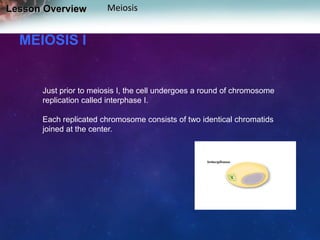
Just prior to meiosis I, the cell undergoes a round of chromosome
replication called interphase I.
Each replicated chromosome consists of two identical chromatids
joined at the center.
Lesson Overview

Meiosis

PROPHASE I

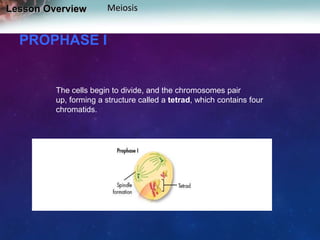
The cells begin to divide, and the chromosomes pair
up, forming a structure called a tetrad, which contains four
chromatids.
Lesson Overview

Meiosis

PROPHASE I
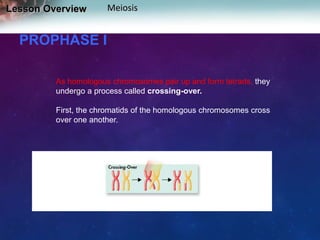
As homologous chromosomes pair up and form tetrads, they
undergo a process called crossing-over.
First, the chromatids of the homologous chromosomes cross
over one another.
Lesson Overview

Meiosis

PROPHASE I

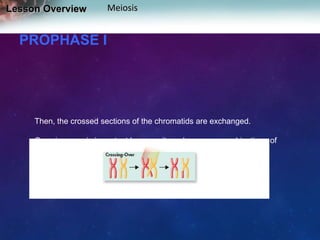
Then, the crossed sections of the chromatids are exchanged.
Crossing-over is important because it produces new combinations of
alleles in the cell.
Lesson Overview

Meiosis

METAPHASE I AND ANAPHASE I
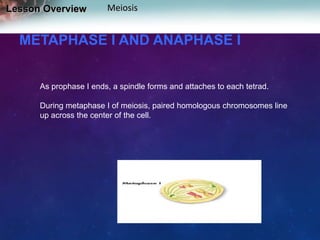
As prophase I ends, a spindle forms and attaches to each tetrad.

During metaphase I of meiosis, paired homologous chromosomes line
up across the center of the cell.
Lesson Overview

Meiosis

METAPHASE I AND ANAPHASE I

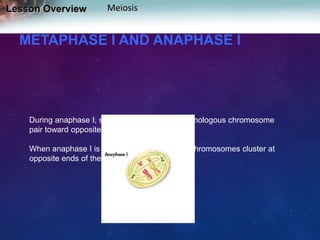
During anaphase I, spindle fibers pull each homologous chromosome
pair toward opposite ends of the cell.
When anaphase I is complete, the separated chromosomes cluster at
opposite ends of the cell.
Lesson Overview

Meiosis

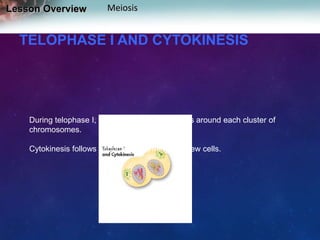
TELOPHASE I AND CYTOKINESIS

During telophase I, a nuclear membrane forms around each cluster of
chromosomes.
Cytokinesis follows telophase I, forming two new cells.
Lesson Overview

Meiosis

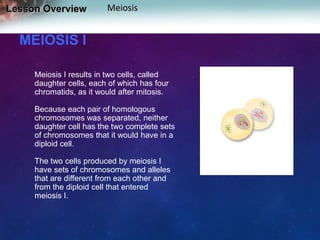
MEIOSIS I
Meiosis I results in two cells, called
daughter cells, each of which has four
chromatids, as it would after mitosis.

Because each pair of homologous
chromosomes was separated, neither
daughter cell has the two complete sets
of chromosomes that it would have in a
diploid cell.
The two cells produced by meiosis I
have sets of chromosomes and alleles
that are different from each other and
from the diploid cell that entered
meiosis I.
Lesson Overview

Meiosis

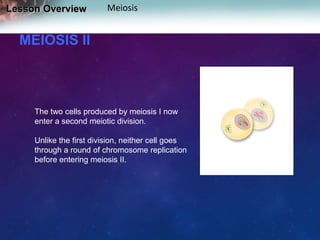
MEIOSIS II

The two cells produced by meiosis I now
enter a second meiotic division.
Unlike the first division, neither cell goes
through a round of chromosome replication
before entering meiosis II.
Lesson Overview

Meiosis

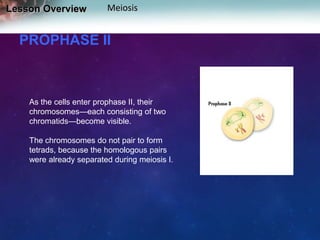
PROPHASE II

As the cells enter prophase II, their
chromosomes—each consisting of two
chromatids—become visible.
The chromosomes do not pair to form
tetrads, because the homologous pairs
were already separated during meiosis I.
Lesson Overview

Meiosis

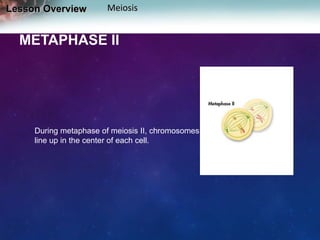
METAPHASE II

During metaphase of meiosis II, chromosomes
line up in the center of each cell.
Lesson Overview

Meiosis

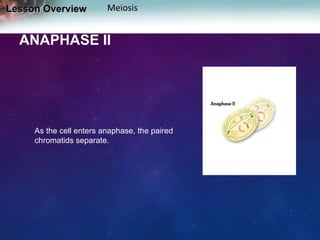
ANAPHASE II

As the cell enters anaphase, the paired
chromatids separate.
Lesson Overview

Meiosis

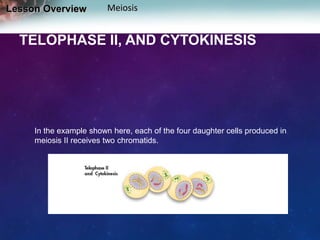
TELOPHASE II, AND CYTOKINESIS

In the example shown here, each of the four daughter cells produced in
meiosis II receives two chromatids.
Lesson Overview

Meiosis

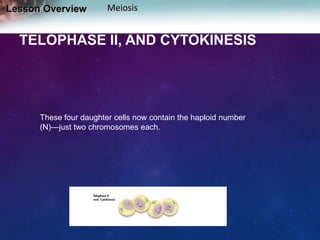
TELOPHASE II, AND CYTOKINESIS

These four daughter cells now contain the haploid number
(N)—just two chromosomes each.
Lesson Overview

Meiosis

GAMETES TO ZYGOTES

The haploid cells produced by meiosis II are gametes.
In male animals, these gametes are called sperm. In some plants, pollen
grains contain haploid sperm cells.
In female animals, generally only one of the cells produced by meiosis is
involved in reproduction. The female gamete is called an egg in animals
and an egg cell in some plants.
Lesson Overview

Meiosis

GAMETES TO ZYGOTES

Fertilization—the fusion of male and female gametes—generates new
combinations of alleles in a zygote.
The zygote undergoes cell division by mitosis and eventually forms a new
organism.
Lesson Overview

Meiosis

COMPARING MEIOSIS AND MITOSIS

How is meiosis different from mitosis?
Mitosis results in the production of two genetically identical diploid
cells, whereas meiosis produces four genetically different haploid cells.
Lesson Overview

Meiosis

COMPARING MEIOSIS AND MITOSIS

Mitosis is a form of asexual reproduction, whereas meiosis is an early step
in sexual reproduction.
There are three other ways in which these two processes differ.
Lesson Overview

Meiosis

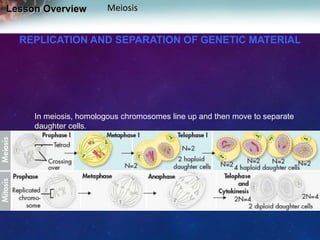
REPLICATION AND SEPARATION OF GENETIC MATERIAL

In meiosis, homologous chromosomes line up and then move to separate
daughter cells.
As a result, the two alleles for each gene segregate from each other and
end up in different cells.
Lesson Overview

Meiosis

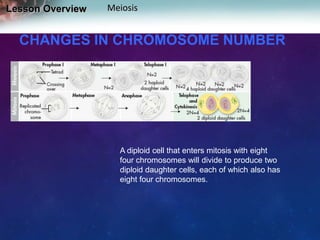
CHANGES IN CHROMOSOME NUMBER

A diploid cell that enters mitosis with eight
four chromosomes will divide to produce two
diploid daughter cells, each of which also has
eight four chromosomes.
Lesson Overview

Meiosis

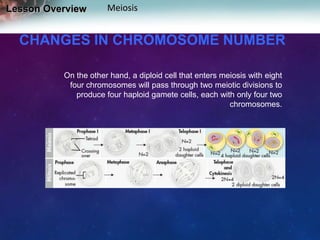
CHANGES IN CHROMOSOME NUMBER
On the other hand, a diploid cell that enters meiosis with eight
four chromosomes will pass through two meiotic divisions to
produce four haploid gamete cells, each with only four two
chromosomes.
Lesson Overview

Meiosis

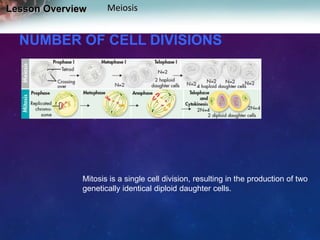
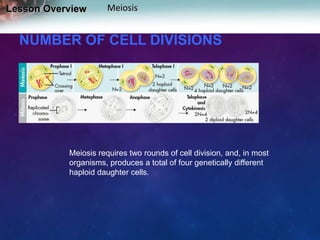
NUMBER OF CELL DIVISIONS

Mitosis is a single cell division, resulting in the production of two
genetically identical diploid daughter cells.
Lesson Overview

Meiosis

NUMBER OF CELL DIVISIONS

Meiosis requires two rounds of cell division, and, in most
organisms, produces a total of four genetically different
haploid daughter cells.
Lesson Overview

Meiosis

REFERENCE LIST
Ppt1 http://www.slideshare.net/rozeka01/biology-unit-4-cell-division-meiosis-notes?qid=8f94cc0f364d-4de2-9488-e100ffbd7aac&v=qf1&b=&from_search=10
Ppt2http://www.slideshare.net/SSpencer53/b10vrv4114
Ppt3http://www.slideshare.net/tamarad423/biology-102
Ppt4http://www.slideshare.net/CWood01/meiosis-presentation-830898?qid=cd7bc90e-55d9-4d43947b-3e3f0d98bc0b&v=default&b=&from_search=35
Ppt5http://www.slideshare.net/ABenagh/ch13-meiosis-14216907?qid=0c7e4396-45c7-4984-967a03ff9b5840d8&v=qf1&b=&from_search=32pp5
ppt6http://www.slideshare.net/nyiko5791/savedfiles?s_title=ch13-meiosis14216907&user_login=ABenagh
Ppt7http://www.slideshare.net/nyiko5791/savedfiles?s_title=biologameiosis&user_login=gunthergretchen

meiosis powerpoint presentation

  • 1.
    CELL DIVISION INTHE FORM OF MEIOSIS BY TINYIKO DLAMINI MEIOSIS
  • 2.
  • 3.
    Lesson Overview Meiosis BACKGROUND As geneticistsin the early 1900s applied Mendel’s laws, they wondered where genes might be located. They expected genes to be carried on structures inside the cell, but which structures? What cellular processes could account for segregation and independent assortment, as Mendel had described?
  • 4.
    CONTENT OF MEIOSIS Meiosis- a form of nuclear division in which the chromosome number is halved from the diploid number (2n) to the haploid number (n).  involves interphase  followed by two cycle of cell division, known as meiosis I and meiosis II (first & second meiotic division).  gives rise to four haploid cells.
  • 5.
    Importance term sin meiosis: a) Chromatid - prior to meiosis 1,DNA replication occurs and each chromosomes has two sister chromatids. - After crossing over occurs,sister chromatid of a chromosome are not longer identical - the chromosomes in the four daughter cells of meiosis are actually chromatids from the original parent cell. b) Synapsis - during meiosis 1,homologous chromosomes pair,come together and line up in synapsis
  • 6.
  • 7.
    Lesson Overview Meiosis PHASES OFMEIOSIS What events occur during each phase of meiosis? What events occur during each phase of meiosis? In prophase I of meiosis, each replicated chromosome pairs with its corresponding homologous chromosome. During metaphase I of meiosis, paired homologous chromosomes line up across the center of the cell.
  • 8.
  • 9.
    Lesson Overview Meiosis PHASES OFMEIOSIS What events occur during each phase of meiosis? In prophase I of meiosis, each replicated chromosome pairs with its corresponding homologous chromosome. During metaphase I of meiosis, paired homologous chromosomes line up across the center of the cell.
  • 10.
    Lesson Overview Meiosis PHASES OFMEIOSIS What events occur during each phase of meiosis? During anaphase I, spindle fibers pull each homologous chromosome pair toward opposite ends of the cell. In telophase I, a nuclear membrane forms around each cluster of chromosomes. Cytokinesis follows telophase I, forming two new cell s.
  • 11.
    Lesson Overview Meiosis DIPLOID CELLS Abody cell in an adult fruit fly has eight chromosomes, as shown in the figure. Four of the chromosomes come from its male parent, and four come from its female parent. These two sets of chromosomes are homologous, meaning that each of the four chromosomes from the male parent has a corresponding chromosome from the female parent.
  • 12.
    Lesson Overview Meiosis DIPLOID CELLS Acell that contains both sets of homologous chromosomes is diploid, meaning “two sets.” The diploid number of chromosomes is sometimes represented by the symbol 2N. For the fruit fly, the diploid number is 8, which can be written as 2N = 8, where N represents twice the number of chromosomes in a sperm or egg cell.
  • 13.
    Lesson Overview Meiosis HAPLOID CELLS Somecells contain only a single set of chromosomes, and therefore a single set of genes. Such cells are haploid, meaning “one set.” The gametes of sexually reproducing organisms are haploid. For fruit fly gametes, the haploid number is 4, which can be written as N = 4.
  • 14.
    Lesson Overview Meiosis CHROMOSOME NUMBER Chromosomes—thosestrands of DNA and protein inside nucleus—are the carriers of genes. the cell The genes are located in specific positions on chromosomes.
  • 15.
    Lesson Overview Meiosis CHROMOSOME NUMBER Howmany sets of genes do multicellular organisms inherit? The diploid cells of most adult organisms contain two complete sets of inherited chromosomes and two complete sets of genes.
  • 16.
    Lesson Overview Meiosis PHASES OFMEIOSIS What events occur during each phase of meiosis? As the cells enter prophase II, their chromosomes—each consisting of two chromatids—become visible. The final four phases of meiosis II are similar to those in meiosis I. However, the result is four haploid daughter cells.
  • 17.
    Lesson Overview Meiosis PHASES OFMEIOSIS Meiosis is a process in which the number of chromosomes per cell is cut in half through the separation of homologous chromosomes in a diploid cell. Meiosis usually involves two distinct divisions, called meiosis I and meiosis II. By the end of meiosis II, the diploid cell becomes four haploid cells.
  • 18.
    Lesson Overview Meiosis MEIOSIS I Justprior to meiosis I, the cell undergoes a round of chromosome replication called interphase I. Each replicated chromosome consists of two identical chromatids joined at the center.
  • 19.
    Lesson Overview Meiosis PROPHASE I Thecells begin to divide, and the chromosomes pair up, forming a structure called a tetrad, which contains four chromatids.
  • 20.
    Lesson Overview Meiosis PROPHASE I Ashomologous chromosomes pair up and form tetrads, they undergo a process called crossing-over. First, the chromatids of the homologous chromosomes cross over one another.
  • 21.
    Lesson Overview Meiosis PROPHASE I Then,the crossed sections of the chromatids are exchanged. Crossing-over is important because it produces new combinations of alleles in the cell.
  • 22.
    Lesson Overview Meiosis METAPHASE IAND ANAPHASE I As prophase I ends, a spindle forms and attaches to each tetrad. During metaphase I of meiosis, paired homologous chromosomes line up across the center of the cell.
  • 23.
    Lesson Overview Meiosis METAPHASE IAND ANAPHASE I During anaphase I, spindle fibers pull each homologous chromosome pair toward opposite ends of the cell. When anaphase I is complete, the separated chromosomes cluster at opposite ends of the cell.
  • 24.
    Lesson Overview Meiosis TELOPHASE IAND CYTOKINESIS During telophase I, a nuclear membrane forms around each cluster of chromosomes. Cytokinesis follows telophase I, forming two new cells.
  • 25.
    Lesson Overview Meiosis MEIOSIS I MeiosisI results in two cells, called daughter cells, each of which has four chromatids, as it would after mitosis. Because each pair of homologous chromosomes was separated, neither daughter cell has the two complete sets of chromosomes that it would have in a diploid cell. The two cells produced by meiosis I have sets of chromosomes and alleles that are different from each other and from the diploid cell that entered meiosis I.
  • 26.
    Lesson Overview Meiosis MEIOSIS II Thetwo cells produced by meiosis I now enter a second meiotic division. Unlike the first division, neither cell goes through a round of chromosome replication before entering meiosis II.
  • 27.
    Lesson Overview Meiosis PROPHASE II Asthe cells enter prophase II, their chromosomes—each consisting of two chromatids—become visible. The chromosomes do not pair to form tetrads, because the homologous pairs were already separated during meiosis I.
  • 28.
    Lesson Overview Meiosis METAPHASE II Duringmetaphase of meiosis II, chromosomes line up in the center of each cell.
  • 29.
    Lesson Overview Meiosis ANAPHASE II Asthe cell enters anaphase, the paired chromatids separate.
  • 30.
    Lesson Overview Meiosis TELOPHASE II,AND CYTOKINESIS In the example shown here, each of the four daughter cells produced in meiosis II receives two chromatids.
  • 31.
    Lesson Overview Meiosis TELOPHASE II,AND CYTOKINESIS These four daughter cells now contain the haploid number (N)—just two chromosomes each.
  • 32.
    Lesson Overview Meiosis GAMETES TOZYGOTES The haploid cells produced by meiosis II are gametes. In male animals, these gametes are called sperm. In some plants, pollen grains contain haploid sperm cells. In female animals, generally only one of the cells produced by meiosis is involved in reproduction. The female gamete is called an egg in animals and an egg cell in some plants.
  • 33.
    Lesson Overview Meiosis GAMETES TOZYGOTES Fertilization—the fusion of male and female gametes—generates new combinations of alleles in a zygote. The zygote undergoes cell division by mitosis and eventually forms a new organism.
  • 34.
    Lesson Overview Meiosis COMPARING MEIOSISAND MITOSIS How is meiosis different from mitosis? Mitosis results in the production of two genetically identical diploid cells, whereas meiosis produces four genetically different haploid cells.
  • 35.
    Lesson Overview Meiosis COMPARING MEIOSISAND MITOSIS Mitosis is a form of asexual reproduction, whereas meiosis is an early step in sexual reproduction. There are three other ways in which these two processes differ.
  • 36.
    Lesson Overview Meiosis REPLICATION ANDSEPARATION OF GENETIC MATERIAL In meiosis, homologous chromosomes line up and then move to separate daughter cells. As a result, the two alleles for each gene segregate from each other and end up in different cells.
  • 37.
    Lesson Overview Meiosis CHANGES INCHROMOSOME NUMBER A diploid cell that enters mitosis with eight four chromosomes will divide to produce two diploid daughter cells, each of which also has eight four chromosomes.
  • 38.
    Lesson Overview Meiosis CHANGES INCHROMOSOME NUMBER On the other hand, a diploid cell that enters meiosis with eight four chromosomes will pass through two meiotic divisions to produce four haploid gamete cells, each with only four two chromosomes.
  • 39.
    Lesson Overview Meiosis NUMBER OFCELL DIVISIONS Mitosis is a single cell division, resulting in the production of two genetically identical diploid daughter cells.
  • 40.
    Lesson Overview Meiosis NUMBER OFCELL DIVISIONS Meiosis requires two rounds of cell division, and, in most organisms, produces a total of four genetically different haploid daughter cells.
  • 41.
    Lesson Overview Meiosis REFERENCE LIST Ppt1http://www.slideshare.net/rozeka01/biology-unit-4-cell-division-meiosis-notes?qid=8f94cc0f364d-4de2-9488-e100ffbd7aac&v=qf1&b=&from_search=10 Ppt2http://www.slideshare.net/SSpencer53/b10vrv4114 Ppt3http://www.slideshare.net/tamarad423/biology-102 Ppt4http://www.slideshare.net/CWood01/meiosis-presentation-830898?qid=cd7bc90e-55d9-4d43947b-3e3f0d98bc0b&v=default&b=&from_search=35 Ppt5http://www.slideshare.net/ABenagh/ch13-meiosis-14216907?qid=0c7e4396-45c7-4984-967a03ff9b5840d8&v=qf1&b=&from_search=32pp5 ppt6http://www.slideshare.net/nyiko5791/savedfiles?s_title=ch13-meiosis14216907&user_login=ABenagh Ppt7http://www.slideshare.net/nyiko5791/savedfiles?s_title=biologameiosis&user_login=gunthergretchen