Lecture 13:
   Minimum Spanning Trees
         Steven Skiena

Department of Computer Science
 State University of New York
 Stony Brook, NY 11794–4400

http://www.cs.sunysb.edu/∼skiena
Problem of the Day
Your job is to arrange n rambunctious children in a straight
line, facing front. You are given a list of m statements of
the form “i hates j”. If i hates j, then you do not want put
i somewhere behind j, because then i is capable of throwing
something at j.
1. Give an algorithm that orders the line, (or says that it is
   not possible) in O(m + n) time.
2. Suppose instead you want to arrange the children in
   rows, such that if i hates j then i must be in a lower
   numbered row than j. Give an efficient algorithm to find
   the minimum number of rows needed, if it is possible.
Weighted Graph Algorithms
Beyond DFS/BFS exists an alternate universe of algorithms
for edge-weighted graphs.
Our adjancency list representation quietly supported these
graphs:
typedef struct {
      int y;
      int weight;
      struct edgenode *next;
} edgenode;
Minimum Spanning Trees
A tree is a connected graph with no cycles. A spanning tree is
a subgraph of G which has the same set of vertices of G and
is a tree.
A minimum spanning tree of a weighted graph G is the
spanning tree of G whose edges sum to minimum weight.
There can be more than one minimum spanning tree in a
graph → consider a graph with identical weight edges.
(c)
(a)   (b)
Why Minimum Spanning Trees?
The minimum spanning tree problem has a long history – the
first algorithm dates back at least to 1926!.
Minimum spanning tree is always taught in algorithm courses
since (1) it arises in many applications, (2) it is an important
example where greedy algorithms always give the optimal
answer, and (3) Clever data structures are necessary to make
it work.
In greedy algorithms, we make the decision of what next to
do by selecting the best local option from all available choices
– without regard to the global structure.
Applications of Minimum Spanning Trees
Minimum spanning trees are useful in constructing networks,
by describing the way to connect a set of sites using the
smallest total amount of wire.
Minimum spanning trees provide a reasonable way for
clustering points in space into natural groups.
What are natural clusters in the friendship graph?
Minimum Spanning Trees and Net Partitioning
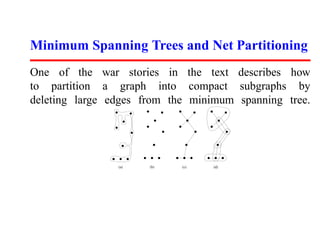
One of the war stories in the text describes how
to partition a graph into compact subgraphs by
deleting large edges from the minimum spanning tree.


                (a)   (b)   (c)   (d)
Minimum Spanning Trees and TSP
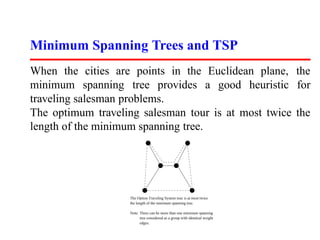
When the cities are points in the Euclidean plane, the
minimum spanning tree provides a good heuristic for
traveling salesman problems.
The optimum traveling salesman tour is at most twice the
length of the minimum spanning tree.


                   The Option Traveling System tour is at most twice
                   the length of the minimum spanning tree.

                   Note: There can be more than one minimum spanning
                         tree considered as a group with identical weight
                         edges.
Prim’s Algorithm
If G is connected, every vertex will appear in the minimum
spanning tree. If not, we can talk about a minimum spanning
forest.
Prim’s algorithm starts from one vertex and grows the rest of
the tree an edge at a time.
As a greedy algorithm, which edge should we pick? The
cheapest edge with which can grow the tree by one vertex
without creating a cycle.
Prim’s Algorithm (Pseudocode)
During execution each vertex v is either in the tree, fringe
(meaning there exists an edge from a tree vertex to v) or
unseen (meaning v is more than one edge away).
Prim-MST(G)
     Select an arbitrary vertex s to start the tree from.
     While (there are still non-tree vertices)
           Select the edge of minimum weight between a tree
           Add the selected edge and vertex to the tree Tprim .
This creates a spanning tree, since no cycle can be introduced,
but is it minimum?
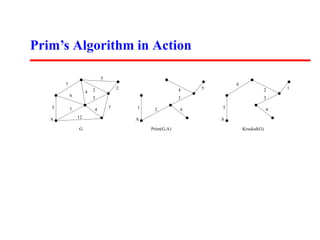
Prim’s Algorithm in Action

                            5
       7                                                            6
                        2           2                   4   5                        2   1
                    4
           9            3                               3                            3

   5       7            4       7       1    2          6       5                    4

   A           12                       A                       A

               G                            Prim(G,A)                   Kruskal(G)
Why is Prim Correct?
We use a proof by contradiction:
Suppose Prim’s algorithm does not always give the minimum
cost spanning tree on some graph.
If so, there is a graph on which it fails.
And if so, there must be a first edge (x, y) Prim adds such
that the partial tree V cannot be extended into a minimum
spanning tree.
x         y                   x          y


         s                         s
                                         v1

                                                    v2


                    (a)                           (b)


But if (x, y) is not in M ST (G), then there must be a path in
M ST (G) from x to y since the tree is connected. Let (v, w)
be the first edge on this path with one edge in V
Replacing it with (x, y) we get a spanning tree. with smaller
weight, since W (v, w) > W (x, y). Thus you did not have the
MST!!
Prim’s Algorithm is correct!
Thus we cannot go wrong with the greedy strategy the way
we could with the traveling salesman problem.
How Fast is Prim’s Algorithm?
That depends on what data structures are used. In the simplest
implementation, we can simply mark each vertex as tree and
non-tree and search always from scratch:
Select an arbitrary vertex to start.
While (there are non-tree vertices)
      select minimum weight edge between tree and fringe
      add the selected edge and vertex to the tree
This can be done in O(nm) time, by doing a DFS or BFS to
loop through all edges, with a constant time test per edge, and
a total of n iterations.
Prim’s Implementation
To do it faster, we must identify fringe vertices and the
minimum cost edge associated with it fast.
prim(graph *g, int start)
{
     int i; (* counter *)
     edgenode *p; (* temporary pointer *)
     bool intree[MAXV]; (* is the vertex in the tree yet? *)
     int distance[MAXV]; (* distance vertex is from start *)
     int v; (* current vertex to process *)
     int w; (* candidate next vertex *)
     int weight; (* edge weight *)
     int dist; (* best current distance from start *)

      for (i=1; i<=g− >nvertices; i++) {
             intree[i] = FALSE;
             distance[i] = MAXINT;
             parent[i] = -1;
      }

      distance[start] = 0;
v = start;

    while (intree[v] == FALSE) {
          intree[v] = TRUE;
          p = g− >edges[v];
          while (p ! = NULL) {
                 w = p− >y;
                 weight = p− >weight;
                 if ((distance[w] > weight) && (intree[w] == FALSE)) {
                        distance[w] = weight;
                        parent[w] = v;
                 }
                 p = p− >next;
          }

          v = 1;
          dist = MAXINT;
          for (i=1; i<= g− >nvertices; i++)
                 if ((intree[i] == FALSE) && (dist > distance[i])) {
                         dist = distance[i];
                         v = i;
                 }
    }
}
Prim’s Analysis
Finding the minimum weight fringe-edge takes O(n) time –
just bump through fringe list.
After adding a vertex to the tree, running through its
adjacency list to update the cost of adding fringe vertices
(there may be a cheaper way through the new vertex) can be
done in O(n) time.
Total time is O(n2 ).
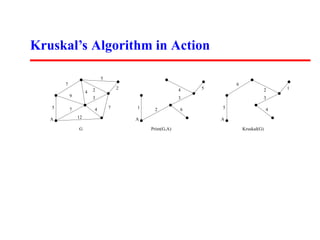
Kruskal’s Algorithm
Since an easy lower bound argument shows that every edge
must be looked at to find the minimum spanning tree, and the
number of edges m = O(n2 ), Prim’s algorithm is optimal in
the worst case. Is that all she wrote?
The complexity of Prim’s algorithm is independent of the
number of edges. Can we do better with sparse graphs? Yes!
Kruskal’s algorithm is also greedy. It repeatedly adds the
smallest edge to the spanning tree that does not create a cycle.
Kruskal’s Algorithm in Action

                            5
       7                                                            6
                        2           2                   4   5                        2   1
                    4
           9            3                               3                            3

   5       7            4       7       1    2          6       5                    4

   A           12                       A                       A

               G                            Prim(G,A)                   Kruskal(G)
Why is Kruskal’s algorithm correct?
Again, we use proof by contradiction.
Suppose Kruskal’s algorithm does not always give the
minimum cost spanning tree on some graph.
If so, there is a graph on which it fails.
And if so, there must be a first edge (x, y) Kruskal adds such
that the set of edges cannot be extended into a minimum
spanning tree.
When we added (x, y) there previously was no path between
x and y, or it would have created a cycle
Thus if we add (x, y) to the optimal tree it must create a cycle.
At least one edge in this cycle must have been added after
(x, y), so it must have a heavier weight.
Deleting this heavy edge leave a better MST than the optimal
tree? A contradiction!
How fast is Kruskal’s algorithm?
What is the simplest implementation?
 • Sort the m edges in O(m lg m) time.
 • For each edge in order, test whether it creates a cycle the
   forest we have thus far built – if so discard, else add to
   forest. With a BFS/DFS, this can be done in O(n) time
   (since the tree has at most n edges).
The total time is O(mn), but can we do better?
Fast Component Tests Give Fast MST
Kruskal’s algorithm builds up connected components. Any
edge where both vertices are in the same connected compo-
nent create a cycle. Thus if we can maintain which vertices
are in which component fast, we do not have test for cycles!
 • Same component(v1, v2) – Do vertices v1 and v2 lie in the
   same connected component of the current graph?
 • Merge components(C1 , C2 ) – Merge the given pair of
   connected components into one component.
Fast Kruskal Implementation

Put the edges in a heap
count = 0
while (count < n − 1) do
      get next edge (v, w)
      if (component (v) = component(w))
            add to T
            component (v)=component(w)
If we can test components in O(log n), we can find the MST
in O(m log m)!
Question: Is O(m log n) better than O(m log m)?
Union-Find Programs
We need a data structure for maintaining sets which can test
if two elements are in the same and merge two sets together.
These can be implemented by union and find operations,
where
 • Find(i) – Return the label of the root of tree containing
   element i, by walking up the parent pointers until there is
   no where to go.
 • Union(i,j) – Link the root of one of the trees (say
   containing i) to the root of the tree containing the other
   (say j) so f ind(i) now equals f ind(j).
Same Component Test

Is si ≡ sj
       t = Find(si)
       u = Find(sj )
       Return (Is t = u?)
Merge Components Operation

Make si ≡ sj
     t = d(si)
     u = d(sj )
     Union(t, u)
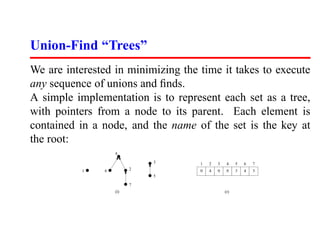
Union-Find “Trees”
We are interested in minimizing the time it takes to execute
any sequence of unions and finds.
A simple implementation is to represent each set as a tree,
with pointers from a node to its parent. Each element is
contained in a node, and the name of the set is the key at
the root:
                   4

                             3      1   2   3    4    5   6   7
           1   6         2          0   4   0    0    3   4   3
                             5

                         7
                   (l)                          (r)
Worst Case for Union Find
In the worst case, these structures can be very unbalanced:
For i = 1 to n/2 do
      UNION(i,i+1)
For i = 1 to n/2 do
      FIND(1)
Who’s The Daddy?
We want the limit the height of our trees which are effected
by union’s.
When we union, we can make the tree with fewer nodes the
child.
                                       UNION (s, t)
                FIND(S)


                          s                           S


                                   t


Since the number of nodes is related to the height, the height
of the final tree will increase only if both subtrees are of equal
height!
If U nion(t, v) attaches the root of v as a subtree of t iff the
number of nodes in t is greater than or equal to the number in
v, after any sequence of unions, any tree with h/4 nodes has
height at most lg h .
Proof
By induction on the number of nodes k, k = 1 has height 0.
Let di be the height of the tree ti

                      d1

                              T1                         T2        d2

                                                        k2 nodes
                           k1 nodes


                                   k = k1+ k2 nodes

                                      d is the height


If (d1 > d2) then d = d1 ≤ log k1 ≤ lg(k1 + k2) = log k
If (d1 ≤ d2), then k1 ≥ k2.
d = d2 + 1 ≤ log k2 + 1 = log 2k2 ≤ log(k1 + k2) =
log k
Can we do better?
We can do unions and finds in O(log n), good enough for
Kruskal’s algorithm. But can we do better?
The ideal Union-Find tree has depth 1:


                                 ... ...

                         N-1 leaves


On a find, if we are going down a path anyway, why not
change the pointers to point to the root?
1
                                         10                                       1
                    2                              14

            3                                      13   FIND(4)                                      14
                            7       11                            2   4       3       7   10         13
                                              12
                                                                                                    12
                                                                          5       6   8    9   11
        4       5       6       8   9


This path compression will let us do better than O(n log n)
for n union-finds.
O(n)? Not quite . . . Difficult analysis shows that it takes
O(nα(n)) time, where α(n) is the inverse Ackerman function
and α(number of atoms in the universe)= 5.

Skiena algorithm 2007 lecture13 minimum spanning trees

  • 1.
    Lecture 13: Minimum Spanning Trees Steven Skiena Department of Computer Science State University of New York Stony Brook, NY 11794–4400 http://www.cs.sunysb.edu/∼skiena
  • 2.
    Problem of theDay Your job is to arrange n rambunctious children in a straight line, facing front. You are given a list of m statements of the form “i hates j”. If i hates j, then you do not want put i somewhere behind j, because then i is capable of throwing something at j. 1. Give an algorithm that orders the line, (or says that it is not possible) in O(m + n) time.
  • 3.
    2. Suppose insteadyou want to arrange the children in rows, such that if i hates j then i must be in a lower numbered row than j. Give an efficient algorithm to find the minimum number of rows needed, if it is possible.
  • 4.
    Weighted Graph Algorithms BeyondDFS/BFS exists an alternate universe of algorithms for edge-weighted graphs. Our adjancency list representation quietly supported these graphs: typedef struct { int y; int weight; struct edgenode *next; } edgenode;
  • 5.
    Minimum Spanning Trees Atree is a connected graph with no cycles. A spanning tree is a subgraph of G which has the same set of vertices of G and is a tree. A minimum spanning tree of a weighted graph G is the spanning tree of G whose edges sum to minimum weight. There can be more than one minimum spanning tree in a graph → consider a graph with identical weight edges.
  • 6.
  • 7.
    Why Minimum SpanningTrees? The minimum spanning tree problem has a long history – the first algorithm dates back at least to 1926!. Minimum spanning tree is always taught in algorithm courses since (1) it arises in many applications, (2) it is an important example where greedy algorithms always give the optimal answer, and (3) Clever data structures are necessary to make it work. In greedy algorithms, we make the decision of what next to do by selecting the best local option from all available choices – without regard to the global structure.
  • 8.
    Applications of MinimumSpanning Trees Minimum spanning trees are useful in constructing networks, by describing the way to connect a set of sites using the smallest total amount of wire. Minimum spanning trees provide a reasonable way for clustering points in space into natural groups. What are natural clusters in the friendship graph?
  • 9.
    Minimum Spanning Treesand Net Partitioning One of the war stories in the text describes how to partition a graph into compact subgraphs by deleting large edges from the minimum spanning tree. (a) (b) (c) (d)
  • 10.
    Minimum Spanning Treesand TSP When the cities are points in the Euclidean plane, the minimum spanning tree provides a good heuristic for traveling salesman problems. The optimum traveling salesman tour is at most twice the length of the minimum spanning tree. The Option Traveling System tour is at most twice the length of the minimum spanning tree. Note: There can be more than one minimum spanning tree considered as a group with identical weight edges.
  • 11.
    Prim’s Algorithm If Gis connected, every vertex will appear in the minimum spanning tree. If not, we can talk about a minimum spanning forest. Prim’s algorithm starts from one vertex and grows the rest of the tree an edge at a time. As a greedy algorithm, which edge should we pick? The cheapest edge with which can grow the tree by one vertex without creating a cycle.
  • 12.
    Prim’s Algorithm (Pseudocode) Duringexecution each vertex v is either in the tree, fringe (meaning there exists an edge from a tree vertex to v) or unseen (meaning v is more than one edge away). Prim-MST(G) Select an arbitrary vertex s to start the tree from. While (there are still non-tree vertices) Select the edge of minimum weight between a tree Add the selected edge and vertex to the tree Tprim . This creates a spanning tree, since no cycle can be introduced, but is it minimum?
  • 13.
    Prim’s Algorithm inAction 5 7 6 2 2 4 5 2 1 4 9 3 3 3 5 7 4 7 1 2 6 5 4 A 12 A A G Prim(G,A) Kruskal(G)
  • 14.
    Why is PrimCorrect? We use a proof by contradiction: Suppose Prim’s algorithm does not always give the minimum cost spanning tree on some graph. If so, there is a graph on which it fails. And if so, there must be a first edge (x, y) Prim adds such that the partial tree V cannot be extended into a minimum spanning tree.
  • 15.
    x y x y s s v1 v2 (a) (b) But if (x, y) is not in M ST (G), then there must be a path in M ST (G) from x to y since the tree is connected. Let (v, w) be the first edge on this path with one edge in V Replacing it with (x, y) we get a spanning tree. with smaller weight, since W (v, w) > W (x, y). Thus you did not have the MST!!
  • 16.
    Prim’s Algorithm iscorrect! Thus we cannot go wrong with the greedy strategy the way we could with the traveling salesman problem.
  • 17.
    How Fast isPrim’s Algorithm? That depends on what data structures are used. In the simplest implementation, we can simply mark each vertex as tree and non-tree and search always from scratch: Select an arbitrary vertex to start. While (there are non-tree vertices) select minimum weight edge between tree and fringe add the selected edge and vertex to the tree This can be done in O(nm) time, by doing a DFS or BFS to loop through all edges, with a constant time test per edge, and a total of n iterations.
  • 18.
    Prim’s Implementation To doit faster, we must identify fringe vertices and the minimum cost edge associated with it fast. prim(graph *g, int start) { int i; (* counter *) edgenode *p; (* temporary pointer *) bool intree[MAXV]; (* is the vertex in the tree yet? *) int distance[MAXV]; (* distance vertex is from start *) int v; (* current vertex to process *) int w; (* candidate next vertex *) int weight; (* edge weight *) int dist; (* best current distance from start *) for (i=1; i<=g− >nvertices; i++) { intree[i] = FALSE; distance[i] = MAXINT; parent[i] = -1; } distance[start] = 0;
  • 19.
    v = start; while (intree[v] == FALSE) { intree[v] = TRUE; p = g− >edges[v]; while (p ! = NULL) { w = p− >y; weight = p− >weight; if ((distance[w] > weight) && (intree[w] == FALSE)) { distance[w] = weight; parent[w] = v; } p = p− >next; } v = 1; dist = MAXINT; for (i=1; i<= g− >nvertices; i++) if ((intree[i] == FALSE) && (dist > distance[i])) { dist = distance[i]; v = i; } } }
  • 20.
    Prim’s Analysis Finding theminimum weight fringe-edge takes O(n) time – just bump through fringe list. After adding a vertex to the tree, running through its adjacency list to update the cost of adding fringe vertices (there may be a cheaper way through the new vertex) can be done in O(n) time. Total time is O(n2 ).
  • 21.
    Kruskal’s Algorithm Since aneasy lower bound argument shows that every edge must be looked at to find the minimum spanning tree, and the number of edges m = O(n2 ), Prim’s algorithm is optimal in the worst case. Is that all she wrote? The complexity of Prim’s algorithm is independent of the number of edges. Can we do better with sparse graphs? Yes! Kruskal’s algorithm is also greedy. It repeatedly adds the smallest edge to the spanning tree that does not create a cycle.
  • 22.
    Kruskal’s Algorithm inAction 5 7 6 2 2 4 5 2 1 4 9 3 3 3 5 7 4 7 1 2 6 5 4 A 12 A A G Prim(G,A) Kruskal(G)
  • 23.
    Why is Kruskal’salgorithm correct? Again, we use proof by contradiction. Suppose Kruskal’s algorithm does not always give the minimum cost spanning tree on some graph. If so, there is a graph on which it fails. And if so, there must be a first edge (x, y) Kruskal adds such that the set of edges cannot be extended into a minimum spanning tree. When we added (x, y) there previously was no path between x and y, or it would have created a cycle Thus if we add (x, y) to the optimal tree it must create a cycle. At least one edge in this cycle must have been added after (x, y), so it must have a heavier weight.
  • 24.
    Deleting this heavyedge leave a better MST than the optimal tree? A contradiction!
  • 25.
    How fast isKruskal’s algorithm? What is the simplest implementation? • Sort the m edges in O(m lg m) time. • For each edge in order, test whether it creates a cycle the forest we have thus far built – if so discard, else add to forest. With a BFS/DFS, this can be done in O(n) time (since the tree has at most n edges). The total time is O(mn), but can we do better?
  • 26.
    Fast Component TestsGive Fast MST Kruskal’s algorithm builds up connected components. Any edge where both vertices are in the same connected compo- nent create a cycle. Thus if we can maintain which vertices are in which component fast, we do not have test for cycles! • Same component(v1, v2) – Do vertices v1 and v2 lie in the same connected component of the current graph? • Merge components(C1 , C2 ) – Merge the given pair of connected components into one component.
  • 27.
    Fast Kruskal Implementation Putthe edges in a heap count = 0 while (count < n − 1) do get next edge (v, w) if (component (v) = component(w)) add to T component (v)=component(w) If we can test components in O(log n), we can find the MST in O(m log m)! Question: Is O(m log n) better than O(m log m)?
  • 28.
    Union-Find Programs We needa data structure for maintaining sets which can test if two elements are in the same and merge two sets together. These can be implemented by union and find operations, where • Find(i) – Return the label of the root of tree containing element i, by walking up the parent pointers until there is no where to go. • Union(i,j) – Link the root of one of the trees (say containing i) to the root of the tree containing the other (say j) so f ind(i) now equals f ind(j).
  • 29.
    Same Component Test Issi ≡ sj t = Find(si) u = Find(sj ) Return (Is t = u?)
  • 30.
    Merge Components Operation Makesi ≡ sj t = d(si) u = d(sj ) Union(t, u)
  • 31.
    Union-Find “Trees” We areinterested in minimizing the time it takes to execute any sequence of unions and finds. A simple implementation is to represent each set as a tree, with pointers from a node to its parent. Each element is contained in a node, and the name of the set is the key at the root: 4 3 1 2 3 4 5 6 7 1 6 2 0 4 0 0 3 4 3 5 7 (l) (r)
  • 32.
    Worst Case forUnion Find In the worst case, these structures can be very unbalanced: For i = 1 to n/2 do UNION(i,i+1) For i = 1 to n/2 do FIND(1)
  • 33.
    Who’s The Daddy? Wewant the limit the height of our trees which are effected by union’s. When we union, we can make the tree with fewer nodes the child. UNION (s, t) FIND(S) s S t Since the number of nodes is related to the height, the height of the final tree will increase only if both subtrees are of equal
  • 34.
    height! If U nion(t,v) attaches the root of v as a subtree of t iff the number of nodes in t is greater than or equal to the number in v, after any sequence of unions, any tree with h/4 nodes has height at most lg h .
  • 35.
    Proof By induction onthe number of nodes k, k = 1 has height 0. Let di be the height of the tree ti d1 T1 T2 d2 k2 nodes k1 nodes k = k1+ k2 nodes d is the height If (d1 > d2) then d = d1 ≤ log k1 ≤ lg(k1 + k2) = log k If (d1 ≤ d2), then k1 ≥ k2. d = d2 + 1 ≤ log k2 + 1 = log 2k2 ≤ log(k1 + k2) = log k
  • 36.
    Can we dobetter? We can do unions and finds in O(log n), good enough for Kruskal’s algorithm. But can we do better? The ideal Union-Find tree has depth 1: ... ... N-1 leaves On a find, if we are going down a path anyway, why not change the pointers to point to the root?
  • 37.
    1 10 1 2 14 3 13 FIND(4) 14 7 11 2 4 3 7 10 13 12 12 5 6 8 9 11 4 5 6 8 9 This path compression will let us do better than O(n log n) for n union-finds. O(n)? Not quite . . . Difficult analysis shows that it takes O(nα(n)) time, where α(n) is the inverse Ackerman function and α(number of atoms in the universe)= 5.