Springfield Public Schools
                Springfield, USA


           Evaluation Report
       First Street Elementary School
2009-2010 School Improvement Plan - Goal 3
                      May 4, 2010


                  Report prepared by
                   Susan Ferdon
      Faculty Member, First Street Elementary School
Graduate Student, Master of Educational Technology Program
                   Boise State University


                  Report Submitted to
 First Street School Improvement Planning Team
Table of Contents

    Acknowledgements . . . . . . . . . . . . . . . . . . . . . . . . . . . . . . . . . . . . . page i

    Introduction . . . . . . . . . . . . . . . . . . . . . . . . . . . . . . . . . . . . . . . . . . .    page 1

    Program Description . . . . . . . . . . . . . . . . . . . . . . . . . . . . . . . . . . . .           page 2

    Evaluation Methods               ....................................                                 page 3
        Participants                                                                                      page 3
        Procedures                                                                                        page 3
        Data Sources                                                                                      page 4

    Results . . . . . . . . . . . . . . . . . . . . . . . . . . . . . . . . . . . . . . . . . . . . . .   page 4
       Objectives and Activities                                                                          page 4
       Teacher Feedback                                                                                   page 6
       Student Goals                                                                                      page 7
       Student Achievement                                                                                page 8
       Goal Attainment                                                                                    page 9

    Discussion . . . . . . . . . . . . . . . . . . . . . . . . . . . . . . . . . . . . . . . . . . .      page 9

    Appendices
       Appendix A              First Street 2009-2010 School Improvement                                  page 13
                               Plan, Goal 3
          Appendix B           First Street SIP Presentation to BOE, October                              page 17
                               2009 (excerpt)
          Appendix C           April 7th Report to SIP Team                                               page 19
          Appendix D           April 27th Report to SIP Sub-Committee                                     page 26
          Appendix E           Checklists and Revised Forms                                               page 30
          Appendix F           Sample Teacher Report                                                      page 38
          Appendix G           Invoice                                                                    Page 40
Acknowledgements

Evaluation is a task best completed with program developers, program staff, and the
evaluator working in harmony. My experiences as I worked with First Street’s SIP Team
could not have been more positive. Their input, assistance and support have been
invaluable. I would like to thank Janet Lange (principal) for permitting me to apply my
burgeoning evaluative skills to a program at First Street. I am grateful to be able to use
what I am learning in my graduate coursework on program evaluation in a manner that
can potentially benefit our school. I would also like to thank the SIP Team for their time,
effort, and contributions to this process. Additional meetings, communication and
planning with their grade level teams, assistance in gathering work samples, and
following-up with teammates as questions arose, are just a few of the things they have
done that have aided in the planning and evaluation processes. Thanks also go to the
office staff for assistance ordering and labeling work samples and copying documents
and reports to be distributed to SIP Team members and building staff. Finally, special
thanks go to my personal assistant, Kate. Her help with numerous tasks have allowed
me to make efficient use of my time as I worked on this project.


                                             I


Introduction

The program being evaluated is First Street’s School Improvement Plan, Goal 3, for
2009-2010 (Appendix A). Required by the Illinois State Board of Education (ISBE) for
schools in academic status, the submission of a School Improvement Plan is optional
but recommended, for schools that are not (http://www.isbe.net/sos/htmls/school.htm).
In Springfield schools, School Improvement Plans provide structure for continuous
improvement of instruction. SIP Goal 3 is an outgrowth of a 2008-2009 goal which
focused on improving teacher feedback and students’ ability to correctly interpret
teacher feedback. It was found that “while 88.6% of First Street students, including
kindergarten students, met the goal of correctly interpreting their teachers’ feedback on
a specific writing assignment, more instruction and practice is needed in order for
students to understand the link between feedback and subsequent learning and
improvement” (SIP Goal 3, p. 3).

For 2009-2010, the goal was expanded to include student-generated learning goals and
subsequent reflection on those goals. The objective for SIP Goal 3 is that “all students
will learn how to reflect after receiving specific and timely feedback from their teachers;
and all students will learn how to use these personal reflections to generate their own
specific learning goal(s) for their next assignment. When subsequent assignments are
assessed, it will be noted that students tied their improvement to their goal based on
prior feedback” (SIP Plan, p. 3).

The SIP Team identified Reader Response (RR) writing assignments, administered
three times during the year, as the data collection tool. Following each of the first two
iterations of the cycle, data were analyzed and recommendations made to the SIP
Team regarding improvements to this process. Though the primary focus of this
evaluation was ultimately narrowed to student goal attainment, a wider view of Goal 3
components is also presented.

Evaluation Timeline:

         March 8th      Evaluator meets with First Street principal to discuss the three
                        SIP goals and select one to focus on for this evaluation.
         March 11th     SIP sub-committee meets for preliminary planning.
         March 15th     Analysis of February work samples begins.
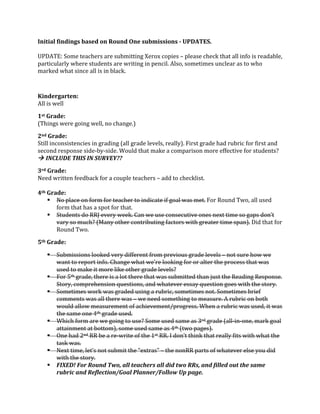
         April 7th      Presentation of initial findings/recommendations to SIP Team.
         April          SIP Team brings recommendations to grade level teams, new
                        work samples are submitted, and data are analyzed.
         April 27th     Presentation of findings and final recommendations to SIP
                        sub-committee.
         May 4th        Presentation of checklists and updated guidelines to faculty.


                                                                                           1


This evaluation and related reports serve several purposes: 1) To determine how
comprehensively SIP Goal 3 has been addressed thus far, 2) To document
recommendations made regarding administration of Goal 3 assessments, 3) To share
February and March Reader Response information and data, and 4) To provide detailed
program information which may be used by First Street’s incoming principal for fall 2010
reporting and goal-setting.


Program Description

The SIP Team selected Reader Response writing assignments, with work samples
submitted in February, March, and May, as a means of collecting data. The Team
developed a framework for the process that would be followed and established
guidelines for the generation of related documents. Grade level teams used that
information to create grade-specific forms used by teachers and students in grades K -
5 for the Feedback/Goal/Reflection cycle (Appendix E).

For each set of writing assignments, students read a story or article and wrote a
response to a prompt. Teachers provided feedback and used district-approved rubrics
to score responses. Student then reflected on feedback and identified a goal. Next,
students read a second story or article and, with their goal in mind, wrote a response to
another prompt. The teacher graded the second response and students reflected on the
achievement of their goal. While the process followed was the same for all grade levels,
procedures varied from one grade level to another due to the developmental nature of
reading and writing skills and the age-range (K-5) of the students who participated in
this program. Whereas kindergarten teachers provided verbal feedback and acted as
scribes for goal setting, students were expected to be increasingly independent in
successive grade levels and over time.

At the point that the evaluator entered the process, February work samples had been
collected. In initial meetings with the principal and SIP Team, three evaluation questions
were identified:

    1. What modifications can be made to clarify and standardize procedures and
       processes teachers and students will follow when completing the next two
       Reader Response writing assignments?
    2. What data can be extracted from Reader Response work samples/feedback in
       order to report on this goal?
    3. What additional information/data is needed and how can we collect it?


                                                                                        2


Evaluation Methods

Participants
It was initially expected that all students and classroom teachers would participate: 73 -
kindergarteners, 81 - 1st graders, 82 - 2nd graders, 104 - 3rd graders, 81 - 4th graders, 98
- 5th graders, and 23 teachers. It was found that student participation was not
compatible with the Read 180 program, a replacement program that coincides with
classroom Language Arts instruction.


     2009 Data         SCHOOL        DISTRICT      STATE
          LEP
    (Limited English    1.50%           0.70%          8%
       Proficient)

    Low Income          0.80%           0.30%      42.90%

      Parental
                        100%            100%       96.70%
    Involvement

    Attendance          96%            95.90%      93.70%
       Mobility         3.70%           1.90%      13.50%

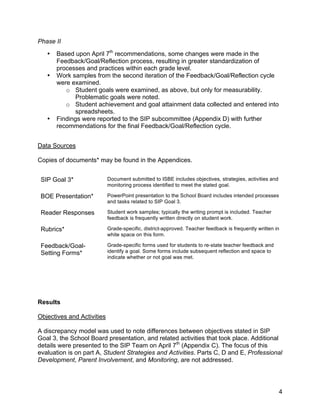
Table 1: First Street Educational Environment                      Figure 1: First Street Demographics
Source: Interactive Illinois Report Card


Source: Illinois Interactive Report Card - Profile


Procedures

Phase I
      •    A discrepancy model was used to identify potential gaps between stated
           objectives and current practice. SIP Goal 3 (Appendix A) and the fall 2009 Board
           of Education Presentation (Appendix B) were used to establish objectives and
           evidence was collected through observation and informal interviews.
      •    February work samples had already been submitted: initial writing assignment,
           teacher feedback, rubric scores, and information related to goal attainment.
               o Teacher feedback was examined and trends were noted.
               o Student goals were examined for quantity, measurability, and to determine
                  what feedback was used in the goal selection process.
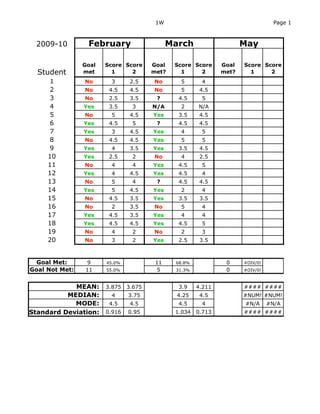
               o Student achievement was examined with individual student scores
                  entered into spreadsheets and mean, median, mode and standard
                  deviation calculated for each classroom of students.
               o Goal attainment was examined via student and teacher reporting and that
                  information was compared against rubric scores when possible.
      •    Preliminary findings were reported to the SIP Team on April 7th, along with
           recommendations for the next Feedback/Goal/Reflection cycle (Appendix C).


                                                                                                                     3


Phase II
      •   Based upon April 7th recommendations, some changes were made in the
          Feedback/Goal/Reflection process, resulting in greater standardization of
          processes and practices within each grade level.
      •   Work samples from the second iteration of the Feedback/Goal/Reflection cycle
          were examined.
             o Student goals were examined, as above, but only for measurability.
                Problematic goals were noted.
             o Student achievement and goal attainment data collected and entered into
                spreadsheets.
      •   Findings were reported to the SIP subcommittee (Appendix D) with further
          recommendations for the final Feedback/Goal/Reflection cycle.


Data Sources

Copies of documents* may be found in the Appendices.


    SIP Goal 3*             Document submitted to ISBE includes objectives, strategies, activities and
                            monitoring process identified to meet the stated goal.

    BOE Presentation*       PowerPoint presentation to the School Board includes intended processes
                            and tasks related to SIP Goal 3.

    Reader Responses        Student work samples; typically the writing prompt is included. Teacher
                            feedback is frequently written directly on student work.

    Rubrics*                Grade-specific, district-approved. Teacher feedback is frequently written in
                            white space on this form.

    Feedback/Goal-          Grade-specific forms used for students to re-state teacher feedback and
    Setting Forms*          identify a goal. Some forms include subsequent reflection and space to
                            indicate whether or not goal was met.


Results

Objectives and Activities

A discrepancy model was used to note differences between objectives stated in SIP
Goal 3, the School Board presentation, and related activities that took place. Additional
details were presented to the SIP Team on April 7th (Appendix C). The focus of this
evaluation is on part A, Student Strategies and Activities. Parts C, D and E, Professional
Development, Parent Involvement, and Monitoring, are not addressed.


                                                                                                        4


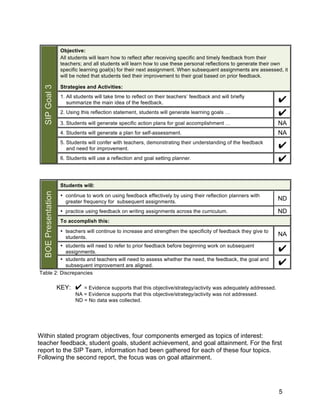
                         Objective:
                         All students will learn how to reflect after receiving specific and timely feedback from their
                         teachers; and all students will learn how to use these personal reflections to generate their own
                         specific learning goal(s) for their next assignment. When subsequent assignments are assessed, it
                         will be noted that students tied their improvement to their goal based on prior feedback.

                         Strategies and Activities:
     SIP Goal 3


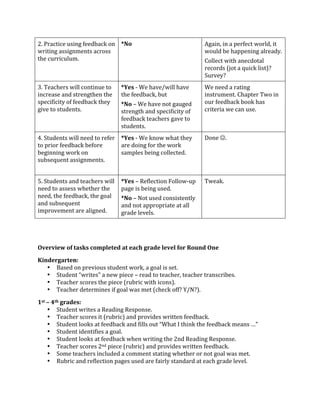
                         1. All students will take time to reflect on their teachers’ feedback and will briefly
                            summarize the main idea of the feedback.                                                    ✔
                         2. Using this reflection statement, students will generate learning goals …                    ✔
                         3. Students will generate specific action plans for goal accomplishment …                      NA
                         4. Students will generate a plan for self-assessment.                                          NA
                         5. Students will confer with teachers, demonstrating their understanding of the feedback
                            and need for improvement.                                                                   ✔
                         6. Students will use a reflection and goal setting planner.                                    ✔

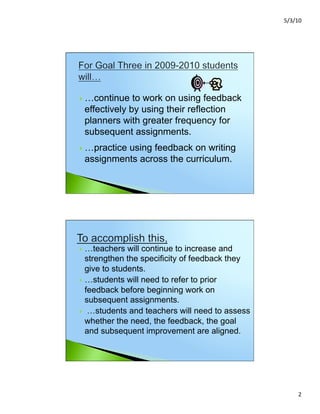
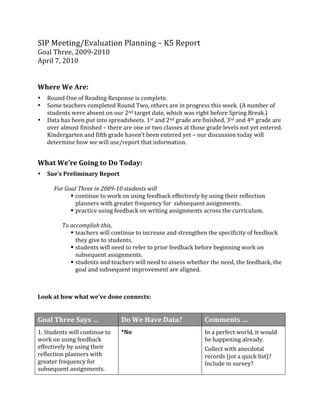
                         Students will:
     BOE Presentation


                         • continue to work on using feedback effectively by using their reflection planners with
                           greater frequency for subsequent assignments.
                                                                                                                        ND
                         • practice using feedback on writing assignments across the curriculum.                        ND
                         To accomplish this:
                         • teachers will continue to increase and strengthen the specificity of feedback they give to
                           students.
                                                                                                                        NA
             • students will need to refer to prior feedback before beginning work on subsequent
               assignments.                                                                                             ✔
             • students and teachers will need to assess whether the need, the feedback, the goal and
               subsequent improvement are aligned.                                                                      ✔
    Table 2: Discrepancies

                        KEY: ✔ = Evidence supports that this objective/strategy/activity was adequately addressed.
                                NA = Evidence supports that this objective/strategy/activity was not addressed.
                                ND = No data was collected.


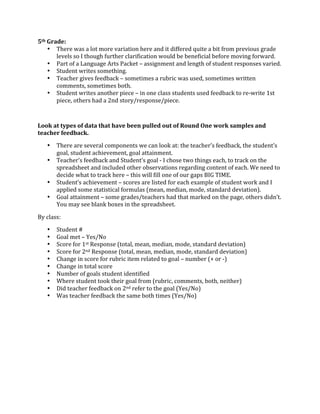
Within stated program objectives, four components emerged as topics of interest:
teacher feedback, student goals, student achievement, and goal attainment. For the first
report to the SIP Team, information had been gathered for each of these four topics.
Following the second report, the focus was on goal attainment.


                                                                                                                       5


Teacher Feedback
Content of written feedback for the first RR in February was examined. Trends were
noted in relation to patterns, detail, and quantity. It was determined that future focus
would not include feedback, so March information was not collected.


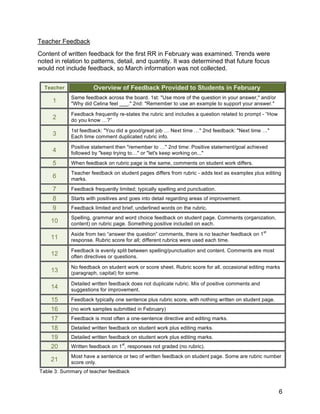
     Teacher             Overview of Feedback Provided to Students in February
                Same feedback across the board. 1st: "Use more of the question in your answer," and/or
         1      "Why did Celina feel ___." 2nd: "Remember to use an example to support your answer."

                Feedback frequently re-states the rubric and includes a question related to prompt - “How
         2      do you know …?”

                1st feedback: "You did a good/great job … Next time …" 2nd feedback: "Next time …"
         3      Each time comment duplicated rubric info.

                Positive statement then "remember to …" 2nd time: Positive statement/goal achieved
         4      followed by "keep trying to…" or "let's keep working on..."

         5      When feedback on rubric page is the same, comments on student work differs.
                Teacher feedback on student pages differs from rubric - adds text as examples plus editing
         6      marks.

         7      Feedback frequently limited; typically spelling and punctuation.
         8      Starts with positives and goes into detail regarding areas of improvement.
         9      Feedback limited and brief, underlined words on the rubric.
                Spelling, grammar and word choice feedback on student page. Comments (organization,
        10      content) on rubric page. Something positive included on each.
                                                                                                    st
                Aside from two “answer the question” comments, there is no teacher feedback on 1
        11      response. Rubric score for all; different rubrics were used each time.

                Feedback is evenly split between spelling/punctuation and content. Comments are most
        12      often directives or questions.

                No feedback on student work or score sheet. Rubric score for all, occasional editing marks
        13      (paragraph, capital) for some.

                Detailed written feedback does not duplicate rubric. Mix of positive comments and
        14      suggestions for improvement.
        15      Feedback typically one sentence plus rubric score, with nothing written on student page.
        16      (no work samples submitted in February)
        17      Feedback is most often a one-sentence directive and editing marks.
        18      Detailed written feedback on student work plus editing marks.
        19      Detailed written feedback on student work plus editing marks.
                                      st
        20      Written feedback on 1 , responses not graded (no rubric).
                Most have a sentence or two of written feedback on student page. Some are rubric number
        21      score only.
    Table 3: Summary of teacher feedback


                                                                                                           6


Student Goals
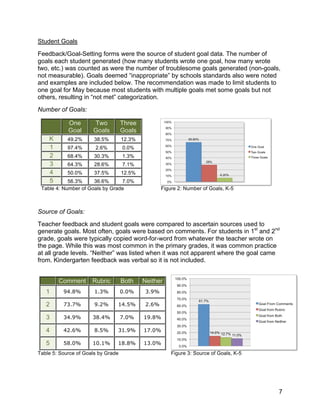
Feedback/Goal-Setting forms were the source of student goal data. The number of
goals each student generated (how many students wrote one goal, how many wrote
two, etc.) was counted as were the number of troublesome goals generated (non-goals,
not measurable). Goals deemed “inappropriate” by schools standards also were noted
and examples are included below. The recommendation was made to limit students to
one goal for May because most students with multiple goals met some goals but not
others, resulting in “not met” categorization.
Number of Goals:

              One       Two         Three
              Goal      Goals       Goals
       K      49.2%     38.5%       12.3%
       1      97.4%      2.6%       0.0%
       2      68.4%     30.3%       1.3%
       3      64.3%     28.6%       7.1%
       4      50.0%     37.5%       12.5%
       5       56.3%     36.6%      7.0%
    Table 4: Number of Goals by Grade               Figure 2: Number of Goals, K-5


Source of Goals:
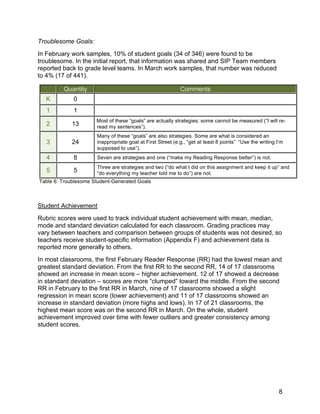
Teacher feedback and student goals were compared to ascertain sources used to
generate goals. Most often, goals were based on comments. For students in 1st and 2nd
grade, goals were typically copied word-for-word from whatever the teacher wrote on
the page. While this was most common in the primary grades, it was common practice
at all grade levels. “Neither” was listed when it was not apparent where the goal came
from. Kindergarten feedback was verbal so it is not included.


           Comment     Rubric       Both    Neither
     1      94.8%       1.3%        0.0%     3.9%

     2      73.7%       9.2%     14.5%       2.6%

     3      34.9%      38.4%        7.0%    19.8%

     4      42.6%       8.5%     31.9%      17.0%

     5      58.0%      10.1%     18.8%      13.0%
Table 5: Source of Goals by Grade                       Figure 3: Source of Goals, K-5


                                                                                        7


Troublesome Goals:
In February work samples, 10% of student goals (34 of 346) were found to be
troublesome. In the initial report, that information was shared and SIP Team members
reported back to grade level teams. In March work samples, that number was reduced
to 4% (17 of 441).

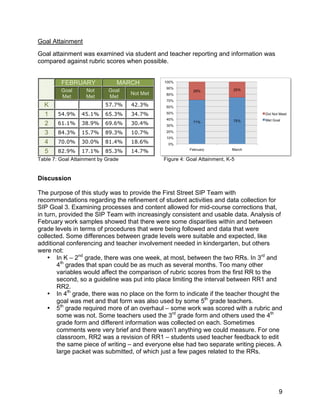
     e       Quantity                                           Comments
         K       0
         1       1
                          Most of these “goals” are actually strategies; some cannot be measured (“I will re-
         2      13        read my sentences”).
                          Many of these “goals” are also strategies. Some are what is considered an
         3      24        inappropriate goal at First Street (e.g., “get at least 8 points” “Use the writing I’m
                          supposed to use”).
         4       8        Seven are strategies and one (“make my Reading Response better”) is not.
                          Three are strategies and two (“do what I did on this assignment and keep it up” and
         5       5        “do everything my teacher told me to do”) are not.
    Table 6: Troublesome Student-Generated Goals


Student Achievement
Rubric scores were used to track individual student achievement with mean, median,
mode and standard deviation calculated for each classroom. Grading practices may
vary between teachers and comparison between groups of students was not desired, so
teachers receive student-specific information (Appendix F) and achievement data is
reported more generally to others.
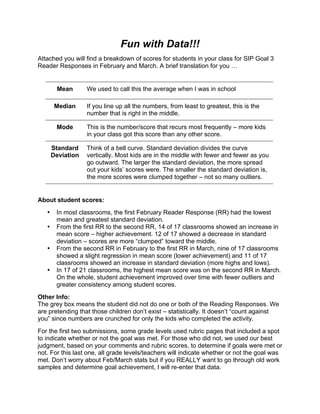
In most classrooms, the first February Reader Response (RR) had the lowest mean and
greatest standard deviation. From the first RR to the second RR, 14 of 17 classrooms
showed an increase in mean score – higher achievement. 12 of 17 showed a decrease
in standard deviation – scores are more “clumped” toward the middle. From the second
RR in February to the first RR in March, nine of 17 classrooms showed a slight
regression in mean score (lower achievement) and 11 of 17 classrooms showed an
increase in standard deviation (more highs and lows). In 17 of 21 classrooms, the
highest mean score was on the second RR in March. On the whole, student
achievement improved over time with fewer outliers and greater consistency among
student scores.


                                                                                                             8
!

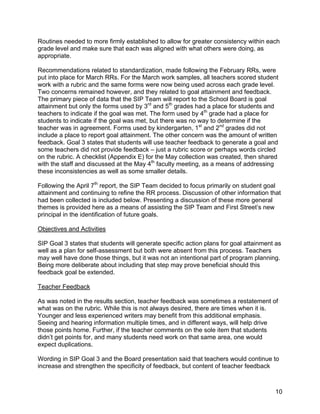
Goal Attainment
Goal attainment was examined via student and teacher reporting and information was
compared against rubric scores when possible.


         FEBRUARY               MARCH
         Goal      Not      Goal
                                    Not Met
         Met       Met      Met
    K                      57.7%    42.3%
    1   54.9%    45.1%     65.3%    34.7%
    2   61.1%    38.9%     69.6%    30.4%
    3   84.3%    15.7%     89.3%    10.7%
    4   70.0%    30.0%     81.4%    18.6%
    5   82.9%    17.1%     85.3%    14.7%
Table 7: Goal Attainment by Grade             Figure 4: Goal Attainment, K-5


Discussion

The purpose of this study was to provide the First Street SIP Team with
recommendations regarding the refinement of student activities and data collection for
SIP Goal 3. Examining processes and content allowed for mid-course corrections that,
in turn, provided the SIP Team with increasingly consistent and usable data. Analysis of
February work samples showed that there were some disparities within and between
grade levels in terms of procedures that were being followed and data that were
collected. Some differences between grade levels were suitable and expected, like
additional conferencing and teacher involvement needed in kindergarten, but others
were not:
    • In K – 2nd grade, there was one week, at most, between the two RRs. In 3rd and
        4th grades that span could be as much as several months. Too many other
        variables would affect the comparison of rubric scores from the first RR to the
        second, so a guideline was put into place limiting the interval between RR1 and
        RR2.
    • In 4th grade, there was no place on the form to indicate if the teacher thought the
        goal was met and that form was also used by some 5th grade teachers.
    • 5th grade required more of an overhaul – some work was scored with a rubric and
        some was not. Some teachers used the 3rd grade form and others used the 4th
        grade form and different information was collected on each. Sometimes
        comments were very brief and there wasn’t anything we could measure. For one
        classroom, RR2 was a revision of RR1 – students used teacher feedback to edit
        the same piece of writing – and everyone else had two separate writing pieces. A
        large packet was submitted, of which just a few pages related to the RRs.


!                                                                                      9!
!

Routines needed to more firmly established to allow for greater consistency within each
grade level and make sure that each was aligned with what others were doing, as
appropriate.

Recommendations related to standardization, made following the February RRs, were
put into place for March RRs. For the March work samples, all teachers scored student
work with a rubric and the same forms were now being used across each grade level.
Two concerns remained however, and they related to goal attainment and feedback.
The primary piece of data that the SIP Team will report to the School Board is goal
attainment but only the forms used by 3rd and 5th grades had a place for students and
teachers to indicate if the goal was met. The form used by 4th grade had a place for
students to indicate if the goal was met, but there was no way to determine if the
teacher was in agreement. Forms used by kindergarten, 1st and 2nd grades did not
include a place to report goal attainment. The other concern was the amount of written
feedback. Goal 3 states that students will use teacher feedback to generate a goal and
some teachers did not provide feedback – just a rubric score or perhaps words circled
on the rubric. A checklist (Appendix E) for the May collection was created, then shared
with the staff and discussed at the May 4th faculty meeting, as a means of addressing
these inconsistencies as well as some smaller details.

Following the April 7th report, the SIP Team decided to focus primarily on student goal
attainment and continuing to refine the RR process. Discussion of other information that
had been collected is included below. Presenting a discussion of these more general
themes is provided here as a means of assisting the SIP Team and First Street’s new
principal in the identification of future goals.

Objectives and Activities

SIP Goal 3 states that students will generate specific action plans for goal attainment as
well as a plan for self-assessment but both were absent from this process. Teachers
may well have done those things, but it was not an intentional part of program planning.
Being more deliberate about including that step may prove beneficial should this
feedback goal be extended.

Teacher Feedback

As was noted in the results section, teacher feedback was sometimes a restatement of
what was on the rubric. While this is not always desired, there are times when it is.
Younger and less experienced writers may benefit from this additional emphasis.
Seeing and hearing information multiple times, and in different ways, will help drive
those points home. Further, if the teacher comments on the sole item that students
didn’t get points for, and many students need work on that same area, one would
expect duplications.

Wording in SIP Goal 3 and the Board presentation said that teachers would continue to
increase and strengthen the specificity of feedback, but content of teacher feedback


!                                                                                      10!
!

was not addressed in program activities. The book that First Street faculty read and
discussed in 2008-2009, How to Give Effective Feedback to Your Students, written by
Susan M. Brookhart and published by the Association for Supervision and Curriculum
Development, lists specific criteria for rating feedback on elementary writing
assignments (pages 79-82). This would be a fine resource to utilize again, should the
SIP Team choose to address strength and specificity of teacher feedback.

Student Goals

Typically, students created appropriate goals that were based on teacher feedback and
revisions. However, most often those goals were a word-for-word restatement of
teacher feedback. For our younger students this is quite appropriate, but for older
students it may not be. If content of student goals were to be addressed in future SIP
goals, looking more closely at student ability to summarize or restate feedback may be
appropriate for older students.

Inter-rater Reliability

As in any educational research, one must expect less-than-ideal research situations.
Differences in teacher expectations and grading practices mean that rubric scores
should be taken with a grain of salt. In some cases differences were more extreme than
one might expect. Student scores were sometimes quite different even though the
content of their responses was quite similar. For example, students in some classes got
credit for citing sources when a text-specific example was mentioned, but others got
credit only if a direct quote is used. Should the SIP Team choose to focus on inter-rater
reliability in the future, the following topics may be a good place to start:

    •   Spelling: How many mistakes can students make and still get the points? There
        was quite a difference of teacher opinion beginning in second grade. Where
        some teachers awarded points only for error-free work, others give full credit
        when there are several errors. Some teachers award partial credit and for others,
        it is all or nothing.
    •   Citations: How much text can students “borrow” before you call it plagiarism or
        caution them about copying too much? There was a great deal of difference in
        terms of what was expected and what was allowed. A useful tool for the
        comparison of text is Quick Diff (http://www.quickdiff.com/index.php). Analysis of
        one work sample, which received full credit and positive feedback regarding
        details, showed that seven of the student’s ten sentences were identical to story
        text.
    •   Concluding Sentence: What constitutes an acceptable concluding sentence?
        Where some teachers gave credit only for a re-statement of the topic sentence,
        others accepted any sentence that did not introduce new details.
    •   Goal Attainment: Questions arose as to the criteria that must be met for a
        teacher to assign the “goal met” distinction. For some teachers, progress toward
        the goal or partially met goals (student had two goals and met one of them) were
        enough and for others it was not.


!                                                                                      11!
!

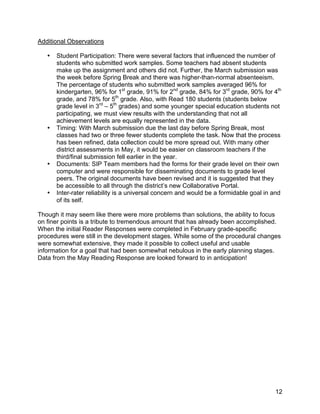
Additional Observations

    •   Student Participation: There were several factors that influenced the number of
        students who submitted work samples. Some teachers had absent students
        make up the assignment and others did not. Further, the March submission was
        the week before Spring Break and there was higher-than-normal absenteeism.
        The percentage of students who submitted work samples averaged 96% for
        kindergarten, 96% for 1st grade, 91% for 2nd grade, 84% for 3rd grade, 90% for 4th
        grade, and 78% for 5th grade. Also, with Read 180 students (students below
        grade level in 3rd – 5th grades) and some younger special education students not
        participating, we must view results with the understanding that not all
        achievement levels are equally represented in the data.
    •   Timing: With March submission due the last day before Spring Break, most
        classes had two or three fewer students complete the task. Now that the process
        has been refined, data collection could be more spread out. With many other
        district assessments in May, it would be easier on classroom teachers if the
        third/final submission fell earlier in the year.
    •   Documents: SIP Team members had the forms for their grade level on their own
        computer and were responsible for disseminating documents to grade level
        peers. The original documents have been revised and it is suggested that they
        be accessible to all through the district’s new Collaborative Portal.
    •   Inter-rater reliability is a universal concern and would be a formidable goal in and
        of its self.

Though it may seem like there were more problems than solutions, the ability to focus
on finer points is a tribute to tremendous amount that has already been accomplished.
When the initial Reader Responses were completed in February grade-specific
procedures were still in the development stages. While some of the procedural changes
were somewhat extensive, they made it possible to collect useful and usable
information for a goal that had been somewhat nebulous in the early planning stages.
Data from the May Reading Response are looked forward to in anticipation!


!                                                                                        12!
Appendices

  • Appendix A: School Improvement Plan, Goal 3 (4 pages)

  • Appendix B: Board of Education Report (2 pages)

  • Appendix C: April 7th Report to SIP Team (7 pages)

  • Appendix D: April 27th Report to SIP Team (4 pages)

  • Appendix E: Checklists and Revised Forms (8 pages)

  • Appendix F: Sample Teacher Report (2 pages)

  • Appendix G: Invoice
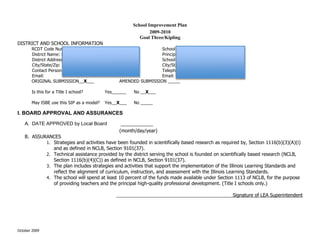
Appendix A: Kipling 2009 - 2010 School Improvement Plan, Goal 3
                                                       School Improvement Plan
                                                               2009-2010
                                                          Goal Three/Kipling
DISTRICT AND SCHOOL INFORMATION
                      !                                                     !
       RCDT Code Number ________________________                      School Name: KIPLING ELEMENTARY
       District Name: Deerfield Public Schools District 109           Principal: Judith A. Lindgren
       District Address:700 Kipling Place                             School Address: 700 Kipling Place
       City/State/Zip: Deerfield, IL 60015                            City/State/Zip: Deerfield, IL 60015
       Contact Person:                                                Telephone: 847 948-5151 Ext. 1102
       Email:                                                         Email: jlindgren@dps109.org
       ORIGINAL SUBMISSION__X___                     AMENDED SUBMISSION _____

       Is this for a Title I school?       Yes______   No __X___

       May ISBE use this SIP as a model?   Yes__X___   No _____

I. BOARD APPROVAL AND ASSURANCES

    A. DATE APPROVED by Local Board               ____________
                                                 (month/day/year)
    B. ASSURANCES
            1. Strategies and activities have been founded in scientifically based research as required by, Section 1116(b)(3)(A)(i)
               and as defined in NCLB, Section 9101(37).
            2. Technical assistance provided by the district serving the school is founded on scientifically based research (NCLB,
               Section 1116(b)(4)(C)) as defined in NCLB, Section 9101(37).
            3. The plan includes strategies and activities that support the implementation of the Illinois Learning Standards and
               reflect the alignment of curriculum, instruction, and assessment with the Illinois Learning Standards.
            4. The school will spend at least 10 percent of the funds made available under Section 1113 of NCLB, for the purpose
               of providing teachers and the principal high-quality professional development. (Title I schools only.)

                                               ____________________________________________Signature of LEA Superintendent


October 2009
2
I. PLAN DEVELOPMENT, REVIEW, AND IMPLEMENTATION
    A. School Support Team
                    !
             Kindergarten—Danna Friedlander
             First—Michelle Comitor
             Second—Meghan Trauten
             Third—Benjamin Lombardi
             Fourth—Jeanne Sayner
             Fifth—Moe Kaulentis
             PST—Jen Grady
             Literacy—Taryn Hartman
             Math—Nicole Tye
             TAP—Lynn Surico
             Parent Reps—Elaine Jacoby
             Administration—Judi Lindgren and Nancy Burnett

    B. Description of Parent Notification (Title I schools only)

    C. Description of Stakeholder Involvement

    D. Description of the Peer Review Process

    E. Description of the Teacher Mentoring Process

    F. Description of the District’s Responsibilities

    G. Description of the State’s Responsibilities


III.    DATA AND ANALYSIS
        A. Data Collection and Information
                 1. School Assessment and AYP Data
                 2. Other Data (optional)
                 (e.g., information and data about the attributes and challenges of the school and community that have affected
                 student learning; local assessment data; educator qualifications and professional growth and development data;
                 and parent involvement data)

October 2009
3


        B. Data Analysis
           While 88.6% of Kipling students, including kindergarten students, met the goal of correctly interpreting their teachers’
           feedback on a specific writing assignment, more instruction and practice is needed in order for students to understand the link
           between feedback and subsequent learning and improvement.

IV. ACTION PLAN

    OBJECTIVES FOR CONTINUOUS AND SUBSTANTIAL PROGRESS (COPY AS NEEDED)

    A. OBJECTIVE
All students will learn how to reflect after receiving specific and timely feedback from their teachers; and all students will learn how to
use these personal reflections to generate their own specific learning goal(s) for their next assignment. When subsequent assignments are
assessed, it will be noted that students tied their improvement to their goal based on prior feedback.
    B. Student Strategies and Activities for this Objective                                                            TIMELINE     BUDGET
All students will take time to reflect on their teachers’ feedback and will briefly summarize the main idea of      2009-2010
the feedback. Using this reflection statement, students will generate learning goals, specific action plans for
goal accomplishment and a plan for self assessment. Students will confer with teachers, demonstrating their
understanding of the feedback and need for improvement. Students will use a reflection and goal setting
planner.


    C. Professional Development Strategies and Activities for this Objective
Time will be provided during faculty meetings for learning about the relationship of teacher feedback, time
for student reflection and how this relates to students being self-directed in their learning. Time will be given
to grade level teams to plan strategies for reflection and student goal setting. At follow-up faculty sessions,
teachers will review the practices that were deemed effective and discuss strategies for improving student
commitment to their goal progress.
    D. Parent Involvement Strategies and Activities for this Objective
Parents will be informed about their child’s progress at each report card period, at the parent teacher
conference, and at other times of the year whenever there is a need. Specific information will be given about
their child’s goal attainment. Parents may be asked to follow up with home support.
    E. 1. Process for Monitoring the Effectiveness of the Strategies and Activities for this Objective

October 2009
4
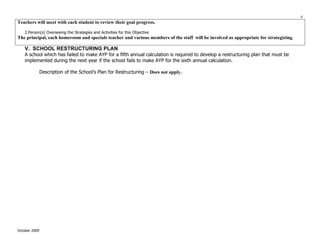
Teachers will meet with each student to review their goal progress.

    2.Person(s) Overseeing the Strategies and Activities for this Objective
The principal, each homeroom and specials teacher and various members of the staff will be involved as appropriate for strategizing.

    V. SCHOOL RESTRUCTURING PLAN
    A school which has failed to make AYP for a fifth annual calculation is required to develop a restructuring plan that must be
    implemented during the next year if the school fails to make AYP for the sixth annual calculation.

               Description of the School’s Plan for Restructuring – Does not apply.


October 2009
!"#"$%&


  A Review of 2008-2009
             and
An Introduction to 2009-2010


     Percent of Students Who Met SIP Goal #3


                                       Met Goal

                                       Did Not Meet
                                       Goal


                                                           $&
!"#"$%&


!! …continue  to work on using feedback
 effectively by using their reflection
 planners with greater frequency for
 subsequent assignments.
!! …practice
          using feedback on writing
 assignments across the curriculum.


!! …teachers   will continue to increase and
   strengthen the specificity of feedback they
   give to students.
!! …students will need to refer to prior
   feedback before beginning work on
   subsequent assignments.
!! …students and teachers will need to assess
   whether the need, the feedback, the goal
   and subsequent improvement are aligned.


                                                      '&
!"#$%&&'()*+,-./0.'(1)$#/.))()*$2$34$5&617'$
81./$9:7&&;$<==>?<=@=$
A67(/$B;$<=@=$
!

"#$%$!"$!&%$'!
•   510)C$D)&$1E$5&.C()*$5&F61)F&$(F$G1H6/&'&I$
•   !1H&$'&.G:&7F$G1H6/&'&C$510)C$9J1;$1':&7F$.7&$()$671*7&FF$':(F$J&&KI$LA$)0HM&7$1E$
    F'0C&)'F$J&7&$.MF&)'$1)$107$<)C$'.7*&'$C.'&;$J:(G:$J.F$7(*:'$M&E17&$!67()*$N7&.KIO$
•   P.'.$:.F$M&&)$60'$()'1$F67&.CF:&&'FI$@F'$.)C$<)C$*7.C&$.7&$E()(F:&C;$Q7C$.)C$R':$*7.C&$.7&$
    1-&7$./H1F'$E()(F:&C$2$':&7&$.7&$1)&$17$'J1$G/.FF&F$.'$':1F&$*7.C&$/&-&/F$)1'$S&'$&)'&7&CI$
    3()C&7*.7'&)$.)C$E(E':$*7.C&$:.-&)T'$M&&)$&)'&7&C$S&'$2$107$C(FG0FF(1)$'1C.S$J(//$
    C&'&7H()&$:1J$J&$J(//$0F&+7&617'$':.'$()E17H.'(1)I$
    $

"#()!"$*%$!+,-./!),!0,!1,2(3'!
•   45$*6!7%$8-9-.(%3!:$;,%)$
    $
    !!!!!"#$!%#&'!()$**!+,!-../01.!2345*,32!6+''!
                 ! G1)'()0&$'1$J17K$1)$0F()*$E&&CM.GK$&EE&G'(-&/S$MS$0F()*$':&(7$7&E/&G'(1)$
                   6/.))&7F$J(':$*7&.'&7$E7&U0&)GS$E17$$F0MF&U0&)'$.FF(*)H&)'FI$
                 ! 67.G'(G&$0F()*$E&&CM.GK$1)$J7('()*$.FF(*)H&)'F$.G71FF$':&$G077(G0/0HI$
                   $
          $$$$(#!&77#89'+2)!3)+2:!!
                 ! '&.G:&7F$J(//$G1)'()0&$'1$()G7&.F&$.)C$F'7&)*':&)$':&$F6&G(E(G('S$1E$E&&CM.GK$
                   ':&S$*(-&$'1$F'0C&)'FI$
                 ! F'0C&)'F$J(//$)&&C$'1$7&E&7$'1$67(17$E&&CM.GK$M&E17&$M&*())()*$J17K$1)$
                   F0MF&U0&)'$.FF(*)H&)'FI$
                 ! F'0C&)'F$.)C$'&.G:&7F$J(//$)&&C$'1$.FF&FF$J:&':&7$':&$)&&C;$':&$E&&CM.GK;$':&$
                   *1./$.)C$F0MF&U0&)'$(H671-&H&)'$.7&$./(*)&CI$
                   $
!
<,,=!()!#,>!>#()!>$*?$!2,.$!@,..$@)6'!
!

+,(8!1#%$$!4(36!A!               0,!"$!B(?$!0()(C!                D,99$.)6!A!
@I$!'0C&)'F$J(//$G1)'()0&$'1$    EF,!                             ")$.$6&7E&G'$J17/C;$('$J10/C$
J17K$1)$0F()*$E&&CM.GK$                                           M&$:.66&)()*$./7&.CSI$$
&EE&G'(-&/S$MS$0F()*$':&(7$                                       V1//&G'$J(':$.)&GC1'./$
7&E/&G'(1)$6/.))&7F$J(':$                                         7&G17CF$LW1'$.$U0(GK$/(F'OX$
*7&.'&7$E7&U0&)GS$E17$$                                           ")G/0C&$()$F07-&SX$
F0MF&U0&)'$.FF(*)H&)'FI$
!"#$%&'()'*#+,)-.#/**01&'2#3-# !"#$                             8.&)-9#)-#&#:*%/*'(#43%709#)(#
4%)()-.#&,,).-5*-(,#&'%3,,#                                     43+70#1*#6&::*-)-.#&7%*&0;"##
(6*#'+%%)'+7+5"#                                                <377*'(#4)(6#&-*'03(&7#
                                                                %*'3%0,#=>3(#&#?+)'2#7),(@A#
                                                                B+%C*;A##
D"#E*&'6*%,#4)77#'3-()-+*#(3#    !%&'#F#G*#6&C*H4)77#6&C*#      G*#-**0#&#%&()-.#
)-'%*&,*#&-0#,(%*-.(6*-#(6*#     (6*#/**01&'29#1+(#             )-,(%+5*-("#<6&:(*%#E43#)-#
,:*')/)')(;#3/#/**01&'2#(6*;#    !"##I#G*#6&C*#-3(#.&+.*0#      3+%#/**01&'2#1332#6&,#
.)C*#(3#,(+0*-(,"#               ,(%*-.(6#&-0#,:*')/)')(;#3/#   '%)(*%)&#4*#'&-#+,*"#
#                                /**01&'2#(*&'6*%,#.&C*#(3#
                                 ,(+0*-(,"#
J"#B(+0*-(,#4)77#-**0#(3#%*/*%# !%&'#F#G*#2-34#46&(#(6*;#       K3-*#!"#
(3#:%)3%#/**01&'2#1*/3%*#       &%*#03)-.#/3%#(6*#43%2#
1*.)--)-.#43%2#3-#              ,&5:7*,#1*)-.#'377*'(*0"#
,+1,*?+*-(#&,,).-5*-(,"#
#
L"#B(+0*-(,#&-0#(*&'6*%,#4)77#   !%&'#I#M*/7*'()3-#N37734F+:#   E4*&2"#
-**0#(3#&,,*,,#46*(6*%#(6*#      :&.*#),#1*)-.#+,*0"#
-**09#(6*#/**01&'29#(6*#.3&7#    !"##I#O3(#+,*0#'3-,),(*-(7;#
&-0#,+1,*?+*-(#                  &-0#-3(#&::%3:%)&(*#&(#&77#
)5:%3C*5*-(#&%*#&7).-*0"#        .%&0*#7*C*7,"#
#

#
()&*)+&,$#-$./'0'$1#234&.&5$/.$&/16$7*/5&$4&)&4$-#*$8#9:5$(:&$
;+:5&*7/*.&:<$$
   • P&,*0#3-#:%*C)3+,#,(+0*-(#43%29#&#.3&7#),#,*("##
   • B(+0*-(#Q4%)(*,R#&#-*4#:)*'*#I#%*&0#(3#(*&'6*%9#(*&'6*%#(%&-,'%)1*,"#
   • E*&'6*%#,'3%*,#(6*#:)*'*#=%+1%)'#4)(6#)'3-,@"#
   • E*&'6*%#0*(*%5)-*,#)/#.3&7#4&,#5*(#='6*'2#3//A#SHOA@"#
='.$>$?.6$7*/5&'<$$
    • B(+0*-(#4%)(*,#&#M*&0)-.#M*,:3-,*"#
    • E*&'6*%#,'3%*,#)(#=%+1%)'@#&-0#:%3C)0*,#4%)((*-#/**01&'2"#
    • B(+0*-(#7332,#&(#/**01&'2#&-0#/)77,#3+(#QG6&(#T#(6)-2#(6*#/**01&'2#5*&-,#UR#
    • B(+0*-(#)0*-()/)*,#&#.3&7"#
    • B(+0*-(#7332,#&(#/**01&'2#46*-#4%)()-.#(6*#!-0#M*&0)-.#M*,:3-,*"#
    • E*&'6*%#,'3%*,#!-0#:)*'*#=%+1%)'@#&-0#:%3C)0*,#4%)((*-#/**01&'2"#
    • B35*#(*&'6*%,#)-'7+0*0#&#'355*-(#,(&()-.#46*(6*%#3%#-3(#.3&7#4&,#5*("#
    • M+1%)'#&-0#%*/7*'()3-#:&.*,#+,*0#&%*#/&)%7;#,(&-0&%0#&(#*&'6#.%&0*#7*C*7"#
!"#$%&'()*$$
    • !"#$#%&'(%'%)*+%,*$#%-'$.'+.*/%"#$#%'/0%.+%0.11#$#0%23.+#%'%4.+%1$*,%5$#-.*3(%6$'0#%
       )#-#)(%(*%7%+"*36"%13$+"#$%8)'$.1.8'+.*/%&*3)0%4#%4#/#1.8.')%4#1*$#%,*-./6%1*$&'$09%
    • :'$+%*1%'%;'/63'6#%<$+(%:'8=#+%>%'((.6/,#/+%'/0%)#/6+"%*1%(+30#/+%$#(5*/(#(%-'$.#09%
    • ?+30#/+%&$.+#(%(*,#+"./69%
    • !#'8"#$%6.-#(%1##04'8=%>%(*,#+.,#(%'%$34$.8%&'(%3(#0@%(*,#+.,#(%&$.++#/%
       8*,,#/+(@%(*,#+.,#(%4*+"9%%
    • ?+30#/+%&$.+#(%'/*+"#$%5.#8#%>%./%*/#%8)'((%(+30#/+(%3(#0%1##04'8=%+*%$#A&$.+#%B(+%
       5.#8#@%*+"#$(%"'0%'%C/0%(+*$DE$#(5*/(#E5.#8#9%
%

+,,-$'"$"./)0$,1$('"'$"#'"$#'2)$3))4$/566)($,5"$,1$7,54($84)$9,&-$0':/6)0$'4($
")';#)&$1))(3';-<%

    •   !"#$#%'$#%(#-#$')%8*,5*/#/+(%&#%8'/%)**=%'+F%+"#%+#'8"#$G(%1##04'8=@%+"#%(+30#/+G(%
        6*')@%(+30#/+%'8".#-#,#/+@%6*')%'++'./,#/+9%%
    •   !#'8"#$G(%1##04'8=%'/0%?+30#/+G(%6*')%A%7%8"*(#%+&*%+"./6(%#'8"@%+*%+$'8=%*/%+"#%
        (5$#'0("##+%'/0%./8)30#0%*+"#$%*4(#$-'+.*/(%$#6'$0./6%8*/+#/+%*1%#'8"9%H#%/##0%+*%
        0#8.0#%&"'+%+*%+$'8=%"#$#%>%+".(%&.))%1.))%*/#%*1%*3$%6'5(%I7J%!7KL9%
    •   ?+30#/+G(%'8".#-#,#/+%>%(8*$#(%'$#%).(+#0%1*$%#'8"%#M',5)#%*1%(+30#/+%&*$=%'/0%7%
        '55).#0%(*,#%(+'+.(+.8')%1*$,3)'(%N,#'/@%,#0.'/@%,*0#@%(+'/0'$0%0#-.'+.*/O9%
    •   J*')%'++'./,#/+%>%(*,#%6$'0#(E+#'8"#$(%"'0%+"'+%,'$=#0%*/%+"#%5'6#@%*+"#$(%0.0/G+9%
        P*3%,'D%(##%4)'/=%4*M#(%./%+"#%(5$#'0("##+9$

ID%8)'((F%
    •   ?+30#/+%Q%
    •   J*')%,#+%>%P#(ER*%
    •   ?8*$#%1*$%B(+%S#(5*/(#%N+*+')@%,#'/@%,#0.'/@%,*0#@%(+'/0'$0%0#-.'+.*/O%
    •   ?8*$#%1*$%C/0%S#(5*/(#%N+*+')@%,#'/@%,#0.'/@%,*0#@%(+'/0'$0%0#-.'+.*/O%
    •   T"'/6#%./%(8*$#%1*$%$34$.8%.+#,%$#)'+#0%+*%6*')%>%/3,4#$%NU%*$%AO%
    •   T"'/6#%./%+*+')%(8*$#%
    •   R3,4#$%*1%6*')(%(+30#/+%.0#/+.1.#0%
    •   H"#$#%(+30#/+%+**=%+"#.$%6*')%1$*,%N$34$.8@%8*,,#/+(@%4*+"@%/#.+"#$O%
    •   V.0%+#'8"#$%1##04'8=%*/%C/0%$#1#$%+*%+"#%6*')%NP#(ER*O%
    •   H'(%+#'8"#$%1##04'8=%+"#%(',#%4*+"%+.,#(%NP#(ER*O%

$
!"#$#%&'(#")#"*+',%+-)'."'/.0")'1"-'+0,2#++#."+3'
4#")-5*%5$-"6!!
"#$%&'()!*+$!,$-.,*'()!/.,0!1!*$%2+$,3!%,$!43'()!2.5$,!-%)$!%(6!#.,&!3%0-7$3!/.,!
3483$94$(*!#,'*'()!%2*'5'*:;!<$!($$6!*.!)$*!*+.3$!8%2&!%(6!/.,*+!'/!#$!%,$!).'()!*.!7..&!%*!
3-$2'/'23!0'6=3*,$%0;!>$,:!'(5.75$6!-,.2$33!3'(2$!0.3*!&'63!2%(?*!%2*4%77:!#,'*$;!@$,+%-3!
*+'3!2.476!8$!.($!./!*+.3$!A%2,.33!*+$!24,,'24740B!*+'()3!%(6!#$!2%(!0.,$!$//'2'$(*7:!%(6!
$//$2*'5$7:!%--7:!*+$!-,.2$33!C6.!%!*+'()D!)$*!/$$68%2&D!0%&$!%!).%7D!6.!%(.*+$,!*+'()E!*.!%!
7$%,('()!%2*'5'*:!3*46$(*3!2%(!2.0-7$*$!0.,$!'(6$-$(6$(*7:;!
7+$'85%)-6'
    ! F*46$(*!3*%*$3!%!).%7!84*!*+$,$?3!(.!-7%2$!.(!*+$!/$$68%2&!-%)$!*.!'(6'2%*$!'/!3*46$(*!
       G*$%2+$,!*+.4)+*!*+$!).%7!#%3!%22.0-7'3+$6;!F'(2$!*+%*?3!.($!./!*+$!*+'()3!'(!.4,!7'3*D!
       H!*+'(&!*+%*!3+.476!8$!'(2746$6!C*$%2+$,!.(7:!6$2'6$!%*!I3*!),%6$JE;!K($!*$%2+$,!
       '(2746$6!*+%*!'(!/$$68%2&!.(!L(6!MM;!
    ! "+,$$!./!*+$!/.4,!*$%2+$,3!3480'**$6!%!3-,$%63+$$*!#'*+!*+$!8,$%&6.#(!./!32.,$3;!
       <.476!*+%*!*:-$!./!'(/.,0%*'.(!8$!43$/47!/.,!.*+$,!),%6$!7$5$73J!N.!*$%2+$,3!%7,$%6:!
       +%5$!*+%*!84*!6'6(?*!-4*!'*!'(!*+$!/.76$,J!
    ! O.,!*+$!94$3*'.(D!AH!*+'(&!*+$!/$$68%2&!/,.0!0:!*$%2+$,3!0$%(3!*+%*!H!PB!'3!*:-'2%77:!
       #.,6=/.,=#.,6!#+%*$5$,!*+$!*$%2+$,!#,.*$;!N.$3!*+'3!0$%(!*+%*!3*46$(*3!,$%77:!
       6.(?*!&(.#!#+%*!'*!0$%(3J!N.!/',3*!),%6$,3!+%5$!*+$!,$%6'()G#,'*'()!3&'773!*.!,$%77:!
       %(3#$,!*+%(!94$3*'.(J!
    ! Q.3*!3*46$(*3!0%6$!*+$!).%7!#+%*$5$,!*+$!*$%2+$,!2.00$(*$6!.(!#+$*+$,!'3!#%3!
       %2*4%77:!3.0$*+'()!*+%*!($$6$6!'0-,.5$0$(*!.,!(.*;!
    ! F.0$!*$%2+$,3!%#%,6$6!+%7/=2,$6'*D!.*+$,3!'*!#%3!%77!.,!(.*+'()!1!*+%*!2.(*,'84*$6!*.!
       3.0$!-,$**:!8')!6'//$,$(2$3!'(!3*46$(*!32.,$3;!
9")'85%)-6'
   ! R)%'(D!#$!($$6!*.!'(6'2%*$!#+$*+$,!.,!(.*!*+$!).%7!#%3!0$*;!F*46$(*!6$2'6$J!
       "$%2+$,J!S.*+J!
   ! T'&$!/',3*!),%6$D!*+$,$!'3!%!($$6!/.,!),$%*$,!2.(3'3*$(2:!'(!*$,03!./!32.,'()!.(!*+$!
       ,48,'2!=!#$!+%6!!! D!!U!D!!V!D!!=!D!!!V!D!!!=!D!$*2;!1!TK"F!./!5%,'$*:;!Q%*+!$W$0-7%,!,48,'2!
       %33')(3!-.'(*3!/.,!$%2+!2%*$).,:!'(!*+$!,48,'2;!<.476!3.0$*+'()!7'&$!*+%*!8$!+$7-/47!
       +$,$J!F%0$!/.,!I3*!),%6$J!X.#!%8.4*!&'(6$,)%,*$(J!X.#!%8.4*!V!!!!=!J!
           o V!Y!L!!C/477!2,$6'*G#$77!6.($E!
           o !!Y!I!
           o =!Y!Z!C%83$(*G8$)'(('()E!
   ! T'&$!I3*!),%6$D!).%7!'3!*:-'2%77:!%!,$3*%*$0$(*!./!#+%*!*+$!*$%2+$,!#,.*$;!K/*$(!*+$!
       #,'**$(!/$$68%2&!#.476!$(2.0-%33!L!.,![!*+'()3!/,.0!*+$!,48,'2!%(6!3*46$(*3!0%6$!
       *+%*!*+$',!).%7;!!
   ! O',3*!),%6$!+%6!,48,'2!/.,!/',3*!%(6!3$2.(6!,$3-.(3$!3'6$=8:=3'6$;!<.476!*+%*!0%&$!%!
       2.0-%,'3.(!0.,$!$//$2*'5$!/.,!3*46$(*3J!!!
   ! F*%,*'()!'(!L(6!),%6$D!*+$,$!#%3!94'*$!%!6'//$,$(2$!./!.-'('.(3!%3!*.!+.#!0%(:!
       3-$77'()!$,,.,3!:.4!2%(!0%&$!%(6!3*'77!)$*!*+$!-.'(*!%(6!#+%*!2.(3*'*4*$3!%(!
       %22$-*%87$!2.(2746'()!3$(*$(2$;!W%0-7$]!K($!3*46$(*!#,.*$!L=IGL!-%)$3!#'*+!
       *+,$$!0'33-$77'()3!%(6!).*!*+$!3%0$!32.,$!CZE!%3!%!3*46$(*!#+.!#,.*$!.($!-%)$!%(6!
!"#$%&!'%()*+,%('*'%-.,,/'##'+0%1"*&."#%2*'+.&%!'*'3%4)',%&!'%5"##%)*%6)&!.678%*9:*.2%
       *'/*','6&%7*"+.67%/*"2&.2',%'#,'(!'*'3%4.,&*.2&%",,',,-'6&,3%;<=>,3%
   !   ;&%-"?%:'%:'?)6+%)9*%,2)/'%!'*'@%:9&%2)-/"*.67%,&9+'6&%,2)*',%"2*),,%"%7*"+'%#'A'#%
       ()9#+%!"A'%-92!%7*'"&'*%A"#.+.&?B*'#.":.#.&?%.$%'C/'2&"&.)6,%('*'%-)*'%,&"6+"*+0%
       =#,)%6)&'+%.,,9',%$*)-%)6'%7*"+'%#'A'#%&)%&!'%6'C&0%

!"#$%"&#'($
    ! D!"&%2)6,&.&9&',%"6%"22'/&":#'%2)62#9+.67%,'6&'62'3%4)%('%7'&%&!'%/).6&%$)*%E9,&%
       !"A.67%"6?%,)*&%)$%2)62#9+.67%,'6&'62'%)*%+)',%.&%6''+%&)%*',&"&'%&!'%&)/.2%,'6&'62'3%
       4'&".#,%"6+%,9//)*&.67%&'C&%A"*.'+%F9.&'%"%#)&%.6%&'*-,%)$%(!"&%.,%'6)97!%&)%'"*6%
       /).6&,0%%
    ! G*"/!.2%)*7"6.H'*%I%D",%.&%)/&.)6"#3%<)-'%,9:-.&&'+%7*"/!.2%)*7"6.H'*,@%,)-'%+.+%
       6)&0%D'*'%&!'?%9,'+%2)6,.,&'6&#?3%
    ! J)(%-92!%&.-'%.,%'C/'2&'+%:'&(''6%&!'%$.*,&%"6+%,'2)6+%(*.&.67%"2&.A.&?3%D!"&%(",%
       +)6'%.6%:'&(''63%K"6%('%"&&*.:9&'%7*)(&!%&!'%9,.67%$''+:"2L%"6+%,'&&.67%"%7)"#%.$%
       &!'*'%.,%"%:.7%,/"63%M'7.66.67%(.&!%&!.*+%7*"+'@%&!'*'%(",%,)-'&.-',%F9.&'%"%,/"6%
       N-)6&!,O%:'&(''6%P,&%"6+%Q6+%RR0%%
    ! M'7.66.67%.6%&!.*+%7*"+'%('%!"A'%&!'%5=$&'*%*'A.'(.67%S8%,'2&.)60%D!"&%.,%+)6'%(.&!%
       &!.,%.6$)*-"&.)63%>'"2!'*%*'A.'(%"6+B)*%2)--'6&3%;6%#))L.67%"&%,'A'*"#@%,&9+'6&%
       )/.6.)6,%"*'%6)&%,9//)*&'+%:?%*9:*.2%,2)*',%"6+%&'"2!'*%$''+:"2L0%%
    ! <)-'%&'"2!'*,%,".+%F9)&',%('*'%6''+'+@%)&!'*,%"##)('+%$)*%-)*'%7'6'*"#%'C"-/#',0%
       T.+,%.6%5F9)&',8%2#",,',%7)&%/).6&,%)$$%(!'*'%L.+,%.6%56)6UF9)&'8%2#",,',%7)&%&!'%
       /).6&,%(!'6%&!'.*%&'C&%(",@%$)*%"##%.6&'6&,%"6+%/9*/),',@%&!'%,"-'0%
)*+$%"&#'($
    ! V)%/#"2'%)6%$)*-%$)*%&'"2!'*%&)%.6+.2"&'%.$%7)"#%(",%-'&0%
    ! =##%7*"+',%U+.+%,)-'%,&9+'6&,%+)%&!.,%.6%&!'%R',)9*2'%R))-3%W$%"##%,&9+'6&,%(!)%
       +)6X&%!"A'%()*L%,9:-.&&'+@%)6#?%)6'%)*%&()%('*'%5*'79#"*%'+8%L.+,0%
    ! Y.L'%-"6?%?)967'*%,&9+'6&,@%-),&%Z&!%7*"+'*,%"*'%9,.67%(!"&'A'*%.,%.6%?)9*%
       2)--'6&,%&)%:'%&!'.*%7)"#0%;$%?)9%,"?%-)*'%&!"6%)6'%&!.67@%,&9+'6&,%-"L'%"##%)$%&!'-%
       7)"#,0%;,%,)-'&!.67%(*.&&'6%&!"&%.,%/),.&.A'B('##%+)6'3%>!'?%-"L'%&!"&%"%7)"#%&))0%
    ! <&9+'6&,%+)%RR[%'A'*?%(''L0%K"6%('%9,'%2)6,'29&.A'%)6',%6'C&%&.-'%,)%7"/,%+)6X&%
       A"*?%,)%-92!3%N"6?%)&!'*%2)6&*.:9&.67%$"2&)*,%(.&!%7*'"&'*%&.-'%,/"6O0%
    ! =&%(!"&%/).6&%+.+%Z&!%7*"+'%&'"2!'*,%#))L%)A'*%,&9+'6&%7)"#,3%D",%&!"&%/"*&%)$%&!'%
       /#"6%$)*%R)96+%W6'3%
    ! Y.L'%)&!'*%7*"+',@%+.$$'*'62',%.6%&'*-,%)$%(!"&%.,%7))+%'6)97!%&)%'"*6%/).6&,0%
,*+$%"&#'($
    ! <9:-.,,.)6,%#))L'+%A'*?%+.$$'*'6&%$*)-%/*'A.)9,%7*"+'%#'A'#,%I%6)&%,9*'%!)(%('%
       ("6&%&)%*'/)*&%.6$)0%K!"67'%(!"&%('X*'%#))L.67%$)*%)*%"#&'*%&!'%/*)2',,%&!"&%(",%
       9,'+%&)%-"L'%.&%-)*'%#.L'%)&!'*%7*"+'%#'A'#,3%
    ! ])*%^&!%7*"+'@%&!'*'%.,%"%#)&%&!'*'%&!"&%(",%,9:-.&&'+%&!"6%E9,&%&!'%R'"+.67%R',/)6,'0%
       <&)*?@%2)-/*'!'6,.)6%F9',&.)6,@%"6+%(!"&'A'*%',,"?%F9',&.)6%7)',%(.&!%&!'%,&)*?0%
    ! <)-'&.-',%()*L%(",%7*"+'+%9,.67%"%*9:*.2@%,)-'&.-',%6)&0%<)-'&.-',%:*.'$%
       2)--'6&,%(",%"##%&!'*'%(",%I%('%6''+%,)-'&!.67%&)%-'",9*'0%=%*9:*.2%)6%:)&!%
!"#$%&'$$"!&()'*#+)(),-&".&'/01)2)(),-34+"5+)**6&70),&'&+#8+1/&!'*&#*)%9&1-&!'*&
        -0)&*'()&",)&:-0&5+'%)&#*)%6&
    !   701/0&."+(&'+)&!)&5"1,5&-"&#*);&<"()&#*)%&*'()&'*&=+%&5+'%)&>'$$?1,?",)9&('+@&5"'$&
        '--'1,(),-&'-&8"--"(A9&*"()&#*)%&*'()&'*&:-0&>-!"&4'5)*A6&&
    !   B,)&0'%&C,%&DD&8)&'&+)?!+1-)&".&-0)&E*-&DD6&F&%",G-&-01,@&-0'-&+)'$$H&.1-*&!1-0&!0'-&-0)&
        -'*@&!'*6&
    !   I)J-&-1()9&$)-G*&,"-&*#8(1-&-0)&K)J-+'*L&M&-0)&,",DD&4'+-*&".&!0'-)2)+&)$*)&H"#&%1%&
        !1-0&-0)&*-"+H6&

&
                            N&&&&N&&&&N&&&&N&&&&N&&&&N&&&&N&&&&N&&&&N&&&&N&&&&N&&&&N&&&&N&
!"##$%&'()%*+'%,"%%'()%-.$#/.+')#-)$0&-%&$1%2-
           o O",G-&%"&("+)&?&%"&("+)&!1-0&!0'-&!)G2)&5"-6&
           o P'*H&-!)'@*&-"&/$'+1.H3*-',%'+%1Q)&-'*@9&'*&'44+"4+1'-)9&."+&)'/0&5+'%)&$)2)$&
             >8)$"!A6&
           o F%),-1.H&',%&'%%+)**&5'4*&?&%)/1%)&!0'-G*&("*-&1(4"+-',-&',%&."/#*&-0)&
             ),)+5H&-0)+)6&
           o O)/1%)&!0'-&"-0)+&1,."+('-1",&-"&/"$$)/-&>-)'/0)+&*#+2)H;&.+"(&)J1*-1,5&!"+@&
             *'(4$)*;A&-"&('@)&-01*&4+"/)**&'*&)..)/-12)&',%&#*).#$&'*&4"**18$)&!01$)&
             '%%+)**1,5&-0"*)&'+)'*&-0'-&'+)&4'+-&".&"#+&K"..1/1'$L&4$',6&
           o </0)%#$)&-0)&,)J-&())-1,5&>'$$;&*"();A&-0'-&<#)&5")*&-"6&

&
3$,(44$)+/&'()%2-
    !   O)2)$"4&'&*-'-)(),-&%)*/+181,59&',%&5121,5&)J'(4$)*&".9&!0'-&/",*-1-#-)*&*-+",5&',%&
        *4)/1.1/&.))%8'/@6&<"()&.))%8'/@&0'%&*-#%),-?&',%&-)J-?*4)/1.1/&/"((),-*9&
        )J'(4$)*&',%&("%)$1,56&<"()&.))%8'/@&1,/$#%)%&4"*1-12)*&'*&!)$$&'*&5"'$*&."+&
        1(4+"2)(),-6&<"()&.))%8'/@&!'*&."+(#$'1/&',%&*"()&!'*&$1(1-)%&-"&,#(8)+*&",&
        -0)&+#8+1/6&7)&0'%&R#1-)&'&!1%)&2'+1)-H&1,&-)+(*&".&!0'-&K.))%8'/@L&$""@*&$1@)&",&'&
        D)'%1,5&D)*4",*)6&
    !   <4)/1.H&",)&()'*#+)'8$)&5"'$&4)+&*-#%),-3-'*@9&#,$)**&-)'/0)+&%))(*&'%%1-1",'$&
        5"'$>*A&-"&8)&'44+"4+1'-)6&&&
    !   S)'/0)+&+)21)!&',%&'44+"2)&-0)&5"'$&8)."+)&-0)&,)J-&!+1-1,5&'**15,(),-&>)J'(4$)*&
        M&$",5)+&*),-),/)*9&5)-&'&ETA6&
    !   <4)/1.H&-0)&('J1(#(&'("#,-&".&-1()&K'$$"!)%L&8)-!)),&E*-&DD&',%&C,%&DD6&
    !   U#-&,'()&',%&%'-)&",&*-#%),-&!"+@6&
    !   F,/$#%)&'&/"4H&".&-0)&*-"+H&',%&-0)&4+"(4-&!0),&*#8(1--1,5&*-#%),-&!"+@6&
    !   V*)&-0)&*'()&."+(*&',%&+#8+1/*&'/+"**&'&5+'%)&$)2)$6&
    !   W(",5&H"#+&5+'%)&$)2)$&4))+*9&/$'+1.H&)J4)/-'-1",*&."+&',H&.#QQH&'+)'*&>0"!&(',H&
        *4)$$1,5&)++"+*&'$$"!)%9&/",-),-&".&/",/$#%1,5&*),-),/)A6&

&
!"#$%&'()'!"#$*'+,)-(.'
   •   !"#$%"&'
          o (%#)'*#&)'+,'-.',""/0#$1'/2/'3)4/"5)'43"')+'$&"#)"'#'6+#78''
          o (%#)'9#3')%"'$+5)"5)'+,'-.',""/0#$18':;*"772568'<45$)4#)2+58'(%#)'9#3'
              6++/8'(%#)'3%+47/'0"'2-*&+="/8'>+9'+,)"5'/2/'?'9&2)"')%"'3#-"')%2568@'
          o A2/',""/0#$1'/2,,"&':B4#5)2).C'3*"$2,2$2).C'DEF@'0")9""5'3)4/"5)3'92)%'
              7+9"&E%26%"&'3$+&"38''
          o A2/',""/0#$1',+&')%23'9&2)256'#33265-"5)'/2,,"&',&+-'9%#)'23').*2$#7',+&'-"8'?,'
              3+C'%+98':-+&"'/")#27'325$"'3)4/"5)3'9+47/'43"'2)',+&'6+#7F3"))256C'7"33'/")#27'
              /4"')+')2-"'$+53)&#25)3@'
   •   ;)4/"5)'G+#7'
          o (%#)'*#&)'+,')"#$%"&',""/0#$1'/2/'3)4/"5)'43"')+'$&"#)"'#'6+#78''
          o H5"'6+#7'+&'-+&"')%#5'+5"8'
          o ?3')%"'6+#7'-"#34&"#07"8'
          o ?3')%"'6+#7'#)'#5'#**&+*&2#)"'/2,,2$47).'7"="78'
          o I5.')"#$%"&'+="&326%)'+&'$+5,"&"5$256',+&'6+#7'3"7"$)2+5'+&'3)&#)"62"3')+'-"")'
              )%"'6+#78'
          o (+47/'#'723)256'+,'3)4/"5)'6+#73'*&+=2/"'43",47'25,+&-#)2+58'
   •   ;)4/"5)'I$%2"="-"5)'
          o >+9'/+"3'3)4/"5)'#$%2"="-"5)'$+-*#&"'+="&')2-"':J"0EK#&$%EK#.@8'
          o J+&')%+3"'$7#33&++-3'92)%'6&"#)"&'%26%"&'3$+&"3C'/2/')%"')"#$%"&'/+'
              3+-")%256')%#)'9#3'/2,,"&"5)')%#5'+)%"&'$7#33&++-3'+&'#&"'3+-"'3$+&"3'
              25,7#)"/8'
          o A2,,"&"5$"3'25')"#$%"&3L'6&#/256'*&#$)2$"3'-#1"'$+-*#&23+5'/2,,2$47)'M'
              45&"72#0272).'+,'&40&2$'3$+&"3N'
          o ?3'?5)"&F&#)"&'&"72#0272).')&#25256'*+33207"8';#-*7"'*#*"&3C'6&#/"'3"*#&#)"7.'
              )%"5'$+-*#&"'#5/'/23$433N'I5$%+&'*#*"&38'
   •   G+#7'I))#25-"5)'
          o A2/'3)4/"5)'-"")')%"'6+#78'
          o >+9'/+"3'6+#7'#))#25-"5)'$+-*#&"'#$&+33')%"'6&#/"'7"="78'
          o >+9'/+"3'6+#7'#))#25-"5)'$+-*#&"'0")9""5'6&#/"'7"="738'
          o >+9'/+"3'6+#7'#))#25-"5)'$+-*#&"'+="&')2-"':J"0EK#&$%EK#.@8''
          o J+&')%+3"'$7#33&++-3'92)%'6&"#)"&'6+#7'#))#25-"5)C'9%#)'/2/')%"')"#$%"&'/+'
              )%#)'9#3'/2,,"&"5)')%#5'+)%"&'$7#33&++-38'
/)$&#&(0$12.'
   • I$&+33')%"'6&#/"'7"="7'
         o ?,'43256'3#-"'3)+&.'43"'3#-"'*&+-*)'
         o O3)'M'P&/'6&#/"3Q'452,+&-'3$+&256'5""/"/R'2,'43256'3#-"'3)+&.C'43"'3#-"'
              *&+-*)':DC'!CF@N'
         o S3256'DC'!CF'-#.'$7"#&'4*'25$+5323)"5$2"3'25')"&-3'+,'%+9'6++/'2)'%#3')+'0"')+'
              6")')%"'*+25)':/2,,"&"5$"3'-+3)7.'25'3*"77256'#5/'$+5$74/256'3"5)"5$"3@'
   • <&+6&"332+5',&+-'+5"'6&#/"'7"="7')+')%"'5"T)'
         o (%#)'#&"')"#$%"&'"T*"$)#)2+53'#)'"#$%'6&#/"'7"="78'>+9'-4$%')2-"'23'3*"5)8'
              K252F7"33+538'G&+4*'*&#$)2$"8'
Appendix D: April 27th Report to SIP Team
    !"#$%&&'()*+,-./0.'(1)$#/.))()*$2$!0&34$51'&4$
    61./$789&&:$;<<=>;<?<$
    @A9(/$;B:$;<?<$
    !

    "#$%$!"$!&%$'!
        •   C10)D4$E)&$.)D$7F1$1G$C&.D()*$C&4A1)4&$.9&$H1IA/&'&J$
        •   C10)D$E)&$(4$H1IA/&'&$.)D$.//$D.'.$(4$()$4A9&.D48&&'4J$C10)D$7F1$(4$H1IA/&'&$.)D$
            D.'.$8.4$K&&)$&)'&9&D$G19$*9.D&4$L:$;$.)D$MJ$%14'$1G$N'8$*9.D&$(4$()$OF.('()*$1)$1)&$
            4&'P$.)D$"$.I$F19Q()*$1)$R9D$*9.D&$)1FJ$?4'$*9.D&$F(//$K&$.G'&9$'8.'$2$.//$D.'.$&)'9S$
            F(//$K&$G()(48&D$KS$T9(D.SJ$
            $

    ()$*+,-.*!+-!&.*/$%!0-123'!
        •   U8.'$.9&$F&$*1()*$'1$9&A19'$4'0D&)'4$F81$D(D$)1'$8.-&$F19Q$40KI(''&DV$!1I&$F&9&$
            .K4&)'$K0'$1'8&94$OC&4109H&P$D(D)3'$D1$('J$%14'$H/.44&4$8.D$.//$K0'$1)&$19$'F1$Q(D4$
            H1IA/&'&$'8&$'.4QJ$E'8&94$8.D$4&-&9./$F81$D(D$)1'$O"$K&/(&-&$'8.'$1)&$H/.44$8.D$W04'$.$
            /(''/&$1-&9$8./G$'8&$H/.44$40KI('PJ$!1I&$'&.H8&94$.9&$8.-()*$4'0D&)'4$I.Q&$('$0A$(G$
            '8&S$F&9&$.K4&)':$1'8&94$.9&$)1'J$
            $
        •   @DD9&44()*$)0IK&9$.)D$.AA91A9(.'&)&44$1G$*1./4$)1F$F(//$.GG&H'$81F$F&//$4'0D&)'4$
            F(//$I&&'$'8&(9$*1./4$()$%.SJ$$
                 o !$2$4A&H(G(H$O'.4Q>9&/.'&D$-4J$X"$F(//$*&'$.)$@YP$
                 o %$2$I&.409.K/&$OX4A&//$F19D$F.//$F19D4$H199&H'/SY$-4J$X.)4F&9$'8&$.)4F&9$
                     H199&H'/SYP$
                 o @$2$.''.().K/&$OF(//$-.9S$KS$4'0D&)'P$
                 o C$2$9&./(4'(H$OF(//$-.9S$KS$4'0D&)'P$
                 o 7$2$'(I&/S$OI.S$9&/.'&$'1$1'8&9$Z@$F19Q:$A9&-(104/S$0)I&'$*1./4:$&I&9*&)'$
                     )&&DP$
                     $
        •   U8.'$D1$F&$D1$(G$'8&$90K9(H$4H19&4$.)D$'&.H8&9$H1II&)'4$D1)3'$40AA19'$F8.'$(4$
            I.9Q&D$()$'&9I4$1G$I&&'()*$'8&$*1./V$T19$I14':$('$(4$H/&.9>H0'$K0'$G19$1'8&94$('34$)1'J$
            T19$&[.IA/&:$'8&$G19I$04&D$KS$M'8$*9.D&$D1&4)3'$8.-&$.$A/.H&$G19$'&.H8&9$'1$I.9Q$
            +5$G19$*1./$2$1)/S$4'0D&)'$I.9Q4$('J$51$()D(H.'(1)$1G$F8&'8&9$19$)1'$'&.H8&9$.*9&&4J$
            T19$.$H10A/&$'&.H8&94:$'8&(9$H1II&)'4$.)D$4H19&4$()D(H.'&$*1./$F.4$)1'$I&':$K0'$
            X&4Y$(4$I.9Q&DJ$
            $
        •   U8.'$()4'90H'(1)4$D1$F&$F.)'$'1$*(-&$'&.H8&94$K&G19&$G()./$CC$()$%.SV$$
                 o ].9D$H1AS$1G$*0(D&/()&4V$
                        ! T&&DK.HQ$2$C0K9(H$G19$K1'8:$4'0D&)'>4A&H(G(H$F9(''&)$G&&DK.HQ$
                        ! 61./$4&''()*$>$%&.409.K/&$*1./4:$H8&HQ$('$K&G19&$Q(D4$F9('&$
                        ! !H19()*$>$"G$I19&$'8.)$1)&$*1./$(4$(D&)'(G(&D$@ZZ$I04'$K&$I&'$G19$.$XJY$
                            ")D(H.'&$+5$1)$A.*&J$
!    !"#$%&&%'()*&"+,'&)-./01)+2&,*).')*&"+,'&)-./01)*&234,1)24352#,&%624)
                                   ./+,/78)
                                   )
    •               952&).&5,/)%':./$2&%.')+.)-,)-2'&):/.$)&,265,/*)&.)5,43)"*)(.%'():./-2/+;)<)
                    ./%(%'244=)&5."(5&)%':.)2#."&)5.-)&5,)3/.6,**)-,'&1)#"&)<)&5%'0)-,)52>,)#,,')&..)?244)
                    .>,/)&5,)3426,@):./)&52&)&.)#,)/,244=)"*,:"48)A.'*%*&,'6=)52*)24/,2+=)%$3/.>,+)%')
                    &,/$*).:)4.(%*&%6*)2'+)*&2'+2/+):./$*B/"#/%6*8)!",C*)',-)%+,2)D)*5./&)*"/>,=)2:&,/)
                    E2=)FFG)
                        o H/%,:4=)+,*6/%#,)2'=)&..4*)./):./$*1)'.&)*"334%,+)#=)!<I)&,2$1)=.")"*,+):./)FF)
                           &52&)=."):."'+)5,43:"4)J,8(81)4%*&).:)(.24*)%')9/%&%'()K.4+,/1)FFL),'&/=),265)
                           -,,078)
                        o M%+)=."/)(/2+,)4,>,4)"*,)2)*3/,2+*5,,&)&.)$.'%&./)*&"+,'&)*6./,*):./)!<I;)
                                ! N.)
                                ! O,*)D)#/2'65G),2*,).:)"*,1)"*,:"4)%':./$2&%.')
                        o 9/%&%'()I/.6,**G)
                                ! P*,).:)(/235%6)./(2'%Q,/*)J/,R"%/,+):./)2441)&,265,/)65.%6,1)*&"+,'&)
                                   65.%6,7)
                                ! A.$34,&%'()F,:4,6&%.'BI42'',/)32(,*)%'+,3,'+,'&4=8)
                                ! !&/2&,(%,*)*&"+,'&*)"*,)&.)5,43)$,,&)(.248)
                    )
                    )

!"#$%%"&'()*$&+,-$.,/(0,!!+1,
 2*%",                               !"#$%%"&'()*$&,                         4#)*$&,       5$%%"&)+,
3.(%",
                        6."7(.",89*'":*&"+,;*&,7.*&)<,-$.,)"(#=".+1,     )               )
                        )                                                S2*0)           T/,2&,/)
                        S2*0)                                                            *&2'+2/+%Q2&%.')
                           • !3,6%:=)&5,)$2U%$"$)2$."'&).:)&%$,)                         -%44),'2#4,)+2&2)
                               ?244.-,+@)#,&-,,')V*&)FF)2'+)W'+)FF8)                     &.)#,)
                                                                         )
                           • P*,)&5,)*2$,):./$*)2'+)/"#/%6*)26/.**)                      6.$32/2#4,8))
                                                                         )
 H,:./,)K%'24)FF)


                               2)(/2+,)4,>,48)                                           )
                                                                         )
                           • <:)"*%'()*2$,)*&./=1)24*.)"*,)*2$,)                         )
                                                                         )
                               3/.$3&8)                                                  )
                                                                         )
                           • <'64"+,)-/%&&,'):,,+#260)2'+)/"#/%6)                        )
                                                                         )
                               *6./,):./),265)3%,6,8)                                    )
                        )                                                                )
                        T.24)!,&&%'()                                    T.24)!,&&%'()   Y65%,>2#4,)(.24)
                           • X',)$,2*"/,2#4,)(.24)3,/)                                   Z)$./,)4%0,4=)&.)
                               *&"+,'&B&2*01)"'4,**)&,265,/)+,,$*)                       #,)$,&8)S,265,/)
                               2++%&%.'24)(.24J*7)&.)#,)233/.3/%2&,8)                    $2/0)OBN):./)
                           • S,265,/)/,>%,-)2'+)233/.>,)&5,)(.24)                        3/.(/,**)
                               #,:./,)&5,)',U&)-/%&%'()2**%('$,'&8)                      $.'%&./%'(8))
                           • S,265,/)+,&,/$%',*)%:)(.24)-2*)$,&)                         )
                               J$2/0).')32(,1)OBN78)                                     )
&,"-)*+%"8%9"-:%&#65$'1%                       !"#$%&'(()*+%   %
                    • ;''.2#,:%<%-=2-),%1,"-'%#*.%>-)(('*%
                        ,"66'*(1%"*%-=2-),%#*.?"-%1(=.'*(%
                        >"-:7%
                    • @*)8"-6%1,"-)*+%8"-%-=2-),1%#(%'#,A%
                        +-#.'%$'3'$7%BA'%8"$$">)*+%>#1%=1'.%2C%
                        1"6'%5-)6#-C%('#,A'-1D%
                            o E%<%F%%08=$$%,-'.)(?>'$$%."*'4%   &,"-)*+%        &(#*.#-.)/#()"*%
                            o !%<%7G%                                           01''%#2"3'4%#*.%
                            o H%<%I%0#21'*(?2'+)**)*+4%                         5-"+-'11%
                    • J*%+"#$?-'8$',()"*?5$#**'-%5#+'K%                         6"*)("-)*+7%
                        ('#,A'-%("%)*.),#('%)8%+"#$%>#1%6'(7%                   %
                        LA',:%2"M%"-%>-)('%NOP%"-%NQP%"*%(A'%                   %
                        5#+'7%                                                  %
                 %                                                              %
    %


                 &=26)(()*+%9"-:%&#65$'1%                                       %
                    • Q#6'%#*.%.#('%"*%1(=.'*(%>"-:7%                           %
                    • R$$%>"-:%8"-%'#,A%1(=.'*(%1(#5$'.%>)(A%                   %
                        "$.'1(%"*%("57%                                         %
                    • &(=.'*(%>"-:?5#,:'(1%)*%#$5A#2'(),#$%                     %
                        "-.'-7%                                                 %
                    • S*,$=.'%#%,"5C%"8%(A'%1("-C%#*.%5-"65(7%                  %
                                                                &=26)(()*+%     T#1'%"8%
                                                                                +#(A'-)*+%.#(#7%
                                                                                S*,$=1)"*%"8%
                                                                                5-"65(%#$$">1%
                                                                                "(A'-1%("%2'(('-%
                                                                                =*.'-1(#*.%
                                                                                1(=.'*(%>"-:7%
                 U'3'$"5%#%1(#('6'*(%.'1,-)2)*+K%#*.%+)3)*+%         %          %
                 'M#65$'1%"8K%>A#(%,"*1()(=('1%1(-"*+%#*.%
                 15',)8),%8''.2#,:7%
                 R6"*+%+-#.'%$'3'$%('#61K%,$#-)8C%'M5',(#()"*1%      %          %
                 8"-%#*C%8=//C%#-'#1%0A">%6#*C%15'$$)*+%'--"-1%
    W"*+%B'-6%


                 #$$">'.K%,"*('*(%"8%,"*,$=.)*+%1'*('*,'4%)*%
                 1,"-)*+%"8%1(=.'*(%>"-:7%
                 T1(#2$)1A%+-#.'%$'3'$%'M5',(#()"*1%8"-%,)()*+%"8%   %          %
                 1"=-,'17%;"-%'M#65$'K%A">%6=,A%('M(%,#*%2'%
                 =1'.%>)(A"=(%,)(#()"*V%S8%(""%6=,A%)1%
                 2"--">'.K%>)$$%(A#(%#88',(%1,"-)*+%0*"(%"*%
                 -=2-),147%
                 X-"+-'11)"*%"8%1:)$$1K%'M5',(#()"*1K%#*.%-)+"-%     %          %
                 8-"6%"*'%+-#.'%$'3'$%("%(A'%*'M(7%
%

%
!"#$#%&'(#")#"*+',%+-)'."'/.0")'1"-'+0,2#++#."+'3'456789:;'
'
!"#$%&'()*+,(-,./0,12(.1,(234+5--567(8,1*9(/*:5,2(;(:<,.2,(/0,/=(-0.-(.<<(56>*(52(1,.?.4<,@(
:.1-5/3<.1<A(B0,1,(2-3?,6-2(.1,(B15-567(56(:,6/5<C($<2*@(2*+,-5+,2(36/<,.1(.2(-*(B0*(
+.1=,?(B0.-(256/,(.<<(52(56(4<./=C(

(
<#")-=*%=$-">((
$<<(52(B,<<(
?+$'@=%)->'
D%05672(B,1,(7*567(B,<<@(6*(/0.67,CE(
A")'@=%)->'
)-5<<(56/*6252-,6/5,2(56(71.?567(D.<<(71.?,(<,F,<2@(1,.<<AEC(G512-(71.?,(0.?(13415/(>*1(>512-(.6?(
2,/*6?(1,2:*62,(25?,H4AH25?,C(I*3<?(-0.-(+.=,(.(/*+:.152*6(+*1,(,>>,/-5F,(>*1(2-3?,6-2J((((
! !"#$%&'(!)*"+!"#!+&,-(.//(
B=)'@=%)->'
K,,?(B15--,6(>,,?4./=(>*1(.(/*3:<,(-,./0,12(;(.??(-*(/0,/=<52-C(
(
C$D'@=%)->'
    ! K*(:<./,(*6(>*1+(>*1(-,./0,1(-*(56?5/.-,(5>(7*.<(B.2(+,-C(G*1(L*36?(%B*@(.<<(32,?(
       >*1+(-0.-(0.2(.(2:*-(>*1(-0.-C(
    ! )-3?,6-2(?*(LLM(,F,1A(B,,=C(N.6(B,(32,(/*62,/3-5F,(*6,2(6,9-(-5+,(2*(7.:2(?*6O-(
       F.1A(2*(+3/0J(DP.6A(*-0,1(/*6-1543-567(>./-*12(B5-0(71,.-,1(-5+,(2:.6EC(#5?(-0.-(>*1(
       L*36?(%B*C(
E$D'@=%)->'

    !   )34+5225*62(<**=,?(F,1A(?5>>,1,6-(>1*+(:1,F5*32(71.?,(<,F,<2(;(6*-(231,(0*B(B,(
        B.6-(-*(1,:*1-(56>*C(N0.67,(B0.-(B,O1,(<**=567(>*1(*1(.<-,1(-0,(:1*/,22(-0.-(B.2(
        32,?(-*(+.=,(5-(+*1,(<5=,(*-0,1(71.?,(<,F,<2J(
    !   G*1(Q-0(71.?,@(-0,1,(52(.(<*-(-0,1,(-0.-(B.2(234+5--,?(-0.6(R32-(-0,(L,.?567(L,2:*62,C(
        )-*1A@(/*+:1,0,625*6(S3,2-5*62@(.6?(B0.-,F,1(,22.A(S3,2-5*6(7*,2(B5-0(-0,(2-*1AC(
    !   )*+,-5+,2(B*1=(B.2(71.?,?(32567(.(13415/@(2*+,-5+,2(6*-C()*+,-5+,2(415,>(
        /*++,6-2(B.2(.<<(-0,1,(B.2(;(B,(6,,?(2*+,-0567(-*(+,.231,C($(13415/(*6(4*-0(
        B*3<?(.<<*B(+,.231,+,6-(*>(./05,F,+,6-T:1*71,22C(I0,6(.(13415/(B.2(32,?@(5-(B.2(
        -0,(2.+,(*6,(U-0(71.?,(32,?C(
    !   I05/0(>*1+(.1,(B,(7*567(-*(32,J()*+,(32,?(2.+,(.2(V1?(71.?,(D.<<H56H*6,@(+.1=(7*.<(
        .--.56+,6-(.-(4*--*+E@(2*+,(32,?(2.+,(.2(U-0(D-B*(:.7,2EC((
    !   W6,(0.?(X6?(LL(4,(.(1,HB15-,(*>(-0,(Y2-(LLC(Z(?*6O-(-056=(-0.-(1,.<<A(>5-2(B5-0(B0.-(-0,(
        -.2=(B.2C(
    !   K,9-(-5+,@(<,-O2(6*-(234+5-(-0,([,9-1.2(;(-0,(6*6LL(:.1-2(*>(B0.-,F,1(,<2,(A*3(?5?(
        B5-0(-0,(2-*1AC(
    !   0"1('2!034!,3567!)839!:;;!<=:>?=4@!:;;!7A7!<83!,,@9!:67!BA;;=7!35<!<?=!@:C=!
        45D4A>!:67!,=B;=><A36EF3:;!G;:66=4E03;;38!&H!H:I=J!
Appendix E: Checklists and Revised Forms

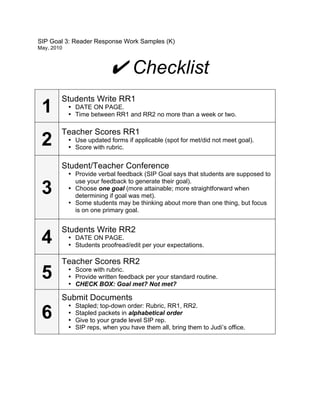
   • Checklist for Kindergarten Reader Responses (1 page)

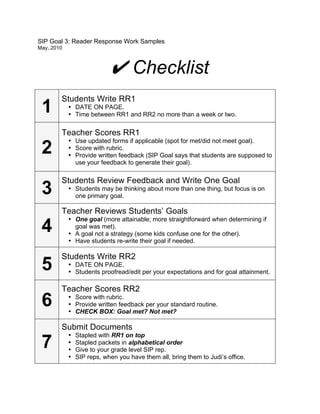
   • Checklist for 1st – 5th grade Reader Responses (1 page)

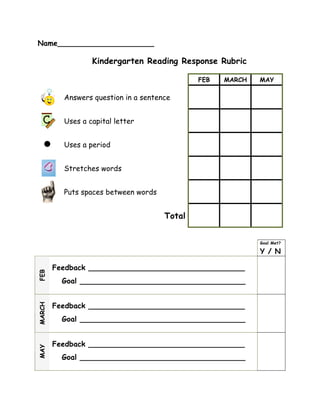
   • Kindergarten rubric and reporting form (1 page)

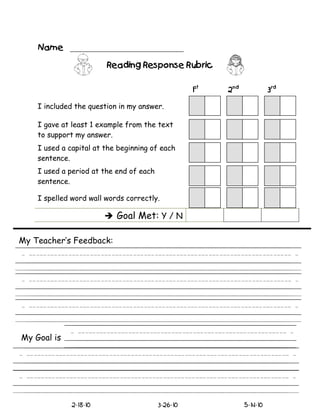
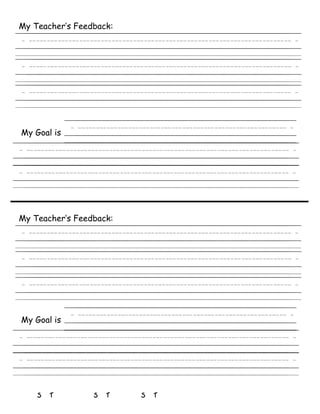
   • 1st grade rubric and reporting form (2 pages)

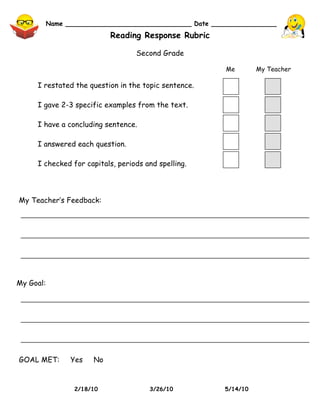
   • 2nd grade rubric and reporting form (2 pages)

   • 3rd/5th grade rubric and reporting form (1 page)

   • 4th grade rubric and reporting form (2 pages)
SIP Goal 3: Reader Response Work Samples (K)
May, 2010


                             ✔ Checklist
        Students Write RR1
 1          • DATE ON PAGE.
            • Time between RR1 and RR2 no more than a week or two.

        Teacher Scores RR1
 2          • Use updated forms if applicable (spot for met/did not meet goal).
            • Score with rubric.


        Student/Teacher Conference
            • Provide verbal feedback (SIP Goal says that students are supposed to

 3
              use your feedback to generate their goal).
            • Choose one goal (more attainable; more straightforward when
              determining if goal was met).
            • Some students may be thinking about more than one thing, but focus
              is on one primary goal.


        Students Write RR2
 4          • DATE ON PAGE.
            • Students proofread/edit per your expectations.

        Teacher Scores RR2
 5          • Score with rubric.
            • Provide written feedback per your standard routine.
            • CHECK BOX: Goal met? Not met?

        Submit Documents

 6
            •   Stapled; top-down order: Rubric, RR1, RR2.
            •   Stapled packets in alphabetical order
            •   Give to your grade level SIP rep.
            •   SIP reps, when you have them all, bring them to Judi’s office.
SIP Goal 3: Reader Response Work Samples
May, 2010


                             ✔ Checklist
        Students Write RR1
 1          • DATE ON PAGE.
            • Time between RR1 and RR2 no more than a week or two.

        Teacher Scores RR1

 2
            • Use updated forms if applicable (spot for met/did not meet goal).
            • Score with rubric.
            • Provide written feedback (SIP Goal says that students are supposed to
              use your feedback to generate their goal).

        Students Review Feedback and Write One Goal
 3          • Students may be thinking about more than one thing, but focus is on
              one primary goal.

        Teacher Reviews Students’ Goals

 4
            • One goal (more attainable; more straightforward when determining if
              goal was met).
            • A goal not a strategy (some kids confuse one for the other).
            • Have students re-write their goal if needed.

        Students Write RR2
 5          • DATE ON PAGE.
            • Students proofread/edit per your expectations and for goal attainment.

        Teacher Scores RR2
 6          • Score with rubric.
            • Provide written feedback per your standard routine.
            • CHECK BOX: Goal met? Not met?

        Submit Documents

 7
            •   Stapled with RR1 on top
            •   Stapled packets in alphabetical order
            •   Give to your grade level SIP rep.
            •   SIP reps, when you have them all, bring them to Judi’s office.
Name_____________________

                  Kindergarten Reading Response Rubric

                                              FEB   MARCH   MAY

          Answers question in a sentence


          Uses a capital letter


   !      Uses a period


          Stretches words


          Puts spaces between words


                                      Total


                                                            Goal Met?

                                                            Y / N

        Feedback __________________________________
FEB


          Goal ____________________________________


        Feedback __________________________________
MARCH


          Goal ____________________________________


        Feedback __________________________________
MAY


          Goal ____________________________________
!
       !

       "#$%                 !


                                                                 &%#'()*!&%+,-)+%!&./0(1                                                                   !


       !!!!!!!!!!!!!!!!!!!!!!!!!!!!!!!!!!!!!!!!!!!!!!!!!!!!!!!!!!!!!!!!!!!!!!!!!!!!!!!!!!!!!!!!!!!!!!!!!!!!!!!!!!!!!!!!!!!!!!!!!!!!!!!!!!!!!!!!!!!!!!!!!!!!!!!!!!!!!!!!
       !                                                                                                                               !!2+3!                         !4)'!                !!50'!

       !"#$%&'()("*+)",')-*#.$"#$"/0"1$-2)34"
                                                                                                                                                                  !                    !            !
       !"516)"1*"&)1-*"7")81/9&)":3./"*+)"*)8*""
       *."-'99.3*"/0"1$-2)34"                                                                                                                                     !                    !            !
       !"'-)("1"%19#*1&"1*"*+)";)5#$$#$5".:")1%+"
       -)$*)$%)4"                                                                                                                                                 !                    !            !
       !"'-)("1"9)3#.("1*"*+)")$(".:")1%+"
       -)$*)$%)4"                                                                                                                                                 !                    !            !
       !"-9)&&)("2.3("21&&"2.3(-"%.33)%*&04"
                                                                                                                                                                  !                    !            !
                                                               ! "<.1&"=)*>"?"@"A""?"@"A"
                                                                                   !                                                                                  !                    !
   !
!"#$%&'(%)*+#,%%-.&'/0"

!!!!!!!!!!!!!!!!!!!!!!!!!!
 !!!!!!!!!!!!!!!!!!!!!!!!!
 !!!!!!!!!!!!!!!!!!!!!!!!!"
     "!!!!!!!!!!!!!!!!!!!!"
=0"<.1&"#-!

 !!!!!!!!!!!!!!!!!!!!!!!!!"
 !!!!!!!!!!!!!!!!!!!!!!!!!"
       !
       !!!!!!!!!!!!!!!!!!!!!!!!4627628! !                             !               !               !!!!!5649628!                   !               !               !!!!!!!!!!!!!:62;628!
!
!"#$%&'(%)*+#,%%-.&'/0!

!!!!!!!!!!!!!!!!!!!!!!!!!!
 !!!!!!!!!!!!!!!!!!!!!!!!!
 !!!!!!!!!!!!!!!!!!!!!!!!!"
    "
    "
    "
    "
    "
"
"
"


    "#!$%&'!()!     "!!!!!!!!!!!!!!!!!!!!"
    !!!!!!!!!!!!!!!!!!!!!!!!!"
    !!!!!!!!!!!!!!!!!!!!!!!!!"
        !
        !
        !
!"#$%&'(%)*+#,%%-.&'/0!

!!!!!!!!!!!!!!!!!!!!!!!!!!
 !!!!!!!!!!!!!!!!!!!!!!!!!
 !!!!!!!!!!!!!!!!!!!!!!!!!"
    "
"
"
"


     "!!!!!!!!!!!!!!!!!!!!"
    "#!$%&'!()!

 !!!!!!!!!!!!!!!!!!!!!!!!!"
 !!!!!!!!!!!!!!!!!!!!!!!!!"
        !
        !
        "!!!!!!#!     !   "!!!!!!#!!!!!!!!!!!!!!!!!!!!!!"!!!!!!#!
        !
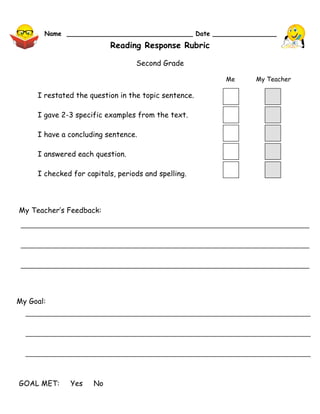
Name ________________________________ Date ___________________

      !                     Reading Response Rubric                             !

                                  Second Grade

                                                         Me        My Teacher

     I restated the question in the topic sentence.

     I gave 2-3 specific examples from the text.

     I have a concluding sentence.

     I answered each question.

     I checked for capitals, periods and spelling.


My Teacher’s Feedback:
 _____________________________________________________________________

 _____________________________________________________________________

 _____________________________________________________________________


My Goal:

 _____________________________________________________________________

 _____________________________________________________________________

 _____________________________________________________________________

GOAL MET:        Yes   No


                  2/18/10             3/26/10            5/14/10
Name ________________________________ Date ___________________

      !                    Reading Response Rubric                          !

                                  Second Grade

                                                        Me     My Teacher

     I restated the question in the topic sentence.

     I gave 2-3 specific examples from the text.

     I have a concluding sentence.

     I answered each question.

     I checked for capitals, periods and spelling.


My Teacher’s Feedback:
 _____________________________________________________________________

 _____________________________________________________________________

 _____________________________________________________________________


My Goal:
  _____________________________________________________________________

  _____________________________________________________________________

  _____________________________________________________________________


GOAL MET:       Yes   No
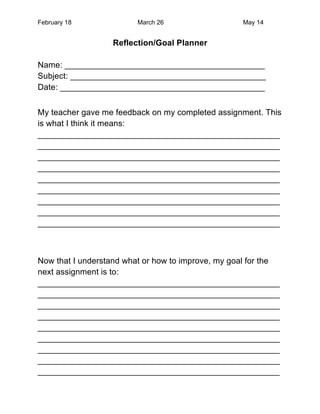
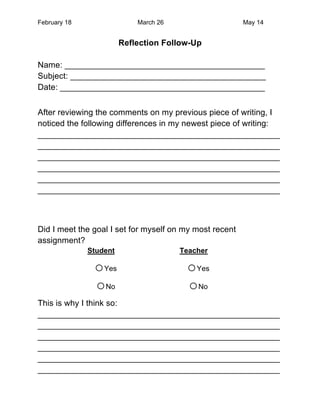
February 18                                       March 26                                      May 14


                           Reflection/Goal Planner/Follow-Up
Name: ___________________________________________
Subject: __________________________________________
Date: ____________________________________________


My teacher gave me feedback on my completed assignment. This is what I think it means:
_____________________________________________________________________________
_____________________________________________________________________________
_____________________________________________________________________________


Now that I understand what or how to improve, my goal for the next assignment is to:
_____________________________________________________________________________
_____________________________________________________________________________
_____________________________________________________________________________


!"#$%&%$'($)(*+&#,$&-.//$*#0&.*&/1&2%$'(.30&2($-$&."&)%(#(*+4&5&*.#(-$6&#,$&
".77.)(*+&6(""$%$*-$0&(*&/1&*$)$0#&2($-$&."&)%(#(*+8&

    !" #################################################################################################
       ###############################################$
    %" #################################################################################################
       ###############################################$

9(6&5&/$$#&#,$&+.:7&5&0$#&".%&/10$7"&.*&/1&/.0#&%$-$*#&:00(+*/$*#;&


$                                             $
                 <#36$*#&                                      =$:-,$%&

    o &'($                                          o &'($
    o )*$                                           o )*$
                      $
February 18              March 26                  May 14


                  Reflection/Goal Planner

Name: ___________________________________________
Subject: __________________________________________
Date: ____________________________________________


My teacher gave me feedback on my completed assignment. This
is what I think it means:
____________________________________________________
____________________________________________________
____________________________________________________
____________________________________________________
____________________________________________________
____________________________________________________
____________________________________________________
____________________________________________________
____________________________________________________


Now that I understand what or how to improve, my goal for the
next assignment is to:
____________________________________________________
____________________________________________________
____________________________________________________
____________________________________________________
____________________________________________________
____________________________________________________
____________________________________________________
____________________________________________________
____________________________________________________
February 18                 March 26                     May 14


                        Reflection Follow-Up

Name: ___________________________________________
Subject: __________________________________________
Date: ____________________________________________


After reviewing the comments on my previous piece of writing, I
noticed the following differences in my newest piece of writing:
____________________________________________________
____________________________________________________
____________________________________________________
____________________________________________________
____________________________________________________
____________________________________________________


Did I meet the goal I set for myself on my most recent
assignment?
              Student                  Teacher

               o Yes                    o Yes
               o No                     o No
This is why I think so:
____________________________________________________
____________________________________________________
____________________________________________________
____________________________________________________
____________________________________________________
____________________________________________________
1W                                       Page 1


 2009-10         February                    March                   May

                Goal   Score Score     Goal   Score Score     Goal   Score Score
  Student       met      1     2       met?     1     2       met?     1     2
      1         No      3       2.5    No       5      4
      2         No      4.5     4.5    No       5      4.5
      3         No      2.5     3.5     ?      4.5     5
      4         Yes     3.5     3      N/A      2     N/A
      5         No      5       4.5    Yes     3.5     4.5
      6         Yes     4.5     5       ?      4.5     4.5
      7         Yes     3       4.5    Yes      4      5
      8         No      4.5     4.5    Yes      5      5
      9         Yes     4       3.5    Yes     3.5     4.5
     10         Yes     2.5     2      No       4      2.5
     11         No      4       4      Yes     4.5     5
     12         Yes     4       4.5    Yes     4.5     4
     13         No      5       4       ?      4.5     4.5
     14         Yes     5       4.5    Yes      2      4
     15         No      4.5     3.5    Yes     3.5     3.5
     16         No      2       3.5    No       5      4
     17         Yes     4.5     3.5    Yes      4      4
     18         Yes     4.5     4.5    Yes     4.5     5
     19         No      4       2      No       2      3
     20         No      3       2      Yes     2.5     3.5


  Goal Met:      9     45.0%            11    68.8%            0     #DIV/0!
Goal Not Met:   11     55.0%             5    31.3%            0     #DIV/0!


            MEAN:      3.875   3.675           3.9    4.211          #### ####
          MEDIAN:       4      3.75            4.25    4.5           #NUM! #NUM!
            MODE:       4.5     4.5            4.5     4             #N/A      #N/A
Standard Deviation:    0.916   0.95           1.034   0.713          #### ####
Fun with Data!!!
Attached you will find a breakdown of scores for students in your class for SIP Goal 3
Reader Responses in February and March. A brief translation for you …


        Mean       We used to call this the average when I was in school

        Median     If you line up all the numbers, from least to greatest, this is the
                   number that is right in the middle.

        Mode       This is the number/score that recurs most frequently – more kids
                   in your class got this score than any other score.

       Standard    Think of a bell curve. Standard deviation divides the curve
       Deviation   vertically. Most kids are in the middle with fewer and fewer as you
                   go outward. The larger the standard deviation, the more spread
                   out your kids’ scores were. The smaller the standard deviation is,
                   the more scores were clumped together – not so many outliers.


About student scores:
   •    In most classrooms, the first February Reader Response (RR) had the lowest
        mean and greatest standard deviation.
   •    From the first RR to the second RR, 14 of 17 classrooms showed an increase in
        mean score – higher achievement. 12 of 17 showed a decrease in standard
        deviation – scores are more “clumped” toward the middle.
   •    From the second RR in February to the first RR in March, nine of 17 classrooms
        showed a slight regression in mean score (lower achievement) and 11 of 17
        classrooms showed an increase in standard deviation (more highs and lows).
   •    In 17 of 21 classrooms, the highest mean score was on the second RR in March.
        On the whole, student achievement improved over time with fewer outliers and
        greater consistency among student scores.
Other Info:
The grey box means the student did not do one or both of the Reading Responses. We
are pretending that those children don’t exist – statistically. It doesn’t “count against
you” since numbers are crunched for only the kids who completed the activity.
For the first two submissions, some grade levels used rubric pages that included a spot
to indicate whether or not the goal was met. For those who did not, we used our best
judgment, based on your comments and rubric scores, to determine if goals were met or
not. For this last one, all grade levels/teachers will indicate whether or not the goal was
met. Don’t worry about Feb/March stats but if you REALLY want to go through old work
samples and determine goal achievement, I will re-enter that data.
Project Cost


Ferdon and Associates, Inc.
                                 ----- INVOICE -----
May 4, 2010

Claudia Kessel
Business Manager, Springfield Public Schools
1776 Independence Avenue
Anytown, U.S.A.

RE: Evaluation Services


Dear Ms.Kessel:
First Street School Evaluation Project is now complete. Please remit the following funds
for evaluation services rendered:

       $ 8,000      Lead Evaluator, 16 days @$500/day
       $ 35         Telephone expenses
       $ 200        Personal Assistant, 10 days @$20/day


       $ 8,235    Total


Please make check payable to Susan Ferdon and send to the following address:
Susan Ferdon
My House
My Town, U.S.A.


Sincerely,
Susan Ferdon, Lead Evaluator
555-123-4567
sferdon@evalisfun.com

505ferdon evalproject

  • 1.
    Springfield Public Schools Springfield, USA Evaluation Report First Street Elementary School 2009-2010 School Improvement Plan - Goal 3 May 4, 2010 Report prepared by Susan Ferdon Faculty Member, First Street Elementary School Graduate Student, Master of Educational Technology Program Boise State University Report Submitted to First Street School Improvement Planning Team
  • 2.
    Table of Contents Acknowledgements . . . . . . . . . . . . . . . . . . . . . . . . . . . . . . . . . . . . . page i Introduction . . . . . . . . . . . . . . . . . . . . . . . . . . . . . . . . . . . . . . . . . . . page 1 Program Description . . . . . . . . . . . . . . . . . . . . . . . . . . . . . . . . . . . . page 2 Evaluation Methods .................................... page 3 Participants page 3 Procedures page 3 Data Sources page 4 Results . . . . . . . . . . . . . . . . . . . . . . . . . . . . . . . . . . . . . . . . . . . . . . page 4 Objectives and Activities page 4 Teacher Feedback page 6 Student Goals page 7 Student Achievement page 8 Goal Attainment page 9 Discussion . . . . . . . . . . . . . . . . . . . . . . . . . . . . . . . . . . . . . . . . . . . page 9 Appendices Appendix A First Street 2009-2010 School Improvement page 13 Plan, Goal 3 Appendix B First Street SIP Presentation to BOE, October page 17 2009 (excerpt) Appendix C April 7th Report to SIP Team page 19 Appendix D April 27th Report to SIP Sub-Committee page 26 Appendix E Checklists and Revised Forms page 30 Appendix F Sample Teacher Report page 38 Appendix G Invoice Page 40
  • 3.
    Acknowledgements Evaluation is atask best completed with program developers, program staff, and the evaluator working in harmony. My experiences as I worked with First Street’s SIP Team could not have been more positive. Their input, assistance and support have been invaluable. I would like to thank Janet Lange (principal) for permitting me to apply my burgeoning evaluative skills to a program at First Street. I am grateful to be able to use what I am learning in my graduate coursework on program evaluation in a manner that can potentially benefit our school. I would also like to thank the SIP Team for their time, effort, and contributions to this process. Additional meetings, communication and planning with their grade level teams, assistance in gathering work samples, and following-up with teammates as questions arose, are just a few of the things they have done that have aided in the planning and evaluation processes. Thanks also go to the office staff for assistance ordering and labeling work samples and copying documents and reports to be distributed to SIP Team members and building staff. Finally, special thanks go to my personal assistant, Kate. Her help with numerous tasks have allowed me to make efficient use of my time as I worked on this project. I
  • 4.
    
 Introduction The program beingevaluated is First Street’s School Improvement Plan, Goal 3, for 2009-2010 (Appendix A). Required by the Illinois State Board of Education (ISBE) for schools in academic status, the submission of a School Improvement Plan is optional but recommended, for schools that are not (http://www.isbe.net/sos/htmls/school.htm). In Springfield schools, School Improvement Plans provide structure for continuous improvement of instruction. SIP Goal 3 is an outgrowth of a 2008-2009 goal which focused on improving teacher feedback and students’ ability to correctly interpret teacher feedback. It was found that “while 88.6% of First Street students, including kindergarten students, met the goal of correctly interpreting their teachers’ feedback on a specific writing assignment, more instruction and practice is needed in order for students to understand the link between feedback and subsequent learning and improvement” (SIP Goal 3, p. 3). For 2009-2010, the goal was expanded to include student-generated learning goals and subsequent reflection on those goals. The objective for SIP Goal 3 is that “all students will learn how to reflect after receiving specific and timely feedback from their teachers; and all students will learn how to use these personal reflections to generate their own specific learning goal(s) for their next assignment. When subsequent assignments are assessed, it will be noted that students tied their improvement to their goal based on prior feedback” (SIP Plan, p. 3). The SIP Team identified Reader Response (RR) writing assignments, administered three times during the year, as the data collection tool. Following each of the first two iterations of the cycle, data were analyzed and recommendations made to the SIP Team regarding improvements to this process. Though the primary focus of this evaluation was ultimately narrowed to student goal attainment, a wider view of Goal 3 components is also presented. Evaluation Timeline: March 8th Evaluator meets with First Street principal to discuss the three SIP goals and select one to focus on for this evaluation. March 11th SIP sub-committee meets for preliminary planning. March 15th Analysis of February work samples begins. April 7th Presentation of initial findings/recommendations to SIP Team. April SIP Team brings recommendations to grade level teams, new work samples are submitted, and data are analyzed. April 27th Presentation of findings and final recommendations to SIP sub-committee. May 4th Presentation of checklists and updated guidelines to faculty. 
 1
  • 5.
    
 This evaluation andrelated reports serve several purposes: 1) To determine how comprehensively SIP Goal 3 has been addressed thus far, 2) To document recommendations made regarding administration of Goal 3 assessments, 3) To share February and March Reader Response information and data, and 4) To provide detailed program information which may be used by First Street’s incoming principal for fall 2010 reporting and goal-setting. Program Description The SIP Team selected Reader Response writing assignments, with work samples submitted in February, March, and May, as a means of collecting data. The Team developed a framework for the process that would be followed and established guidelines for the generation of related documents. Grade level teams used that information to create grade-specific forms used by teachers and students in grades K - 5 for the Feedback/Goal/Reflection cycle (Appendix E). For each set of writing assignments, students read a story or article and wrote a response to a prompt. Teachers provided feedback and used district-approved rubrics to score responses. Student then reflected on feedback and identified a goal. Next, students read a second story or article and, with their goal in mind, wrote a response to another prompt. The teacher graded the second response and students reflected on the achievement of their goal. While the process followed was the same for all grade levels, procedures varied from one grade level to another due to the developmental nature of reading and writing skills and the age-range (K-5) of the students who participated in this program. Whereas kindergarten teachers provided verbal feedback and acted as scribes for goal setting, students were expected to be increasingly independent in successive grade levels and over time. At the point that the evaluator entered the process, February work samples had been collected. In initial meetings with the principal and SIP Team, three evaluation questions were identified: 1. What modifications can be made to clarify and standardize procedures and processes teachers and students will follow when completing the next two Reader Response writing assignments? 2. What data can be extracted from Reader Response work samples/feedback in order to report on this goal? 3. What additional information/data is needed and how can we collect it? 
 2
  • 6.
    
 Evaluation Methods Participants It wasinitially expected that all students and classroom teachers would participate: 73 - kindergarteners, 81 - 1st graders, 82 - 2nd graders, 104 - 3rd graders, 81 - 4th graders, 98 - 5th graders, and 23 teachers. It was found that student participation was not compatible with the Read 180 program, a replacement program that coincides with classroom Language Arts instruction. 2009 Data SCHOOL DISTRICT STATE LEP (Limited English 1.50% 0.70% 8% Proficient) Low Income 0.80% 0.30% 42.90% Parental 100% 100% 96.70% Involvement Attendance 96% 95.90% 93.70% Mobility 3.70% 1.90% 13.50% Table 1: First Street Educational Environment Figure 1: First Street Demographics Source: Interactive Illinois Report Card


Source: Illinois Interactive Report Card - Profile Procedures Phase I • A discrepancy model was used to identify potential gaps between stated objectives and current practice. SIP Goal 3 (Appendix A) and the fall 2009 Board of Education Presentation (Appendix B) were used to establish objectives and evidence was collected through observation and informal interviews. • February work samples had already been submitted: initial writing assignment, teacher feedback, rubric scores, and information related to goal attainment. o Teacher feedback was examined and trends were noted. o Student goals were examined for quantity, measurability, and to determine what feedback was used in the goal selection process. o Student achievement was examined with individual student scores entered into spreadsheets and mean, median, mode and standard deviation calculated for each classroom of students. o Goal attainment was examined via student and teacher reporting and that information was compared against rubric scores when possible. • Preliminary findings were reported to the SIP Team on April 7th, along with recommendations for the next Feedback/Goal/Reflection cycle (Appendix C). 
 3
  • 7.
    
 Phase II • Based upon April 7th recommendations, some changes were made in the Feedback/Goal/Reflection process, resulting in greater standardization of processes and practices within each grade level. • Work samples from the second iteration of the Feedback/Goal/Reflection cycle were examined. o Student goals were examined, as above, but only for measurability. Problematic goals were noted. o Student achievement and goal attainment data collected and entered into spreadsheets. • Findings were reported to the SIP subcommittee (Appendix D) with further recommendations for the final Feedback/Goal/Reflection cycle. Data Sources Copies of documents* may be found in the Appendices. SIP Goal 3* Document submitted to ISBE includes objectives, strategies, activities and monitoring process identified to meet the stated goal. BOE Presentation* PowerPoint presentation to the School Board includes intended processes and tasks related to SIP Goal 3. Reader Responses Student work samples; typically the writing prompt is included. Teacher feedback is frequently written directly on student work. Rubrics* Grade-specific, district-approved. Teacher feedback is frequently written in white space on this form. Feedback/Goal- Grade-specific forms used for students to re-state teacher feedback and Setting Forms* identify a goal. Some forms include subsequent reflection and space to indicate whether or not goal was met. Results Objectives and Activities A discrepancy model was used to note differences between objectives stated in SIP Goal 3, the School Board presentation, and related activities that took place. Additional details were presented to the SIP Team on April 7th (Appendix C). The focus of this evaluation is on part A, Student Strategies and Activities. Parts C, D and E, Professional Development, Parent Involvement, and Monitoring, are not addressed. 
 4
  • 8.
    Objective: All students will learn how to reflect after receiving specific and timely feedback from their teachers; and all students will learn how to use these personal reflections to generate their own specific learning goal(s) for their next assignment. When subsequent assignments are assessed, it will be noted that students tied their improvement to their goal based on prior feedback. Strategies and Activities: SIP Goal 3 1. All students will take time to reflect on their teachers’ feedback and will briefly summarize the main idea of the feedback. ✔ 2. Using this reflection statement, students will generate learning goals … ✔ 3. Students will generate specific action plans for goal accomplishment … NA 4. Students will generate a plan for self-assessment. NA 5. Students will confer with teachers, demonstrating their understanding of the feedback and need for improvement. ✔ 6. Students will use a reflection and goal setting planner. ✔ Students will: BOE Presentation • continue to work on using feedback effectively by using their reflection planners with greater frequency for subsequent assignments. ND • practice using feedback on writing assignments across the curriculum. ND To accomplish this: • teachers will continue to increase and strengthen the specificity of feedback they give to students. NA • students will need to refer to prior feedback before beginning work on subsequent assignments. ✔ • students and teachers will need to assess whether the need, the feedback, the goal and subsequent improvement are aligned. ✔ Table 2: Discrepancies KEY: ✔ = Evidence supports that this objective/strategy/activity was adequately addressed. NA = Evidence supports that this objective/strategy/activity was not addressed. ND = No data was collected. Within stated program objectives, four components emerged as topics of interest: teacher feedback, student goals, student achievement, and goal attainment. For the first report to the SIP Team, information had been gathered for each of these four topics. Following the second report, the focus was on goal attainment. 
 5
  • 9.
    
 Teacher Feedback Content ofwritten feedback for the first RR in February was examined. Trends were noted in relation to patterns, detail, and quantity. It was determined that future focus would not include feedback, so March information was not collected. Teacher Overview of Feedback Provided to Students in February Same feedback across the board. 1st: "Use more of the question in your answer," and/or 1 "Why did Celina feel ___." 2nd: "Remember to use an example to support your answer." Feedback frequently re-states the rubric and includes a question related to prompt - “How 2 do you know …?” 1st feedback: "You did a good/great job … Next time …" 2nd feedback: "Next time …" 3 Each time comment duplicated rubric info. Positive statement then "remember to …" 2nd time: Positive statement/goal achieved 4 followed by "keep trying to…" or "let's keep working on..." 5 When feedback on rubric page is the same, comments on student work differs. Teacher feedback on student pages differs from rubric - adds text as examples plus editing 6 marks. 7 Feedback frequently limited; typically spelling and punctuation. 8 Starts with positives and goes into detail regarding areas of improvement. 9 Feedback limited and brief, underlined words on the rubric. Spelling, grammar and word choice feedback on student page. Comments (organization, 10 content) on rubric page. Something positive included on each. st Aside from two “answer the question” comments, there is no teacher feedback on 1 11 response. Rubric score for all; different rubrics were used each time. Feedback is evenly split between spelling/punctuation and content. Comments are most 12 often directives or questions. No feedback on student work or score sheet. Rubric score for all, occasional editing marks 13 (paragraph, capital) for some. Detailed written feedback does not duplicate rubric. Mix of positive comments and 14 suggestions for improvement. 15 Feedback typically one sentence plus rubric score, with nothing written on student page. 16 (no work samples submitted in February) 17 Feedback is most often a one-sentence directive and editing marks. 18 Detailed written feedback on student work plus editing marks. 19 Detailed written feedback on student work plus editing marks. st 20 Written feedback on 1 , responses not graded (no rubric). Most have a sentence or two of written feedback on student page. Some are rubric number 21 score only. Table 3: Summary of teacher feedback 
 6
  • 10.
    
 Student Goals Feedback/Goal-Setting formswere the source of student goal data. The number of goals each student generated (how many students wrote one goal, how many wrote two, etc.) was counted as were the number of troublesome goals generated (non-goals, not measurable). Goals deemed “inappropriate” by schools standards also were noted and examples are included below. The recommendation was made to limit students to one goal for May because most students with multiple goals met some goals but not others, resulting in “not met” categorization. Number of Goals: One Two Three Goal Goals Goals K 49.2% 38.5% 12.3% 1 97.4% 2.6% 0.0% 2 68.4% 30.3% 1.3% 3 64.3% 28.6% 7.1% 4 50.0% 37.5% 12.5% 5 56.3% 36.6% 7.0% Table 4: Number of Goals by Grade Figure 2: Number of Goals, K-5 Source of Goals: Teacher feedback and student goals were compared to ascertain sources used to generate goals. Most often, goals were based on comments. For students in 1st and 2nd grade, goals were typically copied word-for-word from whatever the teacher wrote on the page. While this was most common in the primary grades, it was common practice at all grade levels. “Neither” was listed when it was not apparent where the goal came from. Kindergarten feedback was verbal so it is not included. Comment Rubric Both Neither 1 94.8% 1.3% 0.0% 3.9% 2 73.7% 9.2% 14.5% 2.6% 3 34.9% 38.4% 7.0% 19.8% 4 42.6% 8.5% 31.9% 17.0% 5 58.0% 10.1% 18.8% 13.0% Table 5: Source of Goals by Grade Figure 3: Source of Goals, K-5 
 7
  • 11.
    
 Troublesome Goals: In Februarywork samples, 10% of student goals (34 of 346) were found to be troublesome. In the initial report, that information was shared and SIP Team members reported back to grade level teams. In March work samples, that number was reduced to 4% (17 of 441). e Quantity Comments K 0 1 1 Most of these “goals” are actually strategies; some cannot be measured (“I will re- 2 13 read my sentences”). Many of these “goals” are also strategies. Some are what is considered an 3 24 inappropriate goal at First Street (e.g., “get at least 8 points” “Use the writing I’m supposed to use”). 4 8 Seven are strategies and one (“make my Reading Response better”) is not. Three are strategies and two (“do what I did on this assignment and keep it up” and 5 5 “do everything my teacher told me to do”) are not. Table 6: Troublesome Student-Generated Goals Student Achievement Rubric scores were used to track individual student achievement with mean, median, mode and standard deviation calculated for each classroom. Grading practices may vary between teachers and comparison between groups of students was not desired, so teachers receive student-specific information (Appendix F) and achievement data is reported more generally to others. In most classrooms, the first February Reader Response (RR) had the lowest mean and greatest standard deviation. From the first RR to the second RR, 14 of 17 classrooms showed an increase in mean score – higher achievement. 12 of 17 showed a decrease in standard deviation – scores are more “clumped” toward the middle. From the second RR in February to the first RR in March, nine of 17 classrooms showed a slight regression in mean score (lower achievement) and 11 of 17 classrooms showed an increase in standard deviation (more highs and lows). In 17 of 21 classrooms, the highest mean score was on the second RR in March. On the whole, student achievement improved over time with fewer outliers and greater consistency among student scores. 
 8
  • 12.
    ! Goal Attainment Goal attainmentwas examined via student and teacher reporting and information was compared against rubric scores when possible. FEBRUARY MARCH Goal Not Goal Not Met Met Met Met K 57.7% 42.3% 1 54.9% 45.1% 65.3% 34.7% 2 61.1% 38.9% 69.6% 30.4% 3 84.3% 15.7% 89.3% 10.7% 4 70.0% 30.0% 81.4% 18.6% 5 82.9% 17.1% 85.3% 14.7% Table 7: Goal Attainment by Grade Figure 4: Goal Attainment, K-5 Discussion The purpose of this study was to provide the First Street SIP Team with recommendations regarding the refinement of student activities and data collection for SIP Goal 3. Examining processes and content allowed for mid-course corrections that, in turn, provided the SIP Team with increasingly consistent and usable data. Analysis of February work samples showed that there were some disparities within and between grade levels in terms of procedures that were being followed and data that were collected. Some differences between grade levels were suitable and expected, like additional conferencing and teacher involvement needed in kindergarten, but others were not: • In K – 2nd grade, there was one week, at most, between the two RRs. In 3rd and 4th grades that span could be as much as several months. Too many other variables would affect the comparison of rubric scores from the first RR to the second, so a guideline was put into place limiting the interval between RR1 and RR2. • In 4th grade, there was no place on the form to indicate if the teacher thought the goal was met and that form was also used by some 5th grade teachers. • 5th grade required more of an overhaul – some work was scored with a rubric and some was not. Some teachers used the 3rd grade form and others used the 4th grade form and different information was collected on each. Sometimes comments were very brief and there wasn’t anything we could measure. For one classroom, RR2 was a revision of RR1 – students used teacher feedback to edit the same piece of writing – and everyone else had two separate writing pieces. A large packet was submitted, of which just a few pages related to the RRs. ! 9!
  • 13.
    ! Routines needed tomore firmly established to allow for greater consistency within each grade level and make sure that each was aligned with what others were doing, as appropriate. Recommendations related to standardization, made following the February RRs, were put into place for March RRs. For the March work samples, all teachers scored student work with a rubric and the same forms were now being used across each grade level. Two concerns remained however, and they related to goal attainment and feedback. The primary piece of data that the SIP Team will report to the School Board is goal attainment but only the forms used by 3rd and 5th grades had a place for students and teachers to indicate if the goal was met. The form used by 4th grade had a place for students to indicate if the goal was met, but there was no way to determine if the teacher was in agreement. Forms used by kindergarten, 1st and 2nd grades did not include a place to report goal attainment. The other concern was the amount of written feedback. Goal 3 states that students will use teacher feedback to generate a goal and some teachers did not provide feedback – just a rubric score or perhaps words circled on the rubric. A checklist (Appendix E) for the May collection was created, then shared with the staff and discussed at the May 4th faculty meeting, as a means of addressing these inconsistencies as well as some smaller details. Following the April 7th report, the SIP Team decided to focus primarily on student goal attainment and continuing to refine the RR process. Discussion of other information that had been collected is included below. Presenting a discussion of these more general themes is provided here as a means of assisting the SIP Team and First Street’s new principal in the identification of future goals. Objectives and Activities SIP Goal 3 states that students will generate specific action plans for goal attainment as well as a plan for self-assessment but both were absent from this process. Teachers may well have done those things, but it was not an intentional part of program planning. Being more deliberate about including that step may prove beneficial should this feedback goal be extended. Teacher Feedback As was noted in the results section, teacher feedback was sometimes a restatement of what was on the rubric. While this is not always desired, there are times when it is. Younger and less experienced writers may benefit from this additional emphasis. Seeing and hearing information multiple times, and in different ways, will help drive those points home. Further, if the teacher comments on the sole item that students didn’t get points for, and many students need work on that same area, one would expect duplications. Wording in SIP Goal 3 and the Board presentation said that teachers would continue to increase and strengthen the specificity of feedback, but content of teacher feedback ! 10!
  • 14.
    ! was not addressedin program activities. The book that First Street faculty read and discussed in 2008-2009, How to Give Effective Feedback to Your Students, written by Susan M. Brookhart and published by the Association for Supervision and Curriculum Development, lists specific criteria for rating feedback on elementary writing assignments (pages 79-82). This would be a fine resource to utilize again, should the SIP Team choose to address strength and specificity of teacher feedback. Student Goals Typically, students created appropriate goals that were based on teacher feedback and revisions. However, most often those goals were a word-for-word restatement of teacher feedback. For our younger students this is quite appropriate, but for older students it may not be. If content of student goals were to be addressed in future SIP goals, looking more closely at student ability to summarize or restate feedback may be appropriate for older students. Inter-rater Reliability As in any educational research, one must expect less-than-ideal research situations. Differences in teacher expectations and grading practices mean that rubric scores should be taken with a grain of salt. In some cases differences were more extreme than one might expect. Student scores were sometimes quite different even though the content of their responses was quite similar. For example, students in some classes got credit for citing sources when a text-specific example was mentioned, but others got credit only if a direct quote is used. Should the SIP Team choose to focus on inter-rater reliability in the future, the following topics may be a good place to start: • Spelling: How many mistakes can students make and still get the points? There was quite a difference of teacher opinion beginning in second grade. Where some teachers awarded points only for error-free work, others give full credit when there are several errors. Some teachers award partial credit and for others, it is all or nothing. • Citations: How much text can students “borrow” before you call it plagiarism or caution them about copying too much? There was a great deal of difference in terms of what was expected and what was allowed. A useful tool for the comparison of text is Quick Diff (http://www.quickdiff.com/index.php). Analysis of one work sample, which received full credit and positive feedback regarding details, showed that seven of the student’s ten sentences were identical to story text. • Concluding Sentence: What constitutes an acceptable concluding sentence? Where some teachers gave credit only for a re-statement of the topic sentence, others accepted any sentence that did not introduce new details. • Goal Attainment: Questions arose as to the criteria that must be met for a teacher to assign the “goal met” distinction. For some teachers, progress toward the goal or partially met goals (student had two goals and met one of them) were enough and for others it was not. ! 11!
  • 15.
    ! Additional Observations • Student Participation: There were several factors that influenced the number of students who submitted work samples. Some teachers had absent students make up the assignment and others did not. Further, the March submission was the week before Spring Break and there was higher-than-normal absenteeism. The percentage of students who submitted work samples averaged 96% for kindergarten, 96% for 1st grade, 91% for 2nd grade, 84% for 3rd grade, 90% for 4th grade, and 78% for 5th grade. Also, with Read 180 students (students below grade level in 3rd – 5th grades) and some younger special education students not participating, we must view results with the understanding that not all achievement levels are equally represented in the data. • Timing: With March submission due the last day before Spring Break, most classes had two or three fewer students complete the task. Now that the process has been refined, data collection could be more spread out. With many other district assessments in May, it would be easier on classroom teachers if the third/final submission fell earlier in the year. • Documents: SIP Team members had the forms for their grade level on their own computer and were responsible for disseminating documents to grade level peers. The original documents have been revised and it is suggested that they be accessible to all through the district’s new Collaborative Portal. • Inter-rater reliability is a universal concern and would be a formidable goal in and of its self. Though it may seem like there were more problems than solutions, the ability to focus on finer points is a tribute to tremendous amount that has already been accomplished. When the initial Reader Responses were completed in February grade-specific procedures were still in the development stages. While some of the procedural changes were somewhat extensive, they made it possible to collect useful and usable information for a goal that had been somewhat nebulous in the early planning stages. Data from the May Reading Response are looked forward to in anticipation! ! 12!
  • 16.
    Appendices •Appendix A: School Improvement Plan, Goal 3 (4 pages) • Appendix B: Board of Education Report (2 pages) • Appendix C: April 7th Report to SIP Team (7 pages) • Appendix D: April 27th Report to SIP Team (4 pages) • Appendix E: Checklists and Revised Forms (8 pages) • Appendix F: Sample Teacher Report (2 pages) • Appendix G: Invoice
  • 17.
    Appendix A: Kipling2009 - 2010 School Improvement Plan, Goal 3 School Improvement Plan 2009-2010 Goal Three/Kipling DISTRICT AND SCHOOL INFORMATION ! ! RCDT Code Number ________________________ School Name: KIPLING ELEMENTARY District Name: Deerfield Public Schools District 109 Principal: Judith A. Lindgren District Address:700 Kipling Place School Address: 700 Kipling Place City/State/Zip: Deerfield, IL 60015 City/State/Zip: Deerfield, IL 60015 Contact Person: Telephone: 847 948-5151 Ext. 1102 Email: Email: jlindgren@dps109.org ORIGINAL SUBMISSION__X___ AMENDED SUBMISSION _____ Is this for a Title I school? Yes______ No __X___ May ISBE use this SIP as a model? Yes__X___ No _____ I. BOARD APPROVAL AND ASSURANCES A. DATE APPROVED by Local Board ____________ (month/day/year) B. ASSURANCES 1. Strategies and activities have been founded in scientifically based research as required by, Section 1116(b)(3)(A)(i) and as defined in NCLB, Section 9101(37). 2. Technical assistance provided by the district serving the school is founded on scientifically based research (NCLB, Section 1116(b)(4)(C)) as defined in NCLB, Section 9101(37). 3. The plan includes strategies and activities that support the implementation of the Illinois Learning Standards and reflect the alignment of curriculum, instruction, and assessment with the Illinois Learning Standards. 4. The school will spend at least 10 percent of the funds made available under Section 1113 of NCLB, for the purpose of providing teachers and the principal high-quality professional development. (Title I schools only.) ____________________________________________Signature of LEA Superintendent October 2009
  • 18.
    2 I. PLAN DEVELOPMENT,REVIEW, AND IMPLEMENTATION A. School Support Team ! Kindergarten—Danna Friedlander First—Michelle Comitor Second—Meghan Trauten Third—Benjamin Lombardi Fourth—Jeanne Sayner Fifth—Moe Kaulentis PST—Jen Grady Literacy—Taryn Hartman Math—Nicole Tye TAP—Lynn Surico Parent Reps—Elaine Jacoby Administration—Judi Lindgren and Nancy Burnett B. Description of Parent Notification (Title I schools only) C. Description of Stakeholder Involvement D. Description of the Peer Review Process E. Description of the Teacher Mentoring Process F. Description of the District’s Responsibilities G. Description of the State’s Responsibilities III. DATA AND ANALYSIS A. Data Collection and Information 1. School Assessment and AYP Data 2. Other Data (optional) (e.g., information and data about the attributes and challenges of the school and community that have affected student learning; local assessment data; educator qualifications and professional growth and development data; and parent involvement data) October 2009
  • 19.
    3 B. Data Analysis While 88.6% of Kipling students, including kindergarten students, met the goal of correctly interpreting their teachers’ feedback on a specific writing assignment, more instruction and practice is needed in order for students to understand the link between feedback and subsequent learning and improvement. IV. ACTION PLAN OBJECTIVES FOR CONTINUOUS AND SUBSTANTIAL PROGRESS (COPY AS NEEDED) A. OBJECTIVE All students will learn how to reflect after receiving specific and timely feedback from their teachers; and all students will learn how to use these personal reflections to generate their own specific learning goal(s) for their next assignment. When subsequent assignments are assessed, it will be noted that students tied their improvement to their goal based on prior feedback. B. Student Strategies and Activities for this Objective TIMELINE BUDGET All students will take time to reflect on their teachers’ feedback and will briefly summarize the main idea of 2009-2010 the feedback. Using this reflection statement, students will generate learning goals, specific action plans for goal accomplishment and a plan for self assessment. Students will confer with teachers, demonstrating their understanding of the feedback and need for improvement. Students will use a reflection and goal setting planner. C. Professional Development Strategies and Activities for this Objective Time will be provided during faculty meetings for learning about the relationship of teacher feedback, time for student reflection and how this relates to students being self-directed in their learning. Time will be given to grade level teams to plan strategies for reflection and student goal setting. At follow-up faculty sessions, teachers will review the practices that were deemed effective and discuss strategies for improving student commitment to their goal progress. D. Parent Involvement Strategies and Activities for this Objective Parents will be informed about their child’s progress at each report card period, at the parent teacher conference, and at other times of the year whenever there is a need. Specific information will be given about their child’s goal attainment. Parents may be asked to follow up with home support. E. 1. Process for Monitoring the Effectiveness of the Strategies and Activities for this Objective October 2009
  • 20.
    4 Teachers will meetwith each student to review their goal progress. 2.Person(s) Overseeing the Strategies and Activities for this Objective The principal, each homeroom and specials teacher and various members of the staff will be involved as appropriate for strategizing. V. SCHOOL RESTRUCTURING PLAN A school which has failed to make AYP for a fifth annual calculation is required to develop a restructuring plan that must be implemented during the next year if the school fails to make AYP for the sixth annual calculation. Description of the School’s Plan for Restructuring – Does not apply. October 2009
  • 21.
    !"#"$%& AReview of 2008-2009 and An Introduction to 2009-2010 Percent of Students Who Met SIP Goal #3 Met Goal Did Not Meet Goal $&
  • 22.
    !"#"$%& !! …continue to work on using feedback effectively by using their reflection planners with greater frequency for subsequent assignments. !! …practice using feedback on writing assignments across the curriculum. !! …teachers will continue to increase and strengthen the specificity of feedback they give to students. !! …students will need to refer to prior feedback before beginning work on subsequent assignments. !! …students and teachers will need to assess whether the need, the feedback, the goal and subsequent improvement are aligned. '&
  • 23.
    !"#$%&&'()*+,-./0.'(1)$#/.))()*$2$34$5&617'$ 81./$9:7&&;$<==>?<=@=$ A67(/$B;$<=@=$ ! "#$%$!"$!&%$'! • 510)C$D)&$1E$5&.C()*$5&F61)F&$(F$G1H6/&'&I$ • !1H&$'&.G:&7F$G1H6/&'&C$510)C$9J1;$1':&7F$.7&$()$671*7&FF$':(F$J&&KI$LA$)0HM&7$1E$ F'0C&)'F$J&7&$.MF&)'$1)$107$<)C$'.7*&'$C.'&;$J:(G:$J.F$7(*:'$M&E17&$!67()*$N7&.KIO$ • P.'.$:.F$M&&)$60'$()'1$F67&.CF:&&'FI$@F'$.)C$<)C$*7.C&$.7&$E()(F:&C;$Q7C$.)C$R':$*7.C&$.7&$ 1-&7$./H1F'$E()(F:&C$2$':&7&$.7&$1)&$17$'J1$G/.FF&F$.'$':1F&$*7.C&$/&-&/F$)1'$S&'$&)'&7&CI$ 3()C&7*.7'&)$.)C$E(E':$*7.C&$:.-&)T'$M&&)$&)'&7&C$S&'$2$107$C(FG0FF(1)$'1C.S$J(//$ C&'&7H()&$:1J$J&$J(//$0F&+7&617'$':.'$()E17H.'(1)I$ $ "#()!"$*%$!+,-./!),!0,!1,2(3'! • 45$*6!7%$8-9-.(%3!:$;,%)$ $ !!!!!"#$!%#&'!()$**!+,!-../01.!2345*,32!6+''! ! G1)'()0&$'1$J17K$1)$0F()*$E&&CM.GK$&EE&G'(-&/S$MS$0F()*$':&(7$7&E/&G'(1)$ 6/.))&7F$J(':$*7&.'&7$E7&U0&)GS$E17$$F0MF&U0&)'$.FF(*)H&)'FI$ ! 67.G'(G&$0F()*$E&&CM.GK$1)$J7('()*$.FF(*)H&)'F$.G71FF$':&$G077(G0/0HI$ $ $$$$(#!&77#89'+2)!3)+2:!! ! '&.G:&7F$J(//$G1)'()0&$'1$()G7&.F&$.)C$F'7&)*':&)$':&$F6&G(E(G('S$1E$E&&CM.GK$ ':&S$*(-&$'1$F'0C&)'FI$ ! F'0C&)'F$J(//$)&&C$'1$7&E&7$'1$67(17$E&&CM.GK$M&E17&$M&*())()*$J17K$1)$ F0MF&U0&)'$.FF(*)H&)'FI$ ! F'0C&)'F$.)C$'&.G:&7F$J(//$)&&C$'1$.FF&FF$J:&':&7$':&$)&&C;$':&$E&&CM.GK;$':&$ *1./$.)C$F0MF&U0&)'$(H671-&H&)'$.7&$./(*)&CI$ $ ! <,,=!()!#,>!>#()!>$*?$!2,.$!@,..$@)6'! ! +,(8!1#%$$!4(36!A! 0,!"$!B(?$!0()(C! D,99$.)6!A! @I$!'0C&)'F$J(//$G1)'()0&$'1$ EF,! ")$.$6&7E&G'$J17/C;$('$J10/C$ J17K$1)$0F()*$E&&CM.GK$ M&$:.66&)()*$./7&.CSI$$ &EE&G'(-&/S$MS$0F()*$':&(7$ V1//&G'$J(':$.)&GC1'./$ 7&E/&G'(1)$6/.))&7F$J(':$ 7&G17CF$LW1'$.$U0(GK$/(F'OX$ *7&.'&7$E7&U0&)GS$E17$$ ")G/0C&$()$F07-&SX$ F0MF&U0&)'$.FF(*)H&)'FI$
  • 24.
    !"#$%&'()'*#+,)-.#/**01&'2#3-# !"#$ 8.&)-9#)-#&#:*%/*'(#43%709#)(# 4%)()-.#&,,).-5*-(,#&'%3,,# 43+70#1*#6&::*-)-.#&7%*&0;"## (6*#'+%%)'+7+5"# <377*'(#4)(6#&-*'03(&7# %*'3%0,#=>3(#&#?+)'2#7),(@A# B+%C*;A## D"#E*&'6*%,#4)77#'3-()-+*#(3# !%&'#F#G*#6&C*H4)77#6&C*# G*#-**0#&#%&()-.# )-'%*&,*#&-0#,(%*-.(6*-#(6*# (6*#/**01&'29#1+(# )-,(%+5*-("#<6&:(*%#E43#)-# ,:*')/)')(;#3/#/**01&'2#(6*;# !"##I#G*#6&C*#-3(#.&+.*0# 3+%#/**01&'2#1332#6&,# .)C*#(3#,(+0*-(,"# ,(%*-.(6#&-0#,:*')/)')(;#3/# '%)(*%)&#4*#'&-#+,*"# # /**01&'2#(*&'6*%,#.&C*#(3# ,(+0*-(,"# J"#B(+0*-(,#4)77#-**0#(3#%*/*%# !%&'#F#G*#2-34#46&(#(6*;# K3-*#!"# (3#:%)3%#/**01&'2#1*/3%*# &%*#03)-.#/3%#(6*#43%2# 1*.)--)-.#43%2#3-# ,&5:7*,#1*)-.#'377*'(*0"# ,+1,*?+*-(#&,,).-5*-(,"# # L"#B(+0*-(,#&-0#(*&'6*%,#4)77# !%&'#I#M*/7*'()3-#N37734F+:# E4*&2"# -**0#(3#&,,*,,#46*(6*%#(6*# :&.*#),#1*)-.#+,*0"# -**09#(6*#/**01&'29#(6*#.3&7# !"##I#O3(#+,*0#'3-,),(*-(7;# &-0#,+1,*?+*-(# &-0#-3(#&::%3:%)&(*#&(#&77# )5:%3C*5*-(#&%*#&7).-*0"# .%&0*#7*C*7,"# # # ()&*)+&,$#-$./'0'$1#234&.&5$/.$&/16$7*/5&$4&)&4$-#*$8#9:5$(:&$ ;+:5&*7/*.&:<$$ • P&,*0#3-#:%*C)3+,#,(+0*-(#43%29#&#.3&7#),#,*("## • B(+0*-(#Q4%)(*,R#&#-*4#:)*'*#I#%*&0#(3#(*&'6*%9#(*&'6*%#(%&-,'%)1*,"# • E*&'6*%#,'3%*,#(6*#:)*'*#=%+1%)'#4)(6#)'3-,@"# • E*&'6*%#0*(*%5)-*,#)/#.3&7#4&,#5*(#='6*'2#3//A#SHOA@"# ='.$>$?.6$7*/5&'<$$ • B(+0*-(#4%)(*,#&#M*&0)-.#M*,:3-,*"# • E*&'6*%#,'3%*,#)(#=%+1%)'@#&-0#:%3C)0*,#4%)((*-#/**01&'2"# • B(+0*-(#7332,#&(#/**01&'2#&-0#/)77,#3+(#QG6&(#T#(6)-2#(6*#/**01&'2#5*&-,#UR# • B(+0*-(#)0*-()/)*,#&#.3&7"# • B(+0*-(#7332,#&(#/**01&'2#46*-#4%)()-.#(6*#!-0#M*&0)-.#M*,:3-,*"# • E*&'6*%#,'3%*,#!-0#:)*'*#=%+1%)'@#&-0#:%3C)0*,#4%)((*-#/**01&'2"# • B35*#(*&'6*%,#)-'7+0*0#&#'355*-(#,(&()-.#46*(6*%#3%#-3(#.3&7#4&,#5*("# • M+1%)'#&-0#%*/7*'()3-#:&.*,#+,*0#&%*#/&)%7;#,(&-0&%0#&(#*&'6#.%&0*#7*C*7"#
  • 25.
    !"#$%&'()*$$ • !"#$#%&'(%'%)*+%,*$#%-'$.'+.*/%"#$#%'/0%.+%0.11#$#0%23.+#%'%4.+%1$*,%5$#-.*3(%6$'0#% )#-#)(%(*%7%+"*36"%13$+"#$%8)'$.1.8'+.*/%&*3)0%4#%4#/#1.8.')%4#1*$#%,*-./6%1*$&'$09% • :'$+%*1%'%;'/63'6#%<$+(%:'8=#+%>%'((.6/,#/+%'/0%)#/6+"%*1%(+30#/+%$#(5*/(#(%-'$.#09% • ?+30#/+%&$.+#(%(*,#+"./69% • !#'8"#$%6.-#(%1##04'8=%>%(*,#+.,#(%'%$34$.8%&'(%3(#0@%(*,#+.,#(%&$.++#/% 8*,,#/+(@%(*,#+.,#(%4*+"9%% • ?+30#/+%&$.+#(%'/*+"#$%5.#8#%>%./%*/#%8)'((%(+30#/+(%3(#0%1##04'8=%+*%$#A&$.+#%B(+% 5.#8#@%*+"#$(%"'0%'%C/0%(+*$DE$#(5*/(#E5.#8#9% % +,,-$'"$"./)0$,1$('"'$"#'"$#'2)$3))4$/566)($,5"$,1$7,54($84)$9,&-$0':/6)0$'4($ ")';#)&$1))(3';-<% • !"#$#%'$#%(#-#$')%8*,5*/#/+(%&#%8'/%)**=%'+F%+"#%+#'8"#$G(%1##04'8=@%+"#%(+30#/+G(% 6*')@%(+30#/+%'8".#-#,#/+@%6*')%'++'./,#/+9%% • !#'8"#$G(%1##04'8=%'/0%?+30#/+G(%6*')%A%7%8"*(#%+&*%+"./6(%#'8"@%+*%+$'8=%*/%+"#% (5$#'0("##+%'/0%./8)30#0%*+"#$%*4(#$-'+.*/(%$#6'$0./6%8*/+#/+%*1%#'8"9%H#%/##0%+*% 0#8.0#%&"'+%+*%+$'8=%"#$#%>%+".(%&.))%1.))%*/#%*1%*3$%6'5(%I7J%!7KL9% • ?+30#/+G(%'8".#-#,#/+%>%(8*$#(%'$#%).(+#0%1*$%#'8"%#M',5)#%*1%(+30#/+%&*$=%'/0%7% '55).#0%(*,#%(+'+.(+.8')%1*$,3)'(%N,#'/@%,#0.'/@%,*0#@%(+'/0'$0%0#-.'+.*/O9% • J*')%'++'./,#/+%>%(*,#%6$'0#(E+#'8"#$(%"'0%+"'+%,'$=#0%*/%+"#%5'6#@%*+"#$(%0.0/G+9% P*3%,'D%(##%4)'/=%4*M#(%./%+"#%(5$#'0("##+9$ ID%8)'((F% • ?+30#/+%Q% • J*')%,#+%>%P#(ER*% • ?8*$#%1*$%B(+%S#(5*/(#%N+*+')@%,#'/@%,#0.'/@%,*0#@%(+'/0'$0%0#-.'+.*/O% • ?8*$#%1*$%C/0%S#(5*/(#%N+*+')@%,#'/@%,#0.'/@%,*0#@%(+'/0'$0%0#-.'+.*/O% • T"'/6#%./%(8*$#%1*$%$34$.8%.+#,%$#)'+#0%+*%6*')%>%/3,4#$%NU%*$%AO% • T"'/6#%./%+*+')%(8*$#% • R3,4#$%*1%6*')(%(+30#/+%.0#/+.1.#0% • H"#$#%(+30#/+%+**=%+"#.$%6*')%1$*,%N$34$.8@%8*,,#/+(@%4*+"@%/#.+"#$O% • V.0%+#'8"#$%1##04'8=%*/%C/0%$#1#$%+*%+"#%6*')%NP#(ER*O% • H'(%+#'8"#$%1##04'8=%+"#%(',#%4*+"%+.,#(%NP#(ER*O% $
  • 26.
    !"#$#%&'(#")#"*+',%+-)'."'/.0")'1"-'+0,2#++#."+3' 4#")-5*%5$-"6!! "#$%&'()!*+$!,$-.,*'()!/.,0!1!*$%2+$,3!%,$!43'()!2.5$,!-%)$!%(6!#.,&!3%0-7$3!/.,! 3483$94$(*!#,'*'()!%2*'5'*:;!<$!($$6!*.!)$*!*+.3$!8%2&!%(6!/.,*+!'/!#$!%,$!).'()!*.!7..&!%*! 3-$2'/'23!0'6=3*,$%0;!>$,:!'(5.75$6!-,.2$33!3'(2$!0.3*!&'63!2%(?*!%2*4%77:!#,'*$;!@$,+%-3! *+'3!2.476!8$!.($!./!*+.3$!A%2,.33!*+$!24,,'24740B!*+'()3!%(6!#$!2%(!0.,$!$//'2'$(*7:!%(6! $//$2*'5$7:!%--7:!*+$!-,.2$33!C6.!%!*+'()D!)$*!/$$68%2&D!0%&$!%!).%7D!6.!%(.*+$,!*+'()E!*.!%! 7$%,('()!%2*'5'*:!3*46$(*3!2%(!2.0-7$*$!0.,$!'(6$-$(6$(*7:;! 7+$'85%)-6' ! F*46$(*!3*%*$3!%!).%7!84*!*+$,$?3!(.!-7%2$!.(!*+$!/$$68%2&!-%)$!*.!'(6'2%*$!'/!3*46$(*! G*$%2+$,!*+.4)+*!*+$!).%7!#%3!%22.0-7'3+$6;!F'(2$!*+%*?3!.($!./!*+$!*+'()3!'(!.4,!7'3*D! H!*+'(&!*+%*!3+.476!8$!'(2746$6!C*$%2+$,!.(7:!6$2'6$!%*!I3*!),%6$JE;!K($!*$%2+$,! '(2746$6!*+%*!'(!/$$68%2&!.(!L(6!MM;! ! "+,$$!./!*+$!/.4,!*$%2+$,3!3480'**$6!%!3-,$%63+$$*!#'*+!*+$!8,$%&6.#(!./!32.,$3;! <.476!*+%*!*:-$!./!'(/.,0%*'.(!8$!43$/47!/.,!.*+$,!),%6$!7$5$73J!N.!*$%2+$,3!%7,$%6:! +%5$!*+%*!84*!6'6(?*!-4*!'*!'(!*+$!/.76$,J! ! O.,!*+$!94$3*'.(D!AH!*+'(&!*+$!/$$68%2&!/,.0!0:!*$%2+$,3!0$%(3!*+%*!H!PB!'3!*:-'2%77:! #.,6=/.,=#.,6!#+%*$5$,!*+$!*$%2+$,!#,.*$;!N.$3!*+'3!0$%(!*+%*!3*46$(*3!,$%77:! 6.(?*!&(.#!#+%*!'*!0$%(3J!N.!/',3*!),%6$,3!+%5$!*+$!,$%6'()G#,'*'()!3&'773!*.!,$%77:! %(3#$,!*+%(!94$3*'.(J! ! Q.3*!3*46$(*3!0%6$!*+$!).%7!#+%*$5$,!*+$!*$%2+$,!2.00$(*$6!.(!#+$*+$,!'3!#%3! %2*4%77:!3.0$*+'()!*+%*!($$6$6!'0-,.5$0$(*!.,!(.*;! ! F.0$!*$%2+$,3!%#%,6$6!+%7/=2,$6'*D!.*+$,3!'*!#%3!%77!.,!(.*+'()!1!*+%*!2.(*,'84*$6!*.! 3.0$!-,$**:!8')!6'//$,$(2$3!'(!3*46$(*!32.,$3;! 9")'85%)-6' ! R)%'(D!#$!($$6!*.!'(6'2%*$!#+$*+$,!.,!(.*!*+$!).%7!#%3!0$*;!F*46$(*!6$2'6$J! "$%2+$,J!S.*+J! ! T'&$!/',3*!),%6$D!*+$,$!'3!%!($$6!/.,!),$%*$,!2.(3'3*$(2:!'(!*$,03!./!32.,'()!.(!*+$! ,48,'2!=!#$!+%6!!! D!!U!D!!V!D!!=!D!!!V!D!!!=!D!$*2;!1!TK"F!./!5%,'$*:;!Q%*+!$W$0-7%,!,48,'2! %33')(3!-.'(*3!/.,!$%2+!2%*$).,:!'(!*+$!,48,'2;!<.476!3.0$*+'()!7'&$!*+%*!8$!+$7-/47! +$,$J!F%0$!/.,!I3*!),%6$J!X.#!%8.4*!&'(6$,)%,*$(J!X.#!%8.4*!V!!!!=!J! o V!Y!L!!C/477!2,$6'*G#$77!6.($E! o !!Y!I! o =!Y!Z!C%83$(*G8$)'(('()E! ! T'&$!I3*!),%6$D!).%7!'3!*:-'2%77:!%!,$3*%*$0$(*!./!#+%*!*+$!*$%2+$,!#,.*$;!K/*$(!*+$! #,'**$(!/$$68%2&!#.476!$(2.0-%33!L!.,![!*+'()3!/,.0!*+$!,48,'2!%(6!3*46$(*3!0%6$! *+%*!*+$',!).%7;!! ! O',3*!),%6$!+%6!,48,'2!/.,!/',3*!%(6!3$2.(6!,$3-.(3$!3'6$=8:=3'6$;!<.476!*+%*!0%&$!%! 2.0-%,'3.(!0.,$!$//$2*'5$!/.,!3*46$(*3J!!! ! F*%,*'()!'(!L(6!),%6$D!*+$,$!#%3!94'*$!%!6'//$,$(2$!./!.-'('.(3!%3!*.!+.#!0%(:! 3-$77'()!$,,.,3!:.4!2%(!0%&$!%(6!3*'77!)$*!*+$!-.'(*!%(6!#+%*!2.(3*'*4*$3!%(! %22$-*%87$!2.(2746'()!3$(*$(2$;!W%0-7$]!K($!3*46$(*!#,.*$!L=IGL!-%)$3!#'*+! *+,$$!0'33-$77'()3!%(6!).*!*+$!3%0$!32.,$!CZE!%3!%!3*46$(*!#+.!#,.*$!.($!-%)$!%(6!
  • 27.
    !"#$%&!'%()*+,%('*'%-.,,/'##'+0%1"*&."#%2*'+.&%!'*'3%4)',%&!'%5"##%)*%6)&!.678%*9:*.2% *'/*','6&%7*"+.67%/*"2&.2',%'#,'(!'*'3%4.,&*.2&%",,',,-'6&,3%;<=>,3% ! ;&%-"?%:'%:'?)6+%)9*%,2)/'%!'*'@%:9&%2)-/"*.67%,&9+'6&%,2)*',%"2*),,%"%7*"+'%#'A'#% ()9#+%!"A'%-92!%7*'"&'*%A"#.+.&?B*'#.":.#.&?%.$%'C/'2&"&.)6,%('*'%-)*'%,&"6+"*+0% =#,)%6)&'+%.,,9',%$*)-%)6'%7*"+'%#'A'#%&)%&!'%6'C&0% !"#$%"&#'($ ! D!"&%2)6,&.&9&',%"6%"22'/&":#'%2)62#9+.67%,'6&'62'3%4)%('%7'&%&!'%/).6&%$)*%E9,&% !"A.67%"6?%,)*&%)$%2)62#9+.67%,'6&'62'%)*%+)',%.&%6''+%&)%*',&"&'%&!'%&)/.2%,'6&'62'3% 4'&".#,%"6+%,9//)*&.67%&'C&%A"*.'+%F9.&'%"%#)&%.6%&'*-,%)$%(!"&%.,%'6)97!%&)%'"*6% /).6&,0%% ! G*"/!.2%)*7"6.H'*%I%D",%.&%)/&.)6"#3%<)-'%,9:-.&&'+%7*"/!.2%)*7"6.H'*,@%,)-'%+.+% 6)&0%D'*'%&!'?%9,'+%2)6,.,&'6&#?3% ! J)(%-92!%&.-'%.,%'C/'2&'+%:'&(''6%&!'%$.*,&%"6+%,'2)6+%(*.&.67%"2&.A.&?3%D!"&%(",% +)6'%.6%:'&(''63%K"6%('%"&&*.:9&'%7*)(&!%&!'%9,.67%$''+:"2L%"6+%,'&&.67%"%7)"#%.$% &!'*'%.,%"%:.7%,/"63%M'7.66.67%(.&!%&!.*+%7*"+'@%&!'*'%(",%,)-'&.-',%F9.&'%"%,/"6% N-)6&!,O%:'&(''6%P,&%"6+%Q6+%RR0%% ! M'7.66.67%.6%&!.*+%7*"+'%('%!"A'%&!'%5=$&'*%*'A.'(.67%S8%,'2&.)60%D!"&%.,%+)6'%(.&!% &!.,%.6$)*-"&.)63%>'"2!'*%*'A.'(%"6+B)*%2)--'6&3%;6%#))L.67%"&%,'A'*"#@%,&9+'6&% )/.6.)6,%"*'%6)&%,9//)*&'+%:?%*9:*.2%,2)*',%"6+%&'"2!'*%$''+:"2L0%% ! <)-'%&'"2!'*,%,".+%F9)&',%('*'%6''+'+@%)&!'*,%"##)('+%$)*%-)*'%7'6'*"#%'C"-/#',0% T.+,%.6%5F9)&',8%2#",,',%7)&%/).6&,%)$$%(!'*'%L.+,%.6%56)6UF9)&'8%2#",,',%7)&%&!'% /).6&,%(!'6%&!'.*%&'C&%(",@%$)*%"##%.6&'6&,%"6+%/9*/),',@%&!'%,"-'0% )*+$%"&#'($ ! V)%/#"2'%)6%$)*-%$)*%&'"2!'*%&)%.6+.2"&'%.$%7)"#%(",%-'&0% ! =##%7*"+',%U+.+%,)-'%,&9+'6&,%+)%&!.,%.6%&!'%R',)9*2'%R))-3%W$%"##%,&9+'6&,%(!)% +)6X&%!"A'%()*L%,9:-.&&'+@%)6#?%)6'%)*%&()%('*'%5*'79#"*%'+8%L.+,0% ! Y.L'%-"6?%?)967'*%,&9+'6&,@%-),&%Z&!%7*"+'*,%"*'%9,.67%(!"&'A'*%.,%.6%?)9*% 2)--'6&,%&)%:'%&!'.*%7)"#0%;$%?)9%,"?%-)*'%&!"6%)6'%&!.67@%,&9+'6&,%-"L'%"##%)$%&!'-% 7)"#,0%;,%,)-'&!.67%(*.&&'6%&!"&%.,%/),.&.A'B('##%+)6'3%>!'?%-"L'%&!"&%"%7)"#%&))0% ! <&9+'6&,%+)%RR[%'A'*?%(''L0%K"6%('%9,'%2)6,'29&.A'%)6',%6'C&%&.-'%,)%7"/,%+)6X&% A"*?%,)%-92!3%N"6?%)&!'*%2)6&*.:9&.67%$"2&)*,%(.&!%7*'"&'*%&.-'%,/"6O0% ! =&%(!"&%/).6&%+.+%Z&!%7*"+'%&'"2!'*,%#))L%)A'*%,&9+'6&%7)"#,3%D",%&!"&%/"*&%)$%&!'% /#"6%$)*%R)96+%W6'3% ! Y.L'%)&!'*%7*"+',@%+.$$'*'62',%.6%&'*-,%)$%(!"&%.,%7))+%'6)97!%&)%'"*6%/).6&,0% ,*+$%"&#'($ ! <9:-.,,.)6,%#))L'+%A'*?%+.$$'*'6&%$*)-%/*'A.)9,%7*"+'%#'A'#,%I%6)&%,9*'%!)(%('% ("6&%&)%*'/)*&%.6$)0%K!"67'%(!"&%('X*'%#))L.67%$)*%)*%"#&'*%&!'%/*)2',,%&!"&%(",% 9,'+%&)%-"L'%.&%-)*'%#.L'%)&!'*%7*"+'%#'A'#,3% ! ])*%^&!%7*"+'@%&!'*'%.,%"%#)&%&!'*'%&!"&%(",%,9:-.&&'+%&!"6%E9,&%&!'%R'"+.67%R',/)6,'0% <&)*?@%2)-/*'!'6,.)6%F9',&.)6,@%"6+%(!"&'A'*%',,"?%F9',&.)6%7)',%(.&!%&!'%,&)*?0% ! <)-'&.-',%()*L%(",%7*"+'+%9,.67%"%*9:*.2@%,)-'&.-',%6)&0%<)-'&.-',%:*.'$% 2)--'6&,%(",%"##%&!'*'%(",%I%('%6''+%,)-'&!.67%&)%-'",9*'0%=%*9:*.2%)6%:)&!%
  • 28.
    !"#$%&'$$"!&()'*#+)(),-&".&'/01)2)(),-34+"5+)**6&70),&'&+#8+1/&!'*&#*)%9&1-&!'*& -0)&*'()&",)&:-0&5+'%)&#*)%6& ! 701/0&."+(&'+)&!)&5"1,5&-"&#*);&<"()&#*)%&*'()&'*&=+%&5+'%)&>'$$?1,?",)9&('+@&5"'$& '--'1,(),-&'-&8"--"(A9&*"()&#*)%&*'()&'*&:-0&>-!"&4'5)*A6&& ! B,)&0'%&C,%&DD&8)&'&+)?!+1-)&".&-0)&E*-&DD6&F&%",G-&-01,@&-0'-&+)'$$H&.1-*&!1-0&!0'-&-0)& -'*@&!'*6& ! I)J-&-1()9&$)-G*&,"-&*#8(1-&-0)&K)J-+'*L&M&-0)&,",DD&4'+-*&".&!0'-)2)+&)$*)&H"#&%1%& !1-0&-0)&*-"+H6& & N&&&&N&&&&N&&&&N&&&&N&&&&N&&&&N&&&&N&&&&N&&&&N&&&&N&&&&N&&&&N& !"##$%&'()%*+'%,"%%'()%-.$#/.+')#-)$0&-%&$1%2- o O",G-&%"&("+)&?&%"&("+)&!1-0&!0'-&!)G2)&5"-6& o P'*H&-!)'@*&-"&/$'+1.H3*-',%'+%1Q)&-'*@9&'*&'44+"4+1'-)9&."+&)'/0&5+'%)&$)2)$& >8)$"!A6& o F%),-1.H&',%&'%%+)**&5'4*&?&%)/1%)&!0'-G*&("*-&1(4"+-',-&',%&."/#*&-0)& ),)+5H&-0)+)6& o O)/1%)&!0'-&"-0)+&1,."+('-1",&-"&/"$$)/-&>-)'/0)+&*#+2)H;&.+"(&)J1*-1,5&!"+@& *'(4$)*;A&-"&('@)&-01*&4+"/)**&'*&)..)/-12)&',%&#*).#$&'*&4"**18$)&!01$)& '%%+)**1,5&-0"*)&'+)'*&-0'-&'+)&4'+-&".&"#+&K"..1/1'$L&4$',6& o </0)%#$)&-0)&,)J-&())-1,5&>'$$;&*"();A&-0'-&<#)&5")*&-"6& & 3$,(44$)+/&'()%2- ! O)2)$"4&'&*-'-)(),-&%)*/+181,59&',%&5121,5&)J'(4$)*&".9&!0'-&/",*-1-#-)*&*-+",5&',%& *4)/1.1/&.))%8'/@6&<"()&.))%8'/@&0'%&*-#%),-?&',%&-)J-?*4)/1.1/&/"((),-*9& )J'(4$)*&',%&("%)$1,56&<"()&.))%8'/@&1,/$#%)%&4"*1-12)*&'*&!)$$&'*&5"'$*&."+& 1(4+"2)(),-6&<"()&.))%8'/@&!'*&."+(#$'1/&',%&*"()&!'*&$1(1-)%&-"&,#(8)+*&",& -0)&+#8+1/6&7)&0'%&R#1-)&'&!1%)&2'+1)-H&1,&-)+(*&".&!0'-&K.))%8'/@L&$""@*&$1@)&",&'& D)'%1,5&D)*4",*)6& ! <4)/1.H&",)&()'*#+)'8$)&5"'$&4)+&*-#%),-3-'*@9&#,$)**&-)'/0)+&%))(*&'%%1-1",'$& 5"'$>*A&-"&8)&'44+"4+1'-)6&&& ! S)'/0)+&+)21)!&',%&'44+"2)&-0)&5"'$&8)."+)&-0)&,)J-&!+1-1,5&'**15,(),-&>)J'(4$)*& M&$",5)+&*),-),/)*9&5)-&'&ETA6& ! <4)/1.H&-0)&('J1(#(&'("#,-&".&-1()&K'$$"!)%L&8)-!)),&E*-&DD&',%&C,%&DD6& ! U#-&,'()&',%&%'-)&",&*-#%),-&!"+@6& ! F,/$#%)&'&/"4H&".&-0)&*-"+H&',%&-0)&4+"(4-&!0),&*#8(1--1,5&*-#%),-&!"+@6& ! V*)&-0)&*'()&."+(*&',%&+#8+1/*&'/+"**&'&5+'%)&$)2)$6& ! W(",5&H"#+&5+'%)&$)2)$&4))+*9&/$'+1.H&)J4)/-'-1",*&."+&',H&.#QQH&'+)'*&>0"!&(',H& *4)$$1,5&)++"+*&'$$"!)%9&/",-),-&".&/",/$#%1,5&*),-),/)A6& &
  • 29.
    !"#$%&'()'!"#$*'+,)-(.' • !"#$%"&' o (%#)'*#&)'+,'-.',""/0#$1'/2/'3)4/"5)'43"')+'$&"#)"'#'6+#78'' o (%#)'9#3')%"'$+5)"5)'+,'-.',""/0#$18':;*"772568'<45$)4#)2+58'(%#)'9#3' 6++/8'(%#)'3%+47/'0"'2-*&+="/8'>+9'+,)"5'/2/'?'9&2)"')%"'3#-"')%2568@' o A2/',""/0#$1'/2,,"&':B4#5)2).C'3*"$2,2$2).C'DEF@'0")9""5'3)4/"5)3'92)%' 7+9"&E%26%"&'3$+&"38'' o A2/',""/0#$1',+&')%23'9&2)256'#33265-"5)'/2,,"&',&+-'9%#)'23').*2$#7',+&'-"8'?,' 3+C'%+98':-+&"'/")#27'325$"'3)4/"5)3'9+47/'43"'2)',+&'6+#7F3"))256C'7"33'/")#27' /4"')+')2-"'$+53)&#25)3@' • ;)4/"5)'G+#7' o (%#)'*#&)'+,')"#$%"&',""/0#$1'/2/'3)4/"5)'43"')+'$&"#)"'#'6+#78'' o H5"'6+#7'+&'-+&"')%#5'+5"8' o ?3')%"'6+#7'-"#34&"#07"8' o ?3')%"'6+#7'#)'#5'#**&+*&2#)"'/2,,2$47).'7"="78' o I5.')"#$%"&'+="&326%)'+&'$+5,"&"5$256',+&'6+#7'3"7"$)2+5'+&'3)&#)"62"3')+'-"")' )%"'6+#78' o (+47/'#'723)256'+,'3)4/"5)'6+#73'*&+=2/"'43",47'25,+&-#)2+58' • ;)4/"5)'I$%2"="-"5)' o >+9'/+"3'3)4/"5)'#$%2"="-"5)'$+-*#&"'+="&')2-"':J"0EK#&$%EK#.@8' o J+&')%+3"'$7#33&++-3'92)%'6&"#)"&'%26%"&'3$+&"3C'/2/')%"')"#$%"&'/+' 3+-")%256')%#)'9#3'/2,,"&"5)')%#5'+)%"&'$7#33&++-3'+&'#&"'3+-"'3$+&"3' 25,7#)"/8' o A2,,"&"5$"3'25')"#$%"&3L'6&#/256'*&#$)2$"3'-#1"'$+-*#&23+5'/2,,2$47)'M' 45&"72#0272).'+,'&40&2$'3$+&"3N' o ?3'?5)"&F&#)"&'&"72#0272).')&#25256'*+33207"8';#-*7"'*#*"&3C'6&#/"'3"*#&#)"7.' )%"5'$+-*#&"'#5/'/23$433N'I5$%+&'*#*"&38' • G+#7'I))#25-"5)' o A2/'3)4/"5)'-"")')%"'6+#78' o >+9'/+"3'6+#7'#))#25-"5)'$+-*#&"'#$&+33')%"'6&#/"'7"="78' o >+9'/+"3'6+#7'#))#25-"5)'$+-*#&"'0")9""5'6&#/"'7"="738' o >+9'/+"3'6+#7'#))#25-"5)'$+-*#&"'+="&')2-"':J"0EK#&$%EK#.@8'' o J+&')%+3"'$7#33&++-3'92)%'6&"#)"&'6+#7'#))#25-"5)C'9%#)'/2/')%"')"#$%"&'/+' )%#)'9#3'/2,,"&"5)')%#5'+)%"&'$7#33&++-38' /)$&#&(0$12.' • I$&+33')%"'6&#/"'7"="7' o ?,'43256'3#-"'3)+&.'43"'3#-"'*&+-*)' o O3)'M'P&/'6&#/"3Q'452,+&-'3$+&256'5""/"/R'2,'43256'3#-"'3)+&.C'43"'3#-"' *&+-*)':DC'!CF@N' o S3256'DC'!CF'-#.'$7"#&'4*'25$+5323)"5$2"3'25')"&-3'+,'%+9'6++/'2)'%#3')+'0"')+' 6")')%"'*+25)':/2,,"&"5$"3'-+3)7.'25'3*"77256'#5/'$+5$74/256'3"5)"5$"3@' • <&+6&"332+5',&+-'+5"'6&#/"'7"="7')+')%"'5"T)' o (%#)'#&"')"#$%"&'"T*"$)#)2+53'#)'"#$%'6&#/"'7"="78'>+9'-4$%')2-"'23'3*"5)8' K252F7"33+538'G&+4*'*&#$)2$"8'
  • 30.
    Appendix D: April27th Report to SIP Team !"#$%&&'()*+,-./0.'(1)$#/.))()*$2$!0&34$51'&4$ 61./$789&&:$;<<=>;<?<$ @A9(/$;B:$;<?<$ ! "#$%$!"$!&%$'! • C10)D4$E)&$.)D$7F1$1G$C&.D()*$C&4A1)4&$.9&$H1IA/&'&J$ • C10)D$E)&$(4$H1IA/&'&$.)D$.//$D.'.$(4$()$4A9&.D48&&'4J$C10)D$7F1$(4$H1IA/&'&$.)D$ D.'.$8.4$K&&)$&)'&9&D$G19$*9.D&4$L:$;$.)D$MJ$%14'$1G$N'8$*9.D&$(4$()$OF.('()*$1)$1)&$ 4&'P$.)D$"$.I$F19Q()*$1)$R9D$*9.D&$)1FJ$?4'$*9.D&$F(//$K&$.G'&9$'8.'$2$.//$D.'.$&)'9S$ F(//$K&$G()(48&D$KS$T9(D.SJ$ $ ()$*+,-.*!+-!&.*/$%!0-123'! • U8.'$.9&$F&$*1()*$'1$9&A19'$4'0D&)'4$F81$D(D$)1'$8.-&$F19Q$40KI(''&DV$!1I&$F&9&$ .K4&)'$K0'$1'8&94$OC&4109H&P$D(D)3'$D1$('J$%14'$H/.44&4$8.D$.//$K0'$1)&$19$'F1$Q(D4$ H1IA/&'&$'8&$'.4QJ$E'8&94$8.D$4&-&9./$F81$D(D$)1'$O"$K&/(&-&$'8.'$1)&$H/.44$8.D$W04'$.$ /(''/&$1-&9$8./G$'8&$H/.44$40KI('PJ$!1I&$'&.H8&94$.9&$8.-()*$4'0D&)'4$I.Q&$('$0A$(G$ '8&S$F&9&$.K4&)':$1'8&94$.9&$)1'J$ $ • @DD9&44()*$)0IK&9$.)D$.AA91A9(.'&)&44$1G$*1./4$)1F$F(//$.GG&H'$81F$F&//$4'0D&)'4$ F(//$I&&'$'8&(9$*1./4$()$%.SJ$$ o !$2$4A&H(G(H$O'.4Q>9&/.'&D$-4J$X"$F(//$*&'$.)$@YP$ o %$2$I&.409.K/&$OX4A&//$F19D$F.//$F19D4$H199&H'/SY$-4J$X.)4F&9$'8&$.)4F&9$ H199&H'/SYP$ o @$2$.''.().K/&$OF(//$-.9S$KS$4'0D&)'P$ o C$2$9&./(4'(H$OF(//$-.9S$KS$4'0D&)'P$ o 7$2$'(I&/S$OI.S$9&/.'&$'1$1'8&9$Z@$F19Q:$A9&-(104/S$0)I&'$*1./4:$&I&9*&)'$ )&&DP$ $ • U8.'$D1$F&$D1$(G$'8&$90K9(H$4H19&4$.)D$'&.H8&9$H1II&)'4$D1)3'$40AA19'$F8.'$(4$ I.9Q&D$()$'&9I4$1G$I&&'()*$'8&$*1./V$T19$I14':$('$(4$H/&.9>H0'$K0'$G19$1'8&94$('34$)1'J$ T19$&[.IA/&:$'8&$G19I$04&D$KS$M'8$*9.D&$D1&4)3'$8.-&$.$A/.H&$G19$'&.H8&9$'1$I.9Q$ +5$G19$*1./$2$1)/S$4'0D&)'$I.9Q4$('J$51$()D(H.'(1)$1G$F8&'8&9$19$)1'$'&.H8&9$.*9&&4J$ T19$.$H10A/&$'&.H8&94:$'8&(9$H1II&)'4$.)D$4H19&4$()D(H.'&$*1./$F.4$)1'$I&':$K0'$ X&4Y$(4$I.9Q&DJ$ $ • U8.'$()4'90H'(1)4$D1$F&$F.)'$'1$*(-&$'&.H8&94$K&G19&$G()./$CC$()$%.SV$$ o ].9D$H1AS$1G$*0(D&/()&4V$ ! T&&DK.HQ$2$C0K9(H$G19$K1'8:$4'0D&)'>4A&H(G(H$F9(''&)$G&&DK.HQ$ ! 61./$4&''()*$>$%&.409.K/&$*1./4:$H8&HQ$('$K&G19&$Q(D4$F9('&$ ! !H19()*$>$"G$I19&$'8.)$1)&$*1./$(4$(D&)'(G(&D$@ZZ$I04'$K&$I&'$G19$.$XJY$ ")D(H.'&$+5$1)$A.*&J$
  • 31.
    ! !"#$%&&%'()*&"+,'&)-./01)+2&,*).')*&"+,'&)-./01)*&234,1)24352#,&%624) ./+,/78) ) • 952&).&5,/)%':./$2&%.')+.)-,)-2'&):/.$)&,265,/*)&.)5,43)"*)(.%'():./-2/+;)<) ./%(%'244=)&5."(5&)%':.)2#."&)5.-)&5,)3/.6,**)-,'&1)#"&)<)&5%'0)-,)52>,)#,,')&..)?244) .>,/)&5,)3426,@):./)&52&)&.)#,)/,244=)"*,:"48)A.'*%*&,'6=)52*)24/,2+=)%$3/.>,+)%') &,/$*).:)4.(%*&%6*)2'+)*&2'+2/+):./$*B/"#/%6*8)!",C*)',-)%+,2)D)*5./&)*"/>,=)2:&,/) E2=)FFG) o H/%,:4=)+,*6/%#,)2'=)&..4*)./):./$*1)'.&)*"334%,+)#=)!<I)&,2$1)=.")"*,+):./)FF) &52&)=."):."'+)5,43:"4)J,8(81)4%*&).:)(.24*)%')9/%&%'()K.4+,/1)FFL),'&/=),265) -,,078) o M%+)=."/)(/2+,)4,>,4)"*,)2)*3/,2+*5,,&)&.)$.'%&./)*&"+,'&)*6./,*):./)!<I;) ! N.) ! O,*)D)#/2'65G),2*,).:)"*,1)"*,:"4)%':./$2&%.') o 9/%&%'()I/.6,**G) ! P*,).:)(/235%6)./(2'%Q,/*)J/,R"%/,+):./)2441)&,265,/)65.%6,1)*&"+,'&) 65.%6,7) ! A.$34,&%'()F,:4,6&%.'BI42'',/)32(,*)%'+,3,'+,'&4=8) ! !&/2&,(%,*)*&"+,'&*)"*,)&.)5,43)$,,&)(.248) ) ) !"#$%%"&'()*$&+,-$.,/(0,!!+1, 2*%", !"#$%%"&'()*$&, 4#)*$&, 5$%%"&)+, 3.(%", 6."7(.",89*'":*&"+,;*&,7.*&)<,-$.,)"(#=".+1, ) ) ) S2*0) T/,2&,/) S2*0) *&2'+2/+%Q2&%.') • !3,6%:=)&5,)$2U%$"$)2$."'&).:)&%$,) -%44),'2#4,)+2&2) ?244.-,+@)#,&-,,')V*&)FF)2'+)W'+)FF8) &.)#,) ) • P*,)&5,)*2$,):./$*)2'+)/"#/%6*)26/.**) 6.$32/2#4,8)) ) H,:./,)K%'24)FF) 2)(/2+,)4,>,48) ) ) • <:)"*%'()*2$,)*&./=1)24*.)"*,)*2$,) ) ) 3/.$3&8) ) ) • <'64"+,)-/%&&,'):,,+#260)2'+)/"#/%6) ) ) *6./,):./),265)3%,6,8) ) ) ) T.24)!,&&%'() T.24)!,&&%'() Y65%,>2#4,)(.24) • X',)$,2*"/,2#4,)(.24)3,/) Z)$./,)4%0,4=)&.) *&"+,'&B&2*01)"'4,**)&,265,/)+,,$*) #,)$,&8)S,265,/) 2++%&%.'24)(.24J*7)&.)#,)233/.3/%2&,8) $2/0)OBN):./) • S,265,/)/,>%,-)2'+)233/.>,)&5,)(.24) 3/.(/,**) #,:./,)&5,)',U&)-/%&%'()2**%('$,'&8) $.'%&./%'(8)) • S,265,/)+,&,/$%',*)%:)(.24)-2*)$,&) ) J$2/0).')32(,1)OBN78) )
  • 32.
    &,"-)*+%"8%9"-:%&#65$'1% !"#$%&'(()*+% % • ;''.2#,:%<%-=2-),%1,"-'%#*.%>-)(('*% ,"66'*(1%"*%-=2-),%#*.?"-%1(=.'*(% >"-:7% • @*)8"-6%1,"-)*+%8"-%-=2-),1%#(%'#,A% +-#.'%$'3'$7%BA'%8"$$">)*+%>#1%=1'.%2C% 1"6'%5-)6#-C%('#,A'-1D% o E%<%F%%08=$$%,-'.)(?>'$$%."*'4% &,"-)*+% &(#*.#-.)/#()"*% o !%<%7G% 01''%#2"3'4%#*.% o H%<%I%0#21'*(?2'+)**)*+4% 5-"+-'11% • J*%+"#$?-'8$',()"*?5$#**'-%5#+'K% 6"*)("-)*+7% ('#,A'-%("%)*.),#('%)8%+"#$%>#1%6'(7% % LA',:%2"M%"-%>-)('%NOP%"-%NQP%"*%(A'% % 5#+'7% % % % % &=26)(()*+%9"-:%&#65$'1% % • Q#6'%#*.%.#('%"*%1(=.'*(%>"-:7% % • R$$%>"-:%8"-%'#,A%1(=.'*(%1(#5$'.%>)(A% % "$.'1(%"*%("57% % • &(=.'*(%>"-:?5#,:'(1%)*%#$5A#2'(),#$% % "-.'-7% % • S*,$=.'%#%,"5C%"8%(A'%1("-C%#*.%5-"65(7% % &=26)(()*+% T#1'%"8% +#(A'-)*+%.#(#7% S*,$=1)"*%"8% 5-"65(%#$$">1% "(A'-1%("%2'(('-% =*.'-1(#*.% 1(=.'*(%>"-:7% U'3'$"5%#%1(#('6'*(%.'1,-)2)*+K%#*.%+)3)*+% % % 'M#65$'1%"8K%>A#(%,"*1()(=('1%1(-"*+%#*.% 15',)8),%8''.2#,:7% R6"*+%+-#.'%$'3'$%('#61K%,$#-)8C%'M5',(#()"*1% % % 8"-%#*C%8=//C%#-'#1%0A">%6#*C%15'$$)*+%'--"-1% W"*+%B'-6% #$$">'.K%,"*('*(%"8%,"*,$=.)*+%1'*('*,'4%)*% 1,"-)*+%"8%1(=.'*(%>"-:7% T1(#2$)1A%+-#.'%$'3'$%'M5',(#()"*1%8"-%,)()*+%"8% % % 1"=-,'17%;"-%'M#65$'K%A">%6=,A%('M(%,#*%2'% =1'.%>)(A"=(%,)(#()"*V%S8%(""%6=,A%)1% 2"--">'.K%>)$$%(A#(%#88',(%1,"-)*+%0*"(%"*% -=2-),147% X-"+-'11)"*%"8%1:)$$1K%'M5',(#()"*1K%#*.%-)+"-% % % 8-"6%"*'%+-#.'%$'3'$%("%(A'%*'M(7% % %
  • 33.
    !"#$#%&'(#")#"*+',%+-)'."'/.0")'1"-'+0,2#++#."+'3'456789:;' ' !"#$%&'()*+,(-,./0,12(.1,(234+5--567(8,1*9(/*:5,2(;(:<,.2,(/0,/=(-0.-(.<<(56>*(52(1,.?.4<,@( :.1-5/3<.1<A(B0,1,(2-3?,6-2(.1,(B15-567(56(:,6/5<C($<2*@(2*+,-5+,2(36/<,.1(.2(-*(B0*( +.1=,?(B0.-(256/,(.<<(52(56(4<./=C( ( <#")-=*%=$-">(( $<<(52(B,<<( ?+$'@=%)->' D%05672(B,1,(7*567(B,<<@(6*(/0.67,CE( A")'@=%)->' )-5<<(56/*6252-,6/5,2(56(71.?567(D.<<(71.?,(<,F,<2@(1,.<<AEC(G512-(71.?,(0.?(13415/(>*1(>512-(.6?( 2,/*6?(1,2:*62,(25?,H4AH25?,C(I*3<?(-0.-(+.=,(.(/*+:.152*6(+*1,(,>>,/-5F,(>*1(2-3?,6-2J(((( ! !"#$%&'(!)*"+!"#!+&,-(.//( B=)'@=%)->' K,,?(B15--,6(>,,?4./=(>*1(.(/*3:<,(-,./0,12(;(.??(-*(/0,/=<52-C( ( C$D'@=%)->' ! K*(:<./,(*6(>*1+(>*1(-,./0,1(-*(56?5/.-,(5>(7*.<(B.2(+,-C(G*1(L*36?(%B*@(.<<(32,?( >*1+(-0.-(0.2(.(2:*-(>*1(-0.-C( ! )-3?,6-2(?*(LLM(,F,1A(B,,=C(N.6(B,(32,(/*62,/3-5F,(*6,2(6,9-(-5+,(2*(7.:2(?*6O-( F.1A(2*(+3/0J(DP.6A(*-0,1(/*6-1543-567(>./-*12(B5-0(71,.-,1(-5+,(2:.6EC(#5?(-0.-(>*1( L*36?(%B*C( E$D'@=%)->' ! )34+5225*62(<**=,?(F,1A(?5>>,1,6-(>1*+(:1,F5*32(71.?,(<,F,<2(;(6*-(231,(0*B(B,( B.6-(-*(1,:*1-(56>*C(N0.67,(B0.-(B,O1,(<**=567(>*1(*1(.<-,1(-0,(:1*/,22(-0.-(B.2( 32,?(-*(+.=,(5-(+*1,(<5=,(*-0,1(71.?,(<,F,<2J( ! G*1(Q-0(71.?,@(-0,1,(52(.(<*-(-0,1,(-0.-(B.2(234+5--,?(-0.6(R32-(-0,(L,.?567(L,2:*62,C( )-*1A@(/*+:1,0,625*6(S3,2-5*62@(.6?(B0.-,F,1(,22.A(S3,2-5*6(7*,2(B5-0(-0,(2-*1AC( ! )*+,-5+,2(B*1=(B.2(71.?,?(32567(.(13415/@(2*+,-5+,2(6*-C()*+,-5+,2(415,>( /*++,6-2(B.2(.<<(-0,1,(B.2(;(B,(6,,?(2*+,-0567(-*(+,.231,C($(13415/(*6(4*-0( B*3<?(.<<*B(+,.231,+,6-(*>(./05,F,+,6-T:1*71,22C(I0,6(.(13415/(B.2(32,?@(5-(B.2( -0,(2.+,(*6,(U-0(71.?,(32,?C( ! I05/0(>*1+(.1,(B,(7*567(-*(32,J()*+,(32,?(2.+,(.2(V1?(71.?,(D.<<H56H*6,@(+.1=(7*.<( .--.56+,6-(.-(4*--*+E@(2*+,(32,?(2.+,(.2(U-0(D-B*(:.7,2EC(( ! W6,(0.?(X6?(LL(4,(.(1,HB15-,(*>(-0,(Y2-(LLC(Z(?*6O-(-056=(-0.-(1,.<<A(>5-2(B5-0(B0.-(-0,( -.2=(B.2C( ! K,9-(-5+,@(<,-O2(6*-(234+5-(-0,([,9-1.2(;(-0,(6*6LL(:.1-2(*>(B0.-,F,1(,<2,(A*3(?5?( B5-0(-0,(2-*1AC( ! 0"1('2!034!,3567!)839!:;;!<=:>?=4@!:;;!7A7!<83!,,@9!:67!BA;;=7!35<!<?=!@:C=! 45D4A>!:67!,=B;=><A36EF3:;!G;:66=4E03;;38!&H!H:I=J!
  • 34.
    Appendix E: Checklistsand Revised Forms • Checklist for Kindergarten Reader Responses (1 page) • Checklist for 1st – 5th grade Reader Responses (1 page) • Kindergarten rubric and reporting form (1 page) • 1st grade rubric and reporting form (2 pages) • 2nd grade rubric and reporting form (2 pages) • 3rd/5th grade rubric and reporting form (1 page) • 4th grade rubric and reporting form (2 pages)
  • 35.
    SIP Goal 3:Reader Response Work Samples (K) May, 2010 ✔ Checklist Students Write RR1 1 • DATE ON PAGE. • Time between RR1 and RR2 no more than a week or two. Teacher Scores RR1 2 • Use updated forms if applicable (spot for met/did not meet goal). • Score with rubric. Student/Teacher Conference • Provide verbal feedback (SIP Goal says that students are supposed to 3 use your feedback to generate their goal). • Choose one goal (more attainable; more straightforward when determining if goal was met). • Some students may be thinking about more than one thing, but focus is on one primary goal. Students Write RR2 4 • DATE ON PAGE. • Students proofread/edit per your expectations. Teacher Scores RR2 5 • Score with rubric. • Provide written feedback per your standard routine. • CHECK BOX: Goal met? Not met? Submit Documents 6 • Stapled; top-down order: Rubric, RR1, RR2. • Stapled packets in alphabetical order • Give to your grade level SIP rep. • SIP reps, when you have them all, bring them to Judi’s office.
  • 36.
    SIP Goal 3:Reader Response Work Samples May, 2010 ✔ Checklist Students Write RR1 1 • DATE ON PAGE. • Time between RR1 and RR2 no more than a week or two. Teacher Scores RR1 2 • Use updated forms if applicable (spot for met/did not meet goal). • Score with rubric. • Provide written feedback (SIP Goal says that students are supposed to use your feedback to generate their goal). Students Review Feedback and Write One Goal 3 • Students may be thinking about more than one thing, but focus is on one primary goal. Teacher Reviews Students’ Goals 4 • One goal (more attainable; more straightforward when determining if goal was met). • A goal not a strategy (some kids confuse one for the other). • Have students re-write their goal if needed. Students Write RR2 5 • DATE ON PAGE. • Students proofread/edit per your expectations and for goal attainment. Teacher Scores RR2 6 • Score with rubric. • Provide written feedback per your standard routine. • CHECK BOX: Goal met? Not met? Submit Documents 7 • Stapled with RR1 on top • Stapled packets in alphabetical order • Give to your grade level SIP rep. • SIP reps, when you have them all, bring them to Judi’s office.
  • 37.
    Name_____________________ Kindergarten Reading Response Rubric FEB MARCH MAY Answers question in a sentence Uses a capital letter ! Uses a period Stretches words Puts spaces between words Total Goal Met? Y / N Feedback __________________________________ FEB Goal ____________________________________ Feedback __________________________________ MARCH Goal ____________________________________ Feedback __________________________________ MAY Goal ____________________________________
  • 38.
    ! ! "#$% ! &%#'()*!&%+,-)+%!&./0(1 ! !!!!!!!!!!!!!!!!!!!!!!!!!!!!!!!!!!!!!!!!!!!!!!!!!!!!!!!!!!!!!!!!!!!!!!!!!!!!!!!!!!!!!!!!!!!!!!!!!!!!!!!!!!!!!!!!!!!!!!!!!!!!!!!!!!!!!!!!!!!!!!!!!!!!!!!!!!!!!!!! ! !!2+3! !4)'! !!50'! !"#$%&'()("*+)",')-*#.$"#$"/0"1$-2)34" ! ! ! !"516)"1*"&)1-*"7")81/9&)":3./"*+)"*)8*"" *."-'99.3*"/0"1$-2)34" ! ! ! !"'-)("1"%19#*1&"1*"*+)";)5#$$#$5".:")1%+" -)$*)$%)4" ! ! ! !"'-)("1"9)3#.("1*"*+)")$(".:")1%+" -)$*)$%)4" ! ! ! !"-9)&&)("2.3("21&&"2.3(-"%.33)%*&04" ! ! ! ! "<.1&"=)*>"?"@"A""?"@"A" ! ! ! ! !"#$%&'(%)*+#,%%-.&'/0" !!!!!!!!!!!!!!!!!!!!!!!!!! !!!!!!!!!!!!!!!!!!!!!!!!! !!!!!!!!!!!!!!!!!!!!!!!!!" "!!!!!!!!!!!!!!!!!!!!" =0"<.1&"#-! !!!!!!!!!!!!!!!!!!!!!!!!!" !!!!!!!!!!!!!!!!!!!!!!!!!" ! !!!!!!!!!!!!!!!!!!!!!!!!4627628! ! ! ! !!!!!5649628! ! ! !!!!!!!!!!!!!:62;628!
  • 39.
    ! !"#$%&'(%)*+#,%%-.&'/0! !!!!!!!!!!!!!!!!!!!!!!!!!! !!!!!!!!!!!!!!!!!!!!!!!!! !!!!!!!!!!!!!!!!!!!!!!!!!" " " " " " " " " "#!$%&'!()! "!!!!!!!!!!!!!!!!!!!!" !!!!!!!!!!!!!!!!!!!!!!!!!" !!!!!!!!!!!!!!!!!!!!!!!!!" ! ! ! !"#$%&'(%)*+#,%%-.&'/0! !!!!!!!!!!!!!!!!!!!!!!!!!! !!!!!!!!!!!!!!!!!!!!!!!!! !!!!!!!!!!!!!!!!!!!!!!!!!" " " " " "!!!!!!!!!!!!!!!!!!!!" "#!$%&'!()! !!!!!!!!!!!!!!!!!!!!!!!!!" !!!!!!!!!!!!!!!!!!!!!!!!!" ! ! "!!!!!!#! ! "!!!!!!#!!!!!!!!!!!!!!!!!!!!!!"!!!!!!#! !
  • 40.
    Name ________________________________ Date___________________ ! Reading Response Rubric ! Second Grade Me My Teacher I restated the question in the topic sentence. I gave 2-3 specific examples from the text. I have a concluding sentence. I answered each question. I checked for capitals, periods and spelling. My Teacher’s Feedback: _____________________________________________________________________ _____________________________________________________________________ _____________________________________________________________________ My Goal: _____________________________________________________________________ _____________________________________________________________________ _____________________________________________________________________ GOAL MET: Yes No 2/18/10 3/26/10 5/14/10
  • 41.
    Name ________________________________ Date___________________ ! Reading Response Rubric ! Second Grade Me My Teacher I restated the question in the topic sentence. I gave 2-3 specific examples from the text. I have a concluding sentence. I answered each question. I checked for capitals, periods and spelling. My Teacher’s Feedback: _____________________________________________________________________ _____________________________________________________________________ _____________________________________________________________________ My Goal: _____________________________________________________________________ _____________________________________________________________________ _____________________________________________________________________ GOAL MET: Yes No
  • 42.
    February 18 March 26 May 14 Reflection/Goal Planner/Follow-Up Name: ___________________________________________ Subject: __________________________________________ Date: ____________________________________________ My teacher gave me feedback on my completed assignment. This is what I think it means: _____________________________________________________________________________ _____________________________________________________________________________ _____________________________________________________________________________ Now that I understand what or how to improve, my goal for the next assignment is to: _____________________________________________________________________________ _____________________________________________________________________________ _____________________________________________________________________________ !"#$%&%$'($)(*+&#,$&-.//$*#0&.*&/1&2%$'(.30&2($-$&."&)%(#(*+4&5&*.#(-$6&#,$& ".77.)(*+&6(""$%$*-$0&(*&/1&*$)$0#&2($-$&."&)%(#(*+8& !" ################################################################################################# ###############################################$ %" ################################################################################################# ###############################################$ 9(6&5&/$$#&#,$&+.:7&5&0$#&".%&/10$7"&.*&/1&/.0#&%$-$*#&:00(+*/$*#;& $ $ <#36$*#& =$:-,$%& o &'($ o &'($ o )*$ o )*$ $
  • 43.
    February 18 March 26 May 14 Reflection/Goal Planner Name: ___________________________________________ Subject: __________________________________________ Date: ____________________________________________ My teacher gave me feedback on my completed assignment. This is what I think it means: ____________________________________________________ ____________________________________________________ ____________________________________________________ ____________________________________________________ ____________________________________________________ ____________________________________________________ ____________________________________________________ ____________________________________________________ ____________________________________________________ Now that I understand what or how to improve, my goal for the next assignment is to: ____________________________________________________ ____________________________________________________ ____________________________________________________ ____________________________________________________ ____________________________________________________ ____________________________________________________ ____________________________________________________ ____________________________________________________ ____________________________________________________
  • 44.
    February 18 March 26 May 14 Reflection Follow-Up Name: ___________________________________________ Subject: __________________________________________ Date: ____________________________________________ After reviewing the comments on my previous piece of writing, I noticed the following differences in my newest piece of writing: ____________________________________________________ ____________________________________________________ ____________________________________________________ ____________________________________________________ ____________________________________________________ ____________________________________________________ Did I meet the goal I set for myself on my most recent assignment? Student Teacher o Yes o Yes o No o No This is why I think so: ____________________________________________________ ____________________________________________________ ____________________________________________________ ____________________________________________________ ____________________________________________________ ____________________________________________________
  • 45.
    1W Page 1 2009-10 February March May Goal Score Score Goal Score Score Goal Score Score Student met 1 2 met? 1 2 met? 1 2 1 No 3 2.5 No 5 4 2 No 4.5 4.5 No 5 4.5 3 No 2.5 3.5 ? 4.5 5 4 Yes 3.5 3 N/A 2 N/A 5 No 5 4.5 Yes 3.5 4.5 6 Yes 4.5 5 ? 4.5 4.5 7 Yes 3 4.5 Yes 4 5 8 No 4.5 4.5 Yes 5 5 9 Yes 4 3.5 Yes 3.5 4.5 10 Yes 2.5 2 No 4 2.5 11 No 4 4 Yes 4.5 5 12 Yes 4 4.5 Yes 4.5 4 13 No 5 4 ? 4.5 4.5 14 Yes 5 4.5 Yes 2 4 15 No 4.5 3.5 Yes 3.5 3.5 16 No 2 3.5 No 5 4 17 Yes 4.5 3.5 Yes 4 4 18 Yes 4.5 4.5 Yes 4.5 5 19 No 4 2 No 2 3 20 No 3 2 Yes 2.5 3.5 Goal Met: 9 45.0% 11 68.8% 0 #DIV/0! Goal Not Met: 11 55.0% 5 31.3% 0 #DIV/0! MEAN: 3.875 3.675 3.9 4.211 #### #### MEDIAN: 4 3.75 4.25 4.5 #NUM! #NUM! MODE: 4.5 4.5 4.5 4 #N/A #N/A Standard Deviation: 0.916 0.95 1.034 0.713 #### ####
  • 46.
    Fun with Data!!! Attachedyou will find a breakdown of scores for students in your class for SIP Goal 3 Reader Responses in February and March. A brief translation for you … Mean We used to call this the average when I was in school Median If you line up all the numbers, from least to greatest, this is the number that is right in the middle. Mode This is the number/score that recurs most frequently – more kids in your class got this score than any other score. Standard Think of a bell curve. Standard deviation divides the curve Deviation vertically. Most kids are in the middle with fewer and fewer as you go outward. The larger the standard deviation, the more spread out your kids’ scores were. The smaller the standard deviation is, the more scores were clumped together – not so many outliers. About student scores: • In most classrooms, the first February Reader Response (RR) had the lowest mean and greatest standard deviation. • From the first RR to the second RR, 14 of 17 classrooms showed an increase in mean score – higher achievement. 12 of 17 showed a decrease in standard deviation – scores are more “clumped” toward the middle. • From the second RR in February to the first RR in March, nine of 17 classrooms showed a slight regression in mean score (lower achievement) and 11 of 17 classrooms showed an increase in standard deviation (more highs and lows). • In 17 of 21 classrooms, the highest mean score was on the second RR in March. On the whole, student achievement improved over time with fewer outliers and greater consistency among student scores. Other Info: The grey box means the student did not do one or both of the Reading Responses. We are pretending that those children don’t exist – statistically. It doesn’t “count against you” since numbers are crunched for only the kids who completed the activity. For the first two submissions, some grade levels used rubric pages that included a spot to indicate whether or not the goal was met. For those who did not, we used our best judgment, based on your comments and rubric scores, to determine if goals were met or not. For this last one, all grade levels/teachers will indicate whether or not the goal was met. Don’t worry about Feb/March stats but if you REALLY want to go through old work samples and determine goal achievement, I will re-enter that data.
  • 47.
    Project Cost Ferdon andAssociates, Inc. ----- INVOICE ----- May 4, 2010 Claudia Kessel Business Manager, Springfield Public Schools 1776 Independence Avenue Anytown, U.S.A. RE: Evaluation Services Dear Ms.Kessel: First Street School Evaluation Project is now complete. Please remit the following funds for evaluation services rendered: $ 8,000 Lead Evaluator, 16 days @$500/day $ 35 Telephone expenses $ 200 Personal Assistant, 10 days @$20/day $ 8,235 Total Please make check payable to Susan Ferdon and send to the following address: Susan Ferdon My House My Town, U.S.A. Sincerely, Susan Ferdon, Lead Evaluator 555-123-4567 sferdon@evalisfun.com