iSchool ImprovementPlan
NAME OF SCHOOL
School ID
School Address
ENHANCED
SCHOOL
IMPROVEMENT
PLAN
School Year 20xx-20xx
iiSchool ImprovementPlan
MESSAGE (OPTIONAL)
The quick brown fox jumps over the lazy dog. The quick brown fox
jumps over the lazy dog. The quick brown fox jumps over the lazy dog. The
quick brown fox jumps over the lazy dog. The quick brown fox jumps over
the lazy dog. The quick brown fox jumps over the lazy dog. The quick brown
fox jumps over the lazy dog. The quick brown fox jumps over the lazy dog.
The quick brown fox jumps over the lazy dog. The quick brown fox jumps
over the lazy dog. The quick brown fox jumps over the lazy dog. The quick
brown fox jumps over the lazy dog. The quick brown fox jumps over the lazy
dog. The quick brown fox jumps over the lazy dog.
iiiSchool ImprovementPlan
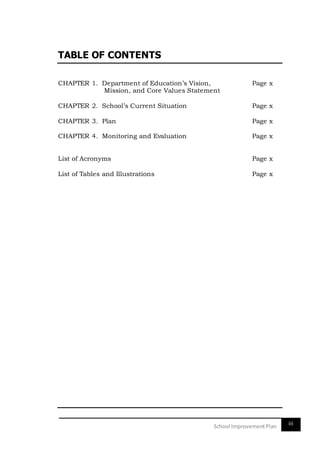
TABLE OF CONTENTS
CHAPTER 1. Department of Education’s Vision,
Mission, and Core Values Statement
Page x
CHAPTER 2. School’s Current Situation Page x
CHAPTER 3. Plan Page x
CHAPTER 4. Monitoring and Evaluation Page x
List of Acronyms Page x
List of Tables and Illustrations Page x
ivSchool ImprovementPlan
LIST OF ACRONYMS
DepEd – Department of Education
SIP – School Improvement Program
AIP – Annual Implementation Plan
vSchool ImprovementPlan
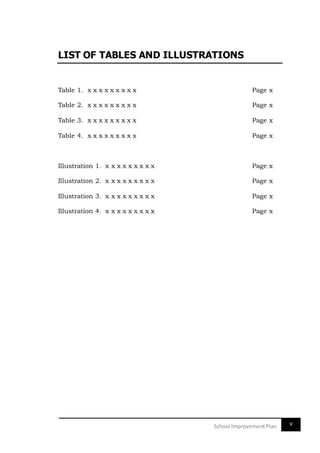
LIST OF TABLES AND ILLUSTRATIONS
Table 1. x x x x x x x x x Page x
Table 2. x x x x x x x x x Page x
Table 3. x x x x x x x x x Page x
Table 4. x x x x x x x x x Page x
Illustration 1. x x x x x x x x x Page x
Illustration 2. x x x x x x x x x Page x
Illustration 3. x x x x x x x x x Page x
Illustration 4. x x x x x x x x x Page x
1School ImprovementPlan
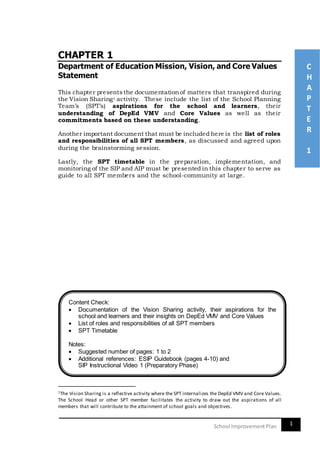
CHAPTER 1
Department of Education Mission, Vision, and Core Values
Statement
This chapter presentsthe documentationof matters that transpired during
the Vision Sharing1 activity. These include the list of the School Planning
Team’s (SPT’s) aspirations for the school and learners, their
understanding of DepEd VMV and Core Values as well as their
commitments based on these understanding.
Another important document that must be included here is the list of roles
and responsibilities of all SPT members, as discussed and agreed upon
during the brainstorming session.
Lastly, the SPT timetable in the preparation, implementation, and
monitoring of the SIP and AIP must be presented in this chapter to serve as
guide to all SPT members and the school-community at large.
1The Vision Sharing is a reflective activity where the SPT internalizes the DepEd VMV and Core Values.
The School Head or other SPT member facilitates the activity to draw out the aspirations of all
members that will contribute to the attainment of school goals and objectives.
Content Check:
 Documentation of the Vision Sharing activity, their aspirations for the
school and learners and their insights on DepEd VMV and Core Values
 List of roles and responsibilities of all SPT members
 SPT Timetable
Notes:
 Suggested number of pages: 1 to 2
 Additional references: ESIP Guidebook (pages 4-10) and
SIP Instructional Video 1 (Preparatory Phase)
C
H
A
P
T
E
R
1
2School ImprovementPlan
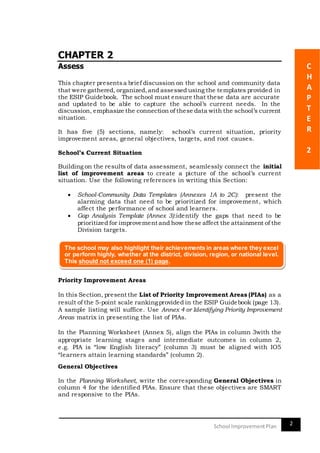
CHAPTER 2
Assess
This chapter presentsa brief discussion on the school and community data
that were gathered, organized,and assessed using the templates provided in
the ESIP Guidebook. The school must ensure that these data are accurate
and updated to be able to capture the school’s current needs. In the
discussion, emphasize the connection of these data with the school’s current
situation.
It has five (5) sections, namely: school’s current situation, priority
improvement areas, general objectives, targets, and root causes.
School’s Current Situation
Building on the results of data assessment, seamlessly connect the initial
list of improvement areas to create a picture of the school’s current
situation. Use the following references in writing this Section:
 School-Community Data Templates (Annexes 1A to 2C): present the
alarming data that need to be prioritized for improvement, which
affect the performance of school and learners.
 Gap Analysis Template (Annex 3):identify the gaps that need to be
prioritized for improvement and how these affect the attainment of the
Division targets.
Priority Improvement Areas
In this Section, present the List of Priority Improvement Areas (PIAs) as a
result of the 5-point scale rankingprovided in the ESIP Guidebook (page 13).
A sample listing will suffice. Use Annex 4 or Identifying Priority Improvement
Areas matrix in presenting the list of PIAs.
In the Planning Worksheet (Annex 5), align the PIAs in column 3with the
appropriate learning stages and intermediate outcomes in column 2,
e.g. PIA is “low English literacy” (column 3) must be aligned with IO5
“learners attain learning standards” (column 2).
General Objectives
In the Planning Worksheet, write the corresponding General Objectives in
column 4 for the identified PIAs. Ensure that these objectives are SMART
and responsive to the PIAs.
The school may also highlight their achievements in areas where they excel
or perform highly, whether at the district, division, region, or national level.
This should not exceed one (1) page.
C
H
A
P
T
E
R
2
3School ImprovementPlan
There are processes involved prior to the conduct of the actual Root Cause
Analysis (RCA), like the conduct of FGDs and interviews with learners and
other stakeholders, and analysis of specific school process involved in the
assigned PIA to identify storm clouds and area of focus. These are not
required to be included in this Section, but shall be part of the Annexes of
the SIP.
A focused problem/area can have several root causes, write in this Section
the results of the Prioritization of Root Causes using the checklist
provided in Annex 8 (ESIP Guidebook, page 98). Write in column 5 of the
Planning Worksheet the identified root causes for the PIAs.
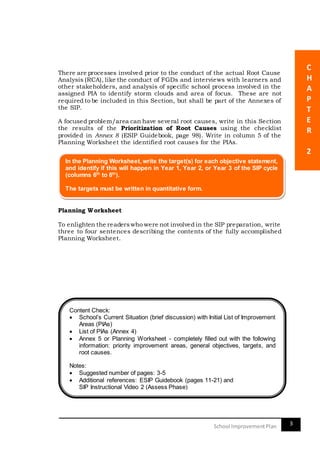
Planning Worksheet
To enlighten the readerswho were not involved in the SIP preparation, write
three to four sentences describing the contents of the fully accomplished
Planning Worksheet.
Content Check:
 School’s Current Situation (brief discussion) with Initial List of Improvement
Areas (PIAs)
 List of PIAs (Annex 4)
 Annex 5 or Planning Worksheet - completely filled out with the following
information: priority improvement areas, general objectives, targets, and
root causes.
Notes:
 Suggested number of pages: 3-5
 Additional references: ESIP Guidebook (pages 11-21) and
SIP Instructional Video 2 (Assess Phase)

In the Planning Worksheet, write the target(s) for each objective statement,
and identify if this will happen in Year 1, Year 2, or Year 3 of the SIP cycle
(columns 6th
to 8th
).
The targets must be written in quantitative form.
C
H
A
P
T
E
R
2
4School ImprovementPlan
CHAPTER 3
Plan
A. Project Work Plan & Budget Matrix
In this Section, present the List of Solutions for the identified root causes.
These identified solutionsare those that have satisfied the criteria provided
in Step5 of the ESIP Guidebook (page 23). Present a matrix containing root
causes and corresponding solution.
Attached copies of the Project Work Plan and Budget Matrix (Annex9)
prepared for the identified solutions. One project work plan per solution,
which contains the following information: problem statement, project
objective statement, activities, and output.
B. Annual Implementation Plan (AIP)
Another important document that will be attached is the Annual
Implementation Plan (Annex 10) for Year 1, the SIP’s operational plan. It
contains specific projects that will be undertaken by the school in a
particular year, which include the following: outputs, activities, schedule,
required resources, source of fund, and the individuals accountable for the
conduct of these projects. It also includes operational cost such as but not
limited to utilities, supplies and materials, etc. that are considered eligible
expenditures in the existing MOOE guidelines.
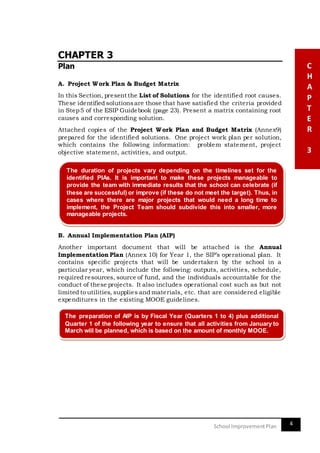
The preparation of AIP is by Fiscal Year (Quarters 1 to 4) plus additional
Quarter 1 of the following year to ensure that all activities from January to
March will be planned, which is based on the amount of monthly MOOE.
The duration of projects vary depending on the timelines set for the
identified PIAs. It is important to make these projects manageable to
provide the team with immediate results that the school can celebrate (if
these are successful) or improve (if these do not meet the target). Thus, in
cases where there are major projects that would need a long time to
implement, the Project Team should subdivide this into smaller, more
manageable projects.
C
H
A
P
T
E
R
3
5School ImprovementPlan
Content Check:
 List of Solutions
 Project Work Plan and Budget Matrix (Annex)
 Annual Implementation Plan Year 1 (Annex)
Note:
 Additional references: ESIP Guidebook (pages 22-26) and
SIP Instructional Video 3 (Plan Phase)
6School ImprovementPlan
CHAPTER 4
Monitoring and Evaluation
The SPT will monitor progress in the middle and end of project
implementation period depending on the timelines set by the Project Teams.
In longer projects, the SPT will have to monitor more than twice.
Schedules of monitoring must be indicated in the suggested Project
Monitoring Report Form (ESIP Guidebook, page 29). To help inform the
SPT of the status of their projects, the Project Teams will submit their
respective progress reports using this template.
Attach the Project Monitoring Report Forms of all projects for Year 1 AIP,
which contains the following information: names of project, project
objectives and targets, and the proposed dates of monitoring.
Content Check:
 Project Monitoring Report Forms
Note:
 Additional references: ESIP Guidebook (pages 27-30) and
SIP Instructional Video 4 (Act Phase)
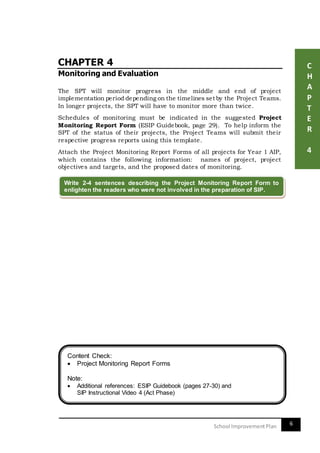
Write 2-4 sentences describing the Project Monitoring Report Form to
enlighten the readers who were not involved in the preparation of SIP.
C
H
A
P
T
E
R
4
7School ImprovementPlan
Sample Certificate of Acceptance

Sip design template

  • 1.
    iSchool ImprovementPlan NAME OFSCHOOL School ID School Address ENHANCED SCHOOL IMPROVEMENT PLAN School Year 20xx-20xx
  • 2.
    iiSchool ImprovementPlan MESSAGE (OPTIONAL) Thequick brown fox jumps over the lazy dog. The quick brown fox jumps over the lazy dog. The quick brown fox jumps over the lazy dog. The quick brown fox jumps over the lazy dog. The quick brown fox jumps over the lazy dog. The quick brown fox jumps over the lazy dog. The quick brown fox jumps over the lazy dog. The quick brown fox jumps over the lazy dog. The quick brown fox jumps over the lazy dog. The quick brown fox jumps over the lazy dog. The quick brown fox jumps over the lazy dog. The quick brown fox jumps over the lazy dog. The quick brown fox jumps over the lazy dog. The quick brown fox jumps over the lazy dog.
  • 3.
    iiiSchool ImprovementPlan TABLE OFCONTENTS CHAPTER 1. Department of Education’s Vision, Mission, and Core Values Statement Page x CHAPTER 2. School’s Current Situation Page x CHAPTER 3. Plan Page x CHAPTER 4. Monitoring and Evaluation Page x List of Acronyms Page x List of Tables and Illustrations Page x
  • 4.
    ivSchool ImprovementPlan LIST OFACRONYMS DepEd – Department of Education SIP – School Improvement Program AIP – Annual Implementation Plan
  • 5.
    vSchool ImprovementPlan LIST OFTABLES AND ILLUSTRATIONS Table 1. x x x x x x x x x Page x Table 2. x x x x x x x x x Page x Table 3. x x x x x x x x x Page x Table 4. x x x x x x x x x Page x Illustration 1. x x x x x x x x x Page x Illustration 2. x x x x x x x x x Page x Illustration 3. x x x x x x x x x Page x Illustration 4. x x x x x x x x x Page x
  • 6.
    1School ImprovementPlan CHAPTER 1 Departmentof Education Mission, Vision, and Core Values Statement This chapter presentsthe documentationof matters that transpired during the Vision Sharing1 activity. These include the list of the School Planning Team’s (SPT’s) aspirations for the school and learners, their understanding of DepEd VMV and Core Values as well as their commitments based on these understanding. Another important document that must be included here is the list of roles and responsibilities of all SPT members, as discussed and agreed upon during the brainstorming session. Lastly, the SPT timetable in the preparation, implementation, and monitoring of the SIP and AIP must be presented in this chapter to serve as guide to all SPT members and the school-community at large. 1The Vision Sharing is a reflective activity where the SPT internalizes the DepEd VMV and Core Values. The School Head or other SPT member facilitates the activity to draw out the aspirations of all members that will contribute to the attainment of school goals and objectives. Content Check:  Documentation of the Vision Sharing activity, their aspirations for the school and learners and their insights on DepEd VMV and Core Values  List of roles and responsibilities of all SPT members  SPT Timetable Notes:  Suggested number of pages: 1 to 2  Additional references: ESIP Guidebook (pages 4-10) and SIP Instructional Video 1 (Preparatory Phase) C H A P T E R 1
  • 7.
    2School ImprovementPlan CHAPTER 2 Assess Thischapter presentsa brief discussion on the school and community data that were gathered, organized,and assessed using the templates provided in the ESIP Guidebook. The school must ensure that these data are accurate and updated to be able to capture the school’s current needs. In the discussion, emphasize the connection of these data with the school’s current situation. It has five (5) sections, namely: school’s current situation, priority improvement areas, general objectives, targets, and root causes. School’s Current Situation Building on the results of data assessment, seamlessly connect the initial list of improvement areas to create a picture of the school’s current situation. Use the following references in writing this Section:  School-Community Data Templates (Annexes 1A to 2C): present the alarming data that need to be prioritized for improvement, which affect the performance of school and learners.  Gap Analysis Template (Annex 3):identify the gaps that need to be prioritized for improvement and how these affect the attainment of the Division targets. Priority Improvement Areas In this Section, present the List of Priority Improvement Areas (PIAs) as a result of the 5-point scale rankingprovided in the ESIP Guidebook (page 13). A sample listing will suffice. Use Annex 4 or Identifying Priority Improvement Areas matrix in presenting the list of PIAs. In the Planning Worksheet (Annex 5), align the PIAs in column 3with the appropriate learning stages and intermediate outcomes in column 2, e.g. PIA is “low English literacy” (column 3) must be aligned with IO5 “learners attain learning standards” (column 2). General Objectives In the Planning Worksheet, write the corresponding General Objectives in column 4 for the identified PIAs. Ensure that these objectives are SMART and responsive to the PIAs. The school may also highlight their achievements in areas where they excel or perform highly, whether at the district, division, region, or national level. This should not exceed one (1) page. C H A P T E R 2
  • 8.
    3School ImprovementPlan There areprocesses involved prior to the conduct of the actual Root Cause Analysis (RCA), like the conduct of FGDs and interviews with learners and other stakeholders, and analysis of specific school process involved in the assigned PIA to identify storm clouds and area of focus. These are not required to be included in this Section, but shall be part of the Annexes of the SIP. A focused problem/area can have several root causes, write in this Section the results of the Prioritization of Root Causes using the checklist provided in Annex 8 (ESIP Guidebook, page 98). Write in column 5 of the Planning Worksheet the identified root causes for the PIAs. Planning Worksheet To enlighten the readerswho were not involved in the SIP preparation, write three to four sentences describing the contents of the fully accomplished Planning Worksheet. Content Check:  School’s Current Situation (brief discussion) with Initial List of Improvement Areas (PIAs)  List of PIAs (Annex 4)  Annex 5 or Planning Worksheet - completely filled out with the following information: priority improvement areas, general objectives, targets, and root causes. Notes:  Suggested number of pages: 3-5  Additional references: ESIP Guidebook (pages 11-21) and SIP Instructional Video 2 (Assess Phase)  In the Planning Worksheet, write the target(s) for each objective statement, and identify if this will happen in Year 1, Year 2, or Year 3 of the SIP cycle (columns 6th to 8th ). The targets must be written in quantitative form. C H A P T E R 2
  • 9.
    4School ImprovementPlan CHAPTER 3 Plan A.Project Work Plan & Budget Matrix In this Section, present the List of Solutions for the identified root causes. These identified solutionsare those that have satisfied the criteria provided in Step5 of the ESIP Guidebook (page 23). Present a matrix containing root causes and corresponding solution. Attached copies of the Project Work Plan and Budget Matrix (Annex9) prepared for the identified solutions. One project work plan per solution, which contains the following information: problem statement, project objective statement, activities, and output. B. Annual Implementation Plan (AIP) Another important document that will be attached is the Annual Implementation Plan (Annex 10) for Year 1, the SIP’s operational plan. It contains specific projects that will be undertaken by the school in a particular year, which include the following: outputs, activities, schedule, required resources, source of fund, and the individuals accountable for the conduct of these projects. It also includes operational cost such as but not limited to utilities, supplies and materials, etc. that are considered eligible expenditures in the existing MOOE guidelines. The preparation of AIP is by Fiscal Year (Quarters 1 to 4) plus additional Quarter 1 of the following year to ensure that all activities from January to March will be planned, which is based on the amount of monthly MOOE. The duration of projects vary depending on the timelines set for the identified PIAs. It is important to make these projects manageable to provide the team with immediate results that the school can celebrate (if these are successful) or improve (if these do not meet the target). Thus, in cases where there are major projects that would need a long time to implement, the Project Team should subdivide this into smaller, more manageable projects. C H A P T E R 3
  • 10.
    5School ImprovementPlan Content Check: List of Solutions  Project Work Plan and Budget Matrix (Annex)  Annual Implementation Plan Year 1 (Annex) Note:  Additional references: ESIP Guidebook (pages 22-26) and SIP Instructional Video 3 (Plan Phase)
  • 11.
    6School ImprovementPlan CHAPTER 4 Monitoringand Evaluation The SPT will monitor progress in the middle and end of project implementation period depending on the timelines set by the Project Teams. In longer projects, the SPT will have to monitor more than twice. Schedules of monitoring must be indicated in the suggested Project Monitoring Report Form (ESIP Guidebook, page 29). To help inform the SPT of the status of their projects, the Project Teams will submit their respective progress reports using this template. Attach the Project Monitoring Report Forms of all projects for Year 1 AIP, which contains the following information: names of project, project objectives and targets, and the proposed dates of monitoring. Content Check:  Project Monitoring Report Forms Note:  Additional references: ESIP Guidebook (pages 27-30) and SIP Instructional Video 4 (Act Phase) Write 2-4 sentences describing the Project Monitoring Report Form to enlighten the readers who were not involved in the preparation of SIP. C H A P T E R 4
  • 12.