Enhanced SIP, SRC, & RPMS
Integration
DEPARTMENT OF EDUCATION
School Effectiveness Division Charter
2
Purpose: The School Effectiveness Division supports and enables
schools to continuously improve its own governance and delivery of
quality basic education services that are responsive to the diverse
needs of its learners.
Summary of Functions/Scope:
1. Formulation of School Effectiveness Framework
2. Establishment of standards for governance to support
effective schools
3. Application and monitoring of school performance
management standards
4. Accreditation of Schools and Learning Centers
DEPARTMENT OF EDUCATION
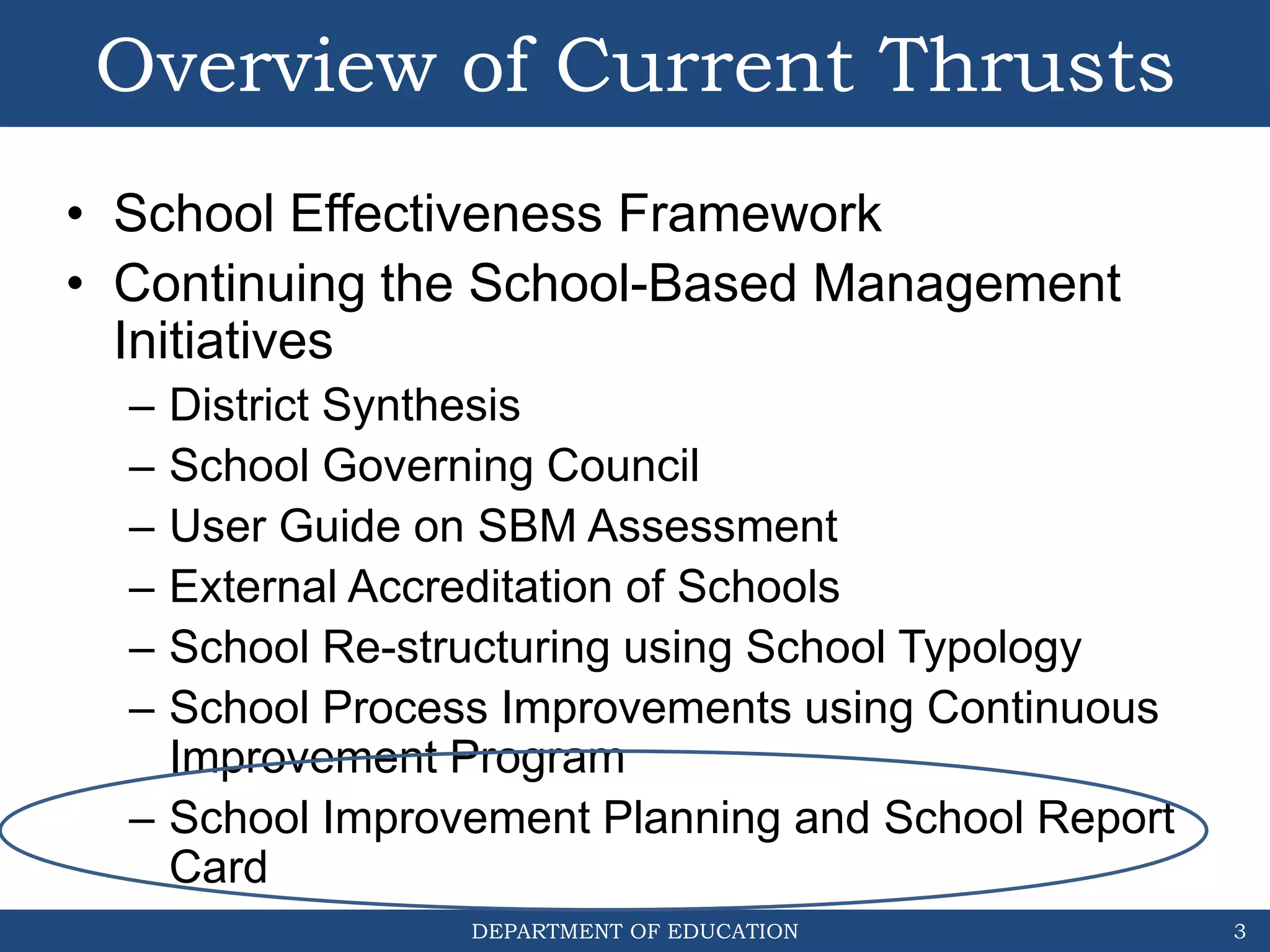
Overview of Current Thrusts
• School Effectiveness Framework
• Continuing the School-Based Management
Initiatives
– District Synthesis
– School Governing Council
– User Guide on SBM Assessment
– External Accreditation of Schools
– School Re-structuring using School Typology
– School Process Improvements using Continuous
Improvement Program
– School Improvement Planning and School Report
Card
3
DEPARTMENT OF EDUCATION
Policy Bases
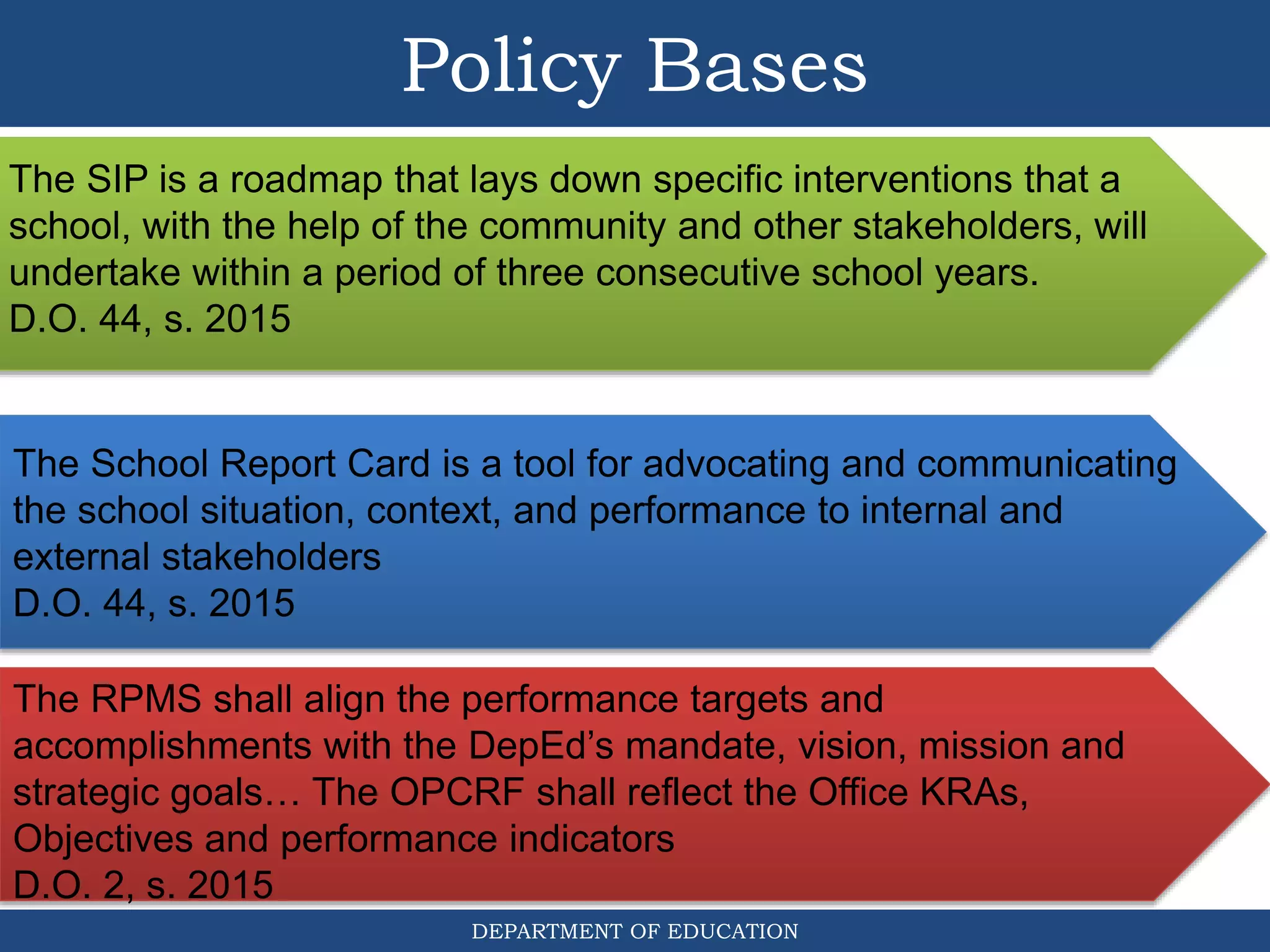
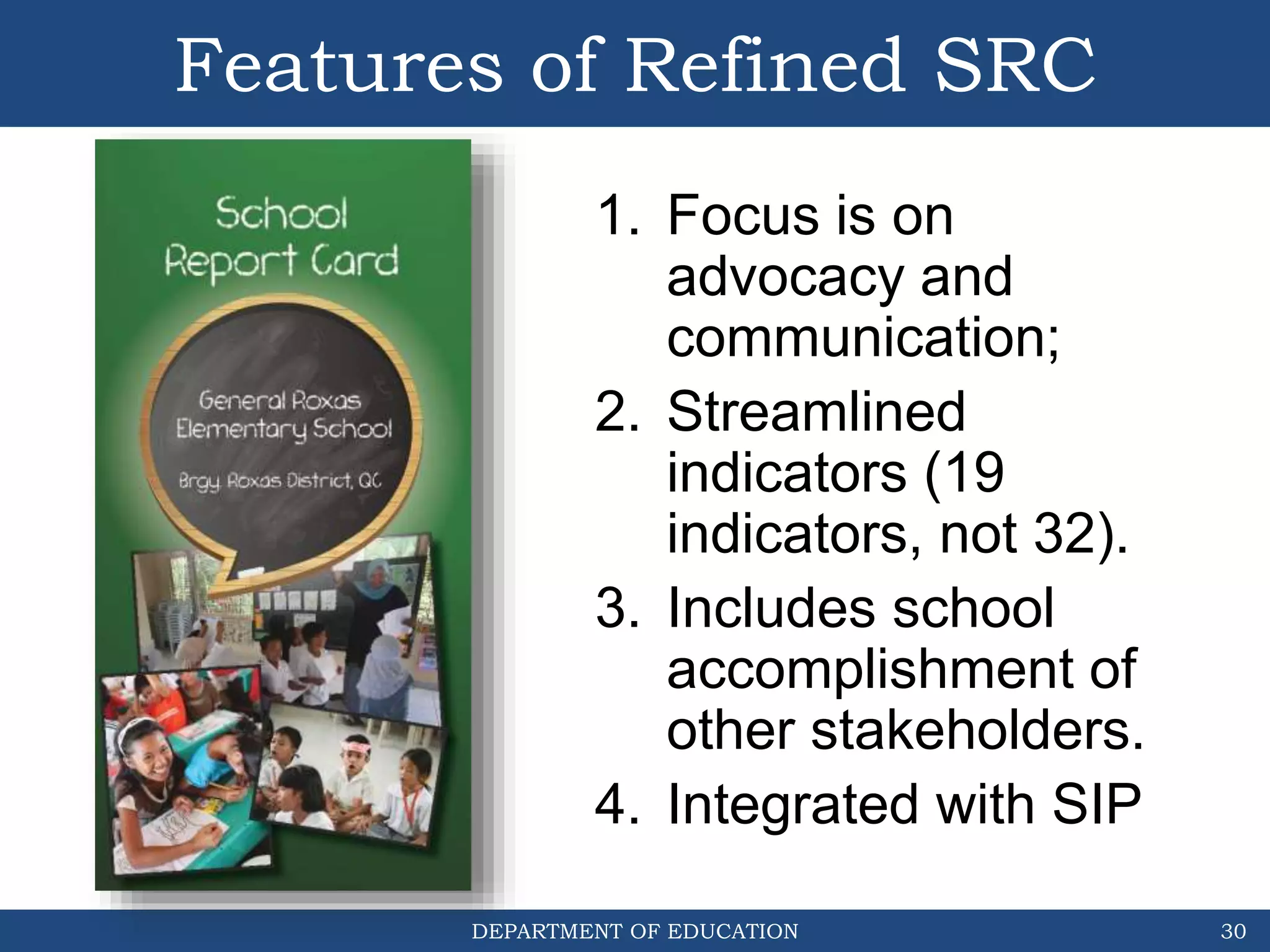
The School Report Card is a tool for advocating and communicating
the school situation, context, and performance to internal and
external stakeholders
D.O. 44, s. 2015
The SIP is a roadmap that lays down specific interventions that a
school, with the help of the community and other stakeholders, will
undertake within a period of three consecutive school years.
D.O. 44, s. 2015
4
The RPMS shall align the performance targets and
accomplishments with the DepEd’s mandate, vision, mission and
strategic goals… The OPCRF shall reflect the Office KRAs,
Objectives and performance indicators
D.O. 2, s. 2015
DEPARTMENT OF EDUCATION
Features of Self-Managing Schools
5
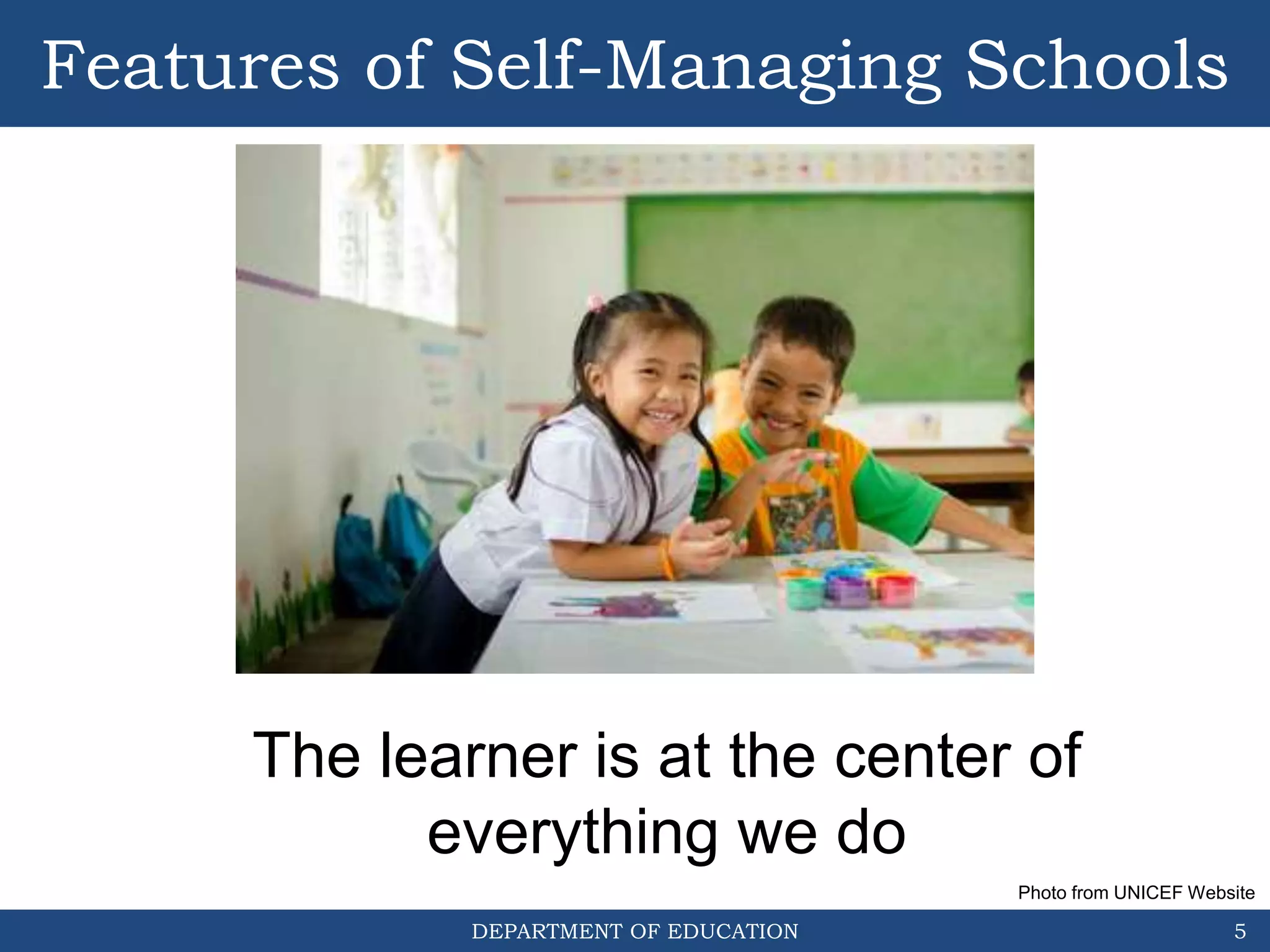
Photo from UNICEF Website
The learner is at the center of
everything we do
DEPARTMENT OF EDUCATION
Features of Self-Managing Schools
6
Investment addresses various
needs of learners
DEPARTMENT OF EDUCATION
Features of Self-Managing Schools
7
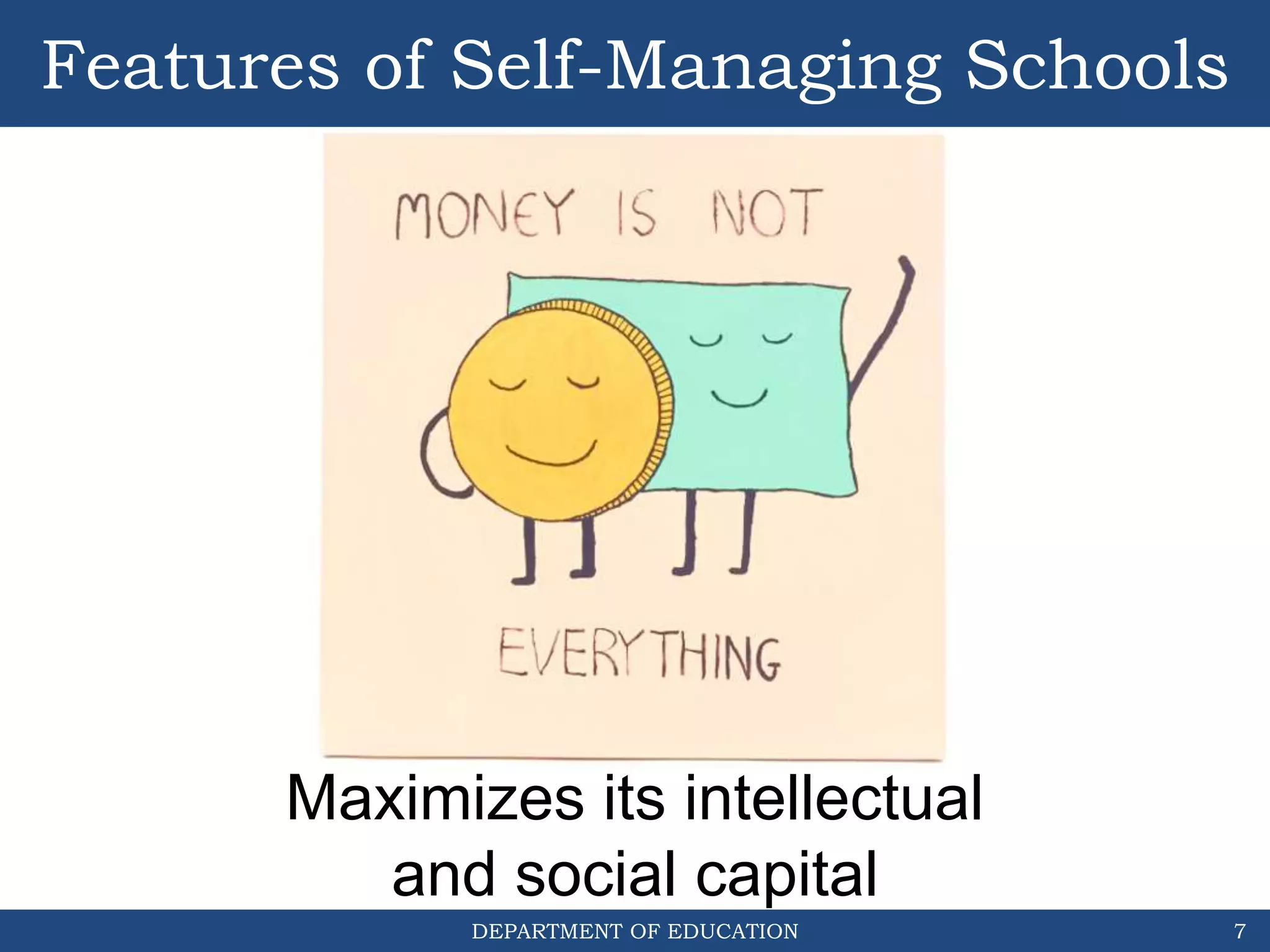
Maximizes its intellectual
and social capital
DEPARTMENT OF EDUCATION
Features of Self-Managing Schools
8
School governance is participatory
DEPARTMENT OF EDUCATION
How can schools become effective
organizations?
DEPARTMENT OF EDUCATION
DepEd Order 44, s. 2015
DEPARTMENT OF EDUCATION
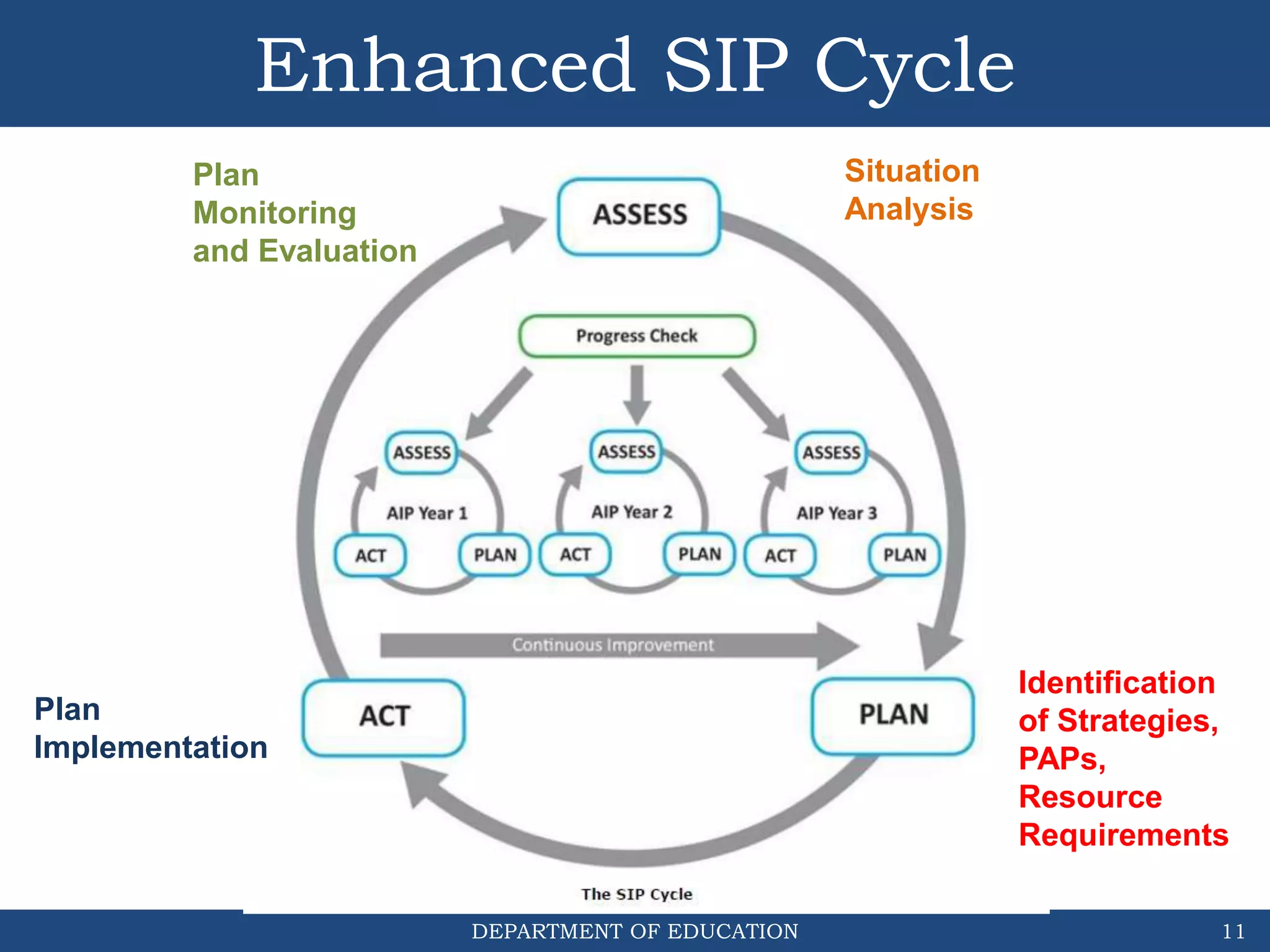
Enhanced SIP Cycle
11
Situation
Analysis
Identification
of Strategies,
PAPs,
Resource
Requirements
Plan
Implementation
Plan
Monitoring
and Evaluation
DEPARTMENT OF EDUCATION 12
DEPARTMENT OF EDUCATION 13
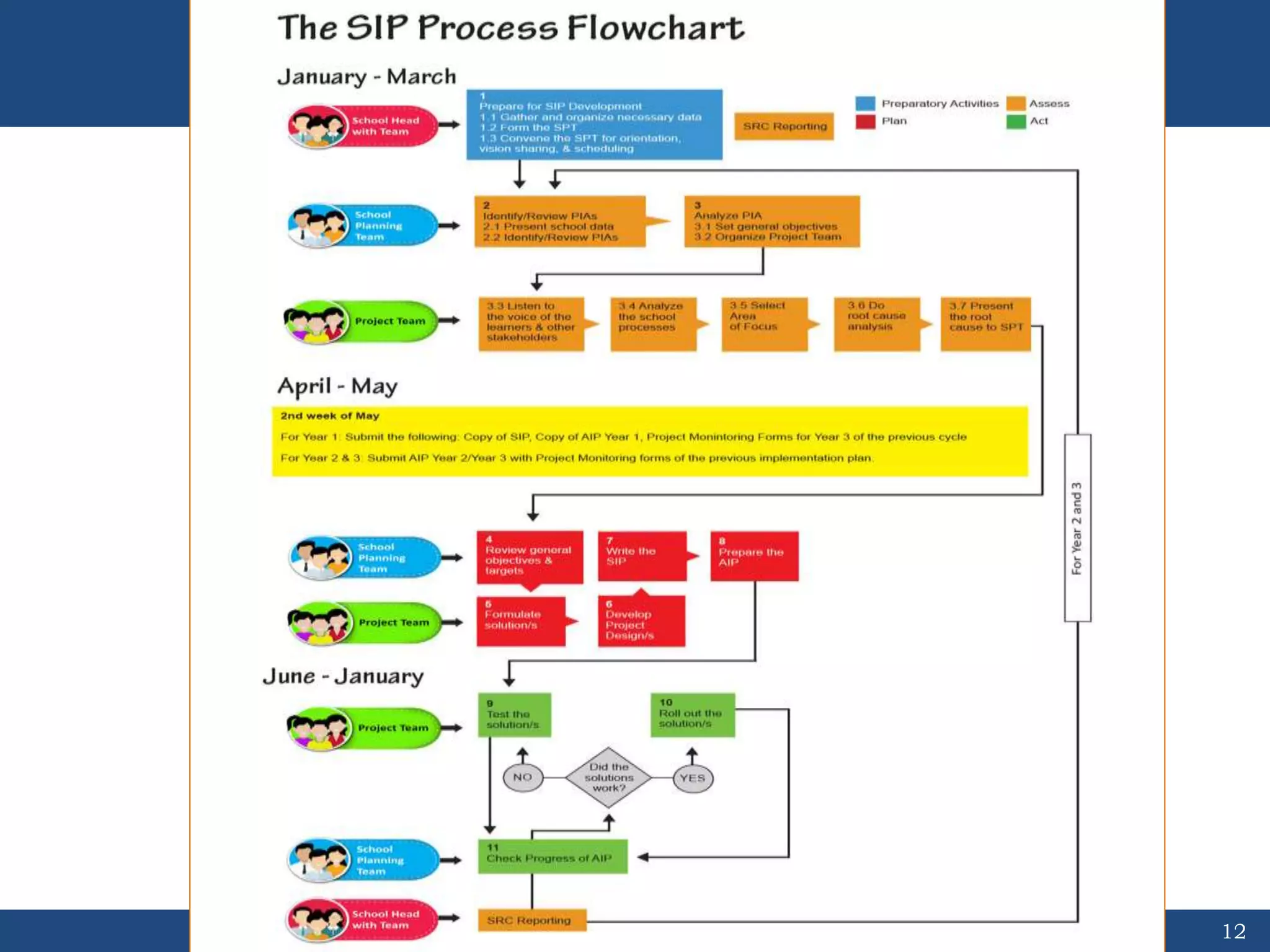
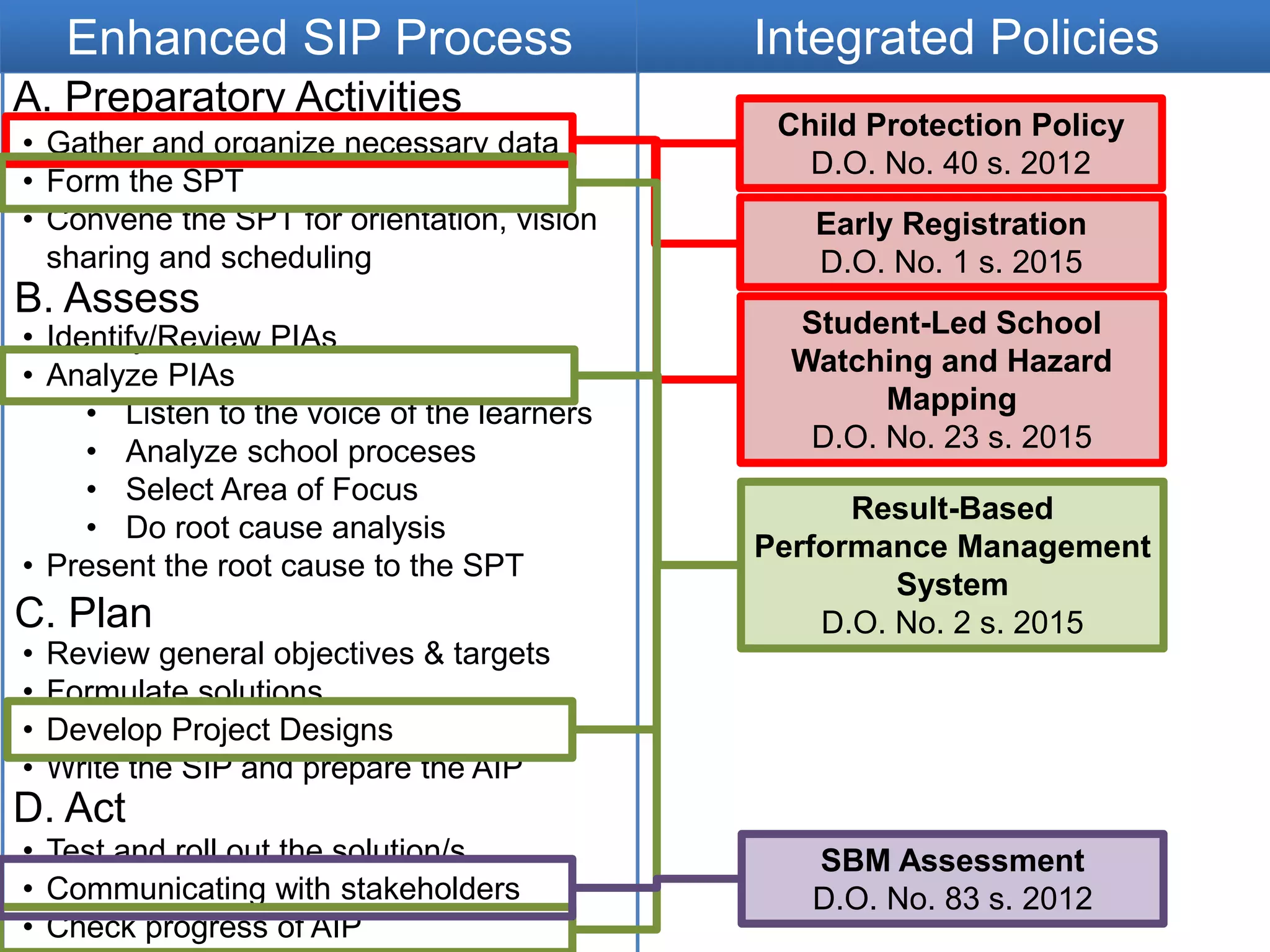
Enhanced SIP Process
B. Assess
C. Plan
D. Act
• Gather and organize necessary data
• Form the SPT
• Convene the SPT for orientation, vision
sharing and scheduling
A. Preparatory Activities
• Identify/Review PIAs
• Analyze PIAs
• Listen to the voice of the learners
• Analyze school proceses
• Select Area of Focus
• Do root cause analysis
• Present the root cause to the SPT
• Review general objectives & targets
• Formulate solutions
• Develop Project Designs
• Write the SIP and prepare the AIP
• Test and roll out the solution/s
• Communicating with stakeholders
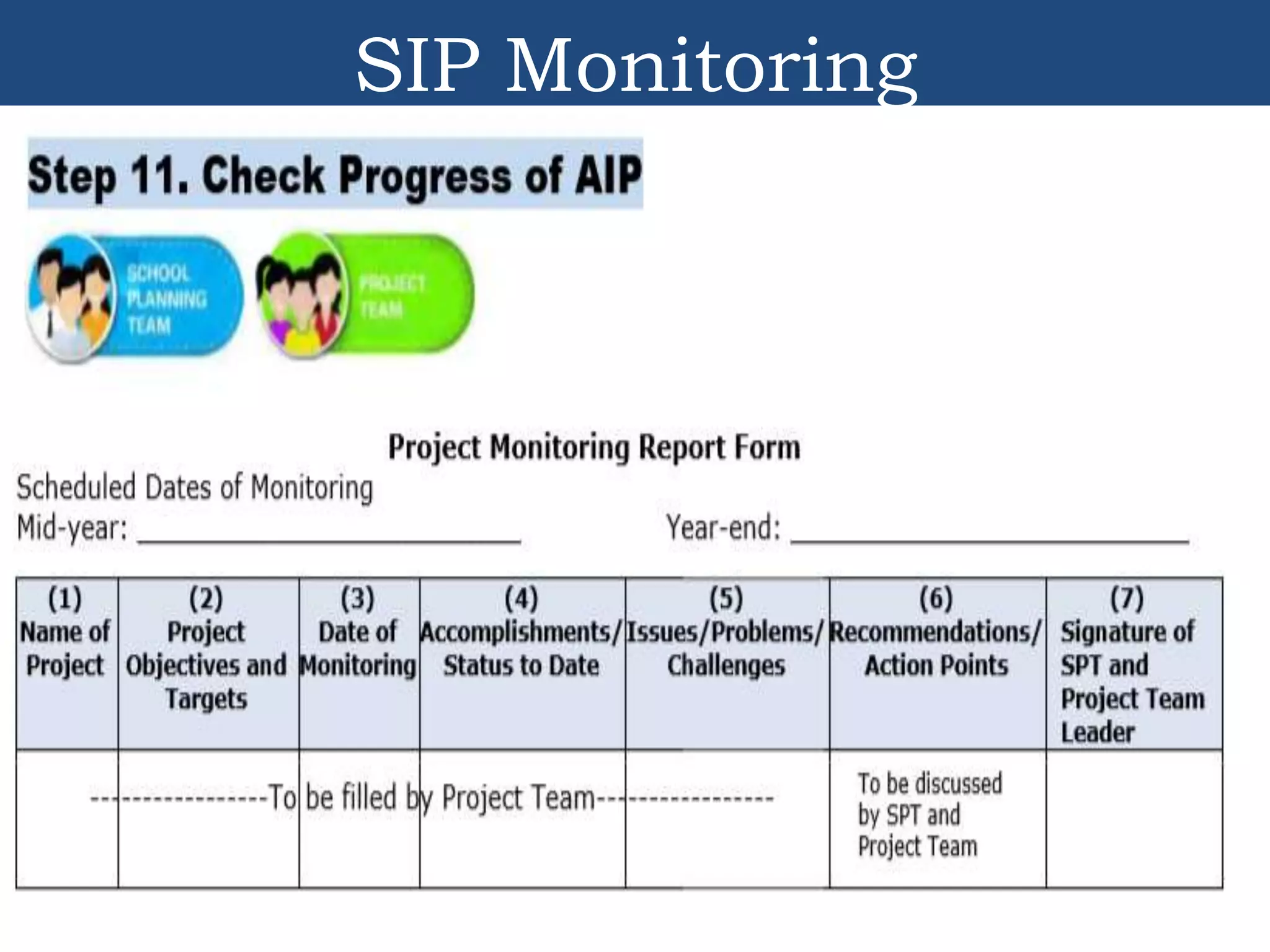
• Check progress of AIP
SBM Assessment
D.O. No. 83 s. 2012
Child Protection Policy
D.O. No. 40 s. 2012
Early Registration
D.O. No. 1 s. 2015
Student-Led School
Watching and Hazard
Mapping
D.O. No. 23 s. 2015
Result-Based
Performance Management
System
D.O. No. 2 s. 2015
Integrated Policies
DEPARTMENT OF EDUCATION 14
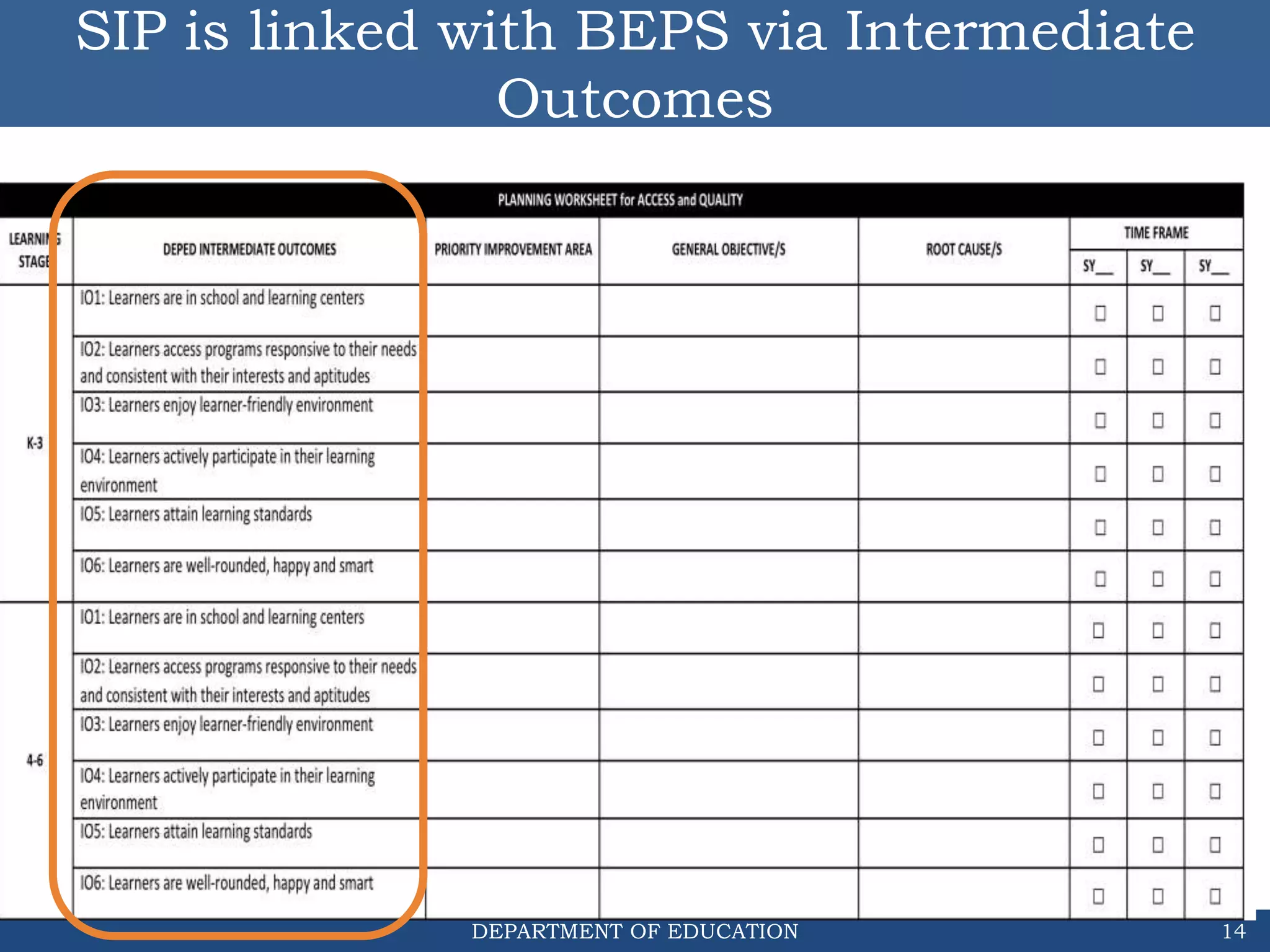
SIP is linked with BEPS via Intermediate
Outcomes
DEPARTMENT OF EDUCATION
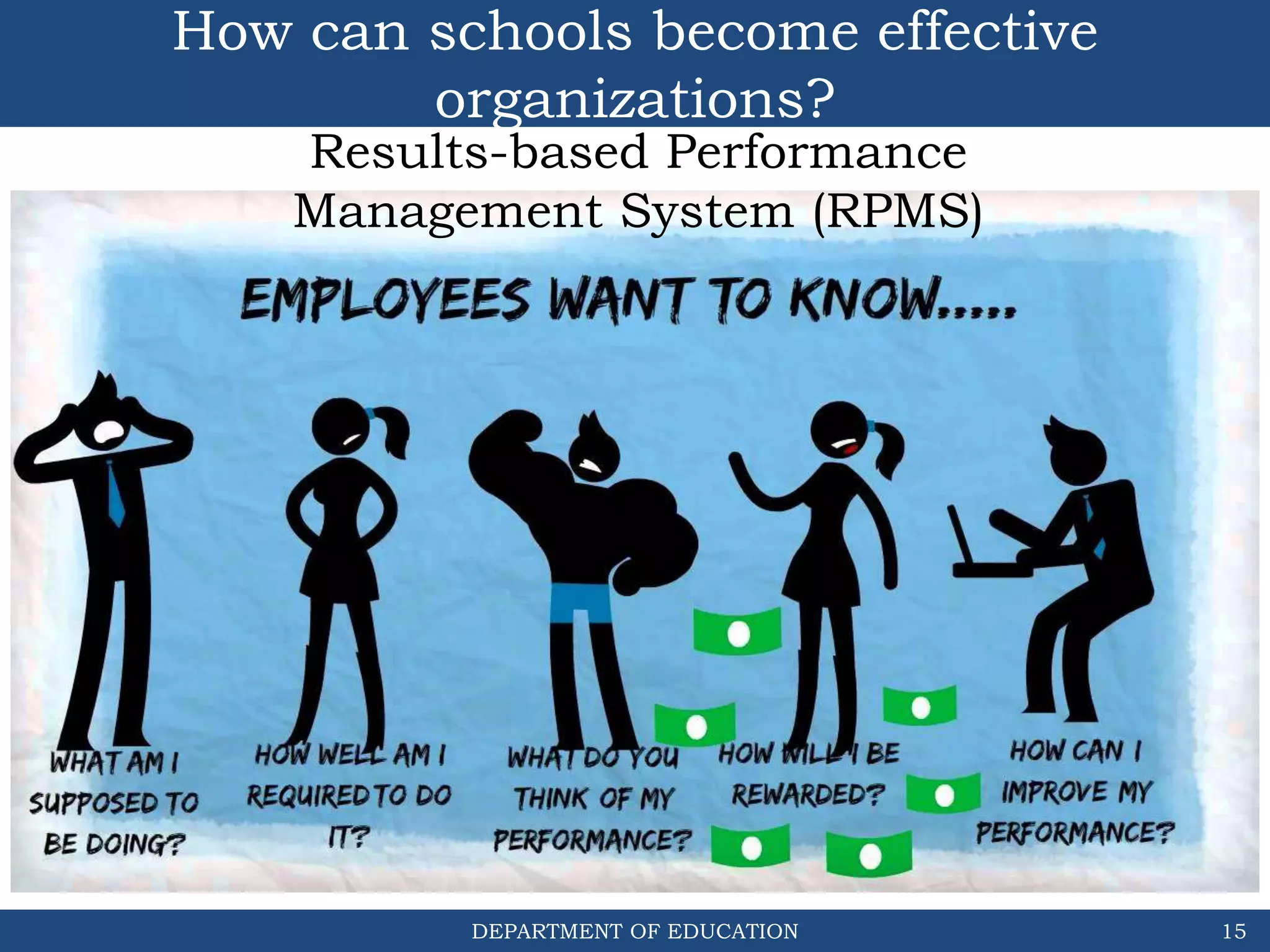
Results-based Performance
Management System (RPMS)
15
How can schools become effective
organizations?
DEPARTMENT OF EDUCATION
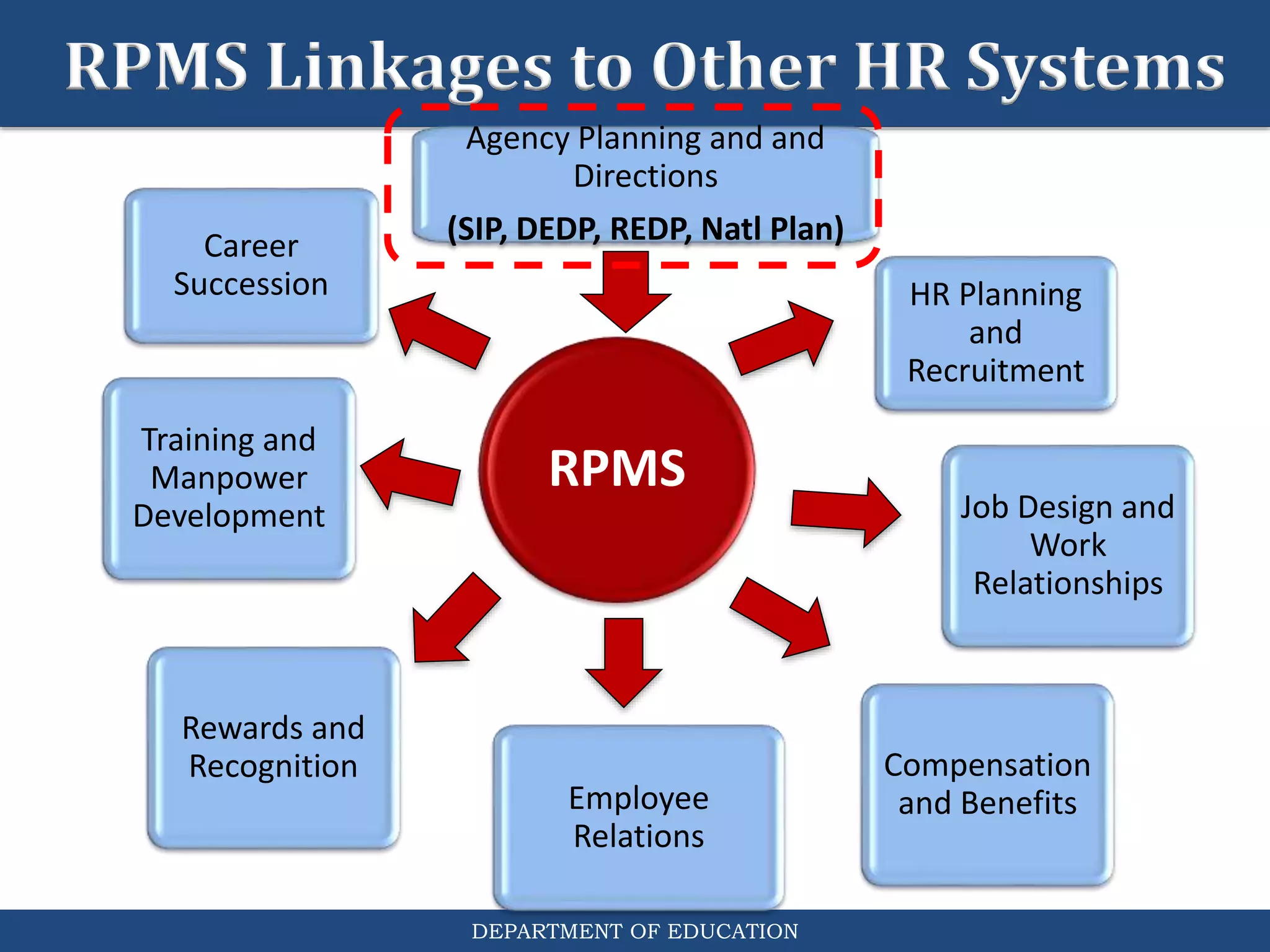
RPMS Linkages to Other HR Systems
RPMS
Job Design and
Work
Relationships
HR Planning
and
Recruitment
Compensation
and Benefits
Rewards and
Recognition
Training and
Manpower
Development
Employee
Relations
Career
Succession
Agency Planning and and
Directions
(SIP, DEDP, REDP, Natl Plan)
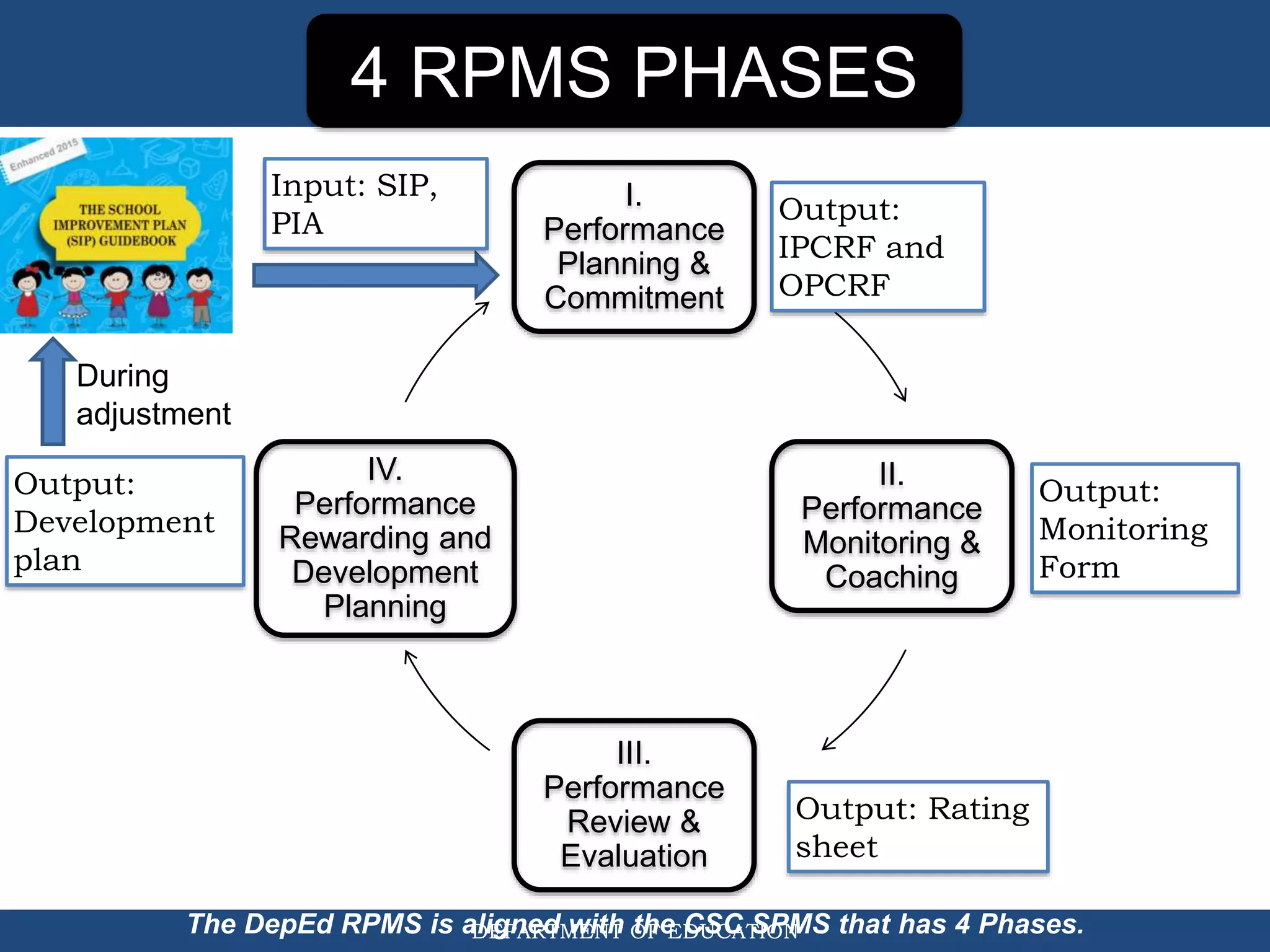
DEPARTMENT OF EDUCATIONThe DepEd RPMS is aligned with the CSC SPMS that has 4 Phases.
4 RPMS PHASES
I.
Performance
Planning &
Commitment
II.
Performance
Monitoring &
Coaching
III.
Performance
Review &
Evaluation
IV.
Performance
Rewarding and
Development
Planning
Output:
IPCRF and
OPCRF
Output:
Monitoring
Form
Output: Rating
sheet
Output:
Development
plan
Input: SIP,
PIA
During
adjustment
DEPARTMENT OF EDUCATION
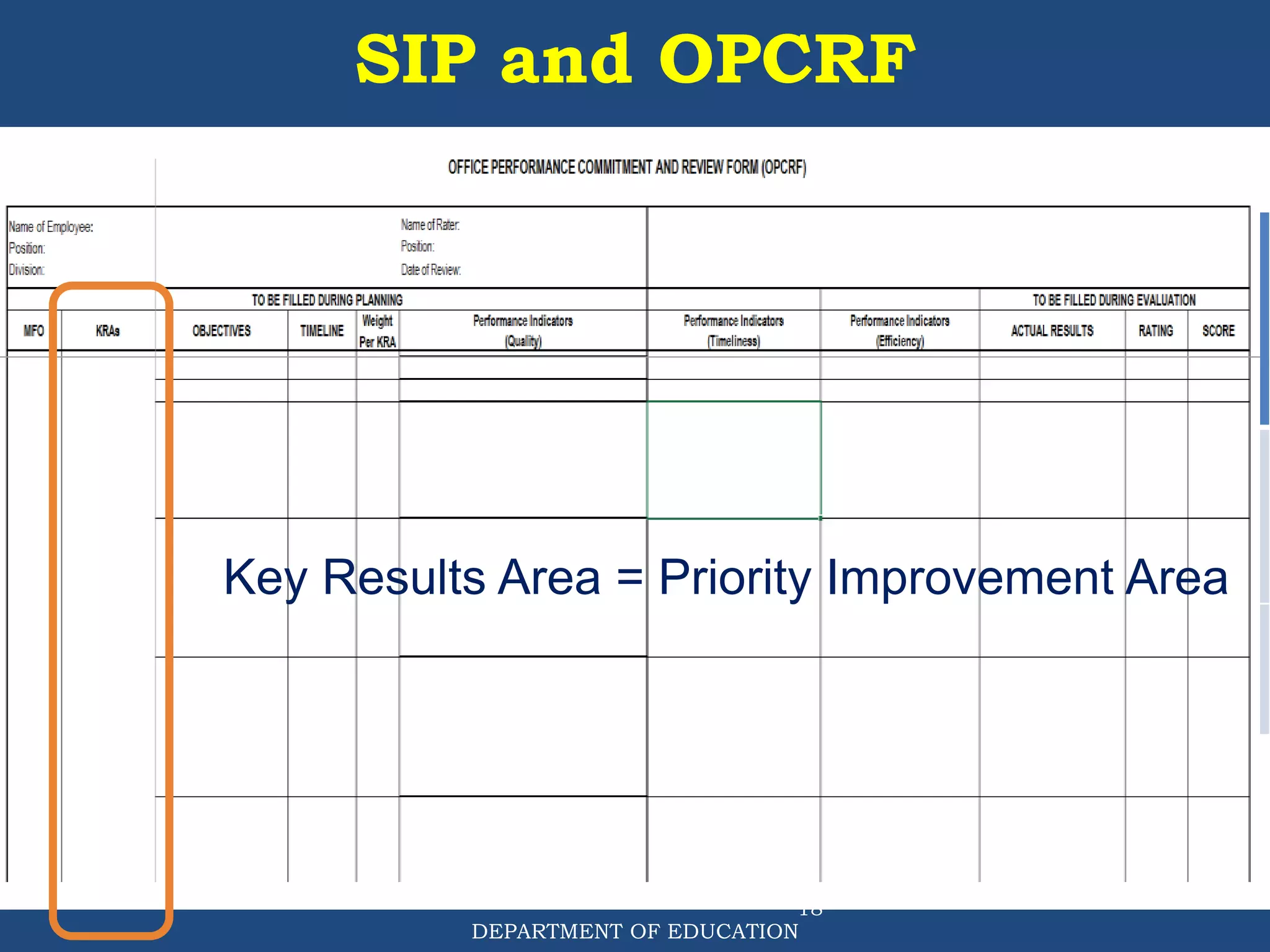
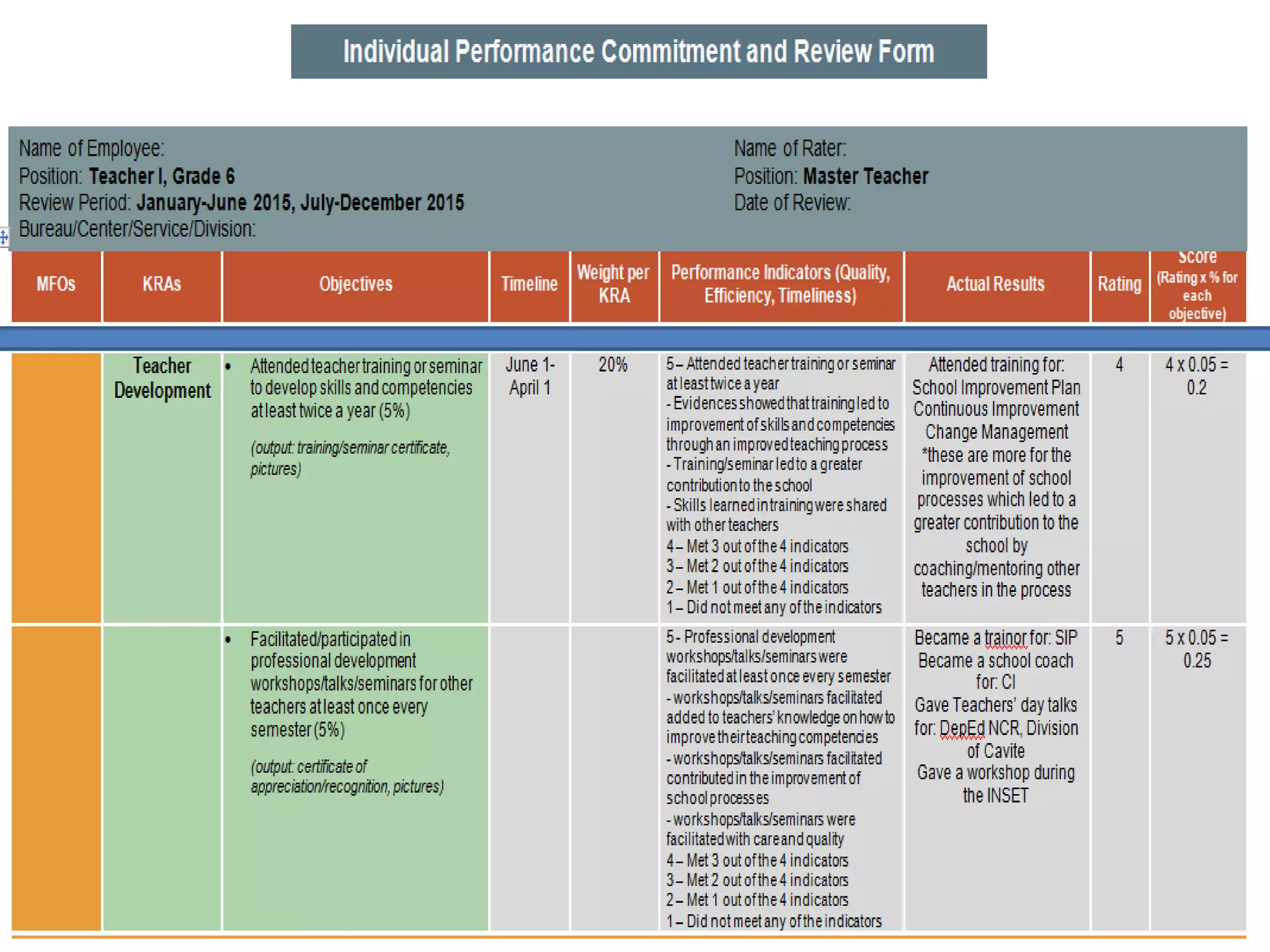
SIP and OPCRF
18
Major
Final
Output
(MFO)
Key Result Areas
(KRAs)/ Priority
Improvement
Areas
OPCRF
(Principal)
Key Result Areas
(KRAs)
IPCRF
(Head Teacher)
Key Result Areas
(KRAs)
IPCRF
(Master Teacher)
Key Result Areas
(KRAs)
IPCRF
(Teachers)
Basic
Education
Services
1. Instructional
Leadership
1. School Curriculum
Monitoring and
Evaluation Plan
1. Instructional
Supervision
2. Instructional
Competence
1. Teaching Learning
Process
5. Human Resource
Management and
Development
5. Human Resource
Management
(School Based INSET)
5. Personal and
Professional
Development (Action
Research)
5. Personal and
Professional
Development
Key Results Area = Priority Improvement Area
DEPARTMENT OF EDUCATION 19
DEPARTMENT OF EDUCATION
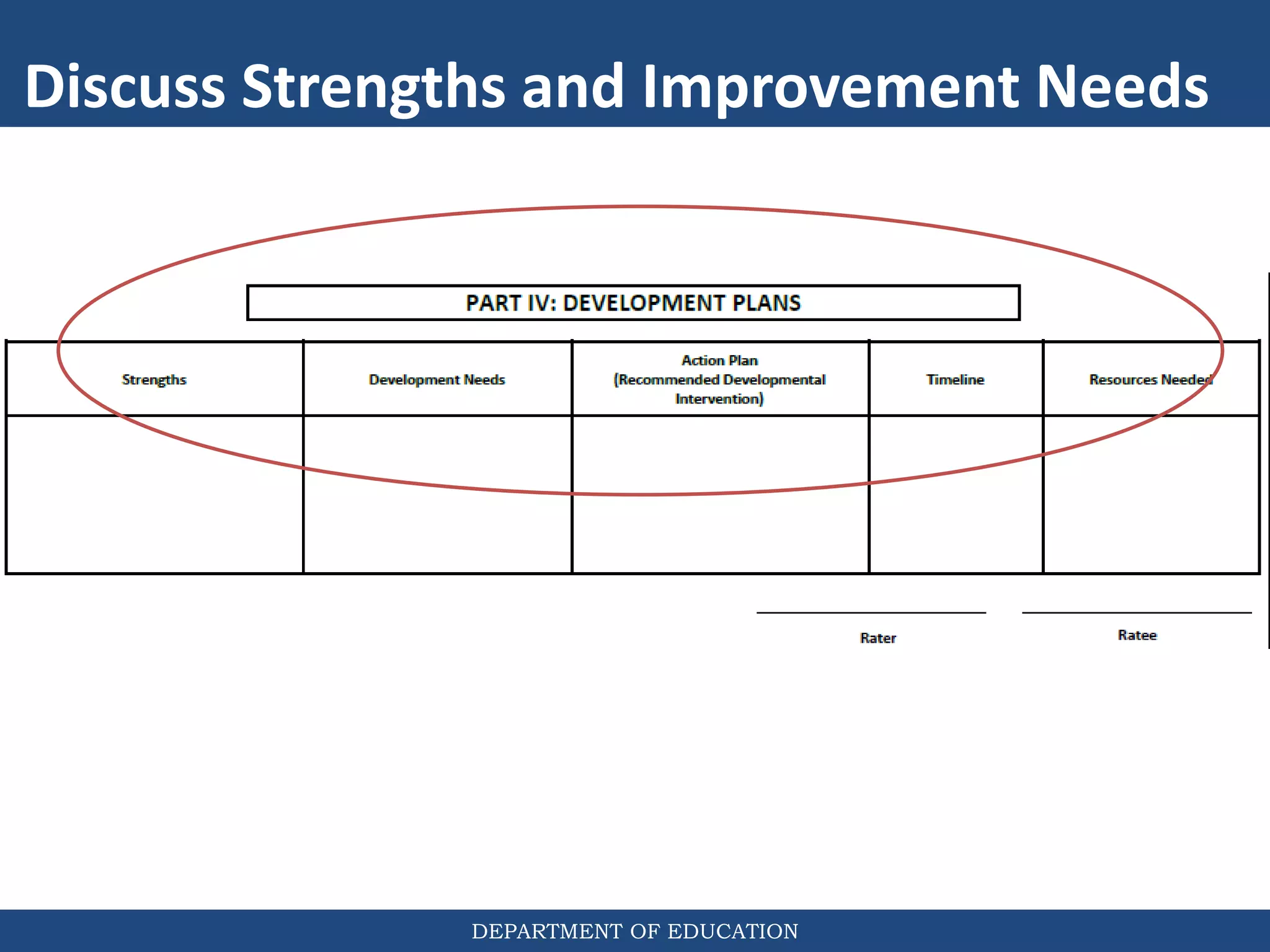
Discuss Strengths and Improvement Needs
DEPARTMENT OF EDUCATION
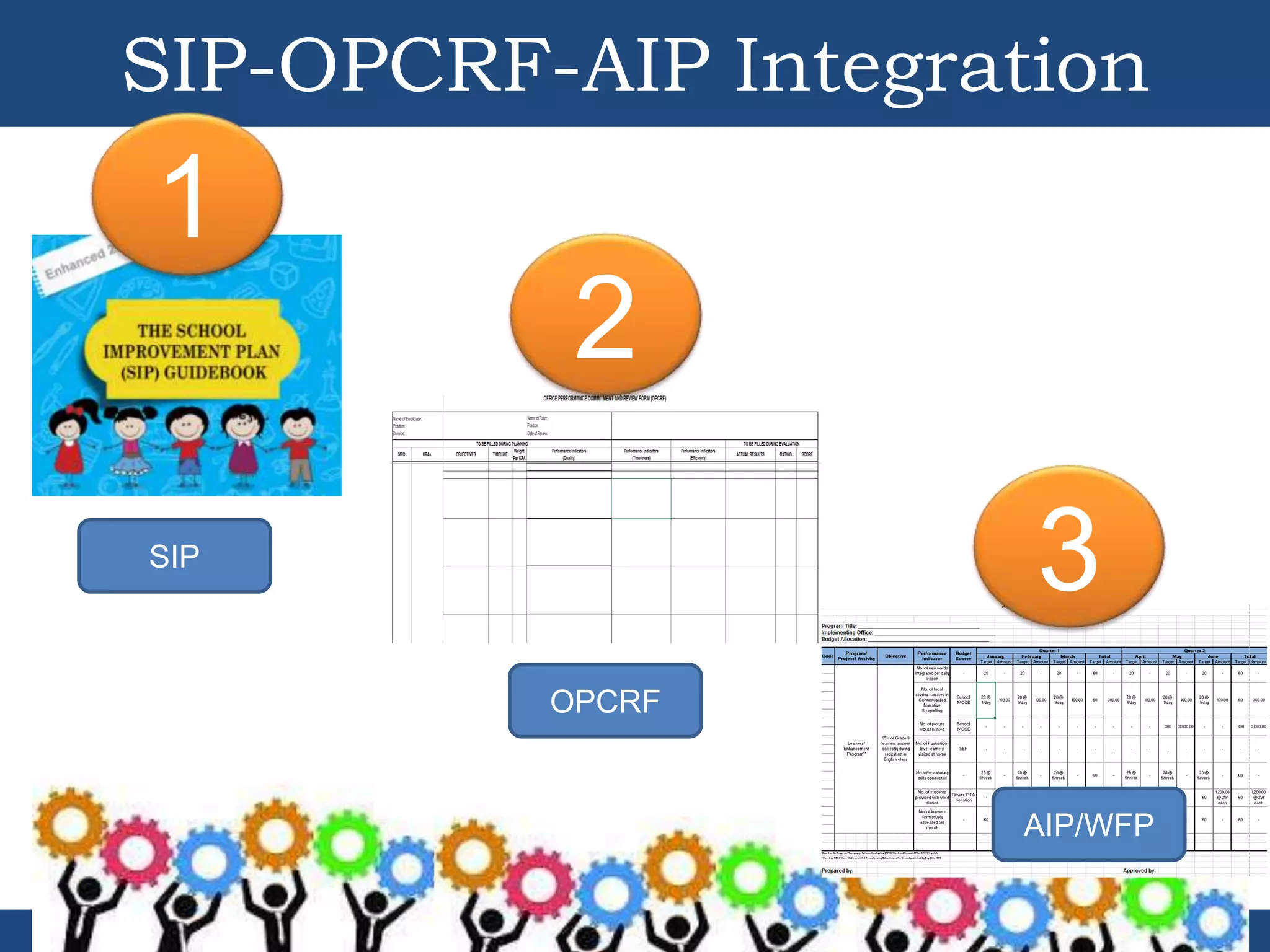
SIP-OPCRF-AIP Integration
21
1
2
3SIP
OPCRF
AIP/WFP
DEPARTMENT OF EDUCATION
Annual Implementation Plan
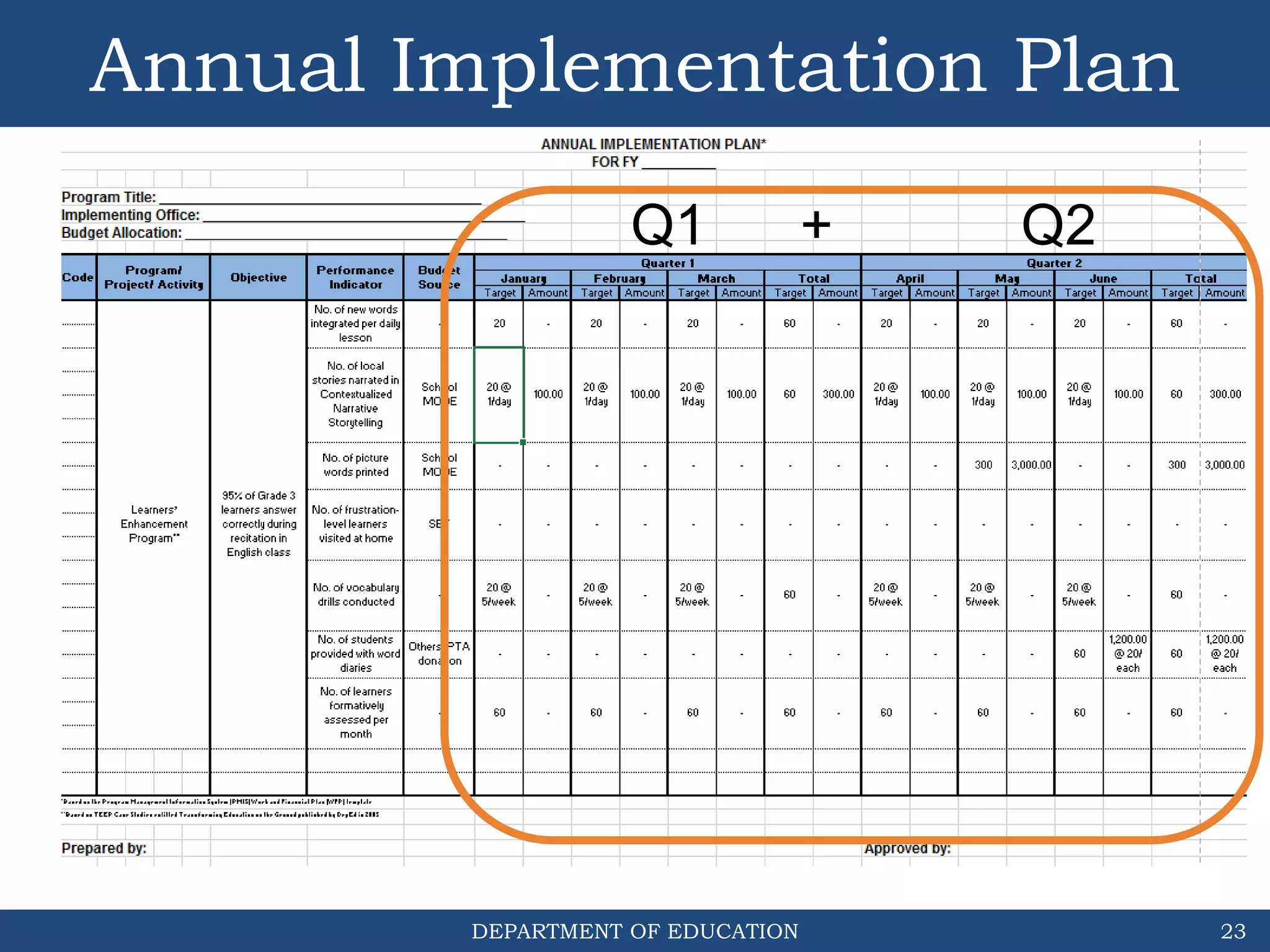
• Adopts the WFP format of Program
Management Information System (PMIS)
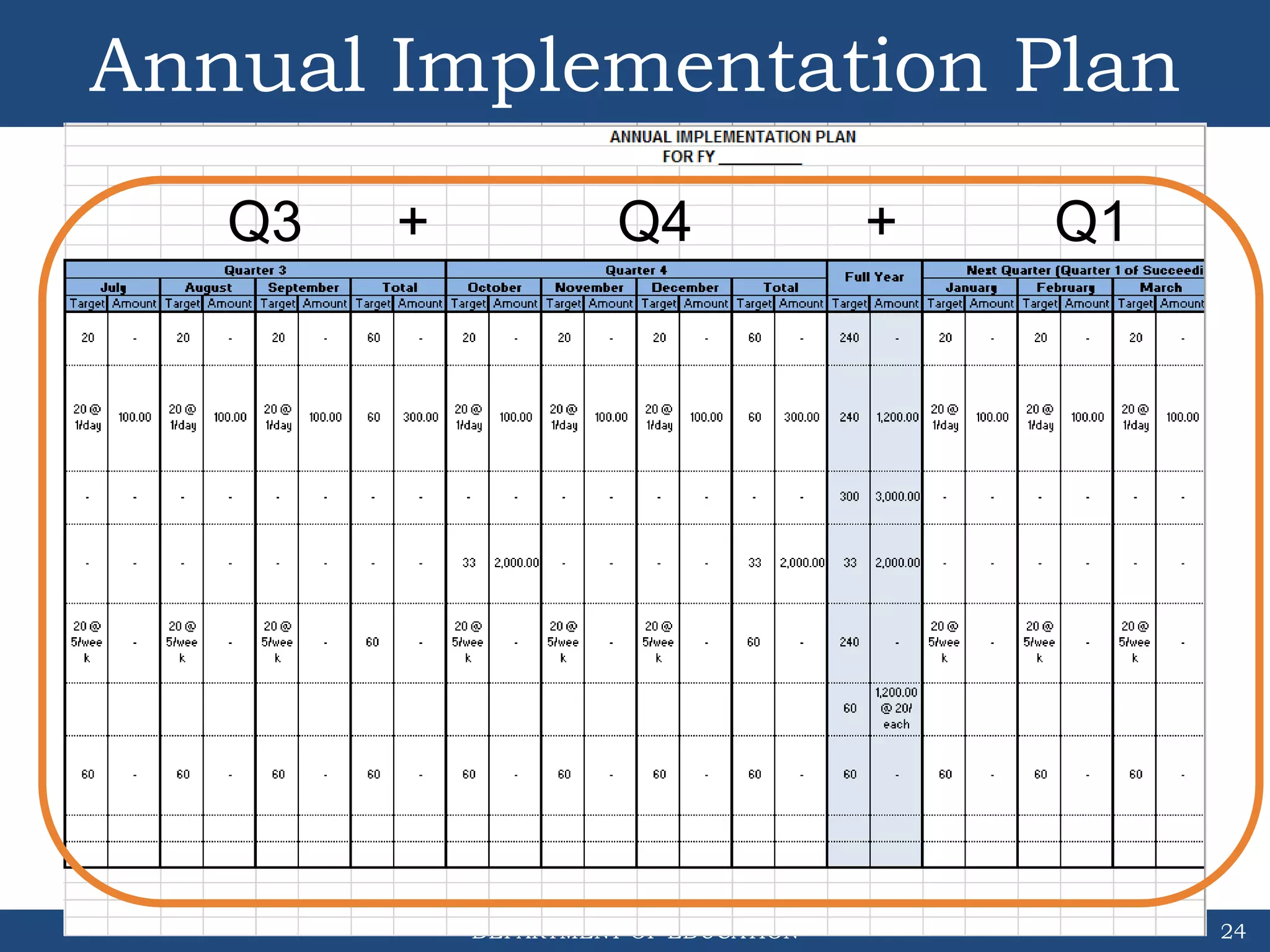
• Follows Fiscal Year Calendar (plus 1st
quarter of the succeeding FY)
• AIP/WFP is the basis for Monthly
Disbursement Program and Annual
Procurement Plan
22
DEPARTMENT OF EDUCATION
Annual Implementation Plan
23
Q1 + Q2
DEPARTMENT OF EDUCATION
Annual Implementation Plan
24
Q3 + Q4 + Q1
DEPARTMENT OF EDUCATION
SIP Monitoring
25
DEPARTMENT OF EDUCATION 26
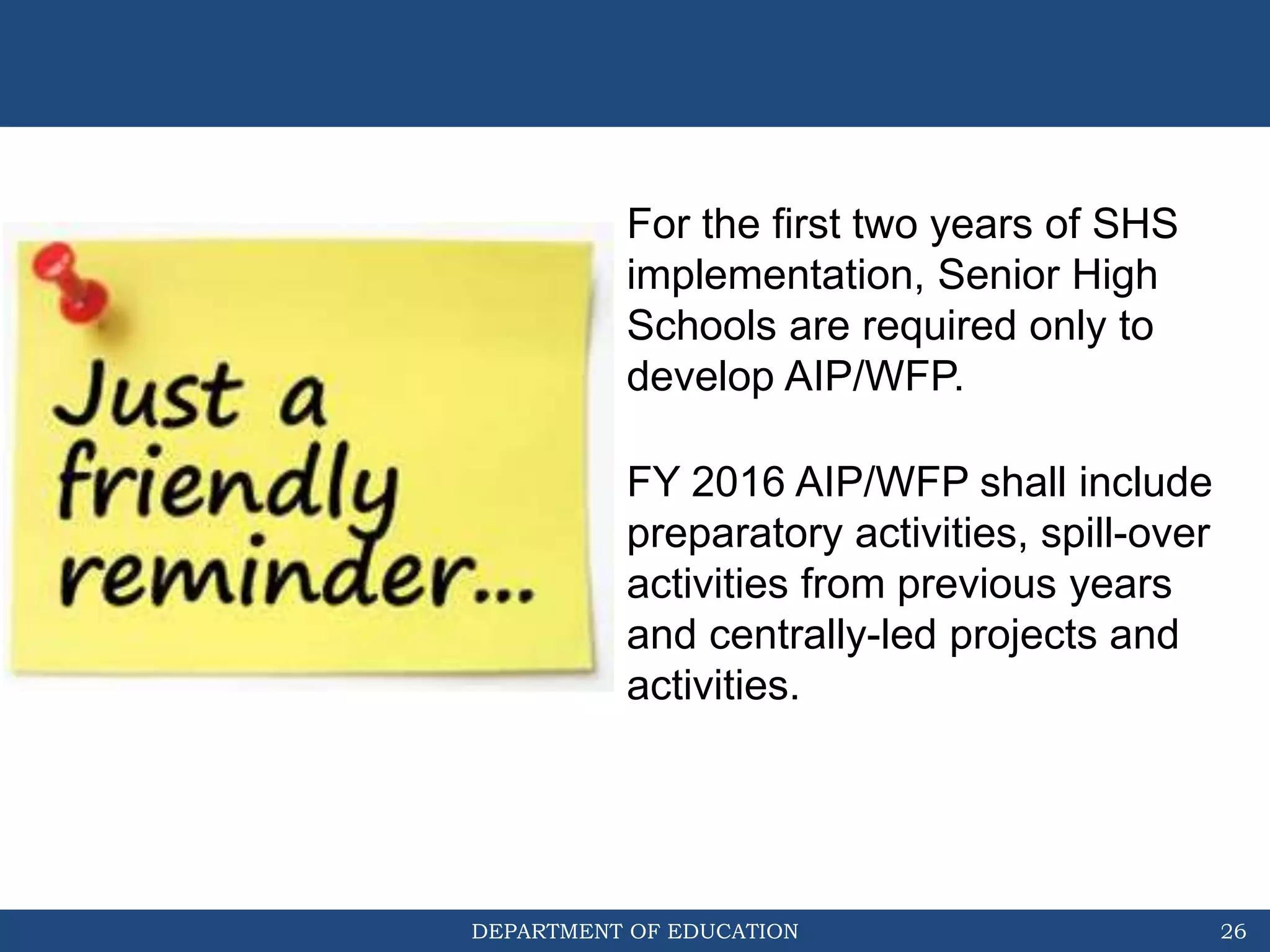
For the first two years of SHS
implementation, Senior High
Schools are required only to
develop AIP/WFP.
FY 2016 AIP/WFP shall include
preparatory activities, spill-over
activities from previous years
and centrally-led projects and
activities.
DEPARTMENT OF EDUCATION
COMMUNICATING TO
STAKEHOLDERS
27
DEPARTMENT OF EDUCATION
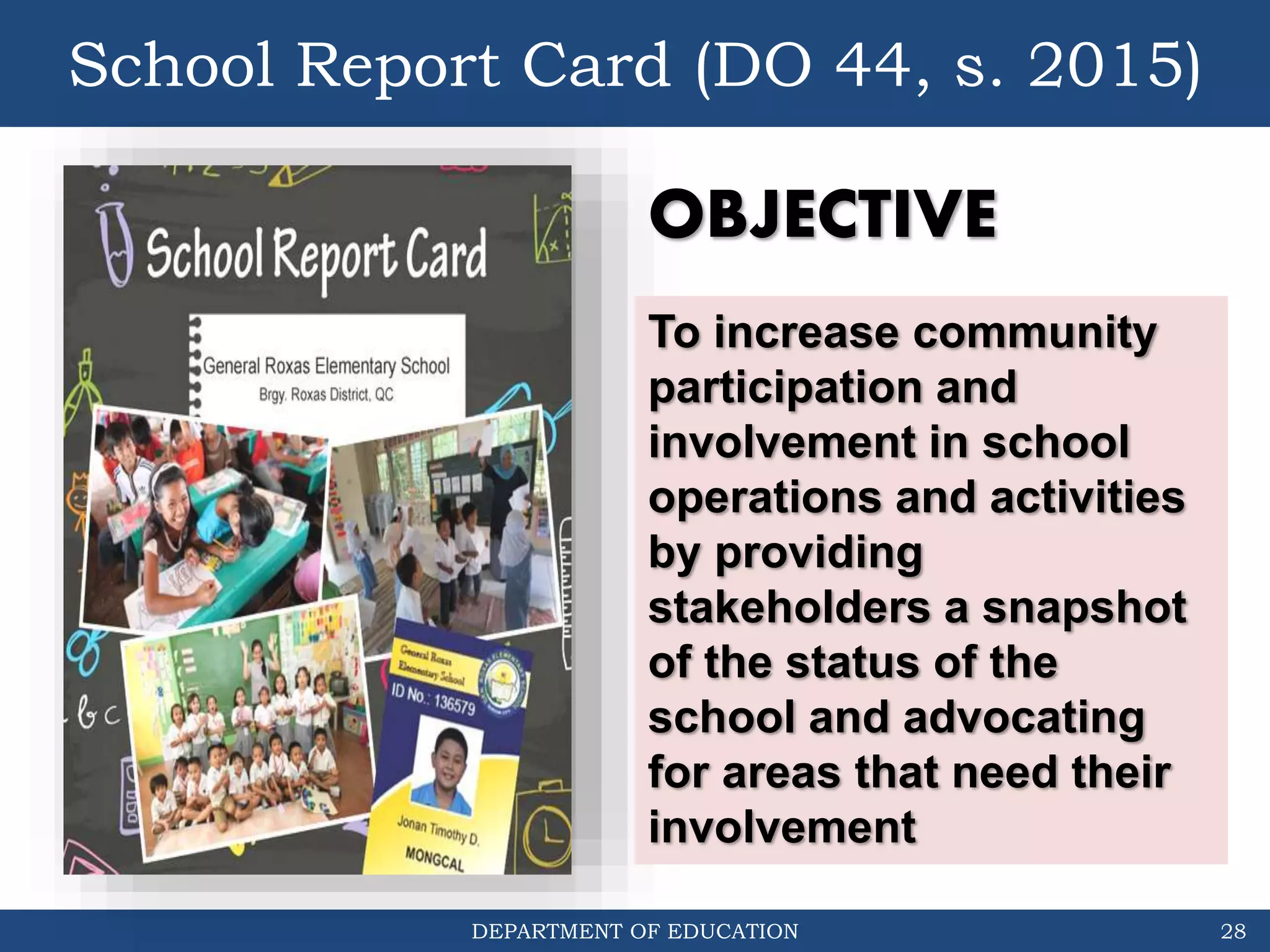
School Report Card (DO 44, s. 2015)
28
To increase community
participation and
involvement in school
operations and activities
by providing
stakeholders a snapshot
of the status of the
school and advocating
for areas that need their
involvement
OBJECTIVE
DEPARTMENT OF EDUCATION
SRC is aligned with FOI EO
29
“Every Filipino shall have access to:
a. Information
b. Official records
c. Public records and to
d. Documents and papers pertaining to official
acts, transactions or decisions,
e. Government research data used as basis for
policy development”
- Section 3, Executive Order 02, s.
2016
DEPARTMENT OF EDUCATION
Features of Refined SRC
30
1. Focus is on
advocacy and
communication;
2. Streamlined
indicators (19
indicators, not 32).
3. Includes school
accomplishment of
other stakeholders.
4. Integrated with SIP
DEPARTMENT OF EDUCATION
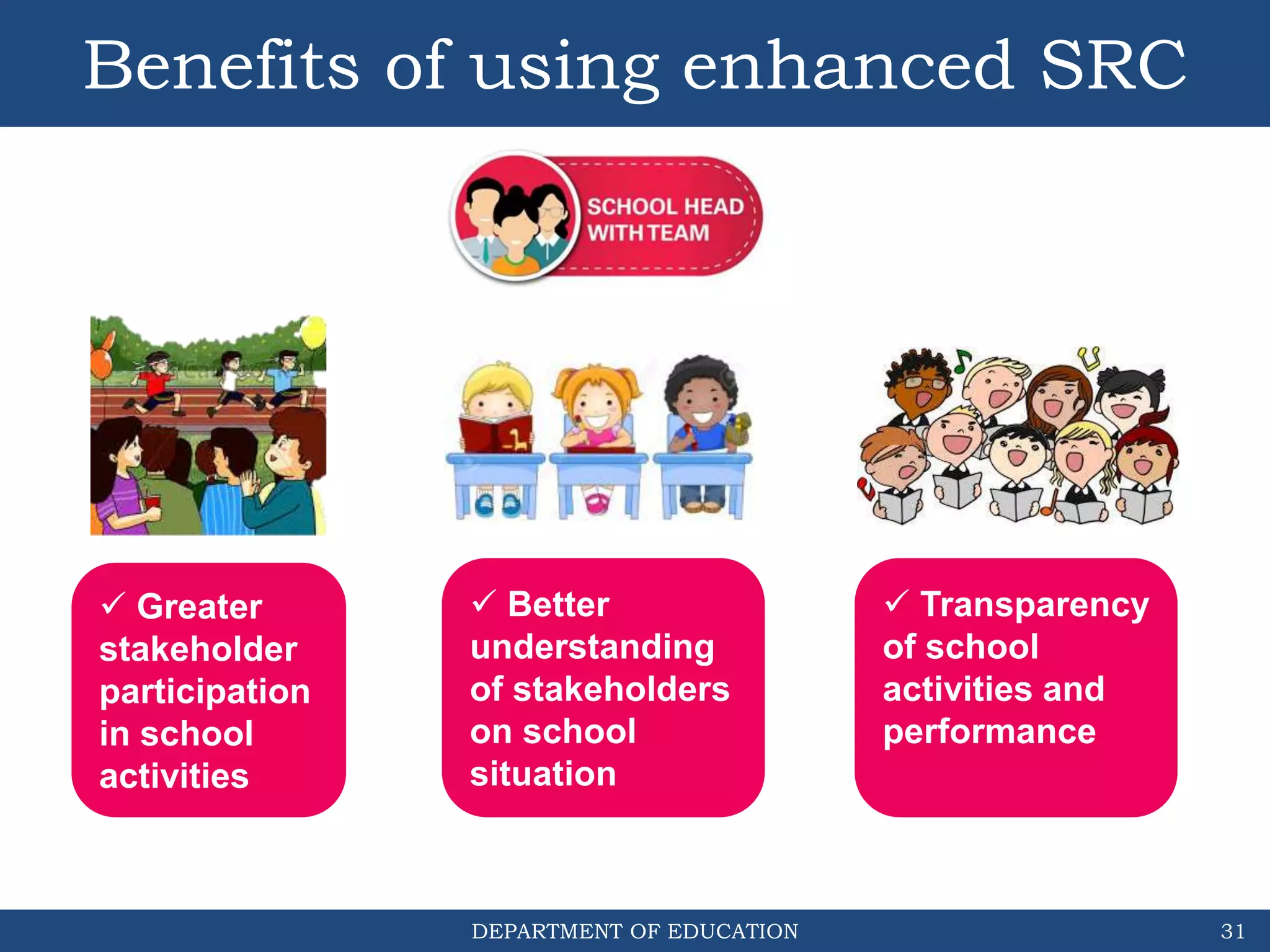
Benefits of using enhanced SRC
31
 Greater
stakeholder
participation
in school
activities
 Transparency
of school
activities and
performance
 Better
understanding
of stakeholders
on school
situation
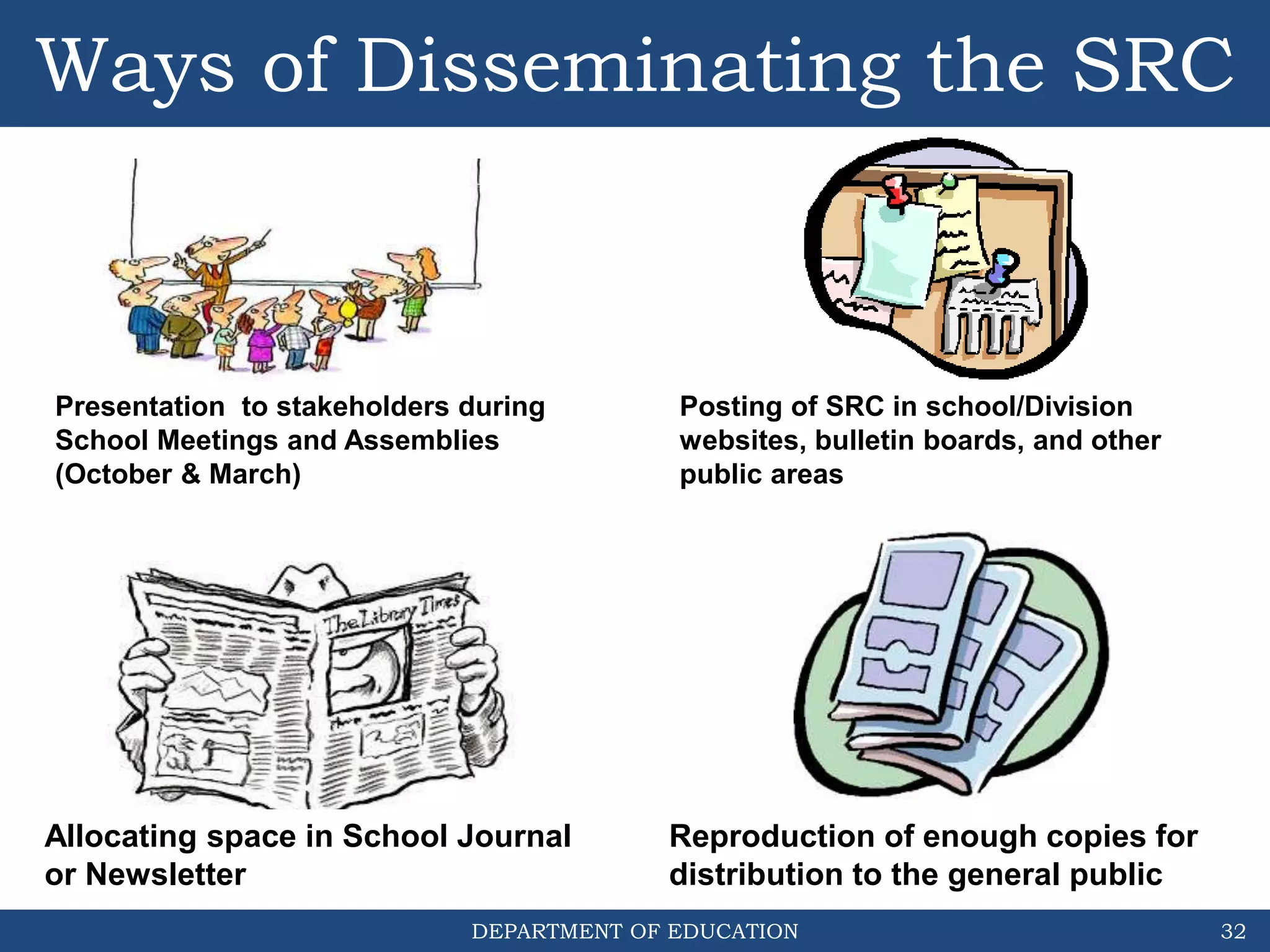
DEPARTMENT OF EDUCATION 32
Allocating space in School Journal
or Newsletter
Posting of SRC in school/Division
websites, bulletin boards, and other
public areas
Reproduction of enough copies for
distribution to the general public
Presentation to stakeholders during
School Meetings and Assemblies
(October & March)
Ways of Disseminating the SRC
DEPARTMENT OF EDUCATION
19 SRC Indicators
33
 Enrolment
 Health and
Nutritional Status
 Learners materials’
 Teachers’
professional
development
 Funding sources
 School awards and
recognitions
SCHOOL PROFILE [6] PERFORMANCE INDICATORS [11]
Access
 Number and rate of dropouts by
cause
Quality
 Percentage of learners who
completed the School Year
(Promotion Rate)
 National Achievement Test
(NAT) – by Mean Percentage
Score (MPS)
 Literacy level
Governance
 School-Based Management
Assessment Level
 Child-Friendly School Survey
result
 Stakeholders’ participation
 Learner-Teacher ratio
 Learner-Classroom ratio
 Learner-Toilet ratio
 Learner—Seat ratio
 Status of Annual
Improvement Plan
(AIP)/Continuous
Improvement
Projects)
 Other Stakeholders'
Accomplishments
STATUS OF SCHOOL
PROJECTS [2]
DEPARTMENT OF EDUCATION
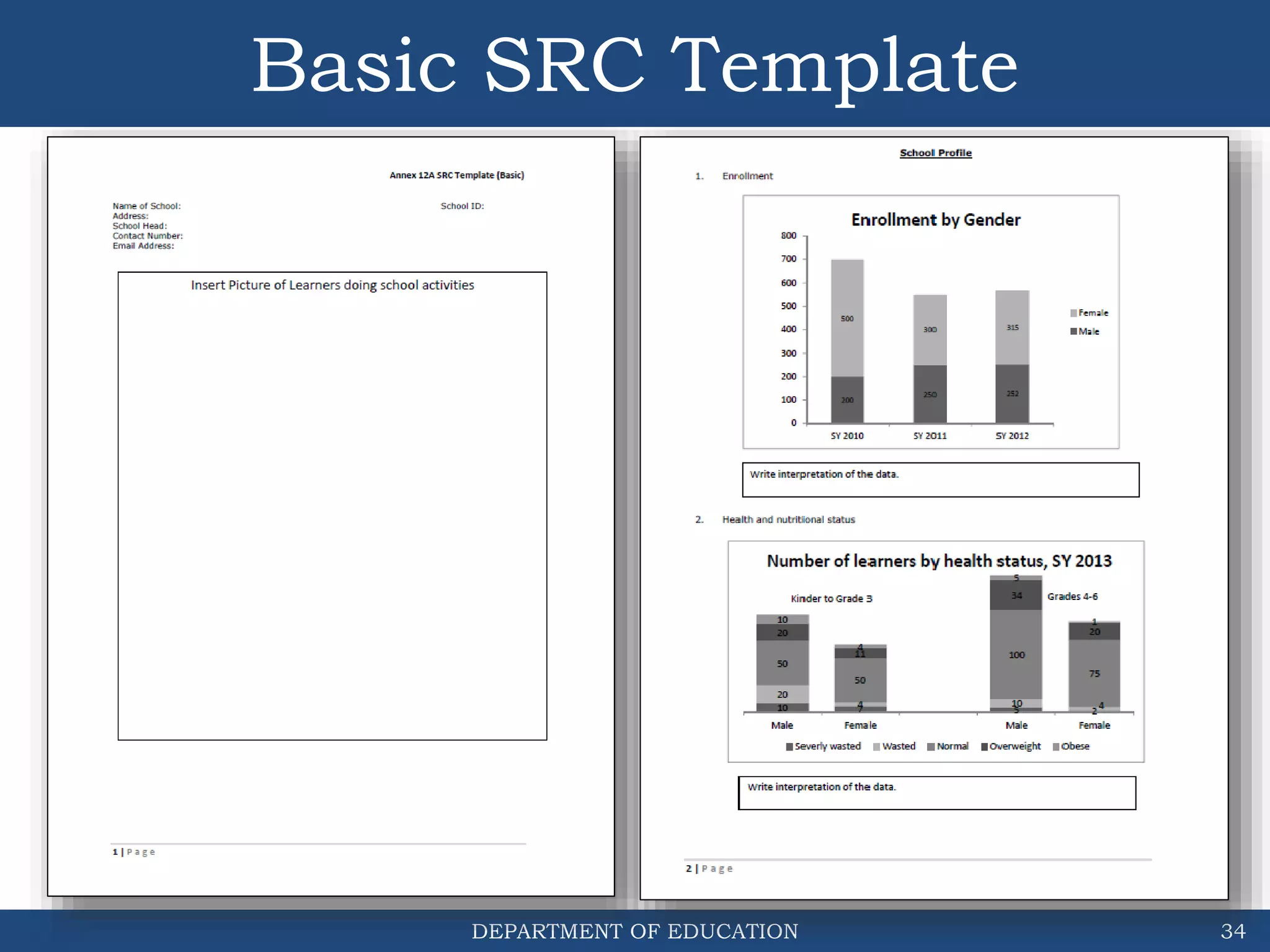
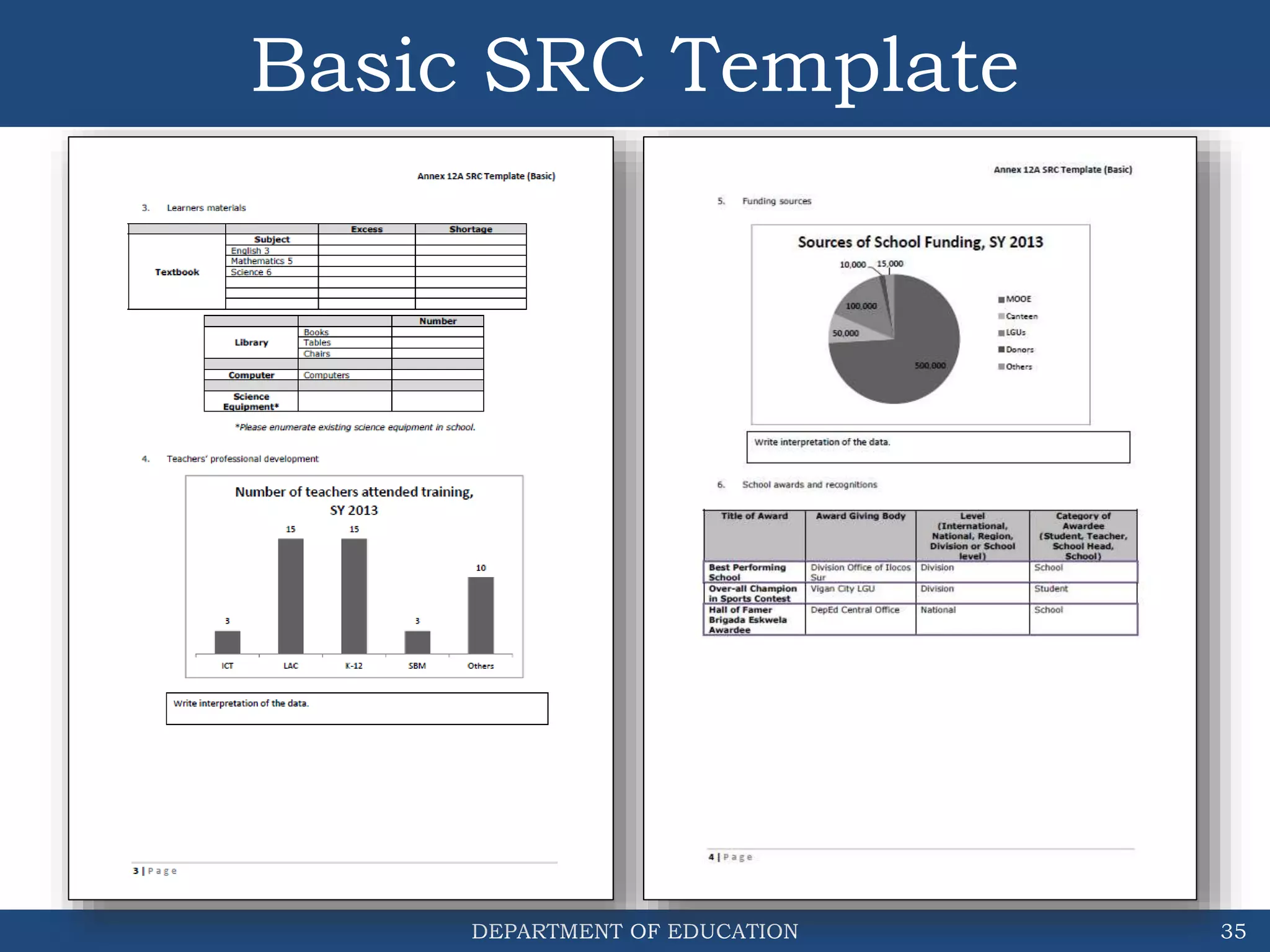
Basic SRC Template
34
DEPARTMENT OF EDUCATION
Basic SRC Template
35
DEPARTMENT OF EDUCATION
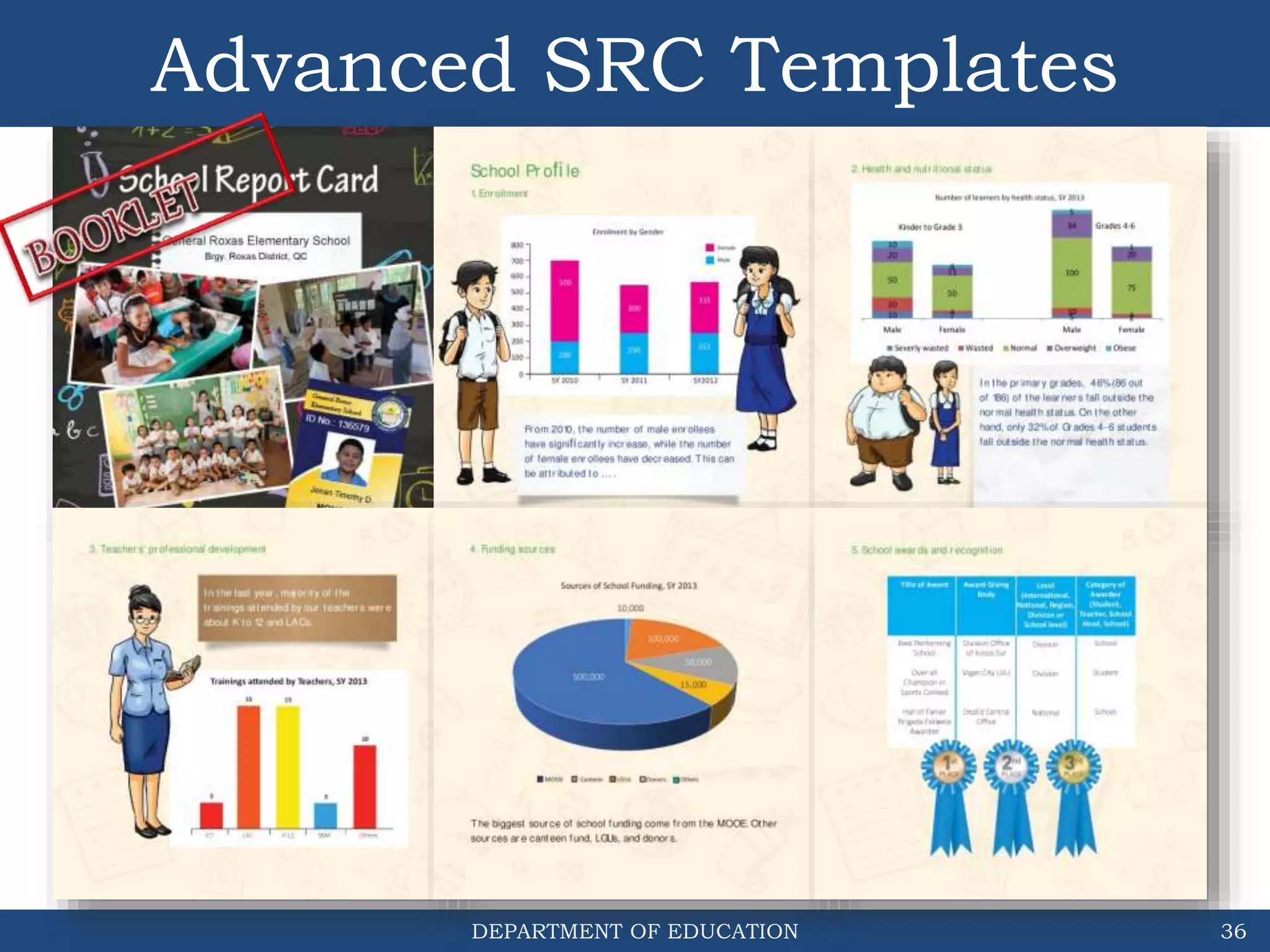
Advanced SRC Templates
36
DEPARTMENT OF EDUCATION
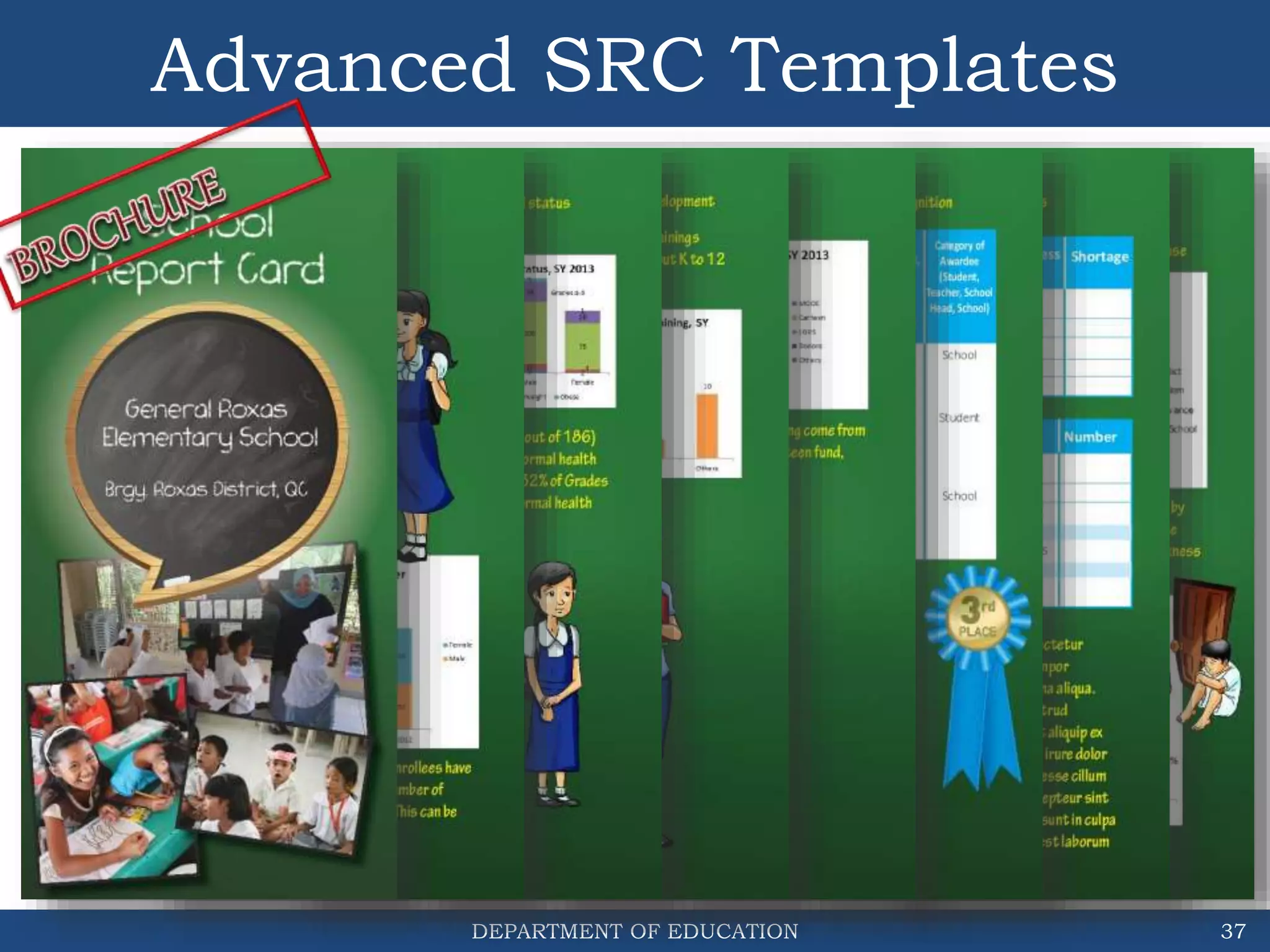
Advanced SRC Templates
37
DEPARTMENT OF EDUCATION
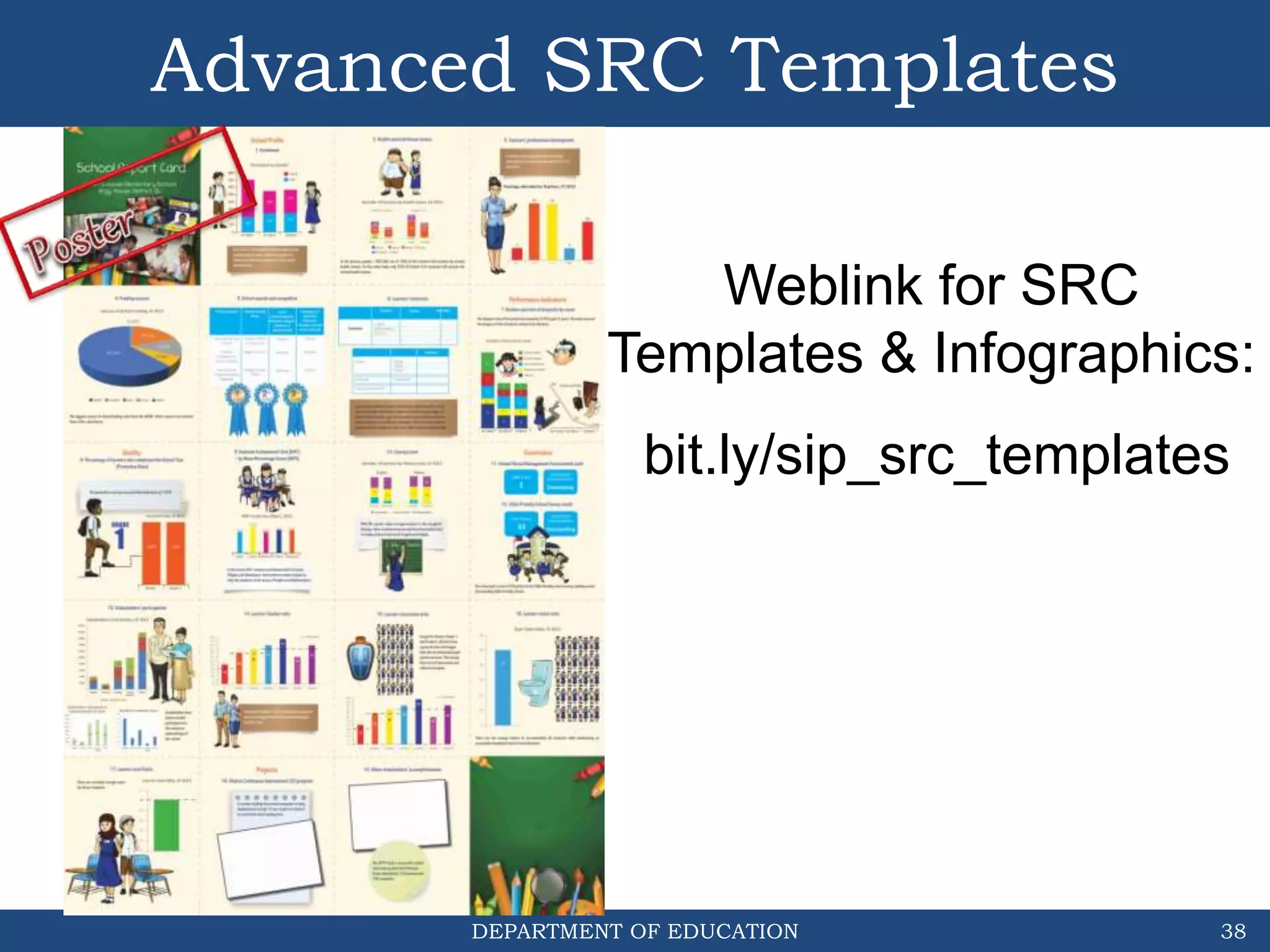
Advanced SRC Templates
38
Weblink for SRC
Templates & Infographics:
bit.ly/sip_src_templates
Navotas NHS
SCHOOL REPORT CARD
2016 – 2017
DEPARTMENT OF EDUCATION
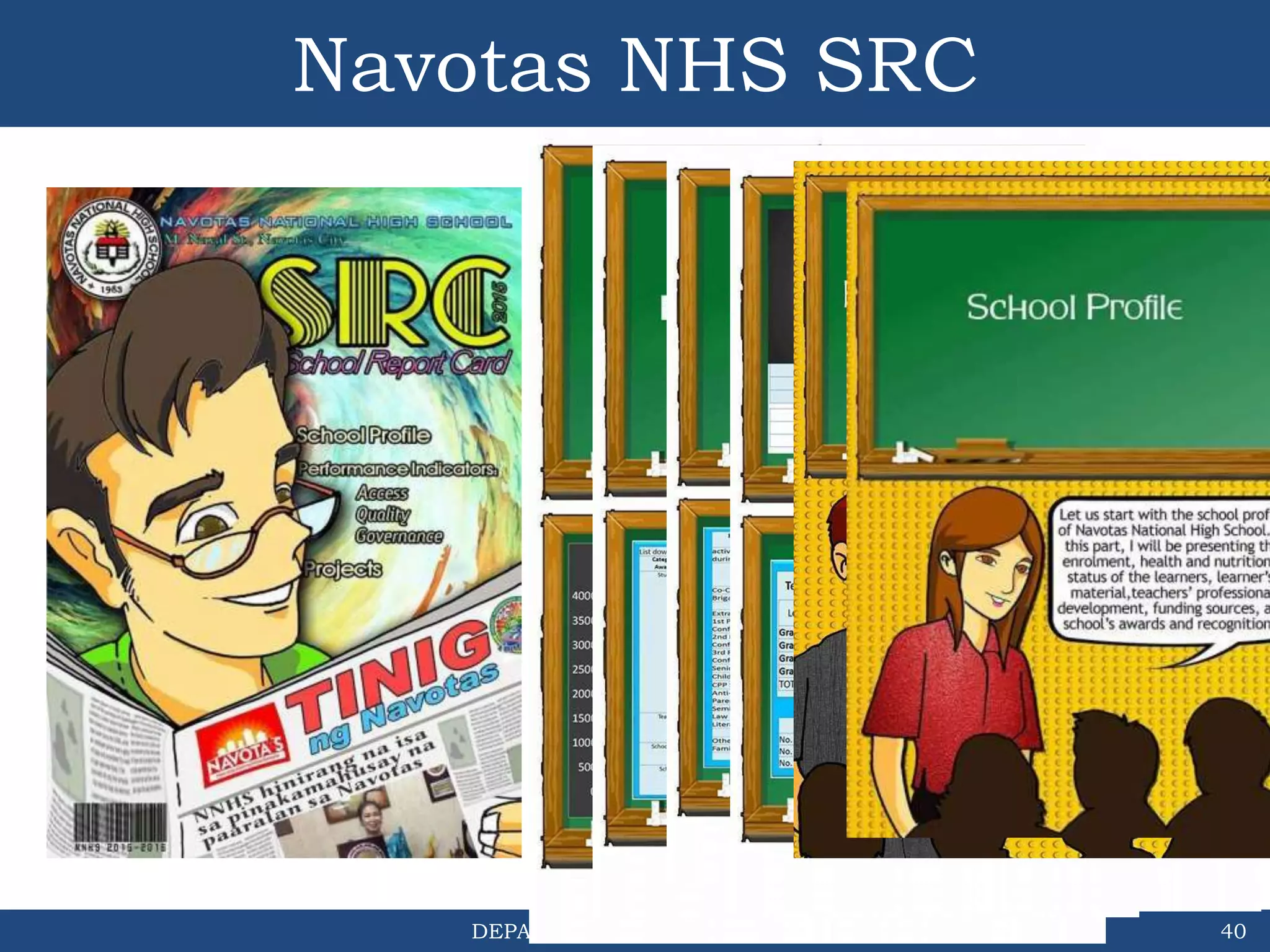
Navotas NHS SRC
40
DEPARTMENT OF EDUCATION
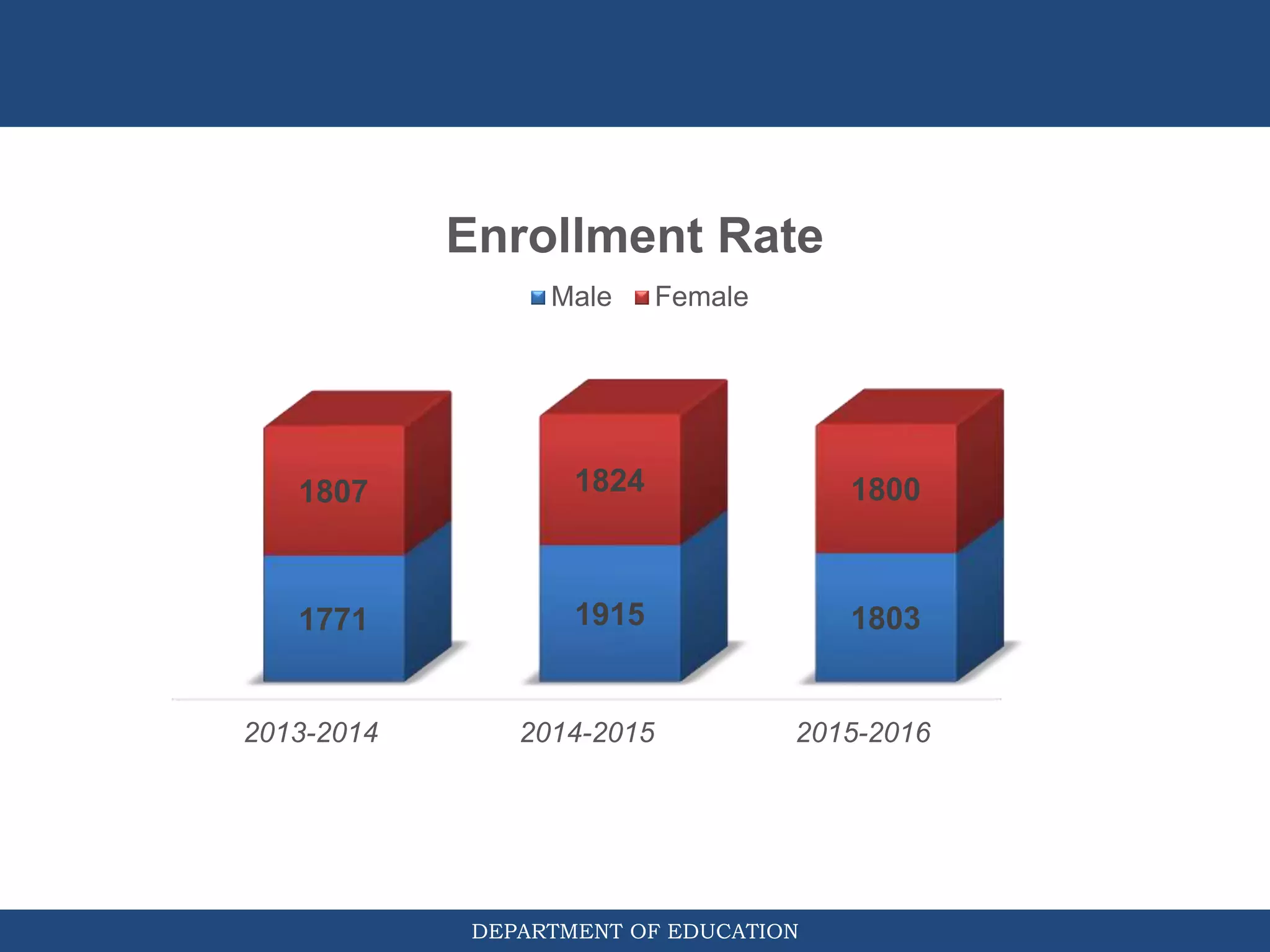
2013-2014 2014-2015 2015-2016
1771 1915 1803
1807 1824 1800
Enrollment Rate
Male Female
DEPARTMENT OF EDUCATION
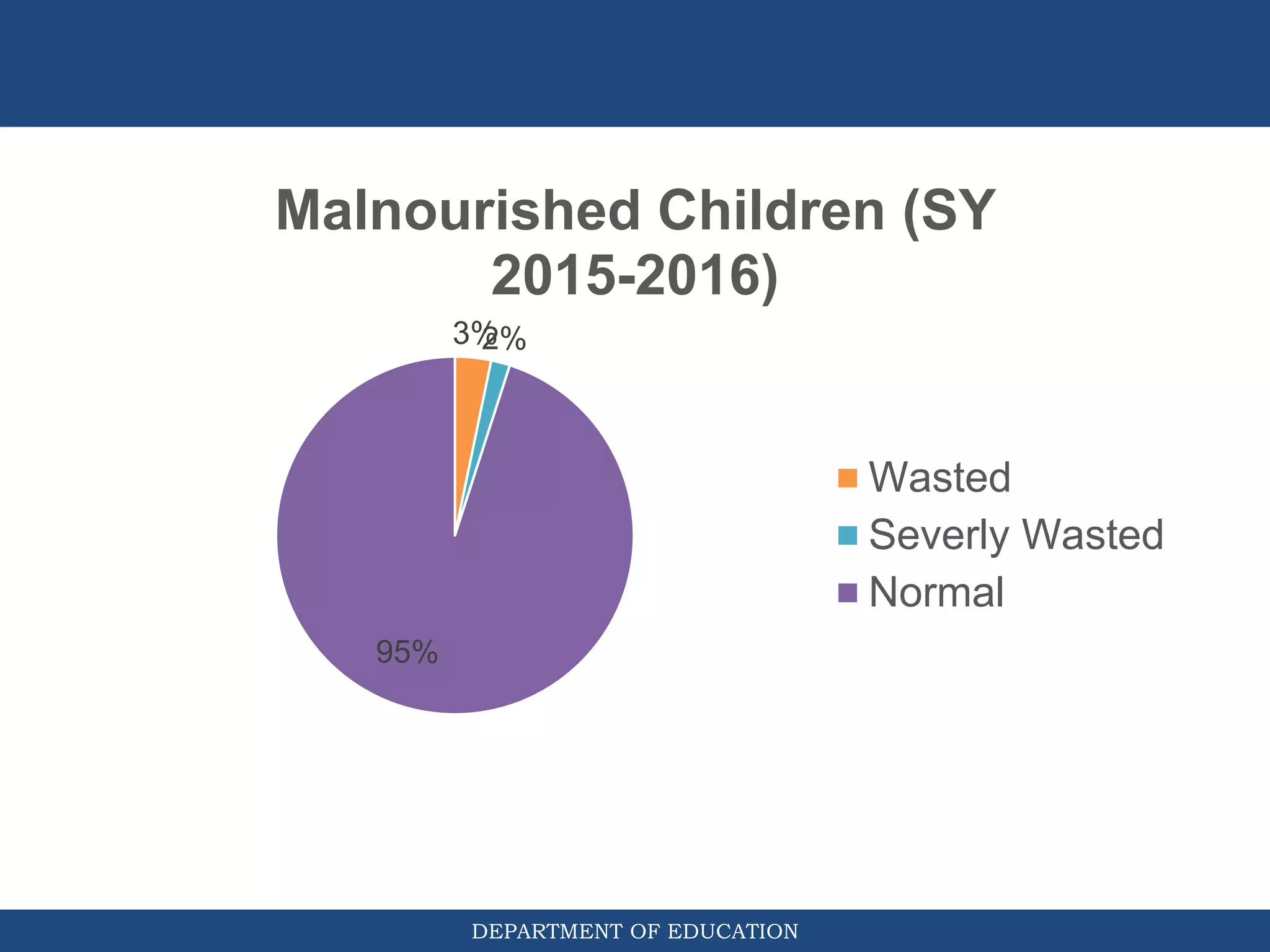
3%2%
95%
Malnourished Children (SY
2015-2016)
Wasted
Severly Wasted
Normal
DEPARTMENT OF EDUCATION
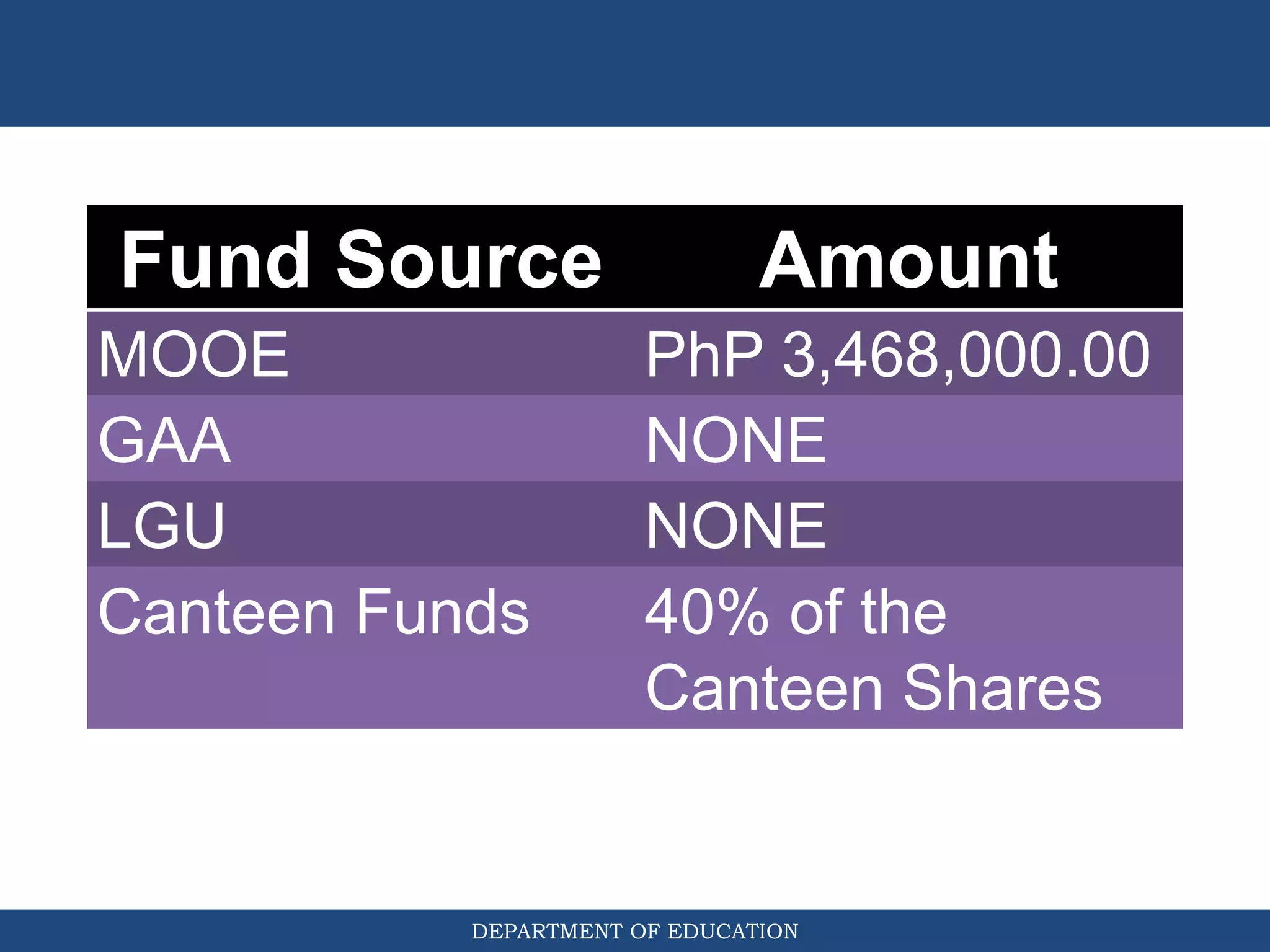
Fund Source Amount
MOOE PhP 3,468,000.00
GAA NONE
LGU NONE
Canteen Funds 40% of the
Canteen Shares
DEPARTMENT OF EDUCATION
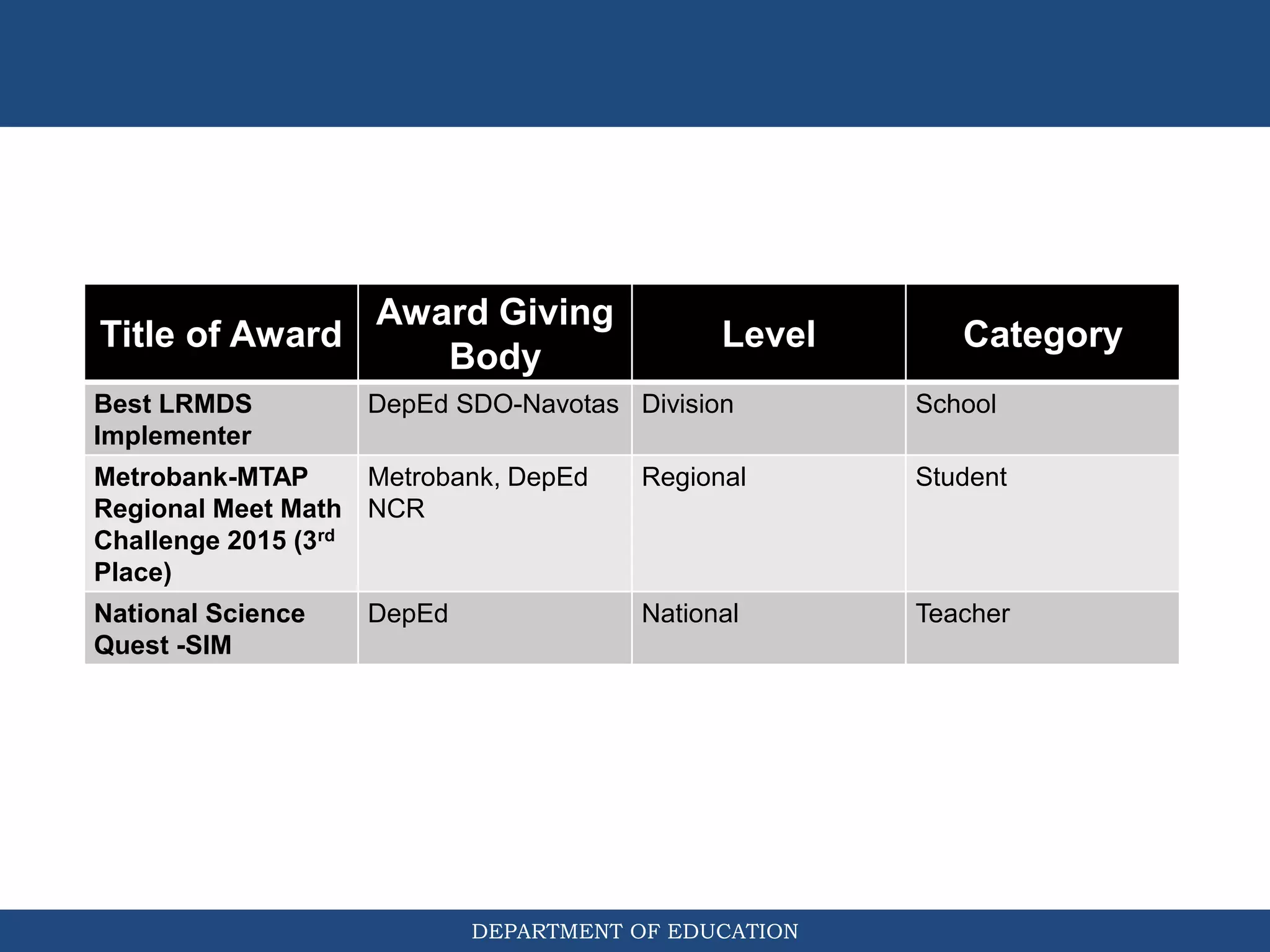
Title of Award
Award Giving
Body
Level Category
Best LRMDS
Implementer
DepEd SDO-Navotas Division School
Metrobank-MTAP
Regional Meet Math
Challenge 2015 (3rd
Place)
Metrobank, DepEd
NCR
Regional Student
National Science
Quest -SIM
DepEd National Teacher
DEPARTMENT OF EDUCATION
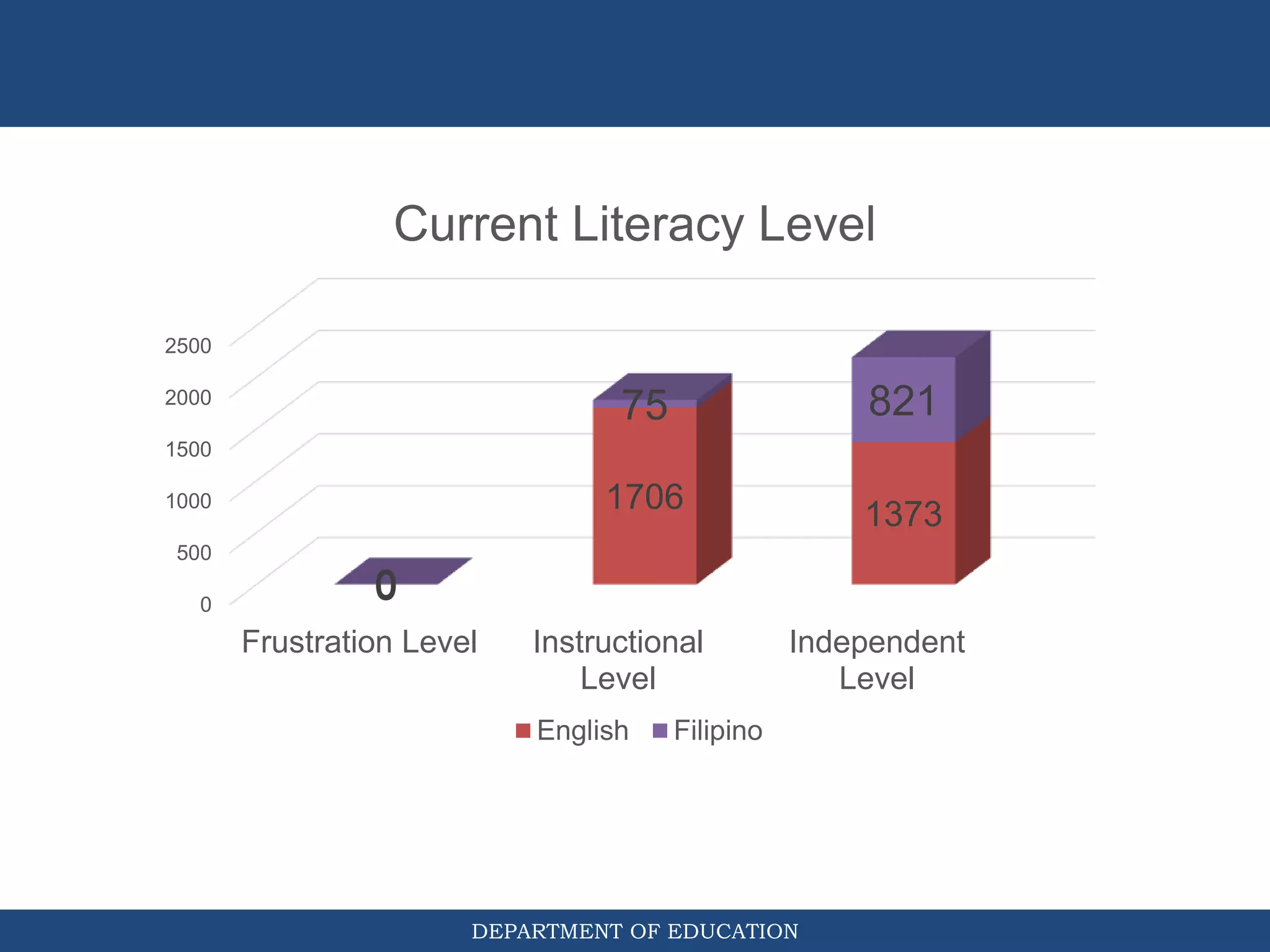
0
5
10
15
20
25
30
35
40
45
50
Grade 7 Grade 8 Grade 9 Grade 10
37
10
28
1
12
6
11
1
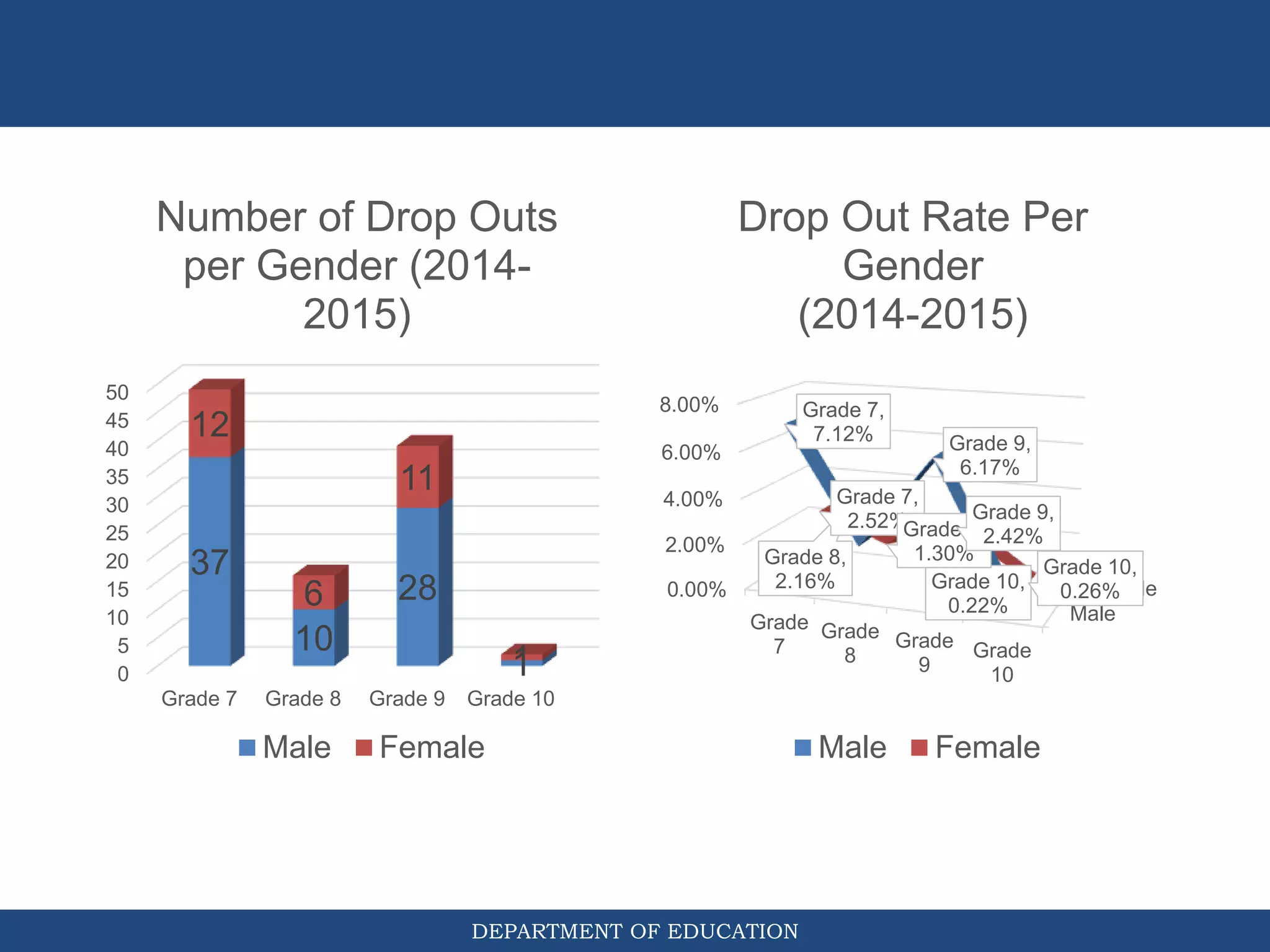
Number of Drop Outs
per Gender (2014-
2015)
Male Female
Male
Female0.00%
2.00%
4.00%
6.00%
8.00%
Grade
7
Grade
8
Grade
9
Grade
10
Grade 7,
7.12%
Grade 8,
2.16%
Grade 9,
6.17%
Grade 10,
0.22%
Grade 7,
2.52%Grade 8,
1.30%
Grade 9,
2.42%
Grade 10,
0.26%
Drop Out Rate Per
Gender
(2014-2015)
Male Female
DEPARTMENT OF EDUCATION
0
10
20
30
40
50
60
70
English Filipino Mathematics Science AP
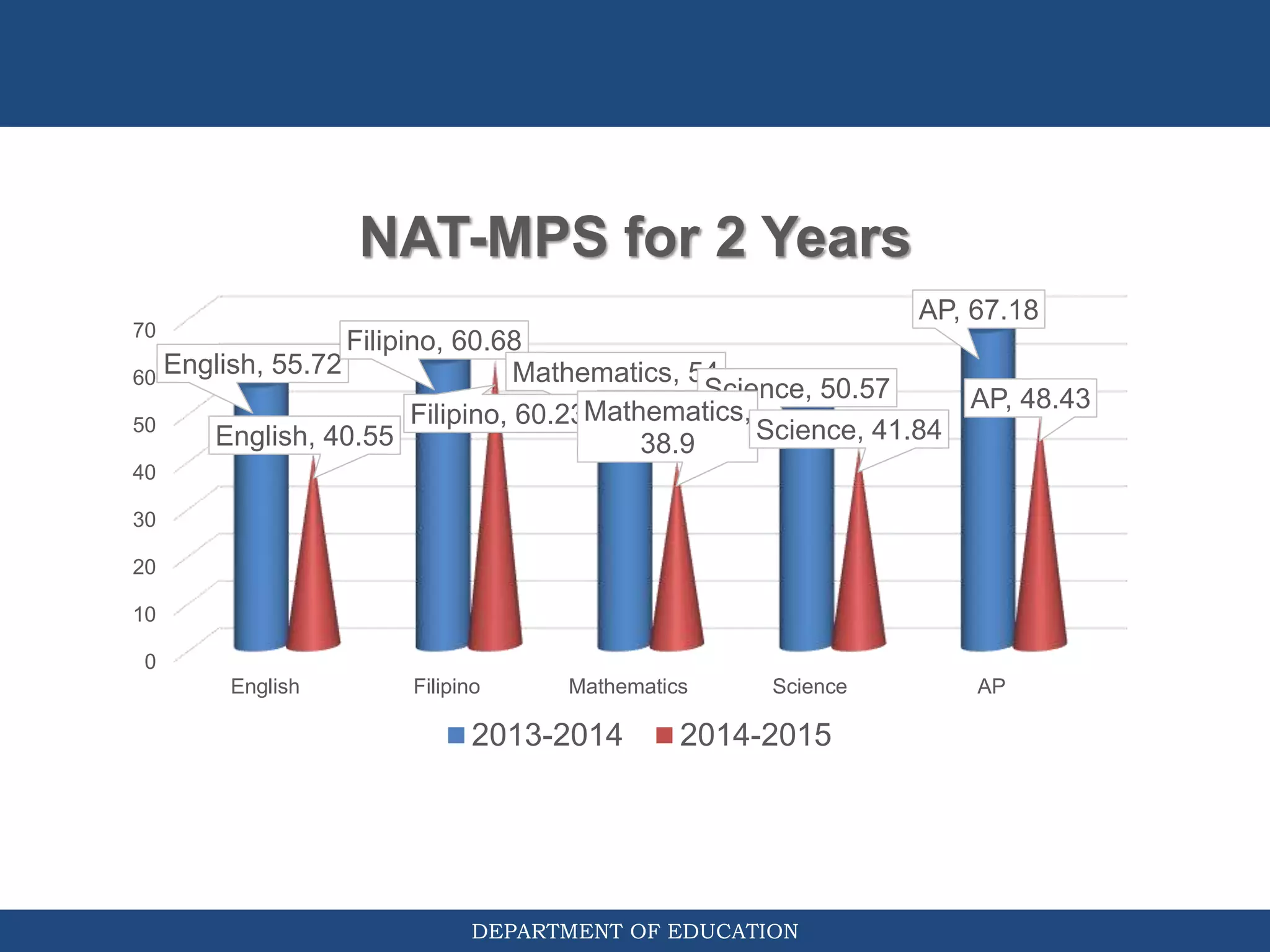
English, 55.72
Filipino, 60.68
Mathematics, 54
Science, 50.57
AP, 67.18
English, 40.55
Filipino, 60.23Mathematics,
38.9 Science, 41.84
AP, 48.43
NAT-MPS for 2 Years
2013-2014 2014-2015
DEPARTMENT OF EDUCATION
0
500
1000
1500
2000
2500
Frustration Level Instructional
Level
Independent
Level
0
1706 1373
0
75 821
Current Literacy Level
English Filipino
DEPARTMENT OF EDUCATION
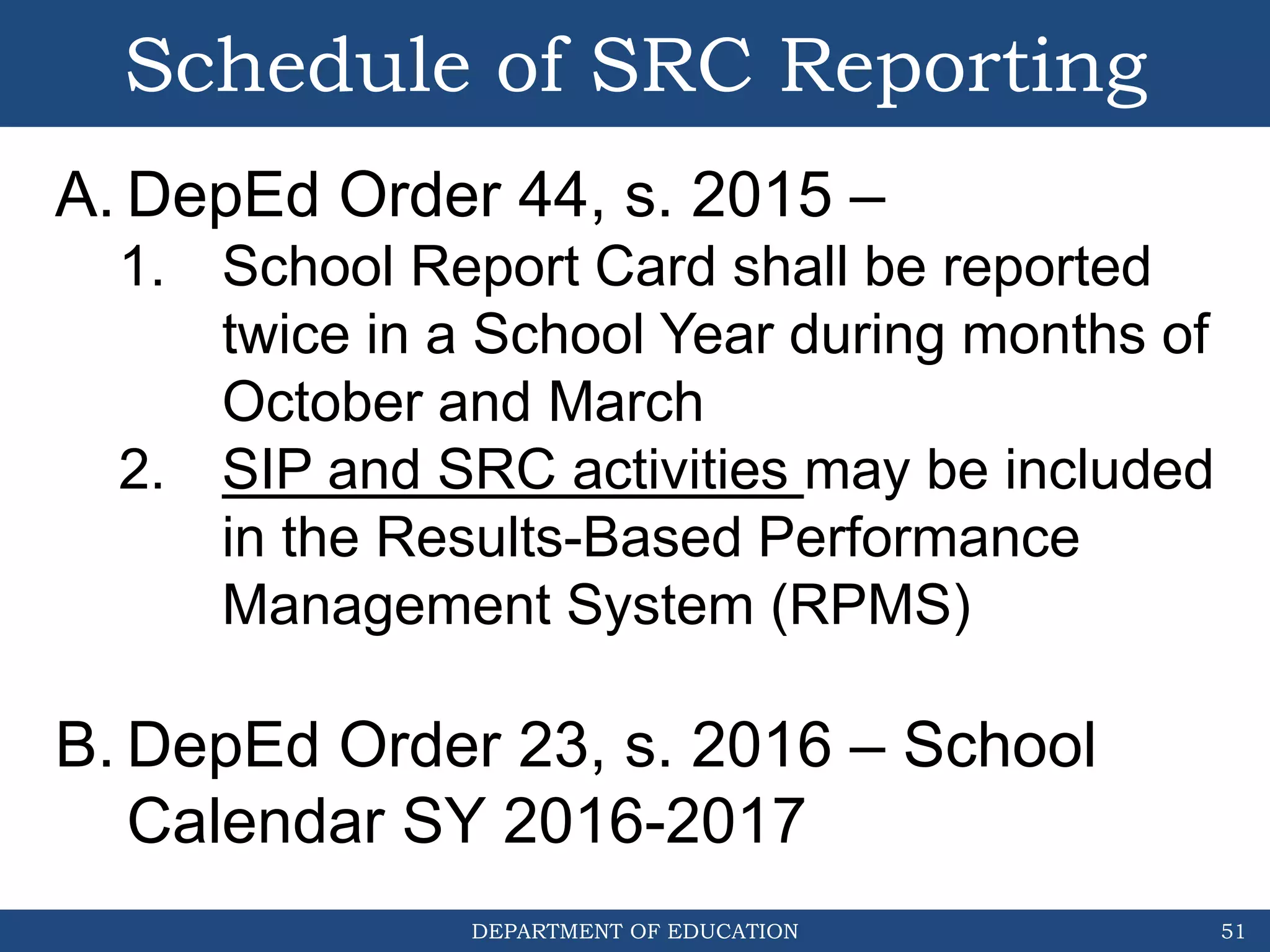
Schedule of SRC Reporting
51
A. DepEd Order 44, s. 2015 –
1. School Report Card shall be reported
twice in a School Year during months of
October and March
2. SIP and SRC activities may be included
in the Results-Based Performance
Management System (RPMS)
B. DepEd Order 23, s. 2016 – School
Calendar SY 2016-2017
DEPARTMENT OF EDUCATION
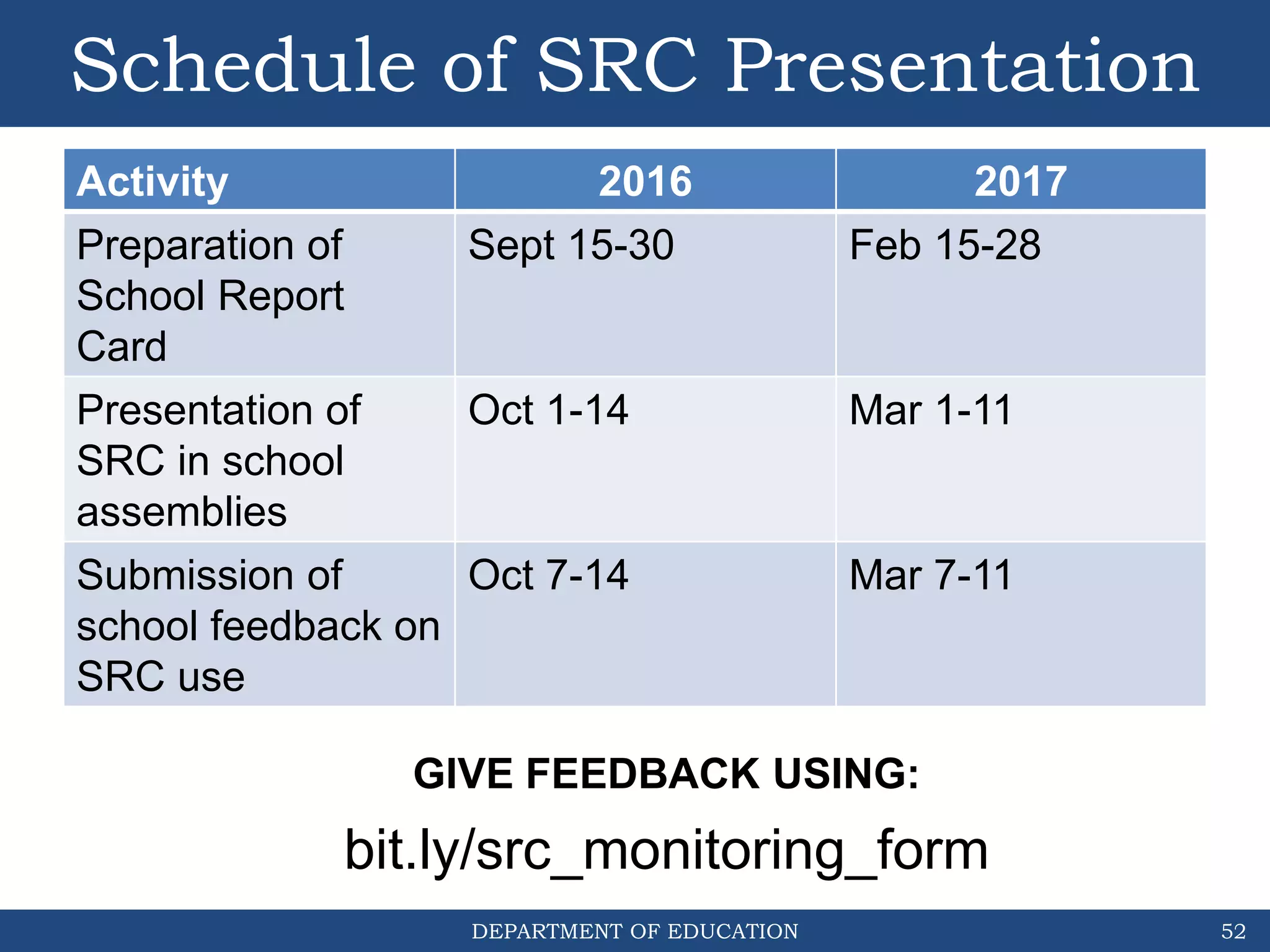
Schedule of SRC Presentation
Activity 2016 2017
Preparation of
School Report
Card
Sept 15-30 Feb 15-28
Presentation of
SRC in school
assemblies
Oct 1-14 Mar 1-11
Submission of
school feedback on
SRC use
Oct 7-14 Mar 7-11
52
bit.ly/src_monitoring_form
GIVE FEEDBACK USING:
DEPARTMENT OF EDUCATION
End of Presentation
• bhrod.sed@deped.gov.ph
53

Enhanced sip-src-rpms-integration-1

  • 1.
    Enhanced SIP, SRC,& RPMS Integration
  • 2.
    DEPARTMENT OF EDUCATION SchoolEffectiveness Division Charter 2 Purpose: The School Effectiveness Division supports and enables schools to continuously improve its own governance and delivery of quality basic education services that are responsive to the diverse needs of its learners. Summary of Functions/Scope: 1. Formulation of School Effectiveness Framework 2. Establishment of standards for governance to support effective schools 3. Application and monitoring of school performance management standards 4. Accreditation of Schools and Learning Centers
  • 3.
    DEPARTMENT OF EDUCATION Overviewof Current Thrusts • School Effectiveness Framework • Continuing the School-Based Management Initiatives – District Synthesis – School Governing Council – User Guide on SBM Assessment – External Accreditation of Schools – School Re-structuring using School Typology – School Process Improvements using Continuous Improvement Program – School Improvement Planning and School Report Card 3
  • 4.
    DEPARTMENT OF EDUCATION PolicyBases The School Report Card is a tool for advocating and communicating the school situation, context, and performance to internal and external stakeholders D.O. 44, s. 2015 The SIP is a roadmap that lays down specific interventions that a school, with the help of the community and other stakeholders, will undertake within a period of three consecutive school years. D.O. 44, s. 2015 4 The RPMS shall align the performance targets and accomplishments with the DepEd’s mandate, vision, mission and strategic goals… The OPCRF shall reflect the Office KRAs, Objectives and performance indicators D.O. 2, s. 2015
  • 5.
    DEPARTMENT OF EDUCATION Featuresof Self-Managing Schools 5 Photo from UNICEF Website The learner is at the center of everything we do
  • 6.
    DEPARTMENT OF EDUCATION Featuresof Self-Managing Schools 6 Investment addresses various needs of learners
  • 7.
    DEPARTMENT OF EDUCATION Featuresof Self-Managing Schools 7 Maximizes its intellectual and social capital
  • 8.
    DEPARTMENT OF EDUCATION Featuresof Self-Managing Schools 8 School governance is participatory
  • 9.
    DEPARTMENT OF EDUCATION Howcan schools become effective organizations?
  • 10.
  • 11.
    DEPARTMENT OF EDUCATION EnhancedSIP Cycle 11 Situation Analysis Identification of Strategies, PAPs, Resource Requirements Plan Implementation Plan Monitoring and Evaluation
  • 12.
  • 13.
    DEPARTMENT OF EDUCATION13 Enhanced SIP Process B. Assess C. Plan D. Act • Gather and organize necessary data • Form the SPT • Convene the SPT for orientation, vision sharing and scheduling A. Preparatory Activities • Identify/Review PIAs • Analyze PIAs • Listen to the voice of the learners • Analyze school proceses • Select Area of Focus • Do root cause analysis • Present the root cause to the SPT • Review general objectives & targets • Formulate solutions • Develop Project Designs • Write the SIP and prepare the AIP • Test and roll out the solution/s • Communicating with stakeholders • Check progress of AIP SBM Assessment D.O. No. 83 s. 2012 Child Protection Policy D.O. No. 40 s. 2012 Early Registration D.O. No. 1 s. 2015 Student-Led School Watching and Hazard Mapping D.O. No. 23 s. 2015 Result-Based Performance Management System D.O. No. 2 s. 2015 Integrated Policies
  • 14.
    DEPARTMENT OF EDUCATION14 SIP is linked with BEPS via Intermediate Outcomes
  • 15.
    DEPARTMENT OF EDUCATION Results-basedPerformance Management System (RPMS) 15 How can schools become effective organizations?
  • 16.
    DEPARTMENT OF EDUCATION RPMSLinkages to Other HR Systems RPMS Job Design and Work Relationships HR Planning and Recruitment Compensation and Benefits Rewards and Recognition Training and Manpower Development Employee Relations Career Succession Agency Planning and and Directions (SIP, DEDP, REDP, Natl Plan)
  • 17.
    DEPARTMENT OF EDUCATIONTheDepEd RPMS is aligned with the CSC SPMS that has 4 Phases. 4 RPMS PHASES I. Performance Planning & Commitment II. Performance Monitoring & Coaching III. Performance Review & Evaluation IV. Performance Rewarding and Development Planning Output: IPCRF and OPCRF Output: Monitoring Form Output: Rating sheet Output: Development plan Input: SIP, PIA During adjustment
  • 18.
    DEPARTMENT OF EDUCATION SIPand OPCRF 18 Major Final Output (MFO) Key Result Areas (KRAs)/ Priority Improvement Areas OPCRF (Principal) Key Result Areas (KRAs) IPCRF (Head Teacher) Key Result Areas (KRAs) IPCRF (Master Teacher) Key Result Areas (KRAs) IPCRF (Teachers) Basic Education Services 1. Instructional Leadership 1. School Curriculum Monitoring and Evaluation Plan 1. Instructional Supervision 2. Instructional Competence 1. Teaching Learning Process 5. Human Resource Management and Development 5. Human Resource Management (School Based INSET) 5. Personal and Professional Development (Action Research) 5. Personal and Professional Development Key Results Area = Priority Improvement Area
  • 19.
  • 20.
    DEPARTMENT OF EDUCATION DiscussStrengths and Improvement Needs
  • 21.
    DEPARTMENT OF EDUCATION SIP-OPCRF-AIPIntegration 21 1 2 3SIP OPCRF AIP/WFP
  • 22.
    DEPARTMENT OF EDUCATION AnnualImplementation Plan • Adopts the WFP format of Program Management Information System (PMIS) • Follows Fiscal Year Calendar (plus 1st quarter of the succeeding FY) • AIP/WFP is the basis for Monthly Disbursement Program and Annual Procurement Plan 22
  • 23.
    DEPARTMENT OF EDUCATION AnnualImplementation Plan 23 Q1 + Q2
  • 24.
    DEPARTMENT OF EDUCATION AnnualImplementation Plan 24 Q3 + Q4 + Q1
  • 25.
  • 26.
    DEPARTMENT OF EDUCATION26 For the first two years of SHS implementation, Senior High Schools are required only to develop AIP/WFP. FY 2016 AIP/WFP shall include preparatory activities, spill-over activities from previous years and centrally-led projects and activities.
  • 27.
  • 28.
    DEPARTMENT OF EDUCATION SchoolReport Card (DO 44, s. 2015) 28 To increase community participation and involvement in school operations and activities by providing stakeholders a snapshot of the status of the school and advocating for areas that need their involvement OBJECTIVE
  • 29.
    DEPARTMENT OF EDUCATION SRCis aligned with FOI EO 29 “Every Filipino shall have access to: a. Information b. Official records c. Public records and to d. Documents and papers pertaining to official acts, transactions or decisions, e. Government research data used as basis for policy development” - Section 3, Executive Order 02, s. 2016
  • 30.
    DEPARTMENT OF EDUCATION Featuresof Refined SRC 30 1. Focus is on advocacy and communication; 2. Streamlined indicators (19 indicators, not 32). 3. Includes school accomplishment of other stakeholders. 4. Integrated with SIP
  • 31.
    DEPARTMENT OF EDUCATION Benefitsof using enhanced SRC 31  Greater stakeholder participation in school activities  Transparency of school activities and performance  Better understanding of stakeholders on school situation
  • 32.
    DEPARTMENT OF EDUCATION32 Allocating space in School Journal or Newsletter Posting of SRC in school/Division websites, bulletin boards, and other public areas Reproduction of enough copies for distribution to the general public Presentation to stakeholders during School Meetings and Assemblies (October & March) Ways of Disseminating the SRC
  • 33.
    DEPARTMENT OF EDUCATION 19SRC Indicators 33  Enrolment  Health and Nutritional Status  Learners materials’  Teachers’ professional development  Funding sources  School awards and recognitions SCHOOL PROFILE [6] PERFORMANCE INDICATORS [11] Access  Number and rate of dropouts by cause Quality  Percentage of learners who completed the School Year (Promotion Rate)  National Achievement Test (NAT) – by Mean Percentage Score (MPS)  Literacy level Governance  School-Based Management Assessment Level  Child-Friendly School Survey result  Stakeholders’ participation  Learner-Teacher ratio  Learner-Classroom ratio  Learner-Toilet ratio  Learner—Seat ratio  Status of Annual Improvement Plan (AIP)/Continuous Improvement Projects)  Other Stakeholders' Accomplishments STATUS OF SCHOOL PROJECTS [2]
  • 34.
  • 35.
  • 36.
  • 37.
  • 38.
    DEPARTMENT OF EDUCATION AdvancedSRC Templates 38 Weblink for SRC Templates & Infographics: bit.ly/sip_src_templates
  • 39.
    Navotas NHS SCHOOL REPORTCARD 2016 – 2017
  • 40.
  • 41.
    DEPARTMENT OF EDUCATION 2013-20142014-2015 2015-2016 1771 1915 1803 1807 1824 1800 Enrollment Rate Male Female
  • 42.
    DEPARTMENT OF EDUCATION 3%2% 95% MalnourishedChildren (SY 2015-2016) Wasted Severly Wasted Normal
  • 43.
  • 44.
    DEPARTMENT OF EDUCATION FundSource Amount MOOE PhP 3,468,000.00 GAA NONE LGU NONE Canteen Funds 40% of the Canteen Shares
  • 45.
    DEPARTMENT OF EDUCATION Titleof Award Award Giving Body Level Category Best LRMDS Implementer DepEd SDO-Navotas Division School Metrobank-MTAP Regional Meet Math Challenge 2015 (3rd Place) Metrobank, DepEd NCR Regional Student National Science Quest -SIM DepEd National Teacher
  • 46.
    DEPARTMENT OF EDUCATION 0 5 10 15 20 25 30 35 40 45 50 Grade7 Grade 8 Grade 9 Grade 10 37 10 28 1 12 6 11 1 Number of Drop Outs per Gender (2014- 2015) Male Female Male Female0.00% 2.00% 4.00% 6.00% 8.00% Grade 7 Grade 8 Grade 9 Grade 10 Grade 7, 7.12% Grade 8, 2.16% Grade 9, 6.17% Grade 10, 0.22% Grade 7, 2.52%Grade 8, 1.30% Grade 9, 2.42% Grade 10, 0.26% Drop Out Rate Per Gender (2014-2015) Male Female
  • 47.
    DEPARTMENT OF EDUCATION 0 10 20 30 40 50 60 70 EnglishFilipino Mathematics Science AP English, 55.72 Filipino, 60.68 Mathematics, 54 Science, 50.57 AP, 67.18 English, 40.55 Filipino, 60.23Mathematics, 38.9 Science, 41.84 AP, 48.43 NAT-MPS for 2 Years 2013-2014 2014-2015
  • 48.
    DEPARTMENT OF EDUCATION 0 500 1000 1500 2000 2500 FrustrationLevel Instructional Level Independent Level 0 1706 1373 0 75 821 Current Literacy Level English Filipino
  • 49.
  • 50.
  • 51.
    DEPARTMENT OF EDUCATION Scheduleof SRC Reporting 51 A. DepEd Order 44, s. 2015 – 1. School Report Card shall be reported twice in a School Year during months of October and March 2. SIP and SRC activities may be included in the Results-Based Performance Management System (RPMS) B. DepEd Order 23, s. 2016 – School Calendar SY 2016-2017
  • 52.
    DEPARTMENT OF EDUCATION Scheduleof SRC Presentation Activity 2016 2017 Preparation of School Report Card Sept 15-30 Feb 15-28 Presentation of SRC in school assemblies Oct 1-14 Mar 1-11 Submission of school feedback on SRC use Oct 7-14 Mar 7-11 52 bit.ly/src_monitoring_form GIVE FEEDBACK USING:
  • 53.
    DEPARTMENT OF EDUCATION Endof Presentation • bhrod.sed@deped.gov.ph 53

Editor's Notes