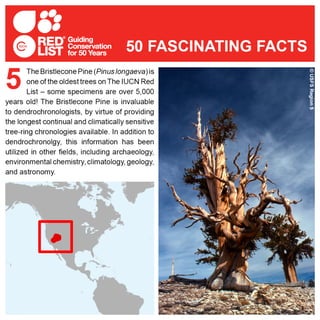
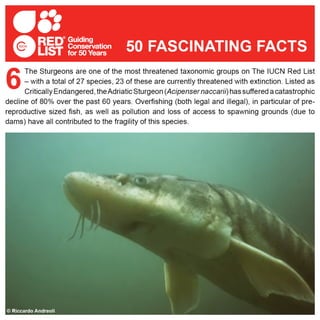
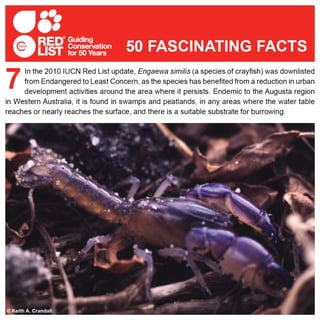
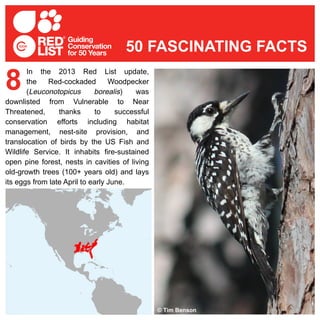
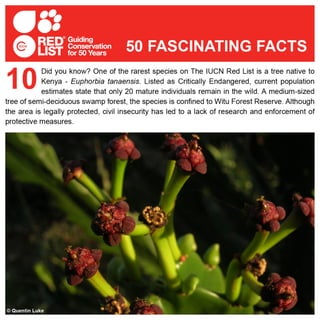
In the 2013 Red List update,
the Red-cockaded Woodpecker
(Leuconotopicus borealis) was
downlisted from Vulnerable to Near
Threatened, thanks to successful
conservation efforts including habitat
management, nest-site provision, and
translocation of birds by the US Fish and
Wildlife Service. It inhabits fire-sustained
open pine forest, nests in cavities of living
old-growth trees (100+ years old) and lays
its eggs from late April to early June.
8
50 FASCINATING FACTS
© Tim Benson
There are currently 828 species classified as Extinct on The IUCN Red List of Threatened
SpeciesTM
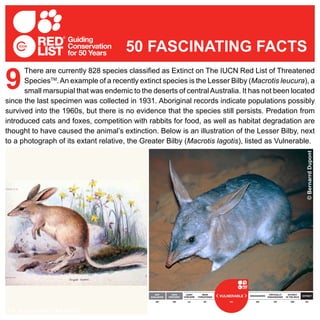
.An example of a recently extinct species is the Lesser Bilby (Macrotis leucura), a
small marsupial that was endemic to the deserts of centralAustralia. It has not been located
since the last specimen was collected in 1931. Aboriginal records indicate populations possibly
survived into the 1960s, but there is no evidence that the species still persists. Predation from
introduced cats and foxes, competition with rabbits for food, as well as habitat degradation are
thought to have caused the animal’s extinction. Below is an illustration of the Lesser Bilby, next
to a photograph of its extant relative, the Greater Bilby (Macrotis lagotis), listed as Vulnerable.
9
50 FASCINATING FACTS
© R. Hucke-Gaete (CBA UACH)
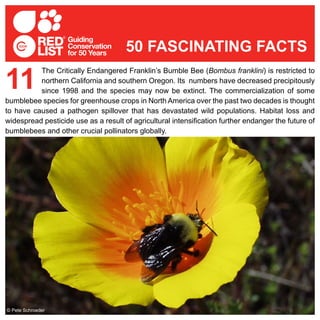
The Critically Endangered Franklin’s Bumble Bee (Bombus franklini) is restricted to
northern California and southern Oregon. Its numbers have decreased precipitously
since 1998 and the species may now be extinct. The commercialization of some
bumblebee species for greenhouse crops in North America over the past two decades is thought
to have caused a pathogen spillover that has devastated wild populations. Habitat loss and
widespread pesticide use as a result of agricultural intensification further endanger the future of
bumblebees and other crucial pollinators globally.
11
50 FASCINATING FACTS
© Pete Schroeder
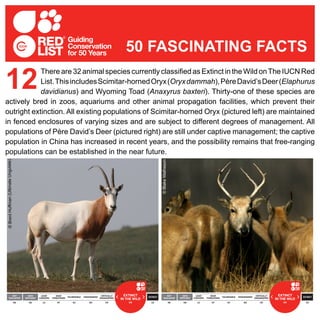
There are 32 animal species currently classified as Extinct in the Wild onThe IUCN Red
List.ThisincludesScimitar-hornedOryx(Oryxdammah),PèreDavid’sDeer(Elaphurus
davidianus) and Wyoming Toad (Anaxyrus baxteri). Thirty-one of these species are
actively bred in zoos, aquariums and other animal propagation facilities, which prevent their
outright extinction. All existing populations of Scimitar-horned Oryx (pictured left) are maintained
in fenced enclosures of varying sizes and are subject to different degrees of management. All
populations of Père David’s Deer (pictured right) are still under captive management; the captive
population in China has increased in recent years, and the possibility remains that free-ranging
populations can be established in the near future.
12
50 FASCINATING FACTS
©BlakeMatheson
©BrentHuffman(UltimateUngulate)
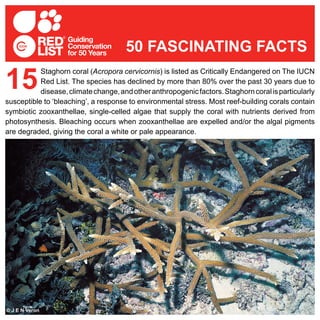
Staghorn coral (Acropora cervicornis) is listed as Critically Endangered on The IUCN
Red List. The species has declined by more than 80% over the past 30 years due to
disease,climatechange,andotheranthropogenicfactors.Staghorncoralisparticularly
susceptible to ‘bleaching’, a response to environmental stress. Most reef-building corals contain
symbiotic zooxanthellae, single-celled algae that supply the coral with nutrients derived from
photosynthesis. Bleaching occurs when zooxanthellae are expelled and/or the algal pigments
are degraded, giving the coral a white or pale appearance.
15
50 FASCINATING FACTS
© J E N Veron
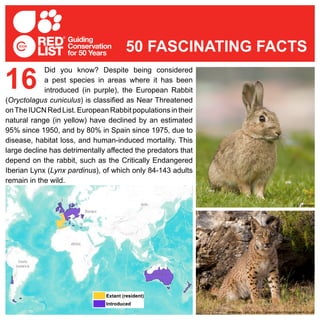
Did you know? Despite being considered
a pest species in areas where it has been
introduced (in purple), the European Rabbit
(Oryctolagus cuniculus) is classified as Near Threatened
onTheIUCNRedList.EuropeanRabbitpopulationsintheir
natural range (in yellow) have declined by an estimated
95% since 1950, and by 80% in Spain since 1975, due to
disease, habitat loss, and human-induced mortality. This
large decline has detrimentally affected the predators that
depend on the rabbit, such as the Critically Endangered
Iberian Lynx (Lynx pardinus), of which only 84-143 adults
remain in the wild.
16
50 FASCINATING FACTS
© JJ Harrison
© Iberian Lynx Ex-situ Conservation Programme/A.Rivas
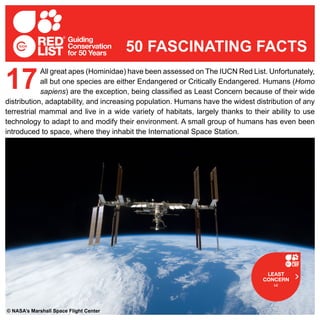
All great apes (Hominidae) have been assessed on The IUCN Red List. Unfortunately,
all but one species are either Endangered or Critically Endangered. Humans (Homo
sapiens) are the exception, being classified as Least Concern because of their wide
distribution, adaptability, and increasing population. Humans have the widest distribution of any
terrestrial mammal and live in a wide variety of habitats, largely thanks to their ability to use
technology to adapt to and modify their environment. A small group of humans has even been
introduced to space, where they inhabit the International Space Station.
17
50 FASCINATING FACTS
© NASA’s Marshall Space Flight Center
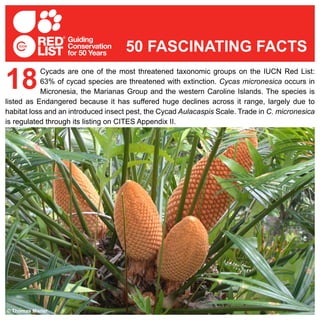
Cycads are one of the most threatened taxonomic groups on the IUCN Red List:
63% of cycad species are threatened with extinction. Cycas micronesica occurs in
Micronesia, the Marianas Group and the western Caroline Islands. The species is
listed as Endangered because it has suffered huge declines across it range, largely due to
habitat loss and an introduced insect pest, the Cycad Aulacaspis Scale. Trade in C. micronesica
is regulated through its listing on CITES Appendix II.
18
50 FASCINATING FACTS
© Thomas Marler
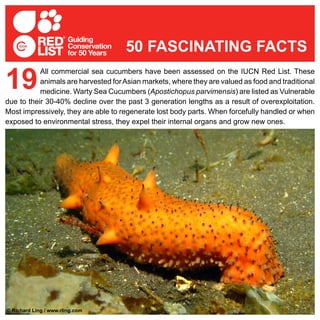
All commercial sea cucumbers have been assessed on the IUCN Red List. These
animals are harvested forAsian markets, where they are valued as food and traditional
medicine. Warty Sea Cucumbers (Apostichopus parvimensis) are listed as Vulnerable
due to their 30-40% decline over the past 3 generation lengths as a result of overexploitation.
Most impressively, they are able to regenerate lost body parts. When forcefully handled or when
exposed to environmental stress, they expel their internal organs and grow new ones.
19
50 FASCINATING FACTS
© Richard Ling / www.rling.com
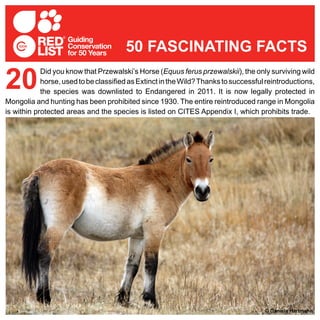
Did you know that Przewalski’s Horse (Equus ferus przewalskii), the only surviving wild
horse,usedtobeclassifiedasExtinctintheWild?Thankstosuccessfulreintroductions,
the species was downlisted to Endangered in 2011. It is now legally protected in
Mongolia and hunting has been prohibited since 1930. The entire reintroduced range in Mongolia
is within protected areas and the species is listed on CITES Appendix I, which prohibits trade.
20
50 FASCINATING FACTS
© Daniela Hartmann
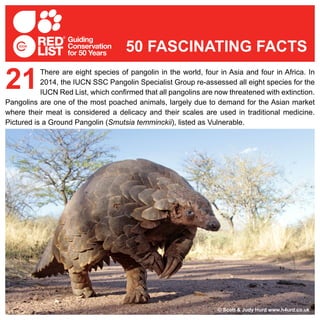
There are eight species of pangolin in the world, four in Asia and four in Africa. In
2014, the IUCN SSC Pangolin Specialist Group re-assessed all eight species for the
IUCN Red List, which confirmed that all pangolins are now threatened with extinction.
Pangolins are one of the most poached animals, largely due to demand for the Asian market
where their meat is considered a delicacy and their scales are used in traditional medicine.
Pictured is a Ground Pangolin (Smutsia temminckii), listed as Vulnerable.
21
50 FASCINATING FACTS
© Scott & Judy Hurd www.h4urd.co.uk
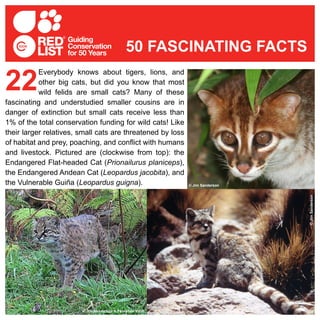
Everybody knows about tigers, lions, and
other big cats, but did you know that most
wild felids are small cats? Many of these
fascinating and understudied smaller cousins are in
danger of extinction but small cats receive less than
1% of the total conservation funding for wild cats! Like
their larger relatives, small cats are threatened by loss
of habitat and prey, poaching, and conflict with humans
and livestock. Pictured are (clockwise from top): the
Endangered Flat-headed Cat (Prionailurus planiceps),
the Endangered Andean Cat (Leopardus jacobita), and
the Vulnerable Guiña (Leopardus guigna).
22
50 FASCINATING FACTS
© Jim Sanderson & Fernando Vidal ©JimSanderson
© Jim Sanderson
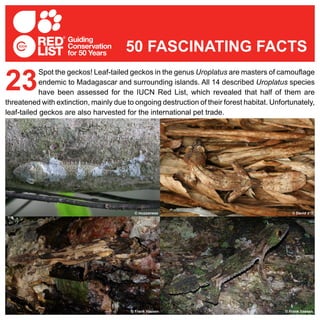
Spot the geckos! Leaf-tailed geckos in the genus Uroplatus are masters of camouflage
endemic to Madagascar and surrounding islands. All 14 described Uroplatus species
have been assessed for the IUCN Red List, which revealed that half of them are
threatened with extinction, mainly due to ongoing destruction of their forest habitat. Unfortunately,
leaf-tailed geckos are also harvested for the international pet trade.
23
50 FASCINATING FACTS
© David d’O
© Frank Vassen© Frank Vassen
© muzzanese
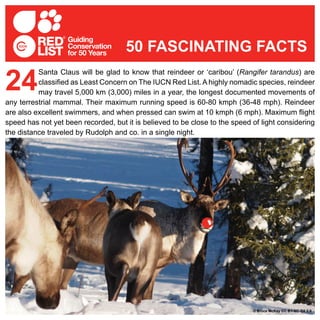
Santa Claus will be glad to know that reindeer or ‘caribou’ (Rangifer tarandus) are
classified as Least Concern on The IUCN Red List. A highly nomadic species, reindeer
may travel 5,000 km (3,000) miles in a year, the longest documented movements of
any terrestrial mammal. Their maximum running speed is 60-80 kmph (36-48 mph). Reindeer
are also excellent swimmers, and when pressed can swim at 10 kmph (6 mph). Maximum flight
speed has not yet been recorded, but it is believed to be close to the speed of light considering
the distance traveled by Rudolph and co. in a single night.
24
50 FASCINATING FACTS
© Frank Vassen© Bruce McKay CC BY-NC-SA 2.0
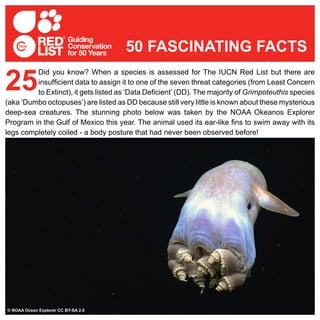
Did you know? When a species is assessed for The IUCN Red List but there are
insufficient data to assign it to one of the seven threat categories (from Least Concern
to Extinct), it gets listed as ‘Data Deficient’ (DD). The majority of Grimpoteuthis species
(aka ‘Dumbo octopuses’) are listed as DD because still very little is known about these mysterious
deep-sea creatures. The stunning photo below was taken by the NOAA Okeanos Explorer
Program in the Gulf of Mexico this year. The animal used its ear-like fins to swim away with its
legs completely coiled - a body posture that had never been observed before!
25
50 FASCINATING FACTS
© Frank Vassen© NOAA Ocean Explorer CC BY-SA 2.0
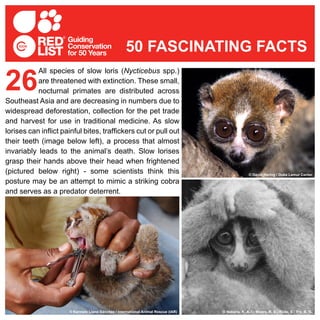
All species of slow loris (Nycticebus spp.)
are threatened with extinction. These small,
nocturnal primates are distributed across
Southeast Asia and are decreasing in numbers due to
widespread deforestation, collection for the pet trade
and harvest for use in traditional medicine. As slow
lorises can inflict painful bites, traffickers cut or pull out
their teeth (image below left), a process that almost
invariably leads to the animal’s death. Slow lorises
grasp their hands above their head when frightened
(pictured below right) - some scientists think this
posture may be an attempt to mimic a striking cobra
and serves as a predator deterrent.
26
50 FASCINATING FACTS
© Karmele Llano Sánchez / International Animal Rescue (IAR) © Nekaris, K. A. I.; Moore, R. S.; Rode, E.; Fry, B. G.
© David Haring / Duke Lemur Center
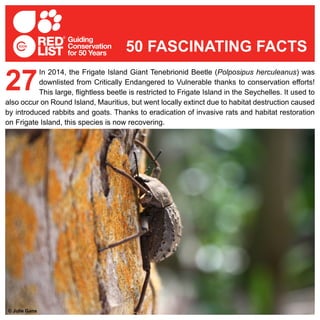
In 2014, the Frigate Island Giant Tenebrionid Beetle (Polposipus herculeanus) was
downlisted from Critically Endangered to Vulnerable thanks to conservation efforts!
This large, flightless beetle is restricted to Frigate Island in the Seychelles. It used to
also occur on Round Island, Mauritius, but went locally extinct due to habitat destruction caused
by introduced rabbits and goats. Thanks to eradication of invasive rats and habitat restoration
on Frigate Island, this species is now recovering.
27
50 FASCINATING FACTS
© Julie Gane
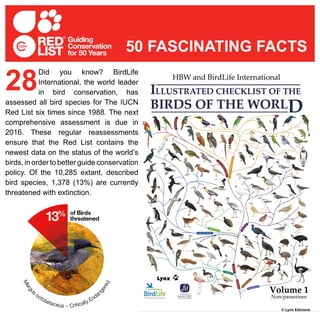
Did you know? BirdLife
International, the world leader
in bird conservation, has
assessed all bird species for The IUCN
Red List six times since 1988. The next
comprehensive assessment is due in
2016. These regular reassessments
ensure that the Red List contains the
newest data on the status of the world’s
birds, in order to better guide conservation
policy. Of the 10,285 extant, described
bird species, 1,378 (13%) are currently
threatened with extinction.
28
50 FASCINATING FACTS
© Lynx Edicions
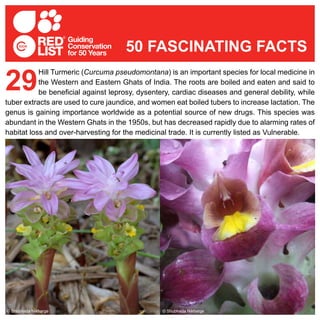
Hill Turmeric (Curcuma pseudomontana) is an important species for local medicine in
the Western and Eastern Ghats of India. The roots are boiled and eaten and said to
be beneficial against leprosy, dysentery, cardiac diseases and general debility, while
tuber extracts are used to cure jaundice, and women eat boiled tubers to increase lactation. The
genus is gaining importance worldwide as a potential source of new drugs. This species was
abundant in the Western Ghats in the 1950s, but has decreased rapidly due to alarming rates of
habitat loss and over-harvesting for the medicinal trade. It is currently listed as Vulnerable.
29
50 FASCINATING FACTS
© Shubhada Nikharge © Shubhada Nikharge
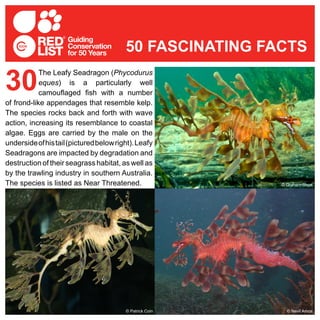
The Leafy Seadragon (Phycodurus
eques) is a particularly well
camouflaged fish with a number
of frond-like appendages that resemble kelp.
The species rocks back and forth with wave
action, increasing its resemblance to coastal
algae. Eggs are carried by the male on the
undersideofhistail(picturedbelowright).Leafy
Seadragons are impacted by degradation and
destruction of their seagrass habitat, as well as
by the trawling industry in southern Australia.
The species is listed as Near Threatened.
30
50 FASCINATING FACTS
© Graham Short
© Nevil Amos© Patrick Coin
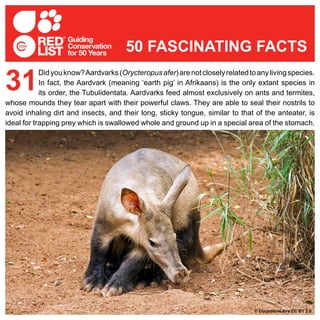
Didyouknow?Aardvarks(Orycteropusafer)arenotcloselyrelatedtoanylivingspecies.
In fact, the Aardvark (meaning ‘earth pig’ in Afrikaans) is the only extant species in
its order, the Tubulidentata. Aardvarks feed almost exclusively on ants and termites,
whose mounds they tear apart with their powerful claws. They are able to seal their nostrils to
avoid inhaling dirt and insects, and their long, sticky tongue, similar to that of the anteater, is
ideal for trapping prey which is swallowed whole and ground up in a special area of the stomach.
31
50 FASCINATING FACTS
© CucombreLibre CC BY 2.0
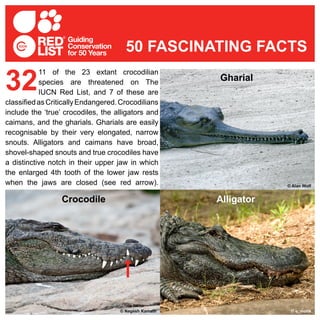
11 of the 23 extant crocodilian
species are threatened on The
IUCN Red List, and 7 of these are
classifiedasCriticallyEndangered.Crocodilians
include the ‘true’ crocodiles, the alligators and
caimans, and the gharials. Gharials are easily
recognisable by their very elongated, narrow
snouts. Alligators and caimans have broad,
shovel-shaped snouts and true crocodiles have
a distinctive notch in their upper jaw in which
the enlarged 4th tooth of the lower jaw rests
when the jaws are closed (see red arrow).
32
50 FASCINATING FACTS
© Nagesh Kamath
© Alan Wolf
© e_monk
Gharial
AlligatorCrocodile
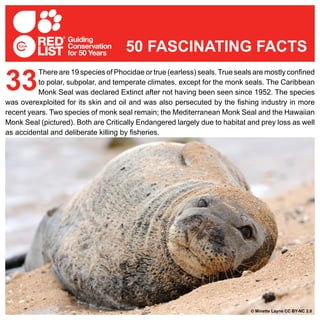
There are 19 species of Phocidae or true (earless) seals.True seals are mostly confined
to polar, subpolar, and temperate climates, except for the monk seals. The Caribbean
Monk Seal was declared Extinct after not having been seen since 1952. The species
was overexploited for its skin and oil and was also persecuted by the fishing industry in more
recent years. Two species of monk seal remain; the Mediterranean Monk Seal and the Hawaiian
Monk Seal (pictured). Both are Critically Endangered largely due to habitat and prey loss as well
as accidental and deliberate killing by fisheries.
33
50 FASCINATING FACTS
© Minette Layne CC BY-NC 2.0
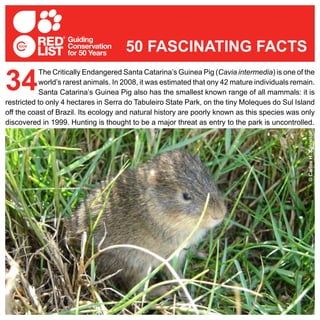
The Critically Endangered Santa Catarina’s Guinea Pig (Cavia intermedia) is one of the
world’s rarest animals. In 2008, it was estimated that ony 42 mature individuals remain.
Santa Catarina’s Guinea Pig also has the smallest known range of all mammals: it is
restricted to only 4 hectares in Serra do Tabuleiro State Park, on the tiny Moleques do Sul Island
off the coast of Brazil. Its ecology and natural history are poorly known as this species was only
discovered in 1999. Hunting is thought to be a major threat as entry to the park is uncontrolled.
34
50 FASCINATING FACTS
©CarlosH.Salvador
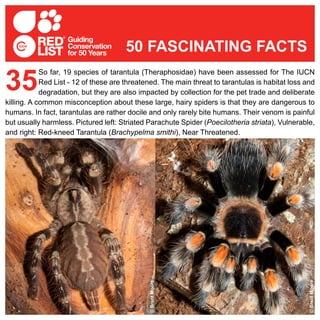
So far, 19 species of tarantula (Theraphosidae) have been assessed for The IUCN
Red List - 12 of these are threatened. The main threat to tarantulas is habitat loss and
degradation, but they are also impacted by collection for the pet trade and deliberate
killing. A common misconception about these large, hairy spiders is that they are dangerous to
humans. In fact, tarantulas are rather docile and only rarely bite humans. Their venom is painful
but usually harmless. Pictured left: Striated Parachute Spider (Poecilotheria striata), Vulnerable,
and right: Red-kneed Tarantula (Brachypelma smithi), Near Threatened.
35
50 FASCINATING FACTS
©BrentMoore
©BrentMoore
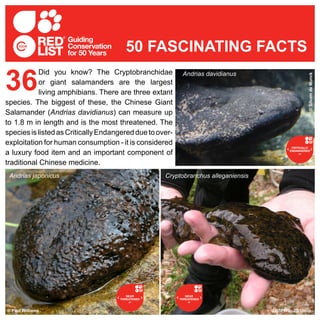
Did you know? The Cryptobranchidae
or giant salamanders are the largest
living amphibians. There are three extant
species. The biggest of these, the Chinese Giant
Salamander (Andrias davidianus) can measure up
to 1.8 m in length and is the most threatened. The
speciesislistedasCriticallyEndangeredduetoover-
exploitation for human consumption - it is considered
a luxury food item and an important component of
traditional Chinese medicine.
36
50 FASCINATING FACTS
© USFWS; Jill Utrup
Cryptobranchus alleganiensisAndrias japonicus
Andrias davidianus
© Paul Williams ©SilvaindeMunck
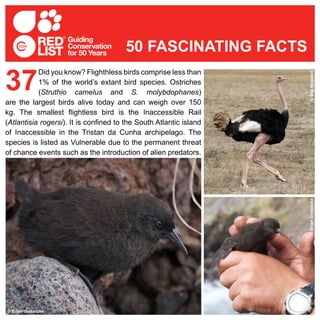
Did you know? Flighthless birds comprise less than
1% of the world’s extant bird species. Ostriches
(Struthio camelus and S. molybdophanes)
are the largest birds alive today and can weigh over 150
kg. The smallest flightless bird is the Inaccessible Rail
(Atlantisia rogersi). It is confined to the South Atlantic island
of Inaccessible in the Tristan da Cunha archipelago. The
species is listed as Vulnerable due to the permanent threat
of chance events such as the introduction of alien predators.
37
50 FASCINATING FACTS
© USFWS; Jill Utrup© Brian Gratwicke ©BrianGratwicke©StigNygaard
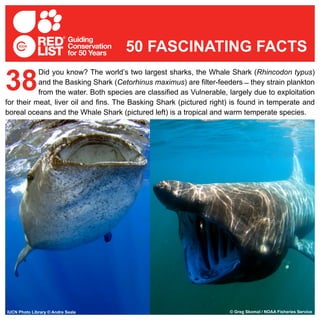
Did you know? The world’s two largest sharks, the Whale Shark (Rhincodon typus)
and the Basking Shark (Cetorhinus maximus) are filter-feeders ̶ they strain plankton
from the water. Both species are classified as Vulnerable, largely due to exploitation
for their meat, liver oil and fins. The Basking Shark (pictured right) is found in temperate and
boreal oceans and the Whale Shark (pictured left) is a tropical and warm temperate species.
38
50 FASCINATING FACTS
IUCN Photo Library © Andre Seale © Greg Skomal / NOAA Fisheries Service
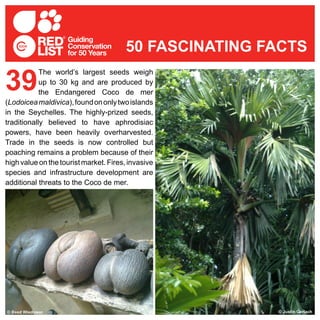
The world’s largest seeds weigh
up to 30 kg and are produced by
the Endangered Coco de mer
(Lodoiceamaldivica),foundononlytwoislands
in the Seychelles. The highly-prized seeds,
traditionally believed to have aphrodisiac
powers, have been heavily overharvested.
Trade in the seeds is now controlled but
poaching remains a problem because of their
highvalueonthetouristmarket.Fires,invasive
species and infrastructure development are
additional threats to the Coco de mer.
39
50 FASCINATING FACTS
© Justin Gerlach© Reed Wiedower
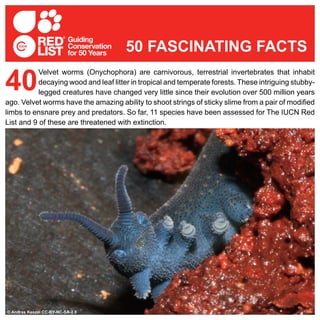
Velvet worms (Onychophora) are carnivorous, terrestrial invertebrates that inhabit
decaying wood and leaf litter in tropical and temperate forests. These intriguing stubby-
legged creatures have changed very little since their evolution over 500 million years
ago. Velvet worms have the amazing ability to shoot strings of sticky slime from a pair of modified
limbs to ensnare prey and predators. So far, 11 species have been assessed for The IUCN Red
List and 9 of these are threatened with extinction.
40
50 FASCINATING FACTS
© Andras Keszei CC-BY-NC-SA-2.0
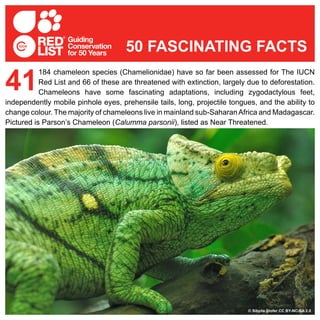
184 chameleon species (Chamelionidae) have so far been assessed for The IUCN
Red List and 66 of these are threatened with extinction, largely due to deforestation.
Chameleons have some fascinating adaptations, including zygodactylous feet,
independently mobile pinhole eyes, prehensile tails, long, projectile tongues, and the ability to
change colour. The majority of chameleons live in mainland sub-SaharanAfrica and Madagascar.
Pictured is Parson’s Chameleon (Calumma parsonii), listed as Near Threatened.
41
50 FASCINATING FACTS
© Sibylle Stofer CC BY-NC-SA 2.0
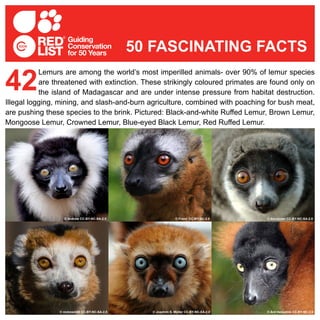
Lemurs are among the world’s most imperilled animals- over 90% of lemur species
are threatened with extinction. These strikingly coloured primates are found only on
the island of Madagascar and are under intense pressure from habitat destruction.
Illegal logging, mining, and slash-and-burn agriculture, combined with poaching for bush meat,
are pushing these species to the brink. Pictured: Black-and-white Ruffed Lemur, Brown Lemur,
Mongoose Lemur, Crowned Lemur, Blue-eyed Black Lemur, Red Ruffed Lemur.
42
50 FASCINATING FACTS
© Andrew CC-BY-NC-SA-2.0 © Franx’ CC-BY-NC-2.0 © Alexander CC-BY-NC-SA-2.0
© nicknack68 CC-BY-NC-SA-2.0 © Joachim S. Müller CC-BY-NC-SA-2.0 © Ard Hesselink CC-BY-NC-2.0
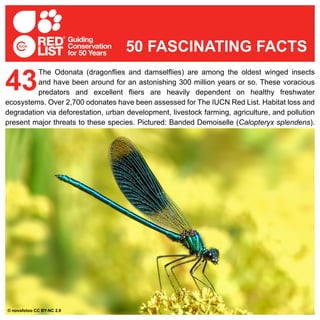
The Odonata (dragonflies and damselflies) are among the oldest winged insects
and have been around for an astonishing 300 million years or so. These voracious
predators and excellent fliers are heavily dependent on healthy freshwater
ecosystems. Over 2,700 odonates have been assessed for The IUCN Red List. Habitat loss and
degradation via deforestation, urban development, livestock farming, agriculture, and pollution
present major threats to these species. Pictured: Banded Demoiselle (Calopteryx splendens).
43
50 FASCINATING FACTS
© novofotoo CC BY-NC 2.0
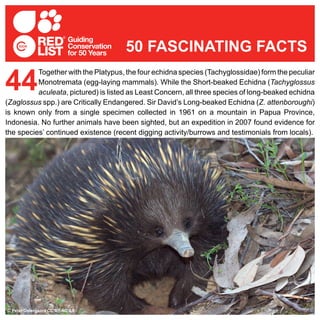
Together with the Platypus, the four echidna species (Tachyglossidae) form the peculiar
Monotremata (egg-laying mammals). While the Short-beaked Echidna (Tachyglossus
aculeata, pictured) is listed as Least Concern, all three species of long-beaked echidna
(Zaglossus spp.) are Critically Endangered. Sir David’s Long-beaked Echidna (Z. attenboroughi)
is known only from a single specimen collected in 1961 on a mountain in Papua Province,
Indonesia. No further animals have been sighted, but an expedition in 2007 found evidence for
the species’ continued existence (recent digging activity/burrows and testimonials from locals).
44
50 FASCINATING FACTS
© Peter Ostergaard CC BY-NC 2.0
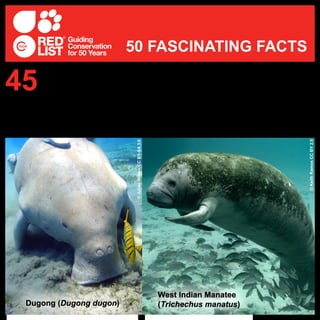
All four extant species in the order Sirenia (manatees and dugongs) are classified as
Vulnerable on The IUCN Red List. A fifth species, Steller’s Sea Cow (Hydrodamalis
gigas), is listed as Extinct - it was hunted to extinction in the 18th century. Unfortunately,
some of the remaining sirenians are also hunted, and habitat alteration and degradation such
as pollution, dam construction, and boat traffic pose significant threats to all remaining species.
The name Sirenia or ‘sirens’ stems from Greek mythology - according to legend, the animals
were discovered by lonely sailors who mistook them for mermaids!
45
50 FASCINATING FACTS
©KeithRamosCCBY2.0
©JulienWillemCCBY-SA3.0
Dugong (Dugong dugon)
West Indian Manatee
(Trichechus manatus)
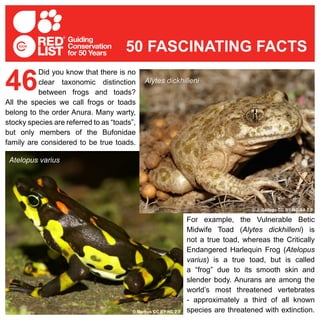
Did you know that there is no
clear taxonomic distinction
between frogs and toads?
All the species we call frogs or toads
belong to the order Anura. Many warty,
stocky species are referred to as “toads”,
but only members of the Bufonidae
family are considered to be true toads.
46
50 FASCINATING FACTS
© J. Gállego CC BY-NC-SA 2.0
© Marcus CC BY-NC 2.0
Alytes dickhilleni
Atelopus varius
For example, the Vulnerable Betic
Midwife Toad (Alytes dickhilleni) is
not a true toad, whereas the Critically
Endangered Harlequin Frog (Atelopus
varius) is a true toad, but is called
a “frog” due to its smooth skin and
slender body. Anurans are among the
world’s most threatened vertebrates
- approximately a third of all known
species are threatened with extinction.
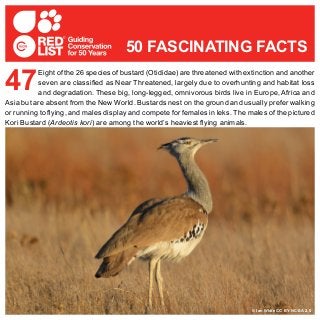
Eight of the 26 species of bustard (Otididae) are threatened with extinction and another
seven are classified as Near Threatened, largely due to overhunting and habitat loss
and degradation. These big, long-legged, omnivorous birds live in Europe, Africa and
Asia but are absent from the New World. Bustards nest on the ground and usually prefer walking
or running to flying, and males display and compete for females in leks. The males of the pictured
Kori Bustard (Ardeotis kori) are among the world’s heaviest flying animals.
47
50 FASCINATING FACTS
© Ian White CC BY-NC-SA 2.0
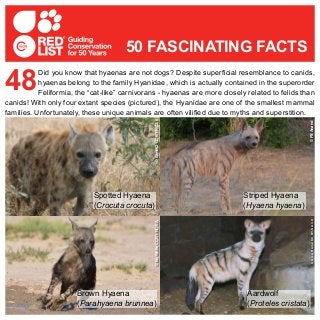
Did you know that hyaenas are not dogs? Despite superficial resemblance to canids,
hyaenas belong to the family Hyanidae, which is actually contained in the superorder
Feliformia, the “cat-like” carnivorans - hyaenas are more closely related to felids than
canids! With only four extant species (pictured), the Hyanidae are one of the smallest mammal
families. Unfortunately, these unique animals are often vilified due to myths and superstition.
48
50 FASCINATING FACTS
© PS Anand
©PSAnand
©Gimli62CCBY-NC2.0
Brown Hyaena
(Parahyaena brunnea)
©IanWhiteCCBY-NC-SA
©GregHumeCCBY-SA3.0
Aardwolf
(Proteles cristata)
Spotted Hyaena
(Crocuta crocuta)
Striped Hyaena
(Hyaena hyaena)
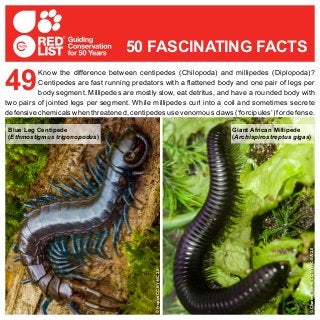
Know the difference between centipedes (Chilopoda) and millipedes (Diplopoda)?
Centipedes are fast running predators with a flattened body and one pair of legs per
body segment. Millipedes are mostly slow, eat detritus, and have a rounded body with
two pairs of jointed legs per segment. While millipedes curl into a coil and sometimes secrete
defensive chemicals when threatened, centipedes use venomous claws (‘forcipules’) for defense.
49
50 FASCINATING FACTS
©CharlesTilfordCCBY-NC-SA2.0
©FrupusCCBY-NC2.0
Blue Leg Centipede
(Ethmostigmus trigonopodus)
Giant African Millipede
(Archispirostreptus gigas)
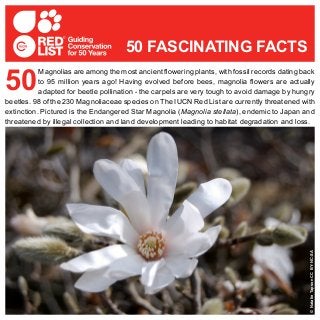
Magnolias are among the most ancient flowering plants, with fossil records dating back
to 95 million years ago! Having evolved before bees, magnolia flowers are actually
adapted for beetle pollination - the carpels are very tough to avoid damage by hungry
beetles. 98 of the 230 Magnoliaceae species on The IUCN Red List are currently threatened with
extinction. Pictured is the Endangered Star Magnolia (Magnolia stellata), endemic to Japan and
threatened by illegal collection and land development leading to habitat degradation and loss.
50
50 FASCINATING FACTS
©NatalieTapsonCCBY-NC-SA

IUCN Red List - 50 Fascinating Facts

  • 8.
    In the 2013Red List update, the Red-cockaded Woodpecker (Leuconotopicus borealis) was downlisted from Vulnerable to Near Threatened, thanks to successful conservation efforts including habitat management, nest-site provision, and translocation of birds by the US Fish and Wildlife Service. It inhabits fire-sustained open pine forest, nests in cavities of living old-growth trees (100+ years old) and lays its eggs from late April to early June. 8 50 FASCINATING FACTS © Tim Benson
  • 9.
    There are currently828 species classified as Extinct on The IUCN Red List of Threatened SpeciesTM .An example of a recently extinct species is the Lesser Bilby (Macrotis leucura), a small marsupial that was endemic to the deserts of centralAustralia. It has not been located since the last specimen was collected in 1931. Aboriginal records indicate populations possibly survived into the 1960s, but there is no evidence that the species still persists. Predation from introduced cats and foxes, competition with rabbits for food, as well as habitat degradation are thought to have caused the animal’s extinction. Below is an illustration of the Lesser Bilby, next to a photograph of its extant relative, the Greater Bilby (Macrotis lagotis), listed as Vulnerable. 9 50 FASCINATING FACTS © R. Hucke-Gaete (CBA UACH)
  • 11.
    The Critically EndangeredFranklin’s Bumble Bee (Bombus franklini) is restricted to northern California and southern Oregon. Its numbers have decreased precipitously since 1998 and the species may now be extinct. The commercialization of some bumblebee species for greenhouse crops in North America over the past two decades is thought to have caused a pathogen spillover that has devastated wild populations. Habitat loss and widespread pesticide use as a result of agricultural intensification further endanger the future of bumblebees and other crucial pollinators globally. 11 50 FASCINATING FACTS © Pete Schroeder
  • 12.
    There are 32animal species currently classified as Extinct in the Wild onThe IUCN Red List.ThisincludesScimitar-hornedOryx(Oryxdammah),PèreDavid’sDeer(Elaphurus davidianus) and Wyoming Toad (Anaxyrus baxteri). Thirty-one of these species are actively bred in zoos, aquariums and other animal propagation facilities, which prevent their outright extinction. All existing populations of Scimitar-horned Oryx (pictured left) are maintained in fenced enclosures of varying sizes and are subject to different degrees of management. All populations of Père David’s Deer (pictured right) are still under captive management; the captive population in China has increased in recent years, and the possibility remains that free-ranging populations can be established in the near future. 12 50 FASCINATING FACTS ©BlakeMatheson ©BrentHuffman(UltimateUngulate)
  • 15.
    Staghorn coral (Acroporacervicornis) is listed as Critically Endangered on The IUCN Red List. The species has declined by more than 80% over the past 30 years due to disease,climatechange,andotheranthropogenicfactors.Staghorncoralisparticularly susceptible to ‘bleaching’, a response to environmental stress. Most reef-building corals contain symbiotic zooxanthellae, single-celled algae that supply the coral with nutrients derived from photosynthesis. Bleaching occurs when zooxanthellae are expelled and/or the algal pigments are degraded, giving the coral a white or pale appearance. 15 50 FASCINATING FACTS © J E N Veron
  • 16.
    Did you know?Despite being considered a pest species in areas where it has been introduced (in purple), the European Rabbit (Oryctolagus cuniculus) is classified as Near Threatened onTheIUCNRedList.EuropeanRabbitpopulationsintheir natural range (in yellow) have declined by an estimated 95% since 1950, and by 80% in Spain since 1975, due to disease, habitat loss, and human-induced mortality. This large decline has detrimentally affected the predators that depend on the rabbit, such as the Critically Endangered Iberian Lynx (Lynx pardinus), of which only 84-143 adults remain in the wild. 16 50 FASCINATING FACTS © JJ Harrison © Iberian Lynx Ex-situ Conservation Programme/A.Rivas
  • 17.
    All great apes(Hominidae) have been assessed on The IUCN Red List. Unfortunately, all but one species are either Endangered or Critically Endangered. Humans (Homo sapiens) are the exception, being classified as Least Concern because of their wide distribution, adaptability, and increasing population. Humans have the widest distribution of any terrestrial mammal and live in a wide variety of habitats, largely thanks to their ability to use technology to adapt to and modify their environment. A small group of humans has even been introduced to space, where they inhabit the International Space Station. 17 50 FASCINATING FACTS © NASA’s Marshall Space Flight Center
  • 18.
    Cycads are oneof the most threatened taxonomic groups on the IUCN Red List: 63% of cycad species are threatened with extinction. Cycas micronesica occurs in Micronesia, the Marianas Group and the western Caroline Islands. The species is listed as Endangered because it has suffered huge declines across it range, largely due to habitat loss and an introduced insect pest, the Cycad Aulacaspis Scale. Trade in C. micronesica is regulated through its listing on CITES Appendix II. 18 50 FASCINATING FACTS © Thomas Marler
  • 19.
    All commercial seacucumbers have been assessed on the IUCN Red List. These animals are harvested forAsian markets, where they are valued as food and traditional medicine. Warty Sea Cucumbers (Apostichopus parvimensis) are listed as Vulnerable due to their 30-40% decline over the past 3 generation lengths as a result of overexploitation. Most impressively, they are able to regenerate lost body parts. When forcefully handled or when exposed to environmental stress, they expel their internal organs and grow new ones. 19 50 FASCINATING FACTS © Richard Ling / www.rling.com
  • 20.
    Did you knowthat Przewalski’s Horse (Equus ferus przewalskii), the only surviving wild horse,usedtobeclassifiedasExtinctintheWild?Thankstosuccessfulreintroductions, the species was downlisted to Endangered in 2011. It is now legally protected in Mongolia and hunting has been prohibited since 1930. The entire reintroduced range in Mongolia is within protected areas and the species is listed on CITES Appendix I, which prohibits trade. 20 50 FASCINATING FACTS © Daniela Hartmann
  • 21.
    There are eightspecies of pangolin in the world, four in Asia and four in Africa. In 2014, the IUCN SSC Pangolin Specialist Group re-assessed all eight species for the IUCN Red List, which confirmed that all pangolins are now threatened with extinction. Pangolins are one of the most poached animals, largely due to demand for the Asian market where their meat is considered a delicacy and their scales are used in traditional medicine. Pictured is a Ground Pangolin (Smutsia temminckii), listed as Vulnerable. 21 50 FASCINATING FACTS © Scott & Judy Hurd www.h4urd.co.uk
  • 22.
    Everybody knows abouttigers, lions, and other big cats, but did you know that most wild felids are small cats? Many of these fascinating and understudied smaller cousins are in danger of extinction but small cats receive less than 1% of the total conservation funding for wild cats! Like their larger relatives, small cats are threatened by loss of habitat and prey, poaching, and conflict with humans and livestock. Pictured are (clockwise from top): the Endangered Flat-headed Cat (Prionailurus planiceps), the Endangered Andean Cat (Leopardus jacobita), and the Vulnerable Guiña (Leopardus guigna). 22 50 FASCINATING FACTS © Jim Sanderson & Fernando Vidal ©JimSanderson © Jim Sanderson
  • 23.
    Spot the geckos!Leaf-tailed geckos in the genus Uroplatus are masters of camouflage endemic to Madagascar and surrounding islands. All 14 described Uroplatus species have been assessed for the IUCN Red List, which revealed that half of them are threatened with extinction, mainly due to ongoing destruction of their forest habitat. Unfortunately, leaf-tailed geckos are also harvested for the international pet trade. 23 50 FASCINATING FACTS © David d’O © Frank Vassen© Frank Vassen © muzzanese
  • 24.
    Santa Claus willbe glad to know that reindeer or ‘caribou’ (Rangifer tarandus) are classified as Least Concern on The IUCN Red List. A highly nomadic species, reindeer may travel 5,000 km (3,000) miles in a year, the longest documented movements of any terrestrial mammal. Their maximum running speed is 60-80 kmph (36-48 mph). Reindeer are also excellent swimmers, and when pressed can swim at 10 kmph (6 mph). Maximum flight speed has not yet been recorded, but it is believed to be close to the speed of light considering the distance traveled by Rudolph and co. in a single night. 24 50 FASCINATING FACTS © Frank Vassen© Bruce McKay CC BY-NC-SA 2.0
  • 25.
    Did you know?When a species is assessed for The IUCN Red List but there are insufficient data to assign it to one of the seven threat categories (from Least Concern to Extinct), it gets listed as ‘Data Deficient’ (DD). The majority of Grimpoteuthis species (aka ‘Dumbo octopuses’) are listed as DD because still very little is known about these mysterious deep-sea creatures. The stunning photo below was taken by the NOAA Okeanos Explorer Program in the Gulf of Mexico this year. The animal used its ear-like fins to swim away with its legs completely coiled - a body posture that had never been observed before! 25 50 FASCINATING FACTS © Frank Vassen© NOAA Ocean Explorer CC BY-SA 2.0
  • 26.
    All species ofslow loris (Nycticebus spp.) are threatened with extinction. These small, nocturnal primates are distributed across Southeast Asia and are decreasing in numbers due to widespread deforestation, collection for the pet trade and harvest for use in traditional medicine. As slow lorises can inflict painful bites, traffickers cut or pull out their teeth (image below left), a process that almost invariably leads to the animal’s death. Slow lorises grasp their hands above their head when frightened (pictured below right) - some scientists think this posture may be an attempt to mimic a striking cobra and serves as a predator deterrent. 26 50 FASCINATING FACTS © Karmele Llano Sánchez / International Animal Rescue (IAR) © Nekaris, K. A. I.; Moore, R. S.; Rode, E.; Fry, B. G. © David Haring / Duke Lemur Center
  • 27.
    In 2014, theFrigate Island Giant Tenebrionid Beetle (Polposipus herculeanus) was downlisted from Critically Endangered to Vulnerable thanks to conservation efforts! This large, flightless beetle is restricted to Frigate Island in the Seychelles. It used to also occur on Round Island, Mauritius, but went locally extinct due to habitat destruction caused by introduced rabbits and goats. Thanks to eradication of invasive rats and habitat restoration on Frigate Island, this species is now recovering. 27 50 FASCINATING FACTS © Julie Gane
  • 28.
    Did you know?BirdLife International, the world leader in bird conservation, has assessed all bird species for The IUCN Red List six times since 1988. The next comprehensive assessment is due in 2016. These regular reassessments ensure that the Red List contains the newest data on the status of the world’s birds, in order to better guide conservation policy. Of the 10,285 extant, described bird species, 1,378 (13%) are currently threatened with extinction. 28 50 FASCINATING FACTS © Lynx Edicions
  • 29.
    Hill Turmeric (Curcumapseudomontana) is an important species for local medicine in the Western and Eastern Ghats of India. The roots are boiled and eaten and said to be beneficial against leprosy, dysentery, cardiac diseases and general debility, while tuber extracts are used to cure jaundice, and women eat boiled tubers to increase lactation. The genus is gaining importance worldwide as a potential source of new drugs. This species was abundant in the Western Ghats in the 1950s, but has decreased rapidly due to alarming rates of habitat loss and over-harvesting for the medicinal trade. It is currently listed as Vulnerable. 29 50 FASCINATING FACTS © Shubhada Nikharge © Shubhada Nikharge
  • 30.
    The Leafy Seadragon(Phycodurus eques) is a particularly well camouflaged fish with a number of frond-like appendages that resemble kelp. The species rocks back and forth with wave action, increasing its resemblance to coastal algae. Eggs are carried by the male on the undersideofhistail(picturedbelowright).Leafy Seadragons are impacted by degradation and destruction of their seagrass habitat, as well as by the trawling industry in southern Australia. The species is listed as Near Threatened. 30 50 FASCINATING FACTS © Graham Short © Nevil Amos© Patrick Coin
  • 31.
    Didyouknow?Aardvarks(Orycteropusafer)arenotcloselyrelatedtoanylivingspecies. In fact, theAardvark (meaning ‘earth pig’ in Afrikaans) is the only extant species in its order, the Tubulidentata. Aardvarks feed almost exclusively on ants and termites, whose mounds they tear apart with their powerful claws. They are able to seal their nostrils to avoid inhaling dirt and insects, and their long, sticky tongue, similar to that of the anteater, is ideal for trapping prey which is swallowed whole and ground up in a special area of the stomach. 31 50 FASCINATING FACTS © CucombreLibre CC BY 2.0
  • 32.
    11 of the23 extant crocodilian species are threatened on The IUCN Red List, and 7 of these are classifiedasCriticallyEndangered.Crocodilians include the ‘true’ crocodiles, the alligators and caimans, and the gharials. Gharials are easily recognisable by their very elongated, narrow snouts. Alligators and caimans have broad, shovel-shaped snouts and true crocodiles have a distinctive notch in their upper jaw in which the enlarged 4th tooth of the lower jaw rests when the jaws are closed (see red arrow). 32 50 FASCINATING FACTS © Nagesh Kamath © Alan Wolf © e_monk Gharial AlligatorCrocodile
  • 33.
    There are 19species of Phocidae or true (earless) seals.True seals are mostly confined to polar, subpolar, and temperate climates, except for the monk seals. The Caribbean Monk Seal was declared Extinct after not having been seen since 1952. The species was overexploited for its skin and oil and was also persecuted by the fishing industry in more recent years. Two species of monk seal remain; the Mediterranean Monk Seal and the Hawaiian Monk Seal (pictured). Both are Critically Endangered largely due to habitat and prey loss as well as accidental and deliberate killing by fisheries. 33 50 FASCINATING FACTS © Minette Layne CC BY-NC 2.0
  • 34.
    The Critically EndangeredSanta Catarina’s Guinea Pig (Cavia intermedia) is one of the world’s rarest animals. In 2008, it was estimated that ony 42 mature individuals remain. Santa Catarina’s Guinea Pig also has the smallest known range of all mammals: it is restricted to only 4 hectares in Serra do Tabuleiro State Park, on the tiny Moleques do Sul Island off the coast of Brazil. Its ecology and natural history are poorly known as this species was only discovered in 1999. Hunting is thought to be a major threat as entry to the park is uncontrolled. 34 50 FASCINATING FACTS ©CarlosH.Salvador
  • 35.
    So far, 19species of tarantula (Theraphosidae) have been assessed for The IUCN Red List - 12 of these are threatened. The main threat to tarantulas is habitat loss and degradation, but they are also impacted by collection for the pet trade and deliberate killing. A common misconception about these large, hairy spiders is that they are dangerous to humans. In fact, tarantulas are rather docile and only rarely bite humans. Their venom is painful but usually harmless. Pictured left: Striated Parachute Spider (Poecilotheria striata), Vulnerable, and right: Red-kneed Tarantula (Brachypelma smithi), Near Threatened. 35 50 FASCINATING FACTS ©BrentMoore ©BrentMoore
  • 36.
    Did you know?The Cryptobranchidae or giant salamanders are the largest living amphibians. There are three extant species. The biggest of these, the Chinese Giant Salamander (Andrias davidianus) can measure up to 1.8 m in length and is the most threatened. The speciesislistedasCriticallyEndangeredduetoover- exploitation for human consumption - it is considered a luxury food item and an important component of traditional Chinese medicine. 36 50 FASCINATING FACTS © USFWS; Jill Utrup Cryptobranchus alleganiensisAndrias japonicus Andrias davidianus © Paul Williams ©SilvaindeMunck
  • 37.
    Did you know?Flighthless birds comprise less than 1% of the world’s extant bird species. Ostriches (Struthio camelus and S. molybdophanes) are the largest birds alive today and can weigh over 150 kg. The smallest flightless bird is the Inaccessible Rail (Atlantisia rogersi). It is confined to the South Atlantic island of Inaccessible in the Tristan da Cunha archipelago. The species is listed as Vulnerable due to the permanent threat of chance events such as the introduction of alien predators. 37 50 FASCINATING FACTS © USFWS; Jill Utrup© Brian Gratwicke ©BrianGratwicke©StigNygaard
  • 38.
    Did you know?The world’s two largest sharks, the Whale Shark (Rhincodon typus) and the Basking Shark (Cetorhinus maximus) are filter-feeders ̶ they strain plankton from the water. Both species are classified as Vulnerable, largely due to exploitation for their meat, liver oil and fins. The Basking Shark (pictured right) is found in temperate and boreal oceans and the Whale Shark (pictured left) is a tropical and warm temperate species. 38 50 FASCINATING FACTS IUCN Photo Library © Andre Seale © Greg Skomal / NOAA Fisheries Service
  • 39.
    The world’s largestseeds weigh up to 30 kg and are produced by the Endangered Coco de mer (Lodoiceamaldivica),foundononlytwoislands in the Seychelles. The highly-prized seeds, traditionally believed to have aphrodisiac powers, have been heavily overharvested. Trade in the seeds is now controlled but poaching remains a problem because of their highvalueonthetouristmarket.Fires,invasive species and infrastructure development are additional threats to the Coco de mer. 39 50 FASCINATING FACTS © Justin Gerlach© Reed Wiedower
  • 40.
    Velvet worms (Onychophora)are carnivorous, terrestrial invertebrates that inhabit decaying wood and leaf litter in tropical and temperate forests. These intriguing stubby- legged creatures have changed very little since their evolution over 500 million years ago. Velvet worms have the amazing ability to shoot strings of sticky slime from a pair of modified limbs to ensnare prey and predators. So far, 11 species have been assessed for The IUCN Red List and 9 of these are threatened with extinction. 40 50 FASCINATING FACTS © Andras Keszei CC-BY-NC-SA-2.0
  • 41.
    184 chameleon species(Chamelionidae) have so far been assessed for The IUCN Red List and 66 of these are threatened with extinction, largely due to deforestation. Chameleons have some fascinating adaptations, including zygodactylous feet, independently mobile pinhole eyes, prehensile tails, long, projectile tongues, and the ability to change colour. The majority of chameleons live in mainland sub-SaharanAfrica and Madagascar. Pictured is Parson’s Chameleon (Calumma parsonii), listed as Near Threatened. 41 50 FASCINATING FACTS © Sibylle Stofer CC BY-NC-SA 2.0
  • 42.
    Lemurs are amongthe world’s most imperilled animals- over 90% of lemur species are threatened with extinction. These strikingly coloured primates are found only on the island of Madagascar and are under intense pressure from habitat destruction. Illegal logging, mining, and slash-and-burn agriculture, combined with poaching for bush meat, are pushing these species to the brink. Pictured: Black-and-white Ruffed Lemur, Brown Lemur, Mongoose Lemur, Crowned Lemur, Blue-eyed Black Lemur, Red Ruffed Lemur. 42 50 FASCINATING FACTS © Andrew CC-BY-NC-SA-2.0 © Franx’ CC-BY-NC-2.0 © Alexander CC-BY-NC-SA-2.0 © nicknack68 CC-BY-NC-SA-2.0 © Joachim S. Müller CC-BY-NC-SA-2.0 © Ard Hesselink CC-BY-NC-2.0
  • 43.
    The Odonata (dragonfliesand damselflies) are among the oldest winged insects and have been around for an astonishing 300 million years or so. These voracious predators and excellent fliers are heavily dependent on healthy freshwater ecosystems. Over 2,700 odonates have been assessed for The IUCN Red List. Habitat loss and degradation via deforestation, urban development, livestock farming, agriculture, and pollution present major threats to these species. Pictured: Banded Demoiselle (Calopteryx splendens). 43 50 FASCINATING FACTS © novofotoo CC BY-NC 2.0
  • 44.
    Together with thePlatypus, the four echidna species (Tachyglossidae) form the peculiar Monotremata (egg-laying mammals). While the Short-beaked Echidna (Tachyglossus aculeata, pictured) is listed as Least Concern, all three species of long-beaked echidna (Zaglossus spp.) are Critically Endangered. Sir David’s Long-beaked Echidna (Z. attenboroughi) is known only from a single specimen collected in 1961 on a mountain in Papua Province, Indonesia. No further animals have been sighted, but an expedition in 2007 found evidence for the species’ continued existence (recent digging activity/burrows and testimonials from locals). 44 50 FASCINATING FACTS © Peter Ostergaard CC BY-NC 2.0
  • 45.
    All four extantspecies in the order Sirenia (manatees and dugongs) are classified as Vulnerable on The IUCN Red List. A fifth species, Steller’s Sea Cow (Hydrodamalis gigas), is listed as Extinct - it was hunted to extinction in the 18th century. Unfortunately, some of the remaining sirenians are also hunted, and habitat alteration and degradation such as pollution, dam construction, and boat traffic pose significant threats to all remaining species. The name Sirenia or ‘sirens’ stems from Greek mythology - according to legend, the animals were discovered by lonely sailors who mistook them for mermaids! 45 50 FASCINATING FACTS ©KeithRamosCCBY2.0 ©JulienWillemCCBY-SA3.0 Dugong (Dugong dugon) West Indian Manatee (Trichechus manatus)
  • 46.
    Did you knowthat there is no clear taxonomic distinction between frogs and toads? All the species we call frogs or toads belong to the order Anura. Many warty, stocky species are referred to as “toads”, but only members of the Bufonidae family are considered to be true toads. 46 50 FASCINATING FACTS © J. Gállego CC BY-NC-SA 2.0 © Marcus CC BY-NC 2.0 Alytes dickhilleni Atelopus varius For example, the Vulnerable Betic Midwife Toad (Alytes dickhilleni) is not a true toad, whereas the Critically Endangered Harlequin Frog (Atelopus varius) is a true toad, but is called a “frog” due to its smooth skin and slender body. Anurans are among the world’s most threatened vertebrates - approximately a third of all known species are threatened with extinction.
  • 47.
    Eight of the26 species of bustard (Otididae) are threatened with extinction and another seven are classified as Near Threatened, largely due to overhunting and habitat loss and degradation. These big, long-legged, omnivorous birds live in Europe, Africa and Asia but are absent from the New World. Bustards nest on the ground and usually prefer walking or running to flying, and males display and compete for females in leks. The males of the pictured Kori Bustard (Ardeotis kori) are among the world’s heaviest flying animals. 47 50 FASCINATING FACTS © Ian White CC BY-NC-SA 2.0
  • 48.
    Did you knowthat hyaenas are not dogs? Despite superficial resemblance to canids, hyaenas belong to the family Hyanidae, which is actually contained in the superorder Feliformia, the “cat-like” carnivorans - hyaenas are more closely related to felids than canids! With only four extant species (pictured), the Hyanidae are one of the smallest mammal families. Unfortunately, these unique animals are often vilified due to myths and superstition. 48 50 FASCINATING FACTS © PS Anand ©PSAnand ©Gimli62CCBY-NC2.0 Brown Hyaena (Parahyaena brunnea) ©IanWhiteCCBY-NC-SA ©GregHumeCCBY-SA3.0 Aardwolf (Proteles cristata) Spotted Hyaena (Crocuta crocuta) Striped Hyaena (Hyaena hyaena)
  • 49.
    Know the differencebetween centipedes (Chilopoda) and millipedes (Diplopoda)? Centipedes are fast running predators with a flattened body and one pair of legs per body segment. Millipedes are mostly slow, eat detritus, and have a rounded body with two pairs of jointed legs per segment. While millipedes curl into a coil and sometimes secrete defensive chemicals when threatened, centipedes use venomous claws (‘forcipules’) for defense. 49 50 FASCINATING FACTS ©CharlesTilfordCCBY-NC-SA2.0 ©FrupusCCBY-NC2.0 Blue Leg Centipede (Ethmostigmus trigonopodus) Giant African Millipede (Archispirostreptus gigas)
  • 50.
    Magnolias are amongthe most ancient flowering plants, with fossil records dating back to 95 million years ago! Having evolved before bees, magnolia flowers are actually adapted for beetle pollination - the carpels are very tough to avoid damage by hungry beetles. 98 of the 230 Magnoliaceae species on The IUCN Red List are currently threatened with extinction. Pictured is the Endangered Star Magnolia (Magnolia stellata), endemic to Japan and threatened by illegal collection and land development leading to habitat degradation and loss. 50 50 FASCINATING FACTS ©NatalieTapsonCCBY-NC-SA