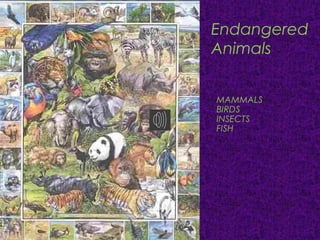
Endangered
Animals
MAMMALS
BIRDS
INSECTS
FISH
Some Endangered
MAMMALS
 Asian Elephant
 Blue Whale
 Hybrid Spider Monkey
 Asiatic Cheetah
 Tiger
 Giant Panda
 Black Rhinoceros
Asian Elephant & Blue Whale
 The Asian elephant is also known as the Indian
elephant. It stands up to ten feet high and weighs
up to 10,000 pounds.
 The Asian elephant is classified as an endangered
species due to a reduction of at least 50% of the
Asian elephant population over the last three
generations based on a decline in area of
occupancy and levels of exploitation.
 The Asian elephant has four subspecies: the Indian,
Ceylon, Sumatran, and Malaysian elephants.
 The male blue whale grows to about 82 feet long,
and the female grows to about 85 feet long. They
weigh up to 285,000 pounds as an adult.
 The blue whale is endangered due to a reduction
of at least 50% of the blue whale population over
the last three generations based on direct
observation, an index of abundance, and levels of
exploitation.
 The blue whale is the largest mammal to have lived
on the earth, but it feeds on some of the smallest
marine organisms - plankton.
Hybrid Spider Monkey
& Asiatic Cheetah
 The hybrid spider monkey grows to almost two feet
long, not including the tail. It weighs from ten to
fifteen pounds.
 The hybrid spider monkey is classified as an
endangered species due to the fact that it only
exists in severely fragmented subpopulations, and
that there has been continuing decline in the
hybrid spider monkey population.
 The hybrid spider monkey is known for its ability to
use its tail as an extra limb.
 The Asiatic cheetah is classified as a critically
endangered species due to an estimated
population of less than 50 mature individuals, a
continuing decline in numbers of mature
individuals, and the fact that all Asiatic cheetahs
are in a single population.
 Asiatic cheetahs can be found in Iran.
Tiger, Giant Panda &
Black Rhinoceros
 The male tiger grows up to ten feet long from its head to the tip
of its tail, and weighs up to 575 pounds.
 The tiger is classified as an endangered species due to the
projected tiger population declining to at most 50% within three
generations due to exploitation and a decline in area of
occupancy.
 The male giant panda stands up to five feet tall, and weighs up
to 265 pounds. The female giant panda is smaller and weighs
less.
 The giant panda is classified as an endangered species due to
the fact that it only exists in severely fragmented subpopulations
consisting of up to 250 mature adults, and that there has been
continuing decline in the area of habitat.
 The black rhinoceros grows up to twelve feet long and six feet
high. It weighs up to three thousand pounds
 The black rhinoceros is classified as a critically endangered
species due to a reduction of at least 80% of the black
rhinoceros population over the last three generations based on
direct observation.
Some Endangered BIRDS
 Marquesan Kingfisher
 California Condor
 Whooping Crane
Marquesan Kingfisher,
California Condor & Whooping Crane
 The marquesan kingfisher is classified as an endangered
species due to a severely fragmented population and a
projected decline of mature marquesan kingfishers and
area and quality of habitat.
 The California condor is classified as a critically endangered
species due to an estimated population of less than 50
mature individuals. The California condor can be found in
the United States.
 The whooping crane is classified as an endangered species
due to an estimated population of less than 250 mature
cranes. The whooping crane can be found in Canada and
the United States.
Some Endangered REPTILES
 Hawksbill Sea Turtle
 Cuban Boa
 Chinese Alligator
Hawksbill Sea Turtle, Cuban Boa
& Chinese Alligator
 It is very difficult to classify how endangered hawksbill turtles are
because they are found throughout the world and are migratory. In
some places, they may be very scarce.
 Currently (throughout the world), it is illegal to trade hawksbill turtle
products. In order to succeed in keeping hawksbill turtles in existence,
there must be cooperation among all nations that have hawksbill
populations in their waters.
 The Cuban boa is an endangered island-dwelling animal. It is found in
holes and rock piles and on cultivated land. They are primarily
arboreal.
 Living on an island, the Cuban boa is at risk from disturbances (e.g.
fire, hunting, cyclones), which can quickly push the species towards
extinction.
 The Chinese Alligator is believed that it will become extinct in about
fifteen years. At the moment in a area called Anhui in China, are
thirteen ponds with only about ten of these actually holding the
alligators with any one pond having a max of eleven animals.
 This is the animal that provided the much known chinese dragon
myth. There is a breeding program setup by biologist and they are
protected under the maximum law but they still need international
help to secure the habitat and educate the public on these wonderful
animals.
Some Endangered FISH
 Chinese Paddlefish
 Silver Shark
 Wild Common Carp
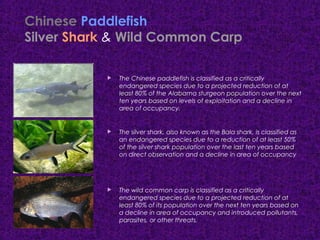
Chinese Paddlefish
Silver Shark & Wild Common Carp
 The Chinese paddlefish is classified as a critically
endangered species due to a projected reduction of at
least 80% of the Alabama sturgeon population over the next
ten years based on levels of exploitation and a decline in
area of occupancy.
 The silver shark, also known as the Bala shark, is classified as
an endangered species due to a reduction of at least 50%
of the silver shark population over the last ten years based
on direct observation and a decline in area of occupancy
 The wild common carp is classified as a critically
endangered species due to a projected reduction of at
least 80% of its population over the next ten years based on
a decline in area of occupancy and introduced pollutants,
parasites, or other threats.
Help Save the
Animals !
Why Save Endangered
Animals?
• They help protect a healthy environment.
• They may lead to advances in medicines, or foods.
• Maintain a good quality of life.
Why save endangered animals…
BECAUSE WE CAN !!!
PRESENTED BY- ADITYA
HINGAR CLASS-7

endangered animals

  • 1.
  • 2.
    Some Endangered MAMMALS  AsianElephant  Blue Whale  Hybrid Spider Monkey  Asiatic Cheetah  Tiger  Giant Panda  Black Rhinoceros
  • 3.
    Asian Elephant &Blue Whale  The Asian elephant is also known as the Indian elephant. It stands up to ten feet high and weighs up to 10,000 pounds.  The Asian elephant is classified as an endangered species due to a reduction of at least 50% of the Asian elephant population over the last three generations based on a decline in area of occupancy and levels of exploitation.  The Asian elephant has four subspecies: the Indian, Ceylon, Sumatran, and Malaysian elephants.  The male blue whale grows to about 82 feet long, and the female grows to about 85 feet long. They weigh up to 285,000 pounds as an adult.  The blue whale is endangered due to a reduction of at least 50% of the blue whale population over the last three generations based on direct observation, an index of abundance, and levels of exploitation.  The blue whale is the largest mammal to have lived on the earth, but it feeds on some of the smallest marine organisms - plankton.
  • 4.
    Hybrid Spider Monkey &Asiatic Cheetah  The hybrid spider monkey grows to almost two feet long, not including the tail. It weighs from ten to fifteen pounds.  The hybrid spider monkey is classified as an endangered species due to the fact that it only exists in severely fragmented subpopulations, and that there has been continuing decline in the hybrid spider monkey population.  The hybrid spider monkey is known for its ability to use its tail as an extra limb.  The Asiatic cheetah is classified as a critically endangered species due to an estimated population of less than 50 mature individuals, a continuing decline in numbers of mature individuals, and the fact that all Asiatic cheetahs are in a single population.  Asiatic cheetahs can be found in Iran.
  • 5.
    Tiger, Giant Panda& Black Rhinoceros  The male tiger grows up to ten feet long from its head to the tip of its tail, and weighs up to 575 pounds.  The tiger is classified as an endangered species due to the projected tiger population declining to at most 50% within three generations due to exploitation and a decline in area of occupancy.  The male giant panda stands up to five feet tall, and weighs up to 265 pounds. The female giant panda is smaller and weighs less.  The giant panda is classified as an endangered species due to the fact that it only exists in severely fragmented subpopulations consisting of up to 250 mature adults, and that there has been continuing decline in the area of habitat.  The black rhinoceros grows up to twelve feet long and six feet high. It weighs up to three thousand pounds  The black rhinoceros is classified as a critically endangered species due to a reduction of at least 80% of the black rhinoceros population over the last three generations based on direct observation.
  • 6.
    Some Endangered BIRDS Marquesan Kingfisher  California Condor  Whooping Crane
  • 7.
    Marquesan Kingfisher, California Condor& Whooping Crane  The marquesan kingfisher is classified as an endangered species due to a severely fragmented population and a projected decline of mature marquesan kingfishers and area and quality of habitat.  The California condor is classified as a critically endangered species due to an estimated population of less than 50 mature individuals. The California condor can be found in the United States.  The whooping crane is classified as an endangered species due to an estimated population of less than 250 mature cranes. The whooping crane can be found in Canada and the United States.
  • 8.
    Some Endangered REPTILES Hawksbill Sea Turtle  Cuban Boa  Chinese Alligator
  • 9.
    Hawksbill Sea Turtle,Cuban Boa & Chinese Alligator  It is very difficult to classify how endangered hawksbill turtles are because they are found throughout the world and are migratory. In some places, they may be very scarce.  Currently (throughout the world), it is illegal to trade hawksbill turtle products. In order to succeed in keeping hawksbill turtles in existence, there must be cooperation among all nations that have hawksbill populations in their waters.  The Cuban boa is an endangered island-dwelling animal. It is found in holes and rock piles and on cultivated land. They are primarily arboreal.  Living on an island, the Cuban boa is at risk from disturbances (e.g. fire, hunting, cyclones), which can quickly push the species towards extinction.  The Chinese Alligator is believed that it will become extinct in about fifteen years. At the moment in a area called Anhui in China, are thirteen ponds with only about ten of these actually holding the alligators with any one pond having a max of eleven animals.  This is the animal that provided the much known chinese dragon myth. There is a breeding program setup by biologist and they are protected under the maximum law but they still need international help to secure the habitat and educate the public on these wonderful animals.
  • 10.
    Some Endangered FISH Chinese Paddlefish  Silver Shark  Wild Common Carp
  • 11.
    Chinese Paddlefish Silver Shark& Wild Common Carp  The Chinese paddlefish is classified as a critically endangered species due to a projected reduction of at least 80% of the Alabama sturgeon population over the next ten years based on levels of exploitation and a decline in area of occupancy.  The silver shark, also known as the Bala shark, is classified as an endangered species due to a reduction of at least 50% of the silver shark population over the last ten years based on direct observation and a decline in area of occupancy  The wild common carp is classified as a critically endangered species due to a projected reduction of at least 80% of its population over the next ten years based on a decline in area of occupancy and introduced pollutants, parasites, or other threats.
  • 12.
  • 13.
    Why Save Endangered Animals? •They help protect a healthy environment. • They may lead to advances in medicines, or foods. • Maintain a good quality of life. Why save endangered animals… BECAUSE WE CAN !!! PRESENTED BY- ADITYA HINGAR CLASS-7