$QLPDOV
DYLVXDO
HQFFORSHGLD
Contents
FOREWORD
ANIMAL KINGDOM
What is an animal?
Animal behavior
An animal’s life cycle
World habitats
Animals in danger
MAMMALS
What is a mammal?
Marsupials
Gliding mammals
Insect eaters
Bats
Listening bats
Primates
New World, Old World
The unique gelada
Apes
Prosimian primates
Rodents
A world of rodents
Beaver engineers
Whales and dolphins
A world of whales
Mother and calf
Dolphin communication
Dogs
Born for the cold!
Bears
Saving giant pandas
Cats
Lion teamwork
A world of cats
Playing to survive
Weasels and their relatives
At home with sea otters
Civets and relatives
Seals and sea lions
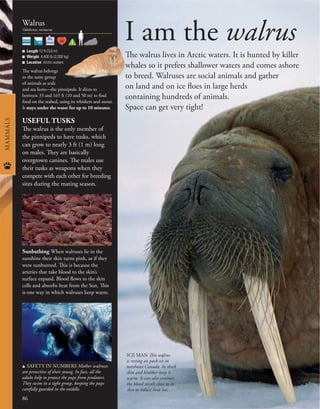
I am the walrus
Elephants
Elephant family
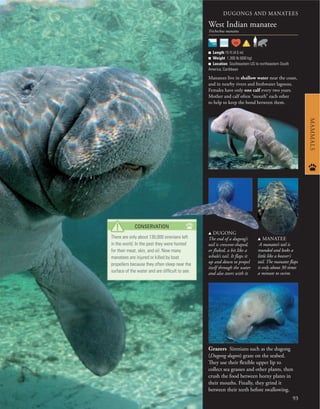
Dugongs and manatees
Horses and zebras
Giraffe and okapi
4
6
8
10
12
14
20
22
24
26
28
30
32
34
36
38
40
42
44
46
48
50
52
56
58
60
62
64
66
68
70
72
74
76
78
80
82
84
86
88
90
92
94
96
LONDON, NEW YORK,
MELBOURNE, MUNICH, and DELHI
Project editors Carrie Love, Caroline Stamps
Project designer Rachael Smith
Editors Ann Baggaley, Elinor Greenwood, Wendy Horobin,
Cécile Landau, Lorrie Mack, and Penny Smith
Designers Sadie Thomas, Clemence De Molliens,
Gemma Fletcher, and Joanna Pocock
Picture researcher Liz Moore
Packaging services supplied by Bookwork
Publishing manager Bridget Giles
Art director Rachael Foster
Production controller Claire Pearson
Production editor Sean Daly
Jacket designer Natalie Godwin
Jacket editor Mariza O’Keeffe
US editor Margaret Parrish
Consultants Dr. Mark Fox, Dr. John P. Friel,
Matthew Robertson, and Eileen Westwig M.S.
First American edition published in 2008.
This paperback American edition published in 2012 by DK Publishing
375 Hudson Street, New York, NY 10014
Copyright © 2008 and 2012 Dorling Kindersley Limited
12 13 14 15 16 10 9 8 7 6 5 4 3 2
001—183849—April/12
All rights reserved.
Without limiting the rights under copyright reserved above, no part
of this publication may be reproduced, stored in or introduced into a
retrieval system, or transmitted in any form, or by any means (electronic,
mechanical, photocopying, recording, or otherwise), without the prior
written permission of the copyright owner.
Published in Great Britain by Dorling Kindersley Limited.
A catalog record for this book is available from the Library of Congress.
ISBN 978-0-7566-9170-7
DK books are available at special discounts when purchased in bulk for sales
promotions, premiums, fundraising, or educational use. For details contact:
DK Publishing Special Markets, 375 Hudson Street, New York, NY 10014,
or SpecialSales@dk.com.
Color reproduction by Colourscan, Singapore
Printed and bound by Toppan, China
Discover more at
www.dk.com
Rhinoceroses
Battling hippos
Camels and relatives
Deer
Cattle and antelope
Wildebeest migration
BIRDS
What is a bird?
A world of birds
Birds of a feather
Birds of prey
Bald eagle
Silent owls
Gamebirds
Seabirds and shorebirds
Penguins
The wandering albatross
Pelicans and relatives
Waterbirds
Migration: Snow geese
Kingfishers and relatives
Flamingos
Herons and relatives
Parrots
Hummingbirds
Woodpeckers and toucans
Amazing nests
Perching birds
Starlings
A world of eggs
REPTILES
What is a reptile?
Reptile birthday
Tortoises and turtles
Snakes
Lizards
Chameleons
Geckos, skinks, and others
Iguanas, monitors, and relatives
Crocodiles and alligators
AMPHIBIANS
What is an amphibian?
Salamanders and newts
Frogs and toads
Marine toad
Poison dart frogs
Frogs and toads
98
100
102
104
106
108
110
112
114
116
118
120
122
124
126
128
130
132
134
136
138
140
142
144
146
148
150
152
156
158
160
162
164
166
168
174
176
178
180
182
184
186
188
190
194
196
198
FISHES
What is a fish?
A world of sharks
The big-headed hammerhead
Killer sharks?
Skates and rays
Bony fishes
Schools
Fishing for food
Giant grouper
Deep-sea fishes
Spawning salmon
INVERTEBRATES
What is an invertebrate?
Sponges
Sea anemones
Jellyfish
Corals
Worms
Mollusks
Snails and slugs
Octopuses and squid
A world of shells
Arthropods
Dragonflies and damselflies
Stick and leaf insects
Grasshoppers and crickets
Mantids
Cockroaches
Bugs
Treehoppers
A world of beetles
Wetas
Ants
Termites
Bees and wasps
Flies
Butterflies and moths
Moths and butterflies
Scorpions
Spiders
Spider silk
Crustaceans
Spider crabs
Centipedes and millipedes
Echinoderms
Glossary
Index
Credits and acknowledgments
200
202
204
206
208
210
212
214
216
218
220
222
224
226
228
230
232
234
236
238
240
242
244
246
248
250
252
254
256
258
260
262
264
266
268
270
272
274
276
278
280
282
284
286
288
290
292
296
303
Foreword
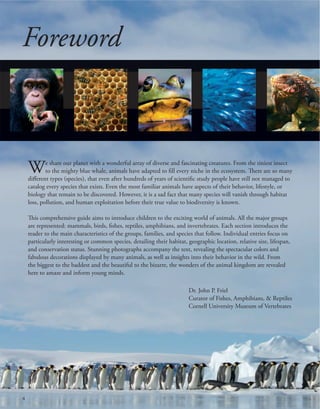
We share our planet with a wonderful array of diverse and fascinating creatures. From the tiniest insect
to the mighty blue whale, animals have adapted to fill every niche in the ecosystem. There are so many
different types (species), that even after hundreds of years of scientific study people have still not managed to
catalog every species that exists. Even the most familiar animals have aspects of their behavior, lifestyle, or
biology that remain to be discovered. However, it is a sad fact that many species will vanish through habitat
loss, pollution, and human exploitation before their true value to biodiversity is known.
This comprehensive guide aims to introduce children to the exciting world of animals. All the major groups
are represented: mammals, birds, fishes, reptiles, amphibians, and invertebrates. Each section introduces the
reader to the main characteristics of the groups, families, and species that follow. Individual entries focus on
particularly interesting or common species, detailing their habitat, geographic location, relative size, lifespan,
and conservation status. Stunning photographs accompany the text, revealing the spectacular colors and
fabulous decorations displayed by many animals, as well as insights into their behavior in the wild. From
the biggest to the baddest and the beautiful to the bizarre, the wonders of the animal kingdom are revealed
here to amaze and inform young minds.
Dr. John P. Friel
Curator of Fishes, Amphibians,  Reptiles
Cornell University Museum of Vertebrates
4
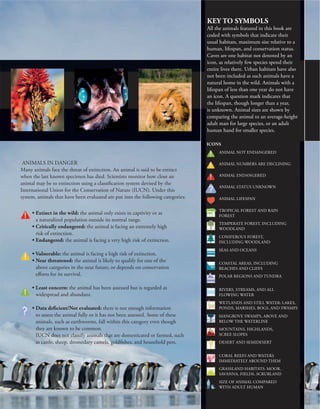
ANIMALS IN DANGER
Many animals face the threat of extinction. An animal is said to be extinct
when the last known specimen has died. Scientists monitor how close an
animal may be to extinction using a classification system devised by the
International Union for the Conservation of Nature (IUCN). Under this
system, animals that have been evaluated are put into the following categories:
TROPICAL FOREST AND RAIN
FOREST
TEMPERATE FOREST, INCLUDING
WOODLAND
CONIFEROUS FOREST,
INCLUDING WOODLAND
SEAS AND OCEANS
COASTAL AREAS, INCLUDING
BEACHES AND CLIFFS
POLAR REGIONS AND TUNDRA
RIVERS, STREAMS, AND ALL
FLOWING WATER
WETLANDS AND STILL WATER: LAKES,
PONDS, MARSHES, BOGS, AND SWAMPS
MANGROVE SWAMPS, ABOVE AND
BELOW THE WATERLINE
MOUNTAINS, HIGHLANDS,
SCREE SLOPES
DESERT AND SEMIDESERT
CORAL REEFS AND WATERS
IMMEDIATELY AROUND THEM
GRASSLAND HABITATS: MOOR,
SAVANNA, FIELDS, SCRUBLAND
ANIMAL NOT ENDANGERED
ANIMAL NUMBERS ARE DECLINING
ANIMAL ENDANGERED
ANIMAL STATUS UNKNOWN
ANIMAL LIFESPAN
KEY TO SYMBOLS
All the animals featured in this book are
coded with symbols that indicate their
usual habitats, maximum size relative to a
human, lifespan, and conservation status.
Caves are one habitat not denoted by an
icon, as relatively few species spend their
entire lives there. Urban habitats have also
not been included as such animals have a
natural home in the wild. Animals with a
lifespan of less than one year do not have
an icon. A question mark indicates that
the lifespan, though longer than a year,
is unknown. Animal sizes are shown by
comparing the animal to an average-height
adult man for large species, or an adult
human hand for smaller species.
ICONS
SIZE OF ANIMAL COMPARED
WITH ADULT HUMAN
• Extinct in the wild: the animal only exists in captivity or as
a naturalized population outside its normal range.
• Critically endangered: the animal is facing an extremely high
risk of extinction.
• Endangered: the animal is facing a very high risk of extinction.
• Vulnerable: the animal is facing a high risk of extinction.
• Near threatened: the animal is likely to qualify for one of the
above categories in the near future, or depends on conservation
efforts for its survival.
• Least concern: the animal has been assessed but is regarded as
widespread and abundant.
• Data deficient/Not evaluated: there is not enough information
to assess the animal fully or it has not been assessed. Some of these
animals, such as earthworms, fall within this category even though
they are known to be common.
IUCN does not classify animals that are domesticated or farmed, such
as cattle, sheep, dromedary camels, goldfishes, and household pets.
ANIMAL
KINGDOM
ANIMAL
KINGDOM
ANIMAL
KINGDOM
ANIMAL
KINGDOM
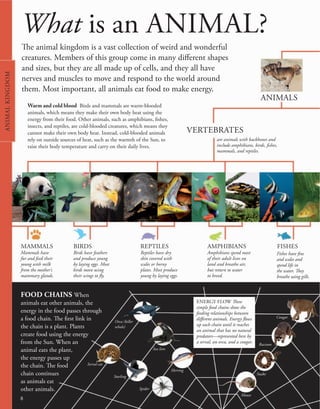
What is an ANIMAL?
The animal kingdom is a vast collection of weird and wonderful
creatures. Members of this group come in many different shapes
and sizes, but they are all made up of cells, and they all have
nerves and muscles to move and respond to the world around
them. Most important, all animals eat food to make energy.
ANIMALS
VERTEBRATES
MAMMALS BIRDS REPTILES AMPHIBIANS FISHES
are animals with backbones and
include amphibians, birds, fishes,
mammals, and reptiles.
Warm and cold blood Birds and mammals are warm-blooded
animals, which means they make their own body heat using the
energy from their food. Other animals, such as amphibians, fishes,
insects, and reptiles, are cold-blooded creatures, which means they
cannot make their own body heat. Instead, cold-blooded animals
rely on outside sources of heat, such as the warmth of the Sun, to
raise their body temperature and carry on their daily lives.
Fishes have fins
and scales and
spend life in
the water. They
breathe using gills.
Amphibians spend most
of their adult lives on
land and breathe air,
but return to water
to breed.
Reptiles have dry
skin covered with
scales or horny
plates. Most produce
young by laying eggs.
Birds have feathers
and produce young
by laying eggs. Most
birds move using
their wings to fly.
Mammals have
fur and feed their
young with milk
from the mother’s
mammary glands.
8
FOOD CHAINS When
animals eat other animals, the
energy in the food passes through
a food chain. The first link in
the chain is a plant. Plants
create food using the energy
from the Sun. When an
animal eats the plant,
the energy passes up
the chain. The food
chain continues
as animals eat
other animals.
ENERGY FLOW These
simple food chains show the
feeding relationships between
different animals. Energy flows
up each chain until it reaches
an animal that has no natural
predators—represented here by
a serval, an orca, and a cougar.
Serval cat
Starling
Spider
Orca (killer
whale)
Sea lion
Herring
Mouse
Snake
Raccoon
Cougar
WHAT IS AN ANIMAL?
9
ANIMAL
KINGDOM
LIFE
BACTERIA PLANTS FUNGI PROTISTS
INVERTEBRATES
SPONGES
CNIDARIANS INSECTS
ARACHNIDS MOLLUSKS
ECHINODERMS
Scorpions, spiders,
ticks, mites
Clams, octopuses,
oysters, squid, slugs,
snails
Starfish,
sea urchins,
sand dollars
make up 95 percent of the animal kingdom.
They are animals that do not have a bony
skeleton. They include insects, spiders, and many
marine creatures such as crabs and starfish.
Crabs, lobsters,
woodlice
CLASSIFICATION
■ Order: Carnivora
Includes any animal
that mainly eats meat.
■ Family: Felidae
Includes every type of
cat, both large and small.
■ Genus: Panthera
Large cats that can roar
as well as purr. Includes
lions, tigers, panthers.
Scientists around the world organize the living
world into different groups. A species is the
simplest unit of this classification. Related
species are grouped into genus, and genera are
grouped into families. This grouping system
carries on through order, class, and phylum to
kingdom at the top of the classification system.
The following shows an example of scientific
classification for the lion. The genus name is
always written in italics with a capital first
letter; the species name is written in italics but
does not have a capital first letter.
CRUSTACEANS
Sea anemones,
corals, jellyfish,
hydroids
HORSESHOE CRAB
WORMS
Animal overcoats Animals keep warm
and protect their skin and bodies in
different ways. Birds are covered with
feathers, mammals have coats of fur,
while scales or horny plates grow out
of the skin of fishes and reptiles.
Feathers (left), fur (center) and scales (right).
■ Species: leo
Identifies the large cat
specifically as a lion.
Butterflies, moths,
mosquitoes, flies,
dragonflies, beetles
Various
unrelated
groups.
are a group of organisms that
include some seaweeds and
molds. Many are single-celled.
10
ANIMAL behavior
Anything an animal does is its behavior. This ranges
from simple things such as eating and keeping clean
to more complex activities such as attracting a mate.
Some behavior is instinctive, while other behavior
develops through experience.
ANIMAL
KINGDOM
u ON THE PROWL
Female lions and their cubs
live in groups called prides.
Male lions live alongside
the females either alone or
in small groups.
Feeding time Animals spend a lot
of time looking for food. Some
predators hunt alone and rely on
speed or stealth to capture prey.
Others hunt in groups. Scavengers
feed on the remains that other
animals leave behind.
u NESTING SITES
During the breeding
season, seabirds such
as gannets and gulls
make their nests in dense
colonies along the coast.
u HOME TO ROOST
During the day, large
numbers of bats gather to
rest at roosting sites, such
as caves. They emerge at
dusk to feed.
u BEE COLONIES
Within a bee colony, one
female, called the queen,
produces all the young. She
is helped by all the bees in
the colony.
u LIFE IN THE HERD
Living in a herd offers a
better chance of survival
for zebras since there are
more eyes on the lookout
for predators such as lions.
LIVING ALONE
Many animals choose
to live and hunt
alone and only come
together to mate
during the breeding
season. As soon as the
mating takes place,
the two sexes part
company again.
LIVING TOGETHER
Animals choose to live together
for many different reasons. One
of the main benefits is safety in
numbers. You might think that a
group of animals offers the predator
a wider choice of prey. In fact, the
predator often finds it hard to single
out its victim. For any one animal,
the chance of being eaten is less.
ANIMAL BEHAVIOR
ANIMAL
KINGDOM
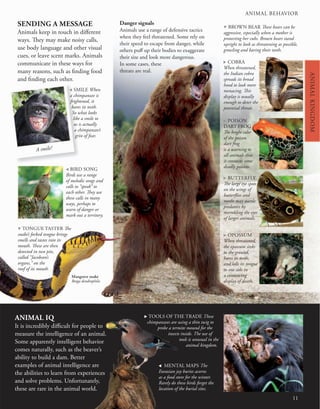
SENDING A MESSAGE
Animals keep in touch in different
ways. They may make noisy calls,
use body language and other visual
cues, or leave scent marks. Animals
communicate in these ways for
many reasons, such as finding food
and finding each other.
. BUTTERFLY
The large eye spots
on the wings of
butterflies and
moths may startle
predators by
resembling the eyes
of larger animals.
. OPOSSUM
When threatened,
the opossum sinks
to the ground,
bares its teeth,
and lolls its tongue
to one side in
a convincing
display of death.
Danger signals
Animals use a range of defensive tactics
when they feel threatened. Some rely on
their speed to escape from danger, while
others puff up their bodies to exaggerate
their size and look more dangerous.
In some cases, these
threats are real.
ANIMAL IQ
It is incredibly difficult for people to
measure the intelligence of an animal.
Some apparently intelligent behavior
comes naturally, such as the beaver’s
ability to build a dam. Better
examples of animal intelligence are
the abilities to learn from experiences
and solve problems. Unfortunately,
these are rare in the animal world.
. COBRA
When threatened,
the Indian cobra
spreads its broad
hood to look more
menacing. This
display is usually
enough to deter the
potential threat.
. TOOLS OF THE TRADE These
chimpanzees are using a thin twig to
probe a termite mound for the
insects inside. The use of
tools is unusual in the
animal kingdom.
Mangrove snake
Boiga dendrophila
d TONGUE TASTER The
snake’s forked tongue brings
smells and tastes into its
mouth. These are then
detected in two pits,
called “Jacobson’s
organs,” on the
roof of its mouth.
, SMILE When
a chimpanzee is
frightened, it
bares its teeth.
So what looks
like a smile to
us is actually
a chimpanzee’s
grin of fear.
A smile?
, BIRD SONG
Birds use a range
of melodic songs and
calls to “speak” to
each other. They use
these calls in many
ways, perhaps to
warn of danger or
mark out a territory.
. POISON
DART FROG
The bright color
of the poison
dart frog
is a warning to
all animals that
it contains some
deadly poisons.
d BROWN BEAR These bears can be
aggressive, especially when a mother is
protecting her cubs. Brown bears stand
upright to look as threatening as possible,
growling and baring their teeth.
, MENTAL MAPS The
Eurasian jay buries acorns
as a food store for the winter.
Rarely do these birds forget the
location of the burial sites.
11
12
An ANIMAL’S life cycle
The whole of an animal’s life has just one purpose: survival
of the species. Staying alive long enough to find a mate and
produce young is all that really matters. Each species has its
own special life cycle that is repeated as one
generation follows another.
ANIMAL
KINGDOM
GOING COURTING
Some animals mate at any time of year.
Others breed only in particular seasons,
such as spring and fall. Attracting a mate
can mean putting in a lot of effort,
especially for the males. Fancy plumage,
shows of strength, and love songs are just
some of the ploys animals use.
The way young develop
Most mammals give birth to live young. Animals such as birds, insects,
and many reptiles and fishes, lay eggs. The time it takes for young to develop
independent life, inside the womb or inside an egg, or by passing through larval
stages, varies enormously. A small mammal such as a vole
is pregnant for two or three weeks, while an elephant’s
pregnancy lasts about 22 months. Some insects stay
at an early stage of development for years.
CARING MOM
This mother orangutan
is bringing up her infant
without any help from her
mate. Over the next 10 years
she will teach the youngster
survival skills, such as how to
live safely in the forests and
where to find food.
u BOXING GLOVES
In spring, male hares that are
rivals for the same mate often
settle the matter with
a fierce boxing match.
. IN THE WOMB
At this early stage a kitten looks
much the same as a human
embryo. Its body systems will be
developed long before birth.
u LOCKING ANTLERS
These deer are having a
wrestling match to decide
which one of them wins
the females.
, IN THE EGG An
embryo chick may not begin
to develop until the parent
birds start sitting on the
eggs. The growing chick is
nourished by the egg yolk.
. FROG SONGS
Frogs and toads
inflate their throat
sacs to make love
calls to mates.
. DISPLAY The
more impressive his
tail, the more females
a peacock will entice
into his harem.
AN ANIMAL’S LIFE CYCLE
13
ANIMAL
KINGDOM
A continuing cycle
In some species of animals,
mothers and their young stay
together as a group for life.
Among animals as widely
different as lions, monkeys, and
killer whales family ties remain
unbroken in this way, though the
male offspring will leave the group
when mature so that only one
dominant male remains with the females.
Other young male and female animals,
such as pandas, move on to a largely
solitary existence.
CHILDCARE
Some newborn animals receive lavish childcare. For example, a mother ape
carries her young everywhere; an infant kangaroo always has a mother’s pouch
to shelter in; parent birds feed their nestlings on demand. On the other hand,
the young of hares and some deer survive on one short daily visit from their
mother, when she shows up to feed them. Often, animals such as
insects, fishes, and reptiles never meet their parents at all.
, A NEWBORN
ANTEATER climbs
straight up on to its
mother’s back. It rides
around, clinging to
the mother’s fur,
until it is about
one year old.
u ELEPHANT AUNTS
All the females in an elephant herd
help a mother to look after her calf.
, KING PENGUINS carry their
single egg on their feet, tucked
under a warm tummy fold. Both
parent birds share the duty.
, YOUNG KANGAROOS
stay in their mother’s pouch for
six months. They feed from
a nipple inside the pouch.
, TADPOLES know
nothing about parents.
When they hatch, they
must fend for themselves.
. A NEST FULL
of chicks is
hard work.
Many parent
birds exhaust
themselves feeding
their hungry brood.
, LIFE TIES
The close
bond between
dolphins and
their offspring
lasts for life.
u PUPS are ready to be weaned
from their mother’s milk when
they are about three weeks old.
World habitats
Our planet is home to a range of landscapes and some
equally varied weather patterns. Months go by in the
desert without a single drop of rain, while rain forests
are soaked daily by tropical storms. Little wonder then
that Earth supports such an amazing diversity of life.
WHERE IN THE WORLD?
Habitats are places where animals live
and mix with other animals and their
surroundings. Most animals can move
from place to place, so they have spread
to every part of the world. Many thrive
in warm, wet tropical forests, while other
hardy types live in some of the harshest
places on our planet, from arid deserts
to the darkest ocean depths.
The following symbols are used
throughout the book.
In the northern hemisphere,
temperate forests of deciduous
trees eventually give way to
coniferous forests that stretch
across the far north, deep inside
the Arctic Circle, where the
temperatures rarely rise above
freezing. Farther south, the
temperate forests of evergreen
trees have warm summers and
mild winters. These forests are
Tropical forest and rain forest
ANIMAL
KINGDOM
Temperate forest, including
woodland
Coniferous forest, including
woodland
Seas and oceans
Coastal areas
Polar regions, including tundra
and icebergs
Rivers, streams, and all
flowing water
Wetlands and all still
bodies of water
Mangrove swamps above or below
waterline
Mountains, highlands, scree slopes
Desert and semidesert
Coral reefs and waters
immediately around them
Open habitats including grassland,
moorland, heathland, savanna, fields, scrub
In some wetlands, plants form a
thin carpet over the waterlogged
soil, while in others stretches of
open water mix with patches of
dense vegetation. Wetlands are
homes for land-based swimmers
such as snakes, as well as many
insects, fishes, and waterbirds.
Mangrove swamps (see inset)
Wetlands and mangroves
Temperate and coniferous forest
are flooded with salt water
when the tide comes in and
left exposed when the
water retreats. These
swamps contain many
fishes, and the dense
forests provide
excellent nesting
sites for birds.
home to many different animals.
Bears, birds of prey, and wolves
live in the coniferous forests of
the far north, while deer, lizards,
squirrels, and
many forest
birds are
found
farther
south.
Mediterranean-type biomes
14
Tropic of Cancer
Equator
Tropic of Capricorn
15
ANIMAL
KINGDOM
The coast is a natural barrier
between land and sea. It is
one of the few places on
Earth where the landscape
constantly changes. Animals
that live here must adapt to
the rhythm of the tides.
Grasslands go by different
names in different places.
They are prairies in North
America, pampas or paramo
in South America, steppes
in Europe and Asia, and the
outback in Australia. The
tropical and subtropical
grassland of Africa is known
WORLD HABITATS
Grassland
Few habitats experience such
a variation in conditions as
the mountains. Lower down
the slopes, in the foothills,
the conditions usually match
that of the surrounding area.
Many animals make their
home here, including forest
birds and large mammals,
Mountain Coastal areas
Tundra
The tundra is a vast, frozen
landscape north of the Arctic
Circle. It is so cold that the soil
is frozen for most of the year.
In the spring, the tundra bursts
into life as snow and ice melt.
Alpine plants appear, and birds
arrive to breed. As the soil starts
to freeze again, the plants wither
and the birds depart, marking
the end of the short summer.
such as apes, bears, deer, and
monkeys. Higher up the
slopes, the air gets thinner
and the temperature drops
rapidly. Only the hardiest
animals, such as birds of prey
and mountain goats, can cope
with the harsh conditions.
Rocky coasts, mudflats, and
sandy beaches abound with
marine invertebrates and
the wading birds that feed
on them.
DESERT LIFE
The world’s deserts
are places of extreme
climate, with very
high temperatures
and little moisture.
as the savanna. In all
these areas, grasses are
the dominant plants and
the main source of food
for huge herds of grazing
mammals, such as the
wildebeest and zebras
of Africa. In turn, these
grazers are the food for
predators such as the big
cats and wild dogs.
Pacific Ocean SOUTH AMERICA
NORTH AMERICA
Atlantic Ocean
Atlantic Ocean
AFRICA
ASIA
EUROPE
Indian Ocean
Pacific Ocean
AUSTRALIA
ANTARCTICA
Arctic Ocean
16
Macrohabitat A typical example
of a macrohabitat would be all the
regions within a large, complex
environment such as a coastal
region. For example, the intertidal
zone, rocky pools, and sand dunes
along the shore would all make
up the coastal macrohabitat.
ANIMAL
KINGDOM
Rain forest layers
A tropical rain forest grows
in distinct layers. Each layer
consists of plants and animals
that have adapted to living in
that particular part of the rain
forest. The top, or emergent,
layer consists of the tallest trees.
Here it is hot and windy. Below
this level is the canopy, a dense
layer of branches that is home to
most of the forest’s animals. The
dark understory of shrubs and
seedlings is the next level down,
followed by the leaf litter on the
forest floor, which supports
fungi and new plant growth.
Microhabitat Within each
macrohabitat there are many
smaller microhabitats. These
regions may be no bigger than a
small, rotting log within the vast
expanse of a rain forest. Each tiny
environment harbors animals that
may not be found anywhere else
in the macrohabitat.
HABITATS LARGE AND SMALL
Hot forests
Rain forests enjoy plenty of warmth and moisture.
The rain forests that lie on the equator are hot and
humid all year round. They are some of the most
productive habitats on Earth. The seasonal forests on
either side of the equator—the so-called monsoon
forests—experience a yearly cycle of rain and sun.
They are home to a wide variety of animal life.
MEALY PARROT
These large parrots live
in pairs or small flocks
in the Amazon rain
forest, where they feast
on the abundant fruits,
seeds, and nuts.
TREE DWELLERS
White-faced capuchins
live in complex social
groups called troops,
which patrol the rain
forests of Central and
South America.
NIGHT CAT
The ocelot lives on the
floor of the rain forest,
where it hunts birds,
small mammals, and
reptiles under the
cover of darkness.
LEAF CUTTERS
Leaf-cutter ants live
in complex colonies in
almost every part of the
rain forest, from the
tallest treetops down
to the leaf litter.
WATER LOVER
The capybara is the
largest of all the
rodents. It lives in
densely forested areas
near lakes, rivers, and
swamps of the South
American rain forest.
TROPICAL RAIN FOREST
The rain forest is warm
and wet, creating the
perfect conditions for
plant growth. This rich
vegetation provides the
foundations for
abundant animal life.
17
ANIMAL
KINGDOM
DESERT
FOOD TIME The
golden eagle uses its
keen sense of
sight to hunt
animals such as
rabbits, hares,
squirrels, and
mice.
NESTING HOLE
The Gila woodpecker
lives in the desert of
the southwestern United
States. It builds its nest
in holes made in saguaro
cacti or mesquite trees.
DESERT CAT The
desert-dwelling bobcat
lives in the southerly
part of North America,
where it hunts birds,
hares, rabbits, and other
small mammals.
DEATH RATTLE
The rattle on the end of
a rattlesnake’s tail gives
this venomous snake its
name. If threatened,
the snake shakes its
rattle as a warning
to steer clear.
STINGING TAIL
Scorpions have large,
hook-shaped stings on
the ends of their tails.
These act as defensive
weapons but can be
used to stun prey.
POLAR REGIONS
ARCTIC TERN
Arctic terns migrate
between the Arctic
and Antarctic each
year, making full
use of the daylight
hours at each pole.
PENGUIN
These superb swimmers
are adapted for a life
under water. They
use their flipperlike
wings to chase fishes
—a favorite food.
LEOPARD SEAL
The fearsome
leopard seal roams
the southern oceans
in search of food such
as seabirds, smaller
seals, and penguins.
KRILL These
tiny crustaceans
thrive in cold Arctic
and Antarctic
waters, where they
feed on plankton.
They are eaten by
seals and whales.
POLAR BEAR
Seals are the main
food source for these
Arctic predators. The
polar bear’s blubber
and thick fur keep it
warm under water
and on the ice.
Dry desert heat
For most of the time, the world’s deserts are
dry, barren habitats, where the intense heat
results in less than 6 in (15 cm) of rain each
year. When it comes, rain soaks the parched
soil and may lead to local flooding. Few
creatures can adapt to these extreme
conditions, so the desert is home to a bunch
of extremely hardy animals and plants.
Life in the cold poles
The world’s deserts and polar regions have one thing
in common. Both get little in the way of rainfall each
year. While deserts are scorching hot, the polar regions
are some of the coldest places on Earth. Few creatures
can survive in these extremes, so the ones that do,
adapt to overcome the frozen conditions. Sea
mammals have thick skin, called blubber, while some
fishes even have an “antifreeze” element in their blood.
WORLD HABITATS
GLIDING EYE
The African white-
backed vulture glides
high over the vast,
open savanna in
search of the remains
of dead animals.
SAVANNA
AFRICAN GIANT
Herds of up to 30
African elephants
wander across the
savanna in search of
food and water holes.
TOP PREDATOR
Female lions hunt
together, targeting
weak or young zebra
and wildebeest from
the vast herds that
roam the savanna.
DUNG DEALERS
Revolting as it may
sound, dung beetles
eat poop! They roll the
dung into balls and
bury them in the soil
to feed their young.
TREE SNAKE
The boomslang is
a highly poisonous
tree-dwelling snake
that lives in savanna
and scrub south of the
Sahara Desert.
URBAN HABITATS
Many animals have chosen to make their
homes alongside our own. Towns and
cities provide plenty of hiding places for
these adaptable animals. The vast amounts
of garbage we produce are rich pickings
for the hungry scavengers that can cope
with the hustle and bustle of city life.
, MONKEY PALACE
Rhesus macaques patrol
the walls of the Hawa
Mahal temple (Palace
of the Winds) in Jaipur,
India. These monkeys
thrive in urban areas
and rely on handouts or
human garbage. They
have become a serious
pest in some countries.
ANIMAL
KINGDOM
18
WORLD HABITATS
ANIMAL
KINGDOM
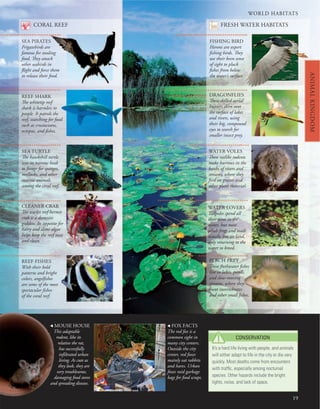
CORAL REEF
SEA PIRATES
Frigatebirds are
famous for stealing
food. They attack
other seabirds in
flight and force them
to release their food.
SEA TURTLE
The hawksbill turtle
uses its narrow beak
to forage for sponges,
mollusks, and other
marine animals
among the coral reef.
CLEANER CRAB
The scarlet reef hermit
crab is a domestic
goddess. Its appetite for
hairy and slime algae
helps keep the reef neat
and clean.
REEF FISHES
With their bold
patterns and bright
colors, angelfishes
are some of the most
spectacular fishes
of the coral reef.
REEF SHARK
The whitetip reef
shark is harmless to
people. It patrols the
reef, searching for food
such as crustaceans,
octopus, and fishes.
FRESH WATER HABITATS
FISHING BIRD
Herons are expert
fishing birds. They
use their keen sense
of sight to pluck
fishes from below
the water’s surface.
WATER VOLES
These ratlike rodents
make burrows in the
banks of rivers and
streams, where they
feed on grasses and
other plant material.
WATER LOVERS
Tadpoles spend all
their time in the
water, but most
adult frogs and toads
usually live on land,
only returning to the
water to breed.
DRAGONFLIES
These skilled aerial
hunters skim over
the surface of lakes
and rivers, using
their big, compound
eyes to search for
smaller insect prey.
PERCH PREY
These freshwater fishes
live in lakes, ponds,
and slow-moving
streams, where they
hunt invertebrates
and other small fishes.
, FOX FACTS
The red fox is a
common sight in
many city centers.
Outside the city
center, red foxes
mainly eat rabbits
and hares. Urban
foxes raid garbage
bags for food scraps.
, MOUSE HOUSE
This adaptable
rodent, like its
relative the rat,
has successfully
infiltrated urban
living. As cute as
they look, they are
very troublesome,
damaging food stores
and spreading disease.
CONSERVATION
It’s a hard life living with people, and animals
will either adapt to life in the city or die very
quickly. Most deaths come from encounters
with traffic, especially among nocturnal
species. Other hazards include the bright
lights, noise, and lack of space.
19
20
Animals in
DANGER
Every year, wonderful animals disappear from
Earth—for good. They vanish mostly because
their natural habitat has been spoiled or
destroyed.When an animal loses its special
niche in the world, it will die if it cannot find
anywhere else suitable to live.
WHAT’S GOING WRONG?
The greatest threat to animals comes
from humans. People are destroying
habitats to make room for their own
activities. They are poisoning the land,
seas, and air with toxic chemicals; they
are even changing the climate. And,
sometimes, the animals that survive all
this are killed to meet human demand.
Melting ice Climate warming is
melting the Arctic sea ice. Polar
bears spend most of the Arctic
summer living on the ice, where
they hunt seals and mate. Now
their habitat is shrinking.
, LOGGING
Clearance for
lumber and land
development has
destroyed vast areas
of forest, with large-
scale damage to the
environment.
ANIMAL
KINGDOM
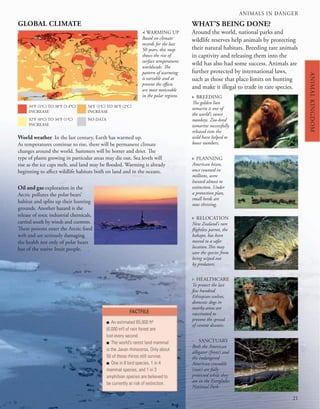
, WARMING
Gases released
from burning fossil
fuels trap heat in
the atmosphere.
This warming
alters habitats in
ways that affect
animal survival.
, POLLUTION
The dumping
of poisonous
chemicals in
the oceans is
harming marine
life and destroying
habitats such as
coral reefs.
, SLAUGHTER
Despite laws that
ban trading in
animal furs and
body parts, the
illegal killing of
species such as the
leopard is difficult
to control.
, CAPTURE
Caught wild birds,
such as these young
African gray
parrots, fetch high
prices in the exotic
bird trade. Many
birds die in transit
between countries.
Fewer polar
bear cubs are
surviving in
the Arctic.
21
■ An estimated 65,000 ft²
(6,000 m²) of rain forest are
lost every second.
■ The world’s rarest land mammal
is the Javan rhinoceros. Only about
50 of these rhinos still survive.
■ One in 8 bird species, 1 in 4
mammal species, and 1 in 3
amphibian species are believed to
be currently at risk of extinction.
FACTFILE
ANIMAL
KINGDOM
GLOBAL CLIMATE WHAT’S BEING DONE?
Around the world, national parks and
wildlife reserves help animals by protecting
their natural habitats. Breeding rare animals
in captivity and releasing them into the
wild has also had some success. Animals are
further protected by international laws,
such as those that place limits on hunting
and make it illegal to trade in rare species.
. BREEDING
The golden lion
tamarin is one of
the world’s rarest
monkeys. Zoo-bred
tamarins successfully
released into the
wild have helped to
boost numbers.
. PLANNING
American bison,
once counted in
millions, were
hunted almost to
extinction. Under
a protection plan,
small herds are
now thriving.
. RELOCATION
New Zealand’s rare
flightless parrot, the
kakapo, has been
moved to a safer
location.This may
save the species from
being wiped out
by predators.
. HEALTHCARE
To protect the last
few hundred
Ethiopian wolves,
domestic dogs in
nearby areas are
vaccinated to
prevent the spread
of canine diseases.
. SANCTUARY
Both the American
alligator (front) and
the endangered
American crocodile
(rear) are fully
protected while they
are in the Everglades
National Park.
34°F (1°C) TO 38°F (3.4°C)
INCREASE
World weather In the last century, Earth has warmed up.
As temperatures continue to rise, there will be permanent climate
changes around the world. Summers will be hotter and drier. The
type of plants growing in particular areas may die out. Sea levels will
rise as the ice caps melt, and land may be flooded. Warming is already
beginning to affect wildlife habitats both on land and in the oceans.
, WARMING UP
Based on climate
records for the last
50 years, this map
shows the rise of
surface temperatures
worldwide. The
pattern of warming
is variable and at
present the effects
are most noticeable
in the polar regions.
Oil and gas exploration in the
Arctic pollutes the polar bears’
habitat and splits up their hunting
grounds. Another hazard is the
release of toxic industrial chemicals,
carried south by winds and currents.
These poisons enter the Arctic food
web and are seriously damaging
the health not only of polar bears
but of the native Inuit people.
34°F (1°C) TO 36°F (2°C)
INCREASE
32°F (0°C) TO 34°F (1°C)
INCREASE
NO DATA
ANIMALS IN DANGER
MAMMALS
MAMMALS
Definition: Mammals are
warm-blooded creatures like
you and me. They drink milk
from their mothers when they’re
first born, and most grow hair
and give birth to live young.
MAMMALS
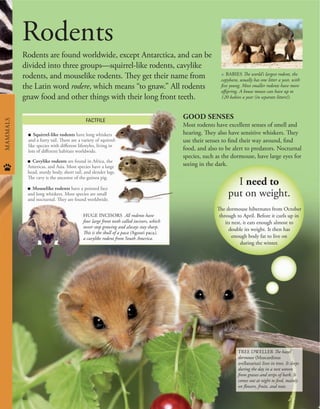
What is a MAMMAL?
Mammals are vertebrates that feed their young from
the female’s mammary glands—these glands give the
class its name. Mammals also maintain a
constant internal body temperature.
24
MAMMALS
FACTFILE
There are about 5,500 species of
mammals, which are grouped into
different families and orders including:
■ Marsupials, which give birth to
embryos early in their development. The
tiny creatures crawl up to the mother’s
pouch, and continue growing there.
■ Insectivores, small mammals that eat
insects, spiders, and worms.
■ Bats, the only mammals that have true
wings and are able to fly.
■ Rodents, small mammals with four
legs, a long tail, clawed feet, long
whiskers, and teeth. There are more
species of rodent than any other mammal.
■ Cetaceans, such as whales, dolphins,
and porpoises. These are aquatic
mammals that breathe through lungs.
■ Carnivores, animals with long, sharp
canine teeth. Most carnivores are meat-
eaters, but some plant-eaters, such as
pandas, are also carnivores.
BORN ALIVE
Most mammals give birth to live
young—only a few lay eggs. The young
of most placental mammals are
born fully developed.
Newborn marsupials
(such as kangaroos)
develop further in
their mother’s
pouch.
, FEEDING
Because newborn
mammals drink
milk from their
mothers, they don’t
have to wander off
and find food.
HAIR
With a few exceptions, mammals
have a covering of hair or fur on their
body. (Whales and dolphins have no
fur.) This helps to keep them warm.
In cold conditions, each hair will be
pulled upright by a tiny erector muscle,
trapping a layer of warming air.
. SPINY BEAST
The short-nosed
echidna is a rare,
egg-laying
mammal. It has
both spines and fur.
■ Hoofed mammals, which are known
for their speed and strength. Hoofed
mammals have long muzzles, grinding
teeth, and barrel-shaped bodies.
Hair
Sebaceous
gland
Follicle
Erector
muscle
Blood supply
to follicle
Sweat
gland
Amazing variety
Mammals, which originally developed
from prehistoric reptiles, come in all
shapes and sizes. They live mostly on
land, but they can live in water, too.
Some mammals are widely familiar,
but other, rarer, species are not as
well known.
u SLOTHS live in the rain-forest trees of
South America. They move slowly and come
down only occasionally to leave droppings.
WHAT IS A MAMMAL?
25
MONKEY SKULL
Like human jaws, monkeys’
jaws are designed to chew
rather than tear, since
monkeys gather food
with their hands.
u JAW ADAPTATIONS
Mammal jaws, like those of all
animals, are shaped and constructed
to suit the food they eat. Long, thin
jaws, for example, are good for
probing and nibbling, while short,
broad jaws are ideal for grinding
plants or cracking bones.
. BOWHEAD
WHALES have
no teeth; they feed
on the plankton
in seawater. Vast
quantities of this
water are filtered
through a tough
fringe called
baleen, which
dangles inside the
whale’s mouth.
ELEPHANT SKULL
To grind tough plant
fiber, elephants’ jaws
can move from side
to side as well as
up and down.
TIGER
SKULL
A tiger’s jaws
anchor huge, sharp
teeth for tearing
chunks of meat.
Rib cage
u ARMADILLOS are native to South and
Central America. They have bony bands
around their middle and skin like leather.
u THE DUCK-BILLED PLATYPUS has
a furry body, but it lives in water and walks
like a reptile. It lays eggs, but its young feed on
their mother’s milk.
Feet and toes
Mammals’ feet are
individually adapted to
suit their lifestyle and
habitat. Some have hooves
with one or more “toes,”
while some have footpads,
with or without claws, and
others have flippers.
An elephant’s
foot bones are
surrounded by a
thick pad to spread
the animal’s weight.
A gazelle’s hoof
is divided into
two toes.
A horse’s
hoof has a
single toe.
A seal’s foot has
long “fingers.”
A badger has wide
claws for digging.
BONE STRUCTURE
Mammal skeletons differ from those
of other vertebrates in that the jaw
is hinged directly to the skull.
Also, the lower jaw consists of
a single bone. Together, these
factors make the jaw
extremely efficient at
cutting and then
chewing food.
Finger
bones
Wrist
bones
Arm
bones
Palm
bones
Hare skeleton Like most mammals,
hares have a backbone that curves up
to help resist the downward pull of their
body weight. The vertebrae are bigger
toward the bottom, or lumbar, end of
the spine, where there is most stress.
Humerus
Radius
Carpal
Spine
Hip bone
MAMMALS
Skull
Jaw
26
■ Length 5–6 ft (1.5–1.8 m)
■ Weight 70–132 lb
(32–60 kg)
■ Speed 34 mph (55 kph)
■ Location Eastern
Australia, Tasmania
The eastern gray kangaroo is
a steely gray color with white
underparts, legs, and underside of the
tail. Its tail is strong and is used for
balance while jumping and leaping,
and as a prop while standing upright.
Females are much smaller than males.
Eastern gray kangaroo
Macropus giganteus
Marsupials
All marsupials give birth to live young, but
these are poorly developed. Most complete
their development in a pouch containing teats,
from which they drink milk. There are about
350 species of marsupial. Most live in Australia
and New Guinea. Some live in the Americas.
LIFE IN A POUCH
When a marsupial is born it makes its way to its
mother’s pouch, where it attaches itself to a teat.
It remains firmly attached until it is fully formed
and can explore the outside world. Some pouches
face up, as in kangaroos, and some face down, as
in koalas. Some pouches can hold several babies,
but others are a simple flap and the young have
to cling tightly to their mother’s fur.
, PARMA WALLABY
(Macropus parma) The
tiny newborn wallaby,
called a joey, develops in
its mother’s pouch. It can
leave the pouch after
about 30 weeks, but is
not independent until it
is about 40 weeks old.
19
MAMMALS
■ Length 31 in (78 cm)
■ Weight 32 lb
(14.5 kg)
■ Location New
Guinea
Tree kangaroos
have short, broad
feet with long claws, which
are useful for gripping as they
climb through the trees. They use their
long tails to help them balance on the
branches. Doria’s tree kangaroo has dense
brown fur, black ears, and a pale brown
or cream tail.
Doria’s tree kangaroo
Dendrolagus dorianus
■ Length 12 in (30 cm)
■ Weight 2 lb (900 g)
■ Location Australia
Quolls are carnivorous
marsupials and have many
sharp teeth for killing their
prey. Northern quolls eat
mainly insects, worms,
small mammals, and
reptiles, but they also like a
bit of honey and fruit. They
are active mostly at night,
preferring to sleep during
the heat of the day.
Northern quoll
Dasyurus hallucatus
MARSUPIALS
■ Length 5 ft (1.6 m)
■ Weight 200 lb (90 kg)
■ Speed 30 mph (50 kph)
■ Location Australia
The red kangaroo is the largest
marsupial. Males are orange-
red in color, while the
smaller females are
blue-gray. Like gray
kangaroos, the red
kangaroo bounds along
on its hind legs. It eats
grass shoots, herbs,
and leaves.
Red kangaroo
Macropus rufus
■ Length 32 in (82 cm)
■ Weight 33 lb (15 kg)
■ Location Eastern Australia
Although it is often called a koala bear, the
koala is not at all related to bears. It lives
in eucalyptus trees and its only food is
eucalyptus leaves. It feeds at night and
spends all day asleep in a tree. Female
koalas have one baby at a time. This
spends more than six months in its
mother’s pouch then climbs out
and rides on her back.
Koala
Phascolarctos cinereus
MAMMALS
20 10 10
2
Monotremes are the only egg-laying mammals. There are five living
species: one platypus and four echidnas. They have a beaklike mouth
and the females produce milk in mammary glands on the belly.
■ Length 24 in (60 cm) ■ Weight 5½ lb (2.5 kg)
■ Location Eastern Australia and Tasmania
The platypus is well equipped for an aquatic
life. It has waterproof fur to keep it dry, and
dense underfur to keep it warm. It also has
webbed feet, which it uses
like flippers to propel
itself through
the water.
Duck-billed platypus
Ornithorhynchus anatinus
■ Duck-billed platypus (Ornithorhynchus anatinus)
live in bank-side burrows in lakes and rivers in
Australia. They have a ducklike beak covered with
sensitive skin, which they use to find crustaceans and
insect larvae on the riverbed.
■ Echidnas have fur and spines and a long, cylindrical beak.
The long-beaked echidna (Zaglossus bruijni) lives
only in New Guinea. The short-beaked
echidna (Tachyglossus aculeatus) lives in
New Guinea and Australia. They eat
ants and termites, which they collect with a sticky tongue.
17
Duck-billed
platypus skull
Long-nosed
echidna skull
MONOTREME FACTFILE
Gliding mammals
A few mammals can glide through the trees, but they
do not actually fly like birds and bats. They have a
membrane of skin on either side of their body, attached
between their fore and hindlimbs. This skin acts like a
sail, allowing the animals to glide down through the air.
PLANNING A PERFECT FLIGHT
A sugar glider is able to make “flights”
through the trees of more than 165 ft
(50 m)! Its long, flat, furry tail is used just
like a rudder, to guide it through the air.
28
MAMMALS
Flying lemurs, or colugos, are the
world’s largest gliding mammals—they
are about the size of a domestic cat. Their
name is a bit misleading, since they are
not actually lemurs and they glide instead
of fly! There are two species and they both
live in the forests of Southeast Asia.
They feed on
leaves, flowers,
and fruit.
Southern flying squirrels live in
North and Central America. They look
very like the sugar glider but they are
rodents. Flying squirrels eat lots of
different kinds of food including nuts,
seeds, fruit, fungi, insects, young birds,
and mice. Like other squirrels, they
collect and store food for the winter.
Sunda flying lemur
Galeopterus variegates
Southern
flying squirrel
Glaucomys volans
The southern flying
squirrel lives in
hollow trees, deserted
woodpecker holes, and
even in bird boxes. It
builds a nest out of
soft materials such
as moss and fur.
WHY DO THEY GLIDE?
Gliding is a useful method of
escaping from predators as well
as a quick way to get from tree to
tree to find better food. Not many
mammals can glide. They include
the sugar glider, shown on the
right, and the flying lemurs.
■ Length 12 in (30 cm)
■ Tail 17½ in (44 cm)
■ Weight 5 oz (150 g)
■ Diet Eucalyptus leaves, pollen, nectar, insects
■ Location Australia, New Guinea, Indonesia
This animal is an opossum and, therefore,
a marsupial, and the female has a pouch. One
or two young are born and will remain in the
pouch for the first 70 days of life, before
venturing out to explore their world.
Sugar glider
Petaurus breviceps
10
GLIDING MAMMALS
29
MAMMALS
Look out!
I’m coming down.
The piece of skin that a glider uses to
float through the air is called a patagium.
When the animal is gliding, this is
stretched taut. When the animal
is walking, running, or sitting, the
patagium is loose and folded
out of the way.
Insect eaters
Many different animals eat insects.
Six related families, including moles,
hedgehogs, and shrews, are called
insectivores because they eat mainly
insects. Aardvarks and anteaters
specialize in eating ants and termites.
They both have long sticky tongues for
sweeping up their prey and powerful
claws for digging out the insects’ nests.
WELL-DEVELOPED NOSES
Most insectivores, such as desmans, have
poor eyesight but a good sense of smell, with snouts
ideal for sniffing out insects. Aardvarks also have a
good sense of smell. They have a piglike snout and
nostrils surrounded with hair to filter out dust.
, RUSSIAN DESMAN
(Desmana moschata) A
member of the mole family,
the desman uses its long,
whiskered snout and strong
sense of smell to investigate.
FACTFILE
■ Moles live in Europe, Asia, and North America.
They live in underground tunnels that they dig with
their powerful front legs. Their eyesight is poor but
they have an acute sense of smell.
Out of the way.
I’m coming out!
The aardvark has large upright ears.
When it is underground, it folds its
ears out of the way. It surfaces at
night, and always comes out of
its burrow head first.
. AARDVARK (Orycteropus
afer) The “earth pig” spends the
day in burrows underground.
It comes out at night to find
ants and termites.
■ Hedgehogs live only in Europe, Africa, and Asia.
They live in many different habitats. Hedgehogs have
spines and curl up into prickly balls when danger
threatens. They have good hearing.
■ Shrews live across most parts of the world except
Australia and New Zealand and parts of South
America. Most have tiny eyes and ears and a long,
pointed snout. They have poor vision but good hearing.
, ANTEATER
The giant anteater
(Myrmecophaga
tridactyla) is
related to sloths
and armadillos.
It rips open ant
and termite nests
with its large claws
and collects the
ants with its long
tongue. It eats up
to 30,000 ants in
a single day.
MOLES
HEDGEHOGS
SHREWS
MAMMALS
30
■ Length 6 in (15 cm)
■ Weight 10 oz (280 g)
■ Location Madagascar
Tenrecs look a little like a cross between a
shrew and a hedgehog because they have sharp
spines as well as fur. Their main diet consists
of worms and grubs, which they find in
grasses or under leaves on the rain-forest floor.
Streaked tenrec
Hemicentetes semispinosus
■ Length 6½ in (16 cm)
■ Weight 4½ oz (125 g)
■ Location Europe, northern Asia
This mole has fur that can lie at any angle,
which means it can go forward and backward
in its tunnels. As it digs, it pushes up piles
of soil as molehills. The mole eats worms and
other soil animals that fall into the tunnels,
often biting off the heads
and storing them
for later.
European mole
Talpa europaea
Eurasian water shrew
Neomys fodiens
■ Length 10½ in (27 cm)
■ Weight 10 oz (280 g)
■ Location Asia and northern Africa
This hedgehog is found in dry areas such as
deserts. It is nocturnal and burrows under
small bushes during the day, or rests under
rocks or in hollows in the ground. It feeds
mainly on small
invertebrates
and insects,
which it
finds using
its acute senses
of hearing and smell.
Long-eared hedgehog
Hemiechinus auritus
INSECT EATERS
31
MAMMALS
■ Length 4 ft (120 cm)
■ Weight 85 lb (39 kg)
■ Location Central and South America
The giant anteater is mainly gray
with black and white markings.
It has coarse, long fur and a
very bushy tail. The anteater
walks on the knuckles of its
front feet so that its long
claws are kept out of the
way. It wanders around
its home range like this
looking for food and is
active day and night.
Giant anteater
Myrmecophaga tridactyla
■ Length 3¾ in (9.5 cm)
■ Weight ½ oz (14 g)
■ Location Europe, northern Asia
This shrew has water-repellent
fur so it can keep dry. Its
tail has a row of bristles,
which may help with
swimming. The shrew
hunts for food under water,
killing insects, small fishes,
and frogs with a poisonous
bite. It also feeds on land,
where it preys on worms,
beetles, and grubs.
Russian desman
Desmana moschata
■ Length 8½ in (21 cm)
■ Weight 7¾ oz (220 g)
■ Location Eastern Europe to central Asia
A desman has a long tail—as long as its head
and body put together. The tail is flattened
from side to side, and the desman uses it as
a paddle and a rudder to move and steer
through water.
? 2
2 3
3
20
32
Bats
There are two groups of bats called
megabats and microbats. Megabats eat
fruit and are often called fruit bats.
Most microbats eat insects. Bats usually
go looking for food at night. During
the day they find somewhere to sleep,
or roost, hanging upside down and
clinging on with their toes.
BAT WINGS
Bats are the only mammals that can truly fly, not just
glide. Their wings are formed from a double layer of
skin stretched between the side of the body and the
four long fingers on each hand. The Latin name for
bats, Chiroptera, means “hand wings.”
Buettikofer’s
epauletted bat
Epomops buettikoferi
FACTFILE
■ Megabats These bats use their
eyes and noses to find their food.
They have large eyes so they can see
in the dark. Many megabats are
found in tropical areas, where there
are lots of different fruits to eat.
They often feed in groups and fly
long distances in search of food.
Can you see
my epaulettes?
Male epauletted bats have patches
of different fur on their shoulders,
which is how they got their name.
(An epaulette is an ornament on
the shoulder of a soldier’s
uniform.)
. LARGEST
The large flying
fox (Pteropus
vampyrus) is one
of the largest bats
with a wingspan
of around 5 ft
(1.5 m).
, SMALLEST
The hog-nosed bat
(Craseonycteris
thonglongyai) is the
smallest bat in the
world. It weighs
about 1
⁄16 oz (2 g)
and is only 1¼ in
(3 cm) long.
■ Microbats Most microbats eat insects, but some prey
on lizards, frogs, or fishes. Vampire bats drink fresh blood
from animals. Microbats have poor eyesight and find
food using echolocation (see page 34). They live
in both temperate and tropical areas.
d SKELETON
This bat’s skeleton shows how
its arms, legs, and long fingers
provide a frame for the wings.
MAMMALS
Large flying fox Hog-nosed bat
Size comparison
Furry epaulettes
■ Length 11¾ in (30 cm)
■ Weight 21 oz (600 g)
■ Wingspan 5 ft (1.5 m)
■ Location Comoros islands
Fruit bats are sometimes called flying foxes.
The Comoro flying fox is found on only two
islands in the Comoros island chain, off the
east coast of Africa. It is critically endangered
and it is estimated that only about 400
individuals exist. They roost in small groups
called harems and stick together in groups
when they go out to look for food.
Comoro flying fox
Pteropus livingstonii
BATS
33
MAMMALS
■ Length 7 in (18 cm)
■ Weight 10 oz (280 g)
■ Wingspan 30 in (76 cm)
■ Location Africa
This is one of the larger species of
fruit bat. It roosts in large colonies
of between 100,000 and 1,000,000
individuals. The bats go out at night
in small groups to search for food.
They eat mainly fruit but they do
not eat the whole fruit. Instead they
suck the juice and spit out the pulp.
African straw-colored fruit bat
Eidolon helvum
, COLOR
The African straw-colored
fruit bat gets its name from
the color of its neck and back.
Its underside is brown or gray.
21
10
■ Length 8–12 in (20–30 cm)
■ Weight 11½ oz (326 g)
■ Wingspan 35 in (90 cm)
■ Location Central Africa
This is the largest bat found in Africa. It roosts
high in the trees in tropical forests to avoid
enemies on the ground. It is sometimes
known as the big-lipped bat because males
have huge lips. They may use these to make
their loud honking noises, which can be heard
in the forest at night at certain times of the
year. The noises attract females to come and
hang beside the males on their branch.
Hammer-headed fruit bat
Hypsignathus monstrosus
Elery’s tube-nosed bat
Murina eleryi
■ Length 3½ in (9 cm)
■ Weight 1½ oz (46 g)
■ Wingspan 18 in (45 cm)
■ Location Mexico to Bolivia
and Brazil
This fruit bat roosts in
caves and buildings
but also makes “tents”
from leaves. It bites
through the mid rib of
a leaf so that it collapses to
form a roof to sleep under. Unlike many
other bats, this fruit bat feeds alone.
Jamaican fruit-eating bat
Artibeus jamaicensis
■ Length 2½ in (6.5 cm)
■ Weight 1
⁄8 oz (4 g)
■ Wingspan 8 in (20 cm)
■ Location North Vietnam
Elery’s tube-nosed bat is a small species with
golden woolly fur. Its nostrils are located at
the end of two tubes that protrude from its
nose, which give this type of bat its name.
It lives in an area of forest that is home to
other species of bats, and feeds on insects.
30 ?
10
34
Most of the bats in the world are microbats.
They are smaller than megabats and live on every
continent, except Antarctica. Sometimes known
as insect-eating bats, they have good hearing that
enables them to sense insects flying by. They also
use their hearing to avoid obstacles in the dark.
SPECIAL FEATURES
Microbats hunt in the dark, finding insects using a technique
called echolocation. Many of these bats have special features
to help them. Some have long ears for hearing. Some have a
growth on their nose, called a nose-leaf, which focuses sounds.
Echolocation To find insects in the
dark, microbats make a series of clicks
(shown here by red bars). The sound
bounces off objects like an echo and the
bat can pinpoint a moth’s position by
listening to the echoes. These get closer
together as the bat approaches its prey. SEEK
34
Gray long-eared bat
Plecotus austriacus
MAMMALS
APPROACH SEIZE
Listening bats
■ Length 2 in (5 cm)
■ Weight 1
⁄2 oz (14 g)
■ Wingspan 12 in (30 cm)
■ Location Central and southern Europe, northern
Africa, southwest Asia
These long-eared bats like to live near human
settlements, where they can roost in buildings.
When they come out to feed, they hunt for
moths, flies, and beetles and
use their long ears to listen
for their prey.
Gray long-eared bat
Plecotus austriacus
16
10
■ Length 11
⁄2–2 in (3.5–4.5 cm)
■ Weight 1
⁄4–1
⁄8 oz (5–8 g)
■ Wingspan 71
⁄2–10 in (19–25 cm)
■ Location Europe
Common
pipistrelle
Pipistrellus pipistrellus
Found in a wide range of habitats from farms
and forests to city buildings, these are
among the smallest and most widespread
of all bats. They come out to feed early
(sometimes before sunset) and hunt for
moths, gnats, and other small insects—a
single bat can eat up to 3,000 insects in
one night. The young are born in early
summer and leave the roost in August
or September.
As their name suggests, these bats have
enormous ears, which reach to the middle
of their body when they are laid flat. The
bats go out hunting late in the evening
and feed almost entirely on moths. Male
Townsend’s big-eared bats live on their
own, but females form groups when they
have their young. These groups, called
nurseries, contain several hundred animals.
They live together for protection.
■ Length 23
⁄4 in (7 cm)
■ Weight ¾ oz (20 g)
■ Wingspan 121
⁄2 in (30 cm)
■ Location North America
Townsend’s
big-eared bat
Corynorhinus townsendii
30
, FOLDED AWAY When
this long-eared bat hibernates,
it folds its ears and tucks
them under its wings.
MAMMALS
Got it! This moth will do
nicely for supper.
The gray long-eared bat has ears almost as long as
its head and body put together. These are
useful for picking up sounds
for echolocation.
LISTENING BATS
The vampire bat is a strong flyer
but can also scuttle along the
ground using its wings as front legs.
It is well known for its eating habits.
It lands on the ground and moves
toward its prey, such as a horse or a
cow. It bites away any fur, cuts into the
skin, then licks up the fresh blood. Its
teeth are so sharp that they can cut into the
skin easily and the victim hardly notices.
■ Length 31
⁄2 in (9 cm)
■ Weight 13
⁄4 oz (50 g)
■ Wingspan 8 in (20 cm)
■ Location Mexico to South America
Common
vampire bat
Desmodus rotundus
There are many species of horseshoe bat and the
lesser horseshoe bat is one of the smallest. Its body is
smaller than a human thumb. Horseshoe bats have a
horseshoe-shaped nose leaf, which is formed of
bare, folded skin. During the day these bats
roost in tree holes, chimneys, and caves.
They come out at night to hunt for
flying insects. In the winter
they hibernate in groups of
up to 500 animals.
■ Length 11
⁄2 in (4 cm)
■ Weight 1
⁄8–3
⁄8 oz (4–10 g)
■ Wingspan 9 in (23 cm)
■ Location Europe, northern Africa to
west Asia
Lesser horseshoe bat
Rhinolophus hipposideros
This species is named for its long pointed
nose. (A “proboscis” is a long nose.) The bats
like to roost head down against the trunks or
branches of trees. They are well camouflaged
here because their gray-brown speckled fur and
small size makes them look a bit like lichen
growing on the tree. Small groups of proboscis
bats roost together, sometimes spaced out
evenly in a vertical line down a tree trunk.
■ Length 12
⁄3 in (5 cm)
■ Weight ¼ oz (5 g)
■ Wingspan 91
⁄2 in (24 cm)
■ Location Central America
Proboscis bat
Rhynchonycteris naso
12
35
4
7
36
Primates
Humans are primates, as are our closest relatives,
the great apes and gibbons. The group also includes
all types of monkeys and many less familiar species,
including the diverse lemurs of Madagascar and the
nocturnal lorises, galagos, and pottos.
PRIMATE FEATURES
All primates are good climbers and
some spend almost their whole lives
in trees. They have strong arms and
legs and long, grasping fingers and
toes for hanging on to branches.
Their forward-facing eyes allow
them to judge distances accurately—
a useful skill when leaping from
branch to branch.
FAST LEARNERS Young
chimpanzees pick up skills by
watching adults, but also by
trial and error. It takes a lot
of practice to fine-tune methods
such as fishing for termites.
FACTFILE
■ The aye-aye’s long skinny fingers are
perfect for picking insect grubs out of
small crevices in tree bark.
■ The pads on a tarsier’s fingers, toes,
palms, and soles provide excellent grip
on smooth trunks and branches.
■ Chimpanzees are as comfortable
moving on the ground as in the trees.
Their feet have large flat soles for
walking on.
I’m ready to
go fishing!
Chimpanzees eat many different kinds of
food. Ants and termites make a good snack
because they contain a lot of protein. To catch
them, chimps use stripped twigs or plant
stems, which they poke into holes in the
termite nest or mound. Only the
smartest animals have the ability
to make and use tools in
this way.
MAMMALS
PRIMATES
37
, MACAQUE SOCIETY Most
primates live in social groups. Members
of the group often groom each other to
strengthen the bonds between them and
to earn favors.
■ Height 28–32 in (70–83 cm)
■ Weight 66–132 lb (30–60 kg)
■ Location Central Africa
These highly intelligent and social
apes are told apart from chimpanzees
by their dark skin and habit of often
walking upright. Bonobos live in
organized groups and are active
mainly by day, when they
forage for fruits, leaves and
small animals. A large amount
of time is spent in social
activities such as grooming,
cuddling, and mating.
Bonobo
Pan paniscus
MAMMALS
■ Length 24–30 in (60–75 cm)
■ Height (on four legs) 28 in (70 cm)
■ Weight 22–44 lb (10–20 kg)
■ Location Eastern Africa including Egypt, Ethiopia,
Sudan and Somalia, also in Arabia
Hamadryas baboons spend most of their time
at ground level, eating grass and any other plant
or animal food they can find. They live in large
groups called troops. A troop can contain
several smaller bands, each led by a large,
experienced male. Members of the band show
their loyalty by grooming one another’s fur.
Hamadryas baboon
Papio hamadryas
■ Length 24–36 in (60–90 cm)
■ Weight 11–22 lb (5–10 kg)
■ Location Northern South America
A tree-dwelling monkey, which lives in
groups and eats mainly fruit and leaves.
Howlers are famous for having one of the
loudest calls of any animal. They gather
each morning for a deafening chorus that
lets other groups know their position.
Their throaty howls can be heard an
incredible 1¾–3 miles (3–5 km) away.
Venezuelan red howler
Alouatta seniculus
■ Length 3½–4¼ in (9–11 cm)
■ Weight ¾–1¼ oz (24–38 g)
■ Location Madagascar only
This is the world’s smallest primate. It lives
in forests and is active mainly at night, when
it scrambles nimbly through the trees, looking
for insects, spiders, frogs, and other small
animals. It also feeds on honeydew secreted
by insects. The long tail is used for balance
when climbing. By day, it sleeps alone in
thick vegetation, unlike some other species
of mouse lemurs, which sleep in groups.
Madame Berthe’s
mouse lemur
Microcebus berthae
CONSERVATION
Many species of primate are endangered in
the wild. Their habitats are disappearing and
some species are illegally hunted for meat.
Some young primates are taken from the
forests to be sold as pets, and primates are
still widely used for medical research.
5–8
30 18
30
38
New World,
Old World
Monkeys can be either New World monkeys or Old
World monkeys. New World monkeys include spider
monkeys, squirrel monkeys, and marmosets. Old
World monkeys include baboons, macaques, and
mandrills. They all live in forests and are good climbers.
NOSES AND TAILS
New World monkeys have flat
noses and their nostrils are directed
outward. The nostrils of Old World
monkeys are close together and
directed downward. New World
monkeys have a fully prehensile
tail, but Old World monkeys never
do. Old World monkeys are more
closely related to apes than the
New World monkeys.
MAMMALS
, ACROBATS Like
all spider monkeys,
the black spider
monkey (Ateles
chamek) can swing
through the forest
canopy incredibly
quickly. It uses its
long, prehensile tail
as a “fifth limb.”
d NORTHERN SOULS Japanese
macaques live farther north than any other
primate (not counting humans). They grow
a thick coat to help them cope with the
cold winters. Sometimes the monkeys bathe
in hot springs to keep warm.
■ New World monkeys are found
from Mexico down through Central
America to Argentina.
■ Old World monkeys can be found
in most of Africa and southern and
eastern Asia.
FACTFILE
1
■ Length 37 in (95 cm)
■ Tail 4 in (10 cm)
■ Weight 31 lb (14 kg)
■ Location Japan
Japanese macaques live
in groups, with females
usually outnumbering
males by about three to
one. Females stay in a
group for life, and
daughters inherit their
mother’s rank, or position,
in the pecking order.
Japanese macaque
Macaca fuscata
1
30
The numbers show where the featured monkeys
are found.
2
3
4 5
6
7
8
NEW WORLD, OLD WORLD
39
MAMMALS
■ Length 32 in (82 cm)
■ Tail 33 in (84 cm)
■ Weight 66 lb (30 kg)
■ Location Southern Africa
This is the largest baboon and it spends most
of its time on the ground. Males are twice as
big as females and have two large canine teeth.
The baboons eat a variety of food—fruit, nuts,
grass, roots, insects, and other small animals.
At night, they sleep in a tree or on a cliff,
using one of
several chosen
spots in their
territory.
Chacma baboon
Papio ursinus
■ Length 35½ in (90 cm)
■ Tail 431
⁄2 in (110 cm)
■ Weight 35 lb (16 kg)
■ Location East Africa
This rare monkey
is found in a small
area in Tanzania and
numbers around 1,100
individuals. It is brownish
gray in color and has a distinctive
crest on top of its head. Although shy and
secretive, adult kipunjis emit a loud “honk-
bark” noise to communicate with members of
their group.
Kipunji
Rungwecebus kipunji
Tufted capuchin
Cebus apella
■ Length 32 in (81 cm)
■ Tail 31
⁄2 in (9 cm)
■ Weight 82 lb (37 kg)
■ Location Western central Africa
Mandrills are easily recognized by
the bright red and blue nose. Males
are much larger than females and are
the largest monkeys in the world.
These monkeys live in mixed groups
containing one dominant male, and
can form troops of up to 250 animals.
They spend most of their time on the
ground looking for fruits, seeds, eggs,
and small mammals.
Mandrill
Mandrillus sphinx
■ Length 10 in (25 cm)
■ Tail 141
⁄2 in (37 cm)
■ Weight 28 oz (800 g)
■ Location Eastern
South America
These monkeys are rare because their
habitat has almost vanished and many
of them are captured and sold as pets.
Tamarins live in small troops in which
only one dominant pair breed. They
look for food during the day, using
their long, thin fingers to find grubs
in crevices and tree bark. At night,
they often sleep in a hole in a tree.
Golden lion tamarin
Leontopithecus rosalia
■ Length
121
⁄2 in (32 cm)
■ Tail 161
⁄2 in (42 cm)
■ Weight
34 oz (950 g)
■ Location
Western to central
South America
Squirrel monkeys form
large troops, sometimes
containing more than 200
individuals. They eat a wide range of
food including fruit, nuts, berries, leaves,
seeds, flowers, insects, and small animals.
Common squirrel monkey
Saimiri sciureus
■ Length 10 in (25 cm)
■ Tail 14 in (35 cm)
■ Weight 12 oz (350 g)
■ Location Brazil
Common marmosets are unusual among
primates because they have clawlike nails
instead of true nails. They use these to help
them cling vertically
to tree trunks and
run on all fours
along branches.
These marmosets
eat tree sap as well
as fruit and insects.
Common marmoset
Callithrix jacchus
■ Length 17 in (42 cm)
■ Tail 19 in (49 cm)
■ Weight 10 lb (4.5 kg)
■ Location Northern, central
and eastern South America
These intelligent
monkeys eat mostly
fruit, but they also eat nuts, eggs, insects, and
other small animals. They are known to use
tools, such as stones, to crack open hard nuts.
Groups of up to 20 animals leap and climb
through the trees, and the young often come
down to the ground to play.
2
25 ? 20
35
12
25
15
5
3 4
8
7
6
NEW WORLD, OLD WORLD
40
The unique
gelada
The gelada’s ancestors roamed over the whole of Africa,
but the modern-day gelada is found only in the grassy
highlands of Ethiopia and is the only grass-eating primate.
Geladas nibble away at blades of grass, as well as the stems,
seeds, and roots. All this munching can take up a lot of
time: these monkeys spend up to 60 percent of their day
eating—longer than any other monkey.
MOM AND BABY A female gelada’s
main job is to care for her young. She
carries, grooms, nurses, and protects her
offspring until they are independent
enough to find their own food, usually
when they are around 12 to 18 months old.
MAMMALS
41
My baby likes
to ride on my back.
From about three months old, young
geladas ride on their mother’s back just
like a jockey rides a horse. Females
usually have one baby at a time and only
four or five in a lifetime. But they
spend a lot of time and energy
looking after them.
COMING TO BLOWS
Gelada males rarely fight, but when
they do they can be quite vicious,
tearing at each other’s flesh with
their long, pointed canine teeth.
Fortunately, most conflicts are
resolved long before this happens.
Angry stares and slapping the
ground to warn off an aggressor are
usually all it takes to restore peace.
Safety in numbers Geladas are not very
territorial, so separate families often graze
together. Troops of up to 400 individuals
are common. Each family in the troop is
made up of an adult male, his “harem”
of three to five females, and their young.
Grooming each other helps the adults to
bond, but it is the close friendships of the
females that hold the family together.
MAMMALS
■ Length 28–29 in (70–74 cm)
■ Tail 27–32 in (70–80 cm)
■ Weight 44 lb (20 kg)
■ Location Ethiopia, Africa
The gelada is a
close cousin of
the baboon and
is sometimes
known as a
gelada baboon.
Both males and
females have a
triangular shaped
patch of bright
pink skin on their chest, outlined with white
hairs. This is why this species of monkey is
sometimes called the pink-chested gelada.
The male has a thick mane that hangs halfway
down his back and a very long tail with a
dense tuft of hairs at the tip.
Gelada
Theropithecus gelada
THE UNIQUE GELADA
19
MAMMALS
Apes
An ape is not a monkey! Apes do not have a
tail, but most monkeys do. Apes are able to
swing from branches from their hands and feet,
but monkeys cannot. There are two families of
apes—the lesser apes (gibbons) and the great
apes (orangutans, gorillas, and chimpanzees).
LIVING IN THE TREES
Apes are found mainly in tropical forests
and are largely vegetarian. Like most
primates, they are good climbers and their
long arms and grasping hands are ideal for
swinging through the trees. All great apes are
on the endangered species list because their
forest homes are being cut down.
u INFANT APE Female
orangutans give birth in a
treetop. The young ape clings
to its mother as she clambers
around and stays with her until
it is about eight years old.
Great apes
FACTFILE
■ Great apes There are six species of great ape:
two species of orangutan, two species of gorilla,
the chimpanzee, and the bonobo, or pygmy
chimpanzee. They are known for their intelligence
and the ability to hold things in their hands.
We can stay
up here all day.
Orangutans spend most of their time in
the trees. They have longer arms and
more flexible joints than other great
apes, so they can swing through
the branches with ease.
■ Lesser apes There are 14 species of lesser
ape, or gibbon. They have long arms and use
their hands like hooks to swing from branch
to branch. This way of moving is called
brachiation. The apes can travel through the
trees at about 9 mph (15 kph).
■ Distribution The orangutan lives only in
forests on the islands of Sumatra and Borneo in
Indonesia and Malaysia. Other great apes live in
forests in western and central Africa. Lesser apes
live in southern and Southeast Asia.
Lesser apes
Orangutan
. GRASPING HANDS All apes can move
their thumbs around to touch their fingers, like
humans. They are called opposable thumbs. This
means they can pick up and hold things.
42
G L
O
O
L
L
G
G
■ Height 41
⁄2 ft (1.4 m)
■ Weight 175 lb (80 kg)
■ Location Borneo, Malaysia
The orangutan’s bright red fur makes it easy
to recognize. The name orangutan is a Malay
word meaning “man of the forest,” and this
great ape spends most of its time on its own in
the treetops. During the day, it looks for food,
such as fruits, leaves, and honey, or sometimes
small lizards and baby birds. At night, it sleeps
on a platform, which it makes by weaving
branches together.
Bornean orangutan
Pongo pygmaeus
■ Height 3 ft (1 m)
■ Weight 130 lb (60 kg)
■ Location West to central Africa
The chimpanzee is one of the most
intelligent of all animals. It is one of very
few animals to use tools, using stones to
crack nuts and sticks to get ants and termites
out of their nests. It strips off the bark with
its teeth, then pokes the stick into the ants’
nests to make them swarm onto the stick. It
then pulls the stick out and wipes it between
its lips to eat the ants. Chimps live in groups
of up to 120 animals, and a young chimp
will stay with its mother for up to 10 years.
Chimpanzee
Pan troglodytes
■ Height 61
⁄4 ft (1.8 m)
■ Weight 400 lb (180 kg)
■ Location Central Africa
Gorillas are the largest great ape. They
may look fierce, but they are shy and
peaceful unless threatened. Males are
more agressive than females and show
off their strength by standing up and
beating their chests with their fists.
Gorillas walk on all fours with their
hands curled over so that their knuckles
touch the ground. The animals live in
small groups in forests, where they eat
mainly plant stems, leaves, and berries.
Western gorilla
Gorilla gorilla
■ Height 25 in (64 cm)
■ Weight 20 lb (9 kg)
■ Location Southeast Asia
Young black-crested gibbons are born with
yellow fur, but they gradually
change color as they grow older.
Males become black with white
cheeks, while females turn brown
or gray. Crested gibbons live in
family groups, but they may join
other families to feed at a good
spot. They eat buds, young
leaves, and fruit. The fruit
must be ripe and juicy!
Black-crested gibbon
Nomascus concolor
■ Height 35 in (90 cm)
■ Weight 33 lb (15 kg)
■ Location Southeast Asia
The siamang is the largest
gibbon and it has an
amazingly loud voice. Males
and females sometimes “sing”
together. The female’s voice
is like a bark but the male’s
voice is more like a
scream. Their duet
can be heard more
than half a mile
(1 km) away.
Siamang
Symphalangus syndactylus
■ Height 25 in (64 cm)
■ Weight 12 lb (5.5 kg)
■ Location South and
Southeast Asia
This gibbon hardly
ever comes down to
the forest floor. It stays
up in the trees, moving
through its territory in the
forest by swinging from branch to
branch. A male and female usually stay
together for their whole lives. They live
with their young, which leave the family
to find partners when they are ready.
Lar gibbon
Hylobates lar
APES
MAMMALS
43
50 50
25
60 25
30
44
HITCHING A
RIDE When they are
old enough, young
Verreaux’s sifakas ride
piggy-back style on
their mother’s back.
Younger infants cling
to their mother’s belly
where they are safer.
FACTFILE
■ Lemurs, such as this black lemur (Eulemur
macaco), live in Madagascar or on the nearby
Comoro Islands. Most are larger than other
prosimians, with long limbs and long snouts.
I like to
dance and leap.
Verreaux’s sifaka (Propithecus verreauxi) is
a species of lemur that spends lots of
time on the ground as well as in trees.
It takes great strides and springs
through the air at speed as if it
were dancing. Babies have
to hold on tight!
■ Bushbabies (or galagos), such as this Senegal
bushbaby (Galago senegalensis), live south of
the Sahara in Africa and on nearby islands.
They have a bushy tail and a childlike cry.
■ Lorises, such as this red slender loris (Loris
tardigradus), are found in southeastern and
southern Asia. The related pottos live in central
and western Africa. They move hand-over-
hand, always gripping a branch, never leaping.
MAMMALS
Prosimian primates
What is a prosimian? The word means “before monkeys,”
and this group of animal is the most primitive of all
primates. Like monkeys and apes, they are adapted for
life in trees, with grasping hands and feet. They include
lemurs, bushbabies, and lorises.
u LONG FINGER The aye-aye
(Daubentonia madagascariensis) lives
in Madagascar. It taps on trees with its
long middle finger then listens for insects
moving under the bark. If anything is
there, it rips off the bark with its teeth
and hooks out the victims with its finger.
45
MAMMALS
■ Length 16 in (40 cm)
■ Tail 19 in (49 cm)
■ Weight 4½ lb (2 kg)
■ Location Central, eastern, and southern Africa
This is the largest bushbaby. It is nocturnal
and has huge ears and eyes to help it find
insects in the dark. It catches its prey by hand
in a split second. It also scrapes up gum
and sap with
its teeth.
Brown greater galago
Otolemur crassicaudatus
■ Length 18 in (46 cm)
■ Tail 24 in (62 cm)
■ Weight 8 lb (3.5 kg)
■ Location Southern Madagascar
Unlike most lemurs, ring-
tailed lemurs are active
during the day and feed
on the ground. They
gather flowers, fruits,
and leaves with their
hands. They are
sociable and form
groups of up to
25 animals,
with the
females
in charge.
Ring-tailed lemur
Lemur catta
■ Length 12 in (30 cm)
■ Tail ½ in (1 cm)
■ Weight 17 oz (475 g)
■ Location Western Africa
The golden angwantibo is nocturnal and
largely solitary. It has unusual hands with
two long fingers and two shorter fingers (one
is hardly more than a fleshy pad). It is a good
climber, moving slowly through the trees
looking for insects to eat, and
picking them off twigs and leaves
with its hands. It also eats fruit.
Golden angwantibo
Arctocebus aureus
■ Length 12 in (30 cm)
■ Tail 10 in (25 cm)
■ Weight 21 oz (600 g)
■ Location Southern Madagascar
This species of lemur eats
mostly leaves. It moves
through the forest by leaping
between tree trunks rather
than from branch to branch,
and has large pads on its
fingers and toes to help it
cling on tightly. A female and
her young form small groups,
while males live alone. The
males have a territory where
one or two females live, and
they defend it fiercely.
White-footed sportive lemur
Lepilemur leucopus
■ Length 6 in (16 cm)
■ Tail 9 in (23 cm)
■ Weight 9 oz (250 g)
■ Location Western Africa
With its large ears and eyes,
and bushy tail, this animal is a
perfect example of a bushbaby.
It can leap as far as 16½ ft (5 m)
using its long back legs. As well
as having good senses of smell,
hearing, and sight, the Senegal
bushbaby has a good sense of touch. It
can even catch flying insects in its hands!
Senegal bushbaby
Galago senegalensis
. LIFE IN TREES
The white-footed
sportive lemur spends
most of its time in
trees and looks for
food at night.
15 25 10
7
13
46
Rodents
Rodents are found worldwide, except Antarctica, and can be
divided into three groups—squirrel-like rodents, cavylike
rodents, and mouselike rodents. They get their name from
the Latin word rodere, which means “to gnaw.” All rodents
gnaw food and other things with their long front teeth.
GOOD SENSES
Most rodents have excellent senses of smell and
hearing. They also have sensitive whiskers. They
use their senses to find their way around, find
food, and also to be alert to predators. Nocturnal
species, such as the dormouse, have large eyes for
seeing in the dark.
TREE DWELLER The hazel
dormouse (Muscardinus
avellanarius) lives in trees. It sleeps
during the day in a nest woven
from grasses and strips of bark. It
comes out at night to feed, mainly
on flowers, fruits, and nuts.
HUGE INCISORS All rodents have
four large front teeth called incisors, which
never stop growing and always stay sharp.
This is the skull of a paca (Agouti paca),
a cavylike rodent from South America.
u BABIES The world’s largest rodent, the
capybara, usually has one litter a year, with
five young. Most smaller rodents have more
offspring. A house mouse can have up to
120 babies a year (in separate litters!).
FACTFILE
■ Squirrel-like rodents have long whiskers
and a furry tail. There are a variety of squirrel-
like species with different lifestyles, living in
lots of different habitats worldwide.
I need to
put on weight.
The dormouse hibernates from October
through to April. Before it curls up in
its nest, it eats enough almost to
double its weight. It then has
enough body fat to live on
during the winter.
■ Cavylike rodents are found in Africa, the
Americas, and Asia. Most species have a large
head, sturdy body, short tail, and slender legs.
The cavy is the ancestor of the guinea pig.
■ Mouselike rodents have a pointed face
and long whiskers. Most species are small
and nocturnal. They are found worldwide.
MAMMALS
RODENTS
47
MAMMALS
■ Length 15 in (38 cm)
■ Weight 28 oz (800 g)
■ Location Southwest South America
The chinchilla is often kept as a pet, but
some wild chinchillas still live in the Andes
mountains. Chinchillas have thick, soft
fur, which keeps them warm
during the cold nights.
They are very active at
twilight and at night.
Long-tailed chinchilla
Chinchilla lanigera
■ Length 4 in (11 cm)
■ Weight 1 oz (30 g)
■ Location Western
Europe to western and
central Asia
The field mouse is
a fast and agile mouse. It lives mainly in
woods and fields, but can be found in most
habitats that are not too wet. Its food changes
with the seasons—seeds in winter, buds in
spring, caterpillars and grubs in summer, and
fruit and fungi in the fall. Most field mice
live in an underground burrow, which gets
passed on from generation to generation.
Long-tailed field mouse
Apodemus sylvaticus
■ Length 11 in (28 cm)
■ Weight 20 oz (575 g)
■ Location Worldwide, except polar regions
This intelligent mammal eats almost
anything, and can survive
in almost any habitat. It
lives in huge groups near
humans because food
is easy to find there.
Wild brown rats are
not liked by humans
because they spread
disease and eat
food stores.
Brown rat
Rattus norvegicus
■ Length 6½ in (16.5 cm)
■ Weight 4 oz (125 g)
■ Location Southeastern Canada
to central and eastern US
This bold, inquisitive animal is a popular
visitor to picnic sites in the areas
where it lives, and is not afraid
of people. It normally
eats seeds, berries,
and nuts but this
“cheeky” creature
also likes sandwiches!
Eastern chipmunk
Tamias striatus
■ Length 5 in (12.5 cm)
■ Weight 2 oz (60 g)
■ Location Eastern Asia
Wild jirds live in hot,
dry places
and eat mainly
seeds. They get most
of the water they
need from their
food. Like many other desert mammals,
jirds have furry feet to keep them cool on
the hot ground. They have a burrow under
ground where they shelter from the hot sun,
store food, and have their young.
Mongolian jird
Meriones unguiculatus
Cape porcupine
Hystrix africaeaustralis
■ Length 16 in (40 cm)
■ Weight 6½ lbs (3 kg)
■ Location Western South America
With its soft, woolly coat and
large ears, the viscacha looks a
bit like a rabbit, but it is related
to the chinchilla. It lives in
groups of about 50 animals
among rocks in the Andes
mountains. Males do sentry
duty at the entrance to the
burrow and warn the others
if danger threatens.
Southern
mountain viscacha
Lagidium viscacia
■ Length 31 in (80 cm)
■ Weight 44 lb (20 kg)
■ Location Central to sourthern Africa
The most noticeable thing about this rodent
is the long spines that grow in its fur. The
spines, called quills, cover the porcupine’s back
and sides. Shorter ones
grow on its tail.
They come out
easily, and if a
predator gets
one stuck
in its nose,
it hurts!
10
3
2 1 15
3
1.5
48
MAMMALS
A world of rodents
Rodentia is the largest group of mammals, with more
than 1,800 species. Because of their huge numbers,
rodents are of great significance to humans. Several make
good pets, others help to shape the environment, but
others cause damage and spread disease.
Common vole
Microtus arvalis
Votsovotsa
Hypogeomys antimena
Naked mole-rat
Heterocephalus glaber
Long-tailed field
mouse
Apodemus sylvaticus
Northeast African spiny mouse
Acomys cahirinus
House mouse
Mus musculus
Eastern gray squirrel
Sciurus carolinensis
Domesticated guinea pig
Cavia porcellus
Brown rat
Rattus norvegicus
Golden hamster
Mesocricetus auratus
28
2
-1
4
1
12
12
3
2
5
Northern
flying squirrel
Glaucomys sabrinus
5
49
MAMMALS
A WORLD OF RODENTS
Roborovski’s desert hamster
Phodopus roborovskii
The capybara
is up to 4¼ ft
(130 cm) in length.
Roborovski’s hamster
(one of the smallest
rodents) is only 1½ in
(4 cm) long.
Pale gerbil
Gerbillus perpallidus
2
Eastern chipmunk
Tamias striatus
2
3
Striped desert hamster
Phodopus sungorus
2
Yellow-necked field mouse
Apodemus flavicollis
-1
Long-tailed chinchilla
Chinchilla lanigera
10
10
BIGGEST RODENT
Capybara
Hydrochoerus
hydrochaeris
1
1
?
5
Roof rat
Rattus rattus
Mongolian jird
Meriones unguiculatus
Bank vole
Myodes glareolus
Laotian rock rat
Laonastes aenigmamus
50
Beaver engineers
An American beaver can fell a tree by gnawing through the
trunk! Once it has felled enough trees, branches are dragged
to dam a stream. Why? The dam creates a lake, in the
middle of which a beaver family builds its home: a lodge.
Underwater entrances provide protection from land
predators. It’s a fantastic piece of engineering.
I’ve just got
to finish this bit.
MAMMALS
Beavers start to build a dam in the
summer. Families work together to push
branches into position, before covering
them with mud and stones. The task
must be done before winter, when
they retreat into the dark
protection of the lodge.
BEAVER ENGINEERS
51
BEAVER TEETH
Beavers have strong upper
incisors for gnawing wood. These
teeth are orange. They are about
1
⁄5 in (5 mm) wide and up to 1 in
(25 mm) long. As with all rodents,
these teeth never stop growing,
so the beaver can go on cutting
down trees as long as necessary.
FIT FOR LIFE The
beaver is well adapted for
its water-based life. It has
thick, waterproof fur, a
large flat tail that can act
as a rudder, and large,
webbed hindfeet.
u BUILT TO LAST Beaver dams and lodges
are strong and last for several years. In fact, they
are usually abandoned only because the beavers
have exhausted local supplies of food. After a few
years, a new family may move in and repair an
old dam and lodge, giving it a new lease on life.
u FEAT OF ENGINEERING Beaver dams
are about 10 ft (3 m) high. They can be more
than 1,650 ft (500 m) long, depending on the
size of the stream the beavers are trying to block.
They alter the landscape in a big way. MAMMALS
■ Length 35 in (88 cm)
■ Weight 57 lb (26 kg)
■ Location Canada and US
Beavers eat leaves, twigs, and bark. In the fall, they
fell small trees, cut them into logs, and store them
near their lodge
so they have a
supply of bark.
They live in
family groups,
with males
and females
pairing up
for life.
American beaver
Castor canadensis
25
52
, Whales close their
blowhole when under
water. As they surface
they release a spout of
air—a blow—before
taking another breath.
Bottlenose dolphin
Tursiops truncatus
MAMMALS
Whales
and dolphins
Whales and dolphins look like big fish; most adults
have no hair, and they have flippers instead of arms
or front legs, yet they are mammals. They breathe
air with their lungs and suckle their young with
milk. They even have belly-buttons!
BLOWHOLES
No whale, dolphin, or
porpoise can breathe under
water. They breathe air—
but not through a nose and
not through their mouth.
They use a hole (or two
holes) on the top of their
heads called a “blowhole.”
My body is about
as warm as yours.
Like all mammals, dolphins are warm-blooded,
which means their blood is kept
at a certain temperature by their
own body heat. In contrast,
fish are cold-blooded.
.Whales and dolphins
choose when they want
to take a breath. This
means they cannot go to
sleep. Instead, they shut
down half their brain at
a time, resting one half,
then the other.
■ Distribution At least one type of whale
lives in every ocean. Many species are
wide-ranging, living in both tropical and
temperate waters.
FACTFILE
Tropic of Capricorn
Tropic of Cancer
Polar regions Temperate regions Tropical regions
Size comparison
Toothed whale
Baleen whale
■ Number of species: 84, of which 13 are baleen
whales and 71 are toothed whales. The largest is the
blue whale; the smallest is the harbor porpoise.
■ Toothed whales include dolphins and
porpoises as well as the killer whale and
sperm whale. They have sharp teeth for
catching slippery prey, such as fishes or
squids. Toothed whales have one blowhole.
■ Baleen whales filter feed by straining
mouthfuls of water through fringed plates of
flexible baleen that hang from the upper jaw.
Baleen whales have two blowholes.
Equator
WHALES AND DOLPHINS
■ Length 66–98 ft (20–30 m)
■ Weight 220,000–352,740 lb (100,000–160,000 kg)
■ Diet Krill
■ Location Worldwide (except Mediterranean,
Baltic, Red Sea, Arabian Gulf)
The blue whale is Earth’s biggest animal,
and can weigh as much as 35 elephants.
It can swallow thousands of krill (a shrimp-
like animal) in one enormous gulp, and its
song is the loudest noise made by
any animal.
Blue whale
Balaenoptera musculus
MAMMALS
■ Length 43–56 ft (13–17 m)
■ Weight 200,000 lb (90,000 kg)
■ Diet Plankton
■ Location Temperate and near-polar waters
worldwide
One of the most endangered of all the big
whales, this ocean cruiser feeds on plankton
near the surface and doesn’t tend to dive
down. This makes potentially fatal collisions
with ships a danger for the whale.
Northern right whale
Eubalaena glacialis
20
■ Length 43–49 ft (13–15 m)
■ Weight 30,000–77.000 lb (14,000–35,000 kg)
■ Diet Marine invertebrates
■ Location North Pacific (temperate and tropical
The gray whale has an unusual feeding
habit (in addition to filter feeding).
It scoops up huge mouthfuls of mud
and filters out seastars, crabs, and worms.
It travels the farthest of any mammal—
migrating from the Arctic to winter
in Mexico.
Gray whale
Eschrichtius robustus
■ Length 7½–8½ ft (2.3–2.6 m)
■ Weight 175 lb (80 kg)
■ Diet Fishes and squids
■ Location Temperate and tropical waters
worldwide
Common dolphins are both social and
chatty. Their whistles and squeaks as they
leap, tumble, and ride the waves can be
heard from nearby boats. They travel in
big groups, sometimes with
thousands of
members.
Common dolphin
Delphinus delphis
■ Length 6¼–13 ft (1.9–4 m)
■ Weight 1,100 lb (500 kg)
■ Diet Fishes, mollusks, and crustaceans
■ Location Worldwide (except polar regions)
The bottlenose is found everywhere
except the chilly waters around the poles.
It can leap high out of the water—up to
16 feet (5 meters)—and likes to land with
a splash. It eats a wide variety of foods,
from soft squids to crunchy crabs.
Bottlenose dolphin
Tursiops truncatus
■ Length 6½–8½ ft (2–2.6 m)
■ Weight 220–350 lb (100–160 kg)
■ Diet Fishes, crabs, river turtles
■ Location South America (Amazon and Orinoco
basins)
This slow-moving, small-eyed river
dolphin uses its long beak to poke around
the riverbed for fishes and crabs that may
be hiding in the mud. It makes short dives
lasting just one or two minutes. They
usually live alone or
in pairs.
Amazon river dolphin
Inia geoffrensis
■ Length 13–15 ft (4–4.5 m)
■ Weight 1,750 –3,500 lb (800–1,600 kg)
■ Diet Fishes, mollusks, and crustaceans
■ Location Arctic Ocean
The narwhal lives farther north than any
other mammal, among ice-floes in Arctic
waters. The male grows a long tusk (the
female doesn’t have one), which it uses like
a sword to “fence” with rival males. Their
powerful lips and tongues are used to
“suck” prey into their
mouths.
Narwhal
Monodon monoceros
■ Length 7¼–7¾ ft (2.2–2.4 m)
■ Weight 380–440 lb (170–200 kg)
■ Diet Fishes and squids
■ Location North Pacific (temperate and tropical)
A friendly and curious porpoise, Dall’s
porpoise is known to surface close to boats
and playfully “bow ride” at high speeds.
And they can really move! They zip along
at 35 mph (55 kph), making them the
fastest of all the whales,
dolphins, and
porpoises.
Dall’s porpoise
Phocoenoides dalli
■ Length 30 ft (9 m)
■ Weight 22,000 lb (10,000 kg)
■ Diet Varied, but can include fishes, marine
mammals, turtles, and birds
■ Location Worldwide
These intelligent and sociable whales are
built for hunting. They are stocky,
powerful, fast, and have an
awesome set of teeth. They
eat a wide assortment of
prey, including other
whales.
Killer whale
Orcinus orca
70 60
50 30
50 17 80
90
54
DEEP DIVERS
The sperm whale can stay under water for
nearly two hours. It is probably the deepest
diver of all whales and may travel 10,000 ft
(3,000 m) below the surface. When whales
go under water, their heart rate slows, while
blood flow to the skin is stopped so that it
can flow to the vital organs for longer.
We have
been hunted by
humans for our oil.
Sperm whales have waxy oil in their head.
This helps them to control their buoyancy
and may focus sound when they are using
echolocation. The sperm whale has been
hunted by humans for its oil and
other body parts and it is a
threatened species.
MAMMALS
■ Length 65 ft (19.8 m)
■ Weight 220,000 lb (100,000 kg)
■ Location Arctic and Sub-Arctic
The bowhead whale gets its name from its
strongly curved, or “bowed,” upper jaws. Its
huge head accounts for about one-third of its
total weight and it has the longest baleen of
any whale. The plates can reach 15 ft (4.6 m)
long. This whale has a layer of blubber under
its skin, which can be 10–20 in
(25–50 cm) thick. This keeps
it warm in the icy cold
waters of the
Arctic Ocean.
Bowhead whale
Balaena mysticetus
■ Length 13 ft (4 m)
■ Weight 2,200 lb (1,000 kg)
■ Location Temperate waters in the southern
hemisphere, North Pacific Ocean
This is one of the smallest of the beaked
whales and has a relatively short beak.
This species lives in deep
waters and is rarely seen.
It feeds on deep-water
squids and fishes, which it
catches by sucking them
in with seawater.
Hector’s beaked whale
Mesoplodon hectori
■ Length 66 ft (20 m)
■ Weight 126,000 lb (57,000 kg)
■ Location Worldwide
This is the largest toothed whale and the
world’s largest carnivore. Bulls, or males, are
twice as big as the cows, or females. Cows
form mixed groups with their young. Young
bulls often form groups, but become more
solitary as adults.
Sperm whale
Physeter catodon
20 100 70
WHALES AND DOLPHINS
55
TAIL SPIN The sperm whale
lifts its tail high into the air
before making a dive. This
helps it to get into position.
The powerful tail then propels
the whale through the water.
MAMMALS
■ Length 46 ft (14 m)
■ Weight 66,000 lb (30,000 kg)
■ Location Worldwide except Mediterranean, Baltic,
Red Sea, Arabian Gulf
This baleen whale is extremely vocal. The
male “sings” using a variety of sounds.
The song can last up to 30 minutes and may
be to attract females, warn off other males,
or be a form of sonar to detect other whales.
This whale has the longest flippers of any
whale. It uses these like wings to
swim through the water.
Humpback whale
Megaptera novaeangliae
■ Length 52 ft (16 m)
■ Weight 88,000 lb (40,000 kg)
■ Location Worldwide except Mediterranean, Baltic,
Red Sea, Arabian Gulf
The sei whale is a baleen whale. It eats a
variety of food, from plankton to small squids
and fishes. These whales swim in groups of up
to five animals. They do not dive more than
1,000 ft (300 m) and stay under water for
no longer than
20 minutes.
Sei whale
Balaenoptera borealis
■ Length 6 ft (1.83 m)
■ Weight 200 lb (90 kg)
■ Location North Pacific, North Atlantic, Black Sea
Also known as the common porpoise, this
porpoise is numerous in the areas where it
lives. It likes shallow seas and stays near the
coast for most of the time. Sometimes it
swims into harbors, which is how
it gets its name. It feeds on fishes
and shellfish on the seabed,
gripping its prey in its teeth.
Harbor porpoise
Phocoena phocoena
50 24 50
56
A world of whales
There are more than 100 different types of whales and dolphins. These
range in size from Hector’s dolphin, which can reach 4 ft (1.3 m) in
length, to the world’s largest animal—the blue whale. This enormous
creature can grow to 100 ft (30 m) long. It is so heavy that on land its
internal organs would be crushed by its great weight.
MAMMALS
Sei whale
Balaenoptera borealis
Indus river dolphin
Platanista minor Cuvier’s beaked whale
Ziphius cavirostris
A fully grown blue whale is about as long
as 19 divers swimming head to foot.
Blue whale
Balaenoptera musculus
Pygmy
killer whale
Feresa attenuata
Short-finned pilot whale
Globicephala macrorhynchus
False killer whale
Pseudorca crassidens
Northern right whale
Eubalaena glacialis
Hector’s beaked whale
Mesoplodon hectori
20
20
50
40
90
20
60
70
60
57
MAMMALS
Gray whale
Eschrichtius robustus
Bottlenose dolphin
Tursiops truncatus
Humpback whale
Megaptera novaeangliae
Harbor porpoise
Phocoena phocoena
Atlantic spotted dolphin
Stenella frontalis
Northern right-whale dolphin
Lissodelphis borealis
Chilean dolphin
Cephalorhynchus eutropia
Killer whale
Orcinus orca
Sperm whale
Physeter catodon
Common dolphin
Delphinus delphis
Dall’s porpoise
Phocoenoides dalli
Spinner dolphin
Stenella longirostris
Narwhal
Monodon monoceros
Shepherd’s beaked whale
Tasmacetus shepherdi
Beluga
Delphinapterus leucas
Hector’s dolphin
Cephalorhynchus hectori
This dolphin is found off
the coast of New Zealand.
It is incredibly rare.
20
20
50
20
42
20
24
50
60
80
50
70
17
50
20
20
A WORLD OF WHALES
58
Mother and calf
A humpback female usually gives birth to a single calf,
and will feed and protect it for the first year. The calf
suckles its mother’s milk until it is about six months
old, when it can begin to catch fishes itself. It grows
rapidly, doubling its length in the first year.
MAMMALS
MOTHER AND CALF
59
SINGING
Humpbacks are noisy whales, and
male humpback whales actually sing.
It’s not known why they sing, but it
may be to attract a female and warn
off a rival male. It also may help
them to detect other whales. Each
song can last for about 30 minutes.
■ Humpback whales undergo long migrations,
from cold summer waters near the poles,
which are rich feeding grounds, to warmer
tropical or subtropical waters in the winter,
where females calve and males seek mates.
MIGRATION
u FISHING Small groups of humpbacks will
cooperate to circle fishes and blow “nets” of bubbles,
trapping the fishes. It’s an effective technique.
SUMMER AND
SPRING
■ Length 46 ft (14 m)
■ Weight 66,000 lb (30,000 kg)
■ Diet Small fishes, krill
■ Location Worldwide except Mediterranean,
Baltic, Red Sea, Arabian Gulf
This whale’s enormous flippers can be up
to one-third the length of its body. It is a
baleen whale, and feeds by filtering fishes
from the water through long
baleen plates.
Humpback whale
Megaptera novaeangliae
MAMMALS
WINTER
50
60
Dolphin communication
Dolphins are sociable animals and live together in groups
called pods. Pods vary in size from just a few dolphins to
more than one thousand. The dolphins communicate with
each other in a “language” of whistles, clicks, and cries.
This enables them to recognize, locate, and help each other.
MAMMALS
DOLPHIN COMMUNICATION
61
DOLPHIN SPEAK
Communication in dolphins is still
being investigated, but scientists
think that dolphins have a complex
system of language. They respond to
each other’s whistles and clicks, and
make noises when playing, hunting,
or when predators are near. They
make lots of different sounds.
TEAMWORK Pods, like
this one of common dolphins
(Delphinus delphis), are
larger where there are lots of
fishes. Dolphins cooperate with
each other to catch them.
Look at me Bottlenose dolphins
(Tursiops truncatus) are probably the
most friendly dolphins. They even
communicate with humans, sometimes
coming inshore to ask for food. They
often swim near boats and swimmers.
Quick!
Someone’s in
trouble.
When dolphins recognize a distress call
they will follow it in search of a lost
friend or relative. If a dolphin
is sick, others will help
push it to the surface
so it can breathe.
MAMMALS
u FINDING
PREY Dolphins
find their food using
a technique called
echolocation. They send out
sounds, which bounce back
off their prey and tell them
exactly where their victim is.
The dolphin listens to the
sounds bouncing off prey.
The nearer the prey,
the more quickly the
echoes come back.
CONSERVATION
Some dolphins are hunted by humans for
their flesh and many are eaten by killer
whales and big sharks. Thousands more are
caught in commercial fishing nets, which is
greatly reducing dolphin numbers. Some nets
are now designed to be “dolphin friendly.”
Dogs
■ Length 21
⁄2–31
⁄2 ft (76–112 cm)
■ Tail 12–18 in (30–45 cm)
■ Weight 33–77 lb (15–35 kg)
■ Location Africa
African wild dog
Lycaon pictus
Arctic fox
Alopex lagopus
The Latin name for this dog means
“painted wolf” and comes from its
striking patterned coat. The African
wild dog lives in packs of about 10
individuals. All the adults help to look
after the young, but only one pair breed.
The pack hunt together and bring
down animals as large as zebra
and wildebeest. This dog
is endangered because of
disease and is also hunted.
This small fox is perfectly suited to its
freezing home. The Arctic fox has a
thick fur coat, the warmest fur of any
mammal. This snugness is helped by its
clever body-temperature control and layers of
insulating fat. These predators prey on smaller
mammals, such as lemmings and Arctic hares.
Arctic fox males and females both look
after their litter of pups, usually in a den
that can house several generations of foxes.
MAMMALS
Dogs and foxes belong to the group of meat-eating mammals
called carnivores. They are well designed for hunting, with
excellent senses for tracking prey, strong legs for
running, and sharp teeth for biting.
Red fox
Vulpes vulpes
Pet dogs are descended from the gray
wolf—even small dogs such as terriers
and chihuahuas. Dogs were first
domesticated about 12,000 years ago.
They were bred to protect and herd
livestock, such as sheep, from as early as
1,000 bce. They reached Australia about
4,000 years ago. The Australian dingo
(above) is descended from these, but now
lives in the wild.
■ Length 1½–2 ft (46–67 cm)
■ Tail 10–17 in (25–43 cm)
■ Weight 4½–20 lb (2–9 kg)
■ Location Arctic
10
. SUMMER COAT
An Arctic fox has a
darker, thinner coat in
the summer to blend
in with the
landscape.
10
d WILD PACK
Male African wild dogs
will stay with their family
pack. This is unusual for
social pack mammals.
DOGS
63
■ Height 2¼–31
⁄3 ft (70–105 cm)
■ Tail 8–12 in (20–30 cm)
■ Weight 15–33 lb (7–15 kg)
■ Location North and eastern Africa
to southeastern Europe and Asia
Coyote
Canis latrans
The coyote is well-known for its howl, which can be heard
at night, echoing across the landscape. Coyotes howl to tell
neighboring coyotes where they are and where their territory is.
These dogs usually go looking for food on their own. They eat
almost anything—snakes, mice, fruit, and dead animals. They
will also search through garbage to find something tasty to eat.
The female gives birth to her puppies in the safety of a burrow
and the male brings them food.
Gray wolf
Canis lupus
The largest member of the dog family, the
gray wolf used to live all over the northern
hemisphere. Now it is only found in remote
areas. Wolves live in packs containing a
pair of adults and several generations
of their young. The pack has a strict
order of seniority and all the wolves
know where they stand in the
pecking order.
Golden jackal
Canis aureus
A pair of golden jackals live
together for life and share
the task of looking after their puppies. When the puppies grow up, one or two
will usually stay with their parents for a year to help look after the next litter.
They hunt small animals, as well as scavenging for carcasses, such as a lion’s
leftovers. Sometimes, they bury pieces of meat to hide them from other animals.
■ Length 21
⁄2–3 ft (75–100 cm)
■ Tail 10–151
⁄2 in (25–40 cm)
■ Weight 15–46 lb (7–21 kg)
■ Location North America to
northern central America
■ Length 41
⁄4–61
⁄2 ft (150–200 cm)
■ Tail 14–22 in (35–56 cm)
■ Weight 44–130 lb (20–60 kg)
■ Location North America, eastern Europe, Asia
MAMMALS
d GOOD PRACTICE
When fox cubs come out of
their den, they tumble around
together and play-fight. This
helps them to learn the skills
they will need for hunting
when they are adults.
We are red fox cubs.
The red fox can have up to 12 cubs
in a litter. They are born underground in
a den and don’t leave there until they
are about four or five weeks old.
Both parents help look
after the cubs.
10
15
16
Born for the cold!
It’s a strange fact, but one of a polar bear’s biggest problems
can be keeping cool. Although they have the most northerly
range of any bear, and so live surrounded by ice and snow,
these enormous bears can overheat. Hollow hairs, black skin,
and a thick layer of blubber all combine to gather and store
the Sun’s heat. It is a very efficient system.
POLAR BEARS will roll in the snow
to cool down. Their fur acts as a natural
insulator, but they can overheat at
temperatures above 50°F (10°C).
MAMMALS
64
■ Height 7–11 ft (2–3.4 m)
■ Weight 880–1,500 lb (400–680 kg)
■ Speed 6 mph (10 kph)
swimming speed
■ Location Arctic, N. Canada
The male polar bear is
the world’s largest land
predator, though at birth
a cub weighs little more
than a small bag of sugar.
Their main food source
is from ringed seals, but
they also prey on walruses,
belugas, and narwhals, as
well as seabirds, and they
also eat carrion.
Polar bear
Ursus maritimus
Young polar bears are born in
snow dens. After emerging,
they stay with their mother
for the first 2½ years.
MAMMALS
AT HOME ON THE ICE
Polar bears live in the Arctic at the
edge of the ice shelf. Clawed, non-
retractable claws help them to grip
the ice, digging in like ice picks as
the animal walks (it’s a little like
having built-in snowshoes!).
I’m safer
with mom.
BORN FOR THE COLD!
65
CONSERVATION
The polar bear population, estimated at just
over 20,000, is under threat because of global
warming. In Northern Canada, more and more
ice melts each spring, and polar bears are
being forced farther inland before they have
built up their fat stores by eating seal pups.
30
u PAW PADDLES Polar bears are superb
swimmers, using their front paws to paddle
through water, and they can hold their breath for
up to two minutes to dive. However, as the Arctic
ice melts due to climate change, bears are having
to swim greater distances between ice floes.
Sometimes they become exhausted and drown.
66
MAMMALS
, CANINE TOOTH Bears have
powerful jaws and teeth for eating
different kinds of food. Canines
such as this brown bear’s tooth tear
into meat, but bears also have
teeth for grinding plant material.
FACTFILE
Brown bear cub
I’m just playing.
Bear cubs are born helpless and without
fur. They stay with their mother for two
or three years until they can fend for
themselves. Their mother protects
them fiercely and teaches them
how to survive.
■ Bears can be found in Europe,
Asia, North America, and parts
of South America. They live
in all sorts of habitat, from
ice floes in the Arctic (see
page 64 for the polar
bear) to deserts,
grasslands, and
mountains—but most
of them live in forests in
the northern hemisphere.
They all like to be within easy
reach of water, for drinking and
for food (such as fish).
Bears
There are eight species of bear. Bears are large
meat-eaters, but eat lots of other things, too.
The giant panda is almost exclusively vegetarian.
Bears can move fast if they have to and can stand
upright, making themselves look even bigger.
DON’T SURPRISE A BEAR
Bears have a good sense of smell but
not such good eyesight and hearing.
This means that they can be taken
by surprise, and then they can be
dangerous. They have large strong
paws with long claws, and can kill
another animal with one blow.
, WINTER SLEEP Bears that live where it gets
cold go to sleep through the winter in a cave, hollow
tree, or a den they dig themselves. Cubs are born in
late winter and come out of their den in the spring.
CONSERVATION
Most species of bear are endangered. They
are hunted for their gall bladders, which are
used in traditional Chinese medicine. Their
habitat is also being destroyed as people cut
down the trees to make room for their own
homes and farms, or for logging.
3
The numbers show where the bears featured opposite are found.
4
5
6
6
1
2
67
■ Length 6 ft (1.8 m)
■ Weight 650 lb (300 kg)
■ Location North America
The American black bear is the smallest
North American bear and the most
common. It is an excellent climber and will
climb up a tree if it is scared. Mother black
bears teach their cubs to climb at an early
age. Black bears are intelligent animals and
have learned to live in a variety of habitats.
Most of them hibernate during the winter,
depending on what the weather is like in
their area and how much food is available.
American black bear
Ursus americanus
■ Length 6 ft (1.8 m)
■ Weight 320 lb (145 kg)
■ Location Southern Asia
A sloth bear loves to eat
ants and termites. It tears
open their nests then
forms its mouth into a
tube and sucks up the
insects—very noisily!
It can even close its
nostrils so the ants
cannot crawl up
its nose.
Sloth bear
Melursus ursinus
■ Length 6½ ft (2 m)
■ Weight 400 lb (175 kg)
■ Location Western South America
The pale fur around this
bear’s eyes give it its other
name, the spectacled bear.
This is the only bear that
lives in South America.
It spends most of its
time in trees, sleeping
or eating. It bends
branches down to reach
the fruit more easily.
Andean bear
Tremarctos ornatus
■ Length 4½ ft (1.4 m)
■ Weight 145 lb (65 kg)
■ Location Southeast Asia
This bear has a long
tongue for licking grubs
and honey from holes.
It also lets ants crawl
over its paws then licks
them off. The bear has
unusually loose skin.
If it is grabbed by a
tiger, it can turn around
in its skin and bite back!
Sun bear
Helarctos malayanus
■ Length 6 ft (1.8 m)
■ Weight 450 lb (200 kg)
■ Location Eastern, southern and
Southeast Asia.
The Asiatic black bear is often
called the moon bear because
of the white crescent of fur on
its chest. It is a good climber
and spends a lot of time in trees,
where it eats fruits and nuts.
It also takes honey from bees’
nests. This bear feeds mostly at
night but will come out during
the day if there is no danger.
Asiatic black bear
Ursus thibetanus
■ Length 10 ft (3 m)
■ Weight 1,700 lb (780 kg)
■ Location Northern North America,
Northern Europe and northern Asia
There are several different kinds of brown
bear, which live in different places. The
Kodiak bear is the largest. It lives on Kodiak
Island in Alaska. The grizzly bear lives in
North America. It is called the grizzly bear
because its fur is tipped with paler fur that
makes it look “grizzled,” or as if it is going
gray. Brown bears are not good climbers and
prefer to stay on the ground. They eat almost
anything (including other bears) and often
catch salmon as the fish migrate up rivers.
Brown bear
Ursus arctos
MAMMALS
25
25
50
25 25 40
6
5
4
2
3
1
BEARS
68
MAMMALS
Saving giant pandas
The giant panda is one of the world’s rarest animals.
There are probably only about 1,600 left in the wild.
Pandas eat little else but bamboo, but more than half
the bamboo forests where they live, in central and
western China, have disappeared since 1974.
SAVING GIANT PANDAS
69
MAMMALS
MOTHER LOVE By the time a
giant panda cub is four months old,
it is a real live wire, running along
behind its mother and climbing trees.
Mother pandas often wrestle and roll
around with their playful infants.
u SPECIAL “THUMB” Pandas have a bony
lump on each front paw. They can move these
false “thumbs,” and use them with their toes
to help them get a firm grip on a bamboo stem,
while they nibble away at the juicy green shoots.
. FEMALE
PANDAS usually
give birth to one or
two cubs. But these
blind, helpless cubs
need a lot of care
and most panda
mothers can only
look after one at
a time. A cub stays
with its mother for
up to three years.
We were
bred in captivity.
Around 150 pandas live in zoos
or nature reserves, but only about
a third of the cubs that are born
in captivity survive more
than six months.
■ Length 5¼–6¾ ft (1.5–2 m)
■ Weight 155–350 lb (70–160 kg)
■ Location Central China
The giant panda’s black and
white markings do not appear
until it is a few weeks old. At birth, the cub
is a tiny pink creature, barely 3 in (8 cm) long,
covered in white hairs. It will develop a thick,
oily coat of fur to keep it warm in the sub-zero
winters of central China. Adults also develop
strong jaws and teeth, which are essential for
chewing the 80 lb (38 kg) of bamboo they need
to eat every day to stay healthy.
Giant panda
Ailuropoda melanoleuca
27
CONSERVATION
Bamboo forest in China are being cleared by
farmers, destroying the panda’s main source
of food. Poachers also kill pandas for their
fur. To save these special bears from
extinction, the Chinese government has set
up more than 50 special panda reservations.
70
Cats
All cats are carnivores and most of them
eat only meat. Helped by their acute senses
of hearing and sight, supple muscles, and
sharp teeth and claws, they are all excellent
hunters. Each cat hunts according to its
size, strength, speed, and stamina.
CUDDLY CATS
Although they are expert hunters and killers, cats are
some of the most loved animals. Their round faces,
bright eyes, and beautiful soft fur make them look cute
and cuddly. Unfortunately, their beauty has come at
a cost, because many cats are hunted for their fur.
. ENDANGERED The
Siberian tiger (Panthera
tigris altaica) is the largest
living cat. The species is
critically endangered and
is rarely seen in the wild.
u ADAPTABLE CAT The
puma (Puma concolor) is found
in large parts of North, Central,
and South America and can live
in many different habitats. It has
a variety of common names, such
as cougar and mountain lion.
FACTFILE
My thick fur keeps
me well insulated.
The Siberian tiger grows a long coat to keep
it warm in the cold winters. The coat
also becomes paler to help it
blend into the snow.
MAMMALS
■ The animals There are about 38 species
of cat. Wild cats are found throughout
Europe, Asia, Africa, and the Americas,
in mountains, forests, grasslands, and
deserts. Most of them are good climbers,
and several are excellent swimmers.
CONSERVATION
Poachers, livestock farmers, and
roadkills all threaten the survival
of wild cats. The destruction
of their habitats makes their
situation worse. Several species
of cat have become extinct and
many are now endangered.
Conservationists are keeping
a constant watch on their
populations and are trying
to discourage poaching.
1
3
4 2
5
6
5
The numbers show where the cats featured opposite are found. Size comparison
CATS
71
■ Length 91
⁄4 ft (2.8 m)
■ Weight 575 lb (260 kg)
■ Speed 34 mph (55 kph)
■ Location Southern and eastern Asia
Although the tiger is large, it can stalk
its prey almost silently. It hunts mainly at
night and pounces on its victims, such as
deer or wild pigs, from close range.
Tigers’ stripes vary in width
and number, and
no two cats
are the same.
Tiger
Panthera tigris
MAMMALS
■ Length 36 in (91 cm)
■ Weight 42 lb (19 kg)
■ Speed 34 mph (55 kph)
■ Location Africa,
western and
southwestern Asia
The caracal has
long legs and is
known for the way it
can spring up into the air and catch
low-flying birds in its front paws. It also
eats other animals, such as rodents, hares
and even small antelopes. This cat lives
mostly on the ground, but can climb well.
Caracal
Caracal caracal
■ Length 5 ft (1.5 m)
■ Weight 160 lb (72 kg)
■ Speed 60 mph (100 kph)
■ Location Africa, western Asia
The cheetah is famous for its speed.
It is the fastest land animal, but
can run at top speed for only
10 to 20 seconds. Cheetahs
are sociable cats. The
young stay with their
mother for up
to two years.
Brothers may
stay together longer.
Cheetah
Acinonyx jubatus
■ Length 3 ft (1 m)
■ Weight 35 lb (16 kg)
■ Location Southern US to central
and South America
This solitary cat is very
adaptable. It lives in a variety
of habitats and eats lots of
different food. Its favorite food
is small rodents, but it will also
eat lizards, fish, birds, snakes
and even turtles. Its spotted
coat has led to it being one of
the most hunted species of cat
and it is now endangered.
Ocelot
Leopardus pardalis
■ Length 61
⁄4 ft (1.9 m)
■ Weight 200 lb (90 kg)
■ Location Africa, southern Asia
The leopard relies on stealth rather than speed
to catch its prey. It can kill larger and heavier
animals, such as wildebeest and antelopes. All
leopards are spotted, even the black panther,
shown here, which is
a leopard with
dark skin
and fur.
Leopard
Panthera pardus
■ Length 32
⁄3 ft
(1.1 m)
■ Weight 34 lb
(15.5 kg)
■ Location Southern
Canada, US, Mexico
This is the most common
wild cat in North America. It gets its name
from its short, “bobbed” tail. The bobcat
hunts mainly rabbits and hares, but will also
eat rodents, bats, birds, deer, and carrion
when its favorite food is scarce. It is a
solitary, secretive animal and does most
of its hunting at dawn and dusk.
Bobcat
Lynx rufus
30
20
15
14
17
26
1
2 3
4
5
6
WORKING TOGETHER
The female members of a pride
team up to hunt large animals
such as zebra, antelopes, and
buffalo. After stalking to
within 100 ft (30 m), they
fan out to encircle their prey.
72
MAMMALS
Lion teamwork
Lions are the only cats that live and hunt in groups. These
groups are called prides and contain between 4 and 35
animals. By working together, they can take down animals
larger than themselves. Female lions do most of the work.
. JOBS FOR
THE GIRLS On
a hunt, lionesses
have different jobs
to do according to
what they are best
at. Some chase and
direct prey; others
ambush and kill.
■ Length 5½–8¼ ft (1.7–2.5 m)
■ Weight 330–550 lb (150–250 kg)
■ Location Africa (sub-Sahara), South Asia
(Gir Forest, West India)
Lions are the most sociable of all big
cats, which makes them great teamworkers. Most live in Africa,
where their coloring blends in well with the dry grassy plains,
making it harder for prey to spot them approaching. The smaller
Asiatic lion (Panthera leo persica) lives in the Gir Forest in India.
Lion
Panthera leo
16
LION TEAMWORK
73
MAMMALS
Shush!
Take it slowly.
Female lions are sleek and powerful.
They do not have a mane like males,
because it would impede them as
they hunt. They creep up silently
on their prey, before swiftly
moving in for the kill.
Who is the scavenger?
A male lion that does not have
any females to hunt for him
may take food from other
hunters, such as hyenas. He
will wait for a pack of hyenas
to do all the hard work of a
kill, and then bully them away
to enjoy the feast himself. Once
he is full, vultures will usually
dive in to strip any remaining
meat from the carcass.
. BOYS FIRST
After a successful kill
by the females, the
male arrives to take
its share. Although it
hasn't done any of the
work, it is always
allowed to feed first.
Its role in the pride
is to defend territory,
which it does by
pacing around,
roaring, and leaving
its scent on trees.
74
A world of cats
Wild cats range in size from the black-footed cat, about the size of
a small pet cat, to the tiger, whose body can be the length of a small
car. But all cats are accomplished hunters, and all move and hunt
in similar ways, stalking their prey
with stealth and patience.
MAMMALS
Sand cat
Felis margarita
Black panther
These cats are either
leopards (Panthera
pardus) or jaguars
(Panthera onca) that
have black fur.
Cheetah
Acinonyx jubatus
Lion
Panthera leo
Bobcat
Lynx rufus
Wild cat
Felis silvestris
Jungle cat
Felis chaus
16
14
14
20
13
20
30
75
MAMMALS
Domestic cat
Felis catus
Fishing cat
Prionailurus viverrinus
SMALLEST CAT
Black-footed cat
Felis nigripes
Tiger
Panthera tigris
LARGEST CAT
Ocelot
Leopardus pardalis
Caracal
Caracal caracal
Serval
Leptailurus serval
A tiger hunts largely
at night, but its coat
provides effective
camouflage
during the day.
Canadian lynx
Lynx canadensis
A WORLD OF CATS
25
17
15
26
13
15
12
12
76
Playing to survive
TAKING OVER Young males leave
their family when they reach adulthood,
and wait until they are strong enough
to fight for leadership of their own pride.
Once in charge, they tolerate their own
cubs, but kill those of the previous leader.
Playing is a good way to learn. When young
mammals tumble around together and chase each
other, they are picking up hunting and fighting
skills, which will be vital for their survival in later
life. They learn coordination and control and gain
experience of situations, which will help them
when they have to fend for themselves.
GAINING EXPERIENCE
Lion cubs tumble, prowl, and
pounce around. In addition to enjoying
themselves and learning useful skills,
they are establishing their position in
the “pecking order” within their family.
They also discover—in a controlled,
safe environment—what risks they can
take and what could happen if they put
themselves in unnecessary danger.
. GONE FISHING
Bear cubs learn from
their mother by
following her and
copying what she does.
An important lesson
for brown bear cubs
is fishing. They watch
their mother while she
fishes for salmon, then
imitate her until they
know how to catch a
fish for themselves.
MAMMALS
PLAYING TO SURVIVE
77
■ Young lions do not become independent
until they are at least 16 months old. Females
stay with their pride, while the males leave.
■ Tiger cubs start to take part in hunting
expeditions when they are about five to six
months old. They stay with their mother until
they are 18 months to three years old.
■ Brown bear cubs remain with their mother
for two to four years. Once they have left, the
mother usually starts a new family.
FACTFILE
Retract those
claws, kids.
They’re sharp!
Like most cats, lions can retract their
claws. When play-fighting, cubs keep
in their claws and do not expose their
teeth. In a real hunt, lions kill
their prey by leaping on it and
biting into the neck.
Learning the ropes Young
tiger cubs love to wrestle
with each other and with
adults. In this way they learn
how to test another animal’s
strength without the risk
of being injured if they get
it wrong. This playful form
of fighting is also a good
opportunity for the cubs
to practice their suffocating
grip on each other.
MAMMALS
78
Weasels and
their relatives
Weasels belong to a family of animals
called mustelids. Their relatives include
otters, badgers, and martens. Many
mustelids are small but they are strong
and can be fierce hunters. They live in
a variety of habitats everywhere except
Australia, New Zealand, and Antarctica.
COMMON FEATURES
Most mustelids have a long flexible body, short
legs, and a long tail. They have five toes
on each foot with nonretractable,
curved claws. They have
an acute sense of smell,
which they use for
hunting. Many
of these animals,
especially the sable,
have been hunted
by humans for their
soft, thick fur.
. AGILE HUNTER
The European pine
marten is an excellent
climber and often hunts
for prey in trees. But it
hunts mainly on the
ground, feeding on
small rodents, birds,
insects, and fruit.
WEASEL SKULL
FACTFILE
■ Terrestrial, or land-based, mustelids
include the weasel, the black-footed
ferret, and the stoat.
European
pine marten
Martes martes
■ Arborial, or tree-based, mustelids
include the European pine marten and
the American marten.
■ Semiaquatic mustelids include the
European mink and the European
polecat. They live near water.
■ Fully aquatic mustelids include the
giant otter, sea otter, and river otters. They
spend most of their time in water.
MAMMALS
■ Burrowing mustelids include the
European badger, honey badger, and the
wolverine. They live in burrows.
u HUNTER’S HEAD A weasel’s
head is little wider than its neck,
which allows it to get through small
holes. Like other meat-eaters, it has
very sharp canine teeth. It kills its
prey of voles and mice with a quick
bite to the back of the neck.
WEASELS AND THEIR RELATIVES
79
MAMMALS
■ Length 9½ in (24 cm)
■ Weight 9 oz (250 g)
■ Location North America, Europe to northern,
central, and eastern Asia
The least weasel is the smallest mustelid.
It is small enough to chase mice into
their burrows. It must eat one-third
of its body weight every day,
and so it hunts
day and night.
It is like a
stoat, but does
not have a black
tip to its tail.
Least weasel
Mustela nivalis
■ Length 35 in (90 cm)
■ Weight 75 lb (34 kg)
■ Location Europe to eastern Asia
Unlike most mustelids, the European badger
lives in groups. It has a burrow called a sett,
which is a system of tunnels and chambers.
It hunts at night and eats a varied diet,
from worms to
small birds.
European badger
Meles meles
■ Length 4½ ft (1.4 m)
■ Weight 70 lb (32 kg)
■ Location Northern and central South America
The giant otter is the largest mustelid in
terms of length. It feeds mainly on fishes
and crabs, which it catches with its
mouth. Groups of up to 10 otters live
in dens or burrows beside a river.
Giant otter
Pteronura brasiliensis
■ Length 20 in (50 cm)
■ Weight 3 lb (1.5 kg)
■ Location Europe
This animal is probably the ancestor of the
pet ferret. It swims well and can catch fishes
to eat, but it prefers to eat small mammals,
reptiles, and birds. If it is threatened, the
polecat produces a strong smell to persuade
its enemy to keep back.
European polecat
Mustela putorius
■ Length 41 in (105 cm)
■ Weight 70 lb (32 kg)
■ Location Canada, northwestern US,
northern Europe to northern and
eastern Asia
This bearlike creature is a fierce
predator and has strong jaws
for crushing bones. It is
also called the glutton—
a word we use for a
greedy person!
Wolverine
Gulo gulo
12
6 17
14
9
d POWERFUL SWIMMER
The paws and feet of the giant otter
are fully webbed, which helps them
dive down to catch slow-moving
fishes that live on the riverbed.
At home with sea otters
80
MAMMALS
This is the only species of otter that spends its whole life
at sea. Its food includes fish, crabs, mollusks, and sea
urchins, and it has strong teeth for crushing the shells.
A social animal, the sea otter lives
in groups called rafts,
separated into male
and female rafts.
AT HOME WITH SEA OTTERS
81
MAMMALS
I love to
float on my back
in the sea.
SAFELY STOWED Sea
otters are found in beds of
giant kelp, a type of seaweed.
They often use the kelp to
anchor themselves while they
sleep. Mothers also wrap their
pups in kelp to keep them safe
while they go fishing.
PROTECTED SPECIES
Once hunted for its fur, the sea otter
nearly became extinct in some areas.
It is now a protected species and its
numbers are increasing in certain
areas. Efforts are being made to
relocate it to other areas.
u UNDER WATER This excellent swimmer
has a strong, flat tail that it uses as a rudder and
flipperlike hind feet. It dives to forage for food on
the seabed and its large lungs allow it to stay
under water for several minutes.
u USING TOOLS The sea otter has learned to
use tools to open shellfish and sea urchins. While
floating on its back, it cracks open the shell on a
rock it carries on its belly.
QLength 4¼ ft (1.3 m)
QWeight 62 lb (28 kg)
QLocation North Pacific ocean
Unlike most sea mammals, the sea otter does
not have blubber under its skin to keep it
warm. Thick fur traps a layer of air so that the
otter’s skin never gets wet. In fact, a sea otter
has more hairs on a fingernail-sized patch of
its skin then a person has on their head!
Sea otter
Enhydra lutris
20
Sea otters spend a lot of time floating on
their backs with their paws out of the
water. They eat and sleep on their backs,
and mother sea otters nurse their pups
while floating on the surface.
MAMMALS
FACTFILE
These catlike animals belong to four families. There
are about 70 species, and they include civets, genets,
and mongooses. They are all very different—many
are fierce predators, some are solitary, while others
work together in social colonies.
BODY PARTS
Civets and their relatives have a long body,
short legs, and a long tail. They have thick
coats, often marked with spots or stripes.
They have scent glands under their
tail, and if an enemy comes too
close, some will spray a
nasty-smelling liquid.
u SKULL AND JAW This is an
Egyptian mongoose skull (Herpestes
ichneumon). The long face is typical of
animals in these families, which, though
related to cats and hyenas, have more
snap to their bite with more teeth.
I’m a
tree climber.
The Cape genet is an excellent
climber. It hunts for birds at night
when they are roosting and not so
likely to escape. They also forage
for eggs, rodents, insects,
and small reptiles.
Civets and relatives
CATLIKE The Cape genet
(Genetta tigrina) looks a bit
like a cat. But its snout is
more pointed and it can only
partly retract its claws when
they are not being used.
■ The spotted linsang (Prionodon
pardicolor) of southeast Asia uses its
tail to balance and brake as it climbs.
■ The binturong (Arctictis binturong)
of Southeast Asia is one of only a few
carnivores with a prehensile tail.
■ The fossa (Cryptoprocta ferox) is
the largest carnivore to live on the
island of Madagascar. 1
2
5
3
4 5
5
The numbers show where the featured animals are found.
CIVETS AND RELATIVES
MAMMALS
■ Height 13 in (33 cm)
■ Tail 10 in (25 cm)
■ Weight 29 oz (800 g)
■ Location Southern Africa
The yellow mongoose is
sometimes called the red
meerkat and it often
shares burrows with
meerkats. It lives in
colonies containing
one breeding pair
and up to 20 of
their young and
other relatives.
Yellow mongoose
Cynictis penicillata
■ Length 18 in (45 cm)
■ Tail 10 in (25 cm)
■ Weight 4½ lb (2 kg)
■ Location Madagascar
This shy, nocturnal civet hunts for small
animals on the forest floor. It can store fat in
its tail as preparation for winter, when food
may be scarce.
Striped civet
Fossa fossana
10
15
■ Length 18 in (45 cm)
■ Tail 9 in (23 cm)
■ Weight 5½ lb (2.5 kg)
■ Location Africa
Mongooses eat lots of different foods, from
termites to birds’ eggs, but they are known
for the way they attack snakes. Their thick
fur helps to protect
them from being
bitten, and they are
partially immune
to poisonous
snake bites.
Banded mongoose
Mungos mungo
10
■ Length 11 in (28 cm)
■ Tail 7½ in (19 cm)
■ Weight 13 oz (350 g)
■ Location Eastern and southern Africa
As its name suggests, this is the smallest
mongoose. It forms packs of from 2 to 20
animals that live and feed together—on
insects, lizards, snakes, birds, eggs, and
mice. Female dwarf mongooses have up
to six young, and the whole pack helps
look after them.
Dwarf mongoose
Helogale parvula
10
■ Length 14 in (35 cm)
■ Tail 10 in (25 cm)
■ Weight 35 oz (975 g)
■ Location Southern Africa
Meerkats live in burrows. They often take over
old burrows of ground squirrels, which they
enlarge by digging with their long front claws.
Their claws are also useful for finding insects,
spiders, roots, and bulbs to eat. These sociable
creatures form colonies of up to 30 animals.
While the colony is searching for food, some
act as lookouts and warn if a predator is
nearby. The colony then dives for cover.
Meerkat
Suricata suricatta
12
1 2
3
4 5
d LINE WATCH
Adult meerkats keep a
watchful eye ready to alert
the colony to danger.
84
Seals and sea lions
These sea mammals belong to a group of animals
called pinnipeds. They spend most of their time at
sea and cannot move around so well on land. They
haul themselves out on to rocky or sandy beaches
to breed. All species have fur and long whiskers.
WATER MAMMALS
Seals and sea lions have a layer of blubber
under the skin, which keeps them warm.
They have flippers, instead of legs, and
can close their ears and nostrils when
they dive. Their large eyes help
them to see well under the water.
SWIMMERS Seals and
sea lions are designed for
swimming, with a
streamlined body and
powerful flippers. In water,
they are agile and graceful.
FACTFILE
u COLONY During the breeding
season, several thousand brown fur seals
come on shore and form colonies.
TRUE SEAL
SKELETON
Northern elephant seal
Mirounga angustirostris
True seals have no external ears. They
include the bearded seal (Erignathus
barbatus), top left, the gray seal, and
the harbor seal. Eared seals have small
external ears. They include the
Californian sea lion (Zalophus
californianus), bottom left, and the
brown fur seal.
MAMMALS
u DIFFERENCES
A true seal has back
flippers that point
backward. A sea lion
can rotate its back
flippers forward for
moving on land.
SEA LION
SKELETON
■ Number of species: There are
36 species of pinniped in three
families. There are 19 true seals,
16 eared seals (sealions and fur
seals), and 1 walrus (see pp. 86–87).
■ Key features: They are all carnivorous.
Seals and sea lions feed mainly on fishes
and small crustaceans called krill.
SEALS AND SEA LIONS
MAMMALS
■ Length 7¾ ft (2.4 m)
■ Weight 860 lb (390 kg)
■ Location Western US
Like all sea lions, California sea lions
can support themselves
on their front flippers
on land. They are fast
swimmers, reaching speeds
of 25 mph (40 kph). They
are playful animals and can
sometimes be seen surfing
and leaping out of
the water.
California sea lion
Zalophus californianus
■ Length 11 ft (3.5 m)
■ Weight 2,400 lb (1,100 kg)
■ Location North Pacific coast
This is the largest sea lion, and a male might
weigh three times as much as a female. Males
are aggressive and fight each other for mates.
This species is in danger because
it has been hunted and its
food is decreasing due
to overfishing.
Steller’s sea lion
Eumetopias jubatus
■ Length 8¼ ft (2.5 m)
■ Weight 680 lbs (310 kg)
■ Location North Atlantic, Baltic Sea
Gray seal pups are born with soft, white fur.
They shed this within three weeks and grow a
gray coat. The Latin name for this seal means
“hook-nosed sea pig” and the male particularly
has a long, hooked nose.
Gray seal
Halichoerus grypus
■ Length 20 ft (6 m)
■ Weight 11,000 lb (5,000 kg)
■ Location Antarctic and
subantarctic waters
Male southern elephant seals
are four or five times the
weight of the females. The
males have a huge nose,
which looks a bit like an
elephant’s trunk. When
they are fighting for
females during the breeding
season, they inflate their
nose and roar at their rivals.
Southern elephant seal
Mirounga leonina
■ Length 6¼ ft
(1.9 m)
■ Weight 375 lb
(170 kg)
■ Location
North Atlantic and
North Pacific coasts
Also known as the common seal,
the harbor seal is the most widespread
pinniped. Harbor seals do not gather in such
large groups as other seals although they do
rest on rocky shores, mud flats, and sandy
beaches. They do not travel more than about
12 miles (20 km) from the shore.
Harbor seal
Phoca vitulina
■ Length 7½ ft (2.3 m)
■ Weight 800 lb (360 kg)
■ Location Southern Africa,
Southeastern Australia, Tasmania
Brown fur seals spend most
of the time at sea, but they
do not swim far from
land. Mother fur seals
spend several days at
sea, feeding, and return
to their pups regularly
to feed them. The pups
play together while
their mothers are away.
Brown fur seal
Arctocephalus pusillus
■ Length 5½ ft (1.70 m)
■ Weight 285 lb (130 kg)
■ Location Antarctic and
subantarctic waters
Fur seals have a layer of
soft underfur as well as
the short fur that most seals
have. This keeps them dry
and warm. Male seals arrive
first at the breeding ground
on a rocky island, and fight
for territory. When the
females arrive, about five
females join each male.
Antarctic fur seal
Arctocephalus gazella
OFTEN SEEN The
Antarctic fur seal is
one of the most
common fur seals. 25
20
35
30
20
34 20
86
I am the walrus
The walrus lives in Arctic waters. It is hunted by killer
whales so it prefers shallower waters and comes ashore
to breed. Walruses are social animals and gather
on land and on ice floes in large herds
containing hundreds of animals.
Space can get very tight!
USEFUL TUSKS
The walrus is the only member of
the pinnipeds to have tusks, which
can grow to nearly 3 ft (1 m) long
on males. They are basically
overgrown canines. The males use
their tusks as weapons when they
compete with each other for breeding
sites during the mating season.
Sunbathing When walruses lie in the
sunshine their skin turns pink, as if they
were sunburned. This is because the
arteries that take blood to the skin’s
surface expand. Blood flows to the skin
cells and absorbs heat from the Sun. This
is one way in which walruses keep warm.
u SAFETY IN NUMBERS Mother walruses
are protective of their young. In fact, all the
adults help to protect the pups from predators.
They swim in a tight group, keeping the pups
carefully guarded in the middle.
MAMMALS
ICE MAN This walrus
is resting on pack ice in
northeast Canada. Its thick
skin and blubber keep it
warm. It can also contract
the blood vessels close to its
skin to reduce heat loss.
■ Length 12 ft (3.6 m)
■ Weight 4,400 lb (2,000 kg)
■ Location Arctic waters
The walrus belongs
to the same group
of animals as seals
and sea lions—the pinnipeds. It dives to
between 33 and 165 ft (10 and 50 m) to find
food on the seabed, using its whiskers and snout.
It stays under the water for up to 10 minutes.
Walrus
Odobenus rosmarus
40
I AM THE WALRUS
87
Look!
I have my own
ice picks!
MAMMALS
Both male and female walruses have
tusks. They are useful for helping to
haul the walrus out of the water and
onto the ice—they are specially
made ice picks!
Elephants
These giant animals are the largest living land
mammal. With their long, mobile trunks; curved,
white tusks; and large, flapping ears, elephants are
instantly recognizable. But what many do not
know is that there are three different elephant
species—one living in Asia and two from Africa.
SAY HELLO Elephants often
greet each other by standing close
and twining their long trunks.
The sense of touch is extremely
important in elephant society.
Lower process
Asian or Indian
elephant African elephant
FACTFILE
■ Family: Elephantidae
■ Number of species: Three
■ Key features: Distinctive trunk used
as a “fifth limb”; upper incisors elongated
into large, curved tusks in bulls; large,
fan-shaped ears; thick, wrinkly skin.
Upper process
Single process
MAMMALS
88
ELEPHANTS
African bush elephant
Loxodonta africana
■ Head–body length 18–24½ ft (5.5–7.5 m)
■ Shoulder height 8–13 ft (2.4–4.0 m)
■ Weight Males 14,000 lb (6,300 kg); females 7,700 lb (3,500 kg)
■ Location Sub-Saharan Africa
The African bush elephant is the world’s largest land
mammal. These giants roam the
African savanna, foraging for
bark, branches, leaves, and
grasses. A single adult
needs to eat around
350 lb (160 kg) of
food a day.
60
African forest elephant
Loxodonta cyclotis
60
■ Head–body length 18–24½ ft (5.5–7.5 m)
■ Shoulder height 51
⁄4–91
⁄4 ft (1.6–2.8 m)
■ Weight Males 13,500 lb (6,000 kg); females
6,000 lb (2,700 kg)
■ Location Central and West Africa
These elephants are smaller than
their savanna relatives, and their
ears are more rounded. The tusks
are generally straighter than those
of the bush elephant and point
downward, which may be an
adaptation to help them move
through the dense lowland
jungle. Sometimes, they wander
along the edges of the forest,
where they come into contact
with bush elephants.
Pygmy elephant
Loxodonta cyclotis pumilio
60
■ Head–body length 8–9¼ ft (2.4–2.8 m)
■ Weight 4,000–7,000 lb (1,800–3,200 kg)
■ Location Congo Basin of Central Africa
Some zoologists think that these small elephants
are a separate species, but they are forest
elephants whose size may be due to
environmental pressures such as restricted food.
MAMMALS
89
Asian elephant
Elephas maximus
■ Head–body length 18–21 ft (5.5–6.4 m)
■ Shoulder height 8–10 ft (2.5–3 m)
■ Weight Males 12,000 lb (5,400 kg); females 6,000 lb (2,700 kg)
■ Location Southern and Southeast Asia
The Asian elephant is much smaller than its African cousins.
Only the males have visible tusks. The Asian elephant
population is rapidly declining. There may be fewer
than 60,000 individuals in the
world, including captive animals.
60
The African
forest elephant
has yellow tusks.
The Asian
elephant has
smaller ears than
its African cousin.
Elephant family
Elephants have long held our fascination. These giant
mammals have the biggest brains in the animal world.
Since their intelligence is combined with great strength,
it is no surprise that we have harnessed them as working
animals. But people have also been the elephant’s worst
enemy thanks to competition for land and the ivory trade.
FAMILY LIFE
Females live in family
units made up of
related cows and their
young offspring. A
cow and her calf are
rarely more than a
trunk’s length apart.
MAMMALS
I won’t let you
out of my sight.
Female elephants are called cows and
their babies are calves. It is not only the
mother that looks after her calf. Every
cow in the family unit plays a part
in helping to bring up the
young elephants.
ELEPHANT FAMILY
91
MAMMALS
CONSERVATION
All elephant species are endangered. In parts of
Asia and Africa, people compete with elephants
for land. But the real damage was done before
the 1989 worldwide ivory ban, when elephants
were hunted for their tusks. The sale of ivory is
now strictly controlled in most countries, and
seized tusks have been publicly burned, but
poachers still supply a black market.
u PRECIOUS WATER A water hole in the
middle of the African savanna attracts animals
from far and wide. Hot and thirsty elephants
love to cool down in water holes.
u LONG REACH Elephants can stand on
their hind legs to reach high branches with
especially tasty fresh green leaves.
92
Dugongs and
manatees
Manatees and dugongs are the only existing
animals in the order of mammals called
sirenians. They have a flat tail, paddlelike
front limbs, but no hind limbs. They are the
only marine mammals that feed purely on
plants. An adult manatee will often eat up
to nine percent of its body weight a day.
TOTALLY AQUATIC
Sirenians spend their whole lives
in water and never come on land.
Manatees make long dives and
can stay under water for up to
15 minutes before they have
to come to the surface to
breathe. The dugong dives
for only about one minute.
MANATEES have tough
skin, which can be up
to 2 in (5 cm) thick.
Underneath is a thinner
layer of blubber. Because
manatees live in warm
water, they do not need
lots of blubber.
I’m not
in any hurry.
Manatees are large, slow-moving creatures.
Their bodies contain a lot of gas, given off
by all the plants they eat. This could
make them rise to the surface, but
they have heavy bones to help
them stay under water.
MAMMALS
DUGONGS AND MANATEES
93
MAMMALS
Grazers Sirenians such as the dugong
(Dugong dugon) graze on the seabed.
They use their flexible upper lip to
collect sea grasses and other plants, then
crush the food between horny plates in
their mouths. Finally, they grind it
between their teeth before swallowing.
u DUGONG
The end of a dugong’s
tail is crescent-shaped,
or fluked, a bit like a
whale’s tail. It flaps it
up and down to propel
itself through the water
and also steers with it.
u MANATEE
A manatee’s tail is
rounded and looks a
little like a beaver’s
tail. The manatee flaps
it only about 30 times
a minute to swim.
CONSERVATION
There are only about 130,000 sirenians left
in the world. In the past they were hunted
for their meat, skin, and oil. Now many
manatees are injured or killed by boat
propellers because they often sleep near the
surface of the water and are difficult to see.
■ Length 15 ft (4.5 m)
■ Weight 1,300 lb (600 kg)
■ Location Southeastern US to northeastern South
America, Caribbean
Manatees live in shallow water near the coast,
and in nearby rivers and freshwater lagoons.
Females have only one calf every two years.
Mother and calf often “mouth” each other
to help to keep the bond between them.
West Indian manatee
Trichechus manatus
40
94
Horses and zebras
There are different types of horse—Przewalski’s horse,
wild donkeys, zebras, and domestic horses (including
ponies). They are called “odd-toed” animals because they
have one toe on each foot. In the wild, they live out in
the open where they can keep an eye out for predators.
RUNNING WILD
There are many herds of horses and
ponies living in the wild. They are
descended from domestic horses.
They include the mustangs of North
America, the brumbies of Australia,
and the white horses of the
Camargue in France. Many breeds
of pony live wild in Britain.
d MIXTURES A zebra/donkey cross is
called a zedonk (right). A male donkey
and female horse produce a mule
(below right). A male horse and
female donkey produce a hinny
(below left).
FACTFILE
■ Horses All
domestic and
semiwild horses
and ponies are
the same species.
Przewalski’s horse
is a different species.
It is the only truly
wild horse.
■ Zebras The three
species of zebra are
Grevy’s zebra, the
plains zebra, and the
mountain zebra.
They have different
patterns of stripes
between species and
between individuals.
■ Donkeys and
relatives The onager,
the kiang, and the
African wild donkey
are the three species
of wild donkey. The
African wild donkey
is the ancestor of the
domestic donkey.
d ROUND UP Many herds of wild
mustangs in the US are rounded up
every year. The horses are gathered
into corrals. Some are kept and
domesticated for riding. The rest are
returned to their life running wild.
CONSERVATION
Przewalski’s horse is rare. Most are now
found in zoos, but several attempts have
been made to reintroduce the horse into the
wild in Mongolia. The African wild donkey
and mountain zebra are also in danger of
extinction due to hunting and loss of habitat.
MAMMALS
■ Height 4¼ ft (1.3 m)
■ Weight 510 lb (230 kg)
■ Speed 45 mph (70 kph)
■ Location Eastern Africa
The African wild donkey lives in hot, dry,
rocky deserts, where it eats almost any
plant material it can find, from
grass to thorny
bushes. It can
go without
water for several
days. The wild
donkey lives in
herds of up to
50 individuals.
African wild donkey
Equus africanus
■ Height 5 ft (1.5 m)
■ Weight 1,000 lb (450 kg)
■ Speed 40 mph (64 kph)
■ Location Eastern Africa
This is the largest species of
zebra. It is not as social as the
other zebras and does not
form permanent herds.
Female Grevy’s zebras and
their foals roam freely,
looking for grass and other
plants to eat. But they stay
within the territory of their
dominant male.
Grevy’s zebra
Equus grevyi
■ Height 4¼ ft (1.3 m)
■ Weight 860 lb (390 kg)
■ Speed 35 mph (55 kph)
■ Location South Africa
This zebra is a good climber and has hard,
pointed hoofs to help it clamber up the
steep, rocky slopes
where it lives. Another
difference between
this and other zebras
is that it has a fold of
skin, called a dewlap,
just under its throat.
Mountain zebra
Equus zebra
■ Height 4 ft (1.2 m)
■ Weight 575 lb (260 kg)
■ Speed 30 mph (50 kph)
■ Location Kept domestically worldwide
Donkeys are domesticated animals, often
kept as working animals or as pets. They are
strong and can carry heavy loads over great
distances with little food and water.
Donkey breeds range
in size from miniature
(less than 36 in
[90 cm] high) to the
French Poitou (up to
5 ft [1.5 m]
high).
Donkey
Equus asinus africanus
■ Height 4½–5 ft (1.4–1.5 m)
■ Weight 700–1,000 lb (317–454 kg)
■ Speed 40 mph (64 kph)
■ Location Wild in North America
The mustang is
descended from
Spanish horses
taken to the
Americas in the
1500s. It is the same species
as all domestic horses and
ponies and comes in many
different colors. This one is
described as bright bay.
Mustang
Equus caballus
HORSES AND ZEBRAS
95
MAMMALS
■ Height 4½ ft (1.4 m)
■ Weight 660 lb (300 kg)
■ Speed 37 mph (60 kph)
■ Location Mongolia
In the 1880s, these wild horses were found
in Mongolia by
an explorer.
A few were
taken to Europe
to save the species.
There are now
small herds living
in zoos around
the world.
■ Height 4¼ ft (1.3 m)
■ Weight 850 lb (385 kg)
■ Speed 35 mph (55 kph)
■ Location Eastern and
southern Africa
Also known as the common
or Burchell’s zebra, the plains
zebra is the only zebra with
stripes under its belly. It
is widespread and herds
containing several hundred
animals can be seen. The
herds are made up of many
family groups.
Plains zebra
Equus quagga
u DIFFERENCES
Grevy’s zebra can
be identified by its
large, round ears. It
also has a V-shaped
mark on its nose.
25 9
34 47 20
20 25
Przewalski’s horse
Equus caballus przewalskii
96
Giraffe and okapi
Most people will have heard of a giraffe, but few know
about the giraffe’s smaller relative, the okapi. Both live
in Africa, but they are found in different places. Giraffes
roam the savanna and open woodlands in small herds.
Okapis live alone and hide away in tropical rain forests.
MAMMALS
GIRAFFE AND OKAPI
97
NECK LOCK
The giraffe is the tallest animal in
the world, thanks to its long neck.
The bulls (males) use their necks
to compete for the attention of the
cows (females). In a display called
“necking,” the bulls lock necks and
often clash heads. The winner earns
the right to mate with the cows.
HORNY HEAD Giraffes
have small horns, called
ossicones, covered with skin.
Baby giraffes are born with
soft horns that turn hard
as they grow older.
, TALL ORDER The
front legs of a giraffe
are much longer than
the back legs. So the
giraffe spreads its front
legs apart to drink at a
water hole. The front
legs are very strong.
Giraffes use them to
kick predators. One
blow can kill a lion.
. STRIPED SKIN
With striking black-
and-white stripes across
its legs and rump, the
okapi looks more like
a zebra than a giraffe.
Like giraffes, okapis
have long necks and
browse on soft twigs,
leaves, and juicy shoots.
Okapis are very shy.
The stripes help them
to hide in the rain
forests of central Africa.
In fact, they are so
shy people didn’t even
know they existed
until 1901.
Giraffes have different skin patterns. Some have clear,
chestnut patches (above left). Others have black
patches (above center) and some have
small, blurry patches of yellow
(above right).
MAMMALS
■ Height 18 ft (5.5 m)
■ Weight 4,200 lb (1,900 kg)
■ Speed 35 mph (56 kph)
■ Location Africa
Giraffes use their
long, dark tongues
and thin, mobile lips
to pick off leaves and
shoots from the treetops.
The taller male giraffes
eat the leaves from
higher up the tree to
avoid competing
with the females.
Giraffe
Giraffa camelopardalis
What do my markings say?
25+
Rhinoceroses
There are five species of rhinoceros living in the savannas
of Africa or the swampy grasslands of Asia. They are
large, heavy animals—only elephants and hippos are
bigger. They have poor eyesight but make up for this
with good senses of hearing and smell.
RHINO HORNS
Rhinos have one or two horns, depending
on the species. The horns are made of hairlike
material called keratin, not bone—in fact, the
same material that your hair and nails are made
of. The horns are “perched” on top of the skull
rather than being part of it.
I’m staying
close to mom.
Young rhinoceroses are called calves.
A female white rhinoceros usually
has one calf every two to four years.
The calf can run beside its mother
after only three days.
MAMMALS
d TWO HORNS The white
rhinoceros has two horns. The
front horn is longer than the
back horn and used for digging
for water and plants.
u All rhinoceroses like to wallow in mud. This
cools them and protects their skin. Black rhinos
look black because of mud dried on their skin.
CONSERVATION
All five species of rhinoceros are endangered.
There are less than 50 Javan rhinos left
in the world and the black rhinoceros is
disappearing faster than any other mammal.
Rhinos are in danger because they are killed
for their horns. Rhino horn is
used in China as a drug. In the
Middle East horns are carved
to make dagger handles.
Removing the horns to
deter poaching has
failed to stop their
decline and is no
longer practiced.
■ Length 12½ ft (3.8 m)
■ Weight 5,000 lb (2,200 kg)
■ Location Nepal and
northern India
The largest of the Asian
rhinoceroses, the Indian
rhino has only one horn.
It eats trees and shrubs, but
feeds out in the open, not
in forests. Its hairless skin
has lots of small lumps and
hangs down in heavy folds.
This makes the rhino look
as if it is wearing armor.
Indian rhinoceros
Rhinoceros unicornis
■ Length 10½ ft (3.2 m)
■ Weight 1,800 lb (800 kg)
■ Location South and Southeast Asia
This is the smallest rhinoceros. It is also
the hairiest because it is covered with
coarse, bristly hair. The Sumatran rhino
lives in forests on hillsides, where it
feeds on twigs,
leaves, and
fruits. It has
two horns.
The front one
grows to 35 in
(90 cm) long.
Sumatran rhinoceros
Dicerorhinus sumatrensis
RHINOCEROSES
MAMMALS
■ Length 13 ft (4 m)
■ Weight 5,100 lb (2,300 kg)
■ Location East and southern Africa
The white rhinoceros is not really white, but
gray. Its name comes from the Afrikaans word
weit meaning “wide.” This refers to its wide,
straight mouth, which is ideal for eating grass.
White rhinoceros
Ceratotherium simum
■ Length 10 ft (3 m)
■ Weight 3,000 lb (1,400 kg)
■ Location East and southern Africa
Unlike the white rhino, the black rhino
feeds on trees and shrubs. It has a pointed
upper lip that it can curl around twigs and
shoots and pull them into its mouth to be
bitten off. The rhino is sometimes called
the hook-lipped rhinoceros. It is more
aggressive than the white rhino and may
charge without warning. Like other
rhinos, it can run surprisingly fast for
its size—25 mph (40 kph) in short bursts,
which is the same as an Olympic sprinter!
Black rhinoceros
Diceros bicornis
■ Length 11½ ft (3.5 m)
■ Weight 3,000 lb (1,400 kg)
■ Location Southeast Asia
This rhino has only one
horn, and some females
have no horn at all.
Like the Indian
rhino, it has no
hair except on its
ears and the tip
of its tail. This is
one of the rarest
large mammals
in the world.
Javan rhinoceros
Rhinoceros sondaicus
99
40
40 40 40
40
Battling hippos
The hippopotamus is one of Africa’s
largest mammals. It is also one of
the continent’s most dangerous
animals. Males can weigh more
than 6,800 lb (3,048 kg). They
are also quick tempered and,
when roused, can be lethal.
Never get too close to a hippo.
BARING THEIR TEETH
Hippos have enormous heads,
with huge jaws. On the lower
jaw are two daggerlike teeth.
These razor-sharp fangs may
be as long as 12 in (30 cm)
and can be deadly in a fight.
100
MAMMALS
SURPRISE KILLERS
Hippos are thought to kill more people
in Africa than any other wild animal. One
minute, a hippo may appear harmless and
docile, and the next, it is a rampaging killer.
Hippos are known to swim under small
boats, tip the occupants into the water, and
then attack with their huge, knifelike teeth.
u KEEPING WATCH A hippo’s eyes, nostrils,
and ears are on top of its head. This means that
it can breathe and look out for any trouble while
almost totally submerged in water. Hippos can
close off their nostrils and ears when under water.
BATTLING HIPPOS
101
I’m boss here.
Challenge me and
you’ll be sorry!
Male hippos often fight over territory.
If roaring and splashing fails to drive
off a rival, a bloody battle may break
out. This could last for hours,
ending only with the
loser’s death.
u UNDER WATER Hippos have webbed feet
and can swim. The webbing allows them to
spread their weight when they put their feet
down: this helps them to walk along riverbeds.
They can stay under water for up to five minutes.
MAMMALS
■ Height 5 ft (1.5 m)
■ Length 16½ ft (5 m)
■ Weight 6,500–10,000 lb
(3,000–4,500 kg)
■ Location Africa
Hippos cannot
sweat to control their body
temperature, so they spend their days
wallowing in rivers and streams to keep
cool. They are also protected from the baking
African sun by an oily red liquid that oozes
out from special glands in their skin. At
night, they leave the water to graze on grass,
wandering up to 3 miles (5 km) to find food.
Hippopotamus
Hippopotamus amphibius
40
102
Camels
and relatives
If an animal has a split upper
lip, one or two humps,
long legs, and a funny
rocking walk, then it’s a
camelid. Camelids walk this
way because they move both
their left legs together, then
both their right legs together,
in a special gait known as
“pacing.” Some species, such as
llamas, are domesticated, while
others, like vicuñas, are wild.
DESERT BEAST The
dromedary is perfectly adapted to
desert life: its broad feet make it
stable on shifting ground, its long
lashes keep sand out of its eyes,
and its nostrils close tight during
dust storms. It has been used to
carry loads for over 4,000 years.
u THIRSTY CREATURE
Smaller than camels and dromedaries, vicuñas
are not suited to dry conditions—they need water
every day. Living high in the Andes in South
America, they were once hunted so widely for
their fur that they nearly became extinct.
FACTFILE
u ANCIENT SERVANT
Native to the Andes, llamas were domesticated
there thousands of years ago. Kept by the native
people (and now bred all over the world) for
their wool, their meat, and their skin, llamas
also make excellent pack animals because they’re
surefooted on rough, hilly ground.
MAMMALS
■ Bactrian camels have two humps.
In winter, they grow
a woolly brown
coat, which
they shed in
spring. There
are still a few
wild bactrian
camels in eastern Asia.
■ Height 6–7½ ft (1.8–2.3 m)
■ Weight 1,500 lb (690 kg)
■ Speed 40 mph (65 kph)
■ Location Northern and eastern Africa,
western and southern Asia
This single-humped
domestic camel is
extinct in the wild.
It eats a wide variety
of plants, even salty
and thorny ones, and
scavenges on bones
and dry carcasses.
Dromedary
Camelus dromedarius
40
■ Camels’ feet have two
large, evenly sized toes with
a wide-cushioned pad
underneath. This pad
makes the animal
particularly stable by
spreading its weight
evenly across the
whole foot.
CAMELS AND RELATIVES
103
I can survive
for days and days
without any water.
Dromedaries can not only drink more than
13 gallons (50 liters) of water at a time, but
they can also store it; this allows them to
survive for long periods without drinking.
To conserve water, they produce
very small amounts of sweat
and urine.
MAMMALS
, CAMEL HUMPS are full of fat,
which the animals store to provide
them with an energy source when
food is in short supply.
Deer
With more than 50 species, deer can be
found in most parts of the world. They
are herbivorous and live in a range
of habitats. Their most striking
feature is their antlers, which
grow on nearly all adult males.
MAMMALS
. NEW PASTURES In
North America, caribou
(called reindeer in
Europe) form large herds
of up to 500,000
animals in the fall and
migrate slowly southward
to escape the extreme
cold. In spring, they
gather together again and
migrate back northward.
104
■ Height 14 in (35 cm)
■ Weight 61
⁄2 lb (3 kg)
■ Location S. Asia
Chevrotains are also
known as mouse deer.
They are not true deer
and belong to a different
animal family. They do
not have antlers, but they
do have two small tusks
that point downward.
These tiny animals are
nocturnal and prefer
to live alone.
White-spotted chevrotain
Moschiola meminna
12
■ Height 4 ft (1.2 m)
■ Weight 660 lb (300 kg)
■ Speed 37–50 mph (60–80 kph)
■ Location N. North America,
Greenland, N. Europe to E. Asia
Caribou have an extremely
thick coat to keep them warm in the cold
of the far north. Their feet are furry, to
give them grip on icy ground, and broad,
to spread their weight and stop them from
sinking into the snow. Caribou eat grass,
leaves, and twigs, and also lichen, a
mosslike plant. The female is the only
female deer to have antlers.
Caribou
Rangifer tarandus
15
DEER
MAMMALS
FACTFILE
■ Antlers are made of solid bone.
They are shed after the rut in the fall and
grow again in the spring, usually getting
larger each year.
■ Deer walk on two toes. A scent gland
between the toes leaves a smell on the
ground for other deer to follow.
■ True deer belong to the family
Cervidae. The two other families of
deer are chevrotains (Tragulidae)
and musk deer (Moschidae).
■ When antlers first grow they are
covered with skin called velvet. This
gradually rubs off in time for the rut.
■ Deer are native to Asia, Africa, the
Americas, and Europe and have been
introduced to Australia and New Zealand.
■ Many young deer are born with white
spots to hide them from predators. They
curl up and keep still in long vegetation.
, MOOSE RUT At the start of the breeding
season, also known as the rut, male deer
compete with each other for the right to breed
with the females. They bellow at each other
and lock antlers to test each other’s strength.
105
■ Height 71
⁄2 ft (2.3 m)
■ Weight 1,800 lb (825 kg)
■ Speed 35 mph (55 kph)
■ Location Alaska, Canada,
N.Europe to N. and E. Asia
This is the largest
deer and its antlers
can grow up to
61
⁄2 ft (2 m) long.
Moose eat twigs
and bark and in
summer often wade
into rivers and lakes
to eat water plants.
Moose
Alces alces
27
■ Height 3¼ ft (1 m)
■ Weight 475 lb (215 kg)
■ Speed 40 mph (64 kph)
■ Location S. Canada to N. South America
When the white-tailed deer is alarmed, it
runs to safety with its long, bushy tail
held up in the air. The tail is white
underneath, and as the deer runs,
the flashes of white warn other
members of the herd of danger.
This deer eats a variety of plant
material, which is why it is
able to survive in different
forest habitats.
White-tailed deer
Odocoileus virginianus
10
■ Height 22 in (55 cm)
■ Weight 40 lb (18 kg)
■ Location E. Asia
Male muntjacs have
short, pointed antlers
and two short tusks.
They live mainly on
their own. These deer
are often called barking
deer because they make
loud, barklike calls
when they are alarmed
and also during the
breeding season.
Reeves’s muntjac
Muntiacus reevesi
10
Cattle and antelope
All these hoofed animals belong to the same family—the bovids.
Some of them are huge and hairy; others are slim and delicate.
The members of this group that have long, slender legs (such as
springbok and impala) are known generally as antelopes.
Horny heads All species in this
family have pointed horns, which
usually appear on both males and
females. Horns do not branch like
antlers, but they are often shaped in
fantastic twists and spirals. A horn
has a bony core covered by a sheath
of tough material called keratin.
u WRAPPED UP
The bison’s range extends to
mountain areas, where the
winters can be bitterly cold.
With its massively thick coat
and shaggy mane, the bison
stays warm even when the
temperature drops below zero.
FACTFILE
■ The desert-dwelling oryx
has straight, ringed horns
that can be 5 ft (1.5 m)
in length.
■ The topi’s horns form
the shape of an “L.” They
are heavily ridged and
point backward.
■ The Asian water buffalo
has the widest horn span
of this group. It can reach
61
⁄2 ft (2 m) across.
■ Only male impalas have
horns. These horns are
ringed and lyre-shaped,
and have heavy ridges.
MAMMALS
. SURVIVORS
Excessive hunting in
earlier centuries wiped
out American bison in
their millions. The
remaining wild herds
live mainly in protected
areas, such as the
Yellowstone National
Park in Wyoming.
■ Height 5–6½ ft (1.5–2 m)
■ Weight 770–2,200 lb (350–1,000 kg)
■ Location North America
Bison are also sometimes called buffalo. These huge animals
roam in groups, spending the greater part of their day grazing
and ruminating. The females, or cows, form herds with their
calves under the leadership of a dominant female. The males,
or bulls, live in separate herds and usually approach the
cows only in the mating season. Rival bulls competing for
cows fight one another in fierce head-to-head clashes.
American bison
Bison bison
20
106
MAMMALS
■ Height 3 ft (90 cm)
■ Weight 88–143 lb (40–65 kg)
■ Location East and
southern Africa
These small antelopes are
very agile. They can leap
high and run fast to escape
predators such as leopards.
A scent released from
glands above their hind
feet is thought to help a
group of impala stay in
touch with each other.
Impala
Aepyceros melampus
■ Height 4–5 ft (1.2–1.5 m)
■ Weight 440–900 lb
(200–410 kg)
■ Location North
America,Greenland
Musk oxen
are found only in
Arctic regions. They
live in herds of one male
with a group of females. If a herd is
threatened by predators such as bears or
wolves, the musk oxen form a defensive
circle, sheltering any young in the center.
Musk ox
Ovibos moschatus
■ Height 2¼–3 ft (70–87 cm)
■ Weight 66–106 lb
(30–48 kg)
■ Location Southern
Africa
When a springbok
is frightened, or
just excited, it
bounces up and
down on stiff legs.
This leaping, called “pronking,” can lift the springbok as much as
10 ft (3 m) straight upward. A frightened springbok may also open
a skinfold on its back to reveal a crest of white hairs.
Cape springbok
Antidorcas marsupialis
■ Height 6½ ft (2 m)
■ Weight 2,200 lb (1,000 kg)
■ Location South and east Asia
Although domesticated
yaks are common in Asia,
wild yaks are rare. These
hardy animals live in the
icy, high-altitude steppes.
To protect them from the
cold, they have a double
coat, with a dense
underlayer of warm hair
beneath a long top coat.
Wild yak
Bos mutus
10+
12+
25
12
CATTLE AND ANTELOPE
107
108
Wildebeest migration
The wildebeest is a member of the cattle family. Huge
herds roam the plains of eastern and southern Africa.
In Tanzania’s Serengeti National Park, more than a million
wildebeest migrate with the seasons, moving from open
grasslands to wooded savanna to find fresh grass.
DANGEROUS JOURNEY
Migrating wildebeest will travel
hundreds of miles to find fresh grass.
At river crossings they are vulnerable
to attacks from crocodiles, which lie
in wait for them.
MAMMALS
WILDEBEEST MIGRATION
109
u Migrating wildebeest can form herds more than
a quarter of a million strong.
u In Serengeti
National Park, in
Tanzania, the line
of migrating wildebeest
can be more than 25 miles (40 km) long.
u Wildebeest calves are born during the rainy
season. They can stand and run within minutes
of birth. Calves need to keep up with the herd,
or could end up as dinner for a hungry lion.
MAMMALS
■ Length 5–7¾ ft (1.5–2.4 m)
■ Weight 260–610 lb (120–275 kg)
■ Speed 50 mph (80 kph)
■ Location Eastern and southern Africa
The Serengeti wildebeest, or brindled gnu, can
have horns up to 32 in (80 cm) long. Every
spring, just before the calves are born, it seeks
out the richest
pastures. This
helps the females
to produce milk that
is full of health-giving
nutrients, to pass on
to their calves.
Serengeti wildebeest
Connochaetes mearnsi
20
BIRDS
BIRDS
Definition: Birds are
warm-blooded, egg-laying
animals, most of which are
able to fly. Their features
include feathers, powerful
wings, and hollow bones.
BIRDS
112
What is a BIRD?
Birds are warm-blooded vertebrates, but they differ from
other vertebrates in having feathered wings and bills
instead of toothed jaws. Most can fly, and their bodies
are specially adapted for this purpose.
FACTFILE
There are almost 10,000 species of birds.
They can loosely be split into groups of
similar birds, including the following:
■ Flightless birds, such as ostriches,
rheas, emus, and penguins.
■ Waterbirds, such as swans, ducks, and
geese, live on coasts, estuaries, or riverbanks.
■ Waders, gulls, and auks live close
to the coast and in wetlands.
■ Birds of prey, such as falcons, vultures,
and eagles, are expert predators.
■ Owls, unlike birds of prey, are well
adapted for hunting at night.
■ Fruit and nectar eaters, such as
toucans and parrots.
■ Passerines, perching birds, or
songbirds, the largest group of birds.
Tail feather
Contour
feathers
Wing feather
Blue and yellow macaw
Ara ararauna
FEATHERS
Feathers are formed from the same
material as mammal hair—keratin—
and they play an important role in
protecting a bird from water and
temperature changes. Flying birds
have four different types of feathers:
down, contour, tail, and wing.
u DOWN
FEATHERS are
soft and form a
warm underlayer.
u CONTOUR
FEATHERS are small
and provide a smooth
covering over the body.
u TAIL FEATHERS
can be very elaborate.
They are used for flying,
steering, and display.
u WING FEATHERS
are the flight feathers.
They are long and rigid,
providing the lift
required for flight.
BIRDS
113
, One of the earliest known
birds was the pigeon-sized
Archaeopteryx, which
appeared about 150
million years ago.
. Archaeopteryx had
toothed jaws, clawed
fingers, and a long bony
tail—all just like a dinosaur.
But it also had feathers.
LIVING DINOSAURS
Many scientists now believe that birds are
related to dinosaurs because some dinosaurs
appear to have a mix of bird
and reptile characteristics.
BONES FILLED WITH AIR
A bird’s skeleton is lightweight, which
helps to keep its body weight low for
flying. In fact, many birds have feathers
that weigh more than their skeleton!
Skull
Bill
Foot
Keel, a wide breast bone.
This is the anchor for the
flight muscles.
Eye socket
Neck
Tail
Ankle
Knee
u INSIDE A BONE A bird’s skeleton is
designed to save weight. It is largely composed
of hollow bones with inner strengthening
struts, as shown in this magnified picture.
Eggs and young Birds lay eggs,
which hatch as chicks. These
chicks are dependent on their
parents for food and protection.
Preening Birds frequently clean
and tidy their feathers to keep them
in good condition. They waterproof
the feathers with oil
that they take from
a gland at the
base of
the tail.
CHICK HATCHING
FEATHER CARE
Wing
Nests Most birds build nests in
which to lay their eggs. Nests are
made from a huge variety of
materials.
THE SHAPE OF A BILL
u FINCHES are seed eaters
and have a short, cone-
shaped bill that is ideal for
pecking up fallen seeds.
u HUMMINGBIRDS
have long, narrow bills just
perfect for extracting nectar
from flowers.
u PARROTS have
powerful bills, with a sharp
hook to break into nuts and
peel back fruit skins.
u EAGLES have sharp,
hooked bills, which help
them to tear up the prey
they grasp in their talons.
u HERONS have a long,
strong, pointed bill to catch
fishes. They don’t spear the
fish, but catch it in the bill.
WHAT IS A BIRD?
WOVEN GRASS NEST
Fossilized Archaeopteryx
BIRDS
114
A world of birds
There are about 10,000 species of birds with a huge variety
of size, color, and habitat. They all have wings and feathers,
but not all of them can fly. Flightless birds include the
ostrich, which runs fast on powerful legs. Penguins use
their wings as flippers to speed through the water.
North Island
brown kiwi
Apteryx mantelli
Yellow-fronted
woodpecker
Melanerpes flavifrons
Red-billed
hornbill
Tockus
erythrorhynchus
Toco toucan
Ramphastos toco
Blue-and-
yellow macaw
Ara ararauna
Masked
lapwing
Vanellus miles
Dalmatian pelican
Pelecanus crispus
Wattled
jacana
Jacana jacana
Chukar
Alectoris chukar
Eurasian golden
plover
Pluvialis apricaria
Common peafowl
Pavo cristatus
Inca tern
Larosterna inca
Common
nightingale
Luscinia megarhynchos
Dideric cuckoo
Chrysococcyx caprius
Humboldt penguin
Spheniscus humboldti
20
10
15
7
50
Greater flamingo
Phoenicopterus roseus
33
?
?
?
?
10
?
7
20
4
35
BIRDS
Red crossbill
Loxia curvirostra
4
115
White helmet-
shrike
Prionops plumatus
Mallard
Anas platyrhynchos
Gray crowned
crane
Balearica regulorum
LARGEST BIRD
Ostrich
Struthio camelus
King
penguin
Aptenodytes
patagonicus
Southern crested
caracara
Caracara plancus
Red-tailed
hawk
Buteo jamaicensis
Barn owl
Tyto alba
Fire-tufted
barbet
Psilopogon
pyrolophus
Scarlet ibis
Eudocimus ruber
Swallow-tailed
manakin
Chiroxiphia caudata
European
robin
Erithacus rubecula
Bearded
reedling
Panurus
biarmicus
SMALLEST BIRD
Bee hummingbird
Mellisuga helenae
Budgerigar
Melopsittacus undulatus
Laughing
kookaburra
Dacelo novaeguineae
A WORLD OF BIRDS
The ostrich
can be up to 9 ft
(280 cm) tall. The male
bee hummingbird
is only 2¼ in
(6 cm) long.
10
20
10
9
?
2
20
? ?
17
15
?
40
3
15
20
BIRDS
116
Birds of a feather
Not all birds can fly. These big birds are too heavy
and they have small wings. Instead, they race
across open countryside on their strong legs.
But how can you tell an emu from an ostrich
or a rhea from an emu? For a start, they come
from different parts of the world.
OSTRICHES PREFER to
live in groups and are rarely
found on their own. In
common with rheas and
emus, the male bird usually
cares for the eggs and chicks.
I am
the largest bird.
Ostriches are the world’s largest bird.
They are also unlike other birds in
having just two toes on each foot.
The legs are powerful and are
used for defense to kick out
at a predator if necessary.
BIRDS
117
■ Height 7–9 ft (2–2.8 m)
■ Weight Up to 220–350 lb (160 kg)
■ Speed Up to 45 mph (70 kph)
■ Location W. to E. Africa (south of
Sahara), southern Africa
This is the world’s largest and
heaviest bird—it is also the
fastest runner. Powerful legs help
to propel it forward by up to 16 ft
(5 meters) at a time, and once it
begins to run it can keep going
for about 30 minutes. It feeds on
plants (from which it gets water),
insects, and lizards. Small stones
are swallowed to help digestion.
Ostrich
Struthio camelus
■ Height 5–6 ft (1.5–1.9 m)
■ Weight Up to 130 lb (60 kg)
■ Speed Up to 30 mph (50 kph) with
a 10 ft (3 m) stride
■ Location Australia
Australia’s biggest bird, the
emu, has drooping, furlike
feathers and small wings.
It is named after the
Portuguese word ema, meaning
“large bird.” Flocks may contain
dozens of birds. They eat berries,
seeds, and insects, and peck seeds
from animal droppings.
Emu
Dromaius novaehollandiae
■ Height 3–5 ft (1–1.5 m)
■ Weight 33–66 lb (15–30 kg)
■ Speed Up to 37 mph (60 kph)
■ Location South America
The rhea is also known as the
American ostrich as it looks similar
but it is actually about half the size.
Rheas live in groups of about six
individuals. They eat broad-
leafed plants, seeds, fruit,
insects, lizards, and small
snakes. A male bird mates with
up to 12 females then builds
one nest for all of the eggs.
Common rhea
Rhea americana
The MALE looks after the
eggs, and then the newly
hatched young, and he will
charge at anything that goes
near, including the mothers.
40
40
33
BIRDS OF A FEATHER
BIRDS
118
Birds of prey
Most of these meat-loving birds are skilled
hunters, although vultures leave the killing to
others, then feast on their leftovers. A bird’s prey
depends on its size. Some species target insects and
worms; others can tackle a lamb or a young deer.
BIRDS
Family groups
There are just over 300 different species of
birds of prey (also called raptors). They
are divided into five groups or families:
■ Eagles, hawks, kites, harriers, and
Old World vultures
■ Condors and New World vultures
■ Ospreys
■ Falcons
■ Secretary bird This family is unusual
as it has just one member.
. FOOD PASS Male
kestrels hunt for food,
but the female carries
it home. She flies up
to him, so he can
drop his prey into
her open beak.
Then she flies off to
feed their young.
. STOOPING Falcons spot
their prey from high up in the
sky, then dive down on it in a
“stoop.” Peregrine falcons reach
speeds of up to 155 mph
(250 kph) when stooping.
■ Key features: Most have a large head
and large eyes with excellent vision. (It is
thought that they can see four times as
much detail as a human!) Many also have
a keen sense of smell and very good
hearing. Almost all have a powerful,
hooked bill and strong feet, with sharp
talons that they use to kill.
■ Size: The smallest, the
falconets of Southeast Asia,
are about the size of a
sparrow, while condors can
weigh up to 27 lb (12.25
kg) with a wingspan of just
over 10 ft (3 m).
FACTFILE
15
Size comparison
■ Length 13–20 in (34–50 cm)
■ Weight 1–3¼ lb (0.5–1.5 kg)
■ Diet Other birds
■ Location Worldwide (except Antarctica)
Peregrine falcon
Falco peregrinus
The peregrine is one of the fastest
moving animals on Earth and one
of the largest falcons. Females are
almost twice the size of males,
but both sexes are swift, efficient
killers, chasing and swooping
down on their prey. They are
popular birds for falconry.
119
■ Height 3 ft (94 cm)
■ Weight 8¾–15 lb (4–7 kg)
■ Diet Freshly dead animals (carrion)
■ Location Central and
southern Africa
Despite it size, this large
bird can be rather timid
compared with other
scavengers. It will wait for
others to open up a fresh
carcass and is often pushed
to one side when jostling
for a share of
the meat.
White-backed vulture
Gyps africanus
■ Height 5–5½ ft (1.5–1.7 m)
■ Weight 3¼–4½ lb (1.5–2 kg)
■ Diet Fishes
■ Location Worldwide (except Antarctica)
This bird is perfectly designed to catch
fishes. It hovers patiently over lakes and
rivers, waiting for a fish to swim close to
the surface. Then it plunges in at lightning
speed and grasps its prey firmly with its
sharp claws. Talons that can move to
grip both sides of the fish and small
spines on the soles of the bird’s feet
help it to hold on to its catch.
Osprey
Pandion haliaetus
■ Height 19–28 in (48–70 cm)
■ Weight 2¼–3¼ lb (1–1.5 kg)
■ Diet Birds, reptiles, and small mammals
■ Location Europe, North America, Mexico, Asia
This bird is a bold and cunning hunter.
Often it sits well hidden in a tree, ready
to pounce on any unsuspecting prey
that is passing by. It will
happily tackle a large
crow or a hare.
Northern goshawk
Accipiter gentilis
■ Length 4–5 ft (1.3–1.5 m)
■ Weight 5½–10 lb (2.5 kg–4.5 kg)
■ Diet Snakes, insects, and small rodents
■ Location Central
and southern Africa
Unlike any
other bird of
prey, this one has
amazingly long legs.
It runs very fast and
chases its prey, which it
stamps on when
caught, digging
in with its
sharp talons.
Secretary bird
Sagittarius serpentarius
■ Height 19½–23 in (49–59 cm)
■ Weight 1¾–3¼ lb (0.8–1.5 kg)
■ Diet Freshly dead animals (carrion),
insects, and small birds
■ Location S. United States, Caribbean,
South America
Caracaras feast mainly on
the leftovers other animals
leave behind. But they
will also steal food
from other birds,
raid nests, and
peck at passing insects.
Southern caracara
Caracara plancus
BIRDS OF PREY
BIRDS
■ Length 29½–35 in (75–90 cm)
■ Weight 6½–14 lb (3–6.5 kg)
■ Diet Birds, reptiles, and small mammals
■ Location Europe, North America, Asia, North Africa
An impressive wingspan of 7½ ft
(2.3 m) helps this bulky bird to
soar elegantly across the sky,
ready to swoop down on any
prey it spots. It is often seen
from a distance, but close
encounters are rare. Its name
comes from the golden-brown
feathers around its neck.
Golden eagle
Aquila chrysaetos
20
30 15
20
30
20
Large talons
■ Length 3¼–4¼ ft (1–1.3 m)
■ Weight 24–33 lb (11–15 kg)
■ Diet Freshly dead animals (carrion)
■ Location W. South America
This huge black
vulture has the
largest wings
of any bird.
It can hover around for hours, constantly
on the lookout for freshly killed meat left by
hunters and other animals. Deer and cattle are
favorite foods. Males are bigger than females,
unlike most birds of prey, and have a
fleshy comb along the top of their head.
Andean condor
Vultur gryphus
50
Broad wings
u FIGHTING FOR FOOD Bald eagles will
fight others for their food; it is sometimes easier
to steal another bird’s catch than hunt for their
own. This happens more in winter, when food
can be scarce.
TIME FOR FISHING
The bald eagle is built to fish. Keen eyesight
allows it to spot fishes, helped on sunny days
by the fact that its eyes have a bony ridge
just above them to shade out the Sun. Once
grasped, a fish has no chance; a hind talon
on each foot pierces the fish’s body,
while it is held securely by long
front talons. It is a killer grip!
■ Length 28–38 in (71–96 cm)
■ Weight 6½–14 lb (3–6.5 kg)
■ Diet Fishes, small animals
and birds, carrion
■ Location North America
The bald eagle is a
large bird of prey, with
a wingspan of up to 8 ft
(2.5 m). They are known for
their white head and necks,
brown bodies, and white tail
feathers, but this plumage
does not develop until the
birds are about five years old.
Females are larger than males.
Bald eagle
Haliaeetus leucocephalus
Bald eagle
This eagle is named after its white head, though it is
not bald: the head and neck are feathered. It is famous
for being the national bird of the US (since 1782),
and it has been protected in North America since
1940. Its Latin name means “sea eagle.”
120
BIRDS
u NESTING Bald eagles pair up for life,
building a large nest in a tree or on the ground,
which they will return to year after year, adding
material each time. They will lay between one
and three eggs a year, with both male and female
tending them, but not all the chicks will survive.
20
BALD EAGLE
121
u A BALD EAGLE can lift about half its
weight. If a fish proves too heavy, the bird
will swim to shore, using its immense wings
as oars since it is unable to release the fish.
However, occasionally a fish has proved so
large it has pulled the eagle under and the
bird has drowned.
BIRDS
122
Silent owls
This group of birds has mastered the skill of night
hunting. Especially soft feathers mean they can swoop
down almost silently on their unsuspecting prey, while
hooked beaks and sharp talons help them to catch and
kill very quickly.
BIRDS
u CARE Owls are attentive parents. Between
one and five young are looked after in a cavity
or tree hole, with the male bringing food and
the female staying nearby.
, PELLETS Owls usually
swallow an animal whole,
and then regurgitate the
indigestible fur, bones, and
claws in the form of a pellet.
AN OWL’S SKULL
This diagram of an owl’s skull
shows how large the eyeball
sockets are. Large eyes help the
owl to see at night. However, an
owl cannot move its eyes around.
If it needs to look to the side, or
even behind, it has to turn its
whole head, an unusual ability
in the animal world.
u VISION Owls have vision
that is specially adapted for
nighttime hunting.
Lens
Iris
Large pupil
Eye is fixed
in socket.
FACTFILE
■ Number of species: More than 200.
■ Key features: Sharp talons, hooked bill,
head that can swivel around, large eyes,
soft plumage. Swallow prey whole and
produce pellets containing the
indigestible parts.
■ Size: The largest is the
eagle owl (Bubo bubo) at
up to 28 in (70 cm) in
length. The smallest is
the least pygmy owl
(Glaucidium minutissimum)
at 4¾ in (12 cm) in length.
d FLIGHT An owl flies
fairly low—and silently.
Size
comparison
■ Height 22–27½ in (55–70 cm)
■ Weight 2¼–5½ lb (1–2.5 kg)
■ Diet Lemmings, rabbits, hares, waterfowl
■ Location Polar regions
This owl lives farther north than
any other owl. Long, thick
feathers extend over the
bill and the toes,
keeping the owl
incredibly well
insulated.
Snowy owl
Nyctea scandiaca
■ Height 6½–8 in (16–20 cm)
■ Weight 2–4 oz (60–125 g)
■ Diet Insects, spiders, worms,
bats, small birds
■ Location Europe to C. Asia, Africa
This owl is hard to spot since
its plumage allows it nearly
to vanish when motionless
against a background of tree
bark. It will even sway, if
surprised, to imitate a branch
moving in the wind! Its call
is a low whistle, not a hoot.
Common scops-owl
Otus scops
■ Height 20–23½ in (50–60 cm)
■ Weight 1½–5½ lb (675–2,500 g)
■ Diet Small mammals, insects, reptiles,
amphibians, birds
■ Location North, Central, and South America
This owl has an instantly recognizable hoot.
It will choose a favorite perch, and when it
spots its prey will swoop silently down to
snatch it up. Females lay between one and
five eggs, and both the male and female will
care for the young for at least six weeks after
hatching. It is the largest American owl.
Great horned owl
Bubo virginianus
■ Height 17–20½ in (43–52 cm)
■ Weight 21–35 oz (600–1,000 g)
■ Diet Small mammals,
insects, crabs
■ Location S. Mexico to
C. South America
With the ring
of white feathers
around its eyes, it’s
easy to see where this
owl gets its name from.
It usually makes its
home in dense
rain forest.
Spectacled owl
Pulsatrix perspicillata
■ Height 11½–17 in (29–44 cm)
■ Weight 11–23 oz (300–650 g)
■ Diet Small rodents
■ Location North, Central,
and South America, Europe,
Asia, Africa, Australia
This owl is the most
widespread of all
owls, and is found
on all continents
except for Antarctica.
It nests in a hollow tree,
or an abandoned building. It
has a shriek rather than a hoot.
Barn owl
Tyto alba
■ Height 22–25 in (55–63 cm)
■ Weight 4½–5½ lb (2–2.5 kg)
■ Diet Fishes and frogs
■ Location Africa
As its name suggests, this owl feeds on
fishes, in addition to frogs and any other
freshwater animals that it can catch. It
helps an animal to live near its food
source, so the fishing-owl’s nest is always
found in a tree hole at the edges of lakes,
rivers, swamps, and marshes. Long,
curved talons help it to grasp and hold
onto its usually slippery prey.
Pel’s fishing-owl
Scotopelia peli
■ Height 12–14 in (30–35 cm)
■ Weight 5–6 oz (150–175 g)
■ Diet Insects, small mammals, and birds
■ Location Australia (including
Tasmania), S. New Guinea, S.E. Asia
This owl is named for its
cry, a distinctive two-
syllable “boo book.”
It is Australia’s
smallest owl, and
often hunts by
snatching flying
insects from
the air.
Southern boobook
Ninox novaeseelandiae
SILENT OWLS
BIRDS
10 30
?
? 7
123
28
5
Gamebirds
The birds in this group usually live on the ground
in a wide variety of habitats. Wild gamebirds, such
as grouse and pheasants, have long been a food
source for humans and hunted for sport, while
their domestic relatives, such as chickens,
are a valuable source of meat and eggs.
■ Number of species: 280
■ Key features: Gamebirds are mainly
ground- dwellers. The cocks (males) of many
species have spectacular plumage or brightly
colored patches of bare skin, while the hens
(females) are usually very dull in color. The
cocks perform elaborate courtship displays to
attract hens. Many gamebirds use camouflage
to escape detection by predators.
FACTFILE
BIRDS
FEATHER FAN A peacock
fans out his train of feathers
to attract a peahen during
courtship. He shakes the fan
of erect feathers during the
display to add to the effect.
, SHORT SPRINT A ring-necked
pheasant launches into flight to escape
from a predator. The strong flight muscles
can support short bursts of speed but
are useless for longer distances.
The numbers show where the birds featured opposite are found.
1
2
2
3
4 5 6
7
125
. EGG COMPOST
If the eggs get too
cold, the malleefowl
adds more mud and
vegetation to its home-
made incubator.
■ Length 25 in (64 cm)
■ Weight Not recorded
■ Diet Plants, insects
■ Location C. and S.E. Asia
During courtship, the
cock inflates his blue
and red throat wattle,
which looks like a brightly
colored bib. If this show of
strength impresses a hen, the
pair will mate. The cock mates
with lots of hens but plays no
part in rearing his young.
Temminck’s tragopan
Tragopan temminckii
■ Length 24 in (60 cm)
■ Weight 4½ lb (2 kg)
■ Diet Buds, fruits, seeds and
the odd insect and spider
■ Location S.W. Australia
Malleefowl are unusual because
they do not lie on their eggs
to keep them warm. Like other
megapodes, these birds build a
natural incubator, laying their
eggs in a pile of mud and rotting
plant matter. The heat given off
keeps the eggs warm.
Malleefowl
Leipoa ocellata
■ Length 6–7½ ft (1.8–2.3 m)
■ Weight 8¾–13 lb (4–6 kg)
■ Diet Fruit, seeds, insects, snakes
■ Location India, Pakistan
Few can mistake the spectacular sight of
a male peafowl (the peacock) displaying
his long train of “tail” feathers.
Each feather extends from the
bird’s back, not the tail,
and ends with a
colorful “eye.”
Common peafowl
Pavo cristatus
■ Length About 15 in (38 cm)
■ Weight 20–25 oz (550–700 g)
■ Diet Mosses, lichens,
berries; chicks also eat insects
■ Location N. Northern
hemisphere
These are hardy gamebirds,
with feathery legs to
insulate them from the cold
winter. Most of these birds turn
from reddish brown to white in
winter as camouflage, but willow
ptarmigan from Scotland (known
as red grouse) are an exception.
Willow ptarmigan
Lagopus lagopus
■ Length 18–22 in (46–56 cm)
■ Weight 2–5¼ lb (1–2.5 kg)
■ Diet Plants, insects
■ Location
Colorado, US
This sage-
grouse has
two yellow air
sacs on its chest
that it uses to
make popping
sounds during courtship. They also make
swishing noises by brushing their wings
against their stiff, white chest feathers.
Gunnison sage-grouse
Centrocercus minimus
■ Length 32 in (80 cm)
■ Weight 1–3¼ lb (0.5–1.5 kg)
■ Diet Mainly seeds and small insects
■ Location C. and S.E. Asia
The domestic
chicken is the
descendant
of the red
jungle-fowl,
which lives
around forests
and the edges
of villages and
plantations.
Red jungle-fowl
Gallus gallus
■ Length Up to 36 in (90 cm)
■ Weight 1¾–4½ lb (0.75–2 kg)
■ Diet Plants, insects, small vertebrates
■ Location Native to Asia
As one of the most popular gamebirds, the
common pheasant has been introduced
to many countries. Typical of the
gamebirds, the cock is much brighter
than the hen, with distinctive red
wattles on the face to attract
hens during courtship.
Common pheasant
Phasianus colchicus
GAMEBIRDS
BIRDS
u THE EYES HAVE IT Female
peafowl look at the number of eyes
on a peacock’s tail when choosing
a mate—the more the better.
Long train of
“tail” feathers.
Shimmering blue
neck and breast.
5
1
2
3
6 7
9
35
2
?
?
?
25
4
126
Seabirds and shorebirds
The birds of sea and shore live in or near the world’s
oceans. Seabirds spend most of their lives at sea
but return to shore to breed. They are strong fliers
and some can dive into the sea to catch fishes.
Shorebirds live along the coast. Many have long legs
and probing bills to forage beneath the sand and
mud for crustaceans, mollusks, and marine worms.
■ Number of species: Around 350
■ Key features: Usually plain with bright body
parts such as eyes or legs; bills come in many
shapes and sizes, from long, slender bills used
to probe in the mud, to short, compact bills for
stabbing at prey; may have salt glands to expel
the excess salt from seawater.
FACTFILE
■ Length 16–17 in (40–43 cm)
■ Weight 16–24 oz (450–700 g)
■ Diet Fishes, marine invertebrates,
small mammals, and carrion
■ Location High Arctic, from
Canada and Greenland to northern
Europe and Russia
Like all gulls, the ivory gull
is a scavenger. It feeds on
the remains left behind by
predators such as polar
bears. Little else is known
about these birds since they
live on the edge of the pack
ice deep within the Arctic Circle.
Ivory gull
Pagophila eburnea
BIRDS
FEEDING FRENZY Every
May, horseshoe crabs lay their
eggs on the shores of the
Delaware Bay. The eggs are
a feast for hungry shorebirds
such as laughing gulls.
1
The numbers show where the featured animals are found.
20
3
3
3 3 3
5
6
56
2
7
7
7
7
2
2
2 1
1 1
4
4
8
8
8
6
5
127
■ Length About 17 in (42 cm)
■ Weight About 19 oz (540 g)
■ Diet Marine worms and shellfish
■ Location Europe, Africa and Asia
Shellfish such as limpets
and mussels are a favorite
food for these striking
birds, but they do
eat oysters when
they find them. They
use their bright bills to
prise the two halves of
the shell apart and stab
at the soft parts inside.
Common oystercatcher
Haematopus ostralegus
■ Length 7–8 in (17–20 cm)
■ Weight About 2¼ oz (60 g)
■ Diet Mainly marine invertebrates
■ Location Breeds in Arctic and northern temperate
zones; many migrate to Africa and Asia for the winter
Ringed plovers are small, plump wading
birds that forage for food on beaches,
fields and tidal flats. As these
birds tap their feet on
the loose sand
or mud, tiny
marine worms
and other invertebrates
rise to the surface to be eaten.
Ringed plover
Charadrius hiaticula
Herring gull
Larus argentatus
■ Length About 24 in (60 cm)
■ Weight 3½–4¼ lb (1.6–1.9 kg)
■ Diet Fishes, marine invertebrates, small
seabirds and their chicks, eggs, carrion
■ Location Antarctic and subantarctic
zones around the Southern Ocean
In summer, brown skuas breed in
sheltered rocky areas on the many
islands of the Southern Ocean.
The breeding pair defend their
nest fiercely, flying at the heads of
intruders with claws outstretched.
The birds fly north in winter,
spending a lot of time at sea.
Brown skua
Catharacta antarctica
■ Length 15–18½ in (38–46 cm)
■ Weight 2–2¼ lb (0.9–1 kg)
■ Diet Fishes and marine invertebrates
■ Location Across the northern hemisphere as far south
as Mexico and North Africa
These expert divers can
descend to depths of
130 feet (40 meters) or more when
fishing. Common guillemots gather
in huge breeding colonies
on rocky cliffs and sea stacks.
Three weeks after hatching,
the chick leaves its nesting
ledge and flies out to sea.
Guillemot
Uria aalge
BIRDS
■ Length 10–12 in (25–30 cm)
■ Weight 12–19 oz (340–540 g)
■ Diet Mainly small fishes
■ Location High Arctic to the
Mediterranean, depending on the season
The large, colorful bill
of the Atlantic puffin
can hold a vast number
of small fishes such as
capelin and sprat. When
feeding, these striking
seabirds gather in large
groups, called rafts,
a few miles offshore.
Atlantic puffin
Fratercula arctica
4
6
7 8
■ Length 16–18 in (40–45 cm)
■ Weight About 14 oz (400 g)
■ Diet Insects and crustaceans
■ Location Europe, Africa, and Asia
When feeding, the
distinctive
avocet
sweeps its
slender, upturned bill
from side to side through
the water. Many avocets
winter in southern Africa
and Asia and then migrate
north in the summer to breed.
Avocet
Recurvirostra avosetta
30+ 11+
6+
20 20
20+ 30+
5
3
2
■ Length 22–26 in (55–66 cm)
■ Weight 1¾–3¼ lb (0.8–1.5 kg)
■ Diet Fishes, invertebrates, small birds,
eggs, carrion, and human garbage
■ Location Northern hemisphere
These large,
noisy
gulls are a
common sight along
coastal regions, but
they are also found
farther inland, where
they scavenge on garbage
dumps and in city centers.
128
Penguins
These flightless birds are found only in
the seas and cold currents of the southern
hemisphere. Penguins are fast, graceful
swimmers, but on land they waddle
awkwardly. To speed up a long journey
over snow and ice, penguins sometimes
toboggan on their bellies.
LIVING IN COLONIES
Penguins spend a lot of their lives
in water hunting for food. However,
most species come on land in the
warmer months to live in colonies
and breed. Colonies can be made
up of hundreds of thousands of
birds. Penguins communicate by
calls and visual displays when they
are gathered in large groups.
Anatomy Penguins have
plump bodies, short legs, and
webbed feet. Their coat of
dense feathers repels water
and traps in body heat.
Penguins have a thick layer
of fat, called blubber, which
insulates them from cold
weather. Their wing bones are
flattened to form flippers and
solid to increase strength.
King penguin
Aptenodytes patagonicus
Breastbone
Wrist
Wing
Foot
Neck
Tail
Bill
PENGUIN SKELETON
Skull
■ Number of species: 17–20
■ Key features: Live in
colonies; fast swimmers.
■ Diet: Fishes, krill, and squids
■ Largest: Emperor penguin,
up to 45 in (115 cm) in height.
■ Smallest: Little penguin, up
to 18 in (45 cm) in height.
FACTFILE
DIVING Penguins can dive
down to about 950 ft (290 m),
flapping their wings to provide
power. Some species can swim
at speeds of 9 mph (14 kph).
Eye socket
1
7
6
4
2
3
5
The numbers show where the featured animals are found.
Little and
emperor
penguins
BIRDS
129
■ Height 43–45 in (110–115 cm)
■ Weight 77–88 lb (35–40 kg)
■ Location Southern Ocean, Antarctica
Emperor penguins are the only penguins
to breed during the harsh Antarctic winter.
After laying her single egg, the female goes
back to the sea. Her male partner looks
after the egg for two months, holding it
on his feet beneath a flap of belly skin. All
the males huddle together in a group to keep
warm during winter storms. The females
return to feed the chicks when they hatch.
Emperor penguin
Aptenodytes forsteri
■ Height 30–35 in (75–90 cm)
■ Weight 19 lb (8.5 kg)
■ Location Subantarctic islands
No other penguin can swim
as fast under water as a gentoo
penguin. These birds make their
nests from stones and twigs piled
up in a circular shape. They
guard their property jealously.
Arguments frequently break out
in a gentoo colony because one
bird has stolen a pebble from
another’s nest. The chicks are
cared for by both parents.
Gentoo penguin
Pygoscelis papua
■ Height 28 in (70 cm)
■ Weight 13 lb (6 kg)
■ Location Antarctica
This is one of several
species of penguin
known as crested
penguins that have
plumes on their heads.
A female royal penguin
lays two eggs. The first
egg, which is small,
is kicked out of the
nest. The reason for
this is unknown.
Royal penguin
Eudyptes schlegeli
■ Height 24–28 in (60–70 cm)
■ Weight 11 lb (5 kg)
■ Location S.W. coast of Africa,
Namibia
Also called the jackass
penguin, this penguin
breeds in Africa,
coming ashore to
nest in burrows.
Over-fishing and
oil spills have
caused a shortage
of food for the
African penguin.
African penguin
Spheniscus demersus
■ Height 22–26 in (56–66 cm)
■ Weight 10–11 lb (4.5–5 kg)
■ Location Peru and N. Chile
Like all penguins, Humboldt
penguins are very sociable. Their
nesting burrows are always close
together and the birds usually
hunt in a group. Over-
fishing in the area has
reduced the Humboldt
penguins’ food supply
and caused a decline in
their numbers.
Humboldt penguin
Spheniscus humboldti
■ Height 19–21 in (48–53 cm)
■ Weight 4½–5 lb (2–2.5 kg)
■ Location Galápagos Islands
and Isabela Island
Galápagos penguins are
among the rarest species
of penguin. They live
the farthest north and
because of this they
struggle to keep cool.
To help heat escape
from their bodies they
hold out their wings.
Galápagos penguin
Spheniscus mendiculus
■ Height 16–18 in (40–45 cm)
■ Weight 2¼ lb (1 kg)
■ Location S. and S.E.
Australia, New Zealand,
Tasman Sea, and Southern
Ocean
This is the smallest penguin
and the only one that stays
offshore in the daytime.
Most little penguins live
in sand or soil burrows,
but some make their homes
among fallen rocks or under
houses and sheds.
Little penguin
Eudyptula minor
FLUFFY The gray down of emperor chicks is
not waterproof, so they cannot go in the sea.
20
PENGUINS
7
3
2
4
6
5
1 11
20
20
20
20
20
BIRDS
The wandering albatross
The wandering albatross is the world’s largest
seabird, with an incredible wingspan that can
reach 11 ft (3.5 m). Albatrosses spend much
of their long life soaring over the sea, on
trips that cover thousands of miles.
They come on land to breed.
GROWTH Albatrosses take
about nine years to mature into
adults, before they seek a mate.
They will pair up for life.
BIRDS
130
A wandering albatross has powerful
flight muscles. Albatrosses have
been observed following ships
across oceans without stopping to
rest. One bird traveled 3,700 miles
(6,000 km) in 12 days.
Ready to fly.
WANDERING ALBATROSS
131
60
■ Height 3½ ft (1.1 m)
■ Weight 18–25 lb (8–11.5 kg)
■ Diet Fishes and squids
■ Location Circumpolar around Antarctica
Although the wandering albatross has a large
wingspan, each wing is actually just 9 in
(23 cm) at its widest point. Long narrow wings
allow the bird to glide on air currents with ease.
Wandering albatross
Diomedea exulans
CONSERVATION
Several species of albatross are under threat.
Many have been accidentally killed when
caught on baited fishhooks, while others have
lost eggs to foxes or rats. Efforts are now
being made to protect them.
u NESTING An albatross lays a single 4 in-
(10 cm) long egg in a nest made from mud, grass,
and moss. Parents take turns sitting on the egg
and will then feed the chick for the first nine
months of its life. Albatrosses breed slowly, laying
perhaps one egg every second year, so their success
depends on the survival of these individual chicks.
BIRDS
132
Pelicans and relatives
These large birds include boobies, cormorants, gannets,
and frigatebirds as well as the pelicans. Pelicans and their
relatives are the only birds with webbing between all four
toes, so most are strong swimmers. They all eat fishes, but
they catch their food in different ways.
BIRDS
PELICAN PLUNGE With wings
folded back, these brown pelicans are
ready to plunge into the sea to catch
their next meal.
■ Number of species: 67
■ Key features: Four webbed toes on each
foot; diving species have small or closed
nostrils (some breathe through their mouths);
nest in large colonies.
■ Distribution: Found near coastal waters
of most seas and oceans; also found around
inland waters.
■ Diet: Mainly fishes but some will eat
crustaceans, mollusks, and other marine
invertebrates.
FACTFILE
■ Length 3¼–5 ft (1–1.5 m)
■ Weight Up to 12 lb (5.5 kg)
■ Diet Mainly fishes
■ Location Caribbean
and the Americas
This is the smallest
of the eight pelicans,
and it is the only one
that dives after fishes.
It plunges headfirst,
mouth wide open,
scooping up fishes in its
large throat pouch. The weight of the catch
can often prevent the pelican from flying.
Brown pelican
Pelecanus occidentalis
20+ 1
The numbers show where the featured birds are found.
4 2
5
1
7
8
8
9
6
3
4
4
8
■ Length 31–33 in (80–85 cm)
■ Weight 3¼ lb (1.5 kg)
■ Diet Fishes and squids
■ Location Mexico to northern South
America and the Galápagos Islands
The bright blue feet that
give this bird its name
play a part in the male’s
mating dance. He
struts in front of his
mate, raising
each foot in
turn. She tucks
her head under her wing
as a sign of approval.
■ Length 31–43 in (80–110 cm)
■ Weight 5½–6½ lb (2.5–3 kg)
■ Diet Mainly fishes
■ Location North Atlantic
and Mediterranean
These gannets spend
most of their lives at
sea but nest in dense
colonies on steep
rocky cliffs and
sea stacks. A
pair breed for
life, using the
same nest year
after year.
Northern gannet
Morus bassanus
■ Length 31–32 in (78–80 cm)
■ Weight 21–29 oz (600–825 g)
■ Diet Fishes and squids
■ Location Tropical waters of the Atlantic, eastern
Pacific, and northern Indian oceans
These small seabirds spend most of their lives
hundreds of miles from land, flying high
above the ocean. Red-billed tropic birds come
to land to breed, usually on remote tropical
islands. The female lays a single egg on a rocky
cliff ledge or directly on the ground. Although
they are poor swimmers, these birds plunge-
dive from great heights to catch their prey.
They are especially fond of flying fishes.
■ Length 33–41 in (85–105 cm)
■ Weight 2¼–3¼ lb (1–1.5 kg)
■ Diet Fishes and squids
■ Location Tropical Pacific, Atlantic, and Indian oceans
During courtship, groups of males shake their
wings and inflate their magnificent scarlet
throat pouches like balloons. The female
chooses a mate based on his display.
Great frigatebird
Fregata minor
Blue-footed booby
Sula nebouxii
■ Length 31–39 in
(80–100 cm)
■ Weight Up to 8 lb (3.5 kg)
■ Diet Mainly fishes
■ Location Eastern North America,
Greenland, Eurasia, central to
southern Africa
Great cormorants are sleek
and streamlined—the
ideal shape for diving and
swimming. These common
coastal seabirds can dive to
considerable depths, but they
often fish in shallow water.
Great cormorant
Phalacrocorax carbo
PELICANS AND RELATIVES
BIRDS
Red-billed tropic bird
Phaethon aethereus
■ Length 33–38 in (85–97 cm)
■ Weight 2¼–4½ lb (1–2 kg)
■ Diet Fishes
■ Location Southern and
Southeast Asia
The Oriental darter
is often called the
snakebird thanks
to its long,
snakelike head.
This bird swims
with its body
submerged, but
its head and neck
above the water.
■ Length 39 in
(100 cm)
■ Weight 5½–
9 lb (2.5–4 kg)
■ Diet Mainly fishes
■ Location Galápagos Islands
The Galápagos cormorant lives
on the islands of Fernandina
and Isabela on the western
shores of the Galápagos. These birds
have lost the ability to fly. Instead, they
use their powerful legs and webbed feet
to swim after squids, octopus, eels, and
other small fishes.
Length 25–331
⁄2 in (64–85 cm)
Weight 1½–3¼ lb (0.7–1.5 kg)
Diet Fishes and squids
Location Tropical Pacific, Atlantic, and Indian oceans
The brown booby is an expert
diver, plunging into the ocean
from heights of 100 feet
(30 meters). The streamlined
shape of the bird helps it to cut
through the water to catch its
prey. Brown boobies also skim
the surface of the ocean,
picking off flying fishes as
they leap from the water.
STREAM AND SCREAM
These birds flick their tail
streamers and make screaming
calls in a spectacular, but
noisy, aerial courtship display.
Oriental darter
Anhinga melanogaster
Brown booby
Sula leucogaster
Galápagos cormorant
Phalacrocorax harrisi
20+ 2 15+
3
?
15 5 6
4
25+ 7 40 8 ? 9
25+
134
HEAD FIRST
Up-ending, known
as dabbling, allows
ducks and swans to
extend their reach
when they search for
food in the water.
Some of these birds swim and dive, others wade
in shallow lakes and swamps or even trot across the
water surface on floating plants. Most waterbirds
also fly well. Many swans and ducks migrate huge
distances every year between their breeding grounds
and the regions where they spend the winter.
BIRDS
■ Key features: Swimming birds
such as ducks and swans have
webbed feet and waterproof
feathers. Some waterbirds feed
while they are in the water, either
by diving or dabbling for food.
Others forage on land.
FACTFILE
LIFTOFF To get its heavy
body airborne, the mute swan
needs a long runway. The
bird launches itself with
much inelegant pedaling of
feet and flapping of wings.
■ Height 4–5¼ ft (1.2–1.6 m)
■ Weight 21–26 lb (9.5–12 kg)
■ Diet Aquatic plants, small fishes, frogs, insects
■ Location North America, Europe, Africa, Asia, Australia
Although they make less noise than other swans,
mute swans are not completely silent. They
use several calls and sometimes hiss or
snort. A mute swan can fly at more than
30 mph (50 kph). Its wings make a loud
creaking sound that can be heard as the
swan passes overhead.
Mute swan
Cygnus olor
7+
Waterbirds
135
■ Height 31–37 in (80–95 cm)
■ Weight 4½–6½ lb (2–3 kg)
■ Diet Leaves, grass, seeds
■ Location N. South America
Screamers are heavily built
birds that look a little like
large domestic fowl. The
horn that juts out from
the head of the horned
screamer is, in fact, a
long feather quill. The
bird’s calls are hoots
and honks rather
than screams.
Horned screamer
Anhima cornuta
■ Height 16–19 in (41–49 cm)
■ Weight 18–22 oz (500–625 g)
■ Diet Plants, insects, snails
■ Location N.W. Europe, E. Asia
These ducks are at home both in water and on
land. They make their nests high in trees, safe
from predators.
The fantastic
plumage of the
male mandarin
duck (seen here)
has made this
bird popular
in captivity.
Mandarin duck
Aix galericulata
■ Height 18–20 in (46–51 cm)
■ Weight 1¼–3¼ lb (0.6–1.5 kg)
■ Diet Fishes, aquatic invertebrates
■ Location Europe, Asia, Africa,
Australia, New Zealand
The black head feathers
and spectacular frill of the
great crested grebe are
displayed to full effect
during the bird’s
courtship ceremony.
A pair of grebes perform
elaborate dances in the water
and offer one another gifts of weeds.
■ Height 6½–10 in (17–25 cm)
■ Weight 3–4 oz (90–125 g)
■ Diet Insects, aquatic invertebrates, rice seeds
■ Location S. Central
America, South America
Big, splayed feet
spread this bird’s
weight and allow it to
walk on floating water
plants without sinking.
The female wattled jacana
usually takes several mates.
She lays her eggs in
floating nests.
Wattled jacana
Jacana jacana
WATERBIRDS
10
?
8+
■ Height 19½–26 in (50–65 cm)
■ Weight 2¼–3¼ lb (1–1.5 kg)
■ Diet Aquatic plants, grasses,
small aquatic invertebrates
■ Location North America, Greenland, Europe, and Asia
One of the most common of all ducks, mallards
are found across the northern
hemisphere. Most
domestic ducks are
descended from
the mallard. Both
male and female
mallards can be recognized by
their noticeable blue wing patch.
Mallard
Anas platyrhynchos
5+
FEMALE
MALLARD
MALE
MALLARD
BIRDS
Great crested grebe
Podiceps cristatus
5+
Dark green
head
Blue wing patch
■ Height 3½–4½ ft (1.1–1.4 m)
■ Weight 11–13 lb (5–6 kg)
■ Diet Plants (mainly aquatic)
■ Location Australia (including Tasmania), New Zealand
These swans sometimes travel together in
colonies numbering many thousands. They
usually nest together,
too, although some
breeding pairs may
stay apart from
the rest. In
Europe, black
swans are kept
as ornamental pets.
Black swan
Cygnus atratus
20+
■ Height 23–26 in (58–66 cm)
■ Weight 3¼–4½ lb (1.5–2 kg)
■ Diet Fishes
■ Location North America, Europe, Asia
The merganser is an unusual duck because
it has a long thin bill with sharp “sawteeth”
along the edges. This means that the bird can
get a firm grip on a slippery fish. Mergansers
hunt by putting
their heads below
the surface of
the water and
diving for
their prey.
Common merganser
Mergus merganser
7+
■ Height 26–33 in (66–84 cm)
■ Weight 4½–8¾ lb (2–4 kg)
■ Diet Leaves, seeds, insects, small
aquatic invertebrates
■ Location Central America,
N. South America
Domesticated muscovy
ducks are kept all over
the world and appear
in many color forms.
Wild muscovy ducks
have black plumage
with some white feathers
in their wings.
Muscovy duck
Cairina moschata
7+
MALE MERGANSER
136
Migration: Snow geese
Some birds fly thousands of miles each year,
following “pathways” in the sky that are only
visible to them. These snow geese, for example,
follow well-established migration routes in
search of richer feeding grounds or to
return to their nesting grounds.
WE ARE FAMILY Snow geese are
sturdy birds. They have to be: it can
take them more than 10 weeks to
reach their nesting grounds, allowing
for nighttime rests. They fly in
family groups within huge flocks.
BIRDS
MIGRATION: SNOW GEESE
u V-FORMATION Why do migrating birds
fly in a V-formation? It means that each bird is
flying in the slipstream of the one in front, which
is a lot less work and so saves energy. The lead
bird changes frequently: it’s a tiring place to be!
ANNUAL MOVEMENT
Snow geese breed on the Arctic
tundra, but fly some 3,000 miles
(5,000 km) south and away from
the Arctic winter in Spetember in
enormous, noisy flocks, which may
number more than 100,000 birds.
They return to the Arctic in the
following spring.
■ Length 27–33 in (69–83 cm)
■ Weight Up to 6 lbs (2.7 kg)
■ Speed Up to 60 mph (95 kph)
■ Location Canada,
Greenland, E. North America
This goose is white,
aside from the tips of
its feathers, which are
black. Some birds have
a blue-gray plumage,
and were once thought
to be a different species,
but they are now known
to be the same. Pairs stay
together for life.
Greater snow goose
Anser caerulescens atlanticus
. GRAZING Snow
geese graze on wetland
rich with plant life.
They largely feed on
aquatic plants, roots,
grasses, and grains.
They swallow small
amounts of sand and
grit to help them
digest the plants.
Why are we
“snow” geese?
Snow geese are named for their white
coloring, which, when a large flock
descends, looks a little like a blizzard of
falling snow. Young birds have more
gray feathers, flecked with white,
which change to white in
their first year.
8
BIRDS
137
138
Kingfishers
and relatives
Kingfishers are famous for their fishing
skills, but they have many relatives that
live far from rivers and streams. These
include bee-eaters, hoopoes, and hornbills.
The birds in this group live in woodland
habitats around the world.
FISH KING The
majestic kingfisher
plunges headfirst into
the water and grabs
its prey in its long,
straight bill.
■ Number of species: 191
■ Key features: Large heads and bills
relative to the size of their compact
bodies; legs usually short, with two toes
fused near the base of the foot; many have
bright plumage; all species nest in holes.
■ Body size: The largest
of these birds are the
hornbills at lengths of up
to 4¾ ft (1.5 m); the
smallest are the todies at
lengths of just 4 in (10 cm).
FACTFILE
BIRDS
Size comparison
My feathers
really shine.
A kingfisher’s feathers shimmer because
they are iridescent. The feathers have
a semitransparent layer that scatters
light like a soap bubble, so
you see the vivid colors
reflected back at you.
139
■ Length 6½–7½ in (16–19 cm)
■ Weight 1¼ oz (35 g)
■ Diet Mainly fishes
■ Location Eurasia, North Africa
Stand by any river or
stream in Europe, and
you might see a flash of
brilliant color as one of
these swift, active birds
flies past. The kingfisher
returns to a favorite
perch after a catch,
striking the head of the
unfortunate fish before
swallowing it whole.
Common kingfisher
Alcedo atthis
■ Length 18½ in (46 cm)
■ Weight 5 oz (150 g)
■ Diet Mainly insects
■ Location Central
America to central
South America,
Trinidad and Tobago
The colorful blue-
crowned motmot
perches quietly for
most of the day,
swinging its racket-
shaped tail feather
like a pendulum.
Blue-crowned motmot
Momotus momota
■ Length 16–18 in (40–45 cm)
■ Weight 13 oz (350 g)
■ Diet Insects, snails, and
small vertebrates
■ Location Southern
Australia (including
Tasmania) and New Zealand
What this bird lacks in color
it makes up for with its raucous
call. The kookaburra is the largest
of the kingfishers and maintains
its bulk by eating a range of small
animals, such as frogs, birds,
fishes, and snakes.
Laughing kookaburra
Dacelo novaeguineae
■ Length 10 in (25 cm)
■ Weight 3¼ oz
(90 g)
■ Diet Fishes
■ Location Africa, southern
Asia, southeast Asia
The breeding behavior
of these birds is rather
unusual. The breeding pair
raises the young with the help
of up to four other kingfishers.
Often the helpers are young
from a previous brood, but they may be
completely unrelated. These birds are equally
at home hunting in fresh water or salt water.
Pied kingfisher
Ceryle rudis
■ Length 20–24 in (50–60 cm)
■ Weight 9 oz (250 g)
■ Diet Fruits and insects
■ Location Southern Africa
This hornbill is a common
sight on the savanna, where
it forages for insects, spiders,
scorpions, and fruits such as
figs. These birds team up with
dwarf mongooses and act as
lookouts, while the mongooses
flush out locusts in return
for the favor.
Southern yellow-
billed hornbill
Tockus leucomelas
■ Length 5 ft (1.5 m)
■ Weight 6½ lb (3 kg)
■ Diet Fruits and small vertebrates
■ Location Southern and southeast Asia
The large yellow helmet on the head of
this massive hornbill is called a casque.
No one knows for sure what purpose the
casque serves. It may have developed as
a way of attracting a mate,
but males have also
been known
to use it as
a battering
ram when fighting.
Great Indian hornbill
Buceros bicornis
■ Length 11–12 in (27–30 cm)
■ Weight 2½ oz (75 g)
■ Diet Stinging insects
■ Location Europe, Central Asia
and Africa
As its common name suggests,
this brightly colored bee-
eater loves to eat stinging
insects such as bees, hornets,
and wasps. Before swallowing its
meal, the bee-eater rubs the insect’s tail
against a perch and then squeezes the
body in its bill to get rid of the sting.
These birds may eat 250 or more
stinging insects in this way every day.
European bee-eater
Merops apiaster
7+
KINGFISHERS AND RELATIVES
BIRDS
5
?
■ Length 18 in (44 cm)
■ Weight 2½ oz (75 g)
■ Diet Insects, earthworms,
slugs, snails, and spiders
■ Location Sub-Saharan
Africa
Yet another brightly colored bird
from this group, the green wood
hoopoe is an agile tree climber
that uses its slender, down-curved
bill to probe the bark for insects
and other invertebrates. These birds
live in close-knit groups of up to 16,
headed by a dominant breeding pair.
Green wood hoopoe
Phoeniculus purpureus
?
4
20
?
30+
■ Height Up to 3¼ ft (1 m)
■ Weight Up to 4½
lbs (2 kg)
■ Plumage Sexes
alike
■ Location W., C.,
and southern Africa
This is the smallest
flamingo, but it is also the
most numerous. Like all
flamingos, it likes company:
some colonies contain more
than one million birds! It
feeds at dusk and after dark.
Lesser flamingo
Phoeniconaias minor
Flamingos
Flamingos nest in huge, noisy colonies consisting of
many thousands of birds. These colorful birds are
found in the tropics and subtropics. Their large
nests are spaced so each roosting bird cannot quite
reach its neighbor; a tactic that
helps prevent pecking!
Why so pink? Flamingos get their pink
color from pigments in the food they eat.
The pigment is made by algae, which are
microscopic plantlike organisms. These
are swallowed by the flamingos, or they
reach the bird after the flamingo eats
brine shrimp that have fed on the algae.
It’s a mini food chain!
33
AN UNUSUAL BILL
Flamingos wade in shallow water to
feed, using their feet to stir up the
muddy bottom. They feed with their
heads almost upside-down, sweeping
their specialized bill from side to
side to filter out food particles. Large
flamingos feed on crustaceans,
worms, and mollusks. Small
flamingos feed on microscopic algae.
BRINE
SHRIMP
140
BIRDS
I can sleep
on one leg.
Flamingos will often stand on
one leg. It is thought that this
helps to lessen the amount
of heat lost through
the legs and feet.
FLAMINGOS make their
nests from flattened cones of
mud, and a colony will lay
eggs within the same few days.
After a week or so, the chicks
will join large nurseries.
FLAMINGOS
141
BIRDS
142
Herons and relatives
Lanky legs, snakelike necks, and heavy, stabbing bills
are features shared by many of these birds. The
group includes storks, egrets, spoonbills, bitterns,
and ibises. Most of them live near fresh water and
eat fishes. The herons are stealth hunters that wait
motionless for prey before making a lightning strike.
■ Height 21½–28 in (55–70 cm)
■ Weight 21–27 oz (600–750 g)
■ Location South America
The brilliant feathers of
the scarlet ibis get some
of their color from
pigments in the
bird’s food. Scarlet
ibises like wet, muddy areas
such as swamps, but for safety they
build their nests in trees well above the
water. If they can, they nest on islands,
where their eggs and chicks are less
likely to be in danger from predators.
Scarlet ibis
Eudocimus ruber
■ Number of species: 115
■ Key features: Most of these birds have
splayed toes that enable them both to wade in
shallow water and mud, and to stand in trees.
They usually live alone, except in the breeding
season. The majority are good flyers.
FACTFILE
■ Height 23–34 in (58–86 cm)
■ Weight 13–18 oz (370–500 g)
■ Location North and Central America
In the reed beds where it lives, the
bittern is disguised by its striped
plumage. When it is startled,
the bird freezes, with its
head pointing straight
upward. This pose
makes it even more
unnoticeable.
However, the bird’s
booming call means
that it is easily heard.
American bittern
Botaurus lentiginosus
BIRDS
d ON THE RUN The courtship
displays of the gray heron include
running and prancing with wings
held open. The bird’s big, rounded
wings measure 5 ft (1.5 meters)
from tip to tip.
. GOOD
CATCH The
rare great white heron,
a color form of the great
blue heron, lives only in
the Florida Keys.
2
1
The numbers show where the featured animals are found
?
15
3
3
3
3
3
8 1
61
7
6
5
6
9
7
4
67 67
7
6
6
2
143
■ Height 19–21 in (48–53 cm)
■ Weight 11 oz (300 g)
■ Location Southern Europe, Africa, South East Asia,
Australia, Central and South America
Once the cattle egret was
found only in Africa, but
it has spread into
many other regions.
In the breeding
season, cattle
egrets develop
long plumes
on their heads
and backs.
Cattle egret
Bubulcus ibis
■ Height 4 ft (1.2 m)
■ Weight 12–14 lb (5.5–6.5 kg)
■ Location East central Africa
The colossal bill of this
extraordinary-looking stork is
the shape of a wooden clog, hence
the bird’s name. Sharp-tipped and
saw-edged, the bill is a fearsome
tool for catching prey. A shoebill
can crack the shell of a turtle or
snap off the head of a small
crocodile. Shoebills live mostly
alone. They pair up to share nest-
building and the care of chicks.
Shoebill
Balaeniceps rex
■ Height 17–20 in (43–50 cm)
■ Weight 7–9 oz (200–250 g)
■ Location Africa, Asia, Australia, South America
Also known as the green-backed heron, this
small, secretive fish-eater spends most of its
time hidden in dense cover. It sometimes
looks for its prey at night. The striated heron
is a crafty hunter. It drops bait, such as an
insect, on the water
to attract fish to
the surface.
Striated heron
Butorides striata
■ Height 3½–5 ft (1.1–1.5 m)
■ Weight 8¾–20 lb (4–9 kg)
■ Location Africa
A bald head and neck and long
dangling throat sac give the marabou
stork a most unusual appearance. When
it goes courting, the stork uses the
throat sac to make calls and grunts.
Marabou storks look magnificent in
the air, as they have a wingspan of
about 10 ft (3 meters). These birds eat
almost everything. Fishes, insects, eggs,
other birds, and dead animals are all
on a marabou stork’s menu.
Marabou stork
Leptoptilos crumeniferus
■ Height 35–39 in (90–98 cm)
■ Weight 3¼ lb (1.4 kg)
■ Location Europe, Sub-Saharan Africa, Asia
Gray heron
Ardea cinerea
BIRDS
■ Height 36 in (90 cm)
■ Weight 3½ lb (1.6 kg)
■ Location Southern Africa
The African spoonbill goes
fishing by sweeping its bill
from side to side in the
water. Its food may
include water insects
and crustaceans,
as well as fishes.
The bird traps its
prey between the
flattened tips
of its bill.
African spoonbill
Platalea alba
■ Height 3–4½ ft (0.9–1.4 m)
■ Weight 4½–5½ lb (2.1–2.5 kg)
■ Location North America
With a wingspan of 6 ft (1.8 meters)
or more, this bird is one of the
world’s biggest herons. The great
blue heron hunts for food on
land as well as in water.
Its diet includes rodents,
lizards, and even
snakes. The heron
may toss its prey
in the air before
gulping it down.
Great blue heron
Ardea herodias
5
4
6
7 9
3
8
While a gray heron waits
motionless, on the lookout
for fishes, it stands with its
neck kinked back. If it spots
prey, the heron takes less than
a second to react, shooting out
its neck and bill to grab the victim.
The long bill
has a sharp tip.
15 15 ?
20
30
? 30
144
Parrots
With their vivid colors and loud squawks and calls,
parrots, and their relatives, are easily recognized. The
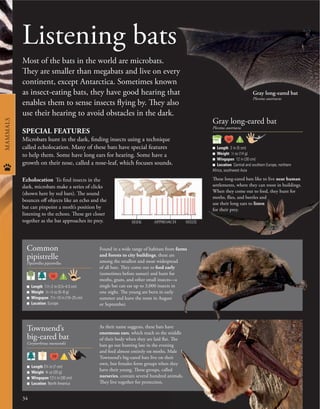
group includes parakeets, macaws, lorikeets, cockatoos,
cockatiels, and budgerigars. Many are popular as pets.
Versatile bill A parrot’s bill can
move far more than you might think.
This is because there is a highly
flexible hinge joining the bird’s upper
bill to its skull. Parrots also use their
strong, hooked upper bill like an extra
foot, to help them grip the branches
as they clamber through the trees.
SCARLET MACAW
■ Key features: Hooked bill, large head,
and short neck. Strong feet with sharp
claws and two toes pointing
forward and two pointing
backward for a firm grip.
■ Size: Smallest are the
pygmy parrots (genus:
Micropsitta), which are
about 3 in (8 cm) long.
Largest is the Hyacinth
macaw at 3¼ ft (1 m) long.
FACTFILE
BIRDS
CONSERVATION
At least a quarter of all parrot species are
under threat of extinction. The two main
reasons for the decline in the number of
parrots living in the wild are loss of their
home, especially the tropical rain forests,
and being caught by trappers, who capture
the parrots for selling on as exotic pets.
FEEDING Parrots have
flexible feet that they use like
hands. They often eat by
grasping food with one foot
and pulling bits off the food
with their sharp, agile bill.
Lower bill (used for
cracking nuts)
Lower jaw hinge
Upper hinge
Upper
bill
Size comparison
145
■ Length 25 in (64 cm)
■ Weight 4½ lb (2 kg)
■ Diet Plant juices, grass,
leaves, seeds, fruit, pollen
■ Location New Zealand
Kakapos cannot fly,
so are vulnerable to
predators. They are extinct
in the wild, but from 1987
to 1992 the few remaining
birds were gathered up and
taken to the safety of three
predator-free islands off
the New Zealand coast.
Kakapo
Strigops habroptila
■ Length 12½ in (32 cm)
■ Weight 3¼ oz (90 g)
■ Diet Seeds, nuts, fruit
■ Location Australia
This is the smallest
cockatoo, but its
beautiful coloring and
large, bright yellow crest
make it a popular pet.
The crest is lowered when
it rests, and sometimes when
it feeds. The underside of the
tail is black for a male bird
and yellow for a female.
Cockatiel
Nymphicus hollandicus
■ Length 12 in (30 cm)
■ Weight 5 oz (150 g)
■ Diet Pollen, nectar, fruit,
seeds, insects
■ Location New Guinea, S.E.
Asia, S.W. Pacific, Australia (including
Tasmania)
This is one of the most
colorful of all parrots. Its
feathers are usually a stunning
mix of vivid colors, although some
birds are duller than others. Lorikeets have
bristles on their tongues to help them to
gather pollen and nectar from flowers.
Rainbow lorikeet
Trichoglossus haematodus
■ Length 16 in (40 cm)
■ Weight 4 oz (125 g)
■ Diet Seeds, nuts, fruit,
flowers, nectar
■ Location W. to E.
Africa, S. and S.E. Asia
This bird can be found
in more parts of the world
than any other parrot. This
is because many released pet
birds are breeding in the
wild in Europe and
in North
America.
Rose-ringed parakeet
Psittacula krameri
■ Length 3¼ ft (1 m)
■ Weight 3¼ lb (1.5 kg)
■ Diet Palm nuts, seeds,
fruit, insects
■ Location C. South America
These are the largest of
all parrots, though half
their length is made up of
their tail! Often described
as gentle giants, these highly
intelligent birds love company and are
usually seen in a group or with their
mates. They stay with the same partner
throughout their long lives.
Hyacinth macaw
Anodorhynchus hyacinthinus
■ Length 7 in (18 cm)
■ Weight 1 oz (25 g)
■ Diet Seeds, grass, leaves
■ Location Australia
Most people know these
friendly birds as pets, but
large flocks of wild
budgerigars are a familiar
sight over the grasslands of
Australia. Wild birds are always
green, with a yellow face and blue tail.
But since budgerigars were first introduced
to Europe in 1840, careful breeding has
produced birds in many different colors.
Budgerigar
Melopsittacus undulatus
■ Length 14 in (35 cm)
■ Weight 12 oz (325 g)
■ Diet Seeds, grass,
leaves, fruit
■ Location Australia
(including Tasmania)
The noisy galah is
the most widespread
and the most
common cockatoo of
all. It gathers in huge
flocks, and can be a
pest to farmers as it will
raid fruits and seeds.
Galah
Eolophus roseicapillus
PARROTS
BIRDS
■ Length 14 in (36 cm)
■ Weight 7–11 oz (200–300 g)
■ Diet Seeds, nuts, fruit, nectar,
pollen, insects
■ Location N. South America
Most of the time this parrot
attracts little attention. But
when it is frightened or
excited, it raises its bright red
neck feathers to form a fan
that frames its face. This makes
the bird look larger and
possibly more scary to
a potential predator.
Red-fan parrot
Deroptyus accipitrinus
45+
15+
50+
50+
20+ 15+
15+
10
MANY COLORS
In captivity, budgerigars
are bred so that they
come in a wide range
of colors: blue, gray,
green, yellow, violet,
and even white.
146
Hummingbirds
These birds beat their wings in a figure-eight
pattern, which gives them a lot of flight control.
They are the only birds able to fly backward and
they can even fly upside down. They also hover,
which is necessary when they use their long bills
to probe flowers and drink the nectar within.
Magenta-throated woodstar
Calliphlox bryantae
My wings
are a blur!
Small hummingbirds flap their wings
about 4,200 times a minute. That’s 70
times a second! A tiny bee hummingbird
flaps its wings even faster, at about
200 times a second during
courtship displays!
BIRDS
u IRIDESCENT FEATHERS are a striking
feature of most male hummingbirds. The feathers
appear to have a metallic sheen. But why? It is
to help the males to attract females. When he is
looking for a female, the male searches for a
perch in the sun, which causes the iridescent
feathers to positively gleam.
DIET Hummingbirds don’t
just feed on nectar. It would
make a very poor diet. They
also catch insects and spiders,
to add valuable protein,
vitamins, and minerals.
HUMMINGBIRDS
. NO HUMMINGBIRD weighs
more than 1 oz (24 g). That is about
the weight of a tablespoon
of sugar. The largest
hummingbird is the
giant hummingbird.
147
■ Length 2–2¼ in (5–6 cm)
■ Weight 1
⁄16 oz (2 g)
■ Location Cuba, Isle of Pines
Famed as the smallest bird
in the world, the male bee
hummingbird is smaller than
the female. Unlike the female,
it also has iridescent feathers
around its head and neck. The
females lay eggs no larger than
peas, in tiny walnut-sized nests.
Bee hummingbird
Mellisuga helenae
3
BIRDS
There are a number of different types of
hummingbirds, but all of them are found
in the Americas. They all have a long,
pointed bill that is designed to probe
into flowers so the bird can drink nectar.
FACTFILE
Woodpeckers
and toucans
These woodland birds all have striking bills—some
huge and brightly colored, others long, thin, and
finely pointed like a dagger. They can also run up
and down the sides of tree trunks with ease,
thanks to their super-grip feet.
Strong skull Woodpecker skulls
are extra thick. This helps to
cushion the brain, which is
important for an animal that
spends hours every day hammering
away at trees with its bill. These
birds also have an unusually long
tongue, with a barbed
or sticky tip for
catching insects.
WOODPECKER
SKULL
■ Number of species: Just
over 400 species, divided
into six groups or families.
■ Key features: Large bills
and strong, parrotlike feet
with two toes pointing
forward and two pointing
backward, for a firm grip.
■ Nest: In holes, safely out
of sight of predators.
FACTFILE
BIRDS
FEEDING Woodpeckers are
born blind and helpless and
rely on their parents for many
months. This youngster takes
a tasty morsel that its father
has carried back to the nest.
, CACTUS NEST
Gila woodpeckers
(Melanerpes uropygialis)
are unusual: they thrive
in deserts, where there are
unlikely to be any trees to
nest in. Instead, they peck
out nest holes in the large
cacti that are common in
the dry, hot areas of the
southwest United States,
where this bird lives.
Size comparison
Toes
148
■ Length 18–20 in (46–51 cm)
■ Weight 10–20 oz (275–550 g)
■ Diet Fruit, insects, reptile and birds’ eggs
■ Location Central and N. South America
Even for a toucan, this bird stands out for its
dazzling array of colors. Keel-billed toucans
do not fly very well, so spend most of their
time hopping along branches in search of
food. Having a long bill means they can
pick fruit that is often beyond the reach
of other birds. Once they have their
prize, they toss their heads back sharply,
open their surprisingly agile jaws wide
and swallow the fruit whole.
Keel-billed toucan
Ramphastos sulfuratus
■ Length 7½–10 in
(19–25 cm)
■ Weight 5
⁄8–1
⁄16 oz
(18–30g)
■ Diet Insects
■ Location Central America
and N. and C. South America
This beautiful bird, with
its shimmering green, red, and
gold feathers, likes to keep a low
profile. It spends most of the day
sitting quietly on a shaded branch,
only darting out occasionally to
spear a passing insect on
its daggerlike bill.
Rufous-tailed jacamar
Galbula ruficauda
■ Length 8 in (20 cm)
■ Weight 1¾ oz (50 kg)
■ Diet Bees and beeswax,
bees’ eggs, ants
■ Location Central and
southern Africa
Honeyguides can sniff out
bees’ nests, their main
source of food, using their
keen sense of smell. Some
African tribes use the bird
to guide them to bees’
nests, so that they can
harvest the honey.
Greater honeyguide
Indicator indicator
WOODPECKERS AND TOUCANS
BIRDS
■ Length 21–23½ in (53–60 cm)
■ Weight 20 oz (550 g)
■ Diet Fruit, insects,
birds’ eggs
■ Location N.E. to
C. South America
This is one of the largest
and most well known of
all toucans. Its spectacular,
brightly colored bill is
not solid, but has a
honeycomblike structure,
making it much lighter
than it appears to be.
Toco toucan
Ramphastos toco
20
■ Length 7½–8½ in
(19–20 cm)
■ Weight 1¾–27
⁄8 oz
(50–80 g)
■ Diet Tree sap, insects
■ Location North and
Central America, Caribbean
The sapsucker gets its
name because it feeds on
the sugary sap that it sucks
out of trees through holes it
drills in the trunk. In spring,
males drum on trees and other
objects to mark their territory.
Yellow-bellied sapsucker
Sphyrapicus varius
?
?
20
■ Length 12½ in (32 cm)
■ Weight 7–11 oz (200–300 g)
■ Diet Fruit, nectar, insects
■ Location Central and East Asia
Barbets use their large,
bristly, pointed bills to
dig out nest holes and to
peck into tree trunks in search
of a meal. This bird’s plump
body, large head, and stubby,
rounded wings make it a poor,
inelegant flyer. It spends quite
a lot of its time bobbing along
the ground.
Great barbet
Megalaima virens
?
?
■ Length 12–16 in (30–33 cm)
■ Weight 6–7 oz (175–200 g)
■ Diet Insects, mainly ants
■ Location Europe, W. Asia
The green woodpecker’s tongue is nearly
twice the length of its bill, with a tip
covered in a sticky liquid to help trap
ants, the bird’s favorite food. Although
green woodpeckers live in woods, where
they peck nest holes in the sides of trees,
they also spend a lot of time on the
ground, in gardens or parks, using their
pointed beaks to dig out any insects that
are crawling through the grass.
Green woodpecker
Picus viridis
10
NOISY
BIRD The
loud “laughing”
cry of the green
woodpecker can be heard
far and wide over woods
and heaths during spring.
149
150
BIRDS
WHY DO BIRDS BUILD NESTS?
Most birds build nests, but a nest is rarely
a permanent home. Birds usually only
start to build a nest when they are ready
to breed. This is because they need a safe,
warm place to lay their eggs, and for their
newly hatched chicks to develop.
Amazing nests
Birds’ nests come in all shapes and sizes, from the tiny
cup-shaped ones of songbirds to the massive platforms
of eagles and the complex communal nests of weaver
birds. All kinds of materials are used to build nests and
some birds spend many weeks constructing them.
AMAZING NESTS
WHITE
TERN
151
BIRDS
NEST INGREDIENTS
Birds use many things for building
their nests, including sticks, mud,
feathers, stones, twigs, grass, and
moss. Long-tailed tits even use sticky
cobwebs to hold their moss nests
together. They then camouflage the
nest with lichen and use feathers
to give it a soft lining.
No nest The white (or angel) tern does
not build a nest. It just sticks its eggs in
the fork of a tree branch, using only a
glob of mucus to hold them in position.
Out of reach Many gulls nest in
colonies high up on the cliff face, away
from possible predators. They build
cup-shaped nests from twigs and plant
materials along the rocky ledges.
Just move in Most
owls are not eager nest
builders. They often
lay their eggs
in holes in tree
trunks. These
openings may
have been
hollowed out
by another
bird, or they
may be
natural.
NEST SHAPES
Some nests are little more than
a hole scraped in the ground and
lined with pebbles. But many are
complex structures, built to last.
. Old World orioles
weave sacklike nests
that they hang from
the branches of trees.
They use almost any
materials, including
bits of string.
, Weaver birds
weave nests
from shreds of
leaves and grass.
A long entrance
tunnel is woven into
the side or base.
, Many small
birds make open,
cup-shaped nests.
SAFETY IN NUMBERS
Southern masked weavers like
to nest in groups. Colonies of
up to 100 nests, woven from
strips of grass, are seen on the
African savanna in spring.
Family pile Storks build huge nests by
piling up sticks, often adding more sticks
to the same nest year after year. They
like to be up high, in tall trees or
on the top of
buildings or
chimneys.
Perching birds
More than half of all the bird species in the
world belong to a group known as perching
birds, or passerines. The feet of perching birds
have three toes pointing forward and one
backward. This allows them to get a firm grip
on even the thinnest and most flexible branches.
GOOD SINGERS
Another special thing about
perching birds is their ability to
sing. They are often referred to as
songbirds, and many of them have
wonderful voices. Each species has a
particular song, which may be made
up of a wide range of notes.
The best singers include
the song thrush and
the nightingale.
My feet don’t lose
their grip even when
I go to sleep.
When a bird lands, the weight of its body
presses down on its toes. This makes the
toes lock automatically around the
branch in a tight grip.
BIRDS
■ Length 5½ in (14 cm)
■ Diet Insects, fruit, seeds
■ Location Europe
This tit is seen everywhere
from woodlands to town
gardens. Bold and bossy,
the great tit does not
hesitate to drive smaller tits
away from garden bird tables.
Its distinctive two-note “teacher,
teacher” call is easy to recognize.
Great tit
Parus major
■ Number of species:
about 5,500.
■ Key features:
specialized perching
feet, with three toes
pointing forward and
one back. Most
perching birds have
distinctive songs.
■ Size: The crows and
ravens are the largest,
with lengths of up to
25½ in (65 cm). The
short-tailed pygmy
tyrant is the smallest
perching bird at just
3 in (7 cm) in length.
FACTFILE
Perching bird foot
Size comparison
15
153
BIRDS
■ Length 5½ in (14 cm)
■ Diet Insects, worms, berries
■ Location Europe, N. Africa, N.W. Asia
The “redbreast” is popular with
gardeners in the UK for its
cheerful, bubbling song and
its appetite for harmful insect
pests. Elsewhere in its range, the
European robin is less inclined
to associate with people. For all
their charm, robins can be very
fierce in defense of their territory.
European robin
Erithacus rubecula
■ Length 9 in (23 cm)
■ Diet Berries, insects, worms,
slugs, snails
■ Location Europe, North
Africa, N.W. Asia, Australia,
New Zealand
Broken snail shells by
a flat stone are a sign
that a thrush has been
eating there. Numbers
of thrushes have fallen
dramatically in Europe
due to loss of their
farmland habitat.
Song thrush
Turdus philomelos
■ Length 7–8 in (18–21 cm)
■ Diet Small fishes, crustaceans, mollusks, larvae
■ Location Europe, N. Africa, N. Asia
The dipper is found by fast-running streams
and rivers. It swims well, and can walk along
riverbeds completely submerged while it
searches for food. When the dipper is not in
the water, it perches on rocks by the riverbank,
constantly bobbing its
body up and down.
This dipping
action is how the
bird got its name.
White-throated dipper
Cinclus cinclus
Woodpecker finch
Camarhynchus pallidus
■ Length Not recorded
■ Diet Insect larvae
■ Location Galápagos Islands
This finch is a rarity
among animals because
it uses a tool to catch
food. The bird holds
a twig or cactus
spine in its beak
and probes in tree
bark with the
tool to lever
out grubs.
■ Length 3½ in (9 cm)
■ Diet Insects and spiders
■ Location Europe, N. America, N. Africa, Asia
This is a very small bird with a very loud
voice. Wrens usually live in dense hedges,
and can be heard
before they are
seen. In the
breeding season,
the male builds
several nests for
the female to
choose from.
Winter wren
Troglodytes troglodytes
Red-backed fairy-wren
Malurus melanocephalus
■ Length 4–5 in (10–13 cm)
■ Diet Insects, fruit, seeds
■ Location N. and E. Australia
There are several different species of
fairy-wren in Australia and Papua New
Guinea. The red-backed wren, like all
its fairy-wren relatives, has a long tail
that it carries cocked upright. This
wren builds its nests in dense
undergrowth or among tall
grasses. It is sometimes
a garden visitor.
u SPLASH OF RED
The vividly colored red-
backed wren is the smallest
of all the fairy-wrens.
10
? 17
17 7
?
154
BIRDS
■ Length 14 in (35 cm)
■ Diet Fruit
■ Location Papua New Guinea
There are many species of bird of paradise.
The male birds usually have spectacular
flowing plumes, which they show off in
courtship rituals. Males of the type of bird of
paradise shown here gather together to put on
a mass display
in front of
the females.
Raggiana bird of paradise
Paradisaea raggiana
, FLOWERS
provide the
Japanese
white-eye
with nectar
and pollen.
Northern house martin
Delichon urbicum
■ Length 5 in (12.5 cm)
■ Diet Flying insects
■ Location Europe, Africa
(south of Sahara) and S.E. Asia
House martins like to be close to people.
These birds nearly always use buildings as
nesting sites. They stick their mud nests under
the eaves of houses, in barns, and even under
road bridges. About the only time a house
martin comes down to the ground is when
it is collecting mud for a nest. For most of
its life, a martin stays in the air, wheeling
and swooping in pursuit of flying insects.
■ Length 6½ in (17 cm)
■ Diet Seeds (from pine cones)
■ Location North America,
Europe, Asia
The crossbill’s
unusual crossed-
over beak
develops
gradually,
and is not
seen in young birds. This
beak is the perfect shape for breaking
the seeds off pine cones.
Red crossbill
Loxia curvirostra
■ Length 4 in (10.5 cm)
■ Diet Invertebrates, fruit, berries, nectar
■ Location S. and S.E. Asia, Hawaii
White feathers ring this bird’s eyes
like a pair of spectacles. Japanese
white-eyes are very common
in Asia. They gather in flocks
in gardens and woodlands.
Their varied diet changes
from season to season,
according to what food
is available.
Japanese white-eye
Zosterops japonicus
■ Length 2½ in (6.5 cm)
■ Diet Insects
■ Location N. and Central
South America
This is one of the
smallest birds in the world. Its tail is not much
more than a tiny stub. The short-tailed pygmy
tyrant belongs to a group of birds called tyrant
flycatchers. These birds are highly skilled at
catching their insect prey in midair. They are
called “tyrants” because, despite their generally
small size, they are very aggressive.
■ Length 7 in (18 cm)
■ Diet Insects, seeds
■ Location Europe
The banks of rivers and streams, and the edges
of ponds are good places to see a pied wagtail.
This bird loves to be near water. A wagtail
darts about in short, fast
runs, flicking its tail, as
it hunts for the insects
that are the main
part of its diet.
White wagtail
Motacilla alba
. PAIRED UP
A breeding pair of ravens
can be fierce when they are
defending their territory.
The couple may attack
intruders or chase
them over long
distances.
7 12 14
?
12
?
Short-tailed pygmy tyrant
Myiornis ecaudatus
■ Length 4 in (10 cm)
■ Diet Insects
■ Location S. Europe, Africa,
Asia, Australia
This warbler is hard
to see because its
color blends in with
the grasslands and
scrublands where
it lives. In flight,
it makes a
monotonous
two-note call.
Zitting cisticola
Cisticola juncidis
■ Length 5–6 in (13–15 cm)
■ Diet Flying insects
■ Location Alaska, Mexico,
South America
Buildings as well as cliffs are
good nesting sites for cliff
swallows. The birds plaster
their cone-shaped mud
nests on to vertical walls.
These birds migrate,
spending spring and
summer in the north
and going south for
the winter.
Cliff swallow
Petrochelidon pyrrhonota
. COLONIES
Hundreds, or
even thousands
of cliff swallows
may nest together
at one site.
■ Length 26½ in (65 cm)
■ Diet Fruit, nuts, eggs, carrion, small animals
■ Location North and Central America, Europe, Asia,
North Africa
The raven is one of the largest perching birds.
It is noted for its aerobatic flight, during
which it may twist and turn at high speed.
Often, a raven rolls right over in midair and
flies upside down. The bird
makes various calls,
including a
hoarse croak.
Common raven
Corvus corax
■ Length 8 in (20 cm)
■ Diet Berries, insects, nectar
■ Location Asia; introduced into Australia and US
Bright plumage and an attractive
song have made the red-
whiskered bulbul popular
as a cage-bird. These birds
are trapped in large
numbers. They are
still common but
may soon need
protection.
Red-whiskered bulbul
Pycnonotus jocosus
d COZY NEST
Golden whistlers
bind their nests with
spiders’ webs and line
them with soft grass.
■ Length 5½–6 in (14–16 cm)
■ Diet Seeds, berries, invertebrates
■ Location North and Central America,
Europe, Asia, North Africa.
Common in woodland, dark-eyed juncos
flock together during the fall and winter,
when the breeding season is over. The male
junco sings at most times of the year.
Dark-eyed junco
Junco hyemalis
10 ? 10
22 11
■ Length 6–7 in (16–18 cm)
■ Diet Insects, berries
■ Location Indonesia, S. and E. Australia, Tasmania, Fiji
As its name suggests, the golden whistler is a
fine songster. It has a loud, tuneful voice and
a wide range of notes. Golden whistlers have
particularly strong feet for gripping and a
stout beak.
Australian golden whistler
Pachycephala pectoralis
15
BIRDS
■ Length 6–10½ in (15–27 cm)
■ Diet Fruit, berries
■ Location Laos
This bulbul really stands out from other
bulbuls because of the bare patches of skin
around each eye. It lives on the sparsely
covered limestone hills of Laos where
it can sometimes be seen
perching on rocks.
It forages in pairs
when looking
for food.
Bare-faced bulbul
Pycnonotus hualon
11
Starlings
Starlings are a familiar sight in many countries throughout the
world, roosting and flying in huge, noisy flocks. They nest in
man-made or natural cavities, perhaps finding a space under roof
tiles or a hole in a tree, and have proved immensely successful.
FROM SMALL BEGINNINGS
Sixty starlings were deliberately released in New York
City in 1890 by a man who aimed to release into the
Americas all the birds named by Shakespeare. By the
mid-1950s, starling numbers in North America had
reached 50 million, and today there are thought to
be some 200 million starlings.
u JUVENILE STARLING Young
birds have a brown plumage, and no
iridescent feathers.
As the bird takes off, its feet are drawn
up toward the body.
By flapping its wings up and down,
the starling stays in the air.
■ Length 8½ in (21 cm)
■ Weight 2–31
⁄4 oz (60–96 g)
■ Diet Insects, earthworms, seeds, fruit
■ Location Worldwide except polar regions
Starlings are stocky birds, with
speckled feathers that shimmer
with iridescent purple and
green. Their bills turn
yellow in the breeding
season. They are
noisy birds, and
often mimic the
calls of other
birds, and even
frogs or cats.
European starling
Sturnus vulgaris
15
Birds fly in one of two ways:
they either flap their wings
continually, or they are able
to glide on air currents,
flapping their wings
occasionally. Starlings
are flappers, following
straight flight lines
and beating their
wings rapidly
to stay aloft.
156
BIRDS
157
Murmuration Starlings gather in large
flocks, and occasionally more than a
million birds will gather. This is known
as a murmuration and it will swoop
and soar as one, each bird following its
neighbor. Flocks as big as these make
strange dark shapes in the sky.
STARLINGS
BIRDS
A world of eggs
BIRDS
Common kingfisher
Alcedo atthis
Green broadbill
Calyptomena viridis
Tawny owl
Strix aluco
Ringed plover
Charadrius hiaticula
Black woodpecker
Dryocopus martius
Song thrush
Turdus philomlos
Eurasian nightjar
Caprimulgus europaeus
Common
oystercatcher
Haematopus ostralegus
Madagascar bulbul
Hypsipetes madagascariensis
Gray butcherbird
Cracticus torquatus
Rose-ringed
parakeet
Psittacula krameri
Rock wren
Salpinctes obsoletus
Emu
Dromaius novaehollandiae
Black-winged
cuckoo-shrike
Coracina melaschistos
Egyptian vulture
Neophron percnopterus
Masked finfoot
Heliopais personatus
Herring gull
Larus argentatus
No two bird eggs are exactly alike; they vary greatly in
size, shape, color, and texture, while the size of the egg
doesn’t always relate directly to the size of the bird. An egg
laid by an ostrich is the world’s largest bird’s egg, but it is
one of the smallest eggs in relation to the bird’s body size.
Southern
cassowary
Casuarius casuarius
158
A WORLD OF EGGS
BIRDS
4,700 bee
hummingbird
eggs could fit
inside one
ostrich egg!
Common quail
Coturnix coturnix
Chimango caracara
Milvago chimango
Willow
ptarmigan
Lagopus lagopus
Eurasian curlew
Numenius arquata
Guillemot
Uria aalge
Golden eagle
Aquila chrysaetos
Ostrich
Struthio camelus
Ostrich eggs are cream in
color, with distinctive
pitted surfaces. The
eggshell is porcelain-
like in texture and
usually smooth
to touch.
Northern
lapwing
Vanellus
vanellus
Peregrine falcon
Falco peregrinus
Domestic chicken
Gallus domesticus
Great-crested grebe
Podiceps cristatus
Graylag goose
Anser anser
Bee hummingbird
Mellisuga helenae
6 in
(15 cm)
½ in
(1 cm)
Great
snipe
Gallinago
media
American robin
Turdus migratorius
Silktail
Lamprolia
victoriae
Cetti’s warbler
Cettia cetti
Dunnock
Prunella
modularis
Green wood-hoopoe
Phoeniculus purpureus
Richard’s pipit
Anthus richardi
Gray catbird
Dumetella
carolinensis
159
REPTILES
REPTILES
Definition: A reptile is a
cold-blooded, usually egg-
laying vertebrate. They are
covered with scales or horny
plates and they breathe
through lungs.
REPTILES
162
What is a REPTILE?
Reptiles once dominated Earth. Fierce tyrannosaurs and huge Diplodocus
stalked the land, until their sudden extinction 65 million years ago.
Although many dinosaurs were wiped out, other reptiles
survived, and these creep around nearly every continent today.
WHAT MAKES THEM
DIFFERENT?
Like mammals and birds, reptiles are
vertebrates (they have a backbone)
and breathe air. However, unlike
mammals, they are cold-blooded,
they have scaly skin, and most
species reproduce by laying eggs.
FACTFILE
■ Tortoises and
turtles: This group of
reptiles had ancestors
that swam alongside
the dinosaurs. They are
the only reptiles with a
hard, protective shell.
There are five main groups
of reptiles: lizards, snakes,
tortoises and turtles,
crocodilians, and the tuatara.
■ Crocodilians:
Crocodiles, caiman,
and alligators make
up this group. Most
are freshwater
inhabitants, but a few
venture into the sea.
■ Lizards: This group
is highly varied and very
common, especially in
warm countries. Many
lizards can camouflage
their skin to match their
surroundings.
■ Tuataras: These
animals can only be
found on two small
islands off the coast
of New Zealand. They
differ from lizards in
lots of subtle ways.
■ Snakes: Snake senses
are sophisticated—they
can find their prey with
ease, and they make
stealthy and cunning
predators. They
don’t tend to
chew their food,
preferring to
swallow it whole.
u SUPPLE SPINES All reptiles
have backbones, and some have
extremely long and flexible
ones, like this emerald tree boa.
Scaly skin
It’s not furry.
It’s not slimy.
It’s not feathery.
It must be a
reptile!
REPTILES
WHAT IS A REPTILE?
163
, DINO
COUSIN
“Dinosaur” means
“terrible lizard”
in Latin. Today’s
reptiles are close
relatives of the
dinosaurs. u LIZARD SKIN u SNAKE SKIN u CROCODILE SKIN
I’M FEELING COLD
Reptiles are often called “cold-blooded.”
This doesn’t mean that their blood is
cold. Their temperature depends on their
surroundings. If the temperature doesn’t
suit them, some reptiles can hibernate
until the temperatures are right again.
, BIRTH DAY
A baby tortoise
emerges from
its egg.
SUNBATHING If a reptile
feels its blood is too cold, it will
sunbathe to warm up.
REPTILES
EGG BEGINNINGS
Most reptiles reproduce
by laying eggs. Females
lay their eggs in decayed
wood, a nest of leaves and
mud, or elsewhere on land.
Most reptiles do not sit
on their eggs to incubate
them but some snakes do.
SCALY SKIN
Reptiles have dry scaly or
scalelike skin. The scales
are made of keratin, the
same material that makes
hair and feathers. All
reptiles shed their skin
as they grow. Snakes cast
theirs off in one piece.
Eye sockets
Curved back
Long tail
STURDY SKELETON
The different groups of reptile have very different skeletons.
This is the skeleton of a chameleon. Reptile skeletons are
sturdy, making them suitable for life on land.
Long toes
Chameleon eggs
Ribs attached to
backbone
LOOK INTO MY EYES…
Another unique characteristic
of reptiles is their eyes. The shape
of a reptile’s pupil indicates whether
the animal is active at night or
during the day. Most reptiles
active at night have slitlike
pupils that can close tightly
in bright light. Reptiles active
in daytime have round pupils.
Round pupil
Slitlike pupil
Reptile birthday
These turtles, like most reptiles, have to fend for
themselves after they are born. There is safety in
numbers so they all hatch at the same time, and
usually during the night. Even so, it is estimated that
just 1 in 1,000 baby turtles makes it to adulthood.
BORN FROM EGGS
Most reptiles, including those that
live mainly in water, reproduce by
laying eggs on land. Reptile eggs
often have a leathery shell that
allows water and oxygen to pass
through to the developing animal
inside. Although many species of
reptile lay their eggs, then leave,
some reptiles, including the Nile
crocodile, make attentive parents.
HEAD FOR WATER The
eggs hatch and hundreds of
baby turtles emerge from nests
in the sand. Instinctively, they
head directly for the water,
where they will have the best
chance of survival. The babies
can swim straight away.
DAY 1
Mom prepares a nest out of sand, mud, and weeds
at the water’s edge. She lays 20–60 eggs in the
nest. They are protected by a tough, leathery shell.
DAY 5
Even though the mother crocodile stays close
by and defends the nest, when she nips off for a
cooling dip, the nest is often raided by predators.
REPTILES
164
REPTILE BIRTHDAY
I’ve got to get to
the sea. I’ve got to
get to the sea...
The mother turtle is long gone by the
time these turtles hatch. They seem to
know they have to make for the waves,
and fast! Unfortunately, they have to
run a gauntlet of predators—from
gulls to sharks—as they grow.
165
TURTLE CONSERVATION
Sadly, the number of sea turtles has rapidly
declined—for man-made reasons. These
include disturbance of their nest sites due
to beach tourism, collection of their eggs,
pollution of the seas, and getting caught in
fishing nets. To address the problem, beach
reserves with assisted breeding programs
have been set up and turtle-friendly fishing
nets have been introduced. Everyone is
keeping their fingers crossed for these
amazing creatures.
DAY 90
The eggs hatch. A baby croc uses its egg tooth to
break the shell. Alerted by tiny grunts and chirps,
the mother helps her babies out of the nest.
DAY 90
The mother carries the babies to the water, where
she will continue to watch and protect them for
up to two years.
REPTILES
166
Tortoises and turtles
Tortoises and turtles are among the longest-living
animals on Earth. But they don’t need to worry about
losing their teeth as they get older, because they haven’t
got any. Instead, they use their sharp, horny beaks to
cut and chew up their food.
SKELETON
Tortoises and turtles have an unusual skeleton. Their ribs
and some of their vertebrae are fused to their upper shell.
This means they cannot move their ribs to help pump
air in and out of their lungs. Instead, they use muscles
at the tops of their legs to do the pumping.
Outer horny layer
I AM 150 YEARS OLD!
The Galápagos tortoise
(Chelonoides elephantopus)
is the world’s biggest at 4 ft
(1.2 m) long. They can live to
be more than 170 years old.
Vertebra
Inner bony layer
Plastron (lower shell)
Shoulder girdle
Pelvic girdle
u DO NOT DISTURB Tortoises and turtles
living in cooler parts of the world often hibernate
in winter, to avoid the cold and shortage of food.
FACTFILE
■ Number of species: 293
■ Key features: Tortoises live on dry
land and have round, stumpy legs. Turtles
spend most of their time in water and
have flipperlike limbs. Freshwater turtles
are often called terrapins. They all have
protective shells.
Biggest turtle Biggest tortoise
Smallest turtle Smallest tortoise
REPTILES
Rib
Carapace (upper shell)
Size comparison
TORTOISES AND TURTLES
167
■ Height 6–14 in (15–36 cm)
■ Diet Cacti, grass, some insects
■ Location S.W. US, N.W. Mexico
On exceptionally hot days, this tortoise will
burrow into the sand, using its shovel-shaped
feet, to escape the baking desert heat. Males
may fight each other for a mate during the
breeding season.
Desert tortoise
Gopherus agassizii
■ Height Up to 11 in (28 cm)
■ Diet Grass, leaves, fruit
■ Location India, Pakistan, Sri Lanka
Its knobby, high-domed shell, covered with
star-shaped markings, make this tortoise one
of the easiest to recognize. It is a thirsty
creature and is usually only very active during
the wet monsoon season. When it is dry, it
tends to venture out
just in the early
morning or late
afternoon.
Indian starred tortoise
Geochelone elegans
■ Height 6–8 in (15–20 cm)
■ Diet Leaves, flowers, fruit
■ Location S.E. Europe,
Mediterranean islands
This tortoise was once a
popular pet, but its sale
is now restricted by law.
It usually hibernates
for several months in
winter, especially if it is
very cold, and spends
much of summer
resting in the shade.
Hermann’s tortoise
Testudo hermanni
■ Length 31
⁄4–4 ft (1–1.2 m)
■ Diet Seaweed and algae; the young also eat jellyfish,
mollusks, snails, worms, and sponges
■ Location Worldwide
Having been hunted for centuries for their
meat and eggs, green turtles are now legally
protected. Special
breeding beaches
have been set up
by conservationists
to help save them
from extinction.
Green sea turtle
Chelonia mydas
■ Length 16–32 in (40–80 cm)
■ Diet Fishes
■ Location S.E. US
This is the world’s largest freshwater turtle.
Most of its day is spent with its scissor-sharp
jaws wide open, as it lures fishes toward them
by wiggling a small, pink, wormlike tube on
the floor of its mouth. Its hooked “beak”
delivers a deadly bite.
Alligator snapping turtle
Macrochelys temminckii
■ Length 41
⁄4–6 ft (1.3–1.8 m)
■ Diet Jellyfish
■ Location Worldwide
Leatherbacks are the biggest turtles. Some
weigh as much as 1,800 lb (800 kg). They also
swim great distances. Individuals have been
known to cross the Atlantic. Unlike other
turtles, they have a leathery outer shell.
Leatherback sea turtle
Dermochelys coriacea
■ Length 8–10 in (20–25 cm)
■ Diet Fishes, crabs, lobsters, tadpoles
■ Location E. and S. Australia
This turtle uses its exceptionally long neck to
“snorkel,” while it hunts for food in rivers and
streams. A long neck is also very handy for
lunging at and grasping prey. The neck and
head together are often
longer than the shell.
Common
snake-necked turtle
Chelodina longicollis
Loggerhead sea turtle
Caretta caretta
■ Length 28–39 in (70–100 cm)
■ Diet Shellfish, crabs, lobsters
■ Location Worldwide
Loggerheads get their name from their
exceptionally big heads.They also have
large, powerful jaws, that can easily
crunch their way through any
passing shellfish, crab, or
lobster. These turtles only breed
every two years at the most and
are becoming rare. Many
of their breeding areas are
now protected.
50+
100 25+
30+
20+
30+
30+ 50
REPTILES
168
Snakes
Snakes are highly evolved and deadly predators.
They slither along on smooth bellies, hunting
by stealth, eating all types
of animal, from ants to
alligators. The only way to
eat their prey is to swallow
it whole, including the
horns, hooves, and hair!
REPTILES
New skin
Cast-off skin
Forked tongue
Heat pits
, SENSES Snakes
have poor eyesight
and hearing. They
rely instead on their
tongue, which they
use to “taste” the air
or touch the ground
to follow a chemical
scent left by their
prey, and face pits
that detect heat.
Anatomy
The skeleton of a snake
is very simple. It consists
of a skull, and hundreds
of ribs set along a long,
flexible backbone. The
internal organs are mostly
long and thin and are
arranged to fit along the
length of the snake. The
jaws are loosely hinged
to help swallow food.
Skull
u SKIN Snakes shed their skin
4–8 times a year. Shedding starts
around the mouth and nose. Once
the skin is loosened the snake rubs
against objects that help grip the
skin as the snake pulls itself out.
FACTFILE
■ Key features: Snakes can move in
three ways. Undulation is a side-to-side
movement where the snake uses rough
ground to push itself along. In tunnels a
snake will concertina its coils against the
walls to thrust itself forward. A snake also
uses its belly scales to pull itself along.
Undulation
Concertina
Straight line
Snake movement
Rib Backbone
SNAKES
169
■ Length 30–39 in (75–100 cm)
■ Location Northern Australia
This small python hides
in caves and crevices
where it waits to
ambush lizards, birds,
and small mammals.
It will even eat bats.
If threatened it will
strike and bite an attacker, but it is not
poisonous. Children’s pythons are reddish
brown in color with darker blotches.
They lay their eggs in hollow trees or caves.
Children’s python
Antaresia childreni
CONSTRICTORS
Constrictors are snakes that kill by wrapping their coils
around their prey and squeezing hard so that the blood
cannot flow around the victim’s body. This stops the heart
and prevents oxygen from reaching the organs. When the
animal stops struggling, the snake swallows it head first.
Boas and pythons are typical constrictor snakes.
■ Length 20–33 ft (6–10 m)
■ Location South America
The green anaconda is the world’s
heaviest snake, and can weigh up
to 550 lb (250 kg). Green anacondas
spend most of their time submerged
in water, hiding in the plants along
the edges of rivers and lakes.They
are capable of killing capybaras
and small deer and have
even been known to
attack and kill fully
grown caimans.
Green anaconda
Eunectes murinus
d BIG DINNER
This anaconda has killed
a caiman. It will not need
to eat anything else for
several months.
REPTILES
FACTFILE
10
■ Length 6 ft (1.8 m)
■ Location Australasia
The olive sea snake is found
on coral reefs in Australia
and New Guinea. Although
venomous, it only attacks
if it is provoked. Its body is
purplish brown with a light
brown underside. These
snakes are regarded as true
sea snakes because they
give birth to live young
in the water.
Olive sea snake
Aipysurus laevis
25
10
. FANGS Most venomous snakes
have two hollow teeth that they use to
inject their prey with venom. Venom
kills or paralyzes the animal, making
it easier for the snake to swallow.
Sea snakes have flattened, paddle-shaped tails and spend most of their lives at sea. Because they have lungs rather
than gills they visit the surface regularly to breathe. Sea kraits are not sea snakes; they lay their eggs on land.
■ Height 31
⁄4–5 ft (1–1.5m)
■ Location Southeast Asia
Sea kraits live in coastal
waters where they hunt
fish and eels. They are
most active at night.
Unlike sea snakes, kraits
lay eggs on land and leave
them to hatch. Sea kraits
have special scales on
their belly that help
them crawl on land.
Yellow-lipped sea krait
Laticauda colubrina
15
170
■ Length 5–61
⁄2 ft (1.5–2 m)
■ Location N. South America
The emerald tree boa is perfectly adapted
for life in the treetops. Its vivid color
blends in with the rain-forest foliage, while
its muscular body firmly grips tree trunks
and branches. These boas coil themselves
around a branch with their heads hanging
down, ready to strike a bird or mammal.
The prey is speared by the snake’s fangs
before being crushed to death. Between
three and 15 orange-red live young are born
each season. They turn green after one year.
Emerald tree boa
Corallus caninus
REPTILES
20
171
u DISGUISE The patterns
and colors of the boa
constrictor’s skin help to break
up the snake’s outline so that it
blends into the background.
■ Length 61
⁄2–13 ft (2–4 m)
■ Location Australia
Carpet pythons are found across much of
Australia and in many different habitats. All
species of carpet snakes have bold markings on
a lighter-colored background. They are active
day and night. Female carpet pythons lay up
to 50 eggs in hollow trees or rotting vegetation
and will incubate them until they hatch.
Carpet python
Morelia spilota
■ Length 31
⁄2–13 ft (1–4 m)
■ Location Central and South America
The common boa is a large snake with
a narrow head and a
pointed snout. Boas
are good climbers and able
swimmers, but are also happy
to hunt on the ground. They
detect prey by scent rather
than by heat. Boa constrictors
have distinctive dark markings along
their backs against a pink, gray, or gold
background. Female boas produce live young.
Common boa constrictor
Boa constrictor
■ Length 14–32 in (35–80 cm)
■ Location S.W. Canada, W. US
This snake gets its common name
from the rubbery feel of its skin.
Both its head and tail are blunt,
making them hard to tell apart.
When threatened, the snake coils
itself up and raises its tail to make
attackers think it is its head. Rubber
boas live under ground, hunting for
small animals in burrows and tree
holes. These snakes often hibernate
for long periods in winter.
Rubber boa
Charina bottae
■ Length 20–33 ft (6–10 m)
■ Location Southeast Asia
The reticulated python is one of the longest
snakes in the world and weighs up to 300 lb
(136 kg). These snakes have irregular
diamond-shaped markings in a variety of
colors. They are widely hunted for their skin,
which has led to them becoming increasingly
rare in the wild.
Reticulated python
Python reticulatus
■ Length 24–43 in (60–110 cm)
■ Location S.W. US, N.W. Mexico
The rosy boa is a burrowing snake and lives
mostly beneath rocks and in crevices, where
it forages for food. Rosy boas are
actually cream, gray, or buff in
color with brown, orange, or
black stripes running along the
lengths of their bodies. They
are very slow movers and
have to ambush
their prey.
Rosy boa
Lichanura trivirgata
■ Length 20–30 ft (6–9 m)
■ Location Central and Southern Africa
African rock pythons are more
aggressive than other pythons and
will readily bite if harassed. They
live on grasslands and savannas,
often close to water. Farmers like
them because they eat cane rats
in the fields, but they are less
welcome on livestock farms,
since they will also take larger
animals such as gazelles,
goats, and even crocodiles.
African rock python
Python sebae
d NOTHING LEFT
Every part of this gazelle
will be eaten by a rock
python, even though it
may take a whole year
for it to be digested.
30
30
30
20
30
REPTILES
30
172
FANG-TASTIC SNAKES!
The majority of snakes do not kill by constriction. Instead, they use
(often venomous) fangs to grab and kill prey. Most are harmless to
humans but there is a small minority that add a LOT of “bite” to
their bite! One strike from a taipan, for example, contains enough
venom to kill 100 people. There are three different fang positions:
■ Length 1¼–6½ ft (0.4–2 m)
■ Diet Insects, frogs, small rodents, other snakes
■ Location North America, Central America,
N. South America
These colorful snakes
are fairly common
within their range, but
rarely seen since they are secretive. They are
usually found near forest edges, but can also
be found in open woodlands, and grasslands,
near streams and rivers, on rocky hillsides, and
in suburban areas and farmlands—in other
words, just about anywhere.
Milksnake
Lampropeltis triangulum
■ Length 4–6½ ft (1.2–2 m)
■ Diet Frogs, fishes
■ Location Europe to C. Asia,
N.W. Africa
These non-
venomous snakes
often take to the
water and are
excellent swimmers,
feeding on frogs and
fishes. When they feel
themselves to be in extreme danger, they
“play dead”—a good surprise tactic.
Grass snake
Natrix natrix
FATAL STRIKE This
rattlesnake hunts by
ambushing its victims,
striking with venomous fangs
before devouring its stunned,
or dead, prey.
REPTILES
PRIMITIVE SNAKE
Primitive snakes have a
heavy skull and few teeth.
Blind snakes, which feed
only on small prey such as
insects and their larvae,
are primitive snakes.
■ Length 6½ ft (2 m)
■ Diet Small mammals, birds, and lizards
■ Location S. US, N. Mexico
This is North America’s most dangerous snake.
Its “rattle” is a horny section at the end of its
tail, which it vibrates when threatened. It is
a deadly predator that stalks its prey, strikes,
then swallows.
Western diamondback
rattlesnake
Crotalus atrox
Fixed, hollow fang
Short, heavy jaw
Fang at rear, below eye
REAR-FANGED SNAKE
Rear-fanged snakes’ fangs are
grooved, not hollow, and
their venom is usually
weaker than front-fanged
snakes. It is more to aid the
digestive process than to kill.
FRONT-FANGED SNAKE
The most familiar venomous
snakes, such as rattlesnakes,
are front-fanged. Their venom
is potent and their fang
position enables venom delivery
during a strike or quick bite.
30
?
25
COLUBRIDS
173
■ Length 3–4 ft (1–2 m)
■ Diet Small vertebrates
■ Location South and S.E. Asia
Technically a glider rather than
a flier, this snake flattens its
body to twice the normal
width to minimize air
resistance. It reaches its takeoff
point by crawling up a tree,
gripping the bark with its scales.
The flying snake is considered
harmless because its venom is
not dangerous to humans.
Golden flying snake
Chrysopelea ornata
■ Length 3¼–6 ft (1–1.8 m)
■ Diet Small rodents
■ Location C. and S.E. US
This eye-catching
snake is not
venomous, but it
may strike to bite
if threatened. It also
vibrates its tail
and excretes a foul-
smelling musk to deter
intruders. It is largely
nocturnal, but may emerge
in daytime in cooler weather.
Corn snake
Pantherophis guttatus
Taipan
Oxyuranus scutellatus
■ Length 8¼–11 ft (2.5–3.5 m)
■ Diet Small mammals and birds
■ Location E. and Southern Africa
This is one of the most venomous snakes, and
probably the fastest moving. In short bursts
it can overtake a running human, making it
an extremely
dangerous
predator.
Black mamba
Dendroaspis polylepis
Puff adder
Bitis arietans
■ Length 6–8 ft (1.8–2.4 m)
■ Diet Small rodents (mice, rabbits) and birds
■ Location Africa
One of the world’s most dangerous snakes,
the puff adder is big, effectively camouflaged,
highly venomous, and aggressive. It strikes
readily when annoyed or frightened, but
usually puffs up or hisses loudly in warning.
This snake has caused many
human deaths.
■ Length 8 ft (2.5 m)
■ Diet Small mammals, lizards, frogs, snakes, fishes
■ Location S.E. Asia
Dramatic colors warn predators that this
is a venomous snake. The mangrove snake
has a slightly flat body with a ridge down
its back. Before striking, it draws back
its head and flares its yellow
lip scales.
Mangrove snake
Boiga dendrophila
■ Length 4–5½ ft (1.2–1.7 m)
■ Diet Rodents
■ Location S. Asia
Well known for emerging out of baskets,
and seeming to dance to a snake-charmer’s
music, this snake is one of the most
dangerous in India—with 10,000 fatalities
each year. Cobras rise up and display their
hoods when they feel threatened to appear
as large as possible.
Indian cobra
Naja naja
10
20
?
10
?
?
?
REPTILES
■ Length 5 ft (1.5 m)
■ Diet Lizards, frogs
■ Location S.E. Asia
It’s easy to tell when this strikingly colored
snake is angry—it flares its neck and flashes
its orange-red scales. Like many other
bronzebacks, it has a venomous bite. It spends
most of its time
hunting lizards
in the
treetops.
Kopstein’s bronzeback
Dendrelaphis kopsteini
?
■ Length 6½–12 ft (2–3.6 m)
■ Diet Mammals, birds, lizards
■ Location S. New Guinea, N. Australia
The most poisonous land snake in the
world, the taipan is the most feared snake
in Australia. However, because an effective
antivenom has been
developed, human
fatalities are now
relatively rare.
174
Lizards
Lizards are a large and varied
group of reptiles that have
successfully adapted to a wide range of
habitats. Most lizards have four legs, a long tail,
scaly skin, and reproduce by laying eggs.
FACTFILE
Dewlap
This pygmy
chameleon is
no bigger than
a fingernail.
■ Key features: Lizards typically have
a tail longer than their body that some
species can shed if attacked. Most have
external ear openings, moveable eyelids,
and a tongue that is notched or forked.
Lizards also have sharp cusped or serrated
teeth running along the edge of the jaw.
REPTILES
d EGG THIEF Lizards such
as the Gila monster often raid
nests for eggs and nestlings.
They crush the egg with their
jaws and let the contents
trickle down their throats.
Fat-storing tail
Beadlike scales
Sharp teeth
d SUNBATHERS Because
lizards are cold blooded they
need to spend time basking
in the sun before they
become fully
active.
Five clawed toes
This lizard has lost
the end of its tail.
It can take up to
two years to grow
a new one.
u CAMOUFLAGE Many lizards have
patterned skin that helps them blend into
their surroundings. This enables them to
hide from predators or stalk their prey.
■ Height 18–24 in (45–60 cm)
■ Location S.W. US, N. Mexico
Gila monsters live in desert
and semi-arid regions, where
they hide under rocks or in burrows. Their
beaded skin is strongly marked with bands
and blotches. Gilas are venomous and
deliver their poison along grooves in the
teeth of the lower jaw. They hunt mainly in
the spring, usually for eggs and baby rabbits.
After a large meal they store fat in the tail.
Gila monster
Heloderma suspectum
Size comparison
LIZARDS
175
LEGLESS LIZARDS
Amphisbaenians are a group of legless lizards that are sometimes mistaken for
worms or snakes. They have a cylindrical body and rings of scales that resemble the
body segments of worms. Adapted to a life underground, amphisbaenians have smooth
heads that are pointed for burrowing and small rudimentary eyes covered with a
transparent scale. The nostrils point backward to prevent them being filled with soil
while tunneling. Most amphisbaenians live in tropical regions, which provide them
with the constantly warm soil temperatures they need to move underground.
■ Length 61
⁄2–81
⁄2 in (16–21 cm)
■ Location South Africa
These tiny lizards live in the deserts of South
Africa. They have unusual square-shaped
scales and a crest of spines along the neck
and tail. If attacked they curl round and
bite their tail to protect their soft belly, just
like an armadillo. They also hide in crevices
and puff themselves up so they cannot be
dislodged. Armadillo lizards bear live young
and sometimes live in colonies of up to
40 individuals.
Armadillo lizard
Cordylus cataphractus
20
■ Length 12–18 in (30–45 cm)
■ Location N. South America, Trinidad
Unlike most amphisbaenians, which are
pinkish brown in color, this species has a
distinctive black and white skin. It spends
most of its life underground but may come
to the surface at night. Worm lizards move
through the soil by pushing their body
segments together like a concertina, which
provides thrust for forward movement.
This species feeds on any small vertebrates
and insects it encounters, crushing them
in its powerful jaws. It will shed its tail
if necessary, but cannot
grow a new one.
Speckled worm
lizard
Amphisbaena fuliginosa
?
Eye
Mouth
■ Length 24–36 in (60–90 cm)
■ Location N. Australia, New Guinea
Australia’s frilled lizard is
a spectacular sight when
provoked. Rising up
on its hind legs, it
unfurls a wide
flap of skin
around its
neck and
hisses loudly.
If this tactic
doesn’t work,
it turns tail
and runs for
the safety of a
tree. It comes
down to forage for
food, eating mainly
insects, spiders, and
other invertebrates.
Frilled lizard
Chlamydosaurus kingii
20
d BIG FRILL The
neck frill of this lizard is
stiffened with cartilage
rods to make it stand
away from the body.
REPTILES
d SKELETON While they may look like
worms from the outside, amphisbaenians
have a skeleton similar to that of a snake.
However, they also have bones that prove
their ancestors had legs. Three Mexican
species still have a pair of front legs.
u EYES AND MOUTH
Amphisbaenians have only limited
vision. The lower jaw is set back to
prevent soil entering while digging.
u SCALES Unlike snakes, the scales
of amphisbaenians do not overlap
and are arranged in rings, making
them look like worm segments.
Chameleons
With their bizarre swiveling eyes and amazing ability
to change color, it’s no surprise that chameleons often
have a special place in folklore. In Madagascar, they
are protected by local superstitions and it is
considered bad luck to kill one.
ALL CHANGE!
Special cells called chromatophores
in the chameleon’s skin contain a
variety of pigments that can be
displayed at the surface of the
cell or hidden. Signals from the
chameleon’s brain tell each skin cell
which colors to show and which to
hide, in order to create an overall
pattern to suit any occasion.
VEILED CHAMELEON
The bony helmet or casque of some chameleons has
several functions, including display and picking up
low frequency sounds, like a satellite dish.
COLORFUL FEELINGS
Males use color mainly to communicate. When
rivals meet, they adopt aggressive postures and
flush a range of colors to intimidate each other.
REPTILES
176
Panther chameleon
Furcifer pardalis
■ Length 16–201
⁄2 in (40–52 cm)
■ Weight 9 oz (250 g)
■ Location Madagascar and Réunion Island,
Indian Ocean
A large and colorful species, panther
chameleons can change color—females do
this only when they are pregnant to signal
they will not mate, but males flush any
combination of red, green, or blue
depending on their mood.
I have a twist
in my tail.
Chameleons have a long, grasping or
“prehensile” tail that can be coiled
tightly around branches to act as a
secure anchor. When not in use
the tail is usually held in
a loose spiral.
5
The prehensile tail
is used to grip
branches.
FANCY FOOTWORK
The five toes on each of the
chameleon’s feet are fused
together in groups of two
and three to form powerful
grippers that provide a secure
hold on narrow branches.
177
CAMOUFLAGE
A chameleon can display colors that match its
background. The disguise is perfected with gentle
swaying that mimics the movement of the tree.
u FOOD
Chameleons eat mainly small
invertebrates such as insects and
spiders, which they catch using
a long, sticky tongue that can be
shot out at lighting speed and
with deadly accuracy.
, NEST
Female chameleons lay clutches of up to 50
rubbery eggs, usually in damp soil. The young
hatch into miniature versions of their parents
and must fend for themselves from day one.
Long, sticky tongue
REPTILES
Each eye moves
independently.
178
Geckos, skinks,
and others
Climbing aces of the lizard world, geckos can get a
grip on anything with their sticky feet. They are common
in the tropics. The slender skinks form the largest group
of lizards. Their pointed heads and flattened bodies
enable them to slip easily into cracks and crevices.
NIGHT VISION
Because the tokay is active at
night it has big goggle eyes to
help it see in the dark. To shut
out bright light, the pupils of
the eyes close to a slit.
■ Length 7–14 in (18–36 cm)
■ Diet Insects, small vertebrates
■ Location Southeast Asia
Big and colorful, the tokay is one of the most
striking geckos. It is popular as a pet, despite
being aggressive and having a fierce bite.
When a tokay is annoyed it opens its mouth
in a gape to show its bright red tongue. Even
other geckos have reason to be wary of the
tokay. It is a cannibal and does not hesitate to
eat geckos smaller than itself. The tokay gets
its name because of its loud “tock-ay” call.
Tokay
Gekko gecko
REPTILES
Pupil closes to a
slit in daylight
d TAKING TO THE
AIR is how Kuhl’s flying gecko
escapes enemies. It leaps from trees
and glides with the help of webbed
feet and skin flaps on its sides.
d STICKY FEET enable geckos
to climb easily, even on smooth surfaces.
Each toe pad is ridged and covered
with tiny hairlike structures that
cling firmly to everything
they touch.
Blue tongue
Sticky toe pad
, TONGUE POKING out,
the blue-tongued skink defies
an enemy. This defensive display,
usually accompanied by loud
hissing noises, often saves the
skink from being attacked.
15
179
■ Length 8–10 in (20–25 cm)
■ Diet Spiders, crickets, worms,
young mice
■ Location South Asia
The tail of the leopard
gecko is almost the
same width as its body.
The gecko uses this plump tail as a store
for spare food, to be drawn on in times of
shortage. Unlike most geckos, this species has
movable eyelids, so it can blink. The leopard
gecko is a popular pet and if kept in the right
environment may live for more than 20 years.
Leopard gecko
Eublepharis macularius
■ Length 4¾–5½ in (12–14 cm)
■ Diet Crickets, spiders
■ Location West southern Africa
The webbing between its toes stops this gecko
from sinking into the sand of the deserts
where it lives. During the day, the gecko
escapes the heat by staying in a tunnel that
it digs out. At night, it emerges to feed. The
gecko’s huge eyes help it
to find prey.
Web-footed gecko
Pachydactylus rangei
■ Length 9–12 in (22–30 cm)
■ Diet Insects, spiders, fruit, pollen, nectar
■ Location North Madagascar
There are several different types of day
gecko and all of them are active during
the daytime. The day gecko is one of
the largest species. Unlike its relatives,
this gecko is fiercely territorial. The
males drive away any other male that
comes near their home ground.
Madagascar day gecko
Phellsuma madagascariensis
■ Length 5–8½ in (12.5–21.5 cm)
■ Diet Insects, spiders
■ Location E. North America
The fine stripes that give this lizard
its name are seen only in females
and young skinks. Males lose
their stripes when they become
adult. Young skinks have bright
blue tails (right). The lizards tend
to live on the ground but can also
be found in trees. They like rotten
logs and tree stumps, which are a
good source of insect food.
Five-lined skink
Plestiodon fasciatus
■ Length 3–4½ ft (90–135 cm)
■ Diet Small vertebrates, snails, eggs, fruit, plants
■ Location South America
This large, strong lizard can sometimes be
aggressive. It is a ground-dweller and digs its
own burrows. The black tegu is a good climber
but prefers to stay on the ground most of the
time. It often lays its eggs in termite mounds
to protect them from predators.
Black tegu
Tupinambis teguixin
■ Length 6–8 in (15–20 cm)
■ Diet Flies, berries
■ Location Southern Africa
Broadley’s flat lizard can squeeze itself into the
narrowest of cracks, because its body and tail are
so flattened. The male (below) is multicolored,
but females and young are brown with pale
stripes. They live near waterfalls, where they
can find swarms of tiny flies to
feed on.
Broadley’s flat lizard
Platysaurus broadleyi
REPTILES
Red markings vary
in individuals
25
10
5
■ Length 6–8½ in (15–21 cm)
■ Diet Insects
■ Location Balearic Islands,
introduced to Majorca
Slim, agile, and shy, Ibiza
wall lizards usually run
away or climb out of
reach extremely quickly
when startled. These lizards often
gather together in large groups. They like
sunning themselves on walls and rocks. Ibiza
wall lizards are also sometimes seen in gardens,
where they forage for food on scrap heaps.
Ibiza wall lizard
Podarcis pityusensis
6
20
?
■ Length 1½–1¾ in (4–4.5 cm)
■ Diet Insects
■ Location Caribbean
Pick up a handful of
leaves from the dry
forest floor of
Union Island
and you may find one of
these tiny geckos hunting for
ants and termites. Although
brightly colored, its patterning
helps it blend into the background in the
dappled shade of the forest.
Union Island gecko
Gonatodes daudini
6
?
180
Iguanas, monitors,
and relatives
Lizards come in all shapes and sizes. The largest lizard
in the world is the Komodo dragon, which hunts
animals such as deer and wild pigs. Others are tiny,
and light enough to glide through the air.
I am the biggest
lizard of all.
Komodo dragons are not the sort of
lizard most humans would want to
bump into. They have thickly folded,
scaly skin, a huge muscular tail, and
powerful jaws that can tear off
large chunks of flesh.
u DEADLY SALIVA Being bitten
by a Komodo dragon can be fatal.
Its saliva contains bacteria that can
kill an animal within 24 hours—if
it doesn’t die from blood loss first!
, FEEDING Komodo
dragons can eat 80 percent
of their body weight at one
feeding. Dragons sometimes
swallow smaller animals
whole, regurgitating the
horns, hooves, and hair
later as pellets.
REPTILES
■ Length 61
⁄2–10 ft (2–3 m)
■ Location Indonesia
Komodo dragons are the top predator on
the islands where they live. Although they
feed mainly on carrion, they will also
ambush live prey. They can run quickly for
short sprints and young dragons can climb
trees. Dragons are usually solitary
creatures.
Komodo dragon
Varanus komodoensis
60
IGUANAS, MONITORS, AND RELATIVES
■ Length 231
⁄2–30 in (60–75 cm)
■ Location Central America
The green basilisk is a bright green lizard that
lives in trees overhanging streams and ponds.
It has three crests along its head, neck, and
tail that it uses when swimming. This lizard
has the unique ability to escape a predator
by running very quickly across the surface
of a pond on its hind feet.
Green basilisk
Basiliscus plumifrons
■ Length 6–7 in (15–18 cm)
■ Location Australia
Thorny devils are small, spiked lizards
that live in the Australian
desert. Their spines protect
them against predators
and also act as channels
to collect water for
drinking. Devils eat only
one type of black ant. They
will sit by an ants’ nest
for hours, eating up to
3,000 ants one by one.
Thorny devil
Moloch horridus
■ Height 12–16 in (30–40 cm)
■ Location Africa
Rainbow lizards are usually brownish gray, but
the males develop a blue body and tail and an
orange-red head after basking in the sun.
Rainbow lizards live in open habitats and
are often found near buildings.
The rainbow’s tail is
twice as long as
its body.
Rainbow lizard
Agama agama
■ Height 51
⁄2–61
⁄2 ft (1.7–2 m)
■ Location Central and South America
Green iguanas are found across most of
northern South America, particularly the
Amazon rain forest. Iguanas have a fleshy
dewlap under the chin and a crest of spiky
scales running down their backs. Although
they are agile climbers, iguanas can also
swim, using their tail to propel them
through the water.
Green iguana
Iguana iguana
■ Height 6–8 in (15–20 cm)
■ Location Southeast Asia
Flying lizards have flaps of skin along their
ribs that they can stretch out to form a “wing”
on either side of their body. They use these
wings like a parachute to escape predators and
glide to safety. Another
flap under the
chin is used to
attract mates
and threaten
rivals.
Flying lizard
Draco spilonotus
■ Height 20–39 in (50–100 cm)
■ Location Galápagos Islands
Marine iguanas live on the rocky
shores of the Galápagos Islands off
the coast of Ecuador. They are the only
iguanas to swim in salt water, diving for
the algae on which they feed. They can only
spend a short time in the cold sea and have to
bask in the sun to warm up again. During this
time they are vulnerable to predators.
Marine iguana
Amblyrhynchus cristatus
■ Height 41
⁄2–51
⁄2 ft (1.5–1.7 m)
■ Location Central Africa
The Nile monitor lives near water, where it
feeds on crabs, mollusks, and fishes as well as
small birds and eggs. In cooler climates Nile
monitors hibernate together in communal
dens. If threatened by crocodiles or pythons,
they will use their teeth, claws, and tail to
defend themselves. Females lay their eggs
in termite mounds.
Nile monitor
Varanus niloticus
SCARY DEVIL
The spines of thorny
devils are not their
only defense. They
can also take in air
to inflate their size.
Spiny scale
15 28
10 ? 20
20
7
REPTILES
182
Crocodiles and alligators
Large, scaly reptiles including
crocodiles and alligators are
collectively known as crocodilians.
They live on land and in water and
are excellent swimmers, using their
tails to propel themselves along.
Their jaws are strong enough to
crush bones when they close,
but so weak when they open,
that they can be held together by hand.
This crocodile has a bony ridge around its eyes
that look like glasses. It spends almost all its
time in fresh water, floating on the surface
during the day and hunting at night. It is a
good swimmer and hunts fishes such as piranhas
and catfish. It also snatches mammals, including
wild pigs, that come to the water to drink.
d Crocodilians have
see-through eyelids
that they close when
they are under water.
■ Length 61
⁄2–8 ft (2–2.5 m)
■ Weight 100 lb (45 kg)
■ Diet Reptiles, fishes, waterbirds
■ Location Central America,
northern South America
Spectacled caiman
Caiman crocodilus
A crocodile with a
long, narrow snout,
the gharial rarely
leaves the water.
It is one of the largest
crocodilians and cannot walk on
land, so it belly slides across the ground.
■ Length 13–23 ft (4–7 m)
■ Weight 220 lb (100 kg)
■ Diet Fishes, frogs, insects
■ Location Northern India
Gharial
Gavialis gangeticus
Among the smallest of crocodiles,
this is one of the most aggressive.
During the day, it burrows among
tree trunks at the water’s edge and at
night it hunts. The female usually lays
about 10 eggs. When they hatch, she carries
each baby to the water in her mouth.
■ Length 51
⁄2 ft (1.7 m)
■ Weight 70 lb (31 kg)
■ Diet Fishes, frogs, toads;
young eat worms and insects
■ Location West and Central Africa
Dwarf crocodile
Osteolaemus tetraspis
Nostrils close when
under water.
Skin is covered in armourlike
plates, called osteoderms.
75
40
REPTILES
60
u Crocodilians are cold-blooded,
so they depend on the temperature
of their environment to warm
up or cool down.
CROCODILES AND ALLIGATORS
183
. KILLING TIME
As it waits for prey,
a crocodilian floats
almost completely
submerged. Only its
nostrils and eyes are
above the water.
The first
crocodilians.
Crocodiles appeared with the first
dinosaurs, about 200 million years ago.
They have remained virtually
unchanged ever since.
Gray-green to almost black,
this crocodile lives in rivers,
lakes, and coastal waters.
Although it prefers fresh water, it can
tolerate salt water and may swim over to
islands near the African mainland. Females
lay between 13 and 27 eggs in riverbank nests.
■ Length 10–14 ft (3–4.2 m)
■ Diet Crabs, frogs, fishes, birds,
and small mammals
■ Location Central and West Africa
Slender snouted crocodile
Crocodylus cataphractus
This crocodile feeds on fishes,
as well as larger animals
including antelopes and
zebras. It pulls big prey
into the water, then spins
around and around to tear
off chunks that it can swallow.
■ Length 11–20 ft (3.5–6 m)
■ Weight 500 lb (225 kg)
■ Diet Fishes and large mammals including
antelopes, zebras, and buffaloes
■ Location Africa, western Madagascar
Nile crocodile
Crocodylus niloticus
A large, heavy predator,
the American alligator lives
mostly in the rivers, lakes,
and swamps of Florida and
Louisiana. Females lay 25–60 eggs.
The young have yellow and black stripes.
They stay with their mother for up to three years.
■ Length 91
⁄4–16 ft (2.8–5 m)
■ Weight 1,000 lb (453 kg)
■ Diet Fishes, small mammals, birds
■ Location S.E. US
American alligator
Alligator mississippiensis
u A crocodilian can open its
mouth wide under water—a
flap of skin on its throat stops
water from going into its lungs.
REPTILES
50
50
40
AMPHIBIANS
AMPHIBIANS
Definition: Amphibians
comprise three groups: newts
and salamanders, frogs and
toads, and caecilians. They
are cold-blooded and live
both in water and on land.
AMPHIBIANS
186
What is an amphibian?
Amphibians have three life stages: eggs, larvae, and adults. Many
amphibians start life in water, and breathe through gills, then change
into adults that can live on land, and breathe through lungs.
This happens in a process called “metamorphosis.”
There are three groups of amphibians: frogs
and toads, newts and salamanders, and
caecilians. Altogether, there are 5,000 species.
■ Caecilians
These form a small group. They have long,
thin bodies and no legs. They only live in
tropical, humid places.
IT’S A FROG’S LIFE
... and a toad’s, and a newt’s, and
a salamander’s, and a caecilian’s.
All these creatures are amphibians.
The least well known of these is the
caecilian. It is a wormlike animal,
rarely seen by humans because it lives
either in soil burrows or under water.
It has a good sense of smell to sniff
out earthworms that it catches with
sharp, curved teeth.
■ Newts and salamanders
These animals have tails and short legs.
They are carnivorous in both their larval
and adult stages.
■ Frogs and toads
Frog and toad larvae are called “tadpoles.”
They eat algae until they become adults
when they become carnivorous.
FACTFILE
A LONG WALK HOME
Most amphibians live on land
as adults but return to water
to breed. Some species migrate
long distances to get back to the
same pond where they started
out themselves. In some cases
this can mean a mass of frogs
moving across rough terrain
during the breeding season
to get “home.”
I might go
ashore now to
wander around.
, CAECILIAN LIFE CYCLE
Caecilians, such as the Mhadei caecilian,
have varied life cycles: some lay eggs,
while some keep the eggs in their bodies
until they are ready to hatch into larvae.
. EGG-CELLENT
When frogs find a pond,
they mate and lay their eggs.
Amphibians are equally at
home on land or in water.
AMPHIBIANS
187
SPECIAL SKIN
The skin of an amphibian is
naked and smooth, and highly
specialized. It is very thin and
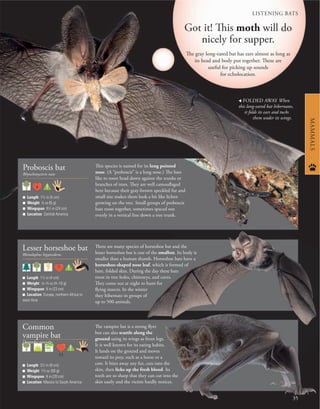
absorbent—thin enough to
breathe through. Mucus glands
keep it damp, which helps gases
pass through.
STURDY SKELETON
Amphibians have a fairly simple body
structure, well adapted to life in water
and on land. They have large eye sockets
to make room for their big eyes, and
wide mouths to fit in large prey.
Five toes
Four fingers
Wide mouth
Long back legs
Long toes
u SALAMANDER STRUT
This creature walks along one foot
after the other. It has a long tail to
help propel it through water. Its long
backbone is flexible and bends.
, LEAP FROG
Just a quick glance at
a frog skeleton and it
is obvious how it
moves. It looks poised
to leap. It has a short
squat body, wide
mouth, and large eye
sockets. All the better
to see its prey.
Ribs
Froglet—12
weeks old
u NEWT LIFE CYCLE
Like frogs, newts have an egg, larvae,
and adult stage. They keep their tails.
Adult frog—
16 weeks
MORPHING
Most amphibians start life in
water, as one egg among a cluster
of eggs (in the case of frogs, this
is called “frogspawn”). After a
few weeks the eggs hatch into
larvae. These are like little fishes
with tails; they swim and breathe
through gills. Gradually, they
start to change and develop
lungs until metamorphosis
is complete and they can
leave the water.
u FROG LIFE CYCLE
Frogs start out as frogspawn, which hatches into tadpoles. Legs
gradually grow, tail shrinks, and, finally, they become frogs.
2 weeks later—
newt larva hatches
3–4 months
later—adult newt
Newt’s egg
Frogspawn
Long back limbs—
6–9 weeks
Tadpole—
recently
hatched
Front legs
—9 weeks
Mucus gland
Carbon dioxide leaves Oxygen is absorbed
Poison gland
Blood vessel carrying
oxygenated blood
Blood vessel carrying
deoxygenated blood
AMPHIBIANS
u SPOT THE FROG Many amphibians have
amazing camouflage. It’s as though their skin has
been painted to make them disappear.
Spine
188
Salamanders and newts
There is no real difference between newts and salamanders.
Newts are a subgroup of salamanders, which means all
newts are salamanders, but not all salamanders are newts!
Newts generally spend more of their adult lives in water
than salamanders. Both groups are amphibians.
AMPHIBIANS
It’s hair raising
being a newt!
This great crested newt is still a baby. It
spends all its time under water, breathing
through its long feathery gills. At about
four months old, its gills shrink and
disappear. It begins to breathe air
through lungs and is ready to
leave the water.
189
■ Length 8–12 in (20–30 cm)
■ Diet Invertebrates
■ Location Southern Europe
This is one of the few amphibians that
makes its home in a cave, sometimes
deep inside Earth’s crust. It lives in total
darkness, and is near-blind. It eats bugs
and larvae in underground streams, and
never leaves the water.
European olm
Proteus anguinus
■ Length 6 ft (1.8 m)
■ Diet Fishes and crustaceans
■ Location China
This is the largest
amphibian in the world.
It lives in mountain streams,
preferring fast-running water.
It hunts mainly at night for
shrimp, fishes, and insects. Certain males
make masterful fathers. In the mating
season, one male controls the movements
of all breeding pairs in his territory and
later guards all the eggs until they hatch.
Chinese giant salamander
Andrias davidianus
Jordan’s salamander
Plethodon jordani
Emperor crocodile
salamander
Tylotriton shanjing
■ Length 7–11 in (18–28 cm)
■ Diet Worms, slugs, and insects
■ Location N.W. Africa, Europe, W. Asia
The yellow markings on this sturdy creature
warn predators that it is poisonous and would
make a disgusting meal. It often
lives on mountain slopes in
woodland. During the cold
winter months, it curls up
underground, in a cozy hole.
It emerges when it’s
warmer, especially
after rain, to eat
slugs and worms.
Fire salamander
Salamandra salamandra
SALAMANDERS AND NEWTS
■ Length 3¼–7½ in (8.5–18.5 cm)
■ Diet Millipedes, beetles, and insect larvae
■ Location E. US
This salamander is also distasteful to predators,
thanks to a slime that oozes from its tail. Its
breeding habits show the varied behavior of
salamanders: males breed every year, females
breed every two years.
■ Length 5½–7 in (14–18 cm)
■ Diet Worms, fishes
■ Location Southern and southeast Asia
During the winter or dry weather, this warty
newt stays underground. It comes out for the
monsoon, when it rains a lot. It then makes a
journey to a breeding pond and sticks its eggs
onto water plants.
50
50 20
■ Length 6½–13½ in (17–34 cm)
■ Diet Invertebrates, other amphibians,
snakes, and mice
■ Location S.W. Canada, N.W. US
This large salamander lives in or around
streams, and comes out at night. Some never
leave the water, and never lose their gills, and
some do leave the water and do lose their gills!
Their numbers have dipped because of logging
and the resulting silting up of streams.
Pacific giant salamander
Dicamptodon tenebrosus
20
■ Length 4–5½ in (10–14 cm)
■ Diet Insects, worms, woodlice, slugs, and snails
■ Location Europe, Central Asia
This is a male great crested newt; you can tell
by the crest on his back that develops during
the breeding season. He does a complex dance
under water to attract a female. After mating,
the female lays one egg at a time, and wraps
each one up in a leaf. It’s a big job, since she lays
more than 200 eggs and it can take up to four
months to wrap
them all.
Great crested newt
Triturus cristatus
16
10
5
AMPHIBIANS
190
Frogs and toads
These cold-blooded creatures form the largest and
best-known group of amphibians. They come in a variety
of shapes, sizes, and colors. The Goliath frog is as big as a
cat, but some are so small they can fit on your fingernail.
LEAP FROG Frogs can
crawl, climb, and hop along,
and are able to leap 10 times
their body length. They launch
themselves out of danger, like
this tiger-striped leaf frog.
■ Number of species: Almost 4,500.
■ Key features: Short body, long hind
legs, moist skin, no tail.
■ There is no clear way to tell the
difference between frogs and toads.
■ Frogs usually have smooth, moist skin,
are slimy, and jump. They spend most of
their lives in or near water.
■ Toads tend to be dry, warty-looking,
and walk rather than jump. They spend
more time living on land.
■ A group of frogs is called an “army.”
A group of toads is called a “knot.”
FACTFILE
WELCOME TO MY PAD The male of
each species has a different call. The gray treefrog
(Hyla versicolor) has a vocal sac that fills with
air to produce a really loud call. On hearing it,
females know where they can find a mate.
AMPHIBIANS
FROGS AND TOADS
191
■ Length 2–4 in (5–10 cm)
■ Habit Terrestrial
■ Location S. New Guinea, N. and E. Australia
This frog is well known for its tame behavior,
and its habit of living in or near buildings.
A night hunter, it eats mosquitoes, bugs, and
even mice, so is a much appreciated guest.
Their skin has also been helpful to humans—
a substance in it
can be used to
treat high blood
pressure.
Australian green treefrog
Litoria caerulea
■ Length 2¼–3¼ in (6–8 cm)
■ Habit Terrestrial/burrowing
■ Location Southern US to Central America
This bloated frog spends most of its life under
ground, burrowing into soft soil, slurping up
ants and termites. It only comes out after
heavy rain to breed. As rain falls any time, it
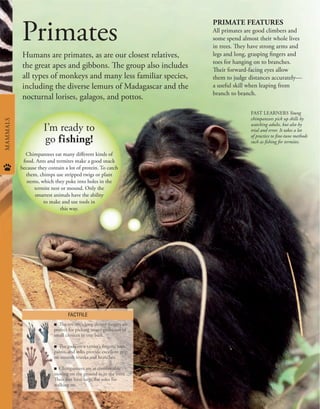
doesn’t have a breeding season and its low
“whoo-oa” call
can be heard
all year
round.
Mexican burrowing toad
Rhinophrynus dorsalis
■ Length 2¾–5½ in (7–14 cm)
■ Habit Mostly terrestrial
■ Location Southeast Asia
This forest floor frog does an amazing
impression of a dead leaf. Its pointed snout,
hooded eyes, and sharp folds in
its skin add to the effect.
The frog stays still
and waits for its
prey—scorpions
or small crabs—
to pass by.
Javan horned frog
Megophrys montana
■ Length 1½–2¾ in (4–7 cm)
■ Habit Terrestrial
■ Location Central America
Many scientists believe the red-eyed treefrog
developed its vivid scarlet peepers to shock
predators into questioning their meal choice.
Any small hesitation gives the frog the split
second it needs to leap
to safety. Red-eyed tree
frogs are nocturnal,
and feed on moths and
crickets, which they
catch with their long,
sticky tongues.
Red-eyed treefrog
Agalychnis callidryas
■ Length 4–16 in (10–40 cm)
■ Habit Mostly aquatic
■ Location Cameroon, Equatorial Guinea
The Goliath is the biggest
frog in the world, and can
leap the length of a car. It is
shy, sharp-eyed, and quick to
dive out of sight. The eggs
and tadpoles of its early stages
give no hint of its future size,
since they are not much larger
than those of any other frogs.
Only after metamorphosis does
it begin to grow and grow.
Goliath bullfrog
Conraua goliath
■ Length 1¼–2¼ in (3–6 cm)
■ Habit Mostly terrestrial
■ Location S. Canada, C. and E. US
These small frogs are well camouflaged to hide
amongst the lichen-covered tree branches they
live on. They are never far from water. Their
tadpoles have round bodies and high tails,
which turn red when there are predators
nearby. They change
from tadpoles to
young adults
in as little
as two
months.
Cope’s gray treefrog
Hyla chrysoscelis
■ Length 2¼–3 in (6–7.5 cm)
■ Habit Mostly terrestrial
■ Location N.E. Australia
Carbine frogs live
on the rain forest
floor of northern
Australia, where
they hunt small
invertebrates and
make burrows among the wet leaves. During
the breeding season they make a deep “wonk”
call to attract mates. The tadpoles are twice
the size of the adults and take two years to
change into frogs.
Carbine frog
Mixophyes carbinensis
■ Length 3½–8 in (9–20 cm)
■ Habit Mostly aquatic
■ Location S.E. Canada, W., C., and E. US
These big frogs have a big appetite! They will
eat almost anything that moves and that they
can swallow, including invertebrates and small
mammals, birds, reptiles, fishes, and even
turtles and other frogs. They usually
live among vegetation along
the edge of large,
slow-moving
rivers and
streams.
American bullfrog
Lithobates catesbeianus
15
16 15
10 6
5 5
AMPHIBIANS
?
EUROPEAN COMMON
TOADS pair up in breeding
ponds in spring. The female
is much bigger than the male,
especially at this time of year,
when she is laden with eggs.
AMPHIBIANS
I think I’m
in love!
Frogs and toads gather in breeding
ponds. Here they mate, the female lays
eggs, and then they take off again. The
survival rate is low. Out of 2,000 eggs
fewer than five frogs or toads will
make it back to the same
pond to breed there.
FROGS AND TOADS
193
■ Length 2–4 in (5–10 cm)
■ Where Mostly on land
■ Location S.E. Asia
Unusually for a
toad, this one is a
good climber. It
likes to “hang out”
in the branches of
trees over rivers. The
female lays long strings
of toadspawn in rivers
and the tadpoles
have suckerlike
mouths to cling
on to rocks.
Malayan tree toad
Pedostibes hosii
■ Length 1¼–2 in (3–5 cm)
■ Where Mostly in water
■ Location E. and S.E Asia
This toad has a bright
orange belly for a
reason—when threatened
it arches its back, flattens its
body, and lifts its legs over
its head to display the vivid
colors—and hopefully scare
off any predator. It lives in
mountain streams near
the coast, and hides
under rocks and logs
during winter.
Oriental fire-bellied toad
Bombina orientalis
■ Length 2–8 in (5–20 cm)
■ Where Always in water
■ Location N. South America
Pipa pipa has powerful
hind legs to swim fast,
and feelers on its fingers
to help it find prey in
muddy water. When the
female lays her eggs, they
are absorbed into the skin
on her back, where they
develop in capsules and
emerge as mini toads.
Surinam toad
Pipa pipa
■ Length 3¼–8 in (8–20 cm)
■ Where Mostly on land
■ Location N.W. Africa, Europe to Central Asia
Bufo bufo is Europe’s most
widespread amphibian.
Except during the breeding
season, the toad spends its
time on land, hunting slugs
and insects. If threatened, it
stands on tiptoe, with rigid
legs, and takes gulps of air
to puff up its body. It is
mainly nocturnal.
European common toad
Bufo bufo
■ Length 2¼–5 in (6–13 cm)
■ Where Mostly in water
■ Location Southern Africa
With eyes on the top of its
head to spy food above, and
long fingers to shovel small
fishes and insect larvae into
its mouth, this toad is a
voracious underwater
feeder. Its skin colors
make effective camouflage—
good protection from
hungry herons.
African clawed toad
Xenopus laevis
■ Length 1¼–2 in (3–5 cm)
■ Where Mostly in water
■ Location W. and C. Europe
This toad has a very
unusual way of
breeding. The female lays
large, yolk-filled eggs in
strings, which are transferred
to the male during mating. The male
then wraps these strings around his legs,
and carries them around until they are
ready to hatch. At which point, he drops
them into a pool.
Midwife toad
Ayltes obstetricans
?
AMPHIBIANS
5
6
40 16
20
194
Marine toad
The world’s largest toad has a hidden weapon. Its skin is
highly toxic, and results in death to an animal that attacks
it. If it is squeezed—or even threatened—a creamy white
venom will ooze from glands on its shoulders and body.
An animal that eats this venom may die rather quickly.
STAY BACK! In addition to
using venom, the marine toad
will raise itself up if threatened,
to look far larger than it is. Most
predators have learned to take
extreme care with a marine toad.
AMPHIBIANS
NEW GENERATIONS
Marine toads lay a lot of eggs—it’s
estimated about 30,000 at a time.
Though perhaps just a few of these
make it to adulthood, it’s partly why
marine toads are so successful. The
eggs hatch in three days, and the
young grow rapidly.
MARINE TOAD
195
10
AMPHIBIANS
Be careful... I eat
small snakes!
Marine toads do eat snakes, but some snakes,
like the toad eater snake shown here, can eat
marine toads without being affected by the
toad’s toxins. However, this toad may be too
big a mouthful for this particular snake.
Marine toads are stocky, and find it
easier to walk on flat rather than
bumpy ground.
■ Length 2–9 in (5–23 cm)
■ Weight Up to 4 lb (2 kg)
■ Habit Mostly terrestrial
■ Location Central America. South America. Introduced
to Australia and elsewhere.
You can see white toxins seeping out of large
glands on the shoulder of this marine toad.
These toads tend
to be active at
night, choosing
to hide during
the day under
leaves or stones,
or burrowing
down into loose soil.
Marine toad
Bufo marinus
CONSERVATION
The marine, or cane, toad was first
introduced to Australia in 1935, but its
numbers have grown rapidly and it is now
a serious pest. It has successfully competed
against Australia’s frogs and toads for space
and food, and caused native animal deaths.
u DIET Marine toads will eat anything they
can catch. Their diet consists largely of insects,
but may include a variety of rodents, smaller
frogs and toads, and snakes. If hungry, they will
even eat their own young. They are common near
houses, where they will eat dog food if it is left out.
Poison dart frogs
These jewel-like frogs of the jungle are colorful for
a reason—bright colors warn predators that they are
highly toxic. In fact, the family name comes from the
use by local tribes of the frogs’ powerful venom
to tip their blowgun darts when hunting.
BEAUTY WITH BITE
The spots, stripes, and
brilliant colors may look
pretty, but to predators, they
mean only one thing:
DON’T EAT THEM.
■ There are about 120 species of poison
dart frog.
■ Nearly all species are brightly
colored.
■ Most are small.
■ They live in tropical rain forests of
Central and South America.
■ Males buzz and chirp to attract females.
■ They have tiny suction cups on their
toes that cling to slippery leaves and
branches.
■ They eat termites, ants, flies, crickets,
and other insects, which they catch with
quick flicks of their sticky tongues.
FACTFILE
u BREEDING AMONG THE TREES
The male looks after the eggs in most poison dart
frog families. He guards them and keeps them
moist by collecting water. When the tadpoles are
ready to hatch, he lets them wriggle onto his back
and carries them to a suitable pool of water.
Glands in a poison dart frog’s
skin ooze poison.
AMPHIBIANS
, THE MOST POISONOUS FROG on Earth is
the golden poison dart frog—with enough poison in its
skin to kill 10 men. These frogs can be very dangerous
and are thought to be the only animal that can kill a
man by touch alone. It is one of the biggest poison dart
frogs, at 2 in (5 cm) long.
197
■ Length 2 in (5 cm)
■ Where Forest floor
■ Location Suriname
Only discovered in 1968,
dyeing poison dart frogs
are active during the
day and can be found
hiding among
boulders and
debris near
streams. They
lack toe webbing
and are poor
swimmers, so
they are never
found in the water.
Dyeing poison dart frog
Dendrobates tinctorius
AMPHIBIANS
■ Length 1–2¼ in (2.5–6 cm)
■ Where Forest floor
■ Location Central and South
America, Hawaii
These little frogs have one habit
that is unusual among amphibians—it
is the female that takes the lead in
mating. She entices the male to
mate by patting him on the back
with her hind feet. People have
introduced these frogs to Hawaii,
where they have flourished. In highly
populated areas, they sometimes leave
their eggs in broken bottles or
discarded cans.
Green and black
poison dart frog
Dendrobates auratus
■ Length 1¼ in (3 cm)
■ Where Forest floor, low bushes
■ Location Colombia
This frog is also known as
Lehmann’s poison frog. It is listed
as critically endangered because it
lives in just one area of rain forest
that is less than 4 sq miles (10 km²).
Groups of frogs are spread about
within this area with no contact
between each group. This puts
this little frog at even greater risk.
Unfortunately, the quality and extent
of their habitat is still in decline.
Red-banded poison dart frog
Oophaga lehmanni
■ Length 1¼–2 in (3–5 cm)
■ Where Forest floor, sometimes in trees
■ Location Northern South America
The male of this species is very territorial.
If another male of its kind happens into its
territory, it will grasp it belly to belly, and
make a loud
buzzing call in
its ear. That’s
why another
name for this
frog is the
bumble
bee frog.
Yellow-headed poison dart frog
Dendrobates leucomelas
■ Length 1–11
⁄2 in (2.5–4 cm)
■ Where Forest floor
■ Location W. Ecuador, Colombia
This is one of the most poisonous of these
frogs, as well as one of the smallest. The
poison that oozes from every bit of its body
is collected from
the toxic bugs
it eats and
then deposited
in its skin.
Harlequin poison dart frog
Oophaga histrionica
■ Length ¾–1 in (2–2.5 cm)
■ Where Forest floor
■ Location S. Central America
This little frog is also small, but
less poisonous than the harlequin
poison dart frog. It would still
give a predator a nasty
stomachache, though. Its color
can vary from bright red, to
brown, blue, or green, depending
on where it lives. It is most
commonly found in the humid
rain forests of Panama.
Strawberry poison dart frog
Oophaga pumilio
10
?
10 10
■ Length 2
⁄3–7
⁄10 in (1.7–1.8 cm)
■ Where Forest floor
■ Location Colombia
This tiny frog lives an area of forest that
covers less than 0.2 sq miles (0.5 sq km),
which means that it is extremely vulnerable
to extinction. It hides in bromeliad plants
and is thought to lay its eggs in the
water that collects there. Two
of its toes are fused
together on each
hind foot, giving
it the appearance
of having only
four toes.
Doris Swanson’s poison
dart frog
Ranitomeya dorisswansoni
?
7
8
198
AMPHIBIANS
BIGGEST FROG
Goliath bullfrog
Conraua goliath
SMALLEST FROG
Brazilian flea-frog
Brachycephalus didactylus
Golden poison dart frog
Phyllobates terribilis
Yellow-headed poison dart frog
Dendrobates leucomelas
Emerald glass frog
Espadarana prosoblepon
European treefrog
Hyla arborea
Malabar flying frog
Rhacophorus malabarcius
Green mantella
Mantella viridis
Red-eyed treefrog
Agalychnis callidryas
Australian green treefrog
Litoria caerulea
Tomato frog
Dyscophus antongilii
Turtle frog
Myobatrachus gouldii
American bullfrog
Lithobates catesbeianus
Javan horned frog
Megophrys montana
Amazonian horned frog
Ceratophrys cornuta
Mexican burrowing toad
Rhinophrynus dorsalis
Natterjack
Epidalea calamita
Frogs and toads
Frogs and toads form the largest group of amphibians.
There’s actually no clear difference between them. They
range in size from the tiny Brazilian flea frog to
the enormous Goliath bullfrog, both shown
here at their maximum life sizes.
Monte Iberia Eleuth frog
Eleutherodactylus iberia
The Goliath bullfrog
can reach just over 16 in
(40 cm) in length. The
Brazilian flea frog is
just under ⅜ in
(1 cm).
Solomon Islands horned frog
Ceratobatrachus guentheri
15
?
?
?
?
?
?
5
10
10 ? 6 ?
?
15
16
?
7
?
199
AMPHIBIANS
Couch’s spadefoot toad
Scaphiopus couchii
Parsley frog
Pelodytes punctatus
Surinam toad
Pipa pipa
Cane toad
Rhinella marina
Red-spotted toad
Anaxyrus punctatus
Green toad
Pseudepidalia viridis
Woodhouse’s toad
Anaxyrus woodhousii
FROGS AND TOADS
? ?
6
?
?
?
10
FISHES
FISHES
Definition: Fishes
are cold-blooded animals
that live in water. All have
gills to obtain oxygen from
the water and most have
fins and scales.
FISHES
What is a FISH?
More than half of all vertebrates are fishes. They first evolved on Earth
at least 500 million years ago. All fishes breathe using gills and are
cold-blooded; most have a body covered with scales and move using
fins. They live in freshwater or in the sea—and some live in both.
FINS
Fishes use their fins, combined with body
movements, to propel themselves through
the water and steer in the right
direction. Some fins come in pairs.
These are the pectoral (behind
the head) and pelvic (on the
underside). Other fins
are unpaired: the
dorsal (top), caudal
(tail), and anal
(nearest the
tail).
FISHES
PELVIC FINS
Paired pelvic fins add
stability and may be used
to slow the fish down.
CAUDAL (OR
TAIL) FIN In most
bony fishes this provides
the power that propels
the fish forward.
ANAL FIN
This fin acts
as a stabilizer.
FACTFILE
■ Jawless fishes (hagfishes and
lampreys) are eel-like fishes that lack
scales and jaws.
There are about 28,000 species of
fishes. They are broadly divided into
three groups: jawless, cartilaginous,
and bony fishes.
■ Cartilaginous fishes (sharks, skates,
and rays) have skeletons made of
cartilage, not bone.They are covered
with a skin with hard scales.
■ Bony fishes are the largest group.
They have hard, bony skeletons.
■ Size: Fishes range from one tiny
minnow that reaches just ¼ in (7 mm)
in length to the whale shark,
at up to 45 ft (14 m).
NEW LIFE
All fishes begin as eggs.
They hatch out as larvae and
change by stages into their
adult form. Some fishes may
hatch from eggs and look
like tiny adults, while others
are born as live
young.
EGG SAC
The eggs of the dogfish
develop inside a leathery
sac, or “purse.” Long
threads anchor the egg
sac to rocks or seaweed.
A baby trout hatches
from a fertilized egg
Fish egg
202
FISHES
PECTORAL FINS A fish uses these fins on each
side of its head to change direction. The pectoral fins
can also be used for tasting, touching, support, and
to give the swimming fish a power boost.
DORSAL FIN
This may be a single fin or it may be
separated into several fins. In most bony
fishes, the dorsal fin is used for sudden
direction changes and it acts as a “keel”
to keep the fish stable in the water.
HOW FISHES BREATHE
To live, fishes need oxygen, which
most obtain from the water. A fish
takes in water through its mouth and
sends it out over its gills (feathery
structures found along the sides of the
head). As the water flows out of the fish’s
body, the surfaces of the gills extract the oxygen,
which then passes into the bloodstream.
Odd fishes
Among the more unusual fishes,
there are those that appear to
fly, others that have no jaws,
and some that can “walk” out
of water on their fins.
Stomach
Liver
d MUDSKIPPERS can live
out of water for long periods.
They move over mudflats by
using their pectoral
fins to pull
themselves
along.
dLAMPREYS have sucker
pads instead of mouths. They
latch on to prey with their teeth
and either rasp off the flesh or
suck blood.
d FLYING FISHES cannot
fly, but their large, winglike
pectoral fins allow them to glide
briefly above the water’s surface.
On the inside
The skeleton of a bony fish is made
up of three main parts: the skull, the
fin skeleton, and the backbone.
Pectoral fin
Dorsal fin
Parental care
Some fishes take an active
part in caring for their
young. Both parents may
look after the eggs and tend
the new hatchlings when
they emerge. Parental duties
can include feeding the
young, fanning water over
them to supply oxygen, and
chasing away predators.
. FATHERS Male
seahorses are
unusual in that
they carry their
young. Female
seahorses put
their eggs in a
pouch on the
male’s abdomen
where they are
fertilized and
begin to develop.
u YELLOWHEAD
JAWFISH The males carry
fertilized eggs in their mouths
until they are ready to hatch.
Fishes have a set
of inner teeth in
the “throat”
Lower jaw
Caudal (tail) fin
SKULL AND TEETH
The skull supports the jaws
and gill arches. A fish may
have teeth in its throat, the
roof of its mouth, on its
tongue, or in its jaws.
Skull
Backbone
OPERCULUM This bony flap covers the gills.
Lampreys are jawless fishes.
WHAT IS A FISH?
Anal fin
Pelvic fin
204
A world of SHARKS
There are more than 350 species of sharks.
They range from small pygmy sharks that are
just a little bit longer than the width of this
page to the whale shark, which can grow to
the length of a truck! Most have a pointed
nose and a triangular dorsal fin.
FISHES
Spined pygmy shark
Squaliosus laticaudus
Port Jackson shark
Heterodontus portusjacksoni
Velvet belly lantern shark
Etmopterus spinax
Common smoothhound
Mustelus mustelus
Nurse shark
Ginglymostoma cirratum
Shortfin mako shark
Isurus oxyrinchus
Porbeagle
Lamna nasus
Angular rough
shark
Oxynotus centrina
Blacktip reef shark
Carcharhinus melanopterus
?
The Port Jackson
shark is unusual
because it can breathe
when it is motionless.
12
20
9
26
?
?
?
25
205
FISHES
Bull shark
Carcharhinus leucas
Horn shark
Heterodontus francisci
Prickly shark
Echinorhinus cookei
Tiger shark
Galeocerdo cuvier
Whitespotted bamboo shark
Chiloscyllium plagiosum
Spinner shark
Carcharhinus brevipinna
Bluntnose sixgill shark
Hexanchus griseus
Great white shark
Carcharodon carcharias
This shark’s two-
tone coloring
makes it hard to
see in the water.
A WORLD OF SHARKS
20
?
25
?
25
20
80
36
206
■ Length 11½–20 ft (350–600 cm)
■ Weight 500–1,000 lb (230–450 kg)
■ Diet Small sharks, rays, bony fishes, and squid
■ Location Worldwide (warm temperate and
tropical waters)
This is the largest of nine species of
hammerhead. They live in warm coastal
waters. Females produce 20–40 pups that
are 27 in (70 cm) in length.
Great hammerhead shark
Sphyrna mokarran
KEY FEATURES
Great hammerhead sharks have a
wide head with an eye at both ends.
The head moves in a constant
sweeping motion so that the shark
can see in every direction. Other
characteristics are a first dorsal fin
that is large and pointed, and teeth
that are triangular with serrated edges.
Electrical field
d PREY
Hammerhead sharks are sometimes cannibalistic,
but generally they live on a diet of fishes,
including rays. They eat other sharks, octopuses,
squids, and crustaceans. Their favorite meal
is stingray, which they pin down using their
“hammer” shaped head. They look fierce,
but there have been few attacks on people.
Hammerhead sharks use their
sensory organs to detect the
electrical fields of their prey.
FISHES
Stingray
hiding
under
the sand.
Pectoral fin
Head lobe
Long upper
tail lobe
30
The big-headed
hammerhead
Hammerhead sharks stick together, and there can be up
to 100 in a school. They are formidable hunters and are
able to find prey more effectively than typical sharks by
using sensory organs in their head, which can pick up
electrical signals in the water from potential prey.
FISHES
THE BIG-HEADED HAMMERHEAD
Killer sharks?
Most people think of sharks as sleek, fast-moving
killers equipped with banks of viciously pointed teeth.
Some sharks do live up to this description. But there are
many other types, from sluggish, toothless giants to glow-
in-the-dark fish not much bigger than a person’s hand.
DEEP DIVER Whale
sharks are capable of diving
more than 3,300 ft (1,000
meters). They plunge to such
depths in search of eggs
released by spawning fishes.
■ Length 39–46 ft (12–14 m)
■ Weight More than 26,500 lb (12,000 kg)
■ Diet Plankton, fish eggs
■ Location Warm seas worldwide
This is the biggest fish in the world.
Despite its name, the whale shark is not
related to whales. With a mouth that may
be up to 4 ft (1.4 m) wide, this shark looks
dangerous but, in fact, it is
quite harmless.
Whale shark
Rhincodon typus
FISHES
Slow moving and mostly solitary, whale sharks
are usually seen cruising near the surface of
the ocean. They feed largely by sucking water
into their mouths to trap plankton—floating
mats of tiny crustaceans and plants. Whale
sharks give birth to live young and pregnant
females have been found carrying hundreds
of developing young.
■ Length 10 in (25 cm)
■ Weight Not recorded
■ Diet Squids, shrimps, small fishes
■ Location Atlantic, W. Indian Ocean,
W. Pacific
This deep water species is one of
the smallest sharks in the world.
Unusually for a shark, it has a dorsal
spine. Light-emitting organs in its belly
glow in the dark. This may act as a disguise,
confusing any predators swimming below.
Spined pygmy shark
Squaliolus laticaudus
■ Length 5¼–7 ft (1.6–2 m)
■ Weight More than 40 lb (18 kg)
■ Diet Fishes, octopuses, crustaceans
■ Location Tropical Pacific and Indian Oceans
Whitetip reef sharks feed around
coral heads, where divers often
meet them. These sharks are not
usually aggressive toward people,
although they have been
known to grab a fish
from a diver’s spear.
Whitetip reef shark
Triaenodon obesus
■ Length 7 ft (2 m)
■ Weight 70 lb (32 kg)
■ Diet Crustaceans, worms, fishes
■ Location E. North Pacific coast
Sensory organs in the leopard shark’s nose
allow it to find and expose prey buried in deep
mud. The shark’s striking body pattern make
it popular with fishermen.
Leopard shark
Triakis semifasciata
? 25
30
70
, SEAFLOOR
These sharks rest on
the seafloor or in
underwater
caves.
208
209
FISHES
■ Length 33–49 ft (10–15 m)
■ Weight 13,300 lb (6,000 kg)
■ Diet Plankton
■ Location Cool to warm seas
worldwide
This giant shark is second in
size to the whale shark. It feeds
simply by swimming along with
its vast mouth gaping wide. As the
water rushes in, and then out again
through the fish’s gills, sievelike
projections filter out minute food
particles. The basking shark takes its
name from its habit of lolling in the
sun at the surface of the water.
Basking shark
Cetorhinus maximus
■ Length 18 ft (5.5 m)
■ Weight 1,000 lb (450 kg) and over
■ Diet Shoaling fishes, such as herrings, squids
■ Location Warm seas worldwide
Using its immensely long tail as a whip, the
thresher shark rounds up its fish prey into tight
schools. The shark then often stuns or kills
its victims with blows from its tail. Thresher
sharks are strong swimmers and are occasionally
seen leaping right out
of the water.
Thresher shark
Alopias vulpinus
■ Length 5 ft (1.5 m)
■ Weight 60 lb (27 kg) and over
■ Diet Small fishes, mollusks
■ Location North Atlantic
Also known as the sand devil or monkfish,
this fish is one of several species of angel
sharks. It lives mostly on the seafloor,
keeping its flat body partly concealed in
the sand. When the shark spots its prey,
it bursts out of its hiding place to make
a sudden grab that takes the victim
by surprise. A potential meal
rarely escapes!
Atlantic angel shark
Squatina dumeril
, WHIPLASH
The thresher’s tail
may be more than
half the shark’s
total length. Some
humans have received a swipe
from this formidable weapon.
u TASTY SHARK
The Atlantic angel shark is
fished for its succulent flesh.
■ Length 20–26 ft (6–8 m)
■ Weight 2,000 kg (4,400 lb) and over
■ Diet Seals, dolphins, and large fishes
■ Location Warm seas worldwide
The great white shark is one of the most feared
creatures of the sea. There are many stories of
its attacks on humans, although the shark’s
reputation as a mankiller has been
exaggerated. However, the great
white’s muscular, streamlined
Great white shark
Carcharodon carcharias
body make it a swift and deadly predator.
With rows of sharp, pointed teeth ideal for
ripping and tearing, the shark can take the
head off prey such as a seal with one bite.
Great white sharks live and hunt alone, but
they sometimes gather together to share a kill.
When feeding in groups, the sharks usually
show no aggression toward each other.
36 ?
28 40
KILLER SHARKS?
210
Skates and rays
These fishes appear to fly through the water, the larger ones using
their fins almost as wings. They have a flattened shape and some
live on the seabed, while others swim in open water.
Some are able to stun unsuspecting fishes
with an electrical charge!
FISHES
■ Length 39 in (1 m)
■ Weight 40 lb (18 kg)
■ Depth 33–328 ft (10–100 m)
■ Location Eastern Atlantic,
Mediterranean
■ Length 41
⁄2 ft (1.4 m)
■ Weight 8 lb (30 kg)
■ Depth 16–650 ft (5–200 m)
■ Location Northeast Atlantic and
Mediterranean Sea
Common stingray
Dasyatis pasinaca
■ Length 4½ ft (1.5 m)
■ Weight 37 lb (17 kg)
■ Depth 50–3,000 ft (15–900 m)
■ Location Eastern Atlantic,
Mediterranean, Canary and Madeira Islands
Long-nosed skate
Dipturus oxyrinchus
d SCAREDY FISH Common
stingrays are not aggressive—
they prefer to flee rather than
stay and confront their attacker.
Common stingrays
have barbed spines full
of venom that can be up to
14 in (35 cm) long. The spines may
break off when the common stingray
attacks; however, these can grow back.
These fishes are caught and eaten, and oil
is sometimes extracted from their wings.
Marbled electric ray
Torpedo marmorata
This ray creates electric shocks powerful enough to stun
or kill other fishes and contact with it can be dangerous
for humans, but there are no reports of people dying
after suffering a shock from it. There are stories that
suggest the ancient Greeks may have used them to stun
patients before surgery! It is nocturnal, and buries
itself in the seabed during daylight hours.
?
The long-nosed skate is distinguished by
its narrow, sharp nose, while its tail is
armed with three rows of spines. It tends
to rest on the seabed, almost buried but
with its eyes just visible. Long-nosed skates
are under threat, partly because they breed
slowly: they take eleven years to mature to
an age at which they can breed.
, FLYING
THROUGH THE
WATER The long-nosed
skate uses its pectoral fins
in a sweeping motion to
move through the water.
?
20
SKATES AND RAYS
211
■ Width 30 ft (9 m)
■ Weight 5,000 lb (2,300 kg)
■ Depth 0–400 ft (0–120 m)
■ Location Surface tropical waters worldwide,
sometimes warm temperate areas.
This ray is the biggest in the world.
It is also known as the devil ray, but not
because it is aggressive: it ignores divers.
Despite its size, this ray can leap out of
the water, occasionally giving birth to
its young while doing so.
Manta ray
Manta birostris
FISHES
■ Length 4 ft (1.2 m)
■ Weight to 15 lb (7 kg)
■ Depth 150–650 ft (45–200 m)
■ Location Eastern Atlantic and
Mediterranean
Blonde ray
Raja brackyura
If you felt the back of this fish and it was
smooth, you’d know that it was a young
blonde ray, because the adults develop
prickles. The young hatch from
rectangular, horned egg cases in the
summer months. Blonde rays have large
eyes and a short snout. The outer angles
of their wings are almost right angles.
Thornback ray
Raja clavata The thornback ray feeds on crustaceans such as shrimps
and crabs. They also eat small fishes such as herrings,
sandeels, and flatfishes. The thornback (as its name
suggests) has thorns on its fin and tail. Females
are longer than males.
. LAYING EGGS Females are known to
lay up to 15 eggs in muddy or sandy flats.
, Seen from
below, an
undulate ray
looks completely
different.
, WHERE ARE YOU?
The underside of a blonde
ray is white, but the top is
covered in small brown
spots and larger, creamy
spots. It can camouflage
itself against the
seafloor.
d EGGS IN WAITING
Females lay their eggs in the
summer and they hatch
during the winter.
Manta rays use the large lobes on
either side of their head to funnel prey into
their mouths. Water and prey goes into the
mouth, and the prey is filtered out as the water
passes through the ray’s gills. Mantas prey
on small fishes as well as sifting
plankton from seawater.
The flying
filter feeders
14
Undulate ray
Torpedo marmorata
The undulate ray is also known
as the painted ray because of its
detailed markings. In fact, it is a
popular fish for large aquariums
because of its markings. The
undulate ray feeds on flatfishes,
crabs, and other seabed invertebrates.
?
■ Length 42 in (1.25 m)
■ Weight 32 lb (14.3 kg)
■ Depth 33–1,250 ft (10–380 m)
■ Location Eastern Atlantic
12
■ Length 41–47 in (105–120 cm)
■ Weight 40 lb (18 kg)
■ Depth 65–1,900 ft (20–577 m)
■ Location N.E. Atlantic, North Sea,
Mediterranean, and the Black Sea
20
212
Bony fishes
Bony fishes are the largest and most varied group
of fishes: 9 out of 10 species of fishes are bony
fishes. Some live in salty oceans and seas, some live
in freshwater, whereas some can survive in both
habitats. But, they all have one thing in common:
a light, but strong, internal bony skeleton.
FISHES
Porthole catfish
Dianema longibarbis
Redtailed
catfish
Phractocephalus
hemioliopterus
Rainbow trout
Oncorhynchus mykiss
Northern pike
Esox lucius
Leopard catfish
Corydoras trilineatus
Goldfish
Carassius auratus
Glass catfish
Kryptopterus bicirrhis
Common
European carp
Cyprinus carpio
Clown knifefish
Chitala ornata
Siamese fighting fish
Betta splendens
Twig catfish
Farlowella acus
Kenyi cichlid
Maylandia lombardoi
Red-bellied
piranha
Pygocentrus nattereri
10
18
5
40
3
15
25
5
15
15
12
8
20
BONY FISHES
213
FISHES
Humbug damselfish
Dascyllus aruanus
Lionfish
Pterois miles
French angelfish
Pomacanthus paru
Atlantic salmon
Salmo salar
Atlantic herring
Clupea harengus
Clown
anemonefish
Amphiprion ocellaris
Atlantic cod
Gadus morhua
Clown triggerfish
Balistoides conspicillum
Yellow longnose
butterfly fish
Forcipiger flavissimus
Northern anchovy
Engraulis mordax
Conger eel
Conger conger
Ringed snake eel
Myrichthys colubrinus
Ribbon eel
Rhinomuraena quaesita
Zebra moray eel
Gymnomuraena zebra
Up to 35 in (89 cm)
Archerfish
Toxotes chatereus
Trumpetfish
Aulostomus chinensis
Estuarine stonefish
Synanceia horrida
Rabbitfish
Siganus vulpinus
Fugu fish
Takifugu rubripes
Blue-striped
dwarf goby
Trimma tevegae
Up to ⅜ in (1 cm)
ONE OF THE
SMALLEST FISHES
Oarfish
Regalecus glesne
Up to 26 ft (8 m)
LONGEST
BONY FISH
Blue marlin
Makaira nigricans
8
?
?
50
8
15
?
30
7
?
?
?
15
25
15
20
20
12
?
?
?
?
FISHES
SCHOOLS
SCHOOLS
There is safety in numbers for fishes
that swim in schools. They are able
to confuse attackers since the size
of the school can be bigger than
the attacker itself. It is harder
for a predator to isolate and
catch a single fish among
a fast-moving group.
Fishes in a school
have an advantage
over the fishes
that are after them
because they have
more pairs of eyes
on the lookout!
FISHES
SCHOOL OR SHOAL?
Schooling fishes swim close together in
a synchronized fashion, whereas a shoal
is a looser aggregation of fishes that
swim in a group. Shoals can be made
up of more than one fish species.
Fishes benefit from living in a shoal
since they can search for food together,
defend themselves from predators, and
have a better chance of finding a mate.
. DIVING
FOR DINNER
Cape gannets
dive into a bait
ball of sardines.
They are plunge
divers and will
slam into shoals
of fishes from
heights of up to
100 ft (30 m).
u PROTECTION FOR PREDATORS
Fishes that are predators also need to have
protection from their attackers. Young barracudas
live in shoals during the day to help each other
keep safe and to look for food. However, most
adult barracudas hunt alone.
■ Fishes use vision and sensory systems
to help them respond to slight movements
around them. This ability allows them to
swim in schools and shoals.
■ The “oddity effect” is a theory that if a
fish stands out in a shoal it is more likely to
be noticed by a predator. So, fish join shoals
of fishes that are similar to themselves.
■ Shoaling fishes use various tactics when
attacked. They disperse into all directions,
they flee away and then come back and
swim past both sides of the attacker, or
they split into smaller groups.
HOW DO THEY WORK?
BAIT BALL
Copper sharks, or bronze whalers,
swallow mouthfuls of sardines as
they push their way through a bait
ball, showering blood and fish
scales around them. Bait balls are
groups of fishes that by instinct
swim tightly together when faced
with a larger predator.
215
Fishing for food
Some fishes are accomplished at fishing for food.
Heavy disguise helps them to hide from predators,
but also to hide from prey. Equipped with a
whiplike rod on their head that often has a lure at
the end that looks deceptively like a small marine
organism, they sit lazily and wait for their prey to
fall for the bait.
Hidden away It is difficult to
see the angler on the seabed as
its marbled skin and flaps blend
in so well with the sediment.
, SUPERB SHUFFLER The angler
has strong pectoral and pelvic fins
that it uses to shuffle itself
over the seabed. It
looks as if it is
walking!
■ Length 6½ ft (2 m)
■ Weight 125 lb (58 kg)
■ Location E. North Atlantic, Mediterranean,
Black Sea
The angler is called by a few other names:
sea devil, fishing-frog, or frogfish. It is
also known as the monkfish when it is
sold as a fish to eat. The angler is able
to camouflage itself on the seabed,
helped by its broad, flattened body.
It sits and waits for a small fish to
swim by and then opens its mouth
and sucks in its prey. It has a large
head and a wide jaw containing
sharp teeth that slant inward so
it can stop prey from trying to
escape from its mouth.
Angler
Lophius piscatorius
216
FISHES
■ Length 4 in (10 cm)
■ Weight Not recorded
■ Location South Australia, Southern Ocean
Like the angler, the smooth anglerfish also
goes by the name of the frogfish. It is part
of the large anglerfish family. The smooth
anglerfish is a small fish with a large head.
It differs from other anglerfishes in that it
has three extended dorsal fin spines on its
head. It uses the first dorsal spine like a
fishing rod to attract other, smaller, fishes,
which it then sucks into its mouth.
Smooth anglerfish
Phyllophryne scortea
24
?
Psychedelic anglerfish
Histiophryne psychedelica
■ Length 2½–3½ in (6½–9 cm)
■ Weight Not recorded
■ Location S.E. Asia
This anglerfish gets its name from the
swirling pattern of white stripes on its
body. These stripes are different on every
fish and can be used to identify
individuals. Unlike other anglerfishes it
has a broad,flat, frilly face with forward-
facing eyes. Its body skin is thick and
loose and hangs in folds over its pectoral
fins. As well as walking along the seafloor,
it swims by pushing water out of its gills
to jet itself forward.
?
HIDE AND WAIT
The estuarine stonefish does not have any scales on its body. Its color
and shape provide brilliant camouflage. It uses its pectoral fins to make a
shallow hole on the seafloor. It then piles up sand and mud around itself
that adds to the illusion. Its head and eyes remain outside of the sand so
that it can see its prey. The estuarine stonefish is a slow swimmer so it
relies on catching fish that swim near to its hideout.
SHARP SPINES
■ Length 4½ in (15 cm)
■ Weight Not recorded
■ Location W. Pacific, Indian Ocean
The warty frogfish is another member of
the anglerfish family. Many anglerfish live
in the deep sea, but the warty frogfish lives
in shallow waters—mainly in coral reefs.
This fish is adorned with various patches
and spots on its body. It eats other small
fishes and occasionally it eats other
warty frogfishes. A flap of colored skin at
the end of the long spine on its dorsal fin
acts like bait on a fishing
rod—it wiggles
it to attract
prey.
Warty frogfish
Antennarius maculatus
■ Length 8 in (20 cm)
■ Weight 14 oz (400 g)
■ Location Tropical and
subtropical seas worldwide
This fish’s Latin name means
“the actor” because it blends in
so well with the sargassum weeds
in which it lives. The sargassum
fish feeds by lying in wait for
its prey, and it is a hungry fish.
It has been known to swallow a
fish as large as itself, while
adults are cannibalistic, which
means they will eat each other.
Sargassum fishes are unusual in
their courtship behavior. Males
pursue females by chasing them
and nipping at them.
Sargassum fish
Histrio histrio
u DINNER
The sargassum fish
lives on a diet of small
fishes and crustaceans.
It uses its
dorsal fin
spine as a
fishing rod
and lure.
■ Height 24 in (60 cm)
■ Weight Not recorded
■ Location Indo Pacific
As its name suggests, the estuarine stonefish
is able to hide on the gravelly seabed
without being seen by its prey. It is the
most venomous fish in the world.
Estuarine stonefish
Synanceia horrida
, VENOMOUS SPINES The
estuarine stonefish has 13 dorsal spines
that have sharp tips and glands full of
venom. If a human steps on one of the
sharp spines it can be fatal.
FISHES
Can you
see me?
?
?
?
Giant grouper
One of the largest of all the grouper fish species,
the giant grouper swims close to the bottom of
the ocean in warm, shallow waters. It usually
swims by itself and likes to stay in the same
area, around coral reefs. It also swims
in caves and near shipwrecks.
FISHES
As its name suggests, the giant
grouper is known for its size. It
is the largest bony fish to live
in coral reefs. The young are
preyed upon by other fishes,
but the adults are only at risk
from humans.
218
Don’t come
too close!
FISHY FOOD
The giant grouper eats a range of food,
including small sharks, rays, bony fishes
and small sea turtles. Its main diet
consists of crustaceans, such as spiny
lobsters, and it occasionally eats crabs.
As giant groupers are so big, they require
plenty of food in order to survive.
GIANT GROUPER
FISHES
■ Length 8½ ft (2.7 m)
■ Weight 880 lb (400 kg)
■ Location Indian Ocean, W. and C. Pacific
The giant grouper is a fish of many names.
It is known as the brown spotted cod,
brindle bass, bumblebee grouper, and, in
Australia, as the Queensland grouper. Its
color changes as it gets older. Young fishes
have irregular black and yellow markings.
Adults are darker.
Giant grouper
Epinephelus lanceolatus
Giant groupers are being wiped out because
cyanide and explosives are used to fish on
reefs. Their size and sluggish behavior also
make them easy to hunt by spearfishing.
Moves have been made to protect them in
some areas, but some giant grouper species
are struggling to survive.
Divers can usually approach the giant grouper without
harm, but there have been reports of fatalties.
Heavy body
Tail fin
Small eyes
CONSERVATION
219
?
Deep-sea fishes
Down in the depths of the oceans it is extremely
cold and food and oxygen are scarce. It is also dark.
Yet many fishes survive here, having evolved to live
in what we think of as harsh conditions. There is
still a lot to learn about deep-sea fishes. Equipment
to reach the deep sea is expensive to operate. There’s
another problem: deep-sea fishes often die quickly
when taken out of their natural environments.
u POPULAR FOOD
Lanternfishes are an important
source of food for many animals
including tuna, sharks, whales,
dolphins, grenadiers, seabirds,
penguins, and large squids.
220
FISHES
Hey!
What are you
looking at?
Some deep-sea fishes have large eyes that
make the most of what little light there
is. Other deep-sea fishes have small
eyes, but they can detect vibrations
and have an excellent
sense of smell.
■ Length 1½ in (8 cm)
■ Weight Not recorded
■ Depth 0–2,000 ft (0–600 m)
■ Location E. and W. Atlantic
Metallic lanternfish have thin, silvery scales.
They have good vision because of their large
eyes; these help them detect changes in light.
Metallic lanternfish have photophores that
look like small, bright studs on their flanks,
undersides, and heads. These bright studs let
out light in shades of green, yellow, or blue.
Photophores help groups of fishes to see each
other in darkly lit waters, enabling them to
recognize each other and stay together.
Metallic lanternfish
Myctophum affine
221
FISHES
?
■ Length of a female 2 ft (60 cm)
■ Length of a male 1½ in (4 cm)
■ Depth 3,300 ft (1,000 m)
■ Location Atlantic, Indian, and Pacific Ocean
Female football fishes are much bigger than
males and have larger mouths. They are
poor swimmers
that lie in wait
for prey.
Atlantic football fish
Himantolophus groenlandicus
■ Length 7¾–14 in (20–35 cm)
■ Weight 1 oz (30 g)
■ Depth 1,550–9,200 ft (473–2,800 m)
■ Location Tropical, subtropical, and temperate
waters worldwide
Sloane’s viperfish is one of nine species
of viperfishes living in Earth’s oceans. They
swim up to depths of less than 2,000 ft
(600 m) during the night as their prey
is more plentiful in shallower waters.
This fish has fearsome fangs that
are transparent! The largest fangs
won’t fit in the mouth, so they
protrude when the jaws close.
Sloane’s viperfish
Chauliodus sloani
?
■ Length 24–39 in (61–100 cm)
■ Weight 2 lb (1 kg)
■ Depth 1,650–25,000 ft (500–7,625 m)
■ Location Tropical and subtropical waters worldwide
The pelican eel is also called the umbrella
mouth gulper eel and is rarely seen by
humans. Its enormous mouth is much wider
than its body. Its stomach can expand so it
can feed on fishes much larger than itself.
Pelican eel
Eurypharynx pelecanoides
■ Length 6½ ft (2 m)
■ Weight Not recorded
■ Depth 165–5,000 ft (50–1,500 m)
■ Location Worldwide
The frilled shark has an eel-like body and
looks very different from typical sharks. This
species reproduces infrequently. It can take up
to two years after fertilization for the female
frilled shark to give birth.
Frilled shark
Chlamydoselachus anguineus
■ Length 3 in (7 cm)
■ Weight Not recorded
■ Depth 0–9,600 ft (0–3,000 m)
■ Location Atlantic, Indian, and
Pacific Oceans.
The lowcrest hatchetfish gets its name because
its body is shaped like the blade of an ax. It
can be found at greater depths during the day,
but at night it swims to shallower waters to
feed. Hatchetfishes use light as a form of
protective camouflage—the photophores
on their belly shine downward to mimic
light coming from above.
Lowcrest hatchetfish
Argyropelecus sladeni
■ Length 60 in (150 cm)
■ Weight 90 lb (40 kg)
■ Depth 80–1,800 ft (25–560 m)
■ Location Northwest Pacific:
Japan, Korea, and the Yellow and
East China Seas
The yellow goosefish is
fished for food; its liver is
considered a delicacy in
Japan, while elsewhere it
is sold as “monkfish.”
It is also used in
Chinese medicine.
Females are much
larger than males.
Yellow goosefish
Lophius litulon
, LURING
LIGHTS
Sloane’s viperfish
have photophores
along their sides
and underside
to lure prey.
. LUMINOUS TAIL
The tail of a pelican eel is
luminous to attract prey.
It moves its tail like a
whip to propel itself
forward in the water.
? ? ?
? 8+
222
Spawning salmon
The life cycle of the sockeye salmon shown here is
anadromous. This means that they are born in freshwater,
then migrate to the ocean, before returning to freshwater
in order to breed (which is also called spawning). On
spawning, the sockeye salmon turns a dramatic bright red.
FISHES
On a mission
From birth to the point at which they return
to spawn, some four years later, these sockeye
salmon may have traveled some 900 miles
(1,500 km). At the end of its amazing journey,
each female will lay more than 4,000 eggs.
OBSTACLES TO OVERCOME
Salmon have well-developed swimming
muscles that are useful on their long
journey from river to ocean and back.
However, even their swimming skills
can’t save them from fishing nets.
Salmon is a popular food and they are
caught in order to be sold and eaten.
■ Length 5 ft (1.5 m)
■ Weight 100 lb (47 kg)
■ Status Locally common
■ Location N.E. North America, W. and N. Europe,
and North Atlantic
Atlantic salmon are farmed as a source
of food. They are strong swimmers with
powerful tails that give them the ability to
leap up waterfalls and weirs on their way back
up the freshwater streams where they spawn.
Most salmon die after spawning, but the
Atlantic salmon sometimes
survive and head back
to the ocean.
Atlantic salmon
Salmo salar
FISHES
BEAR ATTACK
Humans are
not alone in
enjoying a meal
of salmon. Bears
catch salmon
when they return
to freshwater
rivers in the
spawning season.
223
SPAWNING SALMON
13
INVERTEBRATES
INVERTEBRATES
Definition: Invertebrates
are animals without
backbones. They include
insects, mollusks (such as
snails and shellfish), sponges,
jellyfish, and worms.
INVERTEBRATES
226
What is an
INVERTEBRATE?
Invertebrates are animals that have neither a backbone nor a bony internal
skeleton. This group makes up more than 95 percent of the animal kingdom. It is
incredibly varied. Some invertebrates are little known, like the microscopic rotifers
(animals that may be smaller than bacteria). Others are more familiar. Snails and
spiders, fleas and flatworms, centipedes and corals: these are all invertebrates.
There are simple invertebrates, such as sponges, that have no brain or internal
organs. And there are complex ones, like the highly intelligent octopus.
INVERTEBRATES
, PORIFERA—SPONGES (9,000 SPECIES).
Sponges may seem like plants but they are not. They
are the simplest of all living animals. Their bodies
are basically a tube of fibers. Sponges live attached to
rocks on the seafloor. Water currents carry food into
their bodies.
, CNIDARIA—JELLYFISH, CORALS,
HYDRAS (11,000 SPECIES). This group contains various aquatic
animals, including jellyfish, sea anemones, and corals. Cnidarians,
as they are called, all possess tentacles that bear stinging cells (cnidae).
Some cnidarians can swim, others are attached to the seabed.
, ARTHROPODA—INSECTS, ARACHNIDS,
CRUSTACEANS (1,000,000 SPECIES) Arthropods, as these
animals are known as a group, have a hard outer covering. This
covering, called an exoskeleton, is divided into sections. Examples
of an exoskeleton are the shell of a crab and the casing of a beetle.
Arthropods also have jointed limbs, which are arranged in pairs.
, ANNELIDA—EARTHWORMS, LEECHES,
POLYCHAETES (12,000 SPECIES). These are called annelid
worms and they all have bodies that are divided into segments. The
common earthworm belongs to this group. Some polychaetes are also
known as bristleworms. There are aquatic and land-dwelling annelids.
, MOLLUSCA—SQUID, SNAILS,
BIVALVES (60,000 SPECIES). Most mollusks live inside a
hardened shell of some sort. This may be a single shell, like that of
a snail, or in two halves joined by a hinge, like that of a clam or
a mussel. However, mollusks also include animals, such as the octopus
and the cuttlefish, that have either no shell or an internal one.
, ECHINODERMATA—STARFISH, SEA URCHINS, SEA
CUCUMBERS (7,000 SPECIES). The common name of this
group of marine animals is echinoderms. A key feature of many
of them is an extremely prickly body. Nearly all echinoderms live
on the seafloor and most of them can move around to feed.
WHAT IS AN INVERTEBRATE?
227
Invertebrates from the past
One of the first invertebrate
groups to appear on Earth was
the sponges, some 600 million
years ago. Fossils of soft-bodied
invertebrates, like jellyfish, are
rare. However, fossils of trilobites, crustacean-like
arthropods, are abundant. Trilobites (above)
survived for 300 million years, becoming extinct
about 250 million years ago. Other fossil finds
include giant griffonflies with 30 in (75 cm)
wingspans, water scorpions 6½ ft (2 m) long, and
giant marine mollusks with shells 30 ft (9 m) long.
FACTFILE
An estimated five million species of invertebrates exist today. This
could double as we learn more about the habitats of invertebrates.
■ Nematodes, or roundworms, are
possibly the most numerous creatures
on Earth. Some are so tiny that as
many as 90,000 can be counted on
one rotting apple.
■ Invertebrates sometimes gather
together in huge numbers. One of
the biggest locust swarms on record
contained 72,000,000,000 insects and
covered 463 sq miles (1,200 km²).
INVERTEBRATES
■ Octopuses have shown that they are
brainy. A female octopus in a German
zoo watched keepers unscrewing the
lids of jars of shrimps—and learned
how to do it herself.
CREATING NEW LIFE
Invertebrates reproduce in various ways. Not
all of them need to find a mate. Sponges and
starfish can create new individuals from bits of
their own bodies. In fact, if two sponges of the
same species are put through a sieve and mixed
up, they clump together to form a single animal.
Many insects lay unfertilized eggs that hatch
and develop into replicas of their parent. Stick
insects, water fleas, and aphids all reproduce
like this.
Living on others
Among the invertebrates are most of the world’s
parasites. These are animals that live on the
outside or the inside of other animals, including
humans. Many, though not all, are harmful.
Common parasites include worms of various
kinds that live in their host’s intestines. Pests
such as warble flies (above) lay eggs in the hair of
mammals like horses and cattle. When the grubs
hatch, they burrow into the skin, causing sores.
Some insects lay their eggs on other insects, and
the emerging grubs eat their host.
u IT TAKES TWO
butterflies to produce
fertilized eggs. All insects start
off as eggs, then pass through
various stages, such as
caterpillar and pupa, before
becoming adult.
d SINGLE PARENTS
such as aphids can produce
young from unfertilized
eggs. This is a quick way
of building up numbers.
228
Sponges
Sponges live at the bottom of virtually all seas. Although
they grow rooted to the spot like plants, sponges are, in
fact, simple animals. They were once among the most
abundant forms of life in the oceans, and their skeletons
formed vast reefs. These days they must jostle for space
on the seabed with corals and other marine organisms.
FILTER SYSTEM Sponges
are known as “filter feeders.”
d TOXIC SPONGES Many sponges,
including this elephant ear sponge, grow on reefs.
Some contain toxic substances, which act as a
defense against predators. These toxins are used
in the manufacture of drugs and medicines.
Osculum
FACTFILE
■ Anatomy The sponge’s body cells
work together, but do not form
organs, tissues, or obvious body parts.
Sponges reproduce in two ways—by
budding off tiny clones and by
releasing sperm to fertilize egg cells.
■ Feeding Sponges obtain energy by
taking in food. They collect this from
seawater, which is taken in through
tiny pores and passes through a system
of channels in the body. The channels
are lined with cells bearing tiny hairs
that trap the food. The filtered water
passes out again through an opening
called the osculum.
SHAPES AND SIZES
The 8,000 different types of sponge
come in a range of shapes and sizes.
The smallest are simple tube-shaped
animals a fraction of an inch long.
The largest can reach a yard or more
across and have bulbous, branching
shapes. Most species have a skeleton
made of a soft, springy material.
■ Location Indian and Pacific Oceans
and adjoining seas
These large, fan-shaped
sponges intercept and
feed off the water
currents passing over
the reefs. Their springy
skeleton enables them to
flex slightly so they are not
damaged by stormy seas. There
are several species of Ianthella,
and they come in a variety of
shapes, sizes, and colors.
Elephant ear sponge
Ianthella basta
Collar cell
Central
cavity
Pore
INVERTEBRATES
Elephant ear
sponge
Ianthella basta
SPONGES
229
■ Location Red Sea and Arabian Sea
Red sponge
Negombata magnifica
■ Location Atlantic Ocean, Baltic, and
Mediterranean Sea
This sponge often grows on
rocky overhangs in strong
currents. It can reach
up to 24 in (60 cm)
across. The name
refers to the
crumbly looking
surface, which is
covered with
craterlike
openings.
Breadcrumb sponge
Halichondria panicea
■ Location All oceans
Sycon sponges are common
members of the calcareous sponge
class. They are small, with a
delicate skeleton made of
chalky calcium carbonate.
They often grow attached to
seaweeds or reef organisms, in
order to position themselves
in a good feeding current.
A crown of fine spicules
deters predators and helps
prevent debris blockages.
Calcareous sponge
Sycon ciliatum
A dramatic-looking shallow water sponge that can
grow into the branching structure seen below, or as a
spreading crust on rocks. It produces a toxic protein
called “latrunculin” to deter predators. This doesn’t scare
everyone and the sponge is still eaten by a species
of sea slug. The sea slug stores the toxin in
its own body and benefits from the
toxin’s protection without being
poisoned itself.
■ Location Caribbean Sea
This colorful sponge is
a member of the class
Demospongia, which
includes all the soft,
squishy, bath-type sponges.
It lives in sunlit shallow
waters and grows up to
18 in (45 cm) tall. A large
specimen can filter thousands
of pints of water per hour,
extracting algae, plankton, and
other tiny particles of food.
Azure vase sponge
Callyspongia plicifera
■ Location Western Pacific Ocean
This tube-shaped sponge is supported by an
extraordinary lacy lattice of brittle spicules,
which gives it the alternative name “Venus’
flower basket.” The tube is often home to
pairs of small sponge shrimps, which enter
as juveniles and live their whole lives inside
the sponge, eventually
growing too big
to leave.
Glass sponge
Euplectella aspergillum
INVERTEBRATES
Sea anemones
These “sea flowers” are usually found in shallow waters
or tidal pools. As many as 50 percent of the species live
in the depths of the oceans. Sea anemones look delicate
but they are efficient predators that shoot their prey with
poisoned barbs. Most sea anemones do not move around
much or swim. They stay anchored by a fleshy foot to
rocks or dig their soft bodies into sand on the seafloor.
230
Cross-section of a pink beadlet anemone
■ Sea anemones range in size from less
than ½ in (15 mm) to nearly 3 ft (1 m) in
diameter. They can have from 12 tentacles
to as many as several hundred.
■ A sea anemone is made of a soft body
sac, which is attached to the seabed by a
sticky foot. The body is cylinder shaped
with a flattened top called an oral disk.
A mouth opens in the middle of this
disk. The stinging tentacles that surround
the mouth can be retracted (pulled in).
FACT FILE
Prey
Stomach
cavity
Pore through
which water
enters
Stinging tentacle
INVERTEBRATES
The tentacles of sea anemones are lined
with stinging cells (nematocysts). Each
cell contains venom, a barbed needle,
and a “trigger” hair. When prey touches
the hair, the needle shoots out, injecting
the victim with venom. The needle stays
attached to the anemone by a thread.
STINGERS
Before discharge
Nematocyst
After discharge
Coiled thread
Outer cell
Uncoiled hollow
thread
Barbs
Foot
231
SEA ANEMONES
■ Diameter ¾–2 in (2–5 cm)
■ Diet Small marine animals
■ Location Western Pacific
Anemones of this species
live in colonies. They
are often found in
tidal pools. When the
tide goes out, they
pull in their tentacles
and cover themselves
with sand and
fragments of shell
to prevent themselves
from drying out.
Sea anemone
Anthopleura elegantissima
■ Diameter 6–7½ ft (1.8–2.3 m)
■ Diet Small marine animals
■ Location North Atlantic, North Pacific
The swimming anemone behaves
differently from its relatives. If
scared, it bounces off the rock to
which it is attached and swims
away by swaying its body back
and forth. When safe, it sinks
back to the seabed again.
Swimming sea anemone
Stomphia coccinea
■ Diameter 4–6 in (10–15 cm)
■ Diet Shrimps, small fishes
■ Location Indian Ocean
The tentacles of this anemone are up
to 6½ in (17 cm) long. They are often
twisted, giving the species its other
popular name of corkscrew anemone.
This anemone likes to embed its foot
into soft mud on the sea bottom.
It has several color variations, most
commonly shades of gray or
purple. The tentacles are
striped with white.
Long-tentacled sea anemone
Macrodactyla doreensis
20
Clown fish like this one often
take refuge within the tentacles
of sea anemones. Mucus on
their skin protects them
from being stung.
I’m a friend,
not prey.
INVERTEBRATES
20
20
232
Jellyfish
Jellyfish are simple, free-swimming animals, with
stinging tentacles to stun and draw in their prey.
The wobbly, jellylike body is what gives this
group of mostly marine invertebrates its name.
There are around
300 species.
HOW A JELLYFISH MOVES
READY… Jellyfish either float
with the current or move by a form
of jet propulsion if they want to go
in a particular direction.
STEADY… The bell of the
jellyfish extends upward and water
collects underneath it. The jellyfish
prepares to push forward.
INVERTEBRATES
GO… The muscle cells slowly
contract, forcing water out of the
bell. As water leaves its body, the
jellyfish starts to move.
, SOGGY BODY Jellyfish
are almost completely made
of water. This is fine for life
in the ocean, but their lack
of a supporting skeleton makes
them collapse in a heap if they
are washed up on a beach.
The opening into the
gut brings food in
and takes away
waste. It is fringed
with stinging
tentacles, used for
drawing in the food.
... AND AWAY The force
produced by pushing water away
from its bell gently propels the
jellyfish in the opposite direction.
The main body of a
jellyfish is called the
“bell.” It surrounds a
central cavity, which
acts as a gut.
JELLYFISH
233
GIANT JELLY A diver
swims alongside a Nomura’s
jellyfish off the coast of Japan.
These massive sea creatures
can grow 6½ ft (2 m) wide
and weigh 480 lb (220 kg).
INVERTEBRATES
So many Nomura’s jellyfish get
caught up in fishing nets that
people in China and Japan
have started to eat them
instead of the fishes.
I make a
tasty snack!
■ Width 6½ ft (2 m)
■ Weight 480 lb (220 kg)
■ Location Waters surrounding China, Korea, and Japan
■ Diet Plankton and some crustaceans
Nomura’s jellyfish usually drifts in shallow waters but
sinks to greater depths to avoid schools of swordfishes,
tuna, and other predators. The population of this giant
jellyfish has exploded in recent years, and many are
caught up in fishing nets. The sheer weight of jellyfish
can then crush the catch and even destroy the nets.
Nomura’s jellyfish
Nemopilema nomurai
1
d STAR JELLYFISH
This new species of jellyfish gets its
name from the small pigmented
dots inside its body that look
like tiny stars.
u OUCH! The tentacles of the Pacific sea
nettle are covered in thousands of stinging
cells that hold on to prey so that it can
be drawn into the jellyfish’s mouth.
Corals
There are two types of corals: hard and soft. Hard corals
have an internal skeleton made of limestone. These
types build the huge coral reefs found in tropical
seas. Most soft corals, which often look like
plants, have a flexible internal skeleton.
All corals grow from one tiny animal
called a polyp. This animal produces
new polyps, and a colony slowly
develops, forming the coral.
INVERTEBRATES
■ Number of tentacles: The
polyps of hard corals have 12 or
more tentacles; those of soft corals
all have eight.
■ First appearance: The first
corals appeared on Earth some
540 million years ago.
■ Reproduction: Coral colonies
in a reef usually reproduce by
“broadcast spawning,” which
means they all release eggs and
sperm into the water at the same
time, often at full Moon.
FACTFILE
Orange cup coral
Tubastraea coccinea
■ Height Not recorded
■ Diameter 6 ft (1.8 m)
■ Location Western
Atlantic Ocean
Grooved brain coral
Diploria labyrinthiformis
The polyps that form this rounded coral
arrange themselves in wandering lines.
This gives the coral colony a heavily
wrinkled appearance, very like that of a
brain. If sand becomes trapped between
the grooves, the individual polyps push
it out again to keep the coral clean.
Pillar coral
Dendrogyra cylindricus
■ Height 61
⁄2 ft (2 m)
■ Depth 3–60 ft (1–20 m)
■ Location Western Atlantic Ocean
This is a common reef-building
coral. Pillar coral grows straight
upward in thick spires. If it is
in an area where it is safe from
damage, the coral may become
very large. Its furry appearance is
caused by the extended tentacles
of its polyps reaching out to feed.
Great star coral
Montastrea cavernosa
■ Height Not recorded
■ Depth 40–100 ft (12–30 m)
■ Location Atlantic Ocean
Colonies of great star
coral often form huge
mounds. In deeper
waters the coral tends to
spread out in flat plates.
The polyps extend their
tentacles to feed at night.
■ Diameter ½–¾ in (1–2 cm)
■ Depth 30 ft (10 m)
■ Location Northwest Pacific Ocean
Often found in tidal pools,
orange cup coral likes to attach
itself to shady rocks. The tiny
cups have two ways of feeding.
Sometimes, they put out tentacles to
trap food. Alternatively, the coral keeps its
tentacles withdrawn and catches food simply
by holding open a mouth in the cup.
Staghorn coral
Acropora cervicornis
■ Height Not recorded
■ Location Upper to midreef slopes
and lagoons in clear water
There are 120 species of
staghorn coral. Most form
branching shapes, like antlers.
These corals grow quickly but
are easily damaged by rough
waves if the seas are stormy.
Mushroom soft coral
Anthomastus ritteri
■ Diameter 6 in (15 cm)
■ Depth 655–5,000 ft (200–1,500 m)
■ Location Eastern Pacific Ocean
When this deep-water coral extends
its fragile tentacles to trap food, it
resembles a strange, underwater
flower. With the tentacles pulled
in, the coral lives up to its name
and looks more like a mushroom. INVERTEBRATES
Worms
Most people think of worms as the squishy, slimy
creatures wriggling around in soil. But there are thought
to be more than a million different types that are found
in a wide range of places. Some do live in burrows in the
ground, but others live in rivers or the sea, and some are
parasites that are responsible for causing deadly diseases
in humans and other animals.
INVERTEBRATES
Giant tubeworm
Riftia pachyptila
■ Length 6–8 ft (2–2½ m)
■ Diet Bacteria in its body
■ Location Pacific Ocean
Peeping out from the top of its hard,
protective white tube, this bright red worm
resembles a giant lipstick. It is found around
deep-sea hydrothermic vents on the floor
of the Pacific. Here it thrives on a diet of
chemicals that it absorbs
from the water. These
chemicals are converted
into useable food by special
bacteria living inside the worm,
which it digests. It has few
enemies, but some fishes and crabs
will nibble at any worm that is
protruding from its tube.
?
FACTFILE
Worms are possibly the most abundant
animals on Earth. The main types are:
■ Flatworms These are flat and
ribbon-like. They have no lungs and
breathe through their skin. Most are
parasites.
■ Roundworms These have long, thin,
rounded bodies. Many live as parasites
inside other animals and plants.
■ Segmented worms These are divided
into segments, each with a set of basic
organs, that are linked by a long gut.
Life around deep-sea vents
On the bottom of many of the deepest
oceans are craters, formed by volcanic
activity. Many gush out fumes of
steaming seawater, rich in nutritious
minerals. A variety of animals and plants
live around these deep-sea vents, often
growing to be much bigger than similar
creatures from shallower waters.
WORMS
237
■ Length 12–15¾ in (30–40 cm)
■ Diet Small marine animals, rotting algae and plants
■ Location Atlantic Ocean
These giant worms have strong pincer jaws
that they use for fighting each other and
which can easily deliver a painful bite to
a human. King ragworms belong to the
bristleworm group. These marine animals
crawl around on the surface of the seafloor
and make burrows in the soft mud or gravel,
feeding on anything that comes within reach
of their jaws. They are also good swimmers.
King ragworm
Nereis virens
3+
Sea mouse
Aphrodita aculeata
■ Length 3–8 in (7–20 cm)
■ Diet Mainly other worms, small bivalves
■ Location Atlantic, Mediterranean
This marine worm is covered in what looks
like dense fur but is, in fact, bristles. It also
has long hairs that shimmer from red to green
according to the way light falls on them. Sea
mice live in mud
or sand on the
seabed, often
in deep
oceans.
?
INVERTEBRATES
■ Length 8–12 in (20–30 cm)
■ Diet Small marine animals, tiny plankton
■ Location Europe, North America, Caribbean
This long, thin-segmented worm spends its entire life
encased in a flexible tube that it builds around itself,
using a mixture of sand and mud particles that it binds
together with mucus. The tube is anchored to a rock
in coastal waters. Surrounding the worm’s mouth is a
crown of feathery tentacles, banded in red, brown, and
purple. This protrudes from the protective tube when
the worm is feeding. Particles of food suspended in the
water drop onto the crown, where tiny hairlike cilia
on the tentacles move the particles down to the mouth.
Peacock worm
Sabella penicillus
2
■ Length 3½–12 in (9–30 cm)
■ Diet Decaying plant matter
■ Location Worldwide
Earthworms burrow just below the soil’s
surface, feeding as they go. Any undigested
matter passes out of their body to form the
muddy “worm casts” that are often most
noticeable on grass. Segmented worms like
this move in a series of muscular waves
as the segments expand and narrow. Stiff
bristles on the segments help grip the soil.
Earthworm
Lumbricus terrestris
5+
Flaplike “legs”
covered with
bristles, or chetae
■ Length 4¾ in (12 cm) and over
■ Diet Blood
■ Location Europe, Asia
The leech has a flattened body
with suckers at both ends.
At the head end there is a
mouth with jaws. When
a leech bites it injects
substances that numb
pain and stop blood
from clotting. Leeches
may need to feed only
every few months.
Medicinal leech
Hirudo medicinalis
8+
Flexible tube in which
the worm lives
The feeding tentacles
fan out to catch food
Mollusks
Mollusks belong to a large and incredibly diverse group of
invertebrates. They have a huge range of body shapes and sizes,
ranging from 1
⁄2 mm snails (Ammonicera rota) to the colossal
squid (Mesonychoteuthis hamiltoni), which is more than 46 ft
(14 m) in length and one of the largest animals on Earth.
The nautilus and its now extinct
relative, the ammonite, were once
one of the most successful groups of
animals found in the world’s oceans.
However, all except the nautilus
became extinct at the same
time as the dinosaurs,
65 million
years ago.
We have been
on Earth for
500 million
years!
TYPES OF MOLLUSK
Shell made of calcium carbonate
Eye
Tentacle
Muscular foot
■ Gastropods, also called univalves,
usually have a single shell. Sometimes
they have no shell at all. Snails, slugs,
and sea slugs are all gastropods.
Gastropods usually have a muscular
foot that they use for crawling.
■ Bivalves have shells made up of two
pieces. When a bivalve needs to close
its shell, powerful muscles pull the two
halves together, sealing it safely inside.
Clams and oysters are bivalves.
INVERTEBRATES
Most mollusks have a shell or at least the remnants of one.
The shell is made out of calcium carbonate and is produced
by the mantle, part of a mollusk’s fleshy body.
■ Cephalopods include large
invertebrates such as squid. The shells
of squid have become internal and
support the animal’s soft body from
the inside. Octopuses have lost the
ability to make shells altogether.
Size comparison
Ammonicera rota
Mesonychoteuthis hamiltoni
Emperor nautilus
Nautilus pompilius
239
INVERTEBRATES
Pyjama sea slug
Chromodoris quadricolor
■ Length 1 in (24 mm)
■ Diet Sea sponges
■ Location Mediterranean,
western Indian Ocean
Some mollusks have lost
all trace of their shells and
sea slugs, of which there are
3,000 species, are one group of these.
To protect themselves, some, like the colorful
pyjama sea slug, use bright patterns to warn
potential predators that they are full of foul-
tasting chemicals and are not pleasant to eat.
If attacked, a sea slug secretes these chemicals
from glands just under the skin.
Butterfly bubble shell
Hydatina physis
■ Length Shell 13
⁄4 in (45 mm)
■ Diet Small worms
■ Location Indo-West Pacific
and Atlantic Ocean
This is a brightly
colored sea snail with
a thin shell. It can
withdraw into its shell,
although it rarely does
since the shell gives
little protection. It
usually crawls along the
sandy seabed, but unlike most
shelled gastropods, it can also swim.
Giant Pacific octopus
Enteroctopus dofleini
■ Size 93
⁄4–16 ft (3–5 m)
arm span
■ Weight 110 lb (50 kg)
■ Diet Crabs, lobsters, fishes,
and other octopuses
■ Location North Pacific
Ocean
This is the largest octopus
in the world. It can change
the color and texture of its skin
almost instantly, either to hide
from large predators or to warn
them away. Along with other
octopuses it is the most
intelligent of the invertebrates.
Blue sea slug
Glaucus atlanticus
■ Length 1 ft (30 cm)
■ Diet Portuguese man-of-war
■ Location Worldwide
The blue sea slug is a predator
and feeds on the poisonous Portuguese man-of-
war (commonly thought of as a jellyfish, but
actually a colony of hydrozoans). The blue sea
slug is immune to the man-of-war’s venomous
stings. In fact it stores the stings in feather-like
“fingers” that stick out from its body. If
attacked, it fires these out to sting the attacker.
Flat oyster
Ostrea edulis
■ Length 4 in (110 mm)
■ Diet Plant and
animal matter
■ Location European
Atlantic coast
A bivalve, this oyster spends its
life permanently attached to a rock.
It starts as a male, then becomes female
when it is about three years old. Like other
oysters, if a tiny piece of food or sand
becomes trapped in its shell, the oyster
covers it with a secretion of minerals and
proteins to eventually make a pearl.
5
20
Giant clam
Tridacna gigas
■ Length 31
⁄4 ft (1 m)
■ Weight 440 lb (200 kg)
■ Location South Pacific
and Indian Ocean
100
At 31
⁄4 ft (1 m) wide,
the giant clam is the
largest bivalve on
Earth. It usually
lies in shallow
waters. Billions
of algae live on its
fleshy lips. They
produce sugars and
proteins that the clam feeds
on. In return, the clam gives the algae
a safe home as well as access to sunlight
so the algae can make its own food.
Queen scallop
Equichlamys bifrons
■ Length 4 in (110 mm)
■ Diet Plankton
■ Location Southern Ocean
The shells of this bivalve are
usually light purple on the inside. Like all
scallops, the queen scallop moves rapidly
through the water by opening and closing its
shell. This produces a jet of
water that pushes it along.
Humans like to eat
queen scallops.
Snails and slugs
Slugs are the slimy, jellylike creatures that live in
gardens and eat plants, and snails are like slugs with
spiral-shaped shells, but they both belong to a class
called Gastropoda. All gastropods have a large head
and tentacles, plus a soft body they drag around on
a single, suckerlike foot.
LAND AND SEA
Some gastropods live on land, while
others live in water: all of them lay
eggs. The eggs of water-dwelling
gastropods develop into larvae and
grow in stages to become adults.
Land-dwellers hatch as tiny versions
of adults. Gastropods have a row
of tiny teeth and feed on a widely
varied diet.
WARNING SHADES
Because they don’t have shells
to protect them, sea slugs
carry a sting; their brilliant
coloring warns enemies to
stay clear.
u FLOATING RAFT
Also known as a bubble raft snail, the violet sea
snail floats upside down on the surface of warm
seas, anchored there by bubbles of its own mucus.
These snails are blind, with a paper-thin shell.
INVERTEBRATES
. ROCK CLINGERS
Limpets cling to rocky shores by
sucking on tight with their soft,
muscular foot. When the tide is
high, they move slowly, feeding
on algae. When the
tide is low, they lock
themselves into position
on the rocks.
SNAILS AND SLUGS
241
■ Size 1–2 in (2–4 cm)
■ Diet Other gastropods
■ Location N. Atlantic coasts
Also called the Atlantic
dogwinkle, this creature
feeds by boring through
the shells of prey, then
sucking out the tissue.
Dog whelk
Nucella lapillus
INVERTEBRATES
■ Length 3 in (8 cm)
■ Diet Plants
■ Location Tropical Atlantic waters
Named for its ruffled body, which looks like
a leafy lettuce, this sea slug is solar powered!
It gets some of its food from algae that it
takes into its tissues and then the algae turn
sunlight into energy. The ruffles maximize
the sea slug’s surface area, so it
can absorb as much
sunlight as possible.
Lettuce sea slug
Elysia crispata
d TROPICAL MONSTER
Giant African snail shells are
light brown, banded with dark
brown and cream.
u ROCKY NEST
In spring, dog whelks lay clusters of eggs and
attach them inside rock crevices.
1 6
■ Length About 1¼ in (3 cm)
■ Diet Plants
■ Location North America and Europe
Hated by gardeners across the world, the
common slug feeds on cultivated plants,
tubers, and bulbs using a rasping tongue
known as a radula. Mostly active at
night, they spend the day in
moist, hidden places. This
yellowy-gray slug breeds
throughout most of the year.
Garden slug
Arion distinctus
2
■ Diameter 1–1½ in (2.5–4 cm)
■ Diet Plants
■ Location Worldwide
Disliked by gardeners, this snail has a thin
shell with four or five spirals. When it’s
resting or threatened, it retracts inside.
The head has four tentacles, with eyes in the
top two. The garden snail is a close relative of
the edible snail, Helix pomatia.
Garden snail
Helix aspersa
3
■ Diameter 12 in (30 cm)
■ Diet Plants
■ Location East Africa, southern Asia
The world’s biggest land-dwelling snail,
this creature can cause serious damage to
agriculture in the areas where it thrives. Native
to the tropics, it’s a hardy species that can
survive cold or even snowy conditions by
hibernating inside its shell. Typically, adults
live for five to six years.
Giant African snail
Achatina fulicula
6
Octopuses and squid
Believe it or not, these sea-dwelling creatures are mollusks
and related to slugs and snails. They are called cephalopods.
Equipped with long arms and a poisonous bite, they have
little trouble catching prey. They propel themselves through
the sea by taking in water and squirting it out.
242
■ Length 9 in (23 cm)
■ Armspan 47 in (120 cm)
■ Location Australia, New Zealand
Octopuses eat crabs, lobsters,
and mollusks. They have good
eyesight and stalk their prey, hiding
then pouncing on their victim. They
often swim above their prey then fall
on to it, using their body like a net.
Maori octopus
Octopus maorum
INVERTEBRATES
u DANGEROUS BITE The blue-ringed
octopus (Hapalochlaena lunulata) is found
around the coasts of Australia and some Pacific
Ocean islands. Its bite can be fatal to humans.
OCTOPUS arms are flexible.
The octopus can use them to
investigate tight spaces as well
as to open shells and hold prey.
They “taste” things with their
suckers before deciding to eat them.
2
CHAMPION HUNTERS
Squid and cuttlefish have an internal shell.
In addition to having eight arms, these
animals have two long tentacles, each
with a sucker on the end. They use
these to grab prey such as
fish and other mollusks.
, COMMON SQUID (Loligo vulgaris)
Squid live in deep, open water and hardly ever
come near the shore. They have a torpedo-shaped
body, which helps them to move
through the water. Two fins at the
end are used for steering. Squid often
swim in groups for protection.
, COMMON CUTTLEFISH
(Sepia officinalis) This animal’s flat body is
ideal for its life on the seabed. Its internal shell
is the familiar cuttlebone that is often found on
beaches. Like other cephalopods, cuttlefish change
color and squirt ink to confuse predators.
243
INVERTEBRATES
You can’t
fool me...
Size comparison
Octopuses are highly intelligent. They
have the largest and most advanced brain
of any invertebrate. In tests, octopuses
have learned to find their way through
a maze and take the lid off
a container.
244
INVERTEBRATES
Mollusks with shells include gastropods, which usually have shells
in one piece, and bivalves, which have shells in two parts. Not all
mollusks have shells: octopuses and squid are mollusks, but they
have no external shell.
Australian
trumpet shell
Syrinx aruanus
Giant razor
shell
Ensis siliqua
West Indian
worm shell
Vermicularia spirata
Matchless cone shell
Conus cedonulli
Ocelate cowrie
Cypraea ocellata
Tiger
maurea shell
Maurea tigris
Great scallop
Pecten maximus
Common
blue mussel
Mytilus edulis
Japanese wonder shell
Thatcheria mirabilis
Clear
sundial shell
Architectonica
perspectiva
European
prickly
cockle
Acanthocardia
echinata
Precious
wentletrap
Epitonium scalare
Rayed pearl oyster
Pinctada radiata
Listers
keyhole
limpet
Diodora listeri
Hebrew
cone shell
Conus ebraeus
Pacific
thorny
oyster
Spondylus princeps
A world of shells
Imperial harp shell
Harpa costata
FACTFILE
All these shells belong to
marine organisms.
Aside from the giant clam,
none of these mollusks is
known to be endangered.
245
This species of
giant clam can grow
to about 16 in (40 cm)
across. The pontifical
cone shell is only about
1½ in (4 cm) across.
INVERTEBRATES
Circumcision
cone shell
Conus circumcisus
Fluted
giant clam
Tridacna squamosa
Fly-spotted
auger shell
Terebra areolata
Glory of
the sea
Conus
gloriamaris
Australian scallop
Pecten australis
Pontifical
cone shell
Conus dorreensis
Tiger cowrie
Cypraea tigris
Waved goblet shell
Cantharus undosus
Pink conch
Strombus gigas
Commercial trochus shell
Trochus niloticus
Flinders’ vase shell
Vasum flindersi
The Junonia
Scaphella junonia
Triumphant
star turban
shell
Guildfordia triumphans
Tower screw
shell
Turritella terebra
1½ in (4 cm)
16 in (40 cm)
A WORLD OF SHELLS
The giant clam can
close its shell tightly
if it feels threatened
by a predator.
Arthropods
More than 80 percent of all the animals we know
about on Earth are arthropods. They are a diverse
group of animals ranging in size from microscopic
gall mites to Japanese spider crabs that measure up
to 13 ft (4 m) across—that’s the same length as a
car. Arthropods are found in almost every habitat
imaginable, from seals’ noses and pools of gasoline
to crushing depths and frozen glaciers.
INVERTEBRATES
■ Ticks cannot jump like fleas.
Instead, they wait for their host
to walk by, and then grab hold.
■ Although they mainly target deer,
these parasites will nestle on any
large mammal, including humans.
■ Ticks carry several diseases and
can pass these on to their host.
■ Ticks use their legs to grip tightly
on to the chosen host.
DEER TICKS (Ixodes ricinus)
SHEDDING ITS SKIN
The reef lobster, like most
arthropods, has a hard
exoskeleton, which it sheds
as it grows. The new
exoskeleton takes time to
harden, leaving the lobster
vulnerable to predators.
The tick stabs her harpoonlike mouthparts
into the flesh until she hits a blood vessel.
She will now expand to almost 200 times
her original size as she gorges on blood.
■ Length 11–24 in (including tail) (28–60 cm)
■ Weight 10 lb (4.5 kg)
■ Location East coast of North America
These creatures haven’t changed much in nearly
300 million years. They are considered living
fossils and are close living relatives to the
now extinct trilobites. Despite their common
name, they are not crabs, but are related to
arachnids. A female horseshoe crab will lay
between 15,000 and 60,000 eggs. Horseshoe
crabs grow slowly and it can take 12 years for
the young crabs to become adults.
Horseshoe crab
Limulus polyphemus
ARTHROPODS
These many-legged
arthropods have long,
segmented bodies.
Centipedes have a pair
of poisonous claws.
These aren’t true crabs;
they are closer to
arachnids. They
have the rare ability
to regrow lost limbs.
Insects are one of the
most adaptable and
diverse groups of
animals on Earth, with
over a million species.
■ Length 43
⁄4–9 in (12–23 cm)
■ Location Africa
Relying on its size and powerful, serrated
pincers, the imperial scorpion has no need
for deadly venom, unlike other scorpions.
Instead, it sneaks up and grabs, crushing its prey’s
external skeleton or cutting through its flesh.
Small, pincerlike mouthparts then pull it to
pieces. A female scorpion gives birth to live young.
She protects, feeds, and carries them on her back
until they are able to fend for themselves.
Imperial scorpion
Pandinus imperator
5
■ Leg span 20 in (50 cm)
■ Location Worldwide oceans
Sea spiders are found all over the world,
from coastal tropical waters to the poles.
Colossendeis australis are giant deep-sea
inhabitants, with leg spans reaching
more than 20 in (50 cm). They suck the
juices from soft-bodied invertebrates, or
graze on small aquatic animals. Other
sea spider species are smaller and can
be found in coastal waters and on reefs.
Sea spider
Colossendeis australis
5
Arthropods
Insects Centipedes and
millipedes
Horseshoe crabs
Despite the name, these
marine arthropods aren’t
spiders. Species range
in size from 1
⁄32–30 in
(1 mm to 75 cm).
Sea spiders
Sea spider Horseshoe
crab
Crustaceans are mainly
aquatic. They have a
hard exoskeleton, two
pairs of antennae, and a
pair of compound eyes.
Crabs, lobsters,
and shrimps
Prawn
Squat lobster
Crab
Spiders, scorpions,
ticks, and mites
This group is known
as arachnids. They
have two body sections,
but don’t have wings
or antennae.
Raft
spider
Gold
scorpion
Deer ked
Centipede
Millipede
Grasshopper
Wasp
Butterfly
247
INVERTEBRATES
Once gripped by the pincers, prey can
be stabbed repeatedly with the stinger.
A scorpion will crush
its prey with powerful
pincers.
25
248
Dragonflies
and damselflies
If you had been alive around 300 million years ago, you
would have seen insects flying around that were almost
identical to today’s dragonflies and damselflies. The adults,
with their striking colors and amazing flying skills, are a
familiar sight. But these elegant, eye-catching insects spend
most of their lives as water-dwelling larvae, or nymphs, well
hidden in the murky depths of rivers and lakes.
INVERTEBRATES
■ Length 21
⁄2–23
⁄4 in (6.5–7 cm)
■ WIngspan 23
⁄4–3 in (7–8 cm)
■ Location Europe
The nymphs take up to three
years to gain their wings, but
an adult has just a few weeks
in which to mate before it dies.
The males zoom off at speeds
of up to 20 mph (30 kph)
to establish their breeding
territories, fiercely driving off
intruders and any rival males.
Southern hawker
Aeshna cyanea
■ Number of species: 5,000
■ Key features: All have a long, thin body that is
perfect for flying. Two pairs of large transparent wings
are held either out to the side (dragonflies) or folded
along the back (damselflies) when resting. Their
huge compound eyes can see really well. They
are ferocious hunters. The larva, known as a
nymph, lives entirely under water.
FACTFILE
Emperor dragonfly
Anax imperator
■ Length 11
⁄2 in (38 mm)
■ Wingspan 23
⁄8 in (58 mm)
■ Location Europe and W. Asia
Common darters are
given their name
because they fly in an
unpredictable way. They
are often colorful and
have strong and thick
bodies. They prefer to
live in wet areas. In order
to lay their eggs, females hover above water
and then release them into the water.
Common darter
Sympetrum striolatum
DRAGONFLIES AND DAMSELFLIES
249
■ Length 23
⁄4–3 in (7–8 cm)
■ WIngspan 4–41
⁄4 in (10–11 cm)
■ Location Europe, C. Asia and N. Africa
This is one of the biggest and most powerful
dragonflies. It also holds the record for being
the fastest and can swoop and dive through
the air at speeds of up to 24 mph (38 kph).
Adults seize and eat their prey, which include
butterflies and other flying insects, on the
wing. The larvae, or nymphs, take up to a year
to become winged adults, but then live for
only around 10 days. Males often fight to the
death over territory.
The ancestors of mayflies were probably among the first
insects to take to the air about 354 million years ago and,
like their dragonfly cousins, have changed little since then.
■ Length 3
⁄8–11
⁄2 in (1–3.5 cm)–excluding tail filaments
■ Location Europe
The artificial flies used for trout fishing are
modeled on these mayflies, which are also
known as greendrakes.
Eggs are laid in rivers and
lakes. Nymphs chew their
way into the silt on the
bottom and feed on the
tiny plants and animals
that live there.
Common mayfly
Ephemera danica
■ Adult mayflies never eat. Only the larvae, known
as nymphs, feed. It can take as long as three years for
a nymph to develop fully into an adult. But once it is
an adult, it may live for just a few hours.
■ Number of
species: 2,500
■ Length 11
⁄4–11
⁄2 in (3–3.5 cm)
■ WIngspan 11
⁄2–12
⁄3 in (3.5–4 cm)
■ Location Europe
The moment a female lands in his
territory, a male blue damselfly will fly
over to her and hover just in front of her.
By flashing his brightly colored wings,
he is hoping to impress her and prove
that he is a suitable mate. He may also
hover over and make several landings on
the water that runs through his territory.
He does this to convince the female
that it is a good place for her to lay her
eggs, so that the nymphs that hatch out
have the best chance of survival.
Common blue damselfly
Enallagma cyathigerum
INVERTEBRATES
■ Key features: Adult mayflies have
two pairs of transparent wings, which are
held upright above the body. Two or three long tails
project from the tip of the abdomen. Like dragonflies,
their antennae are short, but their eyes are slightly smaller.
■ Length 12
⁄3–13
⁄4 in (4–4.5 cm)
■ WIngspan 23
⁄4–3 in (7–7.5 cm)
■ Location Europe, N. Asia, North America
Chaser dragonflies can see color and their
eyes are also very sensitive to movement.
These aggressive creatures can spot prey from
several yards away. They then swoop up
from under their target, gathering it using
the sharp spines on their legs.
Four-spotted chaser dragonfly
Libellula quadrimaculata
MAYFLIES
Three tails
Stick and leaf insects
These remarkable insects bear an uncanny resemblance to the
twigs and leaves on which they live. The stick insects, or walking
sticks, are found around the world but, like leaf insects, most
species live in dense vegetation in tropical regions. Thanks to
their odd appearance, many people like to
keep these unusual insects as pets.
250
LEAFLIKE INSECTS
Found in the humid rain
forests of Southeast Asia,
the leaf insect Phyllium
celebicum has a pattern of
lines on its body that look
exactly like the veins of a leaf.
INVERTEBRATES
■ Length 1¼–4¼ in (3–11 cm)
■ Species Around 30
■ Diet Leaves
■ Location Australasia, Southeast
Asia, Mauritius, the Seychelles
Leaf insects mimic
leaves with their flat,
round bodies and
dull green and brown
coloration. Some leaf
insects have spots and
blotches that add to the
effect, while others simply
look like dead, wrinkled leaves.
Leaf insects
Family Phylliidae
Some young leaf insects change
color after they hatch. They take on
their distinctive green color after
the first molt, which is around
a week or more after
hatching.
MASTERS OF DISGUISE
True to their name, stick insects
have slender, twiglike bodies to
blend in with their surroundings
and keep from being eaten.
Some sway in the breeze
to add to the disguise.
I can
change color.
STICK AND LEAF INSECTS
251
2
RECORD BREAKERS
Stick insects come in
different shades of
green and brown,
with bumps on
their bodies to
make them look
more like twigs.
They are the
longest insects
in the world. The
longest species lives
in Borneo and
grows up to 12 in
(30 cm) in length.
INVERTEBRATES
252
Grasshoppers and crickets
With more than 20,000 species, there is a huge
variety of these insects, both in behavior and
appearance. Most communicate with a chirping
noise called their “song” and, during the
breeding season, this sound fills the air
in many warm parts of the world.
GROWING UP
All grasshoppers and crickets undergo
incomplete metamorphosis. This means
that young insects change gradually as they
mature, molting several times. Those
species that develop wings have tough
forewings that protect delicate hindwings.
Crickets grow much longer antennae
than grasshoppers, often longer than
their bodies.
■ Crickets eat a
variety of food, from
plants to kitchen
scraps. Many are
hunters or scavengers.
FACTFILE
u EARDRUM Bush crickets hear
using drumlike membranes on their
forelegs. Grasshoppers have membranes
on their sides for hearing. The
membranes pick up the songs of
potential mates. Grasshoppers sing by
rubbing their legs against their wings,
while crickets rub their wings together.
Roesel’s bush cricket
Metrioptera roeselii
■ Locusts are
grasshoppers that
form swarms. They
can cause great
damage to crops.
■ Many grasshoppers
have colorful wings
to startle predators.
Others use camouflage
as a defense.
■ Weta crickets have
enormous, spiny back
legs, which they show
to predators to warn
them to keep away.
INVERTEBRATES
One, two,
three, jump.
Grasshoppers and crickets have long,
powerful hindlegs. Even those species
that have wings often jump away
from danger instead of flying. It
makes it more difficult for a
predator to catch them.
GRASSHOPPERS AND CRICKETS
253
INVERTEBRATES
u DIET This
species feeds on a
variety of plants.
■ Length ¾ in (18 mm)
■ Location Central and southern Europe
to western Asia
This species of grasshopper has a narrow
white stripe along the edge of its forewings.
This grasshopper is usually green but it can
come in a variety of colors, from green to
yellow, brown, and red. The insect has one
of the quietest songs among grasshoppers.
Stripe-winged grasshopper
Stenobothrus lineatus
■ Length 2¾ in (70 mm)
■ Location South Africa
Males of this species of
grasshopper can fly a short
distance, but females do not
fly even though they have wings.
This is probably because females
are too heavy to get off the ground.
This insect’s bright colors act as
a warning to predators to leave it
alone. If it is attacked it will give
off foul-tasting foam.
Milkweed grasshopper
Phymateus morbillosus
■ Length 1¾ in (45 mm)
■ Location Europe
Mole crickets have short, broad, toothed
front legs for digging. Females dig chambers
in the soil to lay their eggs. Males dig
burrows, from where their songs sound
louder. There are about 60 species of mole
cricket. They are covered with short, velvety
hairs, like the burrowing mammal from
which they get their name.
European mole cricket
Gryllotalpa gryllotalpa
■ Length 2¼ in (60 mm)
■ Location Africa, western Asia
The desert locust is known for forming huge
swarms that can stretch for hundreds of
square miles and contain 40 to 80 million
locusts. The locusts change from green to
brown and from
solitary insects into
swarming ones.
Overcrowding makes
them change color and
lack of food makes them
swarm. The swarms fly up
to 80 miles (130 km) a day.
Desert locust
Schistocerca gregaria
■ Length ¾ in
(18 mm)
■ Location Europe
As its name suggests,
this cricket’s body is
covered with tiny black
speckles. It cannot fly but
can jump a long way on
its long, slender legs. The
male’s song is difficult for
humans to hear because it is
so high-pitched. But female
crickets can hear it, and they
answer with their own song.
Speckled bush cricket
Leptophyes punctatissima
■ Length 1½ in (38 mm)
■ Location Northern Africa, southern Europe
Cave crickets can be recognized by
their humped backs, and they are
sometimes known as camel crickets.
They have extra-long hindlegs
for jumping, and even longer,
sensitive antennae. They use
their antennae to help them
detect predators. There are
about 250 species of
cave cricket around
the world.
African cave cricket
Pholeogryllus geertsi
2
1
Mantids
With a triangular-shaped head and the curious
ability to turn it around to see behind, the mantid
is a strange-looking creature. The common name
“praying mantis” comes from the prayerlike
appearance of its forelegs.
If prey thinks it hasn’t been
spotted, it had better think again.
The praying mantis has the
unique ability to turn its head
300 degrees—this means it
can see what is lurking
behind it.
Who’s
behind me?
INVERTEBRATES
254
MANTIDS
255
■ Length 51
⁄2 in (14 cm)
■ Location Sub-Saharan Africa
The African devil’s
flower mantis is one
of the biggest mantises
in the world. It lives
in the dry, bushy
scrublands of eastern
Africa. Here it lurks
around, pretending
to be a nectar-bearing
flower.
Devil’s flower mantis
Idolomantis diabolicum
MAMMALS
1
u PRAYING IN WAIT
Mantids are ambush predators. Hunting during
the day with their specially adapted vision, they
patiently lie and wait for their prey to get close.
u LASH AND GRAB
Mantids use their powerful spiked forelegs to lash
out at fantastic speed and grab their prey. The
mantid’s body remains amazingly still and steady.
u A NASTY BITE?
Mantids do pinch and bite, but they don’t possess
a venom. They rely on their size and camouflage
to defend themselves.
INVERTEBRATES
LIVE BEARERS Cockroaches
such as the giant hissing
cockroach give birth to live
young. The female lays eggs in
an egg case but then draws it
back inside her abdomen so the
young develop inside her body.
Cockroaches
These robust, leathery insects have flat, oval bodies so
they can squeeze into tight spaces to escape predators or
find food. Most cockroaches live in dark, damp places
and come out at night to feed. In their natural habitat they
eat fallen fruits, leaves, and other plant material, but some
will also eat the remains of dead animals. A few cockroaches
are pests that infest houses and spread disease.
INVERTEBRATES
Size comparison
EGG-LAYING MACHINES An adult
American cockroach lives for a year or more,
but in this short time the female will produce
an average of 150 young. The young cockroaches,
or nymphs, hatch from egg cases called oothecae.
The nymphs mature into adults within a year.
FACTFILE
■ Number of species: The
cockroach order Blattodea
has 6,000 species divided
into seven groups or families.
■ Key features: Flat, oval,
leathery bodies with long,
whiplike antennae.
■ Size: Cockroaches grow
quite big—the giant cave
cockroach can reach
4 in (10 cm) in length.
COCKROACHES
257
10
Giant burrowing cockroach
Macropanesthia rhinoceros
■ Length 31
⁄4 in (8 cm)
■ Weight 1 oz (35 g)
■ Location Australia
A true giant, this is the heaviest
species of cockroach in the world.
Giant burrowing cockroaches
construct and live in burrows
up to 39 in (1 m) under the
ground. They come out at night
to collect leaf litter and other
dead plant material,
which they take
back to their
burrow to eat.
American cockroach
Periplaneta americana
■ Length 1–1½ in (2.5–4 cm)
■ Location Worldwide
This pest thrives
in warm, moist
conditions indoors as well as
outdoors. These cockroaches are common
in basements, sewers, and buildings where
food is prepared, such as bakeries and
restaurants, as well as in houses. This species
is large and slow to develop. In cool weather
it will often seek warmth and food inside
a house. Like the German cockroach,
it will eat anything.
2
■ Length 11
⁄2–21
⁄2 in (4–6 cm)
■ Location Central America;
introduced to southern US
This cockroach takes
its common name
from the “skull” or
“vampire” markings on the
pronotum—part of the thorax
just behind the insect’s head. The
nymphs lack wings, while adults have wings
but do not fly. These cockroaches cannot climb
up glass so they make good pets for open
aquariums. They feed mostly on plant material,
but will eat other foods that may be available.
Death’s head cockroach
Blaberus craniifer
Austral ellipsidion
Ellipsidion australe
■ Length 1 in (2.5 cm)
■ Location Australia
These bush cockroaches are active during the
day, where they can be found wandering over
plants in Australia. The younger nymphs are
equally striking, with bands of bright yellow
dots running across the abdomen. Like all
cockroaches, the nymphs grow into adults
by shedding
their outer
skin in stages.
This species feeds
on pollen, honeydew,
and mold fungus.
Giant hissing cockroach
Gromphadorhina portentosa
3
■ Length 2–3 in (5–7.5 cm)
■ Weight ¾ oz (23 g)
■ Location Madagascar
This large cockroach lives
on the forest floor among
the leaf litter and rotting
logs. It comes out at night
to feed on fruit and plant
material. When fighting or
mating it makes a hissing noise
by forcing air through its breathing
holes. Hissing is also used as an alarm
call to the rest of the colony. Males hiss
more often than females.
Green banana cockroach
Panchlora nivea
■ Length 1 in (2.5 cm)
■ Location Caribbean and
US Gulf Coast
These small, green
cockroaches are also known
as Cuban cockroaches,
reflecting their Cuban origins.
They have since spread to the
United States on shipments of Caribbean
fruit. As nymphs, these cockroaches burrow
under logs and other debris, but the adults
are usually found crawling on shrubs and
trees. They emerge at night and are drawn
to bright lights.
German cockroach
Blatella germanica
■ Length 1
⁄2–5
⁄8 in (12–15 mm)
■ Location Worldwide, except
for cold climates
German cockroaches
are found wherever there
is human habitation,
but they do not like the
cold. In the wild, they
live in warm, dark, damp crevices.
Although they have wings, they rarely fly.
They are most active at night, when they
scavenge for food. Unfussy eaters, they will
eat soap, glue, toothpaste, or even each other
when food is scarce.
INVERTEBRATES
Leathery
segmented
abdomen.
1
Bugs
To a biologist, the word “bug” means a very particular
group of insects, also known as hemipterans. Bugs come
in an enormous variety of shapes and live very
varied lifestyles, but they share a special way
of feeding and have a distinctive
wing structure.
CLASSIC BUG This forest
shield bug shows typical bug
characteristics: toughened front
wings covering small, delicate
hindwings, and stout
drinking-straw mouthparts.
Thorax
STAB AND SUCK A close look
at a bug reveals it has no mouth,
only a stout “beak” shaped like a
reinforced drinking straw. This is
used to stab prey or tap into plants
and suck up body fluids or sap.
Bugs cannot bite or eat solid food.
■ Number of species: Entomologists
have so far described over 80,000 species
of bug, and there may be at least as many
still to be discovered.
FACTFILE
INVERTEBRATES
258
TWO TRIBES Bugs can be grouped into
two main types. The heteropterans have front
wings with hardened bases and membranous
tips and they feed on animals and plants,
while the homopterans have uniform front
wings and usually suck fluids from plants.
Shield bug
typical heteropteran
Leafhopper
typical homopteran
Uniform
wings
Split
wings
Thorax
■ Length 3
⁄8–7
⁄8 in (8–20 mm)
■ Status Neutral
■ Location Worldwide
Water striders are predatory
bugs that stalk the surface film
of still pools and ponds. Their
long thin legs allow them to
spread their weight over a wide
area and water-repellent hairs on the
feet prevent them from sinking. They
use the water surface as a spider uses
a web, using vibrations to track down
potential prey. Water striders leave the
water to hibernate in winter.
Water strider
Gerris lacustris
■ Length 3
⁄4 in (2 cm)
■ Status Neutral
■ Location Philippines
The black-spotted red
assassin bug shown here is
just one of thousands of species
of assassin bug. As the name
suggests, these insects are predators.
Some live by sucking blood. Assassin bugs
are found worldwide, especially in tropical
and subtropical regions. They make their
homes in plants, on the ground, and in leaf
litter. Some can transmit diseases to humans
through their bite.
Assassin bug
Eulyes illustris
■ Length 2
⁄3–1 in (1.5–2.5 mm)
■ Status Pest
■ Location Originally from
Europe, but spreading
Like other aphids, this
species feeds on plant
sap and can occur in such
vast numbers that the
plant host is destroyed.
Cabbage aphids also
transmit a number of plant
diseases. They are one of about
250 aphid species listed as plant pests.
Cabbage aphid
Brevicoryne brassicae
■ Length 3
⁄4 in (2 cm)
■ Status Neutral
■ Location Europe
This leaf-shaped bug
inhabits still pools, where it
hunts other insects and small fish,
trapping them with its clasping
front legs and sucking out their
body fluids. The long
tube at the back of the
body serves as a snorkel—every
30 minutes or so the water
scorpion reverses up to the surface
to replenish its air supply.
Water scorpion
Nepa cinerea
■ Length about 1
⁄4 in (5 mm),
not including egg sac
■ Status Pest
■ Location Originally from
Australia, now worldwide
These small sap-sucking
insects are a major pest
of citrus crops such
as orange and lemon
groves. Males are found
occasionally, but most
scales are hermaphrodites
and are able to reproduce
without mating.
Cottony cushion scale
Icerya purchasi
■ Length 11
⁄4 in (3 cm)
■ Status Neutral
■ Location Peru
One of a large group of strange-looking
insects with a greatly enlarged head
section. The species is also known as the
peanut-headed lantern fly. The hindwings
bear large eyespots to deter
predators and further protection
is given by plant poisons extracted
from tree sap and
stored in the
lantern bug’s
body.
Lantern bug
Fulgora lanternaria
BUGS
■ Length 11
⁄2 in (4 cm)
■ Status Occasional pest
■ Location Eastern
United States
The largest of the
periodical cicada species,
with an amazing 17 year lifecycle. Larvae
spend 17 years developing in the soil before
emerging simultaneously in huge numbers.
Swarms of cicadas can damage young trees
and have been known to stop traffic and
cause accidents! Newly emerged adults
mate, produce eggs and die within a few
weeks and all is quiet for a further 17 years.
Periodical cicada
Magicicada septemdecim
INVERTEBRATES
Forest shield bug
Pentatoma rufipes
■ Length 1
⁄2 in (14 mm)
■ Status Occasional pest
■ Location Worldwide
This common species occurs in natural forests
and plantations. It is associated with oak trees,
but can become a nuisance in commercial
fruit orchards. It eats plant fluids and insects.
Females lay eggs
in crevices on
tree bark
during the
winter. The
larvae hatch the
following spring.
259
17
1
260
MASTER OF DISGUISE
From a distance, the distinctive
thornlike projection on the thorax
of the treehopper helps to break up
the shape of the insect. Predators
might think that the treehopper
is part of the plant upon which
it is resting.
Treehoppers
Treehoppers first appeared on our planet about
50 million years ago. Entomologists (scientists who
study insects) think there are up to 3,200 species
that live in warmer regions worldwide, especially in
tropical forests. Many of these insects have
large, thorny projections on the thorax,
which give them their alternative
common name of thorn bug.
INVERTEBRATES
FACTFILE
THORNY THORAX
Even if the foul taste does not
put them off, predators are
bound to find the thorny
thorax a culinary challenge.
■ Number of species: Around 3,200
■ Distribution: Worldwide
■ Diet: Treehoppers suck sap from
plants. Any undigested sap passes through
the treehopper’s body as honeydew. Ants
love honeydew and will stand guard over
the insect to protect it.
261
■ Length Up to ½ in (1 cm)
■ Diet Plant sap
■ Location Central and South America
and southern Florida
The distinctive bump on the
back of the thorn bug is so
sharp that it can pierce
through a shoe and puncture
human skin. This treehopper
is a pest in many parts of its
range thanks to the damage
it does to the plants
on which it
thrives.
Thorn bug
Umbonia crassicornis
?
u CHEMICAL PROTECTION
Would-be predators usually steer clear of
treehoppers and their nymphs (above) because
the bodies of these distinctive bugs contain
foul-tasting chemicals. The females even protect
the eggs by coating them with a frothy substance
that contains the same noxious chemicals.
INVERTEBRATES
TREEHOPPERS
Don’t
step on me!
Tread on the sharp thorax of the
treehopper, and the resulting
wound could easily become
infected thanks to the tiny
microorganisms that feed
on the honeydew.
u NYMPHS
Female treehopper bugs lay hundreds of eggs and
then guard them until they hatch about 20 days
later. The female will then look after the brood.
Treehoppers and their nymphs carpet the twigs
and branches on which they live.
HORNY ISSUES
Adult thorn bugs have
just one bump on their
backs, but the nymphs
start off with three. The
shape, size, and color
varies widely between
individuals.
262
At up to 7½ in
(19 cm) long, the male
Hercules beetle is one
of the world’s longest
beetles. Ladybugs are
1/4 in (5 mm) long.
INVERTEBRATES
Snout beetle
Cyrtotrachelus dux
Ladybug
Coccinella
7-punctata
Click beetle
Semiotus angulatus
Longhorn beetle
Batocera rufomaculata
Hercules
beetle
Dynastes hercules
Jewel scarab beetle
Chrysina resplendens
Pie-dish beetle
Helea subserratus
Malayan frog
beetle
Sagra buqueti Jewel beetle
Sternocera aequisignata
Malaysian
brentid beetle
Eutrachelus temmincki
Longhorn beetle
Callipogon barbatus
King stag beetle
Phalacrognathus muelleri
A world of beetles
About one-third of all insects are beetles. They range in size
from those just visible to the naked eye to giants that are 7½ in
(19 cm) long. Beetles are found all over the world in every kind
of habitat, on land and in freshwater. They have hard forewings
called elytra, which close over the hind wings to protect them.
FACTFILE
No beetle is listed on the
IUCN red list of endangered
species. See pages 4–5 for
more details of this list.
263
INVERTEBRATES
Atlas beetle
Chalcosoma atlas
Goliath beetle
Goliathus goliathus
Longhorn beetle
Zographus regalis
Tortoise beetle
Eugenysa regalis
Dung beetle
Phanaeus demon
Flower beetle
Dicronorhina derbyana
Darkling beetle
Onymacris candidipennis
Six-spotted
giant ground
beetle
Anthia sexguttata
Chafer beetle
Neptunides polychrous
Bombardier
beetle
Brachinus crepitans
Diving beetle
Dytiscus marginalis
Violin beetle
Mormolyce phyllodes
Stag beetle
Lucanus cervus
Weevil
Eupholus linnei
A WORLD OF BEETLES
Wetas
The flightless weta of New Zealand is one of the world’s
most ancient species still alive today. The different types
vary in size, with the giant wetas being among the
biggest insects on Earth. The word weta
derives from the native Maori,
wetapunga, meaning “God
of Ugly Things.”
MOUNTAIN STONE WETA
New Zealand offers a varied climate and
the mountain stone weta has adapted to
this. During winter at high altitudes, the
mountain stone weta can survive being
frozen at temperatures of 14°F (−10°C).
INVERTEBRATES
264
Giant wetas aren’t the only weta group
in New Zealand. There are also about
10 species of tree weta and, as their name
suggests, they are mainly located crawling
around in trees. Smaller than giant wetas,
tree wetas live in small groups and can be
found in wooden burrows made by the
wood-boring beetle larvae. Watch out
though—tree wetas may be small in size,
but they have a nasty bite.
WETAS
CONSERVATION
Giant wetas have become increasingly
threatened. A main reason for this is the
introduction of predators, such as rats and
mice, into their natural habitats. Giant wetas
are listed as vulnerable, and conservationists
have set up captive breeding programs
around New Zealand.
■ Length 6–8 in (15–20 cm)
■ Status Vulnerable
■ Location Poor Knights
Islands, New Zealand
The Poor Knights weta is one
of 11 giant weta species. These
creatures split their time between
the trees and the ground, where they lay their
eggs. Nocturnal, they feed on fruit and fungi,
plus a few insects. The heaviest (as opposed
to the biggest) weta is the wetapunga of Little
Barrier Island: one pregnant female weighed
a staggering 21
⁄2 oz (70 g).
Poor Knights weta
Deinacrida fallai
2
INVERTEBRATES
265
u THREATENING BEHAVIOR
The weta definitely puts the creepy into
creepy-crawly. But it’s not as scary as it looks and
can feel threatened. To protect itself, the male
bush weta adopts a defensive posture. It stretches
its large jaws, raises its spiny legs above its head,
and hisses aggressively.
Insect
or mammal?
Millions of years ago, the New Zealand
archipelago broke away from the main
landmass. Because few mammal species
made it onto the islands, the weta evolved
behaviors usually associated with small
rodents, such as burrowing and
preying on smaller insects.
Ants
Ants are found on almost every land mass on the planet,
except the frozen Arctic and Antarctic. They live in
highly organized colonies, usually with one queen or
breeding female and an army of female workers. The
workers build shelters, find food, and defend their nests.
■ Number of species: 12,600
■ Key features: Three distinct body parts.
Powerful jaws. Thin waists. Colonies contain
three castes of ants: queens, workers, males.
■ Size: Largest is the adult
male African driver ant
(Dorylus sp.), at 11
⁄2 in
(40 mm). Smallest is
Oligomyrmex sp.: workers
are 1
⁄30 in (0.75 mm) long.
FACTFILE
Head
DINOSAUR ANTS cut up
large pieces of food using their
serrated jaws, which are
known as mandibles.
KEEPING ON TOP
Dinosaur ants do not have
a queen—instead they have a
breeding worker called a mother
ant. If a rival challenges her
position, she marks it with a
chemical sting, then leaves it for
her workers to kill and dispose of.
INVERTEBRATES
■ Length 11
⁄2 in (40 mm)
■ Diet Insects and earthworms
■ Location South America
One of the biggest ants in the world,
dinosaur ants live in relatively small
colonies of around 100 individuals.
Their nests are found under mounds
of soil. Inside are networks of connecting
tunnels. The ants mostly forage for food
at night, and feed on small, live animals.
Dinosaur ant
Dinoponera gigantea
Thorax
Abdomen
Six legs
266
Size comparison
■ Length Queen 1
⁄3 in
(8 mm)
■ Diet Young plants and
seeds, insects
■ Location South America,
US, Australia, New Zealand
This tiny, stinging ant lives
in a soil nest, often on lawns,
pastures, or roadsides. If disturbed,
the ant releases a chemical that alerts
other fire ants nearby. These then rush to
attack. Their sting is extremely painful—
similar to burning—and can cause death
among people who are sensitive to the sting.
Fire ant
Solenopsis invicta
■ Length 1 in (21 mm)
■ Diet Honeydew, nectar,
small insects
■ Location Australia
A bulldog ant has good
eyesight, large serrated
jaws, and a powerful
sting. Bulldog ants remain
perfectly still until prey
comes into range, then
ambush it. All the prey
they catch is taken back
to the nest, where it is
fed to the growing larvae.
Bulldog ant
Myrmecia gulosa
■ Length 1
⁄2 in (10 mm)
■ Diet Aphids, flies, caterpillars,
beetles, honeydew
■ Location Europe
An aggressive hunter, the wood ant feeds
on other insects. It also “milks” aphids by
stroking each individual until the aphid
releases a droplet of sweet honeydew.
Wood ants live in nests containing
up to 1,000,000 inhabitants.
If the nest is disturbed, the
ants swarm out and
bite the intruder.
Wood ant
Formica rufa
■ Length Queen ¾ in (15 mm);
workers 1
⁄2 in (11 mm)
■ Diet Honeydew
■ Location Asia and Australia
Weaver ants build their nests by pulling the
leaves of trees together and “weaving” them
with silk produced by the ants’ larvae. A colony
made up of 500,000 ants may stretch
over 10 or more trees.
Weaver ant
Oecophylla smaragdina
■ Length Queen 1½ in (35 mm)
■ Diet Fungus
■ Location Southern US, Central America,
South America
These ants have sharp jaws that they use to
cut parts of leaves from plants in their forest
homes. They carry the leaf parts back to
their nests where the leaves decay.
Fungus grows in the decaying
leaves, and the ants eat
this fungus. More than
1,000,000 ants may
live in each nest.
Leaf-cutter ant
Atta cephalotes
ANTS
■ Length Queen 2
⁄3 in (13 mm);
workers 1
⁄2 in (10 mm)
■ Diet Insects and nectar
■ Location Southern US and Mexico
These ants survive hot, dry habitats by using
workers as food storage pots. The workers,
called “repletes,” gorge on nectar until their
abdomens are stuffed and swollen. They then
act as living pantries, feeding other ants in the
colony. When two colonies meet, they put
on “tournaments” of display fighting.
The colony with the most ants
wins. The losers run away.
Honeypot ant
Myrmecocystus mimicus
INVERTEBRATES
267
268
Termites
Relatives of the cockroaches, some termites
build huge mounds that dominate the
landscape. They feed on plant matter. Termites
are often considered pests since they eat crops
and infest houses, chewing through wooden
walls and beams until the house is destroyed.
INVERTEBRATES
Cathedral termite mounds
Cathedral termites of the Macrotermes
species build cement-hard mounds from
soil and saliva. The mounds are ventilated
by a network of tunnels and holes that can
be opened to let in air, or blocked up with
mud to stop heat escaping. The mounds
protect the colony from predators such
as ants, spiders, and lizards.
live in this cathedral termite
mound. They all work for the
good of the colony and
will protect it with
their lives.
1,000,000
termites
■ Number of species: 2,800
■ Key features: Six legs. No
obvious body divisions. Workers
are usually small and pale colored.
Soldiers are bigger, often with large
jaws. Neither usually have eyes.
All live in colonies.
FACTFILE
Worker Soldiers King
Magnetic mounds
In northern Australia, termites build
mounds up to 13 ft (4 m) high.
These are likened to magnetic
compasses since the narrow sides face
north and south and the wide sides
face east and west. This ensures that
only a small area of the mound faces
the hottest midday sun.
Relative sizes
Queen
269
■ Length Workers 1
⁄2 in (10 mm);
soldiers 5
⁄8 in (12 mm);
queen 61
⁄2 in (140 mm)
■ Diet Fungus, wood, and
dry plant matter
■ Location Africa
Like all termites, cathedral mound termites are
social insects. They live in highly organized
colonies, like ants or bees. Their main food is
fungus, which grows in chambers inside their
nests. The fungus feeds on chewed-up wood
that has passed through the termites’ bodies.
Cathedral mound termite
Macrotermes bellicosus
TERMITES
10
u WORKERS
Most termites in the colony are workers. Their
job is to build and maintain the nest, find
food, and look after the eggs.
u BECOMING QUEEN
The only termites capable of having young
are the reproductives. Once a male and female
mate, the female lays eggs and a new colony
begins. The female is now a queen (above).
Her mate is the king.
INVERTEBRATES
Food stores
u THE QUEEN’S BODY
As the queen gets older, her abdomen expands
and she is able to produce increasing numbers
of eggs. A full-grown queen can produce more
than 2,000 eggs in a day.
Ground level
King and queen’s
royal chamber
Nurseries
containing eggs
Fungus grown
in gardens inside
the nest
Cross-section
of a cathedral
termite mound.
Food stores
and nurseries
are mostly
under ground.
270
Bees and wasps
Alongside the humble ant, bees and wasps form one of the
most plentiful groups of animals on Earth. The honey bee
and common wasp are a familiar sight on a summer’s day
and humans have become reliant on them for predation
of pests, pollination, and honey production.
■ Length 1
⁄3–2
⁄3 in (8–15 mm)
■ Location Originally Asia, now worldwide
Honey bees were first domesticated by
the ancient Egyptians more than 4,500
years ago. This taste for honey hasn’t
waned and the art of bee-keeping,
known as apiculture, is still practiced the
world over. Wild honey bees live in
colonies, which can be made up of more
than 50,000 worker bees and just one
fertile queen. The queen can live up to
two years, unlike the workers who only
survive for about one month.
Honey bee
Apis mellifera
POLLEN COLLECTOR Bees
land on flowers to collect nectar,
which is used to make honey, and
pollen, which is used to feed the bee
larvae. When they land on each
flower, pollen sticks to their legs.
It is stored in pollen baskets on
their hind legs.
FRIEND OR FOE
The bee is widely seen as the
gardener’s friend because of its role
in pollination, though the wasp’s role
shouldn’t be forgotten. As a predator,
it acts as an efficient pest control
agent—almost every pest insect has
a species of wasp that preys on it.
INVERTEBRATES
■ Number of species: There are 160,000
species of wasps and 20,000 species of bees.
■ Key features: Both bees and wasps
possess two pairs of wings and large
compound eyes. Most species live in
colonies, though some live a solitary
life. Wasps are generally predatory and
hairless, whereas
bees have hair and
feed on pollen
and nectar.
FACTFILE
Honey bees’ nests
271
■ Length 15
⁄8 in (40 mm) + 11
⁄4 in (30 mm) ovipositor
■ Location Northern hemisphere
The giant ichneumon is a parasitic wasp.
The female hunts down giant horn-tail
wasp grubs by sensing the vibrations
they make when chewing through
wood. Using her long
ovipositor, she drills
through the wood and
lays her eggs on the
grubs. Her babies will
grow, slowly eating
their grub host.
Giant ichneumon wasp
Rhyssa persuasoria
■ Length 12
⁄3 in (40 mm) + 2
⁄3 in (17 mm) ovipositor
■ Location Europe
The name and appearance of the giant
horn-tail conjures up a fearsome vision, though
it is quite harmless. The stinglike projection
seen on a female is known as an ovipositor—it
is actually part of her reproductive organ and is
used to bore into trees, so she can lay her eggs.
The grubs that hatch will feed on the wood.
Giant horn-tail wasp
Urocerus gigas
■ Length 1
⁄2–7
⁄8 in (12–22 mm)
■ Location Europe
The buff-tailed bumble
bee is usually the first
bumble bee to emerge
after winter. The
young fertilized
queens have thick
fur to protect them
during the cold
months. They nest
below ground.
Buff-tailed bumble bee
Bombus terrestris
■ Length 12
⁄3–2 in (40–50 mm)
■ Location US and Mexico
The tarantula hawk wasp is one
of the biggest wasps in the world.
It gets its name from its ability
to hunt down large tarantula
spiders and paralyze them with
a powerful venom. It uses the
spiders as food for its grubs. The
tarantula hawk wasp possesses
a ⅓ in- (7 mm-) long sting to
inject its venom, which is the
most painful sting of any insect.
Tarantula hawk wasp
Pepsis formosa
■ Length ¾–13
⁄8 in (20–23 mm)
■ Location Europe
These wood-working
bees use their
powerful jaws to
bore tunnels in wood to make
their nests. They don’t eat the wood—they
discard it or use it to create partitions. The
male bees aggressively guard the nest, buzzing
loudly and dive-bombing anything that comes
near. But it’s all for show—they don’t pose any
real threat as the males cannot sting. The
females can sting, but aren’t aggressive.
Potter wasp
Eumenes fraternus
■ Length 1
⁄2–5
⁄8 in (13–18 mm)
■ Location North America
This crafty little wasp
gets its name from the
pot-shaped nests
it builds out of
mud and water. Inside
it lays a single egg and
packs it full of food,
usually paralyzed
caterpillars. Adult potter
wasps are solitary and feed
on nectar.
Carpenter bee
Xylocopa violacea
■ Length ¾–13
⁄8 in (20–35 mm)
■ Location Europe, Asia, and North America
The hornet is a social wasp and lives
in a colony, normally
upward of 500
insects. The
hornet shoulders
a bad reputation
because of its imposing
look and aggressive-
sounding buzz. In truth,
it rarely stings unless
seriously provoked.
Hornet
Vespa crabro
BEES AND WASPS
INVERTEBRATES
1 1
2
272
Flies
Flies are a large group that covers common house flies
to exotic mosquitoes. Flies have one pair of wings.
But they also have the shrunken remains of a second
pair of wings. These are called halteres and act as flight
stabilizers, allowing these insects to fly with incredible
skill and agility. Flies will eat almost anything,
including flesh, blood, feces, urine, rotting
plants, sweat, and nectar.
INVERTEBRATES
■ Number of species:
160,000
■ Key features: Most
have large compound
eyes. Some have sharp
mouths for piercing
prey; others have fleshy
mouths that suck food.
■ Size: Examples
range from tiny gnats
to Australian bottle
flies with their 3 in
(8 cm) wingspan.
FACTFILE
Malaria mosquito
Anopheles gambiae
■ Length 1
⁄32–1
⁄4 in (1–6 mm)
■ Diet Plants, leaves, stems, seeds, and roots
■ Location Worldwide
Many farmers consider these flies to be a
major pest. Their larvae will munch their
way through the leaves of any plants that
they happen to come across and can often
destroy an entire crop in this way.
Leaf-mining fly
From the Agromyzidae family
Size comparison
Sucking mouthparts
Mosquitoes
can be
deadly.
Females use
syringelike
mouthparts to suck
blood from other
animals. Anopheles
gambiae mosquitoes
(below) bite humans,
passing on the parasite
that causes malaria.
■ Length 1
⁄3–2
⁄3 in (7–15 mm)
■ Diet Blood
■ Location Africa
Adult tsetse flies are bloodsuckers. They use
their piercing mouthparts to suck blood from
humans and other animals. They can drink
up to three times their weight in blood in one
sitting. By feeding in this way, tsetse flies help
to spread a fatal sleeping sickness that affects
people and cattle.
Tsetse fly
Glossina morsitans
FLIES
273
INVERTEBRATES
■ Length 1
⁄8–1
⁄4 in (5–6 mm)
■ Diet Organic waste, including
leftover food, rotting flesh, and feces
■ Location Worldwide
The house fly is found
almost everywhere, feeding
on any food that humans and other animals
leave lying around. They help to spread more
than 100 diseases, including cholera and
typhoid. But without them, huge amounts
of organic waste would not decompose and
would just pile up.
House fly
Musca domestica
■ Length 1
⁄3–3
⁄8 in (7–10 mm)
■ Diet Fungi, bacteria, rotting plants
■ Location South East Asia
To prove who is the best and therefore most
likely to attract a mate, male stalk-eyed flies
literally go eyeball-to-eyeball with each
other. The male with the widest ranging eye
stalks usually wins. The loser normally
flies off
unhurt to
search for another
male, hopefully smaller
than himself, that he
can challenge for the
right to mate.
Stalk-eyed fly
Cyrtodiopsis whitei
■ Length 3
⁄4–1 in (20–25 mm)
■ Diet Insects, decaying
organic matter
■ Location Europe
Huge eyes, a
long, thin
body,
and grasping
spined legs
make this fly an excellent
aerial hunter. Its daggerlike
mouthparts inject paralyzing
saliva into its prey, which it sucks up.
Hornet robber fly
Asilus crabroniformis
■ Length 1
⁄2–2
⁄3 in (12–15 mm)
■ Diet Nectar, bee grubs
■ Location Europe,
North America, Northern Asia
With its stout, furry body and
high-pitched whine the bee fly does
a good job of mimicking a bee. But
the long, rigid proboscis (feeding tube)
held out in front of its head gives the
game away. A bee’s proboscis curls up
when not in use. Bee fly larvae live as
parasites in the nests of solitary bees. Here
they feed on stored nectar and bee grubs.
Bee fly
Bombylius major
■ Length 1
⁄3–2
⁄3 in (10–15 mm)
■ Diet Rotting meat and plants, feces
■ Location Europe,
North America,
and Northern
Asia
These flies can sniff out any rotting flesh or
feces that is lying around, even from as far
away as 5 miles (8 km). Their diet means that
blue bottles do an important job in helping
to clear away a lot of undesirable organic
waste. The female fly lays her eggs, up to 2,000,
while she is feeding.
Blue bottle fly
Calliphora vomitoria
■ Length 3
⁄4–1 in (18–25 mm)
■ Diet Plant roots, nectar (adults)
■ Location Worldwide
These fragile flies are known in Europe as
daddy-long-legs. Despite their large wings,
they are poor fliers and rarely get very
far from the ground. The tough-looking,
11
⁄2 in- (40 mm-) long larvae are called
leatherjackets. They live in rotting wood,
bogs, and damp soil, where they eat plant
roots, especially those of grass. Crane flies
often make a tasty snack for passing birds.
Crane fly
Tipula paludosa
Proboscis
Before feeding
Abdomen swollen with
blood after feeding
Haltere
METAMORPHOSIS When a
butterfly’s or moth’s egg hatches, a
caterpillar crawls out. Its main job is to
eat and grow, until it is as big as it can
be. Then it stops eating and a tough,
leathery coat forms around it. It is now
a pupa. Inside this protective coat, the
caterpillar changes into a winged
adult. When it is ready, the new moth
or butterfly emerges and flies away.
274
MONARCH
BUTTERFLY Every
winter, tens of millions of
these butterflies migrate
from the cold of Canada
and the eastern United
States to the warm
sunshine of Mexico and
California. Some fly over
2,500 miles (4,000 km).
Butterflies and moths
The marvellous patterns and brilliant colors of their wings mean that
butterflies are a more welcome sight than most insects. But many members
of the huge group of animals to which they belong are in fact tiny, hairy,
brown moths. These delicate-looking creatures are also much tougher than
they appear. Some can survive in deserts and even the freezing Arctic.
INVERTEBRATES
■ Number of species: 170,000
■ Key features: Four wings
and large compound eyes.
Most have a long, coiled
feeding tube (proboscis).
■ Size: Largest moth: Atlas
(Attacus atlas); smallest
butterfly: Western pygmy
blue (Brephidium exilis).
FACTFILE
Size comparison
Caterpillar hatches Pupa forms New butterfly emerges Ready for takeoff
BUTTERFLIES AND MOTHS
275
Orange-barred sulphur butterfly
Phoebis philea
INVERTEBRATES
■ Wingspan 3½–4¼ in (9–11 cm)
■ Location East Africa
This is one of the few moths that flies during
the day. Like other day-flying moths, it is
brightly colored. Like the morpho butterfly,
its dazzling colors are not due to special
pigments, but are caused by having
prismlike scales
on its wings.
In this case, these
scales split up the
sunlight striking
them into a rainbow
of colors.
■ Wingspan 8–11 in
(20–28 cm)
■ Location S. China, S.E. Asia
This giant is the largest
species of moth in the
world. But being so big
does not seem to stop
many other animals from
attempting to hunt it down and make a meal of
it. To help scare off predators, this moth’s wings
have special protective markings that look very
similar to those found on a highly poisonous
cobra snake. The atlas moth secretes a wool-like
silk that is used for cloth in parts of China.
■ Wingspan 2–2½ in (5.5–6 cm)
■ Location Europe, N. Asia
Adult peacock butterflies hibernate all winter
in sheltered spots, such as a hollow in a tree,
a cavity in a building, or even
a garden shed. On the first
sunny days of spring, the
females emerge and fly
off to look for stinging
nettles on which they
lay their eggs. Each
female lays about
500 eggs.
Peacock butterfly
Inachis io
■ Wingspan 2½–3 in
(6–8 cm)
Location N. India, W. China
This butterfly is
difficult to see
when it is at rest. This
is because the coloring
on its underside makes
it look like a leaf. But
if it is disturbed, it rapidly
opens its wings, flashing the
bright blue and orange of its upper surface.
This change confuses predators, giving the
butterfly a few seconds to escape being eaten.
Indian leaf butterfly
Kallima inachus
■ Wingspan 3½–4½ in
(9–11.5 cm)
■ Location Central and
South America
The scales on this butterfly’s wings are
actually transparent, not blue, and act
like prisms. The blue coloring is
caused by the way these “prisms”
split up sunlight falling on the
wings into its component colors.
The wings are so bright that they
are visible from just over half
a mile (1 km) away.
Morpho butterfly
Morpho peleides
■ Wingspan 3½–4¾ in (9–12 cm)
■ Location S. Europe, W. Asia
This moth loves honey and breaks into
beehives to get at it. The bees sometimes
attack, but usually they ignore it,
possibly because this moth can give
off a scent that makes it smell
like a bee. It is also quite
noisy. The caterpillar
makes a clicking sound
by grinding its jaws
and the adult
squeaks loudly.
Death’s head hawk moth
Acherontia atropos
■ Wingspan
3–4 in (8–10 cm)
■ Location
Central and N. South
America
This colorful butterfly lives for six months or
more. Most moths and butterflies only live for
a few weeks and the long life of this species
may be due to its highly nutritious diet. Like
all butterflies and moths it sucks up nectar
from flowers using its long proboscis, or
feeding tube. At the same time, it takes up
large amounts of pollen, which is particularly
rich in health-giving nutrients.
Postman butterfly
Heliconius melpomene
Atlas moth
Attacus atlas
Sunset moth
Chrysiridia croesus
■ Wingspan 2¾–3¼ in (7–8.5 cm)
■ Location S. US, Central and
South America
At the height of summer,
thousands of these
shimmering, golden-yellow
butterflies gather together
on the banks of dry
riverbeds. They are there to
suck up the mud, which has
large quantities of nutritious
minerals dissolved in it. This
unusual activity is known as
“mud puddling.”
276
Moths and butterflies
There are about 170,000 species of butterflies and moths and
90 percent of them are moths. It can be difficult to tell a moth
from a butterfly. Most butterflies fly during the day and most
moths fly at night. Moth antennae range from single strands
to feathery branches. Butterflies have clubbed antennae.
Hieroglyphic moth
Diphthera festiva
Hornet moth
Sesia apiformis
White
witch moth
Thysania agrippina
Verdant
sphinx hawk-moth
Euchloron megaera
Pale
tussock
Calliteara
pudibunda
Goat
moth
Cossus cossus
Owl moth
Brahmaea wallichii
Magpie moth
Abraxas grossulariata
Oak eggar
Lasciocampa
quercus
African moon moth
Argema mimosae
Hoop pine moth
Milionia isodoxa
Madagascan
sunset moth
Chrysiridia rhipheus
Garden
tiger moth
Arctia caja
Buff-tip
Phalera bucephala
Provence burnet moth
Zygaena occitanica
INVERTEBRATES
MOTHS
MOTHS AND BUTTERFLIES
277
Small copper
Lycaena phlaeas
Cairns birdwing
Ornithoptera priamus
Hewitson’s blue
hairstreak
Thecla coronata
Peacock butterfly
Inachis io
Cocoa mort bleu
Caligo teucer
Queen Alexandra’s birdwing
Ornithoptera alexandrae
Checkered skipper
Carterocephalus palaemon
Great spangled fritillary
Speyeria cybele
Great orange tip
Hebomoia glaucippe
Blue morpho
Morpho menelaus
The Queen
Alexandra’s birdwing
is the largest butterfly
with a wingspan of up to
11 in (28 cm). The small
copper has a wingspan
of 1 in (2.5 cm).
Lesser grass
blue butterfly
Zizina otis
Japanese
emperor
Sasakia
charonda
African giant swallowtail
Papilio antimachus
Viceroy
Limenitis archippus
INVERTEBRATES
BUTTERFLIES
KEY
Aside from the
Queen Alexandra’s
birdwing, none of
the butterflies and moths
shown here is known to
be endangered. They all
carry a data deficient icon.
Underside view
Scorpions
The scorpion’s thick armor plating makes it the
arachnid equivalent of a battle tank. It has four
pairs of legs, two strong pincers, and a long,
curling tail. The tail carries a venomous sting.
This is mainly a weapon of defense but can
also be used to paralyze prey. The venom
of some species is lethal to humans.
Scorpions spend most of the day
in the shade, coming out to
hunt at night.
PINCER MOVEMENT
Scorpions use their pincers to
catch and hold on to prey.
If the prey is small enough,
the scorpion simply crushes
it to death.
278
They think
I’m a taxi service!
Scorpions give birth to live young. After they
emerge, the female carries the whole brood on
her back wherever she goes. Sometimes there
can be as many as a hundred babies holding
on. Until a young scorpion develops its
own hard shell and tail stinger, it needs
its mother to protect it against
predators.
INVERTEBRATES
d RANGE OF SIZE The emperor scorpion is
one of the largest species and grows to more than
8 in (20 cm) in length. Originally from Africa,
these scorpions are sometimes kept as pets, despite
their painful sting. Numbers are threatened by
overcollection. The European scorpion is only
about 11
⁄4 in (3 cm) long and shelters in wall
crevices. Its sting is only mildly painful.
u DEFENSE TACTICS When threatened,
a scorpion lifts its two pincers and waves them
aggressively at its attacker. If this doesn’t work, it
will bring its tail forward to sting the aggressor.
SCORPIONS
■ Length 4–6 in (10–15 cm)
■ Location US (Arizona and California)
This is the largest native scorpion in North
America. It gets its name from its size, and the
brown hairs on its tail and legs. These hairs
detect air and ground vibrations and are
useful in finding prey. Usually this scorpion
lies in wait, ready to ambush a suitable victim.
Although this scorpion’s eyesight is poor, its
senses of hearing and touch are excellent.
Giant desert hairy scorpion
Hadrurus arizonensis
EUROPEAN
SCORPION
INVERTEBRATES
EMPEROR
SCORPION
SILK SPINNERS
Spiders have many different uses for
the silk they make. Lots of spiders spin
webs as a trap for their prey. Then they
can sit and wait for their food to arrive.
Silk cocoons are made to protect spiders’
eggs. Spiders also use silk to line and
seal their burrows.
. BABOON SPIDER
Like other tarantulas,
the king baboon spider
comes out at night to hunt.
It feeds on a variety of
animals including lizards,
large insects, and mice.
280
Female king baboon spider
Citharischius crawshayi
INVERTEBRATES
Spiders
Spiders creep around on eight long legs. Most of them
have eight eyes as well. The size of a spider ranges from a
fraction of an inch to 1 ft (30 cm). Spiders can be found
in a wide variety of habitats. Many live in burrows in the
ground. Others find their way into our homes.
u WATER SPIDER (Argyroneta aquatica)
This is the only species that lives under water.
It survives by spinning an air-bell to live in.
Females wrap their eggs in silk and spend
most of their time inside the bell.
d CRAB SPIDER (Misumena
vatia) This spider, often sitting
like a crab, waits on flowers for
its prey. It catches large meals,
including butterflies
and bees.
■ Number of species: There are
about 40,000 species of spiders.
■ Key features: Predatory animals
that have two body segments and
eight legs. All spiders produce silk,
but not all use it to trap their prey.
Most have venom,
though only 200
species of spider
possess a bite that is
harmful to humans.
FACTFILE
Size comparison
281
■ Length 2
⁄3–11
⁄2 in (15–40 mm)
■ Location North America
Black widows possess a potent
neurotoxic venom. The bright
hourglass markings warn its
predators not to bother it. The
female is bigger, lives longer,
and is more venomous than
the male. Over a summer,
a female will produce
4–9 sacs of eggs,
each containing
100–400 eggs.
■ Length 11
⁄2–2 in (40–50 mm)
■ Location Europe
The adult cave spider is photophobic,
meaning it doesn’t like light, and searches
for caves, tunnels, and dark holes. In
complete contrast, the baby cave spiders
are attracted to light. This is thought to
allow the species to spread beyond the
home cave. Cave spiders prey on
smaller invertebrates, especially slugs.
They possess venom, but it isn’t strong
This, coupled with their lack of
aggression, has landed them the tag
of “gentle giants.”
European cave spider
Meta menardi
■ Length 3–5 in (75–125 mm)
■ Location North America, Asia, and Australia
The brown huntsman gets its name from its
ability to hunt its prey using speed and its
powerful mouth parts. It does have the ability
to spin a tangle web, but the web is only used
to slow down prey. This spider feeds on
cockroaches, which makes it a welcome
visitor to households. It does
have a venomous bite,
though it isn’t too powerful,
and it is more likely to
flee when disturbed.
Brown huntsman spider
Heteropoda ventoria
■ Length 1
⁄16–1
⁄3 in (2–9 mm)
■ Width 1
⁄3–1
⁄2 in (9–13 mm)
■ Location North and South America
The spiny-backed orbweaver is easily
identified by its brightly colored and
pointed body. The females are larger
than the males, and they live a solitary
life within their webs. The web can be
3¼–19½ feet (1–6 m) off the ground and
is a series of loops and spirals. The webs
have a catching area of up to 2 ft (60 cm),
trapping flies, moths, and beetles.
Spiny-backed
orbweaver
Gasteracantha cancriformis
■ Length 7–9 in (180–230 mm)
■ Location India
The Indian ornamental spider belongs to
the tarantula family. It usually lives high
in trees, its long legs helping it to climb.
The female is a silver-gray and is larger than
the brown male. In the wild, the Indian
ornamental spider is lightning fast and
has a strong venom. It preys on large
insects, lizards,
and birds.
Indian ornamental spider
Poecilotheria regalis
INVERTEBRATES
12
5
2
Northern black widow
Lactrodectus variolus
■ Length 43
⁄4–73
⁄4 in (120–200 mm)
■ Location Eastern Africa
This is an aggressive spider. It will attack with
little reason and inject venom through its long
fangs. When threatened, it rears up to show its
fangs and hisses. It is active at night, searching
for prey and excavating its burrow, which can
go down more than 61
⁄2 ft (2 m).
5
King baboon spider
Citharischius crawshayi
Spider silk
Spiders are known for producing silk. The silk,
made from protein, is produced by small organs
called spinnerets. Many spiders use silk to catch
prey, usually by building a web into which insects
fly and get stuck. Other spiders use silk
to transport themselves on the breeze.
INVERTEBRATES
282
283
SPIDER SILK
INVERTEBRATES
TARANTULAS Many tarantulas
use silk to line their burrows. This
may be to stop the burrows from
falling in and to keep them moist.
Some tarantulas also produce sticky
silk on their feet that helps them
grip when climbing vertical surfaces.
QSpider silk never decays or dries out.
Q The silk thread of an orb-web spider can
be stretched by up to 50% before it breaks.
QSome trapdoor spiders lay “signal” threads
outside their burrows. If something touches a
line, the spider rushes out to catch its victim.
Q The bolas spider (Mastophora cornigera)
throws a thread with a sticky ball on the end
at its prey and the prey gets stuck to the ball.
FACTFILE
u DECORATION The spider Cyclosa
insulana decorates its web with bands of silk. No
one is sure why it does this, but it may be to hide
the spider from view, to strengthen the web, or to
stop birds from flying into it and breaking it.
u IN A SPIN Orb-web spiders build webs that
radiate out from a central hub. They then fill in
the gaps between the strong framework strands
with a long spiral of sticky silk thread.
, ZIGZAGS The silver argiope spider
(Argiope argentata) can be found
from the US down to northern South
America. It is known for the dense,
zigzag-shaped webbing that it makes
on plants. Usually these spiders sit in
the middle of their webs with their legs
in the shape of an X.
Crustaceans
This large group of arthropods includes the familiar,
the colorful, and the tidy. Most crustaceans live under
water, either fresh or marine, though some have joined
us on land. This move isn’t for everyone—some hitch
a ride on other animals, while others cling for
life on rocks.
■ Length 8–18 in (20–45 cm)
■ Location Western Atlantic Ocean
The Caribbean spiny lobster is a shy,
nocturnal crustacean that hides in the
coral reef during the day for protection.
Unlike most lobsters, it doesn’t have large
front claws. It ventures out at night to
search for mollusks and echinoderms to
eat but it will also scavenge for food,
feeding on the remains of dead sea
creatures and sometimes dead plants
it finds on the seabed.
Caribbean spiny lobster
Panulirus argus
15
FOLLOW THE LEADER
This mysterious single-file
migration of the Caribbean spiny
lobster is triggered by a drop in
water temperature. The exact
reason for the migration is
unknown, but biologists
believe it is to find
warmer, calmer waters.
A PARASITIC LIFE
Some crustaceans live attached to
other animals. These are known as
parasites. Some parasitic crustaceans,
such as sea lice, cling to the skin of
fishes, but can swim independently.
Others, like the tongue worm, are
more dependent on their hosts.
It attaches its tongue-shaped
body to reptiles, birds,
and mammals
using five
mouthlike
appendages. Tongue
worms rely on the
host’s blood supply to
provide them with food
to live and reproduce.
■ Number of species: About 52,000
■ Key features: A crustacean’s body
consists of a head, thorax, and abdomen.
The head has two pairs of antennae and
one pair of compound
eyes. The body is covered
in a hard exoskeleton.
■ Size: Crustaceans
range from the robber
crab, which can reach
60 in (150 cm) when its
legs are fully stretched,
to tiny lice that live on
other creatures.
FACTFILE
INVERTEBRATES
284
Size comparison
u DEEP DWELLER
The yeti lobster (Kiwa hirsuta)
has been found living around
hydrothermal vents 7,200 ft
(2,200 m) below the surface.
It has long, hairy front legs
and is thought to be blind.
■ Length 21
⁄2–3 in (60–70 mm)
■ Location Red Sea and Indo-Pacific
At first glance these helpful little shrimps look
very well trained or possibly crazy. They
gather together to provide “cleaning
stations” on coral reefs, where they
remove dead tissue and parasites from
various fishes (including some that are
the shrimps’ natural predators). Cleaner
shrimps have a selfish motive though—
they are scavengers, and they naturally
feed on the material they remove.
Pacific cleaner shrimp
Lysmata amboinensis
■ Length 4
⁄5–13
⁄5 in (20–40 mm)
■ Location Europe
Tadpole shrimps have hardly
changed for 220 million years, and
are considered living fossils. They
are born survivors and multiply in
huge numbers in perfect conditions,
while their eggs can survive freezing
temperatures and drought. They also
get the award for the crustacean with
the most legs, with 11 pairs on its
thorax and up to six pairs on each
rear segment.
Tadpole shrimp
Triops cancriformis
■ Length 1
⁄16–1
⁄8 in (2–5 mm)
■ Location Worldwide
These small freshwater
crustaceans move around
in a jerky fashion, using their
antennae to propel themselves toward
their lunch. They prey on smaller
crustaceans, though are generally filter
feeders, sucking up single-celled organisms.
Water fleas have to mate to reproduce, and
the young fleas are reared in a pouch inside
the adult’s exoskeleton.
Water flea
Daphnia pulex
■ Length 4–6 in (10–15 cm)
■ Location Northern and Eastern Pacific
The name “goose-necked” comes
from the fleshy, leathery stalk
that the barnacle uses to cling
to rocks. It is a filter feeder
and catches smaller crustaceans
and plankton. In the Middle
Ages, people thought these
barnacles were young geese
trapped on the riverbed.
Goose-necked barnacle
Pollicipes polymerus
■ Length 40–60 in (100–150 cm) (outstretched legs)
■ Location Indian and Western Pacific oceans
Robber crabs are the largest of
the land crabs. Living
in burrows, they have
been found up to
2 miles (6 km) inland.
They are also known
as coconut crabs
because they were once thought to eat
coconuts. They have powerful claws that
enable them to crack open nuts and seeds.
Robber crab
Birgus latro
■ Length 1¼–7 in (3–18 cm)
■ Location Indo-Pacific
This rainbow-colored mantis shrimp may
look pretty, but it harbors a nasty surprise.
It loiters in its burrow using its supersensitive
eyesight to locate lunch. It then
ambushes at lightning
speeds, smashing its prey
with its
powerful
claws.
Peacock mantis shrimp
Odontodactylus scyllarus
CRUSTACEANS
2
20
3
50
INVERTEBRATES
■ Length 2
⁄5–3
⁄5 in (10–16 mm)
■ Location Western and Northern Europe
These are one of the biggest woodlice
in Europe. They thrive in damp, dark
environments, and happily eat dead plants
and rotting animals. They are known as
decomposers, and they help to decay and
recycle vast amounts of organic waste.
Common woodlouse
Oniscus asellus
2
285
Pacific
cleaner
shrimp
Spider crabs
Spider crabs are instantly recognizable by their triangular
shell, or carapace, and their long, thin legs. Some spider
crabs pick up sponges, seaweed, anemones, and even
bits of wood, which they attach to hairs on their body
and legs to act as a disguise. They will swap their
decorations to match new surroundings.
■ Width 13 ft (4 m) leg span
■ Weight 45 lb (20 kg)
■ Depth 150–1,000 ft (50–300 m)
■ Location Japanese Pacific
These crabs are the largest crustaceans and the biggest living
arthropods. They usually have a knobby orange body and legs
with white spots. The biggest specimens have a body 15 in (37 cm)
wide, with each leg measuring up to 61
⁄2 ft (2 m) long.
Japanese spider crab
Macrocheira kaempferi
100
It’s cold
down here!
INVERTEBRATES
286
. NASTY NIPPERS
Male Japanese spider
crabs are bigger than
females, and their front
legs grow longer. Both
sexes have a pair of
pincers that are capable
of prying open mollusk
shells. The crab’s other
eight legs end in spikes
that it uses to dig into
the seafloor.
With a body the size of a large dinner
plate and long, extendable legs, the
Japanese spider crab walks slowly across
the seafloor like a big mechanical spider
as it scavenges for food. It lurks in
the deepest parts of the ocean,
in the cold waters
around Japan.
, PORTLY SPIDER CRAB
(Libinia emarginata)
The portly spider crab is
a species of crab found in
coastal waters. This crab
grows a “garden” of sponges
and seaweed across its back.
The carapace is shiny and
covered with short hairs.
These trap microscopic sea
creatures that then set up
home here. The portly spider
crab is slow moving, and eats
what it can find.
PICKY EATERS
Despite their long limbs, these leggy
crustaceans don’t break any speed
records. Often too slow to catch speedy
live prey, they pick a way across the
seabed looking for dead animals or
slow invertebrates. Some have been
seen to eat plants and algae. The front
claws are used to pick lunch to pieces
and pass it into the mouth.
INVERTEBRATES
287
A TASTY LUNCH
Although the Japanese spider
crab is the biggest crustacean
in the ocean it is still preyed
upon by even larger predators,
such as the giant octopus. It
is also caught by fishermen.
Centipedes and millipedes
Despite looking similar, centipedes and millipedes have
evolved in very different directions. Millipedes have
become slow-moving, heavily armored herbivores, while
centipedes are fast, lightweight predators. Another major
difference is in the number of legs—millipedes have two
pairs on each segment, centipedes only one.
Giant African millipede
Archispirostreptus gigas
Pill millipedes have
thirteen smooth body
segments. A woodlouse
has eleven rough
segments.
If attacked by a predator
the pill millipede can
roll itself into an
armor-plated ball.
PILL MILLIPEDE
INVERTEBRATES
■ At first glance the pill millipede
looks similar to a land crustacean called
a woodlouse. However, the millipede has
a large shieldlike plate behind its head,
more legs, and a glossy black appearance.
My feet
really hurt...
The front pair of legs in all centipedes
has evolved into hollow fangs through
which they inject venom into their
victim. The walking legs of the giant
desert centipede are also tipped with
sharp claws that can cut human
skin and drip venom into
the wound.
288
■ Length 5–6 in (130–150 mm)
■ Location Southern US
Giant desert centipedes are extremely
efficient predators. They are capable
of sprinting at speeds of up to 11
⁄2 ft
(0.5 m) per second and use all of their
21 pairs of legs to ensnare their prey
before delivering a paralyzing bite.
Centipedes can kill large prey such as
lizards and mice. Females will protect
their eggs and watch over juveniles until
they can fend for themselves.
Giant desert centipede
Scolopendra heros
Shocking pink
dragon millipede
Demoxytes purpurosea
■ Length 101
⁄4–131
⁄2 in (260–350 mm)
■ Location South America
Few animals will
tackle a fully
grown giant
centipede.
However, if another
creature does try to make
a meal of one of these it
will have to deal with its
venomous bite, 46 powerful
clawed legs, and a pair of needle-
tipped appendages at the rear end.
Giant centipede
Scolopendra hardwickii
d ON THE ATTACK
Giant centipedes have been
known to attack prey that is
almost as big as themselves,
including mice and bats.
■ Length 11
⁄2–2 in (30–40 mm)
■ Location North America
With its black and yellow warning colors, this
millipede has few predators. If it is threatened
Flat-backed cyanide
millipede
Harpaphe haydeniana
it secretes pungent-smelling, highly toxic
hydrogen cyanide through pores in its sides. So
far only one ground beetle has been discovered
that can deal with this defense mechanism.
Females have 31 pairs of legs, while males have
only 30 pairs of legs.
■ Length 3
⁄4–11
⁄2 in (20–30 mm)
■ Location Europe
This common species is found in
gardens. At night they hunt for
small invertebrates that hide under
rocks and fallen logs. In gardens,
the underside of a plant pot
makes a good place for them
to go in search of food. If
they are uncovered they will
quickly run for shelter.
Garden centipede
Lithobius forficatus
■ Length 11
⁄2–21
⁄2 in (30–60 mm) including legs
■ Location Europe, Asia, and North America
Perfectly evolved for life in caves, this
centipede has long legs and antennae that
allow it to feel for its prey in the dark. Once
the prey is located, the centipede swiftly
pounces and injects a potent venom to kill
it. They are also found in the basements and
cellars of houses, where they feed on spiders,
ants, cockroaches, and other pests.
Cave centipede
Scutigera coleoptrata
5
Claw-tipped leg
Segmented body
INVERTEBRATES
?
?
8
3
4
289
■ Length 11
⁄4 in (3 cm)
■ Location Thailand
Not many animals would contemplate eating
this spiky little millipede—its vivid pink color
warns attackers that it is extremely poisonous,
as well as difficult to swallow. Armed with this
protection it wanders freely across open ground
and among the vegetation of the Thai
forest where it lives.
Echinoderms
Echinoderms are found in seas and oceans all
over the world. They include starfish, sea urchins,
brittlestars, sea cucumbers, and sea lilies and
feather stars. Many are vividly colored. This is
because of special pigment cells in the skin. In
some species, these cells are sensitive to light
and the animal changes color as night falls.
INVERTEBRATES
■ Number of species: 7,000
■ Key features: Echinoderms
have a wide range of body shapes.
Some have arms and some are
spherical or cylindrical. A central
cavity is enclosed by a tough
skeleton, known as a “test.”
A unique internal system of
water-filled canals is used to
move, feed, and breathe.
HYDRAULIC ANIMAL The
system of water-filled canals links
up to“tube feet” that stick out of
gaps in the test. Echinoderms can
crawl along the seabed by pumping
water into these suckerlike feet.
FACTFILE
Tube feet
Reproductive
organ
Mouth
Violet sea apple
Pseudocolochirus violaceus
■ Length 6–61
⁄2 in (15–17 cm)
■ Diet Decaying organic matter, plankton
■ Location E. Indian Ocean, W. Pacific Ocean
This is a type of sea cucumber. Its soft body
can be a variety of different colors, although
its feet are always yellow and the area around
its mouth is usually blue or violet. It feeds by
extending the ring of feathery tentacles that
surround its mouth, using them to trap bits of
food and tiny organisms that are flowing past
in the sea current. It then pulls the tentacles
into its mouth, drawing in its catch. If a violet
sea apple is injured or disturbed, it often reacts
by releasing a poison that can kill many small
fishes and other small sea animals.
CROSS-SECTION OF SEA URCHIN
Brittlestar
Ophiura ophiura
■ Length 3–4 in (8–10 cm)
leg span
■ Diet Crustaceans, plankton,
decaying organic matter
■ Location N.E. Atlantic Ocean
Like all brittlestars, of which there are two
thousand species, this one has five long,
flexible arms that radiate out from a disklike
body. It uses these snakelike limbs to “row”
itself across the seafloor. Brittlestars often feed
on decaying matter, but this one is also an
active predator. To snare its prey, it loops its
long arms around its victim. Then it swiftly
leaps on top and begins to devour its meal.
6
Spine
Intestine
Water-
filled canal
290
35
SEA URCHIN Sharp,
barbed spines project from
the plates of calcium
carbonate (chalk) that
form the test (skeleton).
Test
Crown-of-thorns starfish
Acanthaster planci
■ Length 12–16 in (30–40 cm) leg span
■ Diet Corals, mollusks, sea urchins, algae
■ Location Red Sea, Indian Ocean, Pacific Ocean
This is one of the world’s largest starfish.
For protection it has a dense coat of thorny
spines. If it is touched or stepped on, these
spines release a toxin that can cause severe
pain, nausea, and vomiting. Corals are this
starfish’s favorite food. Its voracious
appetite has damaged many
coral reefs, including the
vast Great Barrier
Reef off the coast
of Australia.
Cotton-spinning
sea cucumber
Holothuria forskali
■ Length 8–10 in (20–25 cm)
■ Diet Decaying organic matter
■ Location N.E. Atlantic Ocean
If this sea cucumber is attacked, it has an
extraordinary defense mechanism. It expels its
internal organs, including its entire digestive,
respiratory, and reproductive systems. This
sticky mass not only confuses a predator, but
can trap and entangle it as well. Over time,
new replacement organs grow back inside
the sea cucumber’s body.
INVERTEBRATES
Common starfish
Asterias rubens
■ Length 8–20 in (20–50 cm) leg span
■ Diet Mollusks, crustaceans
■ Location N.E. Atlantic Ocean
Huge groups of common starfish are often
found in places where the feeding is good.
Sometimes as many as 800 can be seen
packed together in a few square feet. Starfish
enjoy eating bivalve mollusks, such as mussels
and clams. The starfish grabs its prey and uses
its tube feet to pry open the bivalve’s shell.
Then it pushes its stomach out of its body
and into the shell, where it digests the now
defenseless animal.
Feather star
Antedon petasus
■ Length 3–4 in (8–10 cm) leg span
■ Diet Decaying organic matter, plankton
■ Location North Sea
This feather star has ten arms and likes to
make its home in sheltered places, half-hidden
by rocks, or in a wreck. All feather stars spend
the first months of their lives
attached by a stalk to a pebble,
or seaweed. They break free
and swim off as soon
as their arms have
developed fully.
Blue starfish
Linckia laevigata
■ Length 8–12 in (20–30 cm) leg span
■ Diet Decaying organic matter, plankton
■ Location Indian Ocean, W. and C. Pacific Ocean
Its striking color makes this starfish one
of the most eye-catching inhabitants of the
coral reef. Some individuals are also bright
orange. Like many echinoderms, the blue
starfish can regrow any lost limbs. But the
ability of this species to do this is particularly
impressive. If the animal is pulled apart by
a predator, any arms that do not get eaten
can grow into a completely new starfish.
8
10
10
8
ECHINODERMS
5
292
Glossary
GLOSSARY
Aerial relating to air.
Agile able to move quickly and easily.
Amphibian a type of cold-blooded
vertebrate, such as a frog or newt. Most
amphibians develop from larvae that live
in water and breathe through gills, and
become land-dwelling adults that breathe
air through lungs.
Anal of fins, near the tail.
Antenna movable sense organ on the
head of animals such as insects and
crustaceans.
Antler bony growth, often branched, on
a deer’s head. Unlike horns, antlers usually
grow and are later shed every year.
Aquatic living or growing in or near
water.
Arachnid a type of animal, such as a
spider or scorpion, that has a two-part
body and four pairs of legs.
Arboreal living in or having a lifestyle
connected with trees.
Artery a vessel that carries blood away
from the heart.
Arthropod an animal with a segmented
body, jointed limbs, and a hard, outer
covering.
Australasia a term used to describe the
area that includes Australia, New Zealand,
Papua New Guinea, and neighboring
islands in the Pacific Ocean.
Baleen brushlike fringe that some
whales have at the back of their mouth
to strain food from the water.
Beak a set of narrow, protruding jaws,
usually without teeth.
Blowhole nostril on top of the head of
whales, dolphins, and porpoises; hole in
the ice that aquatic mammals breathe
through.
Blubber the thick layer of fat that
protects some animals (like whales and
seals) from the cold.
Bovid a mammal with hooves divided in
two (called cloven hooves).
Breed to produce young.
Bristles short, stiff, coarse hairs.
Buoyancy the tendency of a body or an
object to float in water.
Burrow a hole in the ground that some
animals (such as rabbits) live in.
Camouflage colors or patterns on an
animal’s skin or fur that allow it to blend
with its surroundings.
Carnivorous often used to describe
animals that eat meat, but also refers to
animals in the order Carnivora, such as
bears and cats, all of which have long,
sharp teeth.
Carrion the remains of dead animals.
Cartilage firm, flexible tissue that is part
of the skeleton of vertebrates. In fish such
as sharks, the entire skeleton is made of
cartilage.
Cell the smallest existing unit of living
matter.
Claw pointed, horny nail on an animal’s
foot.
Cnidarian a type of simple aquatic
animal such as a sea anemone.
Colony a group of animals (such as
penguins) that live together.
Comb fleshy crest on a bird’s head.
Coniferous referring to a tree with scaly
cones that contain seeds.
Courtship the process by which animals
attract their mates.
Crèche a group formed by the chicks of
some birds such as flamingos, terns, and
ostriches.
Crustacean a type of arthropod, mainly
aquatic, that has a hard shell.
Dabbling the action of a waterbird when
it upends to reach food deep down in the
water with its beak.
293
GLOSSARY
Deciduous referring to a tree that sheds
its leaves in the fall and grows new ones in
the spring.
Den a safe resting place for an animal.
Diurnal active during the day.
Echinoderm a type of symmetrical
marine animal such as a starfish.
Echolocation locating distant or
invisible objects by bouncing sound waves
off them.
Environment the natural world all around
us, including land, air, and living things.
Exotic dramatically unusual; introduced
from another country.
Extinct no longer existing on Earth.
Falconry the sport of training falcons or
using them to catch game.
Fang the tooth an animal uses to seize
and tear its prey.
Flank the side of an animal between the
ribs and the hip.
Flipper an aquatic mammal’s paddle-
shaped limb.
Flock a group of birds or mammals
assembled together.
Fluke a rubbery tail flipper on whales
and similar creatures.
Forage to actively seek food.
Forelimb/forefoot a limb or foot at the
front of an animal’s body.
Gam a large group of whales that travel
together.
Gills feathery structures on the side of a
fish’s head that extract oxygen from the water.
Gnaw to bite or nibble continuously.
Graze to feed on growing grass and other
green plants.
Grooming describes an animal’s
behavior when it cleans itself or
another animal.
Habitat the place, or type of place, where
a plant or animal lives naturally.
Harem often used to describe a group of
female animals under the protection of
one male.
Hatch to emerge from an egg or a pupa;
to keep an egg warm so it will hatch.
Hatchling recently hatched young (for
example, a turtle).
Heath a large area of uncultivated land,
usually with peaty soil; moorland.
Herd a large group of animals that feed
and travel together.
Hibernate to go into a deep sleeplike
state, usually during the winter.
Hindlimb/hindfoot a limb or foot at the
rear of an animal’s body.
Hooves the horny feet that animals such
as horses and reindeer have.
Horn a hard, pointed growth, usually
hollow, on a mammal’s head.
Immune having a high level of resistance
to one or more diseases.
Incisor in mammals, a flat tooth at the
front of the jaw used for slicing or gnawing.
Insectivores animals that eat insects.
Invertebrate an animal without a
backbone.
Keratin a tough protein found in hair,
nails, claws, hooves, and horns.
Lair a home or resting place of a wild
animal.
Larva a young stage of an animal, when
completely different in appearance from
the adult. Caterpillars and tadpoles are
examples.
Litter a group of young animals born to
the same mother at the same time.
Lodge the den or lair of a group of
animals such as beavers.
Luminous giving off light; bright.
Mammal a warm-blooded animal that
feeds its young on milk produced by
the female.
Mane the long, thick hair that grows on
the neck of some animals, such as horses
and male lions. GLOSSARY
294
GLOSSARY
Marine connected with the sea.
Marsupial a type of mammal with a
pouch on the female’s abdomen to hold
developing young.
Migration moving from one place to
another according to the seasons, usually
to find food or to breed.
Mollusk a type of invertebrate that has a
soft body without segments, and—usually
but not always—a shell.
Monotreme an egg-laying mammal such
as a platypus.
Monsoon seasonal wind accompanied by
heavy rain.
Moor a large area of uncultivated land,
usually with peaty soil; heath.
Mudflat muddy area of ground exposed
at low tide, but under water at high tide.
Muscle a type of living tissue that
contracts and relaxes to produce
movement.
Mustelid one of a family of predatory
mammals such as weasels, ferrets, or
badgers.
Mute silent.
Necking a mating ritual of male giraffes
in which they lock necks and sometimes
clash heads.
Nectar sweet liquid, produced by
flowers; some birds and insects feed
on nectar.
Nest a structure built by animals, usually
to lay eggs in.
Nocturnal active at night.
Nursing referring to a female mammal
feeding her young on her milk.
Offspring the young of a person, animal,
or plant.
Operculum the body flap that covers a
fish’s gills.
Organism an individual member of a
biological species.
Ossicone small horn covered with skin.
Pacing a distinctive walk in which both
legs on the same side move together, then
both legs move together on the opposite
side; seen in camels and their relatives.
Pack a group of animals that join
together for activities such as hunting.
Passerine a perching songbird such as a
warbler or a thrush.
Patagium a skinflap, such as a bat’s wing,
used for flying or gliding through the air.
Pectoral of fins, behind the head.
Pelvic of fins, on the underside.
Perch to settle or rest, often briefly.
Photophore a light-emitting organ,
especially one of the luminous spots on
some marine fish.
Pigment a substance that colors other
materials.
Pinniped one of a group of mammals,
such as seals and walruses, that have
flippers instead of feet.
Placenta the organ inside the womb
of a female mammal that nourishes the
developing young.
Plankton the mass of tiny plants and
animals that float around in the sea and
provide food for marine animals.
Plumage a bird’s feathers.
Predator an animal that hunts, kills, and
eats other animals.
Preening when a bird cleans and
smoothes its feathers with its beak.
Prehensile adapted for seizing or
grasping; often used to describe a tail.
Prey an animal that is hunted, killed, and
eaten by a predator.
Pride a group of lions.
Primate an animal that has hands or feet
that can grasp, and a relatively large brain.
Pronking behavior seen in some
antelopes in which they bounce up and
down on stiff legs when they are
frightened or excited.
Protected (species) a type of animal
whose life or habitat is safeguarded by law
to save it from extinction.
295
GLOSSARY
GLOSSARY
Pupil the round, dark opening in the eye
that gets bigger and smaller to control the
amount of light that enters.
Pygmy a very small example of its kind,
such as a pygmy shark.
Quill the hollow, horny center of a
feather.
Rain forest dense, tropical woodland
that gets very heavy rainfall.
Raptor a bird of prey.
Regurgitate bring back food that is not
completely digested from the stomach to
the mouth.
Reptile a class of vertebrates that breathe
air and are usually cold blooded, such as
snakes and lizards.
Reservation an area of land set aside for
the protection of particular animals or
habitats.
Rodent gnawing mammals such as mice
and rats.
Roost to settle down for rest or sleep, or
to perch.
Ruminate to regurgitate food and chew
it again—sometimes called “chewing
the cud.”
Scales small, overlapping plates that
protect the skin of some animals such as
fish and reptiles.
Scavenge to feed on the carcasses of
other animals.
School a large group of fish swimming
close together.
Sett the burrow of a badger.
Sheath a close-fitting covering.
Shoal a large group of fish swimming
together in a loose formation.
Sirenian a member of an order of
mammals, including the dugong, that
have a flat tail, paddlelike front limbs,
and no hind limbs.
Skeleton the rigid framework (usually
bone or cartilage) of an animal’s body.
Snout a long, projecting nose.
Social involving interaction with other
animals.
Solitary likely to live alone.
Sonar the process of detecting an
underwater object, such as prey or a
fellow creature, by using sound waves.
Spawn to produce or deposit eggs; used
of aquatic animals.
Spherical in the shape of a sphere or
round ball.
Spine an animal’s supporting column or
backbone.
Stoop the action of a bird when it dives
down very quickly, usually to attack prey.
Suckle to feed milk to young from a teat
or breast.
Talon the sharp claw on a bird of prey.
Tentacle a long, flexible, armlike body
part that aquatic animals such as squids
and octopuses use for touching and
grasping.
Temperate moderate, not extreme.
Terrestrial relating to land.
Territory an area occupied and defended
by an animal, or a group of animals.
Toxic relating to a poison or a toxin.
Troop a gathering of one kind of
primate, such as monkeys.
Tropical relating to hot, humid regions.
Tusk a hard, hornlike tooth. Elephants
and walruses have tusks.
Vein a vessel that carries blood toward
the heart.
Venom poisonous liquid produced by
some animals such as snakes and
scorpions.
Vertebrate an animal with a backbone.
Wetland tidal flat or swamp where the
soil is permanently wet.
Whiskers long, protruding hairs or
bristles that grow near an animal’s mouth.
Wingspan the measurement from the tip
of one wing to the tip of the other when
the wings are outstretched.
Index
A
aardvarks 30
African cave cricket 253
African clawed toad 193
African driver ant 266
African elephant 18, 88, 89
African giant swallowtail 277
African Moon moth 276
African penguin 129
African rock python 171
African spoonbill 143
African straw-colored fruit bat 33
African wild dog 62
African wild donkey 94, 95
albatross 130–131
alligator snapping turtle 167
alligators 162, 182–183
Amazon River dolphin 53
Amazonian horned frog 198
American alligator 183
American beaver 50–51
American bison 21, 106
American bittern 142
American black bear 67
American bullfrog 191, 198
American cockroach 256, 257
American crocodile 21
American marten 78
American robin 159
ammonites 238
amphibians 8, 21, 184–199
life cycle 187
skeleton 187
amphisbaenians 175
anchovies 213
Andean bear 67
Andean condor 119
angel sharks 209
angel tern 151
angelfish 19, 213
anglerfish 216
angular rough shark 204
Antarctic fur seal 85
anteaters 13, 30, 31
antelope 106–107
antlers 104, 105
ants 16, 266–267
apes 13, 36, 42–43
aphids 227, 259
arachnids 9, 226, 247, 277–283
Archaeopteryx 113
archerfish 213
Arctic fox 62
Arctic tern 17
armadillo lizard 175
armadillos 25
arthropods 226, 246–247
Asian elephant 88, 89
Asian water buffalo 106
Asiatic black bear 67
Asiatic lion 72
assassin bugs 259
Atlantic angel shark 209
Atlantic cod 213
Atlantic dogwinkle 241
Atlantic football fish 221
Atlantic herring 213
Atlantic puffin 127
Atlantic salmon 213, 223
Atlantic spotted dolphin 57
Atlas beetle 263
Atlas moth 275
auks 112
Austral ellipsidion 257
Australian golden whistler 155
Australian green treefrog 198
Australian scallop 245
Australian trumpet shell 244
avocet 127
aye-aye 36, 44
azure vase sponge 229
B
baboons 37, 38, 39
Bactrian camel 102
badgers 25, 78
bald eagle 120–121
baleen whales 52, 54, 55, 59
banded mongoose 83
bank vole 49
barbets 149
bare-faced bulbul 155
barn owl 115, 123
barnacles 285
barracudas 215
basking shark 209
bats 10, 24, 32–35
skeleton 32
bearded reedling 115
bearded seal 84
bears 11, 17, 64–67, 76, 77, 223
beavers 11, 50–51
bee fly 273
bee hummingbird 115, 146, 147, 159
bee-eaters 138, 139
bees 10, 270–271
beetles 18, 226, 262–263
behaviour 10–11
beluga 57
big-lipped bat 33
binturong 82
birds 8, 20, 21, 110–159
bills 113
chicks 13, 113
eggs 113, 158–159
feathers 112
nests 113, 150–151
skeleton 113, 122, 148
birds of paradise 154
birds of prey 112, 118–119
birdwing butterflies 277
bison 21, 106
bitterns 142
bivalves 226, 238, 239, 244
black lemur 44
black mamba 173
black panther 71, 74
black rat 49
black rhinoceros 98, 99
black spider monkey 38
black swan 135
black tegu 179
black widows 281
black-crested gibbon 43
black-footed cat 74, 75
black-winged cuckoo-shrike 158
blacktip reef shark 204
blind snakes 172
blonde ray 211
blue bottle fly 273
blue marlin 213
blue morpho 277
blue sea slug 239
blue starfish 291
blue whale 52, 53, 56
blue-and-yellow macaw 112, 114
blue-crowned motmot 139
blue-footed booby 133
blue-ringed octopus 242
blue-striped dwarf goby 213
blue-tongued skink 178
bluntnose sixgill shark 205
boas 169, 170, 171
bobcat 17, 71, 74
bolas spider 283
bombardier beetle 263
bonobo 37, 42
bony fishes 202, 203, 212–213
boobies 132, 133
boomslang 18
Bornean orangutan 43
bottlenose dolphin 52, 53, 57, 61
bowhead whale 25, 54
Brazilian flea-frog 198
breadcrumb sponge 229
brindle bass 219
brindled gnu 109
bristleworms 226, 237
brittlestars 290
broadbills 158
Broadley’s flat lizard 179
brown bear 11, 66, 67, 76, 77
brown booby 133
brown fur seal 84, 85
brown greater galago 45
brown huntsman spider 281
brown pelican 132
brown rat 47, 48
brown skua 127
brown spotted cod 219
budgerigar 115, 144, 145
Buettikofer’s epauletted bat 32
buff-tailed bumble bee 271
buff-tip 276
bugs 258–259
bulbuls 155
bull shark 205
bulldog ant 267
bullfrogs 191, 198
bumble bee 271
bumblebee grouper 219
bush crickets 252, 253
bush weta 265
bushbabies 44, 45
butcherbirds 158
butterflies 11, 227, 247, 274–277
butterfly bubble shell 239
INDEX
296
INDEX
INDEX
297
C
cabbage aphid 259
caecilians 186
caimans 162, 182
Cairns birdwing 277
calcareous sponge 229
Californian sea lion 84, 85
camel crickets 253
camels 102–103
Canadian lynx 74
cane toad 198
cannibalism 178, 206, 217
Cape gannets 215
Cape genet 82
Cape porcupine 47
Cape springbok 106, 107
capuchins 16, 39
capybara 16, 46, 49
caracal 71, 75
caracaras 115, 119, 159
carbine frog 191
Caribbean spiny lobster 284
caribou 104
carp 212
carpenter bee 271
carpet python 171
cartilaginous fishes 202
cassowaries 158
caterpillars 274
catfishes 212
cathedral mound termite 268, 269
cats 12, 16, 17, 70–77
cattle 106–107, 108
cattle egret 143
cave centipede 289
cave crickets 253
cave spider 281
cavy 46
centipedes 226, 247, 288–289
cephalopods 238, 242–243
cetaceans 24
Cetti warbler 159
Chacma baboon 39
chafer beetle 263
chameleons 163, 176–177
chaser dragonflies 249
cheetah 71, 74
chequered skipper 277
chevrotains 104, 105
chickens 124, 159
Children’s python 169
Chilean dolphin 57
Chimango caracara 159
chimpanzee 11, 36, 42, 43
chinchilla 47, 49
Chinese giant salamander 189
chipmunks 47, 49
chukar 114
cichlids 212
circumcision cone shell 245
civets 82–83
clams 226, 238, 239, 244, 245
classification 9
clear sundial shell 244
click beetle 262
cliff swallow 155
climate change 20, 21, 65
clown anemonefish 213, 231
clown knifefish 212
clown triggerfish 213
cnidarians 9, 226
coasts 14, 15
cobras 11, 173
cockatiel 144, 145
cockatoos 144, 145
cockles 244
cockroaches 256–257
cocoa mort bleu 277
cod 213
cold-blooded animals 8
colossal squid 238
colugos 28
commercial trochus shell 245
common blue damselfly 249
common blue mussel 244
common boa constrictor 171
common cuttlefish 243
common darter 249
common dolphin 53, 57, 61
common European carp 212
common kingfisher 158
common marmoset 39
common mayfly 249
common merganser 135
common murre 159
common nightingale 114
common oystercatcher 158
common peafowl 114, 125
common pheasant 125
common pipistrelle bat 34
common porpoise 55
common quail 59
common raven 155
common rhea 117
common scops-owl 123
common smoothhound 204
common snake-necked turtle 167
common squid 243
common squirrel monkey 39
common starfish 291
common stingray 210
common vampire bat 32, 35
common vole 48
common woodlouse 285
communication 11, 60–61
Comoro flying fox 33
conch shells 245
condors 118, 119
cone shells 244, 245
conger eel 213
coniferous forest 14
conservation 19, 21
Cope’s gray treefrog 191
copper sharks 214
coral reefs 14, 19, 20, 234
corals 226, 234–235
corkscrew anemone 239
cormorants 132, 133
corn snake 173
cotton-spinning sea cucumber 291
cottony cushion scale 259
Couch’s spadefoot toad 199
cougar 70
courtship behaviour 12
cowries 244, 245
coyote 63
crab spider 280
crabs 19, 226, 247, 285, 286–287
crane fly 273
cranes 115
crested penguins 129
crickets 252–253
crocodiles 21, 108, 162, 164–165,
182–182
crocodilians 162, 182–183
crown-of-thorns starfish 291
crows 152
crustaceans 9, 226, 247, 284–287
Cuban cockroach 257
cuckoos 114
curlews 159
cuttlefish 226, 243
Cuvier’s beaked whale 56
D
daddy-long-legs 273
Dall’s porpoise 53, 57
Dalmatian pelican 114
damselflies 248–249
dark-eyed junco 155
darkling beetle 263
dart frogs 196–197
darters 133
day geckos 179
death’s head cockroach 257
death’s head hawk moth 275
deep-sea fishes 220–221
deep-sea vents 236
deer 12, 13, 104–105
deer ked 247
deer ticks 246
defenses 11
desert 14, 15, 17
desert locust 253
desert tortoise 167
desman 30, 31
devil ray 211
devil’s flower mantis 255
Dideric cuckoo 114
dingo 62
dinosaur ant 266
dinosaurs 113, 162, 163
dippers 153
diving beetle 263
dog whelk 241
dogfish 202
dogs 13, 62–63
dolphins 13, 24, 52–53, 56–57
communication 60–61
domestic cat 75
domestic chicken 124, 125, 159
domestic guinea pig 48
domestic horse 94
donkey 95
Doria’s tree kangaroo 27
Doris Swanson’s poison dart frog 197
dormouse 46
dragonflies 19, 248–249
dromedary 102–103
duck-billed platypus 25, 27
ducks 12, 134, 135
dugong 92–93
dung beetle 18, 263
dwarf crocodile 182
dwarf mongoose 83
dyeing poison dart frog 197
298
INDEX
E
eagle owl 122
eagles 17, 113, 119, 120–121, 150,
159
eared seals 84
earthworm 226, 236, 237
eastern chipmunk 47, 49
eastern gray kangaroo 26
eastern gray squirrel 48
echidnas 24, 27
echinoderms 9, 226, 290–291
echolocation 32, 34, 35, 54, 61
eels 213, 221
eggs 12, 27, 113, 158–159
Egyptian mongoose 82
Egyptian vulture 158
electric rays 210
elephant 12, 13, 18, 25, 88–91
elephant ear sponge 228
elephant seals 84, 85
Elery’s tube-nosed bat 33
emerald glass frog 198
emerald tree boa 170
emperor crocodile salamander 189
emperor dragonfly 249
emperor nautilus 238
emperor penguin 128, 129
emperor scorpion 279
emu 117, 158
endangered species 5, 20–21
epauletted bats 32
estuarine stonefish 213, 217
Ethiopian wolf 21
Eurasian curlew 159
Eurasian golden plover 114
Eurasian jay 11
Eurasian kingfisher 139
Eurasian nightjar 158
Eurasian water shrew 31
European badger 78, 79
European bee-eater 139
European cave spider 281
European common toad 192, 193
European mink 78
European mole 31
European mole cricket 253
European pine marten 78
European polecat 78, 79
European prickly cockle 244
European robin 153
European scorpion 279
European starling 156
European tree frog 198
exoskeleton 226, 246, 247
extinction 5, 21, 70, 145, 238
F
fairy-wrens 153
falconets 118
falcons 118, 159
false killer whale 56
families 13, 90–91
feather stars 290,
291
feathers 9, 112, 113
ferrets 79
field mice 48, 49
fighting 41, 85, 86, 120, 139, 167,
249
hippos 100–101
finches 113, 153
fire ant 267
fire salamander 189
fire-tufted barbet 115
fishes 8, 13, 19, 200–223
breathing 203
eggs and young 202–203
fins 202–203
schools and shoals 214–215
skeleton 203, 212
spawning 222–223
fishing cat 75
fishing-frog 216
five-lined skink 179
flamingos 114, 140–141
flat oyster 239
flat-backed cyanide millipede 289
flatworms 226, 236
fleas 226
flies 272–273
flightless birds 112, 114, 116–117,
128, 145
Flinders’ vase shell 245
flower beetle 263
fluted giant clam 245
fly-spotted auger shell 245
flying fish 203
flying foxes 32, 33
flying frogs 198
flying lizard 181
flying mammals 28–29
flying squirrel 28, 48
food chains 8, 140
football fish 221
forest 14, 16
forest shield bug 258, 259
fossa 82
fossils 227
four-spotted chaser dragonfly 249
foxes 19, 62, 63
French angelfish 213
freshwater habitats 19
frigatebirds 19, 132, 133
frilled lizard 175
frilled shark 221
frogfish 216, 217
frogs 11, 12, 186, 190–199
life cycle 187
skeleton 187
fruit bats 32, 33
fugu fish 213
fur 9, 24, 62, 64, 70, 81, 85
fur seals 84, 85
G
galagos 36, 44
galah 145
Galápagos cormorant 133
Galápagos penguin 129
Galápagos tortoise 166
gall mites 246
gamebirds 124–125
gannets 132, 133, 215
garden centipede 289
garden slug 241
garden snail 241
garden tiger moth 276
gastropods 238, 239, 240, 244
gazelle 25
geckos 178–179
geese 136–137, 159
gelada 40–41
genets 82
gentoo penguin 129
German cockroach 257
gharial 182
giant African millipede 288
giant African snail 241
giant anteater 30, 31
giant burrowing cockroach 257
giant centipede 289
giant clams 239, 244, 245
giant desert centipede 288, 289
giant desert hairy scorpion 279
giant grouper 218–219
giant hissing cockroach 256, 257
giant horn-tail wasp 271
giant ichneumon wasp 271
giant otter 78, 79
giant Pacific octopus 239
giant panda 66, 68–69
giant rats 48
giant razor shell 244
giant tubeworm 236
giant weta 264, 265
gibbons 36, 42, 43
Gila monster 174
Gila woodpecker 17, 148
giraffe 96–97
glass catfish 212
glass sponge 229
gliders 28–29
global warming 20, 21, 65
glory of the sea 245
glutton 79
gnus 109
goat moth 276
gobies 213
gold scorpion 247
golden angwantibo 45
golden eagle 17, 119, 159
golden flying snake 173
golden hamster 48
golden jackal 63
golden lion tamarin 21, 39
golden mantella 191
golden poison dart frog 196, 198
goldfish 212
Goliath beetle 263
Goliath frog 190, 198, 199
goose-necked barnacle 285
gorillas 42, 43
goshawks 119
grass snake 172
grasshoppers 247, 252–253
grassland 14, 15
gray butcherbird 158
gray catbird 159
gray crowned crane 115
gray heron 142, 143
gray long-eared bat 34, 35
gray seal 84, 85
gray squirrel 48
gray treefrog 190, 191
gray whale 53, 57
gray wolf 62, 63
graylag goose 159
great apes 42, 43
great barbet 149
great blue heron 143
great cormorant 133
great crested grebe 135, 159
great crested newt 188, 189
great frigatebird 133
great hammerhead shark 206
great horned owl 123
great Indian hornbill 139
great orange tip 277
great scallop 244
great snipe 159
great spangled fritillary 277
great star coral 235
great tit 152
great white heron 142
great white shark 205, 209
greater flamingo 114
greater honeyguide 149
greater snow goose 137
grebes 135, 159
green anaconda 169
green and black poison dart frog 197
green banana cockroach 257
green basilisk 181
green broadbill 158
green iguana 181
green mantella 198
green sea turtle 167
green toad 199
green wood hoopoe 139, 159
green woodpecker 149
299
INDEX
INDEX
Grevy’s zebra 94, 95
grizzly bear 67
grooved brain coral 235
grouper fish 218–219
groups 10
grouse 124, 125
guillemot 127
guineafowl 125
guinea pigs 46, 48
gulls 112, 126, 127, 151, 158
Gunnison’s sage-grouse 125
H
habitats 14–19
loss of 20–21, 37, 39, 144, 153
Hamadryas baboon 37
hammer-headed fruit bat 33
hammerhead sharks 206–207
hamsters 48, 49
harbor porpoise 52, 55, 57
harbor seal 84, 85
hares 12, 13, 25
harlequin poison frog 197
hatchetfish 221
hawk-moths 275, 276
hawks 115
hawksbill turtle 19
Hebrew cone shell 244
Hector’s beaked whale 54, 56
Hector’s dolphin 56, 57
hedge accentor 159
hedgehogs 30, 31
helmeted guineafowl 125
Hercules beetle 262
herds 10
Hermann’s tortoise 167
hermit crabs 19
herons 19, 113, 142–143
herring 213
herring gull 127, 158
Hewitson’s blue hairstreak 277
hibernation
insects 275
mammals 34, 35, 46, 66, 67
reptiles 163, 166, 167, 171
hieroglyphic moth 276
hippopotamus 100–101
hog-nosed bat 32
honey badger 78
honey bee 270
honeyguides 149
honeypot ant 267
hoofed mammals 24, 25
hook-lipped rhinoceros 99
hoop pine moth 276
hoopoes 138, 139, 159
horn shark 205
hornbills 114, 138, 139
horned frogs 198
horned screamer 135
hornet 271
hornet moth 276
hornet robber fly 273
horses 25, 94–95
horseshoe bats 35
horseshoe crab 9, 126, 247
house fly 273
house martins 154
house mouse 19, 46, 48
howler monkeys 37
humans 36
Humboldt penguin 114, 129
humbug damselfish 213
hummingbirds 113, 115, 146–147,
159
humpback whale 55, 57, 58–59
hunting 18, 72–73
hyacinth macaw 144, 145
hydras 226
hyenas 73
I
ibis 115, 142
Ibiza wall lizard 179
iguanas 180–181
impala 106, 107
imperial harp shell 244
imperial scorpion 247
Inca tern 114
Indian cobra 173
Indian leaf butterfly 275
Indian ornamental spider 281
Indian rhinoceros 99
Indian starred tortoise 167
Indus river dolphin 56
insectivores 24, 30–31
insects 8, 9, 12, 13, 226, 227, 247,
248–277
intelligence 11
invertebrates 9, 224–291
ivory gull 126
J–K
jackals 63
jackass penguin 129
Jamaican fruit-eating bat 33
Japanese emperor butterfly 277
Japanese macaque 38
Japanese spider crab 246, 286
Japanese white-eye 154
Japanese wonder shell 244
Javan horned frog 191, 198
Javan rhinoceros 21, 99
jawless fishes 202
jays 11
jellyfish 226, 232–233
jewel beetle 262
jewel scarab beetle 262
Jordan’s salamander 189
juncos 155
jungle cat 74
Junonia 245
kakapo 21, 145
kangaroos 13, 26
keel-billed toucan 149
Kenyi cichlid 212
kestrels 118
kiang 94
killer whale 13, 53, 57
king baboon spider 280, 281
king penguin 13, 115, 128
king ragworm 237
king stag beetle 262
kingfishers 138–139, 158
kipunji 39
kiwis 114
koala 26, 27
Kodiak bear 67
Komodo dragon 180
kookaburra 115, 139
Kopstein’s bronzeback snake 173
krill 17, 53, 84
Kuhl’s flying gecko 178
L
ladybug 262
lampreys 203
lantern bug 259
lanternfish 220, 221
Laotian rock rat 49
lapwings 114, 159
lar gibbon 43
large flying fox 32
laughing kookaburra 115, 139
leaf insects 250–251
leaf-cutter ant 16, 267
leaf-mining fly 272
leafhoppers 258
least pygmy owl 122
leatherback sea turtle 167
leatherjackets 273
leeches 226, 237
lemurs 28, 36, 37, 44, 45
leopard 20, 71
leopard catfish 212
leopard gecko 179
leopard seal 17
leopard shark 208
lesser apes 42
lesser flamingo 140
lesser grass blue butterfly 277
lesser horseshoe bat 35
lettuce sea slug 241
life cycles 12–13, 187
limpets 240, 244
lion 10, 13, 18, 72–73, 74, 76–77
lionfish 213
Listers keyhole limpet 244
little penguin 128, 129
lizards 162, 174–181
legless 175
llamas 102
lobsters 246, 247, 284
locusts 227, 252, 253
loggerhead sea turtle 167
long-beaked echidna 27
long-eared hedgehog 31
long-nosed skate 210
long-tailed chinchilla 49
long-tailed field mouse 46, 48
long-tailed tits 151
long-tentacled sea anemone 231
longhorn beetles 262, 263
lorikeets 144, 145
loris 36, 44
lowcrest hatchetfish 221
lynx 75
M
macaques 18, 37, 38
macaws 112, 114, 144, 145
Madagascan sunset moth 276
Madagascar day gecko 179
Madame Berthe’s mouse lemur 37
magenta-throated woodstar 146
magpie moth 276
Malabar flying frog 198
malaria mosquito 272
Malayan frog beetle 262
Malayan tree toad 193
Malaysian brentid beetle 262
mallard 115, 135
300
malleefowl 125
mammals 8, 12, 21, 22–109
skeletons 25, 78, 82
young 24
manatees 92–93
mandarin duck 135
mandrill 38, 39
mangrove snake 11, 173
mangrove swamps 14
manta ray 211
mantids 254–255
Maori octopus 242
marabou stork 143
marbled electric ray 210
marine iguana 181
marine toad 194–195, 199
marlin 213
marmosets 38, 39
marsupials 24, 26–27
martens 78
masked finfoot 158
masked lapwing 114
matchless cone shell 244
mayflies 249
mealy parrot 16
medicinal leech 237
Mediterranean region 14
meerkat 83
mergansers 135
metallic lanternfish 221
metamorphosis 186, 187, 274
incomplete 252
Mexican burrowing toad 191, 198
mice 19, 46, 47, 48
midwife toad 193
migration 186, 222, 274, 284
birds 17, 134, 136–137, 155
mammals 53, 59, 104, 108–109
milksnake 172
milkweed grasshopper 253
millipedes 247, 288–289
mimicry 156, 191, 251
minks 78
minnow 202
mites 247
mole crickets 253
mole rats 48
moles 30, 31
mollusks 9, 226, 227, 238–245
monarch butterfly 274
Mongolian jird 47, 49
mongooses 82, 83
monitors 180–181
monkeys 13, 16, 18, 25, 36, 38–39
monkfish 209, 216, 221
monotremes 27
monsoon forests 16
Monte Iberia Eleuth frog 198
Moon bear 67
moose 105
moray eels 213
morpho butterfly 275
mosquitos 272
moths 274–277
mountain lion 70
mountain stone weta 264
mountain zebra 94, 95
mountains 14, 15
mouse, see mice
mouse deer 104
mouse lemurs 37
mudskippers 203
mule 94
muntjacs 105
murres 159
Muscovy duck 135
mushroom soft coral 235
musk deer 105
musk ox 107
mussels 226, 244
mustang 94, 95
mustelids 78–79
mute swan 134
N–O
naked mole-rat 48
narwhal 53, 57
national parks 21
natterjack 198
nautilus 238
nematodes 227
nests 113, 150–151
New World monkeys 38–39
newts 186, 187, 188, 189
nightingale 114, 152
nightjars 158
Nile crocodile 164, 183
Nile monitor 181
Nomura’s jellyfish 233
North Island brown kiwi 114
Northeast African spiny mouse 48
northern anchovy 213
northern black widow 281
northern elephant seal 84
northern gannet 133
northern goshawk 119
northern house martin 154
northern lapwing 159
northern pike 212
northern quoll 27
northern right whale 53, 56
northern right-whale dolphin 57
nurse shark 204
oak eggar 276
oarfish 213
oceans 14, 20
ocelate cowrie 244
ocelot 16, 71, 75
octopus 226, 227, 238, 239, 242–243
okapi 96, 97
Old World monkeys 38–39
olive sea snake 169
olm 189
onager 94
opossum 11
orangutans 12, 42, 43
orange-barred sulphur butterfly 275
orange cup coral 235
orb-web spiders 283
oriental darter 133
oriental fire-bellied toad 193
orioles 151
oryx 106
osprey 119
ossicones 97
ostrich 115, 116, 117, 158, 159
otters 78, 79, 80–81
owl moth 276
owls 112, 115, 122–123, 151, 158
oystercatchers 127, 158
oysters 238, 239, 244
P
pacas 46
Pacific cleaner shrimp 285
Pacific giant salamander 189
Pacific sea nettle 233
Pacific thorny oyster 244
painted ray 211
pale gerbil 49
pale tussock 276
pandas 13, 66, 68–69
panther 74
panther chameleon 176
parakeets 144, 145, 158
parasites 227, 236, 246, 284
parental care 12, 13
Parma wallaby 26
parrots 20, 21, 16, 113, 144–145
parsley frog 199
passerines 112, 152–153
peacock, see peafowl
peacock butterfly 275, 277
peacock mantis shrimp 285
peacock worm 237
peafowl 12, 114, 124, 125
pelican eel 221
pelicans 114, 132–133
Pel’s fishing-owl 123
penguins 13, 17, 114, 115, 128–129
skeleton 128
perch 19
perching birds 152–155
peregrine falcon 118, 159
periodical cicada 259
pheasants 124, 125
Phyllium celebicum 250
pie-dish beetle 262
pied avocet 127
pied kingfisher 139
pike 212
pill millipede 288
pillar coral 235
pink beadlet anemone 230
pink conch 245
pinnipeds 84–87
pipits 159
piranhas 212
plains zebra 94, 95
plants 8, 9, 21
platypus 25, 27
play 63, 76–77
plovers 114, 127, 158
poison dart frogs 11, 196–197, 198
polar bears 17, 20, 21, 64–65
polar regions 14, 15, 17, 21
polecats 78, 79
pollution 20
polychaetes 226
ponies 94
pontifical cone shell 245
Poor Knights weta 265
porbeagle 204
porcupines 47
porpoises 52, 53, 55
Port Jackson shark 204
porthole catfish 212
portly spider crab 287
Portuguese man-of-war 239
postman butterfly 275
potter wasp 271
pottos 36, 44
prawns 247
praying mantis
254
INDEX
301
INDEX
INDEX
precious wentletrap 244
prehensile tail 38, 72, 176
prickly shark 205
primates 36–45
proboscis bat 35
prosimians 44–45
Provence burnet moth 276
Przewalski’s horse 94, 95
psychedelic anglerfish 216
ptarmigans 159
puff adder 173
puffins 127
puma 70
pygmy chameleon 174
pygmy elephant 89
pygmy killer whale 56
pygmy parrots 144
pygmy shark 204, 208
pyjama sea slug 239
pythons 169, 171
Q–R
quails 59
Queen Alexandra’s birdwing 277
queen scallop 239
Queensland grouper 219
quolls 27
rabbitfish 213
raft spider 247
Raggiana bird of paradise 154
ragworms 236, 237
rain forest 14, 16, 21
rainbow lizard 181
rainbow lorikeet 145
rainbow trout 212
rats 47, 48, 49
rattlesnake 17, 173
ravens 152, 154, 155
rayed pearl oyster 244
rays 210–211
razor shells 244
red crossbill 114, 154
red fox 19, 62, 63
red grouse 125
red jungle fowl 125
red kangaroo 27
red meerkat 83
red sponge 228
red-backed fairy wren 153
red-banded poison dart frog 197
red-bellied piranha 212
red-billed hornbill 114
red-billed tropic bird 133
red-eyed treefrog 191, 198
red-fan parrot 145
red-legged millipede 289
red-spotted toad 199
red-tailed catfish 212
red-tailed hawk 115
red-whiskered bulbul 155
reef lobster 246
reef sharks 19, 204, 208
Reeves’s muntjac 105
reindeer 104
reptiles 8, 13, 160–183
skeletons 163
reticulated python 171
rheas 117
rhesus macaques 18
rhinoceroses 21, 98–99
ribbon eel 213
Richard’s pipit 159
ring-tailed lemur 45
ringed plover 127, 158
ringed snake eel 213
river otters 78
rivers and streams 14
robber crab 285
robins 115, 153, 159
Roborovski’s desert hamster 49
rock wren 158
rodents 16, 24, 46–49, 51
skull 46
Roesel’s bush cricket 252
rose-ringed parakeet 145, 158
rosy boa 171
rotifers 226
roundworms 227, 236
royal penguin 129
rubber boa 171
rufous-tailed jacamar 149
Russian desman 30, 31
S
sable 78
salamanders 186, 188–189
skeleton 187
salmon 213, 222–223
sand cat 74
sand devil 209
sapsuckers 149
sardines 215
sargassum fish 217
savanna 14, 18
scallops 239, 244, 245
scarab beetles 262
scarlet ibis 115, 142
scarlet macaw 144
scavengers 10, 18, 118, 119
scorpions 17, 247, 278–279
screamers 135
sea anemones 226, 230–231
sea cucumbers 226, 290, 291
sea devil 216
sea kraits 169
sea lice 284
sea lilies 290
sea lions 84–85
sea mouse 237
sea otter 78, 80–81
sea slugs 238, 239, 240, 241
sea snails 239
sea snakes 169
sea spiders 247
sea turtles 19, 165
sea urchins 226, 290
seabirds 10, 126–127
seagulls 151
seahorses 203
seals 17, 25, 84–85
seas 14, 21
secretary bird 119
sei whale 55, 56
Senegal bushbaby 44, 45
Serengeti wildebeest 109
serval 75
sharks 19, 202, 204–209, 214, 221
shells
mollusks 226, 238, 244–245
turtles and tortoises 162, 166, 167
Shepherd’s beaked whale 57
shield bugs 258, 259
shocking pink dragon millipede 289
shoebill 143
shorebirds 126–127
short-beaked echidna 27
short-finned pilot whale 56
short-nosed echidna 24
short-tailed pygmy tyrant 152, 154
shortfin mako shark 204
shrews 30, 31
shrimps 229, 247, 285
siamang 43
Siamese fighting fish 212
Siberian tiger 70
silktail 159
silver argiope spider 283
sirenians 92–93
six-spotted giant ground beetle 263
skates 210
skinks 178–179
skuas 127
skunks 78, 79
slender loris 44
slender snouted crocodile 183
Sloane’s viperfish 221
sloth bear 67
sloths 25
slugs 238, 240–241
small copper 277
smooth anglerfish 216
snails 226, 238, 240–241
snakebird 133
snakes 17, 18, 162, 163, 168–173,
195
constrictors 169–71
movement 168
senses 11, 168
skeleton 168
venomous 169, 172–173
snipe 159
snout beetle 262
snow geese 136–137
snowy owl 123
sockeye salmon 222
Solomon Islands horned frog 198
song thrush 152, 153
songbirds 150, 152
southern boobook 123
southern caracara 119
southern cassowary 158
southern crested caracara 115
southern elephant seal 85
southern flying squirrel 28
southern hawker 248
southern mountain viscacha 47
southern yellow-billed hornbill 139
speckled bush cricket 253
speckled worm lizard 175
spectacled caiman 182
spectacled owl 123
sperm whale 54–55, 57
spider crabs 286–287
spider monkeys 38
spiders 226, 247, 280–283
silk 280, 282–283
spined pygmy shark 204, 208
spinner dolphin 57
spinner shark 205
spiny-backed orbweaver 281
sponges 9, 226, 227, 228–229
spoonbills 143
spotted linsang 82
squat lobster 247
squid 226, 238, 242–241
squirrel monkeys 38, 39
squirrels 46, 48
stag beetle 263
staghorn coral 235
302
INDEX
stalk-eyed fly 273
star jellyfish 232
starfish 226, 227, 290, 291
starlings 156–157
Steller’s sea lion 85
stick insects 227, 250–251
stingrays 210
stoat 78
stonefish 213, 217
storks 143, 151
strawberry poison frog 197
streaked tenrec 31
striated heron 143
striped civet 83
striped desert hamster 49
sugar glider 28–29
Sumatran rhinoceros 99
sun bear 67
Sunda flying lemur 28
sunset moth 275
Surinam toad 193
swallow-tailed manakin 115
swallows 155
swans 134, 135
swimming sea anemone 231
sycon sponge 229
T
tadpole shrimp 285
tadpoles 13, 19, 186, 187
taipan 173
tamarins 21, 39
tarantula hawk wasp 271
tarantulas 280, 281, 283
tarsiers 36
tawny owl 158
teeth 46, 51, 66, 78, 100
Temminck’s tragopan 125
temperate forest 14
tenrecs 31
termites 268–269
terns 17, 114, 151
terrapins 166
thorn bugs 260–261
thornback ray 211
thorny devil 181
thresher shark 209
thrushes 153
ticks 246, 247
tiger 25, 70, 71, 74, 75, 77
tiger cowrie 245
tiger maurea shell 244
tiger shark 205
tits 151, 152
toad-eater snake 195
toads 12, 186, 190, 192–195,
198–199
toco toucan 114, 149
todies 138
tokay 178
tomato frog 198
tongue worm 284
tool use 11, 36, 43, 81, 153
toothed whales 52, 54
topi 106
tortoise 162, 163, 166–167
tortoise beetle 263
toucans 114, 148–149
tower screw shell 245
towns and cities 18–19
Townsend’s big-eared bat 34
trapdoor spiders 283
tree kangaroos 27
tree snakes 18, 162
tree wetas 265
treefrogs 191, 198
treehoppers 260–261
trilobites 227, 247
triumphant star turban shell 245
tropic birds 133
tropical forest 14, 16
trout 202, 212
true seals 84
trumpetfish 213
tsetse fly 273
tuataras 162
tufted capuchin 39
tundra 15
turtle frog 198
turtles 19, 162, 164–167
twig catfish 212
tyrant flycatchers 152, 154
U–V
umbrella mouth gulper eel 221
undulate ray 211
Union Island gecko 179
urban habitats 18–19
velvet belly lantern shark 204
Venezuelan red howler 37
venom 174, 230, 278, 281, 289
fishes 210, 217
poison dart frogs 11, 196–197
snakes 17, 169, 172
toads 194, 195
Venus’ flower basket 229
verdant sphinx hawk-moth 276
Verreaux’s sifaka 44
vertebrates 8
Viceroy, The 277
vicuñas 102
violet sea apple 290
violin beetle 263
viperfish 221
viscachas 47
voles 12, 48, 49
votsovotsa 48
vultures 18, 73, 118, 119, 158
W
waders 112
wagtails 154
wallabies 26
walrus 84, 86–87
wandering albatross 130–131
warble flies 227
warblers 155, 159
warm-blooded animals 8
warty frogfish 217
wasps 247, 270–271
water buffalo 106
water flea 227, 285
water scorpion 259
water spider 280
water strider 259
water voles 19
waterbirds 112, 134–135
wattled jacana 114, 135
waved goblet shell 245
weasels 78–79
weaver ant 267
weaver birds 150, 151
web-footed gecko 179
weevil 263
West Indian manatee 93
West Indian worm shell 244
western diamond rattlesnake 172
western gorilla 43
weta crickets 252
wetas 264–265
wetlands 14
whale shark 202, 204, 208
whales 24, 25, 52–59
whelks 241
white helmet-shrike 115
white rhinoceros 99
white tern 151
white wagtail 154
white witch moth 276
white-backed vulture 18, 119
white-footed sportive lemur 45
white-spotted chevrotain 104
white-tailed deer 105
white-throated dipper 153
whitespotted bamboo shark 205
whitetip reef shark 19, 208
wild cat 74
wild yak 107
wildebeest 108–109
wildlife reserves 21, 165
willow ptarmigan 125, 159
wings 32, 111
winter wren 153
wolverine 78, 79
wolves 21, 62, 63
wood ant 267
Woodhouse’s toad 199
woodlouse 285
woodpecker finch 153
woodpeckers 17, 114, 148–149
worm lizards 175
worms 9, 226, 227, 236–237
wrens 153, 158
Y–Z
yaks 107
yellow goosefish 221
yellow longnose butterfly fish 213
yellow mongoose 83
yellow-bellied sapsucker 149
yellow-fronted woodpecker 114
yellowhead jawfish 203
yellow-headed poison frog 197,
198
yellow-lipped sea krait 169
yellow-necked field mouse 49
yeti lobster 284
zebra moray eel 213
zebras 10, 94–95
zitting cisticola 155
303
ACKNOWLEDGMENTS
ACKNOWLEDGMENTS
Acknowledgments
Dorling Kindersley would also
like to thank the following for
their contribution to this book:
Smithsonian Enterprises
Carol LeBlanc, Vice President
Brigid Ferraro, Director of Licensing
Ellen Nanney, Licensing Manager
Kealy Wilson, Product Development
Coordinator
Smithsonian Institution consultants:
National Museum of Natural History
Don E. Wilson, Curator Emeritus,
Vertebrate Zoology;
Carla J. Dove, Ph.D., Feather
Identification Laboratory;
Lynne R. Parenti, Curator of Fishes and
Research Scientist;
Jeremy Jacobs, Collections Manager,
Division of Amphibians and Reptiles;
Gary F. Hevel, Research Collaborator,
Department of Entomology;
Stephen Cairns, Research Scientist,
Invertebrate Zoology;
Jerry Harasewych, Research Scientist,
Invertebrate Zoology;
Kristian Fauchald, Research Scientist,
Invertebrate Zoology;
Chris Mah, Research Associate,
Invertebrate Zoology;
National Marine Fisheries Service
Allen Collins, Research Scientist;
Martha Nizinski, Research Scientist.
Editors: Angeles Gavira Guerrero,
Wendy Horobin, Gill Pitts
Designers: Ina Stradins, Natasha Rees,
Duncan Turner
Jacket designer: Laura Brim
Jacket editor: Manisha Majithia
Production editor: Lucy Sims
Production controller: Erika Pepe
Managing editor: Camilla Hallinan
Managing art editor: Michelle Baxter
Contributors to the first edition:
Amy-Jane Beer, Alex Cox, Leon Gray,
Natalie Godwin, Emma Forge, Tom
Forge, Sophie Pelham, Vicky Wharton,
Romaine Werblow, Lee Wilson, Kevin
Royal, and Chris Bernstein.
The publisher would like to thank the
following for their kind permission to
reproduce their photographs:
(Key: a-above; b-below/bottom;
c-center; f-far; l-left; r-right; t-top)
Valerie Abbott: 17cl; Alamy Images:
Enrique R. Aguirre Aves 139tr; AfriPics.
com 109tr; Alaska Stock LLC 223br;
Bryan  Cherry Alexander 131tr;
AndyLim.com 235cl; Heather Angel
19cr; Arco Images 14b, 145tc, 177bl,
178b, 283tr; Auscape International
181tr; Bill Bachmann 117br; Peter
Barritt 133bl; Blickwinkel 124cl, 163clb,
163cr, 177bc, 179tr, 185c, 185r, 198
(Malabar), 200l, 202l, 206l, 208l, 210l,
212l, 214l, 216l, 218l, 220l, 222l, 246cr,
257cr, 271cr; Steve Bloom 11br, 109cra,
129tl, 144b; Rick  Nora Bowers 166tr,
191c; John Cancalosi 125br; Nigel
Cattlin/Holt Studios International Ltd.
227br, 257c; Brandon Cole Marine
Photography 231tl, 290bl; Bruce
Coleman Inc. 179c; Mark Conlin 304;
Andrew Darrington 185l; Danita
Delimont 117tr, 121br; Thomas Dobner
249cl; Matthew Doggett 161cl; Redmond
Durrell 300, 301; Karin Duthie 181cl;
Florida Images 169cr; FotoNatura
127bl; Stephen Frink Collection 180b,
235cr, 285cl, 291br; Johan Furusjö
129bl; Tim Gainey 274b; Guillen
Photography 287br; Blaine Harrington
III 124b; Mike Hill 149br; Bjorn
Holland 286-287; Friedrich von
Horsten 91cr; Chris Howes/Wild Places
Photography 232c; Iconotec 239cr;
imagebroker 43br; INTERFOTO
Pressebildagentur 167tr; Jonathan
Samuel Gregg Irwin 162c; Andre Jenny
125bl; Steven J. Kazlowski 7tl, 120bl,
120-121; Kevin Schafer 127tr, 130-131,
163bl, 187tr; Holt Studios International
Ltd 259cr; Juniors Bildarchiv 179bl,
182-183, 186t, 259bl; Kuttig - Animals
183tr; LMR Group 129tr; John E.
Marriott 15tl; Chris Mattison 171c,
197bl; Mediacolor’s 246tr; Melba Photo
Agency 49br; Louise Murray 264-265;
N:id 281bl; Eyal Nahmias 275br;
NaturePics 259tl; David Noble
Photography 19c; Rolf Nussbaumer
139bc; David Osborn 131br; Papillo
170, 198 (Emerald), 227clb; Jacky
Parker 157cr, 157tr; Robert C. Paulson
249tr; Wolfgang Polzer 181br;
Premaphotos 181c; Adam Seward 10c;
Martin Shields 179cl, 189c; Marco
Simoni 133cl; Terry Sohl 142cr;
tbkmedia.de 107br; David Tipling
136-137; Tom Uhlman 50-51; Duncan
Usher 12c; Ariadne Van Zandbergen
21crb; John van Decker 135bl; Travis
VanDenBerg 235tr; Visions of America,
LLC 120cla; Visual  Written SL 25br,
247br, 284; David Wall 18-19c; John
Warburton-Lee Photography 213tc;
Dave Watts 148l; Petra Wegner 227tr;
Maximilian Weinzierl 12-13c; Whitehead
Images 289cr; Wildlife GmbH 18l,
196t, 210crb, 211cr, 211cra; Anna Yu
43c; Jim Zuckerman 7tc, 176bl,
176-177t; Ardea: Kathie Atkinson
195br; Ian Beames 45bl; Hans  Judy
Beste 27cl; Leslie Brown 140-141; Julie
Bruton-Seal 85tc; Piers Cavendish 25cr;
Bill Coster 119br; Johan De Meester 66;
Steve Downer 32br; Jean-Paul Ferrero
42t; Kenneth W Fink 33cl, 137tr;
François Grohier 23r, 46tr, 102bl,
102cl, 126b, 271tr; Greg Harold 198
(Turtle); John Cancalosi 17cla, 39cl,
123cr; Ken Lucas 39br, 189t, 289tr;
Geoff Moon 21cr; Hayden Oake 75cb;
Pat Morris 44bc, 193br, 193c, 199tr,
229br; Jadgeep Raiput 88; Sid Roberts
149c; Geoff Trinder 45br; David 
Katie Urry 229tr; M Watson 11tl, 25tr,
44t, 132b; M. Watson 40-41, 41br,
94br, 101cr; Doc White 10tl; Jim Zipp
118l; Andrey Zvoznikov 30tl; Kevin
Arvin: 271br; GK Bhat: 186cl; Bill
Blevins: 199 (Woodhouse); Lia Brand
Photography Inc.: 19tr; Monika
Bright, University of Vienna, Austria:
236b; Meng Foo Choo: 19cra; Corbis:
Remi Benali 18bc; Niall Benvie 153bl;
Jonathan Blair 164bl; Brandon D Cole
52l, 231cl; Kevin Fleming 76b; Michael
 Patricia Fogden 260cl; Martin Harvey
143tr; Frank Lane Picture Agency 291cr;
Frans Lanting 111c; Danny Lehman 21c;
Joe McDonald 11crb; Arthur Morris
142tr; Joel W Rogers 223cr; Jeffrey L
Rotman 286br; Galen Rowell 11c; Josef
Scaylea 137br; Kevin Schafer 133tr,
174ca; Paul A Souders 4-5b, 183br,
296-297; Herbert Spichtinger 148r;
Kennan Ward 105cb; Tammyjo Dallas:
8 (snake); Dr Melanie Dammhahn:
37cl; © Tim Davenport/WCS: 39tc;
Christoph Diewald: 16b; DK Images:
American Museum of Natural History
180cl; Peter Chadwick/Courtesy of the
Natural History Museum, London 148bc,
151crb; Malcolm Coulson 129tc; Philip
Dowell 129cr; Dudley Edmonson 62crb;
Exmoor Zoo, Devon 135tl; Chris
Gomersall Photography 127tl; Frank
Greenaway/Courtesy of the Natural
History Museum, London 127cr, 257br,
275bl, 275c, 275crb, 276cl; Rowan
Greenwood 129br; Colin Keates/
Courtesy of the Natural History
Museum, London 275tc; Mike Linley
196c; Maslowski Photo 151cl; National
Birds of Prey Centre, Gloucestershire
118br, 119bl, 119cr; Natural History
Museum, London 113c, 113tl; Stephen
Oliver 113tr, 151bl; David Peart 20cl,
167cl; Barrie Watts 16-17; Jerry Young
62cr, 274t, 275cra; James Eaton,
Birdtour Asia: 155bc; Tolis Flioukas: 9
(hermit crab); FLPA: Michael  Patricia
Fogden/Minden 146-147; J W Alker
228r; Terry Andrewartha 105bl; Fred
Bavendam 242bl, 242-243t; Matthias
Breiter 51cr; Richard Brooks 123br;
Wendy Dennis 149cl; Reinard Dirscherl
240b; Richard Du Toit/Minden Pictures
62b, 100-101; Michael Durham 34br;
Gerry Ellis/Minden Pictures 69cra;
Peter Entwistle 249cr; Yossi Eshbol 31tl;
Katherine Feng/Globio/Minden Pictures
69br, 69cr; Foto Natura Stock 93b,
304
ACKNOWLEDGMENTS
93cl; Tony Hamblin 118tr, 142bl;
David Hosking 265br; Mitsuhiko
Imamori 269br; Jurgen  Christine
Sohns 30br, 42b, 43bl, 176br; Gerard
Lacz 63cl; Frans Lanting 6-7, 31br,
37br, 81t, 123bl, 160-161, 292-293;
Hans Leijense 60-61, 93cr; S  D  K
Maslowski 28bl, 28c; Chris Mattison
198 (Monte); Phil McLean 139tl; Claus
Meyer/Minden Pictures 38tr, 279-279;
Michio Hoshino/Minden Pictures 38br,
64-65, 104-105t; Minden Pictures/
ZSSD 65br; Patricio Robles Gil/Sierra
Madre/Minden Pictures 86-87; Mark
Moffett/Minden Pictures 197br, 256b,
267bl; Yva Momatiuk/John Eastcott/
Minden Pictures 76-77; Piotr Naskrecki
253t; Chris Newbert/Minden Pictures
229tl; Flip Nicklin 54-55; Pete Oxford
71cr; Panda Photo 189br; Fritz Polking
109br; Michael Quinton/Minden
105cr; Len Robinson 155br; Walter
Rohdich 162bl; Cyril Ruoso/Minden
Pictures 68-69; Malcolm Schuyl 33bc,
33tl; Chris  Tilde Stuart 102-103;
Roger Tidman 67br; Jan Vermeer/Foto
Natura 78b; Larry West 190tr, 281tl;
Terry Whittaker 32bc, 77b, 139c; D P
Wilson 140bl; Martin B Withers 2
(Dingo), 62tl; Norbert Wu 2tl, 26r,
229cr, 235bl; Zhinong Xi 107cr; Neil
Furey: 33ca; Getty Images: AFP
156-157, 233bc; Ingo Arndt 133cr; Pete
Atkinson 151tl; Gary Bell 169tl; Gary
Benson 94t; Walter Bibikow 17c;
Emanuele Biggi 273br; Kathy Collins
271cl; DAJ 5tl, 154bl; Flip De Nooyer/
FotoNatura 127br; Roger Deha Harpe
165br; Georgette Douwma 201c;
Michael Dunning 180tr; Nicole Duplaix
173cr; Michael Durham 190b; Danny
Ellinger 135tr; Tim Flach 267tr; Larry
Gatz 3 (hammerheads), 201l, 206-207;
George Grall 197c; Gavin Hellier 1;
Kevin Horan 116-117; Jeff Hunter
58-59; Gavriel Jecan 275tr; Rene Krekels
7tr, 188; Tim Laman 254-255; Timothy
Laman 28tl, 191tr; Patrick Landmann
261cr; Cliff Leight 86t; Michael
Melford 222-223; Michael Nichols
22-23, 89br; Patricio Robles Gil/Sierra
Madre/Minden Pictures 89bl; Mark
Moffett 196b; Piotr Naskrecki 261br;
Paul Nicklen 86b; Michael  Patricia
Fogden 194-195; Michael Redmer
184-185; Tui De Roy 133bc, 133tl,
149tl; SA Team/Foto Natura 167c;
Kevin Schafer 59crb; Chris Schenk
126tr; Yomiuri Shimbun 232-233; Tom
Stoddart 91br; Ben Van Den Brink
270cl; Wim van Egmond 285tr; Tom
Vezo 63br; Birgitte Wilms/Minden
Pictures 216br; Norbert Wu 213bc,
218-219; Minden Pictures/ZSSD
110-111; Jack Goldfarb/Design Pics
Inc.: 199 (Couch’s spadefoot); Andreas
Graemiger: 11cra; Thor Håkonsen:
255tr; Mark Hamblin: 133 cr; Chod
A. Hedinger: 15tr; imagequestmarine.
com: Jim Greenfield 291c; Takaji Ochi
290-291; Peter Parks 239c;
iStockphoto.com: Omar Ariff 215br;
Bostb 186br; Marshall Bruce 10bl;
Michel De Nijs 17cra; Alan Drummond
10br; Mike Golay 15bl; Hazlan Abdul
Hakim 10bc; Andrew Howe 153cr,
154bc; Frank Leung 111cr; Jurie Maree
18ca; Peter Miller 10tr; Phil Morley
12cra; Dawn Nichols 125tr; Katrina
Outland 285br; Lorenzo Pastore 91t;
Matej Pribelsky 112l; Achim Prill 192;
Proxyminder 270b; Ryan Saul 208cr;
Steve Snyder 273cr; Jan Will 17crb;
Mark Wilson 10fbr; © Hugo Loaiza:
154cr; Stephen Kelly: 16c; Ray Macey:
257cl; Earl F. Martinelli: 19tl; Ric
McArthur: 11cla; Sean McCann:
257bl; Taco Meeuwsen: 153c; Cheryl
Moorehead: 227ftl; National
Geographic Image Collection: Darlyne
A. Murawski 282-283; Natural Visions:
69tr, 104bl; naturepl.com: Ingo Arndt
38l; Peter Blackwell 72br, 171br; Brandon
Cole 169tr; Bruce Davidson 97br,
280-281b; Doug Perrine 92-93, 93t,
167br, 230-231b; Jurgen Freund 165bl,
235br, 238t; Nick Garbutt 31cl; Tony
Heald 98t; Kim Taylor 34cr, 256t; Eliot
Lyons 83b; Tom Mangelsen 106br; Luiz
Claudio Marigo 251cr, 283br; George
McCarthy 67tl; Rolf Nussbaumer 138;
William Osborn 153br; Pete Oxford
37bl, 57b, 79br, 97cr; Pete Cairns 79cr,
106-107; Constantinos Petrinos 285tc;
Tony Phelps 279t; David Pike 41tr;
Premaphotos 251br, 283cr; Peter Reese
265tr; Jeff Rotman 238-239tc; Jose B
Ruiz 155tc; Andy Sands 273bl; Phil
Savoie 154c, 273cl; Peter Scoones 234;
Anup Shah 36, 98b, 99tl, 164br; Igor
Shpilenok 31cr; Sinclair Stammers 280t;
Lynn M. Stone 70-71, 80-81, 173bc;
David Tipling 85tr; Jeff Vanuga 105cl;
Tom Vezo 288b; Doc White 81b;
Staffan Widstrand 99br, 122b; Mike
Wilkes 101br; Simon Williams 268-269;
Solvin Zankl 239tc; NHPA/Photoshot:
Bryan  Cherry Alexander 85cr; ANT
Photo Library 28-29; Daryl Balfour
72-73t, 73bl; Anthony Bannister 30tr,
175bl, 269cr; Bill Coster 135br, 155cr;
Laurie Campbell 135cl; Lee Dalton
115cb; Stephen Dalton 112t, 249tl,
260-261, 279br, 279cb; Nigel J Dennis
143br; Nick Garbutt 23c, 83tr, 97tr,
147cr; Ken Griffiths 267br; Adrian
Hepworth 147br; Daniel Heulin 143c,
174b, 191br, 199c; James Warwick
96-97, 97ftl, 150-151; B. Jones  M.
Shimlock 228l; Rich Kirchner 51br;
Stephen Krasemann 70l, 137cr; Martin
Harvey 183cr, 268b; Dr Eckart Pott
129c; Cede Prudente 173br; Steve
Robinson 82b, 97tl; Andy Rouse 44l,
108-109; Jonathan  Angela Scott
109crb; Taketomo Shiratori 84c; Gerrit
Vyn 125c; M. I. Walker 229bl; Dave
Watts 27br; Martin Wendler 169br;
Photolibrary: Animals Animals/Earth
Scenes 174tr; Kathie Atkinson 26cl,
257tr; David Courtenay 81c; Daniel
Cox 79bl; David M. Dennis 237tc;
IFA–Bilderteam GmbH 61r; Juniors
Bildarchiv 46b; London Scientific Films
227bl; Stan Osolinski 51tr; Oxford
Scientific Films 147tr; Werner Pfunder
104br; Mary Plage/OSF 99c; Survival
Anglia 155r; Konrad Wothe 25crb;
Stuart Plummer: 19bc; Guido 
Philippe Poppe—www.poppe-images.
com: 231cr; Stefano Prigione: 14tl;
Press Association Images: AP 284bl;
PunchStock: Design Pics 193tr; Digital
Vision 173bl; Digital Vision/Caroline
Warren 164-165t; Jupiter 239br;
Raymond Racaza: 19cl; Dr Gil Rilov:
233bl; Mel José Rivera Rodriguez:
179tc; Mike Robles: 9 (blue starfish);
rspb-images.com: Chris Knights 114tc,
154tl; Science Photo Library: Charles
Angelo 235tl; Nigel Cattlin 258; John
Devries 134b; Eye of Science 12br;
Pascal Goetgheluck 266; Richard R.
Hansen 250-251, 251tr; Gary Meszaros
259tc; Sinclair Stammers 9tr; Barbara
Strnadova 269tr; Merlin D. Tuttle 32t;
Jean-Philippe Varin 267tl; Jerome
Wexler 12bl; SeaPics.com: 2 (Dolphins),
5tc, 20-21, 23l, 52r, 200-201, 201cr,
203bc, 203bl, 203br, 208b, 208tl, 209br,
209tl, 210-211, 214-215, 215tr, 216bl,
216c, 216cr, 216tr, 217bl, 217br, 217clb,
217tl, 219br, 219tr, 220, 221bl, 221br,
221c, 221cl, 221cr, 221tl, 221tr, 231tr,
239tr, 286bl; Shutterstock: Kitch Bain
4tl; Joe Barbarite 226bl; Lara Barrett
226cl; Mircea Bezergheanu 226clb;
Stephen Bonk 3 (Newt); Sandra Caldwell
2 (Echidna); Ivan Cholakov 3 (Iguana);
EcoPrint 226tl; Richard Fitzer 225br;
Josiah J. Garber 227cr; Mark Grenier
4tc; Peter Hansen 3 (Snake); Lavigne
Herve 227cl; Eric Isselée 298-299;
Ivanov 290cl; Mawroidis Kamila 224bc;
Cathy Keifer 3 (Mantis); Kelpfish 3
(Starfish), 226-227b; K. L. Kohn 3
(Frog); D. J. Mattaar 3tr, 4tr, 224bl,
302-303; Mayskyphoto 3 (Parrot);
David Mckee 2 (Ape); Mishella 4ftr;
rsfatt 174cl; Vishal Shah 294-295;
Johan Swanepoel 18cb; Morozova
Tatyana 234b; Florin Tirlea 224-225;
Alan Ward 5tr; Richard Williamson 3
(Anemon); Chandan Singh: 11tr; Frank
Steinmann: 197ca; Still Pictures: John
Cancalosi 172bl; Martin Harvey 73br,
90-91; Kayla Swart: 19clb; © Uthai
Treesucon/www.arkive.org: 49cr;
www.uwp.no: Erling Svenson 291bl;
Brian Valentine: 248-249, 272, 272t;
Eric Vanderduys: 191cr; Nikki van
Veelen: 9 (sponge); Gernot Vogel:
173cb; Warren Photographic: 84tl,
85bl, 246b, 253cl; Jane Burton 109bl;
Kim Taylor 252, 289c, 289cl; Tom
Weilenmann: 19cla; Wikimedia
Commons: Holger Gröschl 271tl;
Rowland Shelly, PhD, North Carolina
State Museum of Natural Sciences
289tl; Sergey Yeliseer: 154tr.
Jacket images: Front: Alamy Images:
Juniors Bildarchiv bc; Getty Images:
Georgette Douwma fbr; Bob Elsdale t;
Ralph Hopkins bl; stevebloom.com: br.
Back: Corbis: Jenny E. Ross tc; FLPA:
Frans Lanting b; Larry West tr; Getty
Images: Michael Melford ftr; Brian
Valentine: tl. Spine: Getty Images: Bob
Elsdale t; Oxford Scientific Films/
Photolibrary b.
All other images © Dorling Kindersley
For further information see:
www.dkimages.com

Animals, a visual encyclopedia (2nd Edition).pdf

  • 2.
  • 3.
    Contents FOREWORD ANIMAL KINGDOM What isan animal? Animal behavior An animal’s life cycle World habitats Animals in danger MAMMALS What is a mammal? Marsupials Gliding mammals Insect eaters Bats Listening bats Primates New World, Old World The unique gelada Apes Prosimian primates Rodents A world of rodents Beaver engineers Whales and dolphins A world of whales Mother and calf Dolphin communication Dogs Born for the cold! Bears Saving giant pandas Cats Lion teamwork A world of cats Playing to survive Weasels and their relatives At home with sea otters Civets and relatives Seals and sea lions I am the walrus Elephants Elephant family Dugongs and manatees Horses and zebras Giraffe and okapi 4 6 8 10 12 14 20 22 24 26 28 30 32 34 36 38 40 42 44 46 48 50 52 56 58 60 62 64 66 68 70 72 74 76 78 80 82 84 86 88 90 92 94 96 LONDON, NEW YORK, MELBOURNE, MUNICH, and DELHI Project editors Carrie Love, Caroline Stamps Project designer Rachael Smith Editors Ann Baggaley, Elinor Greenwood, Wendy Horobin, Cécile Landau, Lorrie Mack, and Penny Smith Designers Sadie Thomas, Clemence De Molliens, Gemma Fletcher, and Joanna Pocock Picture researcher Liz Moore Packaging services supplied by Bookwork Publishing manager Bridget Giles Art director Rachael Foster Production controller Claire Pearson Production editor Sean Daly Jacket designer Natalie Godwin Jacket editor Mariza O’Keeffe US editor Margaret Parrish Consultants Dr. Mark Fox, Dr. John P. Friel, Matthew Robertson, and Eileen Westwig M.S. First American edition published in 2008. This paperback American edition published in 2012 by DK Publishing 375 Hudson Street, New York, NY 10014 Copyright © 2008 and 2012 Dorling Kindersley Limited 12 13 14 15 16 10 9 8 7 6 5 4 3 2 001—183849—April/12 All rights reserved. Without limiting the rights under copyright reserved above, no part of this publication may be reproduced, stored in or introduced into a retrieval system, or transmitted in any form, or by any means (electronic, mechanical, photocopying, recording, or otherwise), without the prior written permission of the copyright owner. Published in Great Britain by Dorling Kindersley Limited. A catalog record for this book is available from the Library of Congress. ISBN 978-0-7566-9170-7 DK books are available at special discounts when purchased in bulk for sales promotions, premiums, fundraising, or educational use. For details contact: DK Publishing Special Markets, 375 Hudson Street, New York, NY 10014, or SpecialSales@dk.com. Color reproduction by Colourscan, Singapore Printed and bound by Toppan, China Discover more at www.dk.com
  • 4.
    Rhinoceroses Battling hippos Camels andrelatives Deer Cattle and antelope Wildebeest migration BIRDS What is a bird? A world of birds Birds of a feather Birds of prey Bald eagle Silent owls Gamebirds Seabirds and shorebirds Penguins The wandering albatross Pelicans and relatives Waterbirds Migration: Snow geese Kingfishers and relatives Flamingos Herons and relatives Parrots Hummingbirds Woodpeckers and toucans Amazing nests Perching birds Starlings A world of eggs REPTILES What is a reptile? Reptile birthday Tortoises and turtles Snakes Lizards Chameleons Geckos, skinks, and others Iguanas, monitors, and relatives Crocodiles and alligators AMPHIBIANS What is an amphibian? Salamanders and newts Frogs and toads Marine toad Poison dart frogs Frogs and toads 98 100 102 104 106 108 110 112 114 116 118 120 122 124 126 128 130 132 134 136 138 140 142 144 146 148 150 152 156 158 160 162 164 166 168 174 176 178 180 182 184 186 188 190 194 196 198 FISHES What is a fish? A world of sharks The big-headed hammerhead Killer sharks? Skates and rays Bony fishes Schools Fishing for food Giant grouper Deep-sea fishes Spawning salmon INVERTEBRATES What is an invertebrate? Sponges Sea anemones Jellyfish Corals Worms Mollusks Snails and slugs Octopuses and squid A world of shells Arthropods Dragonflies and damselflies Stick and leaf insects Grasshoppers and crickets Mantids Cockroaches Bugs Treehoppers A world of beetles Wetas Ants Termites Bees and wasps Flies Butterflies and moths Moths and butterflies Scorpions Spiders Spider silk Crustaceans Spider crabs Centipedes and millipedes Echinoderms Glossary Index Credits and acknowledgments 200 202 204 206 208 210 212 214 216 218 220 222 224 226 228 230 232 234 236 238 240 242 244 246 248 250 252 254 256 258 260 262 264 266 268 270 272 274 276 278 280 282 284 286 288 290 292 296 303
  • 5.
    Foreword We share ourplanet with a wonderful array of diverse and fascinating creatures. From the tiniest insect to the mighty blue whale, animals have adapted to fill every niche in the ecosystem. There are so many different types (species), that even after hundreds of years of scientific study people have still not managed to catalog every species that exists. Even the most familiar animals have aspects of their behavior, lifestyle, or biology that remain to be discovered. However, it is a sad fact that many species will vanish through habitat loss, pollution, and human exploitation before their true value to biodiversity is known. This comprehensive guide aims to introduce children to the exciting world of animals. All the major groups are represented: mammals, birds, fishes, reptiles, amphibians, and invertebrates. Each section introduces the reader to the main characteristics of the groups, families, and species that follow. Individual entries focus on particularly interesting or common species, detailing their habitat, geographic location, relative size, lifespan, and conservation status. Stunning photographs accompany the text, revealing the spectacular colors and fabulous decorations displayed by many animals, as well as insights into their behavior in the wild. From the biggest to the baddest and the beautiful to the bizarre, the wonders of the animal kingdom are revealed here to amaze and inform young minds. Dr. John P. Friel Curator of Fishes, Amphibians, Reptiles Cornell University Museum of Vertebrates 4
  • 6.
    ANIMALS IN DANGER Manyanimals face the threat of extinction. An animal is said to be extinct when the last known specimen has died. Scientists monitor how close an animal may be to extinction using a classification system devised by the International Union for the Conservation of Nature (IUCN). Under this system, animals that have been evaluated are put into the following categories: TROPICAL FOREST AND RAIN FOREST TEMPERATE FOREST, INCLUDING WOODLAND CONIFEROUS FOREST, INCLUDING WOODLAND SEAS AND OCEANS COASTAL AREAS, INCLUDING BEACHES AND CLIFFS POLAR REGIONS AND TUNDRA RIVERS, STREAMS, AND ALL FLOWING WATER WETLANDS AND STILL WATER: LAKES, PONDS, MARSHES, BOGS, AND SWAMPS MANGROVE SWAMPS, ABOVE AND BELOW THE WATERLINE MOUNTAINS, HIGHLANDS, SCREE SLOPES DESERT AND SEMIDESERT CORAL REEFS AND WATERS IMMEDIATELY AROUND THEM GRASSLAND HABITATS: MOOR, SAVANNA, FIELDS, SCRUBLAND ANIMAL NOT ENDANGERED ANIMAL NUMBERS ARE DECLINING ANIMAL ENDANGERED ANIMAL STATUS UNKNOWN ANIMAL LIFESPAN KEY TO SYMBOLS All the animals featured in this book are coded with symbols that indicate their usual habitats, maximum size relative to a human, lifespan, and conservation status. Caves are one habitat not denoted by an icon, as relatively few species spend their entire lives there. Urban habitats have also not been included as such animals have a natural home in the wild. Animals with a lifespan of less than one year do not have an icon. A question mark indicates that the lifespan, though longer than a year, is unknown. Animal sizes are shown by comparing the animal to an average-height adult man for large species, or an adult human hand for smaller species. ICONS SIZE OF ANIMAL COMPARED WITH ADULT HUMAN • Extinct in the wild: the animal only exists in captivity or as a naturalized population outside its normal range. • Critically endangered: the animal is facing an extremely high risk of extinction. • Endangered: the animal is facing a very high risk of extinction. • Vulnerable: the animal is facing a high risk of extinction. • Near threatened: the animal is likely to qualify for one of the above categories in the near future, or depends on conservation efforts for its survival. • Least concern: the animal has been assessed but is regarded as widespread and abundant. • Data deficient/Not evaluated: there is not enough information to assess the animal fully or it has not been assessed. Some of these animals, such as earthworms, fall within this category even though they are known to be common. IUCN does not classify animals that are domesticated or farmed, such as cattle, sheep, dromedary camels, goldfishes, and household pets.
  • 7.
  • 8.
  • 9.
    ANIMAL KINGDOM What is anANIMAL? The animal kingdom is a vast collection of weird and wonderful creatures. Members of this group come in many different shapes and sizes, but they are all made up of cells, and they all have nerves and muscles to move and respond to the world around them. Most important, all animals eat food to make energy. ANIMALS VERTEBRATES MAMMALS BIRDS REPTILES AMPHIBIANS FISHES are animals with backbones and include amphibians, birds, fishes, mammals, and reptiles. Warm and cold blood Birds and mammals are warm-blooded animals, which means they make their own body heat using the energy from their food. Other animals, such as amphibians, fishes, insects, and reptiles, are cold-blooded creatures, which means they cannot make their own body heat. Instead, cold-blooded animals rely on outside sources of heat, such as the warmth of the Sun, to raise their body temperature and carry on their daily lives. Fishes have fins and scales and spend life in the water. They breathe using gills. Amphibians spend most of their adult lives on land and breathe air, but return to water to breed. Reptiles have dry skin covered with scales or horny plates. Most produce young by laying eggs. Birds have feathers and produce young by laying eggs. Most birds move using their wings to fly. Mammals have fur and feed their young with milk from the mother’s mammary glands. 8 FOOD CHAINS When animals eat other animals, the energy in the food passes through a food chain. The first link in the chain is a plant. Plants create food using the energy from the Sun. When an animal eats the plant, the energy passes up the chain. The food chain continues as animals eat other animals. ENERGY FLOW These simple food chains show the feeding relationships between different animals. Energy flows up each chain until it reaches an animal that has no natural predators—represented here by a serval, an orca, and a cougar. Serval cat Starling Spider Orca (killer whale) Sea lion Herring Mouse Snake Raccoon Cougar
  • 10.
    WHAT IS ANANIMAL? 9 ANIMAL KINGDOM LIFE BACTERIA PLANTS FUNGI PROTISTS INVERTEBRATES SPONGES CNIDARIANS INSECTS ARACHNIDS MOLLUSKS ECHINODERMS Scorpions, spiders, ticks, mites Clams, octopuses, oysters, squid, slugs, snails Starfish, sea urchins, sand dollars make up 95 percent of the animal kingdom. They are animals that do not have a bony skeleton. They include insects, spiders, and many marine creatures such as crabs and starfish. Crabs, lobsters, woodlice CLASSIFICATION ■ Order: Carnivora Includes any animal that mainly eats meat. ■ Family: Felidae Includes every type of cat, both large and small. ■ Genus: Panthera Large cats that can roar as well as purr. Includes lions, tigers, panthers. Scientists around the world organize the living world into different groups. A species is the simplest unit of this classification. Related species are grouped into genus, and genera are grouped into families. This grouping system carries on through order, class, and phylum to kingdom at the top of the classification system. The following shows an example of scientific classification for the lion. The genus name is always written in italics with a capital first letter; the species name is written in italics but does not have a capital first letter. CRUSTACEANS Sea anemones, corals, jellyfish, hydroids HORSESHOE CRAB WORMS Animal overcoats Animals keep warm and protect their skin and bodies in different ways. Birds are covered with feathers, mammals have coats of fur, while scales or horny plates grow out of the skin of fishes and reptiles. Feathers (left), fur (center) and scales (right). ■ Species: leo Identifies the large cat specifically as a lion. Butterflies, moths, mosquitoes, flies, dragonflies, beetles Various unrelated groups. are a group of organisms that include some seaweeds and molds. Many are single-celled.
  • 11.
    10 ANIMAL behavior Anything ananimal does is its behavior. This ranges from simple things such as eating and keeping clean to more complex activities such as attracting a mate. Some behavior is instinctive, while other behavior develops through experience. ANIMAL KINGDOM u ON THE PROWL Female lions and their cubs live in groups called prides. Male lions live alongside the females either alone or in small groups. Feeding time Animals spend a lot of time looking for food. Some predators hunt alone and rely on speed or stealth to capture prey. Others hunt in groups. Scavengers feed on the remains that other animals leave behind. u NESTING SITES During the breeding season, seabirds such as gannets and gulls make their nests in dense colonies along the coast. u HOME TO ROOST During the day, large numbers of bats gather to rest at roosting sites, such as caves. They emerge at dusk to feed. u BEE COLONIES Within a bee colony, one female, called the queen, produces all the young. She is helped by all the bees in the colony. u LIFE IN THE HERD Living in a herd offers a better chance of survival for zebras since there are more eyes on the lookout for predators such as lions. LIVING ALONE Many animals choose to live and hunt alone and only come together to mate during the breeding season. As soon as the mating takes place, the two sexes part company again. LIVING TOGETHER Animals choose to live together for many different reasons. One of the main benefits is safety in numbers. You might think that a group of animals offers the predator a wider choice of prey. In fact, the predator often finds it hard to single out its victim. For any one animal, the chance of being eaten is less.
  • 12.
    ANIMAL BEHAVIOR ANIMAL KINGDOM SENDING AMESSAGE Animals keep in touch in different ways. They may make noisy calls, use body language and other visual cues, or leave scent marks. Animals communicate in these ways for many reasons, such as finding food and finding each other. . BUTTERFLY The large eye spots on the wings of butterflies and moths may startle predators by resembling the eyes of larger animals. . OPOSSUM When threatened, the opossum sinks to the ground, bares its teeth, and lolls its tongue to one side in a convincing display of death. Danger signals Animals use a range of defensive tactics when they feel threatened. Some rely on their speed to escape from danger, while others puff up their bodies to exaggerate their size and look more dangerous. In some cases, these threats are real. ANIMAL IQ It is incredibly difficult for people to measure the intelligence of an animal. Some apparently intelligent behavior comes naturally, such as the beaver’s ability to build a dam. Better examples of animal intelligence are the abilities to learn from experiences and solve problems. Unfortunately, these are rare in the animal world. . COBRA When threatened, the Indian cobra spreads its broad hood to look more menacing. This display is usually enough to deter the potential threat. . TOOLS OF THE TRADE These chimpanzees are using a thin twig to probe a termite mound for the insects inside. The use of tools is unusual in the animal kingdom. Mangrove snake Boiga dendrophila d TONGUE TASTER The snake’s forked tongue brings smells and tastes into its mouth. These are then detected in two pits, called “Jacobson’s organs,” on the roof of its mouth. , SMILE When a chimpanzee is frightened, it bares its teeth. So what looks like a smile to us is actually a chimpanzee’s grin of fear. A smile? , BIRD SONG Birds use a range of melodic songs and calls to “speak” to each other. They use these calls in many ways, perhaps to warn of danger or mark out a territory. . POISON DART FROG The bright color of the poison dart frog is a warning to all animals that it contains some deadly poisons. d BROWN BEAR These bears can be aggressive, especially when a mother is protecting her cubs. Brown bears stand upright to look as threatening as possible, growling and baring their teeth. , MENTAL MAPS The Eurasian jay buries acorns as a food store for the winter. Rarely do these birds forget the location of the burial sites. 11
  • 13.
    12 An ANIMAL’S lifecycle The whole of an animal’s life has just one purpose: survival of the species. Staying alive long enough to find a mate and produce young is all that really matters. Each species has its own special life cycle that is repeated as one generation follows another. ANIMAL KINGDOM GOING COURTING Some animals mate at any time of year. Others breed only in particular seasons, such as spring and fall. Attracting a mate can mean putting in a lot of effort, especially for the males. Fancy plumage, shows of strength, and love songs are just some of the ploys animals use. The way young develop Most mammals give birth to live young. Animals such as birds, insects, and many reptiles and fishes, lay eggs. The time it takes for young to develop independent life, inside the womb or inside an egg, or by passing through larval stages, varies enormously. A small mammal such as a vole is pregnant for two or three weeks, while an elephant’s pregnancy lasts about 22 months. Some insects stay at an early stage of development for years. CARING MOM This mother orangutan is bringing up her infant without any help from her mate. Over the next 10 years she will teach the youngster survival skills, such as how to live safely in the forests and where to find food. u BOXING GLOVES In spring, male hares that are rivals for the same mate often settle the matter with a fierce boxing match. . IN THE WOMB At this early stage a kitten looks much the same as a human embryo. Its body systems will be developed long before birth. u LOCKING ANTLERS These deer are having a wrestling match to decide which one of them wins the females. , IN THE EGG An embryo chick may not begin to develop until the parent birds start sitting on the eggs. The growing chick is nourished by the egg yolk. . FROG SONGS Frogs and toads inflate their throat sacs to make love calls to mates. . DISPLAY The more impressive his tail, the more females a peacock will entice into his harem.
  • 14.
    AN ANIMAL’S LIFECYCLE 13 ANIMAL KINGDOM A continuing cycle In some species of animals, mothers and their young stay together as a group for life. Among animals as widely different as lions, monkeys, and killer whales family ties remain unbroken in this way, though the male offspring will leave the group when mature so that only one dominant male remains with the females. Other young male and female animals, such as pandas, move on to a largely solitary existence. CHILDCARE Some newborn animals receive lavish childcare. For example, a mother ape carries her young everywhere; an infant kangaroo always has a mother’s pouch to shelter in; parent birds feed their nestlings on demand. On the other hand, the young of hares and some deer survive on one short daily visit from their mother, when she shows up to feed them. Often, animals such as insects, fishes, and reptiles never meet their parents at all. , A NEWBORN ANTEATER climbs straight up on to its mother’s back. It rides around, clinging to the mother’s fur, until it is about one year old. u ELEPHANT AUNTS All the females in an elephant herd help a mother to look after her calf. , KING PENGUINS carry their single egg on their feet, tucked under a warm tummy fold. Both parent birds share the duty. , YOUNG KANGAROOS stay in their mother’s pouch for six months. They feed from a nipple inside the pouch. , TADPOLES know nothing about parents. When they hatch, they must fend for themselves. . A NEST FULL of chicks is hard work. Many parent birds exhaust themselves feeding their hungry brood. , LIFE TIES The close bond between dolphins and their offspring lasts for life. u PUPS are ready to be weaned from their mother’s milk when they are about three weeks old.
  • 15.
    World habitats Our planetis home to a range of landscapes and some equally varied weather patterns. Months go by in the desert without a single drop of rain, while rain forests are soaked daily by tropical storms. Little wonder then that Earth supports such an amazing diversity of life. WHERE IN THE WORLD? Habitats are places where animals live and mix with other animals and their surroundings. Most animals can move from place to place, so they have spread to every part of the world. Many thrive in warm, wet tropical forests, while other hardy types live in some of the harshest places on our planet, from arid deserts to the darkest ocean depths. The following symbols are used throughout the book. In the northern hemisphere, temperate forests of deciduous trees eventually give way to coniferous forests that stretch across the far north, deep inside the Arctic Circle, where the temperatures rarely rise above freezing. Farther south, the temperate forests of evergreen trees have warm summers and mild winters. These forests are Tropical forest and rain forest ANIMAL KINGDOM Temperate forest, including woodland Coniferous forest, including woodland Seas and oceans Coastal areas Polar regions, including tundra and icebergs Rivers, streams, and all flowing water Wetlands and all still bodies of water Mangrove swamps above or below waterline Mountains, highlands, scree slopes Desert and semidesert Coral reefs and waters immediately around them Open habitats including grassland, moorland, heathland, savanna, fields, scrub In some wetlands, plants form a thin carpet over the waterlogged soil, while in others stretches of open water mix with patches of dense vegetation. Wetlands are homes for land-based swimmers such as snakes, as well as many insects, fishes, and waterbirds. Mangrove swamps (see inset) Wetlands and mangroves Temperate and coniferous forest are flooded with salt water when the tide comes in and left exposed when the water retreats. These swamps contain many fishes, and the dense forests provide excellent nesting sites for birds. home to many different animals. Bears, birds of prey, and wolves live in the coniferous forests of the far north, while deer, lizards, squirrels, and many forest birds are found farther south. Mediterranean-type biomes 14 Tropic of Cancer Equator Tropic of Capricorn
  • 16.
    15 ANIMAL KINGDOM The coast isa natural barrier between land and sea. It is one of the few places on Earth where the landscape constantly changes. Animals that live here must adapt to the rhythm of the tides. Grasslands go by different names in different places. They are prairies in North America, pampas or paramo in South America, steppes in Europe and Asia, and the outback in Australia. The tropical and subtropical grassland of Africa is known WORLD HABITATS Grassland Few habitats experience such a variation in conditions as the mountains. Lower down the slopes, in the foothills, the conditions usually match that of the surrounding area. Many animals make their home here, including forest birds and large mammals, Mountain Coastal areas Tundra The tundra is a vast, frozen landscape north of the Arctic Circle. It is so cold that the soil is frozen for most of the year. In the spring, the tundra bursts into life as snow and ice melt. Alpine plants appear, and birds arrive to breed. As the soil starts to freeze again, the plants wither and the birds depart, marking the end of the short summer. such as apes, bears, deer, and monkeys. Higher up the slopes, the air gets thinner and the temperature drops rapidly. Only the hardiest animals, such as birds of prey and mountain goats, can cope with the harsh conditions. Rocky coasts, mudflats, and sandy beaches abound with marine invertebrates and the wading birds that feed on them. DESERT LIFE The world’s deserts are places of extreme climate, with very high temperatures and little moisture. as the savanna. In all these areas, grasses are the dominant plants and the main source of food for huge herds of grazing mammals, such as the wildebeest and zebras of Africa. In turn, these grazers are the food for predators such as the big cats and wild dogs. Pacific Ocean SOUTH AMERICA NORTH AMERICA Atlantic Ocean Atlantic Ocean AFRICA ASIA EUROPE Indian Ocean Pacific Ocean AUSTRALIA ANTARCTICA Arctic Ocean
  • 17.
    16 Macrohabitat A typicalexample of a macrohabitat would be all the regions within a large, complex environment such as a coastal region. For example, the intertidal zone, rocky pools, and sand dunes along the shore would all make up the coastal macrohabitat. ANIMAL KINGDOM Rain forest layers A tropical rain forest grows in distinct layers. Each layer consists of plants and animals that have adapted to living in that particular part of the rain forest. The top, or emergent, layer consists of the tallest trees. Here it is hot and windy. Below this level is the canopy, a dense layer of branches that is home to most of the forest’s animals. The dark understory of shrubs and seedlings is the next level down, followed by the leaf litter on the forest floor, which supports fungi and new plant growth. Microhabitat Within each macrohabitat there are many smaller microhabitats. These regions may be no bigger than a small, rotting log within the vast expanse of a rain forest. Each tiny environment harbors animals that may not be found anywhere else in the macrohabitat. HABITATS LARGE AND SMALL Hot forests Rain forests enjoy plenty of warmth and moisture. The rain forests that lie on the equator are hot and humid all year round. They are some of the most productive habitats on Earth. The seasonal forests on either side of the equator—the so-called monsoon forests—experience a yearly cycle of rain and sun. They are home to a wide variety of animal life. MEALY PARROT These large parrots live in pairs or small flocks in the Amazon rain forest, where they feast on the abundant fruits, seeds, and nuts. TREE DWELLERS White-faced capuchins live in complex social groups called troops, which patrol the rain forests of Central and South America. NIGHT CAT The ocelot lives on the floor of the rain forest, where it hunts birds, small mammals, and reptiles under the cover of darkness. LEAF CUTTERS Leaf-cutter ants live in complex colonies in almost every part of the rain forest, from the tallest treetops down to the leaf litter. WATER LOVER The capybara is the largest of all the rodents. It lives in densely forested areas near lakes, rivers, and swamps of the South American rain forest. TROPICAL RAIN FOREST The rain forest is warm and wet, creating the perfect conditions for plant growth. This rich vegetation provides the foundations for abundant animal life.
  • 18.
    17 ANIMAL KINGDOM DESERT FOOD TIME The goldeneagle uses its keen sense of sight to hunt animals such as rabbits, hares, squirrels, and mice. NESTING HOLE The Gila woodpecker lives in the desert of the southwestern United States. It builds its nest in holes made in saguaro cacti or mesquite trees. DESERT CAT The desert-dwelling bobcat lives in the southerly part of North America, where it hunts birds, hares, rabbits, and other small mammals. DEATH RATTLE The rattle on the end of a rattlesnake’s tail gives this venomous snake its name. If threatened, the snake shakes its rattle as a warning to steer clear. STINGING TAIL Scorpions have large, hook-shaped stings on the ends of their tails. These act as defensive weapons but can be used to stun prey. POLAR REGIONS ARCTIC TERN Arctic terns migrate between the Arctic and Antarctic each year, making full use of the daylight hours at each pole. PENGUIN These superb swimmers are adapted for a life under water. They use their flipperlike wings to chase fishes —a favorite food. LEOPARD SEAL The fearsome leopard seal roams the southern oceans in search of food such as seabirds, smaller seals, and penguins. KRILL These tiny crustaceans thrive in cold Arctic and Antarctic waters, where they feed on plankton. They are eaten by seals and whales. POLAR BEAR Seals are the main food source for these Arctic predators. The polar bear’s blubber and thick fur keep it warm under water and on the ice. Dry desert heat For most of the time, the world’s deserts are dry, barren habitats, where the intense heat results in less than 6 in (15 cm) of rain each year. When it comes, rain soaks the parched soil and may lead to local flooding. Few creatures can adapt to these extreme conditions, so the desert is home to a bunch of extremely hardy animals and plants. Life in the cold poles The world’s deserts and polar regions have one thing in common. Both get little in the way of rainfall each year. While deserts are scorching hot, the polar regions are some of the coldest places on Earth. Few creatures can survive in these extremes, so the ones that do, adapt to overcome the frozen conditions. Sea mammals have thick skin, called blubber, while some fishes even have an “antifreeze” element in their blood. WORLD HABITATS
  • 19.
    GLIDING EYE The Africanwhite- backed vulture glides high over the vast, open savanna in search of the remains of dead animals. SAVANNA AFRICAN GIANT Herds of up to 30 African elephants wander across the savanna in search of food and water holes. TOP PREDATOR Female lions hunt together, targeting weak or young zebra and wildebeest from the vast herds that roam the savanna. DUNG DEALERS Revolting as it may sound, dung beetles eat poop! They roll the dung into balls and bury them in the soil to feed their young. TREE SNAKE The boomslang is a highly poisonous tree-dwelling snake that lives in savanna and scrub south of the Sahara Desert. URBAN HABITATS Many animals have chosen to make their homes alongside our own. Towns and cities provide plenty of hiding places for these adaptable animals. The vast amounts of garbage we produce are rich pickings for the hungry scavengers that can cope with the hustle and bustle of city life. , MONKEY PALACE Rhesus macaques patrol the walls of the Hawa Mahal temple (Palace of the Winds) in Jaipur, India. These monkeys thrive in urban areas and rely on handouts or human garbage. They have become a serious pest in some countries. ANIMAL KINGDOM 18
  • 20.
    WORLD HABITATS ANIMAL KINGDOM CORAL REEF SEAPIRATES Frigatebirds are famous for stealing food. They attack other seabirds in flight and force them to release their food. SEA TURTLE The hawksbill turtle uses its narrow beak to forage for sponges, mollusks, and other marine animals among the coral reef. CLEANER CRAB The scarlet reef hermit crab is a domestic goddess. Its appetite for hairy and slime algae helps keep the reef neat and clean. REEF FISHES With their bold patterns and bright colors, angelfishes are some of the most spectacular fishes of the coral reef. REEF SHARK The whitetip reef shark is harmless to people. It patrols the reef, searching for food such as crustaceans, octopus, and fishes. FRESH WATER HABITATS FISHING BIRD Herons are expert fishing birds. They use their keen sense of sight to pluck fishes from below the water’s surface. WATER VOLES These ratlike rodents make burrows in the banks of rivers and streams, where they feed on grasses and other plant material. WATER LOVERS Tadpoles spend all their time in the water, but most adult frogs and toads usually live on land, only returning to the water to breed. DRAGONFLIES These skilled aerial hunters skim over the surface of lakes and rivers, using their big, compound eyes to search for smaller insect prey. PERCH PREY These freshwater fishes live in lakes, ponds, and slow-moving streams, where they hunt invertebrates and other small fishes. , FOX FACTS The red fox is a common sight in many city centers. Outside the city center, red foxes mainly eat rabbits and hares. Urban foxes raid garbage bags for food scraps. , MOUSE HOUSE This adaptable rodent, like its relative the rat, has successfully infiltrated urban living. As cute as they look, they are very troublesome, damaging food stores and spreading disease. CONSERVATION It’s a hard life living with people, and animals will either adapt to life in the city or die very quickly. Most deaths come from encounters with traffic, especially among nocturnal species. Other hazards include the bright lights, noise, and lack of space. 19
  • 21.
    20 Animals in DANGER Every year,wonderful animals disappear from Earth—for good. They vanish mostly because their natural habitat has been spoiled or destroyed.When an animal loses its special niche in the world, it will die if it cannot find anywhere else suitable to live. WHAT’S GOING WRONG? The greatest threat to animals comes from humans. People are destroying habitats to make room for their own activities. They are poisoning the land, seas, and air with toxic chemicals; they are even changing the climate. And, sometimes, the animals that survive all this are killed to meet human demand. Melting ice Climate warming is melting the Arctic sea ice. Polar bears spend most of the Arctic summer living on the ice, where they hunt seals and mate. Now their habitat is shrinking. , LOGGING Clearance for lumber and land development has destroyed vast areas of forest, with large- scale damage to the environment. ANIMAL KINGDOM , WARMING Gases released from burning fossil fuels trap heat in the atmosphere. This warming alters habitats in ways that affect animal survival. , POLLUTION The dumping of poisonous chemicals in the oceans is harming marine life and destroying habitats such as coral reefs. , SLAUGHTER Despite laws that ban trading in animal furs and body parts, the illegal killing of species such as the leopard is difficult to control. , CAPTURE Caught wild birds, such as these young African gray parrots, fetch high prices in the exotic bird trade. Many birds die in transit between countries. Fewer polar bear cubs are surviving in the Arctic.
  • 22.
    21 ■ An estimated65,000 ft² (6,000 m²) of rain forest are lost every second. ■ The world’s rarest land mammal is the Javan rhinoceros. Only about 50 of these rhinos still survive. ■ One in 8 bird species, 1 in 4 mammal species, and 1 in 3 amphibian species are believed to be currently at risk of extinction. FACTFILE ANIMAL KINGDOM GLOBAL CLIMATE WHAT’S BEING DONE? Around the world, national parks and wildlife reserves help animals by protecting their natural habitats. Breeding rare animals in captivity and releasing them into the wild has also had some success. Animals are further protected by international laws, such as those that place limits on hunting and make it illegal to trade in rare species. . BREEDING The golden lion tamarin is one of the world’s rarest monkeys. Zoo-bred tamarins successfully released into the wild have helped to boost numbers. . PLANNING American bison, once counted in millions, were hunted almost to extinction. Under a protection plan, small herds are now thriving. . RELOCATION New Zealand’s rare flightless parrot, the kakapo, has been moved to a safer location.This may save the species from being wiped out by predators. . HEALTHCARE To protect the last few hundred Ethiopian wolves, domestic dogs in nearby areas are vaccinated to prevent the spread of canine diseases. . SANCTUARY Both the American alligator (front) and the endangered American crocodile (rear) are fully protected while they are in the Everglades National Park. 34°F (1°C) TO 38°F (3.4°C) INCREASE World weather In the last century, Earth has warmed up. As temperatures continue to rise, there will be permanent climate changes around the world. Summers will be hotter and drier. The type of plants growing in particular areas may die out. Sea levels will rise as the ice caps melt, and land may be flooded. Warming is already beginning to affect wildlife habitats both on land and in the oceans. , WARMING UP Based on climate records for the last 50 years, this map shows the rise of surface temperatures worldwide. The pattern of warming is variable and at present the effects are most noticeable in the polar regions. Oil and gas exploration in the Arctic pollutes the polar bears’ habitat and splits up their hunting grounds. Another hazard is the release of toxic industrial chemicals, carried south by winds and currents. These poisons enter the Arctic food web and are seriously damaging the health not only of polar bears but of the native Inuit people. 34°F (1°C) TO 36°F (2°C) INCREASE 32°F (0°C) TO 34°F (1°C) INCREASE NO DATA ANIMALS IN DANGER
  • 23.
  • 24.
    Definition: Mammals are warm-bloodedcreatures like you and me. They drink milk from their mothers when they’re first born, and most grow hair and give birth to live young. MAMMALS
  • 25.
    What is aMAMMAL? Mammals are vertebrates that feed their young from the female’s mammary glands—these glands give the class its name. Mammals also maintain a constant internal body temperature. 24 MAMMALS FACTFILE There are about 5,500 species of mammals, which are grouped into different families and orders including: ■ Marsupials, which give birth to embryos early in their development. The tiny creatures crawl up to the mother’s pouch, and continue growing there. ■ Insectivores, small mammals that eat insects, spiders, and worms. ■ Bats, the only mammals that have true wings and are able to fly. ■ Rodents, small mammals with four legs, a long tail, clawed feet, long whiskers, and teeth. There are more species of rodent than any other mammal. ■ Cetaceans, such as whales, dolphins, and porpoises. These are aquatic mammals that breathe through lungs. ■ Carnivores, animals with long, sharp canine teeth. Most carnivores are meat- eaters, but some plant-eaters, such as pandas, are also carnivores. BORN ALIVE Most mammals give birth to live young—only a few lay eggs. The young of most placental mammals are born fully developed. Newborn marsupials (such as kangaroos) develop further in their mother’s pouch. , FEEDING Because newborn mammals drink milk from their mothers, they don’t have to wander off and find food. HAIR With a few exceptions, mammals have a covering of hair or fur on their body. (Whales and dolphins have no fur.) This helps to keep them warm. In cold conditions, each hair will be pulled upright by a tiny erector muscle, trapping a layer of warming air. . SPINY BEAST The short-nosed echidna is a rare, egg-laying mammal. It has both spines and fur. ■ Hoofed mammals, which are known for their speed and strength. Hoofed mammals have long muzzles, grinding teeth, and barrel-shaped bodies. Hair Sebaceous gland Follicle Erector muscle Blood supply to follicle Sweat gland
  • 26.
    Amazing variety Mammals, whichoriginally developed from prehistoric reptiles, come in all shapes and sizes. They live mostly on land, but they can live in water, too. Some mammals are widely familiar, but other, rarer, species are not as well known. u SLOTHS live in the rain-forest trees of South America. They move slowly and come down only occasionally to leave droppings. WHAT IS A MAMMAL? 25 MONKEY SKULL Like human jaws, monkeys’ jaws are designed to chew rather than tear, since monkeys gather food with their hands. u JAW ADAPTATIONS Mammal jaws, like those of all animals, are shaped and constructed to suit the food they eat. Long, thin jaws, for example, are good for probing and nibbling, while short, broad jaws are ideal for grinding plants or cracking bones. . BOWHEAD WHALES have no teeth; they feed on the plankton in seawater. Vast quantities of this water are filtered through a tough fringe called baleen, which dangles inside the whale’s mouth. ELEPHANT SKULL To grind tough plant fiber, elephants’ jaws can move from side to side as well as up and down. TIGER SKULL A tiger’s jaws anchor huge, sharp teeth for tearing chunks of meat. Rib cage u ARMADILLOS are native to South and Central America. They have bony bands around their middle and skin like leather. u THE DUCK-BILLED PLATYPUS has a furry body, but it lives in water and walks like a reptile. It lays eggs, but its young feed on their mother’s milk. Feet and toes Mammals’ feet are individually adapted to suit their lifestyle and habitat. Some have hooves with one or more “toes,” while some have footpads, with or without claws, and others have flippers. An elephant’s foot bones are surrounded by a thick pad to spread the animal’s weight. A gazelle’s hoof is divided into two toes. A horse’s hoof has a single toe. A seal’s foot has long “fingers.” A badger has wide claws for digging. BONE STRUCTURE Mammal skeletons differ from those of other vertebrates in that the jaw is hinged directly to the skull. Also, the lower jaw consists of a single bone. Together, these factors make the jaw extremely efficient at cutting and then chewing food. Finger bones Wrist bones Arm bones Palm bones Hare skeleton Like most mammals, hares have a backbone that curves up to help resist the downward pull of their body weight. The vertebrae are bigger toward the bottom, or lumbar, end of the spine, where there is most stress. Humerus Radius Carpal Spine Hip bone MAMMALS Skull Jaw
  • 27.
    26 ■ Length 5–6ft (1.5–1.8 m) ■ Weight 70–132 lb (32–60 kg) ■ Speed 34 mph (55 kph) ■ Location Eastern Australia, Tasmania The eastern gray kangaroo is a steely gray color with white underparts, legs, and underside of the tail. Its tail is strong and is used for balance while jumping and leaping, and as a prop while standing upright. Females are much smaller than males. Eastern gray kangaroo Macropus giganteus Marsupials All marsupials give birth to live young, but these are poorly developed. Most complete their development in a pouch containing teats, from which they drink milk. There are about 350 species of marsupial. Most live in Australia and New Guinea. Some live in the Americas. LIFE IN A POUCH When a marsupial is born it makes its way to its mother’s pouch, where it attaches itself to a teat. It remains firmly attached until it is fully formed and can explore the outside world. Some pouches face up, as in kangaroos, and some face down, as in koalas. Some pouches can hold several babies, but others are a simple flap and the young have to cling tightly to their mother’s fur. , PARMA WALLABY (Macropus parma) The tiny newborn wallaby, called a joey, develops in its mother’s pouch. It can leave the pouch after about 30 weeks, but is not independent until it is about 40 weeks old. 19 MAMMALS
  • 28.
    ■ Length 31in (78 cm) ■ Weight 32 lb (14.5 kg) ■ Location New Guinea Tree kangaroos have short, broad feet with long claws, which are useful for gripping as they climb through the trees. They use their long tails to help them balance on the branches. Doria’s tree kangaroo has dense brown fur, black ears, and a pale brown or cream tail. Doria’s tree kangaroo Dendrolagus dorianus ■ Length 12 in (30 cm) ■ Weight 2 lb (900 g) ■ Location Australia Quolls are carnivorous marsupials and have many sharp teeth for killing their prey. Northern quolls eat mainly insects, worms, small mammals, and reptiles, but they also like a bit of honey and fruit. They are active mostly at night, preferring to sleep during the heat of the day. Northern quoll Dasyurus hallucatus MARSUPIALS ■ Length 5 ft (1.6 m) ■ Weight 200 lb (90 kg) ■ Speed 30 mph (50 kph) ■ Location Australia The red kangaroo is the largest marsupial. Males are orange- red in color, while the smaller females are blue-gray. Like gray kangaroos, the red kangaroo bounds along on its hind legs. It eats grass shoots, herbs, and leaves. Red kangaroo Macropus rufus ■ Length 32 in (82 cm) ■ Weight 33 lb (15 kg) ■ Location Eastern Australia Although it is often called a koala bear, the koala is not at all related to bears. It lives in eucalyptus trees and its only food is eucalyptus leaves. It feeds at night and spends all day asleep in a tree. Female koalas have one baby at a time. This spends more than six months in its mother’s pouch then climbs out and rides on her back. Koala Phascolarctos cinereus MAMMALS 20 10 10 2 Monotremes are the only egg-laying mammals. There are five living species: one platypus and four echidnas. They have a beaklike mouth and the females produce milk in mammary glands on the belly. ■ Length 24 in (60 cm) ■ Weight 5½ lb (2.5 kg) ■ Location Eastern Australia and Tasmania The platypus is well equipped for an aquatic life. It has waterproof fur to keep it dry, and dense underfur to keep it warm. It also has webbed feet, which it uses like flippers to propel itself through the water. Duck-billed platypus Ornithorhynchus anatinus ■ Duck-billed platypus (Ornithorhynchus anatinus) live in bank-side burrows in lakes and rivers in Australia. They have a ducklike beak covered with sensitive skin, which they use to find crustaceans and insect larvae on the riverbed. ■ Echidnas have fur and spines and a long, cylindrical beak. The long-beaked echidna (Zaglossus bruijni) lives only in New Guinea. The short-beaked echidna (Tachyglossus aculeatus) lives in New Guinea and Australia. They eat ants and termites, which they collect with a sticky tongue. 17 Duck-billed platypus skull Long-nosed echidna skull MONOTREME FACTFILE
  • 29.
    Gliding mammals A fewmammals can glide through the trees, but they do not actually fly like birds and bats. They have a membrane of skin on either side of their body, attached between their fore and hindlimbs. This skin acts like a sail, allowing the animals to glide down through the air. PLANNING A PERFECT FLIGHT A sugar glider is able to make “flights” through the trees of more than 165 ft (50 m)! Its long, flat, furry tail is used just like a rudder, to guide it through the air. 28 MAMMALS Flying lemurs, or colugos, are the world’s largest gliding mammals—they are about the size of a domestic cat. Their name is a bit misleading, since they are not actually lemurs and they glide instead of fly! There are two species and they both live in the forests of Southeast Asia. They feed on leaves, flowers, and fruit. Southern flying squirrels live in North and Central America. They look very like the sugar glider but they are rodents. Flying squirrels eat lots of different kinds of food including nuts, seeds, fruit, fungi, insects, young birds, and mice. Like other squirrels, they collect and store food for the winter. Sunda flying lemur Galeopterus variegates Southern flying squirrel Glaucomys volans The southern flying squirrel lives in hollow trees, deserted woodpecker holes, and even in bird boxes. It builds a nest out of soft materials such as moss and fur. WHY DO THEY GLIDE? Gliding is a useful method of escaping from predators as well as a quick way to get from tree to tree to find better food. Not many mammals can glide. They include the sugar glider, shown on the right, and the flying lemurs. ■ Length 12 in (30 cm) ■ Tail 17½ in (44 cm) ■ Weight 5 oz (150 g) ■ Diet Eucalyptus leaves, pollen, nectar, insects ■ Location Australia, New Guinea, Indonesia This animal is an opossum and, therefore, a marsupial, and the female has a pouch. One or two young are born and will remain in the pouch for the first 70 days of life, before venturing out to explore their world. Sugar glider Petaurus breviceps 10
  • 30.
    GLIDING MAMMALS 29 MAMMALS Look out! I’mcoming down. The piece of skin that a glider uses to float through the air is called a patagium. When the animal is gliding, this is stretched taut. When the animal is walking, running, or sitting, the patagium is loose and folded out of the way.
  • 31.
    Insect eaters Many differentanimals eat insects. Six related families, including moles, hedgehogs, and shrews, are called insectivores because they eat mainly insects. Aardvarks and anteaters specialize in eating ants and termites. They both have long sticky tongues for sweeping up their prey and powerful claws for digging out the insects’ nests. WELL-DEVELOPED NOSES Most insectivores, such as desmans, have poor eyesight but a good sense of smell, with snouts ideal for sniffing out insects. Aardvarks also have a good sense of smell. They have a piglike snout and nostrils surrounded with hair to filter out dust. , RUSSIAN DESMAN (Desmana moschata) A member of the mole family, the desman uses its long, whiskered snout and strong sense of smell to investigate. FACTFILE ■ Moles live in Europe, Asia, and North America. They live in underground tunnels that they dig with their powerful front legs. Their eyesight is poor but they have an acute sense of smell. Out of the way. I’m coming out! The aardvark has large upright ears. When it is underground, it folds its ears out of the way. It surfaces at night, and always comes out of its burrow head first. . AARDVARK (Orycteropus afer) The “earth pig” spends the day in burrows underground. It comes out at night to find ants and termites. ■ Hedgehogs live only in Europe, Africa, and Asia. They live in many different habitats. Hedgehogs have spines and curl up into prickly balls when danger threatens. They have good hearing. ■ Shrews live across most parts of the world except Australia and New Zealand and parts of South America. Most have tiny eyes and ears and a long, pointed snout. They have poor vision but good hearing. , ANTEATER The giant anteater (Myrmecophaga tridactyla) is related to sloths and armadillos. It rips open ant and termite nests with its large claws and collects the ants with its long tongue. It eats up to 30,000 ants in a single day. MOLES HEDGEHOGS SHREWS MAMMALS 30
  • 32.
    ■ Length 6in (15 cm) ■ Weight 10 oz (280 g) ■ Location Madagascar Tenrecs look a little like a cross between a shrew and a hedgehog because they have sharp spines as well as fur. Their main diet consists of worms and grubs, which they find in grasses or under leaves on the rain-forest floor. Streaked tenrec Hemicentetes semispinosus ■ Length 6½ in (16 cm) ■ Weight 4½ oz (125 g) ■ Location Europe, northern Asia This mole has fur that can lie at any angle, which means it can go forward and backward in its tunnels. As it digs, it pushes up piles of soil as molehills. The mole eats worms and other soil animals that fall into the tunnels, often biting off the heads and storing them for later. European mole Talpa europaea Eurasian water shrew Neomys fodiens ■ Length 10½ in (27 cm) ■ Weight 10 oz (280 g) ■ Location Asia and northern Africa This hedgehog is found in dry areas such as deserts. It is nocturnal and burrows under small bushes during the day, or rests under rocks or in hollows in the ground. It feeds mainly on small invertebrates and insects, which it finds using its acute senses of hearing and smell. Long-eared hedgehog Hemiechinus auritus INSECT EATERS 31 MAMMALS ■ Length 4 ft (120 cm) ■ Weight 85 lb (39 kg) ■ Location Central and South America The giant anteater is mainly gray with black and white markings. It has coarse, long fur and a very bushy tail. The anteater walks on the knuckles of its front feet so that its long claws are kept out of the way. It wanders around its home range like this looking for food and is active day and night. Giant anteater Myrmecophaga tridactyla ■ Length 3¾ in (9.5 cm) ■ Weight ½ oz (14 g) ■ Location Europe, northern Asia This shrew has water-repellent fur so it can keep dry. Its tail has a row of bristles, which may help with swimming. The shrew hunts for food under water, killing insects, small fishes, and frogs with a poisonous bite. It also feeds on land, where it preys on worms, beetles, and grubs. Russian desman Desmana moschata ■ Length 8½ in (21 cm) ■ Weight 7¾ oz (220 g) ■ Location Eastern Europe to central Asia A desman has a long tail—as long as its head and body put together. The tail is flattened from side to side, and the desman uses it as a paddle and a rudder to move and steer through water. ? 2 2 3 3 20
  • 33.
    32 Bats There are twogroups of bats called megabats and microbats. Megabats eat fruit and are often called fruit bats. Most microbats eat insects. Bats usually go looking for food at night. During the day they find somewhere to sleep, or roost, hanging upside down and clinging on with their toes. BAT WINGS Bats are the only mammals that can truly fly, not just glide. Their wings are formed from a double layer of skin stretched between the side of the body and the four long fingers on each hand. The Latin name for bats, Chiroptera, means “hand wings.” Buettikofer’s epauletted bat Epomops buettikoferi FACTFILE ■ Megabats These bats use their eyes and noses to find their food. They have large eyes so they can see in the dark. Many megabats are found in tropical areas, where there are lots of different fruits to eat. They often feed in groups and fly long distances in search of food. Can you see my epaulettes? Male epauletted bats have patches of different fur on their shoulders, which is how they got their name. (An epaulette is an ornament on the shoulder of a soldier’s uniform.) . LARGEST The large flying fox (Pteropus vampyrus) is one of the largest bats with a wingspan of around 5 ft (1.5 m). , SMALLEST The hog-nosed bat (Craseonycteris thonglongyai) is the smallest bat in the world. It weighs about 1 ⁄16 oz (2 g) and is only 1¼ in (3 cm) long. ■ Microbats Most microbats eat insects, but some prey on lizards, frogs, or fishes. Vampire bats drink fresh blood from animals. Microbats have poor eyesight and find food using echolocation (see page 34). They live in both temperate and tropical areas. d SKELETON This bat’s skeleton shows how its arms, legs, and long fingers provide a frame for the wings. MAMMALS Large flying fox Hog-nosed bat Size comparison Furry epaulettes
  • 34.
    ■ Length 11¾in (30 cm) ■ Weight 21 oz (600 g) ■ Wingspan 5 ft (1.5 m) ■ Location Comoros islands Fruit bats are sometimes called flying foxes. The Comoro flying fox is found on only two islands in the Comoros island chain, off the east coast of Africa. It is critically endangered and it is estimated that only about 400 individuals exist. They roost in small groups called harems and stick together in groups when they go out to look for food. Comoro flying fox Pteropus livingstonii BATS 33 MAMMALS ■ Length 7 in (18 cm) ■ Weight 10 oz (280 g) ■ Wingspan 30 in (76 cm) ■ Location Africa This is one of the larger species of fruit bat. It roosts in large colonies of between 100,000 and 1,000,000 individuals. The bats go out at night in small groups to search for food. They eat mainly fruit but they do not eat the whole fruit. Instead they suck the juice and spit out the pulp. African straw-colored fruit bat Eidolon helvum , COLOR The African straw-colored fruit bat gets its name from the color of its neck and back. Its underside is brown or gray. 21 10 ■ Length 8–12 in (20–30 cm) ■ Weight 11½ oz (326 g) ■ Wingspan 35 in (90 cm) ■ Location Central Africa This is the largest bat found in Africa. It roosts high in the trees in tropical forests to avoid enemies on the ground. It is sometimes known as the big-lipped bat because males have huge lips. They may use these to make their loud honking noises, which can be heard in the forest at night at certain times of the year. The noises attract females to come and hang beside the males on their branch. Hammer-headed fruit bat Hypsignathus monstrosus Elery’s tube-nosed bat Murina eleryi ■ Length 3½ in (9 cm) ■ Weight 1½ oz (46 g) ■ Wingspan 18 in (45 cm) ■ Location Mexico to Bolivia and Brazil This fruit bat roosts in caves and buildings but also makes “tents” from leaves. It bites through the mid rib of a leaf so that it collapses to form a roof to sleep under. Unlike many other bats, this fruit bat feeds alone. Jamaican fruit-eating bat Artibeus jamaicensis ■ Length 2½ in (6.5 cm) ■ Weight 1 ⁄8 oz (4 g) ■ Wingspan 8 in (20 cm) ■ Location North Vietnam Elery’s tube-nosed bat is a small species with golden woolly fur. Its nostrils are located at the end of two tubes that protrude from its nose, which give this type of bat its name. It lives in an area of forest that is home to other species of bats, and feeds on insects. 30 ? 10
  • 35.
    34 Most of thebats in the world are microbats. They are smaller than megabats and live on every continent, except Antarctica. Sometimes known as insect-eating bats, they have good hearing that enables them to sense insects flying by. They also use their hearing to avoid obstacles in the dark. SPECIAL FEATURES Microbats hunt in the dark, finding insects using a technique called echolocation. Many of these bats have special features to help them. Some have long ears for hearing. Some have a growth on their nose, called a nose-leaf, which focuses sounds. Echolocation To find insects in the dark, microbats make a series of clicks (shown here by red bars). The sound bounces off objects like an echo and the bat can pinpoint a moth’s position by listening to the echoes. These get closer together as the bat approaches its prey. SEEK 34 Gray long-eared bat Plecotus austriacus MAMMALS APPROACH SEIZE Listening bats ■ Length 2 in (5 cm) ■ Weight 1 ⁄2 oz (14 g) ■ Wingspan 12 in (30 cm) ■ Location Central and southern Europe, northern Africa, southwest Asia These long-eared bats like to live near human settlements, where they can roost in buildings. When they come out to feed, they hunt for moths, flies, and beetles and use their long ears to listen for their prey. Gray long-eared bat Plecotus austriacus 16 10 ■ Length 11 ⁄2–2 in (3.5–4.5 cm) ■ Weight 1 ⁄4–1 ⁄8 oz (5–8 g) ■ Wingspan 71 ⁄2–10 in (19–25 cm) ■ Location Europe Common pipistrelle Pipistrellus pipistrellus Found in a wide range of habitats from farms and forests to city buildings, these are among the smallest and most widespread of all bats. They come out to feed early (sometimes before sunset) and hunt for moths, gnats, and other small insects—a single bat can eat up to 3,000 insects in one night. The young are born in early summer and leave the roost in August or September. As their name suggests, these bats have enormous ears, which reach to the middle of their body when they are laid flat. The bats go out hunting late in the evening and feed almost entirely on moths. Male Townsend’s big-eared bats live on their own, but females form groups when they have their young. These groups, called nurseries, contain several hundred animals. They live together for protection. ■ Length 23 ⁄4 in (7 cm) ■ Weight ¾ oz (20 g) ■ Wingspan 121 ⁄2 in (30 cm) ■ Location North America Townsend’s big-eared bat Corynorhinus townsendii 30
  • 36.
    , FOLDED AWAYWhen this long-eared bat hibernates, it folds its ears and tucks them under its wings. MAMMALS Got it! This moth will do nicely for supper. The gray long-eared bat has ears almost as long as its head and body put together. These are useful for picking up sounds for echolocation. LISTENING BATS The vampire bat is a strong flyer but can also scuttle along the ground using its wings as front legs. It is well known for its eating habits. It lands on the ground and moves toward its prey, such as a horse or a cow. It bites away any fur, cuts into the skin, then licks up the fresh blood. Its teeth are so sharp that they can cut into the skin easily and the victim hardly notices. ■ Length 31 ⁄2 in (9 cm) ■ Weight 13 ⁄4 oz (50 g) ■ Wingspan 8 in (20 cm) ■ Location Mexico to South America Common vampire bat Desmodus rotundus There are many species of horseshoe bat and the lesser horseshoe bat is one of the smallest. Its body is smaller than a human thumb. Horseshoe bats have a horseshoe-shaped nose leaf, which is formed of bare, folded skin. During the day these bats roost in tree holes, chimneys, and caves. They come out at night to hunt for flying insects. In the winter they hibernate in groups of up to 500 animals. ■ Length 11 ⁄2 in (4 cm) ■ Weight 1 ⁄8–3 ⁄8 oz (4–10 g) ■ Wingspan 9 in (23 cm) ■ Location Europe, northern Africa to west Asia Lesser horseshoe bat Rhinolophus hipposideros This species is named for its long pointed nose. (A “proboscis” is a long nose.) The bats like to roost head down against the trunks or branches of trees. They are well camouflaged here because their gray-brown speckled fur and small size makes them look a bit like lichen growing on the tree. Small groups of proboscis bats roost together, sometimes spaced out evenly in a vertical line down a tree trunk. ■ Length 12 ⁄3 in (5 cm) ■ Weight ¼ oz (5 g) ■ Wingspan 91 ⁄2 in (24 cm) ■ Location Central America Proboscis bat Rhynchonycteris naso 12 35 4 7
  • 37.
    36 Primates Humans are primates,as are our closest relatives, the great apes and gibbons. The group also includes all types of monkeys and many less familiar species, including the diverse lemurs of Madagascar and the nocturnal lorises, galagos, and pottos. PRIMATE FEATURES All primates are good climbers and some spend almost their whole lives in trees. They have strong arms and legs and long, grasping fingers and toes for hanging on to branches. Their forward-facing eyes allow them to judge distances accurately— a useful skill when leaping from branch to branch. FAST LEARNERS Young chimpanzees pick up skills by watching adults, but also by trial and error. It takes a lot of practice to fine-tune methods such as fishing for termites. FACTFILE ■ The aye-aye’s long skinny fingers are perfect for picking insect grubs out of small crevices in tree bark. ■ The pads on a tarsier’s fingers, toes, palms, and soles provide excellent grip on smooth trunks and branches. ■ Chimpanzees are as comfortable moving on the ground as in the trees. Their feet have large flat soles for walking on. I’m ready to go fishing! Chimpanzees eat many different kinds of food. Ants and termites make a good snack because they contain a lot of protein. To catch them, chimps use stripped twigs or plant stems, which they poke into holes in the termite nest or mound. Only the smartest animals have the ability to make and use tools in this way. MAMMALS
  • 38.
    PRIMATES 37 , MACAQUE SOCIETYMost primates live in social groups. Members of the group often groom each other to strengthen the bonds between them and to earn favors. ■ Height 28–32 in (70–83 cm) ■ Weight 66–132 lb (30–60 kg) ■ Location Central Africa These highly intelligent and social apes are told apart from chimpanzees by their dark skin and habit of often walking upright. Bonobos live in organized groups and are active mainly by day, when they forage for fruits, leaves and small animals. A large amount of time is spent in social activities such as grooming, cuddling, and mating. Bonobo Pan paniscus MAMMALS ■ Length 24–30 in (60–75 cm) ■ Height (on four legs) 28 in (70 cm) ■ Weight 22–44 lb (10–20 kg) ■ Location Eastern Africa including Egypt, Ethiopia, Sudan and Somalia, also in Arabia Hamadryas baboons spend most of their time at ground level, eating grass and any other plant or animal food they can find. They live in large groups called troops. A troop can contain several smaller bands, each led by a large, experienced male. Members of the band show their loyalty by grooming one another’s fur. Hamadryas baboon Papio hamadryas ■ Length 24–36 in (60–90 cm) ■ Weight 11–22 lb (5–10 kg) ■ Location Northern South America A tree-dwelling monkey, which lives in groups and eats mainly fruit and leaves. Howlers are famous for having one of the loudest calls of any animal. They gather each morning for a deafening chorus that lets other groups know their position. Their throaty howls can be heard an incredible 1¾–3 miles (3–5 km) away. Venezuelan red howler Alouatta seniculus ■ Length 3½–4¼ in (9–11 cm) ■ Weight ¾–1¼ oz (24–38 g) ■ Location Madagascar only This is the world’s smallest primate. It lives in forests and is active mainly at night, when it scrambles nimbly through the trees, looking for insects, spiders, frogs, and other small animals. It also feeds on honeydew secreted by insects. The long tail is used for balance when climbing. By day, it sleeps alone in thick vegetation, unlike some other species of mouse lemurs, which sleep in groups. Madame Berthe’s mouse lemur Microcebus berthae CONSERVATION Many species of primate are endangered in the wild. Their habitats are disappearing and some species are illegally hunted for meat. Some young primates are taken from the forests to be sold as pets, and primates are still widely used for medical research. 5–8 30 18 30
  • 39.
    38 New World, Old World Monkeyscan be either New World monkeys or Old World monkeys. New World monkeys include spider monkeys, squirrel monkeys, and marmosets. Old World monkeys include baboons, macaques, and mandrills. They all live in forests and are good climbers. NOSES AND TAILS New World monkeys have flat noses and their nostrils are directed outward. The nostrils of Old World monkeys are close together and directed downward. New World monkeys have a fully prehensile tail, but Old World monkeys never do. Old World monkeys are more closely related to apes than the New World monkeys. MAMMALS , ACROBATS Like all spider monkeys, the black spider monkey (Ateles chamek) can swing through the forest canopy incredibly quickly. It uses its long, prehensile tail as a “fifth limb.” d NORTHERN SOULS Japanese macaques live farther north than any other primate (not counting humans). They grow a thick coat to help them cope with the cold winters. Sometimes the monkeys bathe in hot springs to keep warm. ■ New World monkeys are found from Mexico down through Central America to Argentina. ■ Old World monkeys can be found in most of Africa and southern and eastern Asia. FACTFILE 1 ■ Length 37 in (95 cm) ■ Tail 4 in (10 cm) ■ Weight 31 lb (14 kg) ■ Location Japan Japanese macaques live in groups, with females usually outnumbering males by about three to one. Females stay in a group for life, and daughters inherit their mother’s rank, or position, in the pecking order. Japanese macaque Macaca fuscata 1 30 The numbers show where the featured monkeys are found. 2 3 4 5 6 7 8
  • 40.
    NEW WORLD, OLDWORLD 39 MAMMALS ■ Length 32 in (82 cm) ■ Tail 33 in (84 cm) ■ Weight 66 lb (30 kg) ■ Location Southern Africa This is the largest baboon and it spends most of its time on the ground. Males are twice as big as females and have two large canine teeth. The baboons eat a variety of food—fruit, nuts, grass, roots, insects, and other small animals. At night, they sleep in a tree or on a cliff, using one of several chosen spots in their territory. Chacma baboon Papio ursinus ■ Length 35½ in (90 cm) ■ Tail 431 ⁄2 in (110 cm) ■ Weight 35 lb (16 kg) ■ Location East Africa This rare monkey is found in a small area in Tanzania and numbers around 1,100 individuals. It is brownish gray in color and has a distinctive crest on top of its head. Although shy and secretive, adult kipunjis emit a loud “honk- bark” noise to communicate with members of their group. Kipunji Rungwecebus kipunji Tufted capuchin Cebus apella ■ Length 32 in (81 cm) ■ Tail 31 ⁄2 in (9 cm) ■ Weight 82 lb (37 kg) ■ Location Western central Africa Mandrills are easily recognized by the bright red and blue nose. Males are much larger than females and are the largest monkeys in the world. These monkeys live in mixed groups containing one dominant male, and can form troops of up to 250 animals. They spend most of their time on the ground looking for fruits, seeds, eggs, and small mammals. Mandrill Mandrillus sphinx ■ Length 10 in (25 cm) ■ Tail 141 ⁄2 in (37 cm) ■ Weight 28 oz (800 g) ■ Location Eastern South America These monkeys are rare because their habitat has almost vanished and many of them are captured and sold as pets. Tamarins live in small troops in which only one dominant pair breed. They look for food during the day, using their long, thin fingers to find grubs in crevices and tree bark. At night, they often sleep in a hole in a tree. Golden lion tamarin Leontopithecus rosalia ■ Length 121 ⁄2 in (32 cm) ■ Tail 161 ⁄2 in (42 cm) ■ Weight 34 oz (950 g) ■ Location Western to central South America Squirrel monkeys form large troops, sometimes containing more than 200 individuals. They eat a wide range of food including fruit, nuts, berries, leaves, seeds, flowers, insects, and small animals. Common squirrel monkey Saimiri sciureus ■ Length 10 in (25 cm) ■ Tail 14 in (35 cm) ■ Weight 12 oz (350 g) ■ Location Brazil Common marmosets are unusual among primates because they have clawlike nails instead of true nails. They use these to help them cling vertically to tree trunks and run on all fours along branches. These marmosets eat tree sap as well as fruit and insects. Common marmoset Callithrix jacchus ■ Length 17 in (42 cm) ■ Tail 19 in (49 cm) ■ Weight 10 lb (4.5 kg) ■ Location Northern, central and eastern South America These intelligent monkeys eat mostly fruit, but they also eat nuts, eggs, insects, and other small animals. They are known to use tools, such as stones, to crack open hard nuts. Groups of up to 20 animals leap and climb through the trees, and the young often come down to the ground to play. 2 25 ? 20 35 12 25 15 5 3 4 8 7 6 NEW WORLD, OLD WORLD
  • 41.
    40 The unique gelada The gelada’sancestors roamed over the whole of Africa, but the modern-day gelada is found only in the grassy highlands of Ethiopia and is the only grass-eating primate. Geladas nibble away at blades of grass, as well as the stems, seeds, and roots. All this munching can take up a lot of time: these monkeys spend up to 60 percent of their day eating—longer than any other monkey. MOM AND BABY A female gelada’s main job is to care for her young. She carries, grooms, nurses, and protects her offspring until they are independent enough to find their own food, usually when they are around 12 to 18 months old. MAMMALS
  • 42.
    41 My baby likes toride on my back. From about three months old, young geladas ride on their mother’s back just like a jockey rides a horse. Females usually have one baby at a time and only four or five in a lifetime. But they spend a lot of time and energy looking after them. COMING TO BLOWS Gelada males rarely fight, but when they do they can be quite vicious, tearing at each other’s flesh with their long, pointed canine teeth. Fortunately, most conflicts are resolved long before this happens. Angry stares and slapping the ground to warn off an aggressor are usually all it takes to restore peace. Safety in numbers Geladas are not very territorial, so separate families often graze together. Troops of up to 400 individuals are common. Each family in the troop is made up of an adult male, his “harem” of three to five females, and their young. Grooming each other helps the adults to bond, but it is the close friendships of the females that hold the family together. MAMMALS ■ Length 28–29 in (70–74 cm) ■ Tail 27–32 in (70–80 cm) ■ Weight 44 lb (20 kg) ■ Location Ethiopia, Africa The gelada is a close cousin of the baboon and is sometimes known as a gelada baboon. Both males and females have a triangular shaped patch of bright pink skin on their chest, outlined with white hairs. This is why this species of monkey is sometimes called the pink-chested gelada. The male has a thick mane that hangs halfway down his back and a very long tail with a dense tuft of hairs at the tip. Gelada Theropithecus gelada THE UNIQUE GELADA 19
  • 43.
    MAMMALS Apes An ape isnot a monkey! Apes do not have a tail, but most monkeys do. Apes are able to swing from branches from their hands and feet, but monkeys cannot. There are two families of apes—the lesser apes (gibbons) and the great apes (orangutans, gorillas, and chimpanzees). LIVING IN THE TREES Apes are found mainly in tropical forests and are largely vegetarian. Like most primates, they are good climbers and their long arms and grasping hands are ideal for swinging through the trees. All great apes are on the endangered species list because their forest homes are being cut down. u INFANT APE Female orangutans give birth in a treetop. The young ape clings to its mother as she clambers around and stays with her until it is about eight years old. Great apes FACTFILE ■ Great apes There are six species of great ape: two species of orangutan, two species of gorilla, the chimpanzee, and the bonobo, or pygmy chimpanzee. They are known for their intelligence and the ability to hold things in their hands. We can stay up here all day. Orangutans spend most of their time in the trees. They have longer arms and more flexible joints than other great apes, so they can swing through the branches with ease. ■ Lesser apes There are 14 species of lesser ape, or gibbon. They have long arms and use their hands like hooks to swing from branch to branch. This way of moving is called brachiation. The apes can travel through the trees at about 9 mph (15 kph). ■ Distribution The orangutan lives only in forests on the islands of Sumatra and Borneo in Indonesia and Malaysia. Other great apes live in forests in western and central Africa. Lesser apes live in southern and Southeast Asia. Lesser apes Orangutan . GRASPING HANDS All apes can move their thumbs around to touch their fingers, like humans. They are called opposable thumbs. This means they can pick up and hold things. 42 G L O O L L G G
  • 44.
    ■ Height 41 ⁄2ft (1.4 m) ■ Weight 175 lb (80 kg) ■ Location Borneo, Malaysia The orangutan’s bright red fur makes it easy to recognize. The name orangutan is a Malay word meaning “man of the forest,” and this great ape spends most of its time on its own in the treetops. During the day, it looks for food, such as fruits, leaves, and honey, or sometimes small lizards and baby birds. At night, it sleeps on a platform, which it makes by weaving branches together. Bornean orangutan Pongo pygmaeus ■ Height 3 ft (1 m) ■ Weight 130 lb (60 kg) ■ Location West to central Africa The chimpanzee is one of the most intelligent of all animals. It is one of very few animals to use tools, using stones to crack nuts and sticks to get ants and termites out of their nests. It strips off the bark with its teeth, then pokes the stick into the ants’ nests to make them swarm onto the stick. It then pulls the stick out and wipes it between its lips to eat the ants. Chimps live in groups of up to 120 animals, and a young chimp will stay with its mother for up to 10 years. Chimpanzee Pan troglodytes ■ Height 61 ⁄4 ft (1.8 m) ■ Weight 400 lb (180 kg) ■ Location Central Africa Gorillas are the largest great ape. They may look fierce, but they are shy and peaceful unless threatened. Males are more agressive than females and show off their strength by standing up and beating their chests with their fists. Gorillas walk on all fours with their hands curled over so that their knuckles touch the ground. The animals live in small groups in forests, where they eat mainly plant stems, leaves, and berries. Western gorilla Gorilla gorilla ■ Height 25 in (64 cm) ■ Weight 20 lb (9 kg) ■ Location Southeast Asia Young black-crested gibbons are born with yellow fur, but they gradually change color as they grow older. Males become black with white cheeks, while females turn brown or gray. Crested gibbons live in family groups, but they may join other families to feed at a good spot. They eat buds, young leaves, and fruit. The fruit must be ripe and juicy! Black-crested gibbon Nomascus concolor ■ Height 35 in (90 cm) ■ Weight 33 lb (15 kg) ■ Location Southeast Asia The siamang is the largest gibbon and it has an amazingly loud voice. Males and females sometimes “sing” together. The female’s voice is like a bark but the male’s voice is more like a scream. Their duet can be heard more than half a mile (1 km) away. Siamang Symphalangus syndactylus ■ Height 25 in (64 cm) ■ Weight 12 lb (5.5 kg) ■ Location South and Southeast Asia This gibbon hardly ever comes down to the forest floor. It stays up in the trees, moving through its territory in the forest by swinging from branch to branch. A male and female usually stay together for their whole lives. They live with their young, which leave the family to find partners when they are ready. Lar gibbon Hylobates lar APES MAMMALS 43 50 50 25 60 25 30
  • 45.
    44 HITCHING A RIDE Whenthey are old enough, young Verreaux’s sifakas ride piggy-back style on their mother’s back. Younger infants cling to their mother’s belly where they are safer. FACTFILE ■ Lemurs, such as this black lemur (Eulemur macaco), live in Madagascar or on the nearby Comoro Islands. Most are larger than other prosimians, with long limbs and long snouts. I like to dance and leap. Verreaux’s sifaka (Propithecus verreauxi) is a species of lemur that spends lots of time on the ground as well as in trees. It takes great strides and springs through the air at speed as if it were dancing. Babies have to hold on tight! ■ Bushbabies (or galagos), such as this Senegal bushbaby (Galago senegalensis), live south of the Sahara in Africa and on nearby islands. They have a bushy tail and a childlike cry. ■ Lorises, such as this red slender loris (Loris tardigradus), are found in southeastern and southern Asia. The related pottos live in central and western Africa. They move hand-over- hand, always gripping a branch, never leaping. MAMMALS Prosimian primates What is a prosimian? The word means “before monkeys,” and this group of animal is the most primitive of all primates. Like monkeys and apes, they are adapted for life in trees, with grasping hands and feet. They include lemurs, bushbabies, and lorises. u LONG FINGER The aye-aye (Daubentonia madagascariensis) lives in Madagascar. It taps on trees with its long middle finger then listens for insects moving under the bark. If anything is there, it rips off the bark with its teeth and hooks out the victims with its finger.
  • 46.
    45 MAMMALS ■ Length 16in (40 cm) ■ Tail 19 in (49 cm) ■ Weight 4½ lb (2 kg) ■ Location Central, eastern, and southern Africa This is the largest bushbaby. It is nocturnal and has huge ears and eyes to help it find insects in the dark. It catches its prey by hand in a split second. It also scrapes up gum and sap with its teeth. Brown greater galago Otolemur crassicaudatus ■ Length 18 in (46 cm) ■ Tail 24 in (62 cm) ■ Weight 8 lb (3.5 kg) ■ Location Southern Madagascar Unlike most lemurs, ring- tailed lemurs are active during the day and feed on the ground. They gather flowers, fruits, and leaves with their hands. They are sociable and form groups of up to 25 animals, with the females in charge. Ring-tailed lemur Lemur catta ■ Length 12 in (30 cm) ■ Tail ½ in (1 cm) ■ Weight 17 oz (475 g) ■ Location Western Africa The golden angwantibo is nocturnal and largely solitary. It has unusual hands with two long fingers and two shorter fingers (one is hardly more than a fleshy pad). It is a good climber, moving slowly through the trees looking for insects to eat, and picking them off twigs and leaves with its hands. It also eats fruit. Golden angwantibo Arctocebus aureus ■ Length 12 in (30 cm) ■ Tail 10 in (25 cm) ■ Weight 21 oz (600 g) ■ Location Southern Madagascar This species of lemur eats mostly leaves. It moves through the forest by leaping between tree trunks rather than from branch to branch, and has large pads on its fingers and toes to help it cling on tightly. A female and her young form small groups, while males live alone. The males have a territory where one or two females live, and they defend it fiercely. White-footed sportive lemur Lepilemur leucopus ■ Length 6 in (16 cm) ■ Tail 9 in (23 cm) ■ Weight 9 oz (250 g) ■ Location Western Africa With its large ears and eyes, and bushy tail, this animal is a perfect example of a bushbaby. It can leap as far as 16½ ft (5 m) using its long back legs. As well as having good senses of smell, hearing, and sight, the Senegal bushbaby has a good sense of touch. It can even catch flying insects in its hands! Senegal bushbaby Galago senegalensis . LIFE IN TREES The white-footed sportive lemur spends most of its time in trees and looks for food at night. 15 25 10 7 13
  • 47.
    46 Rodents Rodents are foundworldwide, except Antarctica, and can be divided into three groups—squirrel-like rodents, cavylike rodents, and mouselike rodents. They get their name from the Latin word rodere, which means “to gnaw.” All rodents gnaw food and other things with their long front teeth. GOOD SENSES Most rodents have excellent senses of smell and hearing. They also have sensitive whiskers. They use their senses to find their way around, find food, and also to be alert to predators. Nocturnal species, such as the dormouse, have large eyes for seeing in the dark. TREE DWELLER The hazel dormouse (Muscardinus avellanarius) lives in trees. It sleeps during the day in a nest woven from grasses and strips of bark. It comes out at night to feed, mainly on flowers, fruits, and nuts. HUGE INCISORS All rodents have four large front teeth called incisors, which never stop growing and always stay sharp. This is the skull of a paca (Agouti paca), a cavylike rodent from South America. u BABIES The world’s largest rodent, the capybara, usually has one litter a year, with five young. Most smaller rodents have more offspring. A house mouse can have up to 120 babies a year (in separate litters!). FACTFILE ■ Squirrel-like rodents have long whiskers and a furry tail. There are a variety of squirrel- like species with different lifestyles, living in lots of different habitats worldwide. I need to put on weight. The dormouse hibernates from October through to April. Before it curls up in its nest, it eats enough almost to double its weight. It then has enough body fat to live on during the winter. ■ Cavylike rodents are found in Africa, the Americas, and Asia. Most species have a large head, sturdy body, short tail, and slender legs. The cavy is the ancestor of the guinea pig. ■ Mouselike rodents have a pointed face and long whiskers. Most species are small and nocturnal. They are found worldwide. MAMMALS
  • 48.
    RODENTS 47 MAMMALS ■ Length 15in (38 cm) ■ Weight 28 oz (800 g) ■ Location Southwest South America The chinchilla is often kept as a pet, but some wild chinchillas still live in the Andes mountains. Chinchillas have thick, soft fur, which keeps them warm during the cold nights. They are very active at twilight and at night. Long-tailed chinchilla Chinchilla lanigera ■ Length 4 in (11 cm) ■ Weight 1 oz (30 g) ■ Location Western Europe to western and central Asia The field mouse is a fast and agile mouse. It lives mainly in woods and fields, but can be found in most habitats that are not too wet. Its food changes with the seasons—seeds in winter, buds in spring, caterpillars and grubs in summer, and fruit and fungi in the fall. Most field mice live in an underground burrow, which gets passed on from generation to generation. Long-tailed field mouse Apodemus sylvaticus ■ Length 11 in (28 cm) ■ Weight 20 oz (575 g) ■ Location Worldwide, except polar regions This intelligent mammal eats almost anything, and can survive in almost any habitat. It lives in huge groups near humans because food is easy to find there. Wild brown rats are not liked by humans because they spread disease and eat food stores. Brown rat Rattus norvegicus ■ Length 6½ in (16.5 cm) ■ Weight 4 oz (125 g) ■ Location Southeastern Canada to central and eastern US This bold, inquisitive animal is a popular visitor to picnic sites in the areas where it lives, and is not afraid of people. It normally eats seeds, berries, and nuts but this “cheeky” creature also likes sandwiches! Eastern chipmunk Tamias striatus ■ Length 5 in (12.5 cm) ■ Weight 2 oz (60 g) ■ Location Eastern Asia Wild jirds live in hot, dry places and eat mainly seeds. They get most of the water they need from their food. Like many other desert mammals, jirds have furry feet to keep them cool on the hot ground. They have a burrow under ground where they shelter from the hot sun, store food, and have their young. Mongolian jird Meriones unguiculatus Cape porcupine Hystrix africaeaustralis ■ Length 16 in (40 cm) ■ Weight 6½ lbs (3 kg) ■ Location Western South America With its soft, woolly coat and large ears, the viscacha looks a bit like a rabbit, but it is related to the chinchilla. It lives in groups of about 50 animals among rocks in the Andes mountains. Males do sentry duty at the entrance to the burrow and warn the others if danger threatens. Southern mountain viscacha Lagidium viscacia ■ Length 31 in (80 cm) ■ Weight 44 lb (20 kg) ■ Location Central to sourthern Africa The most noticeable thing about this rodent is the long spines that grow in its fur. The spines, called quills, cover the porcupine’s back and sides. Shorter ones grow on its tail. They come out easily, and if a predator gets one stuck in its nose, it hurts! 10 3 2 1 15 3 1.5
  • 49.
    48 MAMMALS A world ofrodents Rodentia is the largest group of mammals, with more than 1,800 species. Because of their huge numbers, rodents are of great significance to humans. Several make good pets, others help to shape the environment, but others cause damage and spread disease. Common vole Microtus arvalis Votsovotsa Hypogeomys antimena Naked mole-rat Heterocephalus glaber Long-tailed field mouse Apodemus sylvaticus Northeast African spiny mouse Acomys cahirinus House mouse Mus musculus Eastern gray squirrel Sciurus carolinensis Domesticated guinea pig Cavia porcellus Brown rat Rattus norvegicus Golden hamster Mesocricetus auratus 28 2 -1 4 1 12 12 3 2 5 Northern flying squirrel Glaucomys sabrinus 5
  • 50.
    49 MAMMALS A WORLD OFRODENTS Roborovski’s desert hamster Phodopus roborovskii The capybara is up to 4¼ ft (130 cm) in length. Roborovski’s hamster (one of the smallest rodents) is only 1½ in (4 cm) long. Pale gerbil Gerbillus perpallidus 2 Eastern chipmunk Tamias striatus 2 3 Striped desert hamster Phodopus sungorus 2 Yellow-necked field mouse Apodemus flavicollis -1 Long-tailed chinchilla Chinchilla lanigera 10 10 BIGGEST RODENT Capybara Hydrochoerus hydrochaeris 1 1 ? 5 Roof rat Rattus rattus Mongolian jird Meriones unguiculatus Bank vole Myodes glareolus Laotian rock rat Laonastes aenigmamus
  • 51.
    50 Beaver engineers An Americanbeaver can fell a tree by gnawing through the trunk! Once it has felled enough trees, branches are dragged to dam a stream. Why? The dam creates a lake, in the middle of which a beaver family builds its home: a lodge. Underwater entrances provide protection from land predators. It’s a fantastic piece of engineering. I’ve just got to finish this bit. MAMMALS Beavers start to build a dam in the summer. Families work together to push branches into position, before covering them with mud and stones. The task must be done before winter, when they retreat into the dark protection of the lodge.
  • 52.
    BEAVER ENGINEERS 51 BEAVER TEETH Beavershave strong upper incisors for gnawing wood. These teeth are orange. They are about 1 ⁄5 in (5 mm) wide and up to 1 in (25 mm) long. As with all rodents, these teeth never stop growing, so the beaver can go on cutting down trees as long as necessary. FIT FOR LIFE The beaver is well adapted for its water-based life. It has thick, waterproof fur, a large flat tail that can act as a rudder, and large, webbed hindfeet. u BUILT TO LAST Beaver dams and lodges are strong and last for several years. In fact, they are usually abandoned only because the beavers have exhausted local supplies of food. After a few years, a new family may move in and repair an old dam and lodge, giving it a new lease on life. u FEAT OF ENGINEERING Beaver dams are about 10 ft (3 m) high. They can be more than 1,650 ft (500 m) long, depending on the size of the stream the beavers are trying to block. They alter the landscape in a big way. MAMMALS ■ Length 35 in (88 cm) ■ Weight 57 lb (26 kg) ■ Location Canada and US Beavers eat leaves, twigs, and bark. In the fall, they fell small trees, cut them into logs, and store them near their lodge so they have a supply of bark. They live in family groups, with males and females pairing up for life. American beaver Castor canadensis 25
  • 53.
    52 , Whales closetheir blowhole when under water. As they surface they release a spout of air—a blow—before taking another breath. Bottlenose dolphin Tursiops truncatus MAMMALS Whales and dolphins Whales and dolphins look like big fish; most adults have no hair, and they have flippers instead of arms or front legs, yet they are mammals. They breathe air with their lungs and suckle their young with milk. They even have belly-buttons! BLOWHOLES No whale, dolphin, or porpoise can breathe under water. They breathe air— but not through a nose and not through their mouth. They use a hole (or two holes) on the top of their heads called a “blowhole.” My body is about as warm as yours. Like all mammals, dolphins are warm-blooded, which means their blood is kept at a certain temperature by their own body heat. In contrast, fish are cold-blooded. .Whales and dolphins choose when they want to take a breath. This means they cannot go to sleep. Instead, they shut down half their brain at a time, resting one half, then the other. ■ Distribution At least one type of whale lives in every ocean. Many species are wide-ranging, living in both tropical and temperate waters. FACTFILE Tropic of Capricorn Tropic of Cancer Polar regions Temperate regions Tropical regions Size comparison Toothed whale Baleen whale ■ Number of species: 84, of which 13 are baleen whales and 71 are toothed whales. The largest is the blue whale; the smallest is the harbor porpoise. ■ Toothed whales include dolphins and porpoises as well as the killer whale and sperm whale. They have sharp teeth for catching slippery prey, such as fishes or squids. Toothed whales have one blowhole. ■ Baleen whales filter feed by straining mouthfuls of water through fringed plates of flexible baleen that hang from the upper jaw. Baleen whales have two blowholes. Equator
  • 54.
    WHALES AND DOLPHINS ■Length 66–98 ft (20–30 m) ■ Weight 220,000–352,740 lb (100,000–160,000 kg) ■ Diet Krill ■ Location Worldwide (except Mediterranean, Baltic, Red Sea, Arabian Gulf) The blue whale is Earth’s biggest animal, and can weigh as much as 35 elephants. It can swallow thousands of krill (a shrimp- like animal) in one enormous gulp, and its song is the loudest noise made by any animal. Blue whale Balaenoptera musculus MAMMALS ■ Length 43–56 ft (13–17 m) ■ Weight 200,000 lb (90,000 kg) ■ Diet Plankton ■ Location Temperate and near-polar waters worldwide One of the most endangered of all the big whales, this ocean cruiser feeds on plankton near the surface and doesn’t tend to dive down. This makes potentially fatal collisions with ships a danger for the whale. Northern right whale Eubalaena glacialis 20 ■ Length 43–49 ft (13–15 m) ■ Weight 30,000–77.000 lb (14,000–35,000 kg) ■ Diet Marine invertebrates ■ Location North Pacific (temperate and tropical The gray whale has an unusual feeding habit (in addition to filter feeding). It scoops up huge mouthfuls of mud and filters out seastars, crabs, and worms. It travels the farthest of any mammal— migrating from the Arctic to winter in Mexico. Gray whale Eschrichtius robustus ■ Length 7½–8½ ft (2.3–2.6 m) ■ Weight 175 lb (80 kg) ■ Diet Fishes and squids ■ Location Temperate and tropical waters worldwide Common dolphins are both social and chatty. Their whistles and squeaks as they leap, tumble, and ride the waves can be heard from nearby boats. They travel in big groups, sometimes with thousands of members. Common dolphin Delphinus delphis ■ Length 6¼–13 ft (1.9–4 m) ■ Weight 1,100 lb (500 kg) ■ Diet Fishes, mollusks, and crustaceans ■ Location Worldwide (except polar regions) The bottlenose is found everywhere except the chilly waters around the poles. It can leap high out of the water—up to 16 feet (5 meters)—and likes to land with a splash. It eats a wide variety of foods, from soft squids to crunchy crabs. Bottlenose dolphin Tursiops truncatus ■ Length 6½–8½ ft (2–2.6 m) ■ Weight 220–350 lb (100–160 kg) ■ Diet Fishes, crabs, river turtles ■ Location South America (Amazon and Orinoco basins) This slow-moving, small-eyed river dolphin uses its long beak to poke around the riverbed for fishes and crabs that may be hiding in the mud. It makes short dives lasting just one or two minutes. They usually live alone or in pairs. Amazon river dolphin Inia geoffrensis ■ Length 13–15 ft (4–4.5 m) ■ Weight 1,750 –3,500 lb (800–1,600 kg) ■ Diet Fishes, mollusks, and crustaceans ■ Location Arctic Ocean The narwhal lives farther north than any other mammal, among ice-floes in Arctic waters. The male grows a long tusk (the female doesn’t have one), which it uses like a sword to “fence” with rival males. Their powerful lips and tongues are used to “suck” prey into their mouths. Narwhal Monodon monoceros ■ Length 7¼–7¾ ft (2.2–2.4 m) ■ Weight 380–440 lb (170–200 kg) ■ Diet Fishes and squids ■ Location North Pacific (temperate and tropical) A friendly and curious porpoise, Dall’s porpoise is known to surface close to boats and playfully “bow ride” at high speeds. And they can really move! They zip along at 35 mph (55 kph), making them the fastest of all the whales, dolphins, and porpoises. Dall’s porpoise Phocoenoides dalli ■ Length 30 ft (9 m) ■ Weight 22,000 lb (10,000 kg) ■ Diet Varied, but can include fishes, marine mammals, turtles, and birds ■ Location Worldwide These intelligent and sociable whales are built for hunting. They are stocky, powerful, fast, and have an awesome set of teeth. They eat a wide assortment of prey, including other whales. Killer whale Orcinus orca 70 60 50 30 50 17 80 90
  • 55.
    54 DEEP DIVERS The spermwhale can stay under water for nearly two hours. It is probably the deepest diver of all whales and may travel 10,000 ft (3,000 m) below the surface. When whales go under water, their heart rate slows, while blood flow to the skin is stopped so that it can flow to the vital organs for longer. We have been hunted by humans for our oil. Sperm whales have waxy oil in their head. This helps them to control their buoyancy and may focus sound when they are using echolocation. The sperm whale has been hunted by humans for its oil and other body parts and it is a threatened species. MAMMALS ■ Length 65 ft (19.8 m) ■ Weight 220,000 lb (100,000 kg) ■ Location Arctic and Sub-Arctic The bowhead whale gets its name from its strongly curved, or “bowed,” upper jaws. Its huge head accounts for about one-third of its total weight and it has the longest baleen of any whale. The plates can reach 15 ft (4.6 m) long. This whale has a layer of blubber under its skin, which can be 10–20 in (25–50 cm) thick. This keeps it warm in the icy cold waters of the Arctic Ocean. Bowhead whale Balaena mysticetus ■ Length 13 ft (4 m) ■ Weight 2,200 lb (1,000 kg) ■ Location Temperate waters in the southern hemisphere, North Pacific Ocean This is one of the smallest of the beaked whales and has a relatively short beak. This species lives in deep waters and is rarely seen. It feeds on deep-water squids and fishes, which it catches by sucking them in with seawater. Hector’s beaked whale Mesoplodon hectori ■ Length 66 ft (20 m) ■ Weight 126,000 lb (57,000 kg) ■ Location Worldwide This is the largest toothed whale and the world’s largest carnivore. Bulls, or males, are twice as big as the cows, or females. Cows form mixed groups with their young. Young bulls often form groups, but become more solitary as adults. Sperm whale Physeter catodon 20 100 70
  • 56.
    WHALES AND DOLPHINS 55 TAILSPIN The sperm whale lifts its tail high into the air before making a dive. This helps it to get into position. The powerful tail then propels the whale through the water. MAMMALS ■ Length 46 ft (14 m) ■ Weight 66,000 lb (30,000 kg) ■ Location Worldwide except Mediterranean, Baltic, Red Sea, Arabian Gulf This baleen whale is extremely vocal. The male “sings” using a variety of sounds. The song can last up to 30 minutes and may be to attract females, warn off other males, or be a form of sonar to detect other whales. This whale has the longest flippers of any whale. It uses these like wings to swim through the water. Humpback whale Megaptera novaeangliae ■ Length 52 ft (16 m) ■ Weight 88,000 lb (40,000 kg) ■ Location Worldwide except Mediterranean, Baltic, Red Sea, Arabian Gulf The sei whale is a baleen whale. It eats a variety of food, from plankton to small squids and fishes. These whales swim in groups of up to five animals. They do not dive more than 1,000 ft (300 m) and stay under water for no longer than 20 minutes. Sei whale Balaenoptera borealis ■ Length 6 ft (1.83 m) ■ Weight 200 lb (90 kg) ■ Location North Pacific, North Atlantic, Black Sea Also known as the common porpoise, this porpoise is numerous in the areas where it lives. It likes shallow seas and stays near the coast for most of the time. Sometimes it swims into harbors, which is how it gets its name. It feeds on fishes and shellfish on the seabed, gripping its prey in its teeth. Harbor porpoise Phocoena phocoena 50 24 50
  • 57.
    56 A world ofwhales There are more than 100 different types of whales and dolphins. These range in size from Hector’s dolphin, which can reach 4 ft (1.3 m) in length, to the world’s largest animal—the blue whale. This enormous creature can grow to 100 ft (30 m) long. It is so heavy that on land its internal organs would be crushed by its great weight. MAMMALS Sei whale Balaenoptera borealis Indus river dolphin Platanista minor Cuvier’s beaked whale Ziphius cavirostris A fully grown blue whale is about as long as 19 divers swimming head to foot. Blue whale Balaenoptera musculus Pygmy killer whale Feresa attenuata Short-finned pilot whale Globicephala macrorhynchus False killer whale Pseudorca crassidens Northern right whale Eubalaena glacialis Hector’s beaked whale Mesoplodon hectori 20 20 50 40 90 20 60 70 60
  • 58.
    57 MAMMALS Gray whale Eschrichtius robustus Bottlenosedolphin Tursiops truncatus Humpback whale Megaptera novaeangliae Harbor porpoise Phocoena phocoena Atlantic spotted dolphin Stenella frontalis Northern right-whale dolphin Lissodelphis borealis Chilean dolphin Cephalorhynchus eutropia Killer whale Orcinus orca Sperm whale Physeter catodon Common dolphin Delphinus delphis Dall’s porpoise Phocoenoides dalli Spinner dolphin Stenella longirostris Narwhal Monodon monoceros Shepherd’s beaked whale Tasmacetus shepherdi Beluga Delphinapterus leucas Hector’s dolphin Cephalorhynchus hectori This dolphin is found off the coast of New Zealand. It is incredibly rare. 20 20 50 20 42 20 24 50 60 80 50 70 17 50 20 20 A WORLD OF WHALES
  • 59.
    58 Mother and calf Ahumpback female usually gives birth to a single calf, and will feed and protect it for the first year. The calf suckles its mother’s milk until it is about six months old, when it can begin to catch fishes itself. It grows rapidly, doubling its length in the first year. MAMMALS
  • 60.
    MOTHER AND CALF 59 SINGING Humpbacksare noisy whales, and male humpback whales actually sing. It’s not known why they sing, but it may be to attract a female and warn off a rival male. It also may help them to detect other whales. Each song can last for about 30 minutes. ■ Humpback whales undergo long migrations, from cold summer waters near the poles, which are rich feeding grounds, to warmer tropical or subtropical waters in the winter, where females calve and males seek mates. MIGRATION u FISHING Small groups of humpbacks will cooperate to circle fishes and blow “nets” of bubbles, trapping the fishes. It’s an effective technique. SUMMER AND SPRING ■ Length 46 ft (14 m) ■ Weight 66,000 lb (30,000 kg) ■ Diet Small fishes, krill ■ Location Worldwide except Mediterranean, Baltic, Red Sea, Arabian Gulf This whale’s enormous flippers can be up to one-third the length of its body. It is a baleen whale, and feeds by filtering fishes from the water through long baleen plates. Humpback whale Megaptera novaeangliae MAMMALS WINTER 50
  • 61.
    60 Dolphin communication Dolphins aresociable animals and live together in groups called pods. Pods vary in size from just a few dolphins to more than one thousand. The dolphins communicate with each other in a “language” of whistles, clicks, and cries. This enables them to recognize, locate, and help each other. MAMMALS
  • 62.
    DOLPHIN COMMUNICATION 61 DOLPHIN SPEAK Communicationin dolphins is still being investigated, but scientists think that dolphins have a complex system of language. They respond to each other’s whistles and clicks, and make noises when playing, hunting, or when predators are near. They make lots of different sounds. TEAMWORK Pods, like this one of common dolphins (Delphinus delphis), are larger where there are lots of fishes. Dolphins cooperate with each other to catch them. Look at me Bottlenose dolphins (Tursiops truncatus) are probably the most friendly dolphins. They even communicate with humans, sometimes coming inshore to ask for food. They often swim near boats and swimmers. Quick! Someone’s in trouble. When dolphins recognize a distress call they will follow it in search of a lost friend or relative. If a dolphin is sick, others will help push it to the surface so it can breathe. MAMMALS u FINDING PREY Dolphins find their food using a technique called echolocation. They send out sounds, which bounce back off their prey and tell them exactly where their victim is. The dolphin listens to the sounds bouncing off prey. The nearer the prey, the more quickly the echoes come back. CONSERVATION Some dolphins are hunted by humans for their flesh and many are eaten by killer whales and big sharks. Thousands more are caught in commercial fishing nets, which is greatly reducing dolphin numbers. Some nets are now designed to be “dolphin friendly.”
  • 63.
    Dogs ■ Length 21 ⁄2–31 ⁄2ft (76–112 cm) ■ Tail 12–18 in (30–45 cm) ■ Weight 33–77 lb (15–35 kg) ■ Location Africa African wild dog Lycaon pictus Arctic fox Alopex lagopus The Latin name for this dog means “painted wolf” and comes from its striking patterned coat. The African wild dog lives in packs of about 10 individuals. All the adults help to look after the young, but only one pair breed. The pack hunt together and bring down animals as large as zebra and wildebeest. This dog is endangered because of disease and is also hunted. This small fox is perfectly suited to its freezing home. The Arctic fox has a thick fur coat, the warmest fur of any mammal. This snugness is helped by its clever body-temperature control and layers of insulating fat. These predators prey on smaller mammals, such as lemmings and Arctic hares. Arctic fox males and females both look after their litter of pups, usually in a den that can house several generations of foxes. MAMMALS Dogs and foxes belong to the group of meat-eating mammals called carnivores. They are well designed for hunting, with excellent senses for tracking prey, strong legs for running, and sharp teeth for biting. Red fox Vulpes vulpes Pet dogs are descended from the gray wolf—even small dogs such as terriers and chihuahuas. Dogs were first domesticated about 12,000 years ago. They were bred to protect and herd livestock, such as sheep, from as early as 1,000 bce. They reached Australia about 4,000 years ago. The Australian dingo (above) is descended from these, but now lives in the wild. ■ Length 1½–2 ft (46–67 cm) ■ Tail 10–17 in (25–43 cm) ■ Weight 4½–20 lb (2–9 kg) ■ Location Arctic 10 . SUMMER COAT An Arctic fox has a darker, thinner coat in the summer to blend in with the landscape. 10 d WILD PACK Male African wild dogs will stay with their family pack. This is unusual for social pack mammals.
  • 64.
    DOGS 63 ■ Height 2¼–31 ⁄3ft (70–105 cm) ■ Tail 8–12 in (20–30 cm) ■ Weight 15–33 lb (7–15 kg) ■ Location North and eastern Africa to southeastern Europe and Asia Coyote Canis latrans The coyote is well-known for its howl, which can be heard at night, echoing across the landscape. Coyotes howl to tell neighboring coyotes where they are and where their territory is. These dogs usually go looking for food on their own. They eat almost anything—snakes, mice, fruit, and dead animals. They will also search through garbage to find something tasty to eat. The female gives birth to her puppies in the safety of a burrow and the male brings them food. Gray wolf Canis lupus The largest member of the dog family, the gray wolf used to live all over the northern hemisphere. Now it is only found in remote areas. Wolves live in packs containing a pair of adults and several generations of their young. The pack has a strict order of seniority and all the wolves know where they stand in the pecking order. Golden jackal Canis aureus A pair of golden jackals live together for life and share the task of looking after their puppies. When the puppies grow up, one or two will usually stay with their parents for a year to help look after the next litter. They hunt small animals, as well as scavenging for carcasses, such as a lion’s leftovers. Sometimes, they bury pieces of meat to hide them from other animals. ■ Length 21 ⁄2–3 ft (75–100 cm) ■ Tail 10–151 ⁄2 in (25–40 cm) ■ Weight 15–46 lb (7–21 kg) ■ Location North America to northern central America ■ Length 41 ⁄4–61 ⁄2 ft (150–200 cm) ■ Tail 14–22 in (35–56 cm) ■ Weight 44–130 lb (20–60 kg) ■ Location North America, eastern Europe, Asia MAMMALS d GOOD PRACTICE When fox cubs come out of their den, they tumble around together and play-fight. This helps them to learn the skills they will need for hunting when they are adults. We are red fox cubs. The red fox can have up to 12 cubs in a litter. They are born underground in a den and don’t leave there until they are about four or five weeks old. Both parents help look after the cubs. 10 15 16
  • 65.
    Born for thecold! It’s a strange fact, but one of a polar bear’s biggest problems can be keeping cool. Although they have the most northerly range of any bear, and so live surrounded by ice and snow, these enormous bears can overheat. Hollow hairs, black skin, and a thick layer of blubber all combine to gather and store the Sun’s heat. It is a very efficient system. POLAR BEARS will roll in the snow to cool down. Their fur acts as a natural insulator, but they can overheat at temperatures above 50°F (10°C). MAMMALS 64
  • 66.
    ■ Height 7–11ft (2–3.4 m) ■ Weight 880–1,500 lb (400–680 kg) ■ Speed 6 mph (10 kph) swimming speed ■ Location Arctic, N. Canada The male polar bear is the world’s largest land predator, though at birth a cub weighs little more than a small bag of sugar. Their main food source is from ringed seals, but they also prey on walruses, belugas, and narwhals, as well as seabirds, and they also eat carrion. Polar bear Ursus maritimus Young polar bears are born in snow dens. After emerging, they stay with their mother for the first 2½ years. MAMMALS AT HOME ON THE ICE Polar bears live in the Arctic at the edge of the ice shelf. Clawed, non- retractable claws help them to grip the ice, digging in like ice picks as the animal walks (it’s a little like having built-in snowshoes!). I’m safer with mom. BORN FOR THE COLD! 65 CONSERVATION The polar bear population, estimated at just over 20,000, is under threat because of global warming. In Northern Canada, more and more ice melts each spring, and polar bears are being forced farther inland before they have built up their fat stores by eating seal pups. 30 u PAW PADDLES Polar bears are superb swimmers, using their front paws to paddle through water, and they can hold their breath for up to two minutes to dive. However, as the Arctic ice melts due to climate change, bears are having to swim greater distances between ice floes. Sometimes they become exhausted and drown.
  • 67.
    66 MAMMALS , CANINE TOOTHBears have powerful jaws and teeth for eating different kinds of food. Canines such as this brown bear’s tooth tear into meat, but bears also have teeth for grinding plant material. FACTFILE Brown bear cub I’m just playing. Bear cubs are born helpless and without fur. They stay with their mother for two or three years until they can fend for themselves. Their mother protects them fiercely and teaches them how to survive. ■ Bears can be found in Europe, Asia, North America, and parts of South America. They live in all sorts of habitat, from ice floes in the Arctic (see page 64 for the polar bear) to deserts, grasslands, and mountains—but most of them live in forests in the northern hemisphere. They all like to be within easy reach of water, for drinking and for food (such as fish). Bears There are eight species of bear. Bears are large meat-eaters, but eat lots of other things, too. The giant panda is almost exclusively vegetarian. Bears can move fast if they have to and can stand upright, making themselves look even bigger. DON’T SURPRISE A BEAR Bears have a good sense of smell but not such good eyesight and hearing. This means that they can be taken by surprise, and then they can be dangerous. They have large strong paws with long claws, and can kill another animal with one blow. , WINTER SLEEP Bears that live where it gets cold go to sleep through the winter in a cave, hollow tree, or a den they dig themselves. Cubs are born in late winter and come out of their den in the spring. CONSERVATION Most species of bear are endangered. They are hunted for their gall bladders, which are used in traditional Chinese medicine. Their habitat is also being destroyed as people cut down the trees to make room for their own homes and farms, or for logging. 3 The numbers show where the bears featured opposite are found. 4 5 6 6 1 2
  • 68.
    67 ■ Length 6ft (1.8 m) ■ Weight 650 lb (300 kg) ■ Location North America The American black bear is the smallest North American bear and the most common. It is an excellent climber and will climb up a tree if it is scared. Mother black bears teach their cubs to climb at an early age. Black bears are intelligent animals and have learned to live in a variety of habitats. Most of them hibernate during the winter, depending on what the weather is like in their area and how much food is available. American black bear Ursus americanus ■ Length 6 ft (1.8 m) ■ Weight 320 lb (145 kg) ■ Location Southern Asia A sloth bear loves to eat ants and termites. It tears open their nests then forms its mouth into a tube and sucks up the insects—very noisily! It can even close its nostrils so the ants cannot crawl up its nose. Sloth bear Melursus ursinus ■ Length 6½ ft (2 m) ■ Weight 400 lb (175 kg) ■ Location Western South America The pale fur around this bear’s eyes give it its other name, the spectacled bear. This is the only bear that lives in South America. It spends most of its time in trees, sleeping or eating. It bends branches down to reach the fruit more easily. Andean bear Tremarctos ornatus ■ Length 4½ ft (1.4 m) ■ Weight 145 lb (65 kg) ■ Location Southeast Asia This bear has a long tongue for licking grubs and honey from holes. It also lets ants crawl over its paws then licks them off. The bear has unusually loose skin. If it is grabbed by a tiger, it can turn around in its skin and bite back! Sun bear Helarctos malayanus ■ Length 6 ft (1.8 m) ■ Weight 450 lb (200 kg) ■ Location Eastern, southern and Southeast Asia. The Asiatic black bear is often called the moon bear because of the white crescent of fur on its chest. It is a good climber and spends a lot of time in trees, where it eats fruits and nuts. It also takes honey from bees’ nests. This bear feeds mostly at night but will come out during the day if there is no danger. Asiatic black bear Ursus thibetanus ■ Length 10 ft (3 m) ■ Weight 1,700 lb (780 kg) ■ Location Northern North America, Northern Europe and northern Asia There are several different kinds of brown bear, which live in different places. The Kodiak bear is the largest. It lives on Kodiak Island in Alaska. The grizzly bear lives in North America. It is called the grizzly bear because its fur is tipped with paler fur that makes it look “grizzled,” or as if it is going gray. Brown bears are not good climbers and prefer to stay on the ground. They eat almost anything (including other bears) and often catch salmon as the fish migrate up rivers. Brown bear Ursus arctos MAMMALS 25 25 50 25 25 40 6 5 4 2 3 1 BEARS
  • 69.
    68 MAMMALS Saving giant pandas Thegiant panda is one of the world’s rarest animals. There are probably only about 1,600 left in the wild. Pandas eat little else but bamboo, but more than half the bamboo forests where they live, in central and western China, have disappeared since 1974.
  • 70.
    SAVING GIANT PANDAS 69 MAMMALS MOTHERLOVE By the time a giant panda cub is four months old, it is a real live wire, running along behind its mother and climbing trees. Mother pandas often wrestle and roll around with their playful infants. u SPECIAL “THUMB” Pandas have a bony lump on each front paw. They can move these false “thumbs,” and use them with their toes to help them get a firm grip on a bamboo stem, while they nibble away at the juicy green shoots. . FEMALE PANDAS usually give birth to one or two cubs. But these blind, helpless cubs need a lot of care and most panda mothers can only look after one at a time. A cub stays with its mother for up to three years. We were bred in captivity. Around 150 pandas live in zoos or nature reserves, but only about a third of the cubs that are born in captivity survive more than six months. ■ Length 5¼–6¾ ft (1.5–2 m) ■ Weight 155–350 lb (70–160 kg) ■ Location Central China The giant panda’s black and white markings do not appear until it is a few weeks old. At birth, the cub is a tiny pink creature, barely 3 in (8 cm) long, covered in white hairs. It will develop a thick, oily coat of fur to keep it warm in the sub-zero winters of central China. Adults also develop strong jaws and teeth, which are essential for chewing the 80 lb (38 kg) of bamboo they need to eat every day to stay healthy. Giant panda Ailuropoda melanoleuca 27 CONSERVATION Bamboo forest in China are being cleared by farmers, destroying the panda’s main source of food. Poachers also kill pandas for their fur. To save these special bears from extinction, the Chinese government has set up more than 50 special panda reservations.
  • 71.
    70 Cats All cats arecarnivores and most of them eat only meat. Helped by their acute senses of hearing and sight, supple muscles, and sharp teeth and claws, they are all excellent hunters. Each cat hunts according to its size, strength, speed, and stamina. CUDDLY CATS Although they are expert hunters and killers, cats are some of the most loved animals. Their round faces, bright eyes, and beautiful soft fur make them look cute and cuddly. Unfortunately, their beauty has come at a cost, because many cats are hunted for their fur. . ENDANGERED The Siberian tiger (Panthera tigris altaica) is the largest living cat. The species is critically endangered and is rarely seen in the wild. u ADAPTABLE CAT The puma (Puma concolor) is found in large parts of North, Central, and South America and can live in many different habitats. It has a variety of common names, such as cougar and mountain lion. FACTFILE My thick fur keeps me well insulated. The Siberian tiger grows a long coat to keep it warm in the cold winters. The coat also becomes paler to help it blend into the snow. MAMMALS ■ The animals There are about 38 species of cat. Wild cats are found throughout Europe, Asia, Africa, and the Americas, in mountains, forests, grasslands, and deserts. Most of them are good climbers, and several are excellent swimmers. CONSERVATION Poachers, livestock farmers, and roadkills all threaten the survival of wild cats. The destruction of their habitats makes their situation worse. Several species of cat have become extinct and many are now endangered. Conservationists are keeping a constant watch on their populations and are trying to discourage poaching. 1 3 4 2 5 6 5 The numbers show where the cats featured opposite are found. Size comparison
  • 72.
    CATS 71 ■ Length 91 ⁄4ft (2.8 m) ■ Weight 575 lb (260 kg) ■ Speed 34 mph (55 kph) ■ Location Southern and eastern Asia Although the tiger is large, it can stalk its prey almost silently. It hunts mainly at night and pounces on its victims, such as deer or wild pigs, from close range. Tigers’ stripes vary in width and number, and no two cats are the same. Tiger Panthera tigris MAMMALS ■ Length 36 in (91 cm) ■ Weight 42 lb (19 kg) ■ Speed 34 mph (55 kph) ■ Location Africa, western and southwestern Asia The caracal has long legs and is known for the way it can spring up into the air and catch low-flying birds in its front paws. It also eats other animals, such as rodents, hares and even small antelopes. This cat lives mostly on the ground, but can climb well. Caracal Caracal caracal ■ Length 5 ft (1.5 m) ■ Weight 160 lb (72 kg) ■ Speed 60 mph (100 kph) ■ Location Africa, western Asia The cheetah is famous for its speed. It is the fastest land animal, but can run at top speed for only 10 to 20 seconds. Cheetahs are sociable cats. The young stay with their mother for up to two years. Brothers may stay together longer. Cheetah Acinonyx jubatus ■ Length 3 ft (1 m) ■ Weight 35 lb (16 kg) ■ Location Southern US to central and South America This solitary cat is very adaptable. It lives in a variety of habitats and eats lots of different food. Its favorite food is small rodents, but it will also eat lizards, fish, birds, snakes and even turtles. Its spotted coat has led to it being one of the most hunted species of cat and it is now endangered. Ocelot Leopardus pardalis ■ Length 61 ⁄4 ft (1.9 m) ■ Weight 200 lb (90 kg) ■ Location Africa, southern Asia The leopard relies on stealth rather than speed to catch its prey. It can kill larger and heavier animals, such as wildebeest and antelopes. All leopards are spotted, even the black panther, shown here, which is a leopard with dark skin and fur. Leopard Panthera pardus ■ Length 32 ⁄3 ft (1.1 m) ■ Weight 34 lb (15.5 kg) ■ Location Southern Canada, US, Mexico This is the most common wild cat in North America. It gets its name from its short, “bobbed” tail. The bobcat hunts mainly rabbits and hares, but will also eat rodents, bats, birds, deer, and carrion when its favorite food is scarce. It is a solitary, secretive animal and does most of its hunting at dawn and dusk. Bobcat Lynx rufus 30 20 15 14 17 26 1 2 3 4 5 6
  • 73.
    WORKING TOGETHER The femalemembers of a pride team up to hunt large animals such as zebra, antelopes, and buffalo. After stalking to within 100 ft (30 m), they fan out to encircle their prey. 72 MAMMALS Lion teamwork Lions are the only cats that live and hunt in groups. These groups are called prides and contain between 4 and 35 animals. By working together, they can take down animals larger than themselves. Female lions do most of the work. . JOBS FOR THE GIRLS On a hunt, lionesses have different jobs to do according to what they are best at. Some chase and direct prey; others ambush and kill. ■ Length 5½–8¼ ft (1.7–2.5 m) ■ Weight 330–550 lb (150–250 kg) ■ Location Africa (sub-Sahara), South Asia (Gir Forest, West India) Lions are the most sociable of all big cats, which makes them great teamworkers. Most live in Africa, where their coloring blends in well with the dry grassy plains, making it harder for prey to spot them approaching. The smaller Asiatic lion (Panthera leo persica) lives in the Gir Forest in India. Lion Panthera leo 16
  • 74.
    LION TEAMWORK 73 MAMMALS Shush! Take itslowly. Female lions are sleek and powerful. They do not have a mane like males, because it would impede them as they hunt. They creep up silently on their prey, before swiftly moving in for the kill. Who is the scavenger? A male lion that does not have any females to hunt for him may take food from other hunters, such as hyenas. He will wait for a pack of hyenas to do all the hard work of a kill, and then bully them away to enjoy the feast himself. Once he is full, vultures will usually dive in to strip any remaining meat from the carcass. . BOYS FIRST After a successful kill by the females, the male arrives to take its share. Although it hasn't done any of the work, it is always allowed to feed first. Its role in the pride is to defend territory, which it does by pacing around, roaring, and leaving its scent on trees.
  • 75.
    74 A world ofcats Wild cats range in size from the black-footed cat, about the size of a small pet cat, to the tiger, whose body can be the length of a small car. But all cats are accomplished hunters, and all move and hunt in similar ways, stalking their prey with stealth and patience. MAMMALS Sand cat Felis margarita Black panther These cats are either leopards (Panthera pardus) or jaguars (Panthera onca) that have black fur. Cheetah Acinonyx jubatus Lion Panthera leo Bobcat Lynx rufus Wild cat Felis silvestris Jungle cat Felis chaus 16 14 14 20 13 20 30
  • 76.
    75 MAMMALS Domestic cat Felis catus Fishingcat Prionailurus viverrinus SMALLEST CAT Black-footed cat Felis nigripes Tiger Panthera tigris LARGEST CAT Ocelot Leopardus pardalis Caracal Caracal caracal Serval Leptailurus serval A tiger hunts largely at night, but its coat provides effective camouflage during the day. Canadian lynx Lynx canadensis A WORLD OF CATS 25 17 15 26 13 15 12 12
  • 77.
    76 Playing to survive TAKINGOVER Young males leave their family when they reach adulthood, and wait until they are strong enough to fight for leadership of their own pride. Once in charge, they tolerate their own cubs, but kill those of the previous leader. Playing is a good way to learn. When young mammals tumble around together and chase each other, they are picking up hunting and fighting skills, which will be vital for their survival in later life. They learn coordination and control and gain experience of situations, which will help them when they have to fend for themselves. GAINING EXPERIENCE Lion cubs tumble, prowl, and pounce around. In addition to enjoying themselves and learning useful skills, they are establishing their position in the “pecking order” within their family. They also discover—in a controlled, safe environment—what risks they can take and what could happen if they put themselves in unnecessary danger. . GONE FISHING Bear cubs learn from their mother by following her and copying what she does. An important lesson for brown bear cubs is fishing. They watch their mother while she fishes for salmon, then imitate her until they know how to catch a fish for themselves. MAMMALS
  • 78.
    PLAYING TO SURVIVE 77 ■Young lions do not become independent until they are at least 16 months old. Females stay with their pride, while the males leave. ■ Tiger cubs start to take part in hunting expeditions when they are about five to six months old. They stay with their mother until they are 18 months to three years old. ■ Brown bear cubs remain with their mother for two to four years. Once they have left, the mother usually starts a new family. FACTFILE Retract those claws, kids. They’re sharp! Like most cats, lions can retract their claws. When play-fighting, cubs keep in their claws and do not expose their teeth. In a real hunt, lions kill their prey by leaping on it and biting into the neck. Learning the ropes Young tiger cubs love to wrestle with each other and with adults. In this way they learn how to test another animal’s strength without the risk of being injured if they get it wrong. This playful form of fighting is also a good opportunity for the cubs to practice their suffocating grip on each other. MAMMALS
  • 79.
    78 Weasels and their relatives Weaselsbelong to a family of animals called mustelids. Their relatives include otters, badgers, and martens. Many mustelids are small but they are strong and can be fierce hunters. They live in a variety of habitats everywhere except Australia, New Zealand, and Antarctica. COMMON FEATURES Most mustelids have a long flexible body, short legs, and a long tail. They have five toes on each foot with nonretractable, curved claws. They have an acute sense of smell, which they use for hunting. Many of these animals, especially the sable, have been hunted by humans for their soft, thick fur. . AGILE HUNTER The European pine marten is an excellent climber and often hunts for prey in trees. But it hunts mainly on the ground, feeding on small rodents, birds, insects, and fruit. WEASEL SKULL FACTFILE ■ Terrestrial, or land-based, mustelids include the weasel, the black-footed ferret, and the stoat. European pine marten Martes martes ■ Arborial, or tree-based, mustelids include the European pine marten and the American marten. ■ Semiaquatic mustelids include the European mink and the European polecat. They live near water. ■ Fully aquatic mustelids include the giant otter, sea otter, and river otters. They spend most of their time in water. MAMMALS ■ Burrowing mustelids include the European badger, honey badger, and the wolverine. They live in burrows. u HUNTER’S HEAD A weasel’s head is little wider than its neck, which allows it to get through small holes. Like other meat-eaters, it has very sharp canine teeth. It kills its prey of voles and mice with a quick bite to the back of the neck.
  • 80.
    WEASELS AND THEIRRELATIVES 79 MAMMALS ■ Length 9½ in (24 cm) ■ Weight 9 oz (250 g) ■ Location North America, Europe to northern, central, and eastern Asia The least weasel is the smallest mustelid. It is small enough to chase mice into their burrows. It must eat one-third of its body weight every day, and so it hunts day and night. It is like a stoat, but does not have a black tip to its tail. Least weasel Mustela nivalis ■ Length 35 in (90 cm) ■ Weight 75 lb (34 kg) ■ Location Europe to eastern Asia Unlike most mustelids, the European badger lives in groups. It has a burrow called a sett, which is a system of tunnels and chambers. It hunts at night and eats a varied diet, from worms to small birds. European badger Meles meles ■ Length 4½ ft (1.4 m) ■ Weight 70 lb (32 kg) ■ Location Northern and central South America The giant otter is the largest mustelid in terms of length. It feeds mainly on fishes and crabs, which it catches with its mouth. Groups of up to 10 otters live in dens or burrows beside a river. Giant otter Pteronura brasiliensis ■ Length 20 in (50 cm) ■ Weight 3 lb (1.5 kg) ■ Location Europe This animal is probably the ancestor of the pet ferret. It swims well and can catch fishes to eat, but it prefers to eat small mammals, reptiles, and birds. If it is threatened, the polecat produces a strong smell to persuade its enemy to keep back. European polecat Mustela putorius ■ Length 41 in (105 cm) ■ Weight 70 lb (32 kg) ■ Location Canada, northwestern US, northern Europe to northern and eastern Asia This bearlike creature is a fierce predator and has strong jaws for crushing bones. It is also called the glutton— a word we use for a greedy person! Wolverine Gulo gulo 12 6 17 14 9 d POWERFUL SWIMMER The paws and feet of the giant otter are fully webbed, which helps them dive down to catch slow-moving fishes that live on the riverbed.
  • 81.
    At home withsea otters 80 MAMMALS This is the only species of otter that spends its whole life at sea. Its food includes fish, crabs, mollusks, and sea urchins, and it has strong teeth for crushing the shells. A social animal, the sea otter lives in groups called rafts, separated into male and female rafts.
  • 82.
    AT HOME WITHSEA OTTERS 81 MAMMALS I love to float on my back in the sea. SAFELY STOWED Sea otters are found in beds of giant kelp, a type of seaweed. They often use the kelp to anchor themselves while they sleep. Mothers also wrap their pups in kelp to keep them safe while they go fishing. PROTECTED SPECIES Once hunted for its fur, the sea otter nearly became extinct in some areas. It is now a protected species and its numbers are increasing in certain areas. Efforts are being made to relocate it to other areas. u UNDER WATER This excellent swimmer has a strong, flat tail that it uses as a rudder and flipperlike hind feet. It dives to forage for food on the seabed and its large lungs allow it to stay under water for several minutes. u USING TOOLS The sea otter has learned to use tools to open shellfish and sea urchins. While floating on its back, it cracks open the shell on a rock it carries on its belly. QLength 4¼ ft (1.3 m) QWeight 62 lb (28 kg) QLocation North Pacific ocean Unlike most sea mammals, the sea otter does not have blubber under its skin to keep it warm. Thick fur traps a layer of air so that the otter’s skin never gets wet. In fact, a sea otter has more hairs on a fingernail-sized patch of its skin then a person has on their head! Sea otter Enhydra lutris 20 Sea otters spend a lot of time floating on their backs with their paws out of the water. They eat and sleep on their backs, and mother sea otters nurse their pups while floating on the surface.
  • 83.
    MAMMALS FACTFILE These catlike animalsbelong to four families. There are about 70 species, and they include civets, genets, and mongooses. They are all very different—many are fierce predators, some are solitary, while others work together in social colonies. BODY PARTS Civets and their relatives have a long body, short legs, and a long tail. They have thick coats, often marked with spots or stripes. They have scent glands under their tail, and if an enemy comes too close, some will spray a nasty-smelling liquid. u SKULL AND JAW This is an Egyptian mongoose skull (Herpestes ichneumon). The long face is typical of animals in these families, which, though related to cats and hyenas, have more snap to their bite with more teeth. I’m a tree climber. The Cape genet is an excellent climber. It hunts for birds at night when they are roosting and not so likely to escape. They also forage for eggs, rodents, insects, and small reptiles. Civets and relatives CATLIKE The Cape genet (Genetta tigrina) looks a bit like a cat. But its snout is more pointed and it can only partly retract its claws when they are not being used. ■ The spotted linsang (Prionodon pardicolor) of southeast Asia uses its tail to balance and brake as it climbs. ■ The binturong (Arctictis binturong) of Southeast Asia is one of only a few carnivores with a prehensile tail. ■ The fossa (Cryptoprocta ferox) is the largest carnivore to live on the island of Madagascar. 1 2 5 3 4 5 5 The numbers show where the featured animals are found.
  • 84.
    CIVETS AND RELATIVES MAMMALS ■Height 13 in (33 cm) ■ Tail 10 in (25 cm) ■ Weight 29 oz (800 g) ■ Location Southern Africa The yellow mongoose is sometimes called the red meerkat and it often shares burrows with meerkats. It lives in colonies containing one breeding pair and up to 20 of their young and other relatives. Yellow mongoose Cynictis penicillata ■ Length 18 in (45 cm) ■ Tail 10 in (25 cm) ■ Weight 4½ lb (2 kg) ■ Location Madagascar This shy, nocturnal civet hunts for small animals on the forest floor. It can store fat in its tail as preparation for winter, when food may be scarce. Striped civet Fossa fossana 10 15 ■ Length 18 in (45 cm) ■ Tail 9 in (23 cm) ■ Weight 5½ lb (2.5 kg) ■ Location Africa Mongooses eat lots of different foods, from termites to birds’ eggs, but they are known for the way they attack snakes. Their thick fur helps to protect them from being bitten, and they are partially immune to poisonous snake bites. Banded mongoose Mungos mungo 10 ■ Length 11 in (28 cm) ■ Tail 7½ in (19 cm) ■ Weight 13 oz (350 g) ■ Location Eastern and southern Africa As its name suggests, this is the smallest mongoose. It forms packs of from 2 to 20 animals that live and feed together—on insects, lizards, snakes, birds, eggs, and mice. Female dwarf mongooses have up to six young, and the whole pack helps look after them. Dwarf mongoose Helogale parvula 10 ■ Length 14 in (35 cm) ■ Tail 10 in (25 cm) ■ Weight 35 oz (975 g) ■ Location Southern Africa Meerkats live in burrows. They often take over old burrows of ground squirrels, which they enlarge by digging with their long front claws. Their claws are also useful for finding insects, spiders, roots, and bulbs to eat. These sociable creatures form colonies of up to 30 animals. While the colony is searching for food, some act as lookouts and warn if a predator is nearby. The colony then dives for cover. Meerkat Suricata suricatta 12 1 2 3 4 5 d LINE WATCH Adult meerkats keep a watchful eye ready to alert the colony to danger.
  • 85.
    84 Seals and sealions These sea mammals belong to a group of animals called pinnipeds. They spend most of their time at sea and cannot move around so well on land. They haul themselves out on to rocky or sandy beaches to breed. All species have fur and long whiskers. WATER MAMMALS Seals and sea lions have a layer of blubber under the skin, which keeps them warm. They have flippers, instead of legs, and can close their ears and nostrils when they dive. Their large eyes help them to see well under the water. SWIMMERS Seals and sea lions are designed for swimming, with a streamlined body and powerful flippers. In water, they are agile and graceful. FACTFILE u COLONY During the breeding season, several thousand brown fur seals come on shore and form colonies. TRUE SEAL SKELETON Northern elephant seal Mirounga angustirostris True seals have no external ears. They include the bearded seal (Erignathus barbatus), top left, the gray seal, and the harbor seal. Eared seals have small external ears. They include the Californian sea lion (Zalophus californianus), bottom left, and the brown fur seal. MAMMALS u DIFFERENCES A true seal has back flippers that point backward. A sea lion can rotate its back flippers forward for moving on land. SEA LION SKELETON ■ Number of species: There are 36 species of pinniped in three families. There are 19 true seals, 16 eared seals (sealions and fur seals), and 1 walrus (see pp. 86–87). ■ Key features: They are all carnivorous. Seals and sea lions feed mainly on fishes and small crustaceans called krill.
  • 86.
    SEALS AND SEALIONS MAMMALS ■ Length 7¾ ft (2.4 m) ■ Weight 860 lb (390 kg) ■ Location Western US Like all sea lions, California sea lions can support themselves on their front flippers on land. They are fast swimmers, reaching speeds of 25 mph (40 kph). They are playful animals and can sometimes be seen surfing and leaping out of the water. California sea lion Zalophus californianus ■ Length 11 ft (3.5 m) ■ Weight 2,400 lb (1,100 kg) ■ Location North Pacific coast This is the largest sea lion, and a male might weigh three times as much as a female. Males are aggressive and fight each other for mates. This species is in danger because it has been hunted and its food is decreasing due to overfishing. Steller’s sea lion Eumetopias jubatus ■ Length 8¼ ft (2.5 m) ■ Weight 680 lbs (310 kg) ■ Location North Atlantic, Baltic Sea Gray seal pups are born with soft, white fur. They shed this within three weeks and grow a gray coat. The Latin name for this seal means “hook-nosed sea pig” and the male particularly has a long, hooked nose. Gray seal Halichoerus grypus ■ Length 20 ft (6 m) ■ Weight 11,000 lb (5,000 kg) ■ Location Antarctic and subantarctic waters Male southern elephant seals are four or five times the weight of the females. The males have a huge nose, which looks a bit like an elephant’s trunk. When they are fighting for females during the breeding season, they inflate their nose and roar at their rivals. Southern elephant seal Mirounga leonina ■ Length 6¼ ft (1.9 m) ■ Weight 375 lb (170 kg) ■ Location North Atlantic and North Pacific coasts Also known as the common seal, the harbor seal is the most widespread pinniped. Harbor seals do not gather in such large groups as other seals although they do rest on rocky shores, mud flats, and sandy beaches. They do not travel more than about 12 miles (20 km) from the shore. Harbor seal Phoca vitulina ■ Length 7½ ft (2.3 m) ■ Weight 800 lb (360 kg) ■ Location Southern Africa, Southeastern Australia, Tasmania Brown fur seals spend most of the time at sea, but they do not swim far from land. Mother fur seals spend several days at sea, feeding, and return to their pups regularly to feed them. The pups play together while their mothers are away. Brown fur seal Arctocephalus pusillus ■ Length 5½ ft (1.70 m) ■ Weight 285 lb (130 kg) ■ Location Antarctic and subantarctic waters Fur seals have a layer of soft underfur as well as the short fur that most seals have. This keeps them dry and warm. Male seals arrive first at the breeding ground on a rocky island, and fight for territory. When the females arrive, about five females join each male. Antarctic fur seal Arctocephalus gazella OFTEN SEEN The Antarctic fur seal is one of the most common fur seals. 25 20 35 30 20 34 20
  • 87.
    86 I am thewalrus The walrus lives in Arctic waters. It is hunted by killer whales so it prefers shallower waters and comes ashore to breed. Walruses are social animals and gather on land and on ice floes in large herds containing hundreds of animals. Space can get very tight! USEFUL TUSKS The walrus is the only member of the pinnipeds to have tusks, which can grow to nearly 3 ft (1 m) long on males. They are basically overgrown canines. The males use their tusks as weapons when they compete with each other for breeding sites during the mating season. Sunbathing When walruses lie in the sunshine their skin turns pink, as if they were sunburned. This is because the arteries that take blood to the skin’s surface expand. Blood flows to the skin cells and absorbs heat from the Sun. This is one way in which walruses keep warm. u SAFETY IN NUMBERS Mother walruses are protective of their young. In fact, all the adults help to protect the pups from predators. They swim in a tight group, keeping the pups carefully guarded in the middle. MAMMALS ICE MAN This walrus is resting on pack ice in northeast Canada. Its thick skin and blubber keep it warm. It can also contract the blood vessels close to its skin to reduce heat loss. ■ Length 12 ft (3.6 m) ■ Weight 4,400 lb (2,000 kg) ■ Location Arctic waters The walrus belongs to the same group of animals as seals and sea lions—the pinnipeds. It dives to between 33 and 165 ft (10 and 50 m) to find food on the seabed, using its whiskers and snout. It stays under the water for up to 10 minutes. Walrus Odobenus rosmarus 40
  • 88.
    I AM THEWALRUS 87 Look! I have my own ice picks! MAMMALS Both male and female walruses have tusks. They are useful for helping to haul the walrus out of the water and onto the ice—they are specially made ice picks!
  • 89.
    Elephants These giant animalsare the largest living land mammal. With their long, mobile trunks; curved, white tusks; and large, flapping ears, elephants are instantly recognizable. But what many do not know is that there are three different elephant species—one living in Asia and two from Africa. SAY HELLO Elephants often greet each other by standing close and twining their long trunks. The sense of touch is extremely important in elephant society. Lower process Asian or Indian elephant African elephant FACTFILE ■ Family: Elephantidae ■ Number of species: Three ■ Key features: Distinctive trunk used as a “fifth limb”; upper incisors elongated into large, curved tusks in bulls; large, fan-shaped ears; thick, wrinkly skin. Upper process Single process MAMMALS 88
  • 90.
    ELEPHANTS African bush elephant Loxodontaafricana ■ Head–body length 18–24½ ft (5.5–7.5 m) ■ Shoulder height 8–13 ft (2.4–4.0 m) ■ Weight Males 14,000 lb (6,300 kg); females 7,700 lb (3,500 kg) ■ Location Sub-Saharan Africa The African bush elephant is the world’s largest land mammal. These giants roam the African savanna, foraging for bark, branches, leaves, and grasses. A single adult needs to eat around 350 lb (160 kg) of food a day. 60 African forest elephant Loxodonta cyclotis 60 ■ Head–body length 18–24½ ft (5.5–7.5 m) ■ Shoulder height 51 ⁄4–91 ⁄4 ft (1.6–2.8 m) ■ Weight Males 13,500 lb (6,000 kg); females 6,000 lb (2,700 kg) ■ Location Central and West Africa These elephants are smaller than their savanna relatives, and their ears are more rounded. The tusks are generally straighter than those of the bush elephant and point downward, which may be an adaptation to help them move through the dense lowland jungle. Sometimes, they wander along the edges of the forest, where they come into contact with bush elephants. Pygmy elephant Loxodonta cyclotis pumilio 60 ■ Head–body length 8–9¼ ft (2.4–2.8 m) ■ Weight 4,000–7,000 lb (1,800–3,200 kg) ■ Location Congo Basin of Central Africa Some zoologists think that these small elephants are a separate species, but they are forest elephants whose size may be due to environmental pressures such as restricted food. MAMMALS 89 Asian elephant Elephas maximus ■ Head–body length 18–21 ft (5.5–6.4 m) ■ Shoulder height 8–10 ft (2.5–3 m) ■ Weight Males 12,000 lb (5,400 kg); females 6,000 lb (2,700 kg) ■ Location Southern and Southeast Asia The Asian elephant is much smaller than its African cousins. Only the males have visible tusks. The Asian elephant population is rapidly declining. There may be fewer than 60,000 individuals in the world, including captive animals. 60 The African forest elephant has yellow tusks. The Asian elephant has smaller ears than its African cousin.
  • 91.
    Elephant family Elephants havelong held our fascination. These giant mammals have the biggest brains in the animal world. Since their intelligence is combined with great strength, it is no surprise that we have harnessed them as working animals. But people have also been the elephant’s worst enemy thanks to competition for land and the ivory trade. FAMILY LIFE Females live in family units made up of related cows and their young offspring. A cow and her calf are rarely more than a trunk’s length apart. MAMMALS I won’t let you out of my sight. Female elephants are called cows and their babies are calves. It is not only the mother that looks after her calf. Every cow in the family unit plays a part in helping to bring up the young elephants.
  • 92.
    ELEPHANT FAMILY 91 MAMMALS CONSERVATION All elephantspecies are endangered. In parts of Asia and Africa, people compete with elephants for land. But the real damage was done before the 1989 worldwide ivory ban, when elephants were hunted for their tusks. The sale of ivory is now strictly controlled in most countries, and seized tusks have been publicly burned, but poachers still supply a black market. u PRECIOUS WATER A water hole in the middle of the African savanna attracts animals from far and wide. Hot and thirsty elephants love to cool down in water holes. u LONG REACH Elephants can stand on their hind legs to reach high branches with especially tasty fresh green leaves.
  • 93.
    92 Dugongs and manatees Manatees anddugongs are the only existing animals in the order of mammals called sirenians. They have a flat tail, paddlelike front limbs, but no hind limbs. They are the only marine mammals that feed purely on plants. An adult manatee will often eat up to nine percent of its body weight a day. TOTALLY AQUATIC Sirenians spend their whole lives in water and never come on land. Manatees make long dives and can stay under water for up to 15 minutes before they have to come to the surface to breathe. The dugong dives for only about one minute. MANATEES have tough skin, which can be up to 2 in (5 cm) thick. Underneath is a thinner layer of blubber. Because manatees live in warm water, they do not need lots of blubber. I’m not in any hurry. Manatees are large, slow-moving creatures. Their bodies contain a lot of gas, given off by all the plants they eat. This could make them rise to the surface, but they have heavy bones to help them stay under water. MAMMALS
  • 94.
    DUGONGS AND MANATEES 93 MAMMALS GrazersSirenians such as the dugong (Dugong dugon) graze on the seabed. They use their flexible upper lip to collect sea grasses and other plants, then crush the food between horny plates in their mouths. Finally, they grind it between their teeth before swallowing. u DUGONG The end of a dugong’s tail is crescent-shaped, or fluked, a bit like a whale’s tail. It flaps it up and down to propel itself through the water and also steers with it. u MANATEE A manatee’s tail is rounded and looks a little like a beaver’s tail. The manatee flaps it only about 30 times a minute to swim. CONSERVATION There are only about 130,000 sirenians left in the world. In the past they were hunted for their meat, skin, and oil. Now many manatees are injured or killed by boat propellers because they often sleep near the surface of the water and are difficult to see. ■ Length 15 ft (4.5 m) ■ Weight 1,300 lb (600 kg) ■ Location Southeastern US to northeastern South America, Caribbean Manatees live in shallow water near the coast, and in nearby rivers and freshwater lagoons. Females have only one calf every two years. Mother and calf often “mouth” each other to help to keep the bond between them. West Indian manatee Trichechus manatus 40
  • 95.
    94 Horses and zebras Thereare different types of horse—Przewalski’s horse, wild donkeys, zebras, and domestic horses (including ponies). They are called “odd-toed” animals because they have one toe on each foot. In the wild, they live out in the open where they can keep an eye out for predators. RUNNING WILD There are many herds of horses and ponies living in the wild. They are descended from domestic horses. They include the mustangs of North America, the brumbies of Australia, and the white horses of the Camargue in France. Many breeds of pony live wild in Britain. d MIXTURES A zebra/donkey cross is called a zedonk (right). A male donkey and female horse produce a mule (below right). A male horse and female donkey produce a hinny (below left). FACTFILE ■ Horses All domestic and semiwild horses and ponies are the same species. Przewalski’s horse is a different species. It is the only truly wild horse. ■ Zebras The three species of zebra are Grevy’s zebra, the plains zebra, and the mountain zebra. They have different patterns of stripes between species and between individuals. ■ Donkeys and relatives The onager, the kiang, and the African wild donkey are the three species of wild donkey. The African wild donkey is the ancestor of the domestic donkey. d ROUND UP Many herds of wild mustangs in the US are rounded up every year. The horses are gathered into corrals. Some are kept and domesticated for riding. The rest are returned to their life running wild. CONSERVATION Przewalski’s horse is rare. Most are now found in zoos, but several attempts have been made to reintroduce the horse into the wild in Mongolia. The African wild donkey and mountain zebra are also in danger of extinction due to hunting and loss of habitat. MAMMALS
  • 96.
    ■ Height 4¼ft (1.3 m) ■ Weight 510 lb (230 kg) ■ Speed 45 mph (70 kph) ■ Location Eastern Africa The African wild donkey lives in hot, dry, rocky deserts, where it eats almost any plant material it can find, from grass to thorny bushes. It can go without water for several days. The wild donkey lives in herds of up to 50 individuals. African wild donkey Equus africanus ■ Height 5 ft (1.5 m) ■ Weight 1,000 lb (450 kg) ■ Speed 40 mph (64 kph) ■ Location Eastern Africa This is the largest species of zebra. It is not as social as the other zebras and does not form permanent herds. Female Grevy’s zebras and their foals roam freely, looking for grass and other plants to eat. But they stay within the territory of their dominant male. Grevy’s zebra Equus grevyi ■ Height 4¼ ft (1.3 m) ■ Weight 860 lb (390 kg) ■ Speed 35 mph (55 kph) ■ Location South Africa This zebra is a good climber and has hard, pointed hoofs to help it clamber up the steep, rocky slopes where it lives. Another difference between this and other zebras is that it has a fold of skin, called a dewlap, just under its throat. Mountain zebra Equus zebra ■ Height 4 ft (1.2 m) ■ Weight 575 lb (260 kg) ■ Speed 30 mph (50 kph) ■ Location Kept domestically worldwide Donkeys are domesticated animals, often kept as working animals or as pets. They are strong and can carry heavy loads over great distances with little food and water. Donkey breeds range in size from miniature (less than 36 in [90 cm] high) to the French Poitou (up to 5 ft [1.5 m] high). Donkey Equus asinus africanus ■ Height 4½–5 ft (1.4–1.5 m) ■ Weight 700–1,000 lb (317–454 kg) ■ Speed 40 mph (64 kph) ■ Location Wild in North America The mustang is descended from Spanish horses taken to the Americas in the 1500s. It is the same species as all domestic horses and ponies and comes in many different colors. This one is described as bright bay. Mustang Equus caballus HORSES AND ZEBRAS 95 MAMMALS ■ Height 4½ ft (1.4 m) ■ Weight 660 lb (300 kg) ■ Speed 37 mph (60 kph) ■ Location Mongolia In the 1880s, these wild horses were found in Mongolia by an explorer. A few were taken to Europe to save the species. There are now small herds living in zoos around the world. ■ Height 4¼ ft (1.3 m) ■ Weight 850 lb (385 kg) ■ Speed 35 mph (55 kph) ■ Location Eastern and southern Africa Also known as the common or Burchell’s zebra, the plains zebra is the only zebra with stripes under its belly. It is widespread and herds containing several hundred animals can be seen. The herds are made up of many family groups. Plains zebra Equus quagga u DIFFERENCES Grevy’s zebra can be identified by its large, round ears. It also has a V-shaped mark on its nose. 25 9 34 47 20 20 25 Przewalski’s horse Equus caballus przewalskii
  • 97.
    96 Giraffe and okapi Mostpeople will have heard of a giraffe, but few know about the giraffe’s smaller relative, the okapi. Both live in Africa, but they are found in different places. Giraffes roam the savanna and open woodlands in small herds. Okapis live alone and hide away in tropical rain forests. MAMMALS
  • 98.
    GIRAFFE AND OKAPI 97 NECKLOCK The giraffe is the tallest animal in the world, thanks to its long neck. The bulls (males) use their necks to compete for the attention of the cows (females). In a display called “necking,” the bulls lock necks and often clash heads. The winner earns the right to mate with the cows. HORNY HEAD Giraffes have small horns, called ossicones, covered with skin. Baby giraffes are born with soft horns that turn hard as they grow older. , TALL ORDER The front legs of a giraffe are much longer than the back legs. So the giraffe spreads its front legs apart to drink at a water hole. The front legs are very strong. Giraffes use them to kick predators. One blow can kill a lion. . STRIPED SKIN With striking black- and-white stripes across its legs and rump, the okapi looks more like a zebra than a giraffe. Like giraffes, okapis have long necks and browse on soft twigs, leaves, and juicy shoots. Okapis are very shy. The stripes help them to hide in the rain forests of central Africa. In fact, they are so shy people didn’t even know they existed until 1901. Giraffes have different skin patterns. Some have clear, chestnut patches (above left). Others have black patches (above center) and some have small, blurry patches of yellow (above right). MAMMALS ■ Height 18 ft (5.5 m) ■ Weight 4,200 lb (1,900 kg) ■ Speed 35 mph (56 kph) ■ Location Africa Giraffes use their long, dark tongues and thin, mobile lips to pick off leaves and shoots from the treetops. The taller male giraffes eat the leaves from higher up the tree to avoid competing with the females. Giraffe Giraffa camelopardalis What do my markings say? 25+
  • 99.
    Rhinoceroses There are fivespecies of rhinoceros living in the savannas of Africa or the swampy grasslands of Asia. They are large, heavy animals—only elephants and hippos are bigger. They have poor eyesight but make up for this with good senses of hearing and smell. RHINO HORNS Rhinos have one or two horns, depending on the species. The horns are made of hairlike material called keratin, not bone—in fact, the same material that your hair and nails are made of. The horns are “perched” on top of the skull rather than being part of it. I’m staying close to mom. Young rhinoceroses are called calves. A female white rhinoceros usually has one calf every two to four years. The calf can run beside its mother after only three days. MAMMALS d TWO HORNS The white rhinoceros has two horns. The front horn is longer than the back horn and used for digging for water and plants. u All rhinoceroses like to wallow in mud. This cools them and protects their skin. Black rhinos look black because of mud dried on their skin.
  • 100.
    CONSERVATION All five speciesof rhinoceros are endangered. There are less than 50 Javan rhinos left in the world and the black rhinoceros is disappearing faster than any other mammal. Rhinos are in danger because they are killed for their horns. Rhino horn is used in China as a drug. In the Middle East horns are carved to make dagger handles. Removing the horns to deter poaching has failed to stop their decline and is no longer practiced. ■ Length 12½ ft (3.8 m) ■ Weight 5,000 lb (2,200 kg) ■ Location Nepal and northern India The largest of the Asian rhinoceroses, the Indian rhino has only one horn. It eats trees and shrubs, but feeds out in the open, not in forests. Its hairless skin has lots of small lumps and hangs down in heavy folds. This makes the rhino look as if it is wearing armor. Indian rhinoceros Rhinoceros unicornis ■ Length 10½ ft (3.2 m) ■ Weight 1,800 lb (800 kg) ■ Location South and Southeast Asia This is the smallest rhinoceros. It is also the hairiest because it is covered with coarse, bristly hair. The Sumatran rhino lives in forests on hillsides, where it feeds on twigs, leaves, and fruits. It has two horns. The front one grows to 35 in (90 cm) long. Sumatran rhinoceros Dicerorhinus sumatrensis RHINOCEROSES MAMMALS ■ Length 13 ft (4 m) ■ Weight 5,100 lb (2,300 kg) ■ Location East and southern Africa The white rhinoceros is not really white, but gray. Its name comes from the Afrikaans word weit meaning “wide.” This refers to its wide, straight mouth, which is ideal for eating grass. White rhinoceros Ceratotherium simum ■ Length 10 ft (3 m) ■ Weight 3,000 lb (1,400 kg) ■ Location East and southern Africa Unlike the white rhino, the black rhino feeds on trees and shrubs. It has a pointed upper lip that it can curl around twigs and shoots and pull them into its mouth to be bitten off. The rhino is sometimes called the hook-lipped rhinoceros. It is more aggressive than the white rhino and may charge without warning. Like other rhinos, it can run surprisingly fast for its size—25 mph (40 kph) in short bursts, which is the same as an Olympic sprinter! Black rhinoceros Diceros bicornis ■ Length 11½ ft (3.5 m) ■ Weight 3,000 lb (1,400 kg) ■ Location Southeast Asia This rhino has only one horn, and some females have no horn at all. Like the Indian rhino, it has no hair except on its ears and the tip of its tail. This is one of the rarest large mammals in the world. Javan rhinoceros Rhinoceros sondaicus 99 40 40 40 40 40
  • 101.
    Battling hippos The hippopotamusis one of Africa’s largest mammals. It is also one of the continent’s most dangerous animals. Males can weigh more than 6,800 lb (3,048 kg). They are also quick tempered and, when roused, can be lethal. Never get too close to a hippo. BARING THEIR TEETH Hippos have enormous heads, with huge jaws. On the lower jaw are two daggerlike teeth. These razor-sharp fangs may be as long as 12 in (30 cm) and can be deadly in a fight. 100 MAMMALS
  • 102.
    SURPRISE KILLERS Hippos arethought to kill more people in Africa than any other wild animal. One minute, a hippo may appear harmless and docile, and the next, it is a rampaging killer. Hippos are known to swim under small boats, tip the occupants into the water, and then attack with their huge, knifelike teeth. u KEEPING WATCH A hippo’s eyes, nostrils, and ears are on top of its head. This means that it can breathe and look out for any trouble while almost totally submerged in water. Hippos can close off their nostrils and ears when under water. BATTLING HIPPOS 101 I’m boss here. Challenge me and you’ll be sorry! Male hippos often fight over territory. If roaring and splashing fails to drive off a rival, a bloody battle may break out. This could last for hours, ending only with the loser’s death. u UNDER WATER Hippos have webbed feet and can swim. The webbing allows them to spread their weight when they put their feet down: this helps them to walk along riverbeds. They can stay under water for up to five minutes. MAMMALS ■ Height 5 ft (1.5 m) ■ Length 16½ ft (5 m) ■ Weight 6,500–10,000 lb (3,000–4,500 kg) ■ Location Africa Hippos cannot sweat to control their body temperature, so they spend their days wallowing in rivers and streams to keep cool. They are also protected from the baking African sun by an oily red liquid that oozes out from special glands in their skin. At night, they leave the water to graze on grass, wandering up to 3 miles (5 km) to find food. Hippopotamus Hippopotamus amphibius 40
  • 103.
    102 Camels and relatives If ananimal has a split upper lip, one or two humps, long legs, and a funny rocking walk, then it’s a camelid. Camelids walk this way because they move both their left legs together, then both their right legs together, in a special gait known as “pacing.” Some species, such as llamas, are domesticated, while others, like vicuñas, are wild. DESERT BEAST The dromedary is perfectly adapted to desert life: its broad feet make it stable on shifting ground, its long lashes keep sand out of its eyes, and its nostrils close tight during dust storms. It has been used to carry loads for over 4,000 years. u THIRSTY CREATURE Smaller than camels and dromedaries, vicuñas are not suited to dry conditions—they need water every day. Living high in the Andes in South America, they were once hunted so widely for their fur that they nearly became extinct. FACTFILE u ANCIENT SERVANT Native to the Andes, llamas were domesticated there thousands of years ago. Kept by the native people (and now bred all over the world) for their wool, their meat, and their skin, llamas also make excellent pack animals because they’re surefooted on rough, hilly ground. MAMMALS ■ Bactrian camels have two humps. In winter, they grow a woolly brown coat, which they shed in spring. There are still a few wild bactrian camels in eastern Asia. ■ Height 6–7½ ft (1.8–2.3 m) ■ Weight 1,500 lb (690 kg) ■ Speed 40 mph (65 kph) ■ Location Northern and eastern Africa, western and southern Asia This single-humped domestic camel is extinct in the wild. It eats a wide variety of plants, even salty and thorny ones, and scavenges on bones and dry carcasses. Dromedary Camelus dromedarius 40 ■ Camels’ feet have two large, evenly sized toes with a wide-cushioned pad underneath. This pad makes the animal particularly stable by spreading its weight evenly across the whole foot.
  • 104.
    CAMELS AND RELATIVES 103 Ican survive for days and days without any water. Dromedaries can not only drink more than 13 gallons (50 liters) of water at a time, but they can also store it; this allows them to survive for long periods without drinking. To conserve water, they produce very small amounts of sweat and urine. MAMMALS , CAMEL HUMPS are full of fat, which the animals store to provide them with an energy source when food is in short supply.
  • 105.
    Deer With more than50 species, deer can be found in most parts of the world. They are herbivorous and live in a range of habitats. Their most striking feature is their antlers, which grow on nearly all adult males. MAMMALS . NEW PASTURES In North America, caribou (called reindeer in Europe) form large herds of up to 500,000 animals in the fall and migrate slowly southward to escape the extreme cold. In spring, they gather together again and migrate back northward. 104 ■ Height 14 in (35 cm) ■ Weight 61 ⁄2 lb (3 kg) ■ Location S. Asia Chevrotains are also known as mouse deer. They are not true deer and belong to a different animal family. They do not have antlers, but they do have two small tusks that point downward. These tiny animals are nocturnal and prefer to live alone. White-spotted chevrotain Moschiola meminna 12 ■ Height 4 ft (1.2 m) ■ Weight 660 lb (300 kg) ■ Speed 37–50 mph (60–80 kph) ■ Location N. North America, Greenland, N. Europe to E. Asia Caribou have an extremely thick coat to keep them warm in the cold of the far north. Their feet are furry, to give them grip on icy ground, and broad, to spread their weight and stop them from sinking into the snow. Caribou eat grass, leaves, and twigs, and also lichen, a mosslike plant. The female is the only female deer to have antlers. Caribou Rangifer tarandus 15
  • 106.
    DEER MAMMALS FACTFILE ■ Antlers aremade of solid bone. They are shed after the rut in the fall and grow again in the spring, usually getting larger each year. ■ Deer walk on two toes. A scent gland between the toes leaves a smell on the ground for other deer to follow. ■ True deer belong to the family Cervidae. The two other families of deer are chevrotains (Tragulidae) and musk deer (Moschidae). ■ When antlers first grow they are covered with skin called velvet. This gradually rubs off in time for the rut. ■ Deer are native to Asia, Africa, the Americas, and Europe and have been introduced to Australia and New Zealand. ■ Many young deer are born with white spots to hide them from predators. They curl up and keep still in long vegetation. , MOOSE RUT At the start of the breeding season, also known as the rut, male deer compete with each other for the right to breed with the females. They bellow at each other and lock antlers to test each other’s strength. 105 ■ Height 71 ⁄2 ft (2.3 m) ■ Weight 1,800 lb (825 kg) ■ Speed 35 mph (55 kph) ■ Location Alaska, Canada, N.Europe to N. and E. Asia This is the largest deer and its antlers can grow up to 61 ⁄2 ft (2 m) long. Moose eat twigs and bark and in summer often wade into rivers and lakes to eat water plants. Moose Alces alces 27 ■ Height 3¼ ft (1 m) ■ Weight 475 lb (215 kg) ■ Speed 40 mph (64 kph) ■ Location S. Canada to N. South America When the white-tailed deer is alarmed, it runs to safety with its long, bushy tail held up in the air. The tail is white underneath, and as the deer runs, the flashes of white warn other members of the herd of danger. This deer eats a variety of plant material, which is why it is able to survive in different forest habitats. White-tailed deer Odocoileus virginianus 10 ■ Height 22 in (55 cm) ■ Weight 40 lb (18 kg) ■ Location E. Asia Male muntjacs have short, pointed antlers and two short tusks. They live mainly on their own. These deer are often called barking deer because they make loud, barklike calls when they are alarmed and also during the breeding season. Reeves’s muntjac Muntiacus reevesi 10
  • 107.
    Cattle and antelope Allthese hoofed animals belong to the same family—the bovids. Some of them are huge and hairy; others are slim and delicate. The members of this group that have long, slender legs (such as springbok and impala) are known generally as antelopes. Horny heads All species in this family have pointed horns, which usually appear on both males and females. Horns do not branch like antlers, but they are often shaped in fantastic twists and spirals. A horn has a bony core covered by a sheath of tough material called keratin. u WRAPPED UP The bison’s range extends to mountain areas, where the winters can be bitterly cold. With its massively thick coat and shaggy mane, the bison stays warm even when the temperature drops below zero. FACTFILE ■ The desert-dwelling oryx has straight, ringed horns that can be 5 ft (1.5 m) in length. ■ The topi’s horns form the shape of an “L.” They are heavily ridged and point backward. ■ The Asian water buffalo has the widest horn span of this group. It can reach 61 ⁄2 ft (2 m) across. ■ Only male impalas have horns. These horns are ringed and lyre-shaped, and have heavy ridges. MAMMALS . SURVIVORS Excessive hunting in earlier centuries wiped out American bison in their millions. The remaining wild herds live mainly in protected areas, such as the Yellowstone National Park in Wyoming. ■ Height 5–6½ ft (1.5–2 m) ■ Weight 770–2,200 lb (350–1,000 kg) ■ Location North America Bison are also sometimes called buffalo. These huge animals roam in groups, spending the greater part of their day grazing and ruminating. The females, or cows, form herds with their calves under the leadership of a dominant female. The males, or bulls, live in separate herds and usually approach the cows only in the mating season. Rival bulls competing for cows fight one another in fierce head-to-head clashes. American bison Bison bison 20 106
  • 108.
    MAMMALS ■ Height 3ft (90 cm) ■ Weight 88–143 lb (40–65 kg) ■ Location East and southern Africa These small antelopes are very agile. They can leap high and run fast to escape predators such as leopards. A scent released from glands above their hind feet is thought to help a group of impala stay in touch with each other. Impala Aepyceros melampus ■ Height 4–5 ft (1.2–1.5 m) ■ Weight 440–900 lb (200–410 kg) ■ Location North America,Greenland Musk oxen are found only in Arctic regions. They live in herds of one male with a group of females. If a herd is threatened by predators such as bears or wolves, the musk oxen form a defensive circle, sheltering any young in the center. Musk ox Ovibos moschatus ■ Height 2¼–3 ft (70–87 cm) ■ Weight 66–106 lb (30–48 kg) ■ Location Southern Africa When a springbok is frightened, or just excited, it bounces up and down on stiff legs. This leaping, called “pronking,” can lift the springbok as much as 10 ft (3 m) straight upward. A frightened springbok may also open a skinfold on its back to reveal a crest of white hairs. Cape springbok Antidorcas marsupialis ■ Height 6½ ft (2 m) ■ Weight 2,200 lb (1,000 kg) ■ Location South and east Asia Although domesticated yaks are common in Asia, wild yaks are rare. These hardy animals live in the icy, high-altitude steppes. To protect them from the cold, they have a double coat, with a dense underlayer of warm hair beneath a long top coat. Wild yak Bos mutus 10+ 12+ 25 12 CATTLE AND ANTELOPE 107
  • 109.
    108 Wildebeest migration The wildebeestis a member of the cattle family. Huge herds roam the plains of eastern and southern Africa. In Tanzania’s Serengeti National Park, more than a million wildebeest migrate with the seasons, moving from open grasslands to wooded savanna to find fresh grass. DANGEROUS JOURNEY Migrating wildebeest will travel hundreds of miles to find fresh grass. At river crossings they are vulnerable to attacks from crocodiles, which lie in wait for them. MAMMALS
  • 110.
    WILDEBEEST MIGRATION 109 u Migratingwildebeest can form herds more than a quarter of a million strong. u In Serengeti National Park, in Tanzania, the line of migrating wildebeest can be more than 25 miles (40 km) long. u Wildebeest calves are born during the rainy season. They can stand and run within minutes of birth. Calves need to keep up with the herd, or could end up as dinner for a hungry lion. MAMMALS ■ Length 5–7¾ ft (1.5–2.4 m) ■ Weight 260–610 lb (120–275 kg) ■ Speed 50 mph (80 kph) ■ Location Eastern and southern Africa The Serengeti wildebeest, or brindled gnu, can have horns up to 32 in (80 cm) long. Every spring, just before the calves are born, it seeks out the richest pastures. This helps the females to produce milk that is full of health-giving nutrients, to pass on to their calves. Serengeti wildebeest Connochaetes mearnsi 20
  • 111.
  • 112.
    Definition: Birds are warm-blooded,egg-laying animals, most of which are able to fly. Their features include feathers, powerful wings, and hollow bones. BIRDS
  • 113.
    112 What is aBIRD? Birds are warm-blooded vertebrates, but they differ from other vertebrates in having feathered wings and bills instead of toothed jaws. Most can fly, and their bodies are specially adapted for this purpose. FACTFILE There are almost 10,000 species of birds. They can loosely be split into groups of similar birds, including the following: ■ Flightless birds, such as ostriches, rheas, emus, and penguins. ■ Waterbirds, such as swans, ducks, and geese, live on coasts, estuaries, or riverbanks. ■ Waders, gulls, and auks live close to the coast and in wetlands. ■ Birds of prey, such as falcons, vultures, and eagles, are expert predators. ■ Owls, unlike birds of prey, are well adapted for hunting at night. ■ Fruit and nectar eaters, such as toucans and parrots. ■ Passerines, perching birds, or songbirds, the largest group of birds. Tail feather Contour feathers Wing feather Blue and yellow macaw Ara ararauna FEATHERS Feathers are formed from the same material as mammal hair—keratin— and they play an important role in protecting a bird from water and temperature changes. Flying birds have four different types of feathers: down, contour, tail, and wing. u DOWN FEATHERS are soft and form a warm underlayer. u CONTOUR FEATHERS are small and provide a smooth covering over the body. u TAIL FEATHERS can be very elaborate. They are used for flying, steering, and display. u WING FEATHERS are the flight feathers. They are long and rigid, providing the lift required for flight. BIRDS
  • 114.
    113 , One ofthe earliest known birds was the pigeon-sized Archaeopteryx, which appeared about 150 million years ago. . Archaeopteryx had toothed jaws, clawed fingers, and a long bony tail—all just like a dinosaur. But it also had feathers. LIVING DINOSAURS Many scientists now believe that birds are related to dinosaurs because some dinosaurs appear to have a mix of bird and reptile characteristics. BONES FILLED WITH AIR A bird’s skeleton is lightweight, which helps to keep its body weight low for flying. In fact, many birds have feathers that weigh more than their skeleton! Skull Bill Foot Keel, a wide breast bone. This is the anchor for the flight muscles. Eye socket Neck Tail Ankle Knee u INSIDE A BONE A bird’s skeleton is designed to save weight. It is largely composed of hollow bones with inner strengthening struts, as shown in this magnified picture. Eggs and young Birds lay eggs, which hatch as chicks. These chicks are dependent on their parents for food and protection. Preening Birds frequently clean and tidy their feathers to keep them in good condition. They waterproof the feathers with oil that they take from a gland at the base of the tail. CHICK HATCHING FEATHER CARE Wing Nests Most birds build nests in which to lay their eggs. Nests are made from a huge variety of materials. THE SHAPE OF A BILL u FINCHES are seed eaters and have a short, cone- shaped bill that is ideal for pecking up fallen seeds. u HUMMINGBIRDS have long, narrow bills just perfect for extracting nectar from flowers. u PARROTS have powerful bills, with a sharp hook to break into nuts and peel back fruit skins. u EAGLES have sharp, hooked bills, which help them to tear up the prey they grasp in their talons. u HERONS have a long, strong, pointed bill to catch fishes. They don’t spear the fish, but catch it in the bill. WHAT IS A BIRD? WOVEN GRASS NEST Fossilized Archaeopteryx BIRDS
  • 115.
    114 A world ofbirds There are about 10,000 species of birds with a huge variety of size, color, and habitat. They all have wings and feathers, but not all of them can fly. Flightless birds include the ostrich, which runs fast on powerful legs. Penguins use their wings as flippers to speed through the water. North Island brown kiwi Apteryx mantelli Yellow-fronted woodpecker Melanerpes flavifrons Red-billed hornbill Tockus erythrorhynchus Toco toucan Ramphastos toco Blue-and- yellow macaw Ara ararauna Masked lapwing Vanellus miles Dalmatian pelican Pelecanus crispus Wattled jacana Jacana jacana Chukar Alectoris chukar Eurasian golden plover Pluvialis apricaria Common peafowl Pavo cristatus Inca tern Larosterna inca Common nightingale Luscinia megarhynchos Dideric cuckoo Chrysococcyx caprius Humboldt penguin Spheniscus humboldti 20 10 15 7 50 Greater flamingo Phoenicopterus roseus 33 ? ? ? ? 10 ? 7 20 4 35 BIRDS Red crossbill Loxia curvirostra 4
  • 116.
    115 White helmet- shrike Prionops plumatus Mallard Anasplatyrhynchos Gray crowned crane Balearica regulorum LARGEST BIRD Ostrich Struthio camelus King penguin Aptenodytes patagonicus Southern crested caracara Caracara plancus Red-tailed hawk Buteo jamaicensis Barn owl Tyto alba Fire-tufted barbet Psilopogon pyrolophus Scarlet ibis Eudocimus ruber Swallow-tailed manakin Chiroxiphia caudata European robin Erithacus rubecula Bearded reedling Panurus biarmicus SMALLEST BIRD Bee hummingbird Mellisuga helenae Budgerigar Melopsittacus undulatus Laughing kookaburra Dacelo novaeguineae A WORLD OF BIRDS The ostrich can be up to 9 ft (280 cm) tall. The male bee hummingbird is only 2¼ in (6 cm) long. 10 20 10 9 ? 2 20 ? ? 17 15 ? 40 3 15 20 BIRDS
  • 117.
    116 Birds of afeather Not all birds can fly. These big birds are too heavy and they have small wings. Instead, they race across open countryside on their strong legs. But how can you tell an emu from an ostrich or a rhea from an emu? For a start, they come from different parts of the world. OSTRICHES PREFER to live in groups and are rarely found on their own. In common with rheas and emus, the male bird usually cares for the eggs and chicks. I am the largest bird. Ostriches are the world’s largest bird. They are also unlike other birds in having just two toes on each foot. The legs are powerful and are used for defense to kick out at a predator if necessary. BIRDS
  • 118.
    117 ■ Height 7–9ft (2–2.8 m) ■ Weight Up to 220–350 lb (160 kg) ■ Speed Up to 45 mph (70 kph) ■ Location W. to E. Africa (south of Sahara), southern Africa This is the world’s largest and heaviest bird—it is also the fastest runner. Powerful legs help to propel it forward by up to 16 ft (5 meters) at a time, and once it begins to run it can keep going for about 30 minutes. It feeds on plants (from which it gets water), insects, and lizards. Small stones are swallowed to help digestion. Ostrich Struthio camelus ■ Height 5–6 ft (1.5–1.9 m) ■ Weight Up to 130 lb (60 kg) ■ Speed Up to 30 mph (50 kph) with a 10 ft (3 m) stride ■ Location Australia Australia’s biggest bird, the emu, has drooping, furlike feathers and small wings. It is named after the Portuguese word ema, meaning “large bird.” Flocks may contain dozens of birds. They eat berries, seeds, and insects, and peck seeds from animal droppings. Emu Dromaius novaehollandiae ■ Height 3–5 ft (1–1.5 m) ■ Weight 33–66 lb (15–30 kg) ■ Speed Up to 37 mph (60 kph) ■ Location South America The rhea is also known as the American ostrich as it looks similar but it is actually about half the size. Rheas live in groups of about six individuals. They eat broad- leafed plants, seeds, fruit, insects, lizards, and small snakes. A male bird mates with up to 12 females then builds one nest for all of the eggs. Common rhea Rhea americana The MALE looks after the eggs, and then the newly hatched young, and he will charge at anything that goes near, including the mothers. 40 40 33 BIRDS OF A FEATHER BIRDS
  • 119.
    118 Birds of prey Mostof these meat-loving birds are skilled hunters, although vultures leave the killing to others, then feast on their leftovers. A bird’s prey depends on its size. Some species target insects and worms; others can tackle a lamb or a young deer. BIRDS Family groups There are just over 300 different species of birds of prey (also called raptors). They are divided into five groups or families: ■ Eagles, hawks, kites, harriers, and Old World vultures ■ Condors and New World vultures ■ Ospreys ■ Falcons ■ Secretary bird This family is unusual as it has just one member. . FOOD PASS Male kestrels hunt for food, but the female carries it home. She flies up to him, so he can drop his prey into her open beak. Then she flies off to feed their young. . STOOPING Falcons spot their prey from high up in the sky, then dive down on it in a “stoop.” Peregrine falcons reach speeds of up to 155 mph (250 kph) when stooping. ■ Key features: Most have a large head and large eyes with excellent vision. (It is thought that they can see four times as much detail as a human!) Many also have a keen sense of smell and very good hearing. Almost all have a powerful, hooked bill and strong feet, with sharp talons that they use to kill. ■ Size: The smallest, the falconets of Southeast Asia, are about the size of a sparrow, while condors can weigh up to 27 lb (12.25 kg) with a wingspan of just over 10 ft (3 m). FACTFILE 15 Size comparison ■ Length 13–20 in (34–50 cm) ■ Weight 1–3¼ lb (0.5–1.5 kg) ■ Diet Other birds ■ Location Worldwide (except Antarctica) Peregrine falcon Falco peregrinus The peregrine is one of the fastest moving animals on Earth and one of the largest falcons. Females are almost twice the size of males, but both sexes are swift, efficient killers, chasing and swooping down on their prey. They are popular birds for falconry.
  • 120.
    119 ■ Height 3ft (94 cm) ■ Weight 8¾–15 lb (4–7 kg) ■ Diet Freshly dead animals (carrion) ■ Location Central and southern Africa Despite it size, this large bird can be rather timid compared with other scavengers. It will wait for others to open up a fresh carcass and is often pushed to one side when jostling for a share of the meat. White-backed vulture Gyps africanus ■ Height 5–5½ ft (1.5–1.7 m) ■ Weight 3¼–4½ lb (1.5–2 kg) ■ Diet Fishes ■ Location Worldwide (except Antarctica) This bird is perfectly designed to catch fishes. It hovers patiently over lakes and rivers, waiting for a fish to swim close to the surface. Then it plunges in at lightning speed and grasps its prey firmly with its sharp claws. Talons that can move to grip both sides of the fish and small spines on the soles of the bird’s feet help it to hold on to its catch. Osprey Pandion haliaetus ■ Height 19–28 in (48–70 cm) ■ Weight 2¼–3¼ lb (1–1.5 kg) ■ Diet Birds, reptiles, and small mammals ■ Location Europe, North America, Mexico, Asia This bird is a bold and cunning hunter. Often it sits well hidden in a tree, ready to pounce on any unsuspecting prey that is passing by. It will happily tackle a large crow or a hare. Northern goshawk Accipiter gentilis ■ Length 4–5 ft (1.3–1.5 m) ■ Weight 5½–10 lb (2.5 kg–4.5 kg) ■ Diet Snakes, insects, and small rodents ■ Location Central and southern Africa Unlike any other bird of prey, this one has amazingly long legs. It runs very fast and chases its prey, which it stamps on when caught, digging in with its sharp talons. Secretary bird Sagittarius serpentarius ■ Height 19½–23 in (49–59 cm) ■ Weight 1¾–3¼ lb (0.8–1.5 kg) ■ Diet Freshly dead animals (carrion), insects, and small birds ■ Location S. United States, Caribbean, South America Caracaras feast mainly on the leftovers other animals leave behind. But they will also steal food from other birds, raid nests, and peck at passing insects. Southern caracara Caracara plancus BIRDS OF PREY BIRDS ■ Length 29½–35 in (75–90 cm) ■ Weight 6½–14 lb (3–6.5 kg) ■ Diet Birds, reptiles, and small mammals ■ Location Europe, North America, Asia, North Africa An impressive wingspan of 7½ ft (2.3 m) helps this bulky bird to soar elegantly across the sky, ready to swoop down on any prey it spots. It is often seen from a distance, but close encounters are rare. Its name comes from the golden-brown feathers around its neck. Golden eagle Aquila chrysaetos 20 30 15 20 30 20 Large talons ■ Length 3¼–4¼ ft (1–1.3 m) ■ Weight 24–33 lb (11–15 kg) ■ Diet Freshly dead animals (carrion) ■ Location W. South America This huge black vulture has the largest wings of any bird. It can hover around for hours, constantly on the lookout for freshly killed meat left by hunters and other animals. Deer and cattle are favorite foods. Males are bigger than females, unlike most birds of prey, and have a fleshy comb along the top of their head. Andean condor Vultur gryphus 50 Broad wings
  • 121.
    u FIGHTING FORFOOD Bald eagles will fight others for their food; it is sometimes easier to steal another bird’s catch than hunt for their own. This happens more in winter, when food can be scarce. TIME FOR FISHING The bald eagle is built to fish. Keen eyesight allows it to spot fishes, helped on sunny days by the fact that its eyes have a bony ridge just above them to shade out the Sun. Once grasped, a fish has no chance; a hind talon on each foot pierces the fish’s body, while it is held securely by long front talons. It is a killer grip! ■ Length 28–38 in (71–96 cm) ■ Weight 6½–14 lb (3–6.5 kg) ■ Diet Fishes, small animals and birds, carrion ■ Location North America The bald eagle is a large bird of prey, with a wingspan of up to 8 ft (2.5 m). They are known for their white head and necks, brown bodies, and white tail feathers, but this plumage does not develop until the birds are about five years old. Females are larger than males. Bald eagle Haliaeetus leucocephalus Bald eagle This eagle is named after its white head, though it is not bald: the head and neck are feathered. It is famous for being the national bird of the US (since 1782), and it has been protected in North America since 1940. Its Latin name means “sea eagle.” 120 BIRDS u NESTING Bald eagles pair up for life, building a large nest in a tree or on the ground, which they will return to year after year, adding material each time. They will lay between one and three eggs a year, with both male and female tending them, but not all the chicks will survive. 20
  • 122.
    BALD EAGLE 121 u ABALD EAGLE can lift about half its weight. If a fish proves too heavy, the bird will swim to shore, using its immense wings as oars since it is unable to release the fish. However, occasionally a fish has proved so large it has pulled the eagle under and the bird has drowned. BIRDS
  • 123.
    122 Silent owls This groupof birds has mastered the skill of night hunting. Especially soft feathers mean they can swoop down almost silently on their unsuspecting prey, while hooked beaks and sharp talons help them to catch and kill very quickly. BIRDS u CARE Owls are attentive parents. Between one and five young are looked after in a cavity or tree hole, with the male bringing food and the female staying nearby. , PELLETS Owls usually swallow an animal whole, and then regurgitate the indigestible fur, bones, and claws in the form of a pellet. AN OWL’S SKULL This diagram of an owl’s skull shows how large the eyeball sockets are. Large eyes help the owl to see at night. However, an owl cannot move its eyes around. If it needs to look to the side, or even behind, it has to turn its whole head, an unusual ability in the animal world. u VISION Owls have vision that is specially adapted for nighttime hunting. Lens Iris Large pupil Eye is fixed in socket. FACTFILE ■ Number of species: More than 200. ■ Key features: Sharp talons, hooked bill, head that can swivel around, large eyes, soft plumage. Swallow prey whole and produce pellets containing the indigestible parts. ■ Size: The largest is the eagle owl (Bubo bubo) at up to 28 in (70 cm) in length. The smallest is the least pygmy owl (Glaucidium minutissimum) at 4¾ in (12 cm) in length. d FLIGHT An owl flies fairly low—and silently. Size comparison
  • 124.
    ■ Height 22–27½in (55–70 cm) ■ Weight 2¼–5½ lb (1–2.5 kg) ■ Diet Lemmings, rabbits, hares, waterfowl ■ Location Polar regions This owl lives farther north than any other owl. Long, thick feathers extend over the bill and the toes, keeping the owl incredibly well insulated. Snowy owl Nyctea scandiaca ■ Height 6½–8 in (16–20 cm) ■ Weight 2–4 oz (60–125 g) ■ Diet Insects, spiders, worms, bats, small birds ■ Location Europe to C. Asia, Africa This owl is hard to spot since its plumage allows it nearly to vanish when motionless against a background of tree bark. It will even sway, if surprised, to imitate a branch moving in the wind! Its call is a low whistle, not a hoot. Common scops-owl Otus scops ■ Height 20–23½ in (50–60 cm) ■ Weight 1½–5½ lb (675–2,500 g) ■ Diet Small mammals, insects, reptiles, amphibians, birds ■ Location North, Central, and South America This owl has an instantly recognizable hoot. It will choose a favorite perch, and when it spots its prey will swoop silently down to snatch it up. Females lay between one and five eggs, and both the male and female will care for the young for at least six weeks after hatching. It is the largest American owl. Great horned owl Bubo virginianus ■ Height 17–20½ in (43–52 cm) ■ Weight 21–35 oz (600–1,000 g) ■ Diet Small mammals, insects, crabs ■ Location S. Mexico to C. South America With the ring of white feathers around its eyes, it’s easy to see where this owl gets its name from. It usually makes its home in dense rain forest. Spectacled owl Pulsatrix perspicillata ■ Height 11½–17 in (29–44 cm) ■ Weight 11–23 oz (300–650 g) ■ Diet Small rodents ■ Location North, Central, and South America, Europe, Asia, Africa, Australia This owl is the most widespread of all owls, and is found on all continents except for Antarctica. It nests in a hollow tree, or an abandoned building. It has a shriek rather than a hoot. Barn owl Tyto alba ■ Height 22–25 in (55–63 cm) ■ Weight 4½–5½ lb (2–2.5 kg) ■ Diet Fishes and frogs ■ Location Africa As its name suggests, this owl feeds on fishes, in addition to frogs and any other freshwater animals that it can catch. It helps an animal to live near its food source, so the fishing-owl’s nest is always found in a tree hole at the edges of lakes, rivers, swamps, and marshes. Long, curved talons help it to grasp and hold onto its usually slippery prey. Pel’s fishing-owl Scotopelia peli ■ Height 12–14 in (30–35 cm) ■ Weight 5–6 oz (150–175 g) ■ Diet Insects, small mammals, and birds ■ Location Australia (including Tasmania), S. New Guinea, S.E. Asia This owl is named for its cry, a distinctive two- syllable “boo book.” It is Australia’s smallest owl, and often hunts by snatching flying insects from the air. Southern boobook Ninox novaeseelandiae SILENT OWLS BIRDS 10 30 ? ? 7 123 28 5
  • 125.
    Gamebirds The birds inthis group usually live on the ground in a wide variety of habitats. Wild gamebirds, such as grouse and pheasants, have long been a food source for humans and hunted for sport, while their domestic relatives, such as chickens, are a valuable source of meat and eggs. ■ Number of species: 280 ■ Key features: Gamebirds are mainly ground- dwellers. The cocks (males) of many species have spectacular plumage or brightly colored patches of bare skin, while the hens (females) are usually very dull in color. The cocks perform elaborate courtship displays to attract hens. Many gamebirds use camouflage to escape detection by predators. FACTFILE BIRDS FEATHER FAN A peacock fans out his train of feathers to attract a peahen during courtship. He shakes the fan of erect feathers during the display to add to the effect. , SHORT SPRINT A ring-necked pheasant launches into flight to escape from a predator. The strong flight muscles can support short bursts of speed but are useless for longer distances. The numbers show where the birds featured opposite are found. 1 2 2 3 4 5 6 7
  • 126.
    125 . EGG COMPOST Ifthe eggs get too cold, the malleefowl adds more mud and vegetation to its home- made incubator. ■ Length 25 in (64 cm) ■ Weight Not recorded ■ Diet Plants, insects ■ Location C. and S.E. Asia During courtship, the cock inflates his blue and red throat wattle, which looks like a brightly colored bib. If this show of strength impresses a hen, the pair will mate. The cock mates with lots of hens but plays no part in rearing his young. Temminck’s tragopan Tragopan temminckii ■ Length 24 in (60 cm) ■ Weight 4½ lb (2 kg) ■ Diet Buds, fruits, seeds and the odd insect and spider ■ Location S.W. Australia Malleefowl are unusual because they do not lie on their eggs to keep them warm. Like other megapodes, these birds build a natural incubator, laying their eggs in a pile of mud and rotting plant matter. The heat given off keeps the eggs warm. Malleefowl Leipoa ocellata ■ Length 6–7½ ft (1.8–2.3 m) ■ Weight 8¾–13 lb (4–6 kg) ■ Diet Fruit, seeds, insects, snakes ■ Location India, Pakistan Few can mistake the spectacular sight of a male peafowl (the peacock) displaying his long train of “tail” feathers. Each feather extends from the bird’s back, not the tail, and ends with a colorful “eye.” Common peafowl Pavo cristatus ■ Length About 15 in (38 cm) ■ Weight 20–25 oz (550–700 g) ■ Diet Mosses, lichens, berries; chicks also eat insects ■ Location N. Northern hemisphere These are hardy gamebirds, with feathery legs to insulate them from the cold winter. Most of these birds turn from reddish brown to white in winter as camouflage, but willow ptarmigan from Scotland (known as red grouse) are an exception. Willow ptarmigan Lagopus lagopus ■ Length 18–22 in (46–56 cm) ■ Weight 2–5¼ lb (1–2.5 kg) ■ Diet Plants, insects ■ Location Colorado, US This sage- grouse has two yellow air sacs on its chest that it uses to make popping sounds during courtship. They also make swishing noises by brushing their wings against their stiff, white chest feathers. Gunnison sage-grouse Centrocercus minimus ■ Length 32 in (80 cm) ■ Weight 1–3¼ lb (0.5–1.5 kg) ■ Diet Mainly seeds and small insects ■ Location C. and S.E. Asia The domestic chicken is the descendant of the red jungle-fowl, which lives around forests and the edges of villages and plantations. Red jungle-fowl Gallus gallus ■ Length Up to 36 in (90 cm) ■ Weight 1¾–4½ lb (0.75–2 kg) ■ Diet Plants, insects, small vertebrates ■ Location Native to Asia As one of the most popular gamebirds, the common pheasant has been introduced to many countries. Typical of the gamebirds, the cock is much brighter than the hen, with distinctive red wattles on the face to attract hens during courtship. Common pheasant Phasianus colchicus GAMEBIRDS BIRDS u THE EYES HAVE IT Female peafowl look at the number of eyes on a peacock’s tail when choosing a mate—the more the better. Long train of “tail” feathers. Shimmering blue neck and breast. 5 1 2 3 6 7 9 35 2 ? ? ? 25 4
  • 127.
    126 Seabirds and shorebirds Thebirds of sea and shore live in or near the world’s oceans. Seabirds spend most of their lives at sea but return to shore to breed. They are strong fliers and some can dive into the sea to catch fishes. Shorebirds live along the coast. Many have long legs and probing bills to forage beneath the sand and mud for crustaceans, mollusks, and marine worms. ■ Number of species: Around 350 ■ Key features: Usually plain with bright body parts such as eyes or legs; bills come in many shapes and sizes, from long, slender bills used to probe in the mud, to short, compact bills for stabbing at prey; may have salt glands to expel the excess salt from seawater. FACTFILE ■ Length 16–17 in (40–43 cm) ■ Weight 16–24 oz (450–700 g) ■ Diet Fishes, marine invertebrates, small mammals, and carrion ■ Location High Arctic, from Canada and Greenland to northern Europe and Russia Like all gulls, the ivory gull is a scavenger. It feeds on the remains left behind by predators such as polar bears. Little else is known about these birds since they live on the edge of the pack ice deep within the Arctic Circle. Ivory gull Pagophila eburnea BIRDS FEEDING FRENZY Every May, horseshoe crabs lay their eggs on the shores of the Delaware Bay. The eggs are a feast for hungry shorebirds such as laughing gulls. 1 The numbers show where the featured animals are found. 20 3 3 3 3 3 5 6 56 2 7 7 7 7 2 2 2 1 1 1 4 4 8 8 8 6 5
  • 128.
    127 ■ Length About17 in (42 cm) ■ Weight About 19 oz (540 g) ■ Diet Marine worms and shellfish ■ Location Europe, Africa and Asia Shellfish such as limpets and mussels are a favorite food for these striking birds, but they do eat oysters when they find them. They use their bright bills to prise the two halves of the shell apart and stab at the soft parts inside. Common oystercatcher Haematopus ostralegus ■ Length 7–8 in (17–20 cm) ■ Weight About 2¼ oz (60 g) ■ Diet Mainly marine invertebrates ■ Location Breeds in Arctic and northern temperate zones; many migrate to Africa and Asia for the winter Ringed plovers are small, plump wading birds that forage for food on beaches, fields and tidal flats. As these birds tap their feet on the loose sand or mud, tiny marine worms and other invertebrates rise to the surface to be eaten. Ringed plover Charadrius hiaticula Herring gull Larus argentatus ■ Length About 24 in (60 cm) ■ Weight 3½–4¼ lb (1.6–1.9 kg) ■ Diet Fishes, marine invertebrates, small seabirds and their chicks, eggs, carrion ■ Location Antarctic and subantarctic zones around the Southern Ocean In summer, brown skuas breed in sheltered rocky areas on the many islands of the Southern Ocean. The breeding pair defend their nest fiercely, flying at the heads of intruders with claws outstretched. The birds fly north in winter, spending a lot of time at sea. Brown skua Catharacta antarctica ■ Length 15–18½ in (38–46 cm) ■ Weight 2–2¼ lb (0.9–1 kg) ■ Diet Fishes and marine invertebrates ■ Location Across the northern hemisphere as far south as Mexico and North Africa These expert divers can descend to depths of 130 feet (40 meters) or more when fishing. Common guillemots gather in huge breeding colonies on rocky cliffs and sea stacks. Three weeks after hatching, the chick leaves its nesting ledge and flies out to sea. Guillemot Uria aalge BIRDS ■ Length 10–12 in (25–30 cm) ■ Weight 12–19 oz (340–540 g) ■ Diet Mainly small fishes ■ Location High Arctic to the Mediterranean, depending on the season The large, colorful bill of the Atlantic puffin can hold a vast number of small fishes such as capelin and sprat. When feeding, these striking seabirds gather in large groups, called rafts, a few miles offshore. Atlantic puffin Fratercula arctica 4 6 7 8 ■ Length 16–18 in (40–45 cm) ■ Weight About 14 oz (400 g) ■ Diet Insects and crustaceans ■ Location Europe, Africa, and Asia When feeding, the distinctive avocet sweeps its slender, upturned bill from side to side through the water. Many avocets winter in southern Africa and Asia and then migrate north in the summer to breed. Avocet Recurvirostra avosetta 30+ 11+ 6+ 20 20 20+ 30+ 5 3 2 ■ Length 22–26 in (55–66 cm) ■ Weight 1¾–3¼ lb (0.8–1.5 kg) ■ Diet Fishes, invertebrates, small birds, eggs, carrion, and human garbage ■ Location Northern hemisphere These large, noisy gulls are a common sight along coastal regions, but they are also found farther inland, where they scavenge on garbage dumps and in city centers.
  • 129.
    128 Penguins These flightless birdsare found only in the seas and cold currents of the southern hemisphere. Penguins are fast, graceful swimmers, but on land they waddle awkwardly. To speed up a long journey over snow and ice, penguins sometimes toboggan on their bellies. LIVING IN COLONIES Penguins spend a lot of their lives in water hunting for food. However, most species come on land in the warmer months to live in colonies and breed. Colonies can be made up of hundreds of thousands of birds. Penguins communicate by calls and visual displays when they are gathered in large groups. Anatomy Penguins have plump bodies, short legs, and webbed feet. Their coat of dense feathers repels water and traps in body heat. Penguins have a thick layer of fat, called blubber, which insulates them from cold weather. Their wing bones are flattened to form flippers and solid to increase strength. King penguin Aptenodytes patagonicus Breastbone Wrist Wing Foot Neck Tail Bill PENGUIN SKELETON Skull ■ Number of species: 17–20 ■ Key features: Live in colonies; fast swimmers. ■ Diet: Fishes, krill, and squids ■ Largest: Emperor penguin, up to 45 in (115 cm) in height. ■ Smallest: Little penguin, up to 18 in (45 cm) in height. FACTFILE DIVING Penguins can dive down to about 950 ft (290 m), flapping their wings to provide power. Some species can swim at speeds of 9 mph (14 kph). Eye socket 1 7 6 4 2 3 5 The numbers show where the featured animals are found. Little and emperor penguins BIRDS
  • 130.
    129 ■ Height 43–45in (110–115 cm) ■ Weight 77–88 lb (35–40 kg) ■ Location Southern Ocean, Antarctica Emperor penguins are the only penguins to breed during the harsh Antarctic winter. After laying her single egg, the female goes back to the sea. Her male partner looks after the egg for two months, holding it on his feet beneath a flap of belly skin. All the males huddle together in a group to keep warm during winter storms. The females return to feed the chicks when they hatch. Emperor penguin Aptenodytes forsteri ■ Height 30–35 in (75–90 cm) ■ Weight 19 lb (8.5 kg) ■ Location Subantarctic islands No other penguin can swim as fast under water as a gentoo penguin. These birds make their nests from stones and twigs piled up in a circular shape. They guard their property jealously. Arguments frequently break out in a gentoo colony because one bird has stolen a pebble from another’s nest. The chicks are cared for by both parents. Gentoo penguin Pygoscelis papua ■ Height 28 in (70 cm) ■ Weight 13 lb (6 kg) ■ Location Antarctica This is one of several species of penguin known as crested penguins that have plumes on their heads. A female royal penguin lays two eggs. The first egg, which is small, is kicked out of the nest. The reason for this is unknown. Royal penguin Eudyptes schlegeli ■ Height 24–28 in (60–70 cm) ■ Weight 11 lb (5 kg) ■ Location S.W. coast of Africa, Namibia Also called the jackass penguin, this penguin breeds in Africa, coming ashore to nest in burrows. Over-fishing and oil spills have caused a shortage of food for the African penguin. African penguin Spheniscus demersus ■ Height 22–26 in (56–66 cm) ■ Weight 10–11 lb (4.5–5 kg) ■ Location Peru and N. Chile Like all penguins, Humboldt penguins are very sociable. Their nesting burrows are always close together and the birds usually hunt in a group. Over- fishing in the area has reduced the Humboldt penguins’ food supply and caused a decline in their numbers. Humboldt penguin Spheniscus humboldti ■ Height 19–21 in (48–53 cm) ■ Weight 4½–5 lb (2–2.5 kg) ■ Location Galápagos Islands and Isabela Island Galápagos penguins are among the rarest species of penguin. They live the farthest north and because of this they struggle to keep cool. To help heat escape from their bodies they hold out their wings. Galápagos penguin Spheniscus mendiculus ■ Height 16–18 in (40–45 cm) ■ Weight 2¼ lb (1 kg) ■ Location S. and S.E. Australia, New Zealand, Tasman Sea, and Southern Ocean This is the smallest penguin and the only one that stays offshore in the daytime. Most little penguins live in sand or soil burrows, but some make their homes among fallen rocks or under houses and sheds. Little penguin Eudyptula minor FLUFFY The gray down of emperor chicks is not waterproof, so they cannot go in the sea. 20 PENGUINS 7 3 2 4 6 5 1 11 20 20 20 20 20 BIRDS
  • 131.
    The wandering albatross Thewandering albatross is the world’s largest seabird, with an incredible wingspan that can reach 11 ft (3.5 m). Albatrosses spend much of their long life soaring over the sea, on trips that cover thousands of miles. They come on land to breed. GROWTH Albatrosses take about nine years to mature into adults, before they seek a mate. They will pair up for life. BIRDS 130
  • 132.
    A wandering albatrosshas powerful flight muscles. Albatrosses have been observed following ships across oceans without stopping to rest. One bird traveled 3,700 miles (6,000 km) in 12 days. Ready to fly. WANDERING ALBATROSS 131 60 ■ Height 3½ ft (1.1 m) ■ Weight 18–25 lb (8–11.5 kg) ■ Diet Fishes and squids ■ Location Circumpolar around Antarctica Although the wandering albatross has a large wingspan, each wing is actually just 9 in (23 cm) at its widest point. Long narrow wings allow the bird to glide on air currents with ease. Wandering albatross Diomedea exulans CONSERVATION Several species of albatross are under threat. Many have been accidentally killed when caught on baited fishhooks, while others have lost eggs to foxes or rats. Efforts are now being made to protect them. u NESTING An albatross lays a single 4 in- (10 cm) long egg in a nest made from mud, grass, and moss. Parents take turns sitting on the egg and will then feed the chick for the first nine months of its life. Albatrosses breed slowly, laying perhaps one egg every second year, so their success depends on the survival of these individual chicks. BIRDS
  • 133.
    132 Pelicans and relatives Theselarge birds include boobies, cormorants, gannets, and frigatebirds as well as the pelicans. Pelicans and their relatives are the only birds with webbing between all four toes, so most are strong swimmers. They all eat fishes, but they catch their food in different ways. BIRDS PELICAN PLUNGE With wings folded back, these brown pelicans are ready to plunge into the sea to catch their next meal. ■ Number of species: 67 ■ Key features: Four webbed toes on each foot; diving species have small or closed nostrils (some breathe through their mouths); nest in large colonies. ■ Distribution: Found near coastal waters of most seas and oceans; also found around inland waters. ■ Diet: Mainly fishes but some will eat crustaceans, mollusks, and other marine invertebrates. FACTFILE ■ Length 3¼–5 ft (1–1.5 m) ■ Weight Up to 12 lb (5.5 kg) ■ Diet Mainly fishes ■ Location Caribbean and the Americas This is the smallest of the eight pelicans, and it is the only one that dives after fishes. It plunges headfirst, mouth wide open, scooping up fishes in its large throat pouch. The weight of the catch can often prevent the pelican from flying. Brown pelican Pelecanus occidentalis 20+ 1 The numbers show where the featured birds are found. 4 2 5 1 7 8 8 9 6 3 4 4 8
  • 134.
    ■ Length 31–33in (80–85 cm) ■ Weight 3¼ lb (1.5 kg) ■ Diet Fishes and squids ■ Location Mexico to northern South America and the Galápagos Islands The bright blue feet that give this bird its name play a part in the male’s mating dance. He struts in front of his mate, raising each foot in turn. She tucks her head under her wing as a sign of approval. ■ Length 31–43 in (80–110 cm) ■ Weight 5½–6½ lb (2.5–3 kg) ■ Diet Mainly fishes ■ Location North Atlantic and Mediterranean These gannets spend most of their lives at sea but nest in dense colonies on steep rocky cliffs and sea stacks. A pair breed for life, using the same nest year after year. Northern gannet Morus bassanus ■ Length 31–32 in (78–80 cm) ■ Weight 21–29 oz (600–825 g) ■ Diet Fishes and squids ■ Location Tropical waters of the Atlantic, eastern Pacific, and northern Indian oceans These small seabirds spend most of their lives hundreds of miles from land, flying high above the ocean. Red-billed tropic birds come to land to breed, usually on remote tropical islands. The female lays a single egg on a rocky cliff ledge or directly on the ground. Although they are poor swimmers, these birds plunge- dive from great heights to catch their prey. They are especially fond of flying fishes. ■ Length 33–41 in (85–105 cm) ■ Weight 2¼–3¼ lb (1–1.5 kg) ■ Diet Fishes and squids ■ Location Tropical Pacific, Atlantic, and Indian oceans During courtship, groups of males shake their wings and inflate their magnificent scarlet throat pouches like balloons. The female chooses a mate based on his display. Great frigatebird Fregata minor Blue-footed booby Sula nebouxii ■ Length 31–39 in (80–100 cm) ■ Weight Up to 8 lb (3.5 kg) ■ Diet Mainly fishes ■ Location Eastern North America, Greenland, Eurasia, central to southern Africa Great cormorants are sleek and streamlined—the ideal shape for diving and swimming. These common coastal seabirds can dive to considerable depths, but they often fish in shallow water. Great cormorant Phalacrocorax carbo PELICANS AND RELATIVES BIRDS Red-billed tropic bird Phaethon aethereus ■ Length 33–38 in (85–97 cm) ■ Weight 2¼–4½ lb (1–2 kg) ■ Diet Fishes ■ Location Southern and Southeast Asia The Oriental darter is often called the snakebird thanks to its long, snakelike head. This bird swims with its body submerged, but its head and neck above the water. ■ Length 39 in (100 cm) ■ Weight 5½– 9 lb (2.5–4 kg) ■ Diet Mainly fishes ■ Location Galápagos Islands The Galápagos cormorant lives on the islands of Fernandina and Isabela on the western shores of the Galápagos. These birds have lost the ability to fly. Instead, they use their powerful legs and webbed feet to swim after squids, octopus, eels, and other small fishes. Length 25–331 ⁄2 in (64–85 cm) Weight 1½–3¼ lb (0.7–1.5 kg) Diet Fishes and squids Location Tropical Pacific, Atlantic, and Indian oceans The brown booby is an expert diver, plunging into the ocean from heights of 100 feet (30 meters). The streamlined shape of the bird helps it to cut through the water to catch its prey. Brown boobies also skim the surface of the ocean, picking off flying fishes as they leap from the water. STREAM AND SCREAM These birds flick their tail streamers and make screaming calls in a spectacular, but noisy, aerial courtship display. Oriental darter Anhinga melanogaster Brown booby Sula leucogaster Galápagos cormorant Phalacrocorax harrisi 20+ 2 15+ 3 ? 15 5 6 4 25+ 7 40 8 ? 9 25+
  • 135.
    134 HEAD FIRST Up-ending, known asdabbling, allows ducks and swans to extend their reach when they search for food in the water. Some of these birds swim and dive, others wade in shallow lakes and swamps or even trot across the water surface on floating plants. Most waterbirds also fly well. Many swans and ducks migrate huge distances every year between their breeding grounds and the regions where they spend the winter. BIRDS ■ Key features: Swimming birds such as ducks and swans have webbed feet and waterproof feathers. Some waterbirds feed while they are in the water, either by diving or dabbling for food. Others forage on land. FACTFILE LIFTOFF To get its heavy body airborne, the mute swan needs a long runway. The bird launches itself with much inelegant pedaling of feet and flapping of wings. ■ Height 4–5¼ ft (1.2–1.6 m) ■ Weight 21–26 lb (9.5–12 kg) ■ Diet Aquatic plants, small fishes, frogs, insects ■ Location North America, Europe, Africa, Asia, Australia Although they make less noise than other swans, mute swans are not completely silent. They use several calls and sometimes hiss or snort. A mute swan can fly at more than 30 mph (50 kph). Its wings make a loud creaking sound that can be heard as the swan passes overhead. Mute swan Cygnus olor 7+ Waterbirds
  • 136.
    135 ■ Height 31–37in (80–95 cm) ■ Weight 4½–6½ lb (2–3 kg) ■ Diet Leaves, grass, seeds ■ Location N. South America Screamers are heavily built birds that look a little like large domestic fowl. The horn that juts out from the head of the horned screamer is, in fact, a long feather quill. The bird’s calls are hoots and honks rather than screams. Horned screamer Anhima cornuta ■ Height 16–19 in (41–49 cm) ■ Weight 18–22 oz (500–625 g) ■ Diet Plants, insects, snails ■ Location N.W. Europe, E. Asia These ducks are at home both in water and on land. They make their nests high in trees, safe from predators. The fantastic plumage of the male mandarin duck (seen here) has made this bird popular in captivity. Mandarin duck Aix galericulata ■ Height 18–20 in (46–51 cm) ■ Weight 1¼–3¼ lb (0.6–1.5 kg) ■ Diet Fishes, aquatic invertebrates ■ Location Europe, Asia, Africa, Australia, New Zealand The black head feathers and spectacular frill of the great crested grebe are displayed to full effect during the bird’s courtship ceremony. A pair of grebes perform elaborate dances in the water and offer one another gifts of weeds. ■ Height 6½–10 in (17–25 cm) ■ Weight 3–4 oz (90–125 g) ■ Diet Insects, aquatic invertebrates, rice seeds ■ Location S. Central America, South America Big, splayed feet spread this bird’s weight and allow it to walk on floating water plants without sinking. The female wattled jacana usually takes several mates. She lays her eggs in floating nests. Wattled jacana Jacana jacana WATERBIRDS 10 ? 8+ ■ Height 19½–26 in (50–65 cm) ■ Weight 2¼–3¼ lb (1–1.5 kg) ■ Diet Aquatic plants, grasses, small aquatic invertebrates ■ Location North America, Greenland, Europe, and Asia One of the most common of all ducks, mallards are found across the northern hemisphere. Most domestic ducks are descended from the mallard. Both male and female mallards can be recognized by their noticeable blue wing patch. Mallard Anas platyrhynchos 5+ FEMALE MALLARD MALE MALLARD BIRDS Great crested grebe Podiceps cristatus 5+ Dark green head Blue wing patch ■ Height 3½–4½ ft (1.1–1.4 m) ■ Weight 11–13 lb (5–6 kg) ■ Diet Plants (mainly aquatic) ■ Location Australia (including Tasmania), New Zealand These swans sometimes travel together in colonies numbering many thousands. They usually nest together, too, although some breeding pairs may stay apart from the rest. In Europe, black swans are kept as ornamental pets. Black swan Cygnus atratus 20+ ■ Height 23–26 in (58–66 cm) ■ Weight 3¼–4½ lb (1.5–2 kg) ■ Diet Fishes ■ Location North America, Europe, Asia The merganser is an unusual duck because it has a long thin bill with sharp “sawteeth” along the edges. This means that the bird can get a firm grip on a slippery fish. Mergansers hunt by putting their heads below the surface of the water and diving for their prey. Common merganser Mergus merganser 7+ ■ Height 26–33 in (66–84 cm) ■ Weight 4½–8¾ lb (2–4 kg) ■ Diet Leaves, seeds, insects, small aquatic invertebrates ■ Location Central America, N. South America Domesticated muscovy ducks are kept all over the world and appear in many color forms. Wild muscovy ducks have black plumage with some white feathers in their wings. Muscovy duck Cairina moschata 7+ MALE MERGANSER
  • 137.
    136 Migration: Snow geese Somebirds fly thousands of miles each year, following “pathways” in the sky that are only visible to them. These snow geese, for example, follow well-established migration routes in search of richer feeding grounds or to return to their nesting grounds. WE ARE FAMILY Snow geese are sturdy birds. They have to be: it can take them more than 10 weeks to reach their nesting grounds, allowing for nighttime rests. They fly in family groups within huge flocks. BIRDS
  • 138.
    MIGRATION: SNOW GEESE uV-FORMATION Why do migrating birds fly in a V-formation? It means that each bird is flying in the slipstream of the one in front, which is a lot less work and so saves energy. The lead bird changes frequently: it’s a tiring place to be! ANNUAL MOVEMENT Snow geese breed on the Arctic tundra, but fly some 3,000 miles (5,000 km) south and away from the Arctic winter in Spetember in enormous, noisy flocks, which may number more than 100,000 birds. They return to the Arctic in the following spring. ■ Length 27–33 in (69–83 cm) ■ Weight Up to 6 lbs (2.7 kg) ■ Speed Up to 60 mph (95 kph) ■ Location Canada, Greenland, E. North America This goose is white, aside from the tips of its feathers, which are black. Some birds have a blue-gray plumage, and were once thought to be a different species, but they are now known to be the same. Pairs stay together for life. Greater snow goose Anser caerulescens atlanticus . GRAZING Snow geese graze on wetland rich with plant life. They largely feed on aquatic plants, roots, grasses, and grains. They swallow small amounts of sand and grit to help them digest the plants. Why are we “snow” geese? Snow geese are named for their white coloring, which, when a large flock descends, looks a little like a blizzard of falling snow. Young birds have more gray feathers, flecked with white, which change to white in their first year. 8 BIRDS 137
  • 139.
    138 Kingfishers and relatives Kingfishers arefamous for their fishing skills, but they have many relatives that live far from rivers and streams. These include bee-eaters, hoopoes, and hornbills. The birds in this group live in woodland habitats around the world. FISH KING The majestic kingfisher plunges headfirst into the water and grabs its prey in its long, straight bill. ■ Number of species: 191 ■ Key features: Large heads and bills relative to the size of their compact bodies; legs usually short, with two toes fused near the base of the foot; many have bright plumage; all species nest in holes. ■ Body size: The largest of these birds are the hornbills at lengths of up to 4¾ ft (1.5 m); the smallest are the todies at lengths of just 4 in (10 cm). FACTFILE BIRDS Size comparison My feathers really shine. A kingfisher’s feathers shimmer because they are iridescent. The feathers have a semitransparent layer that scatters light like a soap bubble, so you see the vivid colors reflected back at you.
  • 140.
    139 ■ Length 6½–7½in (16–19 cm) ■ Weight 1¼ oz (35 g) ■ Diet Mainly fishes ■ Location Eurasia, North Africa Stand by any river or stream in Europe, and you might see a flash of brilliant color as one of these swift, active birds flies past. The kingfisher returns to a favorite perch after a catch, striking the head of the unfortunate fish before swallowing it whole. Common kingfisher Alcedo atthis ■ Length 18½ in (46 cm) ■ Weight 5 oz (150 g) ■ Diet Mainly insects ■ Location Central America to central South America, Trinidad and Tobago The colorful blue- crowned motmot perches quietly for most of the day, swinging its racket- shaped tail feather like a pendulum. Blue-crowned motmot Momotus momota ■ Length 16–18 in (40–45 cm) ■ Weight 13 oz (350 g) ■ Diet Insects, snails, and small vertebrates ■ Location Southern Australia (including Tasmania) and New Zealand What this bird lacks in color it makes up for with its raucous call. The kookaburra is the largest of the kingfishers and maintains its bulk by eating a range of small animals, such as frogs, birds, fishes, and snakes. Laughing kookaburra Dacelo novaeguineae ■ Length 10 in (25 cm) ■ Weight 3¼ oz (90 g) ■ Diet Fishes ■ Location Africa, southern Asia, southeast Asia The breeding behavior of these birds is rather unusual. The breeding pair raises the young with the help of up to four other kingfishers. Often the helpers are young from a previous brood, but they may be completely unrelated. These birds are equally at home hunting in fresh water or salt water. Pied kingfisher Ceryle rudis ■ Length 20–24 in (50–60 cm) ■ Weight 9 oz (250 g) ■ Diet Fruits and insects ■ Location Southern Africa This hornbill is a common sight on the savanna, where it forages for insects, spiders, scorpions, and fruits such as figs. These birds team up with dwarf mongooses and act as lookouts, while the mongooses flush out locusts in return for the favor. Southern yellow- billed hornbill Tockus leucomelas ■ Length 5 ft (1.5 m) ■ Weight 6½ lb (3 kg) ■ Diet Fruits and small vertebrates ■ Location Southern and southeast Asia The large yellow helmet on the head of this massive hornbill is called a casque. No one knows for sure what purpose the casque serves. It may have developed as a way of attracting a mate, but males have also been known to use it as a battering ram when fighting. Great Indian hornbill Buceros bicornis ■ Length 11–12 in (27–30 cm) ■ Weight 2½ oz (75 g) ■ Diet Stinging insects ■ Location Europe, Central Asia and Africa As its common name suggests, this brightly colored bee- eater loves to eat stinging insects such as bees, hornets, and wasps. Before swallowing its meal, the bee-eater rubs the insect’s tail against a perch and then squeezes the body in its bill to get rid of the sting. These birds may eat 250 or more stinging insects in this way every day. European bee-eater Merops apiaster 7+ KINGFISHERS AND RELATIVES BIRDS 5 ? ■ Length 18 in (44 cm) ■ Weight 2½ oz (75 g) ■ Diet Insects, earthworms, slugs, snails, and spiders ■ Location Sub-Saharan Africa Yet another brightly colored bird from this group, the green wood hoopoe is an agile tree climber that uses its slender, down-curved bill to probe the bark for insects and other invertebrates. These birds live in close-knit groups of up to 16, headed by a dominant breeding pair. Green wood hoopoe Phoeniculus purpureus ? 4 20 ? 30+
  • 141.
    ■ Height Upto 3¼ ft (1 m) ■ Weight Up to 4½ lbs (2 kg) ■ Plumage Sexes alike ■ Location W., C., and southern Africa This is the smallest flamingo, but it is also the most numerous. Like all flamingos, it likes company: some colonies contain more than one million birds! It feeds at dusk and after dark. Lesser flamingo Phoeniconaias minor Flamingos Flamingos nest in huge, noisy colonies consisting of many thousands of birds. These colorful birds are found in the tropics and subtropics. Their large nests are spaced so each roosting bird cannot quite reach its neighbor; a tactic that helps prevent pecking! Why so pink? Flamingos get their pink color from pigments in the food they eat. The pigment is made by algae, which are microscopic plantlike organisms. These are swallowed by the flamingos, or they reach the bird after the flamingo eats brine shrimp that have fed on the algae. It’s a mini food chain! 33 AN UNUSUAL BILL Flamingos wade in shallow water to feed, using their feet to stir up the muddy bottom. They feed with their heads almost upside-down, sweeping their specialized bill from side to side to filter out food particles. Large flamingos feed on crustaceans, worms, and mollusks. Small flamingos feed on microscopic algae. BRINE SHRIMP 140 BIRDS
  • 142.
    I can sleep onone leg. Flamingos will often stand on one leg. It is thought that this helps to lessen the amount of heat lost through the legs and feet. FLAMINGOS make their nests from flattened cones of mud, and a colony will lay eggs within the same few days. After a week or so, the chicks will join large nurseries. FLAMINGOS 141 BIRDS
  • 143.
    142 Herons and relatives Lankylegs, snakelike necks, and heavy, stabbing bills are features shared by many of these birds. The group includes storks, egrets, spoonbills, bitterns, and ibises. Most of them live near fresh water and eat fishes. The herons are stealth hunters that wait motionless for prey before making a lightning strike. ■ Height 21½–28 in (55–70 cm) ■ Weight 21–27 oz (600–750 g) ■ Location South America The brilliant feathers of the scarlet ibis get some of their color from pigments in the bird’s food. Scarlet ibises like wet, muddy areas such as swamps, but for safety they build their nests in trees well above the water. If they can, they nest on islands, where their eggs and chicks are less likely to be in danger from predators. Scarlet ibis Eudocimus ruber ■ Number of species: 115 ■ Key features: Most of these birds have splayed toes that enable them both to wade in shallow water and mud, and to stand in trees. They usually live alone, except in the breeding season. The majority are good flyers. FACTFILE ■ Height 23–34 in (58–86 cm) ■ Weight 13–18 oz (370–500 g) ■ Location North and Central America In the reed beds where it lives, the bittern is disguised by its striped plumage. When it is startled, the bird freezes, with its head pointing straight upward. This pose makes it even more unnoticeable. However, the bird’s booming call means that it is easily heard. American bittern Botaurus lentiginosus BIRDS d ON THE RUN The courtship displays of the gray heron include running and prancing with wings held open. The bird’s big, rounded wings measure 5 ft (1.5 meters) from tip to tip. . GOOD CATCH The rare great white heron, a color form of the great blue heron, lives only in the Florida Keys. 2 1 The numbers show where the featured animals are found ? 15 3 3 3 3 3 8 1 61 7 6 5 6 9 7 4 67 67 7 6 6 2
  • 144.
    143 ■ Height 19–21in (48–53 cm) ■ Weight 11 oz (300 g) ■ Location Southern Europe, Africa, South East Asia, Australia, Central and South America Once the cattle egret was found only in Africa, but it has spread into many other regions. In the breeding season, cattle egrets develop long plumes on their heads and backs. Cattle egret Bubulcus ibis ■ Height 4 ft (1.2 m) ■ Weight 12–14 lb (5.5–6.5 kg) ■ Location East central Africa The colossal bill of this extraordinary-looking stork is the shape of a wooden clog, hence the bird’s name. Sharp-tipped and saw-edged, the bill is a fearsome tool for catching prey. A shoebill can crack the shell of a turtle or snap off the head of a small crocodile. Shoebills live mostly alone. They pair up to share nest- building and the care of chicks. Shoebill Balaeniceps rex ■ Height 17–20 in (43–50 cm) ■ Weight 7–9 oz (200–250 g) ■ Location Africa, Asia, Australia, South America Also known as the green-backed heron, this small, secretive fish-eater spends most of its time hidden in dense cover. It sometimes looks for its prey at night. The striated heron is a crafty hunter. It drops bait, such as an insect, on the water to attract fish to the surface. Striated heron Butorides striata ■ Height 3½–5 ft (1.1–1.5 m) ■ Weight 8¾–20 lb (4–9 kg) ■ Location Africa A bald head and neck and long dangling throat sac give the marabou stork a most unusual appearance. When it goes courting, the stork uses the throat sac to make calls and grunts. Marabou storks look magnificent in the air, as they have a wingspan of about 10 ft (3 meters). These birds eat almost everything. Fishes, insects, eggs, other birds, and dead animals are all on a marabou stork’s menu. Marabou stork Leptoptilos crumeniferus ■ Height 35–39 in (90–98 cm) ■ Weight 3¼ lb (1.4 kg) ■ Location Europe, Sub-Saharan Africa, Asia Gray heron Ardea cinerea BIRDS ■ Height 36 in (90 cm) ■ Weight 3½ lb (1.6 kg) ■ Location Southern Africa The African spoonbill goes fishing by sweeping its bill from side to side in the water. Its food may include water insects and crustaceans, as well as fishes. The bird traps its prey between the flattened tips of its bill. African spoonbill Platalea alba ■ Height 3–4½ ft (0.9–1.4 m) ■ Weight 4½–5½ lb (2.1–2.5 kg) ■ Location North America With a wingspan of 6 ft (1.8 meters) or more, this bird is one of the world’s biggest herons. The great blue heron hunts for food on land as well as in water. Its diet includes rodents, lizards, and even snakes. The heron may toss its prey in the air before gulping it down. Great blue heron Ardea herodias 5 4 6 7 9 3 8 While a gray heron waits motionless, on the lookout for fishes, it stands with its neck kinked back. If it spots prey, the heron takes less than a second to react, shooting out its neck and bill to grab the victim. The long bill has a sharp tip. 15 15 ? 20 30 ? 30
  • 145.
    144 Parrots With their vividcolors and loud squawks and calls, parrots, and their relatives, are easily recognized. The group includes parakeets, macaws, lorikeets, cockatoos, cockatiels, and budgerigars. Many are popular as pets. Versatile bill A parrot’s bill can move far more than you might think. This is because there is a highly flexible hinge joining the bird’s upper bill to its skull. Parrots also use their strong, hooked upper bill like an extra foot, to help them grip the branches as they clamber through the trees. SCARLET MACAW ■ Key features: Hooked bill, large head, and short neck. Strong feet with sharp claws and two toes pointing forward and two pointing backward for a firm grip. ■ Size: Smallest are the pygmy parrots (genus: Micropsitta), which are about 3 in (8 cm) long. Largest is the Hyacinth macaw at 3¼ ft (1 m) long. FACTFILE BIRDS CONSERVATION At least a quarter of all parrot species are under threat of extinction. The two main reasons for the decline in the number of parrots living in the wild are loss of their home, especially the tropical rain forests, and being caught by trappers, who capture the parrots for selling on as exotic pets. FEEDING Parrots have flexible feet that they use like hands. They often eat by grasping food with one foot and pulling bits off the food with their sharp, agile bill. Lower bill (used for cracking nuts) Lower jaw hinge Upper hinge Upper bill Size comparison
  • 146.
    145 ■ Length 25in (64 cm) ■ Weight 4½ lb (2 kg) ■ Diet Plant juices, grass, leaves, seeds, fruit, pollen ■ Location New Zealand Kakapos cannot fly, so are vulnerable to predators. They are extinct in the wild, but from 1987 to 1992 the few remaining birds were gathered up and taken to the safety of three predator-free islands off the New Zealand coast. Kakapo Strigops habroptila ■ Length 12½ in (32 cm) ■ Weight 3¼ oz (90 g) ■ Diet Seeds, nuts, fruit ■ Location Australia This is the smallest cockatoo, but its beautiful coloring and large, bright yellow crest make it a popular pet. The crest is lowered when it rests, and sometimes when it feeds. The underside of the tail is black for a male bird and yellow for a female. Cockatiel Nymphicus hollandicus ■ Length 12 in (30 cm) ■ Weight 5 oz (150 g) ■ Diet Pollen, nectar, fruit, seeds, insects ■ Location New Guinea, S.E. Asia, S.W. Pacific, Australia (including Tasmania) This is one of the most colorful of all parrots. Its feathers are usually a stunning mix of vivid colors, although some birds are duller than others. Lorikeets have bristles on their tongues to help them to gather pollen and nectar from flowers. Rainbow lorikeet Trichoglossus haematodus ■ Length 16 in (40 cm) ■ Weight 4 oz (125 g) ■ Diet Seeds, nuts, fruit, flowers, nectar ■ Location W. to E. Africa, S. and S.E. Asia This bird can be found in more parts of the world than any other parrot. This is because many released pet birds are breeding in the wild in Europe and in North America. Rose-ringed parakeet Psittacula krameri ■ Length 3¼ ft (1 m) ■ Weight 3¼ lb (1.5 kg) ■ Diet Palm nuts, seeds, fruit, insects ■ Location C. South America These are the largest of all parrots, though half their length is made up of their tail! Often described as gentle giants, these highly intelligent birds love company and are usually seen in a group or with their mates. They stay with the same partner throughout their long lives. Hyacinth macaw Anodorhynchus hyacinthinus ■ Length 7 in (18 cm) ■ Weight 1 oz (25 g) ■ Diet Seeds, grass, leaves ■ Location Australia Most people know these friendly birds as pets, but large flocks of wild budgerigars are a familiar sight over the grasslands of Australia. Wild birds are always green, with a yellow face and blue tail. But since budgerigars were first introduced to Europe in 1840, careful breeding has produced birds in many different colors. Budgerigar Melopsittacus undulatus ■ Length 14 in (35 cm) ■ Weight 12 oz (325 g) ■ Diet Seeds, grass, leaves, fruit ■ Location Australia (including Tasmania) The noisy galah is the most widespread and the most common cockatoo of all. It gathers in huge flocks, and can be a pest to farmers as it will raid fruits and seeds. Galah Eolophus roseicapillus PARROTS BIRDS ■ Length 14 in (36 cm) ■ Weight 7–11 oz (200–300 g) ■ Diet Seeds, nuts, fruit, nectar, pollen, insects ■ Location N. South America Most of the time this parrot attracts little attention. But when it is frightened or excited, it raises its bright red neck feathers to form a fan that frames its face. This makes the bird look larger and possibly more scary to a potential predator. Red-fan parrot Deroptyus accipitrinus 45+ 15+ 50+ 50+ 20+ 15+ 15+ 10 MANY COLORS In captivity, budgerigars are bred so that they come in a wide range of colors: blue, gray, green, yellow, violet, and even white.
  • 147.
    146 Hummingbirds These birds beattheir wings in a figure-eight pattern, which gives them a lot of flight control. They are the only birds able to fly backward and they can even fly upside down. They also hover, which is necessary when they use their long bills to probe flowers and drink the nectar within. Magenta-throated woodstar Calliphlox bryantae My wings are a blur! Small hummingbirds flap their wings about 4,200 times a minute. That’s 70 times a second! A tiny bee hummingbird flaps its wings even faster, at about 200 times a second during courtship displays! BIRDS
  • 148.
    u IRIDESCENT FEATHERSare a striking feature of most male hummingbirds. The feathers appear to have a metallic sheen. But why? It is to help the males to attract females. When he is looking for a female, the male searches for a perch in the sun, which causes the iridescent feathers to positively gleam. DIET Hummingbirds don’t just feed on nectar. It would make a very poor diet. They also catch insects and spiders, to add valuable protein, vitamins, and minerals. HUMMINGBIRDS . NO HUMMINGBIRD weighs more than 1 oz (24 g). That is about the weight of a tablespoon of sugar. The largest hummingbird is the giant hummingbird. 147 ■ Length 2–2¼ in (5–6 cm) ■ Weight 1 ⁄16 oz (2 g) ■ Location Cuba, Isle of Pines Famed as the smallest bird in the world, the male bee hummingbird is smaller than the female. Unlike the female, it also has iridescent feathers around its head and neck. The females lay eggs no larger than peas, in tiny walnut-sized nests. Bee hummingbird Mellisuga helenae 3 BIRDS There are a number of different types of hummingbirds, but all of them are found in the Americas. They all have a long, pointed bill that is designed to probe into flowers so the bird can drink nectar. FACTFILE
  • 149.
    Woodpeckers and toucans These woodlandbirds all have striking bills—some huge and brightly colored, others long, thin, and finely pointed like a dagger. They can also run up and down the sides of tree trunks with ease, thanks to their super-grip feet. Strong skull Woodpecker skulls are extra thick. This helps to cushion the brain, which is important for an animal that spends hours every day hammering away at trees with its bill. These birds also have an unusually long tongue, with a barbed or sticky tip for catching insects. WOODPECKER SKULL ■ Number of species: Just over 400 species, divided into six groups or families. ■ Key features: Large bills and strong, parrotlike feet with two toes pointing forward and two pointing backward, for a firm grip. ■ Nest: In holes, safely out of sight of predators. FACTFILE BIRDS FEEDING Woodpeckers are born blind and helpless and rely on their parents for many months. This youngster takes a tasty morsel that its father has carried back to the nest. , CACTUS NEST Gila woodpeckers (Melanerpes uropygialis) are unusual: they thrive in deserts, where there are unlikely to be any trees to nest in. Instead, they peck out nest holes in the large cacti that are common in the dry, hot areas of the southwest United States, where this bird lives. Size comparison Toes 148
  • 150.
    ■ Length 18–20in (46–51 cm) ■ Weight 10–20 oz (275–550 g) ■ Diet Fruit, insects, reptile and birds’ eggs ■ Location Central and N. South America Even for a toucan, this bird stands out for its dazzling array of colors. Keel-billed toucans do not fly very well, so spend most of their time hopping along branches in search of food. Having a long bill means they can pick fruit that is often beyond the reach of other birds. Once they have their prize, they toss their heads back sharply, open their surprisingly agile jaws wide and swallow the fruit whole. Keel-billed toucan Ramphastos sulfuratus ■ Length 7½–10 in (19–25 cm) ■ Weight 5 ⁄8–1 ⁄16 oz (18–30g) ■ Diet Insects ■ Location Central America and N. and C. South America This beautiful bird, with its shimmering green, red, and gold feathers, likes to keep a low profile. It spends most of the day sitting quietly on a shaded branch, only darting out occasionally to spear a passing insect on its daggerlike bill. Rufous-tailed jacamar Galbula ruficauda ■ Length 8 in (20 cm) ■ Weight 1¾ oz (50 kg) ■ Diet Bees and beeswax, bees’ eggs, ants ■ Location Central and southern Africa Honeyguides can sniff out bees’ nests, their main source of food, using their keen sense of smell. Some African tribes use the bird to guide them to bees’ nests, so that they can harvest the honey. Greater honeyguide Indicator indicator WOODPECKERS AND TOUCANS BIRDS ■ Length 21–23½ in (53–60 cm) ■ Weight 20 oz (550 g) ■ Diet Fruit, insects, birds’ eggs ■ Location N.E. to C. South America This is one of the largest and most well known of all toucans. Its spectacular, brightly colored bill is not solid, but has a honeycomblike structure, making it much lighter than it appears to be. Toco toucan Ramphastos toco 20 ■ Length 7½–8½ in (19–20 cm) ■ Weight 1¾–27 ⁄8 oz (50–80 g) ■ Diet Tree sap, insects ■ Location North and Central America, Caribbean The sapsucker gets its name because it feeds on the sugary sap that it sucks out of trees through holes it drills in the trunk. In spring, males drum on trees and other objects to mark their territory. Yellow-bellied sapsucker Sphyrapicus varius ? ? 20 ■ Length 12½ in (32 cm) ■ Weight 7–11 oz (200–300 g) ■ Diet Fruit, nectar, insects ■ Location Central and East Asia Barbets use their large, bristly, pointed bills to dig out nest holes and to peck into tree trunks in search of a meal. This bird’s plump body, large head, and stubby, rounded wings make it a poor, inelegant flyer. It spends quite a lot of its time bobbing along the ground. Great barbet Megalaima virens ? ? ■ Length 12–16 in (30–33 cm) ■ Weight 6–7 oz (175–200 g) ■ Diet Insects, mainly ants ■ Location Europe, W. Asia The green woodpecker’s tongue is nearly twice the length of its bill, with a tip covered in a sticky liquid to help trap ants, the bird’s favorite food. Although green woodpeckers live in woods, where they peck nest holes in the sides of trees, they also spend a lot of time on the ground, in gardens or parks, using their pointed beaks to dig out any insects that are crawling through the grass. Green woodpecker Picus viridis 10 NOISY BIRD The loud “laughing” cry of the green woodpecker can be heard far and wide over woods and heaths during spring. 149
  • 151.
    150 BIRDS WHY DO BIRDSBUILD NESTS? Most birds build nests, but a nest is rarely a permanent home. Birds usually only start to build a nest when they are ready to breed. This is because they need a safe, warm place to lay their eggs, and for their newly hatched chicks to develop. Amazing nests Birds’ nests come in all shapes and sizes, from the tiny cup-shaped ones of songbirds to the massive platforms of eagles and the complex communal nests of weaver birds. All kinds of materials are used to build nests and some birds spend many weeks constructing them.
  • 152.
    AMAZING NESTS WHITE TERN 151 BIRDS NEST INGREDIENTS Birdsuse many things for building their nests, including sticks, mud, feathers, stones, twigs, grass, and moss. Long-tailed tits even use sticky cobwebs to hold their moss nests together. They then camouflage the nest with lichen and use feathers to give it a soft lining. No nest The white (or angel) tern does not build a nest. It just sticks its eggs in the fork of a tree branch, using only a glob of mucus to hold them in position. Out of reach Many gulls nest in colonies high up on the cliff face, away from possible predators. They build cup-shaped nests from twigs and plant materials along the rocky ledges. Just move in Most owls are not eager nest builders. They often lay their eggs in holes in tree trunks. These openings may have been hollowed out by another bird, or they may be natural. NEST SHAPES Some nests are little more than a hole scraped in the ground and lined with pebbles. But many are complex structures, built to last. . Old World orioles weave sacklike nests that they hang from the branches of trees. They use almost any materials, including bits of string. , Weaver birds weave nests from shreds of leaves and grass. A long entrance tunnel is woven into the side or base. , Many small birds make open, cup-shaped nests. SAFETY IN NUMBERS Southern masked weavers like to nest in groups. Colonies of up to 100 nests, woven from strips of grass, are seen on the African savanna in spring. Family pile Storks build huge nests by piling up sticks, often adding more sticks to the same nest year after year. They like to be up high, in tall trees or on the top of buildings or chimneys.
  • 153.
    Perching birds More thanhalf of all the bird species in the world belong to a group known as perching birds, or passerines. The feet of perching birds have three toes pointing forward and one backward. This allows them to get a firm grip on even the thinnest and most flexible branches. GOOD SINGERS Another special thing about perching birds is their ability to sing. They are often referred to as songbirds, and many of them have wonderful voices. Each species has a particular song, which may be made up of a wide range of notes. The best singers include the song thrush and the nightingale. My feet don’t lose their grip even when I go to sleep. When a bird lands, the weight of its body presses down on its toes. This makes the toes lock automatically around the branch in a tight grip. BIRDS ■ Length 5½ in (14 cm) ■ Diet Insects, fruit, seeds ■ Location Europe This tit is seen everywhere from woodlands to town gardens. Bold and bossy, the great tit does not hesitate to drive smaller tits away from garden bird tables. Its distinctive two-note “teacher, teacher” call is easy to recognize. Great tit Parus major ■ Number of species: about 5,500. ■ Key features: specialized perching feet, with three toes pointing forward and one back. Most perching birds have distinctive songs. ■ Size: The crows and ravens are the largest, with lengths of up to 25½ in (65 cm). The short-tailed pygmy tyrant is the smallest perching bird at just 3 in (7 cm) in length. FACTFILE Perching bird foot Size comparison 15
  • 154.
    153 BIRDS ■ Length 5½in (14 cm) ■ Diet Insects, worms, berries ■ Location Europe, N. Africa, N.W. Asia The “redbreast” is popular with gardeners in the UK for its cheerful, bubbling song and its appetite for harmful insect pests. Elsewhere in its range, the European robin is less inclined to associate with people. For all their charm, robins can be very fierce in defense of their territory. European robin Erithacus rubecula ■ Length 9 in (23 cm) ■ Diet Berries, insects, worms, slugs, snails ■ Location Europe, North Africa, N.W. Asia, Australia, New Zealand Broken snail shells by a flat stone are a sign that a thrush has been eating there. Numbers of thrushes have fallen dramatically in Europe due to loss of their farmland habitat. Song thrush Turdus philomelos ■ Length 7–8 in (18–21 cm) ■ Diet Small fishes, crustaceans, mollusks, larvae ■ Location Europe, N. Africa, N. Asia The dipper is found by fast-running streams and rivers. It swims well, and can walk along riverbeds completely submerged while it searches for food. When the dipper is not in the water, it perches on rocks by the riverbank, constantly bobbing its body up and down. This dipping action is how the bird got its name. White-throated dipper Cinclus cinclus Woodpecker finch Camarhynchus pallidus ■ Length Not recorded ■ Diet Insect larvae ■ Location Galápagos Islands This finch is a rarity among animals because it uses a tool to catch food. The bird holds a twig or cactus spine in its beak and probes in tree bark with the tool to lever out grubs. ■ Length 3½ in (9 cm) ■ Diet Insects and spiders ■ Location Europe, N. America, N. Africa, Asia This is a very small bird with a very loud voice. Wrens usually live in dense hedges, and can be heard before they are seen. In the breeding season, the male builds several nests for the female to choose from. Winter wren Troglodytes troglodytes Red-backed fairy-wren Malurus melanocephalus ■ Length 4–5 in (10–13 cm) ■ Diet Insects, fruit, seeds ■ Location N. and E. Australia There are several different species of fairy-wren in Australia and Papua New Guinea. The red-backed wren, like all its fairy-wren relatives, has a long tail that it carries cocked upright. This wren builds its nests in dense undergrowth or among tall grasses. It is sometimes a garden visitor. u SPLASH OF RED The vividly colored red- backed wren is the smallest of all the fairy-wrens. 10 ? 17 17 7 ?
  • 155.
    154 BIRDS ■ Length 14in (35 cm) ■ Diet Fruit ■ Location Papua New Guinea There are many species of bird of paradise. The male birds usually have spectacular flowing plumes, which they show off in courtship rituals. Males of the type of bird of paradise shown here gather together to put on a mass display in front of the females. Raggiana bird of paradise Paradisaea raggiana , FLOWERS provide the Japanese white-eye with nectar and pollen. Northern house martin Delichon urbicum ■ Length 5 in (12.5 cm) ■ Diet Flying insects ■ Location Europe, Africa (south of Sahara) and S.E. Asia House martins like to be close to people. These birds nearly always use buildings as nesting sites. They stick their mud nests under the eaves of houses, in barns, and even under road bridges. About the only time a house martin comes down to the ground is when it is collecting mud for a nest. For most of its life, a martin stays in the air, wheeling and swooping in pursuit of flying insects. ■ Length 6½ in (17 cm) ■ Diet Seeds (from pine cones) ■ Location North America, Europe, Asia The crossbill’s unusual crossed- over beak develops gradually, and is not seen in young birds. This beak is the perfect shape for breaking the seeds off pine cones. Red crossbill Loxia curvirostra ■ Length 4 in (10.5 cm) ■ Diet Invertebrates, fruit, berries, nectar ■ Location S. and S.E. Asia, Hawaii White feathers ring this bird’s eyes like a pair of spectacles. Japanese white-eyes are very common in Asia. They gather in flocks in gardens and woodlands. Their varied diet changes from season to season, according to what food is available. Japanese white-eye Zosterops japonicus ■ Length 2½ in (6.5 cm) ■ Diet Insects ■ Location N. and Central South America This is one of the smallest birds in the world. Its tail is not much more than a tiny stub. The short-tailed pygmy tyrant belongs to a group of birds called tyrant flycatchers. These birds are highly skilled at catching their insect prey in midair. They are called “tyrants” because, despite their generally small size, they are very aggressive. ■ Length 7 in (18 cm) ■ Diet Insects, seeds ■ Location Europe The banks of rivers and streams, and the edges of ponds are good places to see a pied wagtail. This bird loves to be near water. A wagtail darts about in short, fast runs, flicking its tail, as it hunts for the insects that are the main part of its diet. White wagtail Motacilla alba . PAIRED UP A breeding pair of ravens can be fierce when they are defending their territory. The couple may attack intruders or chase them over long distances. 7 12 14 ? 12 ? Short-tailed pygmy tyrant Myiornis ecaudatus
  • 156.
    ■ Length 4in (10 cm) ■ Diet Insects ■ Location S. Europe, Africa, Asia, Australia This warbler is hard to see because its color blends in with the grasslands and scrublands where it lives. In flight, it makes a monotonous two-note call. Zitting cisticola Cisticola juncidis ■ Length 5–6 in (13–15 cm) ■ Diet Flying insects ■ Location Alaska, Mexico, South America Buildings as well as cliffs are good nesting sites for cliff swallows. The birds plaster their cone-shaped mud nests on to vertical walls. These birds migrate, spending spring and summer in the north and going south for the winter. Cliff swallow Petrochelidon pyrrhonota . COLONIES Hundreds, or even thousands of cliff swallows may nest together at one site. ■ Length 26½ in (65 cm) ■ Diet Fruit, nuts, eggs, carrion, small animals ■ Location North and Central America, Europe, Asia, North Africa The raven is one of the largest perching birds. It is noted for its aerobatic flight, during which it may twist and turn at high speed. Often, a raven rolls right over in midair and flies upside down. The bird makes various calls, including a hoarse croak. Common raven Corvus corax ■ Length 8 in (20 cm) ■ Diet Berries, insects, nectar ■ Location Asia; introduced into Australia and US Bright plumage and an attractive song have made the red- whiskered bulbul popular as a cage-bird. These birds are trapped in large numbers. They are still common but may soon need protection. Red-whiskered bulbul Pycnonotus jocosus d COZY NEST Golden whistlers bind their nests with spiders’ webs and line them with soft grass. ■ Length 5½–6 in (14–16 cm) ■ Diet Seeds, berries, invertebrates ■ Location North and Central America, Europe, Asia, North Africa. Common in woodland, dark-eyed juncos flock together during the fall and winter, when the breeding season is over. The male junco sings at most times of the year. Dark-eyed junco Junco hyemalis 10 ? 10 22 11 ■ Length 6–7 in (16–18 cm) ■ Diet Insects, berries ■ Location Indonesia, S. and E. Australia, Tasmania, Fiji As its name suggests, the golden whistler is a fine songster. It has a loud, tuneful voice and a wide range of notes. Golden whistlers have particularly strong feet for gripping and a stout beak. Australian golden whistler Pachycephala pectoralis 15 BIRDS ■ Length 6–10½ in (15–27 cm) ■ Diet Fruit, berries ■ Location Laos This bulbul really stands out from other bulbuls because of the bare patches of skin around each eye. It lives on the sparsely covered limestone hills of Laos where it can sometimes be seen perching on rocks. It forages in pairs when looking for food. Bare-faced bulbul Pycnonotus hualon 11
  • 157.
    Starlings Starlings are afamiliar sight in many countries throughout the world, roosting and flying in huge, noisy flocks. They nest in man-made or natural cavities, perhaps finding a space under roof tiles or a hole in a tree, and have proved immensely successful. FROM SMALL BEGINNINGS Sixty starlings were deliberately released in New York City in 1890 by a man who aimed to release into the Americas all the birds named by Shakespeare. By the mid-1950s, starling numbers in North America had reached 50 million, and today there are thought to be some 200 million starlings. u JUVENILE STARLING Young birds have a brown plumage, and no iridescent feathers. As the bird takes off, its feet are drawn up toward the body. By flapping its wings up and down, the starling stays in the air. ■ Length 8½ in (21 cm) ■ Weight 2–31 ⁄4 oz (60–96 g) ■ Diet Insects, earthworms, seeds, fruit ■ Location Worldwide except polar regions Starlings are stocky birds, with speckled feathers that shimmer with iridescent purple and green. Their bills turn yellow in the breeding season. They are noisy birds, and often mimic the calls of other birds, and even frogs or cats. European starling Sturnus vulgaris 15 Birds fly in one of two ways: they either flap their wings continually, or they are able to glide on air currents, flapping their wings occasionally. Starlings are flappers, following straight flight lines and beating their wings rapidly to stay aloft. 156 BIRDS
  • 158.
    157 Murmuration Starlings gatherin large flocks, and occasionally more than a million birds will gather. This is known as a murmuration and it will swoop and soar as one, each bird following its neighbor. Flocks as big as these make strange dark shapes in the sky. STARLINGS BIRDS
  • 159.
    A world ofeggs BIRDS Common kingfisher Alcedo atthis Green broadbill Calyptomena viridis Tawny owl Strix aluco Ringed plover Charadrius hiaticula Black woodpecker Dryocopus martius Song thrush Turdus philomlos Eurasian nightjar Caprimulgus europaeus Common oystercatcher Haematopus ostralegus Madagascar bulbul Hypsipetes madagascariensis Gray butcherbird Cracticus torquatus Rose-ringed parakeet Psittacula krameri Rock wren Salpinctes obsoletus Emu Dromaius novaehollandiae Black-winged cuckoo-shrike Coracina melaschistos Egyptian vulture Neophron percnopterus Masked finfoot Heliopais personatus Herring gull Larus argentatus No two bird eggs are exactly alike; they vary greatly in size, shape, color, and texture, while the size of the egg doesn’t always relate directly to the size of the bird. An egg laid by an ostrich is the world’s largest bird’s egg, but it is one of the smallest eggs in relation to the bird’s body size. Southern cassowary Casuarius casuarius 158
  • 160.
    A WORLD OFEGGS BIRDS 4,700 bee hummingbird eggs could fit inside one ostrich egg! Common quail Coturnix coturnix Chimango caracara Milvago chimango Willow ptarmigan Lagopus lagopus Eurasian curlew Numenius arquata Guillemot Uria aalge Golden eagle Aquila chrysaetos Ostrich Struthio camelus Ostrich eggs are cream in color, with distinctive pitted surfaces. The eggshell is porcelain- like in texture and usually smooth to touch. Northern lapwing Vanellus vanellus Peregrine falcon Falco peregrinus Domestic chicken Gallus domesticus Great-crested grebe Podiceps cristatus Graylag goose Anser anser Bee hummingbird Mellisuga helenae 6 in (15 cm) ½ in (1 cm) Great snipe Gallinago media American robin Turdus migratorius Silktail Lamprolia victoriae Cetti’s warbler Cettia cetti Dunnock Prunella modularis Green wood-hoopoe Phoeniculus purpureus Richard’s pipit Anthus richardi Gray catbird Dumetella carolinensis 159
  • 161.
  • 162.
    Definition: A reptileis a cold-blooded, usually egg- laying vertebrate. They are covered with scales or horny plates and they breathe through lungs. REPTILES
  • 163.
    162 What is aREPTILE? Reptiles once dominated Earth. Fierce tyrannosaurs and huge Diplodocus stalked the land, until their sudden extinction 65 million years ago. Although many dinosaurs were wiped out, other reptiles survived, and these creep around nearly every continent today. WHAT MAKES THEM DIFFERENT? Like mammals and birds, reptiles are vertebrates (they have a backbone) and breathe air. However, unlike mammals, they are cold-blooded, they have scaly skin, and most species reproduce by laying eggs. FACTFILE ■ Tortoises and turtles: This group of reptiles had ancestors that swam alongside the dinosaurs. They are the only reptiles with a hard, protective shell. There are five main groups of reptiles: lizards, snakes, tortoises and turtles, crocodilians, and the tuatara. ■ Crocodilians: Crocodiles, caiman, and alligators make up this group. Most are freshwater inhabitants, but a few venture into the sea. ■ Lizards: This group is highly varied and very common, especially in warm countries. Many lizards can camouflage their skin to match their surroundings. ■ Tuataras: These animals can only be found on two small islands off the coast of New Zealand. They differ from lizards in lots of subtle ways. ■ Snakes: Snake senses are sophisticated—they can find their prey with ease, and they make stealthy and cunning predators. They don’t tend to chew their food, preferring to swallow it whole. u SUPPLE SPINES All reptiles have backbones, and some have extremely long and flexible ones, like this emerald tree boa. Scaly skin It’s not furry. It’s not slimy. It’s not feathery. It must be a reptile! REPTILES
  • 164.
    WHAT IS AREPTILE? 163 , DINO COUSIN “Dinosaur” means “terrible lizard” in Latin. Today’s reptiles are close relatives of the dinosaurs. u LIZARD SKIN u SNAKE SKIN u CROCODILE SKIN I’M FEELING COLD Reptiles are often called “cold-blooded.” This doesn’t mean that their blood is cold. Their temperature depends on their surroundings. If the temperature doesn’t suit them, some reptiles can hibernate until the temperatures are right again. , BIRTH DAY A baby tortoise emerges from its egg. SUNBATHING If a reptile feels its blood is too cold, it will sunbathe to warm up. REPTILES EGG BEGINNINGS Most reptiles reproduce by laying eggs. Females lay their eggs in decayed wood, a nest of leaves and mud, or elsewhere on land. Most reptiles do not sit on their eggs to incubate them but some snakes do. SCALY SKIN Reptiles have dry scaly or scalelike skin. The scales are made of keratin, the same material that makes hair and feathers. All reptiles shed their skin as they grow. Snakes cast theirs off in one piece. Eye sockets Curved back Long tail STURDY SKELETON The different groups of reptile have very different skeletons. This is the skeleton of a chameleon. Reptile skeletons are sturdy, making them suitable for life on land. Long toes Chameleon eggs Ribs attached to backbone LOOK INTO MY EYES… Another unique characteristic of reptiles is their eyes. The shape of a reptile’s pupil indicates whether the animal is active at night or during the day. Most reptiles active at night have slitlike pupils that can close tightly in bright light. Reptiles active in daytime have round pupils. Round pupil Slitlike pupil
  • 165.
    Reptile birthday These turtles,like most reptiles, have to fend for themselves after they are born. There is safety in numbers so they all hatch at the same time, and usually during the night. Even so, it is estimated that just 1 in 1,000 baby turtles makes it to adulthood. BORN FROM EGGS Most reptiles, including those that live mainly in water, reproduce by laying eggs on land. Reptile eggs often have a leathery shell that allows water and oxygen to pass through to the developing animal inside. Although many species of reptile lay their eggs, then leave, some reptiles, including the Nile crocodile, make attentive parents. HEAD FOR WATER The eggs hatch and hundreds of baby turtles emerge from nests in the sand. Instinctively, they head directly for the water, where they will have the best chance of survival. The babies can swim straight away. DAY 1 Mom prepares a nest out of sand, mud, and weeds at the water’s edge. She lays 20–60 eggs in the nest. They are protected by a tough, leathery shell. DAY 5 Even though the mother crocodile stays close by and defends the nest, when she nips off for a cooling dip, the nest is often raided by predators. REPTILES 164
  • 166.
    REPTILE BIRTHDAY I’ve gotto get to the sea. I’ve got to get to the sea... The mother turtle is long gone by the time these turtles hatch. They seem to know they have to make for the waves, and fast! Unfortunately, they have to run a gauntlet of predators—from gulls to sharks—as they grow. 165 TURTLE CONSERVATION Sadly, the number of sea turtles has rapidly declined—for man-made reasons. These include disturbance of their nest sites due to beach tourism, collection of their eggs, pollution of the seas, and getting caught in fishing nets. To address the problem, beach reserves with assisted breeding programs have been set up and turtle-friendly fishing nets have been introduced. Everyone is keeping their fingers crossed for these amazing creatures. DAY 90 The eggs hatch. A baby croc uses its egg tooth to break the shell. Alerted by tiny grunts and chirps, the mother helps her babies out of the nest. DAY 90 The mother carries the babies to the water, where she will continue to watch and protect them for up to two years. REPTILES
  • 167.
    166 Tortoises and turtles Tortoisesand turtles are among the longest-living animals on Earth. But they don’t need to worry about losing their teeth as they get older, because they haven’t got any. Instead, they use their sharp, horny beaks to cut and chew up their food. SKELETON Tortoises and turtles have an unusual skeleton. Their ribs and some of their vertebrae are fused to their upper shell. This means they cannot move their ribs to help pump air in and out of their lungs. Instead, they use muscles at the tops of their legs to do the pumping. Outer horny layer I AM 150 YEARS OLD! The Galápagos tortoise (Chelonoides elephantopus) is the world’s biggest at 4 ft (1.2 m) long. They can live to be more than 170 years old. Vertebra Inner bony layer Plastron (lower shell) Shoulder girdle Pelvic girdle u DO NOT DISTURB Tortoises and turtles living in cooler parts of the world often hibernate in winter, to avoid the cold and shortage of food. FACTFILE ■ Number of species: 293 ■ Key features: Tortoises live on dry land and have round, stumpy legs. Turtles spend most of their time in water and have flipperlike limbs. Freshwater turtles are often called terrapins. They all have protective shells. Biggest turtle Biggest tortoise Smallest turtle Smallest tortoise REPTILES Rib Carapace (upper shell) Size comparison
  • 168.
    TORTOISES AND TURTLES 167 ■Height 6–14 in (15–36 cm) ■ Diet Cacti, grass, some insects ■ Location S.W. US, N.W. Mexico On exceptionally hot days, this tortoise will burrow into the sand, using its shovel-shaped feet, to escape the baking desert heat. Males may fight each other for a mate during the breeding season. Desert tortoise Gopherus agassizii ■ Height Up to 11 in (28 cm) ■ Diet Grass, leaves, fruit ■ Location India, Pakistan, Sri Lanka Its knobby, high-domed shell, covered with star-shaped markings, make this tortoise one of the easiest to recognize. It is a thirsty creature and is usually only very active during the wet monsoon season. When it is dry, it tends to venture out just in the early morning or late afternoon. Indian starred tortoise Geochelone elegans ■ Height 6–8 in (15–20 cm) ■ Diet Leaves, flowers, fruit ■ Location S.E. Europe, Mediterranean islands This tortoise was once a popular pet, but its sale is now restricted by law. It usually hibernates for several months in winter, especially if it is very cold, and spends much of summer resting in the shade. Hermann’s tortoise Testudo hermanni ■ Length 31 ⁄4–4 ft (1–1.2 m) ■ Diet Seaweed and algae; the young also eat jellyfish, mollusks, snails, worms, and sponges ■ Location Worldwide Having been hunted for centuries for their meat and eggs, green turtles are now legally protected. Special breeding beaches have been set up by conservationists to help save them from extinction. Green sea turtle Chelonia mydas ■ Length 16–32 in (40–80 cm) ■ Diet Fishes ■ Location S.E. US This is the world’s largest freshwater turtle. Most of its day is spent with its scissor-sharp jaws wide open, as it lures fishes toward them by wiggling a small, pink, wormlike tube on the floor of its mouth. Its hooked “beak” delivers a deadly bite. Alligator snapping turtle Macrochelys temminckii ■ Length 41 ⁄4–6 ft (1.3–1.8 m) ■ Diet Jellyfish ■ Location Worldwide Leatherbacks are the biggest turtles. Some weigh as much as 1,800 lb (800 kg). They also swim great distances. Individuals have been known to cross the Atlantic. Unlike other turtles, they have a leathery outer shell. Leatherback sea turtle Dermochelys coriacea ■ Length 8–10 in (20–25 cm) ■ Diet Fishes, crabs, lobsters, tadpoles ■ Location E. and S. Australia This turtle uses its exceptionally long neck to “snorkel,” while it hunts for food in rivers and streams. A long neck is also very handy for lunging at and grasping prey. The neck and head together are often longer than the shell. Common snake-necked turtle Chelodina longicollis Loggerhead sea turtle Caretta caretta ■ Length 28–39 in (70–100 cm) ■ Diet Shellfish, crabs, lobsters ■ Location Worldwide Loggerheads get their name from their exceptionally big heads.They also have large, powerful jaws, that can easily crunch their way through any passing shellfish, crab, or lobster. These turtles only breed every two years at the most and are becoming rare. Many of their breeding areas are now protected. 50+ 100 25+ 30+ 20+ 30+ 30+ 50 REPTILES
  • 169.
    168 Snakes Snakes are highlyevolved and deadly predators. They slither along on smooth bellies, hunting by stealth, eating all types of animal, from ants to alligators. The only way to eat their prey is to swallow it whole, including the horns, hooves, and hair! REPTILES New skin Cast-off skin Forked tongue Heat pits , SENSES Snakes have poor eyesight and hearing. They rely instead on their tongue, which they use to “taste” the air or touch the ground to follow a chemical scent left by their prey, and face pits that detect heat. Anatomy The skeleton of a snake is very simple. It consists of a skull, and hundreds of ribs set along a long, flexible backbone. The internal organs are mostly long and thin and are arranged to fit along the length of the snake. The jaws are loosely hinged to help swallow food. Skull u SKIN Snakes shed their skin 4–8 times a year. Shedding starts around the mouth and nose. Once the skin is loosened the snake rubs against objects that help grip the skin as the snake pulls itself out. FACTFILE ■ Key features: Snakes can move in three ways. Undulation is a side-to-side movement where the snake uses rough ground to push itself along. In tunnels a snake will concertina its coils against the walls to thrust itself forward. A snake also uses its belly scales to pull itself along. Undulation Concertina Straight line Snake movement Rib Backbone
  • 170.
    SNAKES 169 ■ Length 30–39in (75–100 cm) ■ Location Northern Australia This small python hides in caves and crevices where it waits to ambush lizards, birds, and small mammals. It will even eat bats. If threatened it will strike and bite an attacker, but it is not poisonous. Children’s pythons are reddish brown in color with darker blotches. They lay their eggs in hollow trees or caves. Children’s python Antaresia childreni CONSTRICTORS Constrictors are snakes that kill by wrapping their coils around their prey and squeezing hard so that the blood cannot flow around the victim’s body. This stops the heart and prevents oxygen from reaching the organs. When the animal stops struggling, the snake swallows it head first. Boas and pythons are typical constrictor snakes. ■ Length 20–33 ft (6–10 m) ■ Location South America The green anaconda is the world’s heaviest snake, and can weigh up to 550 lb (250 kg). Green anacondas spend most of their time submerged in water, hiding in the plants along the edges of rivers and lakes.They are capable of killing capybaras and small deer and have even been known to attack and kill fully grown caimans. Green anaconda Eunectes murinus d BIG DINNER This anaconda has killed a caiman. It will not need to eat anything else for several months. REPTILES FACTFILE 10 ■ Length 6 ft (1.8 m) ■ Location Australasia The olive sea snake is found on coral reefs in Australia and New Guinea. Although venomous, it only attacks if it is provoked. Its body is purplish brown with a light brown underside. These snakes are regarded as true sea snakes because they give birth to live young in the water. Olive sea snake Aipysurus laevis 25 10 . FANGS Most venomous snakes have two hollow teeth that they use to inject their prey with venom. Venom kills or paralyzes the animal, making it easier for the snake to swallow. Sea snakes have flattened, paddle-shaped tails and spend most of their lives at sea. Because they have lungs rather than gills they visit the surface regularly to breathe. Sea kraits are not sea snakes; they lay their eggs on land. ■ Height 31 ⁄4–5 ft (1–1.5m) ■ Location Southeast Asia Sea kraits live in coastal waters where they hunt fish and eels. They are most active at night. Unlike sea snakes, kraits lay eggs on land and leave them to hatch. Sea kraits have special scales on their belly that help them crawl on land. Yellow-lipped sea krait Laticauda colubrina 15
  • 171.
    170 ■ Length 5–61 ⁄2ft (1.5–2 m) ■ Location N. South America The emerald tree boa is perfectly adapted for life in the treetops. Its vivid color blends in with the rain-forest foliage, while its muscular body firmly grips tree trunks and branches. These boas coil themselves around a branch with their heads hanging down, ready to strike a bird or mammal. The prey is speared by the snake’s fangs before being crushed to death. Between three and 15 orange-red live young are born each season. They turn green after one year. Emerald tree boa Corallus caninus REPTILES 20
  • 172.
    171 u DISGUISE Thepatterns and colors of the boa constrictor’s skin help to break up the snake’s outline so that it blends into the background. ■ Length 61 ⁄2–13 ft (2–4 m) ■ Location Australia Carpet pythons are found across much of Australia and in many different habitats. All species of carpet snakes have bold markings on a lighter-colored background. They are active day and night. Female carpet pythons lay up to 50 eggs in hollow trees or rotting vegetation and will incubate them until they hatch. Carpet python Morelia spilota ■ Length 31 ⁄2–13 ft (1–4 m) ■ Location Central and South America The common boa is a large snake with a narrow head and a pointed snout. Boas are good climbers and able swimmers, but are also happy to hunt on the ground. They detect prey by scent rather than by heat. Boa constrictors have distinctive dark markings along their backs against a pink, gray, or gold background. Female boas produce live young. Common boa constrictor Boa constrictor ■ Length 14–32 in (35–80 cm) ■ Location S.W. Canada, W. US This snake gets its common name from the rubbery feel of its skin. Both its head and tail are blunt, making them hard to tell apart. When threatened, the snake coils itself up and raises its tail to make attackers think it is its head. Rubber boas live under ground, hunting for small animals in burrows and tree holes. These snakes often hibernate for long periods in winter. Rubber boa Charina bottae ■ Length 20–33 ft (6–10 m) ■ Location Southeast Asia The reticulated python is one of the longest snakes in the world and weighs up to 300 lb (136 kg). These snakes have irregular diamond-shaped markings in a variety of colors. They are widely hunted for their skin, which has led to them becoming increasingly rare in the wild. Reticulated python Python reticulatus ■ Length 24–43 in (60–110 cm) ■ Location S.W. US, N.W. Mexico The rosy boa is a burrowing snake and lives mostly beneath rocks and in crevices, where it forages for food. Rosy boas are actually cream, gray, or buff in color with brown, orange, or black stripes running along the lengths of their bodies. They are very slow movers and have to ambush their prey. Rosy boa Lichanura trivirgata ■ Length 20–30 ft (6–9 m) ■ Location Central and Southern Africa African rock pythons are more aggressive than other pythons and will readily bite if harassed. They live on grasslands and savannas, often close to water. Farmers like them because they eat cane rats in the fields, but they are less welcome on livestock farms, since they will also take larger animals such as gazelles, goats, and even crocodiles. African rock python Python sebae d NOTHING LEFT Every part of this gazelle will be eaten by a rock python, even though it may take a whole year for it to be digested. 30 30 30 20 30 REPTILES 30
  • 173.
    172 FANG-TASTIC SNAKES! The majorityof snakes do not kill by constriction. Instead, they use (often venomous) fangs to grab and kill prey. Most are harmless to humans but there is a small minority that add a LOT of “bite” to their bite! One strike from a taipan, for example, contains enough venom to kill 100 people. There are three different fang positions: ■ Length 1¼–6½ ft (0.4–2 m) ■ Diet Insects, frogs, small rodents, other snakes ■ Location North America, Central America, N. South America These colorful snakes are fairly common within their range, but rarely seen since they are secretive. They are usually found near forest edges, but can also be found in open woodlands, and grasslands, near streams and rivers, on rocky hillsides, and in suburban areas and farmlands—in other words, just about anywhere. Milksnake Lampropeltis triangulum ■ Length 4–6½ ft (1.2–2 m) ■ Diet Frogs, fishes ■ Location Europe to C. Asia, N.W. Africa These non- venomous snakes often take to the water and are excellent swimmers, feeding on frogs and fishes. When they feel themselves to be in extreme danger, they “play dead”—a good surprise tactic. Grass snake Natrix natrix FATAL STRIKE This rattlesnake hunts by ambushing its victims, striking with venomous fangs before devouring its stunned, or dead, prey. REPTILES PRIMITIVE SNAKE Primitive snakes have a heavy skull and few teeth. Blind snakes, which feed only on small prey such as insects and their larvae, are primitive snakes. ■ Length 6½ ft (2 m) ■ Diet Small mammals, birds, and lizards ■ Location S. US, N. Mexico This is North America’s most dangerous snake. Its “rattle” is a horny section at the end of its tail, which it vibrates when threatened. It is a deadly predator that stalks its prey, strikes, then swallows. Western diamondback rattlesnake Crotalus atrox Fixed, hollow fang Short, heavy jaw Fang at rear, below eye REAR-FANGED SNAKE Rear-fanged snakes’ fangs are grooved, not hollow, and their venom is usually weaker than front-fanged snakes. It is more to aid the digestive process than to kill. FRONT-FANGED SNAKE The most familiar venomous snakes, such as rattlesnakes, are front-fanged. Their venom is potent and their fang position enables venom delivery during a strike or quick bite. 30 ? 25
  • 174.
    COLUBRIDS 173 ■ Length 3–4ft (1–2 m) ■ Diet Small vertebrates ■ Location South and S.E. Asia Technically a glider rather than a flier, this snake flattens its body to twice the normal width to minimize air resistance. It reaches its takeoff point by crawling up a tree, gripping the bark with its scales. The flying snake is considered harmless because its venom is not dangerous to humans. Golden flying snake Chrysopelea ornata ■ Length 3¼–6 ft (1–1.8 m) ■ Diet Small rodents ■ Location C. and S.E. US This eye-catching snake is not venomous, but it may strike to bite if threatened. It also vibrates its tail and excretes a foul- smelling musk to deter intruders. It is largely nocturnal, but may emerge in daytime in cooler weather. Corn snake Pantherophis guttatus Taipan Oxyuranus scutellatus ■ Length 8¼–11 ft (2.5–3.5 m) ■ Diet Small mammals and birds ■ Location E. and Southern Africa This is one of the most venomous snakes, and probably the fastest moving. In short bursts it can overtake a running human, making it an extremely dangerous predator. Black mamba Dendroaspis polylepis Puff adder Bitis arietans ■ Length 6–8 ft (1.8–2.4 m) ■ Diet Small rodents (mice, rabbits) and birds ■ Location Africa One of the world’s most dangerous snakes, the puff adder is big, effectively camouflaged, highly venomous, and aggressive. It strikes readily when annoyed or frightened, but usually puffs up or hisses loudly in warning. This snake has caused many human deaths. ■ Length 8 ft (2.5 m) ■ Diet Small mammals, lizards, frogs, snakes, fishes ■ Location S.E. Asia Dramatic colors warn predators that this is a venomous snake. The mangrove snake has a slightly flat body with a ridge down its back. Before striking, it draws back its head and flares its yellow lip scales. Mangrove snake Boiga dendrophila ■ Length 4–5½ ft (1.2–1.7 m) ■ Diet Rodents ■ Location S. Asia Well known for emerging out of baskets, and seeming to dance to a snake-charmer’s music, this snake is one of the most dangerous in India—with 10,000 fatalities each year. Cobras rise up and display their hoods when they feel threatened to appear as large as possible. Indian cobra Naja naja 10 20 ? 10 ? ? ? REPTILES ■ Length 5 ft (1.5 m) ■ Diet Lizards, frogs ■ Location S.E. Asia It’s easy to tell when this strikingly colored snake is angry—it flares its neck and flashes its orange-red scales. Like many other bronzebacks, it has a venomous bite. It spends most of its time hunting lizards in the treetops. Kopstein’s bronzeback Dendrelaphis kopsteini ? ■ Length 6½–12 ft (2–3.6 m) ■ Diet Mammals, birds, lizards ■ Location S. New Guinea, N. Australia The most poisonous land snake in the world, the taipan is the most feared snake in Australia. However, because an effective antivenom has been developed, human fatalities are now relatively rare.
  • 175.
    174 Lizards Lizards are alarge and varied group of reptiles that have successfully adapted to a wide range of habitats. Most lizards have four legs, a long tail, scaly skin, and reproduce by laying eggs. FACTFILE Dewlap This pygmy chameleon is no bigger than a fingernail. ■ Key features: Lizards typically have a tail longer than their body that some species can shed if attacked. Most have external ear openings, moveable eyelids, and a tongue that is notched or forked. Lizards also have sharp cusped or serrated teeth running along the edge of the jaw. REPTILES d EGG THIEF Lizards such as the Gila monster often raid nests for eggs and nestlings. They crush the egg with their jaws and let the contents trickle down their throats. Fat-storing tail Beadlike scales Sharp teeth d SUNBATHERS Because lizards are cold blooded they need to spend time basking in the sun before they become fully active. Five clawed toes This lizard has lost the end of its tail. It can take up to two years to grow a new one. u CAMOUFLAGE Many lizards have patterned skin that helps them blend into their surroundings. This enables them to hide from predators or stalk their prey. ■ Height 18–24 in (45–60 cm) ■ Location S.W. US, N. Mexico Gila monsters live in desert and semi-arid regions, where they hide under rocks or in burrows. Their beaded skin is strongly marked with bands and blotches. Gilas are venomous and deliver their poison along grooves in the teeth of the lower jaw. They hunt mainly in the spring, usually for eggs and baby rabbits. After a large meal they store fat in the tail. Gila monster Heloderma suspectum Size comparison
  • 176.
    LIZARDS 175 LEGLESS LIZARDS Amphisbaenians area group of legless lizards that are sometimes mistaken for worms or snakes. They have a cylindrical body and rings of scales that resemble the body segments of worms. Adapted to a life underground, amphisbaenians have smooth heads that are pointed for burrowing and small rudimentary eyes covered with a transparent scale. The nostrils point backward to prevent them being filled with soil while tunneling. Most amphisbaenians live in tropical regions, which provide them with the constantly warm soil temperatures they need to move underground. ■ Length 61 ⁄2–81 ⁄2 in (16–21 cm) ■ Location South Africa These tiny lizards live in the deserts of South Africa. They have unusual square-shaped scales and a crest of spines along the neck and tail. If attacked they curl round and bite their tail to protect their soft belly, just like an armadillo. They also hide in crevices and puff themselves up so they cannot be dislodged. Armadillo lizards bear live young and sometimes live in colonies of up to 40 individuals. Armadillo lizard Cordylus cataphractus 20 ■ Length 12–18 in (30–45 cm) ■ Location N. South America, Trinidad Unlike most amphisbaenians, which are pinkish brown in color, this species has a distinctive black and white skin. It spends most of its life underground but may come to the surface at night. Worm lizards move through the soil by pushing their body segments together like a concertina, which provides thrust for forward movement. This species feeds on any small vertebrates and insects it encounters, crushing them in its powerful jaws. It will shed its tail if necessary, but cannot grow a new one. Speckled worm lizard Amphisbaena fuliginosa ? Eye Mouth ■ Length 24–36 in (60–90 cm) ■ Location N. Australia, New Guinea Australia’s frilled lizard is a spectacular sight when provoked. Rising up on its hind legs, it unfurls a wide flap of skin around its neck and hisses loudly. If this tactic doesn’t work, it turns tail and runs for the safety of a tree. It comes down to forage for food, eating mainly insects, spiders, and other invertebrates. Frilled lizard Chlamydosaurus kingii 20 d BIG FRILL The neck frill of this lizard is stiffened with cartilage rods to make it stand away from the body. REPTILES d SKELETON While they may look like worms from the outside, amphisbaenians have a skeleton similar to that of a snake. However, they also have bones that prove their ancestors had legs. Three Mexican species still have a pair of front legs. u EYES AND MOUTH Amphisbaenians have only limited vision. The lower jaw is set back to prevent soil entering while digging. u SCALES Unlike snakes, the scales of amphisbaenians do not overlap and are arranged in rings, making them look like worm segments.
  • 177.
    Chameleons With their bizarreswiveling eyes and amazing ability to change color, it’s no surprise that chameleons often have a special place in folklore. In Madagascar, they are protected by local superstitions and it is considered bad luck to kill one. ALL CHANGE! Special cells called chromatophores in the chameleon’s skin contain a variety of pigments that can be displayed at the surface of the cell or hidden. Signals from the chameleon’s brain tell each skin cell which colors to show and which to hide, in order to create an overall pattern to suit any occasion. VEILED CHAMELEON The bony helmet or casque of some chameleons has several functions, including display and picking up low frequency sounds, like a satellite dish. COLORFUL FEELINGS Males use color mainly to communicate. When rivals meet, they adopt aggressive postures and flush a range of colors to intimidate each other. REPTILES 176 Panther chameleon Furcifer pardalis ■ Length 16–201 ⁄2 in (40–52 cm) ■ Weight 9 oz (250 g) ■ Location Madagascar and Réunion Island, Indian Ocean A large and colorful species, panther chameleons can change color—females do this only when they are pregnant to signal they will not mate, but males flush any combination of red, green, or blue depending on their mood. I have a twist in my tail. Chameleons have a long, grasping or “prehensile” tail that can be coiled tightly around branches to act as a secure anchor. When not in use the tail is usually held in a loose spiral. 5 The prehensile tail is used to grip branches.
  • 178.
    FANCY FOOTWORK The fivetoes on each of the chameleon’s feet are fused together in groups of two and three to form powerful grippers that provide a secure hold on narrow branches. 177 CAMOUFLAGE A chameleon can display colors that match its background. The disguise is perfected with gentle swaying that mimics the movement of the tree. u FOOD Chameleons eat mainly small invertebrates such as insects and spiders, which they catch using a long, sticky tongue that can be shot out at lighting speed and with deadly accuracy. , NEST Female chameleons lay clutches of up to 50 rubbery eggs, usually in damp soil. The young hatch into miniature versions of their parents and must fend for themselves from day one. Long, sticky tongue REPTILES Each eye moves independently.
  • 179.
    178 Geckos, skinks, and others Climbingaces of the lizard world, geckos can get a grip on anything with their sticky feet. They are common in the tropics. The slender skinks form the largest group of lizards. Their pointed heads and flattened bodies enable them to slip easily into cracks and crevices. NIGHT VISION Because the tokay is active at night it has big goggle eyes to help it see in the dark. To shut out bright light, the pupils of the eyes close to a slit. ■ Length 7–14 in (18–36 cm) ■ Diet Insects, small vertebrates ■ Location Southeast Asia Big and colorful, the tokay is one of the most striking geckos. It is popular as a pet, despite being aggressive and having a fierce bite. When a tokay is annoyed it opens its mouth in a gape to show its bright red tongue. Even other geckos have reason to be wary of the tokay. It is a cannibal and does not hesitate to eat geckos smaller than itself. The tokay gets its name because of its loud “tock-ay” call. Tokay Gekko gecko REPTILES Pupil closes to a slit in daylight d TAKING TO THE AIR is how Kuhl’s flying gecko escapes enemies. It leaps from trees and glides with the help of webbed feet and skin flaps on its sides. d STICKY FEET enable geckos to climb easily, even on smooth surfaces. Each toe pad is ridged and covered with tiny hairlike structures that cling firmly to everything they touch. Blue tongue Sticky toe pad , TONGUE POKING out, the blue-tongued skink defies an enemy. This defensive display, usually accompanied by loud hissing noises, often saves the skink from being attacked. 15
  • 180.
    179 ■ Length 8–10in (20–25 cm) ■ Diet Spiders, crickets, worms, young mice ■ Location South Asia The tail of the leopard gecko is almost the same width as its body. The gecko uses this plump tail as a store for spare food, to be drawn on in times of shortage. Unlike most geckos, this species has movable eyelids, so it can blink. The leopard gecko is a popular pet and if kept in the right environment may live for more than 20 years. Leopard gecko Eublepharis macularius ■ Length 4¾–5½ in (12–14 cm) ■ Diet Crickets, spiders ■ Location West southern Africa The webbing between its toes stops this gecko from sinking into the sand of the deserts where it lives. During the day, the gecko escapes the heat by staying in a tunnel that it digs out. At night, it emerges to feed. The gecko’s huge eyes help it to find prey. Web-footed gecko Pachydactylus rangei ■ Length 9–12 in (22–30 cm) ■ Diet Insects, spiders, fruit, pollen, nectar ■ Location North Madagascar There are several different types of day gecko and all of them are active during the daytime. The day gecko is one of the largest species. Unlike its relatives, this gecko is fiercely territorial. The males drive away any other male that comes near their home ground. Madagascar day gecko Phellsuma madagascariensis ■ Length 5–8½ in (12.5–21.5 cm) ■ Diet Insects, spiders ■ Location E. North America The fine stripes that give this lizard its name are seen only in females and young skinks. Males lose their stripes when they become adult. Young skinks have bright blue tails (right). The lizards tend to live on the ground but can also be found in trees. They like rotten logs and tree stumps, which are a good source of insect food. Five-lined skink Plestiodon fasciatus ■ Length 3–4½ ft (90–135 cm) ■ Diet Small vertebrates, snails, eggs, fruit, plants ■ Location South America This large, strong lizard can sometimes be aggressive. It is a ground-dweller and digs its own burrows. The black tegu is a good climber but prefers to stay on the ground most of the time. It often lays its eggs in termite mounds to protect them from predators. Black tegu Tupinambis teguixin ■ Length 6–8 in (15–20 cm) ■ Diet Flies, berries ■ Location Southern Africa Broadley’s flat lizard can squeeze itself into the narrowest of cracks, because its body and tail are so flattened. The male (below) is multicolored, but females and young are brown with pale stripes. They live near waterfalls, where they can find swarms of tiny flies to feed on. Broadley’s flat lizard Platysaurus broadleyi REPTILES Red markings vary in individuals 25 10 5 ■ Length 6–8½ in (15–21 cm) ■ Diet Insects ■ Location Balearic Islands, introduced to Majorca Slim, agile, and shy, Ibiza wall lizards usually run away or climb out of reach extremely quickly when startled. These lizards often gather together in large groups. They like sunning themselves on walls and rocks. Ibiza wall lizards are also sometimes seen in gardens, where they forage for food on scrap heaps. Ibiza wall lizard Podarcis pityusensis 6 20 ? ■ Length 1½–1¾ in (4–4.5 cm) ■ Diet Insects ■ Location Caribbean Pick up a handful of leaves from the dry forest floor of Union Island and you may find one of these tiny geckos hunting for ants and termites. Although brightly colored, its patterning helps it blend into the background in the dappled shade of the forest. Union Island gecko Gonatodes daudini 6 ?
  • 181.
    180 Iguanas, monitors, and relatives Lizardscome in all shapes and sizes. The largest lizard in the world is the Komodo dragon, which hunts animals such as deer and wild pigs. Others are tiny, and light enough to glide through the air. I am the biggest lizard of all. Komodo dragons are not the sort of lizard most humans would want to bump into. They have thickly folded, scaly skin, a huge muscular tail, and powerful jaws that can tear off large chunks of flesh. u DEADLY SALIVA Being bitten by a Komodo dragon can be fatal. Its saliva contains bacteria that can kill an animal within 24 hours—if it doesn’t die from blood loss first! , FEEDING Komodo dragons can eat 80 percent of their body weight at one feeding. Dragons sometimes swallow smaller animals whole, regurgitating the horns, hooves, and hair later as pellets. REPTILES ■ Length 61 ⁄2–10 ft (2–3 m) ■ Location Indonesia Komodo dragons are the top predator on the islands where they live. Although they feed mainly on carrion, they will also ambush live prey. They can run quickly for short sprints and young dragons can climb trees. Dragons are usually solitary creatures. Komodo dragon Varanus komodoensis 60
  • 182.
    IGUANAS, MONITORS, ANDRELATIVES ■ Length 231 ⁄2–30 in (60–75 cm) ■ Location Central America The green basilisk is a bright green lizard that lives in trees overhanging streams and ponds. It has three crests along its head, neck, and tail that it uses when swimming. This lizard has the unique ability to escape a predator by running very quickly across the surface of a pond on its hind feet. Green basilisk Basiliscus plumifrons ■ Length 6–7 in (15–18 cm) ■ Location Australia Thorny devils are small, spiked lizards that live in the Australian desert. Their spines protect them against predators and also act as channels to collect water for drinking. Devils eat only one type of black ant. They will sit by an ants’ nest for hours, eating up to 3,000 ants one by one. Thorny devil Moloch horridus ■ Height 12–16 in (30–40 cm) ■ Location Africa Rainbow lizards are usually brownish gray, but the males develop a blue body and tail and an orange-red head after basking in the sun. Rainbow lizards live in open habitats and are often found near buildings. The rainbow’s tail is twice as long as its body. Rainbow lizard Agama agama ■ Height 51 ⁄2–61 ⁄2 ft (1.7–2 m) ■ Location Central and South America Green iguanas are found across most of northern South America, particularly the Amazon rain forest. Iguanas have a fleshy dewlap under the chin and a crest of spiky scales running down their backs. Although they are agile climbers, iguanas can also swim, using their tail to propel them through the water. Green iguana Iguana iguana ■ Height 6–8 in (15–20 cm) ■ Location Southeast Asia Flying lizards have flaps of skin along their ribs that they can stretch out to form a “wing” on either side of their body. They use these wings like a parachute to escape predators and glide to safety. Another flap under the chin is used to attract mates and threaten rivals. Flying lizard Draco spilonotus ■ Height 20–39 in (50–100 cm) ■ Location Galápagos Islands Marine iguanas live on the rocky shores of the Galápagos Islands off the coast of Ecuador. They are the only iguanas to swim in salt water, diving for the algae on which they feed. They can only spend a short time in the cold sea and have to bask in the sun to warm up again. During this time they are vulnerable to predators. Marine iguana Amblyrhynchus cristatus ■ Height 41 ⁄2–51 ⁄2 ft (1.5–1.7 m) ■ Location Central Africa The Nile monitor lives near water, where it feeds on crabs, mollusks, and fishes as well as small birds and eggs. In cooler climates Nile monitors hibernate together in communal dens. If threatened by crocodiles or pythons, they will use their teeth, claws, and tail to defend themselves. Females lay their eggs in termite mounds. Nile monitor Varanus niloticus SCARY DEVIL The spines of thorny devils are not their only defense. They can also take in air to inflate their size. Spiny scale 15 28 10 ? 20 20 7 REPTILES
  • 183.
    182 Crocodiles and alligators Large,scaly reptiles including crocodiles and alligators are collectively known as crocodilians. They live on land and in water and are excellent swimmers, using their tails to propel themselves along. Their jaws are strong enough to crush bones when they close, but so weak when they open, that they can be held together by hand. This crocodile has a bony ridge around its eyes that look like glasses. It spends almost all its time in fresh water, floating on the surface during the day and hunting at night. It is a good swimmer and hunts fishes such as piranhas and catfish. It also snatches mammals, including wild pigs, that come to the water to drink. d Crocodilians have see-through eyelids that they close when they are under water. ■ Length 61 ⁄2–8 ft (2–2.5 m) ■ Weight 100 lb (45 kg) ■ Diet Reptiles, fishes, waterbirds ■ Location Central America, northern South America Spectacled caiman Caiman crocodilus A crocodile with a long, narrow snout, the gharial rarely leaves the water. It is one of the largest crocodilians and cannot walk on land, so it belly slides across the ground. ■ Length 13–23 ft (4–7 m) ■ Weight 220 lb (100 kg) ■ Diet Fishes, frogs, insects ■ Location Northern India Gharial Gavialis gangeticus Among the smallest of crocodiles, this is one of the most aggressive. During the day, it burrows among tree trunks at the water’s edge and at night it hunts. The female usually lays about 10 eggs. When they hatch, she carries each baby to the water in her mouth. ■ Length 51 ⁄2 ft (1.7 m) ■ Weight 70 lb (31 kg) ■ Diet Fishes, frogs, toads; young eat worms and insects ■ Location West and Central Africa Dwarf crocodile Osteolaemus tetraspis Nostrils close when under water. Skin is covered in armourlike plates, called osteoderms. 75 40 REPTILES 60 u Crocodilians are cold-blooded, so they depend on the temperature of their environment to warm up or cool down.
  • 184.
    CROCODILES AND ALLIGATORS 183 .KILLING TIME As it waits for prey, a crocodilian floats almost completely submerged. Only its nostrils and eyes are above the water. The first crocodilians. Crocodiles appeared with the first dinosaurs, about 200 million years ago. They have remained virtually unchanged ever since. Gray-green to almost black, this crocodile lives in rivers, lakes, and coastal waters. Although it prefers fresh water, it can tolerate salt water and may swim over to islands near the African mainland. Females lay between 13 and 27 eggs in riverbank nests. ■ Length 10–14 ft (3–4.2 m) ■ Diet Crabs, frogs, fishes, birds, and small mammals ■ Location Central and West Africa Slender snouted crocodile Crocodylus cataphractus This crocodile feeds on fishes, as well as larger animals including antelopes and zebras. It pulls big prey into the water, then spins around and around to tear off chunks that it can swallow. ■ Length 11–20 ft (3.5–6 m) ■ Weight 500 lb (225 kg) ■ Diet Fishes and large mammals including antelopes, zebras, and buffaloes ■ Location Africa, western Madagascar Nile crocodile Crocodylus niloticus A large, heavy predator, the American alligator lives mostly in the rivers, lakes, and swamps of Florida and Louisiana. Females lay 25–60 eggs. The young have yellow and black stripes. They stay with their mother for up to three years. ■ Length 91 ⁄4–16 ft (2.8–5 m) ■ Weight 1,000 lb (453 kg) ■ Diet Fishes, small mammals, birds ■ Location S.E. US American alligator Alligator mississippiensis u A crocodilian can open its mouth wide under water—a flap of skin on its throat stops water from going into its lungs. REPTILES 50 50 40
  • 185.
  • 186.
    Definition: Amphibians comprise threegroups: newts and salamanders, frogs and toads, and caecilians. They are cold-blooded and live both in water and on land. AMPHIBIANS
  • 187.
    186 What is anamphibian? Amphibians have three life stages: eggs, larvae, and adults. Many amphibians start life in water, and breathe through gills, then change into adults that can live on land, and breathe through lungs. This happens in a process called “metamorphosis.” There are three groups of amphibians: frogs and toads, newts and salamanders, and caecilians. Altogether, there are 5,000 species. ■ Caecilians These form a small group. They have long, thin bodies and no legs. They only live in tropical, humid places. IT’S A FROG’S LIFE ... and a toad’s, and a newt’s, and a salamander’s, and a caecilian’s. All these creatures are amphibians. The least well known of these is the caecilian. It is a wormlike animal, rarely seen by humans because it lives either in soil burrows or under water. It has a good sense of smell to sniff out earthworms that it catches with sharp, curved teeth. ■ Newts and salamanders These animals have tails and short legs. They are carnivorous in both their larval and adult stages. ■ Frogs and toads Frog and toad larvae are called “tadpoles.” They eat algae until they become adults when they become carnivorous. FACTFILE A LONG WALK HOME Most amphibians live on land as adults but return to water to breed. Some species migrate long distances to get back to the same pond where they started out themselves. In some cases this can mean a mass of frogs moving across rough terrain during the breeding season to get “home.” I might go ashore now to wander around. , CAECILIAN LIFE CYCLE Caecilians, such as the Mhadei caecilian, have varied life cycles: some lay eggs, while some keep the eggs in their bodies until they are ready to hatch into larvae. . EGG-CELLENT When frogs find a pond, they mate and lay their eggs. Amphibians are equally at home on land or in water. AMPHIBIANS
  • 188.
    187 SPECIAL SKIN The skinof an amphibian is naked and smooth, and highly specialized. It is very thin and absorbent—thin enough to breathe through. Mucus glands keep it damp, which helps gases pass through. STURDY SKELETON Amphibians have a fairly simple body structure, well adapted to life in water and on land. They have large eye sockets to make room for their big eyes, and wide mouths to fit in large prey. Five toes Four fingers Wide mouth Long back legs Long toes u SALAMANDER STRUT This creature walks along one foot after the other. It has a long tail to help propel it through water. Its long backbone is flexible and bends. , LEAP FROG Just a quick glance at a frog skeleton and it is obvious how it moves. It looks poised to leap. It has a short squat body, wide mouth, and large eye sockets. All the better to see its prey. Ribs Froglet—12 weeks old u NEWT LIFE CYCLE Like frogs, newts have an egg, larvae, and adult stage. They keep their tails. Adult frog— 16 weeks MORPHING Most amphibians start life in water, as one egg among a cluster of eggs (in the case of frogs, this is called “frogspawn”). After a few weeks the eggs hatch into larvae. These are like little fishes with tails; they swim and breathe through gills. Gradually, they start to change and develop lungs until metamorphosis is complete and they can leave the water. u FROG LIFE CYCLE Frogs start out as frogspawn, which hatches into tadpoles. Legs gradually grow, tail shrinks, and, finally, they become frogs. 2 weeks later— newt larva hatches 3–4 months later—adult newt Newt’s egg Frogspawn Long back limbs— 6–9 weeks Tadpole— recently hatched Front legs —9 weeks Mucus gland Carbon dioxide leaves Oxygen is absorbed Poison gland Blood vessel carrying oxygenated blood Blood vessel carrying deoxygenated blood AMPHIBIANS u SPOT THE FROG Many amphibians have amazing camouflage. It’s as though their skin has been painted to make them disappear. Spine
  • 189.
    188 Salamanders and newts Thereis no real difference between newts and salamanders. Newts are a subgroup of salamanders, which means all newts are salamanders, but not all salamanders are newts! Newts generally spend more of their adult lives in water than salamanders. Both groups are amphibians. AMPHIBIANS It’s hair raising being a newt! This great crested newt is still a baby. It spends all its time under water, breathing through its long feathery gills. At about four months old, its gills shrink and disappear. It begins to breathe air through lungs and is ready to leave the water.
  • 190.
    189 ■ Length 8–12in (20–30 cm) ■ Diet Invertebrates ■ Location Southern Europe This is one of the few amphibians that makes its home in a cave, sometimes deep inside Earth’s crust. It lives in total darkness, and is near-blind. It eats bugs and larvae in underground streams, and never leaves the water. European olm Proteus anguinus ■ Length 6 ft (1.8 m) ■ Diet Fishes and crustaceans ■ Location China This is the largest amphibian in the world. It lives in mountain streams, preferring fast-running water. It hunts mainly at night for shrimp, fishes, and insects. Certain males make masterful fathers. In the mating season, one male controls the movements of all breeding pairs in his territory and later guards all the eggs until they hatch. Chinese giant salamander Andrias davidianus Jordan’s salamander Plethodon jordani Emperor crocodile salamander Tylotriton shanjing ■ Length 7–11 in (18–28 cm) ■ Diet Worms, slugs, and insects ■ Location N.W. Africa, Europe, W. Asia The yellow markings on this sturdy creature warn predators that it is poisonous and would make a disgusting meal. It often lives on mountain slopes in woodland. During the cold winter months, it curls up underground, in a cozy hole. It emerges when it’s warmer, especially after rain, to eat slugs and worms. Fire salamander Salamandra salamandra SALAMANDERS AND NEWTS ■ Length 3¼–7½ in (8.5–18.5 cm) ■ Diet Millipedes, beetles, and insect larvae ■ Location E. US This salamander is also distasteful to predators, thanks to a slime that oozes from its tail. Its breeding habits show the varied behavior of salamanders: males breed every year, females breed every two years. ■ Length 5½–7 in (14–18 cm) ■ Diet Worms, fishes ■ Location Southern and southeast Asia During the winter or dry weather, this warty newt stays underground. It comes out for the monsoon, when it rains a lot. It then makes a journey to a breeding pond and sticks its eggs onto water plants. 50 50 20 ■ Length 6½–13½ in (17–34 cm) ■ Diet Invertebrates, other amphibians, snakes, and mice ■ Location S.W. Canada, N.W. US This large salamander lives in or around streams, and comes out at night. Some never leave the water, and never lose their gills, and some do leave the water and do lose their gills! Their numbers have dipped because of logging and the resulting silting up of streams. Pacific giant salamander Dicamptodon tenebrosus 20 ■ Length 4–5½ in (10–14 cm) ■ Diet Insects, worms, woodlice, slugs, and snails ■ Location Europe, Central Asia This is a male great crested newt; you can tell by the crest on his back that develops during the breeding season. He does a complex dance under water to attract a female. After mating, the female lays one egg at a time, and wraps each one up in a leaf. It’s a big job, since she lays more than 200 eggs and it can take up to four months to wrap them all. Great crested newt Triturus cristatus 16 10 5 AMPHIBIANS
  • 191.
    190 Frogs and toads Thesecold-blooded creatures form the largest and best-known group of amphibians. They come in a variety of shapes, sizes, and colors. The Goliath frog is as big as a cat, but some are so small they can fit on your fingernail. LEAP FROG Frogs can crawl, climb, and hop along, and are able to leap 10 times their body length. They launch themselves out of danger, like this tiger-striped leaf frog. ■ Number of species: Almost 4,500. ■ Key features: Short body, long hind legs, moist skin, no tail. ■ There is no clear way to tell the difference between frogs and toads. ■ Frogs usually have smooth, moist skin, are slimy, and jump. They spend most of their lives in or near water. ■ Toads tend to be dry, warty-looking, and walk rather than jump. They spend more time living on land. ■ A group of frogs is called an “army.” A group of toads is called a “knot.” FACTFILE WELCOME TO MY PAD The male of each species has a different call. The gray treefrog (Hyla versicolor) has a vocal sac that fills with air to produce a really loud call. On hearing it, females know where they can find a mate. AMPHIBIANS
  • 192.
    FROGS AND TOADS 191 ■Length 2–4 in (5–10 cm) ■ Habit Terrestrial ■ Location S. New Guinea, N. and E. Australia This frog is well known for its tame behavior, and its habit of living in or near buildings. A night hunter, it eats mosquitoes, bugs, and even mice, so is a much appreciated guest. Their skin has also been helpful to humans— a substance in it can be used to treat high blood pressure. Australian green treefrog Litoria caerulea ■ Length 2¼–3¼ in (6–8 cm) ■ Habit Terrestrial/burrowing ■ Location Southern US to Central America This bloated frog spends most of its life under ground, burrowing into soft soil, slurping up ants and termites. It only comes out after heavy rain to breed. As rain falls any time, it doesn’t have a breeding season and its low “whoo-oa” call can be heard all year round. Mexican burrowing toad Rhinophrynus dorsalis ■ Length 2¾–5½ in (7–14 cm) ■ Habit Mostly terrestrial ■ Location Southeast Asia This forest floor frog does an amazing impression of a dead leaf. Its pointed snout, hooded eyes, and sharp folds in its skin add to the effect. The frog stays still and waits for its prey—scorpions or small crabs— to pass by. Javan horned frog Megophrys montana ■ Length 1½–2¾ in (4–7 cm) ■ Habit Terrestrial ■ Location Central America Many scientists believe the red-eyed treefrog developed its vivid scarlet peepers to shock predators into questioning their meal choice. Any small hesitation gives the frog the split second it needs to leap to safety. Red-eyed tree frogs are nocturnal, and feed on moths and crickets, which they catch with their long, sticky tongues. Red-eyed treefrog Agalychnis callidryas ■ Length 4–16 in (10–40 cm) ■ Habit Mostly aquatic ■ Location Cameroon, Equatorial Guinea The Goliath is the biggest frog in the world, and can leap the length of a car. It is shy, sharp-eyed, and quick to dive out of sight. The eggs and tadpoles of its early stages give no hint of its future size, since they are not much larger than those of any other frogs. Only after metamorphosis does it begin to grow and grow. Goliath bullfrog Conraua goliath ■ Length 1¼–2¼ in (3–6 cm) ■ Habit Mostly terrestrial ■ Location S. Canada, C. and E. US These small frogs are well camouflaged to hide amongst the lichen-covered tree branches they live on. They are never far from water. Their tadpoles have round bodies and high tails, which turn red when there are predators nearby. They change from tadpoles to young adults in as little as two months. Cope’s gray treefrog Hyla chrysoscelis ■ Length 2¼–3 in (6–7.5 cm) ■ Habit Mostly terrestrial ■ Location N.E. Australia Carbine frogs live on the rain forest floor of northern Australia, where they hunt small invertebrates and make burrows among the wet leaves. During the breeding season they make a deep “wonk” call to attract mates. The tadpoles are twice the size of the adults and take two years to change into frogs. Carbine frog Mixophyes carbinensis ■ Length 3½–8 in (9–20 cm) ■ Habit Mostly aquatic ■ Location S.E. Canada, W., C., and E. US These big frogs have a big appetite! They will eat almost anything that moves and that they can swallow, including invertebrates and small mammals, birds, reptiles, fishes, and even turtles and other frogs. They usually live among vegetation along the edge of large, slow-moving rivers and streams. American bullfrog Lithobates catesbeianus 15 16 15 10 6 5 5 AMPHIBIANS ?
  • 193.
    EUROPEAN COMMON TOADS pairup in breeding ponds in spring. The female is much bigger than the male, especially at this time of year, when she is laden with eggs. AMPHIBIANS I think I’m in love! Frogs and toads gather in breeding ponds. Here they mate, the female lays eggs, and then they take off again. The survival rate is low. Out of 2,000 eggs fewer than five frogs or toads will make it back to the same pond to breed there.
  • 194.
    FROGS AND TOADS 193 ■Length 2–4 in (5–10 cm) ■ Where Mostly on land ■ Location S.E. Asia Unusually for a toad, this one is a good climber. It likes to “hang out” in the branches of trees over rivers. The female lays long strings of toadspawn in rivers and the tadpoles have suckerlike mouths to cling on to rocks. Malayan tree toad Pedostibes hosii ■ Length 1¼–2 in (3–5 cm) ■ Where Mostly in water ■ Location E. and S.E Asia This toad has a bright orange belly for a reason—when threatened it arches its back, flattens its body, and lifts its legs over its head to display the vivid colors—and hopefully scare off any predator. It lives in mountain streams near the coast, and hides under rocks and logs during winter. Oriental fire-bellied toad Bombina orientalis ■ Length 2–8 in (5–20 cm) ■ Where Always in water ■ Location N. South America Pipa pipa has powerful hind legs to swim fast, and feelers on its fingers to help it find prey in muddy water. When the female lays her eggs, they are absorbed into the skin on her back, where they develop in capsules and emerge as mini toads. Surinam toad Pipa pipa ■ Length 3¼–8 in (8–20 cm) ■ Where Mostly on land ■ Location N.W. Africa, Europe to Central Asia Bufo bufo is Europe’s most widespread amphibian. Except during the breeding season, the toad spends its time on land, hunting slugs and insects. If threatened, it stands on tiptoe, with rigid legs, and takes gulps of air to puff up its body. It is mainly nocturnal. European common toad Bufo bufo ■ Length 2¼–5 in (6–13 cm) ■ Where Mostly in water ■ Location Southern Africa With eyes on the top of its head to spy food above, and long fingers to shovel small fishes and insect larvae into its mouth, this toad is a voracious underwater feeder. Its skin colors make effective camouflage— good protection from hungry herons. African clawed toad Xenopus laevis ■ Length 1¼–2 in (3–5 cm) ■ Where Mostly in water ■ Location W. and C. Europe This toad has a very unusual way of breeding. The female lays large, yolk-filled eggs in strings, which are transferred to the male during mating. The male then wraps these strings around his legs, and carries them around until they are ready to hatch. At which point, he drops them into a pool. Midwife toad Ayltes obstetricans ? AMPHIBIANS 5 6 40 16 20
  • 195.
    194 Marine toad The world’slargest toad has a hidden weapon. Its skin is highly toxic, and results in death to an animal that attacks it. If it is squeezed—or even threatened—a creamy white venom will ooze from glands on its shoulders and body. An animal that eats this venom may die rather quickly. STAY BACK! In addition to using venom, the marine toad will raise itself up if threatened, to look far larger than it is. Most predators have learned to take extreme care with a marine toad. AMPHIBIANS
  • 196.
    NEW GENERATIONS Marine toadslay a lot of eggs—it’s estimated about 30,000 at a time. Though perhaps just a few of these make it to adulthood, it’s partly why marine toads are so successful. The eggs hatch in three days, and the young grow rapidly. MARINE TOAD 195 10 AMPHIBIANS Be careful... I eat small snakes! Marine toads do eat snakes, but some snakes, like the toad eater snake shown here, can eat marine toads without being affected by the toad’s toxins. However, this toad may be too big a mouthful for this particular snake. Marine toads are stocky, and find it easier to walk on flat rather than bumpy ground. ■ Length 2–9 in (5–23 cm) ■ Weight Up to 4 lb (2 kg) ■ Habit Mostly terrestrial ■ Location Central America. South America. Introduced to Australia and elsewhere. You can see white toxins seeping out of large glands on the shoulder of this marine toad. These toads tend to be active at night, choosing to hide during the day under leaves or stones, or burrowing down into loose soil. Marine toad Bufo marinus CONSERVATION The marine, or cane, toad was first introduced to Australia in 1935, but its numbers have grown rapidly and it is now a serious pest. It has successfully competed against Australia’s frogs and toads for space and food, and caused native animal deaths. u DIET Marine toads will eat anything they can catch. Their diet consists largely of insects, but may include a variety of rodents, smaller frogs and toads, and snakes. If hungry, they will even eat their own young. They are common near houses, where they will eat dog food if it is left out.
  • 197.
    Poison dart frogs Thesejewel-like frogs of the jungle are colorful for a reason—bright colors warn predators that they are highly toxic. In fact, the family name comes from the use by local tribes of the frogs’ powerful venom to tip their blowgun darts when hunting. BEAUTY WITH BITE The spots, stripes, and brilliant colors may look pretty, but to predators, they mean only one thing: DON’T EAT THEM. ■ There are about 120 species of poison dart frog. ■ Nearly all species are brightly colored. ■ Most are small. ■ They live in tropical rain forests of Central and South America. ■ Males buzz and chirp to attract females. ■ They have tiny suction cups on their toes that cling to slippery leaves and branches. ■ They eat termites, ants, flies, crickets, and other insects, which they catch with quick flicks of their sticky tongues. FACTFILE u BREEDING AMONG THE TREES The male looks after the eggs in most poison dart frog families. He guards them and keeps them moist by collecting water. When the tadpoles are ready to hatch, he lets them wriggle onto his back and carries them to a suitable pool of water. Glands in a poison dart frog’s skin ooze poison. AMPHIBIANS , THE MOST POISONOUS FROG on Earth is the golden poison dart frog—with enough poison in its skin to kill 10 men. These frogs can be very dangerous and are thought to be the only animal that can kill a man by touch alone. It is one of the biggest poison dart frogs, at 2 in (5 cm) long.
  • 198.
    197 ■ Length 2in (5 cm) ■ Where Forest floor ■ Location Suriname Only discovered in 1968, dyeing poison dart frogs are active during the day and can be found hiding among boulders and debris near streams. They lack toe webbing and are poor swimmers, so they are never found in the water. Dyeing poison dart frog Dendrobates tinctorius AMPHIBIANS ■ Length 1–2¼ in (2.5–6 cm) ■ Where Forest floor ■ Location Central and South America, Hawaii These little frogs have one habit that is unusual among amphibians—it is the female that takes the lead in mating. She entices the male to mate by patting him on the back with her hind feet. People have introduced these frogs to Hawaii, where they have flourished. In highly populated areas, they sometimes leave their eggs in broken bottles or discarded cans. Green and black poison dart frog Dendrobates auratus ■ Length 1¼ in (3 cm) ■ Where Forest floor, low bushes ■ Location Colombia This frog is also known as Lehmann’s poison frog. It is listed as critically endangered because it lives in just one area of rain forest that is less than 4 sq miles (10 km²). Groups of frogs are spread about within this area with no contact between each group. This puts this little frog at even greater risk. Unfortunately, the quality and extent of their habitat is still in decline. Red-banded poison dart frog Oophaga lehmanni ■ Length 1¼–2 in (3–5 cm) ■ Where Forest floor, sometimes in trees ■ Location Northern South America The male of this species is very territorial. If another male of its kind happens into its territory, it will grasp it belly to belly, and make a loud buzzing call in its ear. That’s why another name for this frog is the bumble bee frog. Yellow-headed poison dart frog Dendrobates leucomelas ■ Length 1–11 ⁄2 in (2.5–4 cm) ■ Where Forest floor ■ Location W. Ecuador, Colombia This is one of the most poisonous of these frogs, as well as one of the smallest. The poison that oozes from every bit of its body is collected from the toxic bugs it eats and then deposited in its skin. Harlequin poison dart frog Oophaga histrionica ■ Length ¾–1 in (2–2.5 cm) ■ Where Forest floor ■ Location S. Central America This little frog is also small, but less poisonous than the harlequin poison dart frog. It would still give a predator a nasty stomachache, though. Its color can vary from bright red, to brown, blue, or green, depending on where it lives. It is most commonly found in the humid rain forests of Panama. Strawberry poison dart frog Oophaga pumilio 10 ? 10 10 ■ Length 2 ⁄3–7 ⁄10 in (1.7–1.8 cm) ■ Where Forest floor ■ Location Colombia This tiny frog lives an area of forest that covers less than 0.2 sq miles (0.5 sq km), which means that it is extremely vulnerable to extinction. It hides in bromeliad plants and is thought to lay its eggs in the water that collects there. Two of its toes are fused together on each hind foot, giving it the appearance of having only four toes. Doris Swanson’s poison dart frog Ranitomeya dorisswansoni ? 7 8
  • 199.
    198 AMPHIBIANS BIGGEST FROG Goliath bullfrog Conrauagoliath SMALLEST FROG Brazilian flea-frog Brachycephalus didactylus Golden poison dart frog Phyllobates terribilis Yellow-headed poison dart frog Dendrobates leucomelas Emerald glass frog Espadarana prosoblepon European treefrog Hyla arborea Malabar flying frog Rhacophorus malabarcius Green mantella Mantella viridis Red-eyed treefrog Agalychnis callidryas Australian green treefrog Litoria caerulea Tomato frog Dyscophus antongilii Turtle frog Myobatrachus gouldii American bullfrog Lithobates catesbeianus Javan horned frog Megophrys montana Amazonian horned frog Ceratophrys cornuta Mexican burrowing toad Rhinophrynus dorsalis Natterjack Epidalea calamita Frogs and toads Frogs and toads form the largest group of amphibians. There’s actually no clear difference between them. They range in size from the tiny Brazilian flea frog to the enormous Goliath bullfrog, both shown here at their maximum life sizes. Monte Iberia Eleuth frog Eleutherodactylus iberia The Goliath bullfrog can reach just over 16 in (40 cm) in length. The Brazilian flea frog is just under ⅜ in (1 cm). Solomon Islands horned frog Ceratobatrachus guentheri 15 ? ? ? ? ? ? 5 10 10 ? 6 ? ? 15 16 ? 7 ?
  • 200.
    199 AMPHIBIANS Couch’s spadefoot toad Scaphiopuscouchii Parsley frog Pelodytes punctatus Surinam toad Pipa pipa Cane toad Rhinella marina Red-spotted toad Anaxyrus punctatus Green toad Pseudepidalia viridis Woodhouse’s toad Anaxyrus woodhousii FROGS AND TOADS ? ? 6 ? ? ? 10
  • 201.
  • 202.
    Definition: Fishes are cold-bloodedanimals that live in water. All have gills to obtain oxygen from the water and most have fins and scales. FISHES
  • 203.
    What is aFISH? More than half of all vertebrates are fishes. They first evolved on Earth at least 500 million years ago. All fishes breathe using gills and are cold-blooded; most have a body covered with scales and move using fins. They live in freshwater or in the sea—and some live in both. FINS Fishes use their fins, combined with body movements, to propel themselves through the water and steer in the right direction. Some fins come in pairs. These are the pectoral (behind the head) and pelvic (on the underside). Other fins are unpaired: the dorsal (top), caudal (tail), and anal (nearest the tail). FISHES PELVIC FINS Paired pelvic fins add stability and may be used to slow the fish down. CAUDAL (OR TAIL) FIN In most bony fishes this provides the power that propels the fish forward. ANAL FIN This fin acts as a stabilizer. FACTFILE ■ Jawless fishes (hagfishes and lampreys) are eel-like fishes that lack scales and jaws. There are about 28,000 species of fishes. They are broadly divided into three groups: jawless, cartilaginous, and bony fishes. ■ Cartilaginous fishes (sharks, skates, and rays) have skeletons made of cartilage, not bone.They are covered with a skin with hard scales. ■ Bony fishes are the largest group. They have hard, bony skeletons. ■ Size: Fishes range from one tiny minnow that reaches just ¼ in (7 mm) in length to the whale shark, at up to 45 ft (14 m). NEW LIFE All fishes begin as eggs. They hatch out as larvae and change by stages into their adult form. Some fishes may hatch from eggs and look like tiny adults, while others are born as live young. EGG SAC The eggs of the dogfish develop inside a leathery sac, or “purse.” Long threads anchor the egg sac to rocks or seaweed. A baby trout hatches from a fertilized egg Fish egg 202
  • 204.
    FISHES PECTORAL FINS Afish uses these fins on each side of its head to change direction. The pectoral fins can also be used for tasting, touching, support, and to give the swimming fish a power boost. DORSAL FIN This may be a single fin or it may be separated into several fins. In most bony fishes, the dorsal fin is used for sudden direction changes and it acts as a “keel” to keep the fish stable in the water. HOW FISHES BREATHE To live, fishes need oxygen, which most obtain from the water. A fish takes in water through its mouth and sends it out over its gills (feathery structures found along the sides of the head). As the water flows out of the fish’s body, the surfaces of the gills extract the oxygen, which then passes into the bloodstream. Odd fishes Among the more unusual fishes, there are those that appear to fly, others that have no jaws, and some that can “walk” out of water on their fins. Stomach Liver d MUDSKIPPERS can live out of water for long periods. They move over mudflats by using their pectoral fins to pull themselves along. dLAMPREYS have sucker pads instead of mouths. They latch on to prey with their teeth and either rasp off the flesh or suck blood. d FLYING FISHES cannot fly, but their large, winglike pectoral fins allow them to glide briefly above the water’s surface. On the inside The skeleton of a bony fish is made up of three main parts: the skull, the fin skeleton, and the backbone. Pectoral fin Dorsal fin Parental care Some fishes take an active part in caring for their young. Both parents may look after the eggs and tend the new hatchlings when they emerge. Parental duties can include feeding the young, fanning water over them to supply oxygen, and chasing away predators. . FATHERS Male seahorses are unusual in that they carry their young. Female seahorses put their eggs in a pouch on the male’s abdomen where they are fertilized and begin to develop. u YELLOWHEAD JAWFISH The males carry fertilized eggs in their mouths until they are ready to hatch. Fishes have a set of inner teeth in the “throat” Lower jaw Caudal (tail) fin SKULL AND TEETH The skull supports the jaws and gill arches. A fish may have teeth in its throat, the roof of its mouth, on its tongue, or in its jaws. Skull Backbone OPERCULUM This bony flap covers the gills. Lampreys are jawless fishes. WHAT IS A FISH? Anal fin Pelvic fin
  • 205.
    204 A world ofSHARKS There are more than 350 species of sharks. They range from small pygmy sharks that are just a little bit longer than the width of this page to the whale shark, which can grow to the length of a truck! Most have a pointed nose and a triangular dorsal fin. FISHES Spined pygmy shark Squaliosus laticaudus Port Jackson shark Heterodontus portusjacksoni Velvet belly lantern shark Etmopterus spinax Common smoothhound Mustelus mustelus Nurse shark Ginglymostoma cirratum Shortfin mako shark Isurus oxyrinchus Porbeagle Lamna nasus Angular rough shark Oxynotus centrina Blacktip reef shark Carcharhinus melanopterus ? The Port Jackson shark is unusual because it can breathe when it is motionless. 12 20 9 26 ? ? ? 25
  • 206.
    205 FISHES Bull shark Carcharhinus leucas Hornshark Heterodontus francisci Prickly shark Echinorhinus cookei Tiger shark Galeocerdo cuvier Whitespotted bamboo shark Chiloscyllium plagiosum Spinner shark Carcharhinus brevipinna Bluntnose sixgill shark Hexanchus griseus Great white shark Carcharodon carcharias This shark’s two- tone coloring makes it hard to see in the water. A WORLD OF SHARKS 20 ? 25 ? 25 20 80 36
  • 207.
    206 ■ Length 11½–20ft (350–600 cm) ■ Weight 500–1,000 lb (230–450 kg) ■ Diet Small sharks, rays, bony fishes, and squid ■ Location Worldwide (warm temperate and tropical waters) This is the largest of nine species of hammerhead. They live in warm coastal waters. Females produce 20–40 pups that are 27 in (70 cm) in length. Great hammerhead shark Sphyrna mokarran KEY FEATURES Great hammerhead sharks have a wide head with an eye at both ends. The head moves in a constant sweeping motion so that the shark can see in every direction. Other characteristics are a first dorsal fin that is large and pointed, and teeth that are triangular with serrated edges. Electrical field d PREY Hammerhead sharks are sometimes cannibalistic, but generally they live on a diet of fishes, including rays. They eat other sharks, octopuses, squids, and crustaceans. Their favorite meal is stingray, which they pin down using their “hammer” shaped head. They look fierce, but there have been few attacks on people. Hammerhead sharks use their sensory organs to detect the electrical fields of their prey. FISHES Stingray hiding under the sand. Pectoral fin Head lobe Long upper tail lobe 30
  • 208.
    The big-headed hammerhead Hammerhead sharksstick together, and there can be up to 100 in a school. They are formidable hunters and are able to find prey more effectively than typical sharks by using sensory organs in their head, which can pick up electrical signals in the water from potential prey. FISHES THE BIG-HEADED HAMMERHEAD
  • 209.
    Killer sharks? Most peoplethink of sharks as sleek, fast-moving killers equipped with banks of viciously pointed teeth. Some sharks do live up to this description. But there are many other types, from sluggish, toothless giants to glow- in-the-dark fish not much bigger than a person’s hand. DEEP DIVER Whale sharks are capable of diving more than 3,300 ft (1,000 meters). They plunge to such depths in search of eggs released by spawning fishes. ■ Length 39–46 ft (12–14 m) ■ Weight More than 26,500 lb (12,000 kg) ■ Diet Plankton, fish eggs ■ Location Warm seas worldwide This is the biggest fish in the world. Despite its name, the whale shark is not related to whales. With a mouth that may be up to 4 ft (1.4 m) wide, this shark looks dangerous but, in fact, it is quite harmless. Whale shark Rhincodon typus FISHES Slow moving and mostly solitary, whale sharks are usually seen cruising near the surface of the ocean. They feed largely by sucking water into their mouths to trap plankton—floating mats of tiny crustaceans and plants. Whale sharks give birth to live young and pregnant females have been found carrying hundreds of developing young. ■ Length 10 in (25 cm) ■ Weight Not recorded ■ Diet Squids, shrimps, small fishes ■ Location Atlantic, W. Indian Ocean, W. Pacific This deep water species is one of the smallest sharks in the world. Unusually for a shark, it has a dorsal spine. Light-emitting organs in its belly glow in the dark. This may act as a disguise, confusing any predators swimming below. Spined pygmy shark Squaliolus laticaudus ■ Length 5¼–7 ft (1.6–2 m) ■ Weight More than 40 lb (18 kg) ■ Diet Fishes, octopuses, crustaceans ■ Location Tropical Pacific and Indian Oceans Whitetip reef sharks feed around coral heads, where divers often meet them. These sharks are not usually aggressive toward people, although they have been known to grab a fish from a diver’s spear. Whitetip reef shark Triaenodon obesus ■ Length 7 ft (2 m) ■ Weight 70 lb (32 kg) ■ Diet Crustaceans, worms, fishes ■ Location E. North Pacific coast Sensory organs in the leopard shark’s nose allow it to find and expose prey buried in deep mud. The shark’s striking body pattern make it popular with fishermen. Leopard shark Triakis semifasciata ? 25 30 70 , SEAFLOOR These sharks rest on the seafloor or in underwater caves. 208
  • 210.
    209 FISHES ■ Length 33–49ft (10–15 m) ■ Weight 13,300 lb (6,000 kg) ■ Diet Plankton ■ Location Cool to warm seas worldwide This giant shark is second in size to the whale shark. It feeds simply by swimming along with its vast mouth gaping wide. As the water rushes in, and then out again through the fish’s gills, sievelike projections filter out minute food particles. The basking shark takes its name from its habit of lolling in the sun at the surface of the water. Basking shark Cetorhinus maximus ■ Length 18 ft (5.5 m) ■ Weight 1,000 lb (450 kg) and over ■ Diet Shoaling fishes, such as herrings, squids ■ Location Warm seas worldwide Using its immensely long tail as a whip, the thresher shark rounds up its fish prey into tight schools. The shark then often stuns or kills its victims with blows from its tail. Thresher sharks are strong swimmers and are occasionally seen leaping right out of the water. Thresher shark Alopias vulpinus ■ Length 5 ft (1.5 m) ■ Weight 60 lb (27 kg) and over ■ Diet Small fishes, mollusks ■ Location North Atlantic Also known as the sand devil or monkfish, this fish is one of several species of angel sharks. It lives mostly on the seafloor, keeping its flat body partly concealed in the sand. When the shark spots its prey, it bursts out of its hiding place to make a sudden grab that takes the victim by surprise. A potential meal rarely escapes! Atlantic angel shark Squatina dumeril , WHIPLASH The thresher’s tail may be more than half the shark’s total length. Some humans have received a swipe from this formidable weapon. u TASTY SHARK The Atlantic angel shark is fished for its succulent flesh. ■ Length 20–26 ft (6–8 m) ■ Weight 2,000 kg (4,400 lb) and over ■ Diet Seals, dolphins, and large fishes ■ Location Warm seas worldwide The great white shark is one of the most feared creatures of the sea. There are many stories of its attacks on humans, although the shark’s reputation as a mankiller has been exaggerated. However, the great white’s muscular, streamlined Great white shark Carcharodon carcharias body make it a swift and deadly predator. With rows of sharp, pointed teeth ideal for ripping and tearing, the shark can take the head off prey such as a seal with one bite. Great white sharks live and hunt alone, but they sometimes gather together to share a kill. When feeding in groups, the sharks usually show no aggression toward each other. 36 ? 28 40 KILLER SHARKS?
  • 211.
    210 Skates and rays Thesefishes appear to fly through the water, the larger ones using their fins almost as wings. They have a flattened shape and some live on the seabed, while others swim in open water. Some are able to stun unsuspecting fishes with an electrical charge! FISHES ■ Length 39 in (1 m) ■ Weight 40 lb (18 kg) ■ Depth 33–328 ft (10–100 m) ■ Location Eastern Atlantic, Mediterranean ■ Length 41 ⁄2 ft (1.4 m) ■ Weight 8 lb (30 kg) ■ Depth 16–650 ft (5–200 m) ■ Location Northeast Atlantic and Mediterranean Sea Common stingray Dasyatis pasinaca ■ Length 4½ ft (1.5 m) ■ Weight 37 lb (17 kg) ■ Depth 50–3,000 ft (15–900 m) ■ Location Eastern Atlantic, Mediterranean, Canary and Madeira Islands Long-nosed skate Dipturus oxyrinchus d SCAREDY FISH Common stingrays are not aggressive— they prefer to flee rather than stay and confront their attacker. Common stingrays have barbed spines full of venom that can be up to 14 in (35 cm) long. The spines may break off when the common stingray attacks; however, these can grow back. These fishes are caught and eaten, and oil is sometimes extracted from their wings. Marbled electric ray Torpedo marmorata This ray creates electric shocks powerful enough to stun or kill other fishes and contact with it can be dangerous for humans, but there are no reports of people dying after suffering a shock from it. There are stories that suggest the ancient Greeks may have used them to stun patients before surgery! It is nocturnal, and buries itself in the seabed during daylight hours. ? The long-nosed skate is distinguished by its narrow, sharp nose, while its tail is armed with three rows of spines. It tends to rest on the seabed, almost buried but with its eyes just visible. Long-nosed skates are under threat, partly because they breed slowly: they take eleven years to mature to an age at which they can breed. , FLYING THROUGH THE WATER The long-nosed skate uses its pectoral fins in a sweeping motion to move through the water. ? 20
  • 212.
    SKATES AND RAYS 211 ■Width 30 ft (9 m) ■ Weight 5,000 lb (2,300 kg) ■ Depth 0–400 ft (0–120 m) ■ Location Surface tropical waters worldwide, sometimes warm temperate areas. This ray is the biggest in the world. It is also known as the devil ray, but not because it is aggressive: it ignores divers. Despite its size, this ray can leap out of the water, occasionally giving birth to its young while doing so. Manta ray Manta birostris FISHES ■ Length 4 ft (1.2 m) ■ Weight to 15 lb (7 kg) ■ Depth 150–650 ft (45–200 m) ■ Location Eastern Atlantic and Mediterranean Blonde ray Raja brackyura If you felt the back of this fish and it was smooth, you’d know that it was a young blonde ray, because the adults develop prickles. The young hatch from rectangular, horned egg cases in the summer months. Blonde rays have large eyes and a short snout. The outer angles of their wings are almost right angles. Thornback ray Raja clavata The thornback ray feeds on crustaceans such as shrimps and crabs. They also eat small fishes such as herrings, sandeels, and flatfishes. The thornback (as its name suggests) has thorns on its fin and tail. Females are longer than males. . LAYING EGGS Females are known to lay up to 15 eggs in muddy or sandy flats. , Seen from below, an undulate ray looks completely different. , WHERE ARE YOU? The underside of a blonde ray is white, but the top is covered in small brown spots and larger, creamy spots. It can camouflage itself against the seafloor. d EGGS IN WAITING Females lay their eggs in the summer and they hatch during the winter. Manta rays use the large lobes on either side of their head to funnel prey into their mouths. Water and prey goes into the mouth, and the prey is filtered out as the water passes through the ray’s gills. Mantas prey on small fishes as well as sifting plankton from seawater. The flying filter feeders 14 Undulate ray Torpedo marmorata The undulate ray is also known as the painted ray because of its detailed markings. In fact, it is a popular fish for large aquariums because of its markings. The undulate ray feeds on flatfishes, crabs, and other seabed invertebrates. ? ■ Length 42 in (1.25 m) ■ Weight 32 lb (14.3 kg) ■ Depth 33–1,250 ft (10–380 m) ■ Location Eastern Atlantic 12 ■ Length 41–47 in (105–120 cm) ■ Weight 40 lb (18 kg) ■ Depth 65–1,900 ft (20–577 m) ■ Location N.E. Atlantic, North Sea, Mediterranean, and the Black Sea 20
  • 213.
    212 Bony fishes Bony fishesare the largest and most varied group of fishes: 9 out of 10 species of fishes are bony fishes. Some live in salty oceans and seas, some live in freshwater, whereas some can survive in both habitats. But, they all have one thing in common: a light, but strong, internal bony skeleton. FISHES Porthole catfish Dianema longibarbis Redtailed catfish Phractocephalus hemioliopterus Rainbow trout Oncorhynchus mykiss Northern pike Esox lucius Leopard catfish Corydoras trilineatus Goldfish Carassius auratus Glass catfish Kryptopterus bicirrhis Common European carp Cyprinus carpio Clown knifefish Chitala ornata Siamese fighting fish Betta splendens Twig catfish Farlowella acus Kenyi cichlid Maylandia lombardoi Red-bellied piranha Pygocentrus nattereri 10 18 5 40 3 15 25 5 15 15 12 8 20
  • 214.
    BONY FISHES 213 FISHES Humbug damselfish Dascyllusaruanus Lionfish Pterois miles French angelfish Pomacanthus paru Atlantic salmon Salmo salar Atlantic herring Clupea harengus Clown anemonefish Amphiprion ocellaris Atlantic cod Gadus morhua Clown triggerfish Balistoides conspicillum Yellow longnose butterfly fish Forcipiger flavissimus Northern anchovy Engraulis mordax Conger eel Conger conger Ringed snake eel Myrichthys colubrinus Ribbon eel Rhinomuraena quaesita Zebra moray eel Gymnomuraena zebra Up to 35 in (89 cm) Archerfish Toxotes chatereus Trumpetfish Aulostomus chinensis Estuarine stonefish Synanceia horrida Rabbitfish Siganus vulpinus Fugu fish Takifugu rubripes Blue-striped dwarf goby Trimma tevegae Up to ⅜ in (1 cm) ONE OF THE SMALLEST FISHES Oarfish Regalecus glesne Up to 26 ft (8 m) LONGEST BONY FISH Blue marlin Makaira nigricans 8 ? ? 50 8 15 ? 30 7 ? ? ? 15 25 15 20 20 12 ? ? ? ?
  • 215.
  • 216.
    SCHOOLS SCHOOLS There is safetyin numbers for fishes that swim in schools. They are able to confuse attackers since the size of the school can be bigger than the attacker itself. It is harder for a predator to isolate and catch a single fish among a fast-moving group. Fishes in a school have an advantage over the fishes that are after them because they have more pairs of eyes on the lookout! FISHES SCHOOL OR SHOAL? Schooling fishes swim close together in a synchronized fashion, whereas a shoal is a looser aggregation of fishes that swim in a group. Shoals can be made up of more than one fish species. Fishes benefit from living in a shoal since they can search for food together, defend themselves from predators, and have a better chance of finding a mate. . DIVING FOR DINNER Cape gannets dive into a bait ball of sardines. They are plunge divers and will slam into shoals of fishes from heights of up to 100 ft (30 m). u PROTECTION FOR PREDATORS Fishes that are predators also need to have protection from their attackers. Young barracudas live in shoals during the day to help each other keep safe and to look for food. However, most adult barracudas hunt alone. ■ Fishes use vision and sensory systems to help them respond to slight movements around them. This ability allows them to swim in schools and shoals. ■ The “oddity effect” is a theory that if a fish stands out in a shoal it is more likely to be noticed by a predator. So, fish join shoals of fishes that are similar to themselves. ■ Shoaling fishes use various tactics when attacked. They disperse into all directions, they flee away and then come back and swim past both sides of the attacker, or they split into smaller groups. HOW DO THEY WORK? BAIT BALL Copper sharks, or bronze whalers, swallow mouthfuls of sardines as they push their way through a bait ball, showering blood and fish scales around them. Bait balls are groups of fishes that by instinct swim tightly together when faced with a larger predator. 215
  • 217.
    Fishing for food Somefishes are accomplished at fishing for food. Heavy disguise helps them to hide from predators, but also to hide from prey. Equipped with a whiplike rod on their head that often has a lure at the end that looks deceptively like a small marine organism, they sit lazily and wait for their prey to fall for the bait. Hidden away It is difficult to see the angler on the seabed as its marbled skin and flaps blend in so well with the sediment. , SUPERB SHUFFLER The angler has strong pectoral and pelvic fins that it uses to shuffle itself over the seabed. It looks as if it is walking! ■ Length 6½ ft (2 m) ■ Weight 125 lb (58 kg) ■ Location E. North Atlantic, Mediterranean, Black Sea The angler is called by a few other names: sea devil, fishing-frog, or frogfish. It is also known as the monkfish when it is sold as a fish to eat. The angler is able to camouflage itself on the seabed, helped by its broad, flattened body. It sits and waits for a small fish to swim by and then opens its mouth and sucks in its prey. It has a large head and a wide jaw containing sharp teeth that slant inward so it can stop prey from trying to escape from its mouth. Angler Lophius piscatorius 216 FISHES ■ Length 4 in (10 cm) ■ Weight Not recorded ■ Location South Australia, Southern Ocean Like the angler, the smooth anglerfish also goes by the name of the frogfish. It is part of the large anglerfish family. The smooth anglerfish is a small fish with a large head. It differs from other anglerfishes in that it has three extended dorsal fin spines on its head. It uses the first dorsal spine like a fishing rod to attract other, smaller, fishes, which it then sucks into its mouth. Smooth anglerfish Phyllophryne scortea 24 ? Psychedelic anglerfish Histiophryne psychedelica ■ Length 2½–3½ in (6½–9 cm) ■ Weight Not recorded ■ Location S.E. Asia This anglerfish gets its name from the swirling pattern of white stripes on its body. These stripes are different on every fish and can be used to identify individuals. Unlike other anglerfishes it has a broad,flat, frilly face with forward- facing eyes. Its body skin is thick and loose and hangs in folds over its pectoral fins. As well as walking along the seafloor, it swims by pushing water out of its gills to jet itself forward. ?
  • 218.
    HIDE AND WAIT Theestuarine stonefish does not have any scales on its body. Its color and shape provide brilliant camouflage. It uses its pectoral fins to make a shallow hole on the seafloor. It then piles up sand and mud around itself that adds to the illusion. Its head and eyes remain outside of the sand so that it can see its prey. The estuarine stonefish is a slow swimmer so it relies on catching fish that swim near to its hideout. SHARP SPINES ■ Length 4½ in (15 cm) ■ Weight Not recorded ■ Location W. Pacific, Indian Ocean The warty frogfish is another member of the anglerfish family. Many anglerfish live in the deep sea, but the warty frogfish lives in shallow waters—mainly in coral reefs. This fish is adorned with various patches and spots on its body. It eats other small fishes and occasionally it eats other warty frogfishes. A flap of colored skin at the end of the long spine on its dorsal fin acts like bait on a fishing rod—it wiggles it to attract prey. Warty frogfish Antennarius maculatus ■ Length 8 in (20 cm) ■ Weight 14 oz (400 g) ■ Location Tropical and subtropical seas worldwide This fish’s Latin name means “the actor” because it blends in so well with the sargassum weeds in which it lives. The sargassum fish feeds by lying in wait for its prey, and it is a hungry fish. It has been known to swallow a fish as large as itself, while adults are cannibalistic, which means they will eat each other. Sargassum fishes are unusual in their courtship behavior. Males pursue females by chasing them and nipping at them. Sargassum fish Histrio histrio u DINNER The sargassum fish lives on a diet of small fishes and crustaceans. It uses its dorsal fin spine as a fishing rod and lure. ■ Height 24 in (60 cm) ■ Weight Not recorded ■ Location Indo Pacific As its name suggests, the estuarine stonefish is able to hide on the gravelly seabed without being seen by its prey. It is the most venomous fish in the world. Estuarine stonefish Synanceia horrida , VENOMOUS SPINES The estuarine stonefish has 13 dorsal spines that have sharp tips and glands full of venom. If a human steps on one of the sharp spines it can be fatal. FISHES Can you see me? ? ? ?
  • 219.
    Giant grouper One ofthe largest of all the grouper fish species, the giant grouper swims close to the bottom of the ocean in warm, shallow waters. It usually swims by itself and likes to stay in the same area, around coral reefs. It also swims in caves and near shipwrecks. FISHES As its name suggests, the giant grouper is known for its size. It is the largest bony fish to live in coral reefs. The young are preyed upon by other fishes, but the adults are only at risk from humans. 218 Don’t come too close!
  • 220.
    FISHY FOOD The giantgrouper eats a range of food, including small sharks, rays, bony fishes and small sea turtles. Its main diet consists of crustaceans, such as spiny lobsters, and it occasionally eats crabs. As giant groupers are so big, they require plenty of food in order to survive. GIANT GROUPER FISHES ■ Length 8½ ft (2.7 m) ■ Weight 880 lb (400 kg) ■ Location Indian Ocean, W. and C. Pacific The giant grouper is a fish of many names. It is known as the brown spotted cod, brindle bass, bumblebee grouper, and, in Australia, as the Queensland grouper. Its color changes as it gets older. Young fishes have irregular black and yellow markings. Adults are darker. Giant grouper Epinephelus lanceolatus Giant groupers are being wiped out because cyanide and explosives are used to fish on reefs. Their size and sluggish behavior also make them easy to hunt by spearfishing. Moves have been made to protect them in some areas, but some giant grouper species are struggling to survive. Divers can usually approach the giant grouper without harm, but there have been reports of fatalties. Heavy body Tail fin Small eyes CONSERVATION 219 ?
  • 221.
    Deep-sea fishes Down inthe depths of the oceans it is extremely cold and food and oxygen are scarce. It is also dark. Yet many fishes survive here, having evolved to live in what we think of as harsh conditions. There is still a lot to learn about deep-sea fishes. Equipment to reach the deep sea is expensive to operate. There’s another problem: deep-sea fishes often die quickly when taken out of their natural environments. u POPULAR FOOD Lanternfishes are an important source of food for many animals including tuna, sharks, whales, dolphins, grenadiers, seabirds, penguins, and large squids. 220 FISHES Hey! What are you looking at? Some deep-sea fishes have large eyes that make the most of what little light there is. Other deep-sea fishes have small eyes, but they can detect vibrations and have an excellent sense of smell.
  • 222.
    ■ Length 1½in (8 cm) ■ Weight Not recorded ■ Depth 0–2,000 ft (0–600 m) ■ Location E. and W. Atlantic Metallic lanternfish have thin, silvery scales. They have good vision because of their large eyes; these help them detect changes in light. Metallic lanternfish have photophores that look like small, bright studs on their flanks, undersides, and heads. These bright studs let out light in shades of green, yellow, or blue. Photophores help groups of fishes to see each other in darkly lit waters, enabling them to recognize each other and stay together. Metallic lanternfish Myctophum affine 221 FISHES ? ■ Length of a female 2 ft (60 cm) ■ Length of a male 1½ in (4 cm) ■ Depth 3,300 ft (1,000 m) ■ Location Atlantic, Indian, and Pacific Ocean Female football fishes are much bigger than males and have larger mouths. They are poor swimmers that lie in wait for prey. Atlantic football fish Himantolophus groenlandicus ■ Length 7¾–14 in (20–35 cm) ■ Weight 1 oz (30 g) ■ Depth 1,550–9,200 ft (473–2,800 m) ■ Location Tropical, subtropical, and temperate waters worldwide Sloane’s viperfish is one of nine species of viperfishes living in Earth’s oceans. They swim up to depths of less than 2,000 ft (600 m) during the night as their prey is more plentiful in shallower waters. This fish has fearsome fangs that are transparent! The largest fangs won’t fit in the mouth, so they protrude when the jaws close. Sloane’s viperfish Chauliodus sloani ? ■ Length 24–39 in (61–100 cm) ■ Weight 2 lb (1 kg) ■ Depth 1,650–25,000 ft (500–7,625 m) ■ Location Tropical and subtropical waters worldwide The pelican eel is also called the umbrella mouth gulper eel and is rarely seen by humans. Its enormous mouth is much wider than its body. Its stomach can expand so it can feed on fishes much larger than itself. Pelican eel Eurypharynx pelecanoides ■ Length 6½ ft (2 m) ■ Weight Not recorded ■ Depth 165–5,000 ft (50–1,500 m) ■ Location Worldwide The frilled shark has an eel-like body and looks very different from typical sharks. This species reproduces infrequently. It can take up to two years after fertilization for the female frilled shark to give birth. Frilled shark Chlamydoselachus anguineus ■ Length 3 in (7 cm) ■ Weight Not recorded ■ Depth 0–9,600 ft (0–3,000 m) ■ Location Atlantic, Indian, and Pacific Oceans. The lowcrest hatchetfish gets its name because its body is shaped like the blade of an ax. It can be found at greater depths during the day, but at night it swims to shallower waters to feed. Hatchetfishes use light as a form of protective camouflage—the photophores on their belly shine downward to mimic light coming from above. Lowcrest hatchetfish Argyropelecus sladeni ■ Length 60 in (150 cm) ■ Weight 90 lb (40 kg) ■ Depth 80–1,800 ft (25–560 m) ■ Location Northwest Pacific: Japan, Korea, and the Yellow and East China Seas The yellow goosefish is fished for food; its liver is considered a delicacy in Japan, while elsewhere it is sold as “monkfish.” It is also used in Chinese medicine. Females are much larger than males. Yellow goosefish Lophius litulon , LURING LIGHTS Sloane’s viperfish have photophores along their sides and underside to lure prey. . LUMINOUS TAIL The tail of a pelican eel is luminous to attract prey. It moves its tail like a whip to propel itself forward in the water. ? ? ? ? 8+
  • 223.
    222 Spawning salmon The lifecycle of the sockeye salmon shown here is anadromous. This means that they are born in freshwater, then migrate to the ocean, before returning to freshwater in order to breed (which is also called spawning). On spawning, the sockeye salmon turns a dramatic bright red. FISHES On a mission From birth to the point at which they return to spawn, some four years later, these sockeye salmon may have traveled some 900 miles (1,500 km). At the end of its amazing journey, each female will lay more than 4,000 eggs.
  • 224.
    OBSTACLES TO OVERCOME Salmonhave well-developed swimming muscles that are useful on their long journey from river to ocean and back. However, even their swimming skills can’t save them from fishing nets. Salmon is a popular food and they are caught in order to be sold and eaten. ■ Length 5 ft (1.5 m) ■ Weight 100 lb (47 kg) ■ Status Locally common ■ Location N.E. North America, W. and N. Europe, and North Atlantic Atlantic salmon are farmed as a source of food. They are strong swimmers with powerful tails that give them the ability to leap up waterfalls and weirs on their way back up the freshwater streams where they spawn. Most salmon die after spawning, but the Atlantic salmon sometimes survive and head back to the ocean. Atlantic salmon Salmo salar FISHES BEAR ATTACK Humans are not alone in enjoying a meal of salmon. Bears catch salmon when they return to freshwater rivers in the spawning season. 223 SPAWNING SALMON 13
  • 225.
  • 226.
    Definition: Invertebrates are animalswithout backbones. They include insects, mollusks (such as snails and shellfish), sponges, jellyfish, and worms. INVERTEBRATES
  • 227.
    226 What is an INVERTEBRATE? Invertebratesare animals that have neither a backbone nor a bony internal skeleton. This group makes up more than 95 percent of the animal kingdom. It is incredibly varied. Some invertebrates are little known, like the microscopic rotifers (animals that may be smaller than bacteria). Others are more familiar. Snails and spiders, fleas and flatworms, centipedes and corals: these are all invertebrates. There are simple invertebrates, such as sponges, that have no brain or internal organs. And there are complex ones, like the highly intelligent octopus. INVERTEBRATES , PORIFERA—SPONGES (9,000 SPECIES). Sponges may seem like plants but they are not. They are the simplest of all living animals. Their bodies are basically a tube of fibers. Sponges live attached to rocks on the seafloor. Water currents carry food into their bodies. , CNIDARIA—JELLYFISH, CORALS, HYDRAS (11,000 SPECIES). This group contains various aquatic animals, including jellyfish, sea anemones, and corals. Cnidarians, as they are called, all possess tentacles that bear stinging cells (cnidae). Some cnidarians can swim, others are attached to the seabed. , ARTHROPODA—INSECTS, ARACHNIDS, CRUSTACEANS (1,000,000 SPECIES) Arthropods, as these animals are known as a group, have a hard outer covering. This covering, called an exoskeleton, is divided into sections. Examples of an exoskeleton are the shell of a crab and the casing of a beetle. Arthropods also have jointed limbs, which are arranged in pairs. , ANNELIDA—EARTHWORMS, LEECHES, POLYCHAETES (12,000 SPECIES). These are called annelid worms and they all have bodies that are divided into segments. The common earthworm belongs to this group. Some polychaetes are also known as bristleworms. There are aquatic and land-dwelling annelids. , MOLLUSCA—SQUID, SNAILS, BIVALVES (60,000 SPECIES). Most mollusks live inside a hardened shell of some sort. This may be a single shell, like that of a snail, or in two halves joined by a hinge, like that of a clam or a mussel. However, mollusks also include animals, such as the octopus and the cuttlefish, that have either no shell or an internal one. , ECHINODERMATA—STARFISH, SEA URCHINS, SEA CUCUMBERS (7,000 SPECIES). The common name of this group of marine animals is echinoderms. A key feature of many of them is an extremely prickly body. Nearly all echinoderms live on the seafloor and most of them can move around to feed.
  • 228.
    WHAT IS ANINVERTEBRATE? 227 Invertebrates from the past One of the first invertebrate groups to appear on Earth was the sponges, some 600 million years ago. Fossils of soft-bodied invertebrates, like jellyfish, are rare. However, fossils of trilobites, crustacean-like arthropods, are abundant. Trilobites (above) survived for 300 million years, becoming extinct about 250 million years ago. Other fossil finds include giant griffonflies with 30 in (75 cm) wingspans, water scorpions 6½ ft (2 m) long, and giant marine mollusks with shells 30 ft (9 m) long. FACTFILE An estimated five million species of invertebrates exist today. This could double as we learn more about the habitats of invertebrates. ■ Nematodes, or roundworms, are possibly the most numerous creatures on Earth. Some are so tiny that as many as 90,000 can be counted on one rotting apple. ■ Invertebrates sometimes gather together in huge numbers. One of the biggest locust swarms on record contained 72,000,000,000 insects and covered 463 sq miles (1,200 km²). INVERTEBRATES ■ Octopuses have shown that they are brainy. A female octopus in a German zoo watched keepers unscrewing the lids of jars of shrimps—and learned how to do it herself. CREATING NEW LIFE Invertebrates reproduce in various ways. Not all of them need to find a mate. Sponges and starfish can create new individuals from bits of their own bodies. In fact, if two sponges of the same species are put through a sieve and mixed up, they clump together to form a single animal. Many insects lay unfertilized eggs that hatch and develop into replicas of their parent. Stick insects, water fleas, and aphids all reproduce like this. Living on others Among the invertebrates are most of the world’s parasites. These are animals that live on the outside or the inside of other animals, including humans. Many, though not all, are harmful. Common parasites include worms of various kinds that live in their host’s intestines. Pests such as warble flies (above) lay eggs in the hair of mammals like horses and cattle. When the grubs hatch, they burrow into the skin, causing sores. Some insects lay their eggs on other insects, and the emerging grubs eat their host. u IT TAKES TWO butterflies to produce fertilized eggs. All insects start off as eggs, then pass through various stages, such as caterpillar and pupa, before becoming adult. d SINGLE PARENTS such as aphids can produce young from unfertilized eggs. This is a quick way of building up numbers.
  • 229.
    228 Sponges Sponges live atthe bottom of virtually all seas. Although they grow rooted to the spot like plants, sponges are, in fact, simple animals. They were once among the most abundant forms of life in the oceans, and their skeletons formed vast reefs. These days they must jostle for space on the seabed with corals and other marine organisms. FILTER SYSTEM Sponges are known as “filter feeders.” d TOXIC SPONGES Many sponges, including this elephant ear sponge, grow on reefs. Some contain toxic substances, which act as a defense against predators. These toxins are used in the manufacture of drugs and medicines. Osculum FACTFILE ■ Anatomy The sponge’s body cells work together, but do not form organs, tissues, or obvious body parts. Sponges reproduce in two ways—by budding off tiny clones and by releasing sperm to fertilize egg cells. ■ Feeding Sponges obtain energy by taking in food. They collect this from seawater, which is taken in through tiny pores and passes through a system of channels in the body. The channels are lined with cells bearing tiny hairs that trap the food. The filtered water passes out again through an opening called the osculum. SHAPES AND SIZES The 8,000 different types of sponge come in a range of shapes and sizes. The smallest are simple tube-shaped animals a fraction of an inch long. The largest can reach a yard or more across and have bulbous, branching shapes. Most species have a skeleton made of a soft, springy material. ■ Location Indian and Pacific Oceans and adjoining seas These large, fan-shaped sponges intercept and feed off the water currents passing over the reefs. Their springy skeleton enables them to flex slightly so they are not damaged by stormy seas. There are several species of Ianthella, and they come in a variety of shapes, sizes, and colors. Elephant ear sponge Ianthella basta Collar cell Central cavity Pore INVERTEBRATES Elephant ear sponge Ianthella basta
  • 230.
    SPONGES 229 ■ Location RedSea and Arabian Sea Red sponge Negombata magnifica ■ Location Atlantic Ocean, Baltic, and Mediterranean Sea This sponge often grows on rocky overhangs in strong currents. It can reach up to 24 in (60 cm) across. The name refers to the crumbly looking surface, which is covered with craterlike openings. Breadcrumb sponge Halichondria panicea ■ Location All oceans Sycon sponges are common members of the calcareous sponge class. They are small, with a delicate skeleton made of chalky calcium carbonate. They often grow attached to seaweeds or reef organisms, in order to position themselves in a good feeding current. A crown of fine spicules deters predators and helps prevent debris blockages. Calcareous sponge Sycon ciliatum A dramatic-looking shallow water sponge that can grow into the branching structure seen below, or as a spreading crust on rocks. It produces a toxic protein called “latrunculin” to deter predators. This doesn’t scare everyone and the sponge is still eaten by a species of sea slug. The sea slug stores the toxin in its own body and benefits from the toxin’s protection without being poisoned itself. ■ Location Caribbean Sea This colorful sponge is a member of the class Demospongia, which includes all the soft, squishy, bath-type sponges. It lives in sunlit shallow waters and grows up to 18 in (45 cm) tall. A large specimen can filter thousands of pints of water per hour, extracting algae, plankton, and other tiny particles of food. Azure vase sponge Callyspongia plicifera ■ Location Western Pacific Ocean This tube-shaped sponge is supported by an extraordinary lacy lattice of brittle spicules, which gives it the alternative name “Venus’ flower basket.” The tube is often home to pairs of small sponge shrimps, which enter as juveniles and live their whole lives inside the sponge, eventually growing too big to leave. Glass sponge Euplectella aspergillum INVERTEBRATES
  • 231.
    Sea anemones These “seaflowers” are usually found in shallow waters or tidal pools. As many as 50 percent of the species live in the depths of the oceans. Sea anemones look delicate but they are efficient predators that shoot their prey with poisoned barbs. Most sea anemones do not move around much or swim. They stay anchored by a fleshy foot to rocks or dig their soft bodies into sand on the seafloor. 230 Cross-section of a pink beadlet anemone ■ Sea anemones range in size from less than ½ in (15 mm) to nearly 3 ft (1 m) in diameter. They can have from 12 tentacles to as many as several hundred. ■ A sea anemone is made of a soft body sac, which is attached to the seabed by a sticky foot. The body is cylinder shaped with a flattened top called an oral disk. A mouth opens in the middle of this disk. The stinging tentacles that surround the mouth can be retracted (pulled in). FACT FILE Prey Stomach cavity Pore through which water enters Stinging tentacle INVERTEBRATES The tentacles of sea anemones are lined with stinging cells (nematocysts). Each cell contains venom, a barbed needle, and a “trigger” hair. When prey touches the hair, the needle shoots out, injecting the victim with venom. The needle stays attached to the anemone by a thread. STINGERS Before discharge Nematocyst After discharge Coiled thread Outer cell Uncoiled hollow thread Barbs Foot
  • 232.
    231 SEA ANEMONES ■ Diameter¾–2 in (2–5 cm) ■ Diet Small marine animals ■ Location Western Pacific Anemones of this species live in colonies. They are often found in tidal pools. When the tide goes out, they pull in their tentacles and cover themselves with sand and fragments of shell to prevent themselves from drying out. Sea anemone Anthopleura elegantissima ■ Diameter 6–7½ ft (1.8–2.3 m) ■ Diet Small marine animals ■ Location North Atlantic, North Pacific The swimming anemone behaves differently from its relatives. If scared, it bounces off the rock to which it is attached and swims away by swaying its body back and forth. When safe, it sinks back to the seabed again. Swimming sea anemone Stomphia coccinea ■ Diameter 4–6 in (10–15 cm) ■ Diet Shrimps, small fishes ■ Location Indian Ocean The tentacles of this anemone are up to 6½ in (17 cm) long. They are often twisted, giving the species its other popular name of corkscrew anemone. This anemone likes to embed its foot into soft mud on the sea bottom. It has several color variations, most commonly shades of gray or purple. The tentacles are striped with white. Long-tentacled sea anemone Macrodactyla doreensis 20 Clown fish like this one often take refuge within the tentacles of sea anemones. Mucus on their skin protects them from being stung. I’m a friend, not prey. INVERTEBRATES 20 20
  • 233.
    232 Jellyfish Jellyfish are simple,free-swimming animals, with stinging tentacles to stun and draw in their prey. The wobbly, jellylike body is what gives this group of mostly marine invertebrates its name. There are around 300 species. HOW A JELLYFISH MOVES READY… Jellyfish either float with the current or move by a form of jet propulsion if they want to go in a particular direction. STEADY… The bell of the jellyfish extends upward and water collects underneath it. The jellyfish prepares to push forward. INVERTEBRATES GO… The muscle cells slowly contract, forcing water out of the bell. As water leaves its body, the jellyfish starts to move. , SOGGY BODY Jellyfish are almost completely made of water. This is fine for life in the ocean, but their lack of a supporting skeleton makes them collapse in a heap if they are washed up on a beach. The opening into the gut brings food in and takes away waste. It is fringed with stinging tentacles, used for drawing in the food. ... AND AWAY The force produced by pushing water away from its bell gently propels the jellyfish in the opposite direction. The main body of a jellyfish is called the “bell.” It surrounds a central cavity, which acts as a gut.
  • 234.
    JELLYFISH 233 GIANT JELLY Adiver swims alongside a Nomura’s jellyfish off the coast of Japan. These massive sea creatures can grow 6½ ft (2 m) wide and weigh 480 lb (220 kg). INVERTEBRATES So many Nomura’s jellyfish get caught up in fishing nets that people in China and Japan have started to eat them instead of the fishes. I make a tasty snack! ■ Width 6½ ft (2 m) ■ Weight 480 lb (220 kg) ■ Location Waters surrounding China, Korea, and Japan ■ Diet Plankton and some crustaceans Nomura’s jellyfish usually drifts in shallow waters but sinks to greater depths to avoid schools of swordfishes, tuna, and other predators. The population of this giant jellyfish has exploded in recent years, and many are caught up in fishing nets. The sheer weight of jellyfish can then crush the catch and even destroy the nets. Nomura’s jellyfish Nemopilema nomurai 1 d STAR JELLYFISH This new species of jellyfish gets its name from the small pigmented dots inside its body that look like tiny stars. u OUCH! The tentacles of the Pacific sea nettle are covered in thousands of stinging cells that hold on to prey so that it can be drawn into the jellyfish’s mouth.
  • 235.
    Corals There are twotypes of corals: hard and soft. Hard corals have an internal skeleton made of limestone. These types build the huge coral reefs found in tropical seas. Most soft corals, which often look like plants, have a flexible internal skeleton. All corals grow from one tiny animal called a polyp. This animal produces new polyps, and a colony slowly develops, forming the coral. INVERTEBRATES ■ Number of tentacles: The polyps of hard corals have 12 or more tentacles; those of soft corals all have eight. ■ First appearance: The first corals appeared on Earth some 540 million years ago. ■ Reproduction: Coral colonies in a reef usually reproduce by “broadcast spawning,” which means they all release eggs and sperm into the water at the same time, often at full Moon. FACTFILE
  • 236.
    Orange cup coral Tubastraeacoccinea ■ Height Not recorded ■ Diameter 6 ft (1.8 m) ■ Location Western Atlantic Ocean Grooved brain coral Diploria labyrinthiformis The polyps that form this rounded coral arrange themselves in wandering lines. This gives the coral colony a heavily wrinkled appearance, very like that of a brain. If sand becomes trapped between the grooves, the individual polyps push it out again to keep the coral clean. Pillar coral Dendrogyra cylindricus ■ Height 61 ⁄2 ft (2 m) ■ Depth 3–60 ft (1–20 m) ■ Location Western Atlantic Ocean This is a common reef-building coral. Pillar coral grows straight upward in thick spires. If it is in an area where it is safe from damage, the coral may become very large. Its furry appearance is caused by the extended tentacles of its polyps reaching out to feed. Great star coral Montastrea cavernosa ■ Height Not recorded ■ Depth 40–100 ft (12–30 m) ■ Location Atlantic Ocean Colonies of great star coral often form huge mounds. In deeper waters the coral tends to spread out in flat plates. The polyps extend their tentacles to feed at night. ■ Diameter ½–¾ in (1–2 cm) ■ Depth 30 ft (10 m) ■ Location Northwest Pacific Ocean Often found in tidal pools, orange cup coral likes to attach itself to shady rocks. The tiny cups have two ways of feeding. Sometimes, they put out tentacles to trap food. Alternatively, the coral keeps its tentacles withdrawn and catches food simply by holding open a mouth in the cup. Staghorn coral Acropora cervicornis ■ Height Not recorded ■ Location Upper to midreef slopes and lagoons in clear water There are 120 species of staghorn coral. Most form branching shapes, like antlers. These corals grow quickly but are easily damaged by rough waves if the seas are stormy. Mushroom soft coral Anthomastus ritteri ■ Diameter 6 in (15 cm) ■ Depth 655–5,000 ft (200–1,500 m) ■ Location Eastern Pacific Ocean When this deep-water coral extends its fragile tentacles to trap food, it resembles a strange, underwater flower. With the tentacles pulled in, the coral lives up to its name and looks more like a mushroom. INVERTEBRATES
  • 237.
    Worms Most people thinkof worms as the squishy, slimy creatures wriggling around in soil. But there are thought to be more than a million different types that are found in a wide range of places. Some do live in burrows in the ground, but others live in rivers or the sea, and some are parasites that are responsible for causing deadly diseases in humans and other animals. INVERTEBRATES Giant tubeworm Riftia pachyptila ■ Length 6–8 ft (2–2½ m) ■ Diet Bacteria in its body ■ Location Pacific Ocean Peeping out from the top of its hard, protective white tube, this bright red worm resembles a giant lipstick. It is found around deep-sea hydrothermic vents on the floor of the Pacific. Here it thrives on a diet of chemicals that it absorbs from the water. These chemicals are converted into useable food by special bacteria living inside the worm, which it digests. It has few enemies, but some fishes and crabs will nibble at any worm that is protruding from its tube. ? FACTFILE Worms are possibly the most abundant animals on Earth. The main types are: ■ Flatworms These are flat and ribbon-like. They have no lungs and breathe through their skin. Most are parasites. ■ Roundworms These have long, thin, rounded bodies. Many live as parasites inside other animals and plants. ■ Segmented worms These are divided into segments, each with a set of basic organs, that are linked by a long gut. Life around deep-sea vents On the bottom of many of the deepest oceans are craters, formed by volcanic activity. Many gush out fumes of steaming seawater, rich in nutritious minerals. A variety of animals and plants live around these deep-sea vents, often growing to be much bigger than similar creatures from shallower waters.
  • 238.
    WORMS 237 ■ Length 12–15¾in (30–40 cm) ■ Diet Small marine animals, rotting algae and plants ■ Location Atlantic Ocean These giant worms have strong pincer jaws that they use for fighting each other and which can easily deliver a painful bite to a human. King ragworms belong to the bristleworm group. These marine animals crawl around on the surface of the seafloor and make burrows in the soft mud or gravel, feeding on anything that comes within reach of their jaws. They are also good swimmers. King ragworm Nereis virens 3+ Sea mouse Aphrodita aculeata ■ Length 3–8 in (7–20 cm) ■ Diet Mainly other worms, small bivalves ■ Location Atlantic, Mediterranean This marine worm is covered in what looks like dense fur but is, in fact, bristles. It also has long hairs that shimmer from red to green according to the way light falls on them. Sea mice live in mud or sand on the seabed, often in deep oceans. ? INVERTEBRATES ■ Length 8–12 in (20–30 cm) ■ Diet Small marine animals, tiny plankton ■ Location Europe, North America, Caribbean This long, thin-segmented worm spends its entire life encased in a flexible tube that it builds around itself, using a mixture of sand and mud particles that it binds together with mucus. The tube is anchored to a rock in coastal waters. Surrounding the worm’s mouth is a crown of feathery tentacles, banded in red, brown, and purple. This protrudes from the protective tube when the worm is feeding. Particles of food suspended in the water drop onto the crown, where tiny hairlike cilia on the tentacles move the particles down to the mouth. Peacock worm Sabella penicillus 2 ■ Length 3½–12 in (9–30 cm) ■ Diet Decaying plant matter ■ Location Worldwide Earthworms burrow just below the soil’s surface, feeding as they go. Any undigested matter passes out of their body to form the muddy “worm casts” that are often most noticeable on grass. Segmented worms like this move in a series of muscular waves as the segments expand and narrow. Stiff bristles on the segments help grip the soil. Earthworm Lumbricus terrestris 5+ Flaplike “legs” covered with bristles, or chetae ■ Length 4¾ in (12 cm) and over ■ Diet Blood ■ Location Europe, Asia The leech has a flattened body with suckers at both ends. At the head end there is a mouth with jaws. When a leech bites it injects substances that numb pain and stop blood from clotting. Leeches may need to feed only every few months. Medicinal leech Hirudo medicinalis 8+ Flexible tube in which the worm lives The feeding tentacles fan out to catch food
  • 239.
    Mollusks Mollusks belong toa large and incredibly diverse group of invertebrates. They have a huge range of body shapes and sizes, ranging from 1 ⁄2 mm snails (Ammonicera rota) to the colossal squid (Mesonychoteuthis hamiltoni), which is more than 46 ft (14 m) in length and one of the largest animals on Earth. The nautilus and its now extinct relative, the ammonite, were once one of the most successful groups of animals found in the world’s oceans. However, all except the nautilus became extinct at the same time as the dinosaurs, 65 million years ago. We have been on Earth for 500 million years! TYPES OF MOLLUSK Shell made of calcium carbonate Eye Tentacle Muscular foot ■ Gastropods, also called univalves, usually have a single shell. Sometimes they have no shell at all. Snails, slugs, and sea slugs are all gastropods. Gastropods usually have a muscular foot that they use for crawling. ■ Bivalves have shells made up of two pieces. When a bivalve needs to close its shell, powerful muscles pull the two halves together, sealing it safely inside. Clams and oysters are bivalves. INVERTEBRATES Most mollusks have a shell or at least the remnants of one. The shell is made out of calcium carbonate and is produced by the mantle, part of a mollusk’s fleshy body. ■ Cephalopods include large invertebrates such as squid. The shells of squid have become internal and support the animal’s soft body from the inside. Octopuses have lost the ability to make shells altogether. Size comparison Ammonicera rota Mesonychoteuthis hamiltoni Emperor nautilus Nautilus pompilius
  • 240.
    239 INVERTEBRATES Pyjama sea slug Chromodorisquadricolor ■ Length 1 in (24 mm) ■ Diet Sea sponges ■ Location Mediterranean, western Indian Ocean Some mollusks have lost all trace of their shells and sea slugs, of which there are 3,000 species, are one group of these. To protect themselves, some, like the colorful pyjama sea slug, use bright patterns to warn potential predators that they are full of foul- tasting chemicals and are not pleasant to eat. If attacked, a sea slug secretes these chemicals from glands just under the skin. Butterfly bubble shell Hydatina physis ■ Length Shell 13 ⁄4 in (45 mm) ■ Diet Small worms ■ Location Indo-West Pacific and Atlantic Ocean This is a brightly colored sea snail with a thin shell. It can withdraw into its shell, although it rarely does since the shell gives little protection. It usually crawls along the sandy seabed, but unlike most shelled gastropods, it can also swim. Giant Pacific octopus Enteroctopus dofleini ■ Size 93 ⁄4–16 ft (3–5 m) arm span ■ Weight 110 lb (50 kg) ■ Diet Crabs, lobsters, fishes, and other octopuses ■ Location North Pacific Ocean This is the largest octopus in the world. It can change the color and texture of its skin almost instantly, either to hide from large predators or to warn them away. Along with other octopuses it is the most intelligent of the invertebrates. Blue sea slug Glaucus atlanticus ■ Length 1 ft (30 cm) ■ Diet Portuguese man-of-war ■ Location Worldwide The blue sea slug is a predator and feeds on the poisonous Portuguese man-of- war (commonly thought of as a jellyfish, but actually a colony of hydrozoans). The blue sea slug is immune to the man-of-war’s venomous stings. In fact it stores the stings in feather-like “fingers” that stick out from its body. If attacked, it fires these out to sting the attacker. Flat oyster Ostrea edulis ■ Length 4 in (110 mm) ■ Diet Plant and animal matter ■ Location European Atlantic coast A bivalve, this oyster spends its life permanently attached to a rock. It starts as a male, then becomes female when it is about three years old. Like other oysters, if a tiny piece of food or sand becomes trapped in its shell, the oyster covers it with a secretion of minerals and proteins to eventually make a pearl. 5 20 Giant clam Tridacna gigas ■ Length 31 ⁄4 ft (1 m) ■ Weight 440 lb (200 kg) ■ Location South Pacific and Indian Ocean 100 At 31 ⁄4 ft (1 m) wide, the giant clam is the largest bivalve on Earth. It usually lies in shallow waters. Billions of algae live on its fleshy lips. They produce sugars and proteins that the clam feeds on. In return, the clam gives the algae a safe home as well as access to sunlight so the algae can make its own food. Queen scallop Equichlamys bifrons ■ Length 4 in (110 mm) ■ Diet Plankton ■ Location Southern Ocean The shells of this bivalve are usually light purple on the inside. Like all scallops, the queen scallop moves rapidly through the water by opening and closing its shell. This produces a jet of water that pushes it along. Humans like to eat queen scallops.
  • 241.
    Snails and slugs Slugsare the slimy, jellylike creatures that live in gardens and eat plants, and snails are like slugs with spiral-shaped shells, but they both belong to a class called Gastropoda. All gastropods have a large head and tentacles, plus a soft body they drag around on a single, suckerlike foot. LAND AND SEA Some gastropods live on land, while others live in water: all of them lay eggs. The eggs of water-dwelling gastropods develop into larvae and grow in stages to become adults. Land-dwellers hatch as tiny versions of adults. Gastropods have a row of tiny teeth and feed on a widely varied diet. WARNING SHADES Because they don’t have shells to protect them, sea slugs carry a sting; their brilliant coloring warns enemies to stay clear. u FLOATING RAFT Also known as a bubble raft snail, the violet sea snail floats upside down on the surface of warm seas, anchored there by bubbles of its own mucus. These snails are blind, with a paper-thin shell. INVERTEBRATES . ROCK CLINGERS Limpets cling to rocky shores by sucking on tight with their soft, muscular foot. When the tide is high, they move slowly, feeding on algae. When the tide is low, they lock themselves into position on the rocks.
  • 242.
    SNAILS AND SLUGS 241 ■Size 1–2 in (2–4 cm) ■ Diet Other gastropods ■ Location N. Atlantic coasts Also called the Atlantic dogwinkle, this creature feeds by boring through the shells of prey, then sucking out the tissue. Dog whelk Nucella lapillus INVERTEBRATES ■ Length 3 in (8 cm) ■ Diet Plants ■ Location Tropical Atlantic waters Named for its ruffled body, which looks like a leafy lettuce, this sea slug is solar powered! It gets some of its food from algae that it takes into its tissues and then the algae turn sunlight into energy. The ruffles maximize the sea slug’s surface area, so it can absorb as much sunlight as possible. Lettuce sea slug Elysia crispata d TROPICAL MONSTER Giant African snail shells are light brown, banded with dark brown and cream. u ROCKY NEST In spring, dog whelks lay clusters of eggs and attach them inside rock crevices. 1 6 ■ Length About 1¼ in (3 cm) ■ Diet Plants ■ Location North America and Europe Hated by gardeners across the world, the common slug feeds on cultivated plants, tubers, and bulbs using a rasping tongue known as a radula. Mostly active at night, they spend the day in moist, hidden places. This yellowy-gray slug breeds throughout most of the year. Garden slug Arion distinctus 2 ■ Diameter 1–1½ in (2.5–4 cm) ■ Diet Plants ■ Location Worldwide Disliked by gardeners, this snail has a thin shell with four or five spirals. When it’s resting or threatened, it retracts inside. The head has four tentacles, with eyes in the top two. The garden snail is a close relative of the edible snail, Helix pomatia. Garden snail Helix aspersa 3 ■ Diameter 12 in (30 cm) ■ Diet Plants ■ Location East Africa, southern Asia The world’s biggest land-dwelling snail, this creature can cause serious damage to agriculture in the areas where it thrives. Native to the tropics, it’s a hardy species that can survive cold or even snowy conditions by hibernating inside its shell. Typically, adults live for five to six years. Giant African snail Achatina fulicula 6
  • 243.
    Octopuses and squid Believeit or not, these sea-dwelling creatures are mollusks and related to slugs and snails. They are called cephalopods. Equipped with long arms and a poisonous bite, they have little trouble catching prey. They propel themselves through the sea by taking in water and squirting it out. 242 ■ Length 9 in (23 cm) ■ Armspan 47 in (120 cm) ■ Location Australia, New Zealand Octopuses eat crabs, lobsters, and mollusks. They have good eyesight and stalk their prey, hiding then pouncing on their victim. They often swim above their prey then fall on to it, using their body like a net. Maori octopus Octopus maorum INVERTEBRATES u DANGEROUS BITE The blue-ringed octopus (Hapalochlaena lunulata) is found around the coasts of Australia and some Pacific Ocean islands. Its bite can be fatal to humans. OCTOPUS arms are flexible. The octopus can use them to investigate tight spaces as well as to open shells and hold prey. They “taste” things with their suckers before deciding to eat them. 2
  • 244.
    CHAMPION HUNTERS Squid andcuttlefish have an internal shell. In addition to having eight arms, these animals have two long tentacles, each with a sucker on the end. They use these to grab prey such as fish and other mollusks. , COMMON SQUID (Loligo vulgaris) Squid live in deep, open water and hardly ever come near the shore. They have a torpedo-shaped body, which helps them to move through the water. Two fins at the end are used for steering. Squid often swim in groups for protection. , COMMON CUTTLEFISH (Sepia officinalis) This animal’s flat body is ideal for its life on the seabed. Its internal shell is the familiar cuttlebone that is often found on beaches. Like other cephalopods, cuttlefish change color and squirt ink to confuse predators. 243 INVERTEBRATES You can’t fool me... Size comparison Octopuses are highly intelligent. They have the largest and most advanced brain of any invertebrate. In tests, octopuses have learned to find their way through a maze and take the lid off a container.
  • 245.
    244 INVERTEBRATES Mollusks with shellsinclude gastropods, which usually have shells in one piece, and bivalves, which have shells in two parts. Not all mollusks have shells: octopuses and squid are mollusks, but they have no external shell. Australian trumpet shell Syrinx aruanus Giant razor shell Ensis siliqua West Indian worm shell Vermicularia spirata Matchless cone shell Conus cedonulli Ocelate cowrie Cypraea ocellata Tiger maurea shell Maurea tigris Great scallop Pecten maximus Common blue mussel Mytilus edulis Japanese wonder shell Thatcheria mirabilis Clear sundial shell Architectonica perspectiva European prickly cockle Acanthocardia echinata Precious wentletrap Epitonium scalare Rayed pearl oyster Pinctada radiata Listers keyhole limpet Diodora listeri Hebrew cone shell Conus ebraeus Pacific thorny oyster Spondylus princeps A world of shells Imperial harp shell Harpa costata FACTFILE All these shells belong to marine organisms. Aside from the giant clam, none of these mollusks is known to be endangered.
  • 246.
    245 This species of giantclam can grow to about 16 in (40 cm) across. The pontifical cone shell is only about 1½ in (4 cm) across. INVERTEBRATES Circumcision cone shell Conus circumcisus Fluted giant clam Tridacna squamosa Fly-spotted auger shell Terebra areolata Glory of the sea Conus gloriamaris Australian scallop Pecten australis Pontifical cone shell Conus dorreensis Tiger cowrie Cypraea tigris Waved goblet shell Cantharus undosus Pink conch Strombus gigas Commercial trochus shell Trochus niloticus Flinders’ vase shell Vasum flindersi The Junonia Scaphella junonia Triumphant star turban shell Guildfordia triumphans Tower screw shell Turritella terebra 1½ in (4 cm) 16 in (40 cm) A WORLD OF SHELLS The giant clam can close its shell tightly if it feels threatened by a predator.
  • 247.
    Arthropods More than 80percent of all the animals we know about on Earth are arthropods. They are a diverse group of animals ranging in size from microscopic gall mites to Japanese spider crabs that measure up to 13 ft (4 m) across—that’s the same length as a car. Arthropods are found in almost every habitat imaginable, from seals’ noses and pools of gasoline to crushing depths and frozen glaciers. INVERTEBRATES ■ Ticks cannot jump like fleas. Instead, they wait for their host to walk by, and then grab hold. ■ Although they mainly target deer, these parasites will nestle on any large mammal, including humans. ■ Ticks carry several diseases and can pass these on to their host. ■ Ticks use their legs to grip tightly on to the chosen host. DEER TICKS (Ixodes ricinus) SHEDDING ITS SKIN The reef lobster, like most arthropods, has a hard exoskeleton, which it sheds as it grows. The new exoskeleton takes time to harden, leaving the lobster vulnerable to predators. The tick stabs her harpoonlike mouthparts into the flesh until she hits a blood vessel. She will now expand to almost 200 times her original size as she gorges on blood.
  • 248.
    ■ Length 11–24in (including tail) (28–60 cm) ■ Weight 10 lb (4.5 kg) ■ Location East coast of North America These creatures haven’t changed much in nearly 300 million years. They are considered living fossils and are close living relatives to the now extinct trilobites. Despite their common name, they are not crabs, but are related to arachnids. A female horseshoe crab will lay between 15,000 and 60,000 eggs. Horseshoe crabs grow slowly and it can take 12 years for the young crabs to become adults. Horseshoe crab Limulus polyphemus ARTHROPODS These many-legged arthropods have long, segmented bodies. Centipedes have a pair of poisonous claws. These aren’t true crabs; they are closer to arachnids. They have the rare ability to regrow lost limbs. Insects are one of the most adaptable and diverse groups of animals on Earth, with over a million species. ■ Length 43 ⁄4–9 in (12–23 cm) ■ Location Africa Relying on its size and powerful, serrated pincers, the imperial scorpion has no need for deadly venom, unlike other scorpions. Instead, it sneaks up and grabs, crushing its prey’s external skeleton or cutting through its flesh. Small, pincerlike mouthparts then pull it to pieces. A female scorpion gives birth to live young. She protects, feeds, and carries them on her back until they are able to fend for themselves. Imperial scorpion Pandinus imperator 5 ■ Leg span 20 in (50 cm) ■ Location Worldwide oceans Sea spiders are found all over the world, from coastal tropical waters to the poles. Colossendeis australis are giant deep-sea inhabitants, with leg spans reaching more than 20 in (50 cm). They suck the juices from soft-bodied invertebrates, or graze on small aquatic animals. Other sea spider species are smaller and can be found in coastal waters and on reefs. Sea spider Colossendeis australis 5 Arthropods Insects Centipedes and millipedes Horseshoe crabs Despite the name, these marine arthropods aren’t spiders. Species range in size from 1 ⁄32–30 in (1 mm to 75 cm). Sea spiders Sea spider Horseshoe crab Crustaceans are mainly aquatic. They have a hard exoskeleton, two pairs of antennae, and a pair of compound eyes. Crabs, lobsters, and shrimps Prawn Squat lobster Crab Spiders, scorpions, ticks, and mites This group is known as arachnids. They have two body sections, but don’t have wings or antennae. Raft spider Gold scorpion Deer ked Centipede Millipede Grasshopper Wasp Butterfly 247 INVERTEBRATES Once gripped by the pincers, prey can be stabbed repeatedly with the stinger. A scorpion will crush its prey with powerful pincers. 25
  • 249.
    248 Dragonflies and damselflies If youhad been alive around 300 million years ago, you would have seen insects flying around that were almost identical to today’s dragonflies and damselflies. The adults, with their striking colors and amazing flying skills, are a familiar sight. But these elegant, eye-catching insects spend most of their lives as water-dwelling larvae, or nymphs, well hidden in the murky depths of rivers and lakes. INVERTEBRATES ■ Length 21 ⁄2–23 ⁄4 in (6.5–7 cm) ■ WIngspan 23 ⁄4–3 in (7–8 cm) ■ Location Europe The nymphs take up to three years to gain their wings, but an adult has just a few weeks in which to mate before it dies. The males zoom off at speeds of up to 20 mph (30 kph) to establish their breeding territories, fiercely driving off intruders and any rival males. Southern hawker Aeshna cyanea ■ Number of species: 5,000 ■ Key features: All have a long, thin body that is perfect for flying. Two pairs of large transparent wings are held either out to the side (dragonflies) or folded along the back (damselflies) when resting. Their huge compound eyes can see really well. They are ferocious hunters. The larva, known as a nymph, lives entirely under water. FACTFILE
  • 250.
    Emperor dragonfly Anax imperator ■Length 11 ⁄2 in (38 mm) ■ Wingspan 23 ⁄8 in (58 mm) ■ Location Europe and W. Asia Common darters are given their name because they fly in an unpredictable way. They are often colorful and have strong and thick bodies. They prefer to live in wet areas. In order to lay their eggs, females hover above water and then release them into the water. Common darter Sympetrum striolatum DRAGONFLIES AND DAMSELFLIES 249 ■ Length 23 ⁄4–3 in (7–8 cm) ■ WIngspan 4–41 ⁄4 in (10–11 cm) ■ Location Europe, C. Asia and N. Africa This is one of the biggest and most powerful dragonflies. It also holds the record for being the fastest and can swoop and dive through the air at speeds of up to 24 mph (38 kph). Adults seize and eat their prey, which include butterflies and other flying insects, on the wing. The larvae, or nymphs, take up to a year to become winged adults, but then live for only around 10 days. Males often fight to the death over territory. The ancestors of mayflies were probably among the first insects to take to the air about 354 million years ago and, like their dragonfly cousins, have changed little since then. ■ Length 3 ⁄8–11 ⁄2 in (1–3.5 cm)–excluding tail filaments ■ Location Europe The artificial flies used for trout fishing are modeled on these mayflies, which are also known as greendrakes. Eggs are laid in rivers and lakes. Nymphs chew their way into the silt on the bottom and feed on the tiny plants and animals that live there. Common mayfly Ephemera danica ■ Adult mayflies never eat. Only the larvae, known as nymphs, feed. It can take as long as three years for a nymph to develop fully into an adult. But once it is an adult, it may live for just a few hours. ■ Number of species: 2,500 ■ Length 11 ⁄4–11 ⁄2 in (3–3.5 cm) ■ WIngspan 11 ⁄2–12 ⁄3 in (3.5–4 cm) ■ Location Europe The moment a female lands in his territory, a male blue damselfly will fly over to her and hover just in front of her. By flashing his brightly colored wings, he is hoping to impress her and prove that he is a suitable mate. He may also hover over and make several landings on the water that runs through his territory. He does this to convince the female that it is a good place for her to lay her eggs, so that the nymphs that hatch out have the best chance of survival. Common blue damselfly Enallagma cyathigerum INVERTEBRATES ■ Key features: Adult mayflies have two pairs of transparent wings, which are held upright above the body. Two or three long tails project from the tip of the abdomen. Like dragonflies, their antennae are short, but their eyes are slightly smaller. ■ Length 12 ⁄3–13 ⁄4 in (4–4.5 cm) ■ WIngspan 23 ⁄4–3 in (7–7.5 cm) ■ Location Europe, N. Asia, North America Chaser dragonflies can see color and their eyes are also very sensitive to movement. These aggressive creatures can spot prey from several yards away. They then swoop up from under their target, gathering it using the sharp spines on their legs. Four-spotted chaser dragonfly Libellula quadrimaculata MAYFLIES Three tails
  • 251.
    Stick and leafinsects These remarkable insects bear an uncanny resemblance to the twigs and leaves on which they live. The stick insects, or walking sticks, are found around the world but, like leaf insects, most species live in dense vegetation in tropical regions. Thanks to their odd appearance, many people like to keep these unusual insects as pets. 250 LEAFLIKE INSECTS Found in the humid rain forests of Southeast Asia, the leaf insect Phyllium celebicum has a pattern of lines on its body that look exactly like the veins of a leaf. INVERTEBRATES
  • 252.
    ■ Length 1¼–4¼in (3–11 cm) ■ Species Around 30 ■ Diet Leaves ■ Location Australasia, Southeast Asia, Mauritius, the Seychelles Leaf insects mimic leaves with their flat, round bodies and dull green and brown coloration. Some leaf insects have spots and blotches that add to the effect, while others simply look like dead, wrinkled leaves. Leaf insects Family Phylliidae Some young leaf insects change color after they hatch. They take on their distinctive green color after the first molt, which is around a week or more after hatching. MASTERS OF DISGUISE True to their name, stick insects have slender, twiglike bodies to blend in with their surroundings and keep from being eaten. Some sway in the breeze to add to the disguise. I can change color. STICK AND LEAF INSECTS 251 2 RECORD BREAKERS Stick insects come in different shades of green and brown, with bumps on their bodies to make them look more like twigs. They are the longest insects in the world. The longest species lives in Borneo and grows up to 12 in (30 cm) in length. INVERTEBRATES
  • 253.
    252 Grasshoppers and crickets Withmore than 20,000 species, there is a huge variety of these insects, both in behavior and appearance. Most communicate with a chirping noise called their “song” and, during the breeding season, this sound fills the air in many warm parts of the world. GROWING UP All grasshoppers and crickets undergo incomplete metamorphosis. This means that young insects change gradually as they mature, molting several times. Those species that develop wings have tough forewings that protect delicate hindwings. Crickets grow much longer antennae than grasshoppers, often longer than their bodies. ■ Crickets eat a variety of food, from plants to kitchen scraps. Many are hunters or scavengers. FACTFILE u EARDRUM Bush crickets hear using drumlike membranes on their forelegs. Grasshoppers have membranes on their sides for hearing. The membranes pick up the songs of potential mates. Grasshoppers sing by rubbing their legs against their wings, while crickets rub their wings together. Roesel’s bush cricket Metrioptera roeselii ■ Locusts are grasshoppers that form swarms. They can cause great damage to crops. ■ Many grasshoppers have colorful wings to startle predators. Others use camouflage as a defense. ■ Weta crickets have enormous, spiny back legs, which they show to predators to warn them to keep away. INVERTEBRATES One, two, three, jump. Grasshoppers and crickets have long, powerful hindlegs. Even those species that have wings often jump away from danger instead of flying. It makes it more difficult for a predator to catch them.
  • 254.
    GRASSHOPPERS AND CRICKETS 253 INVERTEBRATES uDIET This species feeds on a variety of plants. ■ Length ¾ in (18 mm) ■ Location Central and southern Europe to western Asia This species of grasshopper has a narrow white stripe along the edge of its forewings. This grasshopper is usually green but it can come in a variety of colors, from green to yellow, brown, and red. The insect has one of the quietest songs among grasshoppers. Stripe-winged grasshopper Stenobothrus lineatus ■ Length 2¾ in (70 mm) ■ Location South Africa Males of this species of grasshopper can fly a short distance, but females do not fly even though they have wings. This is probably because females are too heavy to get off the ground. This insect’s bright colors act as a warning to predators to leave it alone. If it is attacked it will give off foul-tasting foam. Milkweed grasshopper Phymateus morbillosus ■ Length 1¾ in (45 mm) ■ Location Europe Mole crickets have short, broad, toothed front legs for digging. Females dig chambers in the soil to lay their eggs. Males dig burrows, from where their songs sound louder. There are about 60 species of mole cricket. They are covered with short, velvety hairs, like the burrowing mammal from which they get their name. European mole cricket Gryllotalpa gryllotalpa ■ Length 2¼ in (60 mm) ■ Location Africa, western Asia The desert locust is known for forming huge swarms that can stretch for hundreds of square miles and contain 40 to 80 million locusts. The locusts change from green to brown and from solitary insects into swarming ones. Overcrowding makes them change color and lack of food makes them swarm. The swarms fly up to 80 miles (130 km) a day. Desert locust Schistocerca gregaria ■ Length ¾ in (18 mm) ■ Location Europe As its name suggests, this cricket’s body is covered with tiny black speckles. It cannot fly but can jump a long way on its long, slender legs. The male’s song is difficult for humans to hear because it is so high-pitched. But female crickets can hear it, and they answer with their own song. Speckled bush cricket Leptophyes punctatissima ■ Length 1½ in (38 mm) ■ Location Northern Africa, southern Europe Cave crickets can be recognized by their humped backs, and they are sometimes known as camel crickets. They have extra-long hindlegs for jumping, and even longer, sensitive antennae. They use their antennae to help them detect predators. There are about 250 species of cave cricket around the world. African cave cricket Pholeogryllus geertsi 2 1
  • 255.
    Mantids With a triangular-shapedhead and the curious ability to turn it around to see behind, the mantid is a strange-looking creature. The common name “praying mantis” comes from the prayerlike appearance of its forelegs. If prey thinks it hasn’t been spotted, it had better think again. The praying mantis has the unique ability to turn its head 300 degrees—this means it can see what is lurking behind it. Who’s behind me? INVERTEBRATES 254
  • 256.
    MANTIDS 255 ■ Length 51 ⁄2in (14 cm) ■ Location Sub-Saharan Africa The African devil’s flower mantis is one of the biggest mantises in the world. It lives in the dry, bushy scrublands of eastern Africa. Here it lurks around, pretending to be a nectar-bearing flower. Devil’s flower mantis Idolomantis diabolicum MAMMALS 1 u PRAYING IN WAIT Mantids are ambush predators. Hunting during the day with their specially adapted vision, they patiently lie and wait for their prey to get close. u LASH AND GRAB Mantids use their powerful spiked forelegs to lash out at fantastic speed and grab their prey. The mantid’s body remains amazingly still and steady. u A NASTY BITE? Mantids do pinch and bite, but they don’t possess a venom. They rely on their size and camouflage to defend themselves. INVERTEBRATES
  • 257.
    LIVE BEARERS Cockroaches suchas the giant hissing cockroach give birth to live young. The female lays eggs in an egg case but then draws it back inside her abdomen so the young develop inside her body. Cockroaches These robust, leathery insects have flat, oval bodies so they can squeeze into tight spaces to escape predators or find food. Most cockroaches live in dark, damp places and come out at night to feed. In their natural habitat they eat fallen fruits, leaves, and other plant material, but some will also eat the remains of dead animals. A few cockroaches are pests that infest houses and spread disease. INVERTEBRATES Size comparison EGG-LAYING MACHINES An adult American cockroach lives for a year or more, but in this short time the female will produce an average of 150 young. The young cockroaches, or nymphs, hatch from egg cases called oothecae. The nymphs mature into adults within a year. FACTFILE ■ Number of species: The cockroach order Blattodea has 6,000 species divided into seven groups or families. ■ Key features: Flat, oval, leathery bodies with long, whiplike antennae. ■ Size: Cockroaches grow quite big—the giant cave cockroach can reach 4 in (10 cm) in length.
  • 258.
    COCKROACHES 257 10 Giant burrowing cockroach Macropanesthiarhinoceros ■ Length 31 ⁄4 in (8 cm) ■ Weight 1 oz (35 g) ■ Location Australia A true giant, this is the heaviest species of cockroach in the world. Giant burrowing cockroaches construct and live in burrows up to 39 in (1 m) under the ground. They come out at night to collect leaf litter and other dead plant material, which they take back to their burrow to eat. American cockroach Periplaneta americana ■ Length 1–1½ in (2.5–4 cm) ■ Location Worldwide This pest thrives in warm, moist conditions indoors as well as outdoors. These cockroaches are common in basements, sewers, and buildings where food is prepared, such as bakeries and restaurants, as well as in houses. This species is large and slow to develop. In cool weather it will often seek warmth and food inside a house. Like the German cockroach, it will eat anything. 2 ■ Length 11 ⁄2–21 ⁄2 in (4–6 cm) ■ Location Central America; introduced to southern US This cockroach takes its common name from the “skull” or “vampire” markings on the pronotum—part of the thorax just behind the insect’s head. The nymphs lack wings, while adults have wings but do not fly. These cockroaches cannot climb up glass so they make good pets for open aquariums. They feed mostly on plant material, but will eat other foods that may be available. Death’s head cockroach Blaberus craniifer Austral ellipsidion Ellipsidion australe ■ Length 1 in (2.5 cm) ■ Location Australia These bush cockroaches are active during the day, where they can be found wandering over plants in Australia. The younger nymphs are equally striking, with bands of bright yellow dots running across the abdomen. Like all cockroaches, the nymphs grow into adults by shedding their outer skin in stages. This species feeds on pollen, honeydew, and mold fungus. Giant hissing cockroach Gromphadorhina portentosa 3 ■ Length 2–3 in (5–7.5 cm) ■ Weight ¾ oz (23 g) ■ Location Madagascar This large cockroach lives on the forest floor among the leaf litter and rotting logs. It comes out at night to feed on fruit and plant material. When fighting or mating it makes a hissing noise by forcing air through its breathing holes. Hissing is also used as an alarm call to the rest of the colony. Males hiss more often than females. Green banana cockroach Panchlora nivea ■ Length 1 in (2.5 cm) ■ Location Caribbean and US Gulf Coast These small, green cockroaches are also known as Cuban cockroaches, reflecting their Cuban origins. They have since spread to the United States on shipments of Caribbean fruit. As nymphs, these cockroaches burrow under logs and other debris, but the adults are usually found crawling on shrubs and trees. They emerge at night and are drawn to bright lights. German cockroach Blatella germanica ■ Length 1 ⁄2–5 ⁄8 in (12–15 mm) ■ Location Worldwide, except for cold climates German cockroaches are found wherever there is human habitation, but they do not like the cold. In the wild, they live in warm, dark, damp crevices. Although they have wings, they rarely fly. They are most active at night, when they scavenge for food. Unfussy eaters, they will eat soap, glue, toothpaste, or even each other when food is scarce. INVERTEBRATES Leathery segmented abdomen. 1
  • 259.
    Bugs To a biologist,the word “bug” means a very particular group of insects, also known as hemipterans. Bugs come in an enormous variety of shapes and live very varied lifestyles, but they share a special way of feeding and have a distinctive wing structure. CLASSIC BUG This forest shield bug shows typical bug characteristics: toughened front wings covering small, delicate hindwings, and stout drinking-straw mouthparts. Thorax STAB AND SUCK A close look at a bug reveals it has no mouth, only a stout “beak” shaped like a reinforced drinking straw. This is used to stab prey or tap into plants and suck up body fluids or sap. Bugs cannot bite or eat solid food. ■ Number of species: Entomologists have so far described over 80,000 species of bug, and there may be at least as many still to be discovered. FACTFILE INVERTEBRATES 258 TWO TRIBES Bugs can be grouped into two main types. The heteropterans have front wings with hardened bases and membranous tips and they feed on animals and plants, while the homopterans have uniform front wings and usually suck fluids from plants. Shield bug typical heteropteran Leafhopper typical homopteran Uniform wings Split wings Thorax
  • 260.
    ■ Length 3 ⁄8–7 ⁄8in (8–20 mm) ■ Status Neutral ■ Location Worldwide Water striders are predatory bugs that stalk the surface film of still pools and ponds. Their long thin legs allow them to spread their weight over a wide area and water-repellent hairs on the feet prevent them from sinking. They use the water surface as a spider uses a web, using vibrations to track down potential prey. Water striders leave the water to hibernate in winter. Water strider Gerris lacustris ■ Length 3 ⁄4 in (2 cm) ■ Status Neutral ■ Location Philippines The black-spotted red assassin bug shown here is just one of thousands of species of assassin bug. As the name suggests, these insects are predators. Some live by sucking blood. Assassin bugs are found worldwide, especially in tropical and subtropical regions. They make their homes in plants, on the ground, and in leaf litter. Some can transmit diseases to humans through their bite. Assassin bug Eulyes illustris ■ Length 2 ⁄3–1 in (1.5–2.5 mm) ■ Status Pest ■ Location Originally from Europe, but spreading Like other aphids, this species feeds on plant sap and can occur in such vast numbers that the plant host is destroyed. Cabbage aphids also transmit a number of plant diseases. They are one of about 250 aphid species listed as plant pests. Cabbage aphid Brevicoryne brassicae ■ Length 3 ⁄4 in (2 cm) ■ Status Neutral ■ Location Europe This leaf-shaped bug inhabits still pools, where it hunts other insects and small fish, trapping them with its clasping front legs and sucking out their body fluids. The long tube at the back of the body serves as a snorkel—every 30 minutes or so the water scorpion reverses up to the surface to replenish its air supply. Water scorpion Nepa cinerea ■ Length about 1 ⁄4 in (5 mm), not including egg sac ■ Status Pest ■ Location Originally from Australia, now worldwide These small sap-sucking insects are a major pest of citrus crops such as orange and lemon groves. Males are found occasionally, but most scales are hermaphrodites and are able to reproduce without mating. Cottony cushion scale Icerya purchasi ■ Length 11 ⁄4 in (3 cm) ■ Status Neutral ■ Location Peru One of a large group of strange-looking insects with a greatly enlarged head section. The species is also known as the peanut-headed lantern fly. The hindwings bear large eyespots to deter predators and further protection is given by plant poisons extracted from tree sap and stored in the lantern bug’s body. Lantern bug Fulgora lanternaria BUGS ■ Length 11 ⁄2 in (4 cm) ■ Status Occasional pest ■ Location Eastern United States The largest of the periodical cicada species, with an amazing 17 year lifecycle. Larvae spend 17 years developing in the soil before emerging simultaneously in huge numbers. Swarms of cicadas can damage young trees and have been known to stop traffic and cause accidents! Newly emerged adults mate, produce eggs and die within a few weeks and all is quiet for a further 17 years. Periodical cicada Magicicada septemdecim INVERTEBRATES Forest shield bug Pentatoma rufipes ■ Length 1 ⁄2 in (14 mm) ■ Status Occasional pest ■ Location Worldwide This common species occurs in natural forests and plantations. It is associated with oak trees, but can become a nuisance in commercial fruit orchards. It eats plant fluids and insects. Females lay eggs in crevices on tree bark during the winter. The larvae hatch the following spring. 259 17 1
  • 261.
    260 MASTER OF DISGUISE Froma distance, the distinctive thornlike projection on the thorax of the treehopper helps to break up the shape of the insect. Predators might think that the treehopper is part of the plant upon which it is resting. Treehoppers Treehoppers first appeared on our planet about 50 million years ago. Entomologists (scientists who study insects) think there are up to 3,200 species that live in warmer regions worldwide, especially in tropical forests. Many of these insects have large, thorny projections on the thorax, which give them their alternative common name of thorn bug. INVERTEBRATES FACTFILE THORNY THORAX Even if the foul taste does not put them off, predators are bound to find the thorny thorax a culinary challenge. ■ Number of species: Around 3,200 ■ Distribution: Worldwide ■ Diet: Treehoppers suck sap from plants. Any undigested sap passes through the treehopper’s body as honeydew. Ants love honeydew and will stand guard over the insect to protect it.
  • 262.
    261 ■ Length Upto ½ in (1 cm) ■ Diet Plant sap ■ Location Central and South America and southern Florida The distinctive bump on the back of the thorn bug is so sharp that it can pierce through a shoe and puncture human skin. This treehopper is a pest in many parts of its range thanks to the damage it does to the plants on which it thrives. Thorn bug Umbonia crassicornis ? u CHEMICAL PROTECTION Would-be predators usually steer clear of treehoppers and their nymphs (above) because the bodies of these distinctive bugs contain foul-tasting chemicals. The females even protect the eggs by coating them with a frothy substance that contains the same noxious chemicals. INVERTEBRATES TREEHOPPERS Don’t step on me! Tread on the sharp thorax of the treehopper, and the resulting wound could easily become infected thanks to the tiny microorganisms that feed on the honeydew. u NYMPHS Female treehopper bugs lay hundreds of eggs and then guard them until they hatch about 20 days later. The female will then look after the brood. Treehoppers and their nymphs carpet the twigs and branches on which they live. HORNY ISSUES Adult thorn bugs have just one bump on their backs, but the nymphs start off with three. The shape, size, and color varies widely between individuals.
  • 263.
    262 At up to7½ in (19 cm) long, the male Hercules beetle is one of the world’s longest beetles. Ladybugs are 1/4 in (5 mm) long. INVERTEBRATES Snout beetle Cyrtotrachelus dux Ladybug Coccinella 7-punctata Click beetle Semiotus angulatus Longhorn beetle Batocera rufomaculata Hercules beetle Dynastes hercules Jewel scarab beetle Chrysina resplendens Pie-dish beetle Helea subserratus Malayan frog beetle Sagra buqueti Jewel beetle Sternocera aequisignata Malaysian brentid beetle Eutrachelus temmincki Longhorn beetle Callipogon barbatus King stag beetle Phalacrognathus muelleri A world of beetles About one-third of all insects are beetles. They range in size from those just visible to the naked eye to giants that are 7½ in (19 cm) long. Beetles are found all over the world in every kind of habitat, on land and in freshwater. They have hard forewings called elytra, which close over the hind wings to protect them. FACTFILE No beetle is listed on the IUCN red list of endangered species. See pages 4–5 for more details of this list.
  • 264.
    263 INVERTEBRATES Atlas beetle Chalcosoma atlas Goliathbeetle Goliathus goliathus Longhorn beetle Zographus regalis Tortoise beetle Eugenysa regalis Dung beetle Phanaeus demon Flower beetle Dicronorhina derbyana Darkling beetle Onymacris candidipennis Six-spotted giant ground beetle Anthia sexguttata Chafer beetle Neptunides polychrous Bombardier beetle Brachinus crepitans Diving beetle Dytiscus marginalis Violin beetle Mormolyce phyllodes Stag beetle Lucanus cervus Weevil Eupholus linnei A WORLD OF BEETLES
  • 265.
    Wetas The flightless wetaof New Zealand is one of the world’s most ancient species still alive today. The different types vary in size, with the giant wetas being among the biggest insects on Earth. The word weta derives from the native Maori, wetapunga, meaning “God of Ugly Things.” MOUNTAIN STONE WETA New Zealand offers a varied climate and the mountain stone weta has adapted to this. During winter at high altitudes, the mountain stone weta can survive being frozen at temperatures of 14°F (−10°C). INVERTEBRATES 264
  • 266.
    Giant wetas aren’tthe only weta group in New Zealand. There are also about 10 species of tree weta and, as their name suggests, they are mainly located crawling around in trees. Smaller than giant wetas, tree wetas live in small groups and can be found in wooden burrows made by the wood-boring beetle larvae. Watch out though—tree wetas may be small in size, but they have a nasty bite. WETAS CONSERVATION Giant wetas have become increasingly threatened. A main reason for this is the introduction of predators, such as rats and mice, into their natural habitats. Giant wetas are listed as vulnerable, and conservationists have set up captive breeding programs around New Zealand. ■ Length 6–8 in (15–20 cm) ■ Status Vulnerable ■ Location Poor Knights Islands, New Zealand The Poor Knights weta is one of 11 giant weta species. These creatures split their time between the trees and the ground, where they lay their eggs. Nocturnal, they feed on fruit and fungi, plus a few insects. The heaviest (as opposed to the biggest) weta is the wetapunga of Little Barrier Island: one pregnant female weighed a staggering 21 ⁄2 oz (70 g). Poor Knights weta Deinacrida fallai 2 INVERTEBRATES 265 u THREATENING BEHAVIOR The weta definitely puts the creepy into creepy-crawly. But it’s not as scary as it looks and can feel threatened. To protect itself, the male bush weta adopts a defensive posture. It stretches its large jaws, raises its spiny legs above its head, and hisses aggressively. Insect or mammal? Millions of years ago, the New Zealand archipelago broke away from the main landmass. Because few mammal species made it onto the islands, the weta evolved behaviors usually associated with small rodents, such as burrowing and preying on smaller insects.
  • 267.
    Ants Ants are foundon almost every land mass on the planet, except the frozen Arctic and Antarctic. They live in highly organized colonies, usually with one queen or breeding female and an army of female workers. The workers build shelters, find food, and defend their nests. ■ Number of species: 12,600 ■ Key features: Three distinct body parts. Powerful jaws. Thin waists. Colonies contain three castes of ants: queens, workers, males. ■ Size: Largest is the adult male African driver ant (Dorylus sp.), at 11 ⁄2 in (40 mm). Smallest is Oligomyrmex sp.: workers are 1 ⁄30 in (0.75 mm) long. FACTFILE Head DINOSAUR ANTS cut up large pieces of food using their serrated jaws, which are known as mandibles. KEEPING ON TOP Dinosaur ants do not have a queen—instead they have a breeding worker called a mother ant. If a rival challenges her position, she marks it with a chemical sting, then leaves it for her workers to kill and dispose of. INVERTEBRATES ■ Length 11 ⁄2 in (40 mm) ■ Diet Insects and earthworms ■ Location South America One of the biggest ants in the world, dinosaur ants live in relatively small colonies of around 100 individuals. Their nests are found under mounds of soil. Inside are networks of connecting tunnels. The ants mostly forage for food at night, and feed on small, live animals. Dinosaur ant Dinoponera gigantea Thorax Abdomen Six legs 266 Size comparison
  • 268.
    ■ Length Queen1 ⁄3 in (8 mm) ■ Diet Young plants and seeds, insects ■ Location South America, US, Australia, New Zealand This tiny, stinging ant lives in a soil nest, often on lawns, pastures, or roadsides. If disturbed, the ant releases a chemical that alerts other fire ants nearby. These then rush to attack. Their sting is extremely painful— similar to burning—and can cause death among people who are sensitive to the sting. Fire ant Solenopsis invicta ■ Length 1 in (21 mm) ■ Diet Honeydew, nectar, small insects ■ Location Australia A bulldog ant has good eyesight, large serrated jaws, and a powerful sting. Bulldog ants remain perfectly still until prey comes into range, then ambush it. All the prey they catch is taken back to the nest, where it is fed to the growing larvae. Bulldog ant Myrmecia gulosa ■ Length 1 ⁄2 in (10 mm) ■ Diet Aphids, flies, caterpillars, beetles, honeydew ■ Location Europe An aggressive hunter, the wood ant feeds on other insects. It also “milks” aphids by stroking each individual until the aphid releases a droplet of sweet honeydew. Wood ants live in nests containing up to 1,000,000 inhabitants. If the nest is disturbed, the ants swarm out and bite the intruder. Wood ant Formica rufa ■ Length Queen ¾ in (15 mm); workers 1 ⁄2 in (11 mm) ■ Diet Honeydew ■ Location Asia and Australia Weaver ants build their nests by pulling the leaves of trees together and “weaving” them with silk produced by the ants’ larvae. A colony made up of 500,000 ants may stretch over 10 or more trees. Weaver ant Oecophylla smaragdina ■ Length Queen 1½ in (35 mm) ■ Diet Fungus ■ Location Southern US, Central America, South America These ants have sharp jaws that they use to cut parts of leaves from plants in their forest homes. They carry the leaf parts back to their nests where the leaves decay. Fungus grows in the decaying leaves, and the ants eat this fungus. More than 1,000,000 ants may live in each nest. Leaf-cutter ant Atta cephalotes ANTS ■ Length Queen 2 ⁄3 in (13 mm); workers 1 ⁄2 in (10 mm) ■ Diet Insects and nectar ■ Location Southern US and Mexico These ants survive hot, dry habitats by using workers as food storage pots. The workers, called “repletes,” gorge on nectar until their abdomens are stuffed and swollen. They then act as living pantries, feeding other ants in the colony. When two colonies meet, they put on “tournaments” of display fighting. The colony with the most ants wins. The losers run away. Honeypot ant Myrmecocystus mimicus INVERTEBRATES 267
  • 269.
    268 Termites Relatives of thecockroaches, some termites build huge mounds that dominate the landscape. They feed on plant matter. Termites are often considered pests since they eat crops and infest houses, chewing through wooden walls and beams until the house is destroyed. INVERTEBRATES Cathedral termite mounds Cathedral termites of the Macrotermes species build cement-hard mounds from soil and saliva. The mounds are ventilated by a network of tunnels and holes that can be opened to let in air, or blocked up with mud to stop heat escaping. The mounds protect the colony from predators such as ants, spiders, and lizards. live in this cathedral termite mound. They all work for the good of the colony and will protect it with their lives. 1,000,000 termites ■ Number of species: 2,800 ■ Key features: Six legs. No obvious body divisions. Workers are usually small and pale colored. Soldiers are bigger, often with large jaws. Neither usually have eyes. All live in colonies. FACTFILE Worker Soldiers King Magnetic mounds In northern Australia, termites build mounds up to 13 ft (4 m) high. These are likened to magnetic compasses since the narrow sides face north and south and the wide sides face east and west. This ensures that only a small area of the mound faces the hottest midday sun. Relative sizes Queen
  • 270.
    269 ■ Length Workers1 ⁄2 in (10 mm); soldiers 5 ⁄8 in (12 mm); queen 61 ⁄2 in (140 mm) ■ Diet Fungus, wood, and dry plant matter ■ Location Africa Like all termites, cathedral mound termites are social insects. They live in highly organized colonies, like ants or bees. Their main food is fungus, which grows in chambers inside their nests. The fungus feeds on chewed-up wood that has passed through the termites’ bodies. Cathedral mound termite Macrotermes bellicosus TERMITES 10 u WORKERS Most termites in the colony are workers. Their job is to build and maintain the nest, find food, and look after the eggs. u BECOMING QUEEN The only termites capable of having young are the reproductives. Once a male and female mate, the female lays eggs and a new colony begins. The female is now a queen (above). Her mate is the king. INVERTEBRATES Food stores u THE QUEEN’S BODY As the queen gets older, her abdomen expands and she is able to produce increasing numbers of eggs. A full-grown queen can produce more than 2,000 eggs in a day. Ground level King and queen’s royal chamber Nurseries containing eggs Fungus grown in gardens inside the nest Cross-section of a cathedral termite mound. Food stores and nurseries are mostly under ground.
  • 271.
    270 Bees and wasps Alongsidethe humble ant, bees and wasps form one of the most plentiful groups of animals on Earth. The honey bee and common wasp are a familiar sight on a summer’s day and humans have become reliant on them for predation of pests, pollination, and honey production. ■ Length 1 ⁄3–2 ⁄3 in (8–15 mm) ■ Location Originally Asia, now worldwide Honey bees were first domesticated by the ancient Egyptians more than 4,500 years ago. This taste for honey hasn’t waned and the art of bee-keeping, known as apiculture, is still practiced the world over. Wild honey bees live in colonies, which can be made up of more than 50,000 worker bees and just one fertile queen. The queen can live up to two years, unlike the workers who only survive for about one month. Honey bee Apis mellifera POLLEN COLLECTOR Bees land on flowers to collect nectar, which is used to make honey, and pollen, which is used to feed the bee larvae. When they land on each flower, pollen sticks to their legs. It is stored in pollen baskets on their hind legs. FRIEND OR FOE The bee is widely seen as the gardener’s friend because of its role in pollination, though the wasp’s role shouldn’t be forgotten. As a predator, it acts as an efficient pest control agent—almost every pest insect has a species of wasp that preys on it. INVERTEBRATES ■ Number of species: There are 160,000 species of wasps and 20,000 species of bees. ■ Key features: Both bees and wasps possess two pairs of wings and large compound eyes. Most species live in colonies, though some live a solitary life. Wasps are generally predatory and hairless, whereas bees have hair and feed on pollen and nectar. FACTFILE Honey bees’ nests
  • 272.
    271 ■ Length 15 ⁄8in (40 mm) + 11 ⁄4 in (30 mm) ovipositor ■ Location Northern hemisphere The giant ichneumon is a parasitic wasp. The female hunts down giant horn-tail wasp grubs by sensing the vibrations they make when chewing through wood. Using her long ovipositor, she drills through the wood and lays her eggs on the grubs. Her babies will grow, slowly eating their grub host. Giant ichneumon wasp Rhyssa persuasoria ■ Length 12 ⁄3 in (40 mm) + 2 ⁄3 in (17 mm) ovipositor ■ Location Europe The name and appearance of the giant horn-tail conjures up a fearsome vision, though it is quite harmless. The stinglike projection seen on a female is known as an ovipositor—it is actually part of her reproductive organ and is used to bore into trees, so she can lay her eggs. The grubs that hatch will feed on the wood. Giant horn-tail wasp Urocerus gigas ■ Length 1 ⁄2–7 ⁄8 in (12–22 mm) ■ Location Europe The buff-tailed bumble bee is usually the first bumble bee to emerge after winter. The young fertilized queens have thick fur to protect them during the cold months. They nest below ground. Buff-tailed bumble bee Bombus terrestris ■ Length 12 ⁄3–2 in (40–50 mm) ■ Location US and Mexico The tarantula hawk wasp is one of the biggest wasps in the world. It gets its name from its ability to hunt down large tarantula spiders and paralyze them with a powerful venom. It uses the spiders as food for its grubs. The tarantula hawk wasp possesses a ⅓ in- (7 mm-) long sting to inject its venom, which is the most painful sting of any insect. Tarantula hawk wasp Pepsis formosa ■ Length ¾–13 ⁄8 in (20–23 mm) ■ Location Europe These wood-working bees use their powerful jaws to bore tunnels in wood to make their nests. They don’t eat the wood—they discard it or use it to create partitions. The male bees aggressively guard the nest, buzzing loudly and dive-bombing anything that comes near. But it’s all for show—they don’t pose any real threat as the males cannot sting. The females can sting, but aren’t aggressive. Potter wasp Eumenes fraternus ■ Length 1 ⁄2–5 ⁄8 in (13–18 mm) ■ Location North America This crafty little wasp gets its name from the pot-shaped nests it builds out of mud and water. Inside it lays a single egg and packs it full of food, usually paralyzed caterpillars. Adult potter wasps are solitary and feed on nectar. Carpenter bee Xylocopa violacea ■ Length ¾–13 ⁄8 in (20–35 mm) ■ Location Europe, Asia, and North America The hornet is a social wasp and lives in a colony, normally upward of 500 insects. The hornet shoulders a bad reputation because of its imposing look and aggressive- sounding buzz. In truth, it rarely stings unless seriously provoked. Hornet Vespa crabro BEES AND WASPS INVERTEBRATES 1 1 2
  • 273.
    272 Flies Flies are alarge group that covers common house flies to exotic mosquitoes. Flies have one pair of wings. But they also have the shrunken remains of a second pair of wings. These are called halteres and act as flight stabilizers, allowing these insects to fly with incredible skill and agility. Flies will eat almost anything, including flesh, blood, feces, urine, rotting plants, sweat, and nectar. INVERTEBRATES ■ Number of species: 160,000 ■ Key features: Most have large compound eyes. Some have sharp mouths for piercing prey; others have fleshy mouths that suck food. ■ Size: Examples range from tiny gnats to Australian bottle flies with their 3 in (8 cm) wingspan. FACTFILE Malaria mosquito Anopheles gambiae ■ Length 1 ⁄32–1 ⁄4 in (1–6 mm) ■ Diet Plants, leaves, stems, seeds, and roots ■ Location Worldwide Many farmers consider these flies to be a major pest. Their larvae will munch their way through the leaves of any plants that they happen to come across and can often destroy an entire crop in this way. Leaf-mining fly From the Agromyzidae family Size comparison Sucking mouthparts Mosquitoes can be deadly. Females use syringelike mouthparts to suck blood from other animals. Anopheles gambiae mosquitoes (below) bite humans, passing on the parasite that causes malaria.
  • 274.
    ■ Length 1 ⁄3–2 ⁄3in (7–15 mm) ■ Diet Blood ■ Location Africa Adult tsetse flies are bloodsuckers. They use their piercing mouthparts to suck blood from humans and other animals. They can drink up to three times their weight in blood in one sitting. By feeding in this way, tsetse flies help to spread a fatal sleeping sickness that affects people and cattle. Tsetse fly Glossina morsitans FLIES 273 INVERTEBRATES ■ Length 1 ⁄8–1 ⁄4 in (5–6 mm) ■ Diet Organic waste, including leftover food, rotting flesh, and feces ■ Location Worldwide The house fly is found almost everywhere, feeding on any food that humans and other animals leave lying around. They help to spread more than 100 diseases, including cholera and typhoid. But without them, huge amounts of organic waste would not decompose and would just pile up. House fly Musca domestica ■ Length 1 ⁄3–3 ⁄8 in (7–10 mm) ■ Diet Fungi, bacteria, rotting plants ■ Location South East Asia To prove who is the best and therefore most likely to attract a mate, male stalk-eyed flies literally go eyeball-to-eyeball with each other. The male with the widest ranging eye stalks usually wins. The loser normally flies off unhurt to search for another male, hopefully smaller than himself, that he can challenge for the right to mate. Stalk-eyed fly Cyrtodiopsis whitei ■ Length 3 ⁄4–1 in (20–25 mm) ■ Diet Insects, decaying organic matter ■ Location Europe Huge eyes, a long, thin body, and grasping spined legs make this fly an excellent aerial hunter. Its daggerlike mouthparts inject paralyzing saliva into its prey, which it sucks up. Hornet robber fly Asilus crabroniformis ■ Length 1 ⁄2–2 ⁄3 in (12–15 mm) ■ Diet Nectar, bee grubs ■ Location Europe, North America, Northern Asia With its stout, furry body and high-pitched whine the bee fly does a good job of mimicking a bee. But the long, rigid proboscis (feeding tube) held out in front of its head gives the game away. A bee’s proboscis curls up when not in use. Bee fly larvae live as parasites in the nests of solitary bees. Here they feed on stored nectar and bee grubs. Bee fly Bombylius major ■ Length 1 ⁄3–2 ⁄3 in (10–15 mm) ■ Diet Rotting meat and plants, feces ■ Location Europe, North America, and Northern Asia These flies can sniff out any rotting flesh or feces that is lying around, even from as far away as 5 miles (8 km). Their diet means that blue bottles do an important job in helping to clear away a lot of undesirable organic waste. The female fly lays her eggs, up to 2,000, while she is feeding. Blue bottle fly Calliphora vomitoria ■ Length 3 ⁄4–1 in (18–25 mm) ■ Diet Plant roots, nectar (adults) ■ Location Worldwide These fragile flies are known in Europe as daddy-long-legs. Despite their large wings, they are poor fliers and rarely get very far from the ground. The tough-looking, 11 ⁄2 in- (40 mm-) long larvae are called leatherjackets. They live in rotting wood, bogs, and damp soil, where they eat plant roots, especially those of grass. Crane flies often make a tasty snack for passing birds. Crane fly Tipula paludosa Proboscis Before feeding Abdomen swollen with blood after feeding Haltere
  • 275.
    METAMORPHOSIS When a butterfly’sor moth’s egg hatches, a caterpillar crawls out. Its main job is to eat and grow, until it is as big as it can be. Then it stops eating and a tough, leathery coat forms around it. It is now a pupa. Inside this protective coat, the caterpillar changes into a winged adult. When it is ready, the new moth or butterfly emerges and flies away. 274 MONARCH BUTTERFLY Every winter, tens of millions of these butterflies migrate from the cold of Canada and the eastern United States to the warm sunshine of Mexico and California. Some fly over 2,500 miles (4,000 km). Butterflies and moths The marvellous patterns and brilliant colors of their wings mean that butterflies are a more welcome sight than most insects. But many members of the huge group of animals to which they belong are in fact tiny, hairy, brown moths. These delicate-looking creatures are also much tougher than they appear. Some can survive in deserts and even the freezing Arctic. INVERTEBRATES ■ Number of species: 170,000 ■ Key features: Four wings and large compound eyes. Most have a long, coiled feeding tube (proboscis). ■ Size: Largest moth: Atlas (Attacus atlas); smallest butterfly: Western pygmy blue (Brephidium exilis). FACTFILE Size comparison Caterpillar hatches Pupa forms New butterfly emerges Ready for takeoff
  • 276.
    BUTTERFLIES AND MOTHS 275 Orange-barredsulphur butterfly Phoebis philea INVERTEBRATES ■ Wingspan 3½–4¼ in (9–11 cm) ■ Location East Africa This is one of the few moths that flies during the day. Like other day-flying moths, it is brightly colored. Like the morpho butterfly, its dazzling colors are not due to special pigments, but are caused by having prismlike scales on its wings. In this case, these scales split up the sunlight striking them into a rainbow of colors. ■ Wingspan 8–11 in (20–28 cm) ■ Location S. China, S.E. Asia This giant is the largest species of moth in the world. But being so big does not seem to stop many other animals from attempting to hunt it down and make a meal of it. To help scare off predators, this moth’s wings have special protective markings that look very similar to those found on a highly poisonous cobra snake. The atlas moth secretes a wool-like silk that is used for cloth in parts of China. ■ Wingspan 2–2½ in (5.5–6 cm) ■ Location Europe, N. Asia Adult peacock butterflies hibernate all winter in sheltered spots, such as a hollow in a tree, a cavity in a building, or even a garden shed. On the first sunny days of spring, the females emerge and fly off to look for stinging nettles on which they lay their eggs. Each female lays about 500 eggs. Peacock butterfly Inachis io ■ Wingspan 2½–3 in (6–8 cm) Location N. India, W. China This butterfly is difficult to see when it is at rest. This is because the coloring on its underside makes it look like a leaf. But if it is disturbed, it rapidly opens its wings, flashing the bright blue and orange of its upper surface. This change confuses predators, giving the butterfly a few seconds to escape being eaten. Indian leaf butterfly Kallima inachus ■ Wingspan 3½–4½ in (9–11.5 cm) ■ Location Central and South America The scales on this butterfly’s wings are actually transparent, not blue, and act like prisms. The blue coloring is caused by the way these “prisms” split up sunlight falling on the wings into its component colors. The wings are so bright that they are visible from just over half a mile (1 km) away. Morpho butterfly Morpho peleides ■ Wingspan 3½–4¾ in (9–12 cm) ■ Location S. Europe, W. Asia This moth loves honey and breaks into beehives to get at it. The bees sometimes attack, but usually they ignore it, possibly because this moth can give off a scent that makes it smell like a bee. It is also quite noisy. The caterpillar makes a clicking sound by grinding its jaws and the adult squeaks loudly. Death’s head hawk moth Acherontia atropos ■ Wingspan 3–4 in (8–10 cm) ■ Location Central and N. South America This colorful butterfly lives for six months or more. Most moths and butterflies only live for a few weeks and the long life of this species may be due to its highly nutritious diet. Like all butterflies and moths it sucks up nectar from flowers using its long proboscis, or feeding tube. At the same time, it takes up large amounts of pollen, which is particularly rich in health-giving nutrients. Postman butterfly Heliconius melpomene Atlas moth Attacus atlas Sunset moth Chrysiridia croesus ■ Wingspan 2¾–3¼ in (7–8.5 cm) ■ Location S. US, Central and South America At the height of summer, thousands of these shimmering, golden-yellow butterflies gather together on the banks of dry riverbeds. They are there to suck up the mud, which has large quantities of nutritious minerals dissolved in it. This unusual activity is known as “mud puddling.”
  • 277.
    276 Moths and butterflies Thereare about 170,000 species of butterflies and moths and 90 percent of them are moths. It can be difficult to tell a moth from a butterfly. Most butterflies fly during the day and most moths fly at night. Moth antennae range from single strands to feathery branches. Butterflies have clubbed antennae. Hieroglyphic moth Diphthera festiva Hornet moth Sesia apiformis White witch moth Thysania agrippina Verdant sphinx hawk-moth Euchloron megaera Pale tussock Calliteara pudibunda Goat moth Cossus cossus Owl moth Brahmaea wallichii Magpie moth Abraxas grossulariata Oak eggar Lasciocampa quercus African moon moth Argema mimosae Hoop pine moth Milionia isodoxa Madagascan sunset moth Chrysiridia rhipheus Garden tiger moth Arctia caja Buff-tip Phalera bucephala Provence burnet moth Zygaena occitanica INVERTEBRATES MOTHS
  • 278.
    MOTHS AND BUTTERFLIES 277 Smallcopper Lycaena phlaeas Cairns birdwing Ornithoptera priamus Hewitson’s blue hairstreak Thecla coronata Peacock butterfly Inachis io Cocoa mort bleu Caligo teucer Queen Alexandra’s birdwing Ornithoptera alexandrae Checkered skipper Carterocephalus palaemon Great spangled fritillary Speyeria cybele Great orange tip Hebomoia glaucippe Blue morpho Morpho menelaus The Queen Alexandra’s birdwing is the largest butterfly with a wingspan of up to 11 in (28 cm). The small copper has a wingspan of 1 in (2.5 cm). Lesser grass blue butterfly Zizina otis Japanese emperor Sasakia charonda African giant swallowtail Papilio antimachus Viceroy Limenitis archippus INVERTEBRATES BUTTERFLIES KEY Aside from the Queen Alexandra’s birdwing, none of the butterflies and moths shown here is known to be endangered. They all carry a data deficient icon. Underside view
  • 279.
    Scorpions The scorpion’s thickarmor plating makes it the arachnid equivalent of a battle tank. It has four pairs of legs, two strong pincers, and a long, curling tail. The tail carries a venomous sting. This is mainly a weapon of defense but can also be used to paralyze prey. The venom of some species is lethal to humans. Scorpions spend most of the day in the shade, coming out to hunt at night. PINCER MOVEMENT Scorpions use their pincers to catch and hold on to prey. If the prey is small enough, the scorpion simply crushes it to death. 278 They think I’m a taxi service! Scorpions give birth to live young. After they emerge, the female carries the whole brood on her back wherever she goes. Sometimes there can be as many as a hundred babies holding on. Until a young scorpion develops its own hard shell and tail stinger, it needs its mother to protect it against predators. INVERTEBRATES
  • 280.
    d RANGE OFSIZE The emperor scorpion is one of the largest species and grows to more than 8 in (20 cm) in length. Originally from Africa, these scorpions are sometimes kept as pets, despite their painful sting. Numbers are threatened by overcollection. The European scorpion is only about 11 ⁄4 in (3 cm) long and shelters in wall crevices. Its sting is only mildly painful. u DEFENSE TACTICS When threatened, a scorpion lifts its two pincers and waves them aggressively at its attacker. If this doesn’t work, it will bring its tail forward to sting the aggressor. SCORPIONS ■ Length 4–6 in (10–15 cm) ■ Location US (Arizona and California) This is the largest native scorpion in North America. It gets its name from its size, and the brown hairs on its tail and legs. These hairs detect air and ground vibrations and are useful in finding prey. Usually this scorpion lies in wait, ready to ambush a suitable victim. Although this scorpion’s eyesight is poor, its senses of hearing and touch are excellent. Giant desert hairy scorpion Hadrurus arizonensis EUROPEAN SCORPION INVERTEBRATES EMPEROR SCORPION
  • 281.
    SILK SPINNERS Spiders havemany different uses for the silk they make. Lots of spiders spin webs as a trap for their prey. Then they can sit and wait for their food to arrive. Silk cocoons are made to protect spiders’ eggs. Spiders also use silk to line and seal their burrows. . BABOON SPIDER Like other tarantulas, the king baboon spider comes out at night to hunt. It feeds on a variety of animals including lizards, large insects, and mice. 280 Female king baboon spider Citharischius crawshayi INVERTEBRATES Spiders Spiders creep around on eight long legs. Most of them have eight eyes as well. The size of a spider ranges from a fraction of an inch to 1 ft (30 cm). Spiders can be found in a wide variety of habitats. Many live in burrows in the ground. Others find their way into our homes. u WATER SPIDER (Argyroneta aquatica) This is the only species that lives under water. It survives by spinning an air-bell to live in. Females wrap their eggs in silk and spend most of their time inside the bell. d CRAB SPIDER (Misumena vatia) This spider, often sitting like a crab, waits on flowers for its prey. It catches large meals, including butterflies and bees. ■ Number of species: There are about 40,000 species of spiders. ■ Key features: Predatory animals that have two body segments and eight legs. All spiders produce silk, but not all use it to trap their prey. Most have venom, though only 200 species of spider possess a bite that is harmful to humans. FACTFILE Size comparison
  • 282.
    281 ■ Length 2 ⁄3–11 ⁄2in (15–40 mm) ■ Location North America Black widows possess a potent neurotoxic venom. The bright hourglass markings warn its predators not to bother it. The female is bigger, lives longer, and is more venomous than the male. Over a summer, a female will produce 4–9 sacs of eggs, each containing 100–400 eggs. ■ Length 11 ⁄2–2 in (40–50 mm) ■ Location Europe The adult cave spider is photophobic, meaning it doesn’t like light, and searches for caves, tunnels, and dark holes. In complete contrast, the baby cave spiders are attracted to light. This is thought to allow the species to spread beyond the home cave. Cave spiders prey on smaller invertebrates, especially slugs. They possess venom, but it isn’t strong This, coupled with their lack of aggression, has landed them the tag of “gentle giants.” European cave spider Meta menardi ■ Length 3–5 in (75–125 mm) ■ Location North America, Asia, and Australia The brown huntsman gets its name from its ability to hunt its prey using speed and its powerful mouth parts. It does have the ability to spin a tangle web, but the web is only used to slow down prey. This spider feeds on cockroaches, which makes it a welcome visitor to households. It does have a venomous bite, though it isn’t too powerful, and it is more likely to flee when disturbed. Brown huntsman spider Heteropoda ventoria ■ Length 1 ⁄16–1 ⁄3 in (2–9 mm) ■ Width 1 ⁄3–1 ⁄2 in (9–13 mm) ■ Location North and South America The spiny-backed orbweaver is easily identified by its brightly colored and pointed body. The females are larger than the males, and they live a solitary life within their webs. The web can be 3¼–19½ feet (1–6 m) off the ground and is a series of loops and spirals. The webs have a catching area of up to 2 ft (60 cm), trapping flies, moths, and beetles. Spiny-backed orbweaver Gasteracantha cancriformis ■ Length 7–9 in (180–230 mm) ■ Location India The Indian ornamental spider belongs to the tarantula family. It usually lives high in trees, its long legs helping it to climb. The female is a silver-gray and is larger than the brown male. In the wild, the Indian ornamental spider is lightning fast and has a strong venom. It preys on large insects, lizards, and birds. Indian ornamental spider Poecilotheria regalis INVERTEBRATES 12 5 2 Northern black widow Lactrodectus variolus ■ Length 43 ⁄4–73 ⁄4 in (120–200 mm) ■ Location Eastern Africa This is an aggressive spider. It will attack with little reason and inject venom through its long fangs. When threatened, it rears up to show its fangs and hisses. It is active at night, searching for prey and excavating its burrow, which can go down more than 61 ⁄2 ft (2 m). 5 King baboon spider Citharischius crawshayi
  • 283.
    Spider silk Spiders areknown for producing silk. The silk, made from protein, is produced by small organs called spinnerets. Many spiders use silk to catch prey, usually by building a web into which insects fly and get stuck. Other spiders use silk to transport themselves on the breeze. INVERTEBRATES 282
  • 284.
    283 SPIDER SILK INVERTEBRATES TARANTULAS Manytarantulas use silk to line their burrows. This may be to stop the burrows from falling in and to keep them moist. Some tarantulas also produce sticky silk on their feet that helps them grip when climbing vertical surfaces. QSpider silk never decays or dries out. Q The silk thread of an orb-web spider can be stretched by up to 50% before it breaks. QSome trapdoor spiders lay “signal” threads outside their burrows. If something touches a line, the spider rushes out to catch its victim. Q The bolas spider (Mastophora cornigera) throws a thread with a sticky ball on the end at its prey and the prey gets stuck to the ball. FACTFILE u DECORATION The spider Cyclosa insulana decorates its web with bands of silk. No one is sure why it does this, but it may be to hide the spider from view, to strengthen the web, or to stop birds from flying into it and breaking it. u IN A SPIN Orb-web spiders build webs that radiate out from a central hub. They then fill in the gaps between the strong framework strands with a long spiral of sticky silk thread. , ZIGZAGS The silver argiope spider (Argiope argentata) can be found from the US down to northern South America. It is known for the dense, zigzag-shaped webbing that it makes on plants. Usually these spiders sit in the middle of their webs with their legs in the shape of an X.
  • 285.
    Crustaceans This large groupof arthropods includes the familiar, the colorful, and the tidy. Most crustaceans live under water, either fresh or marine, though some have joined us on land. This move isn’t for everyone—some hitch a ride on other animals, while others cling for life on rocks. ■ Length 8–18 in (20–45 cm) ■ Location Western Atlantic Ocean The Caribbean spiny lobster is a shy, nocturnal crustacean that hides in the coral reef during the day for protection. Unlike most lobsters, it doesn’t have large front claws. It ventures out at night to search for mollusks and echinoderms to eat but it will also scavenge for food, feeding on the remains of dead sea creatures and sometimes dead plants it finds on the seabed. Caribbean spiny lobster Panulirus argus 15 FOLLOW THE LEADER This mysterious single-file migration of the Caribbean spiny lobster is triggered by a drop in water temperature. The exact reason for the migration is unknown, but biologists believe it is to find warmer, calmer waters. A PARASITIC LIFE Some crustaceans live attached to other animals. These are known as parasites. Some parasitic crustaceans, such as sea lice, cling to the skin of fishes, but can swim independently. Others, like the tongue worm, are more dependent on their hosts. It attaches its tongue-shaped body to reptiles, birds, and mammals using five mouthlike appendages. Tongue worms rely on the host’s blood supply to provide them with food to live and reproduce. ■ Number of species: About 52,000 ■ Key features: A crustacean’s body consists of a head, thorax, and abdomen. The head has two pairs of antennae and one pair of compound eyes. The body is covered in a hard exoskeleton. ■ Size: Crustaceans range from the robber crab, which can reach 60 in (150 cm) when its legs are fully stretched, to tiny lice that live on other creatures. FACTFILE INVERTEBRATES 284 Size comparison u DEEP DWELLER The yeti lobster (Kiwa hirsuta) has been found living around hydrothermal vents 7,200 ft (2,200 m) below the surface. It has long, hairy front legs and is thought to be blind.
  • 286.
    ■ Length 21 ⁄2–3in (60–70 mm) ■ Location Red Sea and Indo-Pacific At first glance these helpful little shrimps look very well trained or possibly crazy. They gather together to provide “cleaning stations” on coral reefs, where they remove dead tissue and parasites from various fishes (including some that are the shrimps’ natural predators). Cleaner shrimps have a selfish motive though— they are scavengers, and they naturally feed on the material they remove. Pacific cleaner shrimp Lysmata amboinensis ■ Length 4 ⁄5–13 ⁄5 in (20–40 mm) ■ Location Europe Tadpole shrimps have hardly changed for 220 million years, and are considered living fossils. They are born survivors and multiply in huge numbers in perfect conditions, while their eggs can survive freezing temperatures and drought. They also get the award for the crustacean with the most legs, with 11 pairs on its thorax and up to six pairs on each rear segment. Tadpole shrimp Triops cancriformis ■ Length 1 ⁄16–1 ⁄8 in (2–5 mm) ■ Location Worldwide These small freshwater crustaceans move around in a jerky fashion, using their antennae to propel themselves toward their lunch. They prey on smaller crustaceans, though are generally filter feeders, sucking up single-celled organisms. Water fleas have to mate to reproduce, and the young fleas are reared in a pouch inside the adult’s exoskeleton. Water flea Daphnia pulex ■ Length 4–6 in (10–15 cm) ■ Location Northern and Eastern Pacific The name “goose-necked” comes from the fleshy, leathery stalk that the barnacle uses to cling to rocks. It is a filter feeder and catches smaller crustaceans and plankton. In the Middle Ages, people thought these barnacles were young geese trapped on the riverbed. Goose-necked barnacle Pollicipes polymerus ■ Length 40–60 in (100–150 cm) (outstretched legs) ■ Location Indian and Western Pacific oceans Robber crabs are the largest of the land crabs. Living in burrows, they have been found up to 2 miles (6 km) inland. They are also known as coconut crabs because they were once thought to eat coconuts. They have powerful claws that enable them to crack open nuts and seeds. Robber crab Birgus latro ■ Length 1¼–7 in (3–18 cm) ■ Location Indo-Pacific This rainbow-colored mantis shrimp may look pretty, but it harbors a nasty surprise. It loiters in its burrow using its supersensitive eyesight to locate lunch. It then ambushes at lightning speeds, smashing its prey with its powerful claws. Peacock mantis shrimp Odontodactylus scyllarus CRUSTACEANS 2 20 3 50 INVERTEBRATES ■ Length 2 ⁄5–3 ⁄5 in (10–16 mm) ■ Location Western and Northern Europe These are one of the biggest woodlice in Europe. They thrive in damp, dark environments, and happily eat dead plants and rotting animals. They are known as decomposers, and they help to decay and recycle vast amounts of organic waste. Common woodlouse Oniscus asellus 2 285 Pacific cleaner shrimp
  • 287.
    Spider crabs Spider crabsare instantly recognizable by their triangular shell, or carapace, and their long, thin legs. Some spider crabs pick up sponges, seaweed, anemones, and even bits of wood, which they attach to hairs on their body and legs to act as a disguise. They will swap their decorations to match new surroundings. ■ Width 13 ft (4 m) leg span ■ Weight 45 lb (20 kg) ■ Depth 150–1,000 ft (50–300 m) ■ Location Japanese Pacific These crabs are the largest crustaceans and the biggest living arthropods. They usually have a knobby orange body and legs with white spots. The biggest specimens have a body 15 in (37 cm) wide, with each leg measuring up to 61 ⁄2 ft (2 m) long. Japanese spider crab Macrocheira kaempferi 100 It’s cold down here! INVERTEBRATES 286 . NASTY NIPPERS Male Japanese spider crabs are bigger than females, and their front legs grow longer. Both sexes have a pair of pincers that are capable of prying open mollusk shells. The crab’s other eight legs end in spikes that it uses to dig into the seafloor. With a body the size of a large dinner plate and long, extendable legs, the Japanese spider crab walks slowly across the seafloor like a big mechanical spider as it scavenges for food. It lurks in the deepest parts of the ocean, in the cold waters around Japan.
  • 288.
    , PORTLY SPIDERCRAB (Libinia emarginata) The portly spider crab is a species of crab found in coastal waters. This crab grows a “garden” of sponges and seaweed across its back. The carapace is shiny and covered with short hairs. These trap microscopic sea creatures that then set up home here. The portly spider crab is slow moving, and eats what it can find. PICKY EATERS Despite their long limbs, these leggy crustaceans don’t break any speed records. Often too slow to catch speedy live prey, they pick a way across the seabed looking for dead animals or slow invertebrates. Some have been seen to eat plants and algae. The front claws are used to pick lunch to pieces and pass it into the mouth. INVERTEBRATES 287 A TASTY LUNCH Although the Japanese spider crab is the biggest crustacean in the ocean it is still preyed upon by even larger predators, such as the giant octopus. It is also caught by fishermen.
  • 289.
    Centipedes and millipedes Despitelooking similar, centipedes and millipedes have evolved in very different directions. Millipedes have become slow-moving, heavily armored herbivores, while centipedes are fast, lightweight predators. Another major difference is in the number of legs—millipedes have two pairs on each segment, centipedes only one. Giant African millipede Archispirostreptus gigas Pill millipedes have thirteen smooth body segments. A woodlouse has eleven rough segments. If attacked by a predator the pill millipede can roll itself into an armor-plated ball. PILL MILLIPEDE INVERTEBRATES ■ At first glance the pill millipede looks similar to a land crustacean called a woodlouse. However, the millipede has a large shieldlike plate behind its head, more legs, and a glossy black appearance. My feet really hurt... The front pair of legs in all centipedes has evolved into hollow fangs through which they inject venom into their victim. The walking legs of the giant desert centipede are also tipped with sharp claws that can cut human skin and drip venom into the wound. 288
  • 290.
    ■ Length 5–6in (130–150 mm) ■ Location Southern US Giant desert centipedes are extremely efficient predators. They are capable of sprinting at speeds of up to 11 ⁄2 ft (0.5 m) per second and use all of their 21 pairs of legs to ensnare their prey before delivering a paralyzing bite. Centipedes can kill large prey such as lizards and mice. Females will protect their eggs and watch over juveniles until they can fend for themselves. Giant desert centipede Scolopendra heros Shocking pink dragon millipede Demoxytes purpurosea ■ Length 101 ⁄4–131 ⁄2 in (260–350 mm) ■ Location South America Few animals will tackle a fully grown giant centipede. However, if another creature does try to make a meal of one of these it will have to deal with its venomous bite, 46 powerful clawed legs, and a pair of needle- tipped appendages at the rear end. Giant centipede Scolopendra hardwickii d ON THE ATTACK Giant centipedes have been known to attack prey that is almost as big as themselves, including mice and bats. ■ Length 11 ⁄2–2 in (30–40 mm) ■ Location North America With its black and yellow warning colors, this millipede has few predators. If it is threatened Flat-backed cyanide millipede Harpaphe haydeniana it secretes pungent-smelling, highly toxic hydrogen cyanide through pores in its sides. So far only one ground beetle has been discovered that can deal with this defense mechanism. Females have 31 pairs of legs, while males have only 30 pairs of legs. ■ Length 3 ⁄4–11 ⁄2 in (20–30 mm) ■ Location Europe This common species is found in gardens. At night they hunt for small invertebrates that hide under rocks and fallen logs. In gardens, the underside of a plant pot makes a good place for them to go in search of food. If they are uncovered they will quickly run for shelter. Garden centipede Lithobius forficatus ■ Length 11 ⁄2–21 ⁄2 in (30–60 mm) including legs ■ Location Europe, Asia, and North America Perfectly evolved for life in caves, this centipede has long legs and antennae that allow it to feel for its prey in the dark. Once the prey is located, the centipede swiftly pounces and injects a potent venom to kill it. They are also found in the basements and cellars of houses, where they feed on spiders, ants, cockroaches, and other pests. Cave centipede Scutigera coleoptrata 5 Claw-tipped leg Segmented body INVERTEBRATES ? ? 8 3 4 289 ■ Length 11 ⁄4 in (3 cm) ■ Location Thailand Not many animals would contemplate eating this spiky little millipede—its vivid pink color warns attackers that it is extremely poisonous, as well as difficult to swallow. Armed with this protection it wanders freely across open ground and among the vegetation of the Thai forest where it lives.
  • 291.
    Echinoderms Echinoderms are foundin seas and oceans all over the world. They include starfish, sea urchins, brittlestars, sea cucumbers, and sea lilies and feather stars. Many are vividly colored. This is because of special pigment cells in the skin. In some species, these cells are sensitive to light and the animal changes color as night falls. INVERTEBRATES ■ Number of species: 7,000 ■ Key features: Echinoderms have a wide range of body shapes. Some have arms and some are spherical or cylindrical. A central cavity is enclosed by a tough skeleton, known as a “test.” A unique internal system of water-filled canals is used to move, feed, and breathe. HYDRAULIC ANIMAL The system of water-filled canals links up to“tube feet” that stick out of gaps in the test. Echinoderms can crawl along the seabed by pumping water into these suckerlike feet. FACTFILE Tube feet Reproductive organ Mouth Violet sea apple Pseudocolochirus violaceus ■ Length 6–61 ⁄2 in (15–17 cm) ■ Diet Decaying organic matter, plankton ■ Location E. Indian Ocean, W. Pacific Ocean This is a type of sea cucumber. Its soft body can be a variety of different colors, although its feet are always yellow and the area around its mouth is usually blue or violet. It feeds by extending the ring of feathery tentacles that surround its mouth, using them to trap bits of food and tiny organisms that are flowing past in the sea current. It then pulls the tentacles into its mouth, drawing in its catch. If a violet sea apple is injured or disturbed, it often reacts by releasing a poison that can kill many small fishes and other small sea animals. CROSS-SECTION OF SEA URCHIN Brittlestar Ophiura ophiura ■ Length 3–4 in (8–10 cm) leg span ■ Diet Crustaceans, plankton, decaying organic matter ■ Location N.E. Atlantic Ocean Like all brittlestars, of which there are two thousand species, this one has five long, flexible arms that radiate out from a disklike body. It uses these snakelike limbs to “row” itself across the seafloor. Brittlestars often feed on decaying matter, but this one is also an active predator. To snare its prey, it loops its long arms around its victim. Then it swiftly leaps on top and begins to devour its meal. 6 Spine Intestine Water- filled canal 290 35 SEA URCHIN Sharp, barbed spines project from the plates of calcium carbonate (chalk) that form the test (skeleton). Test
  • 292.
    Crown-of-thorns starfish Acanthaster planci ■Length 12–16 in (30–40 cm) leg span ■ Diet Corals, mollusks, sea urchins, algae ■ Location Red Sea, Indian Ocean, Pacific Ocean This is one of the world’s largest starfish. For protection it has a dense coat of thorny spines. If it is touched or stepped on, these spines release a toxin that can cause severe pain, nausea, and vomiting. Corals are this starfish’s favorite food. Its voracious appetite has damaged many coral reefs, including the vast Great Barrier Reef off the coast of Australia. Cotton-spinning sea cucumber Holothuria forskali ■ Length 8–10 in (20–25 cm) ■ Diet Decaying organic matter ■ Location N.E. Atlantic Ocean If this sea cucumber is attacked, it has an extraordinary defense mechanism. It expels its internal organs, including its entire digestive, respiratory, and reproductive systems. This sticky mass not only confuses a predator, but can trap and entangle it as well. Over time, new replacement organs grow back inside the sea cucumber’s body. INVERTEBRATES Common starfish Asterias rubens ■ Length 8–20 in (20–50 cm) leg span ■ Diet Mollusks, crustaceans ■ Location N.E. Atlantic Ocean Huge groups of common starfish are often found in places where the feeding is good. Sometimes as many as 800 can be seen packed together in a few square feet. Starfish enjoy eating bivalve mollusks, such as mussels and clams. The starfish grabs its prey and uses its tube feet to pry open the bivalve’s shell. Then it pushes its stomach out of its body and into the shell, where it digests the now defenseless animal. Feather star Antedon petasus ■ Length 3–4 in (8–10 cm) leg span ■ Diet Decaying organic matter, plankton ■ Location North Sea This feather star has ten arms and likes to make its home in sheltered places, half-hidden by rocks, or in a wreck. All feather stars spend the first months of their lives attached by a stalk to a pebble, or seaweed. They break free and swim off as soon as their arms have developed fully. Blue starfish Linckia laevigata ■ Length 8–12 in (20–30 cm) leg span ■ Diet Decaying organic matter, plankton ■ Location Indian Ocean, W. and C. Pacific Ocean Its striking color makes this starfish one of the most eye-catching inhabitants of the coral reef. Some individuals are also bright orange. Like many echinoderms, the blue starfish can regrow any lost limbs. But the ability of this species to do this is particularly impressive. If the animal is pulled apart by a predator, any arms that do not get eaten can grow into a completely new starfish. 8 10 10 8 ECHINODERMS 5
  • 293.
    292 Glossary GLOSSARY Aerial relating toair. Agile able to move quickly and easily. Amphibian a type of cold-blooded vertebrate, such as a frog or newt. Most amphibians develop from larvae that live in water and breathe through gills, and become land-dwelling adults that breathe air through lungs. Anal of fins, near the tail. Antenna movable sense organ on the head of animals such as insects and crustaceans. Antler bony growth, often branched, on a deer’s head. Unlike horns, antlers usually grow and are later shed every year. Aquatic living or growing in or near water. Arachnid a type of animal, such as a spider or scorpion, that has a two-part body and four pairs of legs. Arboreal living in or having a lifestyle connected with trees. Artery a vessel that carries blood away from the heart. Arthropod an animal with a segmented body, jointed limbs, and a hard, outer covering. Australasia a term used to describe the area that includes Australia, New Zealand, Papua New Guinea, and neighboring islands in the Pacific Ocean. Baleen brushlike fringe that some whales have at the back of their mouth to strain food from the water. Beak a set of narrow, protruding jaws, usually without teeth. Blowhole nostril on top of the head of whales, dolphins, and porpoises; hole in the ice that aquatic mammals breathe through. Blubber the thick layer of fat that protects some animals (like whales and seals) from the cold. Bovid a mammal with hooves divided in two (called cloven hooves). Breed to produce young. Bristles short, stiff, coarse hairs. Buoyancy the tendency of a body or an object to float in water. Burrow a hole in the ground that some animals (such as rabbits) live in. Camouflage colors or patterns on an animal’s skin or fur that allow it to blend with its surroundings. Carnivorous often used to describe animals that eat meat, but also refers to animals in the order Carnivora, such as bears and cats, all of which have long, sharp teeth. Carrion the remains of dead animals. Cartilage firm, flexible tissue that is part of the skeleton of vertebrates. In fish such as sharks, the entire skeleton is made of cartilage. Cell the smallest existing unit of living matter. Claw pointed, horny nail on an animal’s foot. Cnidarian a type of simple aquatic animal such as a sea anemone. Colony a group of animals (such as penguins) that live together. Comb fleshy crest on a bird’s head. Coniferous referring to a tree with scaly cones that contain seeds. Courtship the process by which animals attract their mates. Crèche a group formed by the chicks of some birds such as flamingos, terns, and ostriches. Crustacean a type of arthropod, mainly aquatic, that has a hard shell. Dabbling the action of a waterbird when it upends to reach food deep down in the water with its beak.
  • 294.
    293 GLOSSARY Deciduous referring toa tree that sheds its leaves in the fall and grows new ones in the spring. Den a safe resting place for an animal. Diurnal active during the day. Echinoderm a type of symmetrical marine animal such as a starfish. Echolocation locating distant or invisible objects by bouncing sound waves off them. Environment the natural world all around us, including land, air, and living things. Exotic dramatically unusual; introduced from another country. Extinct no longer existing on Earth. Falconry the sport of training falcons or using them to catch game. Fang the tooth an animal uses to seize and tear its prey. Flank the side of an animal between the ribs and the hip. Flipper an aquatic mammal’s paddle- shaped limb. Flock a group of birds or mammals assembled together. Fluke a rubbery tail flipper on whales and similar creatures. Forage to actively seek food. Forelimb/forefoot a limb or foot at the front of an animal’s body. Gam a large group of whales that travel together. Gills feathery structures on the side of a fish’s head that extract oxygen from the water. Gnaw to bite or nibble continuously. Graze to feed on growing grass and other green plants. Grooming describes an animal’s behavior when it cleans itself or another animal. Habitat the place, or type of place, where a plant or animal lives naturally. Harem often used to describe a group of female animals under the protection of one male. Hatch to emerge from an egg or a pupa; to keep an egg warm so it will hatch. Hatchling recently hatched young (for example, a turtle). Heath a large area of uncultivated land, usually with peaty soil; moorland. Herd a large group of animals that feed and travel together. Hibernate to go into a deep sleeplike state, usually during the winter. Hindlimb/hindfoot a limb or foot at the rear of an animal’s body. Hooves the horny feet that animals such as horses and reindeer have. Horn a hard, pointed growth, usually hollow, on a mammal’s head. Immune having a high level of resistance to one or more diseases. Incisor in mammals, a flat tooth at the front of the jaw used for slicing or gnawing. Insectivores animals that eat insects. Invertebrate an animal without a backbone. Keratin a tough protein found in hair, nails, claws, hooves, and horns. Lair a home or resting place of a wild animal. Larva a young stage of an animal, when completely different in appearance from the adult. Caterpillars and tadpoles are examples. Litter a group of young animals born to the same mother at the same time. Lodge the den or lair of a group of animals such as beavers. Luminous giving off light; bright. Mammal a warm-blooded animal that feeds its young on milk produced by the female. Mane the long, thick hair that grows on the neck of some animals, such as horses and male lions. GLOSSARY
  • 295.
    294 GLOSSARY Marine connected withthe sea. Marsupial a type of mammal with a pouch on the female’s abdomen to hold developing young. Migration moving from one place to another according to the seasons, usually to find food or to breed. Mollusk a type of invertebrate that has a soft body without segments, and—usually but not always—a shell. Monotreme an egg-laying mammal such as a platypus. Monsoon seasonal wind accompanied by heavy rain. Moor a large area of uncultivated land, usually with peaty soil; heath. Mudflat muddy area of ground exposed at low tide, but under water at high tide. Muscle a type of living tissue that contracts and relaxes to produce movement. Mustelid one of a family of predatory mammals such as weasels, ferrets, or badgers. Mute silent. Necking a mating ritual of male giraffes in which they lock necks and sometimes clash heads. Nectar sweet liquid, produced by flowers; some birds and insects feed on nectar. Nest a structure built by animals, usually to lay eggs in. Nocturnal active at night. Nursing referring to a female mammal feeding her young on her milk. Offspring the young of a person, animal, or plant. Operculum the body flap that covers a fish’s gills. Organism an individual member of a biological species. Ossicone small horn covered with skin. Pacing a distinctive walk in which both legs on the same side move together, then both legs move together on the opposite side; seen in camels and their relatives. Pack a group of animals that join together for activities such as hunting. Passerine a perching songbird such as a warbler or a thrush. Patagium a skinflap, such as a bat’s wing, used for flying or gliding through the air. Pectoral of fins, behind the head. Pelvic of fins, on the underside. Perch to settle or rest, often briefly. Photophore a light-emitting organ, especially one of the luminous spots on some marine fish. Pigment a substance that colors other materials. Pinniped one of a group of mammals, such as seals and walruses, that have flippers instead of feet. Placenta the organ inside the womb of a female mammal that nourishes the developing young. Plankton the mass of tiny plants and animals that float around in the sea and provide food for marine animals. Plumage a bird’s feathers. Predator an animal that hunts, kills, and eats other animals. Preening when a bird cleans and smoothes its feathers with its beak. Prehensile adapted for seizing or grasping; often used to describe a tail. Prey an animal that is hunted, killed, and eaten by a predator. Pride a group of lions. Primate an animal that has hands or feet that can grasp, and a relatively large brain. Pronking behavior seen in some antelopes in which they bounce up and down on stiff legs when they are frightened or excited. Protected (species) a type of animal whose life or habitat is safeguarded by law to save it from extinction.
  • 296.
    295 GLOSSARY GLOSSARY Pupil the round,dark opening in the eye that gets bigger and smaller to control the amount of light that enters. Pygmy a very small example of its kind, such as a pygmy shark. Quill the hollow, horny center of a feather. Rain forest dense, tropical woodland that gets very heavy rainfall. Raptor a bird of prey. Regurgitate bring back food that is not completely digested from the stomach to the mouth. Reptile a class of vertebrates that breathe air and are usually cold blooded, such as snakes and lizards. Reservation an area of land set aside for the protection of particular animals or habitats. Rodent gnawing mammals such as mice and rats. Roost to settle down for rest or sleep, or to perch. Ruminate to regurgitate food and chew it again—sometimes called “chewing the cud.” Scales small, overlapping plates that protect the skin of some animals such as fish and reptiles. Scavenge to feed on the carcasses of other animals. School a large group of fish swimming close together. Sett the burrow of a badger. Sheath a close-fitting covering. Shoal a large group of fish swimming together in a loose formation. Sirenian a member of an order of mammals, including the dugong, that have a flat tail, paddlelike front limbs, and no hind limbs. Skeleton the rigid framework (usually bone or cartilage) of an animal’s body. Snout a long, projecting nose. Social involving interaction with other animals. Solitary likely to live alone. Sonar the process of detecting an underwater object, such as prey or a fellow creature, by using sound waves. Spawn to produce or deposit eggs; used of aquatic animals. Spherical in the shape of a sphere or round ball. Spine an animal’s supporting column or backbone. Stoop the action of a bird when it dives down very quickly, usually to attack prey. Suckle to feed milk to young from a teat or breast. Talon the sharp claw on a bird of prey. Tentacle a long, flexible, armlike body part that aquatic animals such as squids and octopuses use for touching and grasping. Temperate moderate, not extreme. Terrestrial relating to land. Territory an area occupied and defended by an animal, or a group of animals. Toxic relating to a poison or a toxin. Troop a gathering of one kind of primate, such as monkeys. Tropical relating to hot, humid regions. Tusk a hard, hornlike tooth. Elephants and walruses have tusks. Vein a vessel that carries blood toward the heart. Venom poisonous liquid produced by some animals such as snakes and scorpions. Vertebrate an animal with a backbone. Wetland tidal flat or swamp where the soil is permanently wet. Whiskers long, protruding hairs or bristles that grow near an animal’s mouth. Wingspan the measurement from the tip of one wing to the tip of the other when the wings are outstretched.
  • 297.
    Index A aardvarks 30 African cavecricket 253 African clawed toad 193 African driver ant 266 African elephant 18, 88, 89 African giant swallowtail 277 African Moon moth 276 African penguin 129 African rock python 171 African spoonbill 143 African straw-colored fruit bat 33 African wild dog 62 African wild donkey 94, 95 albatross 130–131 alligator snapping turtle 167 alligators 162, 182–183 Amazon River dolphin 53 Amazonian horned frog 198 American alligator 183 American beaver 50–51 American bison 21, 106 American bittern 142 American black bear 67 American bullfrog 191, 198 American cockroach 256, 257 American crocodile 21 American marten 78 American robin 159 ammonites 238 amphibians 8, 21, 184–199 life cycle 187 skeleton 187 amphisbaenians 175 anchovies 213 Andean bear 67 Andean condor 119 angel sharks 209 angel tern 151 angelfish 19, 213 anglerfish 216 angular rough shark 204 Antarctic fur seal 85 anteaters 13, 30, 31 antelope 106–107 antlers 104, 105 ants 16, 266–267 apes 13, 36, 42–43 aphids 227, 259 arachnids 9, 226, 247, 277–283 Archaeopteryx 113 archerfish 213 Arctic fox 62 Arctic tern 17 armadillo lizard 175 armadillos 25 arthropods 226, 246–247 Asian elephant 88, 89 Asian water buffalo 106 Asiatic black bear 67 Asiatic lion 72 assassin bugs 259 Atlantic angel shark 209 Atlantic cod 213 Atlantic dogwinkle 241 Atlantic football fish 221 Atlantic herring 213 Atlantic puffin 127 Atlantic salmon 213, 223 Atlantic spotted dolphin 57 Atlas beetle 263 Atlas moth 275 auks 112 Austral ellipsidion 257 Australian golden whistler 155 Australian green treefrog 198 Australian scallop 245 Australian trumpet shell 244 avocet 127 aye-aye 36, 44 azure vase sponge 229 B baboons 37, 38, 39 Bactrian camel 102 badgers 25, 78 bald eagle 120–121 baleen whales 52, 54, 55, 59 banded mongoose 83 bank vole 49 barbets 149 bare-faced bulbul 155 barn owl 115, 123 barnacles 285 barracudas 215 basking shark 209 bats 10, 24, 32–35 skeleton 32 bearded reedling 115 bearded seal 84 bears 11, 17, 64–67, 76, 77, 223 beavers 11, 50–51 bee fly 273 bee hummingbird 115, 146, 147, 159 bee-eaters 138, 139 bees 10, 270–271 beetles 18, 226, 262–263 behaviour 10–11 beluga 57 big-lipped bat 33 binturong 82 birds 8, 20, 21, 110–159 bills 113 chicks 13, 113 eggs 113, 158–159 feathers 112 nests 113, 150–151 skeleton 113, 122, 148 birds of paradise 154 birds of prey 112, 118–119 birdwing butterflies 277 bison 21, 106 bitterns 142 bivalves 226, 238, 239, 244 black lemur 44 black mamba 173 black panther 71, 74 black rat 49 black rhinoceros 98, 99 black spider monkey 38 black swan 135 black tegu 179 black widows 281 black-crested gibbon 43 black-footed cat 74, 75 black-winged cuckoo-shrike 158 blacktip reef shark 204 blind snakes 172 blonde ray 211 blue bottle fly 273 blue marlin 213 blue morpho 277 blue sea slug 239 blue starfish 291 blue whale 52, 53, 56 blue-and-yellow macaw 112, 114 blue-crowned motmot 139 blue-footed booby 133 blue-ringed octopus 242 blue-striped dwarf goby 213 blue-tongued skink 178 bluntnose sixgill shark 205 boas 169, 170, 171 bobcat 17, 71, 74 bolas spider 283 bombardier beetle 263 bonobo 37, 42 bony fishes 202, 203, 212–213 boobies 132, 133 boomslang 18 Bornean orangutan 43 bottlenose dolphin 52, 53, 57, 61 bowhead whale 25, 54 Brazilian flea-frog 198 breadcrumb sponge 229 brindle bass 219 brindled gnu 109 bristleworms 226, 237 brittlestars 290 broadbills 158 Broadley’s flat lizard 179 brown bear 11, 66, 67, 76, 77 brown booby 133 brown fur seal 84, 85 brown greater galago 45 brown huntsman spider 281 brown pelican 132 brown rat 47, 48 brown skua 127 brown spotted cod 219 budgerigar 115, 144, 145 Buettikofer’s epauletted bat 32 buff-tailed bumble bee 271 buff-tip 276 bugs 258–259 bulbuls 155 bull shark 205 bulldog ant 267 bullfrogs 191, 198 bumble bee 271 bumblebee grouper 219 bush crickets 252, 253 bush weta 265 bushbabies 44, 45 butcherbirds 158 butterflies 11, 227, 247, 274–277 butterfly bubble shell 239 INDEX 296
  • 298.
    INDEX INDEX 297 C cabbage aphid 259 caecilians186 caimans 162, 182 Cairns birdwing 277 calcareous sponge 229 Californian sea lion 84, 85 camel crickets 253 camels 102–103 Canadian lynx 74 cane toad 198 cannibalism 178, 206, 217 Cape gannets 215 Cape genet 82 Cape porcupine 47 Cape springbok 106, 107 capuchins 16, 39 capybara 16, 46, 49 caracal 71, 75 caracaras 115, 119, 159 carbine frog 191 Caribbean spiny lobster 284 caribou 104 carp 212 carpenter bee 271 carpet python 171 cartilaginous fishes 202 cassowaries 158 caterpillars 274 catfishes 212 cathedral mound termite 268, 269 cats 12, 16, 17, 70–77 cattle 106–107, 108 cattle egret 143 cave centipede 289 cave crickets 253 cave spider 281 cavy 46 centipedes 226, 247, 288–289 cephalopods 238, 242–243 cetaceans 24 Cetti warbler 159 Chacma baboon 39 chafer beetle 263 chameleons 163, 176–177 chaser dragonflies 249 cheetah 71, 74 chequered skipper 277 chevrotains 104, 105 chickens 124, 159 Children’s python 169 Chilean dolphin 57 Chimango caracara 159 chimpanzee 11, 36, 42, 43 chinchilla 47, 49 Chinese giant salamander 189 chipmunks 47, 49 chukar 114 cichlids 212 circumcision cone shell 245 civets 82–83 clams 226, 238, 239, 244, 245 classification 9 clear sundial shell 244 click beetle 262 cliff swallow 155 climate change 20, 21, 65 clown anemonefish 213, 231 clown knifefish 212 clown triggerfish 213 cnidarians 9, 226 coasts 14, 15 cobras 11, 173 cockatiel 144, 145 cockatoos 144, 145 cockles 244 cockroaches 256–257 cocoa mort bleu 277 cod 213 cold-blooded animals 8 colossal squid 238 colugos 28 commercial trochus shell 245 common blue damselfly 249 common blue mussel 244 common boa constrictor 171 common cuttlefish 243 common darter 249 common dolphin 53, 57, 61 common European carp 212 common kingfisher 158 common marmoset 39 common mayfly 249 common merganser 135 common murre 159 common nightingale 114 common oystercatcher 158 common peafowl 114, 125 common pheasant 125 common pipistrelle bat 34 common porpoise 55 common quail 59 common raven 155 common rhea 117 common scops-owl 123 common smoothhound 204 common snake-necked turtle 167 common squid 243 common squirrel monkey 39 common starfish 291 common stingray 210 common vampire bat 32, 35 common vole 48 common woodlouse 285 communication 11, 60–61 Comoro flying fox 33 conch shells 245 condors 118, 119 cone shells 244, 245 conger eel 213 coniferous forest 14 conservation 19, 21 Cope’s gray treefrog 191 copper sharks 214 coral reefs 14, 19, 20, 234 corals 226, 234–235 corkscrew anemone 239 cormorants 132, 133 corn snake 173 cotton-spinning sea cucumber 291 cottony cushion scale 259 Couch’s spadefoot toad 199 cougar 70 courtship behaviour 12 cowries 244, 245 coyote 63 crab spider 280 crabs 19, 226, 247, 285, 286–287 crane fly 273 cranes 115 crested penguins 129 crickets 252–253 crocodiles 21, 108, 162, 164–165, 182–182 crocodilians 162, 182–183 crown-of-thorns starfish 291 crows 152 crustaceans 9, 226, 247, 284–287 Cuban cockroach 257 cuckoos 114 curlews 159 cuttlefish 226, 243 Cuvier’s beaked whale 56 D daddy-long-legs 273 Dall’s porpoise 53, 57 Dalmatian pelican 114 damselflies 248–249 dark-eyed junco 155 darkling beetle 263 dart frogs 196–197 darters 133 day geckos 179 death’s head cockroach 257 death’s head hawk moth 275 deep-sea fishes 220–221 deep-sea vents 236 deer 12, 13, 104–105 deer ked 247 deer ticks 246 defenses 11 desert 14, 15, 17 desert locust 253 desert tortoise 167 desman 30, 31 devil ray 211 devil’s flower mantis 255 Dideric cuckoo 114 dingo 62 dinosaur ant 266 dinosaurs 113, 162, 163 dippers 153 diving beetle 263 dog whelk 241 dogfish 202 dogs 13, 62–63 dolphins 13, 24, 52–53, 56–57 communication 60–61 domestic cat 75 domestic chicken 124, 125, 159 domestic guinea pig 48 domestic horse 94 donkey 95 Doria’s tree kangaroo 27 Doris Swanson’s poison dart frog 197 dormouse 46 dragonflies 19, 248–249 dromedary 102–103 duck-billed platypus 25, 27 ducks 12, 134, 135 dugong 92–93 dung beetle 18, 263 dwarf crocodile 182 dwarf mongoose 83 dyeing poison dart frog 197
  • 299.
    298 INDEX E eagle owl 122 eagles17, 113, 119, 120–121, 150, 159 eared seals 84 earthworm 226, 236, 237 eastern chipmunk 47, 49 eastern gray kangaroo 26 eastern gray squirrel 48 echidnas 24, 27 echinoderms 9, 226, 290–291 echolocation 32, 34, 35, 54, 61 eels 213, 221 eggs 12, 27, 113, 158–159 Egyptian mongoose 82 Egyptian vulture 158 electric rays 210 elephant 12, 13, 18, 25, 88–91 elephant ear sponge 228 elephant seals 84, 85 Elery’s tube-nosed bat 33 emerald glass frog 198 emerald tree boa 170 emperor crocodile salamander 189 emperor dragonfly 249 emperor nautilus 238 emperor penguin 128, 129 emperor scorpion 279 emu 117, 158 endangered species 5, 20–21 epauletted bats 32 estuarine stonefish 213, 217 Ethiopian wolf 21 Eurasian curlew 159 Eurasian golden plover 114 Eurasian jay 11 Eurasian kingfisher 139 Eurasian nightjar 158 Eurasian water shrew 31 European badger 78, 79 European bee-eater 139 European cave spider 281 European common toad 192, 193 European mink 78 European mole 31 European mole cricket 253 European pine marten 78 European polecat 78, 79 European prickly cockle 244 European robin 153 European scorpion 279 European starling 156 European tree frog 198 exoskeleton 226, 246, 247 extinction 5, 21, 70, 145, 238 F fairy-wrens 153 falconets 118 falcons 118, 159 false killer whale 56 families 13, 90–91 feather stars 290, 291 feathers 9, 112, 113 ferrets 79 field mice 48, 49 fighting 41, 85, 86, 120, 139, 167, 249 hippos 100–101 finches 113, 153 fire ant 267 fire salamander 189 fire-tufted barbet 115 fishes 8, 13, 19, 200–223 breathing 203 eggs and young 202–203 fins 202–203 schools and shoals 214–215 skeleton 203, 212 spawning 222–223 fishing cat 75 fishing-frog 216 five-lined skink 179 flamingos 114, 140–141 flat oyster 239 flat-backed cyanide millipede 289 flatworms 226, 236 fleas 226 flies 272–273 flightless birds 112, 114, 116–117, 128, 145 Flinders’ vase shell 245 flower beetle 263 fluted giant clam 245 fly-spotted auger shell 245 flying fish 203 flying foxes 32, 33 flying frogs 198 flying lizard 181 flying mammals 28–29 flying squirrel 28, 48 food chains 8, 140 football fish 221 forest 14, 16 forest shield bug 258, 259 fossa 82 fossils 227 four-spotted chaser dragonfly 249 foxes 19, 62, 63 French angelfish 213 freshwater habitats 19 frigatebirds 19, 132, 133 frilled lizard 175 frilled shark 221 frogfish 216, 217 frogs 11, 12, 186, 190–199 life cycle 187 skeleton 187 fruit bats 32, 33 fugu fish 213 fur 9, 24, 62, 64, 70, 81, 85 fur seals 84, 85 G galagos 36, 44 galah 145 Galápagos cormorant 133 Galápagos penguin 129 Galápagos tortoise 166 gall mites 246 gamebirds 124–125 gannets 132, 133, 215 garden centipede 289 garden slug 241 garden snail 241 garden tiger moth 276 gastropods 238, 239, 240, 244 gazelle 25 geckos 178–179 geese 136–137, 159 gelada 40–41 genets 82 gentoo penguin 129 German cockroach 257 gharial 182 giant African millipede 288 giant African snail 241 giant anteater 30, 31 giant burrowing cockroach 257 giant centipede 289 giant clams 239, 244, 245 giant desert centipede 288, 289 giant desert hairy scorpion 279 giant grouper 218–219 giant hissing cockroach 256, 257 giant horn-tail wasp 271 giant ichneumon wasp 271 giant otter 78, 79 giant Pacific octopus 239 giant panda 66, 68–69 giant rats 48 giant razor shell 244 giant tubeworm 236 giant weta 264, 265 gibbons 36, 42, 43 Gila monster 174 Gila woodpecker 17, 148 giraffe 96–97 glass catfish 212 glass sponge 229 gliders 28–29 global warming 20, 21, 65 glory of the sea 245 glutton 79 gnus 109 goat moth 276 gobies 213 gold scorpion 247 golden angwantibo 45 golden eagle 17, 119, 159 golden flying snake 173 golden hamster 48 golden jackal 63 golden lion tamarin 21, 39 golden mantella 191 golden poison dart frog 196, 198 goldfish 212 Goliath beetle 263 Goliath frog 190, 198, 199 goose-necked barnacle 285 gorillas 42, 43 goshawks 119 grass snake 172 grasshoppers 247, 252–253 grassland 14, 15 gray butcherbird 158 gray catbird 159 gray crowned crane 115 gray heron 142, 143 gray long-eared bat 34, 35 gray seal 84, 85 gray squirrel 48 gray treefrog 190, 191 gray whale 53, 57 gray wolf 62, 63 graylag goose 159 great apes 42, 43 great barbet 149 great blue heron 143 great cormorant 133 great crested grebe 135, 159 great crested newt 188, 189 great frigatebird 133 great hammerhead shark 206 great horned owl 123 great Indian hornbill 139 great orange tip 277 great scallop 244 great snipe 159 great spangled fritillary 277 great star coral 235 great tit 152 great white heron 142 great white shark 205, 209 greater flamingo 114 greater honeyguide 149 greater snow goose 137 grebes 135, 159 green anaconda 169 green and black poison dart frog 197 green banana cockroach 257 green basilisk 181 green broadbill 158 green iguana 181 green mantella 198 green sea turtle 167 green toad 199 green wood hoopoe 139, 159 green woodpecker 149
  • 300.
    299 INDEX INDEX Grevy’s zebra 94,95 grizzly bear 67 grooved brain coral 235 grouper fish 218–219 groups 10 grouse 124, 125 guillemot 127 guineafowl 125 guinea pigs 46, 48 gulls 112, 126, 127, 151, 158 Gunnison’s sage-grouse 125 H habitats 14–19 loss of 20–21, 37, 39, 144, 153 Hamadryas baboon 37 hammer-headed fruit bat 33 hammerhead sharks 206–207 hamsters 48, 49 harbor porpoise 52, 55, 57 harbor seal 84, 85 hares 12, 13, 25 harlequin poison frog 197 hatchetfish 221 hawk-moths 275, 276 hawks 115 hawksbill turtle 19 Hebrew cone shell 244 Hector’s beaked whale 54, 56 Hector’s dolphin 56, 57 hedge accentor 159 hedgehogs 30, 31 helmeted guineafowl 125 Hercules beetle 262 herds 10 Hermann’s tortoise 167 hermit crabs 19 herons 19, 113, 142–143 herring 213 herring gull 127, 158 Hewitson’s blue hairstreak 277 hibernation insects 275 mammals 34, 35, 46, 66, 67 reptiles 163, 166, 167, 171 hieroglyphic moth 276 hippopotamus 100–101 hog-nosed bat 32 honey badger 78 honey bee 270 honeyguides 149 honeypot ant 267 hoofed mammals 24, 25 hook-lipped rhinoceros 99 hoop pine moth 276 hoopoes 138, 139, 159 horn shark 205 hornbills 114, 138, 139 horned frogs 198 horned screamer 135 hornet 271 hornet moth 276 hornet robber fly 273 horses 25, 94–95 horseshoe bats 35 horseshoe crab 9, 126, 247 house fly 273 house martins 154 house mouse 19, 46, 48 howler monkeys 37 humans 36 Humboldt penguin 114, 129 humbug damselfish 213 hummingbirds 113, 115, 146–147, 159 humpback whale 55, 57, 58–59 hunting 18, 72–73 hyacinth macaw 144, 145 hydras 226 hyenas 73 I ibis 115, 142 Ibiza wall lizard 179 iguanas 180–181 impala 106, 107 imperial harp shell 244 imperial scorpion 247 Inca tern 114 Indian cobra 173 Indian leaf butterfly 275 Indian ornamental spider 281 Indian rhinoceros 99 Indian starred tortoise 167 Indus river dolphin 56 insectivores 24, 30–31 insects 8, 9, 12, 13, 226, 227, 247, 248–277 intelligence 11 invertebrates 9, 224–291 ivory gull 126 J–K jackals 63 jackass penguin 129 Jamaican fruit-eating bat 33 Japanese emperor butterfly 277 Japanese macaque 38 Japanese spider crab 246, 286 Japanese white-eye 154 Japanese wonder shell 244 Javan horned frog 191, 198 Javan rhinoceros 21, 99 jawless fishes 202 jays 11 jellyfish 226, 232–233 jewel beetle 262 jewel scarab beetle 262 Jordan’s salamander 189 juncos 155 jungle cat 74 Junonia 245 kakapo 21, 145 kangaroos 13, 26 keel-billed toucan 149 Kenyi cichlid 212 kestrels 118 kiang 94 killer whale 13, 53, 57 king baboon spider 280, 281 king penguin 13, 115, 128 king ragworm 237 king stag beetle 262 kingfishers 138–139, 158 kipunji 39 kiwis 114 koala 26, 27 Kodiak bear 67 Komodo dragon 180 kookaburra 115, 139 Kopstein’s bronzeback snake 173 krill 17, 53, 84 Kuhl’s flying gecko 178 L ladybug 262 lampreys 203 lantern bug 259 lanternfish 220, 221 Laotian rock rat 49 lapwings 114, 159 lar gibbon 43 large flying fox 32 laughing kookaburra 115, 139 leaf insects 250–251 leaf-cutter ant 16, 267 leaf-mining fly 272 leafhoppers 258 least pygmy owl 122 leatherback sea turtle 167 leatherjackets 273 leeches 226, 237 lemurs 28, 36, 37, 44, 45 leopard 20, 71 leopard catfish 212 leopard gecko 179 leopard seal 17 leopard shark 208 lesser apes 42 lesser flamingo 140 lesser grass blue butterfly 277 lesser horseshoe bat 35 lettuce sea slug 241 life cycles 12–13, 187 limpets 240, 244 lion 10, 13, 18, 72–73, 74, 76–77 lionfish 213 Listers keyhole limpet 244 little penguin 128, 129 lizards 162, 174–181 legless 175 llamas 102 lobsters 246, 247, 284 locusts 227, 252, 253 loggerhead sea turtle 167 long-beaked echidna 27 long-eared hedgehog 31 long-nosed skate 210 long-tailed chinchilla 49 long-tailed field mouse 46, 48 long-tailed tits 151 long-tentacled sea anemone 231 longhorn beetles 262, 263 lorikeets 144, 145 loris 36, 44 lowcrest hatchetfish 221 lynx 75 M macaques 18, 37, 38 macaws 112, 114, 144, 145 Madagascan sunset moth 276 Madagascar day gecko 179 Madame Berthe’s mouse lemur 37 magenta-throated woodstar 146 magpie moth 276 Malabar flying frog 198 malaria mosquito 272 Malayan frog beetle 262 Malayan tree toad 193 Malaysian brentid beetle 262 mallard 115, 135
  • 301.
    300 malleefowl 125 mammals 8,12, 21, 22–109 skeletons 25, 78, 82 young 24 manatees 92–93 mandarin duck 135 mandrill 38, 39 mangrove snake 11, 173 mangrove swamps 14 manta ray 211 mantids 254–255 Maori octopus 242 marabou stork 143 marbled electric ray 210 marine iguana 181 marine toad 194–195, 199 marlin 213 marmosets 38, 39 marsupials 24, 26–27 martens 78 masked finfoot 158 masked lapwing 114 matchless cone shell 244 mayflies 249 mealy parrot 16 medicinal leech 237 Mediterranean region 14 meerkat 83 mergansers 135 metallic lanternfish 221 metamorphosis 186, 187, 274 incomplete 252 Mexican burrowing toad 191, 198 mice 19, 46, 47, 48 midwife toad 193 migration 186, 222, 274, 284 birds 17, 134, 136–137, 155 mammals 53, 59, 104, 108–109 milksnake 172 milkweed grasshopper 253 millipedes 247, 288–289 mimicry 156, 191, 251 minks 78 minnow 202 mites 247 mole crickets 253 mole rats 48 moles 30, 31 mollusks 9, 226, 227, 238–245 monarch butterfly 274 Mongolian jird 47, 49 mongooses 82, 83 monitors 180–181 monkeys 13, 16, 18, 25, 36, 38–39 monkfish 209, 216, 221 monotremes 27 monsoon forests 16 Monte Iberia Eleuth frog 198 Moon bear 67 moose 105 moray eels 213 morpho butterfly 275 mosquitos 272 moths 274–277 mountain lion 70 mountain stone weta 264 mountain zebra 94, 95 mountains 14, 15 mouse, see mice mouse deer 104 mouse lemurs 37 mudskippers 203 mule 94 muntjacs 105 murres 159 Muscovy duck 135 mushroom soft coral 235 musk deer 105 musk ox 107 mussels 226, 244 mustang 94, 95 mustelids 78–79 mute swan 134 N–O naked mole-rat 48 narwhal 53, 57 national parks 21 natterjack 198 nautilus 238 nematodes 227 nests 113, 150–151 New World monkeys 38–39 newts 186, 187, 188, 189 nightingale 114, 152 nightjars 158 Nile crocodile 164, 183 Nile monitor 181 Nomura’s jellyfish 233 North Island brown kiwi 114 Northeast African spiny mouse 48 northern anchovy 213 northern black widow 281 northern elephant seal 84 northern gannet 133 northern goshawk 119 northern house martin 154 northern lapwing 159 northern pike 212 northern quoll 27 northern right whale 53, 56 northern right-whale dolphin 57 nurse shark 204 oak eggar 276 oarfish 213 oceans 14, 20 ocelate cowrie 244 ocelot 16, 71, 75 octopus 226, 227, 238, 239, 242–243 okapi 96, 97 Old World monkeys 38–39 olive sea snake 169 olm 189 onager 94 opossum 11 orangutans 12, 42, 43 orange-barred sulphur butterfly 275 orange cup coral 235 orb-web spiders 283 oriental darter 133 oriental fire-bellied toad 193 orioles 151 oryx 106 osprey 119 ossicones 97 ostrich 115, 116, 117, 158, 159 otters 78, 79, 80–81 owl moth 276 owls 112, 115, 122–123, 151, 158 oystercatchers 127, 158 oysters 238, 239, 244 P pacas 46 Pacific cleaner shrimp 285 Pacific giant salamander 189 Pacific sea nettle 233 Pacific thorny oyster 244 painted ray 211 pale gerbil 49 pale tussock 276 pandas 13, 66, 68–69 panther 74 panther chameleon 176 parakeets 144, 145, 158 parasites 227, 236, 246, 284 parental care 12, 13 Parma wallaby 26 parrots 20, 21, 16, 113, 144–145 parsley frog 199 passerines 112, 152–153 peacock, see peafowl peacock butterfly 275, 277 peacock mantis shrimp 285 peacock worm 237 peafowl 12, 114, 124, 125 pelican eel 221 pelicans 114, 132–133 Pel’s fishing-owl 123 penguins 13, 17, 114, 115, 128–129 skeleton 128 perch 19 perching birds 152–155 peregrine falcon 118, 159 periodical cicada 259 pheasants 124, 125 Phyllium celebicum 250 pie-dish beetle 262 pied avocet 127 pied kingfisher 139 pike 212 pill millipede 288 pillar coral 235 pink beadlet anemone 230 pink conch 245 pinnipeds 84–87 pipits 159 piranhas 212 plains zebra 94, 95 plants 8, 9, 21 platypus 25, 27 play 63, 76–77 plovers 114, 127, 158 poison dart frogs 11, 196–197, 198 polar bears 17, 20, 21, 64–65 polar regions 14, 15, 17, 21 polecats 78, 79 pollution 20 polychaetes 226 ponies 94 pontifical cone shell 245 Poor Knights weta 265 porbeagle 204 porcupines 47 porpoises 52, 53, 55 Port Jackson shark 204 porthole catfish 212 portly spider crab 287 Portuguese man-of-war 239 postman butterfly 275 potter wasp 271 pottos 36, 44 prawns 247 praying mantis 254 INDEX
  • 302.
    301 INDEX INDEX precious wentletrap 244 prehensiletail 38, 72, 176 prickly shark 205 primates 36–45 proboscis bat 35 prosimians 44–45 Provence burnet moth 276 Przewalski’s horse 94, 95 psychedelic anglerfish 216 ptarmigans 159 puff adder 173 puffins 127 puma 70 pygmy chameleon 174 pygmy elephant 89 pygmy killer whale 56 pygmy parrots 144 pygmy shark 204, 208 pyjama sea slug 239 pythons 169, 171 Q–R quails 59 Queen Alexandra’s birdwing 277 queen scallop 239 Queensland grouper 219 quolls 27 rabbitfish 213 raft spider 247 Raggiana bird of paradise 154 ragworms 236, 237 rain forest 14, 16, 21 rainbow lizard 181 rainbow lorikeet 145 rainbow trout 212 rats 47, 48, 49 rattlesnake 17, 173 ravens 152, 154, 155 rayed pearl oyster 244 rays 210–211 razor shells 244 red crossbill 114, 154 red fox 19, 62, 63 red grouse 125 red jungle fowl 125 red kangaroo 27 red meerkat 83 red sponge 228 red-backed fairy wren 153 red-banded poison dart frog 197 red-bellied piranha 212 red-billed hornbill 114 red-billed tropic bird 133 red-eyed treefrog 191, 198 red-fan parrot 145 red-legged millipede 289 red-spotted toad 199 red-tailed catfish 212 red-tailed hawk 115 red-whiskered bulbul 155 reef lobster 246 reef sharks 19, 204, 208 Reeves’s muntjac 105 reindeer 104 reptiles 8, 13, 160–183 skeletons 163 reticulated python 171 rheas 117 rhesus macaques 18 rhinoceroses 21, 98–99 ribbon eel 213 Richard’s pipit 159 ring-tailed lemur 45 ringed plover 127, 158 ringed snake eel 213 river otters 78 rivers and streams 14 robber crab 285 robins 115, 153, 159 Roborovski’s desert hamster 49 rock wren 158 rodents 16, 24, 46–49, 51 skull 46 Roesel’s bush cricket 252 rose-ringed parakeet 145, 158 rosy boa 171 rotifers 226 roundworms 227, 236 royal penguin 129 rubber boa 171 rufous-tailed jacamar 149 Russian desman 30, 31 S sable 78 salamanders 186, 188–189 skeleton 187 salmon 213, 222–223 sand cat 74 sand devil 209 sapsuckers 149 sardines 215 sargassum fish 217 savanna 14, 18 scallops 239, 244, 245 scarab beetles 262 scarlet ibis 115, 142 scarlet macaw 144 scavengers 10, 18, 118, 119 scorpions 17, 247, 278–279 screamers 135 sea anemones 226, 230–231 sea cucumbers 226, 290, 291 sea devil 216 sea kraits 169 sea lice 284 sea lilies 290 sea lions 84–85 sea mouse 237 sea otter 78, 80–81 sea slugs 238, 239, 240, 241 sea snails 239 sea snakes 169 sea spiders 247 sea turtles 19, 165 sea urchins 226, 290 seabirds 10, 126–127 seagulls 151 seahorses 203 seals 17, 25, 84–85 seas 14, 21 secretary bird 119 sei whale 55, 56 Senegal bushbaby 44, 45 Serengeti wildebeest 109 serval 75 sharks 19, 202, 204–209, 214, 221 shells mollusks 226, 238, 244–245 turtles and tortoises 162, 166, 167 Shepherd’s beaked whale 57 shield bugs 258, 259 shocking pink dragon millipede 289 shoebill 143 shorebirds 126–127 short-beaked echidna 27 short-finned pilot whale 56 short-nosed echidna 24 short-tailed pygmy tyrant 152, 154 shortfin mako shark 204 shrews 30, 31 shrimps 229, 247, 285 siamang 43 Siamese fighting fish 212 Siberian tiger 70 silktail 159 silver argiope spider 283 sirenians 92–93 six-spotted giant ground beetle 263 skates 210 skinks 178–179 skuas 127 skunks 78, 79 slender loris 44 slender snouted crocodile 183 Sloane’s viperfish 221 sloth bear 67 sloths 25 slugs 238, 240–241 small copper 277 smooth anglerfish 216 snails 226, 238, 240–241 snakebird 133 snakes 17, 18, 162, 163, 168–173, 195 constrictors 169–71 movement 168 senses 11, 168 skeleton 168 venomous 169, 172–173 snipe 159 snout beetle 262 snow geese 136–137 snowy owl 123 sockeye salmon 222 Solomon Islands horned frog 198 song thrush 152, 153 songbirds 150, 152 southern boobook 123 southern caracara 119 southern cassowary 158 southern crested caracara 115 southern elephant seal 85 southern flying squirrel 28 southern hawker 248 southern mountain viscacha 47 southern yellow-billed hornbill 139 speckled bush cricket 253 speckled worm lizard 175 spectacled caiman 182 spectacled owl 123 sperm whale 54–55, 57 spider crabs 286–287 spider monkeys 38 spiders 226, 247, 280–283 silk 280, 282–283 spined pygmy shark 204, 208 spinner dolphin 57 spinner shark 205 spiny-backed orbweaver 281 sponges 9, 226, 227, 228–229 spoonbills 143 spotted linsang 82 squat lobster 247 squid 226, 238, 242–241 squirrel monkeys 38, 39 squirrels 46, 48 stag beetle 263 staghorn coral 235
  • 303.
    302 INDEX stalk-eyed fly 273 starjellyfish 232 starfish 226, 227, 290, 291 starlings 156–157 Steller’s sea lion 85 stick insects 227, 250–251 stingrays 210 stoat 78 stonefish 213, 217 storks 143, 151 strawberry poison frog 197 streaked tenrec 31 striated heron 143 striped civet 83 striped desert hamster 49 sugar glider 28–29 Sumatran rhinoceros 99 sun bear 67 Sunda flying lemur 28 sunset moth 275 Surinam toad 193 swallow-tailed manakin 115 swallows 155 swans 134, 135 swimming sea anemone 231 sycon sponge 229 T tadpole shrimp 285 tadpoles 13, 19, 186, 187 taipan 173 tamarins 21, 39 tarantula hawk wasp 271 tarantulas 280, 281, 283 tarsiers 36 tawny owl 158 teeth 46, 51, 66, 78, 100 Temminck’s tragopan 125 temperate forest 14 tenrecs 31 termites 268–269 terns 17, 114, 151 terrapins 166 thorn bugs 260–261 thornback ray 211 thorny devil 181 thresher shark 209 thrushes 153 ticks 246, 247 tiger 25, 70, 71, 74, 75, 77 tiger cowrie 245 tiger maurea shell 244 tiger shark 205 tits 151, 152 toad-eater snake 195 toads 12, 186, 190, 192–195, 198–199 toco toucan 114, 149 todies 138 tokay 178 tomato frog 198 tongue worm 284 tool use 11, 36, 43, 81, 153 toothed whales 52, 54 topi 106 tortoise 162, 163, 166–167 tortoise beetle 263 toucans 114, 148–149 tower screw shell 245 towns and cities 18–19 Townsend’s big-eared bat 34 trapdoor spiders 283 tree kangaroos 27 tree snakes 18, 162 tree wetas 265 treefrogs 191, 198 treehoppers 260–261 trilobites 227, 247 triumphant star turban shell 245 tropic birds 133 tropical forest 14, 16 trout 202, 212 true seals 84 trumpetfish 213 tsetse fly 273 tuataras 162 tufted capuchin 39 tundra 15 turtle frog 198 turtles 19, 162, 164–167 twig catfish 212 tyrant flycatchers 152, 154 U–V umbrella mouth gulper eel 221 undulate ray 211 Union Island gecko 179 urban habitats 18–19 velvet belly lantern shark 204 Venezuelan red howler 37 venom 174, 230, 278, 281, 289 fishes 210, 217 poison dart frogs 11, 196–197 snakes 17, 169, 172 toads 194, 195 Venus’ flower basket 229 verdant sphinx hawk-moth 276 Verreaux’s sifaka 44 vertebrates 8 Viceroy, The 277 vicuñas 102 violet sea apple 290 violin beetle 263 viperfish 221 viscachas 47 voles 12, 48, 49 votsovotsa 48 vultures 18, 73, 118, 119, 158 W waders 112 wagtails 154 wallabies 26 walrus 84, 86–87 wandering albatross 130–131 warble flies 227 warblers 155, 159 warm-blooded animals 8 warty frogfish 217 wasps 247, 270–271 water buffalo 106 water flea 227, 285 water scorpion 259 water spider 280 water strider 259 water voles 19 waterbirds 112, 134–135 wattled jacana 114, 135 waved goblet shell 245 weasels 78–79 weaver ant 267 weaver birds 150, 151 web-footed gecko 179 weevil 263 West Indian manatee 93 West Indian worm shell 244 western diamond rattlesnake 172 western gorilla 43 weta crickets 252 wetas 264–265 wetlands 14 whale shark 202, 204, 208 whales 24, 25, 52–59 whelks 241 white helmet-shrike 115 white rhinoceros 99 white tern 151 white wagtail 154 white witch moth 276 white-backed vulture 18, 119 white-footed sportive lemur 45 white-spotted chevrotain 104 white-tailed deer 105 white-throated dipper 153 whitespotted bamboo shark 205 whitetip reef shark 19, 208 wild cat 74 wild yak 107 wildebeest 108–109 wildlife reserves 21, 165 willow ptarmigan 125, 159 wings 32, 111 winter wren 153 wolverine 78, 79 wolves 21, 62, 63 wood ant 267 Woodhouse’s toad 199 woodlouse 285 woodpecker finch 153 woodpeckers 17, 114, 148–149 worm lizards 175 worms 9, 226, 227, 236–237 wrens 153, 158 Y–Z yaks 107 yellow goosefish 221 yellow longnose butterfly fish 213 yellow mongoose 83 yellow-bellied sapsucker 149 yellow-fronted woodpecker 114 yellowhead jawfish 203 yellow-headed poison frog 197, 198 yellow-lipped sea krait 169 yellow-necked field mouse 49 yeti lobster 284 zebra moray eel 213 zebras 10, 94–95 zitting cisticola 155
  • 304.
    303 ACKNOWLEDGMENTS ACKNOWLEDGMENTS Acknowledgments Dorling Kindersley wouldalso like to thank the following for their contribution to this book: Smithsonian Enterprises Carol LeBlanc, Vice President Brigid Ferraro, Director of Licensing Ellen Nanney, Licensing Manager Kealy Wilson, Product Development Coordinator Smithsonian Institution consultants: National Museum of Natural History Don E. Wilson, Curator Emeritus, Vertebrate Zoology; Carla J. Dove, Ph.D., Feather Identification Laboratory; Lynne R. Parenti, Curator of Fishes and Research Scientist; Jeremy Jacobs, Collections Manager, Division of Amphibians and Reptiles; Gary F. Hevel, Research Collaborator, Department of Entomology; Stephen Cairns, Research Scientist, Invertebrate Zoology; Jerry Harasewych, Research Scientist, Invertebrate Zoology; Kristian Fauchald, Research Scientist, Invertebrate Zoology; Chris Mah, Research Associate, Invertebrate Zoology; National Marine Fisheries Service Allen Collins, Research Scientist; Martha Nizinski, Research Scientist. Editors: Angeles Gavira Guerrero, Wendy Horobin, Gill Pitts Designers: Ina Stradins, Natasha Rees, Duncan Turner Jacket designer: Laura Brim Jacket editor: Manisha Majithia Production editor: Lucy Sims Production controller: Erika Pepe Managing editor: Camilla Hallinan Managing art editor: Michelle Baxter Contributors to the first edition: Amy-Jane Beer, Alex Cox, Leon Gray, Natalie Godwin, Emma Forge, Tom Forge, Sophie Pelham, Vicky Wharton, Romaine Werblow, Lee Wilson, Kevin Royal, and Chris Bernstein. The publisher would like to thank the following for their kind permission to reproduce their photographs: (Key: a-above; b-below/bottom; c-center; f-far; l-left; r-right; t-top) Valerie Abbott: 17cl; Alamy Images: Enrique R. Aguirre Aves 139tr; AfriPics. com 109tr; Alaska Stock LLC 223br; Bryan Cherry Alexander 131tr; AndyLim.com 235cl; Heather Angel 19cr; Arco Images 14b, 145tc, 177bl, 178b, 283tr; Auscape International 181tr; Bill Bachmann 117br; Peter Barritt 133bl; Blickwinkel 124cl, 163clb, 163cr, 177bc, 179tr, 185c, 185r, 198 (Malabar), 200l, 202l, 206l, 208l, 210l, 212l, 214l, 216l, 218l, 220l, 222l, 246cr, 257cr, 271cr; Steve Bloom 11br, 109cra, 129tl, 144b; Rick Nora Bowers 166tr, 191c; John Cancalosi 125br; Nigel Cattlin/Holt Studios International Ltd. 227br, 257c; Brandon Cole Marine Photography 231tl, 290bl; Bruce Coleman Inc. 179c; Mark Conlin 304; Andrew Darrington 185l; Danita Delimont 117tr, 121br; Thomas Dobner 249cl; Matthew Doggett 161cl; Redmond Durrell 300, 301; Karin Duthie 181cl; Florida Images 169cr; FotoNatura 127bl; Stephen Frink Collection 180b, 235cr, 285cl, 291br; Johan Furusjö 129bl; Tim Gainey 274b; Guillen Photography 287br; Blaine Harrington III 124b; Mike Hill 149br; Bjorn Holland 286-287; Friedrich von Horsten 91cr; Chris Howes/Wild Places Photography 232c; Iconotec 239cr; imagebroker 43br; INTERFOTO Pressebildagentur 167tr; Jonathan Samuel Gregg Irwin 162c; Andre Jenny 125bl; Steven J. Kazlowski 7tl, 120bl, 120-121; Kevin Schafer 127tr, 130-131, 163bl, 187tr; Holt Studios International Ltd 259cr; Juniors Bildarchiv 179bl, 182-183, 186t, 259bl; Kuttig - Animals 183tr; LMR Group 129tr; John E. Marriott 15tl; Chris Mattison 171c, 197bl; Mediacolor’s 246tr; Melba Photo Agency 49br; Louise Murray 264-265; N:id 281bl; Eyal Nahmias 275br; NaturePics 259tl; David Noble Photography 19c; Rolf Nussbaumer 139bc; David Osborn 131br; Papillo 170, 198 (Emerald), 227clb; Jacky Parker 157cr, 157tr; Robert C. Paulson 249tr; Wolfgang Polzer 181br; Premaphotos 181c; Adam Seward 10c; Martin Shields 179cl, 189c; Marco Simoni 133cl; Terry Sohl 142cr; tbkmedia.de 107br; David Tipling 136-137; Tom Uhlman 50-51; Duncan Usher 12c; Ariadne Van Zandbergen 21crb; John van Decker 135bl; Travis VanDenBerg 235tr; Visions of America, LLC 120cla; Visual Written SL 25br, 247br, 284; David Wall 18-19c; John Warburton-Lee Photography 213tc; Dave Watts 148l; Petra Wegner 227tr; Maximilian Weinzierl 12-13c; Whitehead Images 289cr; Wildlife GmbH 18l, 196t, 210crb, 211cr, 211cra; Anna Yu 43c; Jim Zuckerman 7tc, 176bl, 176-177t; Ardea: Kathie Atkinson 195br; Ian Beames 45bl; Hans Judy Beste 27cl; Leslie Brown 140-141; Julie Bruton-Seal 85tc; Piers Cavendish 25cr; Bill Coster 119br; Johan De Meester 66; Steve Downer 32br; Jean-Paul Ferrero 42t; Kenneth W Fink 33cl, 137tr; François Grohier 23r, 46tr, 102bl, 102cl, 126b, 271tr; Greg Harold 198 (Turtle); John Cancalosi 17cla, 39cl, 123cr; Ken Lucas 39br, 189t, 289tr; Geoff Moon 21cr; Hayden Oake 75cb; Pat Morris 44bc, 193br, 193c, 199tr, 229br; Jadgeep Raiput 88; Sid Roberts 149c; Geoff Trinder 45br; David Katie Urry 229tr; M Watson 11tl, 25tr, 44t, 132b; M. Watson 40-41, 41br, 94br, 101cr; Doc White 10tl; Jim Zipp 118l; Andrey Zvoznikov 30tl; Kevin Arvin: 271br; GK Bhat: 186cl; Bill Blevins: 199 (Woodhouse); Lia Brand Photography Inc.: 19tr; Monika Bright, University of Vienna, Austria: 236b; Meng Foo Choo: 19cra; Corbis: Remi Benali 18bc; Niall Benvie 153bl; Jonathan Blair 164bl; Brandon D Cole 52l, 231cl; Kevin Fleming 76b; Michael Patricia Fogden 260cl; Martin Harvey 143tr; Frank Lane Picture Agency 291cr; Frans Lanting 111c; Danny Lehman 21c; Joe McDonald 11crb; Arthur Morris 142tr; Joel W Rogers 223cr; Jeffrey L Rotman 286br; Galen Rowell 11c; Josef Scaylea 137br; Kevin Schafer 133tr, 174ca; Paul A Souders 4-5b, 183br, 296-297; Herbert Spichtinger 148r; Kennan Ward 105cb; Tammyjo Dallas: 8 (snake); Dr Melanie Dammhahn: 37cl; © Tim Davenport/WCS: 39tc; Christoph Diewald: 16b; DK Images: American Museum of Natural History 180cl; Peter Chadwick/Courtesy of the Natural History Museum, London 148bc, 151crb; Malcolm Coulson 129tc; Philip Dowell 129cr; Dudley Edmonson 62crb; Exmoor Zoo, Devon 135tl; Chris Gomersall Photography 127tl; Frank Greenaway/Courtesy of the Natural History Museum, London 127cr, 257br, 275bl, 275c, 275crb, 276cl; Rowan Greenwood 129br; Colin Keates/ Courtesy of the Natural History Museum, London 275tc; Mike Linley 196c; Maslowski Photo 151cl; National Birds of Prey Centre, Gloucestershire 118br, 119bl, 119cr; Natural History Museum, London 113c, 113tl; Stephen Oliver 113tr, 151bl; David Peart 20cl, 167cl; Barrie Watts 16-17; Jerry Young 62cr, 274t, 275cra; James Eaton, Birdtour Asia: 155bc; Tolis Flioukas: 9 (hermit crab); FLPA: Michael Patricia Fogden/Minden 146-147; J W Alker 228r; Terry Andrewartha 105bl; Fred Bavendam 242bl, 242-243t; Matthias Breiter 51cr; Richard Brooks 123br; Wendy Dennis 149cl; Reinard Dirscherl 240b; Richard Du Toit/Minden Pictures 62b, 100-101; Michael Durham 34br; Gerry Ellis/Minden Pictures 69cra; Peter Entwistle 249cr; Yossi Eshbol 31tl; Katherine Feng/Globio/Minden Pictures 69br, 69cr; Foto Natura Stock 93b,
  • 305.
    304 ACKNOWLEDGMENTS 93cl; Tony Hamblin118tr, 142bl; David Hosking 265br; Mitsuhiko Imamori 269br; Jurgen Christine Sohns 30br, 42b, 43bl, 176br; Gerard Lacz 63cl; Frans Lanting 6-7, 31br, 37br, 81t, 123bl, 160-161, 292-293; Hans Leijense 60-61, 93cr; S D K Maslowski 28bl, 28c; Chris Mattison 198 (Monte); Phil McLean 139tl; Claus Meyer/Minden Pictures 38tr, 279-279; Michio Hoshino/Minden Pictures 38br, 64-65, 104-105t; Minden Pictures/ ZSSD 65br; Patricio Robles Gil/Sierra Madre/Minden Pictures 86-87; Mark Moffett/Minden Pictures 197br, 256b, 267bl; Yva Momatiuk/John Eastcott/ Minden Pictures 76-77; Piotr Naskrecki 253t; Chris Newbert/Minden Pictures 229tl; Flip Nicklin 54-55; Pete Oxford 71cr; Panda Photo 189br; Fritz Polking 109br; Michael Quinton/Minden 105cr; Len Robinson 155br; Walter Rohdich 162bl; Cyril Ruoso/Minden Pictures 68-69; Malcolm Schuyl 33bc, 33tl; Chris Tilde Stuart 102-103; Roger Tidman 67br; Jan Vermeer/Foto Natura 78b; Larry West 190tr, 281tl; Terry Whittaker 32bc, 77b, 139c; D P Wilson 140bl; Martin B Withers 2 (Dingo), 62tl; Norbert Wu 2tl, 26r, 229cr, 235bl; Zhinong Xi 107cr; Neil Furey: 33ca; Getty Images: AFP 156-157, 233bc; Ingo Arndt 133cr; Pete Atkinson 151tl; Gary Bell 169tl; Gary Benson 94t; Walter Bibikow 17c; Emanuele Biggi 273br; Kathy Collins 271cl; DAJ 5tl, 154bl; Flip De Nooyer/ FotoNatura 127br; Roger Deha Harpe 165br; Georgette Douwma 201c; Michael Dunning 180tr; Nicole Duplaix 173cr; Michael Durham 190b; Danny Ellinger 135tr; Tim Flach 267tr; Larry Gatz 3 (hammerheads), 201l, 206-207; George Grall 197c; Gavin Hellier 1; Kevin Horan 116-117; Jeff Hunter 58-59; Gavriel Jecan 275tr; Rene Krekels 7tr, 188; Tim Laman 254-255; Timothy Laman 28tl, 191tr; Patrick Landmann 261cr; Cliff Leight 86t; Michael Melford 222-223; Michael Nichols 22-23, 89br; Patricio Robles Gil/Sierra Madre/Minden Pictures 89bl; Mark Moffett 196b; Piotr Naskrecki 261br; Paul Nicklen 86b; Michael Patricia Fogden 194-195; Michael Redmer 184-185; Tui De Roy 133bc, 133tl, 149tl; SA Team/Foto Natura 167c; Kevin Schafer 59crb; Chris Schenk 126tr; Yomiuri Shimbun 232-233; Tom Stoddart 91br; Ben Van Den Brink 270cl; Wim van Egmond 285tr; Tom Vezo 63br; Birgitte Wilms/Minden Pictures 216br; Norbert Wu 213bc, 218-219; Minden Pictures/ZSSD 110-111; Jack Goldfarb/Design Pics Inc.: 199 (Couch’s spadefoot); Andreas Graemiger: 11cra; Thor Håkonsen: 255tr; Mark Hamblin: 133 cr; Chod A. Hedinger: 15tr; imagequestmarine. com: Jim Greenfield 291c; Takaji Ochi 290-291; Peter Parks 239c; iStockphoto.com: Omar Ariff 215br; Bostb 186br; Marshall Bruce 10bl; Michel De Nijs 17cra; Alan Drummond 10br; Mike Golay 15bl; Hazlan Abdul Hakim 10bc; Andrew Howe 153cr, 154bc; Frank Leung 111cr; Jurie Maree 18ca; Peter Miller 10tr; Phil Morley 12cra; Dawn Nichols 125tr; Katrina Outland 285br; Lorenzo Pastore 91t; Matej Pribelsky 112l; Achim Prill 192; Proxyminder 270b; Ryan Saul 208cr; Steve Snyder 273cr; Jan Will 17crb; Mark Wilson 10fbr; © Hugo Loaiza: 154cr; Stephen Kelly: 16c; Ray Macey: 257cl; Earl F. Martinelli: 19tl; Ric McArthur: 11cla; Sean McCann: 257bl; Taco Meeuwsen: 153c; Cheryl Moorehead: 227ftl; National Geographic Image Collection: Darlyne A. Murawski 282-283; Natural Visions: 69tr, 104bl; naturepl.com: Ingo Arndt 38l; Peter Blackwell 72br, 171br; Brandon Cole 169tr; Bruce Davidson 97br, 280-281b; Doug Perrine 92-93, 93t, 167br, 230-231b; Jurgen Freund 165bl, 235br, 238t; Nick Garbutt 31cl; Tony Heald 98t; Kim Taylor 34cr, 256t; Eliot Lyons 83b; Tom Mangelsen 106br; Luiz Claudio Marigo 251cr, 283br; George McCarthy 67tl; Rolf Nussbaumer 138; William Osborn 153br; Pete Oxford 37bl, 57b, 79br, 97cr; Pete Cairns 79cr, 106-107; Constantinos Petrinos 285tc; Tony Phelps 279t; David Pike 41tr; Premaphotos 251br, 283cr; Peter Reese 265tr; Jeff Rotman 238-239tc; Jose B Ruiz 155tc; Andy Sands 273bl; Phil Savoie 154c, 273cl; Peter Scoones 234; Anup Shah 36, 98b, 99tl, 164br; Igor Shpilenok 31cr; Sinclair Stammers 280t; Lynn M. Stone 70-71, 80-81, 173bc; David Tipling 85tr; Jeff Vanuga 105cl; Tom Vezo 288b; Doc White 81b; Staffan Widstrand 99br, 122b; Mike Wilkes 101br; Simon Williams 268-269; Solvin Zankl 239tc; NHPA/Photoshot: Bryan Cherry Alexander 85cr; ANT Photo Library 28-29; Daryl Balfour 72-73t, 73bl; Anthony Bannister 30tr, 175bl, 269cr; Bill Coster 135br, 155cr; Laurie Campbell 135cl; Lee Dalton 115cb; Stephen Dalton 112t, 249tl, 260-261, 279br, 279cb; Nigel J Dennis 143br; Nick Garbutt 23c, 83tr, 97tr, 147cr; Ken Griffiths 267br; Adrian Hepworth 147br; Daniel Heulin 143c, 174b, 191br, 199c; James Warwick 96-97, 97ftl, 150-151; B. Jones M. Shimlock 228l; Rich Kirchner 51br; Stephen Krasemann 70l, 137cr; Martin Harvey 183cr, 268b; Dr Eckart Pott 129c; Cede Prudente 173br; Steve Robinson 82b, 97tl; Andy Rouse 44l, 108-109; Jonathan Angela Scott 109crb; Taketomo Shiratori 84c; Gerrit Vyn 125c; M. I. Walker 229bl; Dave Watts 27br; Martin Wendler 169br; Photolibrary: Animals Animals/Earth Scenes 174tr; Kathie Atkinson 26cl, 257tr; David Courtenay 81c; Daniel Cox 79bl; David M. Dennis 237tc; IFA–Bilderteam GmbH 61r; Juniors Bildarchiv 46b; London Scientific Films 227bl; Stan Osolinski 51tr; Oxford Scientific Films 147tr; Werner Pfunder 104br; Mary Plage/OSF 99c; Survival Anglia 155r; Konrad Wothe 25crb; Stuart Plummer: 19bc; Guido Philippe Poppe—www.poppe-images. com: 231cr; Stefano Prigione: 14tl; Press Association Images: AP 284bl; PunchStock: Design Pics 193tr; Digital Vision 173bl; Digital Vision/Caroline Warren 164-165t; Jupiter 239br; Raymond Racaza: 19cl; Dr Gil Rilov: 233bl; Mel José Rivera Rodriguez: 179tc; Mike Robles: 9 (blue starfish); rspb-images.com: Chris Knights 114tc, 154tl; Science Photo Library: Charles Angelo 235tl; Nigel Cattlin 258; John Devries 134b; Eye of Science 12br; Pascal Goetgheluck 266; Richard R. Hansen 250-251, 251tr; Gary Meszaros 259tc; Sinclair Stammers 9tr; Barbara Strnadova 269tr; Merlin D. Tuttle 32t; Jean-Philippe Varin 267tl; Jerome Wexler 12bl; SeaPics.com: 2 (Dolphins), 5tc, 20-21, 23l, 52r, 200-201, 201cr, 203bc, 203bl, 203br, 208b, 208tl, 209br, 209tl, 210-211, 214-215, 215tr, 216bl, 216c, 216cr, 216tr, 217bl, 217br, 217clb, 217tl, 219br, 219tr, 220, 221bl, 221br, 221c, 221cl, 221cr, 221tl, 221tr, 231tr, 239tr, 286bl; Shutterstock: Kitch Bain 4tl; Joe Barbarite 226bl; Lara Barrett 226cl; Mircea Bezergheanu 226clb; Stephen Bonk 3 (Newt); Sandra Caldwell 2 (Echidna); Ivan Cholakov 3 (Iguana); EcoPrint 226tl; Richard Fitzer 225br; Josiah J. Garber 227cr; Mark Grenier 4tc; Peter Hansen 3 (Snake); Lavigne Herve 227cl; Eric Isselée 298-299; Ivanov 290cl; Mawroidis Kamila 224bc; Cathy Keifer 3 (Mantis); Kelpfish 3 (Starfish), 226-227b; K. L. Kohn 3 (Frog); D. J. Mattaar 3tr, 4tr, 224bl, 302-303; Mayskyphoto 3 (Parrot); David Mckee 2 (Ape); Mishella 4ftr; rsfatt 174cl; Vishal Shah 294-295; Johan Swanepoel 18cb; Morozova Tatyana 234b; Florin Tirlea 224-225; Alan Ward 5tr; Richard Williamson 3 (Anemon); Chandan Singh: 11tr; Frank Steinmann: 197ca; Still Pictures: John Cancalosi 172bl; Martin Harvey 73br, 90-91; Kayla Swart: 19clb; © Uthai Treesucon/www.arkive.org: 49cr; www.uwp.no: Erling Svenson 291bl; Brian Valentine: 248-249, 272, 272t; Eric Vanderduys: 191cr; Nikki van Veelen: 9 (sponge); Gernot Vogel: 173cb; Warren Photographic: 84tl, 85bl, 246b, 253cl; Jane Burton 109bl; Kim Taylor 252, 289c, 289cl; Tom Weilenmann: 19cla; Wikimedia Commons: Holger Gröschl 271tl; Rowland Shelly, PhD, North Carolina State Museum of Natural Sciences 289tl; Sergey Yeliseer: 154tr. Jacket images: Front: Alamy Images: Juniors Bildarchiv bc; Getty Images: Georgette Douwma fbr; Bob Elsdale t; Ralph Hopkins bl; stevebloom.com: br. Back: Corbis: Jenny E. Ross tc; FLPA: Frans Lanting b; Larry West tr; Getty Images: Michael Melford ftr; Brian Valentine: tl. Spine: Getty Images: Bob Elsdale t; Oxford Scientific Films/ Photolibrary b. All other images © Dorling Kindersley For further information see: www.dkimages.com