15-08-2020
1
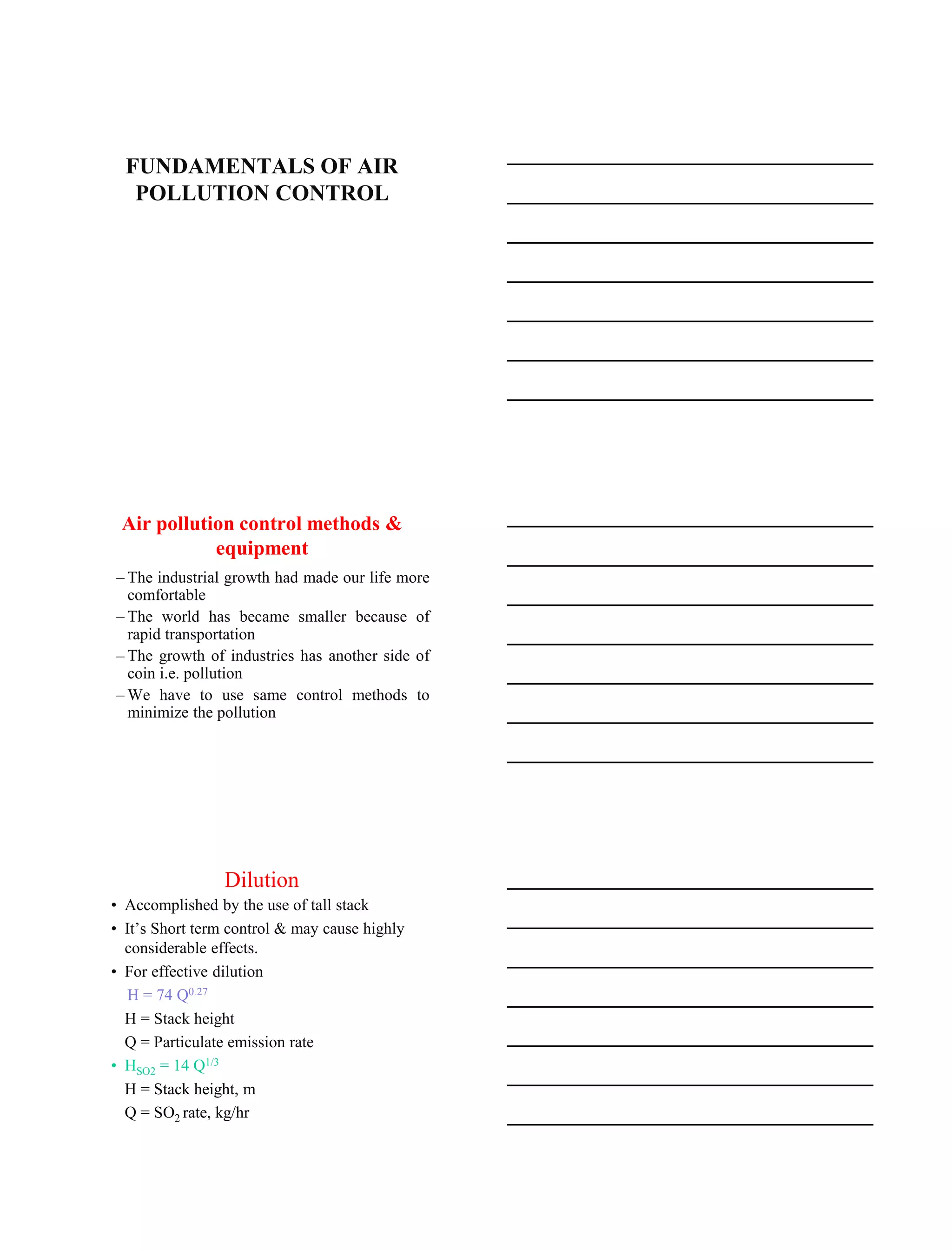
FUNDAMENTALS OF AIR
POLLUTION CONTROL
Air pollution control methods &
equipment
– The industrial growth had made our life more
comfortable
– The world has became smaller because of
rapid transportation
– The growth of industries has another side of
coin i.e. pollution
– We have to use same control methods to
minimize the pollution
Dilution
• Accomplished by the use of tall stack
• It’s Short term control & may cause highly
considerable effects.
• For effective dilution
H = 74 Q0.27
H = Stack height
Q = Particulate emission rate
• HSO2 = 14 Q1/3
H = Stack height, m
Q = SO2 rate, kg/hr
15-08-2020
2
Gravity settling
Absorption
• Natural Absorption process
– Particulate or Gaseous
• Below cloud level
• Falling rain drops absorbs pollutants called
as Washout or scavenging
• Does not remove particles less than 1µm in
size.
• Gaseous pollutants removed in dissolved
state with moisture with or without
chemical changes.
Rain
15-08-2020
3
Adsorption
• Prevention is Better than cure…..
• Try to minimize the WASTE at SOURCE
• It can be done by
– Investigation of various approaches at early stage of
process design & Development
– Selection of method which do not contribute pollution
– This methods are called as source correction
methods….
– Application of this methods are difficult in the existing
plant, but still could be applied without severely
upsetting the economy of the operation
Control of pollution at SOURCE
• Raw material changes
• Operational changes
• Modification or replacement of process
equipment
• By more effective operation of existing
equipment
15-08-2020
4
Raw material changes
• If raw material is responsible for causing air
pollution
– Use of a purer grade of raw material
• Reduce undesirable impurities & by-product
• Eliminate treatment of effluent gas
– Use of low sulfur fuel in place of higher ones
• Limited availability of low sulfur fuel for wholesale use
• Fuel desufurisation is an attractive alternative
– Ore handling operation usually result in emission of
large quantities of dust into atmosphere.
• In steel industries replacement of raw ore
with pelleted ore has gradually reduced dust
emission
Process change
• It involves new or modified techniques to
lowering atmospheric pollutant emissions
• Radical changes in chemical & petroleum
refining had minimized the material
emission to atmosphere.
– The volatile substance are recovered by
condensation & the non-condensable gases are
recycled for additional reaction
15-08-2020
5
• Rotary kiln are major source of dust
generation in cement plant.
• Some dust is controlled by adjusting
operating conditions such as
– reduction of gas velocities
– modification of the rate
– location of feed introduction
• Smelting & paper industries are major
source of emission of sulphourous material
• It can be reduced by major process changes
such as
– hydro-metallurgical separation of ore
– Avoiding use of sulphide in paper making
• Formation of nitric oxide in combustion
chamber reduce by low excess air
combustion by flue gas recirculation &
water injection
• The fly ash emission from coal
pulverization reduce by washing of coal
before pulverization
15-08-2020
6
Equipment modification or
replacement
• In petroleum industries hydrocarbon vapors
are released into atmosphere from storage
tanks due to temperature changes, direct
evaporation and displacement during filling.
• These can be minimized by designing tank
with floating roof covers or by pressurizing
the tanks.
• Replacement of open hearth furnace with
oxygen furnace in steel industries
• Use of alternative power source for
automobiles in place of internal combustion
Engine.
• In addition to above three methods, air
pollutant emission can be reduced by
– proper equipment maintenance
– housekeeping
– changes in the design of local exhaust hood &
proper installation
• Chemical plants have excessive leakage
around ducts, piping, valves & pumps.
Checking the seals routinely can prevent
such leaks
• Floor, storage bins, loading areas &
material transmitter conveyors must be kept
clean to reduce dust pollution.

5. source correction methods

  • 1.
    15-08-2020 1 FUNDAMENTALS OF AIR POLLUTIONCONTROL Air pollution control methods & equipment – The industrial growth had made our life more comfortable – The world has became smaller because of rapid transportation – The growth of industries has another side of coin i.e. pollution – We have to use same control methods to minimize the pollution Dilution • Accomplished by the use of tall stack • It’s Short term control & may cause highly considerable effects. • For effective dilution H = 74 Q0.27 H = Stack height Q = Particulate emission rate • HSO2 = 14 Q1/3 H = Stack height, m Q = SO2 rate, kg/hr
  • 2.
    15-08-2020 2 Gravity settling Absorption • NaturalAbsorption process – Particulate or Gaseous • Below cloud level • Falling rain drops absorbs pollutants called as Washout or scavenging • Does not remove particles less than 1µm in size. • Gaseous pollutants removed in dissolved state with moisture with or without chemical changes. Rain
  • 3.
    15-08-2020 3 Adsorption • Prevention isBetter than cure….. • Try to minimize the WASTE at SOURCE • It can be done by – Investigation of various approaches at early stage of process design & Development – Selection of method which do not contribute pollution – This methods are called as source correction methods…. – Application of this methods are difficult in the existing plant, but still could be applied without severely upsetting the economy of the operation Control of pollution at SOURCE • Raw material changes • Operational changes • Modification or replacement of process equipment • By more effective operation of existing equipment
  • 4.
    15-08-2020 4 Raw material changes •If raw material is responsible for causing air pollution – Use of a purer grade of raw material • Reduce undesirable impurities & by-product • Eliminate treatment of effluent gas – Use of low sulfur fuel in place of higher ones • Limited availability of low sulfur fuel for wholesale use • Fuel desufurisation is an attractive alternative – Ore handling operation usually result in emission of large quantities of dust into atmosphere. • In steel industries replacement of raw ore with pelleted ore has gradually reduced dust emission Process change • It involves new or modified techniques to lowering atmospheric pollutant emissions • Radical changes in chemical & petroleum refining had minimized the material emission to atmosphere. – The volatile substance are recovered by condensation & the non-condensable gases are recycled for additional reaction
  • 5.
    15-08-2020 5 • Rotary kilnare major source of dust generation in cement plant. • Some dust is controlled by adjusting operating conditions such as – reduction of gas velocities – modification of the rate – location of feed introduction • Smelting & paper industries are major source of emission of sulphourous material • It can be reduced by major process changes such as – hydro-metallurgical separation of ore – Avoiding use of sulphide in paper making • Formation of nitric oxide in combustion chamber reduce by low excess air combustion by flue gas recirculation & water injection • The fly ash emission from coal pulverization reduce by washing of coal before pulverization
  • 6.
    15-08-2020 6 Equipment modification or replacement •In petroleum industries hydrocarbon vapors are released into atmosphere from storage tanks due to temperature changes, direct evaporation and displacement during filling. • These can be minimized by designing tank with floating roof covers or by pressurizing the tanks. • Replacement of open hearth furnace with oxygen furnace in steel industries • Use of alternative power source for automobiles in place of internal combustion Engine. • In addition to above three methods, air pollutant emission can be reduced by – proper equipment maintenance – housekeeping – changes in the design of local exhaust hood & proper installation • Chemical plants have excessive leakage around ducts, piping, valves & pumps. Checking the seals routinely can prevent such leaks • Floor, storage bins, loading areas & material transmitter conveyors must be kept clean to reduce dust pollution.