BX-KPI-E-DN-
VERSION 2.0
1 of
74
KPIKPI
Key Performance IndicatorKey Performance Indicator
Introduction
Implementation
Integration
2 of
74
BX-KPI-E-DN-
VERSION 2.0
Training ObjectivesTraining Objectives

Participants will have the following
opportunities :
 Understood the step to develop KPIs
Organizational KPI
Operational KPI
 Identify Critical Success Factor for both levels
of KPIs
 Learn how Process Mapping technique can be
used to identify the Operational KPIs
3 of
74
BX-KPI-E-DN-
VERSION 2.0
AgendaAgenda

Introduction

Deployment Option

Organizational KPI

Operational KPI

Process Mapping

Measuring Baseline & Objective
Setting

Using KPI
BX-KPI-E-DN-
VERSION 2.0
4 of
74
Opening ActivityOpening Activity
Identify Current Performance Measures
BX-KPI-E-DN-
VERSION 2.0
5 of
74
Introduction to KPIIntroduction to KPI
6 of
74
BX-KPI-E-DN-
VERSION 2.0
What is KPI?What is KPI?

A set of measures focusing on
 The aspects of organizational
performance that
 are most critical for the current and
future success of the organization
7 of
74
BX-KPI-E-DN-
VERSION 2.0
Common Application of KPICommon Application of KPI

Process Improvement

Benchmarking

Strategic and business planning
8 of
74
BX-KPI-E-DN-
VERSION 2.0
When to use KPI technique?When to use KPI technique?

You are small company.

You do not have Strategic/Business
Planning Process.

You have to many management layers
in your organization.
9 of
74
BX-KPI-E-DN-
VERSION 2.0
2 Levels of KPIs2 Levels of KPIs

Organizational-Level KPI
 Organizational alignment
 Tracking Strategic Action Plan

Operational-Level KPI
 Tracking Daily Operation
BX-KPI-E-DN-
VERSION 2.0
10 of
74
Deployment OptionDeployment Option
Organizational KPI – Top Down
Operational KPI – Bottom Up
11 of
74
BX-KPI-E-DN-
VERSION 2.0
Organizational KPIOrganizational KPI

Top Down

Focus on:
 Strategic Alignment
 Leadership Direction
12 of
74
BX-KPI-E-DN-
VERSION 2.0
Top Down KPITop Down KPI
Determine
Stakeholder Identify CSFs
Determine
Perspective
Organization KPIs
Organizational Level
2
3
1
Measure Baseline & Set Objectives
Monitor, Review, Keep Current5
4
13 of
74
BX-KPI-E-DN-
VERSION 2.0
Operational KPIOperational KPI

Bottom Up

Focus on:
 Empowerment
 Employee Involvement
14 of
74
BX-KPI-E-DN-
VERSION 2.0
Bottom Up KPIBottom Up KPI
Organizational
CSF
Process
Perspective
Organizational
KPIs
Process
CSFs
Operational
KPIs
Organizational Level Operational Level
1
3
2
A
Measure Baseline & Set Objectives
Monitor, Review, Keep Current5
4
BX-KPI-E-DN-
VERSION 2.0
15 of
74
I. Organizational KPII. Organizational KPI
High-Level KPI
16 of
74
BX-KPI-E-DN-
VERSION 2.0
High-level KPIHigh-level KPI

Organizational KPIs is
 30,000 feet level
 Overall Organizational Performance
Finance
External Customer
Overall Resource
 Difficult to deploy to operator-level
17 of
74
BX-KPI-E-DN-
VERSION 2.0
5 Steps for Developing Organizational KPI5 Steps for Developing Organizational KPI

Step 1:
 Analyze Stakeholders and Determine Strategic
Perspectives

Step 2:
 Identify Critical Success Factors

Step 3:
 Develop Organizational & Operational KPIs

Step 4:
 Measure Baseline & Set Objective

Step 5:
 Monitor, Review, and Keep Current
BX-KPI-E-DN-
VERSION 2.0
18 of
74
Step 1: Analyze Stakeholder &Step 1: Analyze Stakeholder &
Determine Strategic PerspectiveDetermine Strategic Perspective
Organizational KPI
19 of
74
BX-KPI-E-DN-
VERSION 2.0
Purpose of Step 1Purpose of Step 1

Determine Key Strategic Perspective
 To align, link, and balance all KPIs from
Organizational Levels
 To ensure that all KPIs are balancing
value for all key stakeholders

Most organization use the Four
Perspectives from Balanced Scorecard
20 of
74
BX-KPI-E-DN-
VERSION 2.0
Balanced ScorecardBalanced Scorecard
4 Perspective Grouping4 Perspective Grouping

BSC methodology groups those KBFs
into 4 Perspectives
 Financial Perspective
 Customer Perspective
 Internal Business Process Perspective
 Learning & Growth Perspective
21 of
74
BX-KPI-E-DN-
VERSION 2.0
4 Perspectives of BSC4 Perspectives of BSC
22 of
74
BX-KPI-E-DN-
VERSION 2.0
How to set the Perspective?How to set the Perspective?

It depends on type of your
organization.
 Not-for-profit organization
 Production and ship to mother company
 Etc.

Set by grouping from
 Key Stakeholder
 Business Results
 BSC methodology
23 of
74
BX-KPI-E-DN-
VERSION 2.0
Key StakeholdersKey Stakeholders

Key Stakeholders include:

According to Baldrige Criteria and Thailand Quality
Award Criteria,
Customers
Employees,
Partners/Suppliers,
Stockholders, and
Local/Professional
Communities
24 of
74
BX-KPI-E-DN-
VERSION 2.0
Stakeholder AnalysisStakeholder Analysis

What are the needs of business?

What are the needs of key stakeholders?

How to balance those needs?
 How do business needs impact the key
stakeholders?
 How do stakeholders’ needs impact our
business?
 How do stakeholders’ needs impact each
other?
25 of
74
BX-KPI-E-DN-
VERSION 2.0
Key Areas of Business ResultsKey Areas of Business Results

These business results are aligned with the
key stakeholders
1 Customer-Focused Results
2 Product and Service Results
3 Financial and Market Results
4 Human Resource Results
5 Organizational Effectiveness Results
6 Governance and Social Responsibility Results
26 of
74
BX-KPI-E-DN-
VERSION 2.0
Four Perspectives!Four Perspectives!
Are they too few or too many?Are they too few or too many?

A template, not a must.
 Depending on business circumstances &
strategy

Focus on shareholders and customers,
 Employee is part of learning & growth.
 If supplier relationships are part of the
strategy
should be part of internal-business-process
 Environment, Laws and Regulations may be
important
but they are not the basis for competitive
advantage
BX-KPI-E-DN-
VERSION 2.0
27 of
74
Step 2: Identify CSFStep 2: Identify CSF
Organizational KPI
28 of
74
BX-KPI-E-DN-
VERSION 2.0
CSFCSF

Critical Success Factors
 CSFs represent set of objectives or
strategies focusing on the perspectives
of organizational performance that are
most critical for the current and future
success of the organization.
“Each KPI has to align with at least one CSF”
29 of
74
BX-KPI-E-DN-
VERSION 2.0
AlignmentAlignment
Perspective 1
CSF 1.2
CSF 1.1
KPI 1.1.2
KPI 1.1.2
KPI 1.1.3
Perspective 2
CSF 2.2
CSF 2.1
Perspective 3
30 of
74
BX-KPI-E-DN-
VERSION 2.0
CSFsCSFs

Factors that provide context
 Strategic Direction chosen by
Organization
 Competitive Situation
 Legal & Regulatory Environment
 Key Customer Requirements
 Stated Organizational Values
31 of
74
BX-KPI-E-DN-
VERSION 2.0
Where can we get CSFs?Where can we get CSFs?

Identify CSF from:
Mission/Vision/Values
Situation/Market Analysis
Competitor Analysis
SWOT Analysis
32 of
74
BX-KPI-E-DN-
VERSION 2.0
CSF and PerspectivesCSF and Perspectives

Do not forget that all CSFs have to
align with key Perspectives identified
in Step 1.

A company should not have too many
CSFs !!
 Between 15-20 CSFs
33 of
74
BX-KPI-E-DN-
VERSION 2.0
Cause & Effect of CSFsCause & Effect of CSFs
Improve Returns
Broaden Revenue
Mix
Increase Customer
Confidence in Our
Financial Advice
Understand
Customer
Segments
Develop
Strategic skills
Develop
New
Products
Cross -Sell
The Product
Line
Shift to
Appropriate
Channel
Minimize
Problems
Provide
Rapid
Response
Increase
Employee
Productivity
Align personal
Goals
Access to
Strategic Inf.
Improve Operating
Efficiency
Increase Customer
Satisfaction Through
Superior Execution
The Revenue Growth Strategy The Productivity Strategy
Improve Returns
34 of
74
BX-KPI-E-DN-
VERSION 2.0
CSFs for Financial PerspectiveCSFs for Financial Perspective

Increased sales

New business

Higher earnings per employee

Cash flow

Improved cost performance
35 of
74
BX-KPI-E-DN-
VERSION 2.0
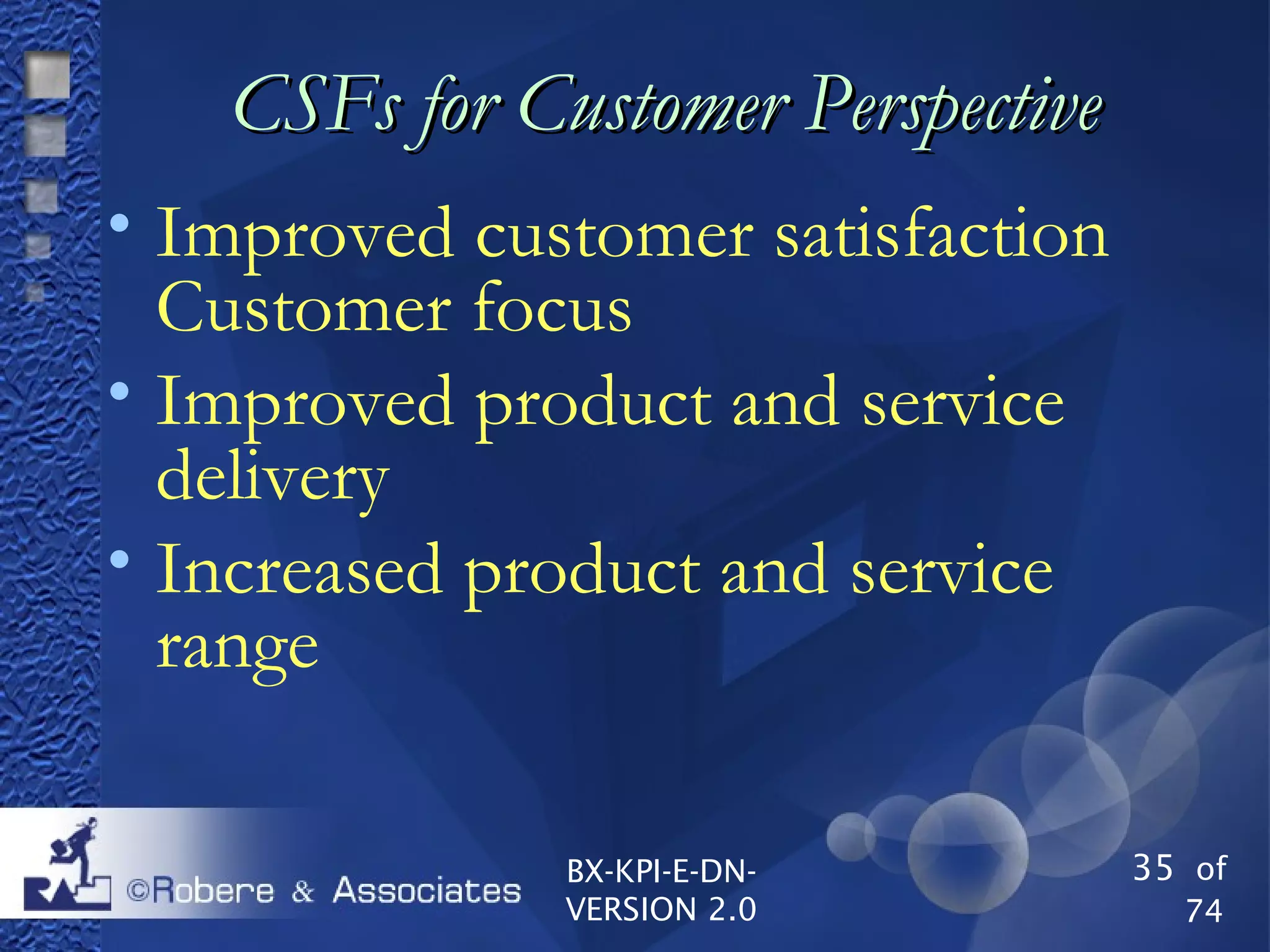
CSFs for Customer PerspectiveCSFs for Customer Perspective

Improved customer satisfaction
Customer focus

Improved product and service
delivery

Increased product and service
range
36 of
74
BX-KPI-E-DN-
VERSION 2.0
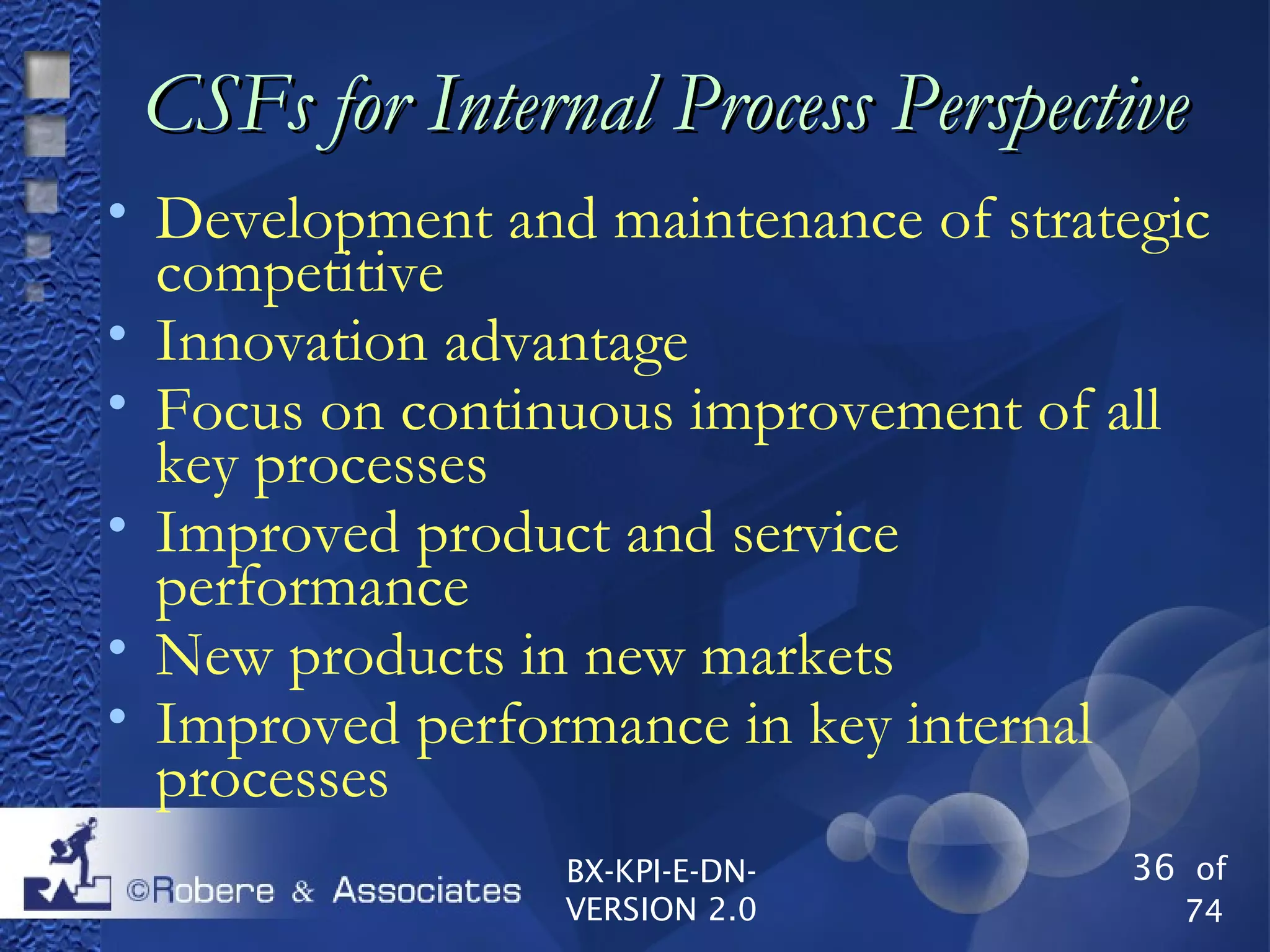
CSFs for Internal Process PerspectiveCSFs for Internal Process Perspective

Development and maintenance of strategic
competitive

Innovation advantage

Focus on continuous improvement of all
key processes

Improved product and service
performance

New products in new markets

Improved performance in key internal
processes
37 of
74
BX-KPI-E-DN-
VERSION 2.0
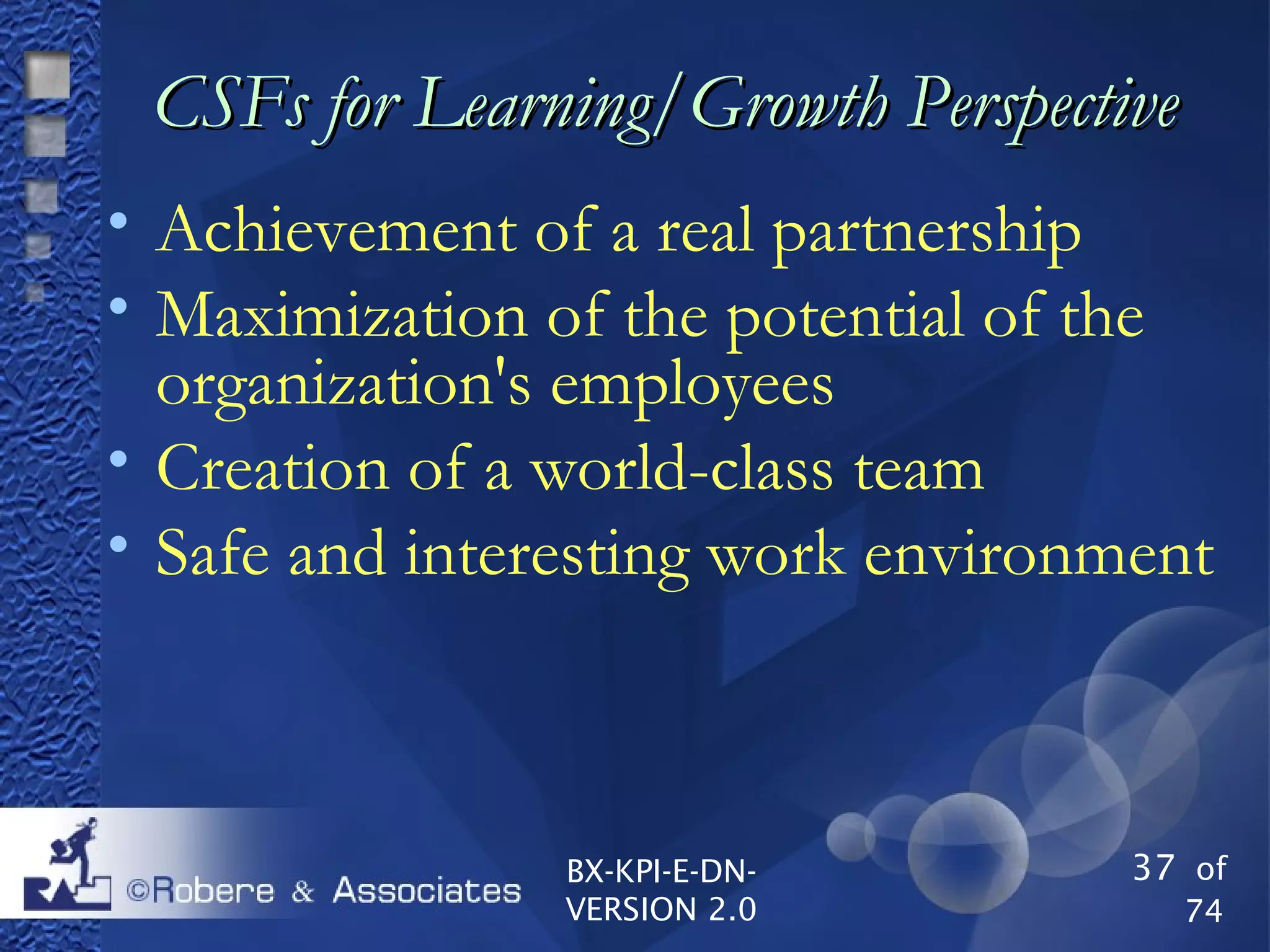
CSFs for Learning/Growth PerspectiveCSFs for Learning/Growth Perspective

Achievement of a real partnership

Maximization of the potential of the
organization's employees

Creation of a world-class team

Safe and interesting work environment
BX-KPI-E-DN-
VERSION 2.0
38 of
74
Step 3: Develop Organizational KPIStep 3: Develop Organizational KPI
Organizational KPI
39 of
74
BX-KPI-E-DN-
VERSION 2.0
How to?How to?

Identify KPIs from:
Critical Success FactorsCritical Success Factors
listed in previous step
40 of
74
BX-KPI-E-DN-
VERSION 2.0
Align KPIs to the Key PerspectivesAlign KPIs to the Key Perspectives
Financial Perspective
Internal Business
Process Perspective
Learning & Growth
Perspective
Customer PerspectiveKPIs
41 of
74
BX-KPI-E-DN-
VERSION 2.0
ExamplesofExamplesof
OrganizationalKPIOrganizationalKPI
Critical Success Factor
Organizational KPI
BX-KPI-E-DN-
VERSION 2.0
42 of
74
II. Operational KPIII. Operational KPI
Lower-Level KPI
43 of
74
BX-KPI-E-DN-
VERSION 2.0
Why do we need Lower-Level KPIs?Why do we need Lower-Level KPIs?

Organizational KPIs (high-level) just
cover overall company health and
performance
 They do not cover process and sub-
process performance

Without the Operational KPIs, front-
line operators will loss direction and
focus.
44 of
74
BX-KPI-E-DN-
VERSION 2.0
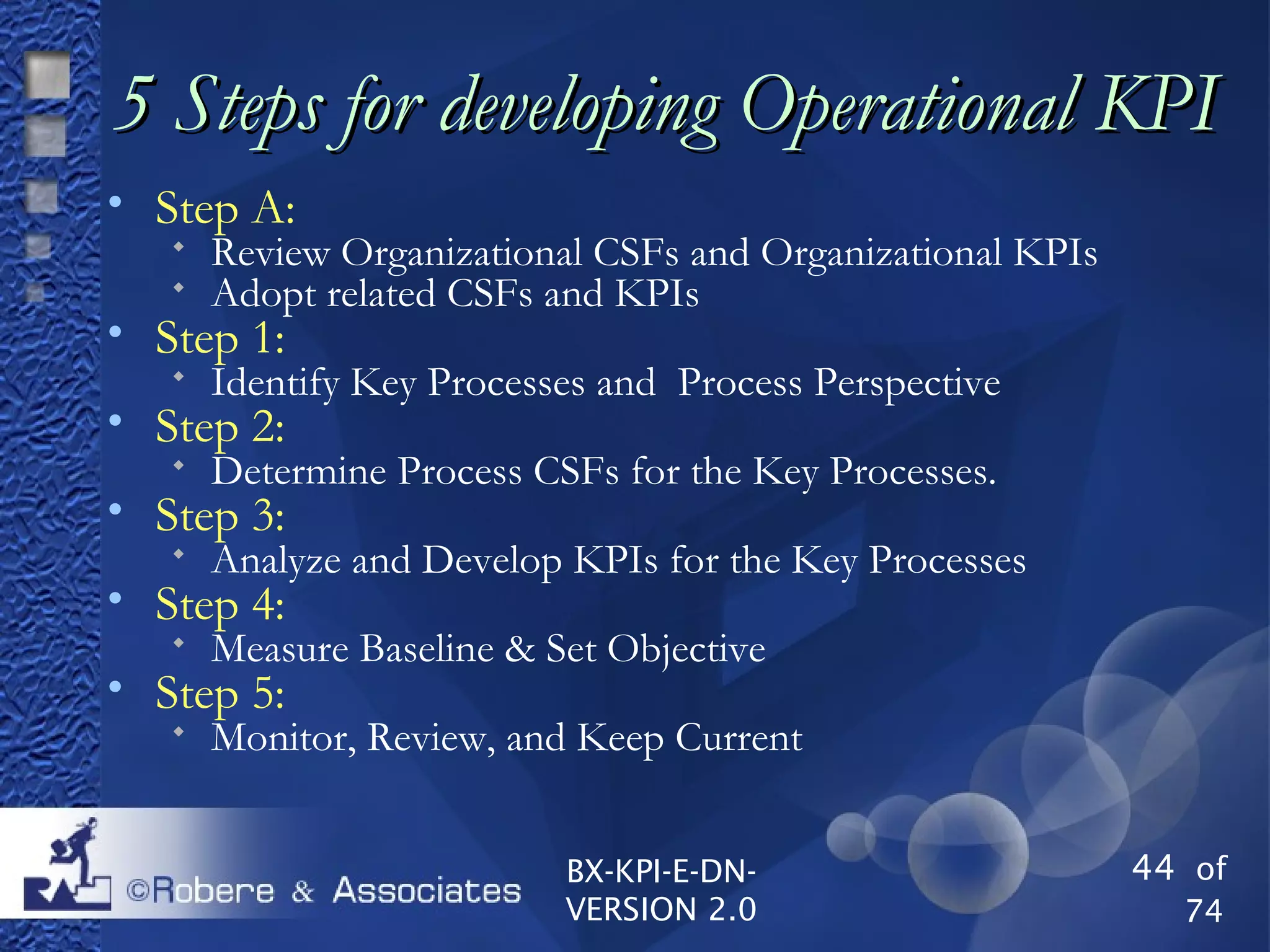
5 Steps for developing Operational KPI5 Steps for developing Operational KPI

Step A:
 Review Organizational CSFs and Organizational KPIs
 Adopt related CSFs and KPIs

Step 1:
 Identify Key Processes and Process Perspective

Step 2:
 Determine Process CSFs for the Key Processes.

Step 3:
 Analyze and Develop KPIs for the Key Processes

Step 4:
 Measure Baseline & Set Objective

Step 5:
 Monitor, Review, and Keep Current
45 of
74
BX-KPI-E-DN-
VERSION 2.0
Levels of Operational KPILevels of Operational KPI

Depends on size of an organization
 Department Level
 Team Level

Note:
 Some Organization KPIs can be used as
Operational KPIs.
 Some Organizational CSFs can be used
as Operational CSFs.
BX-KPI-E-DN-
VERSION 2.0
46 of
74
Step 1: Identify Key ProcessesStep 1: Identify Key Processes
& Perspectives& Perspectives
Operational KPI
47 of
74
BX-KPI-E-DN-
VERSION 2.0
Step 1: Identify Key Processes and PerspectivesStep 1: Identify Key Processes and Perspectives

Focus on
 Value Creation Processes
 Support Processes

Recommended Tools:
 Process Mapping
SIPOC Map
Detailed Functional Map
48 of
74
BX-KPI-E-DN-
VERSION 2.0
Value Creation ProcessesValue Creation Processes

Critical internal processes in which the organization
must excel.
49 of
74
BX-KPI-E-DN-
VERSION 2.0
Support Processes Might IncludeSupport Processes Might Include

Support processes might include:
 Finance and accounting
 Facilities management
 Administration
 Legal
 Human Resource
 Project Management
50 of
74
BX-KPI-E-DN-
VERSION 2.0
Key PerspectivesKey Perspectives

Team has to determine what
perspectives should be used with those
key processes.

Recommended perspective:
 Quality
 Cost
 Time
 Inventory
 Etc..
BX-KPI-E-DN-
VERSION 2.0
51 of
74
Step 2: Identify Process CSFsStep 2: Identify Process CSFs
Operational KPI
52 of
74
BX-KPI-E-DN-
VERSION 2.0
Identify Process CSFIdentify Process CSF

For each key process selected
 Determine key objectives (CSFs)
 For example:
Reduce lead time of changing
jig/fixture
Reduce WIP at machining process
53 of
74
BX-KPI-E-DN-
VERSION 2.0
CSF vs. VOCCSF vs. VOC

Voice of Customer can be used as CSF

Every process has to have its own
customer – person or processes that
receive the output.

Identify the customers and interview
what they need may be a good point to
start.
54 of
74
BX-KPI-E-DN-
VERSION 2.0
Deployed from Higher-LevelDeployed from Higher-Level

Some process CSFs may be directly
deployed from Organizational CSFs
BX-KPI-E-DN-
VERSION 2.0
55 of
74
Step 3: Identify KPIStep 3: Identify KPI
Operational KPI
56 of
74
BX-KPI-E-DN-
VERSION 2.0
Step 3: Identify & Select KPIsStep 3: Identify & Select KPIs

Operational KPI
 Identify by using Process Mapping
technique
 Deployed from Organizational KPI
 Align with Process CSFs (VOC)
 Cover all key process Perspectives
57 of
74
BX-KPI-E-DN-
VERSION 2.0
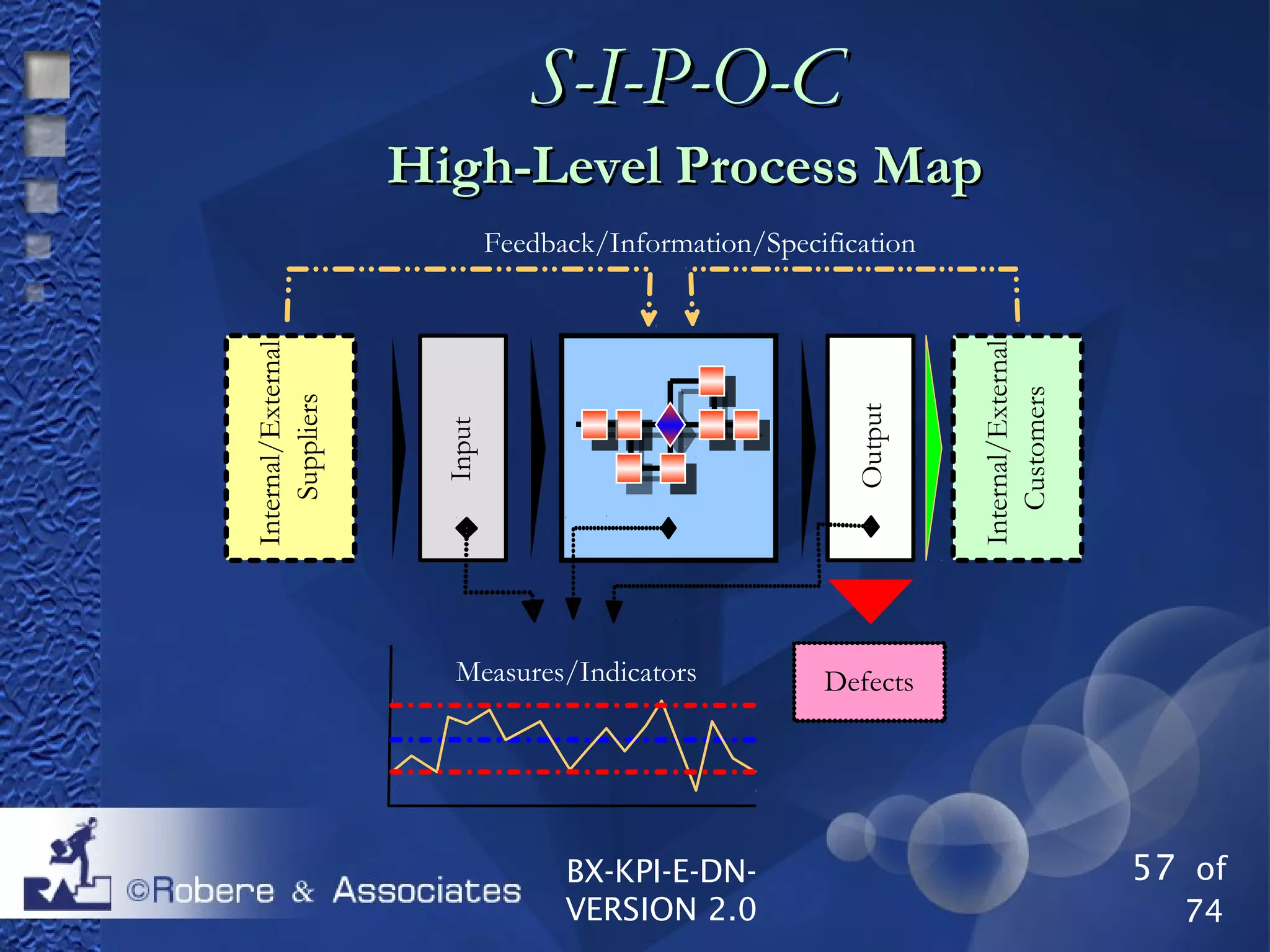
S-I-P-O-CS-I-P-O-C
High-Level Process MapHigh-Level Process Map
Input
Internal/External
Suppliers
Output
Internal/External
Customers
DefectsMeasures/Indicators
Feedback/Information/Specification
58 of
74
BX-KPI-E-DN-
VERSION 2.0
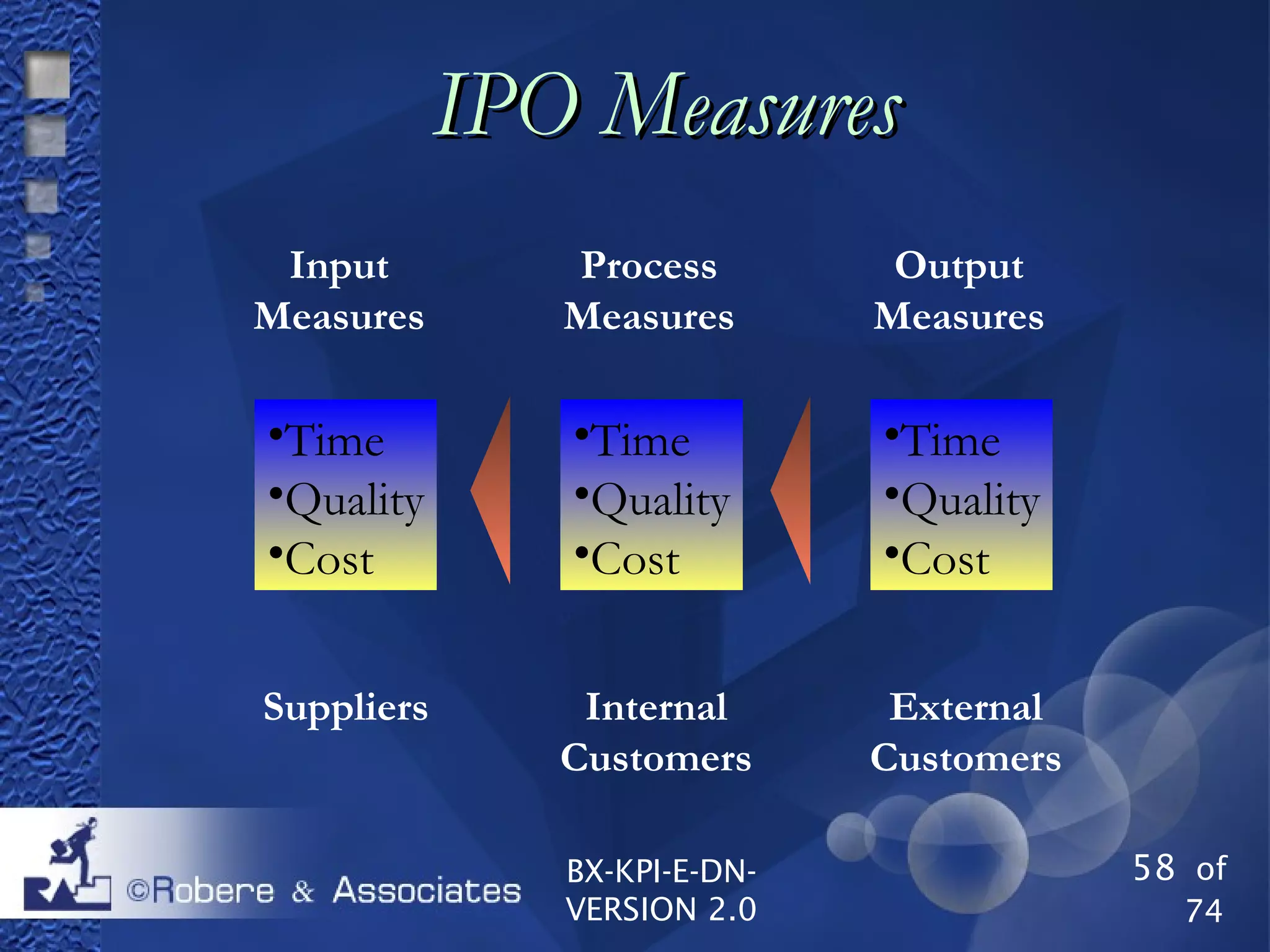
IPO MeasuresIPO Measures
Input
Measures
Process
Measures
Output
Measures
•Time
•Quality
•Cost
Suppliers Internal
Customers
External
Customers
•Time
•Quality
•Cost
•Time
•Quality
•Cost
59 of
74
BX-KPI-E-DN-
VERSION 2.0
Functional Process MapFunctional Process Map
Acquire CCR Produce Delivery Evaluate
Customer
Front Office
Back Office
Support
60 of
74
BX-KPI-E-DN-
VERSION 2.0
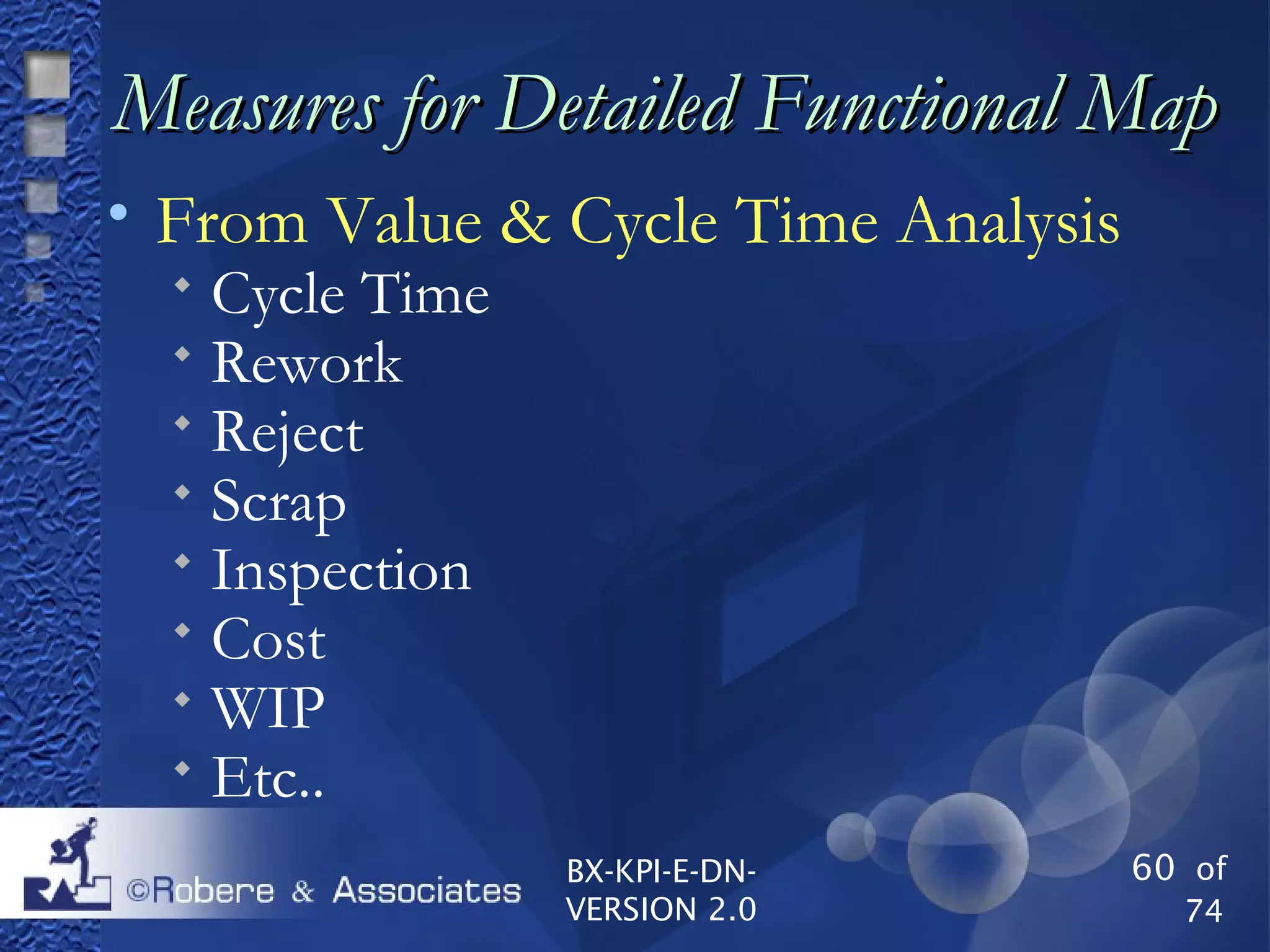
Measures for Detailed Functional MapMeasures for Detailed Functional Map

From Value & Cycle Time Analysis
 Cycle Time
 Rework
 Reject
 Scrap
 Inspection
 Cost
 WIP
 Etc..
61 of
74
BX-KPI-E-DN-
VERSION 2.0
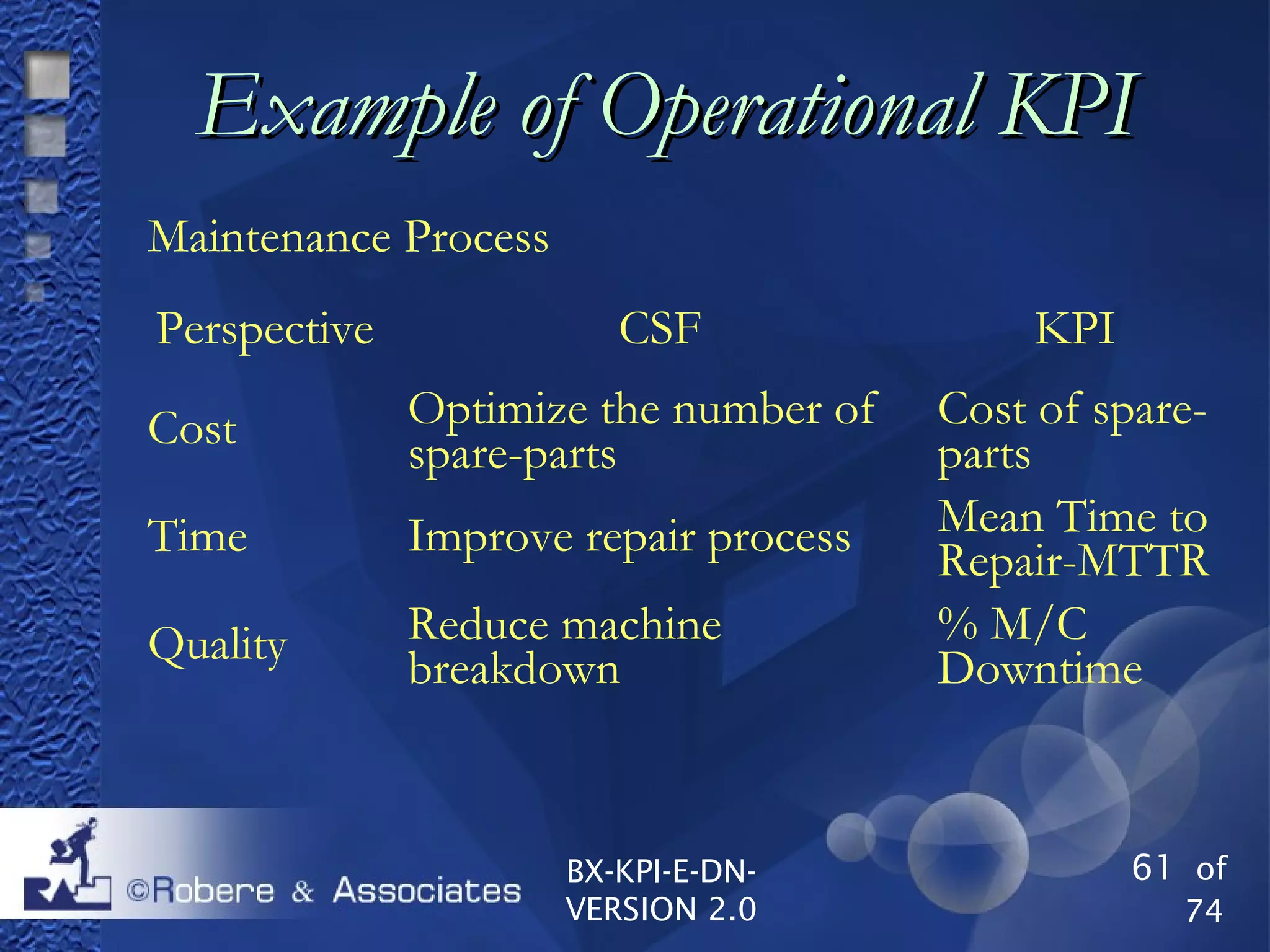
Example of Operational KPIExample of Operational KPI
Maintenance Process
Perspective CSF KPI
Cost Optimize the number of
spare-parts
Cost of spare-
parts
Time Improve repair process Mean Time to
Repair-MTTR
Quality Reduce machine
breakdown
% M/C
Downtime
BX-KPI-E-DN-
VERSION 2.0
62 of
74
Step 5:Step 5:
Measure Baseline & Target SettingMeasure Baseline & Target Setting
Last Step before Deployment
63 of
74
BX-KPI-E-DN-
VERSION 2.0
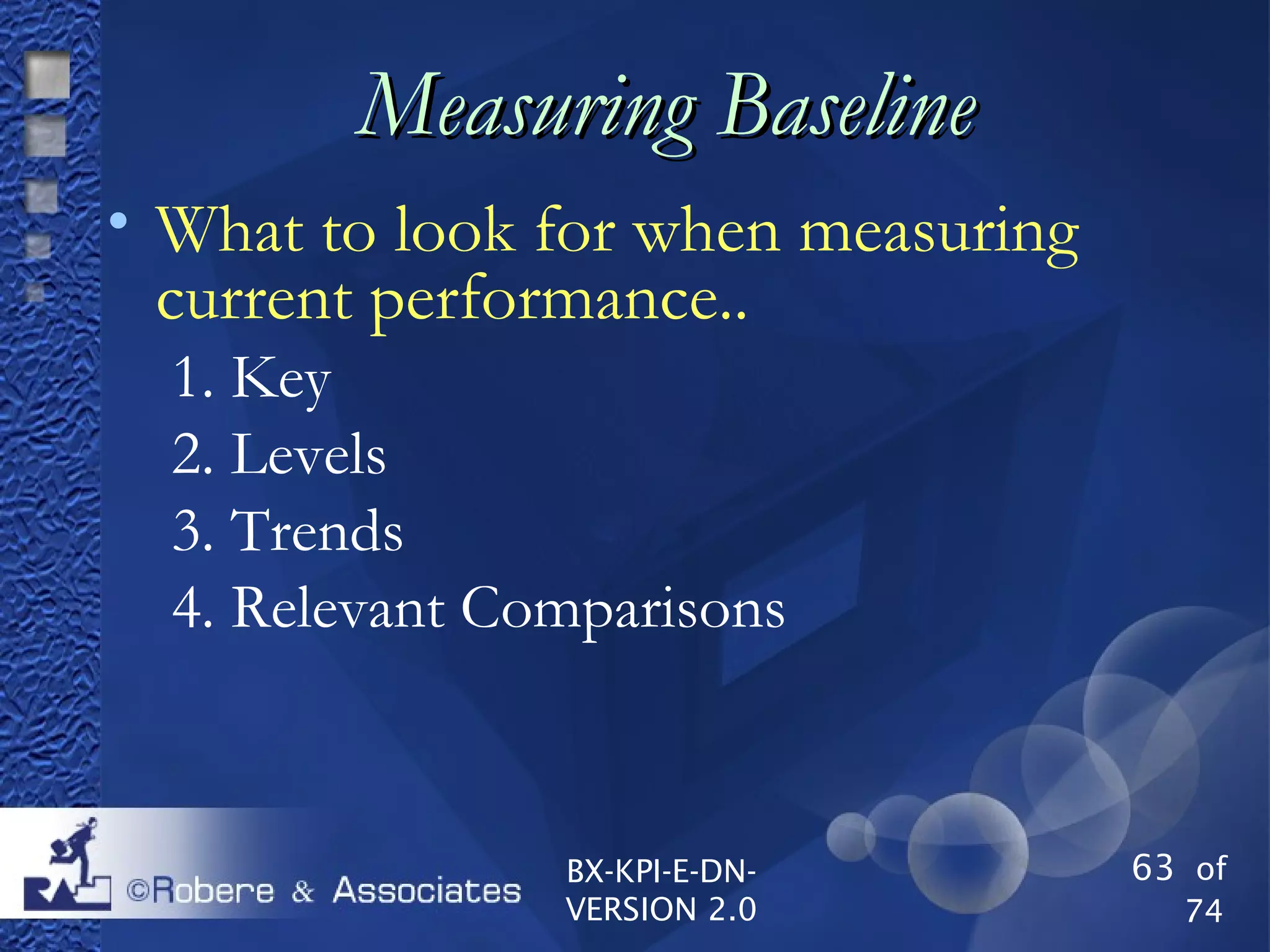
Measuring BaselineMeasuring Baseline

What to look for when measuring
current performance..
1. Key
2. Levels
3. Trends
4. Relevant Comparisons
64 of
74
BX-KPI-E-DN-
VERSION 2.0
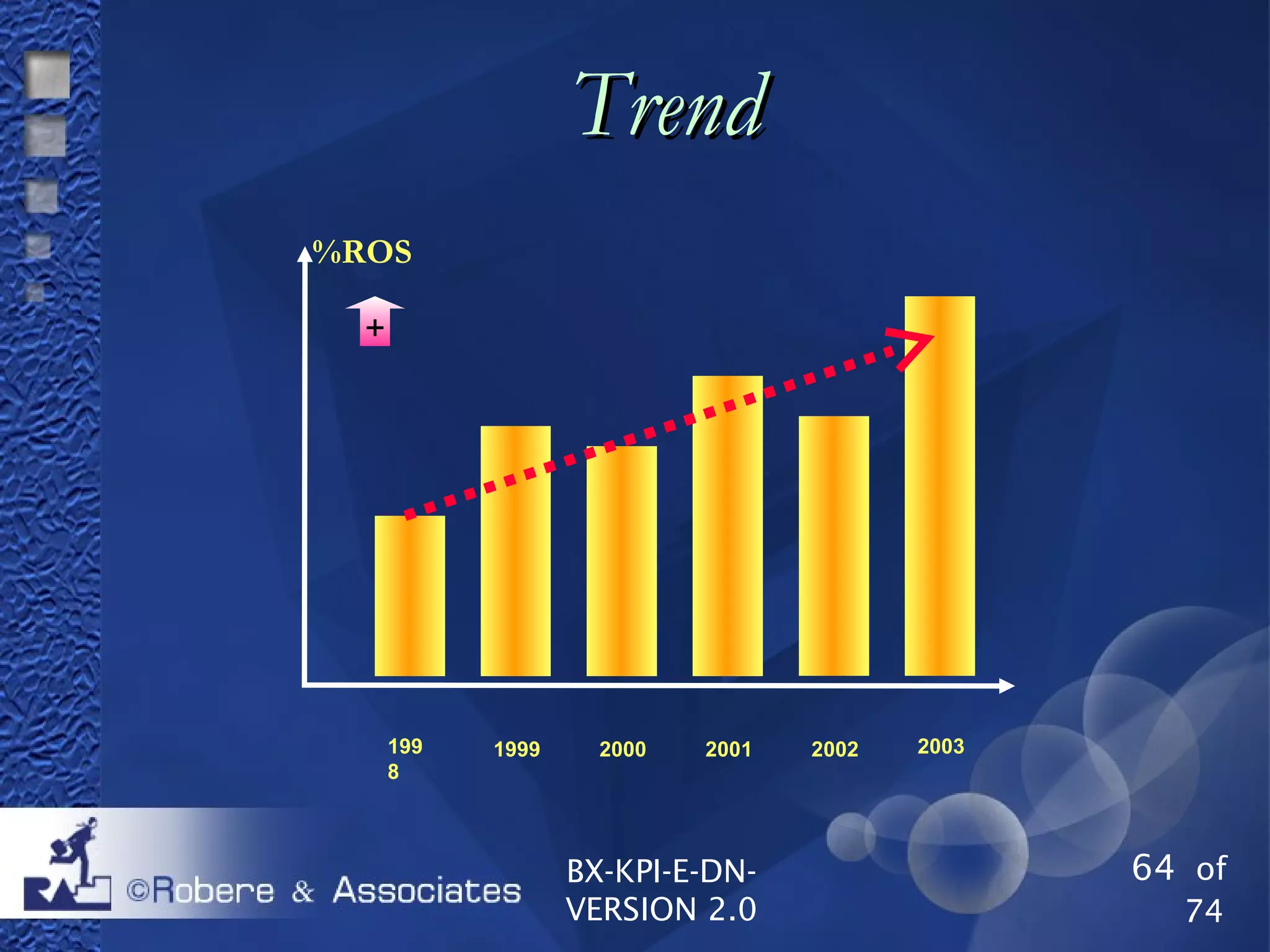
TrendTrend
1999 2000 2001 2002199
8
2003
+
%ROS
65 of
74
BX-KPI-E-DN-
VERSION 2.0
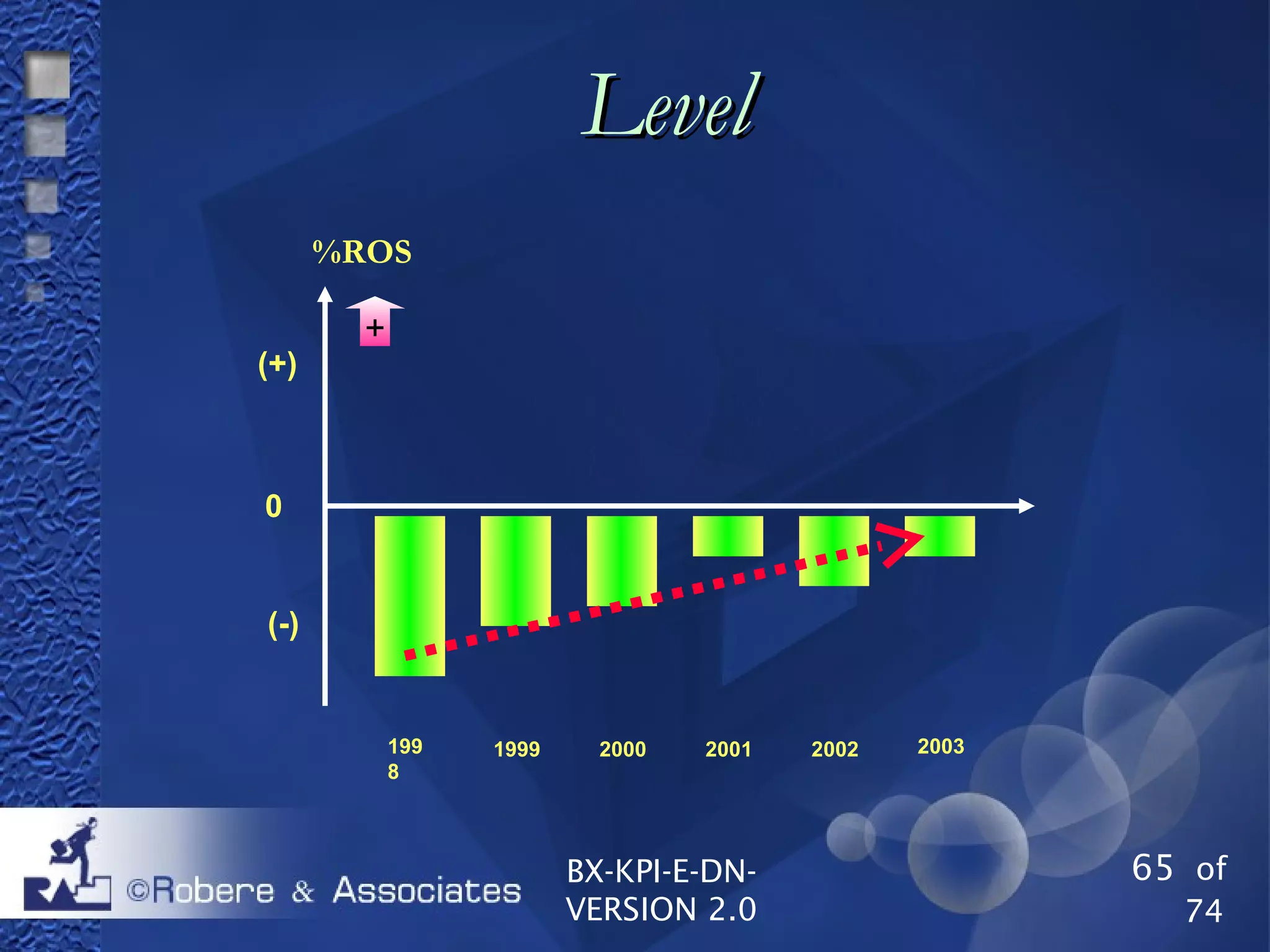
LevelLevel
1999 2000 2001 2002199
8
2003
+
%ROS
0
(+)
(-)
66 of
74
BX-KPI-E-DN-
VERSION 2.0
ComparisonsComparisons
1999 2000 2001 2002199
8
2003
+
%ROS
Best In Class
Competitor A
Industry Avg.
67 of
74
BX-KPI-E-DN-
VERSION 2.0
Relevant ComparisonsRelevant Comparisons

The purpose of comparisons is to help
team evaluate our performance against
norms that represent leadership
position.
68 of
74
BX-KPI-E-DN-
VERSION 2.0
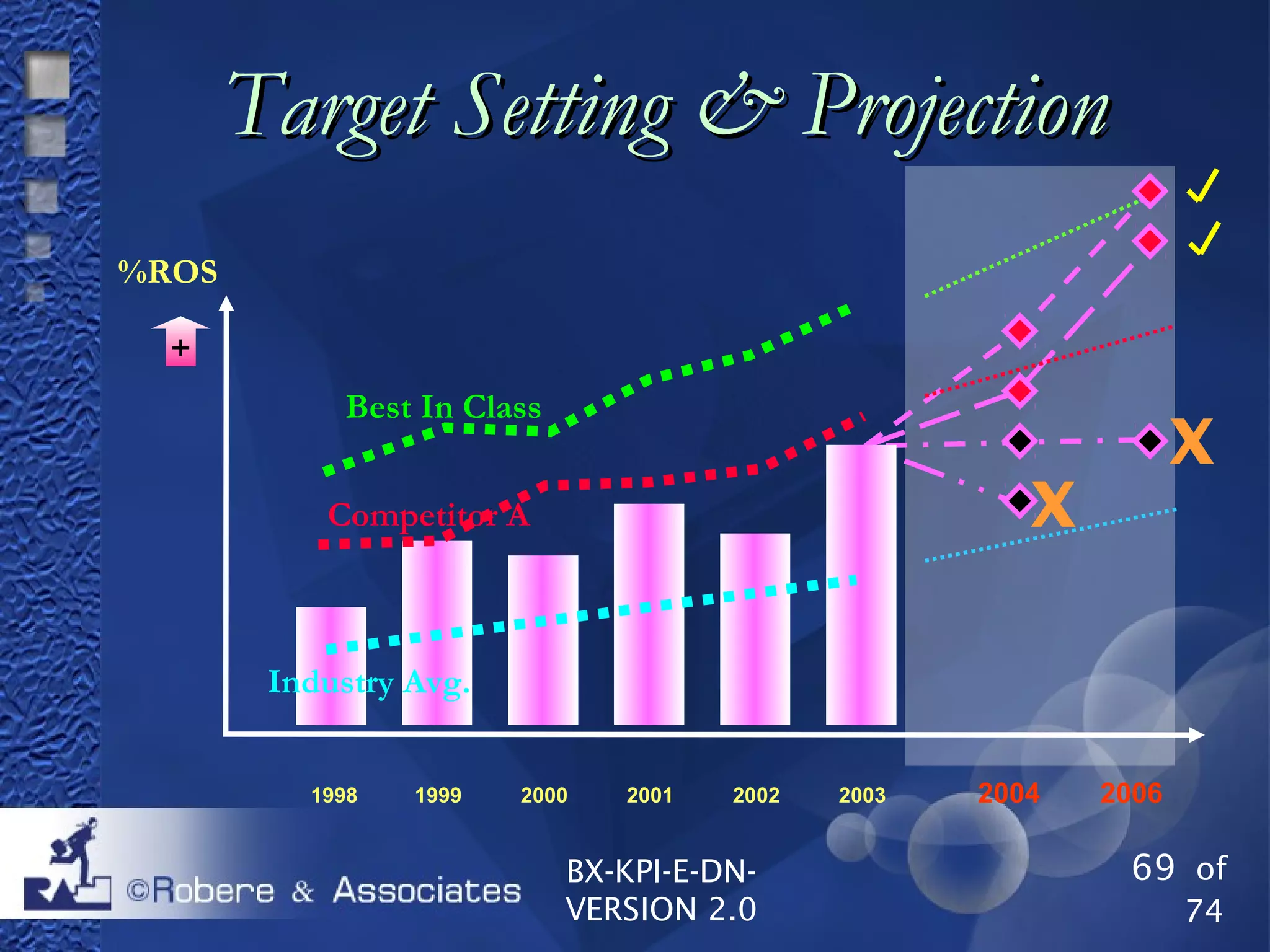
Target SettingTarget Setting

Align with business direction

Target must be better than current
status (baseline)
 Short term target must be better than
this year.
 Longer term target must be better than
that of competitor, best-in-class, or
industry average.
69 of
74
BX-KPI-E-DN-
VERSION 2.0
Target Setting & ProjectionTarget Setting & Projection
1999 2000 2001 20021998 2003
+
%ROS
Best In Class
Competitor A
Industry Avg.
2004 2006
x
x
BX-KPI-E-DN-
VERSION 2.0
70 of
74
Step 6: Deploying KPIStep 6: Deploying KPI
Monitoring
Review
Keep Current
71 of
74
BX-KPI-E-DN-
VERSION 2.0
Use of KPIUse of KPI

Management Review
 Department Review
Monthly
 Organizational Review
Monthly
Quarterly
Yearly

Data/Information Analysis

Benchmarking

Projection/Target Setting
72 of
74
BX-KPI-E-DN-
VERSION 2.0
AnalysisAnalysis

Includes
 trends,
 projections,
 comparisons, and
 cause-effect correlations

intended to support
 performance reviews and
 the settings of priorities for resource use
73 of
74
BX-KPI-E-DN-
VERSION 2.0
Improve KPI SystemsImprove KPI Systems
Improve Evaluate
Measures
BX-KPI-E-DN-
VERSION 2.0
74 of
74
Any Questions?Any Questions?
sixsigma@robere.com
www.robere.com

Kpi 1 day

  • 1.
    BX-KPI-E-DN- VERSION 2.0 1 of 74 KPIKPI KeyPerformance IndicatorKey Performance Indicator Introduction Implementation Integration
  • 2.
    2 of 74 BX-KPI-E-DN- VERSION 2.0 TrainingObjectivesTraining Objectives  Participants will have the following opportunities :  Understood the step to develop KPIs Organizational KPI Operational KPI  Identify Critical Success Factor for both levels of KPIs  Learn how Process Mapping technique can be used to identify the Operational KPIs
  • 3.
    3 of 74 BX-KPI-E-DN- VERSION 2.0 AgendaAgenda  Introduction  DeploymentOption  Organizational KPI  Operational KPI  Process Mapping  Measuring Baseline & Objective Setting  Using KPI
  • 4.
    BX-KPI-E-DN- VERSION 2.0 4 of 74 OpeningActivityOpening Activity Identify Current Performance Measures
  • 5.
  • 6.
    6 of 74 BX-KPI-E-DN- VERSION 2.0 Whatis KPI?What is KPI?  A set of measures focusing on  The aspects of organizational performance that  are most critical for the current and future success of the organization
  • 7.
    7 of 74 BX-KPI-E-DN- VERSION 2.0 CommonApplication of KPICommon Application of KPI  Process Improvement  Benchmarking  Strategic and business planning
  • 8.
    8 of 74 BX-KPI-E-DN- VERSION 2.0 Whento use KPI technique?When to use KPI technique?  You are small company.  You do not have Strategic/Business Planning Process.  You have to many management layers in your organization.
  • 9.
    9 of 74 BX-KPI-E-DN- VERSION 2.0 2Levels of KPIs2 Levels of KPIs  Organizational-Level KPI  Organizational alignment  Tracking Strategic Action Plan  Operational-Level KPI  Tracking Daily Operation
  • 10.
    BX-KPI-E-DN- VERSION 2.0 10 of 74 DeploymentOptionDeployment Option Organizational KPI – Top Down Operational KPI – Bottom Up
  • 11.
    11 of 74 BX-KPI-E-DN- VERSION 2.0 OrganizationalKPIOrganizational KPI  Top Down  Focus on:  Strategic Alignment  Leadership Direction
  • 12.
    12 of 74 BX-KPI-E-DN- VERSION 2.0 TopDown KPITop Down KPI Determine Stakeholder Identify CSFs Determine Perspective Organization KPIs Organizational Level 2 3 1 Measure Baseline & Set Objectives Monitor, Review, Keep Current5 4
  • 13.
    13 of 74 BX-KPI-E-DN- VERSION 2.0 OperationalKPIOperational KPI  Bottom Up  Focus on:  Empowerment  Employee Involvement
  • 14.
    14 of 74 BX-KPI-E-DN- VERSION 2.0 BottomUp KPIBottom Up KPI Organizational CSF Process Perspective Organizational KPIs Process CSFs Operational KPIs Organizational Level Operational Level 1 3 2 A Measure Baseline & Set Objectives Monitor, Review, Keep Current5 4
  • 15.
    BX-KPI-E-DN- VERSION 2.0 15 of 74 I.Organizational KPII. Organizational KPI High-Level KPI
  • 16.
    16 of 74 BX-KPI-E-DN- VERSION 2.0 High-levelKPIHigh-level KPI  Organizational KPIs is  30,000 feet level  Overall Organizational Performance Finance External Customer Overall Resource  Difficult to deploy to operator-level
  • 17.
    17 of 74 BX-KPI-E-DN- VERSION 2.0 5Steps for Developing Organizational KPI5 Steps for Developing Organizational KPI  Step 1:  Analyze Stakeholders and Determine Strategic Perspectives  Step 2:  Identify Critical Success Factors  Step 3:  Develop Organizational & Operational KPIs  Step 4:  Measure Baseline & Set Objective  Step 5:  Monitor, Review, and Keep Current
  • 18.
    BX-KPI-E-DN- VERSION 2.0 18 of 74 Step1: Analyze Stakeholder &Step 1: Analyze Stakeholder & Determine Strategic PerspectiveDetermine Strategic Perspective Organizational KPI
  • 19.
    19 of 74 BX-KPI-E-DN- VERSION 2.0 Purposeof Step 1Purpose of Step 1  Determine Key Strategic Perspective  To align, link, and balance all KPIs from Organizational Levels  To ensure that all KPIs are balancing value for all key stakeholders  Most organization use the Four Perspectives from Balanced Scorecard
  • 20.
    20 of 74 BX-KPI-E-DN- VERSION 2.0 BalancedScorecardBalanced Scorecard 4 Perspective Grouping4 Perspective Grouping  BSC methodology groups those KBFs into 4 Perspectives  Financial Perspective  Customer Perspective  Internal Business Process Perspective  Learning & Growth Perspective
  • 21.
    21 of 74 BX-KPI-E-DN- VERSION 2.0 4Perspectives of BSC4 Perspectives of BSC
  • 22.
    22 of 74 BX-KPI-E-DN- VERSION 2.0 Howto set the Perspective?How to set the Perspective?  It depends on type of your organization.  Not-for-profit organization  Production and ship to mother company  Etc.  Set by grouping from  Key Stakeholder  Business Results  BSC methodology
  • 23.
    23 of 74 BX-KPI-E-DN- VERSION 2.0 KeyStakeholdersKey Stakeholders  Key Stakeholders include:  According to Baldrige Criteria and Thailand Quality Award Criteria, Customers Employees, Partners/Suppliers, Stockholders, and Local/Professional Communities
  • 24.
    24 of 74 BX-KPI-E-DN- VERSION 2.0 StakeholderAnalysisStakeholder Analysis  What are the needs of business?  What are the needs of key stakeholders?  How to balance those needs?  How do business needs impact the key stakeholders?  How do stakeholders’ needs impact our business?  How do stakeholders’ needs impact each other?
  • 25.
    25 of 74 BX-KPI-E-DN- VERSION 2.0 KeyAreas of Business ResultsKey Areas of Business Results  These business results are aligned with the key stakeholders 1 Customer-Focused Results 2 Product and Service Results 3 Financial and Market Results 4 Human Resource Results 5 Organizational Effectiveness Results 6 Governance and Social Responsibility Results
  • 26.
    26 of 74 BX-KPI-E-DN- VERSION 2.0 FourPerspectives!Four Perspectives! Are they too few or too many?Are they too few or too many?  A template, not a must.  Depending on business circumstances & strategy  Focus on shareholders and customers,  Employee is part of learning & growth.  If supplier relationships are part of the strategy should be part of internal-business-process  Environment, Laws and Regulations may be important but they are not the basis for competitive advantage
  • 27.
    BX-KPI-E-DN- VERSION 2.0 27 of 74 Step2: Identify CSFStep 2: Identify CSF Organizational KPI
  • 28.
    28 of 74 BX-KPI-E-DN- VERSION 2.0 CSFCSF  CriticalSuccess Factors  CSFs represent set of objectives or strategies focusing on the perspectives of organizational performance that are most critical for the current and future success of the organization. “Each KPI has to align with at least one CSF”
  • 29.
    29 of 74 BX-KPI-E-DN- VERSION 2.0 AlignmentAlignment Perspective1 CSF 1.2 CSF 1.1 KPI 1.1.2 KPI 1.1.2 KPI 1.1.3 Perspective 2 CSF 2.2 CSF 2.1 Perspective 3
  • 30.
    30 of 74 BX-KPI-E-DN- VERSION 2.0 CSFsCSFs  Factorsthat provide context  Strategic Direction chosen by Organization  Competitive Situation  Legal & Regulatory Environment  Key Customer Requirements  Stated Organizational Values
  • 31.
    31 of 74 BX-KPI-E-DN- VERSION 2.0 Wherecan we get CSFs?Where can we get CSFs?  Identify CSF from: Mission/Vision/Values Situation/Market Analysis Competitor Analysis SWOT Analysis
  • 32.
    32 of 74 BX-KPI-E-DN- VERSION 2.0 CSFand PerspectivesCSF and Perspectives  Do not forget that all CSFs have to align with key Perspectives identified in Step 1.  A company should not have too many CSFs !!  Between 15-20 CSFs
  • 33.
    33 of 74 BX-KPI-E-DN- VERSION 2.0 Cause& Effect of CSFsCause & Effect of CSFs Improve Returns Broaden Revenue Mix Increase Customer Confidence in Our Financial Advice Understand Customer Segments Develop Strategic skills Develop New Products Cross -Sell The Product Line Shift to Appropriate Channel Minimize Problems Provide Rapid Response Increase Employee Productivity Align personal Goals Access to Strategic Inf. Improve Operating Efficiency Increase Customer Satisfaction Through Superior Execution The Revenue Growth Strategy The Productivity Strategy Improve Returns
  • 34.
    34 of 74 BX-KPI-E-DN- VERSION 2.0 CSFsfor Financial PerspectiveCSFs for Financial Perspective  Increased sales  New business  Higher earnings per employee  Cash flow  Improved cost performance
  • 35.
    35 of 74 BX-KPI-E-DN- VERSION 2.0 CSFsfor Customer PerspectiveCSFs for Customer Perspective  Improved customer satisfaction Customer focus  Improved product and service delivery  Increased product and service range
  • 36.
    36 of 74 BX-KPI-E-DN- VERSION 2.0 CSFsfor Internal Process PerspectiveCSFs for Internal Process Perspective  Development and maintenance of strategic competitive  Innovation advantage  Focus on continuous improvement of all key processes  Improved product and service performance  New products in new markets  Improved performance in key internal processes
  • 37.
    37 of 74 BX-KPI-E-DN- VERSION 2.0 CSFsfor Learning/Growth PerspectiveCSFs for Learning/Growth Perspective  Achievement of a real partnership  Maximization of the potential of the organization's employees  Creation of a world-class team  Safe and interesting work environment
  • 38.
    BX-KPI-E-DN- VERSION 2.0 38 of 74 Step3: Develop Organizational KPIStep 3: Develop Organizational KPI Organizational KPI
  • 39.
    39 of 74 BX-KPI-E-DN- VERSION 2.0 Howto?How to?  Identify KPIs from: Critical Success FactorsCritical Success Factors listed in previous step
  • 40.
    40 of 74 BX-KPI-E-DN- VERSION 2.0 AlignKPIs to the Key PerspectivesAlign KPIs to the Key Perspectives Financial Perspective Internal Business Process Perspective Learning & Growth Perspective Customer PerspectiveKPIs
  • 41.
  • 42.
    BX-KPI-E-DN- VERSION 2.0 42 of 74 II.Operational KPIII. Operational KPI Lower-Level KPI
  • 43.
    43 of 74 BX-KPI-E-DN- VERSION 2.0 Whydo we need Lower-Level KPIs?Why do we need Lower-Level KPIs?  Organizational KPIs (high-level) just cover overall company health and performance  They do not cover process and sub- process performance  Without the Operational KPIs, front- line operators will loss direction and focus.
  • 44.
    44 of 74 BX-KPI-E-DN- VERSION 2.0 5Steps for developing Operational KPI5 Steps for developing Operational KPI  Step A:  Review Organizational CSFs and Organizational KPIs  Adopt related CSFs and KPIs  Step 1:  Identify Key Processes and Process Perspective  Step 2:  Determine Process CSFs for the Key Processes.  Step 3:  Analyze and Develop KPIs for the Key Processes  Step 4:  Measure Baseline & Set Objective  Step 5:  Monitor, Review, and Keep Current
  • 45.
    45 of 74 BX-KPI-E-DN- VERSION 2.0 Levelsof Operational KPILevels of Operational KPI  Depends on size of an organization  Department Level  Team Level  Note:  Some Organization KPIs can be used as Operational KPIs.  Some Organizational CSFs can be used as Operational CSFs.
  • 46.
    BX-KPI-E-DN- VERSION 2.0 46 of 74 Step1: Identify Key ProcessesStep 1: Identify Key Processes & Perspectives& Perspectives Operational KPI
  • 47.
    47 of 74 BX-KPI-E-DN- VERSION 2.0 Step1: Identify Key Processes and PerspectivesStep 1: Identify Key Processes and Perspectives  Focus on  Value Creation Processes  Support Processes  Recommended Tools:  Process Mapping SIPOC Map Detailed Functional Map
  • 48.
    48 of 74 BX-KPI-E-DN- VERSION 2.0 ValueCreation ProcessesValue Creation Processes  Critical internal processes in which the organization must excel.
  • 49.
    49 of 74 BX-KPI-E-DN- VERSION 2.0 SupportProcesses Might IncludeSupport Processes Might Include  Support processes might include:  Finance and accounting  Facilities management  Administration  Legal  Human Resource  Project Management
  • 50.
    50 of 74 BX-KPI-E-DN- VERSION 2.0 KeyPerspectivesKey Perspectives  Team has to determine what perspectives should be used with those key processes.  Recommended perspective:  Quality  Cost  Time  Inventory  Etc..
  • 51.
    BX-KPI-E-DN- VERSION 2.0 51 of 74 Step2: Identify Process CSFsStep 2: Identify Process CSFs Operational KPI
  • 52.
    52 of 74 BX-KPI-E-DN- VERSION 2.0 IdentifyProcess CSFIdentify Process CSF  For each key process selected  Determine key objectives (CSFs)  For example: Reduce lead time of changing jig/fixture Reduce WIP at machining process
  • 53.
    53 of 74 BX-KPI-E-DN- VERSION 2.0 CSFvs. VOCCSF vs. VOC  Voice of Customer can be used as CSF  Every process has to have its own customer – person or processes that receive the output.  Identify the customers and interview what they need may be a good point to start.
  • 54.
    54 of 74 BX-KPI-E-DN- VERSION 2.0 Deployedfrom Higher-LevelDeployed from Higher-Level  Some process CSFs may be directly deployed from Organizational CSFs
  • 55.
    BX-KPI-E-DN- VERSION 2.0 55 of 74 Step3: Identify KPIStep 3: Identify KPI Operational KPI
  • 56.
    56 of 74 BX-KPI-E-DN- VERSION 2.0 Step3: Identify & Select KPIsStep 3: Identify & Select KPIs  Operational KPI  Identify by using Process Mapping technique  Deployed from Organizational KPI  Align with Process CSFs (VOC)  Cover all key process Perspectives
  • 57.
    57 of 74 BX-KPI-E-DN- VERSION 2.0 S-I-P-O-CS-I-P-O-C High-LevelProcess MapHigh-Level Process Map Input Internal/External Suppliers Output Internal/External Customers DefectsMeasures/Indicators Feedback/Information/Specification
  • 58.
    58 of 74 BX-KPI-E-DN- VERSION 2.0 IPOMeasuresIPO Measures Input Measures Process Measures Output Measures •Time •Quality •Cost Suppliers Internal Customers External Customers •Time •Quality •Cost •Time •Quality •Cost
  • 59.
    59 of 74 BX-KPI-E-DN- VERSION 2.0 FunctionalProcess MapFunctional Process Map Acquire CCR Produce Delivery Evaluate Customer Front Office Back Office Support
  • 60.
    60 of 74 BX-KPI-E-DN- VERSION 2.0 Measuresfor Detailed Functional MapMeasures for Detailed Functional Map  From Value & Cycle Time Analysis  Cycle Time  Rework  Reject  Scrap  Inspection  Cost  WIP  Etc..
  • 61.
    61 of 74 BX-KPI-E-DN- VERSION 2.0 Exampleof Operational KPIExample of Operational KPI Maintenance Process Perspective CSF KPI Cost Optimize the number of spare-parts Cost of spare- parts Time Improve repair process Mean Time to Repair-MTTR Quality Reduce machine breakdown % M/C Downtime
  • 62.
    BX-KPI-E-DN- VERSION 2.0 62 of 74 Step5:Step 5: Measure Baseline & Target SettingMeasure Baseline & Target Setting Last Step before Deployment
  • 63.
    63 of 74 BX-KPI-E-DN- VERSION 2.0 MeasuringBaselineMeasuring Baseline  What to look for when measuring current performance.. 1. Key 2. Levels 3. Trends 4. Relevant Comparisons
  • 64.
  • 65.
    65 of 74 BX-KPI-E-DN- VERSION 2.0 LevelLevel 19992000 2001 2002199 8 2003 + %ROS 0 (+) (-)
  • 66.
    66 of 74 BX-KPI-E-DN- VERSION 2.0 ComparisonsComparisons 19992000 2001 2002199 8 2003 + %ROS Best In Class Competitor A Industry Avg.
  • 67.
    67 of 74 BX-KPI-E-DN- VERSION 2.0 RelevantComparisonsRelevant Comparisons  The purpose of comparisons is to help team evaluate our performance against norms that represent leadership position.
  • 68.
    68 of 74 BX-KPI-E-DN- VERSION 2.0 TargetSettingTarget Setting  Align with business direction  Target must be better than current status (baseline)  Short term target must be better than this year.  Longer term target must be better than that of competitor, best-in-class, or industry average.
  • 69.
    69 of 74 BX-KPI-E-DN- VERSION 2.0 TargetSetting & ProjectionTarget Setting & Projection 1999 2000 2001 20021998 2003 + %ROS Best In Class Competitor A Industry Avg. 2004 2006 x x
  • 70.
    BX-KPI-E-DN- VERSION 2.0 70 of 74 Step6: Deploying KPIStep 6: Deploying KPI Monitoring Review Keep Current
  • 71.
    71 of 74 BX-KPI-E-DN- VERSION 2.0 Useof KPIUse of KPI  Management Review  Department Review Monthly  Organizational Review Monthly Quarterly Yearly  Data/Information Analysis  Benchmarking  Projection/Target Setting
  • 72.
    72 of 74 BX-KPI-E-DN- VERSION 2.0 AnalysisAnalysis  Includes trends,  projections,  comparisons, and  cause-effect correlations  intended to support  performance reviews and  the settings of priorities for resource use
  • 73.
    73 of 74 BX-KPI-E-DN- VERSION 2.0 ImproveKPI SystemsImprove KPI Systems Improve Evaluate Measures
  • 74.
    BX-KPI-E-DN- VERSION 2.0 74 of 74 AnyQuestions?Any Questions? sixsigma@robere.com www.robere.com