Progesterone and
contraceptives
Presented by- SHOUVIK KUMAR NANDY
1
 Progesterone is a steroid
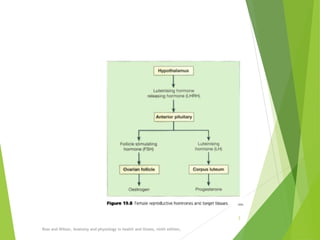
 Produced in ovaries by corpus luteum under the influence of
luteinising hormone(LH) from anterior pituitary and in males
(secreted by the testes)
2
Ross and Wilson, Anatomy and physiology in health and illness, ninth edition,
3
Mechanism of action
 In females, progesterone promotes the development of a
secretory endometrium that can accommodate implantation of
a newly forming embryo
 The high levels of progesterone that are released during the
second half of the menstrual cycle (the luteal phase) inhibit the
production of gonadotropin and, therefore, prevent further
ovulation
Lippincott illustrated review Pharmacology, Sixth edition, page no.- 355-357
4
 Progesterone negatively feedback works at hypothalamus to decrease the
pulse frequency of gonadotropin releasing hormone
 This in turn will decrease the secretion of follicle stimulating
hormone(FSH) and decrease the secretion of luteinizing hormone(LH)
 Progesterone ability to inhibit sperm from penetrating through the cervix
and upper genital track by making the cervical mucus unfriendly
5
Therapeutic uses of progestogens
 The major clinical uses of progestogens are for contraception
or the treatment of hormone deficiency
 For contraception, they are often used in combination with
estrogens
 Synthetic progestogens used in contraception are more stable
to first pass metabolism
 These agents include desogestrel, levonorgestrel
6
Pharmacokinetics
 A micronized preparation of progesterone is rapidly absorbed
after oral administration
 It has a short half-life in the plasma and is almost completely
metabolized by the liver
 The glucuronidated metabolite is excreted primarily by the
kidney
7
Adverse effect
 The major adverse effects associated with the use of progestins
are headache, depression, weight gain, and changes in libido
8
Contraceptives
 Contraception is the act of preventing pregnancy
 This can be a device, a medication, a procedure
A. Major classes of contraceptive-
 Combination oral contraceptives: Products containing a
combination of an estrogen and a progestin are the most
common type of oral contraceptives
Lippincott illustrated review Pharmacology, Sixth edition, page no.- 357 - 360
9
 Transdermal patch: An alternative to combination oral contraceptives is a
transdermal patch containing ethinyl estradiol and the progestin norelgestromin
One contraceptive patch is applied each week for 3 weeks to the abdomen
 Injectable progestin: Medroxyprogesterone acetate is a contraceptive that is
administered via intramuscular or subcutaneous injection every 3 months
10
 Progestin implants: After subdermal placement, the etonogestrel implant offers
contraception for approximately 3 years
 Vaginal ring: An additional contraceptive option is a vaginal ring containing
ethinyl estradiol and etonogestrel
The ring is inserted into the vagina and is left in place for 3 weeks and then
removed
11
Mechanism of action
 Estrogen provides a negative feedback on the release of LH
and follicle-stimulating hormone (FSH) by the pituitary gland,
thus preventing ovulation
 Progestin also thickens the cervical mucus, thus hampering the
transport of sperm
12
Adverse effect
 The most common adverse effects with estrogens are breast
fullness, fluid retention, headache, and nausea
 Increased blood pressure may also occur
 Progestins may be associated with depression, changes in
libido
13
THANK YOU
14

Progesterone

  • 1.
  • 2.
     Progesterone isa steroid  Produced in ovaries by corpus luteum under the influence of luteinising hormone(LH) from anterior pituitary and in males (secreted by the testes) 2
  • 3.
    Ross and Wilson,Anatomy and physiology in health and illness, ninth edition, 3
  • 4.
    Mechanism of action In females, progesterone promotes the development of a secretory endometrium that can accommodate implantation of a newly forming embryo  The high levels of progesterone that are released during the second half of the menstrual cycle (the luteal phase) inhibit the production of gonadotropin and, therefore, prevent further ovulation Lippincott illustrated review Pharmacology, Sixth edition, page no.- 355-357 4
  • 5.
     Progesterone negativelyfeedback works at hypothalamus to decrease the pulse frequency of gonadotropin releasing hormone  This in turn will decrease the secretion of follicle stimulating hormone(FSH) and decrease the secretion of luteinizing hormone(LH)  Progesterone ability to inhibit sperm from penetrating through the cervix and upper genital track by making the cervical mucus unfriendly 5
  • 6.
    Therapeutic uses ofprogestogens  The major clinical uses of progestogens are for contraception or the treatment of hormone deficiency  For contraception, they are often used in combination with estrogens  Synthetic progestogens used in contraception are more stable to first pass metabolism  These agents include desogestrel, levonorgestrel 6
  • 7.
    Pharmacokinetics  A micronizedpreparation of progesterone is rapidly absorbed after oral administration  It has a short half-life in the plasma and is almost completely metabolized by the liver  The glucuronidated metabolite is excreted primarily by the kidney 7
  • 8.
    Adverse effect  Themajor adverse effects associated with the use of progestins are headache, depression, weight gain, and changes in libido 8
  • 9.
    Contraceptives  Contraception isthe act of preventing pregnancy  This can be a device, a medication, a procedure A. Major classes of contraceptive-  Combination oral contraceptives: Products containing a combination of an estrogen and a progestin are the most common type of oral contraceptives Lippincott illustrated review Pharmacology, Sixth edition, page no.- 357 - 360 9
  • 10.
     Transdermal patch:An alternative to combination oral contraceptives is a transdermal patch containing ethinyl estradiol and the progestin norelgestromin One contraceptive patch is applied each week for 3 weeks to the abdomen  Injectable progestin: Medroxyprogesterone acetate is a contraceptive that is administered via intramuscular or subcutaneous injection every 3 months 10
  • 11.
     Progestin implants:After subdermal placement, the etonogestrel implant offers contraception for approximately 3 years  Vaginal ring: An additional contraceptive option is a vaginal ring containing ethinyl estradiol and etonogestrel The ring is inserted into the vagina and is left in place for 3 weeks and then removed 11
  • 12.
    Mechanism of action Estrogen provides a negative feedback on the release of LH and follicle-stimulating hormone (FSH) by the pituitary gland, thus preventing ovulation  Progestin also thickens the cervical mucus, thus hampering the transport of sperm 12
  • 13.
    Adverse effect  Themost common adverse effects with estrogens are breast fullness, fluid retention, headache, and nausea  Increased blood pressure may also occur  Progestins may be associated with depression, changes in libido 13
  • 14.