


Organophosphates are
used in suicidal cases
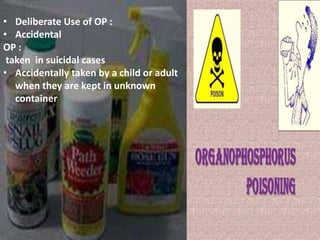
• Deliberate Use of OP :
• Accidental
OP :
taken in suicidal cases
• Accidentally taken by a child or adult
when they are kept in unknown
container
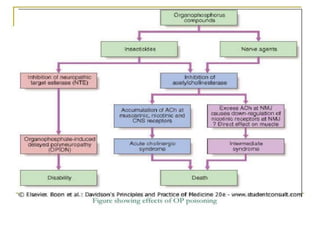
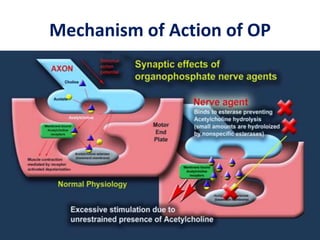
Mechanism of Action of OP
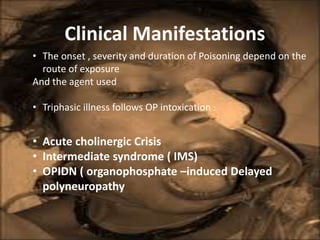
Clinical Manifestations
• The onset , severity and duration of Poisoning depend on the
route of exposure
And the agent used
• Triphasic illness follows OP intoxication :
• Acute cholinergic Crisis
• Intermediate syndrome ( IMS)
• OPIDN ( organophosphate –induced Delayed
polyneuropathy
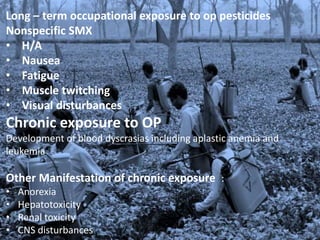
Long – term occupational exposure to op pesticides
Nonspecific SMX
• H/A
• Nausea
• Fatigue
• Muscle twitching
• Visual disturbances
Chronic exposure to OP
Development of blood dyscrasias including aplastic anemia and
leukemia
Other Manifestation of chronic exposure :
• Anorexia
• Hepatotoxicity
• Renal toxicity
• CNS disturbances
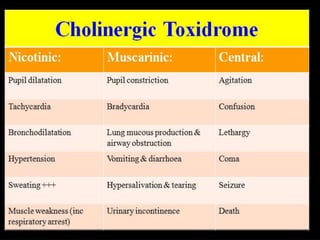
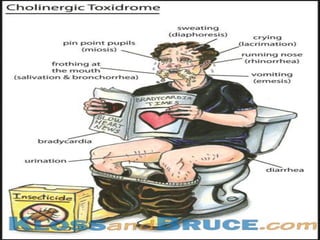
Cholinergic Toxidrome
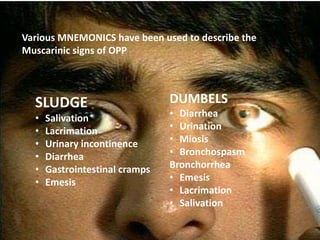
Various MNEMONICS have been used to describe the
Muscarinic signs of OPP
SLUDGE
• Salivation
• Lacrimation
• Urinary incontinence
• Diarrhea
• Gastrointestinal cramps
• Emesis
DUMBELS
• Diarrhea
• Urination
• Miosis
• Bronchospasm
Bronchorrhea
• Emesis
• Lacrimation
• Salivation
Intermediate syndrome
• Occurs 24 to 96 hrs. after ingestion of an OP compound
• Approx. 10-40 % of pts. treated for acute poisoning
develop this illness
• The onset of the IMS is often rapid , with progression of
muscle weakness From the
• Ocular muscles to neck
• Proximal limbs
• Respiratory muscles
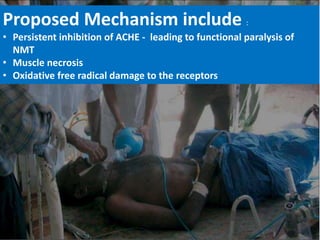
Proposed Mechanism include :
• Persistent inhibition of ACHE - leading to functional paralysis of
NMT
• Muscle necrosis
• Oxidative free radical damage to the receptors
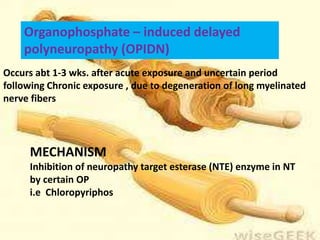
Organophosphate – induced delayed
polyneuropathy (OPIDN)
Occurs abt 1-3 wks. after acute exposure and uncertain period
following Chronic exposure , due to degeneration of long myelinated
nerve fibers
MECHANISM
Inhibition of neuropathy target esterase (NTE) enzyme in NT
by certain OP
i.e Chloropyriphos
Sign and symptoms
of OPIDN
• Cramping muscle pain
• Numbness and paraesthesia
• Acute limb weakness
• Muscle wasting & deformity such
as clawing of the hands
• Symmetrical flaccid weakness
• Tendon reflexes are reduced or
lost
• Later , mild pyramidal tract sign
Diagnosis :
• Hx of exposure to OP compound
• Characteristic manifestation of toxicity to OP
• Improvement of sign and smx after atropine administration
• Search of container of the poison in the vicinity of the pt by
asking the attaindents
• Garlic like smell – sulphur containing OP
Confirmatory investigations :
• CHE estimation (plasma Butyryl cholinesterase and Red cell ACHE )
useful biochemical
• Tool but poor guide to tx and px
Treatment
Acute Cholinergic Crisis
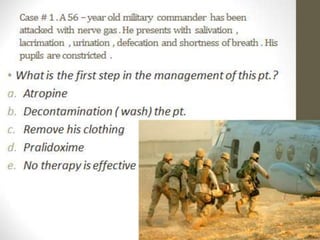
Decontamination and supportive
• Decontimation
• Supportive
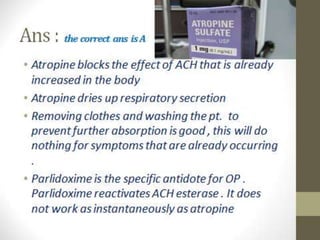
• Blockade of Muscaric activity by ATROPINE
• Reversal of cholinesterase inhibition with OXIME
• Correction of metabolic abnormalities
• Protection of health care staff
• Maintain ABC
• Keep pt in lateral position if comatose or vomiting
• Frequent suction
• O2 therapy
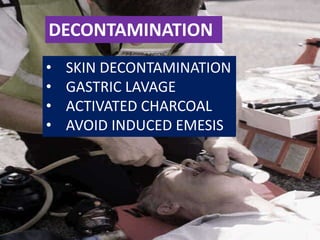
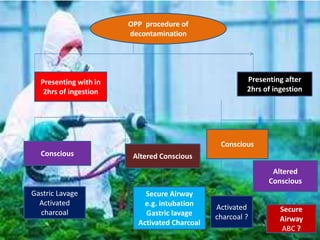
DECONTAMINATION
• SKIN DECONTAMINATION
• GASTRIC LAVAGE
• ACTIVATED CHARCOAL
• AVOID INDUCED EMESIS
Presenting with in
2hrs of ingestion
Presenting after
2hrs of ingestion
Conscious Altered Conscious
Gastric Lavage
Activated
charcoal
Secure Airway
e.g. intubation
Gastric lavage
Activated Charcoal
Conscious
Altered
Conscious
OPP procedure of
decontamination
Activated
charcoal ?
Secure
Airway
ABC ?
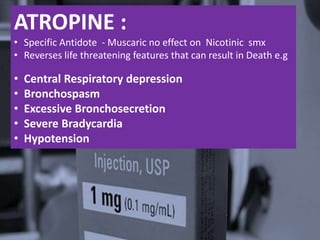
ATROPINE :
• Specific Antidote - Muscaric no effect on Nicotinic smx
• Reverses life threatening features that can result in Death e.g
• Central Respiratory depression
• Bronchospasm
• Excessive Bronchosecretion
• Severe Bradycardia
• Hypotension
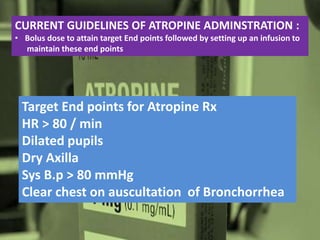
CURRENT GUIDELINES OF ATROPINE ADMINSTRATION :
• Bolus dose to attain target End points followed by setting up an infusion to
maintain these end points
Target End points for Atropine Rx
HR > 80 / min
Dilated pupils
Dry Axilla
Sys B.p > 80 mmHg
Clear chest on auscultation of Bronchorrhea
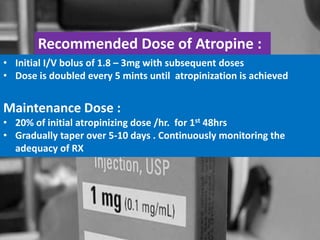
Recommended Dose of Atropine :
• Initial I/V bolus of 1.8 – 3mg with subsequent doses
• Dose is doubled every 5 mints until atropinization is achieved
Maintenance Dose :
• 20% of initial atropinizing dose /hr. for 1st 48hrs
• Gradually taper over 5-10 days . Continuously monitoring the
adequacy of RX
Atropine Toxicity
• Agitation
• Confusion
• Hyperthermia
• Urinary Retention
• Severe Tachycardia – ischemic events – CAD
• Close observation & dose adjustment is essential – to
avoid features of under and over atropinization
Anticholinergic Agent :
Glycopyrrolate along with atropine can be used in order to
limit the central stimulation produced by atropine
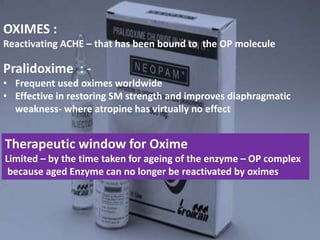
OXIMES :
Reactivating ACHE – that has been bound to the OP molecule
Pralidoxime : -
• Frequent used oximes worldwide
• Effective in restoring SM strength and improves diaphragmatic
weakness- where atropine has virtually no effect
Therapeutic window for Oxime
Limited – by the time taken for ageing of the enzyme – OP complex
because aged Enzyme can no longer be reactivated by oximes
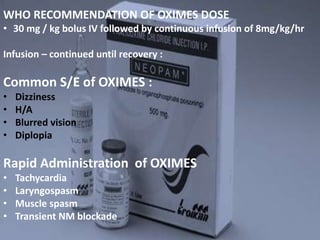
WHO RECOMMENDATION OF OXIMES DOSE
• 30 mg / kg bolus IV followed by continuous infusion of 8mg/kg/hr
Infusion – continued until recovery :
Common S/E of OXIMES :
• Dizziness
• H/A
• Blurred vision
• Diplopia
Rapid Administration of OXIMES
• Tachycardia
• Laryngospasm
• Muscle spasm
• Transient NM blockade
Rx of IMS
• Ventilatory support
• Diazepam or Midazolam
• PTN
unless OPIDN develops recovery of IMS is
complete with adequate ventilatory care
Rx of OPIDN :-
• No specific Rx Measures
• Regular physiotherapy – reduce deformity caused by
muscle wasting
Recovery from OPIDN :-
• incomplete
• May be limited to hands and feet
Although substantial functional recovery after 1-2 yr. may
occur in younger pts.
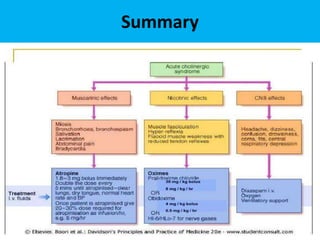
Summary
Home Message
• OP are dangerous chemicals
• OP can be misused by antisocial elements .
• It should be remembered OP may be used in future wars and that
war will be the war of Nerves .
• Immediate management of a pt.
• Treatment must not be delayed .
• Proper observation of treatment .
Dr .hafeez presentation opp

Dr .hafeez presentation opp

  • 5.
    Organophosphates are used insuicidal cases • Deliberate Use of OP : • Accidental OP : taken in suicidal cases • Accidentally taken by a child or adult when they are kept in unknown container
  • 7.
  • 8.
    Clinical Manifestations • Theonset , severity and duration of Poisoning depend on the route of exposure And the agent used • Triphasic illness follows OP intoxication : • Acute cholinergic Crisis • Intermediate syndrome ( IMS) • OPIDN ( organophosphate –induced Delayed polyneuropathy
  • 9.
    Long – termoccupational exposure to op pesticides Nonspecific SMX • H/A • Nausea • Fatigue • Muscle twitching • Visual disturbances Chronic exposure to OP Development of blood dyscrasias including aplastic anemia and leukemia Other Manifestation of chronic exposure : • Anorexia • Hepatotoxicity • Renal toxicity • CNS disturbances
  • 10.
  • 12.
    Various MNEMONICS havebeen used to describe the Muscarinic signs of OPP SLUDGE • Salivation • Lacrimation • Urinary incontinence • Diarrhea • Gastrointestinal cramps • Emesis DUMBELS • Diarrhea • Urination • Miosis • Bronchospasm Bronchorrhea • Emesis • Lacrimation • Salivation
  • 13.
    Intermediate syndrome • Occurs24 to 96 hrs. after ingestion of an OP compound • Approx. 10-40 % of pts. treated for acute poisoning develop this illness • The onset of the IMS is often rapid , with progression of muscle weakness From the • Ocular muscles to neck • Proximal limbs • Respiratory muscles
  • 14.
    Proposed Mechanism include: • Persistent inhibition of ACHE - leading to functional paralysis of NMT • Muscle necrosis • Oxidative free radical damage to the receptors
  • 15.
    Organophosphate – induceddelayed polyneuropathy (OPIDN) Occurs abt 1-3 wks. after acute exposure and uncertain period following Chronic exposure , due to degeneration of long myelinated nerve fibers MECHANISM Inhibition of neuropathy target esterase (NTE) enzyme in NT by certain OP i.e Chloropyriphos
  • 16.
    Sign and symptoms ofOPIDN • Cramping muscle pain • Numbness and paraesthesia • Acute limb weakness • Muscle wasting & deformity such as clawing of the hands • Symmetrical flaccid weakness • Tendon reflexes are reduced or lost • Later , mild pyramidal tract sign
  • 17.
    Diagnosis : • Hxof exposure to OP compound • Characteristic manifestation of toxicity to OP • Improvement of sign and smx after atropine administration • Search of container of the poison in the vicinity of the pt by asking the attaindents • Garlic like smell – sulphur containing OP Confirmatory investigations : • CHE estimation (plasma Butyryl cholinesterase and Red cell ACHE ) useful biochemical • Tool but poor guide to tx and px
  • 18.
    Treatment Acute Cholinergic Crisis Decontaminationand supportive • Decontimation • Supportive • Blockade of Muscaric activity by ATROPINE • Reversal of cholinesterase inhibition with OXIME • Correction of metabolic abnormalities • Protection of health care staff • Maintain ABC • Keep pt in lateral position if comatose or vomiting • Frequent suction • O2 therapy
  • 19.
    DECONTAMINATION • SKIN DECONTAMINATION •GASTRIC LAVAGE • ACTIVATED CHARCOAL • AVOID INDUCED EMESIS
  • 20.
    Presenting with in 2hrsof ingestion Presenting after 2hrs of ingestion Conscious Altered Conscious Gastric Lavage Activated charcoal Secure Airway e.g. intubation Gastric lavage Activated Charcoal Conscious Altered Conscious OPP procedure of decontamination Activated charcoal ? Secure Airway ABC ?
  • 21.
    ATROPINE : • SpecificAntidote - Muscaric no effect on Nicotinic smx • Reverses life threatening features that can result in Death e.g • Central Respiratory depression • Bronchospasm • Excessive Bronchosecretion • Severe Bradycardia • Hypotension
  • 24.
    CURRENT GUIDELINES OFATROPINE ADMINSTRATION : • Bolus dose to attain target End points followed by setting up an infusion to maintain these end points Target End points for Atropine Rx HR > 80 / min Dilated pupils Dry Axilla Sys B.p > 80 mmHg Clear chest on auscultation of Bronchorrhea
  • 25.
    Recommended Dose ofAtropine : • Initial I/V bolus of 1.8 – 3mg with subsequent doses • Dose is doubled every 5 mints until atropinization is achieved Maintenance Dose : • 20% of initial atropinizing dose /hr. for 1st 48hrs • Gradually taper over 5-10 days . Continuously monitoring the adequacy of RX
  • 26.
    Atropine Toxicity • Agitation •Confusion • Hyperthermia • Urinary Retention • Severe Tachycardia – ischemic events – CAD • Close observation & dose adjustment is essential – to avoid features of under and over atropinization Anticholinergic Agent : Glycopyrrolate along with atropine can be used in order to limit the central stimulation produced by atropine
  • 27.
    OXIMES : Reactivating ACHE– that has been bound to the OP molecule Pralidoxime : - • Frequent used oximes worldwide • Effective in restoring SM strength and improves diaphragmatic weakness- where atropine has virtually no effect Therapeutic window for Oxime Limited – by the time taken for ageing of the enzyme – OP complex because aged Enzyme can no longer be reactivated by oximes
  • 28.
    WHO RECOMMENDATION OFOXIMES DOSE • 30 mg / kg bolus IV followed by continuous infusion of 8mg/kg/hr Infusion – continued until recovery : Common S/E of OXIMES : • Dizziness • H/A • Blurred vision • Diplopia Rapid Administration of OXIMES • Tachycardia • Laryngospasm • Muscle spasm • Transient NM blockade
  • 29.
    Rx of IMS •Ventilatory support • Diazepam or Midazolam • PTN unless OPIDN develops recovery of IMS is complete with adequate ventilatory care
  • 30.
    Rx of OPIDN:- • No specific Rx Measures • Regular physiotherapy – reduce deformity caused by muscle wasting Recovery from OPIDN :- • incomplete • May be limited to hands and feet Although substantial functional recovery after 1-2 yr. may occur in younger pts.
  • 31.
  • 32.
    Home Message • OPare dangerous chemicals • OP can be misused by antisocial elements . • It should be remembered OP may be used in future wars and that war will be the war of Nerves . • Immediate management of a pt. • Treatment must not be delayed . • Proper observation of treatment .