Affan Ali
Roll No. 36
CASE STUDY
Demographics
Name: Muhammad Ali
 Age: 21 Years
 Gender: Male
 Marital Status: Un Married
 Ward: Medicine
 Hospital: Dow University Hospital

History
No Disease History
 Not on Medication

Present Complains
Morning & Midnight High Grade Fever
for 5days
 Chills for 5days
 Vomiting for 1 day
 Epigastric Pain
 Sweating
 Weakness

Laboratory Findings
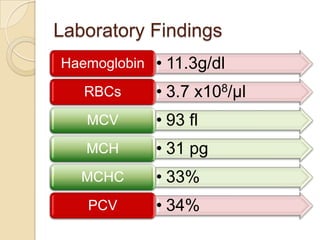
Haemoglobin • 11.3g/dl
RBCs

• 3.7 x10⁸/µl

MCV

• 93 fl

MCH

• 31 pg

MCHC

• 33%

PCV

• 34%
Laboratory Findings
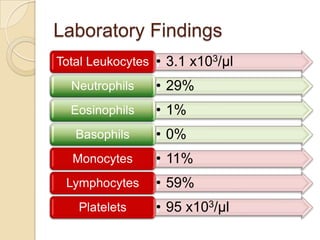
Total Leukocytes • 3.1 x10³/µl
Neutrophils

• 29%

Eosinophils

• 1%

Basophils

• 0%

Monocytes

• 11%

Lymphocytes

• 59%

Platelets

• 95 x103/µl
Laboratory Findings
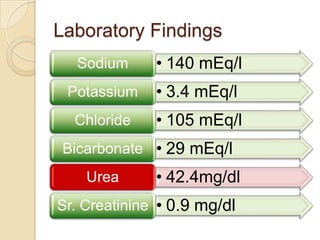
Sodium

• 140 mEq/l

Potassium

• 3.4 mEq/l

Chloride

• 105 mEq/l

Bicarbonate • 29 mEq/l
Urea

• 42.4mg/dl

Sr. Creatinine • 0.9 mg/dl
Laboratory Findings
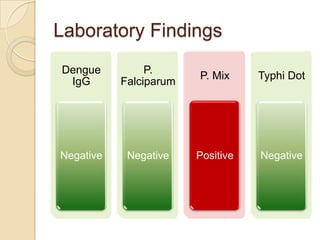
Dengue
IgG

P.
Falciparum

P. Mix

Typhi Dot

Negative

Negative

Positive

Negative
Diagnosis
PRESCRIPTION
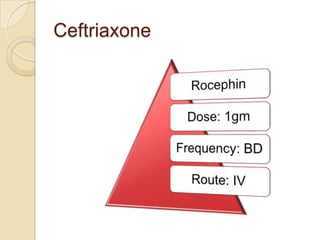
Ceftriaxone
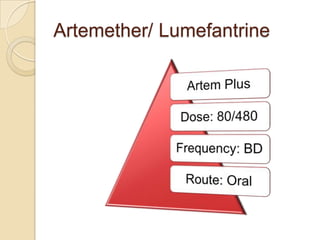
Artemether/ Lumefantrine
Omeprazole
Metoclopramide
Acetaminophen
Vitamin B Complex
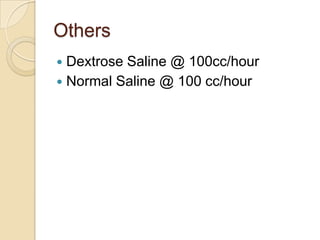
Others
Dextrose Saline @ 100cc/hour
 Normal Saline @ 100 cc/hour

JUSTIFICATIONS
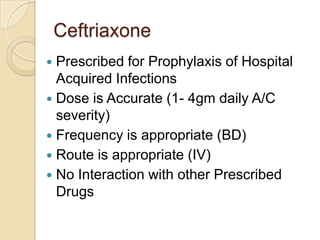
Ceftriaxone
Prescribed for Prophylaxis of Hospital
Acquired Infections
 Dose is Accurate (1- 4gm daily A/C
severity)
 Frequency is appropriate (BD)
 Route is appropriate (IV)
 No Interaction with other Prescribed
Drugs

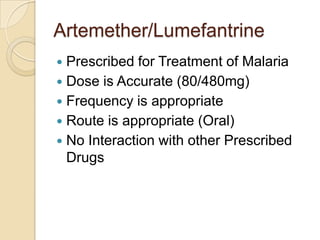
Artemether/Lumefantrine
Prescribed for Treatment of Malaria
 Dose is Accurate (80/480mg)
 Frequency is appropriate
 Route is appropriate (Oral)
 No Interaction with other Prescribed
Drugs

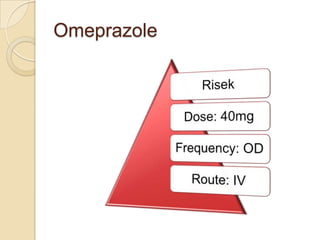
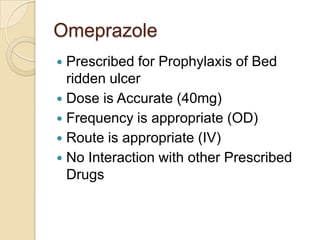
Omeprazole
Prescribed for Prophylaxis of Bed
ridden ulcer
 Dose is Accurate (40mg)
 Frequency is appropriate (OD)
 Route is appropriate (IV)
 No Interaction with other Prescribed
Drugs

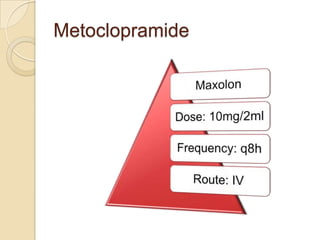
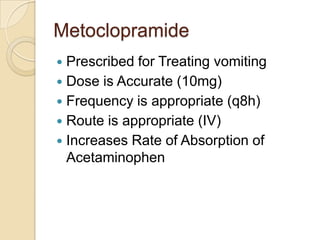
Metoclopramide
Prescribed for Treating vomiting
 Dose is Accurate (10mg)
 Frequency is appropriate (q8h)
 Route is appropriate (IV)
 Increases Rate of Absorption of
Acetaminophen

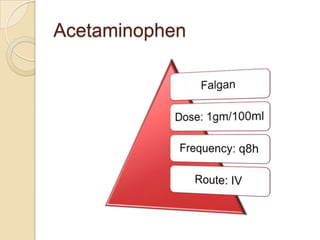
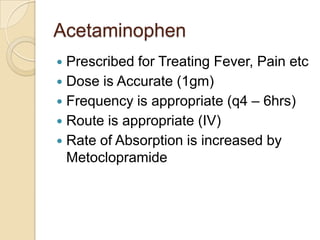
Acetaminophen
Prescribed for Treating Fever, Pain etc
 Dose is Accurate (1gm)
 Frequency is appropriate (q4 – 6hrs)
 Route is appropriate (IV)
 Rate of Absorption is increased by
Metoclopramide

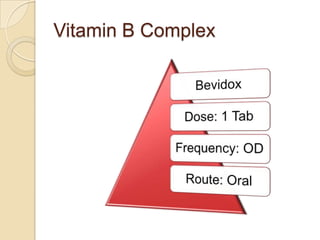
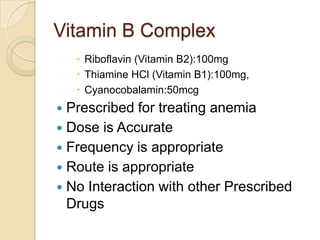
Vitamin B Complex
 Riboflavin (Vitamin B2):100mg
 Thiamine HCl (Vitamin B1):100mg,
 Cyanocobalamin:50mcg

Prescribed for treating anemia
 Dose is Accurate
 Frequency is appropriate
 Route is appropriate
 No Interaction with other Prescribed
Drugs

THE DISEASE
Malaria


Malaria, one of the most widespread
diseases, caused by Plasmodium
Species



Transmitted by infected individuals
via
◦
◦
◦
◦

Mosquito Bite
Blood transfusion,
Congenitally,
Infected needles by drug abusers
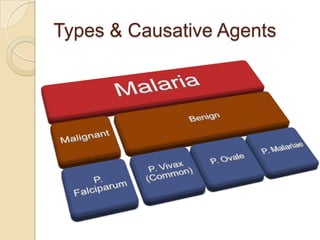
Types & Causative Agents
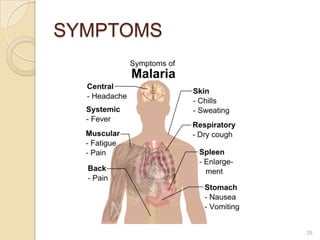
SYMPTOMS

29
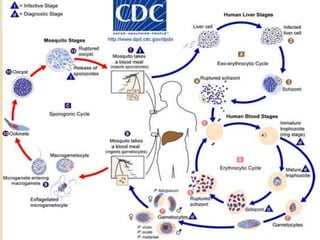
Life Cycle of Plasmodium
Two interdependent life cycles


Sexual cycle: occurs in the mosquito



Asexual cycle: occurs in the human
◦ Exo erythrocytic Phase
◦ Erythrocytic Phase

30
Life Cycle of Plasmodium

31
TREATMENT
MALIGNANT MALARIA
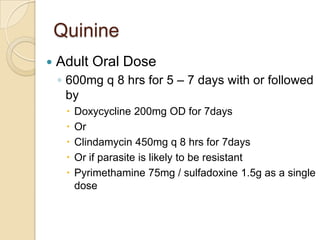
Quinine


Adult Oral Dose
◦ 600mg q 8 hrs for 5 – 7 days with or followed
by






Doxycycline 200mg OD for 7days
Or
Clindamycin 450mg q 8 hrs for 7days
Or if parasite is likely to be resistant
Pyrimethamine 75mg / sulfadoxine 1.5g as a single
dose
Quinine


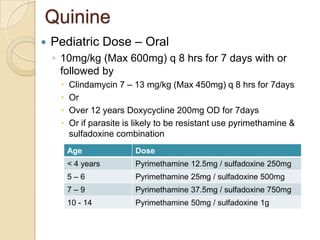
Pediatric Dose – Oral
◦ 10mg/kg (Max 600mg) q 8 hrs for 7 days with or
followed by





Clindamycin 7 – 13 mg/kg (Max 450mg) q 8 hrs for 7days
Or
Over 12 years Doxycycline 200mg OD for 7days
Or if parasite is likely to be resistant use pyrimethamine &
sulfadoxine combination
Age

Dose

< 4 years

Pyrimethamine 12.5mg / sulfadoxine 250mg

5–6

Pyrimethamine 25mg / sulfadoxine 500mg

7–9

Pyrimethamine 37.5mg / sulfadoxine 750mg

10 - 14

Pyrimethamine 50mg / sulfadoxine 1g
Quinine


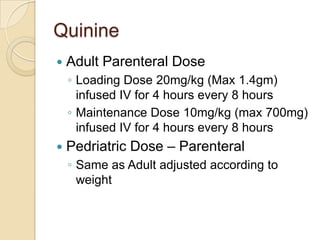
Adult Parenteral Dose
◦ Loading Dose 20mg/kg (Max 1.4gm)
infused IV for 4 hours every 8 hours
◦ Maintenance Dose 10mg/kg (max 700mg)
infused IV for 4 hours every 8 hours



Pedriatric Dose – Parenteral
◦ Same as Adult adjusted according to
weight
Alternative Treatment
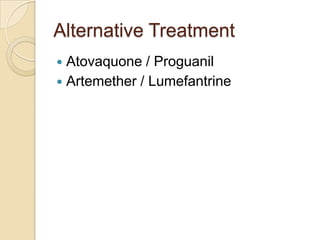
Atovaquone / Proguanil
 Artemether / Lumefantrine

Atovaquone / Proguanil


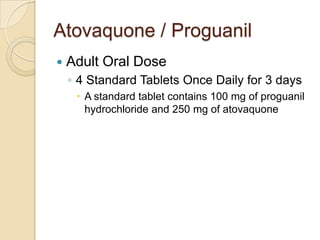
Adult Oral Dose
◦ 4 Standard Tablets Once Daily for 3 days
 A standard tablet contains 100 mg of proguanil
hydrochloride and 250 mg of atovaquone
Atovaquone / Proguanil


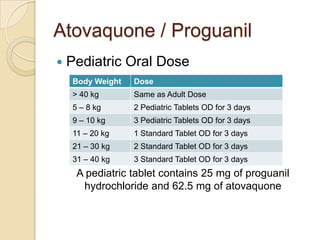
Pediatric Oral Dose
Body Weight

Dose

> 40 kg

Same as Adult Dose

5 – 8 kg

2 Pediatric Tablets OD for 3 days

9 – 10 kg

3 Pediatric Tablets OD for 3 days

11 – 20 kg

1 Standard Tablet OD for 3 days

21 – 30 kg

2 Standard Tablet OD for 3 days

31 – 40 kg

3 Standard Tablet OD for 3 days

A pediatric tablet contains 25 mg of proguanil
hydrochloride and 62.5 mg of atovaquone
Artemether / Lumefantrine


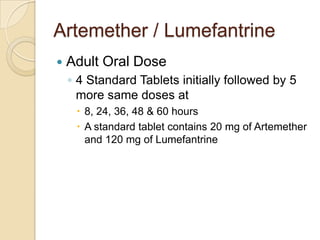
Adult Oral Dose
◦ 4 Standard Tablets initially followed by 5
more same doses at
 8, 24, 36, 48 & 60 hours
 A standard tablet contains 20 mg of Artemether
and 120 mg of Lumefantrine
Artemether / Lumefantrine


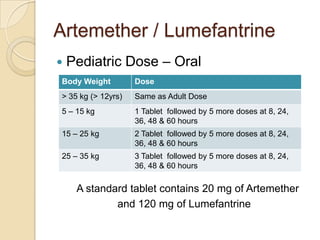
Pediatric Dose – Oral

Body Weight

Dose

> 35 kg (> 12yrs)

Same as Adult Dose

5 – 15 kg

1 Tablet followed by 5 more doses at 8, 24,
36, 48 & 60 hours

15 – 25 kg

2 Tablet followed by 5 more doses at 8, 24,
36, 48 & 60 hours

25 – 35 kg

3 Tablet followed by 5 more doses at 8, 24,
36, 48 & 60 hours

A standard tablet contains 20 mg of Artemether
and 120 mg of Lumefantrine
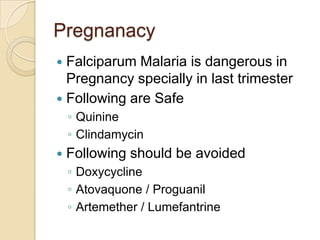
Pregnanacy
Falciparum Malaria is dangerous in
Pregnancy specially in last trimester
 Following are Safe


◦ Quinine
◦ Clindamycin


Following should be avoided
◦ Doxycycline
◦ Atovaquone / Proguanil
◦ Artemether / Lumefantrine
Chloroquine is drug of choice in Benign Malaria

BENIGN MALARIA
Chloroquine
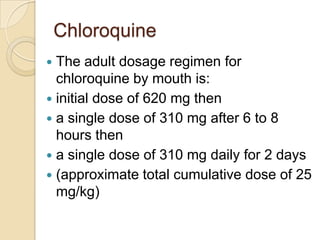
The adult dosage regimen for
chloroquine by mouth is:
 initial dose of 620 mg then
 a single dose of 310 mg after 6 to 8
hours then
 a single dose of 310 mg daily for 2 days
 (approximate total cumulative dose of 25
mg/kg)

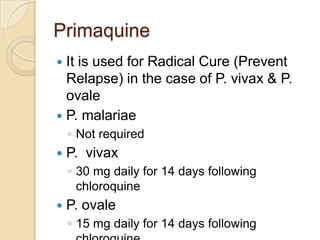
Primaquine
It is used for Radical Cure (Prevent
Relapse) in the case of P. vivax & P.
ovale
 P. malariae


◦ Not required


P. vivax
◦ 30 mg daily for 14 days following
chloroquine



P. ovale
◦ 15 mg daily for 14 days following
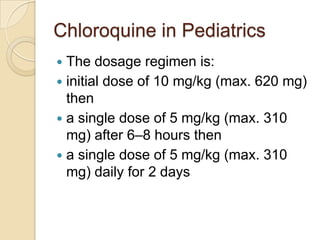
Chloroquine in Pediatrics
The dosage regimen is:
 initial dose of 10 mg/kg (max. 620 mg)
then
 a single dose of 5 mg/kg (max. 310
mg) after 6–8 hours then
 a single dose of 5 mg/kg (max. 310
mg) daily for 2 days

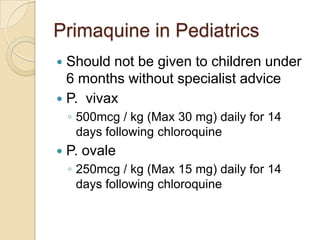
Primaquine in Pediatrics
Should not be given to children under
6 months without specialist advice
 P. vivax


◦ 500mcg / kg (Max 30 mg) daily for 14
days following chloroquine


P. ovale
◦ 250mcg / kg (Max 15 mg) daily for 14
days following chloroquine
Parenteral for Adult &
Pediatrics


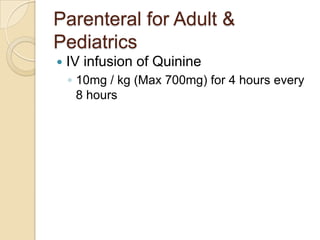
IV infusion of Quinine
◦ 10mg / kg (Max 700mg) for 4 hours every
8 hours
Pregnancy
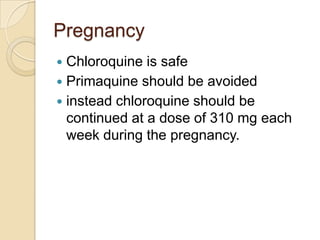
Chloroquine is safe
 Primaquine should be avoided
 instead chloroquine should be
continued at a dose of 310 mg each
week during the pregnancy.

Chloroquine-resistant benign
malaria


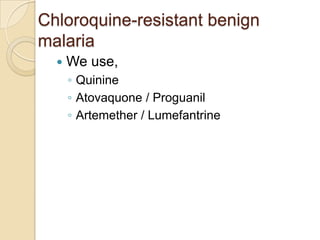
We use,
◦ Quinine
◦ Atovaquone / Proguanil
◦ Artemether / Lumefantrine
Prevention
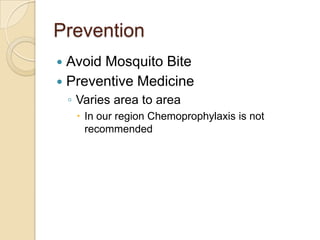
Avoid Mosquito Bite
 Preventive Medicine


◦ Varies area to area
 In our region Chemoprophylaxis is not
recommended
References
BNF 61
 www.cdc.gov/malaria
 www.who.int/topics/malaria

Malaria by affan ali(036)

Malaria by affan ali(036)

  • 2.
    Affan Ali Roll No.36 CASE STUDY
  • 3.
    Demographics Name: Muhammad Ali Age: 21 Years  Gender: Male  Marital Status: Un Married  Ward: Medicine  Hospital: Dow University Hospital 
  • 4.
    History No Disease History Not on Medication 
  • 5.
    Present Complains Morning &Midnight High Grade Fever for 5days  Chills for 5days  Vomiting for 1 day  Epigastric Pain  Sweating  Weakness 
  • 6.
    Laboratory Findings Haemoglobin •11.3g/dl RBCs • 3.7 x10⁸/µl MCV • 93 fl MCH • 31 pg MCHC • 33% PCV • 34%
  • 7.
    Laboratory Findings Total Leukocytes• 3.1 x10³/µl Neutrophils • 29% Eosinophils • 1% Basophils • 0% Monocytes • 11% Lymphocytes • 59% Platelets • 95 x103/µl
  • 8.
    Laboratory Findings Sodium • 140mEq/l Potassium • 3.4 mEq/l Chloride • 105 mEq/l Bicarbonate • 29 mEq/l Urea • 42.4mg/dl Sr. Creatinine • 0.9 mg/dl
  • 9.
    Laboratory Findings Dengue IgG P. Falciparum P. Mix TyphiDot Negative Negative Positive Negative
  • 10.
  • 11.
  • 12.
  • 13.
  • 14.
  • 15.
  • 16.
  • 17.
  • 18.
    Others Dextrose Saline @100cc/hour  Normal Saline @ 100 cc/hour 
  • 19.
  • 20.
    Ceftriaxone Prescribed for Prophylaxisof Hospital Acquired Infections  Dose is Accurate (1- 4gm daily A/C severity)  Frequency is appropriate (BD)  Route is appropriate (IV)  No Interaction with other Prescribed Drugs 
  • 21.
    Artemether/Lumefantrine Prescribed for Treatmentof Malaria  Dose is Accurate (80/480mg)  Frequency is appropriate  Route is appropriate (Oral)  No Interaction with other Prescribed Drugs 
  • 22.
    Omeprazole Prescribed for Prophylaxisof Bed ridden ulcer  Dose is Accurate (40mg)  Frequency is appropriate (OD)  Route is appropriate (IV)  No Interaction with other Prescribed Drugs 
  • 23.
    Metoclopramide Prescribed for Treatingvomiting  Dose is Accurate (10mg)  Frequency is appropriate (q8h)  Route is appropriate (IV)  Increases Rate of Absorption of Acetaminophen 
  • 24.
    Acetaminophen Prescribed for TreatingFever, Pain etc  Dose is Accurate (1gm)  Frequency is appropriate (q4 – 6hrs)  Route is appropriate (IV)  Rate of Absorption is increased by Metoclopramide 
  • 25.
    Vitamin B Complex Riboflavin (Vitamin B2):100mg  Thiamine HCl (Vitamin B1):100mg,  Cyanocobalamin:50mcg Prescribed for treating anemia  Dose is Accurate  Frequency is appropriate  Route is appropriate  No Interaction with other Prescribed Drugs 
  • 26.
  • 27.
    Malaria  Malaria, one ofthe most widespread diseases, caused by Plasmodium Species  Transmitted by infected individuals via ◦ ◦ ◦ ◦ Mosquito Bite Blood transfusion, Congenitally, Infected needles by drug abusers
  • 28.
  • 29.
  • 30.
    Life Cycle ofPlasmodium Two interdependent life cycles  Sexual cycle: occurs in the mosquito  Asexual cycle: occurs in the human ◦ Exo erythrocytic Phase ◦ Erythrocytic Phase 30
  • 31.
    Life Cycle ofPlasmodium 31
  • 32.
  • 33.
  • 34.
    Quinine  Adult Oral Dose ◦600mg q 8 hrs for 5 – 7 days with or followed by      Doxycycline 200mg OD for 7days Or Clindamycin 450mg q 8 hrs for 7days Or if parasite is likely to be resistant Pyrimethamine 75mg / sulfadoxine 1.5g as a single dose
  • 35.
    Quinine  Pediatric Dose –Oral ◦ 10mg/kg (Max 600mg) q 8 hrs for 7 days with or followed by     Clindamycin 7 – 13 mg/kg (Max 450mg) q 8 hrs for 7days Or Over 12 years Doxycycline 200mg OD for 7days Or if parasite is likely to be resistant use pyrimethamine & sulfadoxine combination Age Dose < 4 years Pyrimethamine 12.5mg / sulfadoxine 250mg 5–6 Pyrimethamine 25mg / sulfadoxine 500mg 7–9 Pyrimethamine 37.5mg / sulfadoxine 750mg 10 - 14 Pyrimethamine 50mg / sulfadoxine 1g
  • 36.
    Quinine  Adult Parenteral Dose ◦Loading Dose 20mg/kg (Max 1.4gm) infused IV for 4 hours every 8 hours ◦ Maintenance Dose 10mg/kg (max 700mg) infused IV for 4 hours every 8 hours  Pedriatric Dose – Parenteral ◦ Same as Adult adjusted according to weight
  • 37.
    Alternative Treatment Atovaquone /Proguanil  Artemether / Lumefantrine 
  • 38.
    Atovaquone / Proguanil  AdultOral Dose ◦ 4 Standard Tablets Once Daily for 3 days  A standard tablet contains 100 mg of proguanil hydrochloride and 250 mg of atovaquone
  • 39.
    Atovaquone / Proguanil  PediatricOral Dose Body Weight Dose > 40 kg Same as Adult Dose 5 – 8 kg 2 Pediatric Tablets OD for 3 days 9 – 10 kg 3 Pediatric Tablets OD for 3 days 11 – 20 kg 1 Standard Tablet OD for 3 days 21 – 30 kg 2 Standard Tablet OD for 3 days 31 – 40 kg 3 Standard Tablet OD for 3 days A pediatric tablet contains 25 mg of proguanil hydrochloride and 62.5 mg of atovaquone
  • 40.
    Artemether / Lumefantrine  AdultOral Dose ◦ 4 Standard Tablets initially followed by 5 more same doses at  8, 24, 36, 48 & 60 hours  A standard tablet contains 20 mg of Artemether and 120 mg of Lumefantrine
  • 41.
    Artemether / Lumefantrine  PediatricDose – Oral Body Weight Dose > 35 kg (> 12yrs) Same as Adult Dose 5 – 15 kg 1 Tablet followed by 5 more doses at 8, 24, 36, 48 & 60 hours 15 – 25 kg 2 Tablet followed by 5 more doses at 8, 24, 36, 48 & 60 hours 25 – 35 kg 3 Tablet followed by 5 more doses at 8, 24, 36, 48 & 60 hours A standard tablet contains 20 mg of Artemether and 120 mg of Lumefantrine
  • 42.
    Pregnanacy Falciparum Malaria isdangerous in Pregnancy specially in last trimester  Following are Safe  ◦ Quinine ◦ Clindamycin  Following should be avoided ◦ Doxycycline ◦ Atovaquone / Proguanil ◦ Artemether / Lumefantrine
  • 43.
    Chloroquine is drugof choice in Benign Malaria BENIGN MALARIA
  • 44.
    Chloroquine The adult dosageregimen for chloroquine by mouth is:  initial dose of 620 mg then  a single dose of 310 mg after 6 to 8 hours then  a single dose of 310 mg daily for 2 days  (approximate total cumulative dose of 25 mg/kg) 
  • 45.
    Primaquine It is usedfor Radical Cure (Prevent Relapse) in the case of P. vivax & P. ovale  P. malariae  ◦ Not required  P. vivax ◦ 30 mg daily for 14 days following chloroquine  P. ovale ◦ 15 mg daily for 14 days following
  • 46.
    Chloroquine in Pediatrics Thedosage regimen is:  initial dose of 10 mg/kg (max. 620 mg) then  a single dose of 5 mg/kg (max. 310 mg) after 6–8 hours then  a single dose of 5 mg/kg (max. 310 mg) daily for 2 days 
  • 47.
    Primaquine in Pediatrics Shouldnot be given to children under 6 months without specialist advice  P. vivax  ◦ 500mcg / kg (Max 30 mg) daily for 14 days following chloroquine  P. ovale ◦ 250mcg / kg (Max 15 mg) daily for 14 days following chloroquine
  • 48.
    Parenteral for Adult& Pediatrics  IV infusion of Quinine ◦ 10mg / kg (Max 700mg) for 4 hours every 8 hours
  • 49.
    Pregnancy Chloroquine is safe Primaquine should be avoided  instead chloroquine should be continued at a dose of 310 mg each week during the pregnancy. 
  • 50.
    Chloroquine-resistant benign malaria  We use, ◦Quinine ◦ Atovaquone / Proguanil ◦ Artemether / Lumefantrine
  • 51.
    Prevention Avoid Mosquito Bite Preventive Medicine  ◦ Varies area to area  In our region Chemoprophylaxis is not recommended
  • 52.
    References BNF 61  www.cdc.gov/malaria www.who.int/topics/malaria 