BY
MADHU BALA.M
II C.S
2012
CONTENTS
 EVOLUTION OF 4G
 CONCEPT OF 4G
 3G vs 4G
 APPLICATIONS
 CONCEPT OF WiMAX
 Wi-Fi vs WiMAX
 CONCLUSION
2012
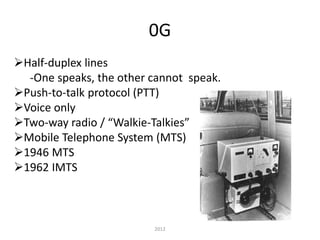
0G
Half-duplex lines
-One speaks, the other cannot speak.
Push-to-talk protocol (PTT)
Voice only
Two-way radio / “Walkie-Talkies”
Mobile Telephone System (MTS)
1946 MTS
1962 IMTS
2012
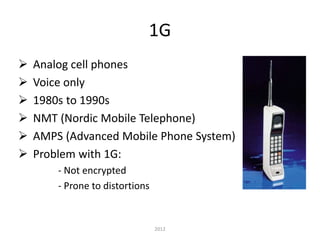
1G
 Analog cell phones
 Voice only
 1980s to 1990s
 NMT (Nordic Mobile Telephone)
 AMPS (Advanced Mobile Phone System)
 Problem with 1G:
- Not encrypted
- Prone to distortions
2012
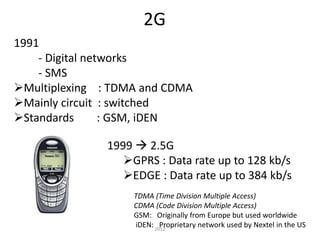
2G
1991
- Digital networks
- SMS
Multiplexing : TDMA and CDMA
Mainly circuit : switched
Standards : GSM, iDEN
1999  2.5G
GPRS : Data rate up to 128 kb/s
EDGE : Data rate up to 384 kb/s
TDMA (Time Division Multiple Access)
CDMA (Code Division Multiple Access)
GSM: Originally from Europe but used worldwide
iDEN: Proprietary network used by Nextel in the US2012
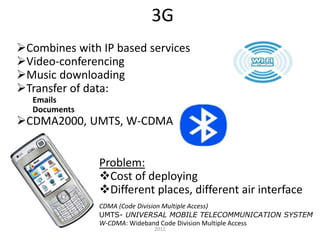
3G
Combines with IP based services
Video-conferencing
Music downloading
Transfer of data:
Emails
Documents
CDMA2000, UMTS, W-CDMA
Problem:
Cost of deploying
Different places, different air interface
CDMA (Code Division Multiple Access)
UMTS- UNIVERSAL MOBILE TELECOMMUNICATION SYSTEM
W-CDMA: Wideband Code Division Multiple Access
2012
4G CONCEPT
“The user has freedom and flexibility
to select any desired service with
reasonable QoS and affordable price,
anytime, anywhere.”
4G networks are projected to
provide speeds of 100 Mbps
while moving and 1 Gbps while
stationary.
2012
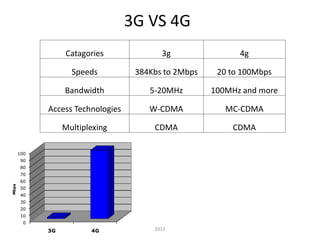
Catagories 3g 4g
Speeds 384Kbs to 2Mbps 20 to 100Mbps
Bandwidth 5-20MHz 100MHz and more
Access Technologies W-CDMA MC-CDMA
Multiplexing CDMA CDMA
0
10
20
30
40
50
60
70
80
90
100
3G 4G
Mbps
3G VS 4G
2012
2012
APPLICATIONS
Virtual Presence
 Tele-geoprocessing applications
 Tele-Medicine
Tele- Education
 Multimedia– Video Services
2012
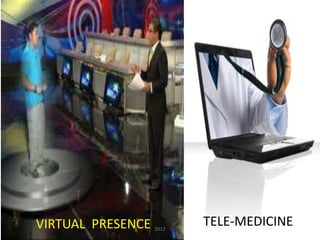
VIRTUAL PRESENCE TELE-MEDICINE2012
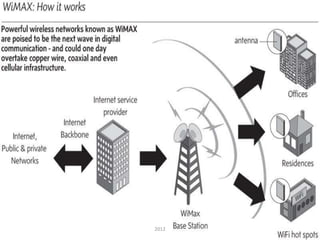
WiMAX
(World Interoperability for Microwave Access)
Two main applications of WiMAX:
1.Fixed WiMAX:
Fixed WiMAX applications are point-to-multipoint
enabling the delivery of last mile wireless broadband access as an
alternative to cable and DSL for homes and businesses.
2.Mobile WiMAX:
Mobile WiMAX offers the full mobility of
cellular networks at true broadband speeds.
2012
2012
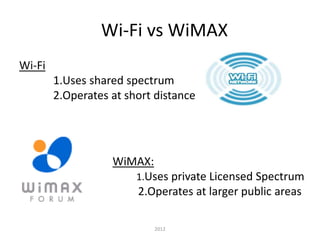
Wi-Fi vs WiMAX
Wi-Fi
1.Uses shared spectrum
2.Operates at short distance
WiMAX:
1.Uses private Licensed Spectrum
2.Operates at larger public areas
2012
– Embed 4G technology
into all end-user devices
– Develop mobile personal
gateways
– Develop external
interfaces with 4G
peripherals
4G ACCESS OPTION
2012
THANK
YOU!!!!!
2012

4G technology

  • 1.
  • 2.
    CONTENTS  EVOLUTION OF4G  CONCEPT OF 4G  3G vs 4G  APPLICATIONS  CONCEPT OF WiMAX  Wi-Fi vs WiMAX  CONCLUSION 2012
  • 3.
    0G Half-duplex lines -One speaks,the other cannot speak. Push-to-talk protocol (PTT) Voice only Two-way radio / “Walkie-Talkies” Mobile Telephone System (MTS) 1946 MTS 1962 IMTS 2012
  • 4.
    1G  Analog cellphones  Voice only  1980s to 1990s  NMT (Nordic Mobile Telephone)  AMPS (Advanced Mobile Phone System)  Problem with 1G: - Not encrypted - Prone to distortions 2012
  • 5.
    2G 1991 - Digital networks -SMS Multiplexing : TDMA and CDMA Mainly circuit : switched Standards : GSM, iDEN 1999  2.5G GPRS : Data rate up to 128 kb/s EDGE : Data rate up to 384 kb/s TDMA (Time Division Multiple Access) CDMA (Code Division Multiple Access) GSM: Originally from Europe but used worldwide iDEN: Proprietary network used by Nextel in the US2012
  • 6.
    3G Combines with IPbased services Video-conferencing Music downloading Transfer of data: Emails Documents CDMA2000, UMTS, W-CDMA Problem: Cost of deploying Different places, different air interface CDMA (Code Division Multiple Access) UMTS- UNIVERSAL MOBILE TELECOMMUNICATION SYSTEM W-CDMA: Wideband Code Division Multiple Access 2012
  • 7.
    4G CONCEPT “The userhas freedom and flexibility to select any desired service with reasonable QoS and affordable price, anytime, anywhere.” 4G networks are projected to provide speeds of 100 Mbps while moving and 1 Gbps while stationary. 2012
  • 8.
    Catagories 3g 4g Speeds384Kbs to 2Mbps 20 to 100Mbps Bandwidth 5-20MHz 100MHz and more Access Technologies W-CDMA MC-CDMA Multiplexing CDMA CDMA 0 10 20 30 40 50 60 70 80 90 100 3G 4G Mbps 3G VS 4G 2012
  • 9.
  • 10.
    APPLICATIONS Virtual Presence  Tele-geoprocessingapplications  Tele-Medicine Tele- Education  Multimedia– Video Services 2012
  • 11.
  • 12.
    WiMAX (World Interoperability forMicrowave Access) Two main applications of WiMAX: 1.Fixed WiMAX: Fixed WiMAX applications are point-to-multipoint enabling the delivery of last mile wireless broadband access as an alternative to cable and DSL for homes and businesses. 2.Mobile WiMAX: Mobile WiMAX offers the full mobility of cellular networks at true broadband speeds. 2012
  • 13.
  • 14.
    Wi-Fi vs WiMAX Wi-Fi 1.Usesshared spectrum 2.Operates at short distance WiMAX: 1.Uses private Licensed Spectrum 2.Operates at larger public areas 2012
  • 15.
    – Embed 4Gtechnology into all end-user devices – Develop mobile personal gateways – Develop external interfaces with 4G peripherals 4G ACCESS OPTION 2012
  • 16.