4423 Physical Education

Education

 Philosophy of Physical Education and your Personal Philosophy of
                   Teaching Physical Education
A Personal Philosophy1
 A personal philosophy allows you to clearly articulate your
  practice as a teacher in the future.
 Many teachers do not believe that this is really important
 Kretchmar (1994) suggest 2 ways to develop this:
       – write a comprehensive philosophy of the profession
       – Developing a philosophical position for YOUR purpose


 1 Green, K. (2002) Physical Education Teachers in their Figurations: A Sociological Analysis of Everyday „Philosophies'
 in Physical Education, Sport, Education and Society, 7 (1), 65-83.
A Personal Philosophy cont …
 Personal philosophies should be individualised, grounded
  in reality and based on personal objectives founded on
  experiences
 Used to guide action while maintaining the required
  flexibility to be contextual
 Your practice (as a PE teacher) is intrinsically worthwhile,
  as such you live your own sessions vicariously and
  emotionally
Trent’s personal philosophy of teaching PE
 Physical education is an important and wonderful subject. I want
  prospective physical education teachers to be passionate and
  enthusiastic about the educative value and richness that it possesses.
 Challenge assumptions, assertions and thoughts on prospective
  physical education teachers understandings and meanings of physical
  education
 I am a learner; I want prospective physical education teachers to
  consider themselves as learners always. I do not think that I will ever
  stop learning.
 As a physical education teacher educator I want to be able to develop
  prospective physical education teachers who enable and facilitate
  „meaningful lived experiences‟ through movement with their students.
Trent’s personal philosophy of teaching PE
 I want to support prospective PE teachers develop their „own‟ ways of
  teaching; I do not want them to teach like me.
     – Methods classes will present opportunities to openly discuss
        issues (classroom management, planning etc) where solutions are
        generated by YOU, with support from my own
        practice/research/teaching.
 Be open and sensitive to the ways that individuals learn.
 Demonstrate, „model‟ approaches and behaviours that will lead
  prospective physical education teachers to engage successfully with
  the profession
 Present knowledge that is holistic; overlay experience and examples
  and then support prospective physical education teachers make
  decisions
Let’s pause for a minute and reflect
 Our discussion up until this point has focussed very much on the
  personal (or at least I hope!)
 Additionally I am hoping that it has related to concepts such as lived
  experience, doing (prac; the teaching), identity, teaching, learning, etc.
 In our reflections though, we have drawn on the personal-social-
  cultural-political-historical-ecological to answer these questions. We
  need to keep these thoughts with us as we move throughout the study
  of this unit.
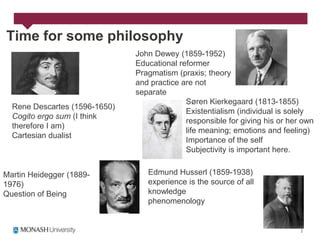
Time for some philosophy
                               John Dewey (1859-1952)
                               Educational reformer
                               Pragmatism (praxis; theory
                               and practice are not
                               separate
                                             Søren Kierkegaard (1813-1855)
  Rene Descartes (1596-1650)
                                             Existentialism (individual is solely
  Cogito ergo sum (I think
                                             responsible for giving his or her own
  therefore I am)
                                             life meaning; emotions and feeling)
  Cartesian dualist
                                             Importance of the self
                                             Subjectivity is important here.


Martin Heidegger (1889-           Edmund Husserl (1859-1938)
1976)                             experience is the source of all
Question of Being                 knowledge
                                  phenomenology
Education and physical education
 Before we endeavour to know what is physical
  education we need to philosophise about what is
  education?
    – What is it to be a person?
    – How can what is being suggested help the person to
      actualise himself along lines that are in keeping with
      a good life?
 So before you can develop curricula, your pedagogy
  and engage students perhaps it is wise to ask
  yourself:
    – What do I want physical education to be? Why do I
      think this? Is it in keeping with all that I have learnt
      over the past 3 years?
Trent’s ‘philosophising’ on the profession
 That physical education, and physical educators have not succinctly justified
  physical education‟s inclusion within the curriculum
     – Perhaps thinking about embodiment, „physical literacy‟, meaning-making
 That the overt focus on scientificism within physical education is a dominant
  discourse and possibly leads to individuals being miseducated or not deriving
  meaning from participation in physical education – creates dualist thinking, body
  as machine; physical education-as-sport-techniques
     – we need to move towards holism
 Also need to find common ground between the so-called biophysical and socio-
  cultural elements of physical education; more explicit teaching of these
 Sports role within physical education needs some important theoretical and
  pragmatic philosophising – relates to the culture of youth in today‟s society
Trent’s ‘philosophising’ on the profession
 We need to know our „history‟ so that when we go into the future (Penney and
  Chandler, 2000; Kirk, 2010) we don‟t make the same mistakes
 Practical activity versus theoretical knowledge (note debates about VCE PE)
  and pedagogical differences between 7-10 and 11-12)
 That the dominant paradigm model (multi-activity curriculum) does not and has
  not EVER worked
 Physical education-as-profession OR physical education-as-discipline?

     – Sport & Outdoor Recreation
     – Other programs
 Hoffman‟s (1987) & Tinning‟s (1992) „future‟ for physical education – from Kirk
  (2010)
Towards a justification of movement in education
 For full development of human beings „requires education
  in a variety of realms of meaning rather than in a single
  rationality‟
 Holism rather than a collection of parts, eg mind/body
  dualisms
 Meaning
     –   Experience
     –   Rule, logic, principle
     –   Selective elaboration
     –   Expression

 Arnold, P. (1979) Meaning in Movement, Sport and Physical Education, Heinemann; London, UK.
Introducing the 3 dimensions of the
  concept of movement
 Historically physical activity in the curriculum has been called:
     – Drill, training, physical education, human movement, sports
       science, kinesiology.
     – These mean different things to different people.
     – Often there is confusion about the types of movement from the
       community and from within the profession.
Arnoldian dimensions of movement
 We can conceptualise movement in some different
  ways:
     – About
           • We can learn what movement does;
                  – eg “muscles exercise gain in size”
     – Through
           • As a means to an end;
                  – Eg by exercising we get healthy; increase productivity
     – In
           • Engage in movement for its own sake as part of being
             human; it is not an objective viewpoint; movement
             has inherent value and is worthwhile in itself.
 These are overlapping and interdependent
 Arnold, P. (1979) Meaning in Movement, Sport and Physical Education, Heinemann; London, UK.
Education about movement
 Rational form of enquiry
 Draw on the areas of anatomy, physiology, history,
  sociology, anthropology, psychology plus others
 Sport, dance, movement, physical activity should be seen
  in the same light as music, poetry and painting because
  they are likely to provide rich sources of meaning and
  expression.
 Rational movement knowledge → objective; analytical
Education through movement
 This term is most currently linked to physical education as it
  is practised today in schools.
 Concerned with the extrinsic or functional values
    – Spin offs, by products, outcomes
 Outcomes suggested:
    – Cognitive development, aesthetic education, moral
      education, social relationships, fitness, physical activity for
      leisure/life
Education in movement
 That movement activities, especially when looked at from
  the „inside‟ or participatory view of the moving agent, are in
  and of themselves worthwhile.
 Educationally they are valuable as it allows the agent to
  learn a great deal about themselves and in the world where
  they live.
 To be in an educative situation is to be caught up in the
  qualitative process of becoming.
 Neither education „about‟ or „through‟ movement is
  concerned with meaning.
Plausible complementarities in PE
1.   Person‟s fitness and health will be improved
2.   Range of physical skills will increase as well as knowledge and understanding about
     them
3.   Kinaesthetic perception will be extended and refined, enriching his consciousness
4.   Become more aesthetically aware and more sensitised towards their own movements
5.   Appreciate the range, intricacy and subtlety of non-verbal interpersonal perception
     and communication
6.   Because of need for choice will become more aware of their identity
7.   Engaging in actional projects will experience herself as a total, holistic, acting-
     thinking-feeling-willing-being: unitary embodied consciousness
8.   Touched by „sportsmanship‟ and quality of relationships; will become more morally
     conscious and socially responsible
9.   When a person is absorbed by what she is doing will be open to possibilities of
     „peak‟/‟rush‟ moments, discovering what it is to be self-actualised and thereby
     experience new and value-laden forms of existential meaning.


                       Arnold, P. (1979) Meaning in Movement, Sport and Physical Education, Heinemann; London, UK.
Penney & Chandler (2000)
 Thematically oriented, rather than activity-based curriculum.
     –   Movement and physical literacy
     –   Physical activity, health and fitness
     –   Competition and cooperation
     –   Challenge

 Bailey, Armour, et al (2009)
 Four domains:
     – Physical, social, affective, cognitive
     – it can be concluded that many of the educational benefits claimed
       for PESS are highly dependent on contextual and pedagogic
       variables
     – Is there any gleaming omission from such a review?
Tinning (2006)
 „Aliens in the Gym‟
      – Uniqueness of PE in the school curriculum
      – Do we really know what interests kids with relation to „physical
        activity‟, movement/physical culture?
      – Need PL to participate in movement culture
      – Competence as capital
      – Pedagogical encounter

 Whitehead (2010) Physical Literacy
 „Physical Literacy‟; Appreciation and understanding of embodiment
    i.   embodiment understood through the lens of existentialism and
         phenomenology is fundamental to human life;
    ii. that movement and its development was being „lost‟ in early childhood;
    iii. there is a drift away from physical activity as part of our lifestyles, and
    iv. within physical education the focus has become high level performance
         and elitism at the expense of notions of participation where it is seen as
         valuable in and of itself.
Writing your personal philosophy
 Informal task to complete – what you put in is what you get out.
 Email to Trent (trent.brown@monash.edu) as soon as possible.

4423 personal philosophies_2012

  • 1.
    4423 Physical Education Education Philosophy of Physical Education and your Personal Philosophy of Teaching Physical Education
  • 2.
    A Personal Philosophy1 A personal philosophy allows you to clearly articulate your practice as a teacher in the future.  Many teachers do not believe that this is really important  Kretchmar (1994) suggest 2 ways to develop this: – write a comprehensive philosophy of the profession – Developing a philosophical position for YOUR purpose 1 Green, K. (2002) Physical Education Teachers in their Figurations: A Sociological Analysis of Everyday „Philosophies' in Physical Education, Sport, Education and Society, 7 (1), 65-83.
  • 3.
    A Personal Philosophycont …  Personal philosophies should be individualised, grounded in reality and based on personal objectives founded on experiences  Used to guide action while maintaining the required flexibility to be contextual  Your practice (as a PE teacher) is intrinsically worthwhile, as such you live your own sessions vicariously and emotionally
  • 4.
    Trent’s personal philosophyof teaching PE  Physical education is an important and wonderful subject. I want prospective physical education teachers to be passionate and enthusiastic about the educative value and richness that it possesses.  Challenge assumptions, assertions and thoughts on prospective physical education teachers understandings and meanings of physical education  I am a learner; I want prospective physical education teachers to consider themselves as learners always. I do not think that I will ever stop learning.  As a physical education teacher educator I want to be able to develop prospective physical education teachers who enable and facilitate „meaningful lived experiences‟ through movement with their students.
  • 5.
    Trent’s personal philosophyof teaching PE  I want to support prospective PE teachers develop their „own‟ ways of teaching; I do not want them to teach like me. – Methods classes will present opportunities to openly discuss issues (classroom management, planning etc) where solutions are generated by YOU, with support from my own practice/research/teaching.  Be open and sensitive to the ways that individuals learn.  Demonstrate, „model‟ approaches and behaviours that will lead prospective physical education teachers to engage successfully with the profession  Present knowledge that is holistic; overlay experience and examples and then support prospective physical education teachers make decisions
  • 6.
    Let’s pause fora minute and reflect  Our discussion up until this point has focussed very much on the personal (or at least I hope!)  Additionally I am hoping that it has related to concepts such as lived experience, doing (prac; the teaching), identity, teaching, learning, etc.  In our reflections though, we have drawn on the personal-social- cultural-political-historical-ecological to answer these questions. We need to keep these thoughts with us as we move throughout the study of this unit.
  • 7.
    Time for somephilosophy John Dewey (1859-1952) Educational reformer Pragmatism (praxis; theory and practice are not separate Søren Kierkegaard (1813-1855) Rene Descartes (1596-1650) Existentialism (individual is solely Cogito ergo sum (I think responsible for giving his or her own therefore I am) life meaning; emotions and feeling) Cartesian dualist Importance of the self Subjectivity is important here. Martin Heidegger (1889- Edmund Husserl (1859-1938) 1976) experience is the source of all Question of Being knowledge phenomenology
  • 8.
    Education and physicaleducation  Before we endeavour to know what is physical education we need to philosophise about what is education? – What is it to be a person? – How can what is being suggested help the person to actualise himself along lines that are in keeping with a good life?  So before you can develop curricula, your pedagogy and engage students perhaps it is wise to ask yourself: – What do I want physical education to be? Why do I think this? Is it in keeping with all that I have learnt over the past 3 years?
  • 9.
    Trent’s ‘philosophising’ onthe profession  That physical education, and physical educators have not succinctly justified physical education‟s inclusion within the curriculum – Perhaps thinking about embodiment, „physical literacy‟, meaning-making  That the overt focus on scientificism within physical education is a dominant discourse and possibly leads to individuals being miseducated or not deriving meaning from participation in physical education – creates dualist thinking, body as machine; physical education-as-sport-techniques – we need to move towards holism  Also need to find common ground between the so-called biophysical and socio- cultural elements of physical education; more explicit teaching of these  Sports role within physical education needs some important theoretical and pragmatic philosophising – relates to the culture of youth in today‟s society
  • 10.
    Trent’s ‘philosophising’ onthe profession  We need to know our „history‟ so that when we go into the future (Penney and Chandler, 2000; Kirk, 2010) we don‟t make the same mistakes  Practical activity versus theoretical knowledge (note debates about VCE PE) and pedagogical differences between 7-10 and 11-12)  That the dominant paradigm model (multi-activity curriculum) does not and has not EVER worked  Physical education-as-profession OR physical education-as-discipline? – Sport & Outdoor Recreation – Other programs  Hoffman‟s (1987) & Tinning‟s (1992) „future‟ for physical education – from Kirk (2010)
  • 11.
    Towards a justificationof movement in education  For full development of human beings „requires education in a variety of realms of meaning rather than in a single rationality‟  Holism rather than a collection of parts, eg mind/body dualisms  Meaning – Experience – Rule, logic, principle – Selective elaboration – Expression Arnold, P. (1979) Meaning in Movement, Sport and Physical Education, Heinemann; London, UK.
  • 12.
    Introducing the 3dimensions of the concept of movement  Historically physical activity in the curriculum has been called: – Drill, training, physical education, human movement, sports science, kinesiology. – These mean different things to different people. – Often there is confusion about the types of movement from the community and from within the profession.
  • 13.
    Arnoldian dimensions ofmovement  We can conceptualise movement in some different ways: – About • We can learn what movement does; – eg “muscles exercise gain in size” – Through • As a means to an end; – Eg by exercising we get healthy; increase productivity – In • Engage in movement for its own sake as part of being human; it is not an objective viewpoint; movement has inherent value and is worthwhile in itself.  These are overlapping and interdependent Arnold, P. (1979) Meaning in Movement, Sport and Physical Education, Heinemann; London, UK.
  • 14.
    Education about movement Rational form of enquiry  Draw on the areas of anatomy, physiology, history, sociology, anthropology, psychology plus others  Sport, dance, movement, physical activity should be seen in the same light as music, poetry and painting because they are likely to provide rich sources of meaning and expression.  Rational movement knowledge → objective; analytical
  • 15.
    Education through movement This term is most currently linked to physical education as it is practised today in schools.  Concerned with the extrinsic or functional values – Spin offs, by products, outcomes  Outcomes suggested: – Cognitive development, aesthetic education, moral education, social relationships, fitness, physical activity for leisure/life
  • 16.
    Education in movement That movement activities, especially when looked at from the „inside‟ or participatory view of the moving agent, are in and of themselves worthwhile.  Educationally they are valuable as it allows the agent to learn a great deal about themselves and in the world where they live.  To be in an educative situation is to be caught up in the qualitative process of becoming.  Neither education „about‟ or „through‟ movement is concerned with meaning.
  • 17.
    Plausible complementarities inPE 1. Person‟s fitness and health will be improved 2. Range of physical skills will increase as well as knowledge and understanding about them 3. Kinaesthetic perception will be extended and refined, enriching his consciousness 4. Become more aesthetically aware and more sensitised towards their own movements 5. Appreciate the range, intricacy and subtlety of non-verbal interpersonal perception and communication 6. Because of need for choice will become more aware of their identity 7. Engaging in actional projects will experience herself as a total, holistic, acting- thinking-feeling-willing-being: unitary embodied consciousness 8. Touched by „sportsmanship‟ and quality of relationships; will become more morally conscious and socially responsible 9. When a person is absorbed by what she is doing will be open to possibilities of „peak‟/‟rush‟ moments, discovering what it is to be self-actualised and thereby experience new and value-laden forms of existential meaning. Arnold, P. (1979) Meaning in Movement, Sport and Physical Education, Heinemann; London, UK.
  • 18.
    Penney & Chandler(2000)  Thematically oriented, rather than activity-based curriculum. – Movement and physical literacy – Physical activity, health and fitness – Competition and cooperation – Challenge Bailey, Armour, et al (2009)  Four domains: – Physical, social, affective, cognitive – it can be concluded that many of the educational benefits claimed for PESS are highly dependent on contextual and pedagogic variables – Is there any gleaming omission from such a review?
  • 19.
    Tinning (2006)  „Aliensin the Gym‟ – Uniqueness of PE in the school curriculum – Do we really know what interests kids with relation to „physical activity‟, movement/physical culture? – Need PL to participate in movement culture – Competence as capital – Pedagogical encounter Whitehead (2010) Physical Literacy  „Physical Literacy‟; Appreciation and understanding of embodiment i. embodiment understood through the lens of existentialism and phenomenology is fundamental to human life; ii. that movement and its development was being „lost‟ in early childhood; iii. there is a drift away from physical activity as part of our lifestyles, and iv. within physical education the focus has become high level performance and elitism at the expense of notions of participation where it is seen as valuable in and of itself.
  • 20.
    Writing your personalphilosophy  Informal task to complete – what you put in is what you get out.  Email to Trent (trent.brown@monash.edu) as soon as possible.