PE 1: Physical Fitness
Prepared by: Alana Angelica Baruc, RN, LPT
UNIT 1:
PHYSICAL EDUCATION: ITS VALUE TO THE
DEVELOPMENT AND ADJUSTMENT OF THE
INDIVIDUAL
• Modern Physical Education activities are based on the natural physical education of
the primitive times. Even the more recent activities, when analyzed, are found to be
developed from natural activities. In most educational systems, physical education
(PE), also called physical training (PT) or gym, though each with a very different
connotation, is a course in the curriculum which utilizes learning in the cognitive,
affective and psychomotor domains in a play or movement exploration setting. The
term physical education is most commonly used in this way; however, this denotes
rather that "they have participated in the subject area, not studied it."
Physical education has existed since the earliest stages of humanity, in areas as
simple as the transmission of knowledge of basic survival skills, such as hunting.
However, the real history of physical education is in the changing methodologies
used to transmit physical skills and, to a lesser extent, the varying intentions of the
educator.
• The first known literary reference to an athletic competition is preserved
in the ancient Greek text, the lliad, by Homer. While by no means is this
the beginning of physical activity, it marks an important point in the study
of the history of physical education.
• Other cultures that existed before the Greeks, including the ancient
Chinese, Indian, and Egyptian civilizations had traditions of physical
education and activity, but the Greek influence is argued to be the
most fundamental to how the discipline is viewed today. The ancient
Greek tradition or the Olympic Games, which originated in the early 8th
century BC, even continues today. The Father of Modern Physical
Education that we know of today was Friedrich Ludwig Jahn. Although
Jahn was highly political within Germany, his contributions to Physical
Education (mostly in Gymnastics) as a discipline are stull seen today.
What is Physical Education?
• Physical Education (PE) is the interdisciplinary study of all areas of science relating
to the transmission of physical knowledge and skills to an individual or a group, the
application of these skills, and their results.
Physical Education is an important segment of general education which aims
to contribute to the total development of the learner through participation
in selected activities. It provides opportunities to acquire lifelong skills that
are essential to his physical, mental, social, and emotional development
It can also be viewed as a program of activities in a school
curriculum that involves sports, games, dance, gymnastics, and
recreational activities. Great emphasis is placed on motor skills,
fitness, health, recreation and safety. It is the vital and integral
part of general education designed to promote the optimum
development of the individual physically, socially, emotionally,
and mentally through total body movement in the performance
of properly selected physical activities.
Objectives of Physical Education
• Most modern school systems claim their intent is to equip students
with the knowledge, skills, capacities, and values along with the
enthusiasm to maintain a healthy lifestyle into adulthood. Some
schools also require physical education as a way to promote weight
loss in students. Activities included in the program are designed to
promote physical fitness, to develop motor skills, to instill
knowledge and understanding of rules concepts, and strategies, and
to teach students to work as part of a team, or as individuals, in a
wide variety of competitive activities.
Physical Development
• Through carefully selected physical education activities, an individual who
participates actively will develop and maintain good health and high level
of physical fitness. The acquisition of physical skills can motivate an
individual to participate further in physical activities: hence, healthy growth
and development of each learner will be enhanced.
Social Development
Participation in Physical Education activities provides opportunities for the
acquisition and practice of desirable social traits necessary for adjustment to
happy living and to the social life in general. Some worthwhile traits are:
Friendliness; Cooperation; Respect for the rights of others; Good
sportsmanship; Good leadership and followership and Honesty in
group competition.
Emotional Development
The informal nature of physical education offers opportunities for the
development of expression and emotional trait needed for emotional mastery
like: Self confidence; Self control; Self reliance; Courage; Determination
and Personal Discipline.
Mental Development
Through participation in Physical Education activities the individual develops his mental
capacities as he learns the mechanical principles of underlying movement, as the
learner acquires knowledge and understanding of rules and strategies of games and
sports as well as dance instructions, as he discovers ways of improving his
movements in gymnastics and dance, and the ability to analyze and give
judgments.
Legal Basis of Physical Education
• Article 1 of the International Charter of Physical Education and Sports, UNESCO,
Paris, 1978 and Recommendation 1, Interdisciplinary Regional Meeting of
Experts on Physical Education, UNESCO, Brisbane Australia, 1982. States that
"The practice of Physical Education and Sports is a fundamental right for
all.."
"And this right should not be treated as different in principle from the right
to adequate food, shelter, and medical care.“
• Article XIV, section 19, 1986 Constitution of the Republic of the Philippines-
"The State shall promote Physical Education and encourage sports
programs, league competitions, and amateur sports including training for
international competition to foster self-discipline, teamwork, and excellence for the
development of a healthy and alert citizenry."
"All educational institutions shall undertake regular sports activities
throughout the country and in cooperation with athletic club and other sectors."
Basic Physical Education in College
The services Physical Education refers to the four subjects given to the freshmen
and sophomores in the first four semesters of their college work as stipulated in the
DECS Order No, 58, series of 1990.
• Physical Education 1: Physical Fitness and Self-Testing Activities
It covers the essentials of physical fitness components and self-testing activities.
• Physical Education 2: Rhythmic Activities
It is focused on the rhythm, fundamental rhythmic activities, dance mixers, local
and foreign dances, as well as social dances.
• Physical Education 3: Individual/Dual Sports/Games
It deals with the acquisition of skills on recreational activities such as bowling; table
tennis, badminton, track and field events, and to foster love of country, " mga laro
ng lahi" are, likewise, given.
• Physical Education 4: Team Sports
It emphasizes the acquisition of the fundamentals of common team sports such as
volleyball, basketball, baseball/ softball.
Values of Physical Education
• The values of physical education activities are found in the
resulting development and adjustment of the individual.
Engaging in any activity stimulates in some degree the four types
of development although different activities emphasize different
amounts. Regular exercise and physical activity are extremely
important and beneficial for long-term health and well-being.
Health benefits of exercise and physical activity
• 1. Reduce the risk of premature death.
• 2. Reduce the risk of developing and/or dying from heart disease
• 3. Reduce high blood pressure or the risk of developing high blood pressure
• 4 Reduce high cholesterol or the risk of developing high cholesterol.
• 5. Reduce the risk of developing colon cancer and breast cancer.
• 6. Reduce the risk of developing diabetes.
• 7. Reduce or maintain body weight or body fat.
• 8. Build and maintain healthy muscles, bones, and joints.
• 9 Reduce depression and anxiety.
• 10. Improve psychological well-being
• 11. Enhance work, recreation, and sports performance
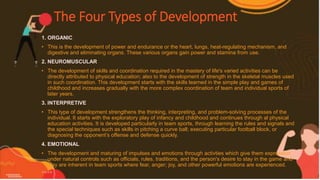
The Four Types of Development
1. ORGANIC
• This is the development of power and endurance or the heart, lungs, heat-regulating mechanism, and
digestive and eliminating organs. These various organs gain power and stamina from use.
2. NEUROMUSCULAR
• The development of skills and coordination required in the mastery of life's varied activities can be
directly attributed to physical education; also to the development of strength in the skeletal muscles used
in such coordination. This development starts with the skills learned in the simple play and games of
childhood and increases gradually with the more complex coordination of team and individual sports of
later years.
3. INTERPRETIVE
• This type of development strengthens the thinking, interpreting, and problem-solving processes of the
individual. It starts with the exploratory play of infancy and childhood and continues through al physical
education activities. It is developed particularly in team sports, through learning the rules and signals and
the special techniques such as skills in pitching a curve ball; executing particular football block, or
diagnosing the opponent’s offense and defense quickly.
4. EMOTIONAL
• The development and maturing of impulses and emotions through activties which give them expression
under natural controls such as officials, rules, traditions, and the person's desire to stay in the game and
play are inherent in team sports where fear, anger; joy, and other powerful emotions are experienced.

teaching elementary physical education and healt

  • 1.
    PE 1: PhysicalFitness Prepared by: Alana Angelica Baruc, RN, LPT
  • 2.
    UNIT 1: PHYSICAL EDUCATION:ITS VALUE TO THE DEVELOPMENT AND ADJUSTMENT OF THE INDIVIDUAL
  • 3.
    • Modern PhysicalEducation activities are based on the natural physical education of the primitive times. Even the more recent activities, when analyzed, are found to be developed from natural activities. In most educational systems, physical education (PE), also called physical training (PT) or gym, though each with a very different connotation, is a course in the curriculum which utilizes learning in the cognitive, affective and psychomotor domains in a play or movement exploration setting. The term physical education is most commonly used in this way; however, this denotes rather that "they have participated in the subject area, not studied it." Physical education has existed since the earliest stages of humanity, in areas as simple as the transmission of knowledge of basic survival skills, such as hunting. However, the real history of physical education is in the changing methodologies used to transmit physical skills and, to a lesser extent, the varying intentions of the educator.
  • 4.
    • The firstknown literary reference to an athletic competition is preserved in the ancient Greek text, the lliad, by Homer. While by no means is this the beginning of physical activity, it marks an important point in the study of the history of physical education. • Other cultures that existed before the Greeks, including the ancient Chinese, Indian, and Egyptian civilizations had traditions of physical education and activity, but the Greek influence is argued to be the most fundamental to how the discipline is viewed today. The ancient Greek tradition or the Olympic Games, which originated in the early 8th century BC, even continues today. The Father of Modern Physical Education that we know of today was Friedrich Ludwig Jahn. Although Jahn was highly political within Germany, his contributions to Physical Education (mostly in Gymnastics) as a discipline are stull seen today.
  • 5.
    What is PhysicalEducation? • Physical Education (PE) is the interdisciplinary study of all areas of science relating to the transmission of physical knowledge and skills to an individual or a group, the application of these skills, and their results. Physical Education is an important segment of general education which aims to contribute to the total development of the learner through participation in selected activities. It provides opportunities to acquire lifelong skills that are essential to his physical, mental, social, and emotional development It can also be viewed as a program of activities in a school curriculum that involves sports, games, dance, gymnastics, and recreational activities. Great emphasis is placed on motor skills, fitness, health, recreation and safety. It is the vital and integral part of general education designed to promote the optimum development of the individual physically, socially, emotionally, and mentally through total body movement in the performance of properly selected physical activities.
  • 6.
    Objectives of PhysicalEducation • Most modern school systems claim their intent is to equip students with the knowledge, skills, capacities, and values along with the enthusiasm to maintain a healthy lifestyle into adulthood. Some schools also require physical education as a way to promote weight loss in students. Activities included in the program are designed to promote physical fitness, to develop motor skills, to instill knowledge and understanding of rules concepts, and strategies, and to teach students to work as part of a team, or as individuals, in a wide variety of competitive activities.
  • 7.
    Physical Development • Throughcarefully selected physical education activities, an individual who participates actively will develop and maintain good health and high level of physical fitness. The acquisition of physical skills can motivate an individual to participate further in physical activities: hence, healthy growth and development of each learner will be enhanced. Social Development Participation in Physical Education activities provides opportunities for the acquisition and practice of desirable social traits necessary for adjustment to happy living and to the social life in general. Some worthwhile traits are: Friendliness; Cooperation; Respect for the rights of others; Good sportsmanship; Good leadership and followership and Honesty in group competition. Emotional Development The informal nature of physical education offers opportunities for the development of expression and emotional trait needed for emotional mastery like: Self confidence; Self control; Self reliance; Courage; Determination and Personal Discipline. Mental Development Through participation in Physical Education activities the individual develops his mental capacities as he learns the mechanical principles of underlying movement, as the learner acquires knowledge and understanding of rules and strategies of games and sports as well as dance instructions, as he discovers ways of improving his movements in gymnastics and dance, and the ability to analyze and give judgments.
  • 8.
    Legal Basis ofPhysical Education • Article 1 of the International Charter of Physical Education and Sports, UNESCO, Paris, 1978 and Recommendation 1, Interdisciplinary Regional Meeting of Experts on Physical Education, UNESCO, Brisbane Australia, 1982. States that "The practice of Physical Education and Sports is a fundamental right for all.." "And this right should not be treated as different in principle from the right to adequate food, shelter, and medical care.“ • Article XIV, section 19, 1986 Constitution of the Republic of the Philippines- "The State shall promote Physical Education and encourage sports programs, league competitions, and amateur sports including training for international competition to foster self-discipline, teamwork, and excellence for the development of a healthy and alert citizenry." "All educational institutions shall undertake regular sports activities throughout the country and in cooperation with athletic club and other sectors."
  • 9.
    Basic Physical Educationin College The services Physical Education refers to the four subjects given to the freshmen and sophomores in the first four semesters of their college work as stipulated in the DECS Order No, 58, series of 1990. • Physical Education 1: Physical Fitness and Self-Testing Activities It covers the essentials of physical fitness components and self-testing activities. • Physical Education 2: Rhythmic Activities It is focused on the rhythm, fundamental rhythmic activities, dance mixers, local and foreign dances, as well as social dances. • Physical Education 3: Individual/Dual Sports/Games It deals with the acquisition of skills on recreational activities such as bowling; table tennis, badminton, track and field events, and to foster love of country, " mga laro ng lahi" are, likewise, given. • Physical Education 4: Team Sports It emphasizes the acquisition of the fundamentals of common team sports such as volleyball, basketball, baseball/ softball.
  • 10.
    Values of PhysicalEducation • The values of physical education activities are found in the resulting development and adjustment of the individual. Engaging in any activity stimulates in some degree the four types of development although different activities emphasize different amounts. Regular exercise and physical activity are extremely important and beneficial for long-term health and well-being.
  • 11.
    Health benefits ofexercise and physical activity • 1. Reduce the risk of premature death. • 2. Reduce the risk of developing and/or dying from heart disease • 3. Reduce high blood pressure or the risk of developing high blood pressure • 4 Reduce high cholesterol or the risk of developing high cholesterol. • 5. Reduce the risk of developing colon cancer and breast cancer. • 6. Reduce the risk of developing diabetes. • 7. Reduce or maintain body weight or body fat. • 8. Build and maintain healthy muscles, bones, and joints. • 9 Reduce depression and anxiety. • 10. Improve psychological well-being • 11. Enhance work, recreation, and sports performance
  • 12.
    The Four Typesof Development 1. ORGANIC • This is the development of power and endurance or the heart, lungs, heat-regulating mechanism, and digestive and eliminating organs. These various organs gain power and stamina from use. 2. NEUROMUSCULAR • The development of skills and coordination required in the mastery of life's varied activities can be directly attributed to physical education; also to the development of strength in the skeletal muscles used in such coordination. This development starts with the skills learned in the simple play and games of childhood and increases gradually with the more complex coordination of team and individual sports of later years. 3. INTERPRETIVE • This type of development strengthens the thinking, interpreting, and problem-solving processes of the individual. It starts with the exploratory play of infancy and childhood and continues through al physical education activities. It is developed particularly in team sports, through learning the rules and signals and the special techniques such as skills in pitching a curve ball; executing particular football block, or diagnosing the opponent’s offense and defense quickly. 4. EMOTIONAL • The development and maturing of impulses and emotions through activties which give them expression under natural controls such as officials, rules, traditions, and the person's desire to stay in the game and play are inherent in team sports where fear, anger; joy, and other powerful emotions are experienced.