Action Research: Moving my own goal postsDr. Ashley Casey
Who was I?Boys’ Physical education teacher
Who was I?Didactic/Command Style
Who was I?Ofsted said: “Good with outstanding features”
Who was I?Knowledgeable and experienced (9 years)
Who was I?Semi-Professional Rugby league and union player
Who was I?1st XV Rugby Coach
What happened?
What Happened?CPD
What Happened?Master’s Degree & PhD
What Happened?Autobiography
What Happened?read
What Happened?Read more
What Happened?Found I didn’t know as much as I thought
What Happened?Didn’t like what I always did
ImplicationsThought I was goodTold I was goodFound out I might not be as good as I thought or had been toldFaced with a dilemma
What did I do?Looked to doing something new
What did I do?But I wanted to see if it worked
What did I do?SO…
What did I do?I undertook an action research project.
What was I told about me?   “dominant, competitive, aggressive, not-too bright individual … (the) companionable ‘man of action’, but not someone with whom to engage in professional dialogue” (Whitehead and Hendry, 1976, p. 75)
What was I told about me?one of those teachers who “worked hard for continuity without knowing it, in the sense that [I was] frightfully conservative, never made a move and was resistant to change” (Briault, 1974, p. 6).
What was I told about teaching?physical educationalist persistently teach the same introductory units of work regardless of the age and past experiences of the students.Siedentop, 2002
What was I told about teaching?there is no one best way to teach physical educationMetzler, 2005
Task 1You have three minutes to reflect on your experiences today.Answer these questions:Who are you?What have you been told about your teaching?What do you want to happen?Share your writing with another student
Learning outcomes
Learning OutcomesYou will: understand more about action researchstart to think about what your action research project might look like.
Section 1Finding a starting point and clarifying the situation
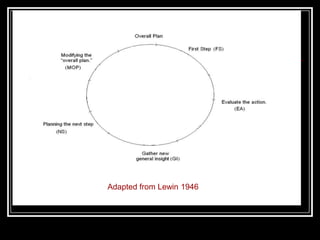
Adapted from Lewin 1946
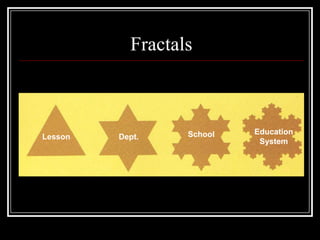
FractalsEducation SystemSchoolDept.Lesson
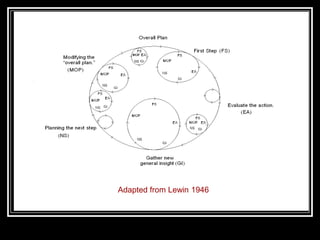
Adapted from Lewin 1946
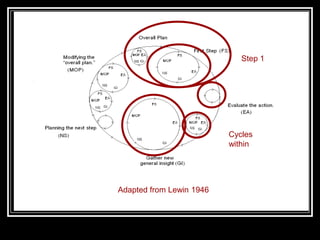
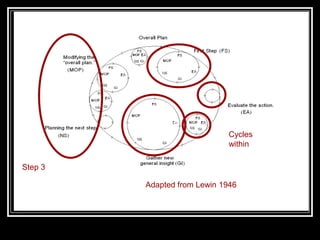
Step 1Cycles withinAdapted from Lewin 1946
My Starting PointI didn’t want to use command/didactic instruction any more
My Starting PointI wanted to use models-based practice
My Starting PointI wanted to see how these two things occurred
Research QuestionsWhat happens to me – as a teacher and a person – when I engage in long-term reflective practice?What impact does a new teaching strategy have on student learning processes?What lessons emerge from this sustained effort of reflective practice that may affect the way in which we view pedagogical change in physical education?
Clarifying the SituationUsed Brookfield’s (1995) four lensesTheoretical LiteratureBiographyStudents’ EyesColleagues’ Observations
Theoretical - MethodologyPractitioner ResearchAction ResearchAutobiographical Inquiry
Section 2Collecting and analysing data, developing action strategies and putting them into practice
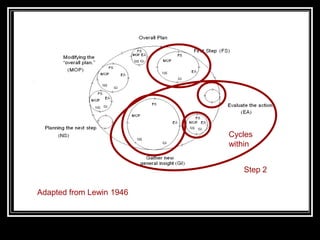
Cycles withinStep 2Adapted from Lewin 1946
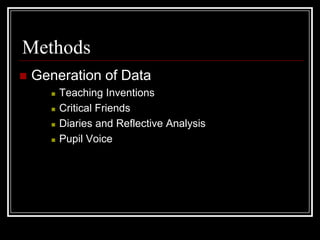
MethodsGeneration of DataTeaching InventionsCritical FriendsDiaries and Reflective AnalysisPupil Voice
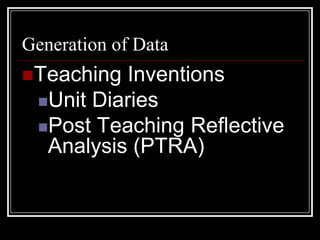
Generation of DataTeaching InventionsUnit DiariesPost Teaching Reflective Analysis (PTRA)
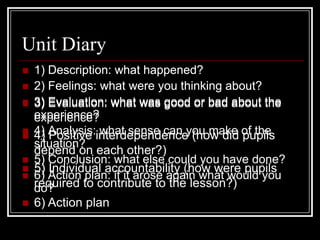
Unit Diary1) Description: what happened?
2) Feelings: what were you thinking about?
3) Evaluation: what was good or bad about the experience?
4) Positive interdependence (how did pupils depend on each other?)
5) Individual accountability (how were pupils required to contribute to the lesson?)
6) Action plan1) Description: what happened? 2) Feelings: what were you thinking about? 3) Evaluation: what was good or bad about the experience? 4) Analysis: what sense can you make of the situation? 5) Conclusion: what else could you have done? 6) Action plan: if it arose again what would you do?
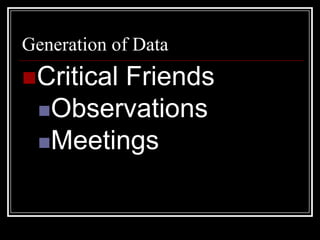
Generation of DataCritical FriendsObservationsMeetings
Critical Friends‘Wayne’Meetings‘Burt’ and ‘Ernie’Teaching assistants‘Carlos’Visiting physical education teacher/Ph.D
Generation of DataDiaries and Reflective AnalysisWriting for 5 minutesPost Teaching Cycle Analysis (PCRA)
Writing for 5 minutesI must remember the journey that I’ve been on to date.  With three years devoted to this already I am doing a good job and mustn’t forget that. I am a long way from the one-dimensional teacher who started this journey.  However, I have still retained much of what was good about my practice – my enthusiasm, my subject knowledge, my ability to break down a task, my relationship with the pupils – these are things that still characterise my teaching and things that I must remember and must hold on to.  Reflective Diary (13th November 2005)
Writing for 5 minutesI am going to plan and run a whole unit of work with my Year 10 rugby group and I plan to plan a whole year’s work with four separate classes in Year 11.  On top of that there’s basketball, swimming, athletics and gymnastics; a lot of work.  I know that I will need to be up to speed before the year starts, so I will have to make some plans on how that will happen.  Picking groups and detailed plans are the key, as is not biting off more than I can manage.  This type of teaching is not simple and I must not try and do too much. Reflective Diary (3rd August 2006)
Generation of DataPupil VoiceComment CardsInterviews
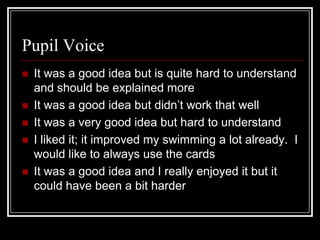
Pupil VoiceIt was a good idea but is quite hard to understand and should be explained moreIt was a good idea but didn’t work that wellIt was a very good idea but hard to understandI liked it; it improved my swimming a lot already.  I would like to always use the cardsIt was a good idea and I really enjoyed it but it could have been a bit harder
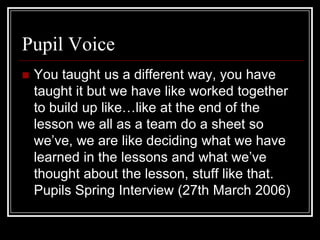
Pupil VoiceYou taught us a different way, you have taught it but we have like worked together to build up like…like at the end of the lesson we all as a team do a sheet so we’ve, we are like deciding what we have learned in the lessons and what we’ve thought about the lesson, stuff like that. Pupils Spring Interview (27th March 2006)
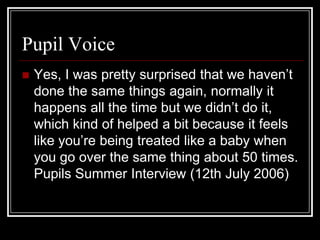
Pupil VoiceYes, I was pretty surprised that we haven’t done the same things again, normally it happens all the time but we didn’t do it, which kind of helped a bit because it feels like you’re being treated like a baby when you go over the same thing about 50 times. Pupils Summer Interview (12th July 2006)
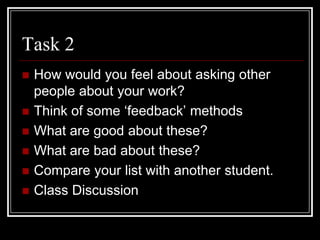
Task 2How would you feel about asking other people about your work?Think of some ‘feedback’ methodsWhat are good about these?What are bad about these?Compare your list with another student.Class Discussion
Section 3Formulating and sharing teacher knowledge

Action Research for the Reflective Teacher

  • 1.
    Action Research: Movingmy own goal postsDr. Ashley Casey
  • 2.
    Who was I?Boys’Physical education teacher
  • 3.
  • 4.
    Who was I?Ofstedsaid: “Good with outstanding features”
  • 5.
    Who was I?Knowledgeableand experienced (9 years)
  • 6.
    Who was I?Semi-ProfessionalRugby league and union player
  • 7.
    Who was I?1stXV Rugby Coach
  • 8.
  • 9.
  • 10.
  • 11.
  • 12.
  • 13.
  • 14.
    What Happened?Found Ididn’t know as much as I thought
  • 15.
    What Happened?Didn’t likewhat I always did
  • 16.
    ImplicationsThought I wasgoodTold I was goodFound out I might not be as good as I thought or had been toldFaced with a dilemma
  • 17.
    What did Ido?Looked to doing something new
  • 18.
    What did Ido?But I wanted to see if it worked
  • 19.
    What did Ido?SO…
  • 20.
    What did Ido?I undertook an action research project.
  • 21.
    What was Itold about me? “dominant, competitive, aggressive, not-too bright individual … (the) companionable ‘man of action’, but not someone with whom to engage in professional dialogue” (Whitehead and Hendry, 1976, p. 75)
  • 22.
    What was Itold about me?one of those teachers who “worked hard for continuity without knowing it, in the sense that [I was] frightfully conservative, never made a move and was resistant to change” (Briault, 1974, p. 6).
  • 23.
    What was Itold about teaching?physical educationalist persistently teach the same introductory units of work regardless of the age and past experiences of the students.Siedentop, 2002
  • 24.
    What was Itold about teaching?there is no one best way to teach physical educationMetzler, 2005
  • 25.
    Task 1You havethree minutes to reflect on your experiences today.Answer these questions:Who are you?What have you been told about your teaching?What do you want to happen?Share your writing with another student
  • 26.
  • 27.
    Learning OutcomesYou will:understand more about action researchstart to think about what your action research project might look like.
  • 28.
    Section 1Finding astarting point and clarifying the situation
  • 29.
  • 30.
  • 31.
  • 32.
  • 33.
    My Starting PointIdidn’t want to use command/didactic instruction any more
  • 34.
    My Starting PointIwanted to use models-based practice
  • 35.
    My Starting PointIwanted to see how these two things occurred
  • 36.
    Research QuestionsWhat happensto me – as a teacher and a person – when I engage in long-term reflective practice?What impact does a new teaching strategy have on student learning processes?What lessons emerge from this sustained effort of reflective practice that may affect the way in which we view pedagogical change in physical education?
  • 37.
    Clarifying the SituationUsedBrookfield’s (1995) four lensesTheoretical LiteratureBiographyStudents’ EyesColleagues’ Observations
  • 38.
    Theoretical - MethodologyPractitionerResearchAction ResearchAutobiographical Inquiry
  • 39.
    Section 2Collecting andanalysing data, developing action strategies and putting them into practice
  • 40.
  • 41.
    MethodsGeneration of DataTeachingInventionsCritical FriendsDiaries and Reflective AnalysisPupil Voice
  • 42.
    Generation of DataTeachingInventionsUnit DiariesPost Teaching Reflective Analysis (PTRA)
  • 43.
  • 44.
    2) Feelings: whatwere you thinking about?
  • 45.
    3) Evaluation: whatwas good or bad about the experience?
  • 46.
    4) Positive interdependence(how did pupils depend on each other?)
  • 47.
    5) Individual accountability(how were pupils required to contribute to the lesson?)
  • 48.
    6) Action plan1)Description: what happened? 2) Feelings: what were you thinking about? 3) Evaluation: what was good or bad about the experience? 4) Analysis: what sense can you make of the situation? 5) Conclusion: what else could you have done? 6) Action plan: if it arose again what would you do?
  • 49.
    Generation of DataCriticalFriendsObservationsMeetings
  • 50.
    Critical Friends‘Wayne’Meetings‘Burt’ and‘Ernie’Teaching assistants‘Carlos’Visiting physical education teacher/Ph.D
  • 51.
    Generation of DataDiariesand Reflective AnalysisWriting for 5 minutesPost Teaching Cycle Analysis (PCRA)
  • 52.
    Writing for 5minutesI must remember the journey that I’ve been on to date. With three years devoted to this already I am doing a good job and mustn’t forget that. I am a long way from the one-dimensional teacher who started this journey. However, I have still retained much of what was good about my practice – my enthusiasm, my subject knowledge, my ability to break down a task, my relationship with the pupils – these are things that still characterise my teaching and things that I must remember and must hold on to. Reflective Diary (13th November 2005)
  • 53.
    Writing for 5minutesI am going to plan and run a whole unit of work with my Year 10 rugby group and I plan to plan a whole year’s work with four separate classes in Year 11. On top of that there’s basketball, swimming, athletics and gymnastics; a lot of work. I know that I will need to be up to speed before the year starts, so I will have to make some plans on how that will happen. Picking groups and detailed plans are the key, as is not biting off more than I can manage. This type of teaching is not simple and I must not try and do too much. Reflective Diary (3rd August 2006)
  • 54.
    Generation of DataPupilVoiceComment CardsInterviews
  • 55.
    Pupil VoiceIt wasa good idea but is quite hard to understand and should be explained moreIt was a good idea but didn’t work that wellIt was a very good idea but hard to understandI liked it; it improved my swimming a lot already. I would like to always use the cardsIt was a good idea and I really enjoyed it but it could have been a bit harder
  • 56.
    Pupil VoiceYou taughtus a different way, you have taught it but we have like worked together to build up like…like at the end of the lesson we all as a team do a sheet so we’ve, we are like deciding what we have learned in the lessons and what we’ve thought about the lesson, stuff like that. Pupils Spring Interview (27th March 2006)
  • 57.
    Pupil VoiceYes, Iwas pretty surprised that we haven’t done the same things again, normally it happens all the time but we didn’t do it, which kind of helped a bit because it feels like you’re being treated like a baby when you go over the same thing about 50 times. Pupils Summer Interview (12th July 2006)
  • 58.
    Task 2How wouldyou feel about asking other people about your work?Think of some ‘feedback’ methodsWhat are good about these?What are bad about these?Compare your list with another student.Class Discussion
  • 59.
    Section 3Formulating andsharing teacher knowledge