Physical Basis of Heredity
and The Traits from Parents
Practice Teacher: Russel A. Junio
What is Chromosome?
• Chromosome is the part
of a cell that contains the
genes which control how
an animal or plants grows
and what it becomes.
• Any of the rod-shaped or
threadlike DNA-
containing structures of
cellular organisms that
are located in the
nucleus.
What is Chromatids?
Chromatids is one of the
usually paired and parallel
strands of duplicated
chromosome joined by a single
centromere.
What is Centromere?
Centromere is the point or
region on a chromosome to
which the spindle attaches
during mitosis and meiosis.
Centromere at
one end of the
chromatid arm
Centromere is
submedianly
located
Centromere at
the center
Homologous chromosome
refers to a pair of paternal and
maternal chromosomes of the
same type, size, banding
pattern and gene loci.
Primary Sex Cells
TESTIS and OVARY
Spermatozoa
(singular: Spermatozoon)
Sperm cell
Ova
(singular: Ovum) Egg cell
Spermatogenesis/Oogenesis: It is the process of reducing the
number of chromosomes of the cell from diploid (2n) to haploid (n).
CROSSING-OVER Syngamy or Fertilization
Exchange of genetic material
between homologous
chromosomes.
Union of sperm cell (n) and egg
cell (n) to restore diploid
chromosome (n+n=2n).
The Traits from Parents
Rediscovered Mendel’s Principles (early 1900s)
German Botanist:
Carl Correns
(1864-1933)
Dutch Botanist:
Hugo de Vries
(1848-1935)
Austrian
Agronomist: Erich
Tschermark von
Seysenegg
(1871-1962)
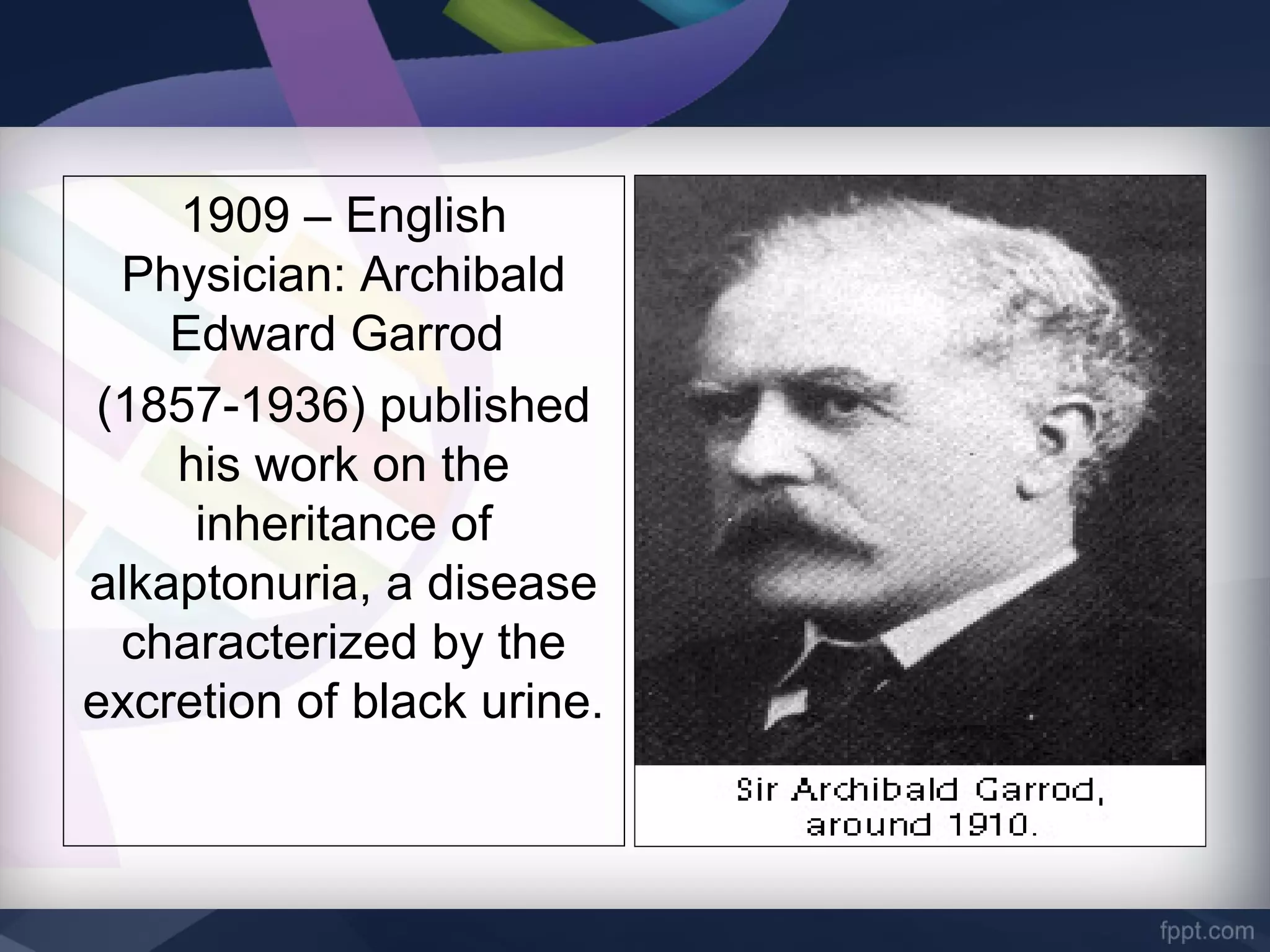
1909 – English
Physician: Archibald
Edward Garrod
(1857-1936) published
his work on the
inheritance of
alkaptonuria, a disease
characterized by the
excretion of black urine.
Traits Controlled by a Single Gene
but with Two Contrasting Alleles
Human traits that are
controlled by a single gene
with two contrasting alleles,
one dominant and one and
one recessive. Inheritance
thus follows the Mendelian
principle of dominance and
recessive. In this pattern of
inheritance, two distinct
phenotypes or physical
appearance are observed
among different individuals.
Traits Controlled by a Single Gene
with Multiple Alleles
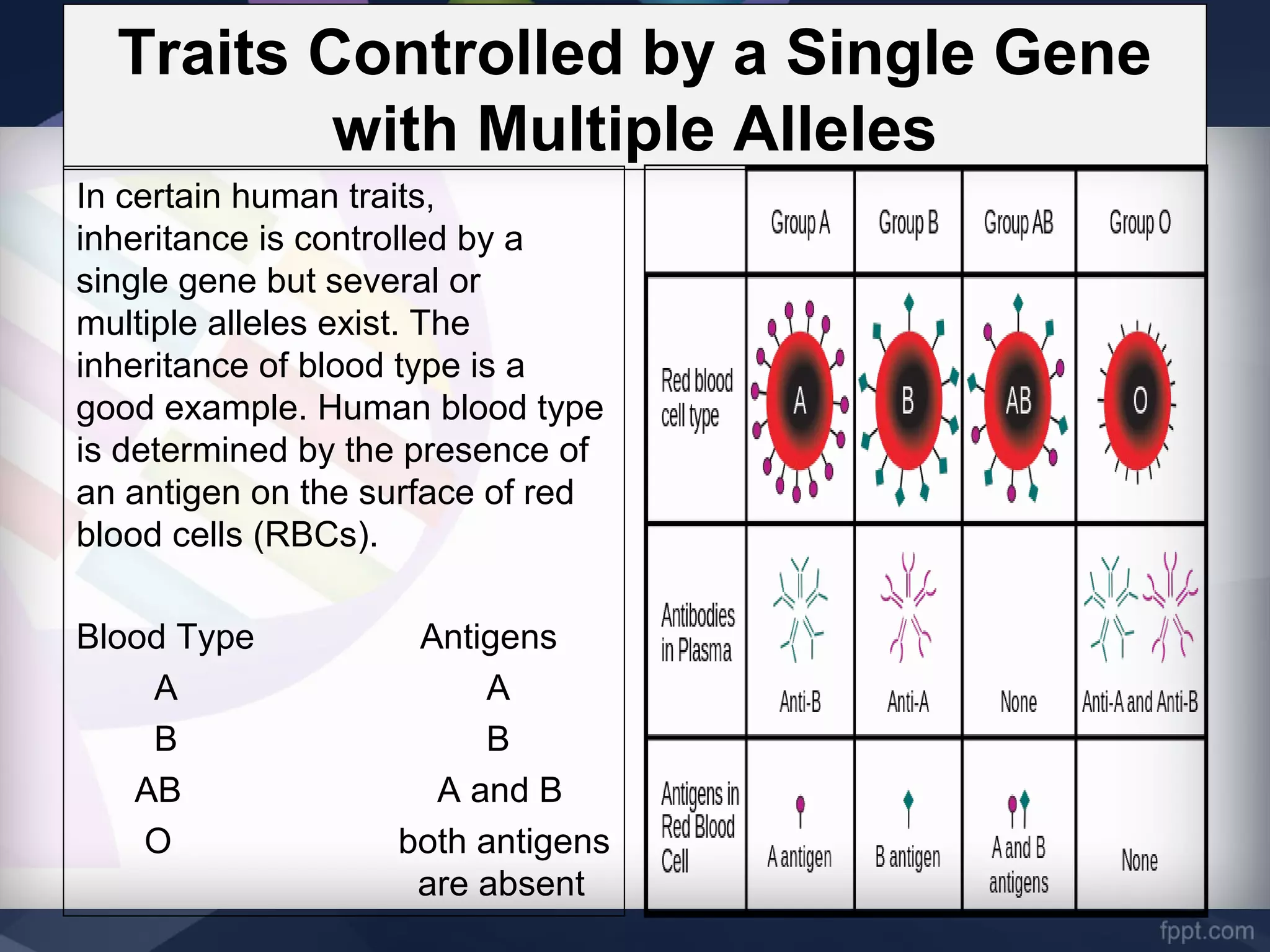
In certain human traits,
inheritance is controlled by a
single gene but several or
multiple alleles exist. The
inheritance of blood type is a
good example. Human blood type
is determined by the presence of
an antigen on the surface of red
blood cells (RBCs).
Blood Type Antigens
A A
B B
AB A and B
O both antigens
are absent
Traits Controlled by Several Genes
Interacting with One Another
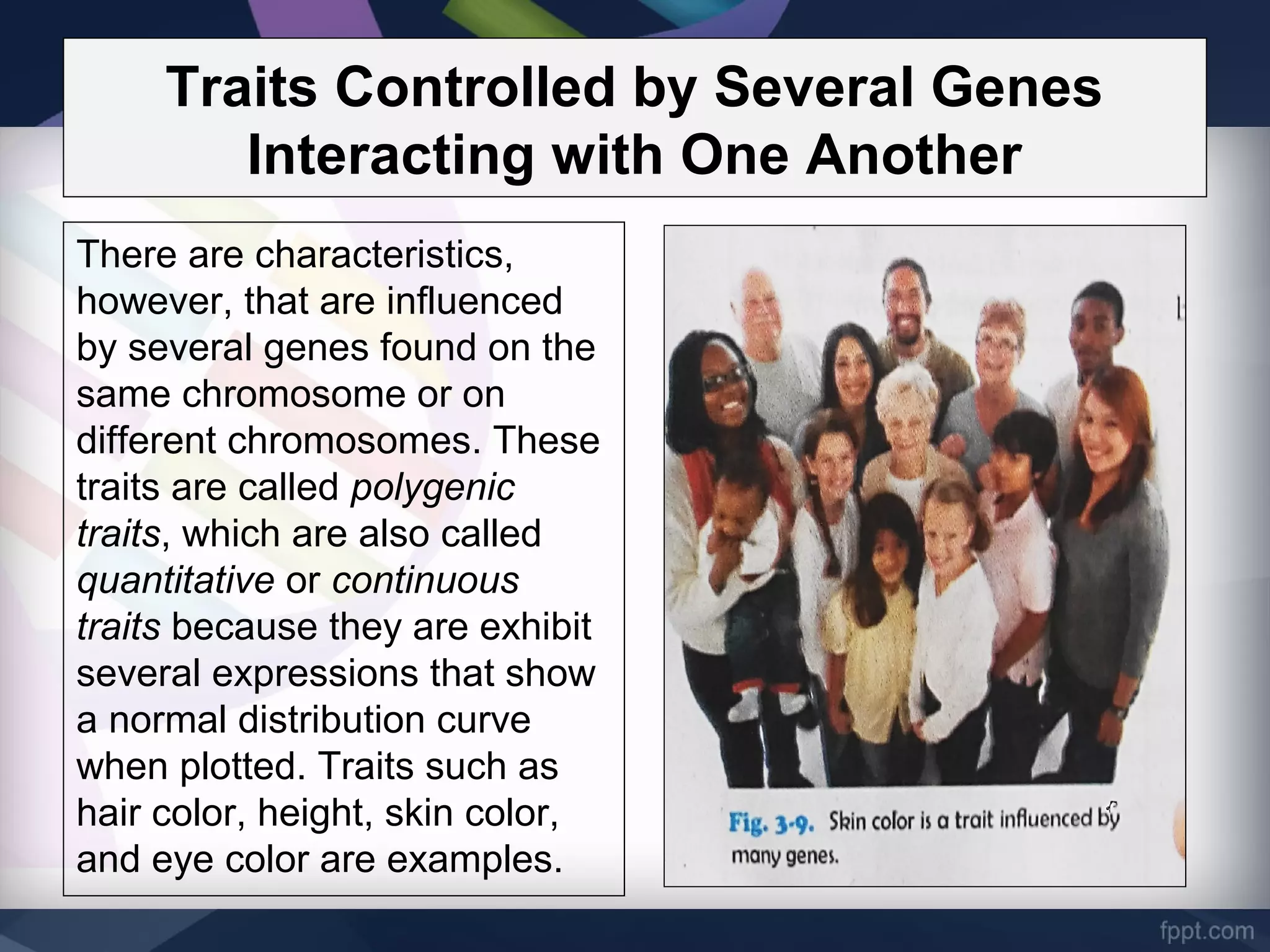
There are characteristics,
however, that are influenced
by several genes found on the
same chromosome or on
different chromosomes. These
traits are called polygenic
traits, which are also called
quantitative or continuous
traits because they are exhibit
several expressions that show
a normal distribution curve
when plotted. Traits such as
hair color, height, skin color,
and eye color are examples.

Traits From Parents

  • 1.
    Physical Basis ofHeredity and The Traits from Parents Practice Teacher: Russel A. Junio
  • 2.
    What is Chromosome? •Chromosome is the part of a cell that contains the genes which control how an animal or plants grows and what it becomes. • Any of the rod-shaped or threadlike DNA- containing structures of cellular organisms that are located in the nucleus.
  • 3.
    What is Chromatids? Chromatidsis one of the usually paired and parallel strands of duplicated chromosome joined by a single centromere. What is Centromere? Centromere is the point or region on a chromosome to which the spindle attaches during mitosis and meiosis.
  • 4.
    Centromere at one endof the chromatid arm Centromere is submedianly located Centromere at the center Homologous chromosome refers to a pair of paternal and maternal chromosomes of the same type, size, banding pattern and gene loci.
  • 5.
    Primary Sex Cells TESTISand OVARY Spermatozoa (singular: Spermatozoon) Sperm cell Ova (singular: Ovum) Egg cell Spermatogenesis/Oogenesis: It is the process of reducing the number of chromosomes of the cell from diploid (2n) to haploid (n).
  • 6.
    CROSSING-OVER Syngamy orFertilization Exchange of genetic material between homologous chromosomes. Union of sperm cell (n) and egg cell (n) to restore diploid chromosome (n+n=2n).
  • 7.
    The Traits fromParents Rediscovered Mendel’s Principles (early 1900s) German Botanist: Carl Correns (1864-1933) Dutch Botanist: Hugo de Vries (1848-1935) Austrian Agronomist: Erich Tschermark von Seysenegg (1871-1962)
  • 8.
    1909 – English Physician:Archibald Edward Garrod (1857-1936) published his work on the inheritance of alkaptonuria, a disease characterized by the excretion of black urine.
  • 9.
    Traits Controlled bya Single Gene but with Two Contrasting Alleles Human traits that are controlled by a single gene with two contrasting alleles, one dominant and one and one recessive. Inheritance thus follows the Mendelian principle of dominance and recessive. In this pattern of inheritance, two distinct phenotypes or physical appearance are observed among different individuals.
  • 10.
    Traits Controlled bya Single Gene with Multiple Alleles In certain human traits, inheritance is controlled by a single gene but several or multiple alleles exist. The inheritance of blood type is a good example. Human blood type is determined by the presence of an antigen on the surface of red blood cells (RBCs). Blood Type Antigens A A B B AB A and B O both antigens are absent
  • 11.
    Traits Controlled bySeveral Genes Interacting with One Another There are characteristics, however, that are influenced by several genes found on the same chromosome or on different chromosomes. These traits are called polygenic traits, which are also called quantitative or continuous traits because they are exhibit several expressions that show a normal distribution curve when plotted. Traits such as hair color, height, skin color, and eye color are examples.