7.2 One-to-One and Onto Functions; Inverse Functions
7.2 One-to-One and Onto Functions; Inverse Functions 1 / 1
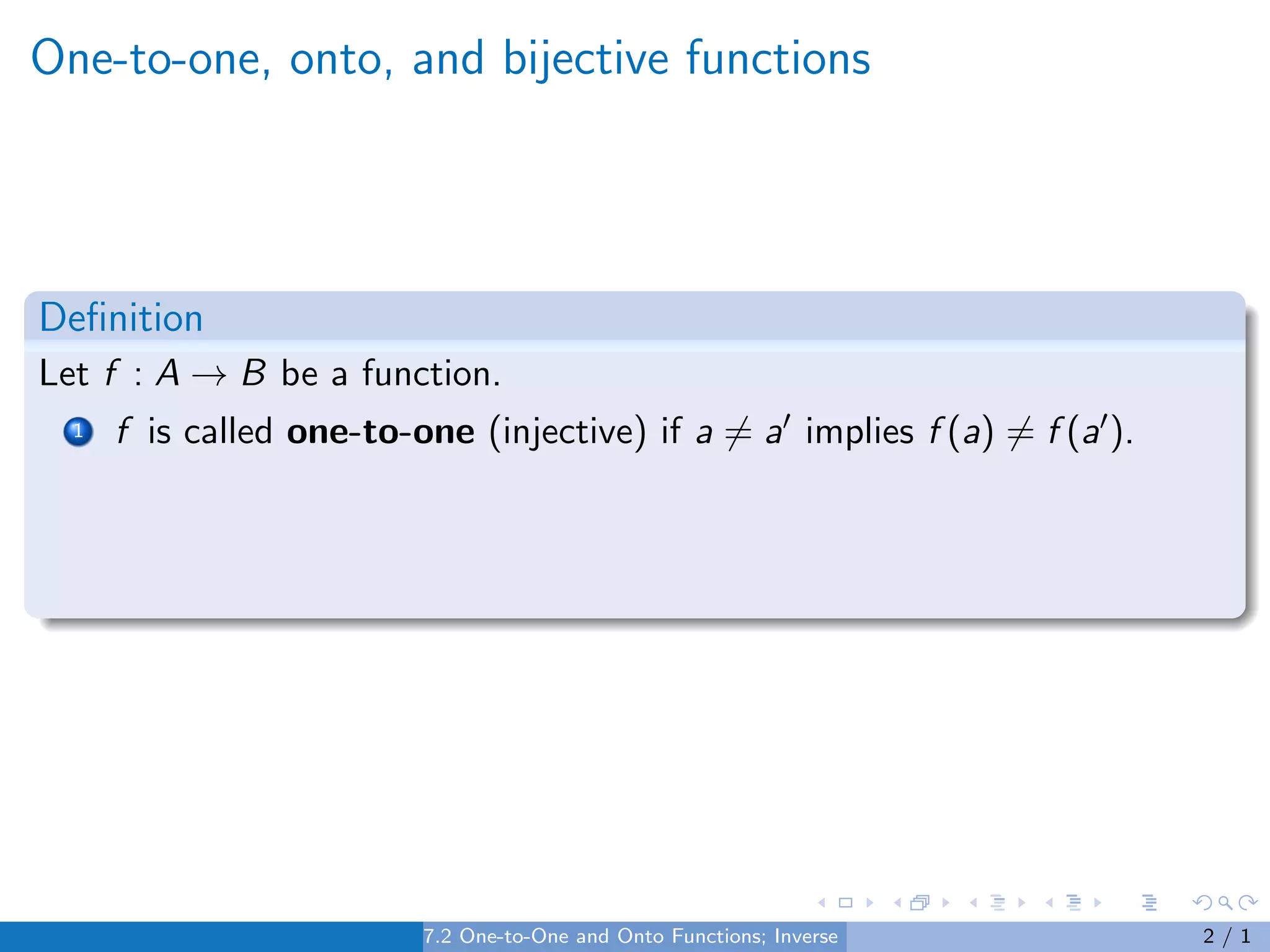
One-to-one, onto, and bijective functions
Definition
Let f : A → B be a function.
1 f is called one-to-one (injective) if a 6= a0 implies f (a) 6= f (a0).
7.2 One-to-One and Onto Functions; Inverse Functions 2 / 1
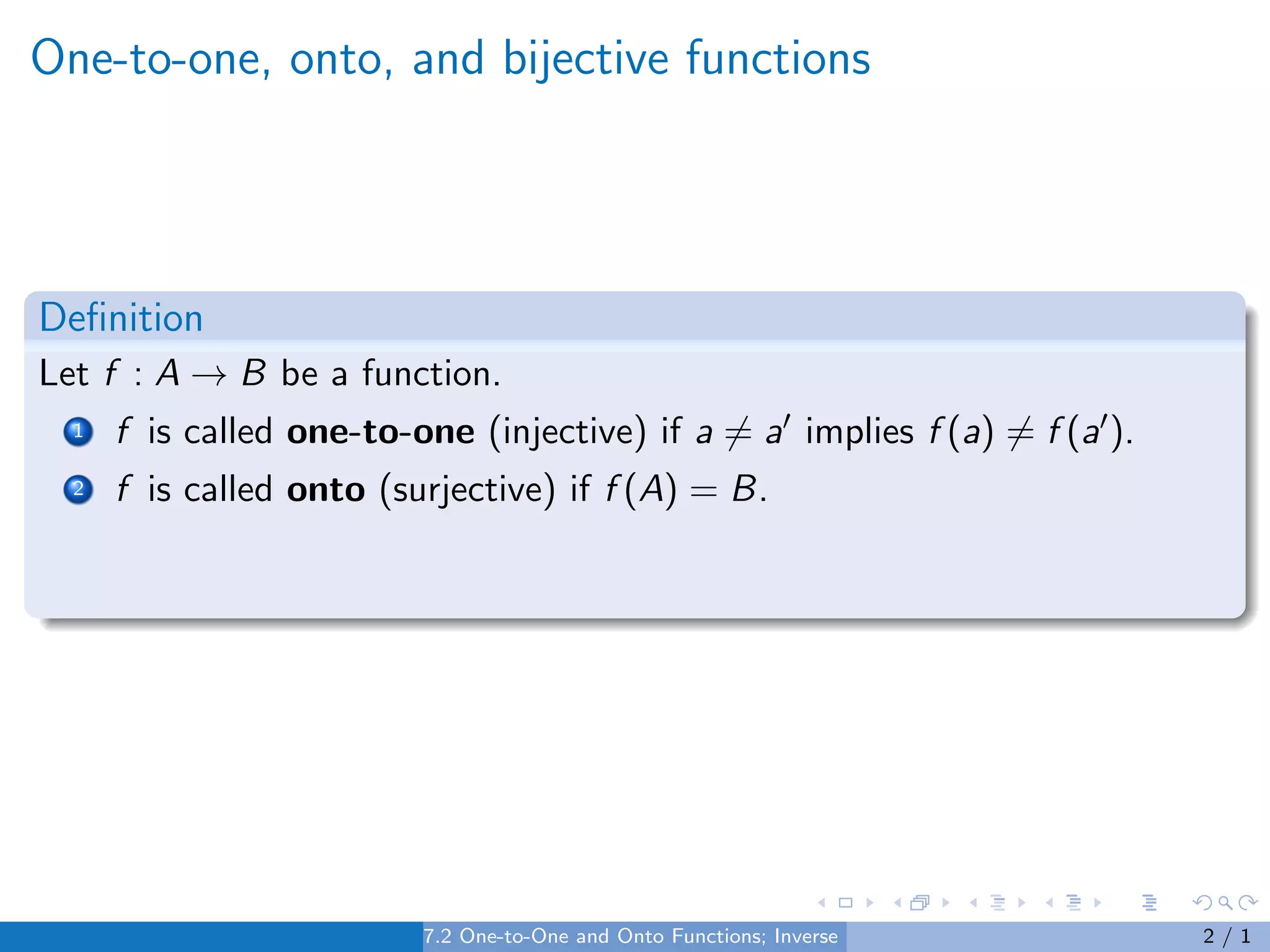
One-to-one, onto, and bijective functions
Definition
Let f : A → B be a function.
1 f is called one-to-one (injective) if a 6= a0 implies f (a) 6= f (a0).
2 f is called onto (surjective) if f (A) = B.
7.2 One-to-One and Onto Functions; Inverse Functions 2 / 1
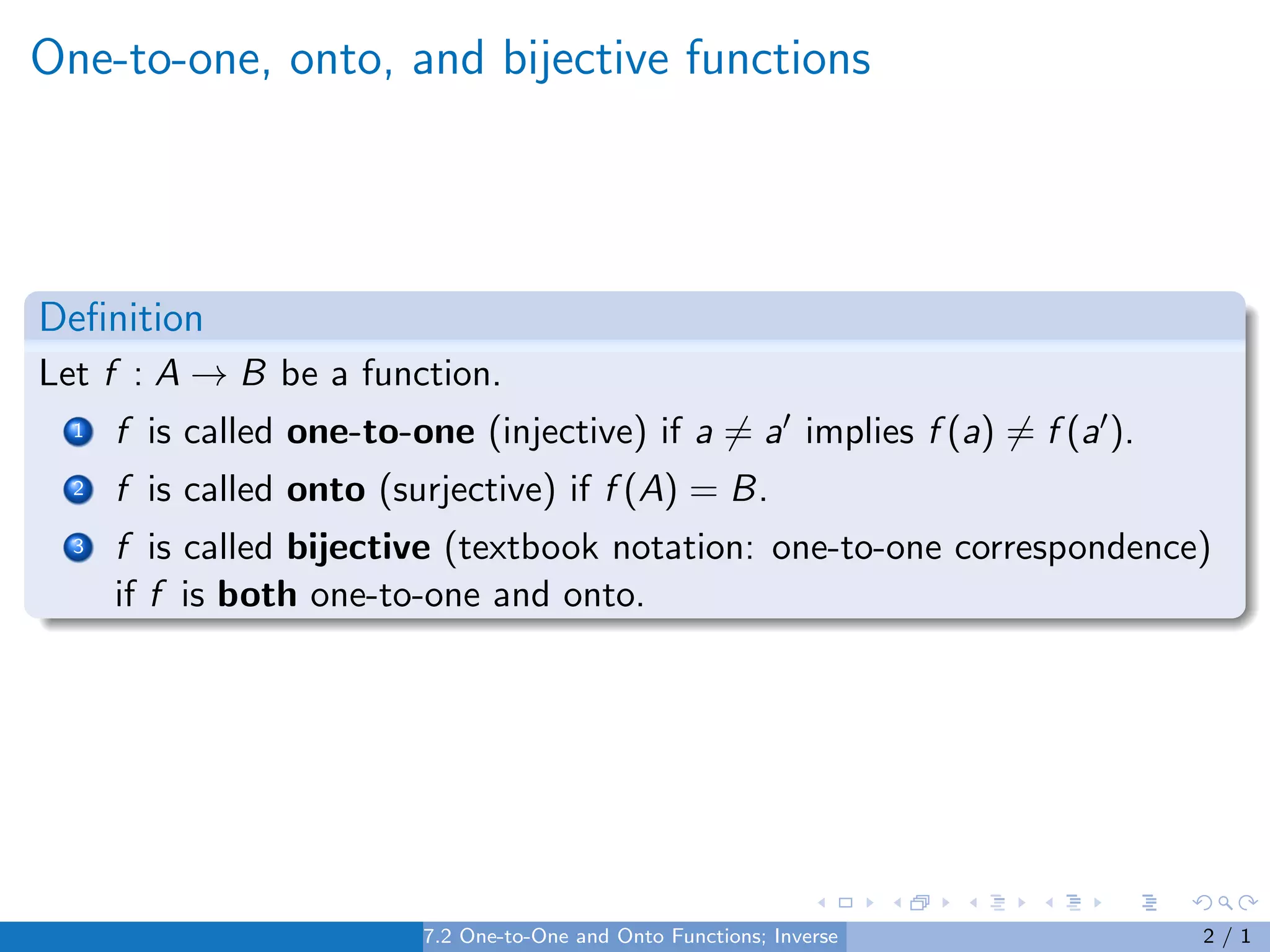
One-to-one, onto, and bijective functions
Definition
Let f : A → B be a function.
1 f is called one-to-one (injective) if a 6= a0 implies f (a) 6= f (a0).
2 f is called onto (surjective) if f (A) = B.
3 f is called bijective (textbook notation: one-to-one correspondence)
if f is both one-to-one and onto.
7.2 One-to-One and Onto Functions; Inverse Functions 2 / 1
Examples (finite sets)
Examples
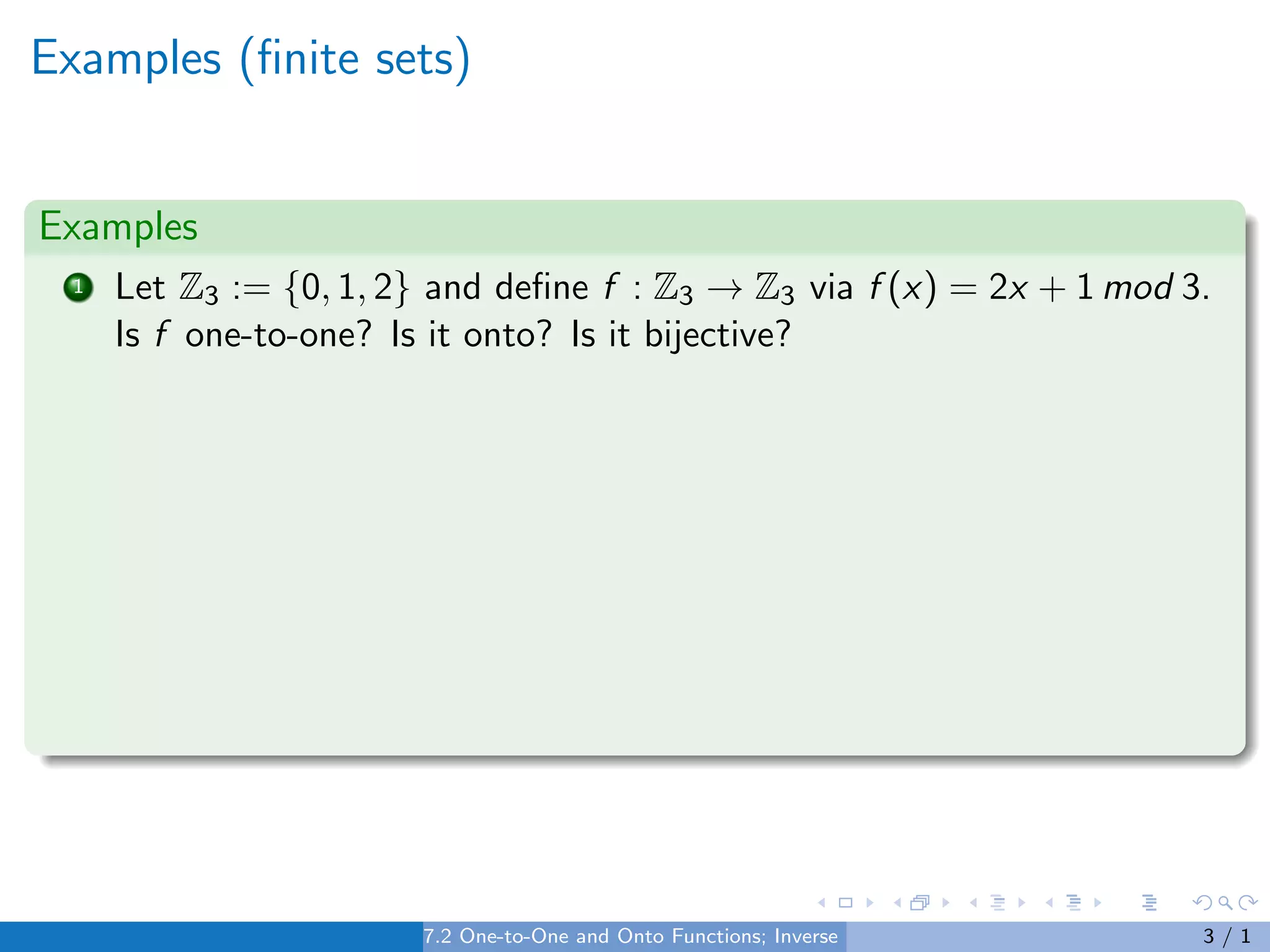
1 Let Z3 := {0, 1, 2} and define f : Z3 → Z3 via f (x) = 2x + 1 mod 3.
Is f one-to-one? Is it onto? Is it bijective?
7.2 One-to-One and Onto Functions; Inverse Functions 3 / 1
Examples (finite sets)
Examples
1 Let Z3 := {0, 1, 2} and define f : Z3 → Z3 via f (x) = 2x + 1 mod 3.
Is f one-to-one? Is it onto? Is it bijective?
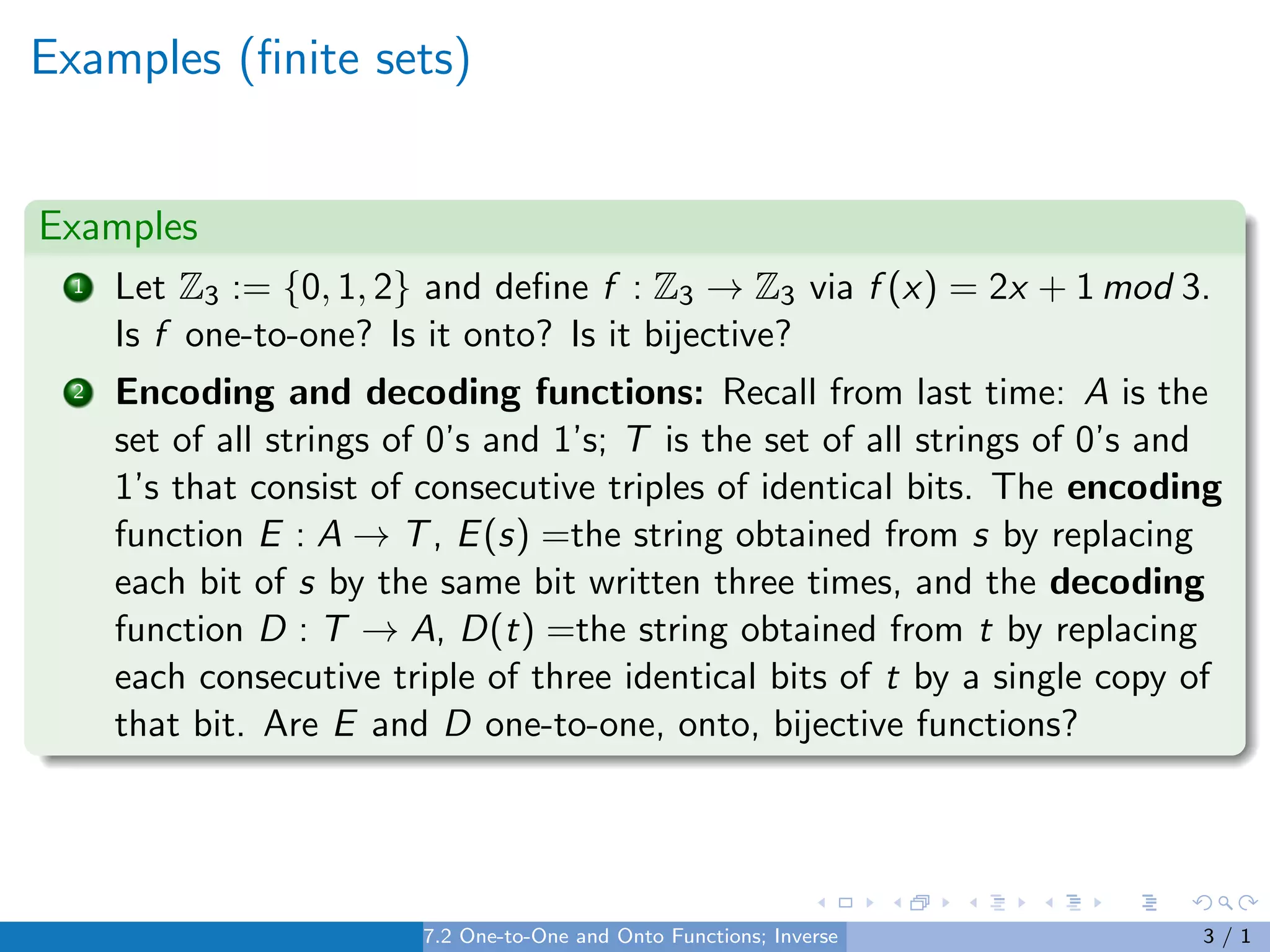
2 Encoding and decoding functions: Recall from last time: A is the
set of all strings of 0’s and 1’s; T is the set of all strings of 0’s and
1’s that consist of consecutive triples of identical bits. The encoding
function E : A → T, E(s) =the string obtained from s by replacing
each bit of s by the same bit written three times, and the decoding
function D : T → A, D(t) =the string obtained from t by replacing
each consecutive triple of three identical bits of t by a single copy of
that bit. Are E and D one-to-one, onto, bijective functions?
7.2 One-to-One and Onto Functions; Inverse Functions 3 / 1
Examples (infinite sets)
Examples
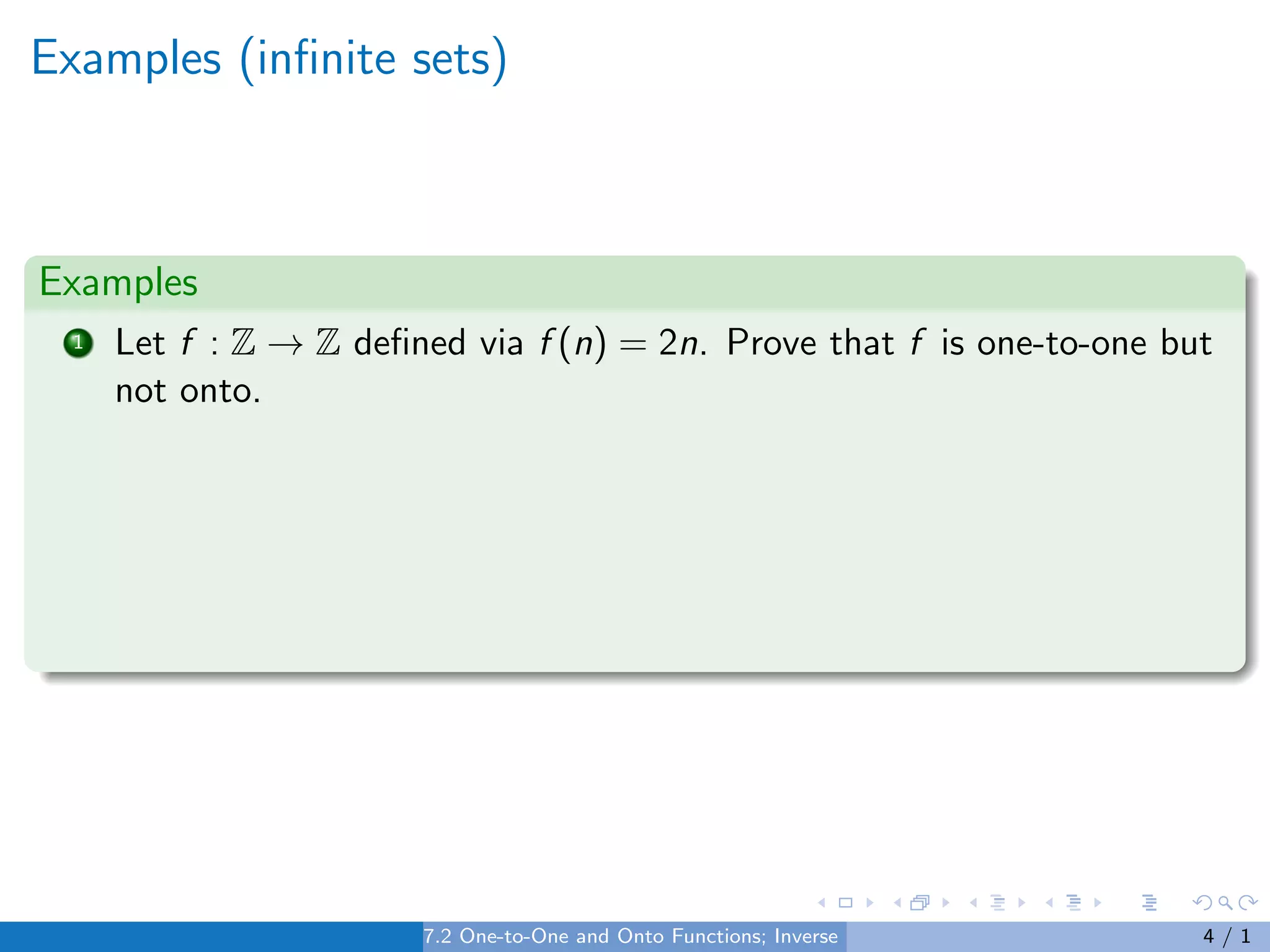
1 Let f : Z → Z defined via f (n) = 2n. Prove that f is one-to-one but
not onto.
7.2 One-to-One and Onto Functions; Inverse Functions 4 / 1
Examples (infinite sets)
Examples
1 Let f : Z → Z defined via f (n) = 2n. Prove that f is one-to-one but
not onto.
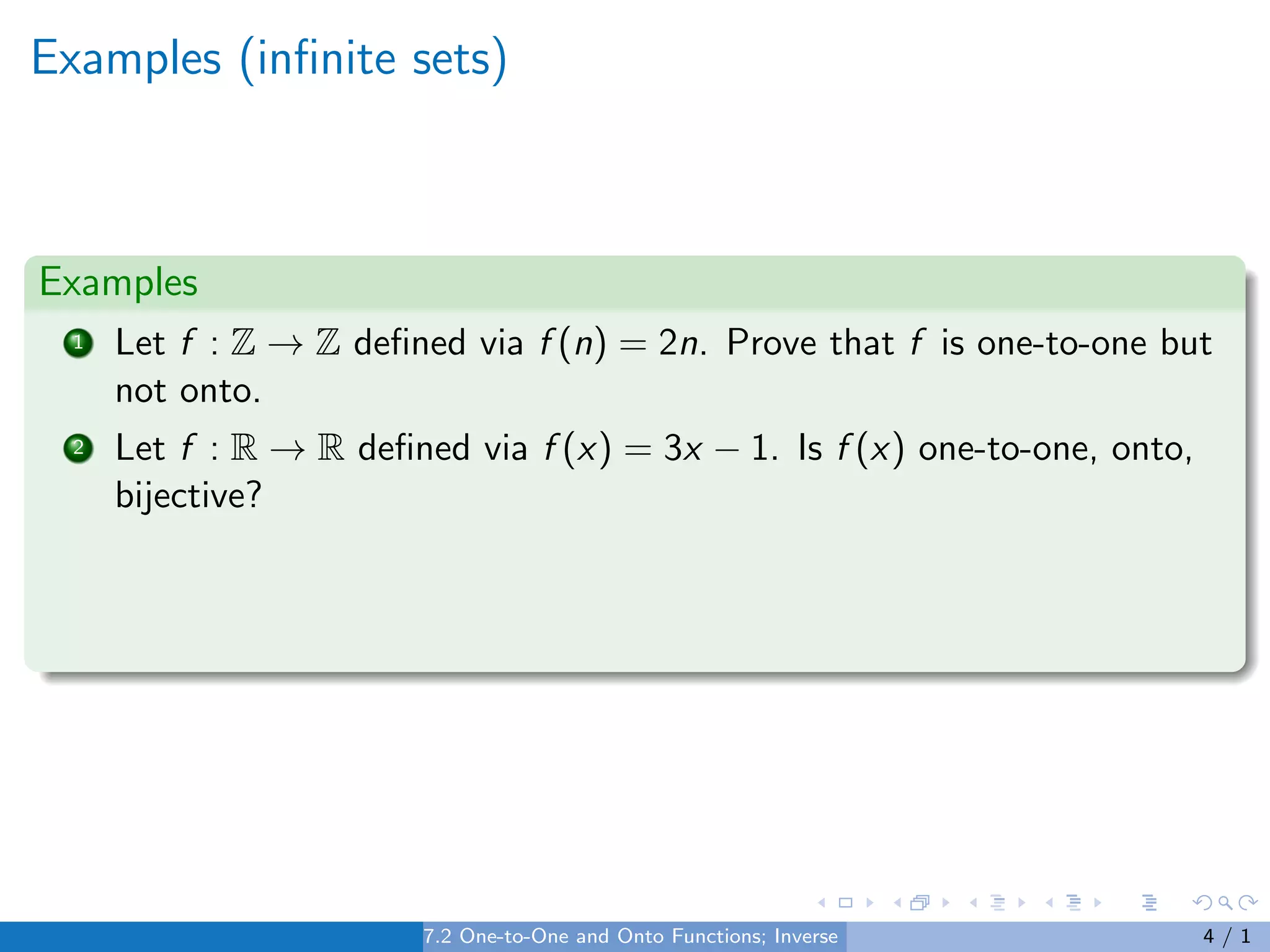
2 Let f : R → R defined via f (x) = 3x − 1. Is f (x) one-to-one, onto,
bijective?
7.2 One-to-One and Onto Functions; Inverse Functions 4 / 1
Examples (infinite sets)
Examples
1 Let f : Z → Z defined via f (n) = 2n. Prove that f is one-to-one but
not onto.
2 Let f : R → R defined via f (x) = 3x − 1. Is f (x) one-to-one, onto,
bijective?
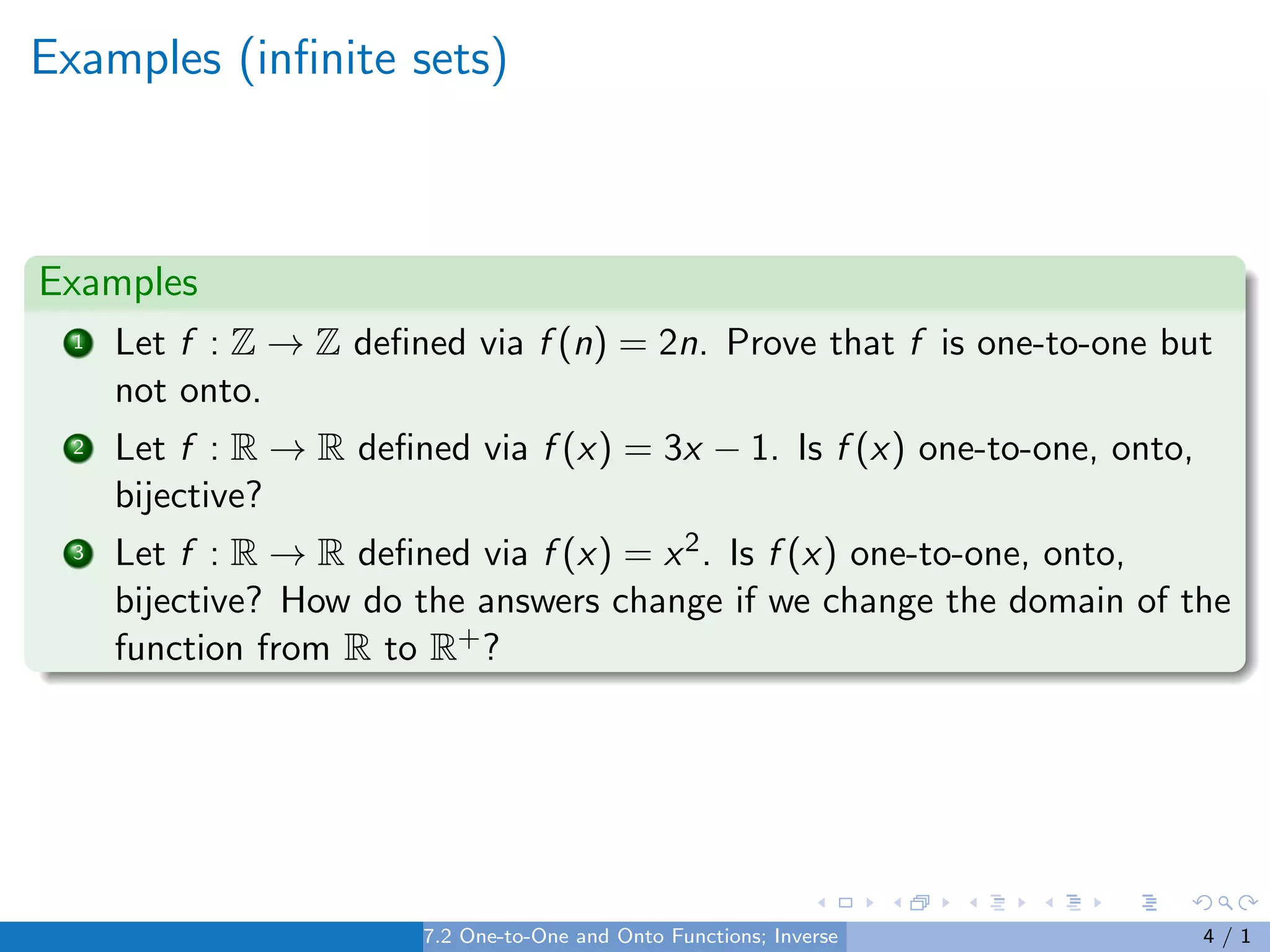
3 Let f : R → R defined via f (x) = x2. Is f (x) one-to-one, onto,
bijective? How do the answers change if we change the domain of the
function from R to R+?
7.2 One-to-One and Onto Functions; Inverse Functions 4 / 1
Inverse Functions
Fact
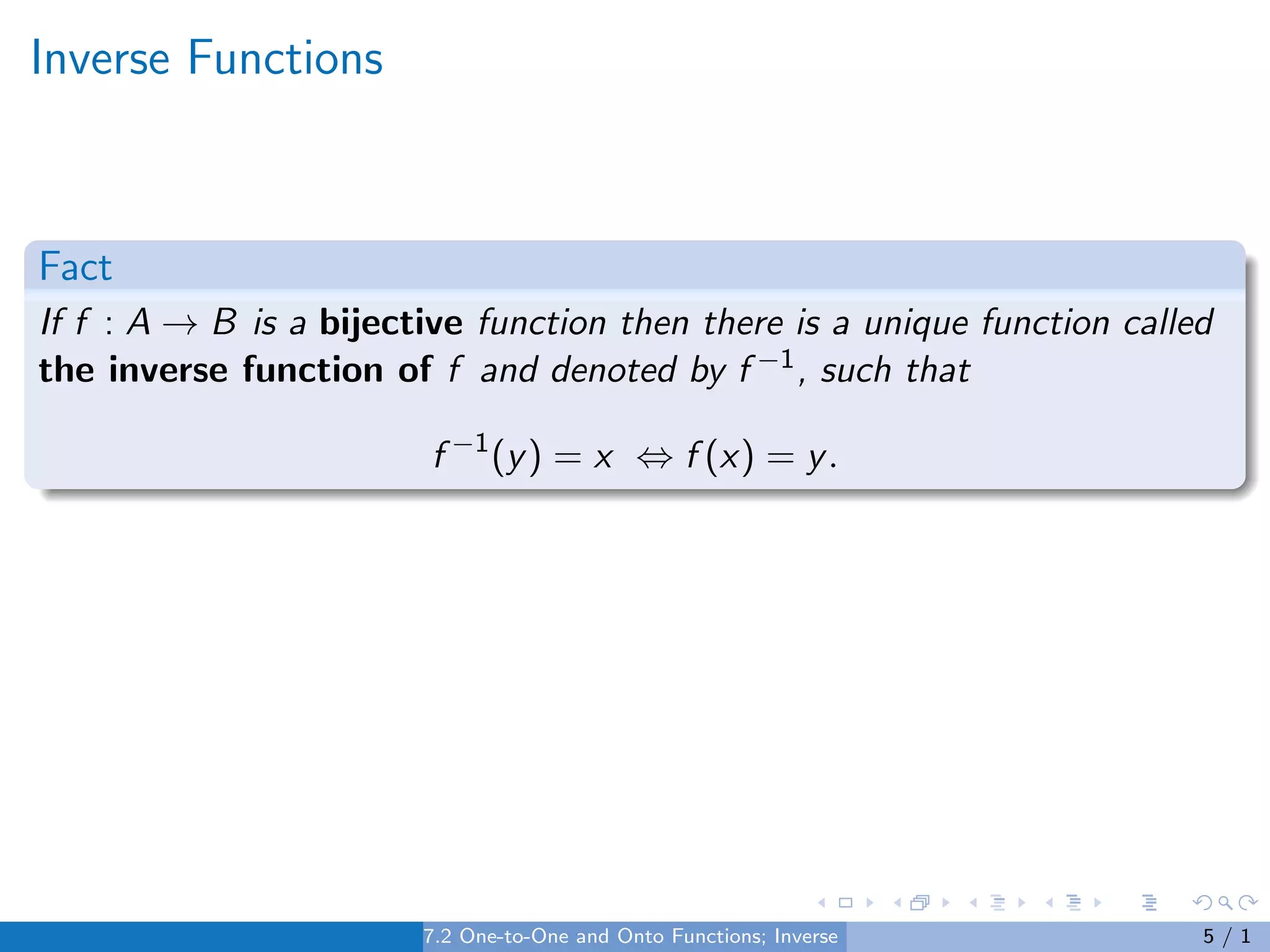
If f : A → B is a bijective function then there is a unique function called
the inverse function of f and denoted by f −1, such that
f −1
(y) = x ⇔ f (x) = y.
7.2 One-to-One and Onto Functions; Inverse Functions 5 / 1
Inverse Functions
Fact
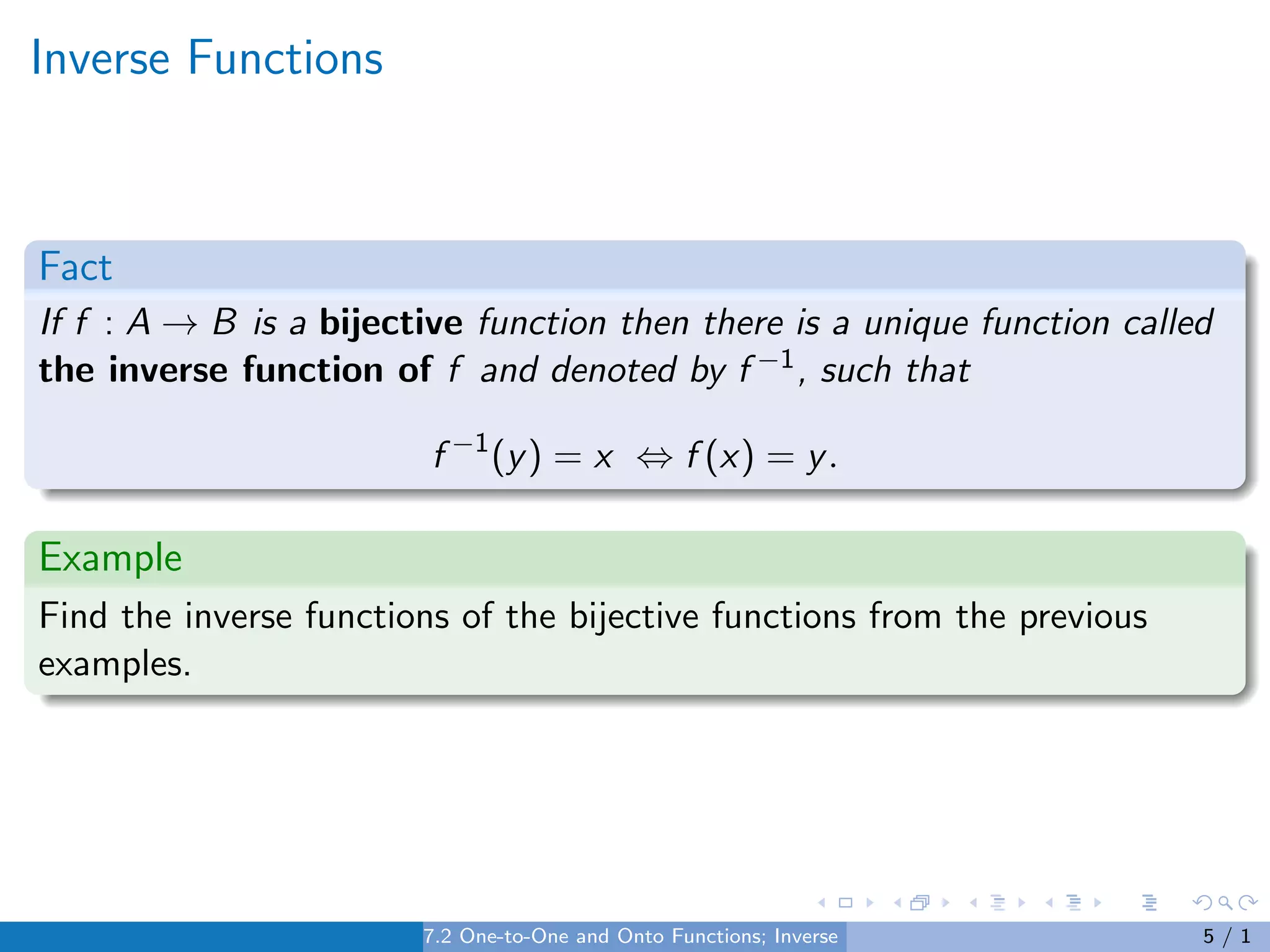
If f : A → B is a bijective function then there is a unique function called
the inverse function of f and denoted by f −1, such that
f −1
(y) = x ⇔ f (x) = y.
Example
Find the inverse functions of the bijective functions from the previous
examples.
7.2 One-to-One and Onto Functions; Inverse Functions 5 / 1
Composition (part of section 7.3)
Definition
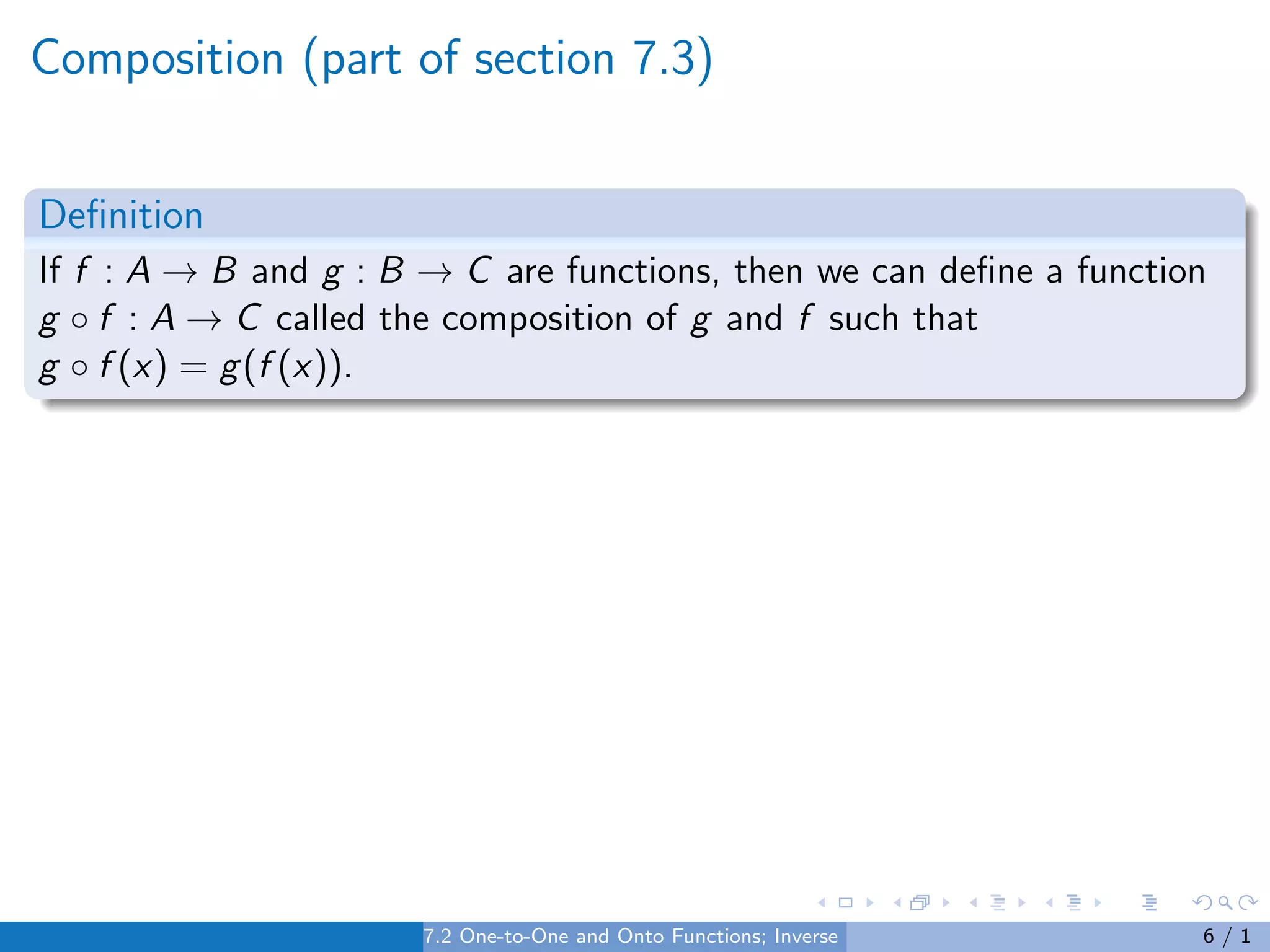
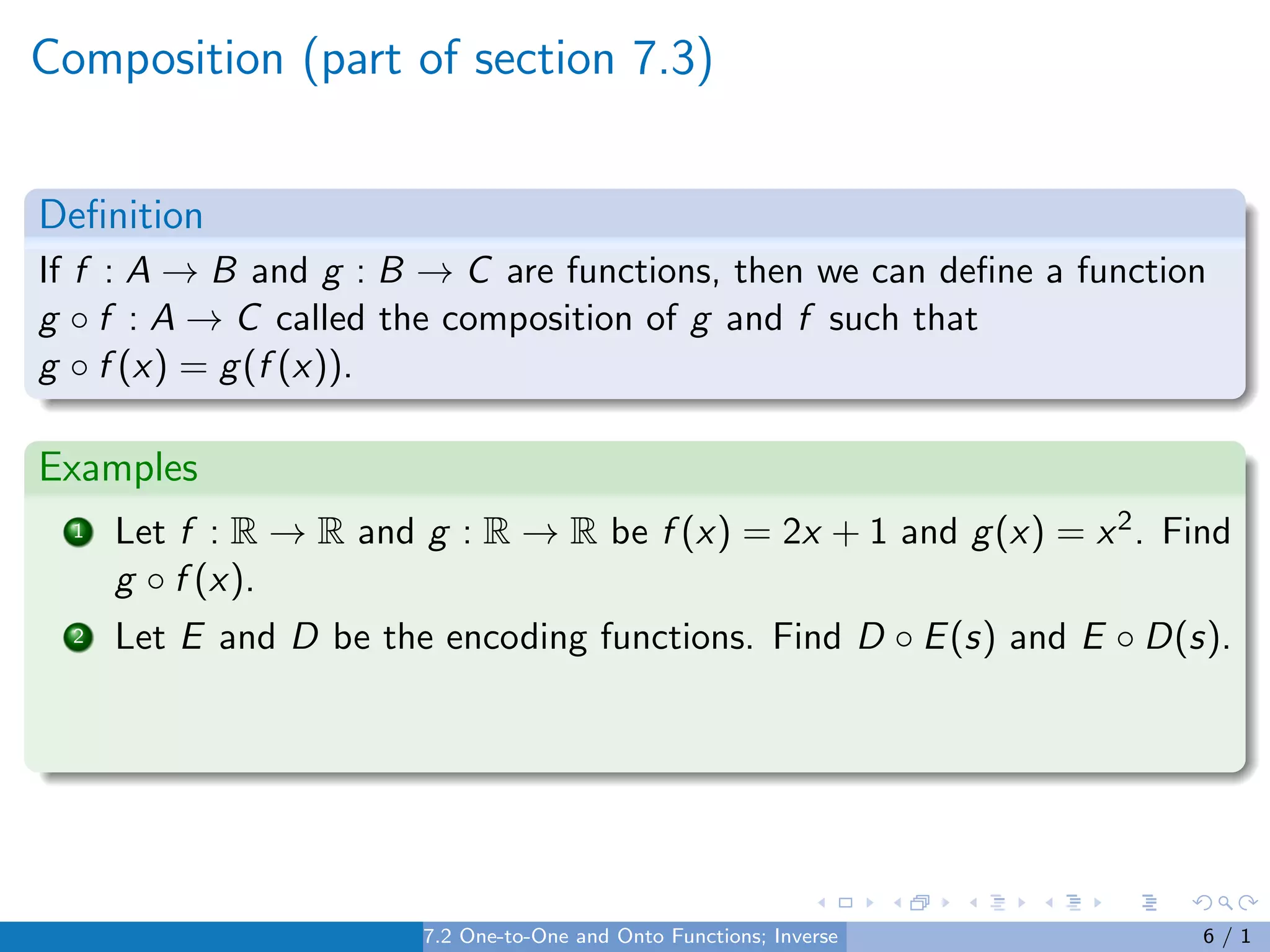
If f : A → B and g : B → C are functions, then we can define a function
g ◦ f : A → C called the composition of g and f such that
g ◦ f (x) = g(f (x)).
7.2 One-to-One and Onto Functions; Inverse Functions 6 / 1
Composition (part of section 7.3)
Definition
If f : A → B and g : B → C are functions, then we can define a function
g ◦ f : A → C called the composition of g and f such that
g ◦ f (x) = g(f (x)).
Examples
1 Let f : R → R and g : R → R be f (x) = 2x + 1 and g(x) = x2. Find
g ◦ f (x).
2 Let E and D be the encoding functions. Find D ◦ E(s) and E ◦ D(s).
7.2 One-to-One and Onto Functions; Inverse Functions 6 / 1
Composition (part of section 7.3)
Definition
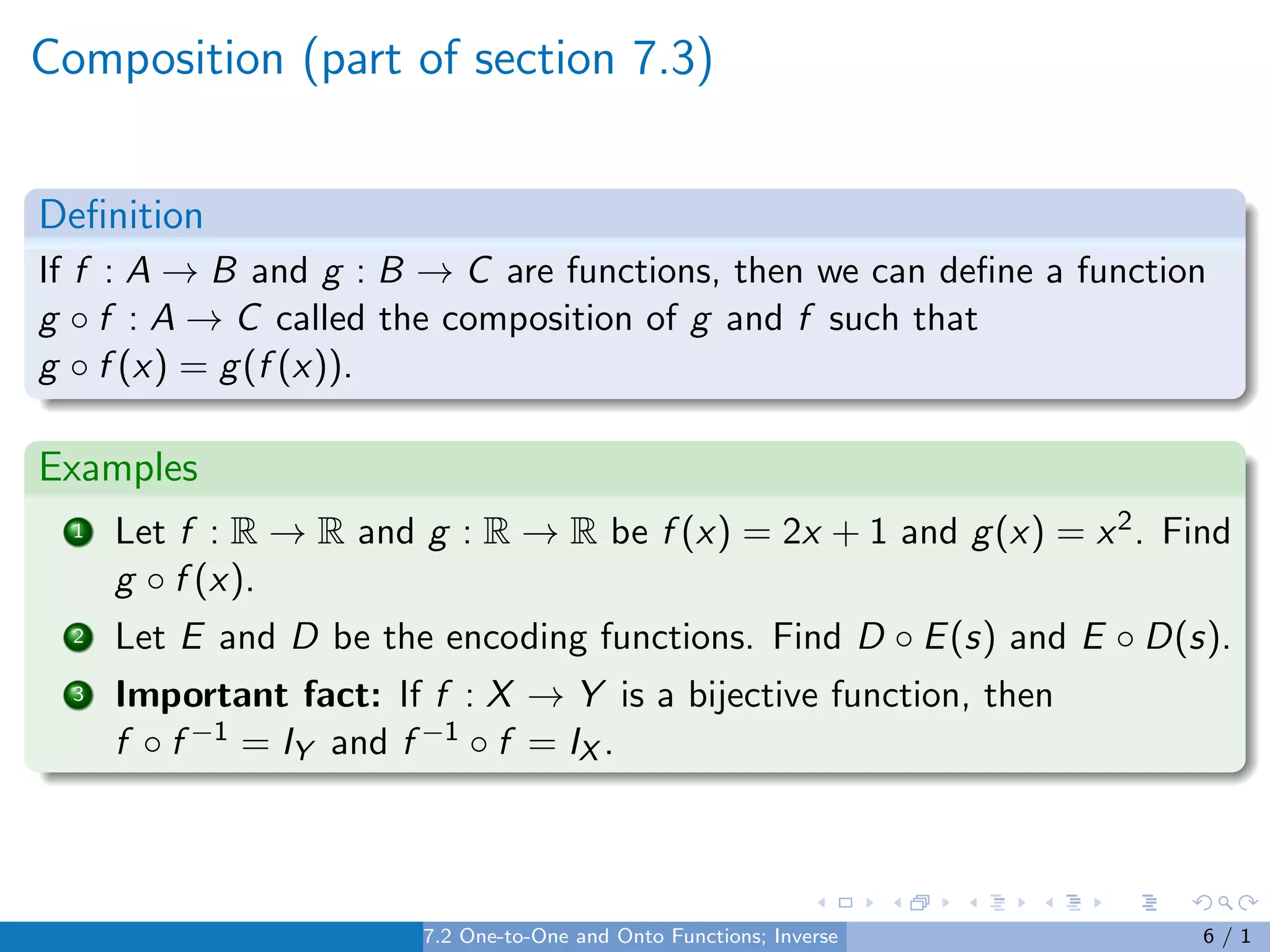
If f : A → B and g : B → C are functions, then we can define a function
g ◦ f : A → C called the composition of g and f such that
g ◦ f (x) = g(f (x)).
Examples
1 Let f : R → R and g : R → R be f (x) = 2x + 1 and g(x) = x2. Find
g ◦ f (x).
2 Let E and D be the encoding functions. Find D ◦ E(s) and E ◦ D(s).
3 Important fact: If f : X → Y is a bijective function, then
f ◦ f −1 = IY and f −1 ◦ f = IX .
7.2 One-to-One and Onto Functions; Inverse Functions 6 / 1

Inverse function

  • 1.
    7.2 One-to-One andOnto Functions; Inverse Functions 7.2 One-to-One and Onto Functions; Inverse Functions 1 / 1
  • 2.
    One-to-one, onto, andbijective functions Definition Let f : A → B be a function. 1 f is called one-to-one (injective) if a 6= a0 implies f (a) 6= f (a0). 7.2 One-to-One and Onto Functions; Inverse Functions 2 / 1
  • 3.
    One-to-one, onto, andbijective functions Definition Let f : A → B be a function. 1 f is called one-to-one (injective) if a 6= a0 implies f (a) 6= f (a0). 2 f is called onto (surjective) if f (A) = B. 7.2 One-to-One and Onto Functions; Inverse Functions 2 / 1
  • 4.
    One-to-one, onto, andbijective functions Definition Let f : A → B be a function. 1 f is called one-to-one (injective) if a 6= a0 implies f (a) 6= f (a0). 2 f is called onto (surjective) if f (A) = B. 3 f is called bijective (textbook notation: one-to-one correspondence) if f is both one-to-one and onto. 7.2 One-to-One and Onto Functions; Inverse Functions 2 / 1
  • 5.
    Examples (finite sets) Examples 1Let Z3 := {0, 1, 2} and define f : Z3 → Z3 via f (x) = 2x + 1 mod 3. Is f one-to-one? Is it onto? Is it bijective? 7.2 One-to-One and Onto Functions; Inverse Functions 3 / 1
  • 6.
    Examples (finite sets) Examples 1Let Z3 := {0, 1, 2} and define f : Z3 → Z3 via f (x) = 2x + 1 mod 3. Is f one-to-one? Is it onto? Is it bijective? 2 Encoding and decoding functions: Recall from last time: A is the set of all strings of 0’s and 1’s; T is the set of all strings of 0’s and 1’s that consist of consecutive triples of identical bits. The encoding function E : A → T, E(s) =the string obtained from s by replacing each bit of s by the same bit written three times, and the decoding function D : T → A, D(t) =the string obtained from t by replacing each consecutive triple of three identical bits of t by a single copy of that bit. Are E and D one-to-one, onto, bijective functions? 7.2 One-to-One and Onto Functions; Inverse Functions 3 / 1
  • 7.
    Examples (infinite sets) Examples 1Let f : Z → Z defined via f (n) = 2n. Prove that f is one-to-one but not onto. 7.2 One-to-One and Onto Functions; Inverse Functions 4 / 1
  • 8.
    Examples (infinite sets) Examples 1Let f : Z → Z defined via f (n) = 2n. Prove that f is one-to-one but not onto. 2 Let f : R → R defined via f (x) = 3x − 1. Is f (x) one-to-one, onto, bijective? 7.2 One-to-One and Onto Functions; Inverse Functions 4 / 1
  • 9.
    Examples (infinite sets) Examples 1Let f : Z → Z defined via f (n) = 2n. Prove that f is one-to-one but not onto. 2 Let f : R → R defined via f (x) = 3x − 1. Is f (x) one-to-one, onto, bijective? 3 Let f : R → R defined via f (x) = x2. Is f (x) one-to-one, onto, bijective? How do the answers change if we change the domain of the function from R to R+? 7.2 One-to-One and Onto Functions; Inverse Functions 4 / 1
  • 10.
    Inverse Functions Fact If f: A → B is a bijective function then there is a unique function called the inverse function of f and denoted by f −1, such that f −1 (y) = x ⇔ f (x) = y. 7.2 One-to-One and Onto Functions; Inverse Functions 5 / 1
  • 11.
    Inverse Functions Fact If f: A → B is a bijective function then there is a unique function called the inverse function of f and denoted by f −1, such that f −1 (y) = x ⇔ f (x) = y. Example Find the inverse functions of the bijective functions from the previous examples. 7.2 One-to-One and Onto Functions; Inverse Functions 5 / 1
  • 12.
    Composition (part ofsection 7.3) Definition If f : A → B and g : B → C are functions, then we can define a function g ◦ f : A → C called the composition of g and f such that g ◦ f (x) = g(f (x)). 7.2 One-to-One and Onto Functions; Inverse Functions 6 / 1
  • 13.
    Composition (part ofsection 7.3) Definition If f : A → B and g : B → C are functions, then we can define a function g ◦ f : A → C called the composition of g and f such that g ◦ f (x) = g(f (x)). Examples 1 Let f : R → R and g : R → R be f (x) = 2x + 1 and g(x) = x2. Find g ◦ f (x). 2 Let E and D be the encoding functions. Find D ◦ E(s) and E ◦ D(s). 7.2 One-to-One and Onto Functions; Inverse Functions 6 / 1
  • 14.
    Composition (part ofsection 7.3) Definition If f : A → B and g : B → C are functions, then we can define a function g ◦ f : A → C called the composition of g and f such that g ◦ f (x) = g(f (x)). Examples 1 Let f : R → R and g : R → R be f (x) = 2x + 1 and g(x) = x2. Find g ◦ f (x). 2 Let E and D be the encoding functions. Find D ◦ E(s) and E ◦ D(s). 3 Important fact: If f : X → Y is a bijective function, then f ◦ f −1 = IY and f −1 ◦ f = IX . 7.2 One-to-One and Onto Functions; Inverse Functions 6 / 1