The Cold War
1945 to 1991
Definitions and Causes
●
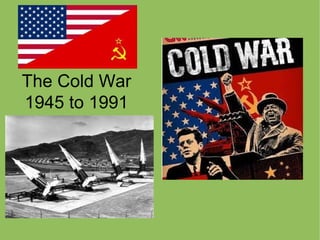
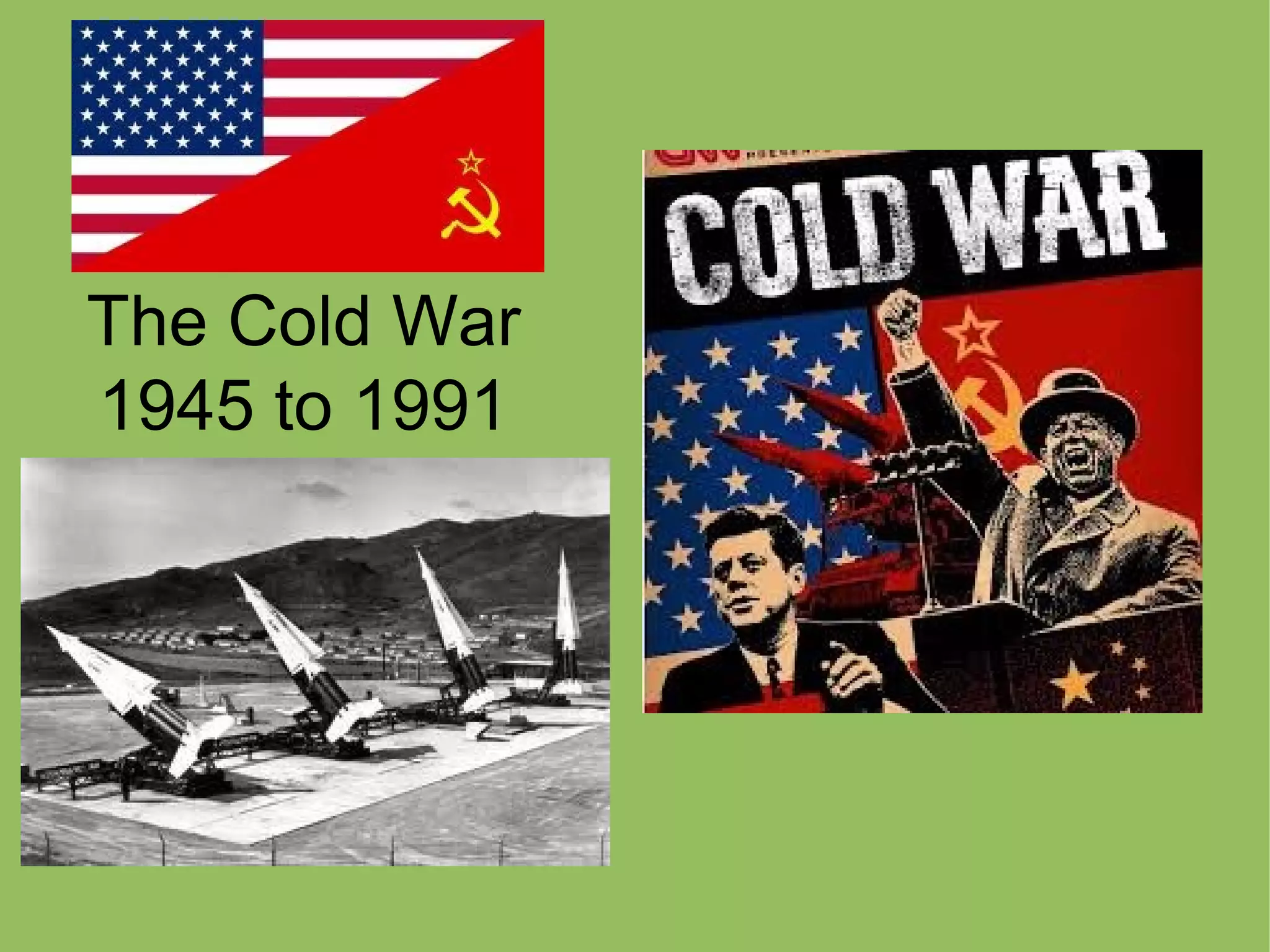
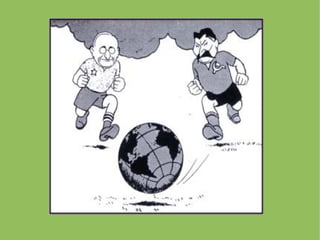
The Cold War was an ideological struggle between Democratic
Capitalism (its champion, the USA) and Authoritarian Communism
(its champion, the USSR) for influence on a global scale
●
As a result, the world became divided into two hostile camps
●
Influence was spread through economic and military aid,
alliances, propaganda, and conquest
●
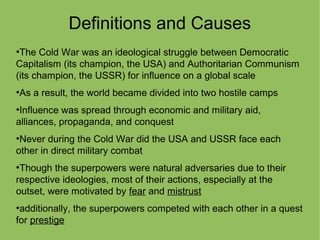
Never during the Cold War did the USA and USSR face each
other in direct military combat
●
Though the superpowers were natural adversaries due to their
respective ideologies, most of their actions, especially at the
outset, were motivated by fear and mistrust
●
additionally, the superpowers competed with each other in a quest
for prestige
Nationalism during the Cold War
●
new characteristics
●
neither the USA nor the USSR have homogenous populations
●
therefore, nationalism during the cold war is based less upon
common bonds of language and culture
●
nationalism during the cold war is about patriotism and loyalty to
the state and its ideology
●
remember – these countries are committed to their respective
ideologies
Imperialism during the Cold War
●
the Superpowers do not create empires in the traditional sense
●
(turning foreign lands into formal colonies)
●
the new way is Influence
●
much effort was spent by both superpowers to attract clients
–convince nations to join their team through propaganda, financial
and military support, and trade agreements
●
Dollar Imperialism – dominate a country economically to the point
that it is able to dominate it politically as well (eg: USA and Latin
America)
Fear
●
USA feared the part of Communism that was aimed at world
revolution (Remember Marx)
●
Comintern and Cominform were Soviet organizations that
confirmed, in the view of the Americans, that they were intent on
world domination
●
It is from this fear that some Americans begin to view communism
like a disease
●
When Stalin installed communist governments in Soviet occupied
central Europe (Satellite States) this fear was confirmed in the
Americans’ view
●
This led to the Domino Theory
●
USSR feared capitalist imperialism and encirclement by capitalist
countries
●
since the days of Napoleon, Russia has always feared attack from
Western Europe
●
When the USA spent $13 billion to enhance the capitalist
economies of Western Europe (the Marshall Plan), this fear was
confirmed in the Soviets’ view
Some Terms You Should Know
●
The Bipolar World
–The division of the world into two opposing camps
–Nearly every country chose one side or the othe
●
●
Spheres of Influence
–The USA and the USSR exerted their influence beyond their own
borders
–Both hoped to influence as much of the world as possible
–Some areas were firmly entrenched in one sphere or the other,
while some areas remained “up for grabs” in the view of the
superpowers
●
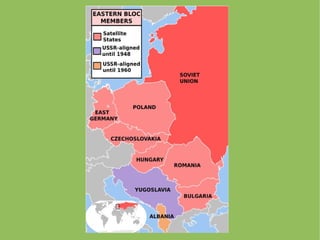
Satellite States / Buffer Zone
–Stalin broke his promise to grant free elections in Soviet occupied
Europe
–He installed communist governments in East Germany, Poland,
Hungary, Czechoslovakia, Bulgaria, and Romania
–He was creating a buffer zone, a line of like-minded countries
that could be a first line of defense in the event of an attack from
the west
–These countries became known as Soviet Satellite States
●
Clients
–Countries that have declared their affiliation with one of the
superpowers
–Examples of clients of the USA: Canada, Turkey, Israel, South Korea,
West Germany
–Examples of clients of the USSR: Hungary, Cuba, North Korea, East
Germany
●
●
Domino Theory
–The belief that if one western ally fell to communism, others would
follow
–This theory motivated the USA to take action in Europe, Korea,
Vietnam, etc.
●
Containment
–Rather than fight the USSR directly, the USA determined they
should contain communism – prevent it from spreading beyond
areas already under Soviet control
–Containment was achieved through economic and technical
assistance and later military force
●
Backyards
–A geographic area identified by one of the superpowers as
untouchable by the other
–An area a superpower would likely go to war over to prevent it
becoming part of the opponent's sphere of influence
–Eg: the Americans did not support Hungary when they tried to
break away from Soviet control because it was in the Soviets'
backyard – interference there would likely lead to war
Cold war definitions and causes

Cold war definitions and causes

  • 1.
  • 2.
    Definitions and Causes ● TheCold War was an ideological struggle between Democratic Capitalism (its champion, the USA) and Authoritarian Communism (its champion, the USSR) for influence on a global scale ● As a result, the world became divided into two hostile camps ● Influence was spread through economic and military aid, alliances, propaganda, and conquest ● Never during the Cold War did the USA and USSR face each other in direct military combat ● Though the superpowers were natural adversaries due to their respective ideologies, most of their actions, especially at the outset, were motivated by fear and mistrust ● additionally, the superpowers competed with each other in a quest for prestige
  • 3.
    Nationalism during theCold War ● new characteristics ● neither the USA nor the USSR have homogenous populations ● therefore, nationalism during the cold war is based less upon common bonds of language and culture ● nationalism during the cold war is about patriotism and loyalty to the state and its ideology ● remember – these countries are committed to their respective ideologies
  • 4.
    Imperialism during theCold War ● the Superpowers do not create empires in the traditional sense ● (turning foreign lands into formal colonies) ● the new way is Influence ● much effort was spent by both superpowers to attract clients –convince nations to join their team through propaganda, financial and military support, and trade agreements ● Dollar Imperialism – dominate a country economically to the point that it is able to dominate it politically as well (eg: USA and Latin America)
  • 5.
    Fear ● USA feared thepart of Communism that was aimed at world revolution (Remember Marx) ● Comintern and Cominform were Soviet organizations that confirmed, in the view of the Americans, that they were intent on world domination ● It is from this fear that some Americans begin to view communism like a disease ● When Stalin installed communist governments in Soviet occupied central Europe (Satellite States) this fear was confirmed in the Americans’ view ● This led to the Domino Theory
  • 6.
    ● USSR feared capitalistimperialism and encirclement by capitalist countries ● since the days of Napoleon, Russia has always feared attack from Western Europe ● When the USA spent $13 billion to enhance the capitalist economies of Western Europe (the Marshall Plan), this fear was confirmed in the Soviets’ view
  • 7.
    Some Terms YouShould Know ● The Bipolar World –The division of the world into two opposing camps –Nearly every country chose one side or the othe ● ● Spheres of Influence –The USA and the USSR exerted their influence beyond their own borders –Both hoped to influence as much of the world as possible –Some areas were firmly entrenched in one sphere or the other, while some areas remained “up for grabs” in the view of the superpowers
  • 8.
    ● Satellite States /Buffer Zone –Stalin broke his promise to grant free elections in Soviet occupied Europe –He installed communist governments in East Germany, Poland, Hungary, Czechoslovakia, Bulgaria, and Romania –He was creating a buffer zone, a line of like-minded countries that could be a first line of defense in the event of an attack from the west –These countries became known as Soviet Satellite States
  • 9.
    ● Clients –Countries that havedeclared their affiliation with one of the superpowers –Examples of clients of the USA: Canada, Turkey, Israel, South Korea, West Germany –Examples of clients of the USSR: Hungary, Cuba, North Korea, East Germany ● ● Domino Theory –The belief that if one western ally fell to communism, others would follow –This theory motivated the USA to take action in Europe, Korea, Vietnam, etc.
  • 10.
    ● Containment –Rather than fightthe USSR directly, the USA determined they should contain communism – prevent it from spreading beyond areas already under Soviet control –Containment was achieved through economic and technical assistance and later military force ● Backyards –A geographic area identified by one of the superpowers as untouchable by the other –An area a superpower would likely go to war over to prevent it becoming part of the opponent's sphere of influence –Eg: the Americans did not support Hungary when they tried to break away from Soviet control because it was in the Soviets' backyard – interference there would likely lead to war